“I know we will have to pay a heavy price for it and I am ready for it. India is ready for it”
Facing opposition’ criticism on the issue, Prime Minister Narendra Modi on Thursday gave a veiled response to US President Donald Trump’s tariff threats on India, saying that India will “never compromise” on interest of farmers and that their interests was his government’s top priority
“For us, the interest of our farmers is our top priority. India will never compromise on the interests of farmers, fishermen and dairy farmers,” PM Modi said
He was speaking at the MS Swaminathan Centenary International Conference.
Without naming the US or Trump, PM Modi added that he was aware of the cost of taking such a stand. “I know we will have to pay a heavy price for it and I am ready for it. India is ready for it, he zaid
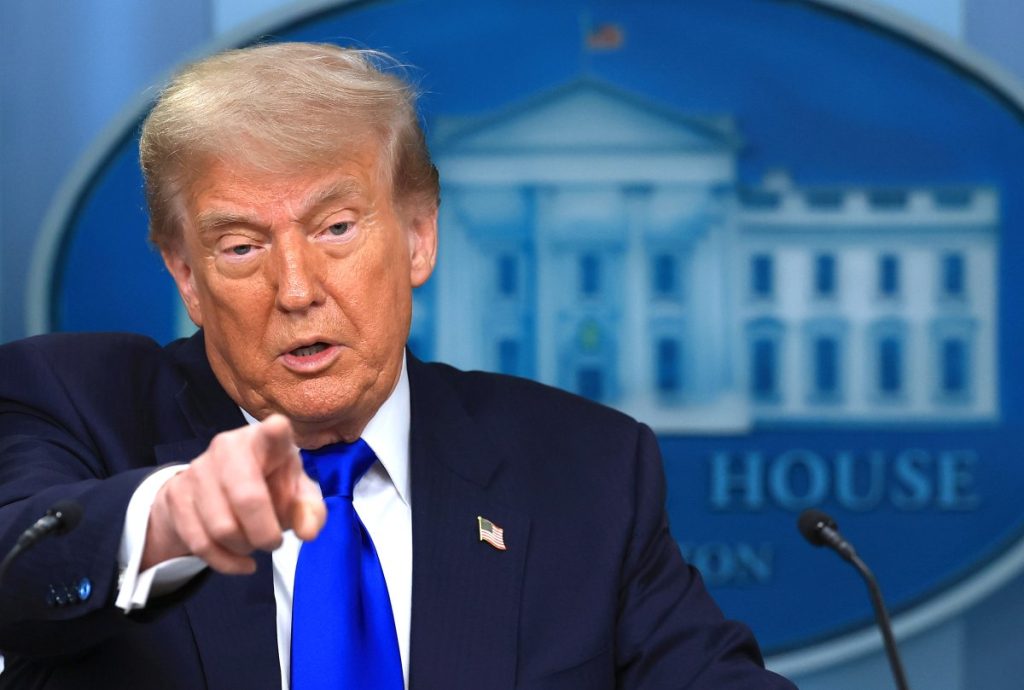
Trump on Wednesday announced additional 25 percent tariff on India for purchases of Russian oil, bringing the total duties on India to 50 percent, among the highest on any country in the world.
India said it will take “all actions necessary to protect its national interests” in response to US President Donald Trump imposing additional 25 percent tariff on Indian imports, taking the total tariffs to 50 percent,
An official statement by the Ministry of External Affairs noted that the “United States has in recent days targeted India’s oil imports from Russia” while India made clear its position on these issues, “including the fact that our imports are based on market factors and done with the overall objective of ensuring the energy security of 1.4 billion people of India.”
“It is therefore extremely unfortunate that the US should choose to impose additional tariffs on India for actions that several other countries are also taking in their own national interest,” it said, reiterating “these actions are unfair, unjustified and unreasonable.”
“India will take all actions necessary to protect its national interests,” it added
So far in 2025, there have been 448 layoffs at tech companies with 131,857 people impacted, that is 602 people per day, according to TrueUp; The answer is reskilling and investing in upskilling to help transition into new roles and adapt to AI-driven changes, as OECD says
File Photo
There is anxiety, there is pain, there are fears, all being expressed over various social media platforms over the Tata Consultancy Services (TCS) internally approving over 12,000 layoffs for FY26. The announcement is expected to impact 12,000 mid-and senior-level employees, which technically constitute “only about 2%” of the global workforce of the TCS. But TCS is a company considered an epitome of job stability, which is why it is a worrying signal for the IT sector and ‘regular’ tech engineers
According to analysts there had been signals with statements regarding “future of work being hybrid of AI and humans” and “reshaping workforce and future-proof operations”
Plus, TCS is a private company, free to take decisions that suit its future plans and growth, they add. Meanwhile, the company has announced wage hikes for 80% of its employees starting September 1, according to agency reports on Wednesday
Tech layoffs are for real
Mass layoffs have been happening in major tech firms like Microsoft, IBM, and Google, some directly linked to artificial intelligence-driven restructuring and development
According to Tech Layoff Tracker by Trueup, so far in 2025, there have been 448 layoffs at tech companies with 131,857 people impacted, that is 602 persons per day. In 2024, there were 1,115 layoffs at tech companies and 238,461 people impacted (653 people per day).
Time for reboot
It’s time for reboot for everyone, TCS’ layoffs are a wakeup call for “regular tech engineers or those thinking of pursuing career on traditional lines,” say experts
AI developments are impacting the job market with far-reaching consequences for countries and businesses, maybe what is also now required are new policies that allow these changes while addressing potential risks. This apart, new developments in AI can also lead to a demand for new skills and roles. The World Economic Forum claims that AI will create more jobs than it displaces.
The answer is reskilling and investing in upskilling to help transition into new roles and adapt to AI-driven changes, as Organisation for Economic Co-operation and Development says. OECD is an international organisation that works to promote policies that improve the economic and social well-being of people around the world
India on Wednesday said it will take “all actions necessary to protect its national interests” in response to US President Donald Trump imposing additional 25 percent tariff on Indian imports, taking the total tariffs on its goods to 50 percent.
An official statement by S. Jaishankar headed Ministry of External Affairs noted that the “United States has in recent days targeted India’s oil imports from Russia” while India made clear its position on these issues, “including the fact that our imports are based on market factors and done with the overall objective of ensuring the energy security of 1.4 billion people of India.”
“It is therefore extremely unfortunate that the US should choose to impose additional tariffs on India for actions that several other countries are also taking in their own national interest,” it said, reiterating “these actions are unfair, unjustified and unreasonable.”
“India will take all actions necessary to protect its national interests,” it added
Trump on Wednesday slapped an additional 25 percent tariff on Indian imports, taking the total tariffs imposed on Indian goods to 50 percent. He signed the executive order imposing the additional tariff barely hours before his initial tariffs on India were set to come into effect on August 7
“I find that the Government of India is currently directly or indirectly importing Russian Federation oil…Accordingly, and as consistent with applicable law, articles of India imported into the customs territory of the United States shall be subject to an additional ad valorem rate of duty of 25 percent,” the order reads.
However, there is a little leeway, a 21-day window before the additional 25 percent strike comes.
“This 25 percent ad valorem duty will be effective for goods entered for consumption, or withdrawn from warehouse for consumption, on or after 12:01 a.m. eastern daylight time 21 days after the date of the order. There are exceptions for goods that were loaded onto a vessel and in transit before this effective date and are entered for consumption or withdrawn from warehouse for consumption before 12:01 a.m. eastern daylight time on September 17, 2025,” the order read.
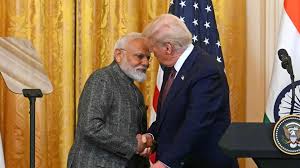
Congress takes potshots at PM Modi’s ‘huglomacy’ says “while his (Trump’s) tariff and penalty actions are simply unacceptable, the fact remains that they also reflect the abysmal failure of Mr. Modi’s personalised and headline-grabbing style of huglomacy.”; The Congress has been taking swipes at PM Modi embracing foreign heads of state during his meetings using the term ‘huglomacy’
File Photo
In a dramatic announcement before US negotiators reach India for further negotiations on trade tariffs later this month, US President Donald Trump on Wednesday slapped an additional 25 percent tariff on Indian imports, taking the total tariffs imposed on Indian goods to 50 percent.
“Today, President Donald J. Trump signed an Executive Order imposing tariffs on India in response to its continued purchase of Russian Federation oil, and establishing a process for the potential imposition of similar tariffs on other countries that directly or indirectly import oil from the Russian Federation,” according to a White House statement
“I find that the Government of India is currently directly or indirectly importing Russian Federation oil…Accordingly, and as consistent with applicable law, articles of India imported into the customs territory of the United States shall be subject to an additional ad valorem rate of duty of 25 percent,” the order reads.
However, there is a little leeway, a 21-day window before the additional 25 percent strike comes.
Basically, what Trump is offering India is a small window for discussion.
“This 25 percent ad valorem duty will be effective for goods entered for consumption, or withdrawn from warehouse for consumption, on or after 12:01 a.m. eastern daylight time 21 days after the date of the order. There are exceptions for goods that were loaded onto a vessel and in transit before this effective date and are entered for consumption or withdrawn from warehouse for consumption before 12:01 a.m. eastern daylight time on September 17, 2025,” the order read.
Notably, after this most of India’s competitors like Vietnam, Bangladesh will be at lower tariffs. Bangladesh has a 20 percent tariff comparable to key apparel-sector competitors like Sri Lanka, Vietnam, Pakistan, and Indonesia which range between 19 percent and 20 percent.
Calling the targeting over the purchase of Russian oil “unjustified and unreasonable”, India says it will take “all necessary measures” to safeguard its “national interests and economic security.
Congress advised a “comprehensive reset” of India’s foreign policy and administration
Congress takes potshots at PM Modi’s ‘huglomacy’
“While his (Trump’s) tariff and penalty actions are simply unacceptable, the fact remains that they also reflect the abysmal failure of Mr. Modi’s personalised and headline-grabbing style of huglomacy,” Congress leader Jairam Ramesh said, asking the Prime Minister to “shed his ego” and “take inspiration from the manner in which she (former PM Indira Gandhi) stood up to the USA.
The Congress has been taking swipes at PM Modi embracing foreign heads of state during his meetings using the term ‘huglomacy’
“India has stood up to the bullying of the US in the 1970s especially under the Prime Ministership of Smt. Indira Gandhi. Instead of defaming, distorting, and denigrating her, Mr. Modi should shed his ego–if indeed that were possible–and take inspiration from the manner in which she stood up to the USA. India’s foreign policy and administration needs a comprehensive reset,” he said
“Mr. Modi has time and again flaunted his supposedly close friendship with President Trump. On Feb 14, 2025, he had shown off his knowledge of algebra by telling President Trump that MAGA + MIGA = MEGA.
“Prime Minister Modi has kept completely quiet even as President Trump has claimed 33 times that he intervened to bring about a ceasefire between India and Pakistan.
“Now President Trump, while still claiming to be a friend of Mr. Modi, has hit India hard and unjustly. While his tariff and penalty actions are simply unacceptable, the fact remains that they also reflect the abysmal failure of Mr. Modi’s personalised and headline-grabbing style of huglomacy.”
It is a story of India’s missing climate plan, greed, poor planning and corruption; As it is, the fragile Himalayas are sensitive to disturbances, and human activities are only adding to the stress making it exceptionally vulnerable to ecological damage and natural disasters.
Source: social media
Landslides continue to block arterial roads leading up to Dharali where several people are said to be trapped after homes and cars were swept away by the raging waters on Tuesday following a devastating cloudburst wreaking havoc across hillsides, resulting in significant loss of life and property. As many as 11 Army personnel are reported to be missing from the nearby camp in Harsil and according to some, many tourists and locals also.
Experts say cloudbursts have increased in recent years in the Himalayas due to climate change, and also unplanned development in mountains. Rising temperatures have accelerated glacier retreat in India’s hill states Himachal Pradesh and Uttarakhand where major glaciers like Gangotri and Yamunotri are located and where local economies rely on tourism and forestry.
More than 6,000 people died and 4,500 villages were affected when a similar cloudburst devastated Uttarakhand in 2013.
Himachal Pradesh reported multiple flash floods, cloud bursts and landslides, leaving many dead and devastated in June-end and beginning of July.
Fact is seasons can no longer be boxed in neat month-wise time zones, heavy rains/cloud bursts can happen anywhere, anytime. Every year the frequency of these “natural calamities” is increasing and are only expected to increase more rapidly in future.
‘Young’ Himalayas
Himalayas—one of the most ecologically fragile regions in the world—are also the youngest major mountain range on Earth in geological terms.
Formed around 50 million years ago due to the collision of the Indian and Eurasian tectonic plates, the collision continues to push the Himalayas upwards. The rich biodiversity of the region, including rare flora and fauna, is under threat due to the shifting weather
Why are Himalayas so fragile
Basically, it is the story of India’s missing climate plan, greed, poor planning and corruption.
Himalayas are considered ecologically fragile because of the ongoing geological activity and their “young age” which contributes to their vulnerability to natural disasters and environmental changes.
Basically, Himalayas are young fold mountains that are still rising, making them prone to earthquakes, landslides, and avalanches. Located in a seismically active zone, the risk of earthquake-related hazards is always there.
What is further adding to the fragility is climate change causing glacial melting, altered rainfall patterns, and increased frequency of extreme weather events. Adding to it is the nonchalant way humans have been treating the precious natural resources. Deforestation, unplanned construction, unsustainable tourism practices are destabilising slopes, leading to soil erosion and landslides.
As it is, the fragile Himalayas are sensitive to disturbances, and human activities and lack of total planning are only adding to the stress making it exceptionally vulnerable to ecological damage and natural disasters.
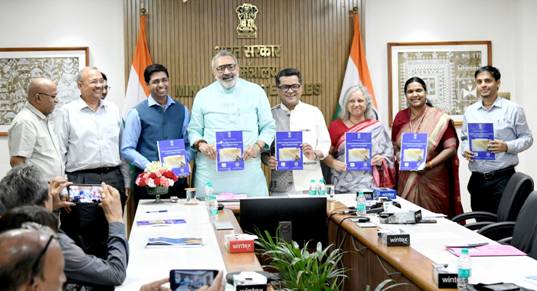
Union Minister of Textiles Giriraj Singh on Wednesday launched the book titled “Carbon Footprint Assessment in the Indian Handloom Sector: Methods and Case Studies”, jointly prepared by Office of Development Commissioner for Handlooms, Ministry of Textiles and Department of Textiles & Fibre Engineering, IIT, Delhi.
This landmark document strengthens the government’s commitment to environmental conscious handloom production and sustainable development by providing clear, practical methodologies to measure and reduce the carbon footprint of the handloom industry—a vital socio-economic sector and a symbol of India’s rich cultural heritage.
The book comprises simple steps to measure carbon footprint through real-world case studies across India, including products viz. cotton bedsheets, floor mats, Ikat sarees, Banarasi sarees, and other iconic handloom items.
It also includes methodologies for low-cost data collection and emission measurement methods designed specifically for the handloom sector to enhance eco-friendly production.
The work involved extensive consultations and close collaboration with experts from the Indian Institute of Handloom Technology, Weavers Service Centres, grassroots weaver groups, Greenstitch Private Limited, and key government agencies.
The book integrates global climate reporting standards while adapting them to India’s unique operational context, thereby empowering the sector to achieve sustainable growth.
The Handloom Sector is an integral part of the rural and semi- rural livelihood engaging over 35 lakh persons. The sector engages over 25 lakh female weavers and allied workers which makes it an important source of economic empowerment of women.
Handloom weaving constitutes one of the richest and most vibrant aspects of the Indian cultural heritage. The sector has the advantage of being less capital intensive, minimal use of power, being eco-friendly, flexibility of small production, openness to innovations and adaptability to market requirements. The uniqueness and its capability to produce small batch size and being eco-friendly, handloom products are in high demand in the international and the domestic market. This book focuses on the vibrant and intricate Indian handloom and its significant role in sustainable fashion and mindful consumption.
The Lok Sabha on Wednesday informed that there has been a significant increase in the production and export of electronic goods over the years.
The ministry of electronics and information technology was responding to a question from Congress MP Geniben Nagaji Thakor on steps taken by the government to boost domestic electronics manufacturing and reduce dependence on imports.
In a written reply, Minister of State for Electronics And Information Technology, Jitin Prasada stated that value addition for electronics manufacturing in India has increased substantially over the years.
There has been a six to eight times increase in the production and export of electronic goods.
“During 2014-15 the country saw Rs 1.9 lakh crore production which later increased six times to 11.3 lakh crore during 2024-2025. Similarly, the export of electronic goods was at Rs 38 thousand crore which stood at 3.27 lakh crore. Eight times increase during 2024-25,” the minister stated.
According to the document, the country had only two mobile manufacturing units in the country which increased to 300 in 2025, a 150 times increase.
“The export of mobile phones has witnessed a 127 times increase as it reached 2 lakh crore in 2025 from 1500 crore in 2014,” the minister added.
“PLI Scheme has significantly boosted investment, production, exports, and job creation in India’s electronics sector. India has transformed itself from a net importer to a net exporter of mobile phones, and is now the second largest mobile manufacturing country in the world,” he said.
The ministry also informed that over four billion dollars Foreign Direct Investment (FDI) was received in the field of electronics manufacturing in the last five years. Nearly 70 per cent of this FDI is contributed by the beneficiaries of the PLI Scheme, the ministry said.
Further, informing about the Semiconductor programme, the ministry said, the government has approved six major projects under the Semicon India Programme to build and grow the semiconductor and display industry in India.
“These projects involve a total investment of over Rs 1.55 lakh crore. The approved projects are under various phases of implementation and are expected to generate over 27,000 direct jobs,” it added.
How much of this connection is true, barely a couple of people will be able to tell. But in politics, it is also about optics, speculations and connecting dots, and more so in the current regime where no one really knows what is going on. If there is any truth in this particular link, maybe time will tell, or maybe this too is one of the many ‘parikatha’ doing the rounds in power corridors
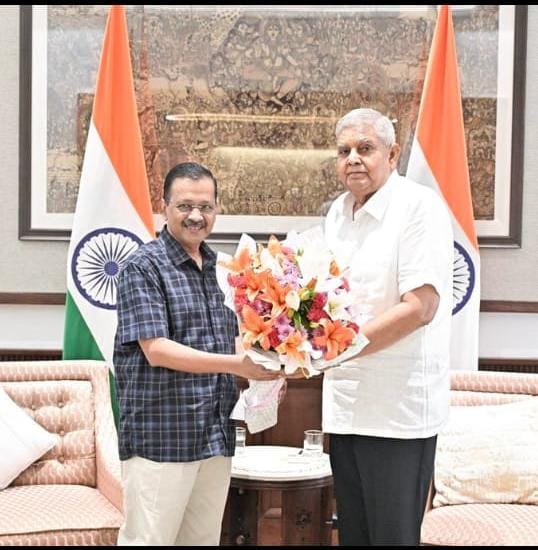
Source: X account of Former Vice President Jagdeep Dhankar
A special court on Monday accepted the Central Bureau of Investigation’s (CBI) closure report in an alleged corruption case against Aam Aadmi Party leader and former minister in Delhi Satyendra Jain and others in 2018. The CBI found that due process was followed and that there was no violation or no personal gain in hiring of external architects by Delhi government for smart schools, hospitals, clinics, and road design, according to reports.
In a post on X in Hindi, former Delhi CM Arvind Kejriwal said that all cases filed against his party leaders are “false” and with time “truth will come out in all these cases.”
“With time, the truth will come out in all these cases. False cases were filed against us, and we were sent to jail. Shouldn’t those who filed these false cases, and those leaders who ordered these false cases, be sent to jail? We were smeared with mud day and night, our families had to endure so much pain what about compensating for all that?” Kejriwals wrote
Now, just a day before his surprise resignation on July 21, former Vice President Jagdeep Dhankar had met Kejriwal and AAP Floor Leader in the Rajya Sabha Sanjay Singh at his residence. Dhankhar posted on X: “Former Chief Minister of the National Capital Territory (NCT) of Delhi, Shri Arvind Kejriwal ji along with Floor Leader of Aam Aadmi Party (AAP) in the Rajya Sabha, Shri Sanjay Singh ji, called on the Hon’ble Vice-President of India, Shri Jagdeep Dhankhar at the Vice-President’s Enclave today”.
Analysts say such meetings are part of official courtesy/protocol, however, Dhankar’s meetings with opposition leaders were being watched closely by those who matter in power.
“There had been murmurs of Dhankhar being critical of Prime Minister Narendra Modi and his government in such meetings. Rumours are that he also told Kejriwal that the opposition needed a ‘mukhar’ (strong) voice in the Rajya Sabha like Rahul Gandhi in the Lok Sabha,” they said.
After he was defeated in Delhi, there was a strong buzz that Kejriwal could go to the Rajya Sabha.
Analysts believe, Dhankar’s conversation with Kejriwal was duly reported to top bosses in the government.
Connecting the dots
Just a couple days before the commencement of the Monsoon session of the Parliament, July 18 to be precise, AAP distanced itself from the INDIA bloc saying that it is not part of the opposition alliance anymore.
Kejriwal met Dhankar on July 20.
Citing health reasons Jagdeep Dhankar resigned on July 21
And on August 5, a special court accepted the CBI’s closure report in the graft case against AAP leader Satyendar Jain.
How much of this connection is true, barely a couple of people will be able to tell. But in politics, it is also about optics, speculations and connecting dots, and more so in the current regime where no one really knows what is going on. If there is any truth in this particular link, maybe time will tell, or maybe this too is one of the many ‘parikatha’ doing the rounds in power corridors
MEA’s statement indicates India’s change in tack to tackle Trump’s threats—US tariffs, sanctions over Russian oil
US President Donald Trump on Tuesday said he “doesn’t know anything” about America importing fertilisers and chemicals from Russia.
He was responding to India’s accusation of “double standards” over Washington’s criticism of New Delhi’s Russian oil trade.
The remarks came during a press conference at the White House when he was asked about India’s statement on the US buying Russian uranium and fertilisers while criticising them for buying Russian energy. “I don’t know anything about it. We will have to check,” he was quoted as saying.
The Ministry of External Affairs (MEA) hit back after Trump threatened to “substantially raise” the tariffs on Indian exports to the US over New Delhi’s purchases of Russian oil. The MEA said the targeting of India is unjustified and unreasonable and questioned Washington and the European Union for their duplicity in their stance. India’s oil imports are guided by national interests and energy security considerations, the MEA said, rejecting “unjustified and unreasonable” pressure from Western powers.
Russia also on Tuesday stated that such threats against Moscow are illegal. Kremlin spokesperson Dmitry Peskov told reporters “trying to force countries to stop trading with Russia is illegal.”
Analysts say MEA’s latest statement indicates a change in tack to face US tariffs, sanctions over Russian oil. Measures that New Delhi may consider are trade agreements with ASEAN and others, restarting oil imports from Iran and Venezuela
Trump claimed that India has been buying “massive amounts” of Russian oil and selling it on the open market for “big profits”.
“Clearly India has done being patient and tolerant, as far as Trump is concerned. India not only exposed the West’s double-standards, but also conveyed its desire to pursue an independent foreign police, basically telling India that it is not not bothered by tariffs and threats,” they add.
Through Operation Sindoor, India dismantled terror infrastructure across Pakistan while averting wider escalation. Yet, a diplomatic tussle followed as US President Trump claimed credit for brokering peace—a narrative India forcefully rejected. A report by Priyanka Tanwer
On May 7, 2025, India launched Operation Sindoor, a calibrated air strike aimed at dismantling nine terror camps believed to be operated by Jaish-e‑Mohammad and Lashkar‑e‑Taiba across Pakistan and Pakistan‑occupied Kashmir. The military action was a direct response to a terror attack in Pahalgam on April 22, in which 26 civilians were killed.
According to Indian defence sources, over 100 terrorists were neutralized—among them senior leaders including Abdul Rauf Azhar—while key air bases like Nur Khan and Rahim Yar Khan were severely degraded.
Pakistan responded with artillery shelling, drone attacks, and cross‑LoC skirmishes that led to civilian and military casualties on both sides. The confrontation intensified over three days before hostilities ceased on May 10, as India and Pakistan reached a bilateral understanding to halt fire.
Importantly, India emphasizes that Pakistan initiated the request to de‑escalate. The Indian government described Operation Sindoor as measured and non‑escalatory, aimed solely at terror infrastructure, not civilian areas.
Shortly after the hostilities ended, US President Donald Trump publicly claimed he had brokered a “full and immediate ceasefire” between India and Pakistan. Trump attributed the breakthrough to US trade leverage, asserting that he had threatened both nations with halted trade deals unless they agreed to stand down.
India swiftly pushed back. The Ministry of External Affairs (MEA) clarified that trade was never mentioned or used as leverage in any discussions between Indian and US officials during Operation Sindoor. Instead, it was the force of Indian arms that prompted Pakistan to solicit a ceasefire. MEA Spokesperson Randhir Jaiswal stated plainly: “It was the force of Indian arms that compelled Pakistan to seek ceasefire” and no mediation by the US occurred.
Meanwhile, External Affairs Minister S. Jaishankar, speaking from the US and subsequently before a parliamentary consultative panel, reiterated that all de‑escalation talks occurred via direct military hotlines, after Pakistan sought dialogue through its Director General of Military Operations contacting his Indian counterpart.
Notably, Jaishankar also underlined that trade negotiations were separate and entirely irrelevant to the ceasefire discussions, dismissing Trump’s claims as a misreading or misstatement of events.
Prime Minister Narendra Modi, via Foreign Secretary Vikram Misri, conveyed the same message in a 35‑minute phone call with Trump on June 18. Modi emphasized that India had not accepted US mediation, and that the stop in hostilities resulted from Pakistan’s request, not any third‑party pressure.
A BJP statement following the call accused the Congress of being “exposed and embarrassed” by their earlier calls questioning Modi’s handling of Operation Sindoor, saying the narrative had been clarified once and for all.
Additionally, Congress MPs and public figures, including Shashi Tharoor, directly echoed Jaishankar’s position. Tharoor told media, “Trump wasn’t directly involved… we were only reacting to terrorism. When Pakistan stopped we stopped,” and asserted “mediation implies equivalence between two parties… but there can be no mediation… between terrorists and their victims”
However, Trump’s repeated claims sparked a storm in Indian political circles. Congress leaders condemned his statements as “insulting to the nation”, arguing they undermined India’s sovereign decision‑making and risked reshuffling the global perception of its independent foreign policy.
Mallikarjun Kharge demanded a government explanation in Parliament, while BJP leaders pledged to discuss the matter during the monsoon session, underscoring its national significance.
Despite the friction over ceasefire claims, India’s India–US strategic relationship remains multifaceted. A multi-party Indian delegation led by MP Shashi Tharoor was dispatched to the United States post‑Operation Sindoor to brief lawmakers and think tanks. That visit reiterated India’s precision and restraint in the strikes and sought international solidarity against terrorism, referencing parallels with 9/11 and the global fight against terror networks.
India is also accelerating its push to expand defence exports under its “Make in India” initiative. Operation Sindoor’s use of platforms like BrahMos missiles and loitering drones boosted interest in Indian defence hardware. Exports to nations including the Philippines, Armenia, and Vietnam are underway, with a goal to more than double revenue by 2029. Indian defence firms are capitalizing on the operation’s perceived success to assert India’s defence-industrial maturity.
Meanwhile, international commentary—such as from US warfare expert John Spencer and the Royal Thai Air Force—has praised the operation as a showcase of India’s military sophistication and deterrent potential. At the same time, it exposed gaps in Pakistani readiness and the limitations of its Chinese-supplied systems.
The clash over who “brokered” the ceasefire has exposed a deeper fault line in India–US relations, narrative control and respect for sovereignty. India’s consistent stance—that ceasefire was reached bilaterally, and trade was not involved—is tied to a foundational policy, no third‑party mediation on Kashmir or cross‑border terrorism. Trump’s continued assertions challenge this core tenet, and India has responded firmly to preserve its diplomatic identity.
From India’s perspective, this episode demonstrates that while strategic alignment with the United States continues, especially in counterterrorism cooperation, energy, and trade, any attempt to recast India as passive or in need of mediation challenges its self‑perception and its standing as a rising power.
On the US side, the insistence on claiming credit reflects Trump’s pattern of framing foreign policy outcomes as personal achievements. This has political value in Washington, especially during the run‑up to elections and positioning for a potential second term. However, for Indian leadership, the priority remains strict delineation between India’s independent decisions and any narratives of dependence on US pressure or trade leverage.
India–US ties remain critical, shaped by shared interests in Indo-Pacific stability, defence collaboration, and economic growth. Operation Sindoor and the aftermath illustrate both the strength and fragility of that partnership. The Modi government has not sought to escalate the matter dangerously; instead it has clarified narrative boundaries and insisted on mutual respect without aggression. At the same time, there are opportunities for deeper collaboration in defence technology, counterterrorism intelligence, and global forums.
Trump’s framing, while diplomatically disputed, may still open avenues for engagement: Indian agencies are continuing outreach in the US to highlight their strategic rationale and sovereignty claims. India’s messaging campaign, including Shashi Tharoor’s visit, has sought to reinforce the idea of India as a capable, mature global actor—less dependent, more assertive.
It also remains that domestic politics in India will keep the debate alive. Parliamentary sessions, opposition criticism, and political branding will continue to draw attention to how India’s leadership responded, both militarily and diplomatically.
Operation Sindoor represents a pivotal moment in India–Pakistan dynamics and has tested India’s diplomatic posture towards a global power. Trump’s sustained claim to have brokered peace, using trade threats as leverage, collides head‑on with India’s official position: it was India’s military deterrence and Pakistan’s outreach that ended the violence—not US mediation.
In rejecting Trump’s narrative, India has reinforced its longstanding policy of bilateral resolution on Kashmir and terrorism. It has leveraged parliamentary addresses, public statements, and diplomatic outreach to preserve its autonomy, while showcasing its military capabilities and signalling confidence to international audiences.
For observers of Indo‑US relations, the episode offers both a cautionary tale and a learning opportunity. Even among close strategic partners, narrative sovereignty matters. India’s insistence on writing its own version of events will likely shape how future interactions unfold—especially when global powers seek visibility or credit in South Asia’s fraught diplomacy.