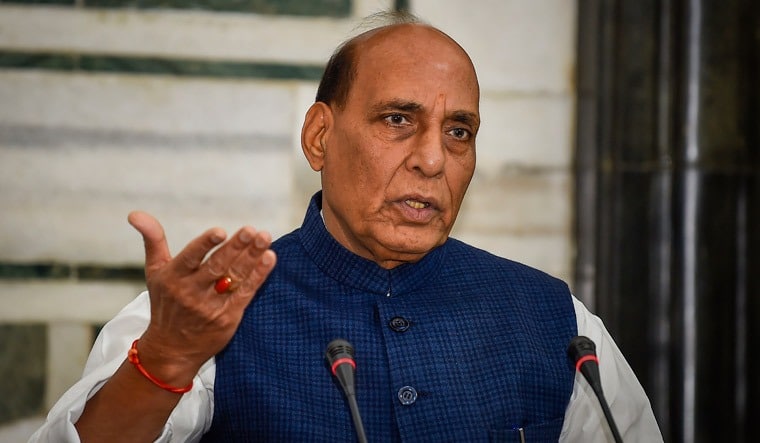
Union Defence Minister Rajnath Singh on Saturday underscored the importance of self-reliance in defence, stating it is no longer an option but a necessity for India’s survival, sovereignty, and progress.
Speaking at the Defence Conclave in New Delhi themed ‘Warfare in the 21st Century’, Singh asserted that self-reliance should not be mistaken for protectionism but understood as a path to strategic autonomy.
Citing the success of Operation Sindoor, Singh hailed the Indian Armed Forces’ precise and indigenous execution as a turning point. “It may appear a short war, but years of preparation and indigenisation made the victory possible,” he said.
The Defence Minister also announced progress on the Sudarshan Chakra Mission, a decade-long initiative to establish full aerial protection using advanced indigenous systems.
Singh highlighted the successful August 23 test of a new integrated air defence weapon system by DRDO, and reaffirmed India’s resolve to build all its warships domestically, pointing to the commissioning of INS Himgiri and INS Udaygiri as proof.
He further revealed that groundwork for a powerful indigenous aero-engine is nearing completion—a sector where India has traditionally struggled. Singh said the question today is no longer if India can build such systems, but how fast they can be deployed.
India’s defence exports have surged from Rs 700 crore in 2014 to nearly Rs 24,000 crore in 2025, with both public and private sectors playing key roles. Over 3,000 items on the Positive Indigenisation Lists are now being produced in India.
He called the defence sector a key pillar of India’s economic growth, with domestic production crossing Rs 1.5 lakh crore, and lauded initiatives like iDEX for involving youth and start-ups in innovation.
Singh reaffirmed India’s peaceful stance internationally but warned that the nation would not compromise on its interests. “Aatmanirbhar Bharat in defence is not a slogan—it’s a roadmap to national strength,” he said.
The Voter Adhikar Yatra has the support of all INDIA bloc constituents, recently DMK supremo and Tamil Nadu Chief Minister MK Stalin was also spotted in Bihar
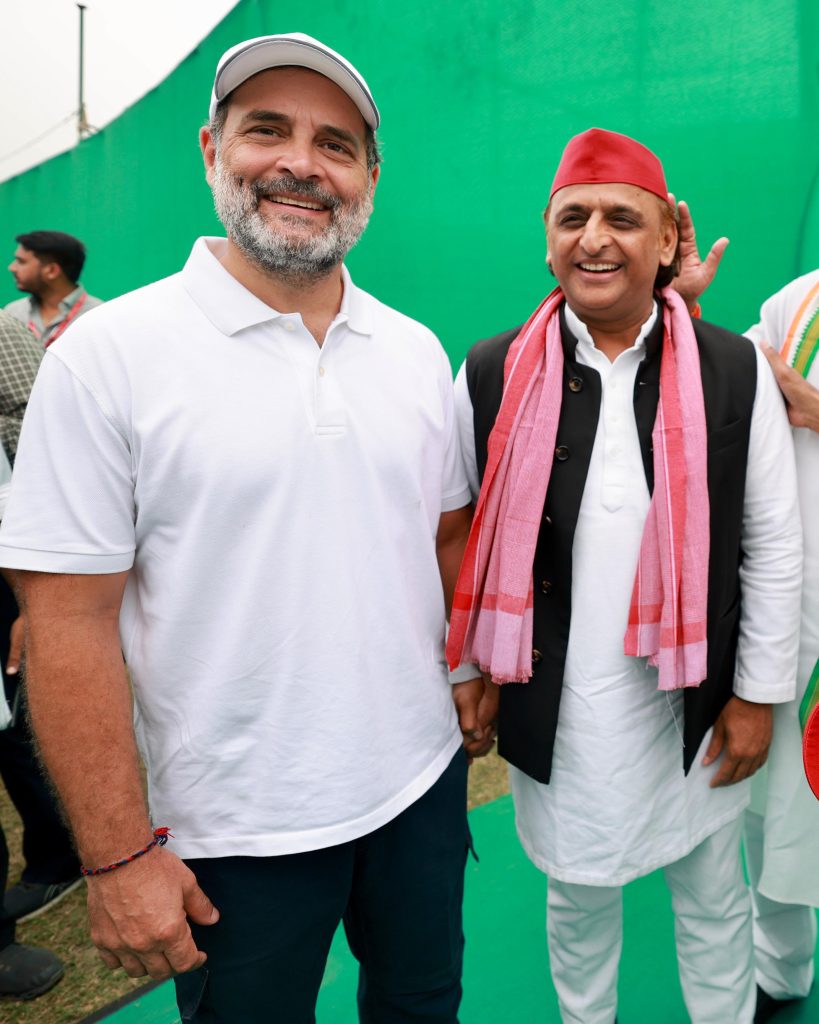
Lending support to Congress’s Rahul Gandhi, Samajwadi Party president Akhilesh Yadav on Saturday joined his Voter Adhikar Yatra’ with senior Congress leader KC Venugopal calling him a “steadfast ally” in the fight against the BJP’s alleged attempt to destroy the country’s democracy. “He has been a steadfast ally in our fight against the BJP’s destruction of our democracy, and a strong voice for the poor and underprivileged in UP and across the country,” Venugopal said.
Speaking to media persons, Akhilesh said the people of Awadh have removed BJP, now the people of Magadh will also remove it. “The people of Bihar are going to conduct an SIR on the Election Commission, which has become a ‘Jugaad Commission’ of the BJP… ‘BJP ka Bihar se palayan hone jaa raha hai’” he said
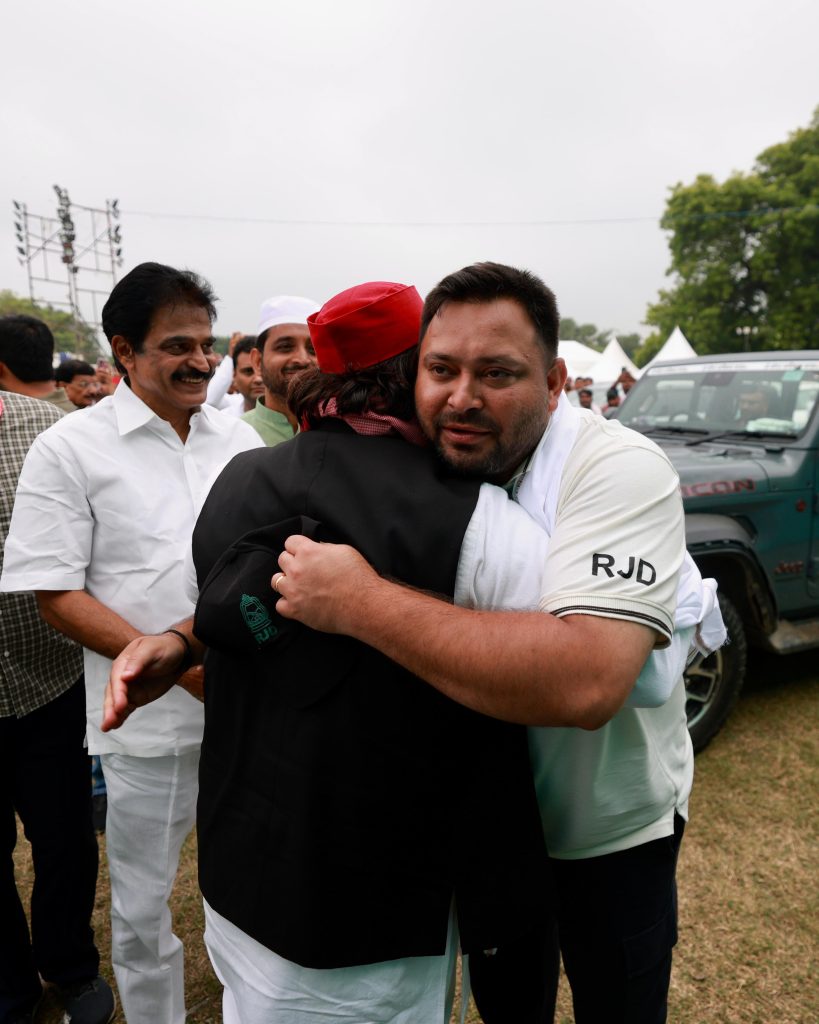
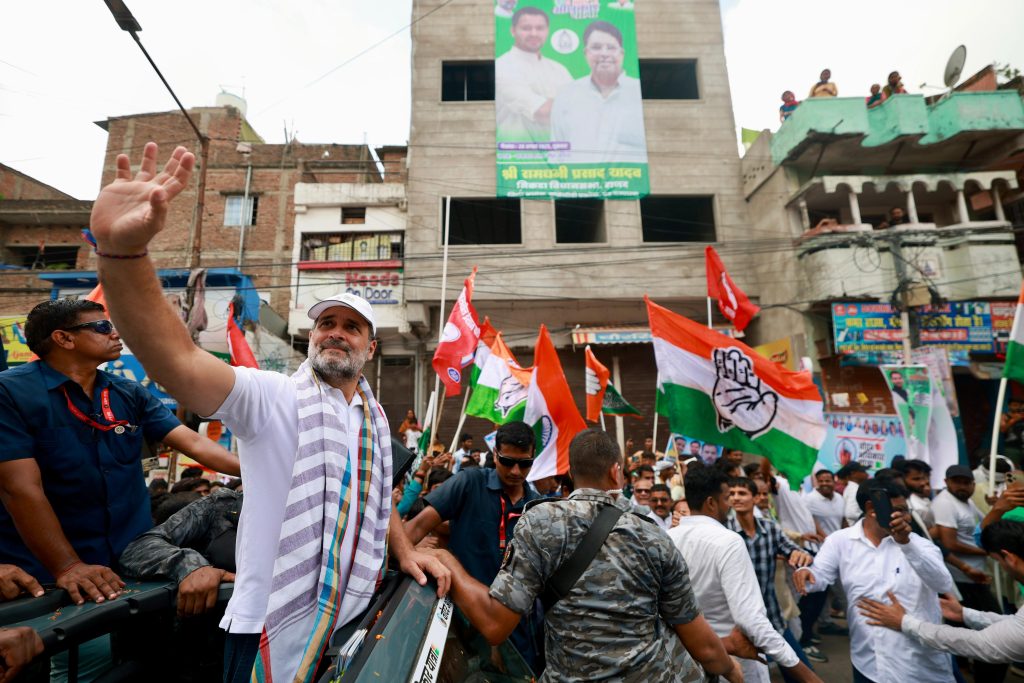
Gandhi launched the yatra from Sasaram in Rohtas district on August 17 to protest against the Election Commission’s Special Intensive Revision (SIR) of electoral rolls in Bihar with RJD leader Tejashwi Yadav as constant support. The yatra has the blessings of all INDIA bloc constituents, recently DMK supremo and Tamil Nadu Chief Minister MK Stalin was also spotted in Bihar.
Voter Adhikar Yatra
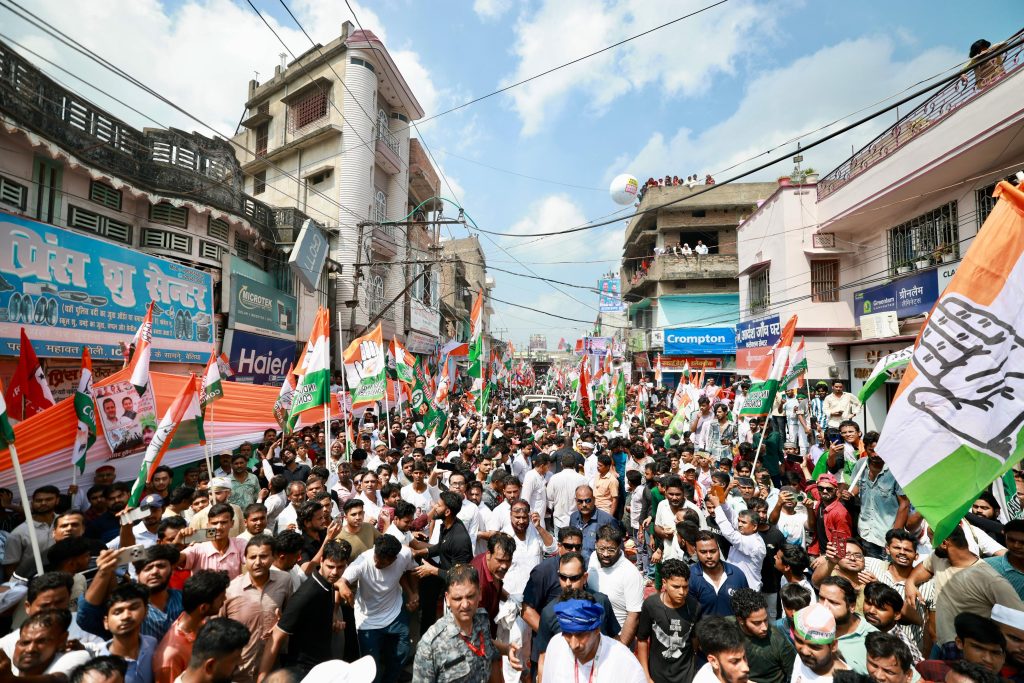
With posters, banners, cut-outs, and hoardings against ‘vote chori’‘(vote theft) along the route, the yatra has covered several districts and has been quite a crowd-puller and Rahul Gandhi and Tejashwi Yadav have drawn large gatherings, stopping by to meet and listen to supporters. At one point, the two also led on motorcycles. Rahul Gandhi also gave a new slogan “vote chor gaddi chhor” (vote thief leave the throne), underlining INDIA bloc’s allegations that genuine voters had been eliminated from draft rolls and thousands of voters with “ghost addresses” added
The main objective, of course, has been to protest against alleged voter disenfranchisement via the SIR process, highlight and oppose the exercise which Congress alleges is being used to disenfranchise key communities—especially Dalits, Adivasis, minorities, and economically weaker groups—by incorrectly deleting or adding voters’ names.
The yatra also mobilised allies across the INDIA/Mahagathbandhan alliance and provoked substantial reactions, including social media, whether it translates into votes is the big question.
Gandhi’s earlier yatras—Bharat Jodo Yatra and Bharat Jodo Nyay Yatra—helped revive Congress’s image, and analysts attribute part of its assembly successes in Karnataka and Telangana to these mobilisations. However, electoral gains were not visible in Madhya Pradesh, Rajasthan, and Chhattisgarh. The BJP has dismissed the yatra as a “circus meant more for spectacle than policy impact”
Change in Bihar politics
While bringing together opposition on one common platform, it also brought together adversaries.
Leader of Opposition in the Assembly Tejashwi Yadav was spotted with Lok Sabha MP from Purnia Pappu Yadav alias Rajesh Ranjan in one frame. Pappu Yadav also described Tejashwi Yadav as ‘Jananayak’.
The optics of two political adversaries embracing and interacting cordially on the campaign stage are being watched closely by the ruling BJP-JD(U) led alliance.
Will it help INDIA Bloc?
Gandhi’s earlier yatras—Bharat Jodo Yatra and Bharat Jodo Nyay Yatra—helped revive Congress’s image, and analysts attribute part of its assembly successes in Karnataka and Telangana to these mobilisations. However, electoral gains were not visible in Madhya Pradesh, Rajasthan, and Chhattisgarh.
The yatra is strategically aimed at improving the party’s and the coalition’s strike rate, therefore it is not just a mass messaging. If it galvanises voters—especially around exclusion fears—it could boost turnout and sentiment in favour of the INDIA bloc. But raising awareness is one thing, winning elections in close, polarised contexts is another, analysts say, that depends on how effectively the campaign translates awareness into voter turnout
India’s economy registered stronger-than-expected growth in the first quarter of the current financial year, expanding by 7.8% between April and June 2025, according to data released by the National Statistical Office (NSO).
This marks a significant improvement from the 6.5% growth seen in the same period last year and is the country’s fastest quarterly expansion in the last five quarters.
The performance beat both market expectations and the Reserve Bank of India’s (RBI) projection of 6.5% for the quarter. The last time India recorded a higher growth rate was in January–March 2024, when GDP rose 8.4%. By comparison, China’s economy expanded 5.2% during April–June this year, reinforcing India’s position as the world’s fastest-growing major economy.
The surge was largely supported by strong showings in services and agriculture. The services sector, which makes up a significant share of the economy, grew 9.3% year-on-year, well above last year’s 6.8%. Agriculture also delivered a healthy boost, expanding 3.7% compared to just 1.5% in the same quarter of 2024–25, aided by favorable monsoon conditions. However, growth in the construction sector eased, slowing to 7.6% from 10.1% a year earlier.
The upbeat figures come at a time when concerns about global trade tensions and tariff-related disruptions, particularly involving the United States, have raised questions about the resilience of emerging economies. Despite these headwinds, domestic factors appear to have shielded India’s growth momentum.
Earlier this month, the RBI forecast overall GDP growth for 2025–26 at 6.5%, with expectations of moderation in the coming quarters—6.7% in Q2, 6.6% in Q3, and 6.3% in Q4. Governor Sanjay Malhotra attributed the positive outlook to supportive conditions, including a strong monsoon, declining inflation, higher capacity utilization, and sustained public investment.
“The combination of accommodative policies, improved financial conditions, and robust government capital expenditure is expected to drive demand further. The services sector, in particular, should continue to remain buoyant alongside steady activity in construction and trade,” Malhotra said.
With growth surpassing forecasts, policymakers now face the dual challenge of sustaining momentum while ensuring price stability in an uncertain global environment.
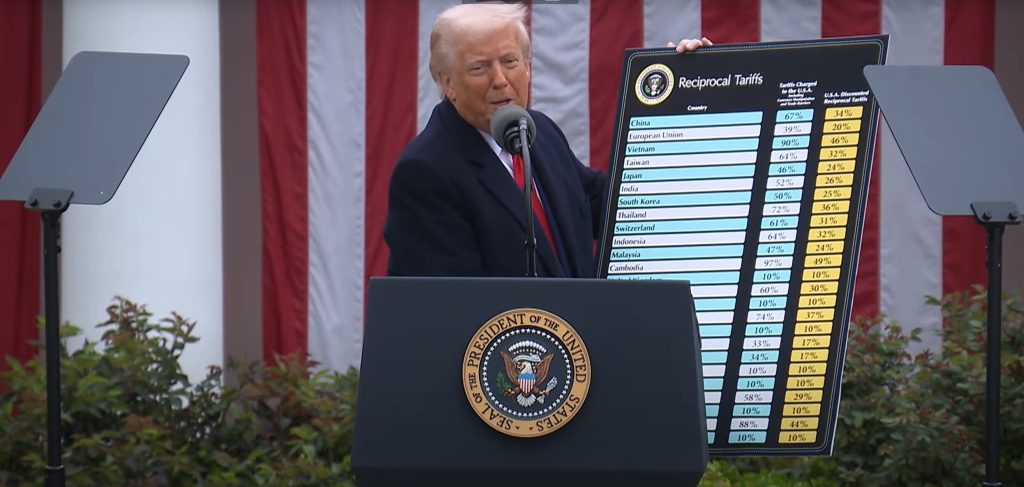
The US Court of Appeals for the Federal Circuit in Washington struck down the bulk of tariffs imposed under Trump’s “reciprocal trade” policy, ruling that the president did not have the authority to unilaterally tax imports under the statute invoked
US President Donald Trump on Friday vowed to take his fight over trade tariffs to the Supreme Court after a federal appeals court ruled that most of his levies were unlawful.
The US Court of Appeals for the Federal Circuit in Washington struck down the bulk of tariffs imposed under Trump’s “reciprocal trade” policy, ruling that the president did not have the authority to unilaterally tax imports under the statute invoked. However, the court permitted the duties to remain in place until October 14, giving the administration time to appeal.
In a strongly worded statement, Trump rejected the ruling and signaled no retreat. “ALL TARIFFS ARE STILL IN EFFECT! Today a highly partisan Appeals Court incorrectly said that our tariffs should be removed, but they know the United States of America will win in the end,” he said. He warned that eliminating the levies would “literally destroy the United States of America” and make the nation “financially weak.”
“If these Tariffs ever went away, it would be a total disaster for the Country…The U.S.A. will no longer tolerate enormous Trade Deficits and unfair Tariffs and Non Tariff Trade Barriers imposed by other Countries, friend or foe, that undermine our Manufacturers, Farmers, and everyone else. If allowed to stand, this Decision would literally destroy the United States of America…For many years, Tariffs were allowed to be used against us by our uncaring and unwise Politicians. Now, with the help of the United States Supreme Court, we will use them to the benefit of our Nation, and Make America Rich, Strong, and Powerful Again! Thank you for your attention to this matter”, he wrote
Trump finds support
His aide Mark Levin wrote that the appellate court majority that ruled against most of the President’s tariffs “has it wrong”.
“Whether you like tariffs or not, the act at issue does, in fact, grant the president broad powers to declare an emergency. Even more, the Constitution, under Article II, grants the president broad powers to make foreign policy. The President’s lawyers are obviously aware of this, which is why the executive orders at issue rely, in part, on serious foreign policy considerations, including, as an example, Mexico, Canada, and China, which the president has determined are not doing enough to prevent the flow of deadly drugs into our country,” he wrote
What court said
As per the court, Trump unlawfully used the International Emergency Economic Powers Act (IEEPA) to justify tariffs on countries including China, Mexico, and Canada. It said that IEEPA, enacted in 1977 to manage national emergencies, does not give the president the power to impose taxes, including tariffs, which it called “a core Congressional power” under the Constitution.
The ruling upholds a lower court decision and specifically strikes down Trump’s “Liberation Day” tariffs and other levies announced earlier this year. However, the court allowed the tariffs to remain in effect until October 14, giving the administration time to appeal to the Supreme Court.
Trump argued that the duties were essential to counter unfair trade practices and to pressure foreign governments into renegotiating trade deals. However, as per the judgement: “The statute bestows significant authority on the President to undertake a number of actions in response to a declared national emergency, but none of these actions explicitly include the power to impose tariffs, duties, or the like, or the power to tax.”
Tariffs imposed under separate laws — including those on steel and aluminum imports — remain unaffected by Friday’s decision. Business groups and Democratic lawmakers welcomed the judgment, arguing that tariffs had increased costs for American consumers and fueled global trade tensions. But Trump and his Republican allies insist the measures strengthened US industries and gave Washington leverage in trade negotiations.
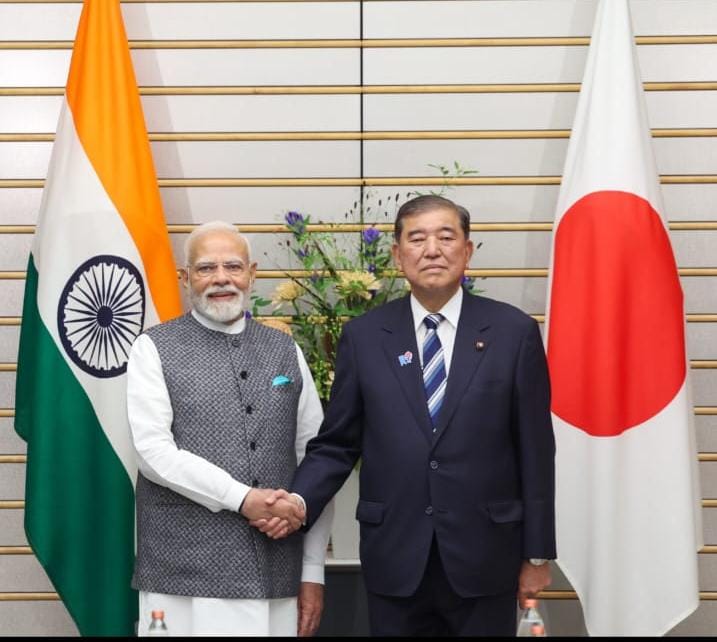
PM Modi’s Japan visit advanced India’s strategic and economic agenda. With tangible outcomes in defence, technology, and industrial cooperation, the partnership is set to play a central role in shaping a secure and prosperous Indo-Pacific
Photo: courtesy PM’s social media
apan on Friday set an investment target of 10 trillion yen in India over a decade and the two sides firmed up a mega roadmap to boost cooperation in several key areas—critical minerals, defence and technology. Coming amid economic turbulence by US President Donald Trump administration’s policies on trade and tariffs, the announcements on expanding India-Japan special strategic and global partnership following summit talks between Prime Minister Narendra Modi and his Japanese counterpart Shigeru Ishiba are significant
“We have set a target of 10 trillion-yen investment in India from Japan in the next 10 years,” PM Modi, flanked by Ishiba, said in his media statement. PM Modi said the India-Japan cooperation is crucial for global peace and stability, and both sides have laid a strong foundation for a “new and golden chapter” in the partnership. “We have formulate a roadmap for the future with a focus on areas such as investment, technology, healthcare, mobility, human-to-human interactions, and partnerships between states and prefectures,” he wrote on X
Tangible outcomes
PM Modi’s recent visit to Japan has boosted India-Japan relations with the two nations deepening both strategic and economic cooperation through a wide-ranging set of agreements and initiatives.
At the heart of the visit was the adoption of a Joint Declaration on Security Cooperation, reaffirming the importance of the India-Japan Special Strategic and Global Partnership, built on shared democratic values and mutual trust.
The declaration emphasises collective action for a free, open and rules-based Indo-Pacific, while laying the groundwork for deeper collaboration in defence, maritime security, advanced technologies, and multilateral forums, according to a PMO statement.
The visit also marked a milestone in economic security cooperation, with both governments committing to build resilient supply chains, safeguard strategic sectors, and promote innovation through public-private partnerships.
The two sides agreed to conduct more complex joint military exercises, enhance logistics interoperability, and collaborate on cybersecurity, counter-terrorism, and tri-service humanitarian operations. India will benefit from access to Japan’s advanced defence logistics and joint research opportunities with agencies like Japan’s ATLA and India’s DRDO, it added Maritime cooperation also received a push with commitments for coast guard coordination, shared maritime awareness, and joint action on piracy and regional disaster resilience — bolstering India’s Indo-Pacific strategy.
Economic Security
One of the key highlights was the India-Japan Dialogue on Economic Security, which included strategic trade and technology talks. Both countries agreed to strengthen cooperation in critical sectors such as semiconductors, critical minerals, pharmaceuticals, clean energy, and ICT.
Notably, Japan’s Renesas Electronics partnered with CG Power to establish a semiconductor assembly facility in Gujarat, while also signing MoUs with IIT Hyderabad and CDAC to support India’s Make in India and Chips to Startup initiatives. Another key partnership involves Tokyo Electron and Tata Electronics, aimed at building a robust semiconductor ecosystem in India.
India and Japan signed a Joint Declaration on Clean Hydrogen and Ammonia, alongside initiatives in biofuels, battery supply chains, and renewable energy. A standout deal includes a bamboo-based bioethanol project in Assam, backed by a ¥60 billion loan from Japan’s JBIC.
In the critical minerals sector, India and Japan advanced cooperation through bilateral agreements and the Quad’s critical minerals initiative. A joint rare earth project in Andhra Pradesh aims to stabilize essential material supply chains.
The two countries declared 2025 the Year of Science, Technology and Innovation Exchanges, with expanded cooperation in AI, quantum technologies, digital infrastructure, and V2X transport systems. Indian students and researchers will also benefit from Japanese-funded fellowships and internships.
An MoU between NTT Data, Neysa Networks, and the Telangana government will establish a massive AI data center cluster in Hyderabad, with Rs10,500 crore in investment.
Union Commerce and Industry Minister Piyush Goyal on Friday said that the central government was committed to ensuring that industry does not face unnecessary stress or difficulties arising from unilateral actions by some countries.
Addressing the gathering at the launch of curtain raiser for Bharat Buildcon 2026 in New Delhi, he urged industry representatives to highlight sectors where alternate markets are required, assuring that the Commerce Ministry is reaching out to partners across the globe to open up new opportunities.
He emphasized that, alongside global outreach, boosting domestic consumption remains a priority. The upcoming GST Council meeting, he noted, is expected to provide measures that will quickly stimulate demand and give a strong boost to domestic manufacturing.
The Minister said the government is focused on supporting industry so that no sector is left behind—whether in accessing international markets or strengthening domestic opportunities.
Underscoring India’s rising global position, Goyal asserted with confidence that this year’s exports will be higher than last year’s, reflecting the growing competitiveness and resilience of Indian industry.
The Minister also drew attention to the acute housing shortage in Australia, where nearly 1 million homes are required. He invited Indian businesses, workers, and experts to seize this opportunity, stating that Australia is open to financial collaboration, technical expertise, and workforce support from India.
“Training and certification opportunities are also being offered so Indian professionals can meet Australian standards. If we miss this opportunity, we will have only ourselves to blame,” he remarked.
He further highlighted India’s expanding network of Free Trade Agreements (FTAs) with developed countries, including Australia, the UAE, Switzerland, Norway, Liechtenstein, Iceland, and the UK, with negotiations ongoing with the European Union and others. These agreements, he said, will further open global opportunities for Indian industries such as construction, steel, and allied sectors.
He also highlighted the vast export potential in steel and iron ore, noting that India could export 15 million tonnes of steel annually, strengthening its export basket with high-quality, competitively priced products.
“Let us build infrastructure that binds India together,” Goyal said, concluding that Bharat Buildcon 2026 will showcase India’s strength, innovation, resilience, and competitiveness as the country marches towards Viksit Bharat 2047.
Apparently, a couple of Congress-associated individuals used abusive language against PM Modi and his late mother Heeraben Modi from a dais set up for Voter Adhikar Rally
BJP leaders doubled down on Congress over the alleged verbal abuse targeting Prime Minister Narendra Modi, demanding apology from Leader of Opposition in the Lok Sabha Rahul Gandhi who is currently undergoing Voter Adhikar Rally in poll-bound Bihar. Political temperatures soared as BJP and Congress clashed on the issue that has led to nationwide outrage.
The issue
During the INDIA bloc’s “Voter Adhikar Yatra” in Darbhanga, a viral video emerged showing derogatory remarks reportedly directed at PM Modi and his mother.
Apparently, a couple of Congress-associated individuals used abusive language against PM Modi and his late mother Heeraben Modi from a dais set up for Voter Adhikar Rally
A man was also arrested for making abusive comments, according to reports.
The BJP accused Rahul Gandhi and RJD’s Tejashwi Yadav of being responsible because the remarks happened at their rally and under their leadership, calling it a failure to maintain dignity. Some Congress leaders later expressed regret but the BJP denounced the incident, calling it “politics at its lowest” and launching a blistering attack on Congress and RJD leaders overseeing the rally.
Senior BJP leaders, including Home Minister Amit Shah and Uttar Pradesh Chief Minister Yogi Adityanath, strongly condemned the language used by some Congress and RJD leaders in Darbhanga, describing it as a violation of democratic dignity and an insult to India’s cultural moorings. Adityanath called the incident “reprehensible,” arguing it hurt the sentiments of all 140 crore Indians
Congress says BJP “baffled”
Rahul Gandhi countered the accusations saying “truth and non-violence willprevail,”
“Untruth and violence cannot stand before” truth and non-violence”. “Beat and break as much as you want to beat and break-we will continue to protect truth over constitution,” he added
Senior Congress leader KC Venugopal issued a statement saying that “Baffled by the soaring popularity of the Voter Adhikar Yatra and the groundswell of public sentiment against them, the BJP has once again unleashed its hooligans to intimidate and scare us.
“The attack on our Bihar PCC Office Sadaqat Ashram in Patna, led by a sitting cabinet minister and other BJP leaders, is an act of cowardice and will not deter us from continuing to expose the massive Vote Chori being carried out in the name of SIR.
“The BJP has sensed its imminent downfall and the growing anger of the people in Bihar, and its desperation knows no limits.
“Attacking a party office is the worst form of political hooliganism and can never be pardoned. Such violence has no place in a democracy, and the BJP’s vandalism of this scale exposes its true character. This must be condemned and protested against by all those who believe in democracy, and we call upon every citizen to rise in united protest against this brazen act,” he said, asking the Bihar Police to “take strict and exemplary action against the perpetrators of this crime, and must arrest the ministers and leaders who led this hooliganism”.
The trade advisor of US President Donald Trump, Peter Navarro on Friday accused India of using American trade dollars to finance Russia’s war in Ukraine.
Backing US’ newly imposed 50 per cent tariffs on Indian imports, Peter said that Indian refiners, working with “silent Russian partners,” were making huge profits by refining Russian oil and selling it in international markets while “Russia pockets hard currency to fund its war on Ukraine.”
Expressing himself on micro blogging site X, he said, “India uses our dollars to buy discounted Russian crude. This isn’t just about India’s unfair trade—it’s about cutting off the financial lifeline India has extended to Putin’s war machine.”
According to Navarro, “Before Russia’s invasion of Ukraine, Russian oil made up less than 1 per cent of India’s imports. Today? Over 30 per cent — more than 1.5 million barrels a day. This surge isn’t driven by domestic demand—it’s driven by Indian profiteers and carries an added price of blood and devastation in Ukraine.”
“India’s Big Oil lobby has turned the largest democracy in the world into a massive refining hub and oil money laundromat for the Kremlin,” he claimed, adding that India now exports more than 1 million barrels a day in refined petroleum, over half of the Russian crude it imports.
He said the Biden administration “largely looked the other way at this madness,” while President Trump was confronting it directly. “A 50 per cent tariff – 25 per cent for unfair trade and 25 per cent for national security — is a direct response. If India, the world’s largest democracy, wants to be treated like a strategic partner of the US, it needs to act like one. The road to peace in Ukraine runs through New Delhi.”
On the criticism, he said, “While the United States pays to arm Ukraine, India bankrolls Russia even as it slaps some of the world’s highest tariffs on US goods, which in turn punishes American exporters. We run a USD 50-billion trade deficit with India—and they’re using our dollars to buy Russian oil. They make a killing and Ukrainians die.”
“It doesn’t stop there. India continues to buy Russian weapons—while demanding that US firms transfer sensitive military tech and build plants in India. That’s strategic freeloading,” he added.
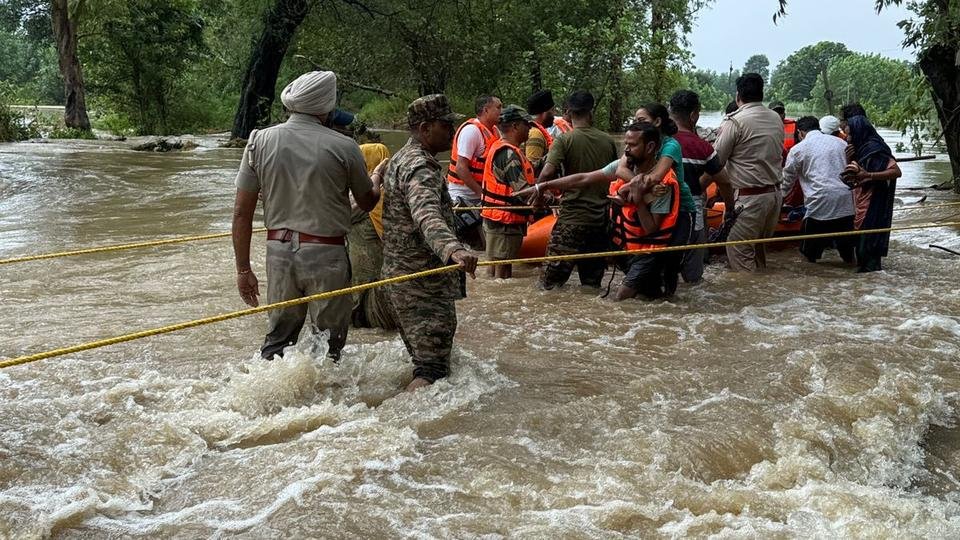
Srinagar: Floodwaters have started to recede across the Jammu division, but rescue and relief operations remain in full swing after five days of unprecedented rain and landslides that have killed dozens and disrupted life across the region.
Teams from the Army, Air Force, NDRF, SDRF, J&K Police and other agencies are working round the clock to assist affected residents. At Ardhkuwari on the Shri Mata Vaishno Devi Shrine route, search operations continued on Thursday at the site of a massive landslide that killed 35 pilgrims earlier this week. No additional bodies have been recovered so far, officials said. Pilgrimage to the shrine will remain suspended for at least three more days.
All schools and colleges in the Jammu division will stay closed until August 30 as a precaution. The Meteorological Department has forecast cloudy weather with occasional rain over the next 24 hours, warning that conditions may remain erratic until September 5.
Meanwhile, the Shri Mata Vaishno Devi Shrine Board denied reports that it ignored weather advisories. In a statement, the board expressed sorrow over the tragedy and said conditions were clear on August 26 morning when the yatra was allowed to proceed. Registrations were suspended as soon as forecasts indicated rain, the board added, noting that safety staff and disaster teams were deployed along the route.
Transport and communications remain badly affected. The Jammu-Srinagar highway is closed for a fourth day due to landslides, leaving hundreds of vehicles stranded, while other key routes such as Kishtwar-Sinthan-Anantnag are shut. Only light vehicles are being allowed on the Mughal Road. Rail traffic is also suspended after flood damage to bridges and tracks, with 40 trains cancelled and several others short-terminated.
Large parts of Jammu, Kathua, Samba, Udhampur, Reasi, Ramban and Doda remain without mobile connectivity and power. Some areas, including parts of Jammu city, have been in blackout for three days. In Kashmir, where the Jhelum River has receded, schools reopened on Friday after a two-day closure.
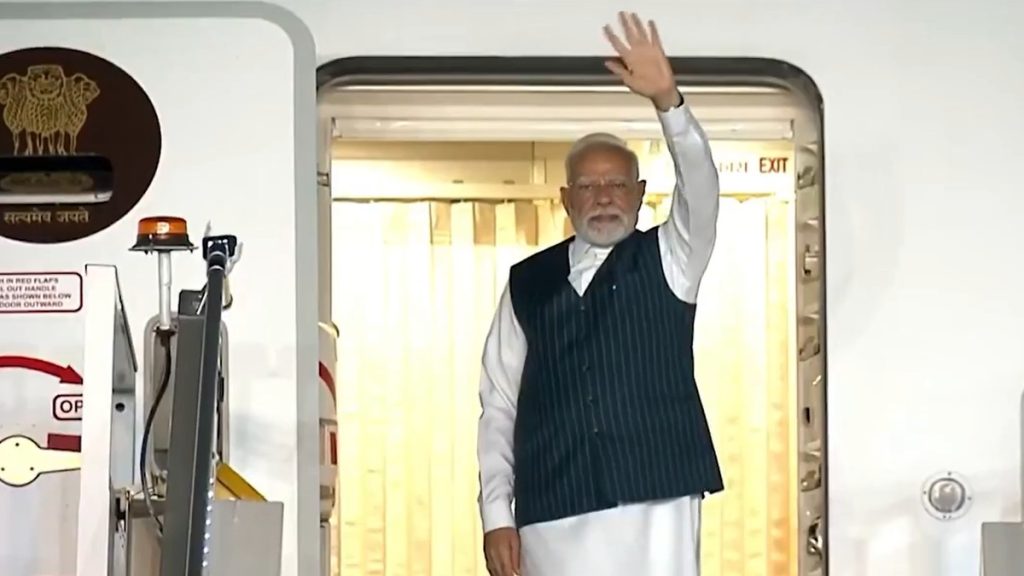
PM visits to Japan, China are being seen as a boost to strategic, economic ties and outreach amid global headwinds; the visits come at a time India is navigating a complex international situation marked by rising US tariffs and regional realignments. The diplomatic push is expected to boost India’s efforts to diversify strategic partnerships, deepen ties in critical technologies and underline India’s role in region’s stability
Prime Minister Narendra Modi today invited Japanese entrepreneurs to ‘make in India’, stressing the country’s political and economic stability, transparency in policy and predictability. “Today, India has political stability, economic stability, transparency in policy, and predictability. Today, India is the fastest-growing major economy in the world. And, very soon, it is going to become the third largest economy in the world,” PM Modi said at the India-Japan Economic Forum in Tokyo
The PM is on a diplomatic tour to Japan and China.
Before leaving he affirmed that the visits will further India’s national interests and priorities and contribute to building regional and global peace, security, and sustainable development.
“At the invitation of Prime Minister Shigeru Ishiba, I am embarking on a two-day visit to Japan for the 15th Annual Summit.
“During my visit, we would focus on shaping the next phase in our Special Strategic and Global Partnership, which has made steady and significant progress over the past eleven years. We would endeavor to give new wings to our collaboration, expand scope and ambition of our economic and investment ties, and advance cooperation in new and emerging technologies, including AI and Semiconductors. The visit will also be an opportunity to strengthen our civilizational bonds and cultural ties that connect our peoples.
“From Japan, I will travel to China to attend the Shanghai Cooperation Organisation Summit in Tianjin, at the invitation of President Xi Jinping. India is an active and constructive member of SCO. During our Presidency, we have introduced new ideas and initiated collaboration in the fields of innovation, health and cultural exchanges. India remains committed to working with the SCO members to address shared challenges and deepen regional cooperation. I also look forward to meeting President Xi Jinping, President Putin and other leaders on the sidelines of the Summit.
“I am confident that my visits to Japan and China would further our national interests and priorities, and contribute to building fruitful cooperation in advancing regional and global peace, security, and sustainable development,” he said in a statement before leaving.
Japan
At his first stop at Japan for the 15th India-Japan Annual Summit, addressing the India-Japan Economic Forum in Tokyo, he talked srong business ties between two nations as being vital element of the friendship.
The PM is in Japan at the invitation of Japanese Prime Minister Shigeru Ishiba. PM Modi’s visit, his eighth as Indian premier, seeks to catalyse a new phase of the “Special Strategic and Global Partnership” that has deepened over the past 11 years.
A key highlight expected during the summit is the announcement of a substantial Japanese investment of about $68 billion over the coming decade. Areas such as defense cooperation, Shinkansen (bullet train) development, and strengthened Quad alliance initiatives are expected to feature prominently in the talks.
China
From Japan, Modi will go to Tianjin to attend the Shanghai Cooperation Organisation (SCO) Summit—the first such visit to China in seven years.
The visit comes in the backdrop of border tensions and current global economic flux amid the ongoing tariff war with US President Donald Trump. PM Modi’s visit aims to ease bilateral strains and discussions include resuming direct flights, easing trade barriers, and accelerating access to vital exports like rare earths and fertilizers are expected
PM Modi will meet Chinese President Xi Jinping and Russian President Vladimir Putin on the sidelines of the summit.