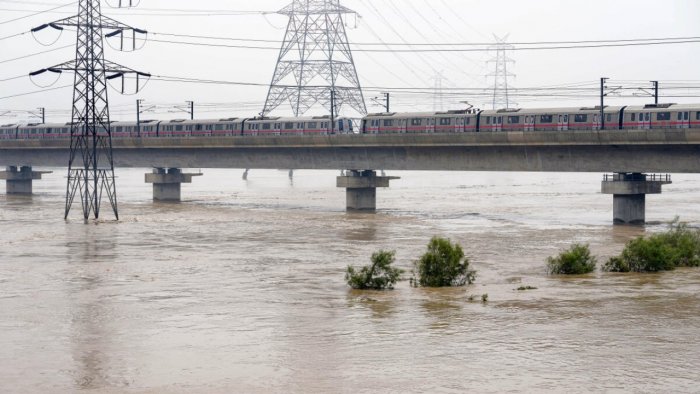
As the water level of the Yamuna River is expected to exceed the danger level after the release of 29,313 cusecs of water from Hathnikund Barrage on Monday, the Delhi government has issued a flood alert in the capital.
Officials were instructed to maintain strict vigilance, along with patrolling in low-lying areas.
The Delhi government order stated, “As the water level of Delhi Old Railway Bridge (ORB) may cross the danger level and is likely to exceed 206.50m, a CWC advisory may be expected soon. So, all the sector officers are hereby advised to keep a strict vigil in their respective areas and to take necessary action at vulnerable points, such as people residing within the river embankments, shall be warned and shifted to safer places.”
“The police and the staff of 1 & FC Department would undertake patrolling along right and left marginal embankments and keep vigil round the clock on the vulnerable points, regulators and pumps as required,” it added.
Meanwhile, IMD, on Sunday, said that India has recorded one of its highest rainfall levels in decades during August 2025, with exceptional showers across several states.
The death toll after the massive earthquake in Afghanistan has gone up to 800, a spokesperson for the Taliban government has stated. The update comes as a stark rise from the earlier reported toll of 600.
Rescue operations are underway to find missing people under the destruction and rubble caused by the strong tremors.
“The number of casualties and injuries is high, but since the area is difficult to access, our teams are still on site,” health ministry spokesperson Sharafat Zaman said in a statement amid the rescue operations.
This was the deadliest earthquake in the region since 2023. Two years ago, a 6.3 earthquake struck the region and was followed by strong aftershocks. As per Taliban, around 4,000 people were killed due to the quake. However, as per data from the United Nations, at least 1,500 people were killed.
Afghanistan is prone to deadly earthquakes, particularly in the Hindu Kush mountain range, where the Indian and Eurasian tectonic plates meet.
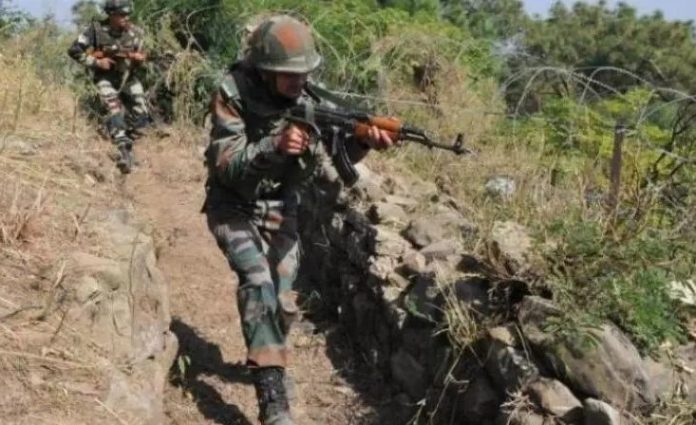
Srinagar: The Indian Army on Monday said it foiled an infiltration attempt along the Line of Control (LoC) in the Mendhar sector of Poonch district in Jammu and Kashmir.
According to officials, troops deployed along the border detected a group of terrorists trying to cross into Indian territory near Dabbi village in Balakote during the early hours.
“They challenged the movement and heavy gunfire was exchanged between the two sides,” an official said.
“The area has been cordoned off, and a massive search operation is underway,” he added.
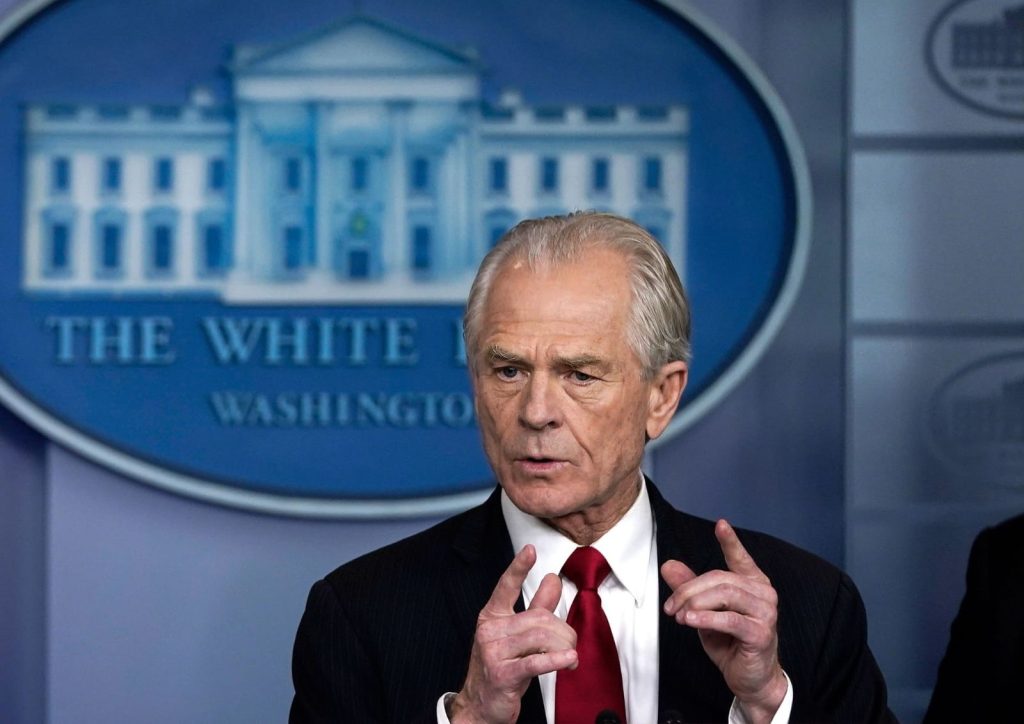
In yet another attack on India, White House Trade Adviser Peter Navarro on Monday said that “Brahmins” are profiteering at the expense of the Indian people and it needs to “stop”.
Referring to India as “nothing but a laundromat for the Kremlin,” Navarro during an interview with Fox News on September 1, 2025, once again accused New Delhi of enabling trade imbalances and geopolitical alliances that run counter to US interests.
He said, “And on top of that, by the way, 25% or 50% is because India is the Maharaja of tariffs. They have the highest tariffs in the world. They won’t let us sell to them, so who gets hurt, workers in America, taxpayers in America… Ukrainians in cities are getting killed by Russian drones.”
“Modi’s a great leader… But I don’t understand why he’s getting into bed with Putin and Xi Jinping…when he’s the leader of the biggest democracy in the world. I would just simply say to the Indian people. Please, understand what’s going on here. You’ve got Brahmins profiteering at the expense of the Indian people. We need that to stop,” he added.
His remarks followed Prime Minister Modi’s bilateral engagement with Chinese President Xi Jinping on August 31, 2025, on the sidelines of the SCO leaders’ summit.
The statement comes as the world is grappling with US President Donald Trump’s tariffs, which the US Appeals Court has itself ruled as “illegal.”
This is not the first time that Navarro has made such remarks to justify Trump’s tariffs on India. Earlier on Friday, Navarro accused India of profiting from Russian oil in scalding remarks.
“India’s Big Oil lobby has turned the largest democracy in the world into a massive refining hub and oil money laundromat for the Kremlin. Indian refiners buy cheap Russian oil, process it, and export fuels to Europe, Africa, and Asia – shielded from sanctions under the pretence of neutrality,” he said in a series of posts on X.
India’s digital revolution, if coupled with reforms in entrepreneurship, capital flows, and formalization, can propel unprecedented growth despite persistent inequalities and can transform the country into a USD 8 trillion economy within the next decade, a report said.
At the Arkam Annual Meet 2025, tech visionary Nandan Nilekani unveiled The Great Unlock: India in 2023 showed bold projections from a USD 3.8 trillion GDP in 2025, India could more than double to USD8 trillion by 2035, assuming compound annual growth rates of 6–8 per cent.
However, the path is fraught with structural headwinds. “Income disparity, lack of formalisation, limited market access, and low productivity remain India’s biggest challenges,” the report warns.
According to the report, only 13 of India’s 788 districts contribute half of the country’s GDP. While Telangana’s per capita GDP sits at USD 3,811, Bihar lags at only USD 652. The top 10 per cent of earners take home nearly 60 percent of total income, while the bottom half scrapes by with a fraction. Migration trends underscore the imbalance: 200 million workers are on the move, leaving high-fertility northern and eastern states for jobs in the more industrialized south and west.
Real estate remains India’s largest asset class, accounting for 50 per cent of household wealth, yet much of it is locked and unmonetizable. Labor productivity tells a similar story—Indian workers generate USD 7 per hour, one-tenth of US output.
To overcome these obstacles, Nilekani and Arkam Ventures propose four levers for growth, including technology, entrepreneurship, capital, and formalisation.
Technology is at the forefront, with India betting big on artificial intelligence trained across 22 languages to bridge access for the “next billion” citizens. From AI-powered platforms for farmers and students to precision manufacturing tools for MSMEs, digital public infrastructure combined with low-cost AI could democratise opportunity.
Entrepreneurship is already reshaping India’s economy. Today, the country boasts 150,000 startups, a number projected to grow to one million by 2035. Significantly, half of these new ventures are emerging outside the top eight metros, addressing needs in smaller cities and rural areas.
Capital is also within reach. Retail participation in equities is surging, with 100 million investors and annual SIP flows topping USD 24 billion. India is poised to become the world’s most preferred IPO market by 2035, as unicorns increasingly list domestically rather than abroad. Credit expansion, tokenisation of land, and the Account Aggregator framework could further ease access to finance.
Finally, formalization is described as India’s most urgent unlock. With only 15 per cent of workers in the formal economy today, expanding access to digital platforms, portable credentials, and simplified compliance could lift millions into stable employment. By 2035, nearly half of India’s workforce is expected to be AI-native, with digital systems bridging the urban-rural divide.
The report concludes with a clear roadmap: accelerate capital flows, deploy AI for mass inclusion, fund entrepreneurs beyond metro hubs, unlock land through tokenization, and turbocharge MSME access to markets and credit. “India has built the infrastructure for take-off,” Nilekani said. “The challenge now is to ensure growth is not only fast but also fair and inclusive.”
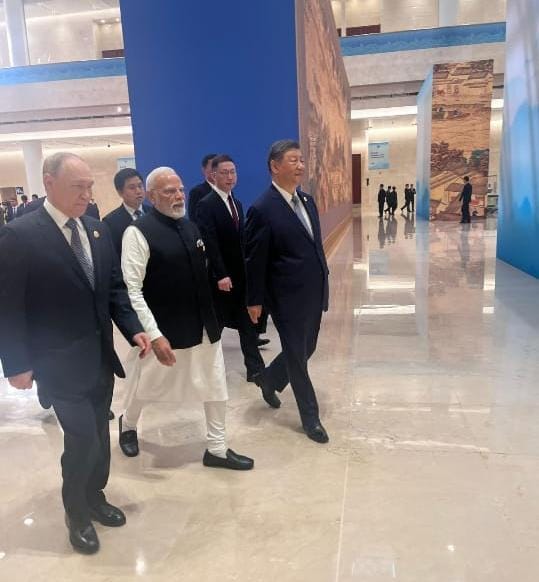
The Modi-Putin meeting and a significant trilateral interaction with Chinese President Xi Jinping, spotlighting the poweful, albeit symbolic, RIC (Russia-India-China) format, underlined the power of masterful and strategic diplomacy with equally powerful optics. “Interactions in Tianjin continue! Exchanging perspectives with President Putin and President Xi during the SCO Summit,” says PM Modi.
Photo: courtesy PM social media
Prime Minister Narendra Modi and Russian President Vladimir Putin met on the sidelines of the Shanghai Cooperation Organization (SCO) Summit in Tianjin—a significant move that reaffirmed the enduring strategic partnership between India and Russia.
Coming at a time when geopolitical alignments are shifting, both leaders underscored the importance of close cooperation in a multipolar world.
The interaction, described as warm and forward-looking by officials, is their first in-person meeting this year, following a series of phone conversations earlier.
PM Modi and Putin reviewed key areas of bilateral cooperation including energy, defence, trade, and regional security. Those in know of developments called the conversation “constructive” and “in tune with the long-standing nature of India-Russia relations.”
Putin in Tianjin
The presence of the Russian President in Tianjin has drawn international attention, underlining his continued engagement with Asian powers amid ongoing global realignments. The Modi-Putin meeting and a significant trilateral interaction with Chinese President Xi Jinping, spotlighting the poweful, albeit symbolic, RIC (Russia-India-China) format,underlined the power of masterful strategic diplomacy with equally powerful optics. “Interactions in Tianjin continue! Exchanging perspectives with President Putin and President Xi during the SCO Summit,” said PM Modi on X.
One of the major takeaways from the meeting was the confirmation that President Putin will travel to India in December 2025 for the annual India-Russia summit. This visit is expected to further deepen bilateral ties and could see the signing of new agreements in areas ranging from energy cooperation to space technology.
PM Modi emphasised India’s commitment to a balanced, independent foreign policy and expressed appreciation for Russia’s consistent support on key strategic issues. Both leaders also discussed regional challenges, including the evolving situation in Central Asia and Afghanistan, and reaffirmed their shared goal of a stable, secure and inclusive regional order.
SCO meetings
The SCO Summit itself provided a timely platform for India to engage with regional partners and project its strategic autonomy. Together, these engagements reflect India’s growing diplomatic influence in the region and its firm commitment to peace, development, and multilateral cooperation.
On Sunday PM Modi engaged in crucial bilateral meetings aimed at strengthening regional cooperation and promoting strategic partnerships.
His meeting with President Xi Jinping of the People’s Republic of China was their first interaction since the Kazan meeting in October 2024
Both leaders welcomed the positive trajectory in India-China relations. Emphasizing that India and China are partners in development—not rivals—they reaffirmed the importance of peace, mutual respect, and sensitivity in shaping a multipolar Asia.
Highlighting the importance of border stability, PM Modi underscored that peace along the Line of Actual Control remains a prerequisite for the furtherance of bilateral ties.
He also held a “productive meeting” with Myanmar’s Senior General Min Aung Hlaing. Reaffirming India’s commitment under the Neighborhood First and Act East policies, the two leaders discussed connectivity projects, security cooperation, and border trade. PM Modi emphasised support for a Myanmar-led peace process and expressed hope for inclusive elections in the near future.
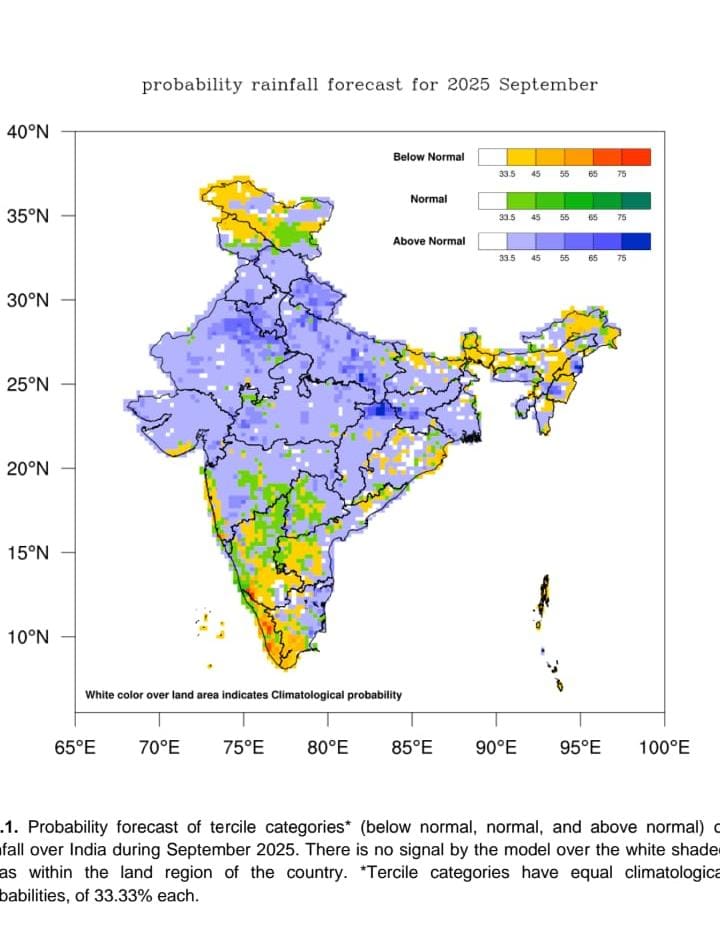
The IMD has projected a wetter-than-usual end to the monsoon season; Monthly rainfall over the country as a whole during September 2025 is most likely to be above normal (>109% of long period average (LPA)). The LPA of rainfall over the country as a whole during September based on data from 1971-2020 is about 167.9 mm.
Image; courtesy IMD
Following an exceptionally wet August, the India Meteorological Department (IMD) has forecast more rainfall for northwest India in September 2025. IMD Director General Mrutyunjay Mohapatra said that many regions, including Uttarakhand, south Haryana, Delhi, and north Rajasthan, may experience heavy rainfall throughout the month.
Monthly average rainfall over the country as a whole in September 2025 is most likely to be above normal (>109% of the Long Period Average (LPA). Geographically, most parts of the country are likely to receive normal to above-normal rainfall. However, some parts of Northeast and East India, many areas of extreme South Peninsular India and some parts of northernmost India, are likely to receive below-normal rainfall, the IMD said
Some areas in the northeast, east, extreme southern peninsular India may see below-normal precipitation.
The meteorological agency has raised concerns over the potential impact of sustained heavy rainfall in hilly regions, particularly Uttarakhand. “Many rivers originate in Uttarakhand. Heavy rainfall in these areas could trigger floods and significantly impact downstream cities and towns,” Mohapatra warned, highlighting the risk of landslides and flash floods, especially in mountainous terrain.
In addition to Uttarakhand, the IMD has indicated the possibility of increased rainfall in the upper catchments of the Mahanadi River in Chhattisgarh, which could pose additional flood risks.
August 2025 proved to be an unusually wet month for the Northwest.
The region recorded 265 mm of rainfall, the highest in August since 2001 and the 13th highest since 1901. Rainfall totals in June and July also surpassed historical averages, with June recording 111 mm (42% above normal) and July 237.4 mm (13% above normal). Cumulatively, the region has received 614.2 mm of rain from June 1 to August 31—about 27% higher than the seasonal average of 484.9 mm.
This excess rainfall has coincided with severe weather events across northern India.
Punjab experienced its worst flooding in decades, displacing lakhs and devastating farmland. Cloudbursts, flash floods, and landslides struck Himachal Pradesh, Uttarakhand, and Jammu and Kashmir, causing widespread damage to infrastructure.
According to the IMD, these extreme events were driven by active monsoon conditions and frequent western disturbances. Meanwhile, South Peninsular India also saw record-breaking rainfall, with 250.6 mm in August—31% above normal—marking its third-highest total since 2001.
As India enters the final phase of the monsoon, the IMD urged for continued vigilance and preparedness, particularly in vulnerable regions.
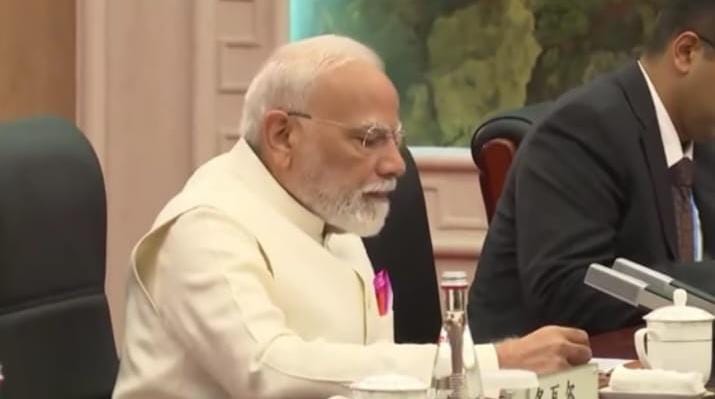
Prime Minister Narendra Modi today said India is committed to advancing the bilateral ties with China based on mutual trust, respect and sensitivity. In his opening remarks at a bilateral meeting with Chinese President Xi Jinping at Tianjin, PM Modi said “we are committed to further strengthening our relations on the basis of mutual trust, respect, and sensitivity.”
In China on his first visit in seven years PM Modi also referred to last year’s disengagement of troops along the boundary with China saying, “Since then, an atmosphere of peace and stability has been maintained.”
He also mentioned how the Special Representatives of both sides have “agreed on border management” and flagged it as a positive development.
“Last year, we had a very meaningful discussion in Kazan, which gave a positive direction to our relations.
“An atmosphere of peace and stability has been established after disengagement at the border. Our Special Representatives have reached an understanding on border management,” he said.
The Prime Minister said direct flights between India and China are being restored and the Kailash Mansarovar Yatra has been resumed,
“The cooperation between us is linked to the interests of 2.8 billion people of our two nations. This will also pave the way for the welfare of all humanity. We are committed to further strengthening our relations on the basis of mutual trust, respect, and sensitivity,”he said
PM Modi is in China primarily to attend the annual summit of the Shanghai Cooperation Organisation on August 31 and September 1.
Coming amid the sudden downturn in India-US ties following the enhanced tariffs, the visit is being closely watched across the world.
National Security Adviser Ajit Doval and Chinese Foreign Minister Wang Yi were present at the meeting. External Affairs Minister S Jaishankar is not in China for the SCO Leaders’ Summit due to health reasons.
Maratha agitation: the farmer-turned-activist from Jalna district rose to prominence in 2023 when he led a massive protest for Maratha reservation.
Photo: courtesy social media
Maharashtra Chief Minister Devendra Fadnavis on Saturday said the government was working within the constitutional and legal framework to resolve the Maratha quota issue. Maharashtra Deputy Chief Minister Ajit Pawar also indicated that the Maharashtra government is positive about Maratha quota demands and is working to find a solution to Maratha quota activist Manoj Jarange-Patil ‘s hunger strike.
The latest agitation comes amid growing pressure on the state, with over protestors marching in Mumbai on Friday — far exceeding the permitted number. The CM’s statement came even as talks between Jarange-Patil and the Maharashtra government failed to yield a solution, following which the Maratha quota activist extended his hunger strike for a third consecutive day
Drawing good support from Marathas leaders and supporters, the agitation has put the BJP-led Mahayuti government in Maharashtra in a major fix
When Jarange-Patil reached Mumbai on Friday along with a huge convoy of vehicles carrying thousands of his supporters, there were massive traffic snarls in many parts of India’s financial capital amid the ongoing Ganpati festival
His demands include Marathas in Marathwada be declared as belonging to Kunbi caste and given reservation
According to reports., he also criticised Fadnavis for choosing retired High Court judge Sandeep Shinde, head of the committee set up for expediting the granting of reservation to Marathas, to hold talks with him at the Azad Maidan, where he is protesting.
Decoding Jarange-Patil
Manoj Jarange-Patil has emerged as the face of the renewed agitation for Maratha reservation in Maharashtra
On Saturday rejected the Justice Sandeep Shinde committee’s appeal for more time to address the issue.
He demanded an immediate government resolution declaring all Marathas in the Marathwada region as Kunbis — a move that would make them eligible for reservation under the Other Backward Classes (OBC) category.
The farmer-turned-activist from Jalna district rose to prominence in 2023 when he led a massive protest for Maratha reservation.
Known for his non-political stance and grassroots mobilization, he has led multiple rallies and hunger strikes, pressing for caste certificates for Marathas based on historical records.
He is demanding the withdrawal of cases against protesters, compensation and jobs for families of those who died during past agitations, and full OBC recognition.
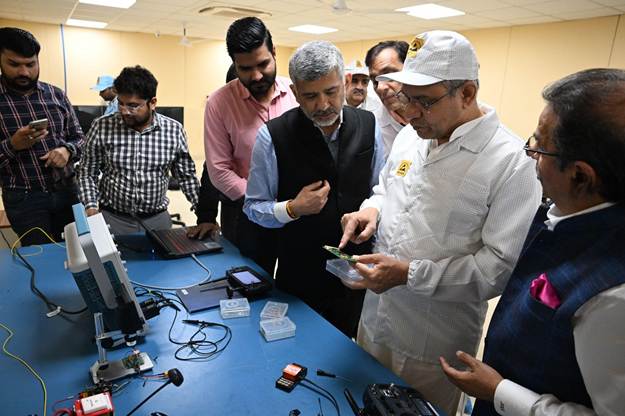
Union Minister of Electronics and Information Technology Ashwani Vaishnaw on Saturday inaugurated India’s first Tempered Glass Manufacturing Facility for mobile devices at Noida.
The facility has been set up by Optiemus Electronics in collaboration with Corning Incorporated, USA, and will produce high-quality tempered glass under the globally recognised brand “Engineered by Corning”. The products will be supplied to both domestic and international markets.
Speaking on the occasion, the Minister said that tempered glass is an important accessory for mobile phones and its indigenous manufacturing is a major step forward in the success of Make in India and the vision of Prime Minister Narendra Modi.
He added that step by step, India will manufacture each and every component used in mobile phones, including chips, cover glasses, laptop and server components, thereby positioning the country as a global player in electronics manufacturing. The Minister also informed that a Made in India chip is expected to roll out soon, marking another milestone in the country’s journey towards self-reliance.
On the occasion, Ashok Kumar Gupta, Chairman, Optiemus Infracom Limited said, “This is a landmark moment for the Indian electronics manufacturing industry and the Make in India vision. Despite being one of the world’s largest mobile phone markets, India has relied on imports for tempered glass. With this initiative, we are looking at building global-scale capabilities to support the Indian and international markets with the best quality products. Our aspiration is that every Indian mobile phone user must use a Make in India tempered glass with BIS certification and fog marking to protect their screen.”
Pankaj Mahindroo, Chairman, India Cellular & Electronics Association (ICEA) said, “This product segment has a very high labour-intensive manufacturing process and presents a tremendous opportunity for India – not just to meet its own high domestic demand, but also to become a leading exporter. By promoting high-quality manufacturing, we see immense potential to support MSMEs, generate large-scale employment, and contribute significantly to India’s export footprint – making India a global centre for electronics accessories manufacturing.”
For Tempered Glass, it is estimated that the domestic market is more than 500 million pieces with a retail value of approximately Rs 20,000 crore – showcasing a large-scale opportunity in the country. The global market is worth over USD 60 billion.