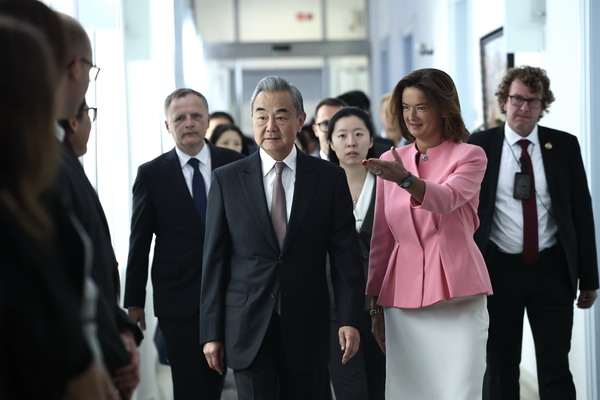
Chinese foreign minister Wang Yi has stressed that cooperation was needed to confront global challenges.
Speaking at the joint address after meeting his Slovenian counterpart Tanja Fajon in Ljubljana he said, “Europe should be friends rather than rivals and cooperation is needed to confront global challenges.”
Hitting out at the US over its proposal that NATO nations should impose 50 to 100 per cent tariffs on China, he said that China encourages peace talks.
“China does not participate in or plan wars, and what China does is to encourage peace talk and promote political settlement of hotspot issues through dialogue,” Yi said.
He also gave a call to promote multilateralism, strengthen multilateral mechanisms, and jointly safeguard the purposes and principles of the UN Charter. He highlighted that in the present times, the international situation is characterised by intertwined chaos and continuous conflicts.
“Making the right choices amid the greatest changes in a century demonstrates the responsibilities that both sides should fulfill towards history and the people,” Wang Yi said, as reported by Global Times.
“I believe that this, plus NATO, as a group, placing 50 per cent to 100 per cent Tariffs On China, to be fully withdrawn after the war with Russia and Ukraine is ended, will also be of great help in ending this deadly, but ridiculous, war,” Trump wrote on Truth Social.
Previously, Trump had accused Chinese President Xi Jinping of “conspiring against” the United States. The accusation followed China’s largest-ever military parade held on September 3, which North Korean leader Kim Jong Un and Russian President Vladimir Putin attended.
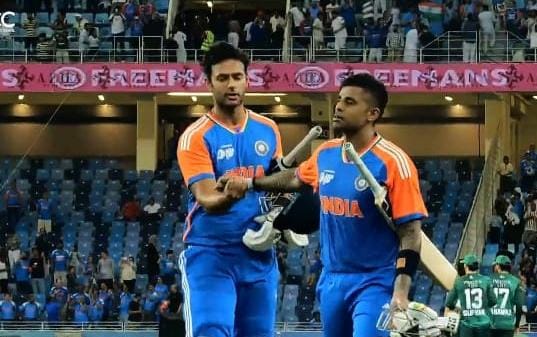
India outclassed Pakistan in the Asia Cup 2025 clash on Sunday, and no—the teams did not shake hands at the end.; While AIMIM and Shiv Sena (UBT) denounced the match as an insult to martyrs and officials defending their stance to play, India silenced Pakistan on the field with a commanding seven-wicket victory
Photo courtesy social media
India outclassed Pakistan in the Asia Cup 2025 clash on Sunday, and no—the teams did not shake hands at the end. India cruised to victory by seven wickets, chasing down 128 with ease after Pakistan managed only 127 for nine. Suryakumar Yadav anchored the chase with an unbeaten 47, sealing the win in just 15.5 overs.
But more than the result, attention was drawn to the behaviour and attitude of the Indian side. Captain Suryakumar Yadav and his team skipped the customary handshake with Pakistan—both before the match at the toss and after the game. While Pakistan’s players were seen waiting, the Indians had already started walking off. Reports suggest the move was directed by the BCCI and aligned with the Indian government’s stance. Yadav later confirmed that it was a team call, taken in line with the BCCI and government directives. “Some things in life are bigger than sportsmanship,” he said, dedicating the victory to the armed forces and expressing solidarity with the victims of the Pahalgam terror attack.
Pakistan’s coach, Mike Hesson, voiced disappointment, saying the players “went over but found the doors closed.” Captain Salman Ali Agha skipped the post-match presentation in protest, while the team management lodged a formal complaint, calling the snub a breach of sportsmanship.
On social media, many hailed the move by the Indian team, seeing it as a symbolic response to the Pahalgam terror attack and India’s subsequent ‘Operation Sindoor’. Analysts noted that in such moments, politics and national sentiment often override traditional norms of sportsmanship, sparking a debate: should sport remain separate from politics, or do such gestures carry deeper meaning?
The refusal to shake hands carried strong political weight in India. With backing from the BCCI and government, the Indian team signaled that cricket cannot be “business as usual” with Pakistan after terror incidents—a message that resonates with a large section of voters who expect a firm stance. It also helps the ruling BJP maintain control over the nationalist narrative.
“Symbolic acts like this tend to play strongly in Indian politics,” analysts observed. “Voters who lean towards nationalist sentiment may see it as India showing strength, pride, and solidarity with soldiers. Anyone who objects risks appearing ‘soft,’ even if purists argue it goes against the spirit of cricket.”
AIMIM and Shiv Sena (UBT) had opposed the match even before it was played, calling it an insult to the Pahalgam martyrs. Asaduddin Owaisi questioned whether crores earned from TV rights were valued more than the lives lost, with AIMIM leaders threatening to disrupt public screenings. Shiv Sena (UBT) staged protests in Mumbai, burning effigies, smashing televisions, and launching a “Sindoor Raksha” campaign to symbolically convey women’s anguish to the Prime Minister. Both parties accused the BJP of putting money above national sentiment, insisting no cricket should be played with Pakistan while blood is being shed.
Officials, however, pointed out that India’s participation in multilateral tournaments is mandatory. Withdrawing could jeopardize future hosting rights, they argued. While bilateral series with Pakistan remain off the table, multi-team events follow different rules. To manage public sentiment, the BCCI has quietly adopted what some call an “invisible boycott”: no senior office-bearers attended the match in Dubai, and players were instructed to follow official directives while keeping their focus on cricket.
The implications for BJP can be significant, the public spat between Rudy and Dubey revealed the tensions within BJP’s own ranks, how the senior BJP leadership is viewing it is anyone’s guess
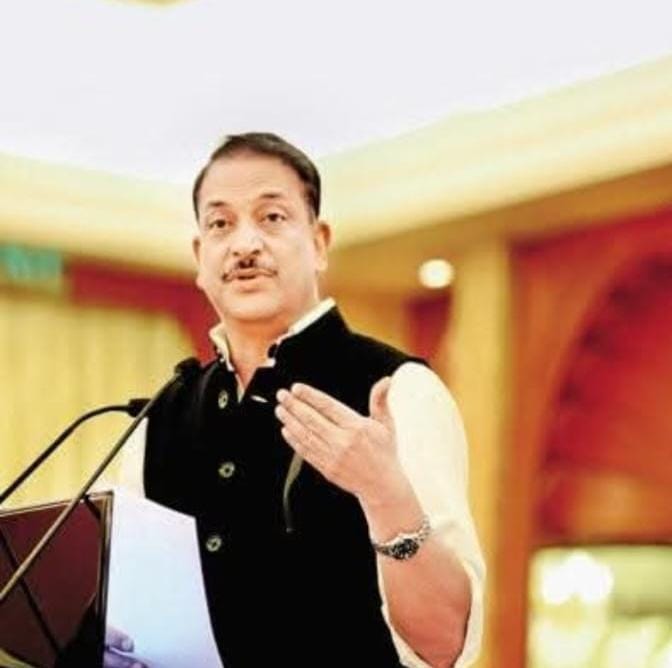
BJP’s Rajiv Pratap Rudy is no stranger to Bihar’s shifting political sands, but this poll’ season Saran MP seems to be trying a new reinvention. On the ground in Saran, he reportedly rallied his Rajput community with the slogan of “Jai Sanga” to give it a distinct identity. The slogans were also heard in Delhi, after he weathered a fierce contest against Sanjeev Balyan for retaining control of the prestigious Constitution Club of India (CCI)
Together, these moves sketch out a politician preparing both for the street battles of Bihar and the corridors of Lutyens’ Delhi. Rudy is trying to position himself as indispensable—a leader of Bihar’s Rajputs and around someone politicians across the party lines can rally. At the same time, the events also seem to be signalling a divide in the BJP, which no party leader will publicly acknowledge, obviously
At a gathering in Ekma during his Rana Sanga Yatra, Rudy was quoted as saying: “Other castes have leaders—Yadavs have Lalu, Kurmis have Nitish, Dalits have Paswan—but Rajputs have none,” he said appealing to supporters not to vote for any party “without a guarantee of work” and asked each Rajput to spread his message to three others daily for the next six months.
Caste politics
Rudy is someone who has never done this, despite caste being the organising principle of politics in Bihar. By invoking Rana Sanga, he is offering Rajputs both pride and direction, hoping to emerge as their undisputed face within the NDA coalition.
But Rudy’s maneuvering is not limited to Bihar. In August, he defeated Sanjeev Balyan in the CCI election for Secretary (Administration), winning by about 100 votes with support from both BJP colleagues and opposition MPs. The contest, ostensibly about club management, quickly became a proxy for influence within Parliament. Balyan later complained that opposition MPs had rallied behind Rudy, while Rudy countered that his victory was proof of his ability to deliver across party lines.
Nishikant Dubey angle
There was another controversy surrounding fellow BJP MP Nishikant Dubey who supported Balyan—Rudy’s opponent—in the Constitution Club election. Rudy reportedly claimed that Dubey was not asked by, nor had blessings from, BJP leadership to oppose him and accused him of “arrogance.” Rudy did not stop there, according to reports, he also alleged that Dubey behaves in Parliament as if he is running his own “government” separate from the actual government—one in which senior leaders like him have no role.
The public spat revealed the tensions within BJP’s own ranks, even as Rudy sought to present himself as someone who is trusted beyond party lines.
Bihar—what next
The implications for Bihar can be significant.
Rudy’s Rajput gambit is meant to give him a loyal caste base comparable to Nitish Kumar’s Kurmis, Lalu Prasad’s Yadavs, and the Paswan family’s Dalits. His CCI victory strengthens his claim as a leader with clout in Delhi, yet there may be risks—”Jai Sanga” may be perceived as sidelining the BJP’s Hindutva plank. Still, Rudy is betting that in Bihar’s caste-driven chessboard, the time has come for Rajputs to speak in one voice—and that he should be the one leading them.
How this works for him and BJP in Bihar’s shifting political sands remains to be seen but the latest tussle within the BJP has once again brought the party’s internal politics into the spotlight. . For the party leadership, the situation is particularly challenging at a time when the BJP is trying to strengthen its strategy in states like Bihar and Jharkhand.
“Your 3-hour PIT STOP in Manipur is not compassion — it’s farce, tokenism, and a grave insult to a wounded people”: Kharge
rime Minister Narendra Modi on Saturday made his first visit to Manipur since ethnic clashes between Kukis and Meiteis erupted in May 2023, appealing for reconciliation and unveiling development projects worth thousands of crores. While he sought to project the trip as a step toward healing, opposition leaders denounced it as a “farce” and accused him of neglecting the state for over two years. “Your three-hour pit stop in Manipur is not compassion — it’s farce, tokenism, and a grave insult to a wounded people,” Congress president Mallikarjun Kharge said.
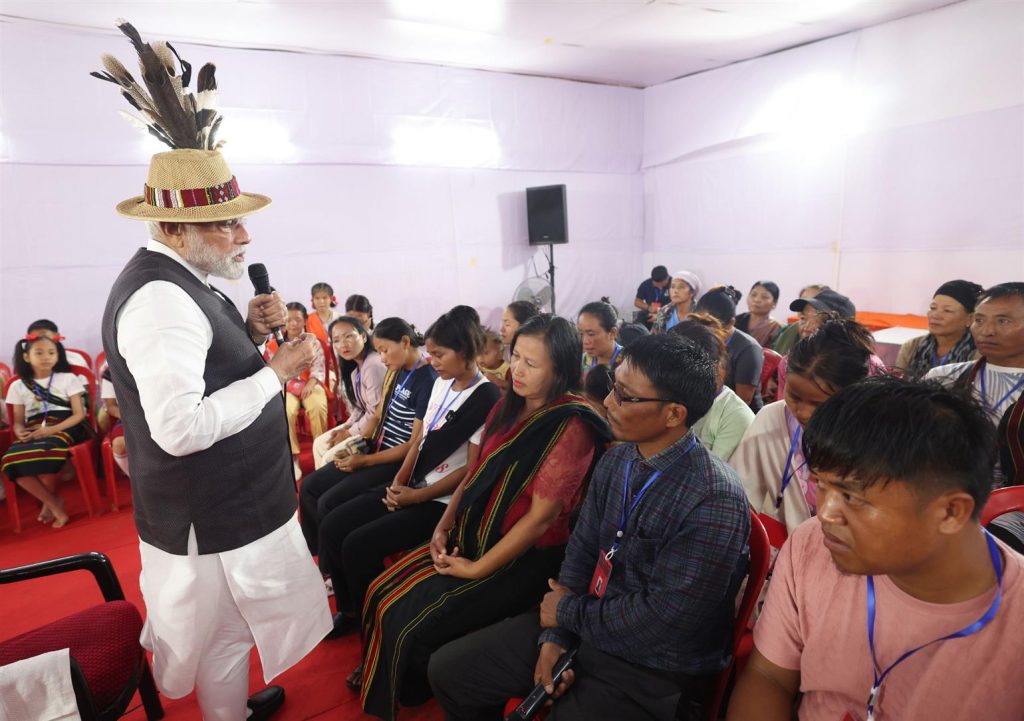
Heavy rain on arrival in Imphal forced the cancellation of Modi’s helicopter ride to Churachandpur and, determined to meet displaced families and address public gatherings, he instead travelled more than 90 minutes by road, officials said. In Churachandpur, the Prime Minister said that his government was making “every possible effort” to restore normalcy.
“We are moving forward with the goal of making Manipur a symbol of peace, prosperity, and progress. I assure you that the Government of Bharat, along with the Government of Manipur, will continue to cooperate in Manipur’s development, in resettling the displaced people at appropriate locations as soon as possible, and in establishing peace,” he said
“Our government is providing assistance to construct 7,000 new homes for displaced families. Recently, a special package of nearly Rs 3,000 crore has also been approved. Additionally, a provision of Rs 500 crore has been made specifically to help displaced persons. We are moving forward with the goal of making Manipur a symbol of peace, prosperity, and progress. I assure you that the Government of Bharat, along with the Government of Manipur, will continue to work together in resettling the displaced, restoring peace, and accelerating development,” he added.
The Prime Minister also laid foundation stones for projects worth over Rs 7,300 crore — ranging from urban road and drainage works to five new national highways, the Manipur Infotech Development (MIND) project, and women’s hostels — calling connectivity “vital for border regions like Manipur.”
Adding a personal touch, Modi shared a video of four schoolgirls performing Bharat Ki Beti during his visit, calling them his “young friends” and praising the state’s cultural vibrancy as a “pearl that will make India shine.”
Yet, the visit underscored unresolved tensions. The Kuki-Zo Council (KZC) submitted a memorandum demanding a “lasting political solution” through the creation of a separate Union Territory with a legislature under Article 239A, arguing that hill-based Kuki-Zo communities could no longer live under “valley domination.”
The opposition mounted an all-out attack. Kharge said Modi’s brief stopover amounted to “tokenism” and a “grave insult” to victims, reminding him that “300 lives have been lost, 67,000 displaced, and 1,500 injured” since May 2023 while the PM undertook dozens of foreign trips.
“Your so-called roadshow in Imphal and Churachandpur today is nothing but a cowardly escape from hearing the cries of people in relief camps.
“864 days of violence: ~300 lives lost, 67,000 displaced, 1,500+ injured. You made 46 foreign trips since, but not a single visit to share two words of sympathy with your own citizens. Your last visit to Manipur? January 2022 — for elections! Your ‘Double Engine’ has bulldozed innocent lives; you and Home Minister Amit Shah’s incompetence and complicity were shielded by imposing President’s Rule in the state,” Kharge wrote on X.
Congress general secretary Priyanka Gandhi Vadra said the visit “should have happened much earlier” to prevent suffering, while party colleague K. C. Venugopal dismissed it as a “face-saving farce.” CPI(M) MP John Brittas called it “too late” but welcomed it as a step that might help restore trust. DMK’s Kanimozhi, meanwhile, alleged the timing was linked more to preparations for the 2027 assembly elections than genuine compassion.
Punjab, the major grain producer state of India, has faced the brunt of the severe deluge during the last fortnight which has dashed all hopes of the inhabitants, especially the farmers of the state. It has inflicted deep wounds to the state. An official release informed that flood havoc has struck 2185 villages across 22 districts till September 10 with the affected population crossing 3,88,466. On the agricultural front, the total crop area damaged has climbed to 1,91,981.45 hectares.
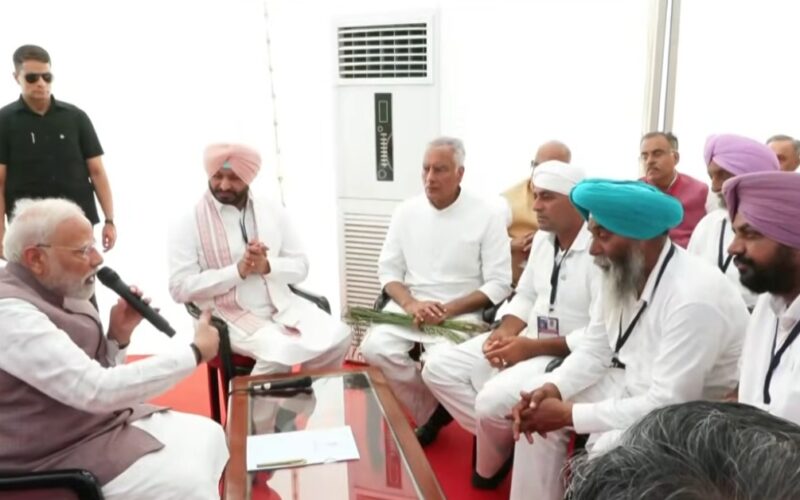
To heal the wounds of flood affected people, Prime Minister Narendra Modi visited Punjab on Tuesday, September 9, and reviewed the flood situation and damage caused and extending a helping hand, he announced financial assistance of Rs. 1600 crore for Punjab and stated that this relief of Rs. 1600 crore for Punjab is in addition to the Rs 12,000 crore already in the state’s kitty.
The Punjab wing of BJP leaders have applauded the Prime Minister for extending relief of Rs, 1600 crore and revealing that Rs 12,000 crore already in the state’s kitty.
Sunil Jakhar, the State president of BJP, says, “Prime Minister Shri Narendra Modi has announced an additional ₹1600 crore in aid for flood-affected Punjab, on top of the existing ₹12,000 crore in central assistance. I wholeheartedly thank the Prime Minister for supporting the people of Punjab during this challenging time.”
Ravneet Singh Bittu @RavneetBittu, Union Minister of State Railway & Food Processing Industries, tweets, “The people of Punjab express their heartfelt gratitude to the Hon’ble Prime Minister of India, Shri Narendra Modi ji, for the generous relief package of ₹1600 crore extended to the state during this critical time. This timely assistance reflects the Prime Minister’s deep concern and compassion for Punjab and its people.”
Is Rs 12,000 crore DRF a false propaganda by BJP?
After the statement of Prime Minister, Modi, the BJP leaders are making much hue and cry that the state government is already having Rs 12,000 crore in the state’s kitty. But the Aam Aadmi Party (AAP) Punjab, on September 11, has strongly countered it by terming this as the false propaganda being spread by BJP leaders over the State Disaster Response Fund (SDRF) and released the actual official figures to the people of Punjab.
In a statement, Punjab Cabinet Minister Harpal Singh Cheema condemned the BJP for deliberately misleading the public on disaster relief funds. He said, “BJP leaders have been shamelessly peddling lies to defame the AAP government. The truth is now before the people, and every single rupee received and spent from SDRF is in the public domain. Unlike BJP, which thrives on deceit and diversion, we believe in transparency and accountability.”
Cheema presented the complete breakup of funds received by the Punjab Government from the Government of India under SDRF and the amount spent by the state since April 1, 2022 as in 2022-23: ₹208 crore received, ₹61 crore spent; 2023-24: ₹645 crore received, ₹420 crore spent; 2024-25: ₹488 crore received, ₹27 crore spent; 2025-26: ₹241 crore received and ₹140 crore spent.
Minister Cheema further stated that from April 1, 2022, to September 10, 2025, the Punjab Government received a total of ₹1582 crore from the Government of India under the State Disaster Response Fund (SDRF). Out of this, ₹649 crore has already been spent on various relief and rehabilitation works across the state, while the remaining SDRF Balances are being used for ongoing and upcoming relief operations to ensure timely assistance to flood affected people.
Criticizing PM Modi’s claim that the state is already having Rs 12,000 crore of Disaster Relief Fund (DRF) in the state’s kitty, Punjab Congress President Amarinder Singh Raja Warring has also reiterated that this was nothing as compared to the great losses caused in the state. He also disputed the PM’s claims about Rs 12,000 crore saying there was nothing special about it as it was provided to the states as a matter of routine. Warring said that by trying to club the Rs 12,000 crore DRF amount with the relief he announced, the Prime Minister had tried to wriggle out of the situation as he also knew that the relief he was providing to Punjab was too little and too little.
Why the opposition stating the PM relief as ‘A drop in the ocean?
Punjab state congress president Amarinder Singh Raja Warring in a tweet on September 9, termed this relief, “A drop in the ocean; as we say in Hindi, ‘Oont ke mooh mein jeera’. Prime Minister @narendramodi ji has deeply disappointed Punjabis once again. When Punjab had great expectations from him, he failed. Rs 1600 crore is not even peanuts. The estimated loss ran into thousands of crores of rupees. Wonder what is the idea behind such meagre relief!”
Leader of Opposition in Punjab Vidhan Sabha, S. Partap Singh Bajwa, slammed the Union Government for announcing only ₹1,600 crore as relief for Punjab after the devastating floods. He has termed this a “cruel joke” when the state has suffered losses worth nearly ₹20,000 crore. “Against this backdrop, the Centre’s announcement amounts to less than 8% of the damages—a fraction of what Punjab urgently requires.”
Bajwa further demanded that the Union Government must also immediately release the ₹60,000 crore pending funds that rightfully belong to Punjab under GST compensation, RDF, and other central schemes.
Punjab Revenue and Rehabilitation Minister, Hardeep Singh Mundia has termed the meagre relief of Rs 1600 Cr announced for Punjab as insufficient for Punjab, which is suffering from the devastating floods, and has said that at least an interim relief of Rs 20,000 Cr should be released and the blocked funds of Rs 60,000 Cr should be released. Giving only Rs 1600 Cr against the demand of Rs 80,000 Cr is a cruel joke on the food bowl state.
Punjab Cabinet Minister and Aam Aadmi Party State President Mr. Aman Arora stated, “The Prime Minister came, saw, and offered a pittance. While our farmers stand amidst the ruins of their lives—their homes, their crops, their livestock washed away—the Centre’s response is not just inadequate, it is a blatant insult. Rs. 1600 crore is a slap in the face of every citizen who has lost everything.”
Shivraj Singh Chouhan @ChouhanShivraj, Minister of Agriculture and Farmers Welfare, Minister of Rural Development, Government of India, who visited Punjab on September 4 to take stock of the situation, has also described the catastrophic condition of the state, “The tragedy of floods has disrupted the lives of people everywhere. Villages are submerged in water, lush green crops in the fields have been destroyed, there has been a huge loss of livestock and many families are standing homeless and helpless. I have come to assure my farmer brothers and sisters and the people of Punjab that I have come here not only to assess the situation, but to stand with you and share your grief.”
Farmers’ union terms the relief as rubbing salt on the wounds
In a Press statement, Bharatiya Kisan Union Ekta Dakounda has termed the Prime Minister’s announcement of Rs. 1600 crore for flood-ravaged Punjab as an insult to Punjabis. The state committee said that this is the same Prime Minister who had announced a package of Rs 1.25 lakh crore during the Bihar elections in 2020 and now when Punjab is going through a difficult time, people’s houses have collapsed, the land has been eroded by the river, the remaining land has been filled with sand, crops have been ruined, human lives have been lost, livestock and all the goods and equipment have been swept away, then by announcing only Rs 1600 crore, salt has been rubbed on the wounds of the people.
The State Committee said that Rs 60 thousand crore of RDF and other funds are already pending with the Center, these should have been released. The leaders said that apart from the obvious damage caused by floods near the rivers, the roads under the Bharatwala project have also damaged crops by blocking water, houses of poor farmers and labourers have collapsed in the entire Punjab and crops have been damaged which cannot be quantified. The state committee said that at this time, the same relief was needed for the labourers as for the farmers, but after the central government conducted a survey through committees, the visit of the Union Agriculture Minister and now the visit of the Prime Minister was promoted with great enthusiasm, only meagre relief has been given.
‘Will mere bandaging without adequate medication heal the deep wounds?’
Now the questions arise- Is it the sufficient relief for the state which has been ruined at all corners. The crops are damaged, houses have been dashed to ground, no eatables left usable, livestock (the major additional income source for farmers and landless villagers) have been swayed away in the floods and all income ways are closed, not only temporarily, but will take a long time to revive. Already burdened with debt taken from banks, private lenders, other financial institutions and the balance amount for goods purchased on credit from the Adhatiyas, which the farmers pay at the time of crop harvesting, now how will the farmers arrange this much when all their crops have been damaged? Will the central government waive the debts? Also, the consequences of the flood will bring more difficulties in the time to come in the shape of diseases and scarcity of everything. So, extending an inadequate relief of Rs 1600 crore against the loss of Rs 20,000 crores questions- ‘Will mere bandaging without adequate medication heal the deep wounds?’
Raising the issue, Delhi based senior journalist, K P Malik asks, “Whether the relief is Salt or balm on Punjab’s wounds?”
Malik adds, “PM Modi has announced a relief of Rs 1,600 crore for Punjab. But this amount is less than a drop in the ocean. The devastation in Punjab is not hidden from anyone, according to the information so far, more than 2.5 lakh livestock affected, paddy and other crops destroyed, fields filled with silt, labourers unemployed and thousands of houses razed to the ground.”
He raises a chain of questions, “Now the question is, will Rs 1,600 crore remove silt from Punjab’s fields? Will it help to rebuild the fallen houses? Will it help to bring back the animals that died or were swept away? Will it help to sow the next wheat crop? Is the government making fun of the farmers by giving Rs 6,000 advance in the name of Kisan Samman Nidhi? This is not the relief, but like handing over a begging bowl to the farmers. So, is the Modi government standing with the farmers or trying to punish Punjab? Is this “relief package” a political revenge against Punjab?”
We may conclude with a positive note that as the state needs much more help, ‘Punjab Mange More’, so the central government should and hopefully will release a bonanza to the state immediately, without considering which party is ruling the state. It is the time to save the state and not to play the political game. Let us hope for the better!
Jag Mohan Thaken is a Senior Journalist, Columnist & Political Analyst, views are personal
Prime Minister Narendra Modi on Saturday laid the foundation stone, inaugurated development works worth over Rs 9000 crore in Aizawl, Mizoram.
These projects will cater to multiple sectors including Railways, Roadways, Energy, Sports among others.
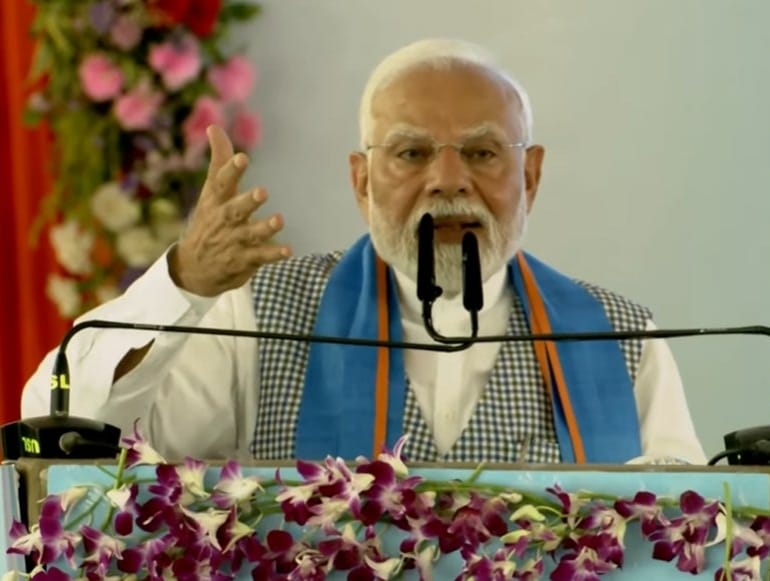
Addressing the gathering via videoconferencing, the Prime Minister said, “Today, Mizoram is playing an important role in India’s development journey.”
Describing the day as historic for the nation, particularly for the people of Mizoram, he said, “from today, Aizawl will be on India’s railway map”.
Modi underlined that despite many challenges, including difficult terrain, the Bairabi–Sairang rail line has now become a reality.
Affirming that the hearts of the people and the nation have always been directly connected, the Prime Minister announced that for the first time, Sairang in Mizoram will be directly connected with Delhi by the Rajdhani Express.
He emphasized that this is not merely a railway connection, but a life-line of transformation and it will revolutionize the lives and livelihoods of the people of Mizoram.
The Prime Minister stated that for a long time, some political parties in the country practiced vote-bank politics and as a result, the entire North East, including states like Mizoram, suffered greatly due to this attitude.
Modi emphasized that the current approach is very different and those who were earlier neglected are now at the forefront. He added that those who were once marginalised are now part of the mainstream.
“Mizoram has a major role in both the Act East Policy and the emerging North East Economic Corridor”, exclaimed the Prime Minister. He stated that with the Kaladan Multi-Modal Transit Transport Project and the Sairang–Hmawngbuchhuah rail line, Mizoram will be connected to the Bay of Bengal through South East Asia.
Emphasising that India is rapidly emerging as an important hub for global sports, he remarked that this growth is also giving rise to a sports economy in the country.
Underlining that the government is consistently taking steps to boost Ease of Living and Ease of Doing Business, the Prime Minister said, “the next-generation GST reforms have recently been introduced and it means lower taxes on many products, making life easier for families”.
The Governor of Mizoram, General VK Singh, Chief Minister of Mizoram, Lalduhoma, Union Minister, Ashwini Vaishnaw were present among other dignitaries at the event.
The PM’s much-awaited visit comes against the backdrop of mounting criticism by opposition parties, who have repeatedly targeted him for not visiting Manipur since May 2023, when clashes between the Kuki and Meitei communities plunged the state into ethnic strife. It is not a standalone visit but part of an itinerary which includes visits to Mizoram, Manipur, Assam, West Bengal and Bihar from 13th to 15th September.
Prime Minister Narendra Modi will visit Manipur on Saturday—his first trip to the state since ethnic violence broke out there over two years ago. His tour will begin from Churachandpur where he is scheduled to lay the foundation stones for development projects and meet people affected by the violence. Later in Imphal, he will address a public gathering at Kangla Fort and inaugurate and lay the foundation stones for multiple initiatives.
It is not a standalone visit but part of an itinerary which includes visits to Mizoram, Manipur, Assam, West Bengal and Bihar from 13th to 15th September.
Leader of the Opposition in the Lok Sabha Rahul Gandhi called the PM’s trip to Manipur “not a big deal” as a key issue before the country was “vote chori” (vote theft). Besides, the trip, according to him, was too late in the day. Speaking to the media in Junagadh Rahul said “Manipur has been in trouble for a long time and the PM has decided to go there now. So that’s not a big deal. The main issue today in India is ‘vote chori’.”
“So now it is official. The PM will spend less than 3 hours in Manipur tomorrow. This visit instead of providing a force for peace and harmony is actually going to be a farce,” said Congress leader Jairam Ramesh on Friday
“The proposed visit of the Prime Minister to Manipur on Sept 13 is being hailed by his cheerleaders. But it appears that he will be spending just about 3 hours–yes just 3 hours–in the state. What does he hope to accomplish by such a rushed trip? This is actually an insult to the people of the state who have waited for him for 29 long and agonising months. Sept 13th will actually be a non-visit by the PM, who has once again revealed his callousness and insensitivity towards the people of Manipur,”
The Coordinating Committee on Manipur Integrity (COCOMI) urged the PM to address the state’s deep-rooted crisis, warning against reducing it to “tokenism” or mere inauguration of projects. Urging the PM to focus on identifying illegal immigrants, implementing the National Register of Citizens (NRC), resettling internally displaced persons, and ending the ongoing proxy war, the civil society group of the Meitei community stressed that the state was facing “the brunt of illegal immigrants”.
The All Manipur United Clubs’ Organisation (AMUCO) maintained that the PM’s visit was more about getting credit rather than addressing the state’s pressing issues arising out of the two-year-long ethnic violence.
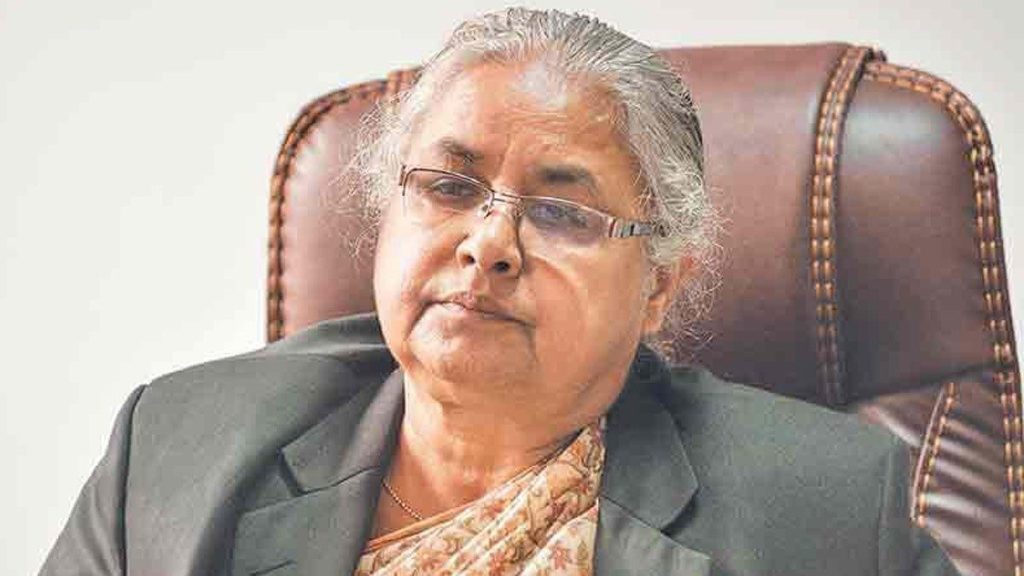
Nepal’s former Chief Justice Sushila Karki has been appointed to lead an interim government, according to an announcement from President Ramchandra Paudel’s office, ending days of political uncertainty following the resignation of Prime Minister KP Sharma Oli after widespread anti-government protests.
Karki (73) was administered oath of office by President Paudel
Karki was chosen after a meeting between President Paudel, senior military officials, and representatives of the youth-led “Gen Z” protest movement. Her immediate challenge will be to restore law and order in the strife-torn Himalayan nation.
Officials said Karki’s appointment was the outcome of a broad consensus among stakeholders. She is expected to form a small cabinet, which in its first meeting will recommend dissolution of Parliament, as per the understanding reached during consultations. President Paudel also held separate discussions with political leaders, legal experts, and civil society before making his decision.
Oli was forced to step down after the Gen Z movement staged massive demonstrations demanding an end to corruption, favouritism, and the ban on social media platforms.
Karki’s appointment has also revived interest in her family’s political history.
Her husband, Durga Prasad Subedi, was reportedly involved in Nepal’s first-ever aircraft hijacking in 1973. The Royal Nepal Airlines flight was carrying 19 people, including Bollywood actress Mala Sinha. Subedi, then a youth leader of the Nepali Congress, along with Basanta Bhattarai and Nagendra Prasad Dhungel, forced the pilot to divert the Kathmandu-bound aircraft to Forbesganj in Bihar, India, according to reports.
The hijackers’ target was not the passengers but Rs 30 lakh in cash being transported by Nepal Rastra Bank. The funds were seized to bankroll the Nepali Congress’s underground campaign to overthrow the autocratic Panchayat system under King Mahendra and restore multi-party democracy.
The hijacked plane later continued its journey with passengers unharmed, while the cash was smuggled to Darjeeling. Within a year, most of the conspirators were arrested in India, though they were released after the lifting of the Emergency in 1975. The plot was reportedly masterminded by Girija Prasad Koirala, who went on to become Nepal’s prime minister.
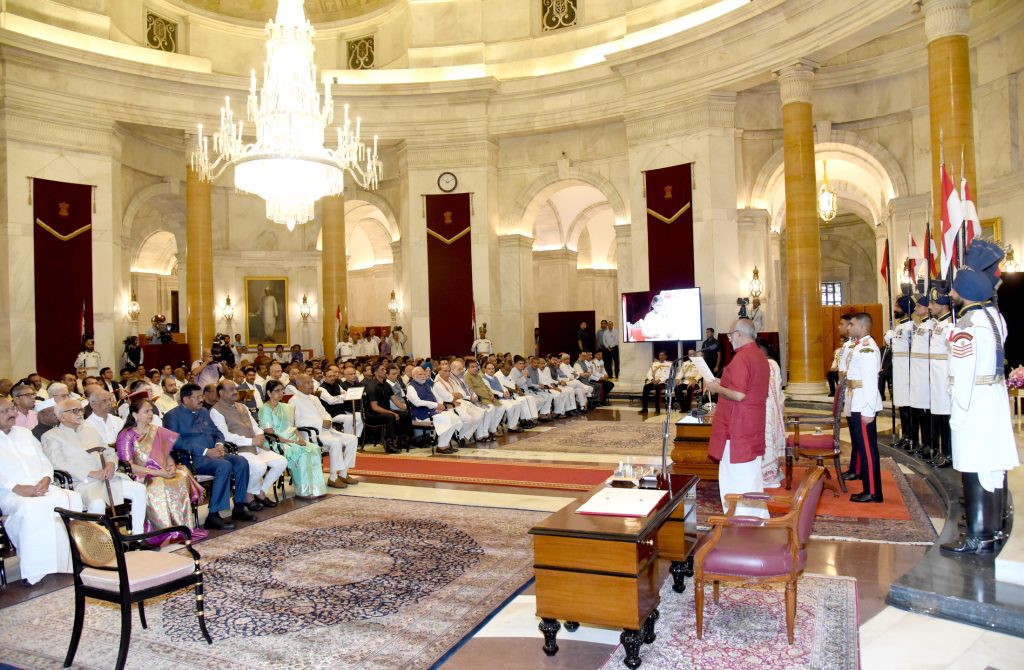
Seated in the front row next to his predecessor, M. Venkaiah Naidu, Dhankhar looked relaxed, sharing smiles and greetings. His wife, Sudesh Dhankhar, accompanied him, while another former Vice President, Hamid Ansari, sat alongside Naidu — creating the rare sight of three former VPs in one frame.
The swearing-in of CP Radhakrishnan as India’s new Vice President on Friday was meant to be the highlight of the day. Yet, much of the spotlight fell on a familiar but long-absent figure — Jagdeep Dhankhar, making his first public appearance since his surprise resignation on July 21 citing health concerns.
His sudden exit had left Delhi’s political circles buzzing, and his 50-day absence only added to the mystery. No wonder then, that Dhankhar’s reappearance instantly stole the show.
Seated in the front row next to his predecessor, M. Venkaiah Naidu, Dhankhar looked relaxed, sharing smiles and greetings. His wife, Sudesh Dhankhar, accompanied him, while another former Vice President, Hamid Ansari, sat alongside Naidu — creating the rare sight of three former VPs in one frame.
Dhankhar’s silence, however, continues to be a talking point. The Opposition has repeatedly questioned the secrecy around his resignation. Congress leader Jairam Ramesh remarked earlier this week that the “nation is still waiting for him to speak out.” Rahul Gandhi too raised the issue during the Monsoon Session, pointedly asking, “Where has the old VP gone?” It is another matter that the BJP today was questioning the absence of Leader of Opposition Rahul Gandhi from today’s event
BJP national general secretary Tarun Chugh slammed Gandhi for his “constitutionally irresponsible behaviour by abstaining from the oath ceremony of the newly-elected Vice President”. “Rahul Gandhi has not only undermined the grace of his office but has brought shame to the nation. He might be busy in his personal matters but he has no grace to carry out his constitutional responsibilities,” he said, also questioning his foreign trips without prior information to his security staff.
Meanwhile, Radhakrishnan’s victory remains significant. The BJP nominee comfortably defeated Opposition candidate B. Sudershan Reddy by a margin of 152 votes earlier this week, cementing his place as the 15th Vice President of India.
The revision of history textbooks is being carried out by the National Council of Educational Research and Training (NCERT) with great enthusiasm under the directions of the Government of India. The rewriting of history textbooks under a neo-nationalist government can never be a simple, unbiased & honest academic exercise as its exclusivist “Idea of India” is diametrically opposite to the inclusivist “Idea of India” based on the founding principles of the Constitution of India. History is the first lesson in identity that is conferred on children. It shapes the moral universe for its future citizens. Hence, the recent revisions by the NCERT that diminish the role of the Mughals in medieval history while glorifying Hindu rulers cannot be just edits in a textbook. They are an attempt to restructure India’s moral and political imagination. There is a dangerous fallacy at the core of this project. It assumes that the nationhood of “we the people” can be redefined by simplifying history into a tale of villains and heroes. The Mughal emperors must be depicted as ruthless invaders, temple destroyers, and oppressors. Hindu kings are to be exalted as guardians of tradition and tolerance. The broad lesson in Indian history must radiate with Hindu virtue under siege by Muslim barbarity. This project is nothing but myth making in the service of politics.
All civilizations wrestle with violence. To single out the Mughals as uniquely brutal is historically dishonest. As historians remind us, conquest, temple destruction, and political repression were the lingua franca of power across dynasties – Hindu, Buddhist, or Muslim. The Cholas, the Pallavas, the Kashmir kings – all left records of violence that match, and sometimes exceed, those attributed to the Mughals. But NCERT textbooks are curiously silent on these episodes. For example, it is unfair to condemn Akbar for one massacre in a 45-year reign while erasing the Maratha atrocities in Bengal. Such distortions matter because history is not simply about the past; it is about what kind of polity we wish to become. The great achievement of India’s freedom struggle was not simply political independence, but the articulation of a moral vision.
The India that our Constitution makers dreamt of was not just a country of borders drawn on a map. It was an India that would stand firm on its diversity and plurality. This dream had its roots in our shared culture. It is the same culture in which the elegance of Persian, the tradition of Sanskrit, Islamic ideology and the flavour of our local languages blend together to form the civilization in which we all live. The foundation of our country is based on equal respect for all faiths, ideologies, ethnicities, cultures, languages and regions. If the supremacy of a specific culture, language or religion is imposed on everyone, and the diversities and identities are erased by thrusting uniformity and similarity; then the very foundation of India and “Indianness” will be shaken. By rewriting history with a pre-defined agenda, the narrow and exclusivist Hindutva ideology is being surreptitiously imposed on the broad “Indianness” This would tantamount to reversing original constitutional “Idea of India.” The objective of history textbooks should be to expose our young generation to the evolution of our present-day society. Students should get an unbiased and factual picture of major changes, incidents and various factors responsible for shaping our nation. The history textbooks should enable students to think, analyze and draw lessons to shape the future of society.
Supporters of these revisions say that the Mughals were given more space than necessary in the textbooks and this marginalised the ancient Hindu dynasties. This argument has some strength. It is true that our curriculum has not been able to do justice to the entire civilizational achievements of India. But reform cannot be achieved by condemnation. History should be understood, not hated. A balanced and factual view would be that we avoid both glorification and demonization. Show students the magnificent architecture of the Mughals and also acquaint them with their strict policies. Keep Akbar’s experiments with religious tolerance alongside his military campaigns. Textbooks should also include rulers like Tipu Sultan and Dara Shikoh, who in their own ways showed the path of resistance and pluralism. Remember Sher Shah Suri for administrative reforms, Abul Fazal for his intellectual legacy. Only then will our children learn that Indian civilization is not made of a single religion or a single tradition, but of complexities, multiplicities and dialogue.
What we are witnessing is not the pursuit of truth but the construction of usable pasts. By presenting Hindu rulers as noble and Muslim rulers as barbaric, the textbooks become primers of communalism. They train children to see their society as a battlefield of fixed identities, where one community is forever the victim and another forever the oppressor. Such lessons, once learned early, are difficult to unlearn. A 13-year-old who absorbs that “Muslim rulers were cruel” may not read the historian who reminds us that violence was universal, nor notice that Kerala and Bengal – areas with little Mughal control – are among the most Muslim-populated today. Instead, the prejudice instilled in childhood hardens into a worldview. That worldview infected with prejudice and a sense of victimhood metamorphoses into hatred that corrodes our democratic ethos and communal harmony.
This convergence of pedagogy and propaganda risks entrenching communalism in the very minds that democracy requires to remain open and critical. It is true that all governments have sought to tilt the telling of history. But what distinguishes the current moment is not just the tilt but the abandonment of scholarly integrity. In the past, textbooks might have favoured the Congress or downplayed uncomfortable episodes. But they did not indulge in alt-facts – claims that the Aryan migration is merely a “theory,” or that jizya was imposed to encourage conversions. These assertions are not interpretations; they are fabrications. A democracy can survive contested interpretations. It cannot survive the institutionalization of lies.
What, then, is at stake? At stake is not only historical accuracy but the very moral compass of the republic. A plural society cannot be held together by myths of victimhood and vengeance. It can only be sustained by an honest reckoning with its past – a reckoning that acknowledges the grandeur and the brutality, the syncretism and the coercion, across all communities. The point of history is not to cultivate pride or shame but understanding. To teach a child that their ancestors were only victims or only villains is to deny them the possibility of empathy, the foundation of citizenship. A nation that censors its past cannot imagine a democratic future. For the sake of its children, India must resist the temptation of selective memory. The integrity of history is the integrity of democracy itself.
The author is Vice President of Jamaat-e-Islami Hind and Chairman of Markazi Taleemi Board, Views are Personal