How RSS powered BJP’s Delhi return

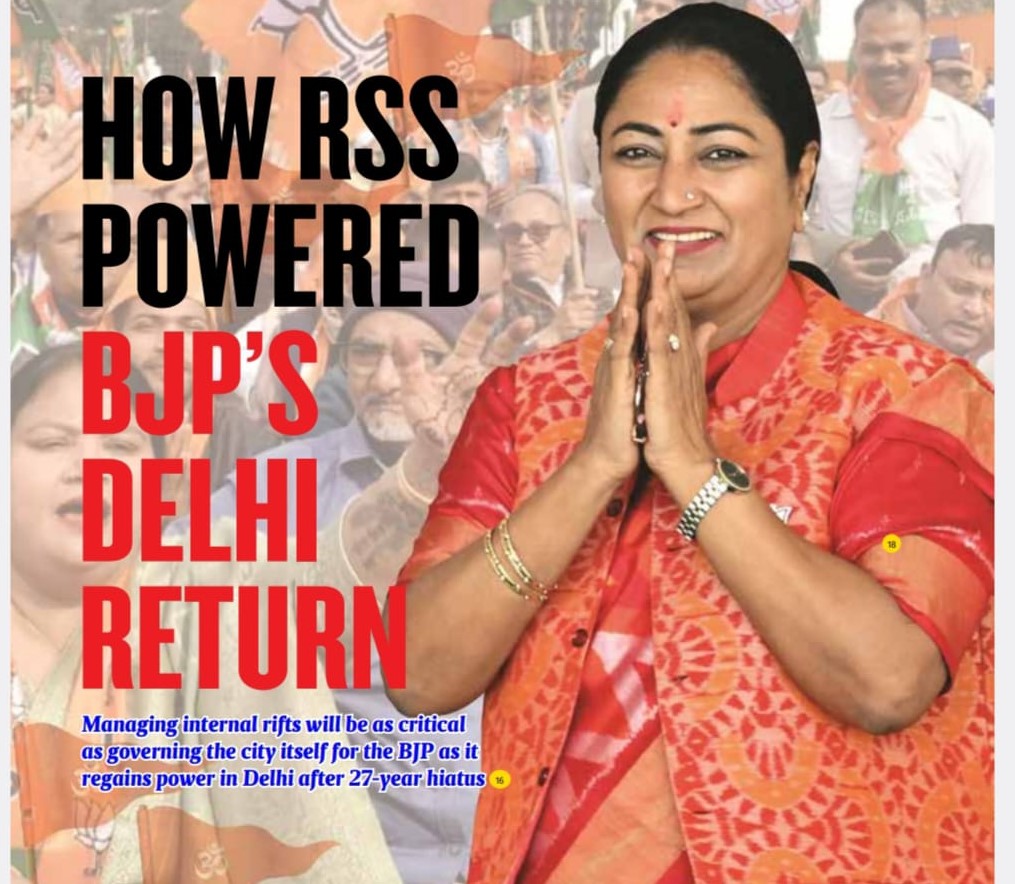
Managing internal rifts will be as critical as governing the city itself for the BJP as it regains power in Delhi after 27-year hiatus, with strategic backing from the RSS.  A report by Nitin Mahajan
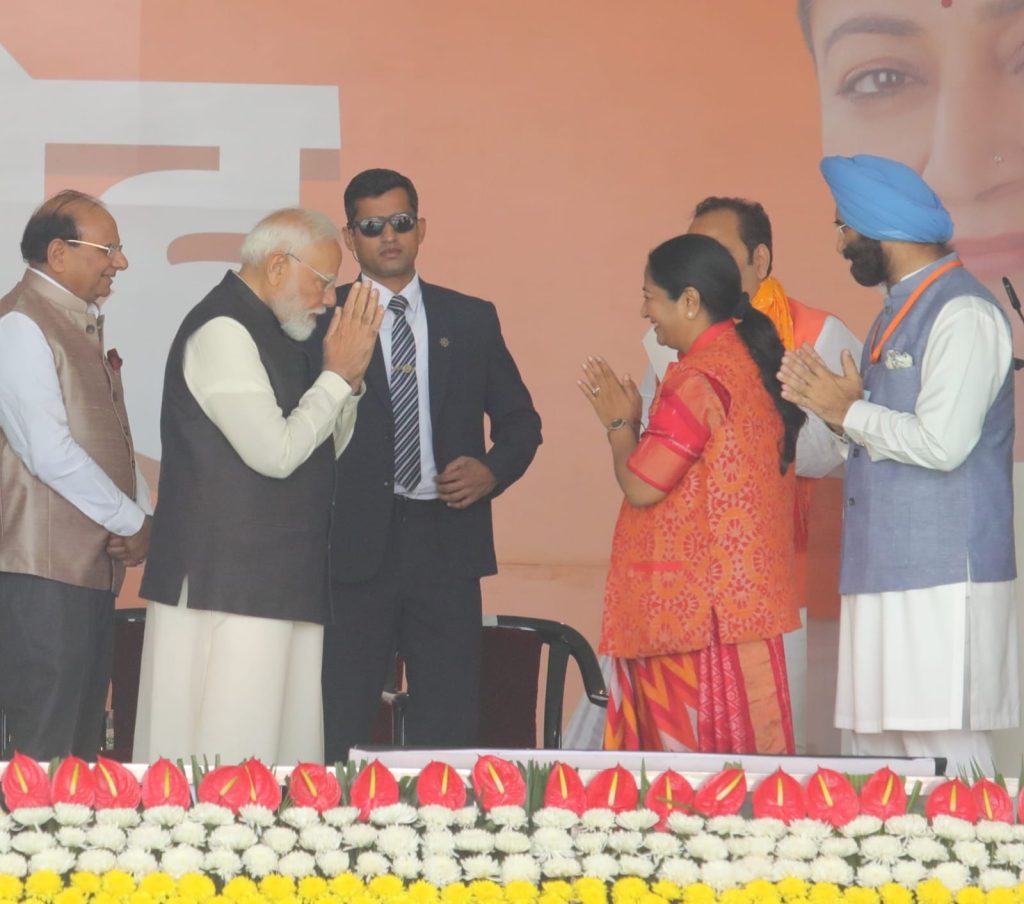
Photo: Naveen Bansal

While the Bharatiya Janata Party (BJP) has been wielding political power at the Centre and in over 20 states across the country for the past 11 years under the leadership of Prime Minister Narendra Modi, securing the Delhi Assembly has remained an elusive dream for the saffron party for almost three decades, since its last Chief Minister, the late Sushma Swaraj, demitted office in December 1998.

The BJP’s exile from the Players’ Building, the headquarters of the Delhi government, ended after its leader Rekha Gupta was sworn in as the chief minister of the national capital territory, along with her six cabinet colleagues on 20th February this year.       

The mission of securing a political win in the national capital by defeating the Arvind Kejriwal-led Aam Aadmi Party wasn’t an easy one and the BJP leadership was aware of this predicament. And to make this task a success, the leadership of the BJP, including Prime Minister Narendra Modi, party chief JP Nadda and Home Minister Amit Shah, decided to heavily lean on the support of Rashtriya Swayamsevak Sangh (RSS) and seek an active involvement of its cadres to bolster the support for the party, just like they did in the Maharashtra and Haryana Assembly polls, a few months ago.
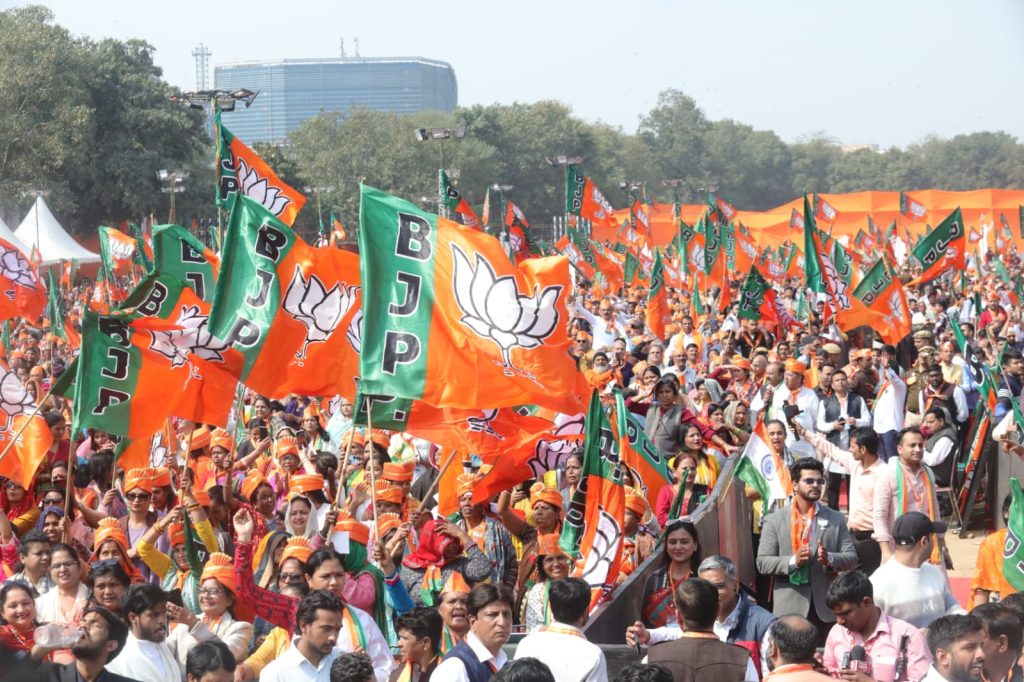
Photo: Naveen Bansal

After getting a go-ahead from the top saffron leadership, the RSS began working on the strategy to win over the common people of Delhi over the past several months. The mission wasn’t easy as the Arvind Kejriwal-led Aam Aadmi Party held a vice-like grip over the Delhi government and enjoyed a mass appeal due to the freebie culture— dubbed revdi culture by BJP— that his successive governments had spawned.

It took months of planning and political strategizing by the saffron leadership to formulate a plan of action for successful removal of the AAP government.

The initial process began last year, with the continued and sharpened targeting of senior AAP leaders like Kejriwal, Manish Sisodia, Satyendar Jain and others over alleged corruption cases. The BJP ensured that the AAP leadership, which prided itself on riding to the national capital’s power corridors on the back of an anti-corruption movement, could not evade these charges so easily.

A relentless pursuit and charging of these leaders ensured that Kejriwal, Sisodia and Jain were imprisoned after indictments (being charge-sheeted) by the investigative agencies. This ensured that the clean image of the AAP leadership came under a cloud and raised doubts in the minds of ordinary people.
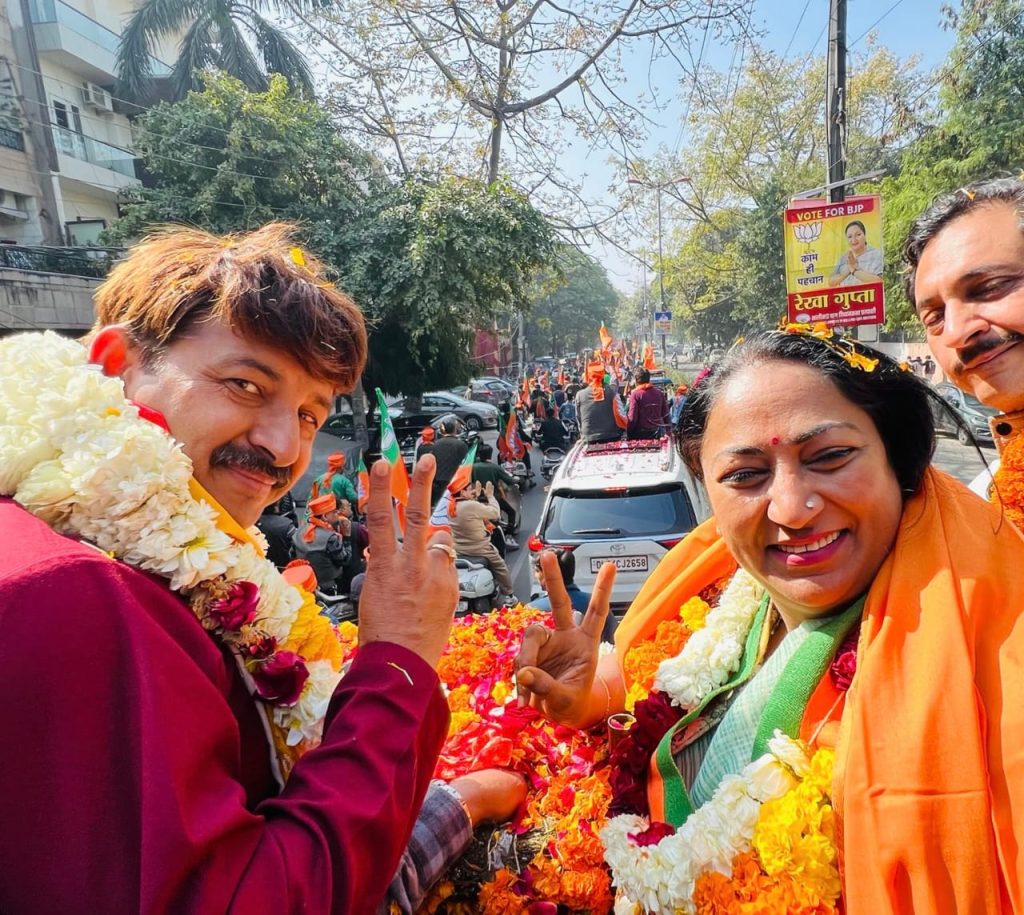
Photo: Naveen Bansal

Interestingly, for the first time in Delhi’s electoral politics, the BJP too decided to go for a freebie model, made ever so popular by Kejriwal, in these Assembly polls. The party has been staying away from making any such promises in the past few polls in the city. However, the local leadership in consultation with the top leaders announced the party’s decision to continue the already implemented subsidies including free bus rides for women, subsidised power and potable water, if it came to power. Moreover, the BJP also went ahead and promised a monthly dole of Rs 2,500 to economically weaker, eligible women in the national capital with an aim to secure additional votes.  

Meanwhile, during the run up to polls, an attempt was also made by the saffron affiliates to avoid any factionalism among the Delhi leadership. The local leaders were asked to follow the strategy devised by the central leaders and take the local cadre on board if they wanted to return to power in the national capital.   

The Delhi BJP has historically struggled with internal rivalries. Leaders like Vijender Gupta, Manoj Tiwari, and Parvesh Verma have often been at odds, vying for influence. The BJP’s centralized decision-making under Prime Minister Narendra Modi immensely helped suppress factionalism.

For implementation of these political strategies, the RSS, which is the ideological parent of the BJP, played a crucial role.

Ahead of the Delhi Assembly polls, a massive outreach program by the RSS cadre was implemented where over 60,000 meetings were held across the national capital which ensured that a ground was prepared for the BJP’s return to power in the national capital after 27 years. 

Despite speculation over various names, it is understood that Gupta had a strong backing of the RSS ever since the results of the polls were announced. The Sangh had expressed complete confidence in her and had also conveyed the same to the BJP leadership. 

The RSS and BJP high command reportedly favored a candidate with a “clean image” and broader appeal.   

Ever since the BJP’s less-than-adequate performance in the 2024 Lok Sabha polls, the Sangh has become more hands-on in shaping electoral strategy and bolstering support for its political affiliate. The fact was clearly evident earlier during Maharashtra and Haryana Assembly polls as well, where the Sangh cadre had ensured that the BJP’s supporters came out to vote on the polling day and that it connected with the undecided and young voters of these states, ensuring impressive victories for the saffron front.  

Ever since the Lok Sabha polls, the Sangh cadre had upped its outreach, where issues related to nationalism and public welfare measures of the Narendra Modi government were discussed with first time voters, youth and women. The results of these outreach meetings by the Sangh cadres have been seen in recent Maharashtra, Haryana and Delhi Assembly polls, a fact acknowledged by BJP leadership . 

Last year, in Haryana, the BJP won 48 out of 90 seats for a third consecutive term, while in Maharashtra, the MahaYuti alliance — comprising the BJP, Shiv Sena (Shinde faction), and NCP (Ajit Pawar) — claimed 228 out of 288 seats.

The saffron win in these two states was attributed to the effective outreach by RSS narrative in favour of the party.

In Delhi, the campaign by Sangh was launched soon after the Maharashtra election and the city was divided among eight zones, catering to 30 districts and 173 nagars. Apart from RSS pracharaks, cadres of various associate organizations also took part in the outreach programme in Delhi. 

 RSS imprint on Gupta cabinet

The nomination of Rekha Gupta as Chief Minister, Delhi’s fourth woman CM after Sushma Swaraj (BJP), Sheila Diskhit (Congress) and Atishi (AAP), clearly has a stamp of approval by the RSS. The senior leader hails from the Akhil Bharatiya Vidyarthi Parishad (ABVP), the youth wing of the Sangh, and enjoys complete confidence of saffron outfits. She is considered to be a loyalist of RSS sarkaryavah (general secretary) Dattatreya Hosable. 

The top leadership of the BJP is understood to have accommodated the RSS’ candidate for the Chief Minister’s post after a strong backing by the Sangh in recent Delhi Assembly polls, another acknowledgement by BJP of Sangh’s influence in selection of CM faces.

It is believed that the BJP was able to secure 48 of the 70 seats in the Delhi Assembly after trouncing the Arvind Kejriwal-led Aam Aadmi Party, largely due to the solid and unwavering support of the Sangh affiliates. Rekha Gupta’s appointment as the first woman CM under BJP rule in any state aligns with the party’s aim to secure support of female voters, who played a crucial role in its Delhi victory. 

The BJP has also tried to ensure that caste equations and community aspirations are taken care of in the appointments to the Delhi government cabinet. 

Gupta’s appointment is seen as potentially historic, as there has been no woman BJP chief minister in any of the 21 states where the BJP is in power. Her clean image, grassroots engagement, organizational skills, and her convincing victory in Shalimar Bagh are cited as reasons for her selection for the top post.

By appointing Rekha Gupta as the Delhi CM, the BJP has created many equations at once. She has taken the baton from CMs during Aam Aadmi Party tenure, Arvind Kejriwal (Bania) and Atishi Marlena (woman), and fulfilled the aspirations of these communities.

It sends out a positive message to the saffron cadres that even an ordinary ABVP worker can rise to become the chief minister, if you work relentlessly for the organization.

By appointing, ministers including Parvesh Verma (Jat), Ashish Sood (Punjabi, Bania), Manjinder Singh Sirsa (Sikh, Minority), Kapil Mishra (Brahmin), Ravinder Indraj Singh (Dalit) and Pankaj Kumar Singh (Purvanchali) regional, caste and community aspirations have been fulfilled.

Moreover, senior leader Vijender Gupta, who hails from bania community, has been accommodated as the Speaker of the House.

By inducting leaders from these communities, the BJP has ensured representation for all major communities and castes that have helped it in the ousting of the Arvind Kejriwal-led Aam Aadmi Party from power in the national capital.    

The social engineering is expected to ensure that voting blocks and communities that supported the BJP in the recent Assembly polls and Lok Sabha polls last year receive adequate representation in the Delhi cabinet. The BJP hopes that this accommodation will boost the political standing of the saffron front in the national capital.   

In other states, 15 percent of the Assembly strength can be made ministers. However, in Delhi, only 10 percent of the Assembly seats i.e. a total of 7 ministers can be made. There are 70 members in the Delhi Legislative Assembly. According to the formula in Delhi, a total of 7 ministers including the chief minister can be in the cabinet. That means one chief minister and 6 cabinet ministers.

Winning, and more importantly, holding on to the power in the national capital is very important for the BJP as it wants to showcase and develop it into a world class city. Prime Minister Narendra Modi had earlier stated that he wanted to evolve the city into a modern day metropolis that can be displayed as the pride of India. And the saffron party feels that its double engine concept would be ideal one to make the PM’s vision materialise.

There had been a feeling in the BJP that unless a friendly government took power in Delhi, it would be very difficult to achieve the target set by PM Modi. With the Arvind Kejriwal-led AAP at the helm of affairs, the saffron unit had been facing frustrating times in the national capital as several of its developmental initiatives were not implemented in the city.  

As the saffron party embarks on its first term in Delhi in nearly three decades, managing internal rifts will be as critical as governing the city itself.

It is believed that a faction of state leadership is unhappy with the elevation of Gupta as the CM and could stir up trouble in the future. The BJP’s victory in Delhi is a moment of triumph, but the shadow of dissent looms large over its internal dynamics. Only time will reveal if this internal strife can be doused by the spirit of reconciliation or stir up rebellion within the saffron fold. The Delhi unit’s fractious past means that tensions could simmer beneath the surface, ready to erupt if the new government falters.

Any internal discord within the saffron front could jeopardize the goals set by the central BJP leadership and its long-term plan to retain political power in the national capital, especially as the Aam Aadmi Party, led by a wounded but resilient Arvind Kejriwal, waits to capitalize on any misstep by the BJP.

As the saffron party embarks on its first term in Delhi in nearly three decades, managing internal rifts will be as critical as governing the city itself.

The Delhi government needs to deliver on the BJP’s ambitious promises—tackling pollution, improving infrastructure, transport and providing economic relief—to maintain its vote bank’s trust. The newly-sworn in government seems to have hit the ground running with several rounds of meetings being held with government officials for review of various projects and initiation of new development works ever since the government took over.
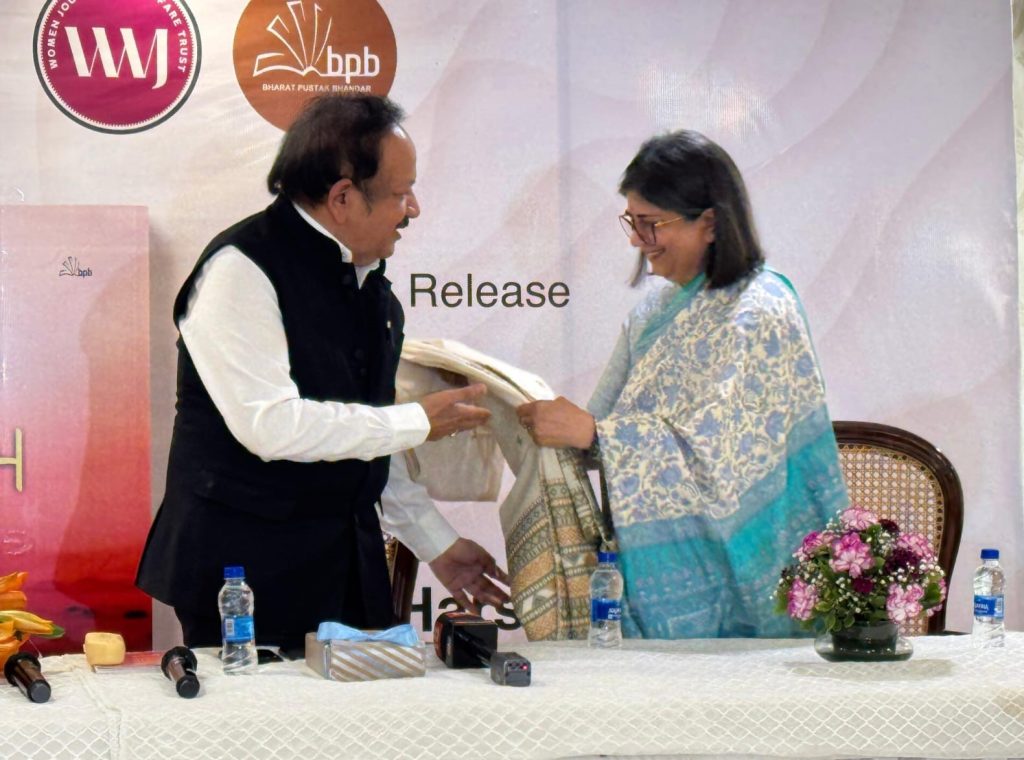
Dr. Harshvardhan unveils Pritpal Kaur’s latest ‘Neel’

Photo: Naveen Bansal

Pritpal Kaur, the acclaimed author of Saal Chaurasi, Thug Life, Half Moon, Raahbaaz & Ishq Faramosh has on Saturday announced the launch of her latest book – Neel.

The book was launched by former union minister Dr. Harshvardhan. He was the union minister of health and family welfare during the pandemic.

He worked tirelessly during those turbulent times for the people and the nation. The event had a reading, Q&A session along with a discussion on the book by prominent personalities of the field.

During the release of the book, Dr. Harshvadhan termed the book as extraordinary.

 This highly anticipated novel promises to captivate readers with its theme that revolves around the COVID-19 Pandemic, the pain and the suffering of a father and his daughter. The duo had already lost loved ones to cancer and a road accident.

“This book is extraordinary and I can go on and on about this book,” he said. 

Author Pritpal Kaur is a television journalist and a fiction writer. Her earlier works are highly acclaimed novels Saal Chaurasi, Half Moon, Thug Life among others. In addition she has published a few more novels, story book collections as well as published short stories in almost all leading literary magazines and story collections edited and published by reputed publications.

A snowless winter in Kashmir, and the ticking climate clock

Kashmir faces an unprecedented dry winter, with historic Achabal spring running dry, Gulmarg’s famous ski slopes left bare, and vital water sources depleting. As the region grapples with climate change, the fallout is threatening agriculture, tourism, and livelihoods. A report by Riyaz Wani

For days in mid-February, the ancient spring at Achabal Mughal garden in south Kashmir’s Anantnag district ran dry due to a largely dry winter, during which Kashmir has recorded an 80 percent precipitation deficit in January and February. This is believed to be the first time in living memory that the spring that provides water to nearly 20 surrounding villages ceased to flow, triggering a water crisis. Although the spring was restored following a light snowfall in the hills, both the symbolism and fallout of Achabal spring wasn’t lost on anyone. 

Built by Noor Jahan, wife of Mughal Emperor Jahangir, in the 17th century, the spring has never run dry before, claim the locals. 

“In my entire life, I have never seen the spring being depleted of water,” said Mohammad Ashraf, 65. “Nor has father told me of such an occurrence in his lifetime.”

However, running dry of the Achabal spring isn’t the only instance of the growing impact of climate change in the Valley. In Gulmarg, where winter sports fuel the local economy, the famed ski slopes are nearly bare, forcing the government to postpone winter games which were due to be held from February 22 to 25. This has dealt blow to hoteliers, ski instructors, and small businesses that count on tourist footfall. For many, the winter season isn’t just about recreation—it’s their livelihood. Without snow, their earnings disappear.

Around 300 athletes from all over the country were expected to compete in four snow sports such as ski mountaineering, alpine skiing, snowboard, and Nordic skiing in the games.  Although Gulmarg has witnessed some slight snowfall since then, the government doesn’t deem it sufficient to hold the games. 

“The administration is closely monitoring the snowfall situation. Experts from the Ski Federation will assess the slopes in the coming days, and if they approve, the games could be held in the first week of March,” J&K Chief Minister said while speaking to reporters on the sidelines of the inaugural event for a year-round helicopter service in Gulmarg, 

“At present, we are not in a position to make an announcement. If there is sufficient snowfall, the games will be held in early March; otherwise, it will not be feasible due to the approaching summer,” he added.

According to J&K’s meteorological department, the Valley recorded temperatures 12 degrees Celsius above normal in February, causing crops that should remain dormant until late February to become active in winter only.   

The decline is conspicuously visible in Jhelum, the Valley’s primary water source, crucial for irrigation, drinking water, and hydroelectric power. The current data from the Irrigation and Flood Control Department reveals that water levels in the river have fallen below the Reduced Level (RL) of zero at Sangam, with similar declines recorded at Ram Munshi Bagh and Asham. Tributaries such as Lidder, Pohru, and Ferozpora are also flowing at unprecedented lows. 

For now, this has affected the Valley’s hydropower generation the most, plummeting it by a whopping 84 percent. This has forced the administration to rely on external sources to meet the shortfall. Power plants generated only 250 MW in January, a fraction of the 1200 MW capacity, with February seeing a further 5% decline. Unless water levels improve, the situation is expected to deteriorate.

 Glacier replenishment takes a hit

The snowfall, however, is important not merely for hydropower or tourism but as a lifeline for the glaciers which keep our rivers and streams flowing and agriculture fields irrigated. High-altitude areas retain their sub-zero temperatures, enabling the snow to endure throughout the year. Kashmir  witnesses its heaviest snow during chilai kalan and the snowfall progressively reduces in February and March when spring sets in. This keeps glaciers replenished. Alarmingly, the experts fear a drastic reduction in snowfall by the century’s end, and this can have horrific consequences not just for Kashmir but the region. 

Going forward, agriculture and horticulture are also going to be hit hard if the current dry spell lingers. With glaciers failing to replenish due to growing snow-deficit, and also melting prematurely due to an unusually warm winter, farmers are worried about the upcoming agriculture season.  The likelihood of an impending drought could devastate apple orchards, paddy fields, and vegetable farms. 

Kashmir  witnesses its heaviest snow during chilai kalan and the snowfall progressively reduces in February and March when spring sets in. But this winter December, January and February have largely been dry, the last such seasons were in 2015 and 2018. Last winter, however, was no different. Though snow was delayed, February in 2024 witnessed recurring precipitation.

Heavy snow in these two months helps in the glacier formation which in turn charges up the Valley’s water bodies through summer. So increasing the frequency of dry winters signals trouble. More so, at a time when the Valley’s major glaciers have shown marked signs of depletion in recent decades. Biggest of them is the Kolahai glacier. The area of Kolahai, according to an estimate,  has retreated to 11.24 square kilometers from 13.87 sq kms since 1976. 

 Impact on tourism

Needless to say, the tourism sector could be another casualty. Inadequate snowfall, even in the upper reaches, has already led to a sharp decline in visitors to the popular winter destinations like Gulmarg and Pahalgam,  with hoteliers reporting a 50% drop in bookings.

“International tourism, particularly in the adventure and recreational segments, has sadly experienced a substantial downturn,” Faiz Ahmad Bakshi, secretary general of the Kashmir Chamber of Commerce and Industry, said.  This decline directly impacts foreign exchange earnings and employment in the tourism sector.”

Over the last three years, the growing tourism has gone a long way to shore up the Kashmir economy and brought back employment lost to the successive security and Covid-19 lockdown. The boom in tourism, which forms 6.8 percent of Kashmir’s GDP and employs over two million people, has also had a positive spillover effect on other sectors.  

Could there still be a possibility of snowfall? Yes, the Valley has witnessed some heavy snowfalls in March in the past, but it is less likely than in the previous three months. Also, snowfall in March, according to weather experts, is less helpful in terms of glacier replenishment in view of the relative rise in temperature in the month. 

Going forward, however, the Valley will need a compensatory increase in rainfall to have a normal agriculture season. 

Jamaat’s banned ranks spawn new front: Can it stir the pot?

After biting the dust in last year’s Assembly polls, the Jamaat-e-Islami-backed faction has launched a new political party, the JDF, which plans to contest the upcoming panchayat and municipal polls and could impact their outcome in parts of the Valley. A report by Riyaz Wani

Banned Jamaat-e-Islami-backed candidates in Jammu and Kashmir who unsuccessfully fought last year’s Assembly election have launched a new political party to contest the upcoming panchayat and municipal body elections in the union territory.

Christened as Jammu and Kashmir Justice and Development Front (JDF), the party will officially be launched in March, one of its leaders, Talat Majid, told media.

Talat himself began his political innings with the Apni Party led by Altaf Bukhari in 2023, and subsequently contested the 2024 assembly elections as an independent candidate from the Pulwama assembly constituency, which he lost.

Shamim Ahmad Thoker, the panel member of the banned Jamaat-e-Islam, said he will be the president of the new party, while Abdul Rehman Shalla from Baramulla will be its vice president and Sayar Ahmad Reshi its general secretary. Reshi also unsuccessfully fought the last year’s Assembly election. 

Jamaat, which was banned by the central government in 2019 for its alleged links to militant outfits, had fielded some 10 candidates as Independents in the assembly elections last year including Sayyar Ahmad Reshi and Talat Majid in South Kashmir. None of them won despite tapping into Jamaat’s long standing cadre.  Other than Reshi, who contested the elections against communist leader MY Tarigami, and polled 25000 votes, all others lost their deposits.

However, the irony of the Jamaat’s decision to contest polls wasn’t lost on anyone and had been met with some social media backlash, largely from unidentified accounts. Many saw Jamaat participation as a betrayal of the separatist cause they earlier espoused, and in pursuit of which thousands of lives were lost. 

Omar Abdullah then publicly articulated a widely felt sentiment. “An organization that spent the last 30 plus years telling the people of Kashmir that elections are Haram (prohibited) and that they should not participate in these elections is now turning around and doing the same,” Omar told reporters in Srinagar at the time.

In the earlier elections held over the last two decades, Jamaat cadre was perceived to have been the lynchpin of the PDP’s support base, especially in South Kashmir seats. Jamaat candidates, when confronted with difficult questions about their party’s past role, explain that they became a part of the separatist movement and militancy more by circumstance than by conviction. 

The newly floated party now plans to contest the panchayat and municipal body elections and could certainly be a potential factor in deciding their outcome in parts of the Valley believed to be their traditional strongholds. The party could very well win a few seats here and there marking their return to power politics, albeit still at the grassroots level.  However, while the new party name makes it possible for the leaders to escape the banned label of their parent party, it can also detach them from the Jamaat ideology and its followers. 

The central government, on the other hand, remains deeply skeptical of Jamaat even while it may have encouraged its leaders to join mainstream politics. Police recently raided dozens of bookshops and seized hundreds of copies of books by Maulana Maududi, founder of Jamaat in India. Police said searches were based on “credible intelligence regarding the clandestine sale and distribution of literature promoting the ideology of a banned organisation (Jamaat)”. Although, the authorities did not name the author, store owners said they had seized literature by the late Abul Ala Maududi.

Moderate Hurriyat chairman Mirwaiz Umar Farooq condemned the police action. “Cracking down on Islamic literature and seizing them from bookstores is ridiculous,” Mirwaiz said in a statement, pointing out that the literature was available online. “Policing thought by seizing books is absurd — to say the least — in the time of access to all information on virtual highways.” 

A new era in Delhi politics: Atishi to square off with Rekha Gupta

Delhi gears up to witness an intriguing political battle between new CM Rekha Gupta and outgoing CM Atishi, now LoP in the Delhi Assembly. With Arvind Kejriwal out, it will be fascinating to see how Atishi adapts to her new role after AAP’s two consecutive terms in power, writes Pawan Kumar Bansal

Delhi will witness an interesting political battle between two women; new Chief Minister Rekha Gupta and outgoing CM Atishi, who is now Leader of the Opposition in Delhi assembly. Atishi is experienced and Rekha is first time MLA. With Arvind Kejriwal out of the picture, it will be interesting to watch how Atishi handles her responsibility with Gupta enjoying the support of the Union government and of LG.

The BJP has aggressively targeted the AAP, raising issues such as the lavish spending on the “Sheesh Mahal” official residence of outgoing CM Arvind Kejriwal and the alleged mismanagement of the widely publicised “Mohalla Clinic” scheme. During a session of the State Assembly, a CAG report on the liquor scam was presented, leading to accusations and counter-accusations. Delhi BJP President Virender Sachdeva claimed the CAG report revealed a loss of approximately Rs 2,000 crores, further exposing the AAP government. On the other hand, Leader of the Opposition, Atishi, defended the Excise policy, arguing that it had curbed black marketing and boosted revenue.

On the other hand, Atishi attempted to corner the BJP over the removal of pictures of Baba Sahib Ambedkar and Bhagat Singh from the Chief Minister’s office. Meanwhile, firebrand Rekha Gupta, Delhi’s new CM, enjoys the support of the LG, Prime Minister Narendra Modi, and the RSS. On the other hand, former CM Arvind Kejriwal is focusing more on managing the situation in Punjab, amid reports of Congress’s efforts to lure away AAP legislators.

Political analyst Devinder Surjewala commented, “After ten years of Kejriwal in power, the people of Delhi are hoping for an era of development, with the BJP now in control at both the Centre and in Delhi. Also, there will be no excuse that the LG is preventing independent action. Without Kejriwal, AAP lacks a prominent figure to “gherao” the government, and Atishi is unlikely to emerge as a formidable challenger.”

The BJP is expected to have a smooth run for the next five years, with their usual tactics of blame games and divide-and-rule. It is believed that Kejriwal’s coming days will be critical, as the BJP is poised to hold him accountable for the issues that arose during his tenure. During the campaign, Prime Minister Modi referred to the AAP government as “aapda” (disaster), urging people to vote for the BJP to escape the consequences of Kejriwal’s “hawa-hawai” promises, freebies, and alleged falsehoods. It’s speculated that central agencies like the ED will dig into old files to target Kejriwal further.  This will form part of the strategy to keep Kejriwal occupied with self-defence. 

On the first day of the session, 21 AAP legislators were suspended by the Speaker for creating disturbances. In the Assembly, the BJP commands the support of 48 MLAs, while AAP, which was in power for two terms, has been reduced to just 22 seats. Atishi accused the BJP of being “anti-Dalit” and “anti-Sikh” for removing the portraits of Dr B.R. Ambedkar and Bhagat Singh from the CM’s office. CM Rekha Gupta denied these allegations, asserting that AAP is attempting to conceal its corruption.

In response, the BJP shared a photo of the CM’s office displaying portraits of Mahatma Gandhi, Babasaheb Bhimrao Ambedkar, Bhagat Singh, the President, and the Prime Minister of India. Media expert Sunit Mukherjee noted that the BJP-led government now faces high expectations and cannot claim that the LG is preventing it from functioning. The people of Delhi, and indeed the country, will closely watch the Rekha Gupta vs Atishi contest.

While Atishi has experience in running the government, Rekha Gupta’s rise through the ranks of the RSS gives her a distinct advantage. By choosing Gupta over senior leaders like Parvesh Verma, the BJP has played a dual card: a woman leader and someone from the same caste as Arvind Kejriwal. While both Sushma Swaraj and Atishi had brief stints, Rekha Gupta now has to prove she can deliver results like Sheela Dixit did during her tenure, when people still remember the all-round development the latter brought to the state.

Glaring gaps exposed as chaos, tragedies mar Mahakumbh 2025

The Mahakumbh 2025 drew millions of pilgrims to Prayagraj, setting a new record. But the festivities were marred by stampedes, road accidents, and environmental concerns, highlighting both the scale and challenges of India’s largest religious gathering. A report by Mudit Mathur

The 45-day religious and cultural festivities of the Mahakumbh concluded with the final royal bathing on Mahashivratri, 26 February. The event saw an overwhelming turnout, with more than 650 million pilgrims—about half of India’s population—gathering at the Sangam (the confluence of the Ganga, Yamuna, and the mythical Sarasvati,). This year’s Kumbh Mela set a new record in terms of scale. The event remains unique in the world, where no invitation is needed yet millions gather to celebrate.

In 2025, the Mahakumbh also provided a platform for UP CM Yogi Adityanath to bolster his national profile, positioning him as a competitor to PM Modi’s popularity.

The festival, however, was marred by tragic incidents. On 29 January, a stampede occurred at the Mahakumbh site. Later, on 15 February, another stampede at New Delhi Railway Station claimed the lives of at least 18 people. The stampede occurred due to a surge of passengers heading to Prayagraj for the festival. Soon after the incident, the Ministry of Railways announced a compensation of Rs 10 lakh for the deceased’s families, Rs 2.5 lakh for victims with grievous injuries and Rs 1 lakh for those with minor injuries. More than a dozen injured persons in the stampede were taken to treatment at Lok Nayak Jai Prakash Narayan Hospital in New Delhi.

According to Railways authorities, the incident occurred as a massive crowd gathered at platform no. 14, where the Prayagraj Express was stationed. Delays in the departures of Swatantrata Senani Express and Bhubaneswar Rajdhani further exacerbated the congestion, leading to overcrowding at platforms 12, 13, and 14. Reports indicate that around 1,500 general tickets were sold, resulting in an overwhelming rush, particularly near platform no. 14 and the escalator at platform no. 1.

The Railway Protection Force’s report highlighted that a sense of anxiety and panic spread among the thousands of passengers after the Shivganga Express departed from Platform 12. This tension escalated further when an announcement indicated that the Kumbh Special train would now depart from Platform 16 instead of Platform 12, causing a large crowd to gather at the platforms.

In response, the Ministry of Railways has ordered a high-level investigation into the incident, and a two-member committee has been formed to look into the matter. Videos taken by passengers at the station show the overwhelming crowds on the platforms. Delhi’s Lieutenant Governor, VK Saxena, expressed his concern over the incident and stated that he is closely monitoring the situation.

Meanwhile, a division bench led by Chief Justice D.K. Upadhyaya and Justice Tushar Rao Gedela took notice of a Public Interest Litigation (PIL) filed by Arth Vidhi. The PIL, in the aftermath of the tragic stampede, questioned the Indian Railways’ practice of selling more tickets than the seating capacity of the coaches. The bench raised concerns, asking, “If you fix the number of passengers to be accommodated in a coach, then why do you sell… why do the number of tickets sold exceed that number? That is a problem… Implementing such a simple measure could help avoid such situations.”

The Railways ministry has directed X (formerly Twitter) to remove 285 social media links containing videos of casualties from the February 15 New Delhi Railway Station stampede, marking one of its first major content enforcement actions since gaining direct takedown powers in December. The ministry, which cited “ethical norms” and the platform’s content policy, sent the notice on February 17, asking for action to be taken in 36 hours, according to people aware of the matter.

Many road accidents were reported from various parts of the country wherein pilgrims of Mahakumbh died and were injured. In and around Uttar Pradesh at least 31 people died and 45 injured in such accidents. These pilgrims were either coming from or going back to Jharkhand, Karnataka, Andhra Pradesh, Bihar, Odisha, Uttar Pradesh and Delhi.

Meanwhile, Uttar Pradesh Chief Minister Yogi Adityanath has dismissed concerns over the water quality at the Sangam during the ongoing Mahakumbh, calling reports of faecal bacteria contamination an attempt to defame the grand religious gathering (Sanatan). He declared the Sangam water safe for drinking and bathing, despite the Central Pollution Control Board (CPCB)  pollution report testing high faecal bacteria levels in Prayagraj river water, surpassing bathing standards.

The National Green Tribunal (NGT) summoned the Uttar Pradesh PCB (UPPCB) authorities for the non-compliance of directives regarding ‘serious water quality violation in Ganga and Yamuna at Prayagraj’ and allegedly filing a misleading lengthy old testing report of 12 January. The fact is that the NGT has repeated itself when it said that high levels of faecal and total coliform were found at various locations at the Mahakumbh, during a hearing on allegations that untreated sewage has been discharged into Ganga and Yamuna rivers in Prayagraj.

However, beyond the serious environmental issues, the stampede deaths, numerous road accidents resulting in casualties, damage to railway windows, and the congestion caused by massive crowds eager to take a holy dip, unprecedented surge of pilgrims point to a resurgence of Hindutva. Despite the challenges posed by overcrowded roads, severe traffic jams, and congested transport, the overwhelming influx of pilgrims in Prayagraj was undeterred.

The hardships faced by pilgrims are worth noting: many were caught in hours-long traffic jams, with no access to water or food for their children, and no toilet facilities for women. On the way, basic necessities were being sold at exorbitant prices, with apples priced at Rs 200 and bananas at Rs 100. Even water bottle rates were hiked to ten times than their usual cost. The unanticipated overcrowding exposed the failure of crowd management strategies, as authorities struggled to assess road traffic, venue capacity, and crowd behaviour.

Though there were long queues for free ‘Bhandaras’ organised by various industrial houses and some Akharas, the food was extremely costly in the shops. The exploitation of pilgrims was so rampant at a large scale that even a seller of ‘neem datoon’ (soft stem of Neem for brushing the teeth) made millions during this long festival exploiting pilgrims from India and abroad.

The traditional Kumbh Mela, recognised by UNESCO as an ‘Intangible Cultural Heritage of Humanity,’ remains the largest congregation of people in the world. This time, the government repackaged the Mahakumbh with an emphasis on promoting Hindutva unity, adopting a commercial approach aimed at turning it into a high-tech religious tourism event to generate significant revenue for the state exchequer.

Chief Minister Yogi is expecting that the event will bring more than Rs 3 lakh crore to the economy while the state has spent about Rs 75000 crore on organising it. The government is also focusing on other key symbolic locations tied to Hindutva mythology, such as Ayodhya, Mathura-Vrindavan, Kashi, Mirzapur, Naimisharanya, and Chitrakoot, to boost religious and cultural tourism through infrastructure development.

The government also targeted some other important symbolic places in the state associated with Hindutva mythology such as Ayodhya, Mathura––Vrindavan, Kashi, Mirzapur, Naimisharanya and Chitrakoot for infrastructural development promoting religious cultural tourism.

In the recently tabled budget, Chief Minister Adityanath announced an allocation of Rs 1,50 crore for tourism infrastructure in Ayodhya, Rs 1,00 crore for the Bankey Bihari corridor in Mathura-Vrindavan, and Rs 200 crore for the Vindhyavasini temple corridor connecting Kalikho and Ashtbhuji temples.

Court’s gag order on Allahabadia raises concerns over free speech

Civil society is raising an alarm over a recent Supreme Court directive imposing a gag order on podcaster Ranveer Gautam Allahbadia, fearing it marks a troubling step towards judicial
moral policing and an expanded censorship regime in India. A report by Mudit Mathur

Civil society is deeply concerned over a recent interim order from a two-judge bench of the Supreme Court of India, which, it feels, in the name of morality, imposed a gag order on the petitioner, restricting his right to free speech and expression on social media. India is already witnessing an erosion of free speech, and civil society fears that judicial moral policing, coupled with the potential for a broader censorship regime, could deepen the crisis.

The contentious order came when a bench headed by Justice Surya Kant, with Justice N. Kotiswar Singh, stayed the arrest of Ranveer Gautam Allahabadia on the condition that he cooperate with the police and appear when summoned. The court also prohibited any further FIRs based on the same show but refrained from deciding whether to club them. Most concerning, however, is the imposition of a sweeping restriction, barring ‘Allahabadia’ and his associates from airing any shows on YouTube or other platforms “until further orders.”

Many argue that such restrictions violate their freedom of speech and expression under Article 19(1)(a) and their fundamental right to practice any profession or occupation under Article 19(1)(g) of the Constitution. In a similar case in 2022, a three-judge bench, led by then CJI and including Justice Suryakant and Justice A.S. Bopanna ruled that prohibiting Zubair from tweeting would amount to an unconstitutional gag order.

 “A blanket order directing the petitioner not to express his opinion—an opinion he is rightfully entitled to hold as an active, participating citizen—would be disproportionate to the purpose of imposing conditions on bail. The imposition of such a condition would amount to a gag order against the petitioner. Gag orders have a chilling effect on the freedom of speech… Passing an order restricting him from posting on social media would constitute an unjustified violation of the freedom of speech and expression, and the freedom to practice his profession,” the three-judge bench had then held, which also comprised Justice Surya Kant.

The contentious interim order, passed in contradiction to settled Supreme Court law, has drawn criticism from civil society, particularly academia and the legal fraternity. While few endorse Allahabadia’s comments on his social media show India Got Latent, many have expressed concern over the judicial overreach of the bench, whose order has had a far more chilling effect on free speech—a right recognised as the mother of all civil liberties.

Judicial outbursts often provide the government with an opportunity to scrutinise existing legal provisions, particularly regarding new media services driven by the internet, such as OTT platforms and YouTube, which currently lack a dedicated regulatory framework. This has triggered renewed demands for amending laws. The Information and Broadcasting Ministry is reviewing existing statutory provisions and assessing the need for a new legal framework to regulate “harmful” content amid complaints of “obscenity and violence” on digital platforms.

Senior Advocate Saurabh Kripal of the Delhi High Court, in an article for a prominent newspaper, asserted, “When the Court becomes a party to restricting, rather than protecting free speech, the citizens of the country ought to be afraid indeed.” He further cautioned, “Taking sanction under the Court’s observations, the executive is likely to further restrict the rights of citizens. And this time, they will have nowhere to turn to because it is the Court itself that has initiated the act of restricting the most fundamental of all freedoms.”

After securing Haryana, Maharashtra, Delhi for saffron hue, Sangh eyes Bihar win

As the Bihar Assembly elections approach, scheduled for later this year, the Rashtriya Swayamsevak Sangh (RSS), the ideological parent of the Bharatiya Janata Party (BJP), has shifted its focus to the state. This comes soon after securing consecutive electoral victories in Haryana, Maharashtra and Delhi.

Known for its organizational prowess and grassroots mobilization, the RSS is leaving no stone unturned to ensure the BJP-led National Democratic Alliance (NDA) retains power in Bihar. The Sangh cadre is expected to conduct over one lakh outreach meetings across the state to ensure a comeback of Nitish Kumar-led NDA government’s return to power. The Sangh’s effective voter outreach model, honed in Delhi with over 60,000 “drawing room meetings,” is being adapted for Bihar. The RSS is learnt to be deploying a multi-pronged approach dubbed “Mission Trishul” to clinch victory. The strategy is centred on three key pillars—identifying voter discontent, shaping the election narrative, and assessing electoral risks and benefits. This approach, termed “Mission Trishul,” mirrors the trident symbolizing strength and precision, reflecting the organization’s intent to penetrate Bihar’s complex socio-political landscape.

It is understood that booth-level surveys across Bihar have been initiated to identify discontented voters and the issues that matter most to them. This survey will identify weak polling stations and inform strategies to bolster voter turnout—a tactic that was successfully implemented in Delhi, Haryana, and Maharashtra.

By understanding local grievances like unemployment, infrastructure issues, or caste-based concerns, the aim is to tailor the BJP’s campaign to resonate with the electorate.

The outreach meetings will attempt to put in place a narrative that positions the BJP as the harbinger of progress and stability. This includes leveraging Prime Minister Narendra Modi’s popularity and the alliance’s achievements under CM Nitish Kumar, such as infrastructure projects and welfare schemes.

The caste equations, alliance dynamics with other political allies in the state like Lok Janshakti Party and Rashtriya Lok Morcha will also be reviewed with a goal to fortify weak polling stations and optimize resource allocation.

As part of the public contact programs, Bihar has been divided into North and South Bihar for better organizational efficiency, allowing for targeted outreach.

These small-scale gatherings will focus on discussing local issues like governance, healthcare, and education while subtly promoting the BJP’s agenda. The organization’s cadre, known for its discipline and dedication, is expected to work tirelessly to unite voters under the saffron banner. The BJP’s recent triumphs in Delhi, Haryana, and Maharashtra have bolstered the saffron cadre’s morale.

Nitish Kumar’s return to the NDA ahead of 2024 Lok Sabha polls proved to be a crucial turn as it helped secure the alliance 30 of 40 Lok Sabha seats in the state, also ensuring the return of Prime Minister Narendra Modi’s return to power. The saffron front hopes to keep Bihar under its rule and successfully tackle the anti-incumbency against the Nitish Kumar government.

Will BJP’s Surprise CM Pick Catapult Delhi to ‘New Heights’?

In recent years, the BJP has developed a knack for surprising political observers with its choice of chief ministers, be it in Chhattisgarh, Rajasthan, Madhya Pradesh, Gujarat, or Haryana, and the national capital is no exception. The selection of first-time MLA and former councillor Rekha Gupta disappointed prominent aspirants such as ex-MP Parvesh Verma and three-time MLA Vijender Gupta. Gupta’s appointment unfolds the strong influence of the Sangh Parivar. She honed her political skills within the Akhil Bharatiya Vidyarthi Parishad (ABVP), the student wing of the RSS.

Tehelka’s cover story, ‘How RSS Powered BJP’s Delhi Return’, delves into the challenges of managing internal party rifts while also effectively governing the city. After a 27-year hiatus, the BJP has reclaimed power in Delhi, a feat it has struggled to achieve despite holding power at the Centre and in over 20 states for the past 11 years under Prime Minister Narendra Modi’s leadership. The last BJP Chief Minister of Delhi, the late Sushma Swaraj, left office in December 1998. Since then, the party has failed to secure the Delhi Assembly, making this victory a significant milestone.

For the BJP, securing political dominance in the national capital was no easy feat. To ensure success, the BJP leadership—including Prime Minister Modi, party president JP Nadda, and Home Minister Amit Shah—strategically relied on the RSS and its dedicated cadre, mirroring their approach in the Maharashtra and Haryana Assembly polls. This strategic move appears to have rejuvenated the BJP machinery, which had shown signs of fatigue following its underwhelming performance in the 2024 Lok Sabha elections. Now, the party seems to be regaining its momentum.

Buoyed by the victory and her appointment, Rekha Gupta, in her maiden speech, promised to take Delhi to “new heights.” As the fourth woman chief minister of Delhi, she enjoys both a commanding two-thirds majority in the Assembly and the Centre’s full backing. However, fulfilling this promise will require more than rhetoric. Urgent action is needed to address critical issues such as air and water pollution, while also delivering on election promises, including welfare schemes that surpass those introduced by the previous AAP government. With BJP’s “double-engine” government overseeing both law and order and local administration, meeting these expectations will be a true test of its governance capabilities.

Meanwhile, for former Delhi Chief Minister and AAP convener Arvind Kejriwal, a significant player in the political landscape, speculation is rife that AAP may field one of its Rajya Sabha MPs in an upcoming Punjab Assembly by-election, to potentially pave the way for his transition to the Upper House. With AAP currently holding 10 Rajya Sabha seats—three from Delhi and seven from Punjab—the latter presents the most viable route for his entry. As AAP recently attained the status of a national party, securing a Rajya Sabha seat could bolster Kejriwal’s national influence. However, whether he will make this strategic move remains to be seen.

A tale of displacement, love, loss and resilience in a shifting world

In Border Crossers, Bhaskar Roy crafts an evocative and timely novel about the human cost of migration, love, and loss. The novel weaves together all the big themes of our times: from climate change to migration to growing religious intolerance and violence through the story of Rita (Rabeya), a young Bangladeshi migrant. A book review

by Meera Shankar

Bhaskar Roy’s book, Border Crossers, is an elegantly written and haunting novel about displacement, love and loss and, ultimately, the resilience of the human spirit. It weaves together all the big themes of our times: from climate change to migration to growing religious intolerance and violence through the story of Rita (Rabeya), a young Bangladeshi woman, who makes the perilous journey across the border into India, from her coastal village along the river Rupsa. She is fortunate to find employment with the retired Indian diplomat Arijit Basu, who has come back after a distinguished career to settle in a boom town on the outskirts of Delhi where new urban apartments rise amidst the surrounding farmland. Arijit, back from negotiating a nuclear energy agreement, is an outsider here. For him “it was unfamiliar urban life with hints of cow dung and sugar cane”. The poor, many illegal migrants amongst them including Rita, live in a festering shanty town nearby and provide the services that those living in the glitzy new apartments need.

Rita shines as a cook, transforming Arijit’s silent apartment into a home. She learned these cooking skills from her father and a foodie American documentary filmmaker who was making a film on Bangladesh and with whom her father had worked, before he abandoned his family for a new wife. Ironically, the generosity of his American employer had destroyed his family!

There are two unrealized love stories in the book. Nandita, the intelligent and self- assured journalist and publisher, who had “become a part of Paris society, making waves” had helped Arijit to survive and heal in Paris after his marriage with Ranjana, the street theatre artist and eternal rebel, had shattered on the shards of her depression and alcoholism. Nandita is now back in Delhi, confused and dejected, “a woman in her fifties caught in a blind alley”. She reconnects with Arijit and they renew their relationship, plan to get married and spend the autumn and winter of their lives together. But their efforts to help Rita, and the terrible and tragic chain of events that follow, wreck their lives condemning them to their separate and lonely existence. “The events of a single day ruined what had promised to be a good ending to a long story.”

The unfulfilled, blazing passion of Jamal for Rita ends in devastation. A fisherman who rowed his boat on the Rupsa river, Jamal crosses over to India searching for Rita. He never adjusts and longs to be back again in his old life, rowing his little boat, past the stunted mangrove palms; “that’s the end of the human kingdom and the start of dark tides, fish, crocodiles and dense forests. Tiger country”. Rita is drawn to him, but she craves stability and security and decides that, given his erratic ways, he cannot be her life partner. Thwarted in love and uprooted, Jamal falls easy prey to the preachings of shadowy figures with devastating consequences.

It is Chhetri, the simple Nepali security guard, at Arijit’s apartment, who saves Rita in her darkest hour. He takes her away with him on a scooter, gets her a Nepali passport and, when Arijit finally finds them, they are hoping to migrate to Australia where they will start a new life. Chhetri’s silent love for Rita finds fulfillment. In the moment of crisis, he acts without hesitation and it is, finally, Chhetri who could potentially provide the security that Rita has been seeking and the hope of a better life.

There are also fascinating nuances in the way the border crossers adapt to their life in India. Some, like Rita’s cousin Rekha (Amina), grasp new opportunities with both hands and leave their old life. Others, like Jamal, hark back to the past, unable to cope with the feelings of loss and displacement. Those, like Rita, look ahead but do not cut themselves off from their roots.

Different lives and worlds interact and collide in Border Crossers. The rich and the middle class in India find that they cannot isolate themselves in islands of prosperity and order, when the lives of the teeming poor around them are so precarious and on the razor’s edge. The various currents of rising religious intolerance flowing through the polity and society in India impact even those who seek to remain aloof and above the fray, like Arijit. At a global level, President Trump has sailed to victory riding the crest of this anti-immigrant wave and is currently undertaking large scale deportations. Anti immigrant fears led to Brexit in the UK,even at the cost of future prosperity. In Europe, right wing parties are growing on the back of anti-immigrant feeling. The unprecedented movement of people across borders in search of better lives or in the wake of environmental disasters or conflicts has led to a backlash in the developed world as values and cultures collide .It is a time of great global uncertainty and volatility. Border Crossers captures this shifting world in the South Asian sub continent in its many dimensions.

The book flows easily. The writing is lyrical and expressive and the narrative taut. The fate of the well-drawn characters keeps you engrossed. It is a book of the times and worth reading.

(Meera Shankar was the first woman career diplomat to serve as India’s ambassador to the U.S.)

MOST POPULAR

HOT NEWS