Not formal tie-up yet but it is matter of survival for both sides; Election to BMC, the richest civil body in India, will be the real test of Thackerays
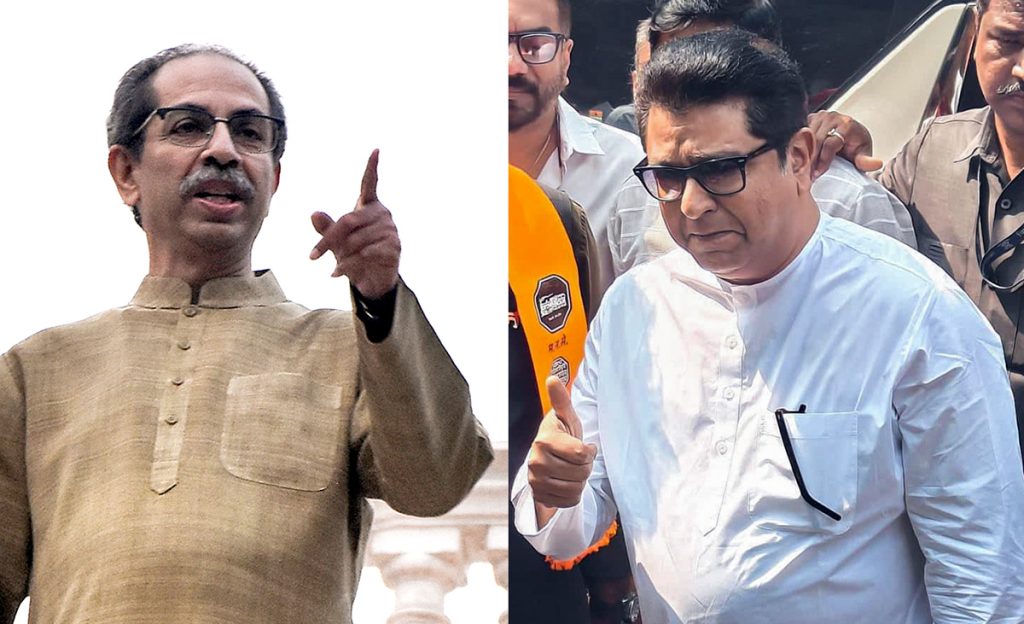
Speculation over a possible political realignment between Uddhav Thackeray’s Shiv Sena (UBT) and Raj Thackeray’s Maharashtra Navnirman Sena (MNS) is growing even though, as per Rajya Sabha MP Sanjay Raut, there is no formal tie-up yet. But talking to media persons, Raut admitted to pressure and demand from supporters and cadres for the two estranged Thackeray cousins to come together for the upcoming elections to the Brihanmumbai Municipal Corporation (BMC).
“I have not said that Shiv Sena and MNS are contesting local body elections together. I said there is pressure and demand from the public that the two parties should contest together. People believe that if the rights of the ‘Marathi Maanos’ are to be protected, then Uddhav Thackeray and Raj Thackeray must come together,” Raut was quoted as saying.
Significantly, he also indicated that the Uddhav side may not contest the upcoming civic elections as part of the INDIA bloc, which includes parties like the Congress and the Sharad Pawar faction of the NCP.
Can Thakeray cousins unite
The success of the recent show of unity against the imposition of Hindi in Maharashtra schools, overall language on the whole, has given hope to both sides.
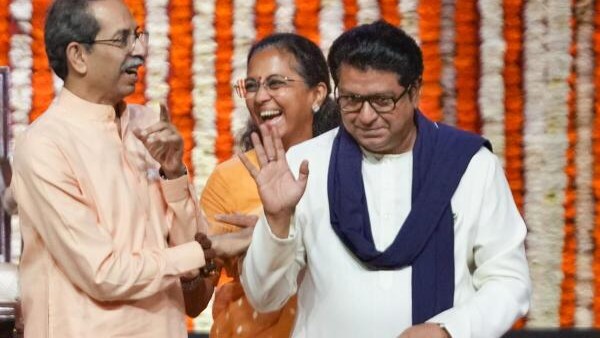
Last week, MNS supremo Raj Thackeray and cousin Uddhav Thackeray (Shiv Sena UBT) reunited after 20 years at a public rally in Worli, Mumbai, for an event called ‘Awaj Marathicha’—the Voice of the Marathi. The event was jointly organised by Shiv Sena (UBT) and MNS to mark the withdrawal of government resolutions related to the three-language policy in primary schools.
The Marathi issue has already become a major political issue in the state, giving jitters to both the ruling BJP-Shiv Sena-NCP Mahayuti as also Uddhav’s supporters in opposition.
Interestingly Maharashtra transport minister Pratap Sarnaik criticised his own government over the denial of permission for a Marathi rally on Mira Road and tried to join the protest, but was forcefully driven away by Thackeray loyalists, calling him a “traitor”. The Shiv Sena (Shinde) minister had broken ranks with his government to reach the protest site.
In November 2019, undivided Shiv Sena, undivided NCP, and Congress formed the government under a new alliance Maha Vikas Aghadi with Uddhav as the Chief Minister.
In June 2022, Uddhav resigned after a faction of MLAs led by Shinde split from Shiv Sena and allied with the BJP.
Shinde was sworn in as Chief Minister and Devendra Fadnavis as the deputy Chief minister. Later Ajit Pawar-led NCP MLAs also broke away and joined the ruling coalition.
While all local bodies are important, the elections to BMC will be the real test of Thackerays grassroots support. BMC is the richest civic body in India with a budget surpassing many small Indian states.
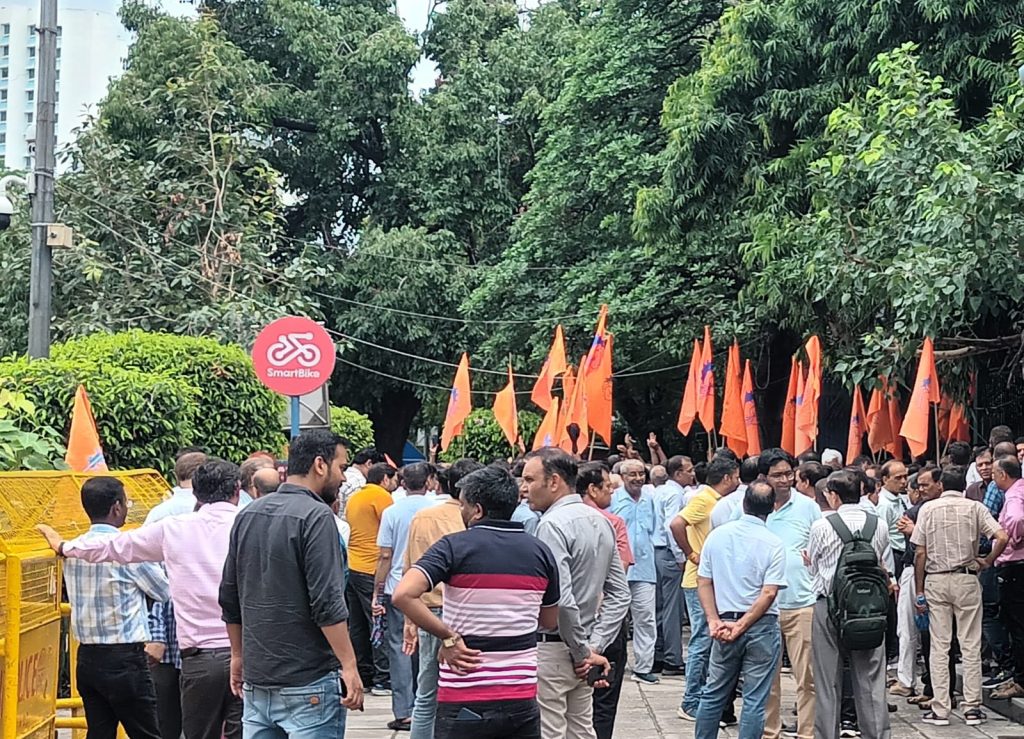
Mahanagar Telephone Nigam Ltd. (MTNL) Employees have demonstrated a protest at Sanchar Bhawan in New Delhi, demanding clarity on their future and employment amid the ongoing integration of MTNL services into Bharat Sanchar Nigam Ltd. (BSNL).
Employees protesting under the banner of MTNL Mazdoor Sangh and MTNL Executives Association have alleged that the BSNL was supposed to manage the services; but it has encroached the MTNL and shifted its around 700 crore revenue from MTNL to BSNL, leaving the MTNL with zero revenue and 3000 employees whose employment is uncertain.
Speaking to Tehelka.com, RP Tiwari, working president, MTNL mazdoor Sangh said,“On Jan 2025, all services of MTNL were shifted to BSNL, leaving around 3000 employees of MTNL in limbo. We have been getting half salary with zero perks which we used to get. There are people here who are yet to complete their 15 years tenure in the company, but now there is nowhere to go.”
On asking about the roadmap for the re-employment into BSNL, Tiwari said, “There is no formal information or assurance from any of the officials about our future and employment. Even as services are being moved, employees are being left behind in an empty-shell MTNL, a company has no revenue, only assets and loan liabilities.”
The unions say employee morale is collapsing, citing suspended HR benefits like promotions, financial upgrades and career progression opportunities.
A key demand is the withdrawal of a DoT order dated March 11, 2025, which unions claim disrupts existing employee entitlements.
Meanwhile the government has assured that it is actively assessing the plans for employees impacted by the transition.
Learning Education Ideas Insight Intelligence Study Concept
In a landmark development for India’s education system, the PARAKH Rashtriya Sarvekshan 2024, the largest-ever school-level assessment conducted in the country, has revealed significant improvements in foundational learning outcomes, marking a critical step toward achieving the goals of the National Education Policy (NEP) 2020 and Mission NIPUN Bharat.
Conducted by the National Assessment Centre, PARAKH (Performance Assessment, Review, and Analysis of Knowledge for Holistic Development) under NCERT, the survey assessed over 21.15 lakh students across 74,229 schools in all 781 districts spanning India’s 36 States and Union Territories. Targeting Grades 3, 6, and 9, the assessment offers a system-level baseline aligned with the key NEP 2020 stages, including Foundational, Preparatory, and Middle.
The most striking gains emerged at the foundational level. In Grade 3, 57% of students were proficient or above in Language and 65% in Mathematics, according to Item Response Theory (IRT) scores. These figures mark a sharp increase from 2021, when only 39% and 42% of students demonstrated similar proficiency in Language and Math, respectively.
The 2024 findings not only exceed pre-pandemic levels seen in the 2017 NAS (47% in Language, 53% in Math), but also indicate that India has effectively recouped learning losses at the foundational level caused by the COVID-19 pandemic.
According to the survey, state government schools emerged as top performers in Grade 3, indicating the early success of the NIPUN Bharat Mission, while Central Government schools dominated outcomes in Grades 6 and 9. Rural students slightly outperformed their urban counterparts in both Language and Math at the foundational level.
Gender-based trends showed girls slightly ahead in Language (65% vs 63%) but equal performance in Math (60%) in Grade 3. However, gender and urban-rural gaps persisted at the higher stages, highlighting the need for targeted interventions.
The report emphasizes that only Grade 3 scores are comparable across the 2017, 2021, and 2024 cycles, due to alignment with the NEP 2020’s revised school structure. Direct comparisons between older grades (such as NAS Grade 5 or 8) and current Grades 6 and 9 could lead to misleading conclusions about learning decline.
Beyond student performance, the survey gathered insights from over 2.7 lakh teachers and school leaders. Their responses shed light on factors affecting learning, including digital access, school environments, and student well-being. Notably, the report raised red flags over emotional stress among adolescents and limited access for Children with Special Needs (CWSN) — issues that demand urgent policy attention.
The improvement in foundational learning directly strengthens India’s performance on SDG 4.1.1, which tracks minimum proficiency in reading and math across three school stages. Several states — including Punjab, Himachal Pradesh, Kerala, Uttar Pradesh, and Madhya Pradesh — surpassed their previous performances, demonstrating the impact of sustained efforts in teacher training, curriculum reforms, and early-grade interventions.
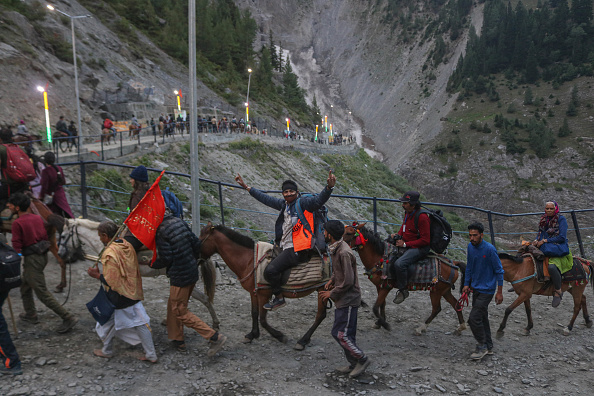
Hindu pilgrims ride horses during their pilgrimage to the cave shrine of Amarnath from a base camp near Baltal, east of Srinagar, Jammu and Kashmir, on July 3, 2025. The Amarnath Yatra starts on July 3 under an unprecedented security blanket after a terror attack in Pahalgam kills 25 tourists and a local pony handler. In response, the government deploys additional troops along the pilgrimage routes and cancels all helicopter services this year. The 45-day Himalayan pilgrimage to the sacred Shiva shrine takes place amid heightened India-Pakistan tensions following ‘Operation Sindoor’ and cross-border shelling, raising safety concerns for thousands of pilgrims. (Photo by Firdous Nazir/NurPhoto via Getty Images)
Srinagar: The annual Amarnath Yatra continues to witness a strong turnout, with over 1.28 lakh pilgrims having completed the pilgrimage in the past week. On Thursday, a fresh batch of 7,307 devotees departed from Jammu to join the Yatra in the Kashmir Valley.
According to officials, the pilgrims left from the Bhagwati Nagar Yatri Niwas in two separate, security-escorted convoys. The first convoy, comprising 137 vehicles and carrying 3,081 pilgrims, departed at 3:15 a.m. for the Baltal base camp. The second convoy, consisting of 147 vehicles with 4,226 pilgrims, left at 3:58 a.m. for the Nunwan base camp in Pahalgam.
The Shri Amarnathji Shrine Board (SASB) reported that, apart from those traveling via Jammu, a significant number of pilgrims are heading directly to the Baltal and Nunwan base camps for on-the-spot registration.
The India Meteorological Department has forecast rainfall across Jammu and Kashmir over the next 12 hours, with isolated spells of heavy showers and thunderstorms likely, particularly in parts of the Jammu region.
This year’s Yatra is being held under heightened security in the aftermath of the April 22 terror attack in Pahalgam’s Baisaran area. In response, security has been stepped up across the pilgrimage route, with the deployment of 180 additional companies of Central Armed Police Forces (CAPFs) alongside the Army, BSF, CRPF, SSB, and local police. Transit camps and roads leading to the cave shrine are under strict surveillance.
Local residents have extended their traditional hospitality to the pilgrims. On July 6, several people from Srinagar travelled to Nuner village, about 30 kilometres away, to offer cold drinks and water to returning Yatris, a gesture warmly received by the devotees.
The Yatra began on July 3 and will conclude on August 9, coinciding with Shravan Purnima and Raksha Bandhan. The holy cave shrine, situated at an altitude of 3,888 metres in the Himalayas, is accessible via two routes. The 46-kilometre traditional route from Pahalgam takes about four days on foot, while the shorter 14-kilometre Baltal route allows pilgrims to return the same day.
Active monsoon conditions will continue over central parts of the country during the next four to five days, according to the IMD
Heavy to very heavy rainfall with isolated extremely heavy rainfall (≥21 cm) has already been recorded over East Madhya Pradesh, Vidarbha and Tripura.
Heavy to very heavy rainfall (7-20 cm) has also been recorded at isolated places over West Bengal, West Madhya Pradesh, Chhattisgarh, Odisha, East Uttar Pradesh, Haryana; Heavy rainfall (7-11 cm) at isolated places over Jharkhand, Himachal Pradesh, Uttarakhand, West Rajasthan, West Uttar Pradesh, Coastal Karnataka, Mizoram and Meghalaya.
So far as the Delhi-NCR is concerned, the IMD says rains are expected to continue over Thursday and Friday.
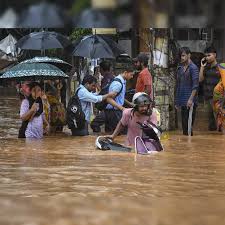
Offering relief from the heat but also leading to heavy waterlogging in many parts of the national capital, rains continued through the night with minimum temperatures ranging between 25–27°C.
However, the weather affected flight operations at Delhi’s Indira Gandhi International Airport with some flights being diverted to Jaipur and Lucknow and causing delays due to the bad weather
The weather office has predicted a generally cloudy sky with moderate to light rain, accompanied by thunderstorms and lightning, in Delhi until July 15.
Northwest India
According to the IMD, light to moderate rain, along with thunderstorms and lightning, is likely at most or many locations across the Western Himalayan Region and multiple places in plains over the next few days.
Isolated heavy rainfall is expected over east Rajasthan and Uttarakhand between July 10 and 15, Jammu and Kashmir, Punjab, Haryana, and Chandigarh on July 10, Himachal Pradesh on July 10 and again during July 13 to 15, west Uttar Pradesh from July 10 to 13, east Uttar Pradesh from July 10 to 11, and west Rajasthan from July 12 to 15.
Very heavy rainfall is also expected over Uttarakhand, Uttar Pradesh, Punjab, and Haryana on July 10, and in East Rajasthan between July 11 and 13.
Multiple systems at play
There are multiple systems at play in the country, currently
The western end of the Monsoon trough runs north of its normal position and its eastern end runs near its normal position at mean sea level.
A Low-Pressure area over Gangetic West Bengal & neighbourhood lies over Gangetic West Bengal adjoining Jharkhand. The associated cyclonic circulation extended upto middle tropospheric level. It is likely to move slowly west-northwestwards across Jharkhand and north Chhattisgarh.
An upper air cyclonic circulation over north Haryana and another over northwest Uttar Pradesh & neighbourhood in lower tropospheric levels.
A trough runs from northeast Arabian Sea to the cyclonic circulation associated with Low-Pressure area over Gangetic West Bengal & neighbourhood across south Gujarat Region, north Madhya Maharashtra, Vidarbha, south Chhattisgarh, Odisha in middle tropospheric levels.
A trough runs from west Assam to Telangana in lower tropospheric levels.
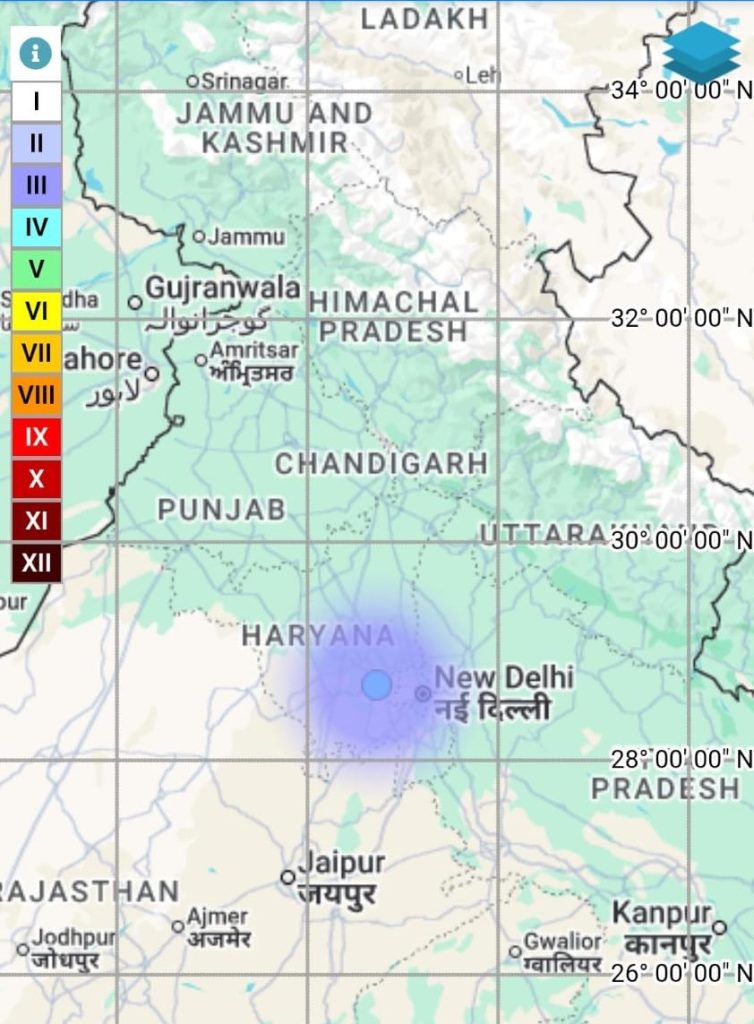
A 4.4 magnitude earthquake rocked the Delhi-NCR region around 9.04 AM IST on Thursday.
The earthquake originated from Jhajjar Haryana at 28.63 latitude and 76.68 longitude at a depth of 10 km, relatively shallow and in the mild category
The National Centre of Seismology said the earthquake was shallow and originated about 10 km below the earth’s surface.
Notably shallow earthquakes have greater capacity to cause damage but in this case the magnitude of the earthquake was not very strong.
There were also no immediate reports of any damage having been caused by the shallow tremblor
Delhi is prone to earthquakes and falls in Zone IV of seismically active areas of the country—the second highest category. In recent years, the region has experienced magnitude-4 earthquakes.
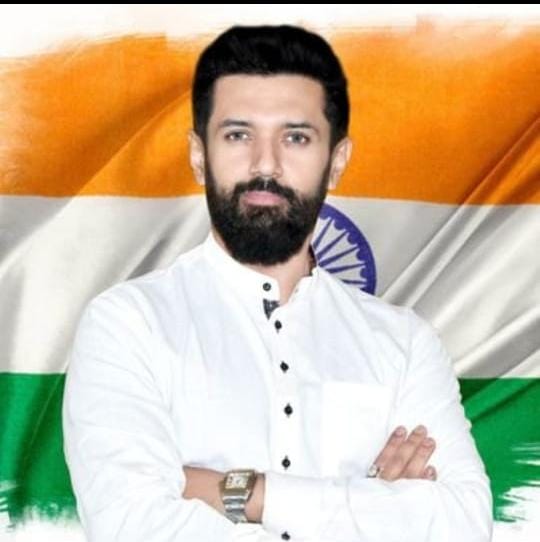
Trustees of SM Khan Foundation, Shahwar Mohammed Khan and Advocate Shahryar Mohammed Khan on Wednesday met Union Minister for Food Processing Industries Chirag Paswan to brief him on the newly setup foundation and details of its aims and objectives.
The SM Khan Foundation, a non-profit organisation established in memory of late S.M. Khan, a former bureaucrat who served as Press Secretary to late President APJ Abdul Kalam, is aimed to advancing education, improving access to medical care, and fostering community development, according to press statement
The Union Minister and the trustees of the foundation recalled the strong bond between late Ram Vilas Paswan and SM Khan and their shared values to work tirelessly in building a more prosperous, compassionate and united society.
They also extended best wishes to Chirag Paswan for the upcoming Bihar state elections, expressing confidence in his leadership and vision for the state’s progress. The Union Minister, in turn, motivated them to work for the initiative, emphasising the importance of such measures in creating a positive and lasting impact on society, according to the statement.
Maharashtra transport minister Pratap Sarnaik on Tuesday criticised his own government over the denial of permission for a Marathi rally on Mira Road and joined the protest, also daring the police to arrest him, according to reports
“The Marathi Ekikaran Samiti and several other organisations had applied for the rally, but were denied permission. I am going—if the police dare, let them arrest me,” Sarnaik was quoted as saying
Sarnaik was, however, forcefully driven away by the agitated Thackeray loyalists, calling him a “traitor”. Notably, the Maharashtra minister had broken ranks with his government to reach the MNS protest site.
MNS supremo Raj Thackeray and estranged cousin Uddhav Thackeray (Shiv Sena UBT) recently reunited after 20 years at a public rally in Worli, Mumbai, for an event called ‘Awaj Marathicha’—the Voice of the Marathi.
The event had been jointly organised by Shiv Sena (UBT) and MNS to mark the withdrawal of government resolutions related to the three-language policy in primary schools.
The Marathi issue has already become a major political issue, giving jitters to the ruling BJP-Shiv Sena-NCP Mahayuti as also Uddhav’s supporter Congress.
Language an emotive issue
Language is often a strong marker of identity and any perceived threat can trigger strong emotional responses, thereby making it a great political tool
After Tamil and Kannada, Marathi is at the centre-stage, one of the reasons could be the upcoming local bodies elections
Due to its close connection with identity and the cultural heritage in Maharashtra, Marathi is an emotive issue. Historical and political factors, including debates over language policy and the place of Marathi in education and public life, have only added.
But this is not the first time language has been a source of discontent
Earlier it was Tamil with Tamil Nadu Chief Minister MK Stalin objecting to the implementation of the National Education Policy (NEP) 2020. A section of the policy recommends that students learn three languages.
Stalin cited a number of reasons for not implementing the NEP, including that the three-language policy will lead to the imposition of Hindi
Then has also been this long-standing Karnataka-Maharashtra border dispute escalated by language issue.
Recently, tensions between Karnataka and Maharashtra escalated after a Karnataka state transport bus conductor in Belagavi was assaulted for not responding in Marathi. This resulted in Maharashtra bus driver’s being blackened in Karnataka’s Chitradurga.
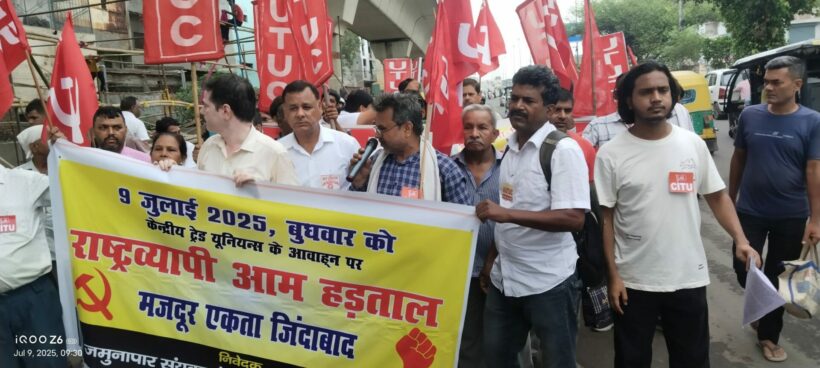
The Country witnessed a sweeping nationwide strike on Wednesday as lakhs of workers, farmers, and trade union members gathered and organized rallies against the central government’s economic and labour policies, terming them anti-worker and pro-corporate.
Exempting the essential services- like hospitals, pharmacies, airports, and metro rail etc, on call of 10 central trade unions, over 25 crore workers across India adopted the path of strike to raise their voice and grievances against the adamant attitude of the central government on 9th July, as claimed by the union leaders. This nationwide strike impacted banking, insurance, transport, and more services.
The trade unions in a joint press release claimed that more than 25 crores participated in the Strike action/Rasta Roko/Rail Roko all over the country in the formal and informal sectors, in Government, Public sector enterprises, and industrial areas. There were very large mobilisations in rural India and also at block-sub-division levels by informal sector workers, agricultural labour and farmers and other sections of common people. Participation of students and youth was quite visible in many states. The ranks and file of Samyukta Kisan Morcha and joint front of Agricultural Labour Unions played a significant role in the mobilisation in rural India.
The protest stresses on the 17-point demand charter, submitted last year to Union Labour Minister Mansukh Mandaviya. The trade unions claim that the government has failed to engage with their concerns and instead rushed through reforms that strip away labour protections, encourage privatisation, and intensify job insecurity.
Banking, Power, Transport, Railways and Education sectors have taken a hit across the country with their operations staying temporarily non-functional. Farmers have also joined the bandh.
Trade Union leaders and farmers leaders have claimed that the huge participation of the people in the all-India strike was a clear-cut rejection of the anti-people policies of the BJP Central and the state government of Haryana for not listening to the woes of ordinary people and rather embarking on blind pursuit of the policies of privatisation and simultaneously seeking to divide the people on communal and caste basis.
All India Kisan Sabha national Vice President and CPIM leader, Inderjit Singh divulged to Ground Post that the trade Union leaders have reminded the government to see the writing on the wall in the form of massive success of the all-India strike and withdraw the draconian labour codes forthwith. Leaders have exhorted the protesters to further strengthen their unity, involve more and more sections of the society reeling under price rise and employment and prepare for bigger actions in future.
Bhartiya Kisan Union Ekta Dakounda, Punjab Unit, supporting Bharat Bandh and strike call joined the gatherings of workers and employees in 14 districts.
Giving information to the press in this regard, the state president of the organization, Manjit Singh Dhaner, senior vice president Gurdeep Singh Rampura and general secretary Harnek Singh Mahima said that 25 crore workers and employees from all over the country raised their voice against the central government’s privatization policies, changing labour laws to implement four labour codes and increasing the daily working hours of the workers from eight to 12 hours by going on strike.
Why the strike?
This strike step follows long negotiations and failed talks between unions and government representatives related to Workers’ demands of withdrawal of new labour codes, job security, and better wages. To amplify the strike pace some Farmers’ organizations have also extended support. It is stated that this is the 22nd General Strike since the advent of neo-liberal policies in India in 1991.
The main demands include repeal of 4 labour codes, stop privatisation of the PSU’s and public services, end contractualization and casualization of employment and minimum wage of Rs.26000/month.
The major hammer hovering over the working class are the four Labour codes legalising contract labour based on hire and fire policy. The trade unions fear that once implemented, that will shatter not only the rights of the existing workforce but the entire new generations of workers in all sectors of the economy. The youth cannot dream of having access to formal employment with social security and retirement benefits. The right to 8 hours work will not sustain and new forms of slavery will be imposed on the working people under the guise of ease of doing business to facilitate corporate profiteering. Workers will lose the right to unionise, right to bargain for remunerative wage and right to strike. The 4 labour codes are most authoritarian and undemocratic in character and will eventually endanger the independence of the working people and sovereignty of the country. Hence it is vital for all the freedom loving citizens to join the fight to bury the labour codes once and forever.
The trade unions consider these labour codes as negation of the labour rights won over after the struggle of 150 years from British Raj onwards.
“These codes negate our right to strike, make union registration problematic, de-recognition of unions easy, the process of conciliation and adjudication cumbersome, winding up labour courts and introducing tribunal for workers, overriding power to registrars to de-register unions, definition of wage being changed and the schedule of occupations for minimum wages applicability being abolished, Occupational Safety and Health and Working Conditions code designed to put the right of safety of every worker and also rights and entitlements of workers in workplace in total jeopardy, the inspections exclusive putting the right of safety of every worker made in jeopardy, the inspections have been done away with and facilitators to facilitate employers is being brought, change in industrial code and its rule for increasing applicability-threshold from 100 to 300 would push out 70 percent of industries out of the coverage of labour laws, the changes in factory act also would throw out substantial number of workforce from its coverage, giving the employers class wide discretionary powers to repress and exploit”, divulging the effects of Labour codes in a press release at the closing time of the strike, trade unions claimed.
Why did the farmers’ unions support the strike?
Samyukta Kisan Morch (SKM) also supported the general strike and declared to rally in protest demonstrations at tehsil level across India independently as well as in coordination with the trade unions and agricultural workers unions. SKM states that these are critical policy requirements decisive to resist the corporatisation of the Indian economy and to protect the independence of India.
Farmers’ umbrella union, SKM warns that the General Strike is also against the imposition of free trade agreements on Indian people. US Imperialism has unleashed all efforts to coerce the Modi Government to impose unfair trade terms and to dump US agricultural products in India. The intention of the free trade agreement is unregulated freedom for US food chains, trading giants and agribusiness corporations to operate in India. Tariff free Import of huge quantity of highly subsidised milk and milk products, soybean, cotton, mice, wheat, rice, pulses, oilseeds, paddy, GM crops, fruits and vegetables including apple and walnuts, processed and canned foods into Indian markets will devastate the income and livelihood of Indian peasantry.
SKM alleges that the Trump Administration has been compelling the Modi Government to wind up PDS food distribution and withdraw all subsidies for farmers on fuel and fertilisers. It wants India to change its patent laws to suit American companies.
What irked the trade unions?
Noticing the dismissive and unresponsive approach of the central government, the Joint Platform of Central Trade Unions and Independent Sectoral Federations/Associations, while deciding the national strike, agreed to raise their voice unitedly and resolved, “Working hours are being unilaterally increased; statutory minimum wages and social security benefits are being flouted. Workers, particularly contract workers, are being retrenched with impunity. These are nothing but heinous attempts to implement notorious Labour Codes through backdoors. At the same time despite repeated persuasion by trade unions, the Govt did not bother to meet and consult the Central Trade Unions or to hold Indian labour conferences, despite receiving notices for strike from all corners of the country across the sectors.”
Now the trade unions have warned the government, “This is the beginning of the prolonged battle in the days to follow in the sectoral levels focussed on determined united resistance, again to culminate into a bigger national level heightened united action.”
However, the reports coming here state that the strike movement was organized peacefully by the participants, but the Communist Party of India (Marxist) alleges lathi charge at some places by the police forces.
In a statement released Wednesday, the Polit Bureau of CPIM contends, “Reports show that the police resorted to lathi charge in various places and attempts were made to intimidate workers from participating in the general strike. Braving all such attacks, the strike was held successfully. Kisan, agricultural workers and various sections of the people too joined the workers in solidarity and held protest demonstrations.”
The CPI(M) congratulated all the people who stood with the working class and made this general strike a huge success. The left party demanded that the BJP led central government should listen to the voices against the labour codes and its anti-worker policies. It should immediately rescind the amendments to the labour laws and protect the rights of the working class.
A total of nine people were killed and three injured on Wednesday when several vehicles fell into the Mahisagar River after a section of the Gambhira-Mujpur bridge in Padra Taluka of Gujarat’s Vadodara collapsed.
The bridge connects the Anand and Vadodara districts and the incident happened during peak morning traffic hours.
According to initial reports, four vehicles, including two trucks, a Bolero SUV, and a pickup van, were crossing the bridge when it suddenly crumbled.
Eyewitnesses said a loud cracking noise was heard moments before the vehicles dropped into the river. Fire brigade teams, local police, and members of the Vadodara district administration rushed to the spot and launched immediate rescue operations.
Padra MLA Chaitanyasinh Zala visited the site shortly after the incident.
Authorities have cordoned off the area to prevent further accidents and initiated a probe into the cause of the collapse.
Senior Congress leader Amit Chavda posted on social media, “The main Gambhira bridge connecting Anand and Vadodara districts has collapsed. Many vehicles have fallen into the river, and major casualties are feared. The administration must immediately carry out rescue operations and arrange alternate routes for traffic.”
Divers were continuing to search the river for any missing persons, and cranes had been brought in to retrieve the submerged vehicles.