Have a query about Covid-19? This book has an answer!

The book authored by the  two leading scientists of the country, Seyed  Ehtesham Hasnain and Arun Tewari,  focuses  on the  Covid 19  pandemic, with  all its  dimensions and hues and  forms.  A book review by Humra Quraishi

This  book  authored by the  two leading scientists of the country, Seyed  Ehtesham Hasnain and Arun Tewari,  focuses  on the  Covid 19  pandemic, with  all its  dimensions and hues and  forms.

Yes, as I read through this book, it got writ large that every aspect to the Covid 19 pandemic seems to be focused on. Written for the common man, it answers all those queries that we often think aloud: Why the infection hit the vital organs of one patient but spared that of the other? Why only minor symptoms surfaced in some whilst others were down by more than one symptom? What if in future a pandemic of this nature strikes? What is our collective future vis-à-vis this virus still hovering around …lurking? What are the chances of it striking yet again? Who all are to be blamed for this level of health disasters hitting this planet, destroying lives and livelihoods?

Actually this book has to be read to get answers to all possible doubts and apprehensions and the ground realities that exist today in the context of the virus and the dilemmas and tragedies spread around.

Besides  addressing the various aspects to the pandemic, what I found rather interesting is the  fact that the  authors  have taken the trouble of  researching and  brining to the fore, all aspects and details about the  past pandemics that hit mankind. “Though there had  been many  endemics in the 20th  century —Manchurian  plague in 1910,  United  States poliomyelitis in 1916, Russian Typhus during  1918-22, Indian Smallpox in 1974, West  African  meningitis in 1996, Malaysian Nipah  virus in  1998 — none of them crossed  national  boundaries,  leave aside  international boundaries…”

What makes this book very readable is that webbed and inter-webbed in, are many details of the human happenings. To quote one such ‘happening’ from the book – “In 1939, American journalist Katherine Anne Porter (1890 – 1980) published a novel ‘Pale Horse, Pale Rider’, brilliantly capturing the  human tragedy of the pandemic. The novel narrated a love story between a soldier of an occupying army and a woman who sold newspapers in the street with 1918  Influenza pandemic in the backdrop. The woman, Miranda, got infected and was cared for by the soldier, Adam. During her illness the woman ran high fever and got disoriented. By the time she recovered, Adam had succumbed to the infection, which most likely he got  while nursing her.”

Title of the book – DECODING THE PANDEMIC

Authors – Seyed Ehtesham Hasnain and Arun Tiwari

Publishers – Sakal Publications

Pages –  254

Price –Rs 599


A fast-paced historical fiction which will keep you on the edge

Dehra Dun-born and naturalized American research scientist Neerja Raman has now assumed a new avatar as an iconic storyteller. Her latest book The House on East Canal Road has been widely praised both by the critic and the literati alike. A book review by Raj Kanwar

THIS historical novel tells the story of three generations of the Chand family from 1905 onward when its hometown Dehra Dun with the rest of the country was in rebellion against the imperialist rule of the British government.  The businesses owned by the family patriarch Kishan Chand were then the largest employer in the valley. His forte was in the designing and construction of canals particularly in consonance with Dehra Dun’s unique topography and ambience. His own expansive house on East Canal Road that sat on two lush acres was both a source of envy and admiration in equal measure.

A lingering tragedy in Kishan Chand’s life was the death at child birth of his dearest wife, Radha. The son born was named Ishaan, but there was no happiness in Kishan Chand’s life. He lost interest in business, and listlessly spent his days. Unable to live without Radha, Kishan Chand left Dehra Dun to spend some time with his friend Moti Lal, a leading Allahabad lawyer who had just then become father of a girl named Leela. Then there in Allahabad, the two friends became prospective in-laws; Moti Lal agreeing to marry his newly-born daughter to Kishan Chand’s son who was then just about four. The Gauna was to be performed several years later when the daughter is physically and emotionally mature enough.

Raman has written a fast-paced story with many twists and turns that keeps the reader guessing what happens next. The family’s personal struggles are seamlessly woven into the turbulent landscape of emerging India from 1900-1947 and the historical context is a perfect background on how to overcome challenges by staying true to yourself. Raman has also captured the emergence of the Indian educated middle class and its role in bringing together people of different ethnicities and religions. There is a lot to learn in this slim novel and even more to love.

Neerja was born and raised in Dehra Dun. Her father Prof. KC Gupta had taught Chemistry both at the DAV College and the Doon School. Neerja too has had her education at the Doon School, and later at the Delhi’s famed Miranda House. Essentially, a research scientist, Neerja was inducted into the Women in Technology International (WITI) Hall of Fame for her leadership and mentoring women in workplaces. Her debut fiction Moments in Transition had garnered awards in the Literary Fiction category. She had retired from Hewlett-Packard Labs as a Director in 2006, and as a Distinguished Visiting Scholar at Stanford University in February 2022. She and her husband Vasan Raman now live in Los Altos Hills in California.


Title:                The House on East Canal Road

Author:            Neerja Raman

Publisher:        ARCHWAY Publishing

Pages: 174

Price:   $13.99 /Rs.939


Egypt approves India as wheat supplier: Piyush Goyal

New Delhi:  Commerce and Industry Minister Piyush Goyal on Friday said Egypt, which is one of the largest importers of wheat from Ukraine and Russia, has approved India as a wheat supplier.

There is a sharp decline in availability of wheat in the global markets due to the ongoing conflict between Russia and Ukraine. Both the nations are major producers and exporters of wheat.

Egypt imported wheat worth about USD 1.8 billion from Russia and USD 610.8 million from Ukraine in 2020.

The African nation is looking to import 1 million tonne of wheat from India and would need 2,40,000 tonne in April.

Indian farmers are feeding the world. Egypt approves India as a wheat supplier. Modi Govt. steps in as the world looks for reliable alternate sources for steady food supply. Our farmers have ensured our granaries overflow and we are ready to serve the world, Goyal said in a tweet.

India’s wheat exports increased to USD 1.74 billion in April-January 2021-22 as against USD 340.17 million in the same period last year.

In 2019-20, wheat exports were worth USD 61.84 million, which rose to USD 549.67 million in 2020-21.

India’s wheat exports are mainly to neighbouring countries with Bangladesh having the largest share of more than 54 per cent in both volume and value terms in 2020-21. It has entered new wheat markets such as Yemen, Afghanistan, Qatar and Indonesia.

The top ten countries importing Indian wheat in 2020-21 were Bangladesh, Nepal, the United Arab Emirates, Sri Lanka, Yemen, Afghanistan, Qatar, Indonesia, Oman and Malaysia.

India accounts for less than 1 %  in the world’s wheat export. However, its share has increased from 0.14 %  in 2016 to 0.54 %  in 2020. India is the second largest producer of wheat with a share of around 14.14 per cent in the world’s total production in 2020.

India produces around 107.59 million tonne of wheat annually while a major chunk of it goes towards domestic consumption. Major wheat growing states in India are Uttar Pradesh, Punjab, Haryana, Madhya Pradesh, Rajasthan, Bihar and Gujarat.

India logs 949 new coronavirus infections in last 24 hours

New Delhi India logged 949 new coronavirus infections taking the total tally of COVID-19 cases to 4,30,39972 while the active cases rose to 11,191, according to the Union Health Ministry data updated on Friday morning at 8 am.
The death toll climbed to 5,21,743 with 6 new fatalities.

As per union health ministry The active cases comprise 0.03 %  of the total infections, while the national COVID-19 recovery rate remained at 98.76 %. An increase of 133 cases has been recorded in the active COVID-19 caseload in a span of 24 hours.

Daily positivity rate was recorded as 0.26 % and the weekly positivity rate as 0.25 %, according to the health ministry.

The number of people who have recuperated from the disease surged to 4,25,07,038 while the case fatality rate was recorded as 1.21%.

The cumulative doses administered in the country so far under the nationwide COVID-19 vaccination drive has exceeded 186.30 crore.

India’s COVID-19 tally had crossed the 20-lakh mark on August 7, 2020, 30 lakh on August 23, 40 lakh on September 5 and 50 lakh on September 16. It went past 60 lakh on September 28, 70 lakh on October 11, crossed 80 lakh on October 29, 90 lakh on November 20 and surpassed the one-crore mark on December 19.

The country crossed the grim milestone of two crore on May 4 and three crore on June 23 last year

The six new fatalities include five from Maharashtra and one from Mizoram.  A total of 5,21,743 deaths have been reported so far in the country including 1,47,826 from Maharashtra, 68,402 from Kerala, 40,057 from Karnataka, 38,025 from Tamil Nadu, 26,158 from Delhi, 23,499 from Uttar Pradesh and 21,200 from West Bengal.

Union health ministry stressed that more than 70 % of the deaths occurred due to comorbidities.
“Our figures are being reconciled with the Indian Council of Medical Research,” the ministry said on its website, adding that state-wise distribution of figures is subject to further verification and reconciliation.

Murder mystery of 5 years old Jash solved within 48 hours

KARNAL : Police solved murder mystery of five years old Jash strangled to death by his aunt Anjali with the wire of her mobile phone battery charger was solved by police within 48 hours. The body of victim child reported missing was recovered lying on the window shed of a near by house in the area hardly after 20 minutes. According to FSL team arrived at the spot for investigation the cause of death of innocent child due to strangling. Police also recovered blood oozing from victim’s neck.\Ganga Ram Poonia SP constituted an STI led by Himadri Kaushik ASP along with two CIA teams to investigate murder. Investigation revealed, Jash went to his aunt Anjali’s house  nearby along with his nearly seven years old sister to play as usual who returned home after some time leaving Jash alone. Information revealed Anjali was a psycho patient since past sometime having treatment at the civil hospital as well in a private hospital at Panipat and was frequently seen suffering from mental tension when Anjali was seen involved in abnormal activities in the state of depression and a couple of times she attempted to cut her arm nerve with sharp knife  and many times she had broken her mobile phone in the state of depression.  Investigating team also sought help of a panel of doctors and psychologists found Anjali also pregnant.    However, police solved murder mystery within hours. Anjali residing at Indri was married to a youth Vikas resident of Karnal about three years ago with whom she was in love affairs  and the couple was trying to settle abroad since after their marriage but their desire could not be fulfilled for one reason or other. Meanwhile, she was often seen in the state of depression. Investigation revealed, Anjali when watching a crime show on U-tube in which she saw how a child in a killing scene was strangled to death with the help of wire of mobile phone battery charger when under the influence of depression she lost sense and killed Jash in the same way in-spite of the fact innocent child attempted a lot to save his life. According to STI report, after killing child, on seeing blood spots Anjali returned to conscious but it was too late. She tried to hide dead body and immediately contacted her husband Vikas to reach immediately. Anjali told everything to his brother-in-law Rajesh and his wife Dhanwanti seeking help to dispose off deceased’s body and destroy murder evidences when body of the child was thrown in another nearby house. But Anjali was arrested by police, which also arrested Rajesh and Dhanwanti allegedly trying to finish evidences. During search police also recovered Jash’s shoes lying in waste bucket.  Large number of residents of area demanding immediate action against accused blocked highway when police also arrested five protestors, however later released. Ganga Ram Poonia SP Karnal assured that police have yet to receive forensic report and all those involved in crime will not be spared at any cost.   

CNG price hiked by Rs 2.5 per kg, piped cooking gas by Rs 4.25

New Delhi: Prices of CNG in the national capital on Thursday were hiked by Rs 2.50 per kg and that of piped cooking gas by Rs 4.25 per unit to record levels on the back of surge in raw material cost.
CNG in the national capital territory of Delhi now costs Rs 71.61 per kg, up from Rs 69.11 per kg, according to the information posted on the website of Indraprastha Gas Ltd (IGL) — the firm which retails CNG and piped cooking gas in the national capital and adjoining cities.

This is the third price hike this month and the 11th since March 7.

In all, the CNG price has risen by Rs 15.6 per kg in less than six weeks. This includes a Rs 7.50 per kg hike in this month alone.

In the last one year, prices have increased by Rs 28.21 per kg or 60 per cent, according to data compiled by PTI.

Alongside, the rates of gas piped to household kitchens, called piped natural gas (PNG), were hiked by Rs 4.25 per cubic meters to cost Rs 45.86 per scm.

City gas distributors have been periodically raising prices since October last year when domestic as well as international gas prices started to climb as economies world over recovered from the pandemic-induced slowdown.

Prices rose by Rs 8.74 per kg in the last three months of 2021, and from January there was a steady increase of about 50 paise a kg almost every week.

The rates have gone up after the government more than doubled the price of natural gas to USD 6.1 per million British thermal unit from April 1.

Natural gas when compressed becomes CNG for use as fuel in automobiles. The same gas is piped to household kitchens and industries for cooking and other purposes.

On Wednesday, Mahanagar Gas Limited (MGL) raised Compressed Natural Gas (CNG) price by Rs 5 per kg to Rs 72 per kg in Mumbai. It also raised PNG price by Rs 4.50 to Rs 45.50 per scm.

Prices vary from city to city depending on the incidence of local taxes such as VAT.

The increase in CNG prices follows a Rs 10 per litre hike in petrol and diesel prices in 16 days and a Rs 50 per cylinder raise in the cooking gas LPG rates.

A record 137-day hiatus in petrol and diesel price revision ended on March 22. On the same day, the price of a 14.2-kg LPG cylinder was increased to Rs 949.50 in the national capital. In some places, the LPG price has touched Rs 1,000 per cylinder.

Petrol and diesel prices have been on a freeze for the last eight days. The last price revision took place on April 6.

According to IGL, CNG will now cost Rs 74.61 per kg in Noida, Greater Noida and Ghaziabad and Rs 79.94 per kg in Gurugram, the cities adjoining Delhi.

PNG in Noida, Greater Noida and Ghaziabad will now cost Rs 45.96 per scm and Rs 44.06 in Gurugram.


Minimum temperature in Delhi settles above normal

New Delhi:  Delhiites woke up to a warm morning as the minimum temperature of the city on Thursday was recorded at 26.2 degrees Celsius, five notches above normal even as the weather office predicted strong winds during the day.

The weather office also predicted that heatwave conditions are unlikely in the city for the next three days.
Strong surface winds will sweep across the region during the day time on Thursday. The maximum temperature of the day is likely to hover around 40 degrees Celsius, officials of the India Meteorological Department (IMD) said.

The maximum temperature of Wednesday has settled at 40.6 degrees Celsius, five notches above the season’s average.

The relative humidity at 5.30 am was 35 per cent, the IMD said.

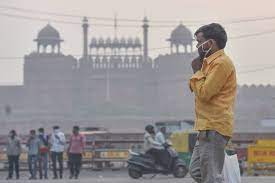
Delhi’s air quality was in the poor category as the air quality index value stood at 273 at 9.05 am, the Central Pollution Control Board data showed.

An AQI between zero and 50 is considered good, 51 and 100 satisfactory, 101 and 200 moderate, 201 and 300 poor, 301 and 400 very poor, and 401 and 500 severe.

PM Modi pays tribute to Dr Babasaheb Ambedkar on his Birth Anniversary

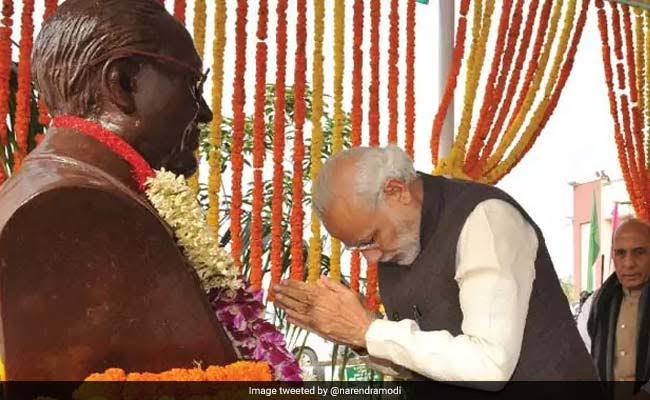
New Delhi: Prime Minister Narendra Modi on Thursday paid tributes to B R Ambedkar, the key architect of India’s Constitution, and said his ideas for the welfare of Dalits, the downtrodden and deprived sections of society are an inspiration for his government.

He said Ambedkar has made indelible contributions to the country’s progress. Modi joined a host of dignitaries, including President Ram Nath Kovind, Vice President M Venkaiah Naidu and Lok Sabha Speaker Om Birla, in Parliament to pay floral tributes to Ambedkar.

The prime minister said his government’s schemes have been executed keeping in mind the poor’s interests.

“Our government has set many benchmarks in the field of social justice,” he added.

Born in Maharashtra in a Dalit family in 1891, Ambedkar was a jurist and economist who played an important role in India’s freedom movement.

Ambedkar championed the cause of the Dalit community which faced deep-rooted discrimination. He was also India’s first law minister.

“Tributes to Dr Babasaheb Ambedkar on his Jayanti. He has made indelible contributions to India’s progress. This is a day to reiterate our commitment to fulfil his dreams for our nation,” Modi said in a tweet.

Active COVID-19 cases in country rise to 11058

New Delhi India logged 1,007 new coronavirus infections, taking the total tally of COVID-19 cases to 4,30,39,023, while the active cases rose to 11,058, according to the Union Health Ministry data updated on Thursday morning at 8 am

The death toll climbed to 5,21,737 with one fatality reported from Maharashtra,

The active cases comprise 0.03 %  of the total infections, while the national COVID-19 recovery rate remained at 98.76 %, the health ministry said. An increase of 188 cases has been recorded in the active COVID-19 caseload in a span of 24 hours.

The daily positivity rate was recorded as 0.23 % and the weekly positivity rate was recorded as 0.25 per cent, according to the health ministry.

The number of people who have recuperated from the disease surged to 4,25,06,228, while the case fatality rate was recorded as 1.21 % .

The cumulative doses administered in the country so far under the nationwide COVID-19 vaccination drive has exceeded 186.22 crore.

India’s COVID-19 tally had crossed the 20-lakh mark on August 7, 2020, 30 lakh on August 23, 40 lakh on September 5 and 50 lakh on September 16. It went past 60 lakh on September 28, 70 lakh on October 11, crossed 80 lakh on October 29, 90 lakh on November 20 and surpassed the one-crore mark on December 19.

PM Modi pays tribute to martyrs of Jallianwala Bagh

Prime Minister, Narendra Modi has paid tributes to those martyred in Jallianwala Bagh on this day in 1919. PM Modi has also shared his last year’s speech at the inauguration of the renovated complex of Jallianwala Bagh Smarak.

In a tweet, the Prime Minister said ; Tributes to those martyred in Jallianwala Bagh on this day in 1919. Their unparalleled courage and sacrifice will keep motivating the coming generations. Sharing my speech at the inauguration of the renovated complex of Jallianwala Bagh Smarak last year https://t.co/zjqdqoD0q2″

MOST POPULAR

HOT NEWS