Meet the forest warriors of Nayagarh

In Kodalpalli village of Odisha, women have carried on a revolution for forest conservation since 1999. Their dedication paid off after the village received community forest resource rights last year under the Forest Rights Act, 2006,  writes Deepanwita Gita Niyogi

Climbing atop the bare rocky surface seemed an impossible feat in the heat of August, which is incidentally the peak monsoon season in India. But rainfall which brings instant relief on a hot day was a distant dream.

Around midday, 10-12 women armed with bamboo sticks, locally called thengapali, started the arduous climb. Some of them inadvertently showed their slipper-clad feet adorned with alta, a red dye usually applied by married women in India.

“All of us climb this hillock to take a look at the dense forest surrounding it. None of us fears falling down and getting hurt,” said Kaushalya Pradhan.

Welcome to Kodalpalli, a tribal village in Ranpur block of Odisha’s Nayagarh district, about two hours’ drive from state capital Bhubaneswar. Here, women have carried on a revolution since the 1990s to protect the forest which provides them sustenance. The fight started seven years before the historic Forest Rights Act, 2006 was passed. The Act allows tribal communities and forest dwellers rights over forest resources.

Guide Susanta Kumar Dalai, who works for non-profit Vasundhara which focuses on the conservation of forest resources for food security of communities, informed that forest in this part of the world has survived due to the prolonged fight put up by these bravehearts.

“The women patrol the forest on a rotational basis. Instead of men, they took up the responsibility of protecting the forest,” Dalai said.

Owning the forest

Reaching the top after a few minutes yielded a view of hills and lush forests. Some of the women started looking for things they wanted to gather like edible mushrooms which is usually savoured during monsoon in rural households. A few also brought over peacock feathers. The women informed that the birds are frequently spotted thanks to their conservation efforts.

In Ranpur block, women’s participation in forest conservation has been on since 1980s. In several villages like Kodalpalli, women have struggled despite odds to emerge victorious.

Their dedication paid off when the villages of Kodalpalli and neighbouring Sinduria received the community forest resource rights (CFRR) in September 2021 over 760.20625 acres. Of this, reserved forest is on 706.67625 acres and gramya jungle (land reserved for village forest) covers 53.53 acres. The CFRR claim was made in 2008, two years after the Forest Rights Act was passed. Under CFRR, a village is given the legal right to manage a forest land which it has been traditionally using for years.

At the village community centre, Kaushalya Pradhan informed that women were drawn into forest management in Kodalpalli in 1999 after the men failed in their duty to protect an important resource.

“The timber mafia was dominant and our forest wouldn’t have survived had we not intervened. Men came from outside and did not show any scruple in felling trees. It led to food and firewood shortage. To take control, a meeting was organised in the village where it was decided to pass the baton to women,” Pradhan said.

The women of Kodalpalli carry out joint protection of the forest along with Sinduria. After a group comes back from their duty by late afternoon, it leaves the bamboo sticks at common points to be picked up by those who would visit the forest next. Many of them belong to the Kondh Adivasi community.

The success story of Kodalpalli is laudable at a time when in several parts of India, rural communities are still struggling for the recognition of rights under the Forest Rights Act.

Praising the women, Vasundhara executive director Giri Rao said there is also another side to the struggle. “Because of forest protection duty, the women feel burdened. They have to cook and clean their houses as men usually avoid household work. Instead of waking up at 5 am, many women are now up by 3- 4 am to finish their daily chores. Usually, they go in the morning and return by 11am and then resume again after a brief rest in the afternoon.”

Rina Pradhan prepares meal for the family and sends over her two sons to school before going to the forest about a kilometre away. Sometimes, she and her friends gather on the hilltop and offer prayer for good rains.

Her companion Pramila Pradhan said the women continued their struggle hoping for a better future. “After receiving the CFRR title, the fear of being prevented from visiting the forest has subsided. Earlier, the forest department staff used to prevent us sometimes.”

Towards a better future

As Kodalpalli has received CFRR, the women are gearing up to prepare a management plan for future. Rules and regulations regarding forest protection are being finalised.

The title will benefit them in many ways. Earlier, cashew collection was controlled by the government-owned Odisha State Cashew Development Corporation Limited. “It did not allow people to participate in the auction. Cashew is a decent livelihood option in an area where mostly paddy is grown in monsoon due to the lack of irrigation facilities,” said Ashok Parida who works for Vasundhara as a district coordinator and is based in Nayagarh.

Parida added that the corporation initially promised the involvement of the women in cashew collection and auction but later went back on its words by taking the entire produce outside. Auction started around 1985. But now the women are in control.

As cashew trees come under the CFRR area, ownership now rests with the people of Kodalpalli. In 2021, the earning from cashew stood at about Rs 2 lakh and this year it has been Rs 1.5 lakh. Sinduria has 2.70 acres of cashew plantation and Kodalpalli 50.83 acres. The corporation has been developing cashew plantations since 1999-2000 in Odisha. In the Khurdha forest division of which Nayagarh is a part, there are 146 plantations spread over 6720 hectares according to Right to Information Odisha.

Besides income from cashew, the women are also planning to do something meaningful with bamboo, besides selling plates made from Siali and Sal leaves for income generation.

As women are sidelined in decision-making processes in India’s rural areas, the battle over forest resources in Kodalpalli is a fine example of female empowerment. In tribal communities, collection of minor forest produce forms a major part of livelihood throughout the year. It is mostly women who enter forested areas to collect mushroom, mahua flowers, leafy greens and Siali leaves. Thus, control over forest is linked to women’s economic and social well-being.

In many villages of Nayagarh, communities themselves came forward to protect forests. The reason was that post-independence, management by the forest department was poor and the rate of deforestation increased. The department restricted people from entering reserved forest areas, fined them and even slapped cases. Thus, communities faced problems in accessing firewood and grazing lands.

Independent researcher Tushar Dash, who works on forest rights, said as many as 60 villages in Nayagarh have received titles under community rights and community forest resource rights or CFRR in short. “In many villages, communities felt an acute scarcity of resources. So, they started forest protection in an organised manner which was somewhat informal in nature. It is remarkable how these women carried on with their struggle, created legal knowledge and took part in forest mapping. Now that they have legal representation and participation, forest governance will only get strengthened.”

The story was covered in collaboration with the International Women’s Media Foundation based in Washington, D.C.




It’s time to boycott the ‘boycott Bollywood’ trend

Those who join the Boycott cinema call with a herd mentality don’t realise that Bollywood does not comprise only stars. An estimate places those directly involved in the Indian entertainment industry at 850 thousands and those indirectly affected at 2 million, writes Amitabh Srivastva

In 2022, Akshay Kumar, who boasts of being the biggest income-tax payer in the country gave three big flops, all belonging to different genres.

Bachchan Paandey was a masala comedy; Samrat Prithviraj was a period drama; while Raksha Bandhan was a family drama.

Same was the fate of Lal Singh Chadha starring Aamir Khan and Kareena Kapoor and is called the biggest loser as far as Aamir Khan (Mr.Perfect) is concerned whose films are eagerly awaited both by the elite and masses.

But the irony is that Kangana Ranaut, four time National Award winner who started this boycott movement in 2020 after the suicide of Sushant Singh Rajput, has had three massive flops in Panga, Thalaivii and now with Dhakkad, she joins the top failures of 2022 whose figures of ticket collection are reported to be less than Rs 4000 and the slick high action drama had to be taken off theatres.

The boycott trend is not new to the world actually. We in India boycotted British goods and made a bonfire of foreign clothes on the call of Mahatma Gandhi.

In independent India too, the boycott of politicians, theatre artistes, stand up comedians, cricketers and cinema has been significant.

There was a time when the houses of cricketers were stoned by mobs after India lost a cricket match to Pakistan.

But today with almost every individual holding a mobile in his hand, the boycott, trolling and abuse of film stars has become the most favourite pastime because they are the most vulnerable lot as no one dares speak out for them.

The sole exception being 2010 when the Shiv Sena had given a call to stop the screening of  ‘My Name is Khan’ and called for its boycott.

The trigger for this was that Shahrukh Khan had supported the inclusion of Pakistani players in the IPL.

Rahul Gandhi, the then Congress president took it as a personal challenge from the Shiv Sena led by Bal Thackerey and travelled in the local trains on Mumbai to ensure that theatres were not closed by the protesting mobs of the Shiv Sena on the day of the release.

In 2020, the suicide of Sushant Singh Rajput triggered one of the worst hate movements on the social media and supported by some loud TV anchors it called for the boycott of all

prominent film personalities accused of promoting nepotism for denying roles to the young and promising stars like Sushant Singh Rajput.

Prominent names that were targeted included Shahrukh, Salman Khan,Karan Johar, Mahesh Bhatt and by inference Alia Bhatt, Pooja Bhatt etc.

Some of the worst abuses on social media were reserved for the Big B. His fault: he did not speak out on the SSR suicide but in the same breath the trolls abused him and his family in the vilest terms for not welcoming the establishment of the Ram Temple at Ayodhya. Is there a connection between the two topics? I don’t k know!

Leading the charge from the front was Kangana Ranaut with her critics alleging she was hankering for a political position though none of that has happened so far.

In the same wave Deepika Padukone became an enemy of the people because when she went for the promotion of her film Chapaak to Delhi she was persuaded to address a student gathering at JNU. The film bombed.

In that same boycott wave, people like Naseeruddin Shah, Javed Akhtar, Swara Bhaskar, Anurag Kashyap and Tapsee Pannu were heavily trolled because they were supporting the students of JNU who were protesting against the CAA.

It’s been more than two years since SSR died and today neither his parents nor his vocal sisters are ever heard talking about his death.

Actually, the more the investigations the more the unsavoury aspects of SSR’ s personal life started tumbling out. It was disclosed how he was a drug addict and how he changed his girlfriends every year.

The boycott call is a Frankenstein. It devours it’s own creators.

Till two years back we knew who the victims were and why. There was an ideology of hate and bigotry towards what is called the liberals or seculars.

Most of those who spoke out against the killing of people for eating beef or protested against intolerance of the ruling regime bore the brunt of the virulent trolls.

Aamir Khan became a target because he said his wife was afraid of living in India.

In 2024, no one knows why they are boycotting Bollywood. On the chopping list are Arjun Kapur, Ranbir Kapoor, Aamir Khan, Akshay Kumar and the irony of ironies Kangana  Ranaut who does not leave any chance of having a go at star kids for promoting nepotism.

However the patience of film stars is now wearing out.

Arjun Kapoor says, “I think we made a mistake in being silent and that was our decency.”

This reaction also led to a strange phenomenon where pictures of prominent film stars were posted on the social media holding banners saying,”Boycott people.”

But fact-checkers found out that these were doctored pictures of protests against the rape of a minor girl in Kathua by some prominent Hindu leaders including the temple priest.

Those who join the Boycott cinema call with a sadist pleasure are the same who are happy that railway concessions to senior citizens have been abolished.

These people with mobiles in their hands joining the herd mentality don’t realise that entertainment industry does not comprise only Shahrukh Khan,Aamir Khan, Salman Khan,Amitabh Bachchan, Deepika Padukone, Kangana Ranaut, Alia Bhatt but involves thousands who are dependent on it for their day to day living.

An estimate of 2019 places the numbers of those directly involved in the Indian entertainment industry including cinema, TV, serials and now the OTT platforms at 850 thousand and those indirectly affected at 2 million.

But things are definitely changing with       ‘ Brahmastra’ starring Ranbir Kapoor and Alia Bhatt produced by Karan Johar.The film which has been in the making for several years has finally bucked the trend of empty theatres.

One could say this was a gift from the public to the newly-weds, one of the most loved couples in Bollywood whose marriage was eagerly awaited by their fans.

Even though boycott Ranbir Kapoor did trend for sometime due to a comment he had made about eating beef 4 years ago, thankfully the word of mouth publicity from those who went to watch the film at the theatres has worked.

Alia Bhatt, also part of the so-called nepotism lobby, has proved a lucky mascot for the entertainment industry in this dismal scenario as Brahmastra has already crossed the 350 crore landmark and running.

Her hold on audiences was also reflected in the recent release of her first directorial venture ‘Darlings’ where she plays a revengeful wife who cannot stand domestic violence and decides to give her husband a taste of his own medicine.

Such was the horror of the males in India that they started a boycott Alia trend against the film. But not only did she withstand it, her next film Brahmastra went on to break the 300 crore bar.

Talking of boycott, actually all journalists should ‘boycott’ the recently released  Chup:Revenge of an artiste directed by R Balki.

The film shows a psychopath who is a fan of late Guru Dutt killing all film critics in the most gory way possible because they do not understand the craft and the hard work that goes into making films like Kagaz ke Phool or Pyasaa that were panned by film critics when they were made.

But Balki is sure that there was nothing like  boycott Bollywood.

Talking about it he said in an interview,”It is rubbish. It is a lovely theory to have. Few films flopped and propel love to fill columns. When success happens they will have entertainment again and they will write ‘The rise and rise of Bollywood.’


Punjab CM announces to give major push to agriculture allied activities in state

Ferozepur: Punjab Chief Minister Bhagwant Mann said that the state government will give a major push to the agriculture allied activities for supplementing income of the farmers.

The Chief Minister, while addressing the gathering after dedicating Verka milk plant with capacity of processing one lakh litre milk, said that it is the need of hour to bail out farmer from crisis. He said that due to increasing agriculture inputs and diminishing returns the agriculture is no longer a profitable venture. Bhagwant Mann in such scenario the allied activities can bail out the farmers.

The Chief Minister said that it will reduce the dependence of farmers only on fields. He said that this project constructed at cost of Rs 15 crore will give major push to diary farming sector. Bhagwant Mann said that besides giving impetus to dairy farming it will also help in checking the supply of spurious milk in state.

The Chief Minister further said that another such plant with capacity six times more than this plant is coming up at a cost of Rs 100 crore in Ludhiana. He said that it will be too dedicated to people soon. Bhagwant Mann said that stringent quality check is also being introduced in these plants.

The Chief Ministed asserted that upgradation of the procurement infrastructure is the need of hour to ensure best quality of milk is collected from villages and then is supplied to consumers after processing. Bhagwant Mann envisioned that Milkfed will usher brand Verka to new horizons, where sole mantra shall be inclusive growth of all. Bhagwant Mann unequivocally said that the sole aim of his government is to extend maximum support and best prices to the dairy farmers of Punjab by following the true essence of cooperation.

The Chief Minister also asserted that farmer friendly schemes should be implemented so as to boost the dairying business amongst the youth so as to make them financially independent and self reliant. Bhagwant Mann also said that the Verka products like ghee, milk, curd, kheer and others have huge potential across the globe. He said that supply of Verka in Delhi is 30, 000 litres which will be enhanced to 2 lakh litres very soon.

Race for Cong prez: MallikarjunKharge ,ShashiTharoor& Jharkhand’s K NTripathi in fray

New Delhi: The stage was set on Friday for a contest between MallikarjunKharge and ShashiTharoor for the Congress president’s post with the Dalit leader from Karnataka emerging as the clear favourite.

The third candidate in the fray, K N Tripathi, a former minister in Jharkhand, is considered a lightweight for the contest.

Kharge, Tharoor and Tripathi filed nominations on the last day which saw the AICC headquarters come back to life after long, with workers swarming the complex.

Two bus blasts in Jammu and Kashmir’s Udhampur

Two blasts have hit passenger buses in Jammu and Kashmir’s Udhampur. The second blast occurred at 10:45 pm on a bus at Domail chowk near a petrol pump.

However, the blasts occurred in empty buses when they were parked. Still two people were injured

Other nearby vehicles were also damaged in the blast. The injured were shifted to Udhampur District Hospital.

Security forces rushed to the spot soon after the incident. They have started the investigation.

“The blast occurred around 10:30 pm. Two people have been injured in the incident and vehicles parked nearby have also suffered damage,” said Suleman Choudhary, DIG Udhampur-Reasi Range. “The reason for the blast is still not known. We are investigating the matter.”


Focus is on adaptability ahead of T20 WC says Arshdeep Singh

India’s left-arm pacer Arshdeep Singh said “adaptability” is the main focus of the team ahead of the T20 World Cup, starting next month in Australia.

The T20 World Cup will be held in Australia from October 16 to November 13, and Arshdeep said the Indian bowlers are geared up for the tough challenge that awaits them.

“Adaptability is the big motive of our team. The main motive is adapting to the situations and demands of the team, whatever the situations and conditions are,” said the 23-year-old pacer, who made a sensational comeback after a disappointing outing in the Asia Cup recently.

“When we go there (Australia) we will see how the conditions are. I’m looking forward to doing well.”

Arshdeep (3/32) and Deepak Chahar (2/24) broke South Africa’s backbone to help India register an easy eight-wicket win over the Proteas in the low-scoring first T20I of the three-match series here on Wednesday night.

“We are trying to tick all the boxes in the practice sessions and trying to execute all our plans on the field. Today (Wednesday) was really a good example of showing a good power play bowling and we are looking forward to do amazing things in the coming days,” Arshdeep said at the post-match presentation.

The left-arm pacer, a key arsenal in India’s death bowling scheme of things for the ICC showpiece next month, missed the preceding three T20Is against Australia after he was sent to the NCA for conditioning.

“The purpose of the last 10 days was to get refreshed and come back stronger and fitter that will help me in my bowling. I feel really refreshed and looking forward to doing good things on the field,” Arshdeep said after his exploits with the ball.

Centre Government should file review petition in Supreme Court against HSGMC Act, 2014 : SGPC

Shiromani Gurdwara Parbandhak Committee President Harjinder Singh Dhami on Thursday wrote a letter to Home Minister of India, Amit Shah, demanding that the Government of India should file a review petition against the Supreme Court judgment upholding validity of Haryana Sikh Gurdwara (Management) Act, 2014.

In his letter to the Home Minister, SGPC President said that the right to make any amendment in the Sikh Gurdwaras Act, 1925, with recommendations of SGPC, is only with the Government of India, according to which, the state governments cannot make any interference in this Act of 1925. He said the Act passed by the Haryana government for establishing a separate Gurdwara management for the state is unconstitutional and its validity should be cancelled immediately.

He demanded that the Government of India should file a review petition and should immediately pass an ordinance in the Parliament to undo the effects of HSGMC, Act, 2014. He said that the SGPC came into existence before independence after great sacrifices and with its foundation, the path for India’s independence was rooted. Any act of breaking this constitutional organisation will not be accepted at any cost.

Notably, SGPC in its executive committee meeting on September 23, 2022, at Chandigarh has also decided to file a review petition against the Supreme Court judgment (related to HSGMC Act, 2014) dated September 20, 2022.

He said that the Supreme Court’s validation of the HSGMC Act, 2014, has affected the SGPC greatly and with this judgment, Haryana Sikhs have been separated from the central Sikh body. He said that with this decision, the Sikh community is feeling divided and it is directly looking at biased and politically motivated judgment.

Meanwhile, he has termed the support to HSGMC Act by some Sikh leaders of Haryana and those related to BJP as creating divisions among the Sikh community.

He said a BJP leader sitting on a constitutional post is advocating for the All India Sikh Gurdwaras Act, while he is silent on direct interference in the Sikh Gurdwaras Act, 1925, by establishing a separate Haryana Gurdwara Committee. He said it is a dual policy, which is being adopted deliberately to create doubts in the community.

SGPC President questioned whether these leaders can answer that a state government can make any amendment or interfere in the jurisdiction of the Sikh Gurdwaras Act, 1925? He said the SGPC is also in favour of the All India Sikh Gurdwaras Act, but it can never accept that jurisdiction of SGPC, established after great sacrifices, is affected.


World Heart Day : Tobacco major risk factor for heart diseases, strong law must to check fatalities, say experts

Tobacco consumption is a major risk factor for not only cancer but also cardiovascular diseases, experts warned on

Tobacco consumption is a major risk factor for not only cancer but also cardiovascular diseases, experts warned on World Heart Day on Thursday and demanded early passage of the COTPA Amendment Bill to ban point-of-sale advertisements.

The draft Cigarettes and Other Tobacco Products Act Amendment Bill also proposes banning public designated smoking zones to ensure a healthy and fit India.

The theme for this year’s World Heart Day is ‘Use Heart for Every Heart.’

At a webinar organised by public health platform ‘Tobacco Free India’, Dr Uma Kumar, head of the Department of Rheumatology, AIIMS, highlighted the link between tobacco and cardiovascular diseases.

“Tobacco is the world’s leading cause of death, responsible for 44 per cent of all fatalities caused by non-communicable diseases, or 17.9 million deaths annually,” she said.

Tobacco use and exposure to second-hand smoke are major causes of cardiovascular diseases, including heart attacks and stroke, contributing to approximately 3 million deaths per year worldwide, Dr Uma Kumar said.

“If all the political parties reach a consensus on the progressive COTPA amendments at the earliest, we will be saving millions of youth from falling into the trap of harmful tobacco products,” she said.

Noting that India is the second largest producer and consumer of tobacco that claims nearly 13 lakhs lives annually, BJP MP Manoj Tiwari said the government under Prime Minister Narendra Modi’s guidance has adopted a ‘zero-tolerance’ policy against the hazardous product.

He enlisted several tobacco-control measures taken by the government in the last few years, including banning e-cigarettes and printing big pictorial warnings on tobacco products.

Interventional cardiologist Dr Sekhar Kashyap spoke about the multiple heart health risks associated with tobacco like peripheral vascular disease in the blood vessels that supply blood to arms and legs, and abdominal aortic aneurysm.

Pointing out that deaths due to tobacco consumption are just the tip of the iceberg. Productivity and economic loss due to tobacco usage are enormous, he said.

Dr Kashyap said that since the industry is working in real-time to influence the youth through innovative ways, like introducing synthetic nicotine which is out of legal purview, there is a need to tighten the noose against the players by bringing amendments in COTPA.

“Designated smoking zones should be completely banned. In fact, by allowing such zones, we are promoting smoking. It’s like their existence is sending the message that it is ok to smoke. By banning these places, we will help smokers curb their habit,” he asserted.

on Thursday and demanded early passage of the COTPA Amendment Bill to ban point-of-sale advertisements.
The draft Cigarettes and Other Tobacco Products Act Amendment Bill also proposes banning public designated smoking zones to ensure a healthy and fit India.

The theme for this year’s World Heart Day is ‘Use Heart for Every Heart.’

At a webinar organised by public health platform ‘Tobacco Free India’, Dr Uma Kumar, head of the Department of Rheumatology, AIIMS, highlighted the link between tobacco and cardiovascular diseases.

“Tobacco is the world’s leading cause of death, responsible for 44 per cent of all fatalities caused by non-communicable diseases, or 17.9 million deaths annually,” she said.

Tobacco use and exposure to second-hand smoke are major causes of cardiovascular diseases, including heart attacks and stroke, contributing to approximately 3 million deaths per year worldwide, Dr Uma Kumar said.

“If all the political parties reach a consensus on the progressive COTPA amendments at the earliest, we will be saving millions of youth from falling into the trap of harmful tobacco products,” she said.

Noting that India is the second largest producer and consumer of tobacco that claims nearly 13 lakhs lives annually, BJP MP Manoj Tiwari said the government under Prime Minister Narendra Modi’s guidance has adopted a ‘zero-tolerance’ policy against the hazardous product.

He enlisted several tobacco-control measures taken by the government in the last few years, including banning e-cigarettes and printing big pictorial warnings on tobacco products.

Interventional cardiologist Dr Sekhar Kashyap spoke about the multiple heart health risks associated with tobacco like peripheral vascular disease in the blood vessels that supply blood to arms and legs, and abdominal aortic aneurysm.

Pointing out that deaths due to tobacco consumption are just the tip of the iceberg. Productivity and economic loss due to tobacco usage are enormous, he said.

Dr Kashyap said that since the industry is working in real-time to influence the youth through innovative ways, like introducing synthetic nicotine which is out of legal purview, there is a need to tighten the noose against the players by bringing amendments in COTPA.

“Designated smoking zones should be completely banned. In fact, by allowing such zones, we are promoting smoking. It’s like their existence is sending the message that it is ok to smoke. By banning these places, we will help smokers curb their habit,” he asserted.

Govt bans PFI, associates for alleged terror activities

The Popular Front of India (PFI), which has allegedly been involved in a series of violence and has “links” with global terror groups like ISIS, has been banned by the Centre along with its several associates for five years following the second round of crackdown against its leaders

The organisations which were also declared banned under the stringent anti-terror law UAPA include Rehab India Foundation (RIF), Campus Front of India (CF), All India Imams Council (AIIC), National Confederation of Human Rights Organisation (NCHRO), National Women’s Front, Junior Front, Empower India Foundation and Rehab Foundation, Kerala

More than 150 people allegedly linked with PFI were detained or arrested in raids across seven states on Tuesday, five days after a similar pan-India crackdown against the 16-year-old group had led to the arrest of over a hundred of its activities and seizure of several dozen properties

In a late Tuesday night notification, the Union Home Ministry said some of the PFI’s founding members are the leaders of the Students Islamic Movement of India (SIMI) and the PFI has linkages with Jamat-ul-Mujahideen Bangladesh (JMB). Both JMB and SIMI are proscribed organisations

It said there had been many instances of international linkages of PFI with global terrorist groups such as the Islamic State of Iraq and Syria (ISIS)

The PFI and its associates or affiliates or fronts have been working covertly to increase the radicalisation of one community by promoting a sense of insecurity in the country, which is substantiated by the fact that some PFI cadres have joined international terrorist organisations, the notification claimed

“Whereas, the Central government, having regard to the above circumstances, is of the firm opinion that it is necessary to declare the PFI and its associates or affiliates or fronts association outlawed with immediate effect, and accordingly, in exercise of the powers conferred by the proviso to sub-section (3) of section 3 of the said Act, declares it as outlawed,” it said

The Home Ministry said Uttar Pradesh, Karnataka and Gujarat governments had also recommended a ban on PFI

It claimed that PFI and its associates or affiliates or fronts have been involved in violent terrorist activities with an intent to create a reign of terror in the country, thereby endangering the security and public order of the state

The PFI, the notification alleged, is encouraging and trying to enforce a terror-based regressive regime, continue to propagate anti-national sentiments and radicalising a particular section of society to create disaffection against the country, aggravating activities which are detrimental to the integrity, security and sovereignty of the country

The home ministry claimed investigations have established clear linkages between PFI and its associates or affiliates or fronts

It said Rehab India Foundation collects funds through PFI members. Some PFI members are also members of Campus Front of India, Empower India Foundation, and Rehab Foundation, Kerala. The activities of Junior Front, All India Imams Council. National Confederation of Human Rights Organisation and National Women’s Front are monitored/coordinated by the PFI leaders, the notification claimed

PFI created these associates or affiliates or fronts to enhance its reach among different sections of the society such as the youth, students, women, Imams, lawyers or weaker sections of the society with the sole objective of expanding its membership, influence and fund-raising capacity, it said

The Centre, through another notification, empowered the state governments to take action against these groups which were affiliated with the PFI and the possible action against them could be seizure of places and arrest of their members

The home ministry said these associates or affiliates or fronts have a ‘hub and spoke’ relationship

PFI acts as the hub and utilises the mass outreach and fund-raising capacity of its associates or affiliates or fronts to strengthen its capability for unlawful activities and these associates or affiliates or fronts function as “roots and capillaries through which the PFI is fed and strengthened”, the ministry claimed

The PFI and its associates or affiliates or fronts operate openly as socio-economic educational and political organisations. But they have been pursuing a secret agenda to radicalise a particular section of the society, working towards undermining the concept of democracy and showing sheer disrespect towards the constitutional authority and constitutional setup of the country, it alleged

Investigations in various cases have revealed that the PFI and its cadres have been repeatedly engaging in violent and subversive acts, the ministry claimed

Criminal violent acts carried out by PFI include chopping off the limbs of a college professor, cold-blooded killings of persons associated with organisations espousing other faiths, obtaining explosives to target prominent people and places and destruction of public property, it said

The notification also mentioned the names of several people who were alleged victims of the PFI’s “brutal” violence and most of them belong to Kerala, Karnataka and Tamil Nadu

The home ministry said there had been many instances of PFI’s linkages with global terrorist groups and some activists of its PFI have joined ISIS and participated in terror activities in Syria, Iraq and Afghanistan

Some of these PFI cadre were killed in these conflict theatres and some have been arrested by state police and central agencies, the Centre claimed

The home ministry claimed the office bearers and cadre of PFI along with others are conspiring and raising funds from within India and abroad through banking channels, hawala and donations among others as part of a “well-crafted criminal conspiracy”, and then transferring, layering and integrating these funds through multiple accounts to project them as legitimate and eventually using these for various criminal, unlawful and terrorist activities in India

The sources of deposits on behalf of PFI with respect to its several bank accounts were not supported by the financial profiles of the account holders and the activities of PFI were not being carried out as per their declared objectives. Therefore, the Income Tax Department cancelled the registration granted to PFI under section 12A or 12AA of the Income Tax Act, 1961 (43 of 1961), it said

The Income Tax Department also cancelled the registration of Rehab India Foundation.

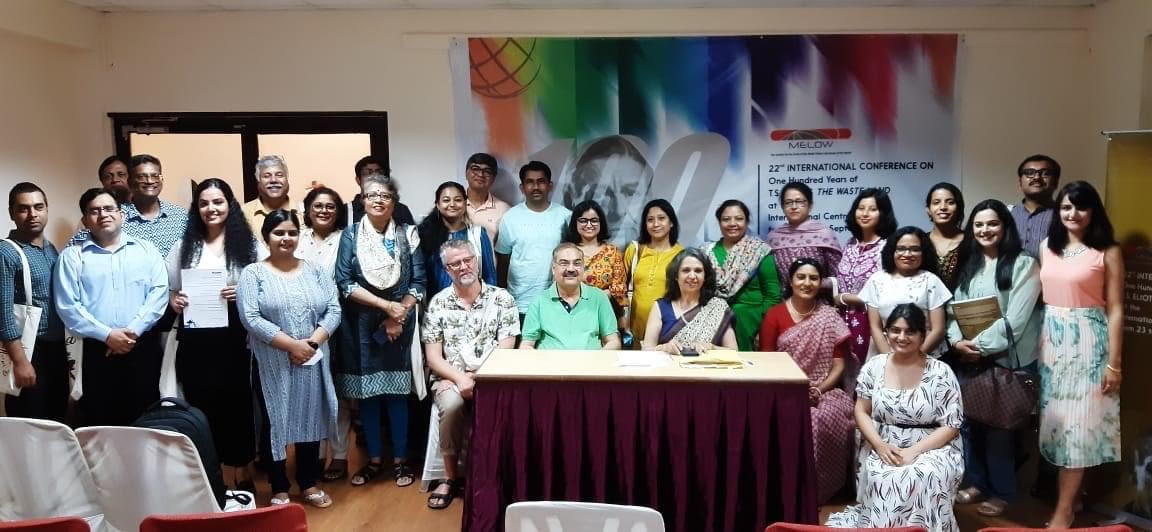
MELOW holds an International Conference to mark 100 years of T.S. Eliot’s The Waste Land  

The Society for the Study of the Multi-Ethnic Literatures of the World (MELOW) organised a three day International Conference at Goa to celebrate the 100th anniversary of T. S. Eliot’s masterpiece The Waste Land.  

The Waste Land is arguably even more relevant now and finds deep resonance today than it was when it was written 100 years ago in 1922. The Vice-Chancellor of Shoolini University, Prof. Atul Khosla who was the chief guest stressed the importance of poetry and bringing it back into our lives. He spoke about his strong belief in the amalgam of creativity and science and how creativity powers output. He appreciated the efforts of MELOW in pushing the frontiers of literature.

Prof. Manju Jaidka, President, MELOW, in her presidential address familiarized the delegates with the history of the society which has been holding conferences for the past twenty-five years.  In her address titled, ‘Many People, Many Tongues: The Plurality of Perspectives in The Waste Land.’ Prof. Manju Jaidka traced the critical reception of The Waste Land when it was written. She also welcomed Professor Sripad Bhat, Department of English, University of Goa, Goa to the conference.

Prof. Manpreet Kang, Indraprastha University, New Delhi and Secretary, MELOW introduced the audience to the theme and the twentieth-century poet, critic and essayist, T. S. Eliot at the  22nd MELOW International conference held from September 23 to 25.

In the plenary session chaired by Prof. Roshan Lal Sharma, Central University of Himachal Pradesh, Dharamshala, the first speaker of the session- Sanjay Mukherjee, Prof. Department of English and CLS, Saurastra University, Rajkot, Gujrat, gave his insights on The Sense of ‘Shantih’ in The Waste Land. Jason Wiens, Department of English, Associate Dean, Faculty of Arts, University of Calgary, discussed the Appropriative Poetics in The Waste Land and the multiplicity of voices which enter the poem.

Kalpana Purohit, Professor and Head, Department of English, Jai Narain Vyas University, Jodhpur, made a presentation on Traversing Through Eliot’s The Waste Land: A Cultural and Philosophical Kaleidoscopic Views. Her paper reconstructed Eliot’s The Waste Land from the cultural and philosophical point of view.

The session chaired by Dr Roshan Lal Sharma focused on the Isaac Sequeira Memorial Lecture K. Narayana Chandran, Department of English, University of Hyderabad presenting his paper  poke on Shoring Fragments of the Waste Land Centennial and approached The Waste Land as a post-modern poem written in the Modernist era. The ISM Lecture was in the memory of Prof. Isaac Sequeira who was a great support in the initial years of MELOW. Every year MELOW awards a cash prize and a certificate to the best paper presented by a young scholar at the conference.

Ashish Kumar Pathak, Assistant professor, Department of English, BHU discussed the contemporary Environmental Crisis and The Ecological Wisdom in The Waste Land. The second speaker, Sayantani Sengupta, Department of English, The Bhawanipur Education Society College examined Eliot’s Detective and Rowson’s The Waste Land. Deeksha Vats, presented a paper on “The Waste Land” and the stage; relevance of Art in a Dilapidating world.   Sreejit Datta made an interesting discussion on “The Waste Land” as a cross-civilizational Dialogue. The Isaac Sequeira Memorial (ISM) prize was awarded to Sreejit Datta, Assistant Professor, Rishihood University, Sonipat for his paper titled ‘Reading T.S. Eliot’s The Waste Land as a Cross-Civilizational Dialogue.

In the session chaired by Prof. Sanjay Mukherjee,  two presenters in this session were Bipasha and Navreet. The first presenter, Bipasha, presented a paper titled “Vision of Tiresias: Desire and Disability in The Waste Land.    The second presenter, Navreet Sahi, presented a paper titled “Journeying into the ‘Mental Wasteland’: A Psychopathological Reading of T.S. Eliot’s Th Waste Land.

The session chaired by Dr. Navreet, Pia Bakshi, the first presenter, suggested that the presence of dead characters in The Waste Land allude to the impossibility of a return to the past in her paper titled “Nostalgia and Spectrality in The Waste Land.  Rajguru Santosh, the second presenter explored the aesthetic aspect of the poem in his paper titled “Aesthetics in T. S. Eliot’s The Waste Land: A Dantean Approach.” Sree Prasad presented his paper “Human Stage of Musical Noises: The Waste Land as a Rhyme of Shambolic Modernity” in which he focused on the significance of musicality taking into account Eliot’s thoughtful and pragmatic metrical composition. Subham Dutta, presented a paper titled “Spatiality, Narrative and the Poetics of Representation in The Waste Land” where he explored the relationship between narrative and spatiality focusing on the fluid representation of “I” narrator.

At the session chaired by Dr. Brian, Vaishali Sharma, presented a detailed account of the relevance of the notes in the poem to make the reader aware of the satire in the work in her paper titled “Hollow and Ignored Voices in the Unattended and Plaintive Waste Land.” The second presenter Sukriti, presented her paper titled “Fragments of Past and Present: Use of Allusions and Mythologyin T. S. Eliot’s The Waste Land in which she examined the various temporal and cultural contexts that are woven together in the poem.

Surabhi Chandan, made a comparative study of Margaret Atwood’s Oryx and Crake and Eliot’s The Waste Land, in her paper titled “Environmental Apathy and Denial to Change: A Comparative Study of Oryx and Crake and Eliot’s The Waste Land. 

Dr. Vandana Sharma, presented her paper titled “What does the Thunder Say? 3 Da’s to Shanti Paath in The Waste Land.  She explored the Vedic connection of the poem also examining Eliot’s antidote to spiritual bleakness for the restoration of the individual.  The session chaired by Prof. Jap Preet had two presenters. The first presenter, Tarika’s paper titled “Antiquated Indian Voices in European Modern Cities: The Uses of Planetarity in The Waste Land explored the postcolonial and planetary engagement of the Western and Oriental landscapes.

The last presentation of the day was made by Sumegha. Her paper titled “Mapping the Contours of Changing Social Spaces in The Waste Land” dealt with the concept of social spaces and how it relates to the images of transforming social spaces in The Waste Land.

In session chaired by Neela Sarkar, the first presentation was made by Amitrajeet Mukherjee, “Trenches in the Mind: The Waste Land and T. S. Eliot’s Legacy as a Wartime Poet.” Brian Mendonca’s “The Waste Land as a Palimpsest of the Pandemic” posited that The Waste Land was a poem written during the pandemic and drawing examples from the text itself established a coherent thesis on the same.

Hariom Singh’s “Modernity as ‘Other’: Technology and Gender in T. S. Eliot’s The Waste Land. The paper sought to elucidate “the impact of the industrial revolution on the female sex.  Ishita Sareen presented a paper titled “Topophrenic Spatiotemporalities in The Waste Land: Revisiting Eliot’s Poem as a Produced Space.”  Jap Preet Kaur Bhangu in her paper titled “T. S. Eliot’s The Waste Land. A Metaphor for the Contemporary World” analyzed the poem as an attempt to find a sense of a multicultural creation.

Manika Ahuja was the final presenter. Her paper was titled, “Allusions to Illusions: The Influence of Indian Thought on T.S. Eliot” examined the intent of Eliot’s Indian connection from an Orientalist perspective. It was followed by an engaging discussion on the relevance of literature, the significance of literary allusions and the relevance of Eliot in the modem world and the need for a Dalit interpretation of the poem.

Neela Sarkar and Bulu Mukhopadhay presented their paper “Traversing The Waste Land with T. S. Eliot and Bishnu Dey” drew incredibly insightful parallels between the British-American poet and the Bengali poet.  The second paper was presented by Nitika Gulati. Her paper “Mapping the Modem Mind: Mental Health Echoes in The Waste Land” drew relevant examples from the poem to show how the poem can be read as an indirect and a direct reflection on and of mental health issues afflicting humanity both in the past and the present. Rajesh Williams, through his paper “Echoes of The Waste Land in Literature, Popular Culture and Art highlighted the relevance of Eliot’s imagery in the modem world and how echoes of it may be seen in contemporary literature, art as well as popular culture across the globe.

In the session chaired by Santosh Rajguru, Shehreen Ataur Khan’s novel presentation titled “Reading Banksy’s Street art through the verses of The Waste Land” included the print outs of the paintings being handed out.  Mary Mohanty, the second speaker, in her paper “Impact of The Waste Land on Odia Literature: Revisiting Guru Prasad Mohanty’s Kalapurusha” gave us a glimpse into Odia literature, specifically Kalapurusha.

The session chaired by  Prof. Anil Raina had three presenters. Shimi Moni Doley presented a paper on  “Eliot’s The Wasteland: Deconstructing the Morality of Mankind.”  Smita Verghese  presented her paper on “Sustenance, Indulgence, or Decadence: Edibles in T. S. Eliot’s The Waste Land.”  The third paper was presented jointly by Srishti Sharma and Sakshi Sundaram titled “The Waste Land and Its Cinematic Afterlives: Critical Analysis of Select Diegetic Readings of the Poem. In the session chaired by Dr.  Jason Wiens, the first presenter, Prof. Manpreet Kaur Kang, who presented her paper titled “Madame Sosostris and Her Tribe: A Study of the Women in The Waste Land.” The speaker aimed to take a re-look at The Waste Land from the lens of contemporary feminist debates to study the women in the poem who have been used by Eliot to portray the agony, horror and decay of the modern world.

Prof. Roshan Sharma presented his paper “Upanishadic Notions of Datta, Dayadhvam and Damyata as Antidotes to Varied Waste Lands.” The speaker intended to analyse Upanishadic notions of Datta, Dayadhvam and Damyata as antidotes to diverse kinds of desolate and hopeless wastelands as depicted in the poem, He further delved into the ‘why’ of Eliot’s considered choice of them as the only viable and sustainable correctives.  At the concluding session of the conference the report of the three days of the conference proceedings was read by Dr. Navreet Sahi while the report was compiled by Navreet Sahi with inputs from Surbhi Chandan and Sayantani Sengupta Certificates were handed over to all the participants and their feedback was sought. Prof. Manpreet Kaur Kang announced that the selected papers would be published in the journal MEJO after a double-blind peer review.

MOST POPULAR

HOT NEWS