Yatra’s success pointer to ordinary people’s yearning to live in peace

Covid-19  is raising its head again. As it is, the communal virus has been horrifying, wrecking lives and livelihoods, and if it gets compounded by the coronavirus then consequences would be disastrous

By the  time you’d  get to  read this column, the  new  year would  have  just  about unfolded. Mixed emotions for me. Less of enthusiasm and more of  apprehensions. For one, the coronavirus scare seems getting back into our daily lives.  Perhaps, it could be denting the free flow of movement and the connected bandobast. It wouldn’t be amiss to state that in case the virus strikes, once again that is, it will be nothing short of hell. The very survival would get difficult, financially and emotionally. As it is, the communal virus has been horrifying, wrecking lives and livelihoods, and if it gets compounded by the coronavirus then one can imagine what disasters would unfold.

As  of  now  today, the  only  little ray  of  hazy hope is the  way the  masses are  moving towards the  Bharat  Jodo  Yatra. Hundreds and thousands of our fellow citizens are joining in that long march.  This indicates that the common man wants to live amidst a secure and safe environment. No more communal hatred, no more divisive politics!

The man who was all for yatras

Last fortnight on  12  December, on  Mulk  Raj  Anand’s   birthday (he was  born  on 12  December 1905 in Peshawar), I sat wondering how  he  wrote  and continued writing no matter the  emotional challenges coming his way. Also, the fact that he was all for undertaking yatras.

Each time I had interviewed Mulk what came across rather too strongly was the stark fact that for him writing was a form of therapy, to lessen the emotional pain and turmoil. “Writing is a therapy for me …to this day I must write every day. During 1927 when I had suffered the first nervous breakdown,  my meeting with Sigmund Freud in Vienna and five sittings with him helped to a considerable extent. But later, the subsequent two nervous breakdowns were cured only through writings. I wrote a novel each time to recover my fragile nerves …Wrote the novel – Across The Black Waters – when my friend, activist Gertrude Mitchell, was killed by the Nazis in 1936.”

Mulk had detailed, “In my personal life I have loved several women and was left shattered when they died. In fact, each nervous breakdown took off with that loss. The first breakdown came with the news of the first woman I ‘d fallen in love with, Irene, who was an Irish and was involved with the Irish national movement,  was killed in 1927 …Two more nervous breakdowns followed…I’ve suffered not just in relationships but also on the marriage front .My first marriage with Kathleen Van Gelder had failed. The second marriage to Anel D’ Silva couldn’t really take off because at the last minute she changed her mind. I had then married dancer Shireen Vajifdar.”

Mulk had added, “I’ve always been provoked by all that is happening around me. My novels are my reactions to a personal loss or to all that is happening around me …today there is much violence and hatred everywhere …the rise of fundamentalism is also alarming … the only answer to the growing intolerance is going back to Mahatma Gandhi’s teachings. All these years we have ignored his teachings and that’s why problems are erupting all around us.”

Mulk wrote till the late 90s.What had compounded his deteriorating health was the sudden death of his companion, the well-known Mumbai based illustrator, Dolly Sahiar, who had died on board whilst travelling from the US to Mumbai. Mulk just couldn’t cope with that loss, and he’d passed away in 2004.
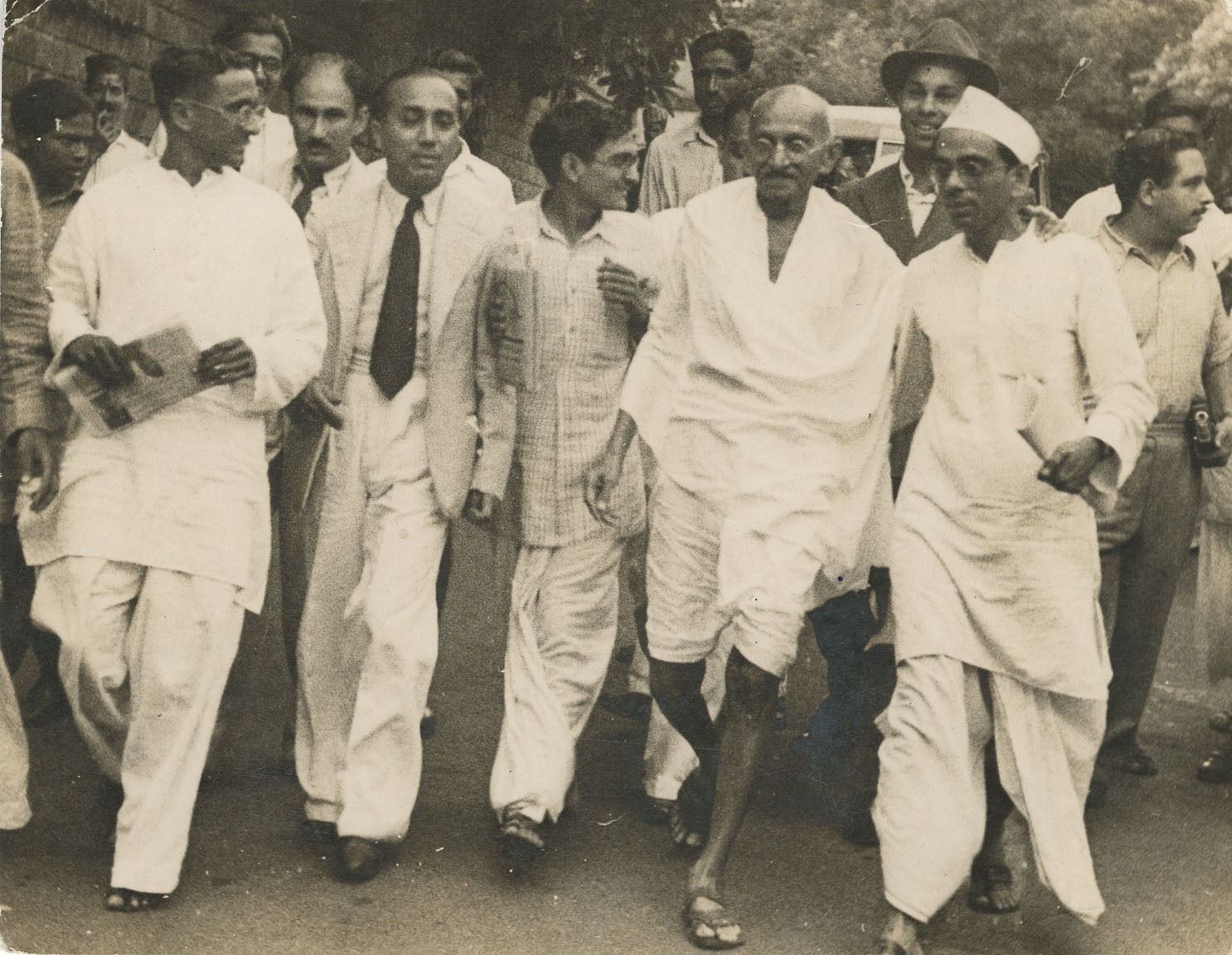
Surrounded by Indian Journalists Narayan Acharya, U.G. Rao and K.A. Abbas are on the left – Mahatma Gandhi walks briskly down Mount pleasant Road to Birla House. And so ended the first day of the Momentous talks, 1944.

Today when  one thinks of Mulk it is not just the books he has written or his off beat views but also the way he had done up his home in New Delhi. To be precise one of his homes, for he had a place on Mumbai’s Cuffe Parade. I had visited and interviewed him several times at his New Delhi situated home ‘Lokayata ‘. It stood out at the very start of the Hauz Khas Village, very close to the Deer Park. There was something very different about the place. Not in terms of architecture or some fancy layout. On the contrary, there were just bare basics to the home and yet it had an air of being different. And it’s with much pride Mulk would detail that he had done up the place with just about the minimum expenditure – “bought these moorahs from the village and also some of these durries and chiks … and a local carpenter has done these wooden shelves and I had these painted in bright red, because red brings in cheer to the atmosphere.”

I recall the last time I’d met him was in the autumn of 1999. It was during the month of November, and though he was nearing 95 years but looked much younger and he had kept calling himself “young man”. And this “young man” had undertaken a long road journey along with Dolly Sahiar, from Chandigarh to Amritsar and from there to New Delhi. And that too in a Gypsy yet he’d looked rather relaxed. It was a long winding interview and he had been at his blatant best.

When I had asked him to comment on the social decay spreading out he had said, “At times I question myself whether we are the same people who created the Ellora Caves in the second century. See, what’s become of us. Today we seem to have no time to read or even think, because we are busy watching bosomy heroines on the idiot box, selling our own daughters through those massive matrimonial advertisements as though selling cattle. And look at our bureaucrats! Wonder how do they administer us when most can’t even drive their own vehicles! And look at what our men are wearing – not cottons and khadi and none of the kurta pyjamas which is suitable for our climatic conditions but tight fitting synthetic trousers.”
Perhaps, few of us would know that Mulk had spent some time living in the Sabarmati Ashram …he’d lived there till the day he had violated one of the ashram rules and was asked by Mahatma Gandhi to leave the ashram- “I had just recovered from my first nervous breakdown, which I had suffered in the UK, when I had travelled back to India and went to the meet Gandhiji at the Sabarmati Ashram, and requested him if I could stay there. After much thought he did finally allow me to stay there but only after I had agreed on three basic issues. I had taken three vows — to clean toilets, never to drink alcohol and never to look at women with desire. In the beginning it went off okay but, then, somebody had told him that I was flirting with the typist also staying in the ashram. She was an American divorcee and staying there with her young son and though there was just no truth is that allegation but I had to leave the ashram …But even that short stay in the ashram and my interactions with Mahatma Gandhi left an impact on not just my lifestyle but on my perceptions and on my very bonding with the masses. He had asked me to tour the country and interact with the villagers and see the realities for myself. And  proved to be so very  significant for  me…saw for  myself  my country and  met  my countrymen in the  various  locales of  my  country. I’m of the  opinion that every  Indian should  undertake a  yatra across the country,  so that ground realities can be  seen and  grasped.”

Land dispute puts spanner in claims under Forest Rights Act

The claims first placed in 2021 and then twice this year have not been recognised till now due to land dispute, writes Deepanwita Gita Niyogi

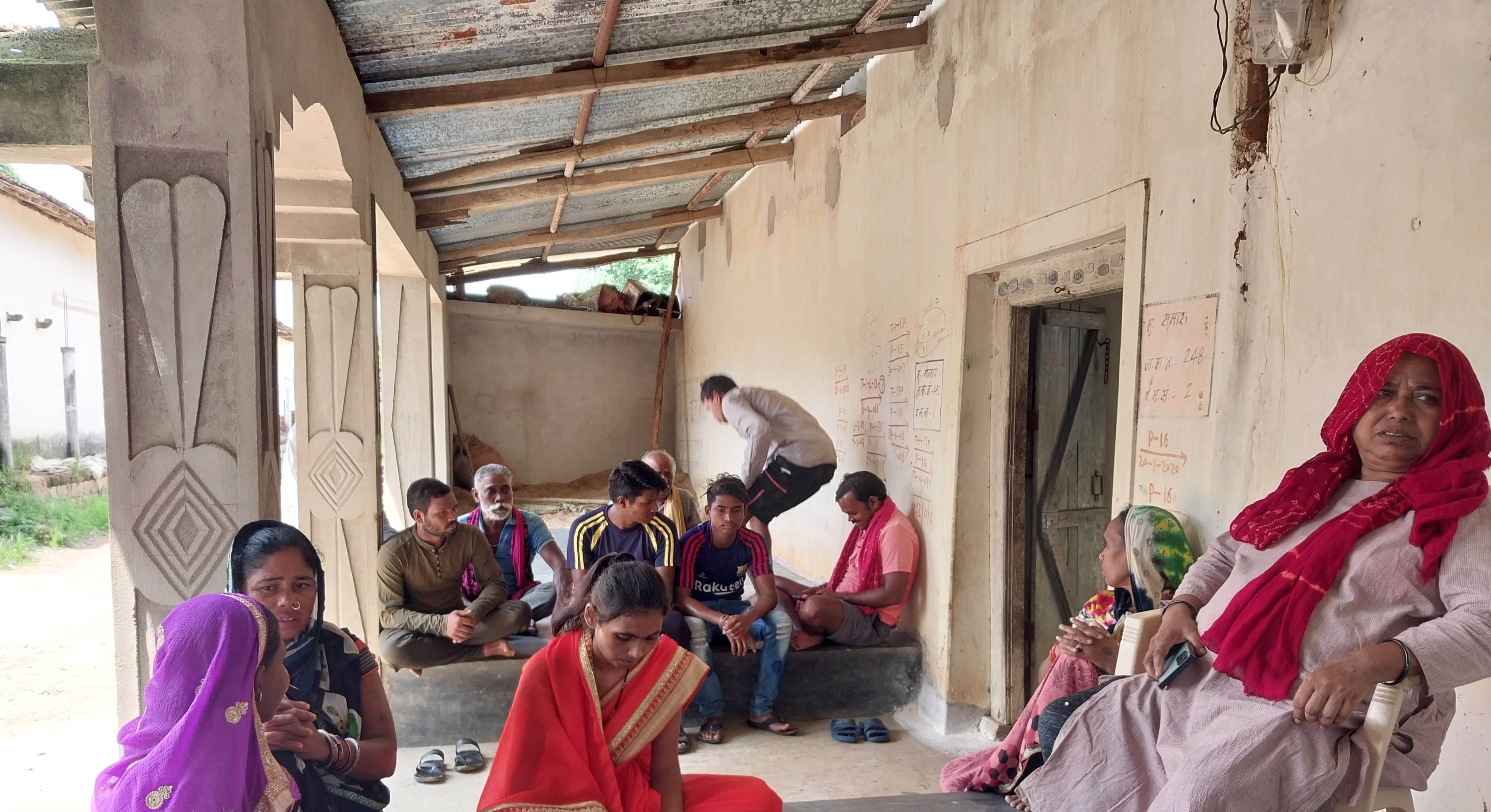
In her late 20s, Manjulata Miri leads a self-help group which is involved in livelihood generation of rural women in Pilwapali, a village in Mahasamund district of Chhattisgarh, central India.

Along with this, Miri, who has studied till Class 10, has another responsibility. She is fighting on behalf of 54 women in her village who have applied for individual rights under the Forest Rights Act (FRA), 2006. The claims first placed in 2021 and then twice this year have not been recognised till now due to land dispute. In this regard, a court case is on in the High Court of Chhattisgarh, Bilaspur.

Pilwapali residents informed that the dispute dates back to 2012-13 when about 376 acres of forest land was sold to Jindal Steel and Power Limited through the land mafia in Pithora block of the district where the village is located. According to them, at that time the forest department did not intervene. But as it is a disputed land, it prevented people from carrying out farming. Miri said cultivation has been going on since 1980s. The writ petition mentions that the land in question was in fact a forest land and now revenue records show it to be an agricultural land.

“The forest department is against us as the company bought lands belonging to farmers. But people in the village were kept in the dark and came to know about it a year later. A barbed wire boundary was put up to prevent us but we carried out farming despite opposition,” said resident Hiralal Yadav.

Awaiting recognition of FRA claims

In India, the Forest Rights Act allows indigenous communities, known as tribals or Adivasis, rights over forest resources. However, in many places, several issues are coming to light like the rejection of FRA claims, low awareness among communities and the non-inclusion of women.

Activist Rajim Ketwas, who works with social organisation Dalit Adivasi Manch, is trying to address the gender gap in FRA by trying to get pattas or land titles in women’s names. “Land titles in women’s names can reduce instances of domestic violence. A majority of women in India work in agricultural lands and collect minor forest produce. But they do not get any respect due to the lack of land ownership.” She said women are not called to meetings or even allowed to take major decisions.

In Pilwapali village where both tribal and non-tribals reside, the forest lies within a kilometre. It is frequented by women for the collection of tendu leaves used in making bidis and other minor forest produce.

“Traders pay low rates for the leaves. But as tendu is profitable, the women want to open a mandi (market) and sell the leaves directly. But the court case has put a spanner in the plan. The forest department refuses to listen to us and has raised an objection,” said Miri

In Chhattisgarh, a densely forested state, 4,54,415 individual forest rights (IFR) titles have been distributed covering 3,70,275. 412 hectares of land. But in many villages of Chhattisgarh, women still lack knowledge and awareness about FRA. They are also underrepresented in forest rights committees.

In Baloda Bazaar district adjoining Mahasamund where Ketwas is based, the prevailing gender gap has been addressed to an extent in Maharaji village. Resident Kaushalya Chauhan said women were informed in detail about FRA. Claims placed in 2014 were recognised three years later. In the village, widow Gayatri Paikra has received 10 acres under IFR. Today, she is benefitting from Kisan Credit Card, which ensures timely access to credit, besides getting Rs40,000 loan for farming.

An ongoing dispute

As women of Pilwapali await a better future, a source from the forest department based in Pithora said van bhoomi or forest land was shown as revenue land in records and sold off which caused the dispute to arise. An estimate for carrying out plantation drive was also given.

At a time when many claims under FRA get rejected, the case of Pilwapali raises concern. The source, requesting anonymity, pointed out that in Pithora block of Mahasamund, land sharks are active.

Remarking on the situation, Ketwas said sometimes it is not known if a certain piece of land belongs to the forest department or the revenue department.

As women await the recognition of their rights, Miri described how some men used to torture their wives and denied them freedom. “Women weren’t allowed to step outside at one time. Land titles under FRA will ensure they get respect at home. Land work is mostly carried out by women but they are viewed as inferior by men. But women in the village won’t give up. They are now aware and want their claims to be recognised.”

Under Miri’s guidance, Sukhwati Kandoi has filed for claim on three acres of land. She is a farmer and cultivates turmeric, pulses and paddy. Kandoi said women were a deprived lot but saw hope when they came to know about FRA. “It made us happy. Women view FRA as an end to their struggle.”

As Miri remains hopeful, she gives credit to Ketwas who showed women the way by telling them to include their names first, along with men, as joint claimants. “If women get rights, men won’t find it easy to abandon their wives,” Miri said.

(The story has been covered with the International Women’s Media Foundation’s Howard G Buffet grant.)


‘So unassuming, that his greatness may have been missed by the undiscerning’

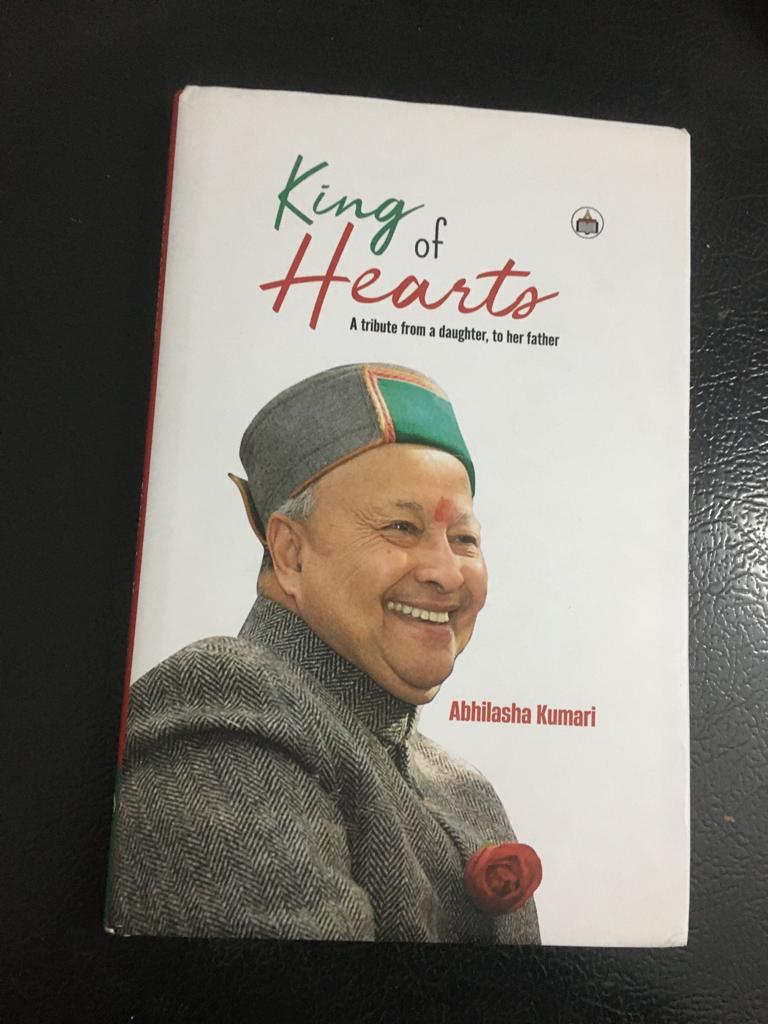
 ‘King of Hearts – A tribute from a daughter, to her father’ is Abhilasha Kumari’s tribute to her father, the late Virbhadra Singh. And as one reads through this book, what hits is that there’s little mention of Singh’s political graph, considering he was towering political figure of Himachal Pradesh. A book review by Humra Quraishi

As the very title relays this book is Abhilasha Kumari’s tribute to her father, the late Virbhadra Singh. And as one reads through this book, what hits is that there’s little mention of Virbhadra Singh’s political graph. Not to be overlooked the fact he was the reigning political figure of Himachal Pradesh.

To  this there’s Abhilasha Kumari’s rather candid explanation tucked in the preface:“This  book is  not  meant to be a  record of  my  father’s  political  achievements. It is neither a biography, nor a memoir or a history book. It is simply an attempt to throw light  upon the  man who was my  father, through the eyes  of the daughter. It comes straight from my heart.”

With that take off, Abhilasha dwells on the family backgrounders.  Building up from the early years of Virbhadra Singh till passed away in the summer of 2021.

Perhaps, the forte are the whole range of photographs, focussing on Virbhadra  Singh  and his spouse and  children and relatives. Of course, webbed and inter-webbed are details to what made Virbhadra Singh stand out, as a caring-loving-doting father.  As Abhilasha describes her father, “He was a simple man, so unassuming, that his greatness of  character may  have  been  missed by the  undiscerning. However, all those who knew him, had worked with him, or had any sort of connection with him, could never forget him…He was true to his heart and spoke his mind.”

One instance after another, where Abhilasha details how her father would not just spend time with her and her siblings but also get them involved with work. “Another memory of those days is that of my father composing and typing his own letters, on a portable typewriter. He was extremely meticulous and very particular about neatness and spellings. The  nuns in school were  very  particular about them too, which stood  me in good stead, as my  father sometimes  asked  me  to  take  down dictation in long  hand. As I grew older, this became a  regular feature. I would prepare a rough draft and read it loud, as he typed it with two fingers. He would never sign a document containing manual corrections. The page had to be retyped until it was perfect.”

This slim book carries various anecdotes and incidents, focusing on Virbhadra Singh’s  personality and also those subtle relays. Perhaps, the most significant one is this:  To quote Abhilasha, “One of the earliest practical  lessons I  imbibed from my  father is that, whatever is  worth doing, is worth doing well.”

Title of the book – King of Hearts- A tribute from a  daughter, to  her  father

Author –  Abhilasha Kumari

Pages -106

Price –  Rs 495

Publishers – AuthorsPress

For all his so-called charm, Sobhraj was a pure evil: Amod K Kanth

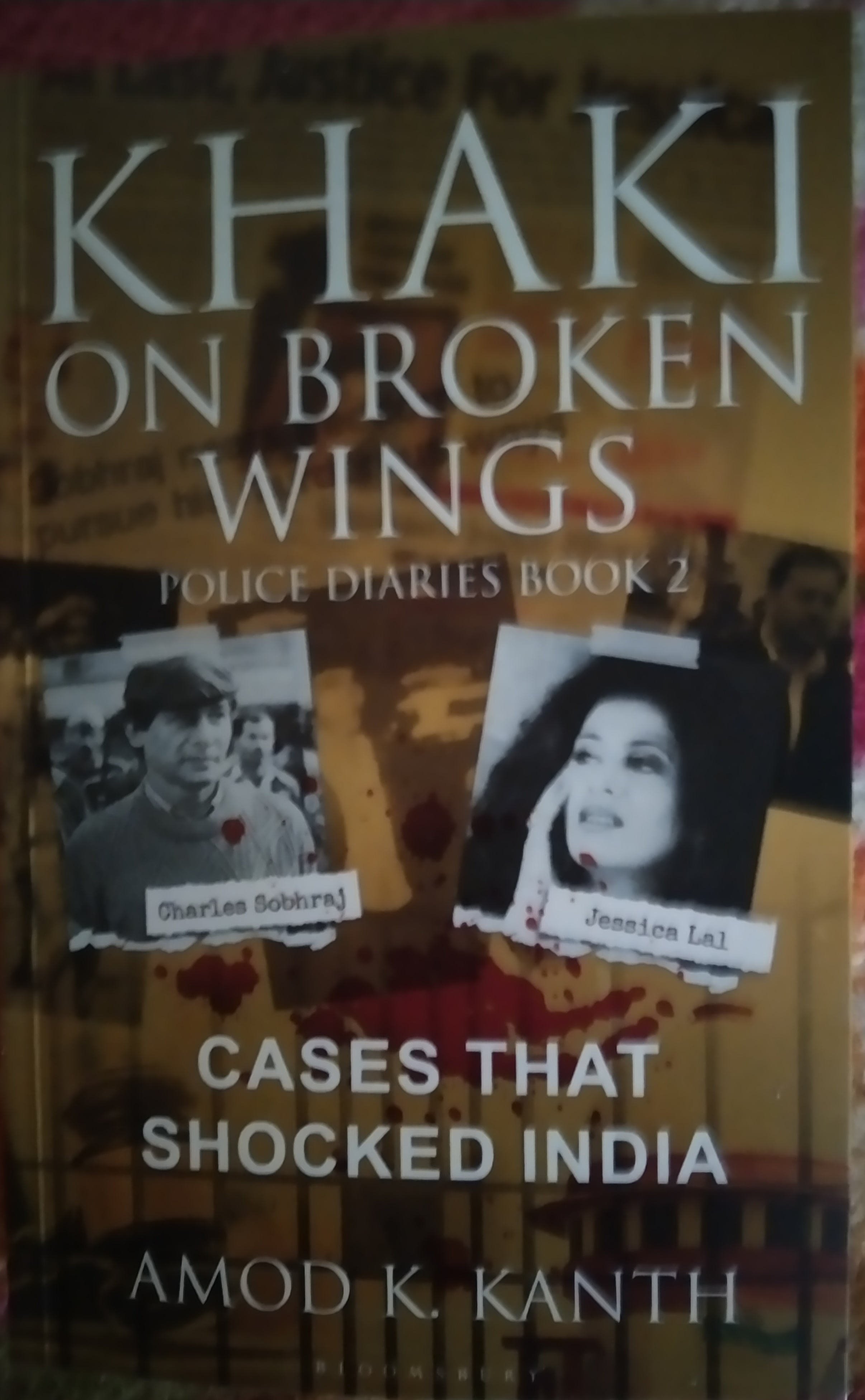
‘Khaki on Broken Wings’ deals with three high profile cases that Amod Kanth, the author and  former DGP, handled. The cases pertained to Romesh Sharma, a political and corporate honcho, Charles Sobhraj, an out and out criminal,, and Jessica Lal case which involved the sons of two of the most powerful politicians in the country, Vinod Sharma and DP Yadav in their time. A book review by  Amitabh Srivastva

Now that 78 year old Charles Sobhraj is out of Nepal jail on medical grounds after serving 19 years out of the 20 he was sentenced to, those who want to understand the slimy criminal would once again turn to the BBC and Netflix thriller ‘The Serpent’ released on the OTT platform last year.

And Sobhraj who is always proud of his contacts with the media and lawyers would be the happiest man in the world. Because it would once again set off a chain of exclusive interviews for which he is highly paid.

But many journalists who had followed the case of Charles Sobhraj in India after his daring escape from the Tihar jail were hoping for more authentic reports on the international crook.

In an exclusive interview with Tehelka, Amod Kanth who had interrogated him for days together finds this very odd.

“I don’t know how women fell for him. Because for all his so-called charm the man is pure evil.’ because he has no moral compunction in swindling and eventually killing those who trusted him,” says Kanth.

Kanth maintains that he has never used third degree to get confessions even from hardened criminals but each criminal had a different key. Since the media, both national and international, had created a larger than life persona for Charles he decided to break down his ego.

He mentions that to bring him down to earth he never offered him a chair to sit down while interrogating him but made him sit down at his feet, literally.

Writing about the other high profile case of Jessica Lal murder that features in his second nook of memoirs, Amod Kanth confesses how all his well-wishers including his wife and seniors in the police advised him not to get into it again after news started streaming that her killers were going to be released by the highest court of the land while he who had done the initial investigation into the case and collected all evidence was posted far away from Delhi as DGP Arunachal Pradesh.

“But I returned to Delhi, met the Police Commissioner Ajay Raj Sharma and demanded an investigation into the tampering of the forensic evidence”, he says.

‘Khaki on Broken Wings’ deals with three high profile cases that he handled: Romesh Sharma, a political and corporate honcho, Charles Sobhraj, an out and out criminal, and Jessica Lal case where the villains were sons of two of the most powerful politicians in the country Vinod Sharma and D P Yadav in their time.

The book deals in great and irrefutable detail about the flaws in the legal, the criminal investigation and the media pressures because of his one habit – maintaining a daily diary.

 Khaki on Broken Wings

(Police diaries book II)

Author- Amod K Kanth

Publisher-Bloomsbury India

Pages -310

Price -Rs.799

Available on Amazon


Why is New Year on the 1st of January ? 

By Jawhar Sircar 
When did we really start celebrating the 1st of January as New Year’s Day ?
  Not very long ago.
Earlier, the western new year was actually celebrated on the  1st of March or on the 25th of March.  The credit for counting years to mark one round of the earth around the  son was started some 4000 years ago by the Babylonians.
And then, other ancient civilisations like the Phoenicians, the Persians and the Egyptians started to improve the system and try to be more exact to calculate their months and years more scientifically.  But most of these ancient years preferred the date of the ‘autumn equinox’ (21st-22nd September) to start the cycle — hence their new year’s day.
The the Greeks, however, pushed this date to ‘winter solstice’ day, around the 21st of December. The Romans came next and introduced a year of ten months which had just 304 days and started from the first of March. In 153 BC, the date of their new year was brought forward to the first of January in honour of their god, Janus, beginning the modern ‘New Year’s Day’.
But more interesting is how this 304-day was bullied by the first two Roman emperors to become 365 days in order to accommodate their egos.  Julius Caesar came disrupted Roman life and state by introducing a new month, July, in his own name as the seventh month. His nephew and successor, Augustus, promptly declared the next month as August, rather immodestly.
Consequently, the remaining four months of the old Roman year, that were numbered earlier as seventh to tenth, were then jostled further down the line. For instance, the 7th month, September (Latin ‘septa’, as in our seven, like sapta as in sapta-rishi) is now the ninth month. Similarly, October the original eighth (‘octo’ like our ashta) is now in the tenth position. In like manner, the old ninth month, November, which is based on navam (nine) is rolled over to the eleventh month. Obviously, dasam (tenth) month December became our current twelfth one. Julius however retained the first of January as the new year’s day in his new Julian calendar.
Though we still go by this sequence and call the months by the same names, the first day of the year has, however, been tossed around like a volleyball. In 567 AD, at the Council of Tours, the Christian Church declared the Roman celebration of the first of January to be too pagan and mandated that the year should begin from the 25th of March —  on the ‘Feast of the Annunciation’. This was close enough to spring equinox, which was usually on the 21st or 22nd of March, and near to Easter, as well.
Incidentally, much of Deccan India and even beyond observes a date quite close to this date as the first day of their year — on Chaitra Shukla Pratipada. In many parts of India, this time marked the end of the Rabi season and certainly called for festivities.
At the end of the medieval age in Europe, the Roman Catholic Church restored new year’s day to the first of January. The Julian calendar had a slight mismatch with the actual solar year and by the late 16th century, this accumulated into 14 days’s difference. In 1582, Pope Gregory XIII stepped in and introduced the more scientific Gregorian calendar, by adjusting the ‘excess’ number of days and European countries adopted this practice.
By the 19th century, however, the Gregorian calendar became almost completely universal. Since European nations colonised almost all of the Third World, it was imposed on all of us. We have our regional New Years but the sheer weight of Western ‘impositions’ (even after decolonisation) and Western commerce continue to dominate our lives.
                    Interesting, isn’t it? 
                    Wishing a Happy New Year to all.

Nearly 5000 persons die in every year in road accidents in Haryana

Bahadurgarh&  Sirsa : Information reveals, nearly 5000 persons die in road accidents every year in Haryana state and life of between 80-90% accident victims can be saved in case immediate medical aid s provided to accident victims. As usually seen, over 40% accident victims succumb to their injuries unable to get first aid and timely treatment after the mishap. There are 12 Trauma Centers in Haryana state set up by state health department in districts to provide immediate treatment to accident victims which include eight Trauma Centers located in district civil hospitals at Ambala City, Karnal, Yamunanagar, Panipat, Sonipat and Rewari apart from other districts Gurugram, Hisar and Palwal functioning in private hospitals authorized by the state government.

 It has been observed that these Trauma Centers are functioning merely as referral centers since most of the serious accident victims brought to these Trauma Centers are referred to PGI at Chandigarh or Rohtak or General Hospital Chandigarh after first aid, since these Trauma centers are unable to treat serious patients struggling for life after sustained serious injuries in road mishaps because of non-availability of senior doctors as well as surgical instruments in these Trauma centers as a result large number of accident victims die on the way. Information also reveals that in 30-40% cases the patients are not provided even first aid and blood oozing from injuries l on the ways causes death due to excessive bleeding from the body. It is usually seen that most of the Trauma Centers are situated at a distant place from highways and seriously injured accident victim on way to nearby Trauma Center succumbs to their injuries before reaching destination generally due to excessive bleeding or lot of time taken to complete formalities while carrying patients to referred hospital.     

Information reveals, on an average 5000 persons die in road mishaps every year in Haryana and in case timely treatment is provided to accident victims their lives can be saved. According to information, ambulance service to reach at the accident spot immediately on dialing Toll Free number 1033 is available in every 60 kilometer distance on the highways as well as prominent roads in the state likely to reach at the accident spot within 10 to 15 minutes.

According to available data as regard number of road accidents reported in Haryana state, injured victims referred by Trauma centers and reported died in the mishaps in past five years has been identified as 10939 road mishaps reported in the state in which 5120 persons died and 8164 accident victims were referred for treatment in year 2017. During year 2018 as many as 10760 road accidents were reported in the state in which 5118 persons were reported died and 7735 in injured victims were referred. During year 2019 total number of 5057 persons were reported died in road mishaps, whereas 7500 injured victims were referred for treatment. Similarly, during year 2020  as many as 4507 persons were reported died in 8875 road accidents and 6410 accident victims were referred. During year 2021, in 9392 road accidents 4706 persons were reported died and 6948 accident victims were referred to PGIs and Government hospital Chandigarh for treatment.

Respite from chilly weather in Delhi, AQI remains in ‘very poor’ category

New Delhi : Despite a thin layer of fog, the Delhiites witnessed respite in the cold as the mercury crossed the minimum temperature of 10 degree Celsius.

The temperature was 11 degrees Celsius at Safdarjung observatory and 12 degrees Celsius in the Palam area during early morning hours, as per the India Meteorological Department (IMD).

Despite the relief from chilly weather, the air quality in the national capital remained in a very poor category as the overall Air Quality Index (AQI) of the city reached 364 on Friday morning, according to data from the System of Air Quality and Weather Forecasting And Research (SAFAR).

The AQI at Dhirpur entered into a severe category with PM 2.5 at 356, under a very poor category.

Experts said that the air quality may also remain in a very poor category on Saturday.

The AQI between zero and 50 is considered ‘good’, 51 and 100 ‘satisfactory’, 101 and 200 ‘moderate’, 201 and 300 ‘poor’, 301 and 400 ‘very poor’, and 401 and 500 ‘severe’.

In Pusa, the AQI recorded PM 2.5 at 373 ‘very poor category’.

At Lodhi Road, the Air Quality Index with PM 2.5 concentration was at 360 under the very poor category and the PM 10 stood at 280 under the poor category. In Ayanagar the PM 2.5 was at 355, poor category while the PM 10 reached 277, in poor category.

Congress demands white paper on farmers’ income in 2004, 2014, 2022

New Delhi:  Amid the demand for an MSP Law, the Congress on Thursday sought white paper on farmers’ income in 2004, 2014, 2022 on the same parameters.

Addressing a press conference here, Sukhpal Singh Khaira, chairman of farmers’ cell of the Congress, said, “In February 2016, PM Modi had promised the doubling of farmers income in the year 2022. What to speak of doubling their income, if inflation is accounted for, the farmers’ income has actually reduced during these years.

“It was actually the Congress-led UPA government between 2004 and 2014 which had more than doubled the farmers’ income, ” said Khaira.

He pointed out that the Minimum Support Price (MSP) is one of the basic parameters of determining the income of farmers. He said the UPA government had doubled the MSP of wheat and paddy, two main crops, within eight years of coming to power.

Giving official figures of MSP, the Kisan Congress chairman said, in 2004 when the UPA led by Dr Manmohan Singh took over, the MSP for wheat was Rs 640 per quintal and it went up to Rs 1, 285 per quintal in 2011-2012 and Rs 1, 400 per quintal for 2013-14 season. Similarly, the MSP for paddy in 2004 was Rs 560 per quintal, which went to Rs 1, 310 per quintal in 2013-14.

“In strong contrast”, Khaira said, “from the BJP government’s own admission, the MSP for both paddy and wheat did not increase by more than 50 per cent during their regime. After independence, the Modi government was the first Government of India, which imposed GST on pesticides, fertilisers and farm appliances. Who actually doubled the farmers’ income?” he asked, while remarking, “doubling the farmers’ income was another epic ‘jumla’ of Prime Minister Narendra Modi”.

The farmers leader said, “The farmers also faced the double whammy in terms of increase in input costs like diesel. Substantiating his charge, he pointed out, the prices of diesel in May 2014 were Rs 55.48 per litre while in December 2022 these were Rs 89.62 per litre which means the diesel prices have increased to about 61 per cent. This was despite the crude oil prices falling substantially in the international market.

“On May 26, 2014, when the Congress was voted out of power and the Modi government came, the price of crude oil was USD 108 per barrel, in December 2022, the average is $77.99 per barrel which is about 28 per cent lower as compared to May 2014 prices, ” he said, adding, “but the government is not passing on the benefit to the farmers and common man”.

“The Government of India constituted a Doubling of Farmers’ Income Committee (DFIC) in 2016 which submitted its report in 2018 and that report is still gathering dust in the corridors of power”, he disclosed, while alleging that the government had no intention of doubling the farmers income and only wanted to fool people.

Questioning Prime Minister Modi’s silence on the non-fulfilment of his promise of doubling farmers’ income by 2022, the Congress leader asked him what happened to the recommendations of the committee set up for the purpose in 2016.

“What to speak of doubling the farmers’ income, the National Sample Survey of the Government of India revealed during 2018 that the farmers’ income had actually declined and this report was pushed under the carpet, ” Khaira revealed, challenging the government to make public the findings of the NSS survey of 2018.

Modi’s Mother Heeraben cremated in Gandhinagar, PM Performs last rites

New Delhi: Prime Minister Narendra Modi’s mother Heeraben Modi, who dies early this morning, has been cremated in Gandhinagar. PM Modi, who reached Gujarat early this morning, performed the last rites. Heeraben Modi was 99.

“Smt Heeraban Modi passed away on 30/12/2022, at 3:39 am (early morning, during the treatment at UN Mehta Heart Hospital,” the hospital where she had been admitted since Wednesday said in a statement.

Informing about her death, the Prime Minister posted a heartfelt tweet early this morning, “A glorious century rests at the feet of God… In Maa, I have always felt that trinity, which contains the journey of an ascetic, the symbol of a selfless Karmayogi and a life committed to values.”

PM Modi, who was scheduled to launch the developmental projects in West Bengal, may join the events through video conferencing.

Heeraben Modi lived with PM Modi’s younger brother Pankaj Modi at Raysan village near Gandhinagar.

The Prime Minister would regularly visit Raysan and spend time with his mother during most of his Gujarat visits.

PM Modi leaves the crematorium after performing the last rites of his mother Heeraben Modi, who died early this morning. Heeraben Modi was 99.

A host of development programmes, including a Namami Gange meeting and the inauguration of the Vande Bharat train, scheduled to be attended in West Bengal by PM Modi on Friday will be held as per plan, the PMO confirmed in a tweet, adding that he will participate via video-conferencing

Bihar Chief Minister Nitish Kumar expressed grief at the death and said that “the death of a mother is an unbearable and irreparable loss”.

“Saddened by the passing away of Hira Ben, mother of Honorable Prime Minister Narendra Modi. The death of a mother is an unbearable and irreparable loss. No one in the world can take the place of mother,” Nitish Kumar tweeted.

“I pray to God to grant eternal peace to the departed soul and strength to Prime Minister Narendra Modi and his family members to bear patience in this hour of grief,” he added.

BJP received highest donations from electoral trusts in 2021-22, TRS 2nd: ADR

New Delhi:  The Bharatiya Janata Party (BJP) received the highest amount of donations from electoral trusts (ETs) in fiscal year 2021-22, at Rs 351.50 crore making up 72.17 per cent of the total donations received by all parties, as per a detailed report by the Association for Democratic Reforms (ADR).

The Prudent ET donated the highest amount (Rs 336.50 crore) to the BJP, against Rs 209 crore contributed in FY 2020-21. AB General ET and Samaj ET donated Rs 10 crore and Rs 5 crore to the BJP in FY 2021-22, respectively.

After BJP, the Telangana Rashtra Samithi (TRS) received the second highest amount of Rs 40 crore, with Prudent ET being the only donor.

The Congress and the Aam Aadmi Party (AAP) have received a total of Rs 18.43 crore and Rs 21.12 crore from ETs, respectively.

While there is only Rs 0.19 crore difference in the donations made by the Prudent ET to both parties, Independent ET donated Rs 4.81 crore to the AAP, making AAP the bigger receiver compared to Congress. Small Donations ET donated only Rs 1.9351 cr to the Congress.

Moreover, the Prudent ET donated to nine political parties, including the TRS, the Samajwadi Party, the YSR Congress, the Shiromani Akali Dal, the Punjab Lok Congress Party, and the Goa Forward Party.

Six ETs, that have declared receiving contributions from different corporates and individuals during FY 2021-22, received a total amount of Rs 487.0856 crore and distributed Rs 487.0551 crore (99.994 per cent) to various political parties.

However, details of donors to these six ETs remain unknown, thereby leading to speculation on whether donations to these trusts were only a means of getting tax exemption or a way to convert black money stashed in tax havens to white money in India, the ADR said.

According to the ADR, details of donors to these ETs, which were formed before the Central Board of Direct Taxes rules came into existence, should also be disclosed.

In FY 21-22, 89 corporate/business houses contributed Rs 475.8021 crore to ETs out of which 62 contributed Rs 456.30 crore to Prudent ET, two contributed Rs 10 crore to AB General ET, three contributed Rs 5 crore to Samaj ET, and 15 contributed Rs 2.20 crore to Independent ET.

As many as 40 individuals have contributed to ETs in FY 2021-22. Prudent ET has received the highest contribution compared to Independent ET and Small Donation ET. Top 10 donors have donated Rs 331 crore to ETs, which forms 67.96 per cent of the total donations received by the trusts during FY 2021-22.

Arcelor Mittal Nippon Steel India Ltd contributed the highest amount, Rs 70 crore amongst all donors of the ETs, followed by Acrelor Mittal Design and Engg Centre Pvt Ltd with Rs 60 crore, and Bharti Airtel Ltd which contributed Rs 51 crore, to various Trusts.

Furthermore, the ADR has observed that 10 (62.50 per cent) of the 16 ETs that submitted their annual reports for FY 2021-22 declared that they received nil contributions in that year.

“This raises a question on the continuation of the registration of such electoral trusts that fail to fulfill their primary objective of distributing contributions received by them to the political parties concerned, ” it said.

MOST POPULAR

HOT NEWS