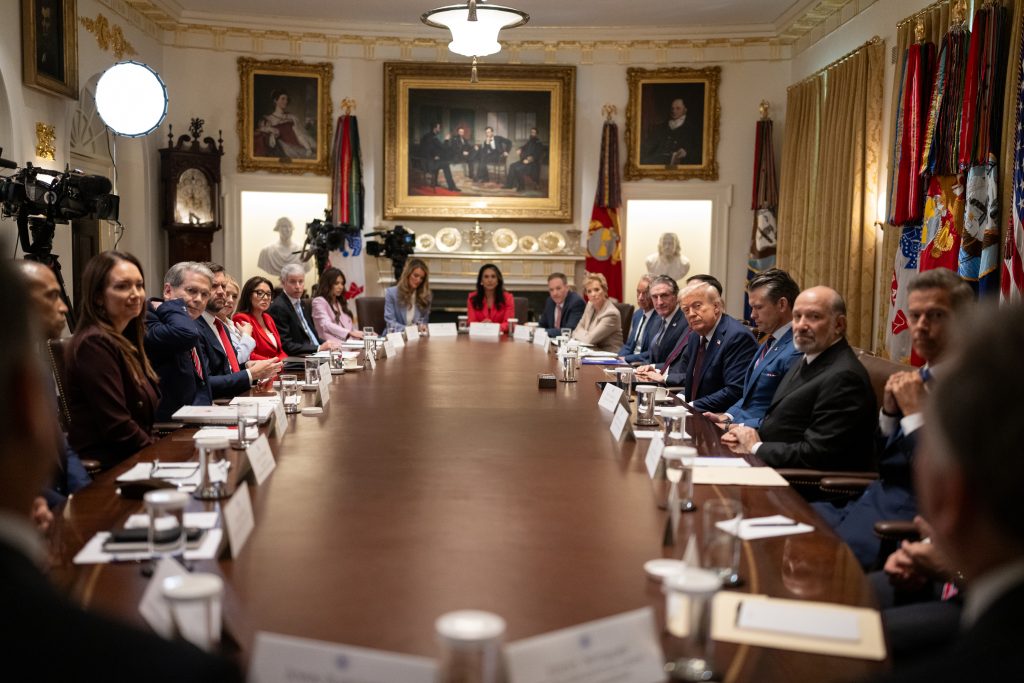
After more than 27 times reiterating that he mediated the war between India and Pakistan after a terror attack in Kashmir’s Pahalgam which became a hot topic in India and gave an upper hand to Opposition on which it cornered the central government, US President Donald Trump once again said that he directly intervened to stop a potential nuclear confrontation.
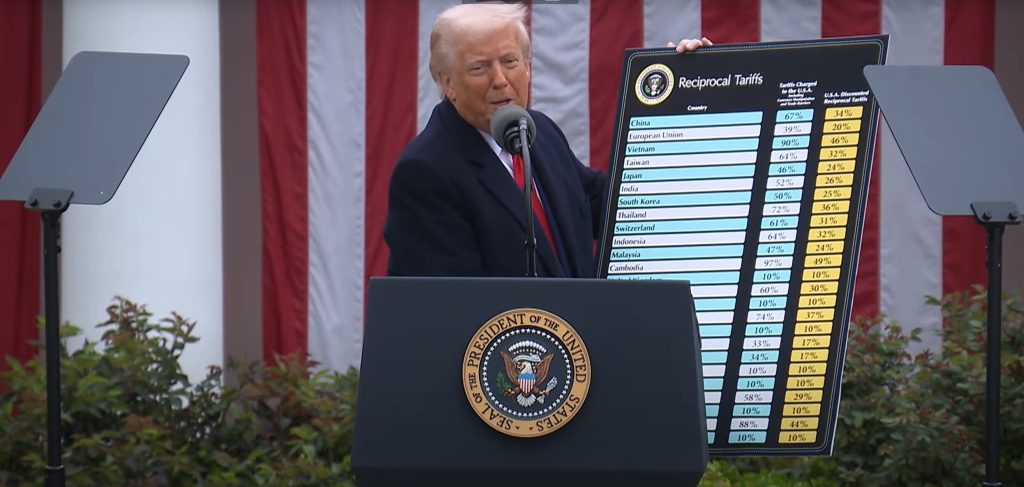
Presiding over the cabinet meeting, he said that he warned both the nation of hefty trade tariffs that ‘your heads going to spin’.
He said that he personally spoke to the Prime Minister Narendra Modi on the matter.
“I am talking to a very terrific man, Modi of India. I said, ‘what’s going on with you and Pakistan?’ Then I spoke to Pakistan about trade. I said, ‘what’s going on with you and India?’ This has been going on for a hell of a long time, sometimes under different names for hundreds of years,” he added.
India Pakistan conflict goes back to 1947 when both the nation became independent, following the end of nearly 200 years of British colonial rule in the subcontinent.
He said, “But I said, ‘what’s going on?’ I said, ‘I don’t want to make a trade deal….’ I said, ‘no, no, I don’t want to make a trade deal with you. You are going to have a nuclear war. You guys are going to end up in a nuclear war’. And that was very important to them. I said, ‘call me back tomorrow, but we are not going to do any deals with you, or we are going to put tariffs on you that are so high. I don’t give a damn. Your head’s going to spin.”
“Within about five hours, it was done. Now, maybe it starts again, I don’t know. I don’t think so. But I will stop it if it does. We can’t let these things happen. ”He also went on to say that seven or more fighter jets were downed during the war. “I saw seven jets were shot down and that was not good. Seven, maybe more than that, they never revealed the real numbers,” he added.
Though the RSS publicly supports affiliate autonomy, insiders suggest it plays a significant indirect role in vetting and approving the next president. The preferred candidate profile is clear—a senior leader around 60, deeply embedded in the RSS, someone known for organisational acumen, ideological loyalty, and the ability to steward BJP into a post-Narendra Modi era
File Photo
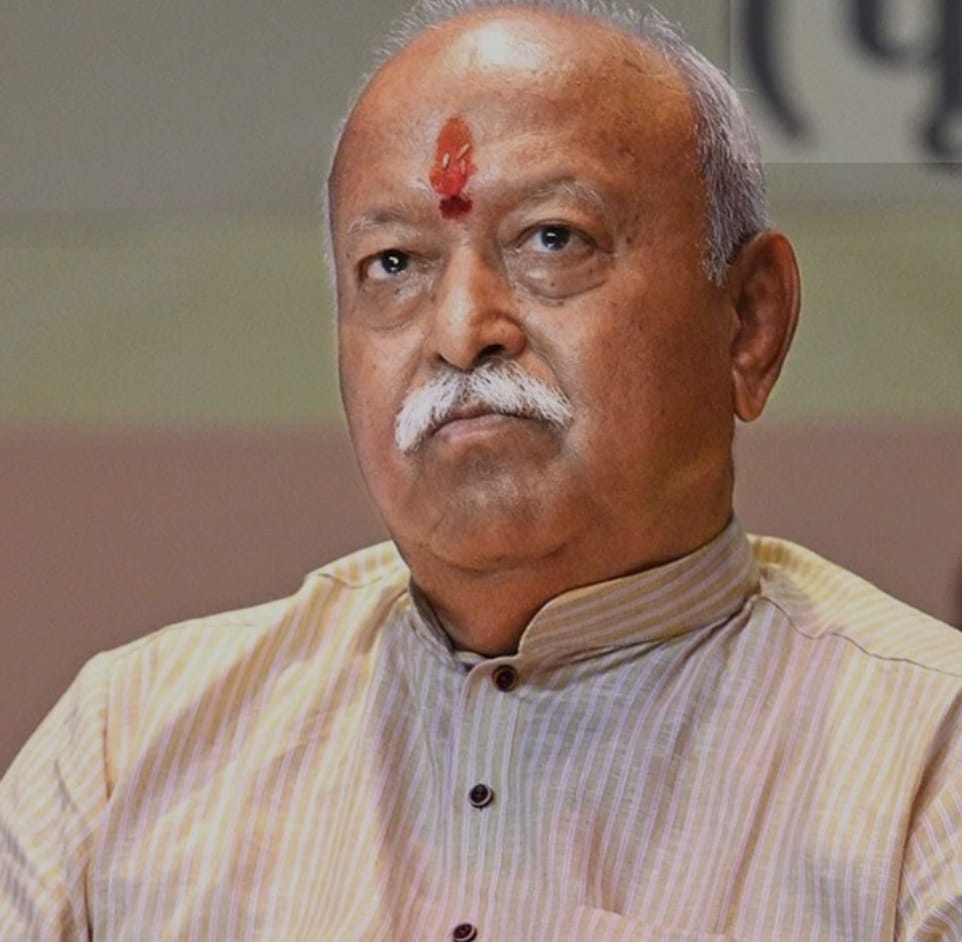
Amid speculation of differences between the Rashtriya Swayamsevak Sangh (RSS) and its political arm—the Bharatiya Janata Party (BJP)—over the selection of the next party president, Sarsanghchalak Mohan Bhagwat on Tuesday clarified that the Sangh does not interfere in the functioning of its affiliates.
“We don’t control them (RSS affiliates) directly or remotely. The bond of our volunteers with the RSS is unbreakable. We meet, talk and help them if they seek help, but we don’t pressurise them to do what we say. They hear us and do what they deem fit because they have to run the organisation and they have the expertise. After a while, our affiliates become self-reliant,” Bhagwat said.
Speaking at an interaction with influencers ahead of the RSS completing 100 years this October, he also emphasised that organisations linked to the Sangh are independent in their decisions and actions as they “have to take everyone along and are not formed of RSS cadres alone.”
Interestingly, though the RSS publicly supports affiliate autonomy, insiders suggest it plays a significant indirect role in vetting and approving the next president. The preferred candidate profile is clear—a senior leader around 60, deeply embedded in the RSS, someone known for organisational acumen, ideological loyalty, and the ability to steward BJP into a post-Narendra Modi era
Meanwhile, Bhagwat also struck a note of inclusivity, stressing the need for harmony among communities. He described the “organisation of Hindu society” as the Sangh’s ultimate goal, but underlined that Hindu dharma stood for unity, not division. “For 40,000 years, the DNA of the people of Bharat — living in Akhand Bharat — has been the same… Some know they are Hindus but hesitate to admit it, and some do not know they are Hindus,” he said, reiterating a position he has voiced earlier.
The speculation over the BJP’s next president has gained momentum. The three-year term of incumbent JP Nadda formally ended last year, and while he continues in the role, the party is expected to name his successor soon.
On Tuesday, Agriculture Minister Shivraj Singh Chouhan sidestepped questions on whether he was in contention for the top post, insisting his focus was on boosting farm output and raising farmers’ income. His remarks came amid reports of a recent meeting with Bhagwat.
According to sources, the BJP is expected to finalise its new president before the Bihar Assembly elections. A panel of potential candidates has been drawn up by the party high command. Consultations will resume after the Vice President election on September 9, after which the formal schedule for the BJP president’s election is likely to be announced.
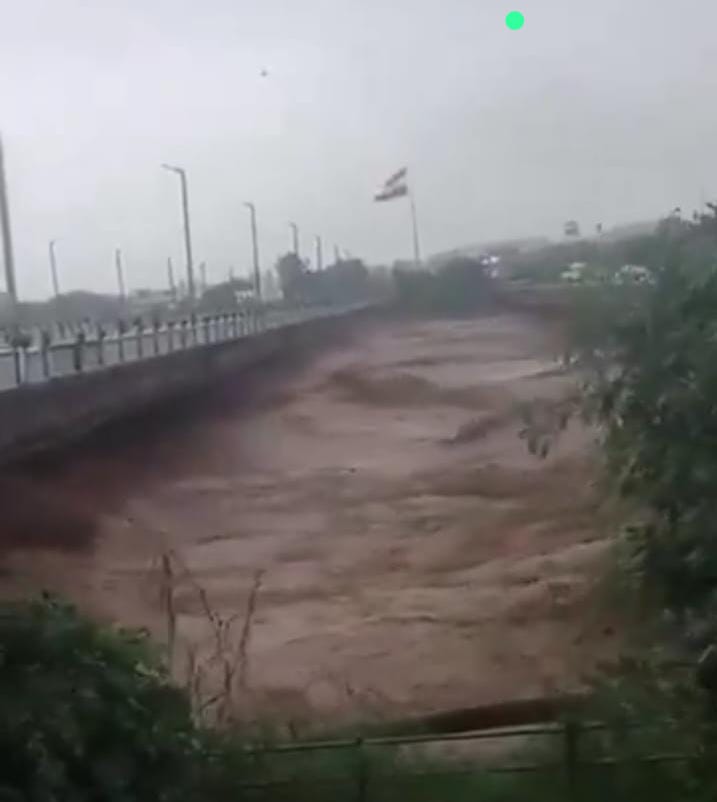
Rivers overflow, highways/bridges collapse and pilgrimage routes turn perilous, the scale of the crisis and damage is mammoth in Jammu and kashmir, Himachal Pradesh and Uttarakhand and plains of Punjab. For now, the focus is on saving lives and preventing further tragedy, but this season’s rain mayhem has once again underlined North India’s fragile relationship with its mountains, rivers and monsoon.
Photo: courtesy social media
North India is reeling under a devastating monsoon spell that has battered the hills and flooded the plains, leaving behind a trail of destruction. Relentless rains, swelling rivers and landslides have paralysed life across Himachal Pradesh, Jammu and Kashmir, and Uttarakhand, with the impact spilling into Punjab and Haryana. From temples and highways to homes and hotels, little has been spared from the fury of the skies—highlighting yet again the vulnerability of the region to erratic monsoon behaviour.
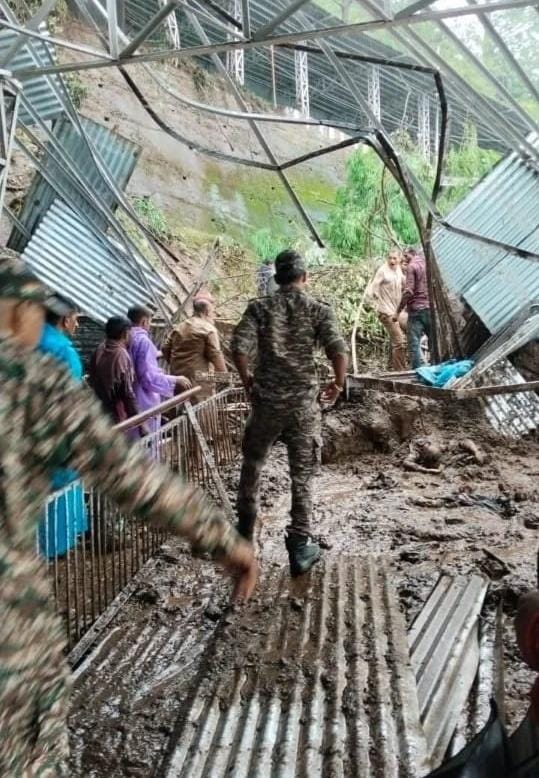
In Jammu and Kashmir, tragedy struck the sacred pilgrimage to Mata Vaishno Devi when a massive landslide rolled down the Trikuta hills midway along the 12-kilometre trek, according to reports. The disaster near Inderprastha Bhojnalaya at Adhkuwari killed and injured several pilgrims, forcing the authorities to suspend the yatra and launch rescue operations. The winding mountain path, normally teeming with devotees, was left scarred and desolate, as teams searched for survivors under layers of mud and rock.
The fresh calamities come barely days after one of the worst cloudburst-triggered floods in recent memory struck Chositi village in Kishtwar district on August 14. Located on the Machail Mata pilgrimage route, the village was devastated as torrents of mud and rock buried houses, pilgrims and livestock. At least 60 lives were lost and more than 100 people were injured; several are still missing.
The memory of that tragedy was still raw when Tuesday’s landslide hit the Vaishno Devi trek, compounding the region’s grief.
The larger Jammu region has been paralysed after recording 190.4 mm of rainfall within 24 hours—the second-highest August downpour in nearly a century, behind only 1926, as per reports
Photo: courtesy Indian Army
The sheer volume of rain caused rivers to swell dangerously, sweeping away bridges and flooding residential areas. Low-lying neighbourhoods were inundated, while the collapse of a bridge on the Jammu–Pathankot highway cut off road connectivity for hours. The Northern Railway cancelled several trains to and from Katra, Udhampur and Jammu, as floodwaters and landslides blocked major lines of transport.
Himachal Pradesh, too, has been battered by a series of cloudbursts and landslides.
In Manali, the Beas River swept away multi-storey hotels, shops with collapsing buildings and crumbling riverbanks leaving residents and tourists shaken. The Chandigarh–Manali highway near Mandi has been cut off in several places, isolating entire stretches of the state. Thousands of travellers have been stranded for nearly two days after roads were buried under boulders and landslides. Helicopters have been pressed into service for evacuation, but weather conditions have hampered flights.
Photo: courtesy social media
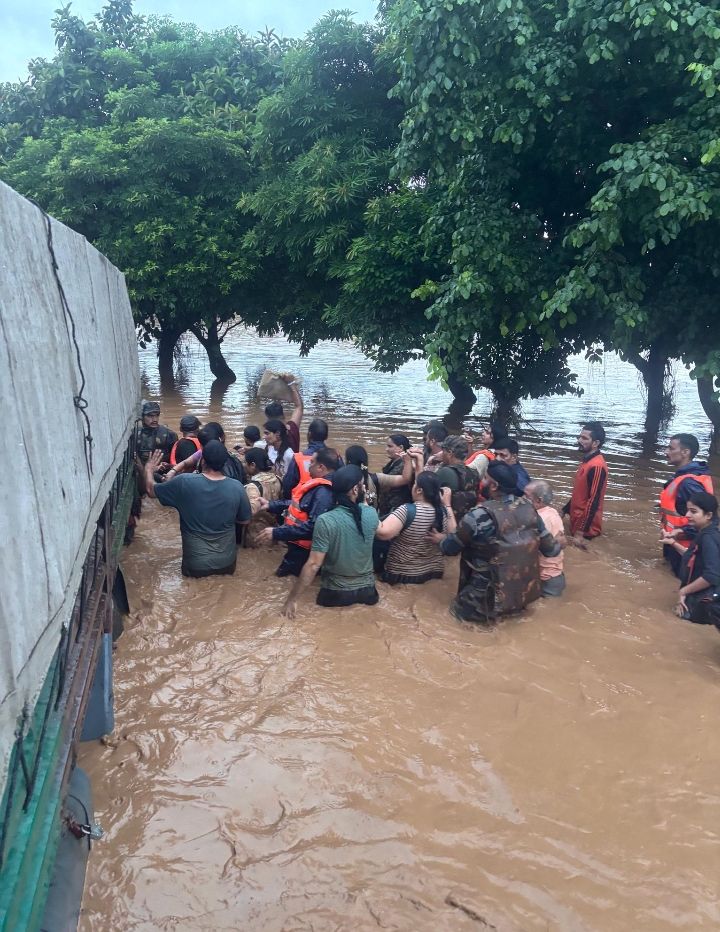
In Punjab, flood fears turned into reality after heavy rainfall and the release of surplus water from dams inundated villages, particularly in Pathankot and neighbouring districts. Entire stretches of farmland disappeared under sheets of water as swollen rivers surged into habitations.
The state government has sounded a high alert, setting up control rooms, relief camps and community kitchens, while helicopters were used to airlift residents from marooned houses. Haryana too has not been spared, with towns such as Hisar, Rohtak and Narnaul reporting heavy rainfall, waterlogging and damaged roads.
Uttarakhand remains equally vulnerable
Earlier this month, the state was shaken by a deadly flash flood in Dharali near Uttarkashi, where a suspected cloudburst or glacial lake outburst swept away homes and hotels. The relentless rain since then has only worsened conditions in Tharali, Harshil and other disaster-prone pockets of the state.
The crisis is not confined within India’s borders. Swollen rivers such as the Ravi, Sutlej and Chenab, flowing downstream into Pakistan, have forced authorities across the border to evacuate nearly 150,000 people from Punjab province.
With continuous rain lashing Himachal Pradesh, Jammu and Kashmir and Uttarakhand, authorities are grappling with the double challenge of conducting search-and-rescue operations while preparing for fresh disasters.
The Indian Meteorological Department has issued a red alert for several districts in Himachal and J&K, and an orange alert for Mandi, Kullu and parts of Punjab. Rainfall is forecast to continue through the week, with isolated extremely heavy showers likely in the hills and adjoining plains.
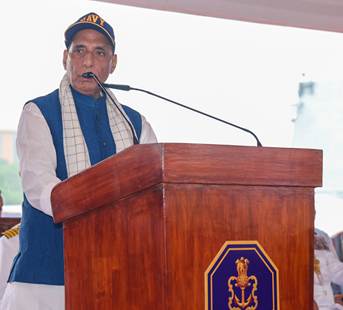
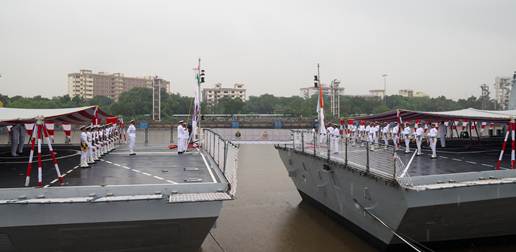
Defence Minister Rajnath Singh on Tuesday commissioned two multi-mission stealth frigates of Project 17A – INS Udaygiri and INS Himgiri into the Indian Navy in Visakhapatnam.
It was for the first time that two frontline surface combatants indigenously constructed by two different shipyards – Mazagon Dock Shipbuilders Limited (MDL), Mumbai (INS Udaygiri) and Garden Reach Shipbuilders & Engineers Limited (GRSE), Kolkata (INS Himgiri) – were commissioned simultaneously.
Addressing the gathering here Singh said, “The commissioning bolsters India’s policy of Neighbourhood First and Mutual and Holistic Advancement for Security & Growth for All in the Region (MAHASAGAR). These frigates, which will enhance the capability of the Indian Navy, send a message that India is fully capable of protecting its maritime borders and is ready to respond immediately to any situation.”
INS Udaygiri and INS Himgiri follow INS Nilgiri, the lead ship of the successor class to Project 17 (Shivalik class). They incorporate improved stealth features, reduced radar signatures, advanced surveillance radars and electronic warfare suites, supersonic surface-to-surface missiles, surface-to-air missiles and rapid-fire gun systems. Both ships feature Combined Diesel or Gas propulsion plants and a state-of-the-art Integrated Platform Management System, enabling higher speeds and improved fuel efficiency.
Singh described the commissioning as a giant stride towards the realisation of Prime Minister Narendra Modi’s dream of Aatmanirbhar Bharat, and a proof of the government’s vision & commitment.
“INS Udaygiri and INS Himgiri are the shining examples of the government’s firm resolve towards self-reliance, symbols of a transformative movement, and testament to the vision that the nation will touch greater heights & obtain the goal of self-reliance with concerted efforts of all stakeholders,” he said, commending the seamless collaboration between MDL and GRSE in constructing and delivering the two potent warships.
The multi-mission frigates are crucial operational enablers that will enhance the Navy’s ability to safeguard national interests across the full spectrum of maritime missions. They are equipped with next-generation weapons, sensors and integrated platform management systems, are ready to perform anti-air, anti-surface and anti-submarine warfare, sea-control and humanitarian operations.
Singh asserted that the commissioning of INS Udaygiri and INS Himgiri not only strengthens the Navy’s combat potential but reinforces its role as a “First Responder” and “Preferred Security Partner” in the Indian Ocean Region.
“From combating piracy, fighting against smuggling and illegal trafficking, curbing maritime terrorism, or providing relief after a natural disaster, these warships will prove to be a game-changer in complex and risky operations,” he said.
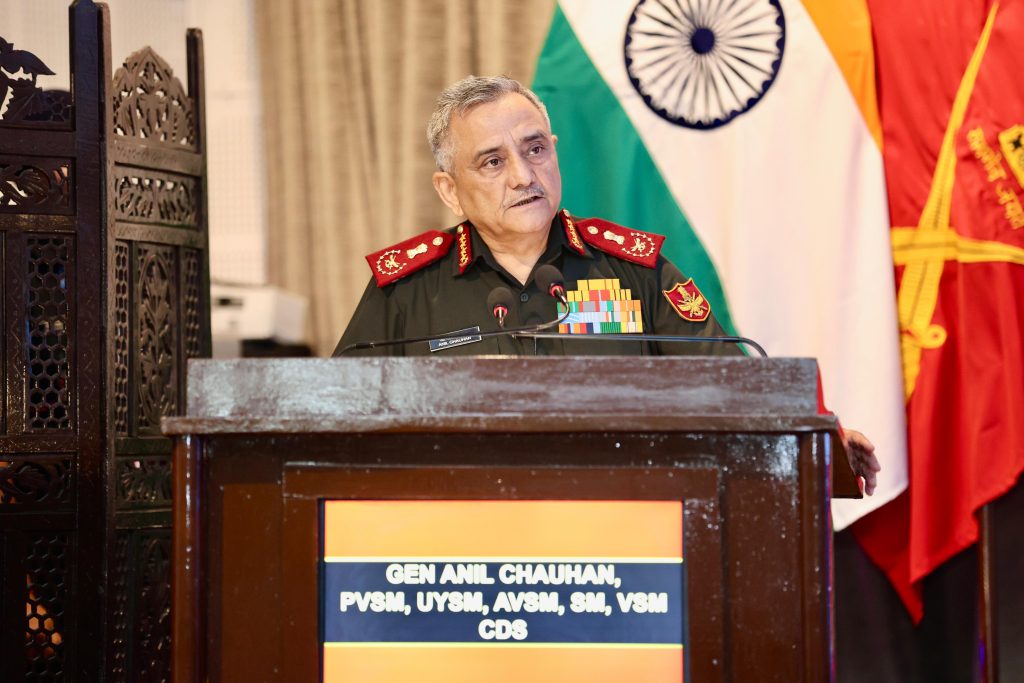
Chief of Defence Staff (CDS) General Anil Chauhan on Tuesday called for developing capabilities in multiple domains to develop “Sudarshan Chakra” which will act as both a shield and a sword in the future wars.
Emphasizing that battlefields of tomorrow will not recognise service boundaries, Chauhan has called for swift and decisive joint responses across domains to ensure victory in future wars.
He was delivering the keynote address at RAN SAMWAD, a first-of-its-kind Tri-service seminar on war, warfare & warfighting, on the theme ‘Impact of Technology on Warfare’ at the Army War College in Dr Ambedkar Nagar, Madhya Pradesh.
Addressing the gathering here he said, “For a robust civil-military integration, it is importance to develop Sudarshan Chakra (India’s Own Iron Dome) which will act as both ‘A Shield and A Sword’, that developing capabilities in multiple domains is central for attaining victory in future wars.”
Terming Aatmanirbharta in defence and integrated logistics as key to emerge victorious in the wars to come, the Chauhan reaffirmed that ‘jointness’ is foundational to India’s transformation.
He underscored the need to institutionalize joint training and absorb constantly-evolving technologies such as Artificial Intelligence, Cyber and Quantum to enhance operational capability.
Citing Kautilya, Chauhan stated, “Serious research needs to be done on various dimensions of war, leadership, motivation, morale and technology. India needs to be Sashakt, Surakshit, Aatmanirbhar and Viksit. This can only be achieved when all stakeholders participate collectively in the process of building future ready forces.” The two-day seminar brings serving military professionals to the forefront of strategic dialogue. Defence Minister Rajnath Singh will deliver the plenary address on the second and final day.
India’s domestic readymade garment industry growth is expected to take a major hit this fiscal on account of the additional trade tariff that sets in on India from Wednesday. The US Customs and Border Protection (CBP) has issued a draft notice on the implementation of additional duties on products imported from India, according to which additional tariffs are being imposed to give effect to the President’s Executive Order 14329 of August 6, 2025, titled “Addressing Threats to the United States by the Government of the Russian Federation”
According to Crisil ratings, the revenue growth of India’s readymade garment (RMG) industry is set to nearly halve on-year this fiscal as the imposition of 50% tariffs by the US on its imports from India becomes effective from August 27. That, coupled with a decline in profitability, will impact credit metrics for industry players. The impact will vary by company, some of which get more than 40% of their revenue from the US, it said.
The 50% tariff puts India at a distinct disadvantage compared with competing nations like China, Bangladesh and Vietnam, said Manish Gupta from the Crisil Ratings,
“If the tariffs hold, RMG exports to the US will see a sharp decline. Post 50% tariffs, Indian exports to the US may be minimal, despite limited capacity of competing nations in value-added garments and lead time taken by big-box retailers in the US to re-align their sourcing arrangements. Overall, we expect the share of the US in India’ RMG exports to fall from 33% last fiscal to 20-25% this fiscal,” he said
Some relief may be provided by the recently signed Free Trade Agreement (FTA) with the UK, which is expected to result in higher exports to that country from the end of this fiscal. The industry will also have to realign trade with other major export destinations—the European Union (EU), United Kingdom (UK) and United Arab Emirates (UAE), which together form ~45% of India’s exports for fiscal 2025.
A point of relief may be India’s domestic market
“The domestic market for RMG, accounting for three-fourths of the sector’s revenue, will continue to see steady revenue growth of 8-10% this fiscal, fuelled by economic growth, interest rate cuts, and tax reductions. This, in turn, will cushion the tariff blow and spur overall growth at the sector level, but at a slower pace than last fiscal,” said Gautam Shahi, director, Crisil Ratings.
Otherwise weaker revenue growth and tariff-driven competitive disadvantage in US will impact profitability of India manufacturers. In case the tariffs are returned to the previously announced level of 25%, India could maintain its competitive advantage, given its higher presence in the value-added garments segment compared with its rivals. That would then limit the impact on Indian exports to the US, according to Crisil
Earlier this month, US President Donal Trump unveiled plans to double tariffs on Indian goods from 25 percent to 50 percent over New Delhi’s continued purchase of Russian oil, setting an August 27 deadline.
Published Monday, the draft notice confirms the administration will proceed with the higher levies. Scheduled to be published on August 27, 2025, the new duties will come into effect on August 27, 2025. From 12:01 am eastern daylight time on that day, the higher tariffs will apply to all products of India that are either entered for consumption in the United States or withdrawn from warehouses for consumption, it says
Prime Minister Narendra Modi has already said that his government will find a way out “no matter how much pressure comes”, assuring farmers, small shopkeepers, and entrepreneurs that their interests would be protected despite rising trade tensions with the US. “We will keep increasing our strength to withstand it. Today, the Atmanirbhar Bharat Abhiyan is getting a lot of energy from Gujarat and behind this are two decades of hard work,” he said in Ahmedabad on Monday
Global politics was increasingly being shaped by economic interests but India’s rural economy would remain safeguarded, he added.
The Commerce and Industry Ministry is consulting exporters and export promotion councils to gauge the impact of the existing 25 percent levy, say officials
Officials said shielding farmers and export-oriented units and small and medium enterprises (SMEs) remains central to the government’s approach, given their vulnerability to external shocks. The PMO meeting is expected to firm up the contours of India’s response as exporters brace for the hike.
India has suspended parcel services to US as new customs rules kick in under 50 percent Trump tariff
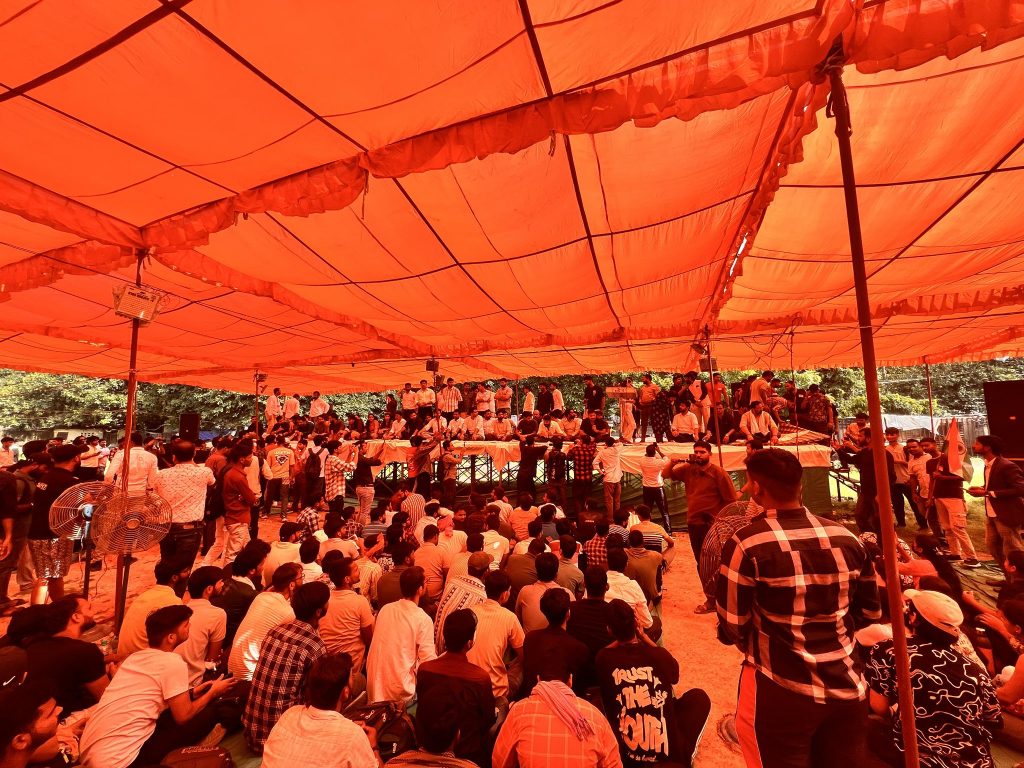
Day after the massive protest by the SSC aspirants and coaching teachers at Delh’s Ramlila Maidan, the Staff Selection Commission (SCC) chairman S Gopalakrishnan said that the commission will conduct re-examination on August 29 in three shifts.
More than 50,000 students have been hit by the technical glitch that happened in the SSC exam that was held between July 24 and August 2.
Addressing a press conference on Monday, Gopalakrishnan said, “A detailed log analysis has been done and about 59,000 candidates have been identified for whom three special exam shifts will be held on August 29.”
He said that the SSC Combined Graduate Level (CGL) exams, scheduled on August 13, have been postponed to September to resolve the matter.
The students who gathered at Ramlila Maidan alleged that there had been a lathi Charge from the Delhi Police despite us having the permission to spend the night at the venue after the protest was over. However, on the other hand the Delhi Police has denied the allegation and said that there was no lathi charge.
Meanwhile, Rahul Gandhi slammed the lathi charge on the SSC aspirants and teachers and termed the act as the hallmark of a cowardly government.
Taking to the micro blogging site X he said, “The brutal lathi charge on SSC aspirants and teachers peacefully protesting in Ramleela Maidan – not just shameful, but the hallmark of a cowardly government. The youth had only demanded their rights – employment and justice. What did they get? Lathis. It’s clear – the Modi government neither cares about the country’s youth nor their future. Why? This government didn’t come to power on the votes of the people, but by stealing votes.
He further wrote, “First, they’ll steal votes, Then, they’ll steal exams, Then, they’ll steal jobs, Then, they’ll crush both your rights and your voice! Youth, farmers, the poor, Dalits, and minorities – they don’t need your vote, so your demands will never be their priority. Now is the time – not to fear, but to stand firm and fight back.”
Aam Aadmi Party (AAP) also criticized the act and said, “Modi government has once again shown its dictatorial face‼. Students and teachers were peacefully protesting at Ramlila Maidan regarding the demand for reforms in the irregularities being issued in SSC. During this time, BJP sent its Delhi police and got a lathi charge done there. During this, many students and teachers have been badly injured. If as much attention as Modi ji and his police are giving to stopping the students’ protest were given to reforms in SSC, then students wouldn’t have to come to the streets like this.”
Madhya Pradesh Congress chief Jitendra (Jeetu) Patwari on Tuesday has triggered a political controversy with his remarks on women consume alcohol the most in the state as compared to any other state in the country.
Addressing the media in Bhopal on Monday, he said that the BJP government’s policies has turned the state, once projected as the land of prosperity, into a one that is drowned in intoxication.
“Our sisters and daughters have started consuming intoxicants. The BJP sought votes in the name of schemes like Ladli Behna, but never took serious steps to protect women from substance abuse. Today, Madhya Pradesh women lead nation in liquor consumption” he added.
“Madhya Pradesh tops the country in liquor consumption,” he asserted, adding that the state has even surpassed Punjab in drug-related cases.
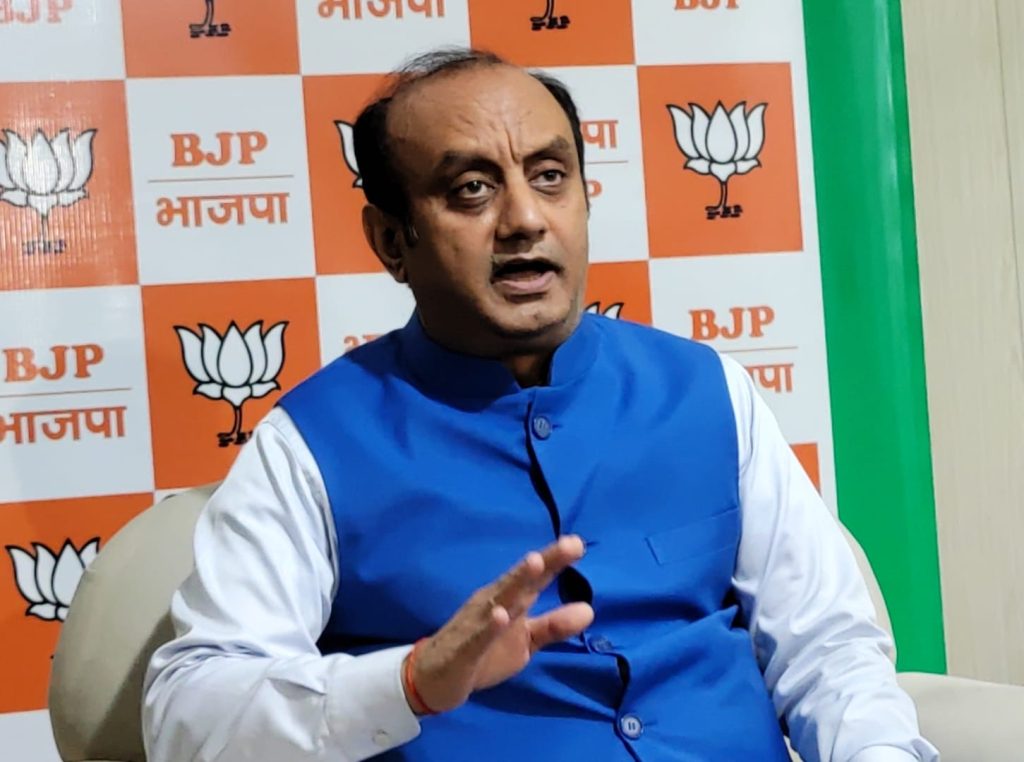
Criticizing the comment made by the senior leader of Congress, Bharatiya Janata Patry (BJP) leader Sudhanshu Trivedi termed the comment as “Indecent” and called the Congress party “Anti-women”.
Speaking to media he said that Congress leader’s comment has exposed how anti-women the Congress party is.
“Anti-progress and anti-Constitution Congress party has been exposed by the MP Congress chief Jeetu Patwari on how this party is anti-women when he tried to say that most of the women in MP drink alcohol,” Trivedi said.
He said this remark is not just an insult of women of MP but it is an example of Congress’ anti-women mindset.
According to the National Family Health Survey-5 (NFHS-5), women’s alcohol consumption is highest in Arunachal Pradesh, where nearly 26 per cent of women drink alcohol.
In Sikkim, the figure stands at 16.2 per cent, while Assam, Telangana, and Jharkhand also feature among the top states. In stark contrast, only 1.6 per cent of women in Madhya Pradesh consume alcohol, placing the state far below the national average.
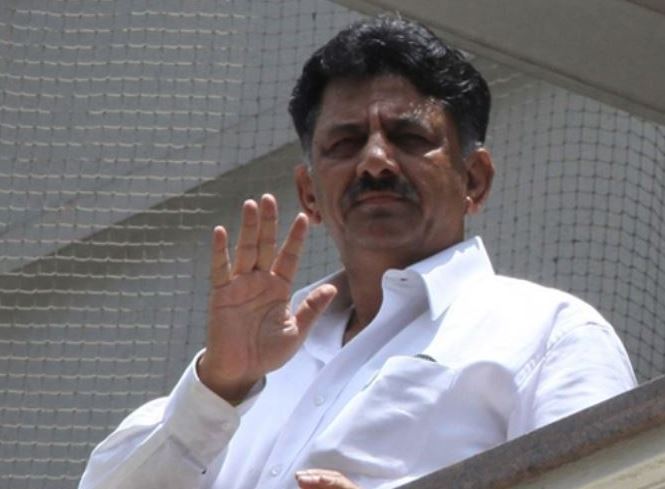
Shivakumar took everyone by surprise by singing the RSS anthem during a discussion in the state Assembly on the stampede near Chinnaswamy Stadium. The video clip showing the Deputy CM singing the RSS anthem went viral. As Shivakumar sang ‘Namaste Sada Vatsale’, BJP MPs cheered, later the saffron party also targeted the Congress, claiming that the majority of its leaders are now hailing the RSS.
File photo
Last week Karnataka Deputy Chief Minister created quite a stir when he chose to recite RSS’ anthem ‘Namaste Sada Vatsale’ in the state Assembly. However, facing criticism within the Congress’ circles on Tuesday he clarified that he was just trying to pull the opposition BJP’s leg and was ready to apologise if anyone was hurt in the process. He also asserted that he was a Congressman and would die as one.
“I am not bigger than anyone… As a loyal Congressman I don’t want to hurt anyone’s feelings. If you want an apology…If you feel that I have made a mistake, which I have not done, I’m still ready to apologise,” he was quoted as saying.
Reaffirming loyalty to the Congress and Gandhi family, Shivakumar said, “My loyalty to the Congress party and Gandhi family cannot be questioned by anyone. I am a born Congressman, I will die as one,” he also added.
While some defended him, many Congress leaders, including BK Hariprasad, demanded an apology, questioning who he was trying to impress. Called ‘prarthana’ it is sung at Sangh’ gatherings. Written by Nagpur-based Professor Narahari Narayan Bhide, a friend of Dr K B Hedgewar, it was first sung publicly by RSS pracharak Yadavrao Joshi on May 18, 1940 in Sangh Shiksha Varg at Nagpur
Seen as a sign that Shivakumar was disgruntled
On August 21, Shivakumar took everyone by surprise by singing the RSS anthem during a discussion in the state Assembly on the stampede near Chinnaswamy Stadium. The video clip showing the Deputy CM singing the RSS anthem went viral. As Shivakumar sang ‘Namaste Sada Vatsale’, the BJP MPs cheered , later the saffron party also targeted the Congress, claiming that the majority of its leaders are now hailing the RSS.
According to reports, a couple of days later another Congress MLA from the state was seen heaping praise on the song. Speaking to reporters, HD Ranganath crooned the opening lines of the anthem, calling it a “very good song”
He said he too heard it after Shivakumar sang it in the Assembly. “I read its meaning. It says we should salute the land where we are born. I see nothing wrong in that. Ours is a secular party, and we must accept good things from others,” he was quoted as saying
Earlier in July there were reports of trouble brewing between Karnataka Chief Minister Siddaramaiah and Shivakumar, though later they both dismissed speculations about a change in the State’ leadership, those familiar with the political happenings in the key southern state insist that the struggle for the top post in Karnataka is “very real”
Coming from the influential Vokkaliga community, Shivakumar is credited with swinging the votes of the community to help Congress defeat the ruling BJP in the last Assembly elections. He expected to be rewarded with the CM post but had to settle as Siddaramaiah’s deputy.
As someone who has been a favourite “trouble shooter” for the Congress, his organising skills have helped keep flock whether it was when the then Maharashtra Chief Minister late Vilasrao Deshmukh faced the trust vote or when late Ahmed Patel was contesting Rajya Sabha elections in Gujarat. Shivakumar was also one of the observers appointed for Himachal Pradesh in 2024 to resolve the crisis when a key MLA resigned.
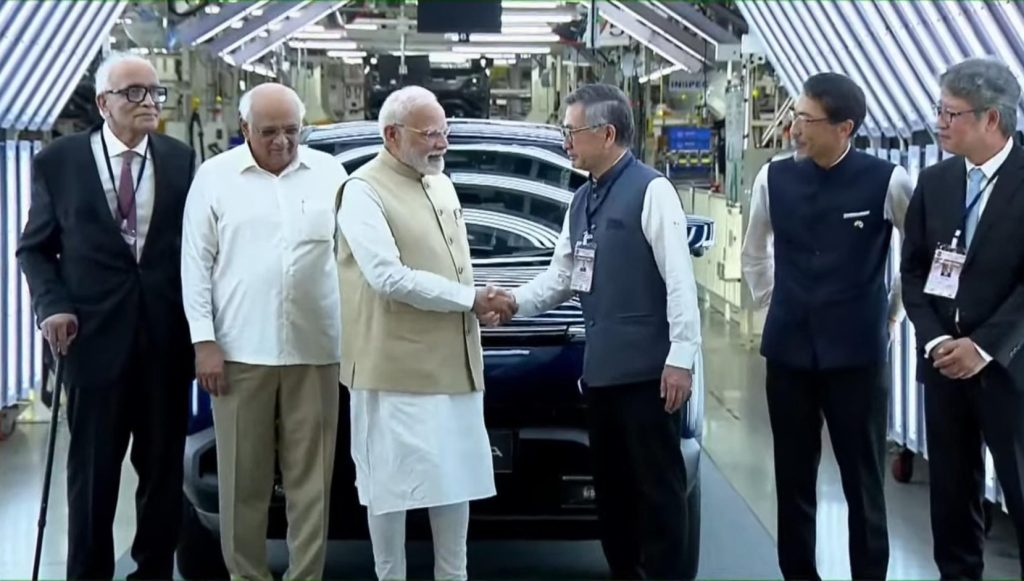
Prime Minister Narendra Modi on Tuesday inaugurated Maruti Suzuki’s first fully electric SUV, the ‘e-VITARA’, and launched its global export from the company’s Hansalpur facility in Gujarat. The milestone marks a significant step in India’s ambition to position itself as a hub for green mobility and advanced clean energy manufacturing.
The e-VITARA, first unveiled at the Bharat Mobility Global Expo 2025, will be exported to over 100 countries, including Japan and several European markets. With this launch, India has officially become Suzuki Motor Corporation’s global manufacturing base for electric vehicles.
Alongside the EV rollout, Modi also inaugurated the production of hybrid battery electrodes at the TDS Lithium-Ion Battery plant in Gujarat — a joint venture between Denso, Toshiba, and Suzuki. This development will localize more than 80 percent of the battery value chain in India, strengthening the domestic EV ecosystem and reducing the nation’s reliance on imports.
“Today is a special day for India’s journey towards self-reliance and sustainable mobility,” Modi said during the event.
Maruti Suzuki’s Hansalpur unit, part of its 2.6 million annual production capacity across four Indian plants, will manufacture the e-VITARA. In FY25, the automaker exported 3.32 lakh vehicles and sold 19.01 lakh units domestically.
In addition to the EV launch, the Prime Minister dedicated railway projects worth Rs 1,400 crore, including the Rs 530 crore doubling of the 65-km Mahesana–Palanpur railway line, further enhancing Gujarat’s transport infrastructure.
The twin initiatives — boosting green mobility and strengthening rail connectivity — align with the government’s broader vision of transforming India into a global hub for electric mobility, clean energy, and modern infrastructure.