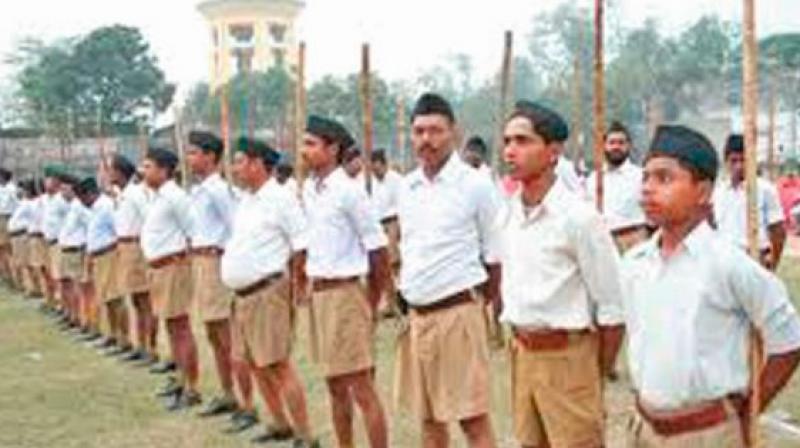
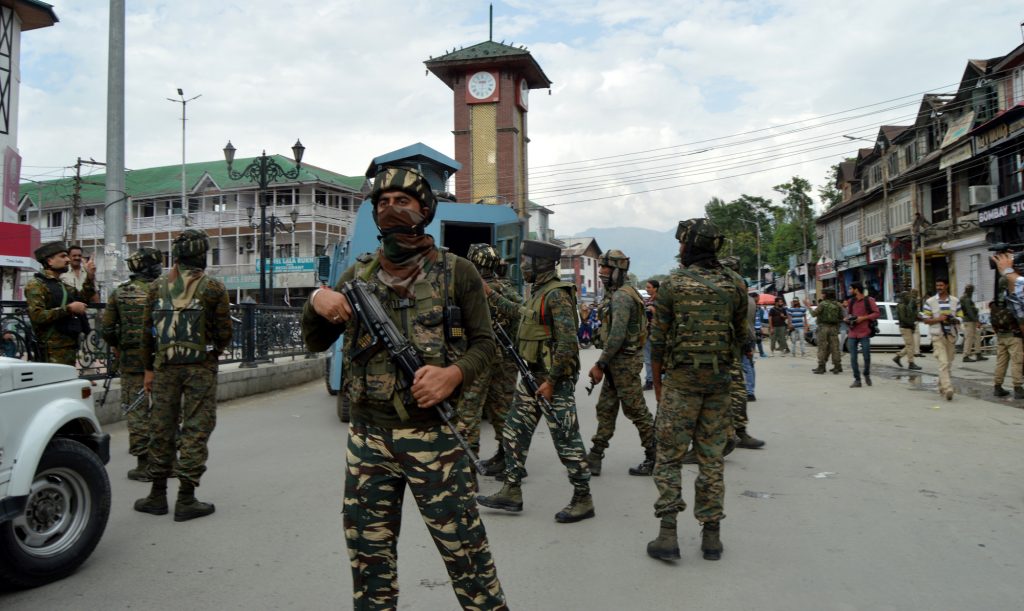
The Resistance Front (TRF), considered a front for Pakistan-based terror group Lashkar-e-Taib has issued threats to thirty members of the Rashtriya Swayamsevak Sangh (RSS) in Jammu and Kashmir.
The TRF has has threatened largely Muslim leaders who are supposedly associated with RSS. These RSS members are in-charge of areas in South and North Kashmir and Jammu region in the union territory, according to an official.
The list does not include any big name. The threat letter has come at time, when Kashmir Valley has been by and large peaceful.
An all-party delegation, on invitation of National Conference leader Farooq Abdullah, is slated to visit Kashmir probably later this month to asses the ground situation.
Leaders of as many as 13 opposition parties had met in Delhi and submitted a memorandum to Election Commission to start process of election in the union territory.
Patiala: With fears of recession looming large, the employment scenario is feeling the heat not just only limited to the IT sector but financials, retail, energy, healthcare etc. To add to the woes, the rise of artificial intelligence (AI) is transforming the way we work and live, and it is having a significant impact on employment. In fact, the effects of AI on employment are complex and multifaceted, with both positive and negative implications for workers and employers alike.
One of the most significant effects of AI on employment is the displacement of jobs that can be automated. Jobs that involve routine and repetitive tasks, such as data entry, assembly line work, and customer service, are particularly vulnerable to automation. As AI becomes more sophisticated and capable, it is increasingly able to perform tasks that were once thought to require human intelligence and skills.
While the displacement of jobs due to AI can be unsettling for workers, it is also creating new opportunities for those who can adapt to the changing landscape. As some jobs become obsolete, new ones are emerging that require skills and expertise in AI, data science, and other cutting-edge fields. This is leading to a growing demand for workers with advanced technical skills and expertise in AI and related fields.
Another impact of AI on employment is the increased use of AI-based tools to augment and enhance human productivity. For example, AI-powered chatbots and virtual assistants are becoming increasingly common in customer service and support roles, freeing up human workers to focus on more complex and high-value tasks. Similarly, AI-powered predictive analytics tools are helping businesses to make better decisions by providing insights into customer behavior and market trends.
Job losses
However, the growing reliance on AI and automation also raises concerns about the future of work and the role of human workers. Some experts predict that AI will lead to significant job losses, particularly in industries such as manufacturing, transportation, and logistics. Others argue that the impact of AI on employment will be more nuanced, with the technology creating new opportunities for workers while also reshaping the nature of work and the skills required to succeed in the workforce.
Ultimately, the effects of AI on employment will depend on a range of factors, including the speed of technological progress, the rate of adoption of AI-based tools and systems, and the ability of workers and employers to adapt to the changing landscape. As AI continues to evolve and mature, it is likely that we will see both positive and negative effects on employment, and it will be important for policymakers, businesses, and workers to work together to ensure that the benefits of AI are shared equitably and that workers are able to thrive in the new economy.
One of the most significant effects of AI on employment is the displacement of jobs that can be automated. Jobs that involve routine and repetitive tasks, such as data entry, assembly line work, and customer service, are particularly vulnerable to automation. As AI becomes more sophisticated and capable, it is increasingly able to perform tasks that were once thought to require human intelligence and skills.
Displacement of jobs
While the displacement of jobs due to AI can be unsettling for workers, it is also creating new opportunities for those who can adapt to the changing landscape. As some jobs become obsolete, new ones are emerging that require skills and expertise in AI, data science, and other cutting-edge fields. This is leading to a growing demand for workers with advanced technical skills and expertise in AI and related fields.
Another impact of AI on employment is the increased use of AI-based tools to augment and enhance human productivity. For example, AI-powered chatbots and virtual assistants are becoming increasingly common in customer service and support roles, freeing up human workers to focus on more complex and high-value tasks. Similarly, AI-powered predictive analytics tools are helping businesses to make better decisions by providing insights into customer behavior and market trends.
However, the growing reliance on AI and automation also raises concerns about the future of work and the role of human workers. Some experts predict that AI will lead to significant job losses, particularly in industries such as manufacturing, transportation, and logistics. Others argue that the impact of AI on employment will be more nuanced, with the technology creating new opportunities for workers while also reshaping the nature of work and the skills required to succeed in the workforce.
Ultimately, the effects of AI on employment will depend on a range of factors, including the speed of technological progress, the rate of adoption of AI-based tools and systems, and the ability of workers and employers to adapt to the changing landscape. As AI continues to evolve and mature, it is likely that we will see both positive and negative effects on employment, and it will be important for policymakers, businesses, and workers to work together to ensure that the benefits of AI are shared equitably and that workers are able to thrive in the new economy.
The Writer Romanchit is a student of Journalism and Mass Communication currently pursuing MA from Punjabi University, Patiala.
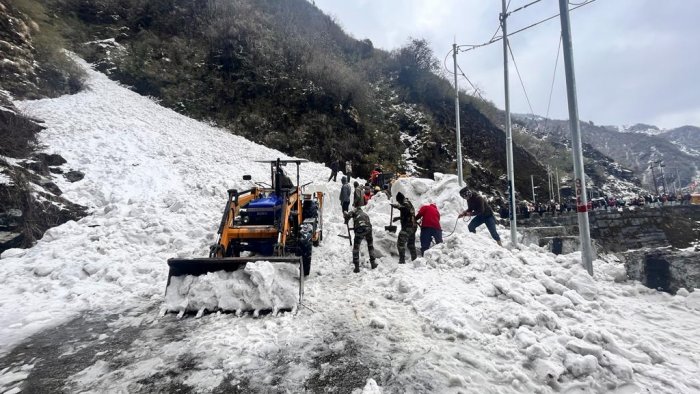
Gangtok : Seven tourists were killed as a massive avalanche hit Sikkim’s Nathu La area on Tuesday morning, burying their vehicles under the snow, officials said.
The avalanche hit the arterial Jawaharlal Nehru Marg, which connects Gangtok to Nathu La at the China border, around 11.30 am, trapping five-six vehicles with around 30 people under the snow, the Army said in a statement.
Till 4 pm, seven bodies were brought out of the snow and 23 people were rescued alive, including six tourists from a deep valley, a state government official said, quoting reports from the Army.
Among those dead are a woman and a child, he said.
Search operations in the area are underway by the Army, state disaster management teams and police to find if any other person is trapped, officials said.
Those injured were admitted to different hospitals in Gangtok, around 55 km away, they said.
Union Home Minister Amit Shah said the Centre was closely monitoring the situation, and the teams of the NDRF will reach the area — between Milestones 13 and 17 — soon.
“My sincerest condolences to the families of those who have lost their lives in the tragic avalanche in Sikkim. We are closely monitoring the situation and the teams of NDRF will reach the affected area soon. I pray for the speedy recovery of those injured,” he tweeted.
Nathu La, situated at 14,450 feet above the sea level, is one of the three open trading border posts between India and China. It is a major tourist destination because of its scenic beauty.
The tourists were not permitted to travel beyond Milestone 13 due to inclement weather, but they forced the tour operators and the drivers to take them to the area where the incident happened, a police officer said.
The road has been opened for traffic by the Border Roads Organisation (BRO) as the snow was cleared, the Army said. Some 350 people in 80 vehicles, stranded on the road because of the snow, were being brought back to Gangtok, officials said.
Chief Minister Prem Singh Tamang condoled the deaths, and said that he was praying for the speedy recovery of those injured. “My heart goes out to the bereaved family and friends in this hour of grief and I pray that the departed souls rest in eternal peace,” Tamang said.
Kolkata : Following clashes in pockets of West Bengal over Ram Navami processions in the last few days, Chief Minister Mamata Banerjee on Monday warned of repeating similar tension on April 6 on the occasion of Hanuman Jayanti.
“I am asking my administration as well as the common people to remain alert on April 6. We all respect Bajrangbali, and we do not want any tension or violence in his name. The youth should come forward in preventing any kind of tension, ” the Chief Minister said while addressing an administrative review meeting at Khejuri in East Midnapore district.
Banerjee said the tension over Ram Navami procession was deliberately stoked by taking it to routes that were not permitted.
On the latest clash at Rishra in Hooghly district on Sunday, the Chief Minister questioned the justification of taking out the procession three days after Ram Navami.
“We are in the middle of Ramzan month. But some people are steering the processions to sensitive areas with the intention of creating tension. The fruit stalls in those areas have been burnt down. They are even participating in the procession with firearms and other lethal weapons, ” Banerjee said.
The Chief Minister also launched a scathing attack against the Union government for not clearing the central dues to the state under various centrally-sponsored schemes.
“Instead of clearing the dues, the Centre is trying to create tension in the state. Huge sums almost under all the centrally-sponsored schemes are being held up. The Centre should explain why they are not releasing the funds under the schemes, ” Banerjee said.
She also appealed to the people to keep in mind the Centre’s stance, and not vote for the BJP in the forthcoming panchayat elections as well as the 2024 Lok Sabha polls.
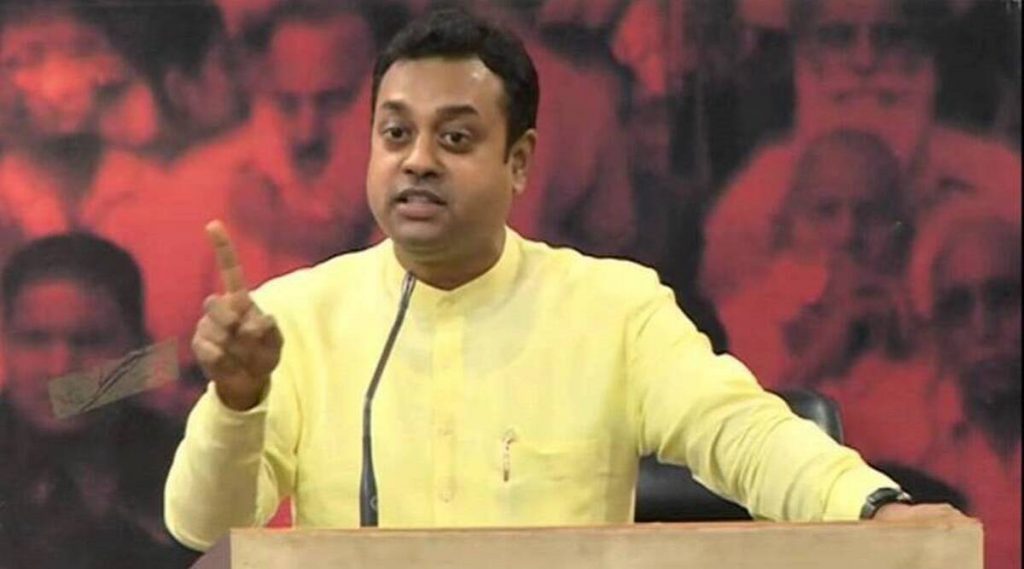
Kolkata- Congress leader Rahul Gandhi does not have any respect towards the judicial system of the country, BJP’s national spokesman Sambit Patra said in Kolkata on Monday.
“My question is why Rahul Gandhi does not have any regard for the judicial system of the country. Why did he not apologize after issuing insulting statements about the other backward class community? He had the scope to that within the court, ” Patra said at a press conference at BJP’s newly-opened office at Salt Lake in the northern outskirts of Kolkata this morning.
His comments come on a day when Rahul Gandhi and Priyanka Gandhi Vadra are going to Surat to file an appeal in the court challenging his convictions for making a derogatory statement attacking the surname of Modi.
He also questioned why the Congress leadership had not displayed similar proactive steps when the party’s Karnataka chief D.K. Shivakumar was arrested. He also claimed that the Congress leadership always becomes hyperactive when the issue is concerning Rahul Gandhi.
Speaking on the occasion, Sambit Patra also launched a scathing attack against All Indian Trinamool Congress’s national president and the West Bengal Chief Minister Mamata Banerjee and accused her of double-standards in pursuing her political lines.
“I wonder whether at all she is supporting the Congress. In the evening the chief minister speaks exactly the opposite of what she said in the morning. In the morning she gifts flowers to the Gandhi family members and in the evening, she claims Rahul Gandhi is not effective. I think that she should first clarify her stand about Rahul Gandhi, ” Patra said.
Artificial Intelligence has become an important part of our life. This fast growing technology is increasing in every sector. As many as 18% of Global jobs could be automated due to rise of Artificial Intelligence platforms, expected to impact advanced economies. The Goldman Sachs report predicts that 300 million jobs will be lost By Artificial intelligence. The workforce worldwide would be upended.
Goldman Sachs predicts that the growth in AI is increasing fast. Just as the world went from main computers to modern day technology, there will be a fast growth in Artificial intelligence also and it will play a vital role in reshaping the world. AI will score brilliantly in every sector, it added. According to Stanford’s AI index Report the investments in AI has nearly crossed $94 billion in two years. If it continues AI could add 1% to the U.S. GDP by 2030. The Goldman Report also predicts that the legal, Engineering, business, Sales, Healthcare, Architecture, Management, and art and designs are some of the sectors mainly impacted by it, so the jobs here will be at risk. White collar jobs will face more automation than manual labor, as it is not possible to computerize manual labor. The labor market could face significant disruption, the report added.
Before we proceed further, it is important to understand what Generative Artificial Intelligence actually is? It is actually designed to create content like images, text, music and entire videos without actually being programmed to do so. This type of AI is dependent on deep learning algorithms and can be trained to produce original content. AI can also be used in Creative as well as practical fields, it can also give new compositions to old songs. It can also create images that do not exist in this real world.
It is also important to understand what other organizations are saying about AI. According to a report The World Economic Forum(WEF) in 2020, “ A new generation of smart machines fueled by AI and robotics can replace large proportion of existing human jobs” Robotics and AI will cause a double disruption, it said. The PriceWaterhouseCoopers reported that AI and Robotics have the potential to bring great economic benefits ,contributing to $15 trillion to global GDP by 2030, but will come at a high human cost. Though it would generate new jobs but could also displace some existing ones”, it adds. Though AI proponents believe there is nothing to worry as they have successfully dealt with technologies in the past. Millions of workers in China, US, japan , germany and other countries have to retool their workers.
As per the Goldman Sachs report the United States, Europe, Hong kong, Japan, Sweden are likely to be most affected . But countries like India, Kenya, China, Nigeria, Vietnam will be least affected by automation. Generative AI is the technology that powers ChatGPT.
‘How come all of these thieves have Modi in their names’, a taunt that Congress leader Rahul Gandhi had made in 2019 during electioneering, has been found by a Court in Surat to be defamatory. The court has awarded a two-year imprisonment, which is harshest punishment and maximum that can be given under Section 500 of the IPC, leading to his disqualification from Lok Sabha.
Significantly, Section 499 of the IPC refers to the expression ‘collection of persons’, who can be identified to initiate criminal proceedings for defamation. The question is: can all those with the ‘Modi’ surname and not merely the three individuals who were blamed by the Congress leader, be aggrieved?
Indeed, it was unbecoming of senior opposition leader Rahul Gandhi to indulge in name-calling but the haste shown in awarding punishment and the quantum seems disproportionate to his offence and raises questions. The statutes prescribe jail terms only in proportion to the gravity of the crime. Was a general remark grave enough to warrant the maximum sentence.
Criminal defamation is a colonial legacy and should have no place in modern democracy because it acts as a tool to suppress criticism and free voice. The Opposition has been mounting pressure for a JPC on the Adani issue while the ruling party had been insisting that Rahul Gandhi should apologize for what he had said in London. To add to the acrimony, the Congress has moved a notice of breach of privilege against Prime Minister Narendra Modi in the Rajya Sabha.
The Opposition is building a narrative that action against convicted Congress Wayanad MP Rahul Gandhi was taken in undue haste, first disqualifying him right away though the two-year sentence had been suspended by the same trial court for 30 days, and then serving him a notice to vacate the government bungalow in Lutyens’ Delhi by April 22. However, the Election Commission showed restraint when it said there was no hurry to declare by-election to the Wayanad Lok Sabha seat as the trial court has given Rahul Gandhi one month to file an appeal.
Will the prosecution make Rahul Gandhi a bigger leader because history is replete with examples that whenever a leader is persecuted, he or she gets people’s sympathy. Already, 18 opposition parties, including the Aam Aadmi Party and the Trinamool Congress which had been strongly critical of Congress, have come together. The decision to ask the Congress, the largest Opposition party, to take the initiative for coordinating the fight to “save democracy” is the acknowledgement of the reality that the Congress cannot be excluded from any effort at total opposition unity.
The ‘Bharat Jodo Yatra’ during which Rahul walked 4,080-plus kilometres in 136 days, made people take Gandhi scion seriously and now the opposition parties are coming together after his conviction. However, he has to avoid controversies like “My name is not Savarkar. I am Gandhi. I won’t apologise,” which can undermine the efforts for opposition unity.
Poachers have struck after a year of lull in Kaziranga National Park and Tiger Reserve in Assam. A carcass of fully grown one-horned rhinoceros was found inside the globally acclaimed forest reserve with precious horn missing on 26 March 2023. A report by Nava Thakuria
After a one-year hiatus, poachers have struck again in Kaziranga National Park and Tiger Reserve in Assam of northeast India. A carcass of fully grown one-horned rhinoceros was found inside the globally acclaimed forest reserve on 26 March 2023 by the forest department officials. As the precious horn was missing (apparently for which the gigantic animal is hunted down), it’s assumed to be a case of poaching. The rhino is understood to have been killed a few days earlier and its decomposed body was recovered from the Bagori range.
Not only Kaziranga, the incident of poaching of rhinos was not reported from other forest reserves of the State since December 2021 as well. Brutal laws against the poachers, strengthening of ground staff inside the protected forest areas and increasing public awareness in the fringe localities of national parks and wildlife sanctuaries across the State have positively impacted the mission to save the rhinos. Moreover, unlike people of other parts of the globe, the residents of Assam (irrespective of their political, ethnic or religious affiliations) maintain a strong will to protect the giant animal.
From 1 January 2021 till the middle of March this year, only two rhinos were poached in Kaziranga forest reserve. Prior to the latest one, a similar incident took place in last week of 2021, where a decomposed carcass of a 30 years old female rhino was recovered inside the UNESCO world heritage site on the south bank of mighty river Brahmaputra. As the horn was not with the carcass, it was not considered a natural death. Recovered in the second week of January 2022, the rhino was apprehended to be killed around two weeks back.
Assam’s anti-rhino poaching task force chief GP Singh (now promoted as the DGP of Assam) asserted on 15 January last year that till date only one incident of rhino poaching had taken place at Kaziranga (in April 2021). State chief minister Himanta Biswa Sarma on 1 January last claimed that Kaziranga recorded zero rhino poaching cases throughout 2022. He also added that it was the first time in two decades that no incident of rhino poaching was reported across the State for a full year.
Supporting his stand, the State forest department also clarified that the Rhino (whose carcass was recovered near Silekhunda camp under Kohora range in January 2022) was killed on 28 December 2021. So Sarma’s statement justifying ‘not a single rhino was poached in 2022’ across Assam was correct. But it may be difficult for the wildlife lovers to accept that no responsible State agency had the information about the incident till 15 January. Moreover, the Kaziranga authority was silent when many media outlets reported it as the first rhino poaching case in 2022.
Native to the Indian subcontinent, the single horn rhino (also known as rhinoceros unicorns) is one of the worst affected rhino species. The reason behind the poaching of rhinos is due to the high demand for horns in a number of countries (including China) where people term it as a black ivory. A matured horn may fetch a huge sum of money in the international market. The animal enjoys great sexual power, as its mating time may continue for 45 minutes. So many people unscientifically believe that one can achieve the unusual power with the help of rhino horns (using it as a traditional Viagra).
The rhino horns are also believed to have other medicinal values supposing to cure the high fever, stomach ailment and cancer. Taiwan, Thailand, South Korea, Vietnam and the Middle East are also known to be huge markets for the horns, where the use of horns for medical purposes and scientific research are legalised. Rhinos are recognized as vulnerable by the International Union for Conservation of Nature and India’s wildlife protection act gives enormous power to the rangers for protecting the grass-eating pachyderm. The veterinarians argue that rhino horns comprise the same protein that constitutes the formation of hair.
Rhinos are recognised as a pride to the people of Assam and the 800 square kilometer Kaziranga reserve supports around 2,613 prized animals (whereas the global population of one-horned rhinos is around 3,700). The KNP also gives shelter to over 150 Royal Bengal tigers & around 250 leopards, over 5500 Asiatic elephants, a sizable number of buffalos, different species of deer, birds, fish, etc.
Besides Kaziranga, other forest reserves of Assam, namely Pabitora Wildlife Sanctuary (around 107 rhinos), Orang National Park (125) and Manas National Park (50) also support the rhino population to make a total count for Assam of around 2650 individuals. Every year, over 100 rhinos die because of natural causes in those forest reserves. Assam expects to increase the rhino population to 3,000 as the incidents of poaching have decreased following the deployment of ground forces with sophisticated weapons and other modern gadgets.
There was a time when Assam lost 27 rhinos to poachers in 2013 and 2014. Next year, the count was reduced to 17, while 18 cases were reported in 2016. With the declining trend, 2017 witnessed only seven incidents of rhino poaching, followed by seven in 2018, three in 2019, two cases in 2020 and 2021. Meanwhile, over 55 poachers were arrested last year, and four criminals were killed in encounters. The captured poachers and their associates admitted that they took the risk of killing rhinos inside the restricted forest reserves following the greed of ‘enormous money’.
The water cess bill, which was recently passed by the Himachal Pradesh assembly to mop up about Rs 4,000 crore revenue, has left Punjab and Haryana – which would be impacted with it – fuming and fretting. Both of them have rolled up their sleeves to oppose it, writes Rajesh Moudgil
The Himachal Pradesh assembly in Shimla passed the Water Cess on Hydropower Generation Bill on March 16, 2023. Five days later, the assemblies of Punjab and Haryana, which were simultaneously in progress in Chandigarh, reacted resentfully and passed resolutions to resist it.
The new law would be applicable to the existing 172 power projects and future projects in the hill state.
The new law would not affect the people of the state and it was brought to enable the Himachal Pradesh Congress government to raise its resources to resolve its financial hardships. The law is expected to generate about Rs 4,000 crore, deputy chief minister Mukesh Agnihotri told the House. The state government also planned to hold dialogue with the hydropower companies and power projects of less than 5MW capacity, which if run by Himachal Pradesh residents, would be eligible for relief.
Leader of Opposition Jairam Thakur said that the BJP supported the Bill and the government had to find out such new ways to generate resources. He, however, said that it should also be ensured that people of the hill state were not burdened.
Punjab fumes
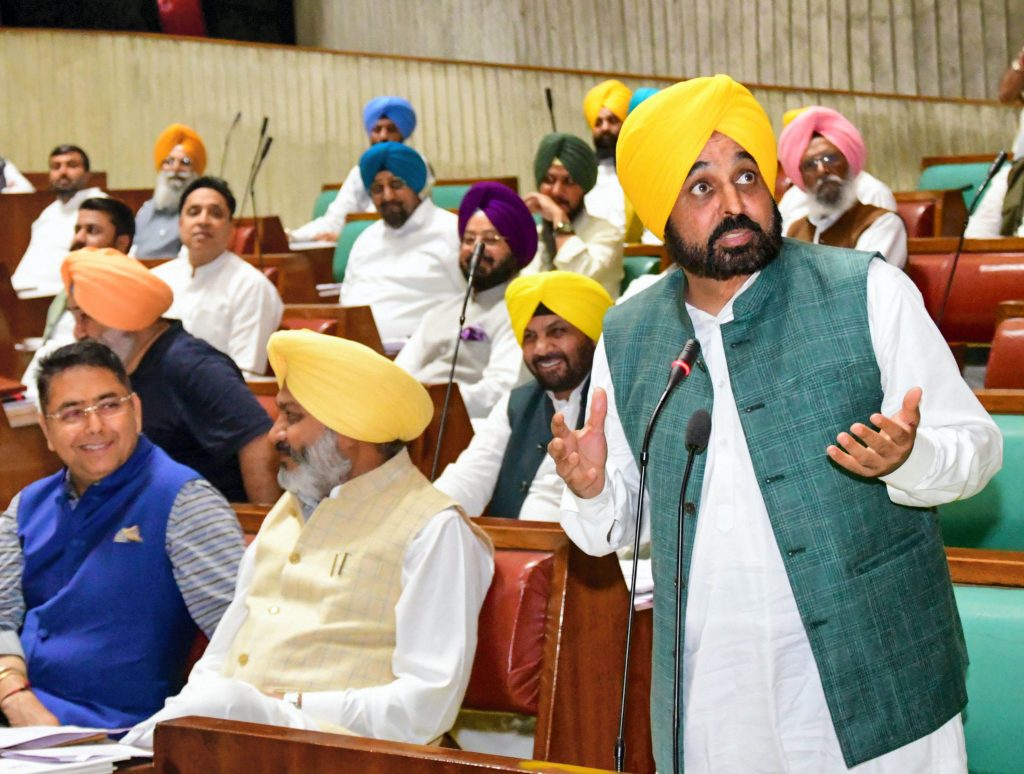
The Punjab assembly unanimously adopted a resolution – in the absence of the Congress – declaring the water cess proposed to be levied by neighbouring Himachal Pradesh on hydel power generated in the hill state as “illegal”, and sought its immediate withdrawal. Terming it to be in violation of the Inter-State River Water Disputes Act, 1956, the assembly recommended to the state government to request the Centre to prevail upon the Himachal Pradesh government to withdraw the move. Aam Aadmi Party (AAP) in power in Punjab.
Punjab Chief Minister Bhagwant Sing Mann
Lambasting the said move of the newly-elected Congress government in the neighbouring Himachal Pradesh and questioning the absence of Congress legislators, the Punjab water resources minister Gurmeet Singh Meet Hayer termed it as a “senseless move’’. He also took a dig at the Congress members saying that they had run away as they knew that this resolution was coming up against the Congress government in Himachal Pradesh. While the chief minister Bhagwant Mann also flayed Himachal Pradesh’s move, the Shiromani Akali Dal (SAD) members also backed the resolution.
Punjab’s resentment was obvious as the Bhakra Beas Management Board (BBMB) and the Punjab State Power Corporation Limited’s (PSPCL) hydro projects in the Himachal Pradesh would also come under the purview of this law. Hence the resolution in the Punjab assembly read that the House was concerned about the said move to impose water cess on the hydro power projects for non-consumptive use of water for power generation. The water resources of the hill state were now the government property while any proprietary, riparian or usage rights with any individual, group, company, corporation, society or community were deemed to have been terminated.
Stating that the House acknowledged and recognised the right of Punjab over the use of waters flowing into the state for all purposes, the resolution said that all the BBMB projects which had since been constructed with the investment made by the state of Punjab largely happened to be situated in Himachal Pradesh.
It further said that with the imposition of cess, the Himachal Pradesh government was trying to put avoidable tax burden on Punjab as it was evident from the objective of the ordinance. With this levy, there is an additional financial burden of Rs 1,200 crore annually of which a major burden was likely to be on Punjab, it said and added that this was not only an infringement on the exclusive rights of the state over its natural resources but also result in additional financial burden for generation of power resulting in the higher cost of power generation.
The resolution further held that the water cess by Himachal Pradesh was against provisions of the Inter State River Water Disputes Act, 1956 while the Punjab through the Bhakra Beas Management Projects was already liberal in releasing 7.19% of electricity of the composite share of Punjab.
The resolution said that the House very strongly and unanimously resolved that this levy of water cess imposed by Himachal Pradesh government was illegal and, therefore, the same should be withdrawn.
This House recommends to the state government to request the government of India to prevail upon the government of Himachal Pradesh to withdraw the ordinance as it violates a Central Act, the Inter State River Water Disputes Act, 1956, it read.
Haryana too decries the move
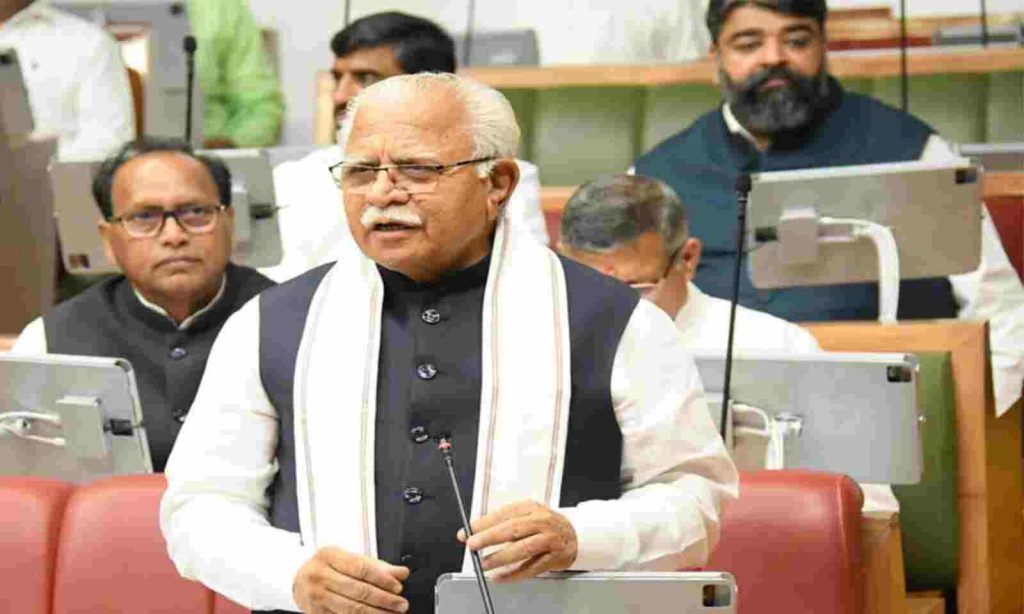
Haryana chief minister Manohar Lal Khattar also opposed the ordinance passed by the Himachal Pradesh government to impose the said water cess for non-consumptive use of water for power generation and said that it was illegal and not binding on the state of Haryana and therefore the same should be withdrawn immediately by the Himachal government.
Haryana has a BJP-Jannayak Janta Party (JJP) coalition government.
Haryana Chief Minister Manohar Lal Khattar
The resolution which was moved by the chief minister on the last day of the budget session, opposing the said move, was unanimously supported and passed by the House. The House also urged the Central government to prevail upon the Himachal Pradesh government to withdraw the Ordinance as the same was in violation of the Central Act – Inter State Water Disputes Act, 1956.
Khattar told the House that with this new levy there would be an additional financial burden amounting to Rs 1,200 crore per annum on partner states out of which about Rs 336 crore would be burden on the state of Haryana. This new levy was not only an infringement of the exclusive rights of the state over its natural resources but would also result in additional financial burden for generation of power resulting in the higher cost of generation of electricity, said the chief minister.
Himachal sticks to stand
Meanwhile, responding to the Punjab assembly’s resolution declaring the water cess Bill of Himachal Pradesh as illegal, its deputy chief minister Mukesh Agnihotri has said that the Inter-State River Water Disputes Act, 1956 did not prohibit the state from imposing the water cess on the power generation for the use of water and there was no bar on the imposition of water cess under Section 7 of this Act. He also said that the water cess had already been imposed by various states like Uttarakhand and Jammu and Kashmir.
Their stances notwithstanding, a new row between the three neighbouring states has just begun.
There is a palpable desire for polls in the region. The entire political class barring the BJP wants the elections to be held in near future in the UT. Some feel the BJP may hold election after the 2024 general poll when it expects to return with a fresh mandate. A report by Riaz Wani
Even as the country braces for 2024 general elections, there are no signs that the Assembly elections will be held in Jammu and Kashmir. And with every passing month, the hope that the polls will be held in the union territory before the national elections is fading fast. This, despite the fact that the entire political class in the UT, except the BJP, want the elections to be held in the near future.
J&K has not had an elected government since June 2018 when Governor’s rule was imposed after the PDP-led coalition government lost its majority following the withdrawal of support by the BJP. Subsequently, on August 5, 2019, New Delhi abrogated Article 370 that granted J&K special status under India’s constitution, and downgraded the state into two union territories – J&K and Ladakh. Since then the Lieutenant Governor has taken over from the Governor. The last four years have witnessed a drastic political makeover of the state-turned-union territory, so much so that in many aspects, the current J&K bears little resemblance to what it was pre-August 2019.
The BJP is claiming to have ushered in the peace but has somehow shied away from holding polls. This has forced the opposition parties to close ranks and demand election.
Earlier this month, a delegation of political leaders led by National Conference president Dr Farooq Abdullah met the Election Commission of India, seeking early elections in the Union Territory. The delegation requested the ECI to hold elections as soon as possible now that the delimitation process had been completed. The political leaders also submitted a memorandum to the ECI, in which they called for the restoration of the democratic process in the UT. The memorandum also mentioned that union home minister Amit Shah has stated many times that the government is ready to facilitate assembly elections, but the final call has to be taken by the Commission.
Significantly, the signatories of the memorandum included Abdullah, Congress national president Mallikarjun Kharge, CPI (M) general secretary Sitaram Yechury, NCP chief Sharad Pawar and other senior leaders of national political parties. Other signatories were DMK, TMC, CPIM, RJD, SP and AAP. They have also decided to visit Srinagar in May to assure people of their support. This is the first such attempt by leaders from Jammu and Kashmir to seek support from opposition parties from across the country for the restoration of statehood and democracy in the region. And this initiative followed immediately after Abdullah rallied opposition leaders from Jammu division where they decided to jointly approach the poll panel.
“In disregard of the letter and spirit of the Constitution, an unrepresentative and unaccountable bureaucracy is allowed to run the government to the discomfort and inconvenience of the general public,” the memorandum to the ECI read. “The Election Commission of India is under a constitutional obligation to hold assembly elections in Jammu and Kashmir and delay in and denial of assembly elections would amount to denial of fundamental and democratic rights of the people of Jammu and Kashmir and a breach of constitutional obligations.”
But the ECI gave no specific timeline to the delegation for the election, although it assured them of its seriousness to hold the exercise.
“The election commissioner of India didn’t give any specific dates about when the elections will be held,” the National Conference leader and parliament leader Hasnain Masoodi said. “But we are hopeful this meeting will bear fruit.”
Around ten Assembly elections are scheduled to be held before the general elections. But J&K is not one of them. Among them, the elections in Karnataka, Chhattisgarh, Madhya Pradesh, Rajasthan and Telangana will be very crucial. The BJP will hope to win all of them. But should the party suffer reverses in the majority of these states, this may not bode well for its 2024 chances. The elections in these five major states represent the last chance for the opposition, especially Congress, to hurtle back into the reckoning. This preoccupation with the national polls has made elections in J&K a secondary concern.
But not in J&K where people can be seen to be eagerly waiting for the elections, as the exercise is expected to lead to the restoration of statehood. No less than the union home minister has made it clear that the statehood of J&K would be restored only after elections are held and a representative government is formed. There have so far been no signs that the centre is reviewing its policy.
“It seems that the union government wants to first see how the future elected government would look and what its political and governance priorities would be, including its approach to the issue of the revocation of Article 370,” read an editorial in a local Kashmiri daily. “Also, it is as yet unclear if the centre would be inclined to restore complete statehood or a truncated one on the pattern of Delhi. All we can hope for now is that the elections are announced earlier than later, and September-October will be an ideal time for the exercise.”
But the centre has maintained a studied silence on the issue. The occasional utterance by a senior BJP leader has passed the buck on to the ECI. The ECI, in turn, has said that it will factor in “weather conditions and security situation” before taking a call on the elections.
“We are aware that once the process is complete, they (polls) must be held. And taking the weather, the security concerns and all other factors…other elections at that time…. (into consideration, we will take a decision),” the Chief Election Commissioner Rajiv Kumar said in January.
As for the weather and security, the concerns cited by the CEC as factors in holding polls in J&K, this is not an opinion shared by J&K political parties or for that matter, people in the region. It is springtime in Kashmir now and the weather is relatively warm. Second, as for security, Kashmir is now a considerably more peaceful place, a surprising turn of events which the government boasts as its singular achievement following the withdrawal of the region’s special status in August 2019. So, now is, in a sense, the ideal time for the Assembly polls.
This should normally pave the way for the polls, but this doesn’t seem to be the case. For some reason, the elections keep getting deferred. More so, at a time when there is a palpable desire for polls in the region. Some people are speculating that the BJP has shelved the plan for J&K Assembly elections and might want to postpone them until after the 2024 elections when it expects to return with a fresh mandate.
“Then the party may not hold elections for another five years,” said a Kashmiri politician not wanting to be named. “As of now, it is difficult to read the mind of the union government as far as Assembly polls in J&K.”