At a time when so much was happening around- Prime Minister Narendra Modi attending the ‘Pran Pratishtha’ or consecration of the Ram temple at Ayodhya and Bihar Chief Minister Nitish Kumar switching sides again preceding his ninth stint as CM, Tehelka Special Investigation Team was working overtime to expose rampant leak of question papers of competitive examinations. Our Cover Story “Paper leak mafia unplugged” unveils an illicit network that not only orchestrates paper leaks but also aids those desperate to immigrate in navigating the illicit ‘donkey’ route. Our undercover reporter recorded on hidden camera claims of an agent who boasted, “Our mafia reigns supreme as the main force behind the leakage of examination papers. Our reach extends to even the prestigious IAS examination, which is available for a price tag of Rs 3 crore. We assure you a fool proof package, covering Prelims, Main, and Interview, all with an unequivocal 100 percent guarantee.”
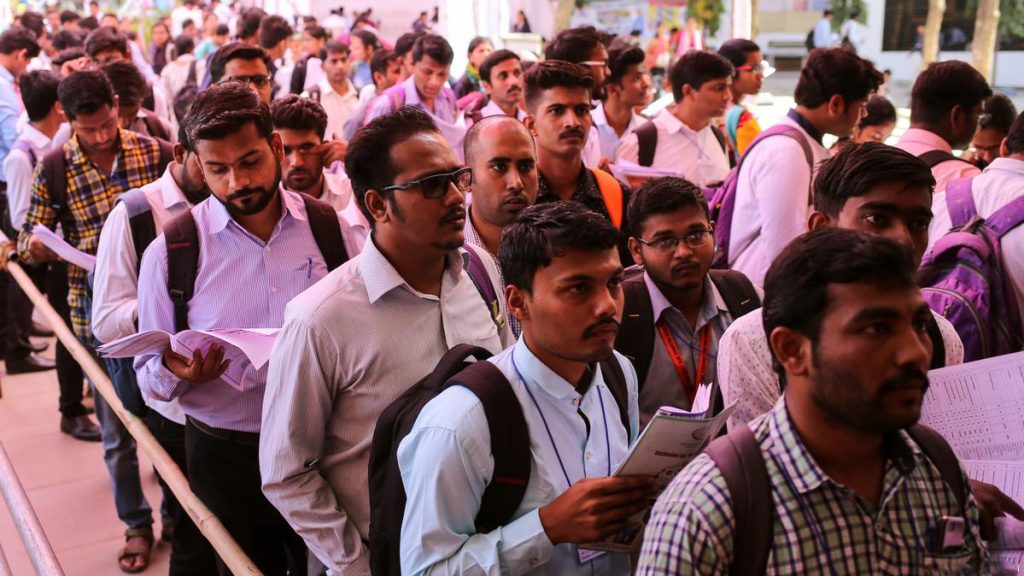
Demand-supply mismatch with a handful of vacancies in government departments attracting lakhs of applicants has led to corrupt ways to grab these. Little doubt, paper leak cases are being reported from several states including West Bengal, Gujarat, Maharashtra, Rajasthan, Haryana, Punjab, Himachal Pradesh, Tamil Nadu, Madhya Pradesh, Karnataka, Bihar and Telangana. In Rajasthan, there have been over two dozen cases of paper leak during 2011 to 2022. In Himachal, the new state government dissolved the staff selection commission upon coming to power. In Gujarat, the Bhavnagar Police lodged an FIR in 2023 busting a state wide mafia that arranged dummy candidates to appear for government jobs. In Bihar, the Staff Selection Commission’s offline paper was leaked leading to the arrest of its chairman. In Telangana, the State Public Service Commission question paper for Junior Engineers Town Planning was leaked and had to be cancelled when it fuelled protests. Uttar Pradesh also saw many instances of paper leak but what raised the eyebrows was the arrest of three scribes who had exposed some paper leaks but were allegedly trapped by cops after they made them share a copy of the leaked examination question paper.
However, a stunner came from Haryana when the Supreme Court, took suo-motu notice of leak of Judicial Service (Preliminary) exam and transferred to itself the case pending before the Punjab and Haryana High Court. A candidate had moved the High Court, alleging she was approached by two persons a day before the examination who offered to provide her the question paper for Rs 1 crore. In the dental surgeon examination and pre-examination of Haryana Civil Services, an HCS officer has been named as the main accused.
It is time to make sure that not one more exam paper leak occurs in future by enacting a national legislation to curb such leaks. The remedy sometimes could be worse than the disease but the existing system needs immediate course correction.
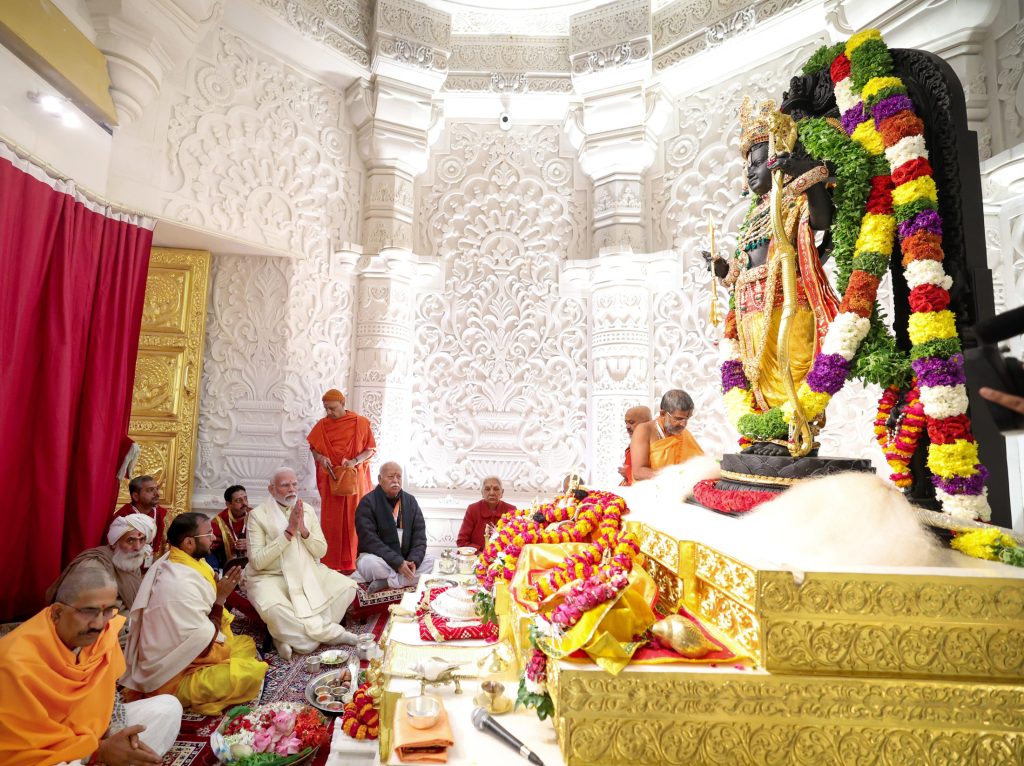
After performing ‘pran pratishtha’ of the newly installed idol of a five-year-old Ram Lalla in the sanctum sanctorum of Ram temple, Prime Minister Modi invoked the universality of the spirit of Ram even as he called for humility while celebrating the historic event. A report by Mudit Mathur
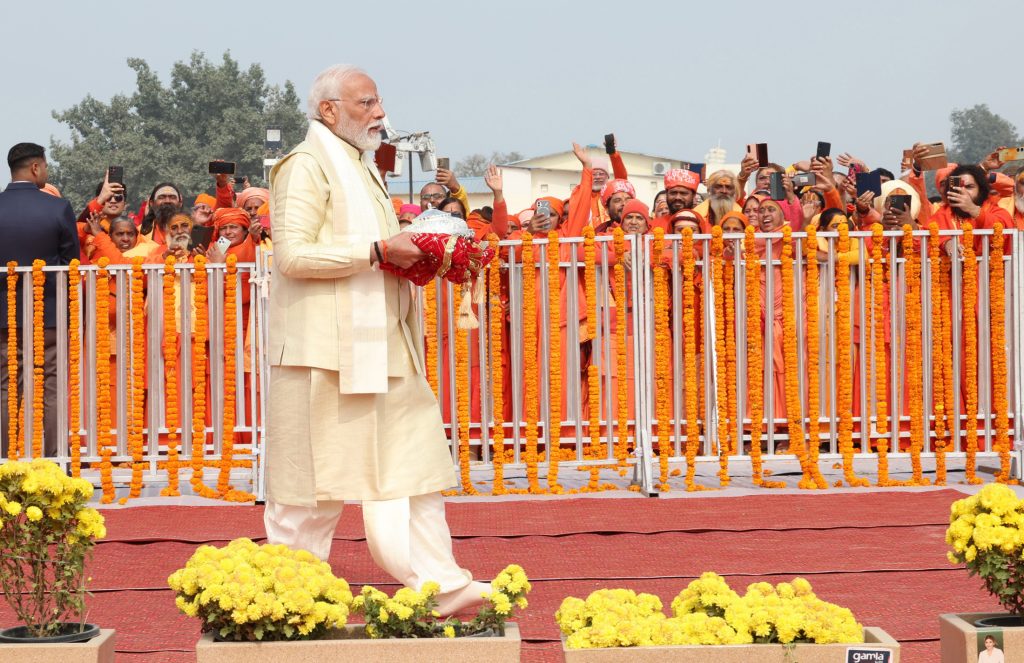
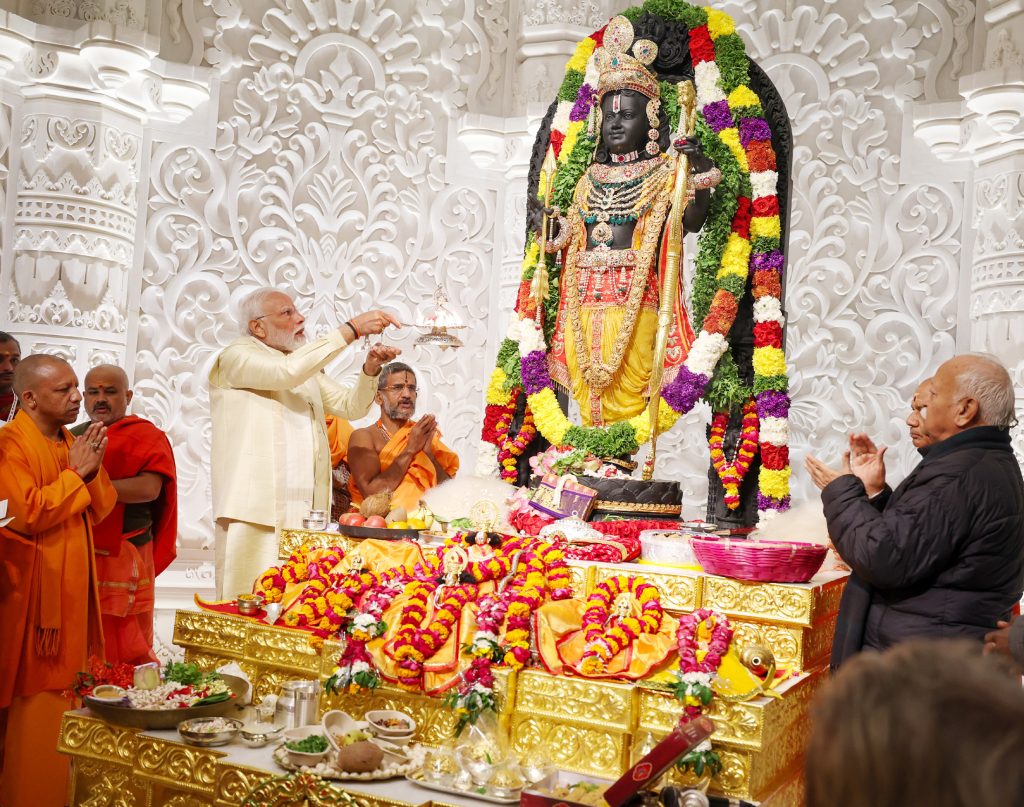
PM at the Pran Pratishtha ceremony of Shree Ram Janmaboomi Temple in Ayodhya, Uttar Pradesh on January 22, 2024.
On January 22, Prime Minister Narendra Modi assumed the role of Mukhya Yajmaan (key performer) of religious rituals in Ayodhya along with Rashtriya Swayamsevak Sangh (RSS) chief Mohan Bhagwat in the sanctum sanctorum of Ram temple where magnificent ‘pran pratishtha’ or consecration of the newly installed idol of a five-year-old Ram Lalla wss done amid chanting of vedic hymns in “Abhijeet Muhurta”, which according to Vedic astrology is considered to be most auspicious period for securing victory.
Modi said it was the beginning of a new era for the country, an era that will last for centuries and called for humility while celebrating the historic day. He invoked the universality of the spirit of Ram that defines inclusiveness of humanity. After the religious rituals, Modi broke his 11-day fast that was part of his spiritual preparation for the rituals. He accepted Ram Lalla’s “Panchamrit” (five main ingredients, Yogurt (Dahi), Milk, Honey, Tulsi (basil), and Ghee from Govind Dev Giri, treasurer of the temple trust.
Modi made it a point to tell the nation that he had been at the Ram Setu a day earlier. He also recalled how Ram, too, had begun his return journey from Lanka to Ayodhya from that very spot, after defeating Ravana. He also added that he was here not without observing an 11-day fast, during which he offered prayers at select temples in the southern Indian states of Tamil Nadu, Kerala, Karnataka and Andhra Pradesh as pilgrim sites which had been associated with Lord Ram. While visiting temples in the south, he connected with the people of the south, where his party has a dismal presence politically.
In his new avtar of a Hindu prime minister, Modi in his long address pitched that Ram was not just as a deity but as an icon of governance. He emotively asserted that Ram represented the “prestige of India”, “nation-building”, and the “solution, not controversy.” He talked passionately about moving from “Dev” to “Desh” and “Ram to Rashtra” for India’s resurrection. Terming it a historic day, Modi said that it was akin to a “nation uprising by breaking the mentality of slavery, drawing courage from every disorder of the past and creating a new history”.
Addressing the selective audience soon after consecration ceremony comprising more than 8000 prominent people from all walks of life, including seers who had been involved in the Ram Temple movement, industrialists like Mukesh Ambani and his family, film stars like Amitabh Bachchan, Rajinikanth, Maduri Dixit, Ranbir Kapoor, Alia Bhatt, Kangana Ranaut and many others, Modi said, “Ram Temple is a symbol of peace, patience, harmony, and maturity of Indian society. Today, I call upon those people to rethink their perspective.”
Speaking on the inclusiveness and spirit of service of the characters in the Ramayana and the life of Lord Ram, the Prime Minister said there was much to learn from them. “We need to learn the value of service and loyalty from Lord Hanuman, resilience from Adivasi mother Shabari who had the conviction that ‘Ram will come’, while Nishad Raj had helped Ram and Sita to cross the Ganga in his boat,” he said. “Even the smallest of creatures such as squirrels had contributed to the construction of the Ram Setu, while the Jatayu had fought Ravana to save Sita knowingly that he would be defeated,” Modi added.
Modi gave credit to the apex judiciary for imparting justice in centuries old controversy but he did not mention a word about the defining role of BJP stalwarts like former deputy prime minister Lal Krishna Advani, or former BJP chief Murli Manohar Joshi, or frontline activists like Vinay Katiyar, Mahant Dharam Das and others, who are believed to have been kept away from the ceremony.
Over a dozen former judges of the Supreme Court were also present for the consecration ceremony including four former Chief Justice of India J S Khehar, Justices V N Khare, N V Ramana and U U Lalit. Justice Khehar had offered to personally “mediate” the Ayodhya dispute in 2017. The list included Justice Arun Mishra, chairperson of the National Human Rights Commission; Justice Ashok Bhushan, Chairperson of the National Company Law Appellate Tribunal among others. Justice Bhushan was part of the five-judge Constitution Bench which in 2019 cleared the decks for construction of the Ram Temple. Justice Adarsh Goel, Justices V Ramasubramanium, Anil Dave, Justice Krishna Murari, Vineet Saran and Gyan Sudha Mishra were also present. Justice Sudhir Agarwal, former Allahabad High Court judge, who was part of the 2010 High Court ruling in the Ayodhya dispute also attended the temple inauguration.
Advani spearheaded the Ayodhya movement in 1988 that culminated in destruction of Babri mosque on 6th December,1992 in his presence on the dais along with Uma Bharti, Joshi and many others who were blamed for instigating the masses. Though the apex court did not approve the act of demolition treating it criminal, a Special Trial court has honourably exonerated all the accused of demolition for want of credible evidence against them. Uma Bharti and Sadhvi Ritambhara were seen bending among thousands of saints behind the barricades when Modi took a round to express his gratitude to his specially invited audience.
The major opposition parties did not attend the Ram temple consecration ceremony in Ayodhya citing diverse points of view that it was a BJP-RSS show to garner political support in upcoming elections as the temple is yet to be completed fully. The opposition leaders cited utterances and decision of religious and spiritual heads of four seats of Shankaracharyas who had objected to the hasty decision to inaugurate the incomplete Ram temple and stayed away from the consecration ceremony in Ayodhya. Four seats (Peeth) situated in north, south, east and west are considered as ancient sources of Hindu spirituality and faith established to protect religion.
Ram Lalla’s idol, which has been installed in the sanctum sanctorum, has been made by sculptor Arun Yogiraj. The idol carved out by Mysuru-based artisan was among the three idols out of which one had to be selected to be placed in the sanctum sanctorum of the Ram Mandir. The glittering grand show – streamed live all around the world on TV channels connected with specially set up big screens in the prominent temples of Hindu faith for public viewing of the event.
Several states declared holiday for schools, while government offices, other establishments and public sector banks remained closed for half a day. Some states declared a dry day; and asked shops selling non-vegetarian food items to remain closed till evening. Saffron streamers, flags with the images of Ram, Hanuman, Sita and Lakshman and posters welcoming the arrival of Ram to his birth place Ayodhya dotted several nook and corner of the mega cities of India and abroad displaying hype of the event. People congregated in the temples that were decorated with flowers, lamps, flags and posters. In the evening, there was a Diwali-like atmosphere as earthen lamps (Diyas) were lit outside homes, shops and business establishments to mark the occasion.
Many parts in the country witnessed unpleasant sectarian clashes during celebratory aggression which led to arrests and retaliatory bulldozer actions. The euphoria erupted among the proponents of the temple after watching the central role of the state in the religious rituals associated with the inauguration of the temple is visible ubiquitously in the form of aggressive display of Hindu identity on the streets, which however does not augur well for secular character of Indian polity in the coming days.
Terming January 22 a Swarna Diwas (golden day), the RSS chief Mohan Bhagwat said Ram Lalla (child Ram) had come back to Ayodhya after 500 years. He paid tributes to all those who fought for the Ram Janmabhoomi movement. Bhagwat said Mahatma Gandhi used to say, “there was enough on earth for everyone’s needs but not for everyone’s greed.” “It should be our duty to serve people who are in crisis and pain. We must earn with both hands, keep whatever is needed for our own lives and donate everything else to charity,” the RSS chief exhorted. Uttar Pradesh chief minister Adityanath emphasised on how the ‘pran pratishtha’ marked the virtual revival of the ‘Treta Yug’ (the era of Ram).
Hours after the consecration of the Ram idol in Ayodhya, Prime Minister Narendra Modi, citing divine inspiration, publicly announced a scheme to electrify one crore households with solar electricity.
“Today, on the auspicious occasion of the consecration in Ayodhya, my resolve has been further strengthened that the people of India should have their own solar rooftop system on the roof of their houses. The first decision I have taken after returning from Ayodhya is that our government will launch ‘Pradhanmantri Suryodaya Yojana’ with the target of installing rooftop solar on one crore houses.
“This will not only reduce the electricity bill of the poor and middle class, but will also make India self-reliant in the field of energy,” Modi tweeted from his personal account. No information on a timeline for such installations was given.
Cabinet hails Modi
Country’s body got freedom in 1947 but its soul on Jan 22, 2024. Congratulating Prime Minister Narendra Modi on the consecration ceremony at the new Ram temple in Ayodhya, the Union Cabinet chaired by prime minister Narendra Modi adopted a sycophantic resolution a day after, expressing that while “the body of the country attained independence” in 1947, the “Pran Pratishtha of its soul was done on January 22, 2024”, and “everyone experienced spiritual satisfaction”.
The resolution, moved by Union Defence Minister Rajnath Singh on behalf of the Cabinet, termed the Wednesday meeting “historic… Cabinet of the Millennium” and said Modi had “fulfilled a centuries-old dream” that “Indian civilization had dreamt for five centuries.”
“The love you have received from the people has established you as a “Jan Nayak”. But, after the ushering in of the new era, you have also emerged as the pioneer of the new era,” it stated.
J-K recently published its final electoral roll and registered a total of 86.93 lakh voters, marking the third revision following the completion of the delimitation exercise on May 5, 2022. However, the continuous delay in holding Assembly poll is causing anxiety among residents, reports Riyaz Wani
With the inauguration of Ram Mandir on January 22, the focus has shifted now to parliamentary elections being held probably in May-June 2024 in which the temple is expected to dominate the discourse. And it will be unlike the general election of 2019 when it was the Pulwama bombing that killed 40 CRPF jawans which set the narrative. The subsequent Balakot attack and the India-Pakistan skirmishes further swayed the public opinion in favour of the prime minister Narendra Modi.
Ram Mandir has currently done a similar kind of thing. There is a groundswell of support for the PM Modi and it could very well earn him a third term in power at the centre.
Kashmir could still be a major issue in the polls after the December verdict of the Supreme Court in favour of the abrogation of Article 370. This also goes to the favour of the BJP which counts the withdrawal of Article 370 as one of its biggest achievements. Also, with other achievements such as the passing of the laws like Citizenship Amendment Act 2019 (CAA), National Register of Citizens (NRC), Triple Talaq and others, the BJP has a major political advantage over the opposition.
In Jammu and Kashmir, the BJP’s victory is largely seen as a foregone conclusion. If anything, the people are looking forward to a third saffron term for the party and hoping it works out well for the union territory. The primary issue that is on the minds of people is the Assembly election which is expected to take place by September 2024 in accordance with the Supreme Court directions.
Jammu and Kashmir recently published its final electoral roll and registered a total of 86.93 lakh voters on January 01, 2024. The new count comprises 44.35 lakh male and 42.58 lakh female voters. The gender ratio has increased from 924 to 954. This marks the third revision of electoral rolls in Jammu and Kashmir, following the completion of the delimitation exercise on May 05, 2022.
“This should hopefully pave the way for the long-awaited Assembly elections,” said a political leader with the PDP, not wishing to identify himself adding that the Jammu and Kashmir by and large had now no representation of the people in the democratic institutions.
The absence of Rajya Sabha members, impending conclusion of the tenure of all 5 Lok Sabha representatives, abolition of the 36-member J&K Legislative Council in August 2019, and the prolonged 10-year gap before the upcoming elections for the 90-member J&K Legislative Assembly by September 2024, all contribute to absence of regional voices in democratic processes.
Moreover, the terms of the 4,100 Panchayats with 40,000 Panches and Sarpanches have expired, along with the conclusion of terms for all Block Development Councils (BDCs) and Urban Local Bodies (ULBs), including the prominent Srinagar Municipal Corporation and Jammu Municipal Corporation. The only exception lies with the 3rd tier of Panchayati Raj Institutions, the District Development Councils (DDCs), which have a remaining term of two years.
The question in 2024 revolves around whether elections will be conducted across these democratic institutions, with the exception of DDCs.
“The necessity for timely elections in J&K is critical to reinstating a functional and representative democracy in the region,” an editorial in a local daily read. “It is crucial to address the current void in various legislative bodies and local governance structures, ensuring that the people of the union territory regain their rightful representation in the democratic framework.”
For now, the people are looking forward to the upcoming parliament polls for an opportunity in the UT to exercise their democratic right. But the delay in Assembly elections prolongs the absence of a locally accountable government, which does impact the implementation of policies tailored to address the unique challenges faced by Jammu and Kashmir.”
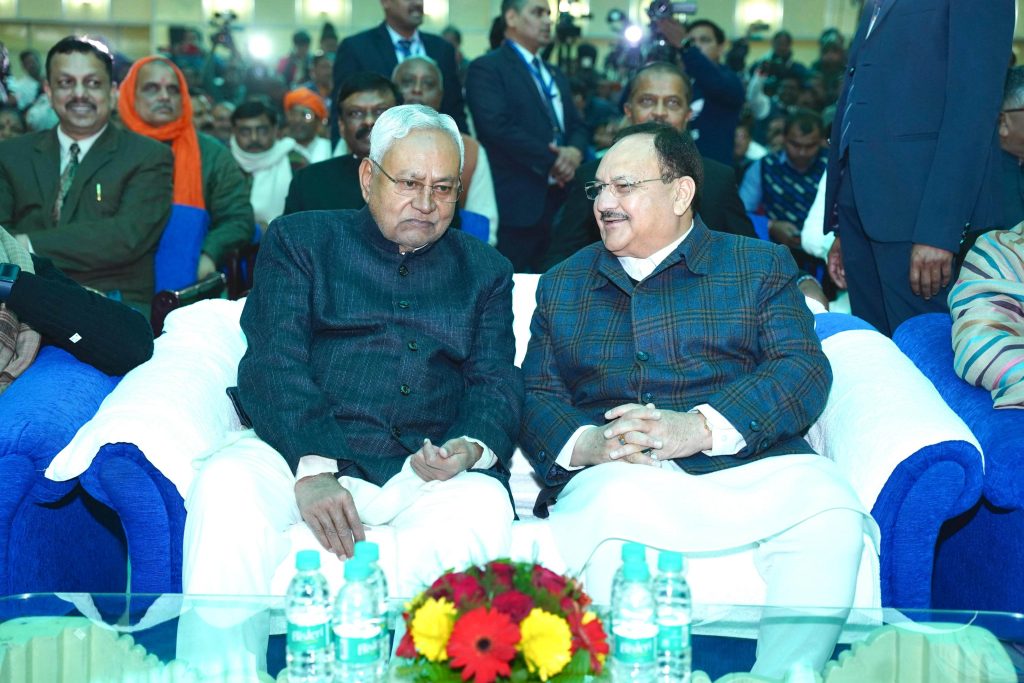
The ‘Paltu Ram’ of Bihar politics has done it again. With the Lok Sabha election round the corner, the 72-year-old longest-serving Bihar chief minister Nitish Kumar has resigned as the CM of ‘Maha Gathbandhan’ government while switching sides with the BJP. A report by Aayush Goel
From being the ‘king’ in Bihar politics to ‘kingmaker’ in central government, Nitish Kumar with his latest and fourth somersault has epitomised the adage: ‘if you can’t beat them, join them’. There are no permanent friends or foes in politics. If one person has imbibed that to the core, it is Nitish Kumar. The ‘Paltu Ram’ of Bihar has done it again. On the eve of the forthcoming Lok Sabha election, the 72-year-old longest-serving Bihar chief minister Nitish Kumar has resigned as the CM of ‘Maha Gathbandhan’ government and has switched sides with BJP.
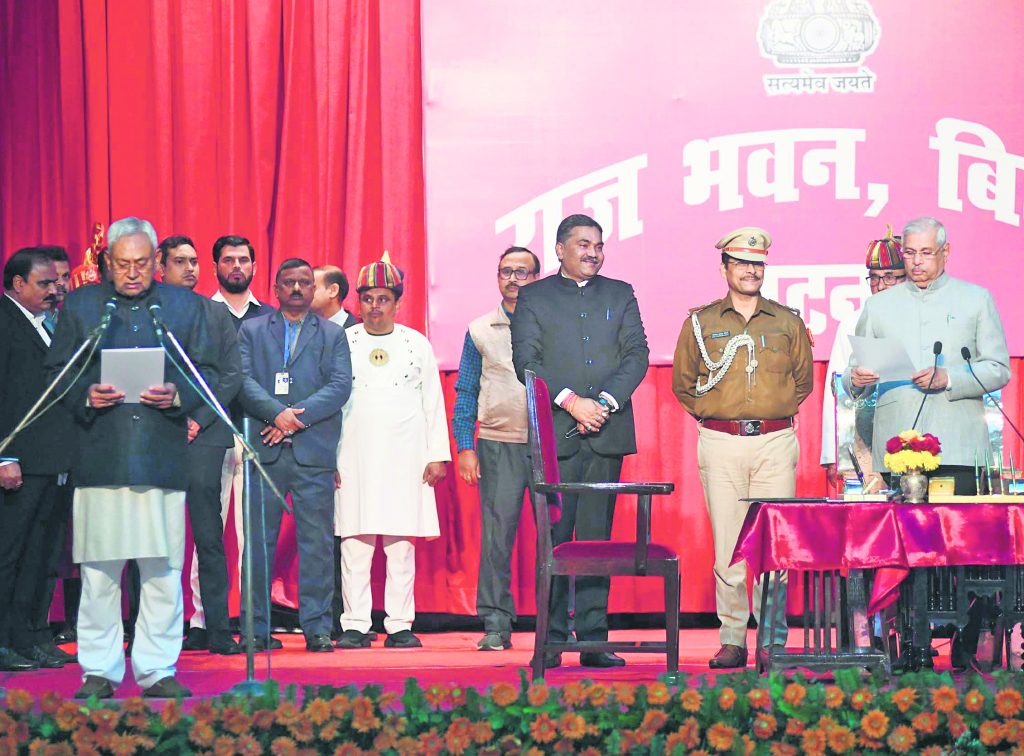
The political drama reached its peak as he was sworn as CM for the ninth time, hours after resignation, but this time holding BJP’s and HAM’s hands.
The state BJP unit elected Samrat Choudhary and Vijay Kumar Sinha as his deputy CMs. The move is an admission that the Narendra Modi-led BJP is set to return to power for a record third time. As of today, the BJP has 78 MLAs, and with JDU’s 45, Jitan Ram Manjhi’s HAM (Hindustani Awam Morcha) 4, they together have 127, five more than the required number to form the government. In the opposition camp, the RJD has 79 MLAs, Congress 19, and three Left parties have 16. One independent candidate is also backing the opposition, taking the total number to 116. The AIMIM, which has one MLA, is neither supporting the government nor the opposition.
The switch has not just hit the state coalition of Lalu Prasad Yadav-led RJD (Rashtriya Janata Dal) and Congress but appears to have dealt a severe blow to the I.N.D.I.A block and the idea of united opposition. Over the years, Nitish Kumar managed to survive as chief minister, irrespective of the party he partnered with. Lauded by some for commendable political survival skills and ridiculed by others for being the poster boy of turn coats, it’s not easy being him, say close associates. While JDU being a smaller player with just 45 MLAs, it may be noted that Nitish is also a Kurmi, a caste that accounts for just 2.87% of Bihar’s population, contrasting 14.26% of Yadavs, the core vote base of Lalu Yadav and Tejashwi’s RJD. A follower of recently Bharat Ratna awardee socialist leader Karpoori Thakur, Nitish has now emerged as the leader of the Extremely Backward Classes (EBCs), which constitutes over 30% of Bihar’s population which makes him the CM choice, irrespective of caste and seat arithmetic.
All was not well: Nitish Kumar
Shortly after submitting his resignation to the Governor of state, outgoing Bihar CM and JDU president Nitish Kumar interacted with the media. Shedding light on the cause that led to his move, Nitish said, “…this situation came because everything was not going well…I was taking opinion from everyone. I listened to all of them. Today I have resigned and ended the government…” He particularly mentioned that the alliance with the INDIA Bloc didn’t work well leading to his resignation. After Nitish Kumar handed over his resignation to the governor, he took questions from the reporters outside the Raj Bhavan. When questioned about him being accused of practicing ‘opportunistic politics’, Kumar hit out at the INDIA bloc, saying he was ‘hurt’ by the member parties. “I wasn’t saying anything for a while now. You must remember I was wanting to say a lot of things lately but did not speak. I was doing so much of work. I also formed an alliance there (INDIA bloc), and did a lot of things for it. But the others were not working at all. I was hurt because of that. People in the party were also hurt by the behaviour. Humne Chhod Diya (We have left it)” he added.
The development has changed the dynamics of the INDIA bloc as Mamta Banerjee would now look to flex muscle and try to replace Nitish Kumar as face of the bloc. West Bengal CM is scheduled to visit North Bengal while Rahul Gandhi would be around for his ‘Bharat Jodo Nyay Yatra’. She is expected to renegotiate her political stand in the bloc. The bloc is now also pinning the hope on Samajwadi Party which has come forward offering 11 of their stronghold seats to Congress in Uttar Pradesh.
Nitish’s shrinking political space
Over the past few weeks, reports from Bihar had suggested that Nitish Kumar was battling for political space. A large section in his party wanted Kumar to renew the party’s partnership with the BJP as it was convinced that the opposition coalition would not succeed in unseating the present dispensation at the Centre. Contrary to their earlier belief, Narendra Modi’s popularity is yet to be dented even after ten years in office. On the other hand, his image had had got further fillip after the recent consecration ceremony of the Ram Temple at Ayodhya, making him an invincible adversary.
Political experts claim ‘predatory’ BJP was making moves to poach a number of JDU legislators. Nitish Kumar’s relations with the RJD were strained and getting worse with each passing day. The two allies had lately been constantly sniping at each other.
While RJD’s Tejashwi Yadav felt he was not getting his due as deputy chief minister, Nitish Kumar suspected that his ally was planning to split his party and anoint Tejashwi as chief minister. It was precisely for this reason that Nitish Kumar moved in quickly to take over the presidency of his party from the incumbent Lalan Singh. It had become well-known in Patna that Singh had become close to RJD leader Lalu Prasad Yadav and that there was a distinct possibility that he could help him in spiriting away a section of his party MLAs.
Disillusionment and marginalisation in INDIA block.
While the political scene back home was not rosy, what according to Nitish loyalists drove him to finally make the switch was the disillusionment with the functioning of the 28-party I.ND.I.A block. Speaking to Tehleka, a close aid of Nitish Kumar said he felt particularly slighted at being marginalized since he had taken the initiative in bringing the disparate opposition parties together last year. Having been welcomed back by the RJD and Congress with all the hype after he dumped the BJP in 2022, Nitish Kumar wanted an upgrade and a role befitting his stature. Having caught national attention for projecting himself as face of I.N.D.I.A block and prime ministerial candidate, his ambitions however fizzled when West Bengal CM Mamata Banerjee and her Delhi counterpart Arvind Kejriwal upstaged him by suggesting that Congress president Mallikarjun Kharge be named as the INDIA bloc’s Prime Ministerial candidate. Meanwhile his numerically-stronger alliance partner in the state RJD was becoming increasingly assertive. Facing the prospect of a split in his party and, at the same time, losing out on a pre-eminent position in the opposition coalition, Nitish Kumar preferred to exit the INDIA bloc before the ‘ship sank’.
Nitish a chameleon Nitish’s exit was right on schedule just a day before Rahul Gandhi’s ambitious ‘Bharat Jodo Nyay Yatra’ was to enter Bihar. His sudden political move is highly attributed to the Congress’s failure to unite the regional parties on the seat-sharing arrangement and diverting focus majorly on Rahul Gandhi and his ‘Nyay Yatra’. Reports suggested that the JDU chief remained ‘non-committal’ about his participation in Congress’s yatra as he was reportedly upset over delay in seat-sharing talks for the 2024 Lok Sabha election. Lashing out at Kumar, Congress leader Jairam Ramesh said, “Nitish Kumar, who frequently changes political partners, is giving tough competition to the chameleons in changing colours,” Ramesh said in a post in Hindi on X. The Congress leader said the people of Bihar will not forgive the “expert of this betrayal” and those who made them dance on their tunes. Nitish had first severed his ties with the BJP in 2013 as he was unhappy that the BJP had named Narendra Modi as its Prime Ministerial candidate. The two teamed up again in the 2019 Lok Sabha election, only to part ways in 2022 as Nitish Kumar felt the BJP was constantly undermining him.
By proactively addressing the rising Iran-Pakistan tensions, China has again established itself as a key player in the geo-politics and a new messiah for peace in South Asia. much to the discomfiture to the United States – by Gopal Misra
Beijing does it again. During the last quarter of the year 2023, it succeeded in restoring diplomatic ties between Iran and Saudi Arabia; and now it prevails upon Islamabad and Tehran to avoid any further conflict on their sensitive borders. Much to the discomfiture to the White House, China is emerging to be a new messiah for peace in the regions of the Gulf and South Asia.
The rise of Dragon playing a key role in the geo-politics has given a setback to the ‘great game’ of the US establishment on retaining its assertive role in 21st century. The American agenda, which was being discussed through various think tanks comprising strategic planners and eminent members of academia, especially following the collapse of the Soviet Union in the nineties, has lost its direction, at least temporarily, due to the assertive policies of the Chinese leadership.
During the past two years, the US administration under President Joe Biden’s massive financial and military support to Ukraine in its ongoing war with Russia has turned into a perennial conflict between the western block and Russia. It also reveals that the agenda of divide and rule, the British had adopted in their 250-year rule in India, is being vigorously followed by Washington. It is natural for Indians to be reminded of this policy in American strategy in provoking conflict between Ukraine and Russia having centuries of close cultural, religious and ethnic ties.
Similarly, the recent clashes between Iran and Pakistan could have flared up into a much bigger conflict, but the timely Chinese intervention has diffused the situation, at least for the time being. It is also being asked how the Afghan Taliban could use the state-of-the art weapons abandoned by the American forces, while suddenly leaving Kabul. Even in New Delhi strategic affairs, experts are at their wits end about how the present incumbents in Afghanistan are maintaining the weapons and how they got trained in using them. The possibility of connivance of an American deep state with Qatar cannot be ruled out in empowering the Taliban fighters. A section of these Taliban fighters have common ethnicity with the Muslims of Xinjiang, a Chinese province. In this context, Iran-Pakistan clashes must be understood and the timely intervention of China before it becomes unmanageable, provoking Americans to re-enter the fluid situation in the region.
The clash and beyond
The tit-for-tat strikes have recently become a common phenomenon in the cross-border clashes in different parts of the world, whether it is between Russia and Ukraine in Europe, Hamas’s terrorist attack on Israel in West Asia and now between Iran and Pakistan, not far off from India. The Indian concerns about the clashes in the region are natural.
However, instead of working for peace, Washington appears to be fanning conflict; perhaps, settling its old anger against Russians. It is often stated that what you sow, you also reap. It appears that the Americans have adopted the British hatred against the Russians, who follow Orthodox Church. After the collapse of the USSR, the Warsaw Pact being dissolved, the then Russian president Yeltsin was keen to join NATO.
It may also be noted that the new Russian leadership had decided to abandon their international role, and wanted to be a part of Europe and its economy. The economic ties between Russia and Europe had increased many folds, but Washington deliberately enrolled Eastern European powers, perhaps in an effort to dilute the Russian influence in the region. The apprehension is that the USA might be engineering conflicts among India western neighbours.
Sun Weidong in Islamabad
Sun Weidong, Chinese Vice Foreign Minister, was in Islamabad, on January 20, 2024 to attend the 4th meeting of the CPEC-Joint Working Group on International Cooperation and Coordination, but the visit was also used to tell the present caretaker government in Pakistan that China “disapproves” any conflict between Pakistan and Iran as well as with Afghanistan. In the case of Iran, China imports a huge quantity of crude oil for its industry. In the case of Afghanistan, it apprehends that Islamists may walk into its Muslim-majority province of Sinkiang. Also, China is planning to mine precious mineral resources from Afghanistan.
It is true that Sun Weidong’s visit was planned much before the Iran-Pakistan clashes, but it enabled the top Chinese diplomat to communicate his country’s concern on growing decline in Islamabad-Tehran ties. Apart from inaugurating the CPEC Corner at the Ministry of Foreign Affairs library, he also met Pakistani President Arif Alvi.
Weidong’s visit has also ensured that during Iran’s Foreign Minister Hossein Amir-Abdollahian accompanied by some top Iranian military officials, visit to Pakistan later, the stress will be on peace. Amir-Abdollahian will also be meeting his Pakistani counterpart Jalil Abbas Jilani. Since the polls in Pakistan are due in February, the substantial discussion might be left to the new government. Earlier, Iran’s Foreign Minister acknowledged at Davos in Switzerland that his country has carried out attacks in Pakistan against the terrorists operating from Pakistani soil. He was in Switzerland attending the World Economic Forum. Their ambassadors too have returned to their respective positions in Tehran and Islamabad respectively.
US for redesigning boundaries
The border disputes between Pakistan and its neighbours, Afghanistan and Iran could be traced to British colonialism. The colonial power had created boundaries for having total control and more revenue. The Durand Line is not acceptable to Afghanistan, because it divides its Pashtun population. Similarly, people of Balochistan were subjugated by Pakistan due to Nehru’s reluctance to have Indian territories bordering with Iran and Afghanistan. There is a substantial population of the Baloch people in Iran and Afghanistan, and they want to form a greater Balochistan.
Similarly, the partition of Africa had begun with the Berlin Conference (1884–85) and ended by the early twentieth century. During this period, European colonizers partitioned Africa into spheres of influence, colonies, and various segments. They partitioned the vast continent with limited knowledge of the geography, history, and ethnic composition of Africa. In many African countries, a significant portion of their population belongs to groups split by colonial partitions.
There are a number of studies being undertaken in the USA for correcting the past mistakes, but the superpower has yet to evolve a strategy for ending disputes emanating due to the mistakes committed by the colonial powers.
Worse still, our young are getting sent off to the conflict-ridden Israel. And that too without the much-required cum much-needed guarantees. In such a grim situation, worries surmount. by Humra Quraishi
Though in the election rallies and amidst the stale political speeches, the Right-Wing rulers promised jobs for our young men and women, but where are those much promised jobs! Today, as citizens of the country we ought to query and question: what happened to the promises and assurances made by the government of the day along the strain that there’ll be adequate jobs for our unemployed. Where are those jobs! Seems nowhere in sight!
Today, as unrest and anarchy and civil strife seems spreading out, distractions are getting thrown about, in the form of the various garbs and guises. Worse still, our young are getting sent off to the conflict-ridden Israel! Mind you, many a time without the much-required cum much-needed guarantees! In such a grim situation, worries surmount. Where is the assurance that those unemployed going all the way to Israel for mundane jobs, are not stuffed into their armed forces to fight Hamas!
There’s been no doubt of this Right-Wing sarkar’s tilt towards Israel. Right from day one it came centre stage. Not limited to buying military /arms equipment from the Israeli companies but now, of course, going a step ahead. Sending our hapless-helpless-jobless young men to work in Israel.
And here comes in another very serious reality to it. To quote Vappala Balachandran (the formerSpecial Secretary, Cabinet Secretariat) from his column published in The Tribune on 18 January 2024: “There are reports that the National Skill Development Corporation and state employment departments are recruiting Indian citizens for work in Israel. The Haryana Kaushal Rozgar Nigam is reported to have registered 550 candidates from Haryana, Rajasthan and Uttar Pradesh in a day for a skill test. These unemployed youths have chosen this option instead of approaching unscrupulous touts who charge Rs 40-50 lakh, as was seen in the recent ‘donkey route’ case. While the government route is preferable for overseas workers’ recruitment, what is disconcerting is the report that those selected will not undergo the statutory immigration clearance to ensure that their interests are protected at the destination. The report also said that the workers will not have insurance, medical coverage and other guarantees, which the government usually insists on for such overseas employees. It also said that our labour unions are agitated over this and intend to seek judicial remedies…If all this is true, this scheme is not advisable. Our workers’ contribution to the foreign exchange earnings has always been higher than the foreign direct investment. During 2023, the foreign inward remittance, mainly from our overseas workers, had touched a record $125 billion. During the same period, the FDI was only $70.9 billion…”
*****
There’s also worry that the unemployed here in our country could be getting stuffed or say recruited into the Hindutva brigades nurtured by the Right-Wing, to terrorize the disadvantaged minority communities. In these recent couple of weeks, the communally surcharged atmosphere has only worsened. Shots and visuals of Hindutva mobs attacking Muslim property, chanting provocative slogans right in front of mosques, raising saffron flags atop mosques and churches. To compound this frightful situation stand out the blatantly communal comments of the Right-Wing politicians. And seemingly no action against any of them. After all, they are part of the ruling brigade, out to instil fear in the minority community.
The situation can be termed alarming to the extent that though communal unleash by Hindutva mobs was witnessed and reported in several locales of Madhya Pradesh, Gujarat, Delhi, Uttar Pradesh, Maharashtra, Telangana, Bihar, but not a word of condemnation from any of the ruling politicians. Why!
And as these Hindutva brigades seem growing in size and dimension and outreach and also in their brazen unleash, one wants to know the very basics: Who all are funding their upkeep? Which Hindutva outfits are recruiting these youngsters, training them to unleash violence? Who are the young men in these outfits? Why are these outfits not termed terror brigades, as they go about terrorizing and assaulting the minority communities?
Also, looming is the big question in the backdrop of the larger picture– in this atmosphere where hate and violence is getting whipped up to such an extent that Muslims in North India are sitting all too apprehensive and fearful, what lies ahead? Correct me, if I’m wrong but the dismal fact is that most Muslims have accepted their second class status as Right-Wing’s terrorizing tactics seem mounting. Many Muslims can be heard mumbling, “Ab unki sarkar hai …woh jo chahein karva saktai hain …kya karein!” (It’s their government, they can do anything …what else!)
Yes, Muslims are feeling not just utterly dejected and also as though doomed! Very worried about their future survival, as discrimination and destruction mounts. There seems to be a definite pattern, if not a well-planned design to weaken and dent the minority community to such an extent that they don’t react or even raise their voice. Subdued they survive as second or third class citizens. That is, if their very citizenship is not snatched away from them by any of the new rulings of this sarkar!
Of course, 1992 has been the turning point in the recent history of the country, when LK Advani’s rath yatra paved the seeds of divisions and utter anarchy all across the Northern States of the country…The last ten years, right from 2014 when the Right Wing government came centre stage, has only brought along some very grim aspects to the rising unemployment and poverty and crime and malnutrition deaths. Yet we continue to sit mute to these build-ups! Can’t we see beyond the distractions!
‘Just keep on Living’
Ending this week’s column with this verse of Nida Fazli (translated from Urdu by Baidar Bakht and Lesilie Lavigne) – who passed away almost eight years back – 8 February 2016
‘Just keep on living /
Just keep on living like this /
Say nothing /
When you get up in the morning /
Take a head count of the family /
Slouch in the chair and read the paper /
There was a famine there /
And a war raged somewhere else /
Be thankful that you are safe/
Switch on the radio and listen to the new pop songs /
After ex-Haryana CM Hooda was grilled by ED over Manesar land scam and money-laundering cases, the Congress dubbed it as a witch-hunt claiming that growing public support for the party’s campaign against Khattar govt’s policies had rattled the CM, reports Pawan Kumar Bansal
Bhupinder Singh Hooda and his half-a-dozen blue-eyed IAS officers are facing the heat of CBI and Enforcement Directorate for various alleged acts of omission and commission committed during his ten-year-rule. According to political analysts, central investigative agencies have intensified their investigations apparently at the instance of ‘political-bosses’, as Hooda, in his capacity as Leader of Congress Legislature Party, with active support of State Pradesh Congress Chief, Uday Bhan is busy holding a series of public meetings across the State to mobilise people on the issue of alleged anti-people policies, rampant corruption and lawlessness prevailing in the state ruled by government led by Manohar Lal.
Although elections of Haryana assembly are scheduled six months after Lok Sabha polls, there are reports that assembly-elections may be held along with Lok Sabha polls. Haryana CM Manohar Lal, when asked about the possibility of simultaneous polls in Haryana is reported to have said that although the party is ready but final call is to be taken by the party High Command.
Manohar Lal, according to political- analysts, feels that the brand name of Narender Modi coupled with euphoria created by consecration of Ram Lala in Ayodhya, will cut into anti-incumbency sentiments prevalent across the state. There is also sentiment against the CM due to his “arrogant” attitude towards ordinary people during his public contact programs. Though Haryana has only 10 Lok Sabha seats, the state is a trend-setter in national politics. Hence, BJP wants good performance here.
In the last elections, BJP riding on Modi-wave had won all the ten seats. Both Bhupinder Singh Hooda and his son, Deepender Hooda, were defeated from Sonipat and Rohtak, respectively, despite both being Jat-dominated Lok Sabha seats. Union Home Minister Amit Shah, who has taken command of Haryana, recently at a public meeting had appealed to people to ensure blooming of ‘ten lotus flowers,’ implying victory for BJP in all the ten seats.
To weaken Aam Aadmi party, the BJP has succeeded in engineering defection of its senior leader, former MP, Ashok Tanwar into saffron party fold after he was reportedly assured of party ticket from Ambala reserve Lok Sabha seat which recently fell vacant after the sitting party MP and former Union Minister, Rattan Lal Kataria passed away. However Kataria’s wife, Banto Kataria and former Haryana DGP, Baljit Sandhu are also lobbying for the ticket.
Hooda enjoys considerable influence in the Jat belt of Old Rohtak district in the Lok Sabha constituency comprising Rohtak, Jhajjar and Sonipat districts. Since Hooda has been CM for about a decade and so many people got benefitted in Change of Land Use business which flourished under his regime, he has supporters across the state. Hooda is facing investigations in Manesar land scam, allotment of industrial plots at Panchkula, re-allotment of plot to Messrs Associate Journal Limited running newspaper National Herald at Panchkula besides granting of colonization licence in Ulahwas village of Gurugram.
Ironically, the central agencies have intensified their investigations at a time when Hooda is also fighting battle of supremacy within the party from what is popularly known as “SRK” trio meaning Selja, former Union Minister, Randeep Surjewala and Kiran Choudhary, former Haryana Minister, all of whom incidentally enjoy proximity to senior party leaders Sonia Gandhi and Rahul Gandhi.
Hooda enjoys support of the majority of party legislators besides the support of Pradesh Congress Chief Uday Bhan who owes his position to Hooda. There are apprehensions that CBI and Enforcement Directorate may also conduct raids on premises of supporters of Hooda in various land scams.
In Ulahawas (Gurugram) case, licence for colonization was allegedly given when even papers were not complete. File for licence was cleared with jet- speed in a single day by Chief Town Planner, Director, Town and Country Planning, Financial Commissioner, Town and Country Planning and Principal Secretary of CM with noting that CM has approved it. Bhupinder Singh Hooda had described the allegations against him as politics of witch- hunt and political vendetta.
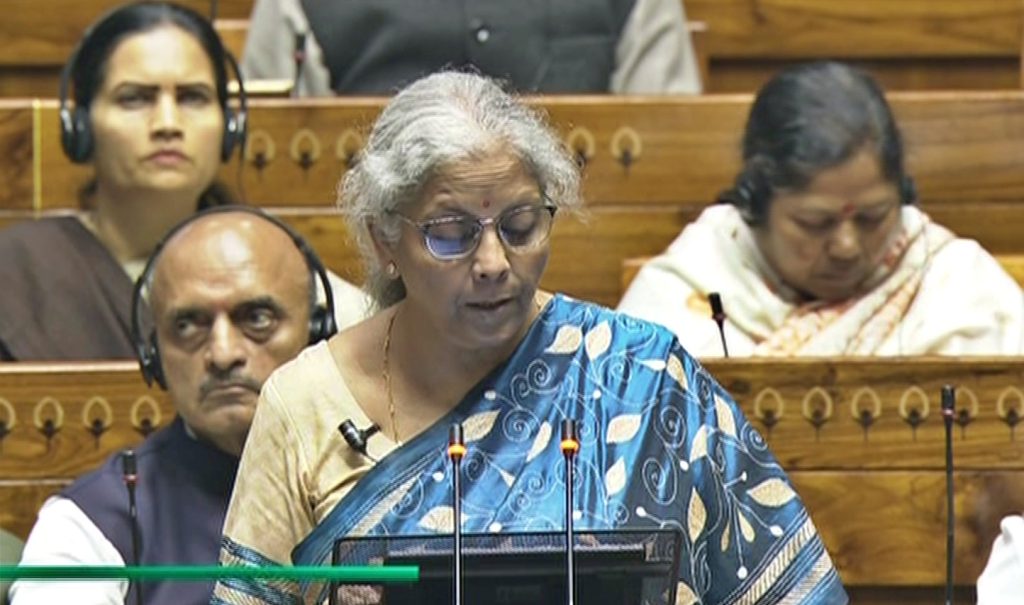
New Delhi : Finance Minister Nirmala Sitharaman presented the Interim Budget 2024-25 at Parliament on Thursday, February 1, a day after the commencement of the Budget Session. While delivering the budget, She said India’s economy is going through a transformation, focusing on the poor, youth, women, and farmers. She said her government is working towards a new ‘ Vikshit Bharat’ by 2047.
On taxation, the Union Minister kept all tax rates-direct and indirect, including import duties unchanged. The minister announced plans to bolster the electric vehicle ecosystem, emphasising infrastructure expansion and support for manufacturing. The initiative aims to create jobs and entrepreneurship opportunities, with a focus on e-buses for public transport.
She said that the Indian government will borrow less money from the market and will keep more money in the bank to lend to private sector companies, however the lending rate will be checked. She adds the government plans to set up more medical colleges by utilising existing hospital infrastructure while presenting the interim Budget for 2024-2025 and a committee will be set up to examine the matter. The interim budget includes healthcare coverage under Ayushman Bharat which will be extended to all ASHA workers, Anganwadi workers, and helpers.
On the power sector, the Minister announced schemes and upcoming policies for various sources of power generation. The mix of announcements had almost equal attention to renewable and non-renewable sources as the country continues to witness increased demand for power while staying on track with its global green goals.
She emphasized on a roadmap for ensuring a green gas based economy in India. The policy mandating phased blending of CBG and for CNG and PNG will help in greening the gas supply chain and balancing the demand-supply for clean fuels.
FN Nirmala Sitharaman said the government would launch a housing scheme for the middle class, schemes to help slum dwellers as well as those living on rent. She also said the government will give 2 crore more houses under the Pradhan Mantri Awas Yojna – Gramin in 5 years.
Prime Minister Narendra Modi hailed the interim Budget presented by Finance Minister Nirmala Sitharaman by calling it “inclusive and innovative”. He said the Budget has a “reflection of the young aspirations of a young India”. “This interim budget is inclusive and innovative. It has the confidence of continuity. It will empower all four pillars of Viksit Bharat- Yuva (youth), Garib (poor), Mahila (women) and Kisan (farmer). This Budget gives the guarantee of making India a developed nation by 2047,” Modi said.
Amit Shah says, “The Union Budget draws the roadmap to achieve PM Shri Narendra Modi Ji’s vision of a Developed Bharat by 2047.”
Congress leader Rahul Gandhi hit out at the Centre over the Budget presented on Wednesday, claiming that it was a ‘Mitr Kaal’ Budget which does not do anything to tackle unemployment, inflation or inequality.
“‘Mitr Kaal’ Budget has: No vision to create jobs; no plan to tackle mehngai; no intent to stem inequality. 1% richest own 40% wealth, 50% poorest pay 64% of GST, 42% youth are unemployed- yet, PM doesn’t care! This Budget proves government has no roadmap to build India’s future,” Rahul Gandhi tweeted.
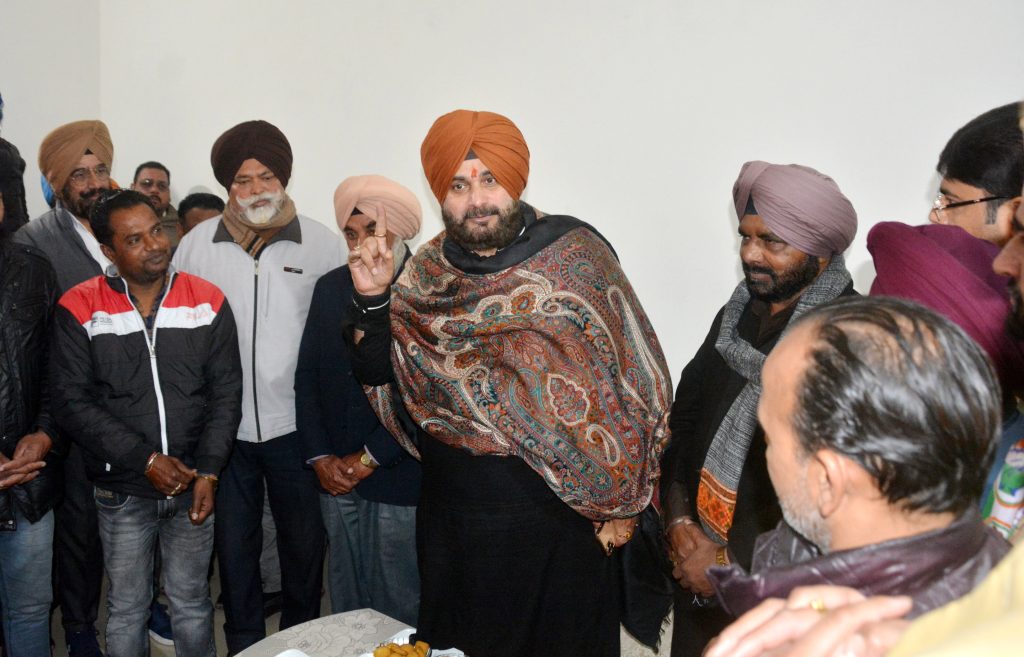
Chasm within Punjab Congress seems to widening with the state leadership and the former state party president Navjot Singh Sidhu not being seen on the same page ahead of the upcoming General Election, which is just about three months away. A report by Rajesh Moudgil
The top Congress leaders in Punjab have two daunting challenges at a time when the upcoming Lok Sabha elections are just about three months away. It has to fight the ruling Aam Aadmi Party (AAP) on one hand and the factionalism within, led by former party chief Navjot Sidhu, on the other.
Sample this: The last few days saw the state leaders including state chief Amarinder Singh Raja Warring, state in-charge Devender Yadav and the Leader of Opposition (LoP) Partap Singh Bajwa holding deliberations with leaders and the workers of some of the Lok Sabha seats about the preparations for the upcoming polls – in different parts of the state. These meets, like several party programmes, were skipped by Sidhu.
It may be recalled that Sidhu and state leadership have, for long, been engaged in a bitter war of words. However, since the polls are due in May, such a situation is set to harm the party immensely, if allowed to continue.
At such meetings in Patiala and Sangrur, the fissures came out in open when Warring was asked by the newspersons about Sidhu’s absence from party events. Warring in a veiled attack on Sidhu said that now anyone thinking himself to be above party, wouldn’t get notice, he would be straightway shown the door.F
“Focussing solely on individual interests hinders the prosperity of the party. It is imperative to prioritise the party’s interests above all else. Together, we are stronger than when standing alone”, he said.
Warring had also written to the party high command in the past including the post-Moga rally held by Sidhu without his consent. On another occasion, a war of words was also witnessed at a party meeting.
Earlier, several party leaders had openly rued that Sidhu seemed to blow his own trumpet while holding his “solo shows’’.
Sidhu’s ‘darkest phase’ jibe
Sidhu, on the other hand, in a veiled attack on the state leaders held that many honest and senior party leaders in the state had been sidelined and people of no political stature were trying to call the shots which weakened the party.
He had also gone on to say that he had decided to pull the Congress out of this “darkest phase’’ by supporting all the party leaders. He further held that unlike many leaders who had shifted over to other parties for posts and personal gains, he had left BJP to strengthen the Congress in Punjab.
However, in reaction to it, Durlabh Singh, a close associate of Warring, also took to `X’ and said: “Which darkest phase? These are like abuses to the Congressmen who have toiled for the past two years’’?
Another senior leader also said that the problem was that Sidhu was participating in the rallies being held without keeping the state leadership into the loop.
Earlier this month, Warring, who did not name anyone, had sought that the party programmes should be held in consultation with the state unit and said that those who become a “spoilsport’’ would face consequences. He said that even though party programmes should be held according to the state unit president’s wishes, he had a big heart as he had no insecurity from anyone. “Some people have a good height, but a small heart and they feel threatened’’, he said without naming Sidhu.
Sidhu, in reaction to it, had posted a message on the X without naming anyone, saying that spineless leaders who could not stand for what was right were now talking big. The message was understandably meant for his detractors seeking action against him. He also recited an couplet (shair) meaning that the people who sold themselves for a penny and the ones who went on their knees making compromises and who grew in pots, talked about banyan trees – “Kodi kodi bikey hue log, samjhauta karke ghutano pe tike hue log, bargad ki baat karte hain, gamle mein uge hue log’’.
It may be recalled that it was on December 9 that several senior leaders of the party had sought action against Sidhu during their interaction with the party in-charge Yadav, and the latter had assured them that he would speak to Sidhu about it.
Subsequent to it, Sidhu, on the question about his rallies, held that these programmes were scheduled before Yadav’s visit and that his next public meetings were scheduled for January 21 and January 24. He said that he had also told Yadav that the discipline was for everyone and it could not be one thing for a few and something else for the rest.
No ticket for Preneet: Warring
Notably, Warring while responding to a media query in Patiala, regarding the party MP Preneet Kaur, pointedly said that she was currently not a part of the political fold of the Congress as she was suspended from the party. Any person causing a disruption to the path of the Congress, would face consequences from the high command, he said and pointedly said that she would not be the party candidate from Patiala Lok Sabha seat this time. Kaur was suspended from the party in 2023 for supporting her husband Capt Amarinder Singh, who had joined BJP in 2022.
Indiscipline, gangrene must be checked in time: Bajwa
The fissures, in the latest instance, seem to widen with the LoP Partap Singh Bajwa quipping on January 24 at the top leaders’ meeting in Jalandhar in the presence of Yadav that indiscipline and gangrene must be checked in time.
Stating that the Congress had lost the 2022 assembly polls solely because of the indiscipline and it was time this mistake was not repeated. “Indiscipline has to be checked in time just like gangrene. Ideally, the toe has to be removed. It spreads fast. If not treated in time, a foot or even the leg has been ampuated’’, he said, according to media reports.
Sidhu in poll panel
Meanwhile, while the tussle within the party continues, the party has set up its Punjab state election committee with Warring as its chairman and senior leaders including Bajwa, Ambika Soni, Navjot Sidhu, Sukhjinder Singh Randhawa and former chief minister Charanjit Singhh Channi among its members.
The committee also includes Bharat Bhushan Ashu, Manish Tewari, Mohinder Singh Kay Pee, Rajinder Kaur Bhathal, Vijay Inder Singhla, Rana Gurjit Singh, Ravneet Singh Bittu, Kuljeet Singh Nagra, Pargat Singh, and Sukhpal Singh Khaira in its 27-member panel. The panel has four ex-officio members – president, state Youth Congress, president, NSUI, chief organiser, state Seva Dal and president, state Mahila Congress Committee.
Overnight, Modi became the human avtar to deliver Ram-avtar. Therefore when PM goes campaigning in the next few months, the Rambaan, or panacea, as they say is enough to work wonders. BY KUMKUM CHADHA
Even if industrialist Mukesh Ambani had not spelt it out, from this year on, India would have two diwalis. Looking at the enthusiasm of the temple opening at Ayodhya on January 22, 2024 this is kind of a given.
As things have panned out, Indians across the length and breadth of the country are celebrating Ram’s temple-abode more than they did on his return to Ayodhya after a 14-year long exile.
In this context, the tent totemple phrase has caught on given that till Ram’s idol was installed in the grand temple, the God lived in a makeshift temple: actually under a tent.
A new idol, some 51 inch, sculpted by Mysuru’s Arun Yogiraj, has been installed in the new temple. If reports are anything to go by, the idols which were worshipped for years in the makeshift shrine, will also find a place in the new temple.
If there are any questions on the need for a new idol when the old exists, the answer is best summed up by the Shri Ram Janambhoomi Teertha Kshetra Trust: the idol is diminutive and can only be seen from a distance of less than 30 feet.
However in the BJP’s scheme of things, if the temple is bhavya, grand, then how can the idol fall short?
Rewind to 1992: the Babri masjid was demolished and the idol of Ram was shifted to a tent set up at the demolition site and worshipped.
As for the maths, here is the 14 to 500 years calculation:
It was after 14 years of exile that Ram returned to Ayodhya which till now was celebrated as Deepavali: a very significant and perhaps most important festival in North India.
The 500 years story dates back to the year 1528. A mosque was built by Mughal Emperor Babar at the birthplace of Lord Ram where a temple had originally existed.
Following court battles from 1885 through 2019, the Supreme Court gave the go-ahead for the temple construction in Ayodhya while allotting 5 acres of land to Muslims for building a mosque in Ayodhya.
Putting the pieces together, it was in 1885 that Mahant Raghubir Das filed a suit seeking permission to build a canopy on the Ram chabutra, courtyard, adjoining the mosque. The plea was rejected; in 1950, Hindus filed a suit to conduct pujas which were allowed. This followed pleas and counter pleas till the conclusion in 2019 with a court order that Hindus welcomed and Muslims regretted.
In 2020, Prime Minister Narendra Modi laid the foundation stone for the temple in Ayodhya that was completed in record time.
Therefore what the world witnessed on January 22, 2024 was the opening of the temple and consecration of the Ram idol at Ayodhya: dubbed as grand and majestic by most.
This was a second Diwali to put it mildly when lakhs of diyas were lit in Ayodhya and homes across the country: a second Diwali more joyous and participatory than the original that India celebrates any time between September and November depending on the lunar calendar.
Prime Minister Narendra Modi had given a clarion call for Indians to light diyas at their homes to mark the temple opening in Ayodhya: “Light a diya at home on January 22. That day should be Diwali across India”, Mr Modi told the nation. The believers went that extra mile to honour what the Prime Minister had wished.
This “second Diwali” may be a first in India but it is here to stay and perhaps to be celebrated with greater enthusiasm and gusto. Therefore Ambani was not off the mark when he said from here on, India would celebrate two Diwalis. In other words, put the 14 years to the 500 in action so to say.
As for Prime Minister Narendra Modi, he self-imposed a regimen wherein he slept on the floor and lived on coconut water for eleven days. The anushthan or special ritual is observed ahead of the consecration or pran pratishtha of an idol: in this case Ram in Ayodhya.
This neither stopped his work nor weakened his resolve. Not surprising because PM Modi is accustomed to adhering to regimens that common people may find difficult to follow.
Remember Navratri? PM Modi routinely fasts for nine days and if reports are anything to go by, he survives on a liquid diet: mostly water.
During his US visit in his first term, he followed this regimen despite the fasting period clashing with the state banquets during his five-day visit.
The White House had then created and curated a special grain-less menu, comprising salads and fruits.
Back home, even during election campaigns, he has observed the Navratri fasts surviving primarily on lemon water during his hectic tours.
Against this backdrop the pre-ritual fast for the Ram temple should not come as a surprise.
However, Modi is not alone in devotion. There are others:
A bookseller has offered a unique edition of the Ramayana, also said to be the most expensive, which is printed on paper from France, a “three floor” box made of walnut wood, sourced from the US and organic ink, imported from Japan. The claim: this special edition would last 400 years and can be read by four generations.
Whether PM Modi will take well to so much imported material being used for an Indian scripture remains to be seen given that he is a votary of Makein India.
Then there is a 108 feet long incense stick from Gujarat which is said to last for over a month; a themed necklace reportedly studded with 5,000 American diamonds; a lock and key weighing 400 kgs from Aligarh; a 2000 plus kg bell; a 1100 kg giant lamp good to hold 851 kg ghee and a 1000 plus kg ladoo from Hyderabad.
While on food, some 7000 kg Ram Halwa for devotees was prepared by a Nagpur chef and chappan bhog, 56 items petha-prasad was dispatched from a famous sweetmeat manufacturer in Agra. This comprised 56 flavours weighing 56 quintals.
The list is long and in one sense unending. But that is a mere subtext.
The storyline is about religion and politics jointly spearheaded by Prime Minister Modi and the BJP in its current playground: Ayodhya.
At one level it is a dream and a promise fulfilled. At another, it is showcasing Prime Minister Modi as a man who can do what others cannot: one who delivers and one who not only puts his men to work but also ensures that they are deadline-driven. The culmination of the temple in Ayodhya and the installation of Ram’s idol therein is testimony enough.
The naysayers, Opposition parties included, may have slammed the move but that cacophony was drowned in the immense faith and support that came from the people across the country. Believers were willing to worship the Prime Minister for this feat. Others marvelled at the grandeur and scale of this mammoth project, grudgingly accepting the Modi hai to mumkin hai, with Modi everything is possible, slogan.
Add to this Modi’s work culture where not a single minister, including heavy weight Amit Shah, was seen in Ayodhya. If some were packed off to different temples in India to offer prayers, others stayed put and visited temples in Delhi. Whether this was to make it a non-government event and focus only on people, celebrities and ordinary men and women, is anyone’s guess.
Having said this, one must give it to the BJP and its cadres that it not only marketed the event well but displayed its organisational capabilities to the hilt.
The way it has played out encompassing a large mass, speaks a lot about BJP’s ability to dramatically transform an event into a spectacle and that too at a scale that will remain etched in memory for years to come. In the process, it awakened and energized people’s dormant religious beliefs and showcased them as never before.
The outpouring of multitudes with gifts, devotion and prayers does say something about the BJP touching a chord and awakening a suppressed and neglected sentiment: in this case devotion to Ram.
Contrary to critics slamming the temple as being divisive, Prime Minister Modi went that extra mile to say that Ram unites. If events are anything to go by, he is spot on.
Naysayers are projecting this purely as an electoral exercise.
Looking at the way events have unfolded, this now seems a half-truth.
At one level, the BJP is a political party which is in election mode 24×7. So to see the Ayodhya jamboree sans elections would be not only naïve but plain stupid to say the least.
For starters, the timing of throwing open the temple a few months before the general elections says it all. Add to this, converting it into a mega event encompassing major cities and villages is not without a purpose.
To put it simply, Modi is being “packaged and electorally sold” as one who has the heft to give to the country something denied for 500 years. The fan-fare that came with it did wonders because it made even non-believers sit up and “wow” the moment.
Overnight, Modi became the human avtar to deliver Ram-avtar or Ram’s incarnation. Therefore when Prime Minister Modi goes campaigning in the next few months, the Rambaan, or panacea, as they say is enough to work wonders.
Having said that, one cannot take away the fact that PM Modi ensured completion and did in one sense gift to the Hindus something long overdue. That they would remain indebted to him for many years is a given. In this context, one would need to look beyond politics and accept that the ocean of people who converged in Ayodhya on the morning of January 22,2024 were driven by both emotion and devotion. It was Ram and Modi in that order. To Ram they paid obeisance and to Modi expressed their gratitude.
Pitch this sentiment against political gains and it would not be wrong to conclude that the mega event India and the world witnessed on January 22 this year, backed with the emotion, devotion and sentiment of the common man, would go beyond one election.