No gainer, no taker for UP mini-grids

With nearly 1.42 crore households in rural Uttar Pradesh (UP) still living without electricity connections, renewable energy models like mini-grids and solar home systems appear to be the ideal solution.  In fact, renewable energy models seem like an oasis in the desert as these are addressing the woes of the power consumers in villages. These privately run power packs promise to provide quality, accessible and uninterrupted electricity supply, ensuring a growth graph in terms of quality life and business. Mini-grids ensure lighting houses, smooth running of mobile chargers, fans in the scorching heat, right up to running refrigerators, computers and of course, some business gadgets. Mini-grids are proving instrumental in not only improving the condition of villages but, at the same time, helping rural folks to increase financial prosperity through better output in the business.

All is good except for the fact that this prosperity quotient comes at a very high price. The rural consumers pay a hefty price per unit than the urban folks. More so, even the tariff rates per unit are not fixed that vary from 20 per unit and can go up to as high as 150 per unit for 6-8 hour power supply. In many cases, quality control is also in doubt. 

A report by Centre for Science and Environment (CSE), an environmental research and advocacy organisation on mini-grids in Uttar Pradesh clearly said that it is unlikely that Prime Minister ambitious Sahaj Bijli Har Ghar Yojna (SAUBHAGYA) or Deen Dayal Upadhyaya Gram Jyoti Yojana will be able to give “dedicated push to improve village electrification for the entire 1.4 crore people.” The report said that it will require from seven to ten years before this can be done.

The CSE recently held a round-table meeting in Lucknow to discuss the role of mini-grid electricity generators in addressing the energy access challenge in rural Uttar Pradesh. According to a report, one-fifth of the rural population of India continues to live without electricity access despite the massive growth in electricity infrastructure in recent years.

Incidentally, Uttar Pradesh became the first state in the country to implement dedicated mini-grid policy and regulations. The object was to ensure access to power at affordable rates, providing viable exit options and encouraging development of standard distribution networks.

“Unfortunately these have had little impact as no developers have set up projects under the state policy,” said the CSE report.

The mini-grid developers know that they have just a decade to do business in the state and that is why they too are in a hurry to draw maximum profit from their business. So the poor rural power consumer is totally powerless and at the mercy of the mini-grid promoters.

Realising it is in a no-win situation, the government is also rather soft on these developers. After all, they are doing to an extent what the government should be doing and so the morally bound government cannot put hurdles in the way of those in the mini-grids market. 

Defending these high charges one of the developers stressed that remoteness comes with inherent cost. “UP ki majboor hai, mini-grids zaroori hai (Mini-grids are must for UP’s growth),” said a developer not wishing to be identified.

Severely power starved, rural folks in the state have to pay the price for quality and uninterrupted power supply in his household. Mini-grids and solar home systems is the only solution, at least for the next decade.

As the electricity crunch is likely to persist, there is a strong chance of mini-grid development in the state over the next 5-10 years. The issue is how and how much the UP government can get them to follow the rules and reduce tariff for the poor rural consumers to breathe easy. The report suggests that UP makes Policy changes to provide subsidies to developers in order to support the transition to mini-grids, suggested by CSE.  It also recommends tariff rates similar to those being charged by DISCOMS in rural areas

It is clear that while UP has to give big sops to the mini-grid developers so that they, in turn, reduce the financial burden through reducing tariffs for the rural consumer of power.

State government’s attempt to regulate tariffs and improve the supply of mini-grids through its mini-grid policy in February 2016 has found no takers and has thus failed to achieve its objectives.

According to the CSE report, not a single developer seems to have availed the state subsidy or is operating a project under its ambit.

“This is because it fails to address the developers’ concerns of project viability at low tariffs and commercial uncertainties,” said the CSE report.

Tweaks in the existing policy mechanism and the business/revenue model can result in mini-grids providing adequate, reliable and affordable electricity to all. This will encompass setting minimum standards in terms of hours of electricity supply, reasonable tariffs for consumers and viable operational and commercial terms of agreement for developers.

letters@tehelka.com

PM Modi vs Opposition: The battle begins

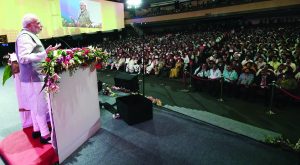
Prime Minister Narendra Modi’s speech at the much touted ‘mammoth’ rally at Jaipur on July 7 perhaps has sounded as the signal ahead of the state assembly elections. These elections are scheduled to be held in Chhattisgarh, Madhya Pradesh, Mizoram and Rajasthan by this year end and Lok Sabha elections in mid-2019. Four major issues — Demonetisation, Goods and Services Tax (GST), Employment and Foreign Policy — which the ruling BJP claims as its USP and the Opposition parties as the prime ammunition to target the ruling dispensation during the ensuing electoral campaigns. Undoubtedly, local and regional issues like law and order, the plight of the farmers along with other issues will rule the roost of campaigning particularly in Chhattisgarh, Madhya Pradesh and Rajasthan assembly hustings; nevertheless, the four national issues will play a pivotal role as well. These issues have formed the highlights of Prime Minister Modi’s recent interview to Swarajya magazine also.  

Demonetisation

Demonetisation was launched on November 8, 2016, as a means of tackling the black economy, stop the circulation of fake currency and stop funding of the terrorists in J&K and the Maoists-hit areas. Undoubtedly, the Modi Government claims its measure of launching the demonetisation having achieved its avowed objectives; nonetheless, a vast majority of experts and major Opposition parties rebut official claims. It is argued that demonetisation was carried out on the incorrect premise that black money means cash. It was also thought that if cash was squeezed out, the black economy would be eliminated. However, some experts opine that cash is only one component of black wealth: about 1% of it. It has now been confirmed that 98.8 per cent of demonetized currency has come back to the Reserve Bank of India.

Arguing that not even 0.01 per cent of the black money has been extinguished, some critics point out that the big failure of demonetisation is that it was carried out without preparation and caused big losses to the unorganised sector. This has not been factored into the recent data on growth rate, so the loss to the economy could be in lakhs of crores of rupees. Farmers, traders and the youth are all agitating. Recent media reports also show a two-fold increase in the deposits by Indians in Swiss banks during 2017 and some critics call it a ‘failure of demonetisation.’ Even the government’s claim about demonetization as a way of addressing a large number of fake currency notes circulating in the economy was based on a false premise, as it turned out, it was closer to 40 crore.

Linkage to terrorism, as one of the main components of the reason for demonetisation, and its outcome in terms of the way it was articulated has been abysmal. In the wake of the failure of attaining the declared objectives of demonetisation, some experts point out that the goalposts started shifting when it became apparent that the main reason was not justified by what was happening. Apart from a vast majority of experts raising scepticism over the demonetization, the Opposition is also questioning the rationale behind such a ‘drastic’ measure to which the ruling dispensation has no satisfactory answer.

 Goods and Services Tax

The GST, launched with much fanfare last year, has just completed one year. The Modi government wants the nation to believe the new tax has been a great success — not surprising, given this government’s marketing orientation. In the wake of media reports that the GST collections in each of the months between March 2018 and May 2018 have been lower than the collection in February 2018. In 2018-2019, the Central government hopes to earn 6, 03, 900 crore from central GST. Some economists opine that this works out to 50,325 crore per month on an average. The collections in April and May 2018 were 32,089 crore and 28,119 crore, respectively. Pointing out that this being way below the target of 50,325 crore per month, some economists ask as to how does this make GST a success, when the government is not able to achieve the target it set for itself.

While drawing attention to the decline in Indian merchandise exports as a proportion of the GDP owing to the GST, some critics opine that prior to the implementation of the GST, the exports to GDP ratio was 12.1 per cent in 2016-2017 and in 2017-2018, it fell to 11.7 per cent in post GST period. According to these critics, a major reason for this is because exporters did not get GST refunds on time, which created a working capital problem for them. The multiplicity of GST rates: 5, 12, 18 and 28 per cent is the fundamental problem of the GST system. The prime minister Modi’s recent defence of the GST by saying that milk and Mercedes cannot be taxed at the same rate is rebutted by some experts who argue that milk is not taxed under GST and pitiably while diamonds are taxed at 0.25 per cent and gold at 3 per cent, sanitary napkins are taxed at 12 per cent. 

 Employment

The Opposition has been questioning the Modi-led government on providing two-crore jobs every year as promised during the elections and there is no satisfactory answer in the absence of reliable statistics. As the formal sector accounts for just about 8-15  per cent of India’s workforce, the official estimates are completely silent about the majority of the workforce engaged in the informal sector. While raising the question as to why few jobs are so created when the economy is said tobegrowing at over 7 per centsome critics opine that an answer is that GDP growth figures are probably overestimated on account of the mis-measurement of GDP in the new National Accounts Statistics and this leads one to believe that the economy is probably growing much slower.

While raising doubts about government’s claim that 4.1 million new jobs were created in the economy’s formal sector during since September 2017, some experts argue that this data is based on the enrolment of additional workers under state-provided (or mandated) social security schemes; therefore, this claim seems questionable on empirical and conceptual considerations. Besides, the official claim is about the formal or organized sector, which at best counts for 15 per cent of India’s labour force and there is no way of knowing what is happening in agriculture and the non-farm informal sector, accounting for 85per cent of the workforce.

 Foreign Policy

Much-hyped foreign visits to over 50 countries during the past years by prime minister Modi are touted as ushering in the dawn of a new era in India’s relations with other countries. However, experts disagree with this hype by pointing out that India has lost its eminent position in South Asia owing to its ‘reckless adventurism’ in its neighbourhood, which is tilting towards China. A pall of ‘unease’ has reportedly descended on India’s relations with China in the wake of Doklam standoff and Modi has to visit China thrice thereafter to keep the later in good humour. Russia holding anti-terror drills with Pakistan in 2017 attest to ‘decline’ in the special relationship with Moscow.  

Many experts opine that India has come to face a unique combination of diplomatic, security and strategic challenges under the Modi government. The growing economic, defence and strategic partnership with the U.S. is being questioned on account of the transactional nature of the Trump administration, its unreasonable trade demands, and its sanctions related to Iran and Russia that are unmindful of India’s interests and costs. Some of India’s efforts, such as membership of the Nuclear Suppliers Group and a facility in Seychelles, have been stymied and not to talk of India’s membership of the UN Security Council.

 Way Forward

Aggressive propagation of cultural nationalism resulting in mob-lynching, unabated atrocities on Dalits and minorities, increasing incidents of crimes against women, burgeoning unemployment and the miserable plight of the farmers, especially in the BJP-ruled states, along with failure in fulfilling its promises have cumulatively made the picture more complicated. There are strong sui generis challenges and headwinds, requiring course modulation and adaptation. Fudging the data to conceal its failures and projecting a greener pasture to hoodwink the gullible masses via publicity blitzkrieg may look attractive for the BJP to wrest power again; nevertheless, it also affords sufficient ammunition for the Opposition to target the BJP, provided it gets its house in order and present a united face. The ensuing assembly elections in four states by year-end is going to be a testing ground and one needs just to wait and watch.

letters@tehelka.com

Family’s trauma: Trail of notes uncover the Burari deaths

The handwritten notes found at the home of Burari family, of whom all the members were found dead on July 1, talk of apprehensions that the family may not see the next Diwali, because of “someone’s mistakes.” In the note dated November 11, 2017, Lalit, the 45-year old businessman who led the hangings, talks of “family’s mistakes” in “attaining something.”

Dhanteras aakar chali gayi. Kisi ki purani galti ke aabhaav se kuch prapti se door ho. Agli Diwali na mana sako. Chetavni ko nazar andaaz karne ke bajai gaur kiya karo (Dhanteras has already been celebrated. You have not achieved something due to someone’s past mistakes. You might not celebrate the next Diwali. Pay attention rather than ignoring the warnings),” the entry said. 

Burari’s alleged mass suicides have the Delhiites horrified, with the police yet to come up with a convincing explanation for the family tragedy. The crime branch which is now investigating the deaths is piecing together evidence to crack the spine-chilling incident, which has left the neighbourhood in shock and bewilderment.

The postmortem reports of 10 bodies have revealed death by hanging, while postmortem reports of the eldest family member, Narayan Devi, is still awaited. The reports indicate the family members had hung themselves and no injury marks were found on the bodies.

Ten members of the Bhatia family in Delhi’s Burari were found hanging from iron mesh in their home on the morning of July 1, one of the bodies was found on the floor, which was apparently strangulated. The dairies written by the family members carried the details of the ‘death ritual’ detailing how the family was to execute the ‘suicides.’ Further, the crime branch has also found a register containing notes about “salvation”, “shunya” and “appeasing God.”

77-year-old Narayan Devi, her two sons Bhavnesh Bhatia (50) and Lalit Bhatia (45), their wives Savita (48) and Tina (42) respectively, Narayan’s daughter Pratibha (57) and five grandchildren, Priyanka (33), Neetu (25), Monu (23), Dhruv (15) and Shivam (15) were found blindfolded with their mouths covered with while cloth. The limbs of the eight of the bodies were tied.

The closest relatives of the Bhatias are however denying that the family indulged in any kind of occult activities, and police has not found the involvement of any baba in the case. The police are now investigating the angle of ‘shared psychosis’, which is a psychiatric syndrome in which symptoms of a delusional belief are transmitted from one individual to another.

The investigating authorities also claim to have found notes which indicated that Lalit Bhatia, who is believed to have led the rituals, had assumed his father’s alter ego. Lalit would often talk and behave like his father, sometimes observing ‘maun vrat’.

The conversations of the family’s children with the neighbours also confirmed this aspect. The notes from 2008 were recovered, which indicated that Lalit Bhati had turned to spiritual practices soon after his death. The family had been convinced that he had been possessed with his father’s soul. The police also while digging deep and examining the browsing history from his phone found that he often used to watch paranormal videos and ghost shows. Further investigations showed the family had been preparing for the ‘ghostly’ ritual for about ten days in advance.

What is more befuddling is that no one in the neighbourhood or even the Bhatia family’s closest relatives had the whiff of what was coming. The family had been busy in marriage preparations; the engagement had just recently been concluded. 

The written account of their plan is the basis of all the conclusions the police has drawn from the incident, the notes contains meticulous planning of the deaths. However, the police maintain that the aim of the ritual was not to commit suicide, but the incident ended up in tragedy, quite unexpectedly. The family was convinced that they will achieve ‘salvation’ with their act and will be rescued by the spirit at the last moment, according the reports by the police.

The neighbours are steering clear of passing by the house even in the day, considering the circumstances in which the deaths happened. The people living in this Sant Nagar colony are having wild imaginations about what might have compelled the family to take the extreme step. There is an atmosphere of inexplicable fear amongst the people in the area and it is said the buzzing activity in the colony goes off as the darkness descends.

It isn’t just the Burari, the story created shock and horror across the country as the details of the incident emerged. The story was reported in the international press as well.

While there is no evidence to point to an external hand in the deaths, the police say they are still looking at all angles to unravel the mystery. The house is being thoroughly examined by forensic experts, the psychiatrists and the crime branch itself, besides the saints who are well versed with the rituals associated with occult practices. 

The practices of superstition are still very common in the Indian society. It is therefore not a surprise that people resort to such practices and harbor such thinking even in these times. The Burari case however stands apart in the way the ‘religious ritual’ was planned and executed, the case took the superstition practices to the extremes. The incident shows how deep the practices of superstition and witchcraft are entrenched within the Indian society. We hear the stories of women burnt on suspicion of witchcraft every day from different states across India. So much development and education has not helped eradicate dogmatic beliefs from our society. We still have a long way to go to embrace modern thought and reason.

It’s raining pits and potholes

Life at stake The roads across the country each monsoon, posing a threat to the life of commuters

The first rains of the monsoon lash Chandigarh while Ridhhi is on her way home from work. As she approaches Railway crossing number 126 at Manimajra, Chandigarh, a barricade, a gaping pit and a huge mound of dug-up earth greet her. She sighs, “Another road ravaged just before the rains! Why do they always start the construction work so close to the monsoons?” The said railway crossing is closed for the construction of a Railway Under-Bridge (RUB), the work on which has already been delayed by almost six years. As much as the project would ease traffic jams, the question arises that why would the local civic body green-light such a tedious project during the rainy season, even though said rains would hamper the construction work. As we shift our gazes to some other premier cities in India, we find the phenomenon is an oft-repeated one.

One must remember that modern meteorological and environmental science helps forecast weather well in advance. An efficient government can plan strategies well in advance to cope with the challenges no matter how unusual they are. Along with the building of huge bridges and underpasses during monsoons (which often turn into ponds after a heavy rain ), there is a dire need for a sustainable mechanism to manage the annual monsoon season. So why do the roads fall to pieces every year, even though we have just four months of monsoon? 

Cities in bad road woes

Roads have existed in India for the last 5,000 years. India has a road network of over fifty-lakh kilometres, the second largest in the world. About 63 percent of these roads are paved. Civic bodies and road contractors play the blame game every year by deflecting the responsibility for damaged roads on each other. All line departments have to work in tandem to deal with the challenges of monsoons, which seldom happens. Lessons have to be learnt from repeated monsoon havoc on these roads to devise effective strategies for future. Roads in India are subject to extreme temperature variations; hot and humid summers, monsoons and harsh winters, resulting in subsequent contraction and expansion of base materials. Moreover, specifications have not been changed in proportion to the rise in the number of vehicles. Water stagnation and traffic jams put further pressure on roads. The top layer of the road, which used to be 40-mm thick, is now reduced to 25 mm. The layer below, made of blue metal stones, has been reduced from 70mm to 50 mm. A civic body official from Ludhiana confessed, ”Using building debris for filling potholes was not in the list of approved filling materials. Yet contractors continue violating regulations. They hike project costs and timeframes midway. We have to keep mum due to political pressure.”

Usually, the lifeline of a road starts when it is sanctioned by the Transport Ministry. The projects involve contractors, brokers and politicians who want their share of business, commission and votes respectively. A road contractor from Mumbai lamented,”The civic body doesn’t give us the required number of road gullies and service ducts, adding pressure on the roads during heavy rains. The consulting agencies hired for planning and budget estimation for new roads give unrealistic targets. They seldom inspect the actual site. We underbid to keep our business alive. If we don’t, someone else will.”

Another contractor from Bangalore has a similar story to tell, ”Contractors of damaged roads are asked by the civic body to rectify the defects in ridiculously small time. Failing to complete the contracts can result in disqualification from further projects.” There is no minimum ceiling for the bid. Companies just try to win the contracts at any cost. Those making the roads indulge in heavy cost-cutting. This leads to the roads breaking in quick time. Thus, roads are made every year post monsoons and the overall expenditure exceeds the required cost. 

Experts also point to the ever-increasing burden on roads in urban areas. Sports utility vehicles (SUVs, meant for off-road and highway travels) and luggage carriers can often be seen on city roads in peak hours. Such heavy loads further add stress to the road ecosystem. 

The recent road over-bridge collapse at Mumbai’s Andheri railway station during a spell of heavy rain has raised concerns over the robustness of the city’s infrastructure. Vibhav Mehta, an Andheri resident, said, “Any structure, bearing so much traffic load needs regular inspection. Mostly, hasty patchwork is done on the roads just before monsoons to placate complaining residents of the area. The stormwater drains are not properly de-silted, adding to the burden on these overcrowded roads due to accumulation of stagnant water after a heavy rain.” Commuters on Delhi-Gurugram expressway were stuck in a monster jam, which lasted almost two days during the 2016 monsoon season. The civic authorities have done little in the past two years to prevent such incidents. Neha Arora, who resides in Gurugram and commutes to New Delhi for work, does not sound hopeful, “There was some road repair activity this year as well before the rains arrived. Sewage lines were laid in parts of the city. But the construction debris and the muck cleared from the road gullies was left on the side of the road. In case of heavy rains, the same waste material will block the road gullies again.”  Hadley, a Bangalore resident, sums up his woes, “The biggest issue is for motorcyclists as it becomes very dangerous when all of a sudden a big bump appears from nowhere on these flooded roads. If you are aware of where the bump is, you will slow down only to be splashed with dirty rainwater from a car next to you. The situation is bad and although everyone is aware of it, no action is being taken. Pathetic road conditions are prevalent even on expressways and bridges where one pays toll tax to use the road. So where is all this money really going? Is it robbery in plain sight by our authorities?” 

Contrary to popular perception in India, the subcontinent is not the only region at the receiving end of unrelenting rains. The UK is a developed country where it rains all throughout the year. According to recent estimates, 12 percent of UK roads are in very poor condition. Though the figures are better than India, sources say it would take about 14 years and £9.3bn to repair Britain’s roads properly. This proves the wrath of nature spares no-one.

There has been no major upward or downward trend of rainfall for the last few centuries but a decrease in rainfall in the last two decades, with a contrast record of increasing floods, has been experienced in cities like Chennai, Kolkata, etc. Thus, the oft-cited reason by the administration for urban floods-heavy rainfall in a few hours – does not hold. It is only an excuse for bad planning in the cities. The number of water bodies in all major cities of India has drastically come down over the last three decades. The floodplains and lakes in the low-lying parts of a city did not just fulfill the water needs of a city but also drained it off the excess rainwater that poured there. When construction blocked the path of water, it led to water-logging on the city roads. The blame then fell on the storm water drains which in most cases, were designed very long ago, assuming half the water would be absorbed by the soil. With the onset of rampant and indiscriminate urbanisation, most areas are now paved. As a result, very little rainwater is absorbed into the ground. Even at one inch per hour, the drainage system is coping with almost twice its intended capacity.


A way out

Though efforts are being made to find lasting solutions, they are too few and the implementation is too tedious due to the extent of the problem and the red tape involved. A scientist near Bangalore is working on self-healing roads that resist heavy rains, intense heat and poor drainage. Some experts suggest replacing Bituminous (BT) roads with Cement Concrete (CC) roads, which are more durable and easier to repair. But the real need of the hour is urban rainwater harvesting. Recharge wells and harvesting ponds need to be constructed in low-lying areas as well as around storm water drains, to collect excess rainwater. In countries like the Netherlands, the roads are constructed with a material that absorbs rainwater, which also allows for recharging of groundwater. This can be a boon in agricultural states like Punjab, where the groundwater levels have reduced to alarming levels. New roads should be designed to incorporate the needs of the local terrain, climate and population.

After a harsh spell of a typical summer in the Indian sub-continent, rain is welcomed as a blessing from the skies. In a country like India, with its extreme and varying terrain, roads form a lifeline by being the most flexible means of transport as they can handle high gradients, sharp turns, et al. The condition of roads during the monsoons gives a true picture of their quality. The difference can be seen in roads managed by BRO (Border Roads Organization), which face extreme weather and still remain in better condition than some big city roads. While those maintained by urban civic authorities are often ridden with potholes; these are not just minor potholes, but big craters at many places.  Governments change but the condition of our roads doesn’t. The only changes occur is names of policies, e.g. from Jawaharlal Nehru National Urban Renewable Mission (JNNURM) to Atal Mission for Rejuvenation of Urban Transformation (AMRUT).

Alas, the governing authorities cannot be held solely responsible. To avoid the wrath of the rains, we need to embrace the monsoons rather than try to fight against them. A sustainable Private Public Partnership (PPP) model is required to manage the monsoon season in urban areas. If public and private entities take charge of managing rainwater in their respective areas, by constructing feasible water harvesting and drainage systems, the burden on storm water drains and road gullies would reduce and the problem of water-logged roads will go away by itself.

letters@tehelka.com

Burhan Wani Lives On Two Years Since His Death

Photo: Faisal Khan

On July 7, the second death anniversary of the popular Hizbul Mujahideen commander Burhan Wani, Kashmir was under a tense lockdown. Security curbs were at their most stringent in South Kashmir and the downtown Srinagar. Large contingent of the forces was deployed on the streets to reduce the protesters’ ability to organise. In Tral, Burhan’s hometown, his grave was made out of bounds for the people.  Security personnel also dotted the road leading to slain commander’s home. Separatist leaders were put under house arrest and JKLF supremo Yasin Malik was detained at a police station. But despite all these measures, the protests marked the day. There was also a complete shutdown in response to the separatist call.

If anything, this state of affairs shows how Burhan continues to loom large over the Valley two years after his death in an encounter with the security forces. Kashmir has not been same again since. In 2016, his killing not only triggered a five-month-long unrest leading to the killing of around a hundred people and blinding several hundred but it also lent a disproportionate boost to the local militancy. According to a security estimate, more than 65 local youth have joined militancy since January, among them the PhD scholar from Aligarh Mannan Wani, son of the top separatist leader Ashraf Sehrai, an IPS officer’s brother and also a youth Abid Hussain Bhat from Doda in Jammu province which had otherwise been declared free of militancy over the past one and a half decade.

In the past two months alone, twenty youth are estimated to have taken up arms.

Burhan’s influence has been fundamental in altering the dynamics of the situation. Security and the civil society opinion largely trace the new age militancy in the Valley to the advent of Burhan and his popularisation of the militancy as a glamorous occupation through a deft use of social media.

“Up until 2014, the militancy was a largely underground phenomenon. They had no public or media presence. They hid their identities and masked their faces if at all their pictures were taken,” said a police officer not wishing to be named. “But Burhan changed it all. He opted out of anonymity and aggressively used the social media to propagate militancy. This caught the fancy of the youth who until then used to hear only distantly about the militancy through reports of their deaths in a far away encounter.”

But many Kashmiri observers don’t think that the social media alone set off Burhan’s legend and that he alone ushered in the new militancy in the state. “Legend of Wani wasn’t a product of Facebook alone.  Indeed, his Facebook pictures and videos made a difference. They also gave face to a name and made visible a reality that is supposed to operate in the underground.  The fact is that Burhan was the first to do so in three decades of militancy and so he instantly hooked people,” said Naseer Ahmad, author of Kashmir Pending. “But this doesn’t completely explain the shift that followed. What also played a role was a deep sense of siege, disempowerment and alienation that had taken a deep root by the time Burhan emerged on the scene.”

This sense of alienation has only grown deeper since the killing of Burhan. And his legend has correspondingly grown. One big factor in this is believed to be “the militaristic, muscular approach” adopted by the centre towards the state. The clamour in Kashmir is for a meaningful political initiative geared to address the Kashmir issue.

“A sustainable political process which addresses itself to achieving a political settlement on the state will certainly deprive militancy of its raison and address the public unrest,” said Ahmad. “Security approach may keep militancy in check but it will not end it as its trajectory over the past three decades tells us. In the existing situation not only will Burhan live on and remain an inspiration but new Burhans will also keep emerging.”

Bajrangi’s killing in jail raises many questions

The Uttar Pradesh government has begun the preparation to defend its position before the apex court over alleged extrajudicial killings in police encounters. The matter was brought to light in a Public Interest Litigation (PIL) filed by a Human Right organisation, People’s Union for Civil Liberties (PUCL). The apex court has issued a notice to the state government to submit its time bound reply within two weeks. The PIL sought a probe into such encounter killings in the state in the last one year.

At a time, when high-level consultation was busy defending the quoted utterances of Chief Minister Yogi Adityanath, Deputy Chief Minister Keshav Mourya and Additional Director of Police (Law and Order) Anand Kumar, the custodial killing in the Baghpat jail upset the tone of the preparations.

The government faced severe criticism when it failed to protect the life of an under-trial prisoner who was shot dead point blankly inside the premises of Baghpat Jail in western UP, on July 9, despite the early warnings by the deceased’s wife. A life-term convict assailant pumped more than ten bullets on the head and chest of Munna Bagrangi, an under-trial accused of murdering former BJP MLA Krishnanand Rai. He was getting ready to attend a court proceeding when he was killed.

Just nine days before the killing of Munna Bajrangi, wife Seema Singh held a press conference in Lucknow and asked for security cover for her husband. She alleged that some white collared people with connivance of some STF cops are conspiring to eliminate her husband in judicial custody and they had attempted to poison him in jail through their under trial mole. Bajrangi was named in the murder case of BJP MLA Krishnanand Rai, 13 years ago and facing trial in about 40 other heinous criminal cases under the charges of murder and extortion.

“Nobody is safe at his home or on roads. Even jails are not remained safe in UP,” commented senior congress leader and veteran parliamentarian Pramod Tiwari in talk with Tehelka. “In BJP rule, the law and order situation has become even worse than before,” he added. While criticising poor law and order situation, the State president of Samjwadi Party, Naresh Uttam said, “There is no law and order or rule of law. Even police sub-inspectors are not safe in police station, stabbed to death and constables are killed. Now, high security jails witness gruesome daylight murder.” “The governance in state totally failed in the hands of BJP,” he contended.

Chief Minister Yogi Adityanath has directed stern action against jail officials and assured that guilty would not be spared. Spokesperson of Aam Aadmi party, Vaibhav Maheshwari said, “There is anarchy all over the state. A prisoner is killed clod blooded in its premises. Nobody is safe outside either. There must be fair and impartial probe and entire case must be worked out at the earliest.”

On July 2, the Supreme Court bench comprising Chief Justice Dipak Misra and Justices A.M. Khanwilkar and D Y Chandrachud has issued notice on the PIL for examining allegations of extrajudicial killings in police encounters and the role of Uttar Pradesh government. The PIL has also sought a probe into encounter killings in the state in accordance with apex court guidelines already enforced on the subject.

Petitioner even placed on records a news report published by some media organisations. The report examined cases of fourteen of the persons killed in police encounters in the state and found several patterns including the similarity in the language of all FIRs; the mention of accomplices who could not be traced; marks of police torture in the body, etc. It further reported that out of twelve families interviewed, only in one case family’s statement has been recorded for inquiry.

Petitioner also cited that in an interview to a news channel in June 2017, UP chief minister Yogi Adityanath had said, “Agar apradh karenge toh thok diye jayenge (If they commit crimes, they will be killed).” PUCL also quoted a news item carried out in March 2018.

The report also highlighted concerns raised by the National Human Rights Commission and relatives of the deceased persons regarding the likelihood of fake encounters, the abuse of power by police authorities as well as the apparent support by the State government,” petition argued. Petitioner cited Adityanath statement in response to opposition’s concern over the allegations of brazen powers given to police for encounter spree. Chief Minister Yogi Adityanath had said, “Everyone should be guaranteed security, but those who want to disturb peace of the society and believe in the gun, should be given the answer in the language of the gun itself.” 

According to a news report on  September 16, 2017, that the ADJ Law and Order, Anand Kumar had stated that police encounter in Uttar Pradesh were as per the “desires of the government, expectations of public and according to the constitutional and legal power accorded to the police.” The report further quoted Deputy CM Keshav Prasad Maurya saying. “Today criminals are terrified with the thought that either they will have to give up crime or leave U.P or may be even leave this world.”

Quoting the example of a gym trainer of Noida who was reportedly critically injured in a police encounter on February 5 2018, the petitioner referred to the observations expressed by the NHRC in a press release issued the same day: “The Commission has observed that it seems that the police personnel in the State of Uttar Pradesh are feeling free, misusing their power in the light of an undeclared endorsement given by the higher ups. They are using their privileges to settle scores with the people. The police force is to protect the people; these kind of incidents would send a wrong message to the society. Creating an atmosphere of fear is not the correct way to deal with the crime. In this particular case, the injured man is not an offender. He was travelling with his friends when the rowdy act done by the delinquent SI has gravely violated his right to life and liberty.”

Referring the dictum of the Supreme Court, that clearly said that “the state cannot adopt such means, which are against the constitutional principles to fight with terrorism or hardened criminals. Such extrajudicial killings in the name of encounters were considered as ‘state-sponsored terrorism’ and could not be permitted as it would be against the Rule of Law.”  The statements made by the Chief Minister and other authorities on the face of it violate the restrictions imposed by this Hon’ble Court on State’s duty while dealing with the criminals, the petition emphasised.

Petitioner of PUCL urged that the investigation should be handed over to the Central Bureau of Investigation (CBI) in addition to a monitoring committee headed by a retired Supreme Court judges to inquire into the role played by the state machinery in the act of commission of police encounters.

Lynching conundrum

The messages about “child lifters” swirling across many social media platforms have not only left 27 persons dead so far in nine states- Assam, Jharkhand, Odisha, Maharashtra, Gujarat, Andhra Pradesh, etc. but has left many wonder whether social media is doing more bad than good to India’s growing number of mobile Internet users.

If statistics are to be believed, mob lynching is nothing new in most of these states and has often claimed lives of innocent people in the name of “witch-hunt”, much before social media was invented and used, although women have been the prime targets.  

The Crime in India 2016 report of National Crime Records Bureau (NCRB) under the Ministry of Home Affairs says, 134 people were murdered (mob attacked) in “witch-craft” cases in 2016 alone, with Jharkhand reporting the maximum 27 murder cases followed by Odisha (24), Madhya Pradesh (19), Chattisgarh (17), Gujarat (14) and Telangana (11). Assam, Haryana, Maharashtra, Meghalaya, Rajasthan, Punjab, Uttar Pradesh, and West Bengal reported rest of the cases during the year.

Witch-hunt was one of the eight major reasons behind mob-lynching in 2016, the other being road rage,extremism/Naxalism, casteism, robbery, extortion, rape, class conflict and political reasons.

The number was higher in 2014, out of 157, 30 per cent (127) of such murders were reported in the tribal-dominated Jharkhand followed by Odisha (32), Madhya Pradesh (24) and Chattisgarh (16), said the 2015 NCRB report. The bureau said 2,097 murders were committed between 2000 and 2012 where witch hunting was the main reason.

The police investigation into most of mob attack cases in rural India revealed almost similar modus-operandi — be it in the tea garden areas of Assam, or mining hotbeds of Jharkhand or Odisha.  

In a public interest litigation (PIL) filed by Seema Bhuyan, a young lawyer in Gauhati high court, that sought strict action against mob lynching, particularly in Assam argued, “According to our rule of law, no person can be punished with the authority of law. If any person who commits a crime, he/she can be punished through the procedure of established by law.” 

However, nowadays it has been seen that people often tend to go for mob lynching and thereby giving punishment to a person without any legal authority for an offence. Preservation of life is the most important right for an individual and the state has to protect it. Such frequent incidents of mob lynching have resulted in the violation of Article 14 and 21 of the Constitution. These kind incidents are a blot on the face of our democracy because we have a democracy, not mobocracy in India,” she added.

The PIL was filed in June this year following the lynching of two youths from Guwahati — Nilotpal Das and Abhijit Nath, on June 8, in a village in Karbi Anglong district. The two youths were beaten to death by a mob of at least 250 people who suspected them to be childlifter.

Nilotpal and Abhijit were dragged out of their black SUV after a youth informed the villagers that two child lifters (Das and Nath) had kidnapped a boy from their Panijuri village and is taking him in their car, leading to the lynching of the two.  

WITCH HUNT CASES

Jharkhand

A mob of unidentified persons attacked an elderly couple at Dadgama village in Jharkhand’s Khunti district, after branding them to be witches, killed them and beheaded the lady. The gang, at least six persons barged into the house of the
victim, identified as Satri Munda, 55 and his wife Javni Devi, 50. The mob threatened and assaulted their children when they cried in fear. Although police arrested the killers a few days after the gruesome attack, many in the state have got bails due to police’s failure to gather substantive evidence to prove their involvement. The state continues to struggle such witch-hunt attacks, mostly triggered by superstitions prevalent in tribal society, despite being one of the seven states having a specific law to check witch-hunt was back in 2001.

Assam 

Among several cases of witch-hunt attacks in Assam—attack on Debjani Bora, an athlete in Karbi Anglong district in October 2014 and killing of an Adivasi couple in Kokrajhar district in April 2017. The couple at Palashguri village in Kokrajhar district was sleeping in a hut when they were killed after their five children were tied in another hut as they shouted for help. Since then the five children are being taken care of in an orphanage in Nagaon district. After being asked by Gauhati high court in 2016, the state Assembly passed an anti-witch hunt bill, which got its nod from the Centre recently.

Odisha

The attack on the family of Guru Munda, a 40-year-old tribal at Mundasahi village in Keonjhar district in July 2015 is one of the chilling “witch-hunt” murders in Odisha, a state which reports second highest witch hunt attacks after Jharkhand. Munda, his wife, Budhini, two daughters and two sons were brutally murdered in a span of 30-minutes. According to police, although women were the focus of the Odisha Prevention of Witch Hunting Act, 2014, men were also found to be victims in many cases.

Maharashtra

Maharashtra is one state that tried to enact a law against witch hunt and other superstitious practices some years ago. It failed primarily because of opposition from some religious groups that felt that the law might do away with certain ancient rites altogether. The number of witch hunt attacks in the state saw a decline after the state brought in the Prevention and Eradication of Human Sacrifice and Other Inhuman, Evil, Aghori Practices and Black Magic Act in 2013.

Root of witch-hunt lynching     

As at least 12 states grapple under witch-hunt lynching, many tried to understand the root causes of such a dangerous practice. A study conducted by Partners for Law in Development, an NGO, witch-hunting is rooted in patriarchy, financial disputes, superstition and other personal and social conflict. More often than not, these conflicts arise out of jealousy or conflict and tension between the victim and their relatives, friends or acquaintances. Lack of proper medical facilities in interior areas often people resort to ojhas or quacks, who often blame a family or woman in a village as a witch, resulting in such lynching. The ‘punishment’ meted out ranges from death to being banished from their homes.

Psychologist viewpoint

Apart from the poor socio-economic condition of the villagers, Deppanjali Medhi, an associate professor of psychology of Gauhati Medical College and Hospital said militancy, riots and violent agitations and the law enforcement agencies’ failure to punish those involved in such crime could have led people to take law into their own hands for “instant justice.” “When people see others being gunned down, deaths in bomb blasts and often victims not getting justice, the fear of death reduces and they tend to take the law into their own hands for instant justice,” she said.

 Legal safeguards

Sadashib Narlekar, a Mumbai-based lawyer who is associated with NGOs working for victims of mob violence, said although social media misuse was blamed for the recent lynching, most rural people are unable to distinguish between fake news and the real one and get influenced quickly by such messages and jump into action — be it attacking persons suspected to be child lifters or those identified as witches. “A section of people having knowledge of social media may take advantage of such situation in order to take revenge on a person or a family having a personal grudge,” he said.

Similar facts came to light during an investigation into the recent lynching of two youths in Karbi Anglong district in Assam. A youth, who was identified as prime accused and arrested later told police that following a brief quarrel with Nilotpal and Abhijit, he had called neighbouring villagers informing that the two were child lifters. The villagers trusted him and caught the duo and killed them.

Asian Human Rights Commission, the Hong Kong-based human rights organisation, said since there is no specific penal law criminalising mob lynching in India, those taking part in such activities and murder are held accountable under various sections of the Indian Penal Code. “This could range from provisions such as Section 302 for murder, Section 304 for culpable homicide, Section 307 for attempt to murder, Section 323 for voluntarily causing hurt, Section 325 for voluntarily causing grievous hurt, and when it comes to crimes committed by a larger number of people, Section 34 for common intention, Section 141 for unlawful assembly and Section 120 B for criminal conspiracy, as well as the relevant sections criminalizing rioting,” the NGO said. Meanwhile, NGOs in India have launched a campaign for penal laws against mob lynching under the banner of National Campaign against Mob Lynching.

letters@tehelka.com

Killings by the state murdering democracy

What are encounter killings? What are the so-called encounter specialists up to? What is the role of the State in killing its own citizens? What is the State trying to achieve, bypassing the traditional ways to settle crime and the so labelled criminals? What havoc is this new form of State terror tactics heaping on masses of the country, who are anyway surviving amidst tough and challenging circumstances?

Till about few years ago, the term encounter killings seemed reserved only for those living in the so -called conflict zones of the country or for those fitted in the underworld, but today the State seems to have adopted this strategy to liquidate just about any rival coming in its way. Victims could range from political opponents to personal enemies to those who are not part and parcel of the very nexus controlling the very system.

I have been going through the long list of recent encounters and also of those lying dead or injured or captured in those targeted killings. The largest number of encounters have been reported from the State of Uttar Pradesh in the last one year. Quoting these figures from the PUCL’s very recent findings on encounters taking place in Uttar Pradesh: Since March 2017, 49 people have been killed in over 1,100 encounters. More than 370 have been injured and over 3,300 arrested across the state.

And though activists have been crying hoarse, labelling a majority of these encounters to be fake and undertaken by vested political interests to eliminate rivals and opponents, but the actual culprit cops have not ever publicly spat out against the political might, at whose commands and orders these encounters are undertaken. With this in the background or foreground, I was more than surprised to read cop RB Sreekumar’s volume — Gujarat :Behind The Curtain — (English edition published by Manas, and its Hindi, Urdu, Gujrati editions published by Pharos Media) where this whistle-blower top cop of the Gujarat cadre writes rather too candidly about the nexus that works between the partners in crime — cops, the politician and the bureaucracy.

Space constraints come in way of my detailing the alleged proximity of the former encounter-specialist of Gujarat, DG Vanzara, with the top political brass of the Gujarat … Perhaps, DG Vanzara’s resignation letter published in Kumar’s volume speaks volumes , “DIG DG Vanzara, jailed since April 2007 for the alleged guilt of committing fake encounters ,in his resignation letter to the government of Gujarat, dated September 1, 2013, captioned — ‘Tendering of resignation from my service with renunciation of all post- retirement benefits’ wrote ‘Gujarat CID / Union CBI had arrested me and my officers in different encounter cases, holding us to be responsible for carrying out alleged fake encounters, if that is true then the CBI investigating officers of all the four encounter cases of Sohrabuddin, Tulsi Ram, Sadiq Jamal and Ishrat Jahan have to arrest the policy formulators also, as we, being field officers have simply implemented the conscious policy of this government, which was inspiring, guiding and monitoring our actions from very close quarters. By this reasoning, I am of the firm opinion that the place of this government, instead of being in Gandhinagar, should either be in Taloja Central Prison at Navi Mumbai or in the Sabarmati Central Jail in Ahmedabad.’”

Have we ever paused to think on what happens to the families of those killed or captured or injured in the various encounters. They are ruined on any given front, with social and economic offshoots hitting them to such an extent that they find basic surviving to be near impossible. Of late, I have been reading news reports, where hapless families of those killed in the Uttar Pradesh encounters have said that their men have been framed and done away with, and they have little means and nil resources to seek justice. They have little choice but to carry on with the tainted image inflicted on them.

This brings me to write that few years after 19-year-old student Ishrat Jahan’s killing in that much-hyped encounter, on an empty stretch of road between Ahmedabad and Gandhinagar in Gujarat, by the officers of the Ahmedabad Police Crime Branch led by DG Vanzara, I had interviewed her mother, Shamima Begum, and also her younger sister, Musarrat Jahan. It gets difficult to describe the trauma they were facing. To quote Musarrat, “It was such a blow on all possible fronts; emotionally, socially, financially.  Ever since Ishrat was murdered, we have just kept to ourselves and seldom move out, we have become wary of stepping out and meeting even the neighbourhood people. Our studies got disrupted. It was difficult to even survive, forget about books and studies. I sat blank, in a trance-like condition. I gave up studies, stopped going out, and didn’t meet even any of our relatives. Even financially our situation worsened. After our father had died in 2002 because of brain tumour, the entire responsibility of the family fell on the eldest of the seven sibling, Ishrat Jahan. She had begun taking up part- time jobs and tuitions together with her college level studies, to keep the home fires burning. But with her killing we are ruined … toot se gai hain … we want justice for my sister. After all, that encounter in which my sister was gunned down was staged for political gains. It was a well concocted false charge that my sister had gone to kill Chief Minister Narendra Modi, and so they had her killed in that encounter.”

Musarrat Jahan had repeatedly said that though they are ruined and devastated but determined to get justice. “For us it is a fight for ‘insaaf’, to remove the terrorist tag thrown at my innocent sister, at us, at my entire family. You cannot imagine how difficult it’s been for us to survive.”

They were fortunate enough to have had the well-known lawyer, Vrinda Grover, fight their case. In fact, Grover had then told me that she had decided to take up this case of slain Ishrat Jahan because, “It was the conviction of the mother and family in Ishrat’s innocence and their determination to have her name cleared that persuaded me. They want their respect and dignity restored.” Till date I haven’t read a full- fledged volume on the rising number of encounters taking place in today’s so- called developed India, but in one of the volumes written by a former jailed inmate there is a detailed description of his near -death in an encounter.

Probe time CBI or SIT probe sought into all encounter killings

I Am A Mufti & I Am Not A Terrorist -11 Years Behind the Bars — written by Mufti Abdul Qayyum Husain Mansuri carries not just details of the torture inflicted on him after he was “kidnapped” by Gujarat Crime Branch and then implicated in the Akshardham case, but much more…Imprisoned for 11 long years till acquitted by the Supreme Court of India; one of the first things he did was to write this book, carrying not just details of his prison years but also of the one encounter he faced.

To quote from this book: “It was the cold night of Thursday, 18 September 2003. I was sleeping in Vanaar’s office in such position/condition that one of my hands was cliffed and locked with the table. I was asleep with great difficulty when one of the officers awakened me by kicking me on my back with his shoes. Singhal was standing in front of me and the best kind of Awadh’s fragrance was witting from his clothes. Behind Singhal one face was seen. He was V.D. Vanaar. On Singhal’s order, the hand cliff was unlocked from my hand. V.D. Vanaar took me along and said, ‘come on, its Sahab’s order today your encounter has to be done. I was told you offer namaaz/salat for dead persons, today offer namaaz for yourself. I was pushed to sit in a Tata Sumo [car]…After misfiring on me on one or two places, Vanaar asked for the revolver from P.S.I., R.I. Patel and after directing the vehicle (Tata Sumo) on two, three roads, told the driver to take it near the canal. On the way, Vanaar also narrated the legend of his mastery in encounters and the allotment of medals from the government. He said: See I have killed Hameed Lala. I have killed Ranapwala here on the stairs of the crime branch, and he counted some more names and said even after so many encounters what harm the government and the court done to me. On the contrary, I was given bravery medal of ‘Puraskar’ and 51,000 as an award. Today this encounter of yours is the sixth one. Tomorrow we will give this story to the media and newspapers that are going to investigate the case: on getting chance he ran away, somehow he got a revolver from somewhere and fired on us and on back-firing (from us) he was shot …The vehicle was stopped at one place in the dark night. As per my assumption, it was some place behind the airport, because the lights of the airport were seen from there. On both sides of the road there was the canal….Then they led the vehicle deep inside on the other side of the canal, on the left side and all the braves got down from the vehicle after stopping it at a vast open space and they also got me down by pulling my beard and abusing me…Vanaar took out the revolver and told his companions to move aside a bit after he aimed the revolver on my head …I was standing alive dumb with amazement and was astonished, because the bullet did not strike my head but passed by my head. After that five fires were shot on my right and left side of the head and on the left and right side of my legs ….Until now, Mr. A.A. Chauhan, being a silent audience in this blood-shedding drama, entered the scene. He came forward and said, Vanaar sahab don’t kill him. I want to give him a last chance, after talking to superior officer. Then asked me, turning towards me: if you confess all that the superior office says then I can save your life…”

Personhood For Non-Human Animals — A Historic Moment

The Uttarakhand High Court at Nainital, in a petition praying for restriction of movement of horses and mules between Nepal and India, declared all animals (non-human animals including birds and fish) as legal entities. Animal welfare and animal rights advocates across the country are celebrating this landmark judgement.

While it is important to recognise the rights of animals, it is even more essential to recognise the duty of care that we, as humans, have towards animals. The Supreme Court recognised this duty of care towards animals, mandated in section 3 of the Prevention of Cruelty to Animals Act, 1960, in the case of Animal Welfare Board of India vs. A. Nagaraja& Ors. The High Court at Nainital too vested the responsibility of protecting animals, ensuring their welfare, on us- the human citizens. The recognition of animal rights must be harmoniously read with the duty of care- without which, we cannot secure the ideal concept of rights.

This declaration is an opportunity for us to introspect on our relationship with the non-human animals we share the world with. A majority of the interaction we have with non-human animals is through their exploitation. We interact with animals when we raise them in intensive factory farms for slaughter, when we confine them for experiments in the name of science, breed them for trade and encroach upon their habitats. While we theoretically confer them with personhood and rights, animals are still held in zoos, circuses, and scientific laboratories.

For too long, we have regarded non-human animals as objects, having no intrinsic worth beyond their use for us. This judgement is the beginning of the dialogue to change the narration, to recognise the animals as living, sentient beings. The education system must include material that instils an interest in and respect for all living beings. These are objectives best fulfilled by providing knowledge that emphasizes animals as living, sentient creatures who share the environment with humans.

The key to realising this historic judgement is to forge a lasting and comprehensive change in human consciousness of and behaviour toward all animals in order to prevent animal cruelty, exploitation, and neglect and to protect natural habitats.

The Government of India must recognise its fundamental duty towards non-human animals, as enshrined in Article 48-A &51 A(g) and reiterated by the Hon’ble Courts of this country, and implement animal welfare laws in letter and spirit. Only then can we, as a Nation, protect and preserve the entire community of life.


The author is an animal welfare law consultant.  She conducts training sessions for law enforcement agencies and workshops  for magistrates in many States for better understanding of animal welfare laws. She has been awarded the Nari Shakti Puruskar by the President of India in 2018, which is the highest civilian award for women in India. Her efforts have led to several landmark judgements in the field of animal welfare.

World unites to rescue minors from Thai cave in miraculous operation

TWELVE MINOR BOYS and their 25-year-old football coach, who went exploring on June 23 in Thailand’s Chiang Rai province and ended up getting trapped deep inside a flooded cave underneath a mountain, were rescued in a monumental operation conducted by the Thai Navy SEALs along with divers from across the world. The boys, members of a local youth football team called the Wild Boars, and their assistant coach, Ekkapol “Ake” Chantawong, went exploring inside the Tham Luang cave, a favourite haunt for them in the mountain range towering over their village Mae Sai. They would often venture deep inside the cave, sometimes as far as eight kilometres, and would return after spending a couple of hours there. However, this time they were trapped inside for two weeks as the cave got inundated with rain waters when they were inside. They were caught off-guard by a flash flood and needed to get out, but instead had no choice but to scramble even deeper into the cave. While it was known that the group had ventured inside the cave, it took several days to find out where exactly they were and that they were all alive. The international rescuers were the US air force rescue specialists, and cave divers from the UK, Belgium, Australia, Scandinavia, and many other countries. Some had volunteered, and some were called in by Thai authorities. The divers faced a tough time as they had to fight constant battles such as swimming against strong currents and being forced back by rising floodwaters. On July 2, over a week after the boys had gone missing, they were finally discovered by two British divers. The boys and their coach were quickly joined by a military medic and Navy SEAL divers who stayed with them for the rest of the ordeal.

They were put on a special diet of medicated liquid food and mineral water infused with vitamins. Rescuers set to work in figuring out how to extract 13 people — some of whom couldn’t swim — from a winding, flooded 4km-long stretch of caves that even experienced divers would struggle with. Finally, on July 10, over two weeks after they were trapped, rescuers took them out in batches of three over three days in what is being called a “superhuman” mission. While all the boys and the coach were miraculously rescued, former Navy Seal diver Saman Gunan, 38, who was one of many volunteers to have rushed to help in the rescue, died.

MOST POPULAR

HOT NEWS