India loses a great statesman, poet as Vajpayee dies at 93

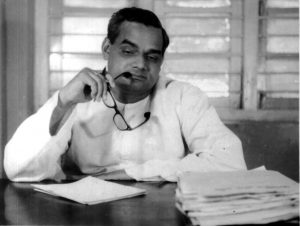
Former Prime Minister and Bharat Ratna awardee Atal Bihari Vajpayee passed away at 93 on August 16 at AIIMS Delhi where he was being treated since last nine weeks. Alarm bells rang when Former Prime Minister Atal Bihari Vajpayee became critical and had been put on life support system after his health deteriorated on August 15.

Atal Bihari Vajpayee, being a diabetic had only one functional kidney. He suffered a stroke in 2009, weakening his cognitive abilities. Later, he developed dementia. He was elected as Prime Minister thrice during 1996, 1996-1999 and during 1999-2004 — when he completed the full five-year term as a non-Congress Prime Minister. As his health deteriorated, he slowly withdrew himself from public life and was confined to his residence for years.

Mourning the loss of Vajpayee, PM Narendra Modi tweeted, “India grieves the demise of our beloved Atal Ji. His passing away marks the end of an era. He lived for the nation and served it assiduously for decades. My thoughts are with his family, BJP Karyakartas and millions of admirers in this hour of sadness. Om Shanti.”

President Ram Nath Kovind, expressing his condolences, said, “Extremely sad to hear of the passing of Shri Atal Bihari Vajpayee, our former Prime Minister and a true Indian statesman. His leadership, foresight, maturity and eloquence put him in a league of his own. Atalji, the Gentle Giant, will be missed by one and all.”

Vajpayee was a charismatic statesman who navigated the field of politics with finesse, but perhaps what endeared him more to his fellow politicians and the common man alike was his poetic side that often manifested in his fiery speeches. His oratory skills combined with subtle rhetoric earned him praises even from the members of the opposition when he spoke in Parliament and his public addresses liberally laced with poetries drew thunderous applause from the crowd.

Vajpayee had in fact underlined the frailty of human body in his poem ‘Apne hin man se kuch bolen’. One of its stanzas read — ‘Prithvi lakho varsh purani, jeevan ek anant kahani; par tann ki apni seemayen; yadyapi sau shardo ki vani, itna kafi hai antim dastak par khud darwaza kholen’ (The Earth is millions of years old, life an eternal story; but body has limits; though voices of hundred winters, it is enough that one must open the door on the last knock). He had also remarked once in his speech that ‘Manushya sau sal jiye ye ashirvad hai, lekjin tann ki seema hai’ (Man may live for hundred years is a blessing, but, body has its limits).

Born in Gwalior in 1924, Vajpayee was fluent in English. However, his oratory and eloquence came in full force when he spoke in Hindi, in or out of Parliament, balancing his trenchant remarks with well-timed wit. A seasoned politician, he carefully chose his words to drive home the message and even in his sarcasm remained dignified till the end.

A veritable wordsmith, Vajpayee’s speeches were so riveting, it earned him legions of admirers and monikers like ‘shabdon ka jadugar’ (‘magician with words’). In most of his speeches, his love for the country and faith in democracy resonated with his vision for building a stronger India. In his hard-hitting May 1996 speech in Parliament, Vajpayee had famously remarked, “Satta ka to khel chalega, sarkaren ayyengi, jayengi; partiyan banegi, bigedgi; magar ye desh rahna chahiye, is desh ka loktantra amar rahna chahiye (‘governments will come and go. But this country should remain, this country’s democracy should remain eternally)”.

A prolific poet, he penned many works, including Kaidi Kavirai Ki Kundalian (collection of poems written in jail during Emergency); and Amar Aag Hai (collection of poems) and Meri Ekyavan Kavitayen.

He often felt that politics did not afford him time for his poetry. In a public event, he had once remarked that the “streams of poetry ran dry in the desert of politics (‘lekin rajniti ke registan me ye kavita ki dhara sukh gayi’)”.

But, even if couldn’t find time to write new poems, he compensated for that by liberally peppering his speeches with his poetries.  In a public address, he had spoken in his charismatic style about the idea of freedom and hit out at those forces who were threatening — “Ise mitane wale ki saajish karne walon se kah do ki chingari ka khel bura hota hai; Auron ke ghar aag lagane ka jo sapna, wo apne hin ghar mey sada khara hota hai (Tell those conspiring to destroy it that playing with fire is dangerous; Those who think of burning someone else’s house, that would often happen to their own house)”.

A romantic at heart, Vajpayee, who mostly wore dhoti-kurta and bandi, wrote poetry in his spare time, and was a connoisseur of good food, but was unabashedly honest about not finding the conducive environment while being in active politics. “Poetry needs environment, concentration, poetry means self-expression, and self-expression cannot take place in noise (‘Kavita vatavran chahta hai, kavita ekagrata chahti hai kavita atmaabhivyakti ka naam hai, aur wo atmaabhivyakti shor-sharabe mey nahin ho sakti’),” he had said.

Known equally for his humour, Vajpayee had once remarked the he had wanted to leave politics but politics wouldn’t leave him (‘Main rajniti chodna chata hun par rajnti mujhe nahin chhodti’). “But, since I have entered politics, and got stuck in it, my desire was and still is that I leave it without a blemish, and, after my death, people say that he was a good man, who endeavoured to make his country and the world a better place,” he had said.

And, perhaps that is how Vajpayee would be remembered. In recognition of his contributions, he was awarded India’s highest civilian award Bharat Ratna in March 2015. A modest Vajpayee had once said that his contribution in the field of poetry was “almost nil”.

“If I had not entered politics, I would have recited and listened to poetries, attended ‘mushairas’ and ‘kavi sammelans’; would have been in the mood of writing and the poet’s sentiments would have kept expressing,” he said.

(With agency inputs)

letters@tehelka.com
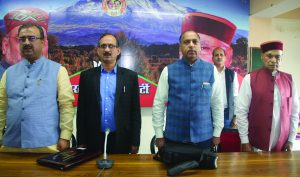
Himachal to see major reshuffle in state BJP unit

BJP state in-charge Mangal Pandey, state president Satpal Satti and chief Minster Jai Ram Thakur during meeting at chakkar in Shimla.

The state BJP will soon choose a new state chief as the second term of Satpal Satti is ending in September. Though BJP had won December 2017 assembly polls with thumping majority (44 seats), there are talks among the party leaders and workers in the state about the performance of Jai Ram Thakur government.

Sources told the Tehelka that the chief minister may adjust few of the leaders and MLAs in various boards and corporations to end the unrest among them. Party president Amit Shah is expected to visit Himachal soon. State BJP in-charge Mangal Pandey has already visited Shimla and held meetings with top BJP brass and other senior functionaries along with the chief minister. A senior BJP leader told Tehelka that the party has to replace Satti as he has completed two terms as state president. “We won assembly elections under his leadership, however according to the party constitution one can not hold state president post for more than two terms,’’ he added.

The problem in front of the party leadership is that after September they will have only six months before the parliamentary elections. Insiders say that party may appoint an ad-hoc president or may extend the term of Satti for few more months. Many in the party feel that a senior and influential leader should be given command of state chief so that party could perform well in the coming Lok Sabha polls.

It is important to mention here that BJP had won all the four Lok Sabha seats in 2014 and popularity of Prime Minister Narendra Modi had played a major role in that. However, things have changed now and few political observers feel that Modi’s popularity alone will not be able to give BJP that success in 2019 general elections.

The problem in the party is that there are at least four power centres in the state BJP. Union Health Minister Jagat Prakash Nadda is considered to be the most powerful as he enjoys the support of party chief Amit Shah and prime minister Modi. However, if one talks about the strength on the ground, former chief minister Prem Kumar Dhumal is the most influential leader. Despite losing previous assembly election he held a larger chunk of voters. He is considered to be the most powerful Rajput leader in state BJP.

Many in the party feel that giving responsibility to Dhumal will increase the possibilities of BJP performance in the Lok Sabha polls. On the condition of anonymity, a senior BJP leader said, ‘’If Dhumal is given bigger responsibility in any shape, this will also help in covering the alleged weaknesses of BJP government in the state’’. He is need of the party before the parliamentary polls, he added.

Interestingly, Dhumal has visited Delhi for more than two times in the recent days. Party leaders are curious about his visits to Delhi. Though a bigger chunk of the party is supporting a pro-active role of Dhumal in the state, it is said that former chief minister Shanta Kumar’s camp is opposite to this opinion. It is pertinent to mention that Shanta and Dhumal camps are considered like north and south poles in the state BJP.

Though Shanta Kumar is not considered influential in the state now, it was he who had strongly opposed the appointment of Dhumal as chief minister in December 2017. It is said that even a section in the party high command was also in favour of appointing two time chief minister Dhumal (who was declared as party’s CM candidate before the elections) as the CM was keeping in view his services to the party in tough times but consensus was if a defeated leader is made chief minister this will send wrong message among the masses. However, now many in the state party feel that Dhumal would have been better choice as CM.

It is said that Chief Minister Jai Ram Thakur may appoint few MLAs and party leaders as chairmen and vice chairmen in the boards and corporations in the coming days to give representation to those areas which could not get ministerial berths during the formation of the cabinet. With the total strength of 68 member assembly Himachal can have only 12 ministers including the chief minister according to the laws and all the berths in the ministry are already occupied. So, CM will adjust his aspirants on the boards and corporations.

Keeping in view the controversy over the appointments of parliamentary and chief parliamentary secretaries, Thakur has already made it clear that he has no intention of appointing CPS in the state. Sources said that if the party decides to appoint ad-hoc state BJP chief, present state chief Satpal Satti may be ‘’adjusted’’ in the government.

Sources say that he may be given the coveted post of the Chairman of 20 Point Programme Committee.

The coming days are also important for chief minister Jai Ram Thakur. There is all possibility that Shah may indicate about party high command view on the functioning of Jai Ram government. Jai Ram is well aware of his main opponents who are within the BJP. He has also visited Delhi and met various union ministers to stress on clearance of various state projects. Though Jai Ram is chief minister, he didn’t have any strong group in the state BJP.

His supporters, though are making all efforts that when Shah visits the state, they present an impressive show. They are also highlighting various achievements of Jai Ram government on various fronts. Sources said that some senior party leaders may raise the issue of performance of the party government in front of Shah. There seems to be very less possibility of removing him though despite questions on his capabilities have worried the Jai Ram camp. It is said that the RSS has played a role in making Jai Ram the chief minister after BJP got a thumping majority in 2017 assembly elections, though the party had fought under the leadership of Dhumal, who otherwise lost his own election.

letters@tehelka.com

Monsoon revival stimulates Indian economy and politics

South-West Monsoon is in full bloom in most parts of India. An initial phase of anxiety about deficit monsoon has subsided and rainfall is expected to be normal. The four months — June, July, August and September — receive 70 per cent of annual rainfall of the country and any deviation from normal is painful. A lifeline for the rural population, monsoon has a multiplier effect on all sectors of the economy. Though monsoon has taken almost entire country in its fold, the unpredictable weather God is over generous at some places. The state of Kerala has been facing a fierce flood fury. Many districts in the state have been submerged in water and several people (167 dead till this report was filed) have lost their lives. Relief and rescue operation may provide an immediate succor but the extensive damage caused to public and private property inter alia may derail the lives of the people.
Cloudbursts and landslides in the state of Himachal Pradesh, Uttarakhand and Leh in Jammu and Kashmir have been reported. Amidst the reports of chaos and misery, the revival of
monsoon has restored the hopes of a good kharif crop.

Kharif crops constitute a major proportion of food grains production in India for crops like Paddy, Cotton, Sugarcane, Maize, Moong, Millets (Jowar and Bajra), Groundnuts, Soyabean and Chilies are grown in this season. Of the total cropped area in the country, approximately 65 per cent  of the net sown area comes under rain fed crops. India ranks first among the rain fed countries in the world in terms of area but performs poor in the rain fed yield (less than 1 tonne per hectare).

According to Niti Ayog, of the total pulses, oilseeds and cotton produced in the country-80 per cent  pulses, 73 per cent  oil seeds and 68 per cent  cotton come from rain-fed agriculture.

The Economic Survey of year 2017-18 projected the annual growth of agriculture sector at 2.1 per cent, lagging miserably behind industry (4.4 per cent) and services(8.3 per cent). The economists endorse that almost 52 per cent of the cropped area in India remains without irrigation and some areas are chronically water stressed. The share of canal in net-irrigated area has declined from 39.8 per cent to 23.6 per cent and at the same time, underground sources have increased from 29.7 per cent to 62.4 per cent between 1950-51 to 2012-13. This describes the increasing dependence of farmers on rain-fed agriculture.

A good monsoon not only irrigates the field crops but also fills the reservoirs for the rabi crops and recharges the underground water. According to Central Groundwater Board, the ground water situation in the states of Ahdhra Pradesh, Gujarat, Haryana, Karnataka, Punjab, Rajasthan, Tamilnadu and Telengana has reached a critical level. The monsoon plays a vital role in recharge and replenish of underground water.

Monsoon rains are essential, not only for agriculture but for the economy of the country as a whole. Timely arrival of monsoon and equitable distribution of rain ensure the income generation in hinterland and adequate availability of raw material for the textile and food
processing industry.

Rural sector has tangible effects of monsoon but its intangible effects are all pervasive — from business, economy, and policy making to politics. The monsoon may not have any direct bearing on poll outcome but it plays a vital role in the penultimate election year; particularly in a country like India where the largest section of voter hails from agricultural backdrop.

The recent announcement about the revision of Minimum Support Price of the 14 kharif crops may bear fruit only if the rainfall is adequate. The ruling NDA alliance has evidently played a political card by substantially revising the MSP of crops and the procurement agencies have also been given an indication to pull up the socks. An elusive monsoon, at this juncture may smash the hopes of the ruling Bharatiya Janata Party and its partners. If the monsoon remains consistent, this will propel sentiments on all fronts. Earlier this year, backed by the prediction of Indian Meteorological Department (IMD) of a normal rainfall this season (June to September 2018), the Union Ministry of Agriculture has set a tentative target of 283.7 MT of food grain production for next year. This indicates a 4MT increase from 279.51 MT (the third advanced estimate of country’s food grain production for the crop year July 2017-June 2018). The Union Agriculture Minister Radha Mohan Singh had
informed that the country was able to save 9,775 cr in foreign exchange with the help of record output of pulses.

A good monsoon, coupled with perfect market conditions and proper implementation of farmer welfare schemes are the necessary ingredients for actual well-being of the farmers and prosperity of the nation.

The acute agricultural distress, farmers’ unrest, growing number of farmers’ suicides in the country may abate for some time in the wake of favorable climate conditions.

According to the sources in Meteorological Department, a rainfall deficit of up to 19 per cent  is considered normal presuming the standard deviation and error due to a large area under rain. He told that reservoirs at most of the places were filled up to the capacity and there are few more weeks to go, so there is no need to worry.

Whether floods or draughts,  political parties explore the silver lining in every situation. If monsoon is conducive, perceptions are positive, businesses are up and the ruling parties take the credit of framing suitable policies and woo the voters. On the flip side, a deficit monsoon may also turn the tide in their favour by announcing doles and financial stimulus packages to gratify voters.

The former Governor of Reserve Bank of India D Subbarao had said that RBI chases the monsoon like millions of farmers in the country as monsoon performance is an important factor in determining the RBI policies. The food inflation is directly related to a good harvest and a good harvest ensures moderate rate of inflation to sustain the desirable growth rate in the economy.

For Corporate sector, there are more than one benefits of normal rain. On one hand good rains spur the production-keeping price of inputs in control; at the same time it invigorates the demand in rural and semi-urban areas. A good cotton crop this year may revitalise the textile sector (ginning and spinning) as the demand of cotton in global market (especially from China) is expected to be high, informed a Gujarat based trader. This will enable the mills to run at full capacity thus cutting average cost of production along with higher employment generation.

The corporate sector is also busy drawing up plans to cash in good monsoon. The automobile manufacturers (two wheelers, tractors), agriculture implements, fertilisers, FMCG, tourism and hospitality all are keeping their hopes high post the revival of monsoon.

The banking sector of the country, that is under an appalling fund crunch due to colossal NPAs in general and debt waivers announced for the agriculture sector in particular also feels the pinch of any discrepancy in monsoon. The good monsoon translates into credit expansion and smooth repayment and vice-versa.

Monsoon is the single common factor in the life of every individual Indian and every interest group. Every citizen of the country stands to gain from monsoon rain but its richest dividends would be reaped by the incumbent government in the penultimate year of general elections.

letters@tehelka.com

Stalin inherits legacy as per Karunanidhi’s wish

Political pundits are convinced that the state of Tamil Nadu (TN) is in for a political turmoil in the absence of two of its tallest leaders — M Karunanidhi and J Jayalalithaa. The state, in the recent years, has seen a fall in its status as a front-ranking state in economic performance, suffered dent in industrial might and good governance.

On the face of it, things may look that conditions are fav ourable, new players to enter state politics to occupy the apparent vacuum in political leadership — given the fact that the ruling AIADMK is only held together by the greed and need of power and the anticipation that its principal rival DMK will be hit by internal squabbles that its chief-to-be and Karunanidhi’s declared political heir, MK Stalin, cannot control.

This supposition could very well come true if not for the fact that the DMK is a well-oiled cadre-based party, which is still intact. Another fact is that Stalin has in the last two years since Karunanidhi was out of political action due to illness, took complete control over the party and is a leader acceptable to the party rank and file.

With a firm succession plan in place, the DMK will not find the passing away of Karunanidhi earlier this month affecting the party structure in a large way. The succession of Stalin, in the works for the past two years, will be smooth barring the odd regional satrap exerting more pressure to up his or her bargaining power.

Knifes will be out if Stalin fails to win in the 2021 general elections to state assembly, but his first test will be 2019 general elections that will cement his position in the party and Tamil Nadu politics. The DMK is already prepared for local body polls and has been demanding they be held.

Flexing of muscles by the local chieftains is something that Stalin will have to deal with, but even on this count he managed to put in place men of his choice in key party positions in all the districts of Tamil Nadu. He has been working hard, raising issues of concern of the common man and also attacking the ruling AIADMK and the government, but cadres are a bit restless over his seeming inability to deliver the killer punch.

Now, after a 40-year plus stint as an understudy to his father, it is for the first time that Stalin will have the chance to be the authority in the party to take all decisions as far as the DMK and its affairs are concerned. Since it is an open secret in Chennai and Tamil Nadu that Stalin was the chosen one as the political heir by Karunanidhi, he is not expected to be facing trouble from DMK leaders, activists and cadres.

Trouble for him could be coming from within the family – and the first taste of it is in the growing emotional demand from within family members for taking back his elder brother MK Alagari into the party fold. Alagiri, who was also a union minister in the UPA government, was dismissed from the DMK’s primary membership for anti-party activities three years ago by Karunanidhi himself.

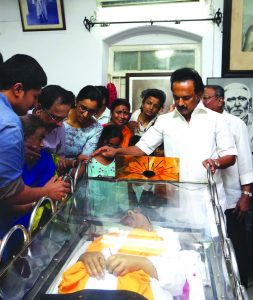
Alagiri has been trying for a re-entry into the party and had met Karunanidhi several times, but to no avail. How emotions played out was on display during the burial ceremony at Marina Beach when Kanimozhi, Stalin’s sister noticed Alagiri in the back rows, went up to him and escorted him to the front row and sit next to Stalin. Of course, she took permission from Stalin the moment she noticed Alagiri was missing from the front row.

Stalin is expected to address this very issue — whether to allow Alagiri return to party or not — as he takes complete and formal charge of the party that is yet to formally elect him as the leader in place of his father Karunanidhi, who was the unquestioned President of the party he was co-founder of for 50 years at a stretch.

Politics within the Karunanidhi family or the DMK’s first family is what that could cramp Stalin somewhat as he plots the future course of action and how it fights the forthcoming 2019 Lok Sabha general elections.

But, one thing is clear. It is certainly an end of an era in Tamil Nadu politics with the demise of the state’s tallest leaders Karunanidhi and Jayalalithaa.

What ails the ruling AIADMK is that unlike in DMK, there was no succession plan in place and her death sparked off an intense power struggle within the party. Even today, the party is plagued with internal squabbles that will grow in intensity as elections — assembly elections of 2021 — approach. For the present it is the power that is acting like a glue and also for the reason that most of the MLAs know that without an Amma, their individual chances of winning seats were highly doubtful.

This is not so in DMK, which is on an upswing and has been highly active as an opposition party, raising issues of concern and taking an anti-Centre stand, at a time when the perception of the people of the state was that the ruling AIADMK was working as the B team of the BJP.

“It is no secret that BJP is backseat driving the government,” said political analyst Prof Ramu Manivannan of the Madras University.

The two national parties — Congress and the BJP — largely irrelevant politically in Tamil Nadu for the past over three decades may like to try and occupy the political vacuum created by the departure of the two leaders.  The political situation on the ground, with ruling AIADMK losing popularity with each passing day and DMK without its sharpest political brain seems ripe for national parties to exploit. But the Congress is hardly in a position to make any serious bid and is content with playing second fiddle to the DMK, with whom it has an alliance going. Whether it will continue or not, time will decide, but so far indications have been that DMK will fight against the BJP.

The BJP on the other hand sees in Tamil Nadu a chance of a lifetime to enter Tamil Nadu, and may work out an alliance or an understanding with the dominant faction of the ruling AIADMK. The BJP is also seriously trying to woo Rajinikanth into its fold, with a tie up, for the elections should he enter politics as he announced he would.

Then there is the other superstar, Kamal Haasan, who can articulate his ideas and thoughts well, who has announced he will be working with the Congress and has endorsed the idea of Rahul Gandhi as the Prime Minister candidate.

But in all these permutations and combinations will be side play as the main political battle in Tamil Nadu still will be between the two Dravidian rivals — ruling AIADMK and opposition DMK. Whether the superstars can win enough votes and seats is something that remains to be seen whether they are serious long-term players or disrupters at best.

letters@tehelka.com

Why Is Peace a Dirty Word In Kashmir?

Peace is a dirty word in Kashmir. You can certainly land in a serious trouble if you are deemed to be a votary of it. Your arguments, your write-ups, your social media posts in its support will count for nothing and on the contrary only deepen suspicions about your motivations.
But this apparently weird response has a rationale too. And an eminently understandable one at that. Peace, in the context of Kashmir, is not seen as a condition to be sought for its own sake. It is not about seeking to stop violence one fine morning and living happily ever after, a kind of thinking that seemed to inform the recent unilateral ceasefire by New Delhi in the state. Peace is seen as a function of the resolution of the conflict that breeds violence.

So, if you seek peace in Kashmir, you better champion the resolution. And for anyone interested in Kashmir, or genuinely working to make a redeeming difference to the troubled state of affairs, knowing this distinction is critical to winning the confidence of a majority of Kashmiris and reassuring them as to your intentions.

One reason that has bred this deep hatred of peace is the recurrent efforts by the successive central and state governments to dress the state up as peaceful to pass it off as their respective achievement. And this is done by holding an election, a conference or a large political rally in Srinagar with people being bused from across the Valley to attend it.

For example, in November 2015, the PDP ferried its workers from across the Valley at Sher-i-Kashmir Stadium in Srinagar for the Prime minister Narendra Modi’s to deliver his speech.  But while Modi spoke to a stadium-full crowd, Srinagar was under a complete lockdown to prevent separatist groups lead their parallel Million March. Police and paramilitary personnel had fanned out across the city setting up checkpoints and laying concertina rolls to prevent easy movement. As the stadium throbbed with activity, reverberating to the cries of “Modi, Modi”, the silence beyond its modest confines was deafening.

Early this year the J&K Government also held a tourism convention to create an illusion of peace in its bid to draw tourists to the Valley. While the convention was a success, its purpose was defeated by the escalating violence in the state. Both events, meticulously stage-managed, made some news but had little to do with the ground situation.

Such examples are galore: In the mid-nineties, when  Farooq Abdullah government had tried to flaunt peace by reopening a cinema on Srinagar’s Residency Road there was a grenade attack during the first show itself, leading to the death of a person.

That is about the state government. There have also been attempts to hold events in the Valley from outside the state and which have been resisted for the same reason: a widespread perception that the secret motive behind them is to demonstrate peace where none existed. In August 2011, the then proposed “apolitical” Harud Literary Festival was called off by its organisers Teamwork Productions after it met a strong resistance by the civil society groups including the renowned Kashmiri writers Basharat Peer and Mirza Waheed who refused to be a part of it. Besides, an online campaign to boycott the event went viral threatening to spill over onto the streets.

The idea of an “apolitical” literary festival grated on the sensitivities in the Valley where people saw it as a covert effort to show to world that everything was hunky-dory in the state. One major reason for the anger was that only a year before the Valley had witnessed a five month long unrest leading to the killing of 120 persons. Writers and a majority of the people in Valley took serious exception to the word “apolitical” and read it as a deliberate attempt to limit the scope of the readings and dialogue at the festival.

Similarly, a music concert by Zubin Mehta at Nishat in September 2013 got mired in deep controversy. The concert was also opposed by the civil society and separatist groups who argued it was designed to project a false peaceful image of the troubled state to the world. But the concert went ahead nevertheless, under a heavy security. On the day it was held, however, a  parallel concert Haqeeqat-e-Kashmir (reality of Kashmir) was organised by civil society members to protest Mehta’s concert.

While people tend to see the motives behind these events, there is little they can do about them except complain, protest or simply resign to the state of affairs. But, the situation could be less forgiving when an individual starts talking about peace — or a defence of peace becomes a part of his outlook or activity. It breeds more scepticism. That is, if such an advocacy is seen to be unqualified by the requisite stress on the resolution. Or if the peace is seen to be defended only as the means rather than a consequence of the resolution you are in a dangerous place.

letters@tehelka.com

Article 35A case in SC puts Kashmir on brink of another unrest

Kashmir is on edge and set to tip into fresh turmoil. And this time the trigger has little to do with the militancy but the ongoing case about Article 35A in Supreme Court. The apex court is hearing a clutch of petitions challenging the validity of the constitutional provision that grants special citizenship rights to people of J&K and forbids people from other parts of the country to settle in the state.
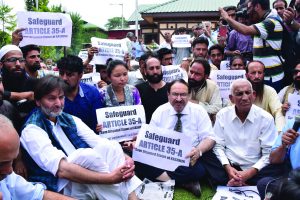
On August 6, the court deferred the crucial hearing on the petition to the last week of this month. The run-up to the hearing witnessed protests and shutdowns in Kashmir. Hurriyat had even issued a call for a sustained agitation in case the Court issued an adverse judgement. The adjournment of the case, therefore, offered a breather but did not address the apprehension which has since only further deepened. Civil society groups have mobilised to resist any change. Hurriyat has called for the continuance of the protests.  And what is more, the mainstream political parties have also joined in and supported the protests. This has created a broad across-the-board alignment on the issue.

There are also voices which support the abrogation of the Article 35A but they are confined to Jammu and a part of Ladakh. Among the political parties, the BJP is the leading voice supporting the repeal of the crucial constitutional safeguard arguing it is ultra-vires of the constitution as it was applied directly through a presidential order and not enacted by the parliament.

But a predominant majority of the state opposes removal or any tinkering with the law. And the anxiety runs so deep that any adverse decision could throw the state into disorder. What has reinforced the unease is that the centre has refused to defend the law in the court and the Governor led state government isn’t expected to be in a position to put up the best defence.

“We owe it to our future generations to safeguard and protect our political identity and special status that our ancestors and our founding leaders fought for,” the National Conference Omar Abdullah said while addressing his party workers in central Kashmir district of Budgam. “The forces that are sponsoring these elaborate assaults on the state’s special status have been inimical to the state’s interests and political identity from the very first day and we fought them then and we will fight them now.”

Similarly, the former J&K Chief Minister Mehbooba Mufti said the scrapping of the law would be against the “basic structure of the constitution.” After the Supreme Court deferred the hearing of the case, Mehbooba took to Twitter to articulate the grave situation prevailing in the state.

“The constitution of India is the supreme law of India which has conferred special status to J&K. Any attempt to fiddle with it will amount to violating its basic structure,” Mehbooba wrote. “The people of J&K placed great faith in our country by rejecting the two-nation theory which was divisive & driven by religion. Instead, we chose a democratic and secular India. Now it is for the nation to respect that decision in its entirety. Instead of attempting to
dilute J&K’s special status they should embrace it and treat Kashmiris with dignity”.

But on ground it is the mainly the separatist and civil society groups which are leading the campaign. Tension and tempers run high. The local newspapers is filled with news about the protests, statements, editorials and analysis in defence of the Article 35A.

“The court judgements, as warned by the legal experts in the Valley, tend to be unpredictable. But the stakes in case of the Article 35A are too high to be left to perceived capriciousness of the court orders,” an editorial in a local daily said. “The implications of an adverse judgement will be horrific. It confronts the majority of the people of the state with an existential challenge”.

Everybody is looking forward to next hearing of the case in the Supreme Court. A sense of suspense looms large. The majority of the people of the state believe that the attempt to abrogate the constitutional provision is designed to alter the demographic character of the state.

“By taking away this safeguard, BJP-RSS combine is trying to make settlements in Kashmir like Israel in Palestine to change the demography and hence to bury the Kashmir dispute for all times,” a statement issued by the Kashmir Centre for Social and Development Studies said. “Even a layman understands that any change in the demographics of the state by removing the safeguard to our exclusive rights on our land will alter the ratio of population.”

On the other hand, justifying their fight for retention of Article 35A, separatists have said that doing away with constitutional provision will detrimentally impact their struggle for Azadi (freedom).

 “We want the rulers of India to know that every Kashmiri would protect the state subject law with his blood and life,” JKLF supremo Yasin Malik said while addressing a protest. “They know their right to self-determination will be automatically snatched from them if state subject law is scrapped”.

letters@tehelka.com

Differences in Punjab AAP widen over leadership

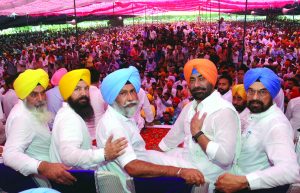
02 July 2018 Bathinda Dissident AAP MLAs led by Sukhpal Singh Khaira and Others Announce to Dissolve State Unit of AAP at a convention, in Bathinda on Thursday.PHOTO-PRABHJOT GILL BATHINDA

Since July 26, the turmoil in Punjab AAP is showing no sign of abating. The no-holds-barred offensive launched by eight-out of the total 20 MLAs in Vidhan Sabha over removal of Sukhpal Singh Khaira as the Leader of Opposition (LoP) was not expected in the least by the party’s leadership.

There is an open revolt against the manner in which the affairs of the state unit of the party were being handled. The daily war of words since then between the rebel group of MLAs and those against them including a majority of the state unit office bearers has precipitated the crisis to a level that warned a split may be on the cards.

Even as the rebel group led by Sukhpal Khaira and Kanwar Sandhu have been queering pitch for the party’s central leadership since Bathinda Convention on August 2 which saw a big turnout in their favour, there has been no thaw in the situation.

Though this is not the first time that AAP, which has next significant presence in Punjab after Delhi, is embroiled in the crisis like this, yet in terms of scale and positions taken by warring inner party groups, it is unprecedented.

“We are not even thinking of parting ways with our central leadership. Kejriwal is our leader. But there will be no compromise on the resolutions passed at our Bathinda Convention,” said Kanwar Sandhu, a journalist-turned politician who represents Kharar constituency in the Vidhan Sabha. Seeking autonomy in running the Punjab unit of the party is one of the major resolutions. And this is what has been taken most unkindly by the central leadership as it considers it as a step towards literal revolt. If that happens, the party is sure to lose the status of the main Opposition party in the Vidhan Sabha.

The rift among the party seniors at the state level has expected demoralising impact on the party’s volunteers. They too are vertically split. And they give vent to their ire on social media allegedly at the behest of rival group leaders. The situation degenerated to the level that even the women MLAs opposed to Khaira-Sandhu duo were targeted on social media. Sandhu, however, apologized for that.

Nobody in Punjab AAP and even in the rebel group knows where the ongoing turmoil will it lead them to. “What next? It’s a million dollar question,” said Dr Balbir Singh, co-president of the state unit and the main person who Khaira accused of conspiring against him and leading to his removal as the LoP. This suave Patiala-based eye surgeon, who enjoys trust of the central leadership, attributes Khaira’s removal mainly to his failure to highlight the party and its government’s achievements in Delhi to bolster party’s image in Punjab. Even as both warring groups stick to their stated positions, the crisis seems unending. Though Dr Balbir Singh discloses efforts are on to woo back the rebels, the onus is on the both sides to broker peace. Undoubtedly, the central leadership has to play the bigger role and make effective intervention. But sources say there is no sign of this happening at the moment. The party’s Punjab Affairs Incharge and Delhi Deputy Chief Minister Manish Sisodia has hardly any time out of his busy official duties in Delhi.

For the close observers of AAP’s journey in Punjab, the current crisis is inevitable outcome of the its brand of politics. “Such a situation arises when a party deals in politics bereft of any ideological substance. The AAP was guided more by power logic and failed to deliver on people-centric issues. This brand of politics cannot sustain for long,” observes Chandigarh-based political analyst Dr Parmod Kumar who is Director, Institute for Development and Communication.

Apparently stung by the adverse public reaction fearing political alienation due to constant inner party bickering, both factions have now realized that they should connect with people and the party volunteers at the grassroots level. “We have started series of meetings to revive and strengthen the party at the grassroots on line with our resolution at Bathinda Convention,” says Sandhu. Similarly, Dr Balbir Singh says they too have started district level meetings. Such series of meetings seem to have been planned more to serve the purpose of establishing their respective credentials. The internal rift still remains.

Observers attribute the crisis to lack of party loyalty and resultant inner party discipline which in many ways could not mature as self-seekers thronged the party sensing it could form the government in the state. This process started after unprecedented four-seat victory in 2014 Lok Sabha elections. Several disgruntled middle and lower rung leaders from other parties including Akalis, Congress and BJP jumped on to AAP bandwagon.

It continued like this till Vidhan Sabha elections in 2017. The flashpoint came at the time of tickets distributions. The desertions followed. The allegations of ignoring genuine candidates and selling tickets flew thick and thin. The central leadership was accused of arrogance and Punjab versus Delhi narrative gained currency. Most of the present senior leaders including MLAs, particularly those in the rebel group, endorsed this narrative. Interestingly, this narrative has revived in an equally scathing manner after removal of Khaira as the LoP.

In a way, the ongoing crisis is being seen as another round of filtering process. Khaira and Sandhu were among many who had joined AAP not long before the Vidhan Sabha elections. Those who had been finding it increasingly tough to adhere to the party discipline, even when apparently wrong decisions are taken, have for the first time been clearly marked. “It’s a welcome churning. After all, if something negative is happening, positive too is there at the same time,” philosophises an MLA without wishing to be named. As a fallout of the Khaira episode, the three leaders back at the helm of the party affairs- Sangrur MP Bhagwant Maan, State co-president Dr Balbir Singh, newly appointed LoP Harpal Cheema- are the old timers.It is not that the rebels are rootless. A fairly impressive turnout at their Bathinda Convention, irrespective of the rivals allegation of it being helped by supporters of the AAP’s estranged alliance partner, Ludhiana’s MLAs duo Bains brothers, provided them enough boost to remain unrelenting in their demand of having the right to run the party in the state on their own. They claim to have majority of volunteers and the district level leaders on their side. Social media is also abuzz with a section of NRI Punjabis siding with them. But will all this be enough to establish them as the real face of AAP capable of taking decisions in line with the original AAP plank that once earned the party mass support in Punjab? Sandhu has more than once talked about reinventing Kejriwal’s concept of Swaraj.

Kumar thinks the rebels have the potential of becoming mega spoiler like Bahujan Samaj Party (BSP). They did not offer any Punjab-centric concrete agenda at Bathinda Convention. Their main focus was on presenting themselves as the real AAP. “No doubt, there will always be scope of a third alternative in Punjab. They can be formidable and give sleepless nights political rivals if they resign as MLAs. It must be remembered that people tend to sympathise in such cases,” he added.

But the question is, do the rebels have the courage to take such a step in the interest of Punjab? “What next?” is indeed a million dollar question for AAP as a whole in Punjab.

letters@tehelka.com

Flying deep inside the Rafale deal controversy

Though the NDA government has remained in controversies for its decisions like demonetisation and roll out of the Goods and Services Act, it had never been charged with corruption. The significance of the Rafale deal is that this is the first major corruption charge against the government and the opposition has found an issue which it could drum up during the election year. Although corruption charges have not been substantiated with any hard evidence, the issue is likely to resonate all through the election campaign unless the government comes out with convincing replies.
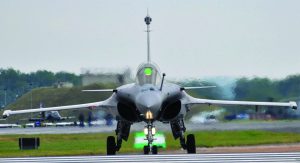
There are at least two aspects of the deal which require clarifications and explanations to the general public. One is that the price of each jet has been increased by a whopping 1000 crore per aircraft to about 1600 crore. The massive increase sounds unbelievable and unrealistic but the opposition has produced two documents to bolster its claim. The first document stated that the Rafale aircraft price was 670 crore per aircraft. This was stated by Minister of State for Defence in the Lok Sabha on November 8, 2016, while answering a question on the acquisition of fighter aircraft.

He had stated, and it is part of the official proceedings of Lok Sabha, that “an inter-governmental agreement with the Government of French Republic was signed on 23 September 2016 for the purchase of 36 Rafale aircraft along with requisite equipment, services and weapons. Cost of each Rafale aircraft is approximately 670 crore and all the aircraft would be delivered by April 2022”.

The other document is a press release by the Reliance Defence and Aerospace, which is the Indian partner of the French manufacturer of Rafale. In a press release dated February 16, 2017, it had stated that the total price of the deal was about 60,000 crore for 36 aircraft or 1,660 crore per aircraft.

The second significant aspect of the deal, which was signed by French prime minister Emmanuel Macron and his Indian counterpart Narendra Modi in April 2015 in Paris, was that the earlier plan was to purchase 126 aircraft but the number was reduced to 36 in the revised deal. The charge is that it was done without consulting the Air Force or the Defence ministry. The actual requirements of the Air Force is much higher as its depleting fleet has not been strengthened for a long time.

The third controversy relating to the deal is the involvement of a newly constituted private company, Reliance Defence Ltd, belonging to Anil Ambani. The earlier deal had public sector unit Hindustan Aeronautics Limited as part of negotiations for offset contract. The decision to drop the established and tested HAL in favour of the new Reliance Company was indeed baffling. The Company was floated barely two weeks before the deal was signed. The government has, however, defended this aspect by stating that it had nothing to do with the partnership as it was a decision of the Dassault Aviation Company which manufactures Rafale fighter aircraft.

Congress, which has been hit in the past by several scams like the infamous Bofors deal, has been in the forefront of the attack on the  Rafale deal. It took up the issue both inside and outside the Parliament and described it as the “mother of all scandals”. While several parties belonging to the UPA kept away from the protests, it found support from the Left parties and the Aam Aadmi Party.

The attack was bolstered by two former ministers who had served in the Atal Behari Government-Yashwant Sinha and Arun Shourie, and a leading Supreme Court lawyer Prashant Bhushan. They said there were no additional add-ons and yet the country will pay 1,000 crore more per plane as compared to the earlier deal. They said such an agreement between Reliance Defence and Dassault Aviation, which makes Rafale jets, should have come after governmental approval.

Former union minister Sinha, who had been openly criticising the government on various issues, said Bofors “pales into insignificance” when compared to this “scam”. He and Shourie said statements of then foreign secretary S Jaishankar and Defence Minister Manohar Parrikar suggest that none of them was aware of the new deal to buy 36 jets, against 126 aircraft as per a Request for Proposal issued in 2007, for which Dassault had been selected as it was the lowest bidder.

They also said there were no additional add-ons as per Indian specifications, as claimed by the government, compared to the original RFP. They quoted the joint statement by India and France on April 10, 2015, which mentioned that the 36 jets to be delivered by Dassault “and associated systems and weapons would be delivered on the same configuration as had been tested and approved by the Indian Air Force”.

Shourie described it an “enormous scandal which jeopardises national security” and asked the government to make details of the deal public. Pointing out that offset guidelines of the government issued on April 1, 2016, mention that “all offset proposals will be processed by the Acquisition Manager and approved by Raksha Mantri, regardless of their value”, he said Dassault’s deal with Reliance Defence could not have happened “without a nudge and a wink” from the government.

A joint statement issued by the three said, “Could an experienced manufacturer like Dassault have picked a company that had no experience whatsoever of manufacturing aircraft…without the approval from the government?” It said a “private party which has had absolutely no experience in manufacturing aerospace and defence equipment has been handed an enormous financial benefit.” They demanded an audit by Comptroller and Auditor General.

Surprisingly, barring a couple of newspapers, the media has ignored the issue. The press conference by the three was not covered by large sections of the media while some pushed it to inside pages. One of the prominent English dailies gave the headline to a two column report on the press conference, which also included the statement of Union finance minister Arun Jaitley, that read: “Jaitely rubbishes wild allegations on Rafale deal” without giving any benefit of doubt to those making the allegations.

Jaitley said in a blog post that there “is not a grain of truth in the wild allegations repeated today nor anything substantiating in the purported facts and voluminous documents marshalled to corroborate the baseless accusations”. He went on to say that the “allegations constitute nothing but reprocessed lies by forces increasingly desperate to prove their relevance”.

He said, “those raising alarm about the alleged danger to national security ought to realise their responsibility and refrain from politicising for narrow individual ends those very matters pertaining to the defence of the nation that were consistently ignored by them and by those with whom they sympathise”.

However, this explanation is not adequate and the government needs to come out with more details and clarifications on the deal while keeping in mind national security aspects. The Congress and other opposition parties are certain to milk the deal to tarnish the image of the government. There is no doubt a confidential clause between the Indian and the French governments which must be respected but the clearing of certain doubts would help the government in defending the deal.

letters@tehelka.com

AAP’s ‘Bhaichara Kanwar Yatra’ set to win support in Haryana

It would be the first time for AAP when they will contest elections in Haryana next year. Four years ago, the party successfully contested parliamentary polls in neighbouring Punjab and won four seats. Last year, AAP also contested the assembly polls in Punjab and tasted success. AAP emerged as the main opposition party in the state although at one time it looked like it would come to power in the state.

AAP also ventured unsuccessfully in Goa elections. But for now, the party is only concentrating in Haryana where it spots a big chance. With the Indian National Lok Dal out of power for about 15 years and Congress struggling to come to grip after ruling Haryana for 10 years, AAP feels it has the best chance in 2019 to come to power if the anti-incumbency factor grows against the ruling BJP.

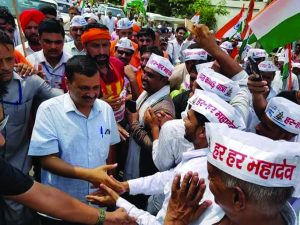
In the name of establishing ‘bhaichara’ (brotherhood) among the Haryanvis, AAP is making sincere efforts to reach out to the people. One such move of the party was visible when it undertook a yatra campaign from Haridwar to Rohtak in Haryana from August 1 to 9 carrying the pious Gangajal and distributing it to the leaders of various parties after the end of the yatra.

AAP aptly named its innovative move ‘Bhaichara Kanwar Yatra’. The yatra was led by AAP president in Haryana, Naveen Jaihind. A group of AAP volunteers began the Bhaichara yatra from Haridwar on August 1 during the Holy Shravan month. On its way, it passed through Panchkula, Chandigarh, Ambala, Kaithal and finally ended at Rohtak.

Talking to Tehelka, Naveen Jaihind said all the AAP volunteers first took a dip in the holy Ganges before embarking upon the yatra. The volunteers then began a foot march carrying the kanwar. Jaihind said they plan to distribute Gangajal to various people, including Haryana Chief Minister, his cabinet ministers, MLAs, opposition leaders to request them to ensure ‘bhaichara’ (brotherhood) in the state.

“The political leaders always speak ill of others. This Gangajal will remind them of their duties and responsibilities,” said Naveen Jaihind.

He also said that Gangajal will help cleanse the minds of the political leaders. AAP never ever thinks of doing any harm to the people. The party is always for the progress, welfare and development of the state and the people. “The Gangajal will help these political leaders become pious and wise and they start working for the welfare of the people without hampering the peace and brotherhood in Haryana.”

The Gangajal given to the BJP leaders will remind them of their forgotten promises. The BJP promised development, jobs to the youth, law and order and maintaining peace and brotherhood in the state, but it has miserably failed on all these fronts. It is, therefore, time these leaders realise how they have failed the people, he said.

Jaihind went on to say that it was not just the BJP which had failed the people. The Indian National Lok Dal (INLD) and the Congress party were equally to blame for this. There is leadership fight in the Congress. Both senior Congress leader and former Chief Minister of Haryana, Bhupinder Singh Hooda and Haryana Congress president Ashok Tanwar have been at loggerheads with each other for long. Both the leaders are also holding yatras in their own capacity. While Bhupinder Singh Hooda has been holding his Jan kranti yatra on a chariot, Tanwar has been taking out his ‘Cycle Rally’ to gain attention and build a vote base.

He even said said both leaders have personal interest in their mind. It is most unfortunate that they do not think about the welfare of the people. Their only objective is to grab the Chief Minister’s post if their respective parties come to power in Haryana. But the AAP aims to create brotherhood among various sections of people. “We want to restablish the peace and harmony among the 36 biradari disturbed by various events in the past including the violent agitations,’’ said Jaihind.  

Highlighting on the casteism in the state, he was of the opinion that the BJP government at the centre and in Haryana has only promoted casteism and religious bigotry during its four years’ reign and disturbed the peace and brotherhood among different communities both in the state and the rest of the country. In the name of casteism riots are taking place everywhere and the BJP and other parties are taking full advantage of the disturbed situation. “It was AAP which launched a ‘Meri Jati Hindustani’ campaign in Rohtak for establishing communal peace and harmony,’’ said Jaihind.

The AAP president said they will also give the Gangajal to Jat leader and president of the All India Jat Andolan Sangharsh Samiti (AIJASS) Yashpal Malik and BJP’s MP from Kurukshetra Rajkumar Saini over their utterances which tended to disturb the communal peace in the state time and again.

As per the Panchkula district head of AAP, Yogeshwar Sharma, Aam Aadmi Party has always focused on the wellbeing of the people. “We do not compromise with our principles,’’ he said.

Sharma said the `Bhaichara kanwar yatra’ helped create a goodwill for the AAP in both the rural and the urban belt of Haryana. “It created curiosity and a positive vibe among the people. We are also carrying out a membership drive in the state. In this regard I have held several meetings in Panchkula and Kalka, said Sharma.

However, commenting on the `Bhaichara Kanwar Yatra’ of the AAP, Pawan Jain, former Media Congress of the Haryana Congress said AAP leaders always indulge in dramas. “AAP does not have a base in Haryana. They try various tactics to influence people but no one ever takes them seriously. The Congress party under Bhupinder Singh Hooda will form the government after next elections in Haryana. People are fed up with the BJP rule in Haryana based on falsehood. The BJP government has failed on all fronts. People of the state will vote it out next time,’’ said Pawan Jain.

But senior BJP leader and Health Minister of Haryana, Anil Vij said BJP has fulfilled all the expectations of the people who voted it to power four years ago. “The opposition will not prove any match to the BJP,” he said.

letters@tehelka.com

Trade expansion likely to boost India-Vietnam ties

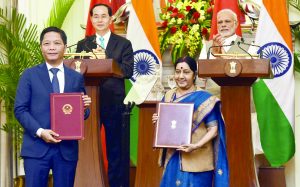
The Prime Minister, Shri Narendra Modi and the President of the Socialist Republic of Vietnam, Mr. Tran Dai Quang witnessing the exchange of agreements, at Hyderabad House, in New Delhi on March 03, 2018.

As India and Vietnam celebrate 45 years of bilateral relations by upgrading their Comprehensive Strategic Partnership, the future seems to hold a lot of potential for the two nations. The rising power of India, not just in South Asian region but with considerable clout in the Indo Pacific, will be more balanced than before, said Vietnamese envoy to India, Ton Sinh Thanh.

India is one of the three nations with which Vietnam has Comprehensive Strategic Partnership, the other two being China and Russia. It was during Prime Minister Narendra Modi’s visit two years ago that the partnership was elevated. Vietnam has Strategic Partnership with 11 countries. Vietnam boosts of US$2,100 per capita per annum.

This year will see more dialogues between India and Vietnam. Visits from India include a just concluded trip of Defence Minister of India, Nirmala Seetharaman. A Defence Dialogue will soon take place in Delhi. External Affairs Minister Sushma Swaraj will visit Vietnam to co-chair a joint meeting in the end of August. According to sources, the President of India is likely to visit Vietnam by the end of this year. 

Regarding India’s role in the Southeastern region and the Indo Pacific for establishing peace and stability, the Vietnamese Ambassador said, “India is moving fast. It is becoming a strong player in the region and will now look over a bigger space in the Indo Asia Pacific region. Its role will be played out in the extended neighbourhood. We welcome India’s new role and its engagement in the region, so does the Association of South East Asian Nations (ASEAN).” Thanh said, “India’s increasing role and growing power will act as a balancing element in the region.”

Trade between India and Vietnam has scope to expand further. Ambassador Thanh said, ‘’FTA between India and ASEAN should be upgraded and expanded for the pact to deliver desired results. ‘’Vietnam wants to diversify trade with different countries specially India which is a big market and a big investor.’’ There is need to expand the agreement to
include more products, the ambassador added.

Last year, the trade between India and Vietnam stood at US$7.56 billion, a very small amount compared to other countries of the world that stood at US$420 billion last year. In the year 2016-17 investment from India to Vietnam was a little more than US$800 million which is very small in comparison to the total of US$300 billion investment from the world. Indian companies are investing to the tune of US$40 billion a year in the world whereas in Vietnam it was merely US$100-150 million a year. Thanh said, ‘’There is a lot of potential for Indian companies to invest in Vietnam. Big groups like Mahindra and Adani are looking for investing in Vietnam.” Vietnam has a good foreign investment regime, labour cost is low. Bilateral trade with Vietnam is much lesser in trade with India even in the ASEAN countries. With Singapore it is US$20 billion and with Indonesia, Malaysia around US$18 billion. Vietnam has a 100 billion trade with China.

Elucidating the demand in Vietnam’s textile sector, the Ambassador informed that textile was one sector where Vietnam imported to a tune of around US $10 billion every year. He expressed that India has the capacity of meeting Vietnam’s demands for textile inputs. ‘’If trade was opened up, we could be importing a lot of items from India’’, he said. ‘’There a potential of 20 billion trade in textile to Vietnam from India which is a possibility waiting to be explored. Vietnam needs it and this is the time’’. Presently investment from India is merely US$1 billion, there is scope for much more like in energy, especially in solar energy and tourism.

India and Vietnam commonalities are abound as both countries are rapidly growing economies. Vietnam’s growth rate last year was at 6.8 per cent and in the previous years, it has even touched 9 per cent. The Ambassador said that while the defence ties were robust, the economic relation could still be taken much forward. And the cultural ties needed to be tapped. He informed Vietnam exports are more than the country’s GDP. The South eastern country is trading with more than 200 countries presently.

India, although, has objections to China’s ambitious Belt and Road Initiative (BRI), Vietnam is still studying the various aspects of the initiative. “We have to figure out if it is good for us or not. If it is good, we will join it, if not, we will stay away from it,” he said. Unlike India, however, Vietnam had attended the big BRI meet that China organised last summer.

Thanh did not mince words on the Indo Pacific saying India’s vision on the Indo-Pacific, which was revealed in Modi’s address at the Shangri-La Dialogue recently, was similar to Vietnam’s approach, which is about inclusiveness, openness and engagement rather than confrontation. “We, in fact, refer to the area as Indo Asia Pacific,” he said.

Vietnam has issues with the growing Chinese footprint in the South China Sea and it wants a rules based order to prevail (like India does). “Vietnam will raise its voice, asking for support from other countries, including those outside the region because so many vessels pass through the seas (which makes other nations also stakeholders).”

In the absence of direct flight from New Delhi to Hanoi tourist traffic to Vietnam and India is considerably poor. It is a roadblock that the two governments are working upon. The
Ambassador informed that connectivity between the two capitals is being worked out and talks are being held. Currently, only Jet Airways operates flights to Ho Chi Minh City from New Delhi and Mumbai via Bangkok.

Last year 110,000 tourists visited Vietnam while 22 million Indians travelled abroad. 3.5 million Indians went to South Asia out of them 1.6 million went to Thailand alone. Vietnamese come to India for pilgrim.

Vietnam is expecting 1,70,000 visitors this year, as per reports. The number of Indian tourists to Vietnam has risen from 16,000 in 2010 to an estimated 1,10,000 last year, Thanh informed and called for promoting India as a destination for Vietnamese. As per the embassy figures 20 million Indians travel overseas every year, while only 90,000 of them go to visit Vietnam. Thanh said the first direct air service between Vietnam’s most populous city Ho Chi Minh City and New Delhi is likely to commence by the last quarter of this financial year.

letters@tehelka.com

MOST POPULAR

HOT NEWS