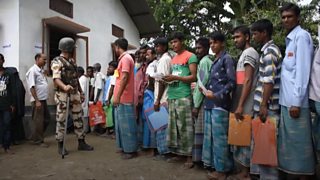
A total of 66 illegal Bangladeshi immigrants have been arrested from Wazirpur and NS Mandi areas of the national capital, Delhi Police said on Monday.
According to the police, Out of the total illegal foreign nationals included 20 male, 16 females and 30 children who deliberately concealed their mobile phones and all forms of Bangladesh identification documents to avoid detection and prevent tracking through mobile surveillance.
The arrests have been made during a special drive to identify and apprehend illegal Bangladeshi migrants residing in the jurisdiction of the North-West District.
On receiving intelligence input, the two dedicated teams of the foreigner cell of the North West District Police conducted a raid on June 6 within the jurisdiction of PS Bharat Nagar and PP NS Mandi, PS Mahendra Prak.
“This operation was part of the ongoing efforts to identify and take action against unauthorized foreign nationals residing in the national capital,” the police said.
These families, reportedly migrants from the neighboring state of Haryana, had relocated to Delhi following intensified enforcement actions against illegal immigrants by the police, as well as widespread media coverage of such operations.
“The proactive and intelligence-driven operation was aimed at not only apprehending those attempting to flee but also deterring the illegal movement of foreign nationals in the region. The drive remains ongoing with further verification and legal action under process,” police stated in a statement.
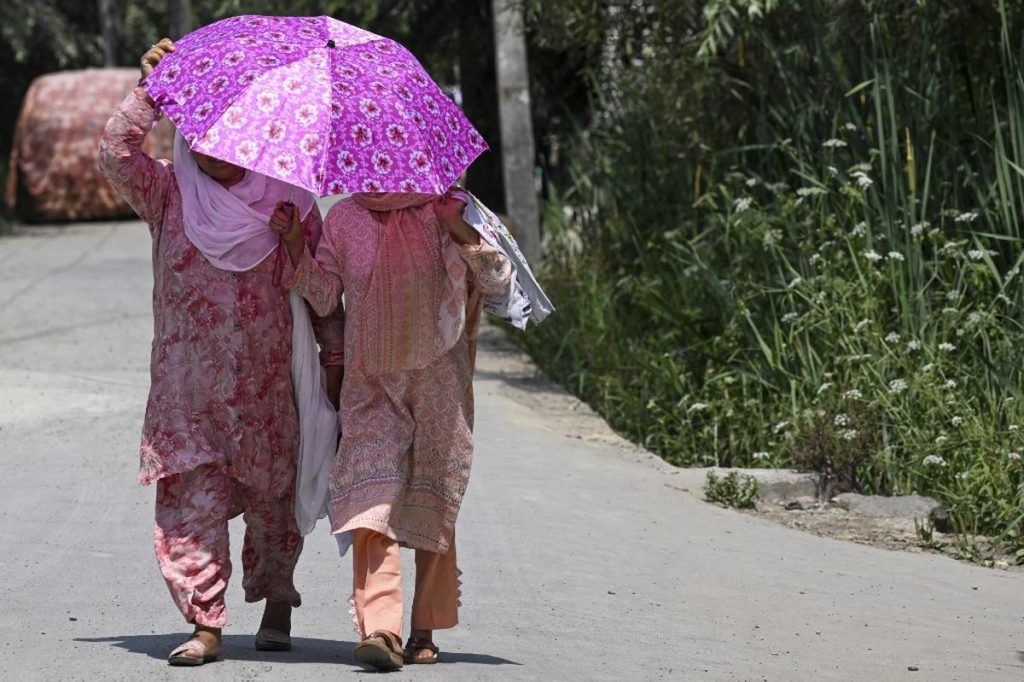
SRINAGAR: While temperatures in the Kashmir Valley continue to climb gradually, the Jammu region is facing an intense heatwave, with Samba district recording a season-high of 44 degrees Celsius on Sunday.
According to the India Meteorological Department (IMD), dry and hot weather is likely to persist across Jammu and Kashmir over the next five days. A brief spell of wind and thundershowers is expected in parts of Jammu on the evening of June 9, offering some short-lived relief.
In the Valley, Srinagar recorded a maximum temperature of 31.9°C on Sunday—around four degrees above normal. Tourist destinations like Gulmarg and Pahalgam remained cooler, registering 22.2°C and 27.8°C, respectively. Kokernag touched 30.9°C.
However, the heat has been much more severe in the Jammu division. Jammu city recorded 42.7°C on Sunday, up from 40.2°C a day earlier. Samba was the hottest district, with temperatures peaking at nearly 44°C. Reasi followed with 38.5°C, Katra with 38.2°C, and Rajouri at 35.9°C.
Other districts in the region also saw high temperatures: Bhaderwah, Banihal, and Batote hovered around 31–32°C, while Kishtwar recorded 30.9°C and Poonch reached 35.4°C.
This ongoing heatwave is the most intense of the season so far in the Jammu region. Weather officials warn that temperatures are expected to rise further in the coming days.
Meanwhile, the monsoon is reportedly progressing faster than usual. It is likely to reach Jammu and Kashmir by the third week of June, with pre-monsoon showers expected around June 20–21 in parts of Jammu, according to the agricultural meteorological outlook.
Wife Sonam among four held, cops say she ‘hired killers’ to ‘murder’ Raja Raghuvanshi
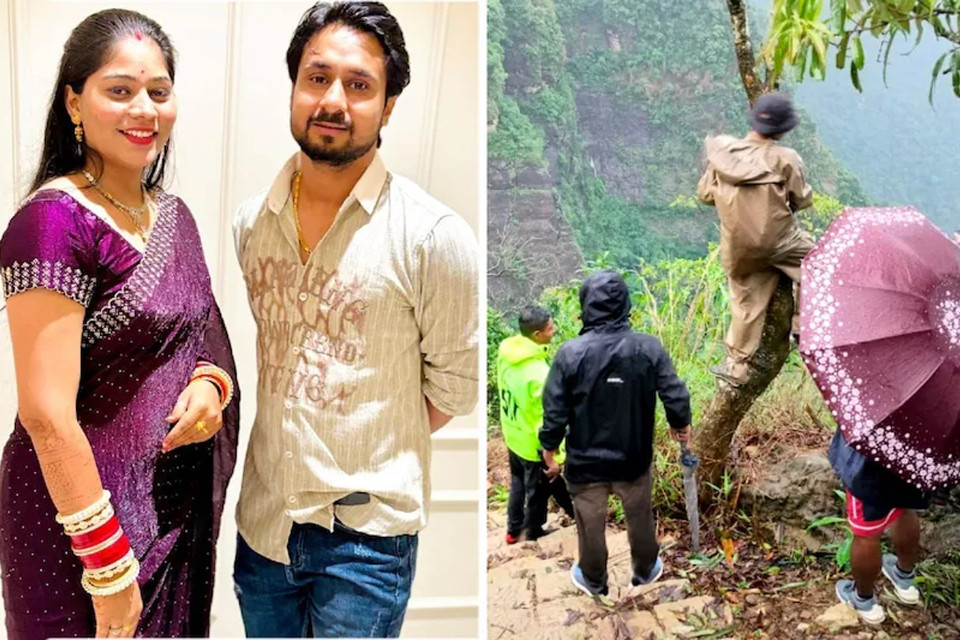
New Delhi, June 9- Sonam Raghuvanshi has been arrested, for alleged murder of husband Raja Raghuvanshi, an Indore resident whose decomposed body was found in a gorge of Weisawdong falls last Monday.
Meghalaya director general of police (DGP) I Nongrang said on Monday that Raja was “ killed by assailants hired by wife Sonam” who “surrendered to police in Ghazipur, Uttar Pradesh.” while three other accused were arrested during overnight operations.
On their honeymoon in Meghalaya, Raja and Sonam had “disappeared” on May 23.
The shocking turn of events has provided some relief Meghalaya—the northeastern state reeling under the high per capita crime rate and concerns over safety and security of tourists.
With a crime rate of 5.1 per capita, higher than Delhi’s 5.0 according to the NCRB’s 2024 data, Meghalaya is often flagged for safety concerns, particularly in certain tribal regions.
Rising crime incidents despite a small population base had added it to the dubious list of 10 Indian states with the highest per capita crime rates.
The murder of Raja Raghuvanshi was being seen as a reflection on not just the prevailing crime situation in Meghalaya but the entire northeast.
Earlier, Raja’s family had voiced suspicion on some locals, but the police said all locals had been questioned and there was no possibility of their involvement.
Nongrang said the arrested men confessed that they had been hired by Raja’s wife to carry out the murder and the operation is still continuing in Madhya Pradesh to apprehend others involved in the crime. Chief minister Conrad K Sangma congratulated the police for cracking the case that shocked the state and the nation.
Police said Raja was hacked to death with a ‘dao’ (machete).
Sonam’s arrest has provided the society with yet another shocker about relationships and the limits of criminal minds.
Several shocking crimes involving married and unmarried couples have been reported in the past few months.
Why late FM Arun Jaitley was trending on social media
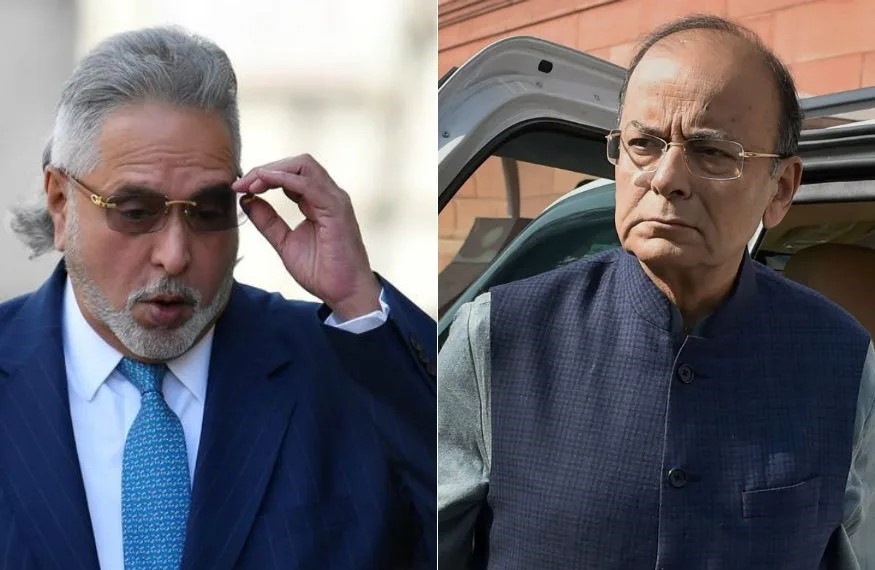
Recounting in a podcast that he informed the then Finance Minister Arun Jaitley before flying out of India to London in March 2016, fugitive liquor tycoon Vijay Mallya has given the Opposition one more opportunity to corner the ruling BJP and the Narendra Modi government in the upcoming Monsoon Session of Parliament.
When Mallya had told reporters outside a London court that was hearing arguments over his extradition to India in 2018 that he met Jaitley and “repeated my offer to settle with the banks”, the late Finance Minister rubbished the claims in a strongly worded social media post
Explaining in detail how Mallya as a member of Rajya Sabha uttered one sentence that “I am making an offer of settlement”, Jaitley wrote that the lone encounter did not last for more than a few minutes.
“Since 2014, I have never given him any appointment to meet me and the question of his having met me does not arise. However, since he was a Member of Rajya Sabha and he occasionally attended the House, he misused that privilege on one occasion while I was walking out of the House to go to my room,” Jaitley had said..
Mallya’s statement has now reignited the political debate around the issue, while giving a fresh lease of life to controversy on India’s runaway business tycoons who managed to flee despite being under investigation, the late BJP leader trend on the social media .
The Modi government has been under attack over businessmen involved in multimillion dollar scams—Nirav Modi, Mehul Choksi and Vijay Mallya—who managed to flee the country, allegedly because of failure of probe agencies to arrest them at the proper time.
Accused of embezzling funds from the state-owned Punjab National Bank, Choksi and nephew Nirav Modi fled India in January 2018 just days before details of the scandal broke.
Mallya claimed in the podcast with Raj Shamani that he was not aware of any action against him, being downgraded etc.
“I told FM Arun Jaitley before leaving for the airport and then I flew from Delhi to London on the way to Geneva for a meeting which was fixed months ago. I told the then finance minister because I went from Parliament to Delhi airport. When this news hit the media, once again, it created a storm.
“People went running to Mr Jaitley. He denied meeting me. A Congress MP saw us and then said to the media ‘No, I saw them together’. Mr Jaitley had to retract his statement and say ‘Yes, yes I met him but only while walking — it was a fleeting meeting,” Mallya was quoted as saying
Congress leaders were quick to take jibes at the saffron party and its government over the issue. “Foreign Minister attacks Pakistan by telling them. Bank fugitives flee the country after informing the Finance Minister. Narendra’s entire system turned out to be surrendered,” Congress leader Pawan Khera wrote on ‘X’
Jaitley, in 2016, had said: “ He (Mallya) paced up to catch up with me and while walking uttered a sentence that “I am making an offer of settlement”. Having been fully briefed about his earlier “bluff offers”, without allowing him to proceed with the conversation, I curtly told him “there was no point talking to me and he must make offers to his bankers.” I did not even receive the papers that he was holding in his hand.
“Besides this one sentence exchange where he misused his privilege as a Rajya Sabha Member, in order to further his commercial interest as a bank debtor, there is no question of my having ever given him an appointment to meet me,” Jaitley had said in his post.
All parties of the opposition collective—the INDIA bloc—do not appear to be on the same page regarding the demand for calling a special session of Parliament to discuss Operation Sindoor.
NCP(SP) Baramati MP Supriya Sule was quoted as saying that the Congress approached her to join the demand but she refused saying that it was a time to be united and not play “petty politics”.
Notably, Sule was a part of one of the all-party delegations sent abroad by the Narendra Modi government to put forward India’s stand on Operation Sindoor.
There is also a buzz of growing “closeness” between NCP patriarch Sharad Pawar and estranged nephew and NCP chief Ajit Pawar, who is a part of the BJP-led NDA in Maharashtra.
Meanwhile, the absence of the Arvind Kejriwal-led Aam Aadmi Party was also noted at a meeting organised earlier this week by Opposition parties on the issue. AAP did not want to be seen sharing the stage with the grand old party since it had positioned itself as a rival to it in key states like Punjab, Haryana, Delhi and Gujarat, it was said.
“If there was a crime, a culpable act shaking the foundations of democracy — the rule of law, why wasn’t it punished”.
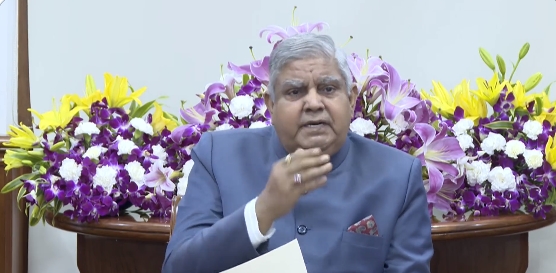
Amid reports of Centre introducing an impeachment motion against Allahabad High Court Judge Yashwant Varma in the upcoming Monsoon Session of Parliament, Vice-President Jagdeep Dhankhar today questioned that more than three months have been lost and “if there was a crime, a culpable act shaking the foundations of democracy — the rule of law, why wasn’t it punished”.
The decision to introduce the impeachment motion follows a Supreme Court-appointed inquiry panel’s appointed inquiry panel’s indictment of Justice Varma over allegations of unaccounted cash discovered at his official residence in Delhi after a fire on March 14, 2025.
“I have raised the issue. Ultimately, if a motion is brought to remove a judge, is that the answer? If there has been a crime, a culpable act shaking the foundations of democracy — the rule of law, why wasn’t it punished? We have lost more than three months, and the investigation has not even been initiated. Whenever you go to court, they ask why the FIR was delayed,” Dhankhar said, interacting with members of the Punjab and Haryana High Court Bar Association in Chandigarh today
Dhankar lamented that the government could not lodge an FIR because of a three-decade old judicial order.
“The Government of the day is handicapped. It can’t register an FIR. Because there is a judicial order. And that judicial order is more than three decades old. It provides virtually impregnable cover. Unless permission is accorded by a functionary at the highest level in the judiciary, an FIR can’t be registered. So I pose a question to myself, in deep pain, worried, concerned, in anguish — why was that permission not given? That was the minimum that could have been done on the earliest occasion,” he added.
“Does the committee of judges have a constitutional sanction? Does it have statutory sanction? Can this report result in any outcome? Can this report, by itself, be actionable? If a judge removal mechanism is there, the Constitution says this removal mechanism can be initiated either in the Lok Sabha or the Rajya Sabha. This is the only way.
“Then this committee cannot substitute for an FIR investigation. Now, the separation of powers. Penal thing has to follow it. If we have to lay claim on democracy, on the rule of law, equality before law, let me tell you — even the President of India and the Governors — they have immunity from prosecution only till they are in office. No other body has it. No other in the country, no other constitutional office has this immunity, and that too while in office. Now, how can we have a mechanism that such a crime — a culpable act — revealed from a document revealed by the Supreme Court, that there was a cash haul,” he also added.
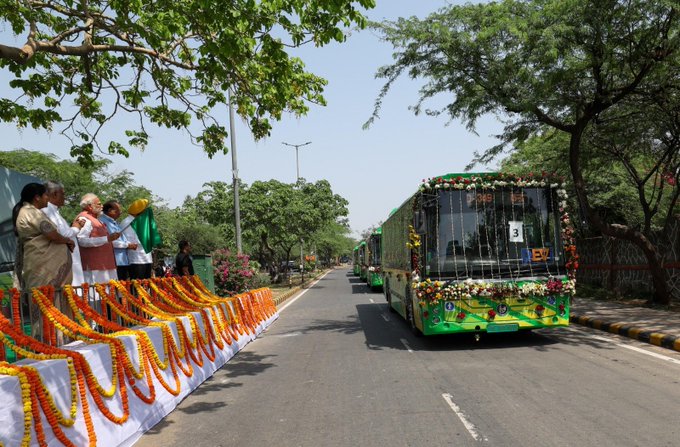
In order to combat air pollution in Delhi, Prime Minister Narendra Modi on Thursday flagged off 200 electric buses under an initiative of the Delhi Government aimed at boosting sustainable development and clean urban mobility.
The Prime Minister stated that the initiative will contribute to building a clean and green Delhi. He further noted that this step will also improve the ‘Ease of Living’ for the people of Delhi.
“Building a clean and green Delhi! Flagged off Electric Buses under an initiative of the Delhi Government aimed at boosting sustainable development and clean urban mobility. Additionally, this will also improve ‘Ease of Living’ for the people of Delhi,” he posted on X.
Meanwhile, taking to the X, Delhi Chief Minister Rekha Gupta said, “The honourable Prime Minister flagged off 200 Devi buses. These electric buses will provide clean transport facilities to the people of Delhi and will help in ridding the capital of pollution. Our government is working on a war footing to make Delhi clean, beautiful and prosperous.”
These buses are designed to navigate narrow, congested lanes of Delhi and connect interior neighbourhoods with major arterial roads.
Equipped with GPS tracking, CCTV cameras, panic buttons, voice announcements, and ramps for the differently abled, the buses aim to bring safer and more inclusive transit to underserved parts of the city.
On May 2, Delhi CM Rekha Gupta had flagged off around 400 DEVI buses alongside Union education minister Dharmendra Pradhan. At the launch event, she had said that the expansion of Delhi’s bus fleet with electric buses complements the city’s broader effort to reduce vehicular emissions, which account for nearly 45 per cent of its air pollution.
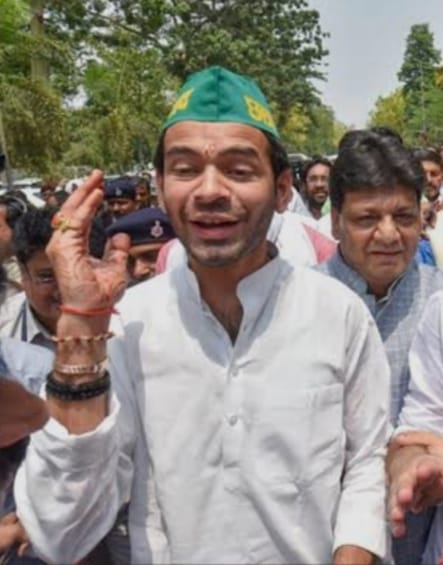
New Delhi,June 5- RJD supremo Lalu Prasad Yadav’s controversial elder son Tej Pratap Yadav is making the waves again.
After making public his 12-year-old love on social media (which he denied posting and after which he was expelled from the party and family) Tej Pratap shared another post early this morning, adding to the speculations around him.
Bihar’s former MoEFCC posted on ‘X’ a video of him going to the office, leading to questions if he was forming a new political party ahead of the upcoming Bihar elections. Sharing the video of him sitting behind a desk with a picture of parents—Bihar’s former chief ministers Lalu Yadav and Rabri Devi—on the wall, Tej Pratap wrote “All our dreams can come true; if we have the courage to pursue them”.
“All our dreams can come true; if we have the courage to pursue them. #TejPratapYadav #India #Bihar https://t.co/114CLGMZyd
A few days back he had also written messages to father Lalu Yadav and younger brother Tejashwi Yadav, asking them to be cautious while referring to a ‘Jaichand’.
Lalu Yadav expelled Tej Pratap from the party for six years a day after the post on his ‘X’ account proclaiming relationship with a woman named Anushka Yadav, breaking all ties citing “irresponsible conduct” and deviation from the family’s values and public decorum.
Engaged in a bitter divorce battle with his estranged wife Aishwarya Roy, Tej Pratap claimed his account had been hacked and deleted the post
However, the dramatic political developments in the family, and just before the crucial Bihar Assembly polls, led to speculations if Tej Pratap was forming a new party or alliance with some other party.
He formed many organisations when he was sidelined in the RJD.
Observers say Tej Pratap contesting as an Independent or in an alliance with some other party can pose a challenge for the RJD. If Tej Pratap contests as an Independent, RJD may be forced to not field its candidate or give the particular seat to an ally.
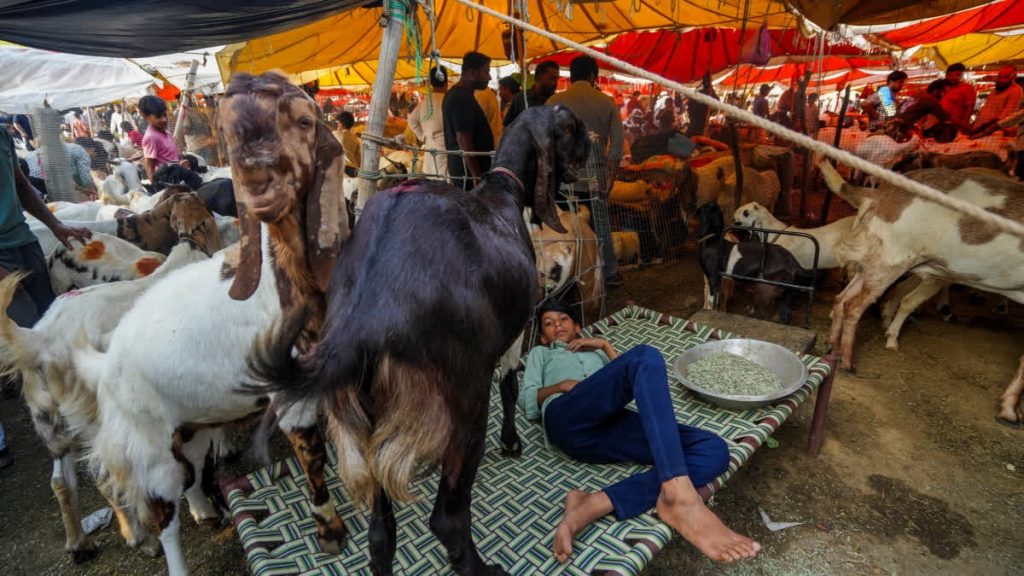
In order to stop illegal killing of animals during Bakra-eid festival, the Delhi government bans slaughtering of animals in unauthorized areas in the national capital.
The Delhi Development Department stated that it is feared that a lot of illegal animal markets and illegal slaughtering may come up in different parts of Delhi.
“No person shall slaughter any animal within a municipal area except in a slaughterhouse recognized or licensed by the concerned authority,” the advisory from Animal Husbandry Unit stated.
It further read that as per rule of Food Safety and Standards Regulations 2011, camels are not considered as food animals, they cannot be slaughtered for food purpose. “The Delhi Agricultural Cattle Preservation Act, 1994 strictly prohibits slaughtering of cows in Delhi,” it stated.
Meanwhile, the government also banned the recording and sharing of sacrificial rituals on social media during the festival, warning legal action against those found violating the norms.
The guidelines align with several existing laws, including the Prevention of Cruelty to Animals Act (1960), Transport of Animals Rules (1978), Slaughter House Rules (2001), and the Food Safety and Standards Act (2006).
The advisory also cites Rule 3 of the Slaughter House Rules, which bans the killing of pregnant animals, those with very young offspring, and animals not certified by a vet.
“All concerned authorities are requested to take suitable precautionary measures for enforcing laws relating to welfare of animals to stop illegal killing of animals during Bakra-eid festival and to take stringent action against the offenders violating the provision of prevention of cruelty to animals Act 1960, Transport of Animals Rules 1978 Slaughter House Rules (2001), and the Food Safety and Standards Act (2006),” it said.
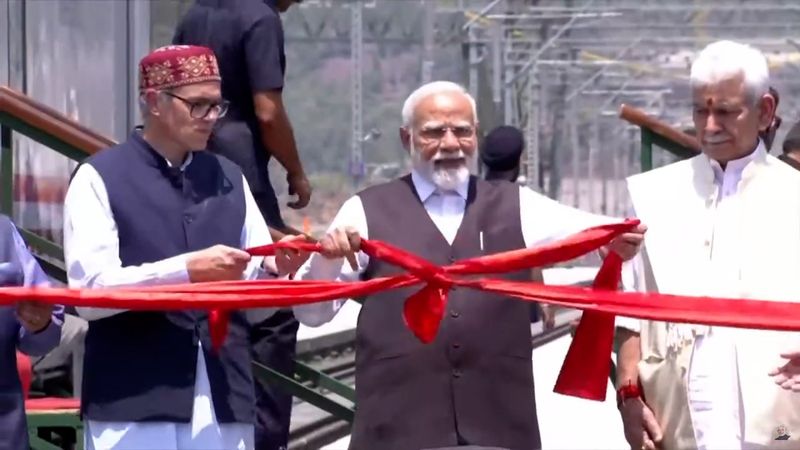
Srinagar: Prime Minister Narendra Modi on Friday inaugurated two landmark railway infrastructure projects in Jammu and Kashmir – the Chenab Rail Bridge and the Anji Cable-Stayed Bridge – describing them as key milestones in connecting the region with the rest of India.
Built over the Chenab River at a height of 359 metres, the Chenab bridge is the world’s highest railway bridge. The project was completed at a cost of Rs 1,486 crore over a period of more than eight years. The prime minister also flagged off the Anji bridge, India’s first cable-stayed rail bridge, built over the Anji river.
Modi arrived at the site in a train engine coach and later walked across the Chenab bridge carrying the Indian tricolour. Railway Minister Ashwini Vaishnaw, Jammu and Kashmir Lieutenant Governor Manoj Sinha, and former Chief Minister Omar Abdullah were also present at the ceremony.
Speaking at a public rally in Katra following the inauguration, Modi said the projects marked a major step forward in the region’s development and integration. “The phrase ‘from Kashmir to Kanyakumari’ is now a reality in our railway network too,” he said.
He described the Udhampur-Srinagar-Baramulla Rail Link (USBRL) as a symbol of a “new, empowered Jammu and Kashmir” and praised the connectivity boost that the Chenab and Anji bridges would provide to the region.
“Today, the dream of lakhs of people in Jammu and Kashmir has come true,” Modi said, crediting his government for completing the ambitious and challenging projects. “All the good work seems to be left for me to complete. Our government chooses to challenge the challenge itself.”
He also highlighted that the all-weather infrastructure being built in the Union Territory is helping transform the region’s economic prospects and quality of life.
The USBRL project is expected to significantly improve rail connectivity between Jammu and Srinagar, making travel easier and boosting economic opportunities across the region.