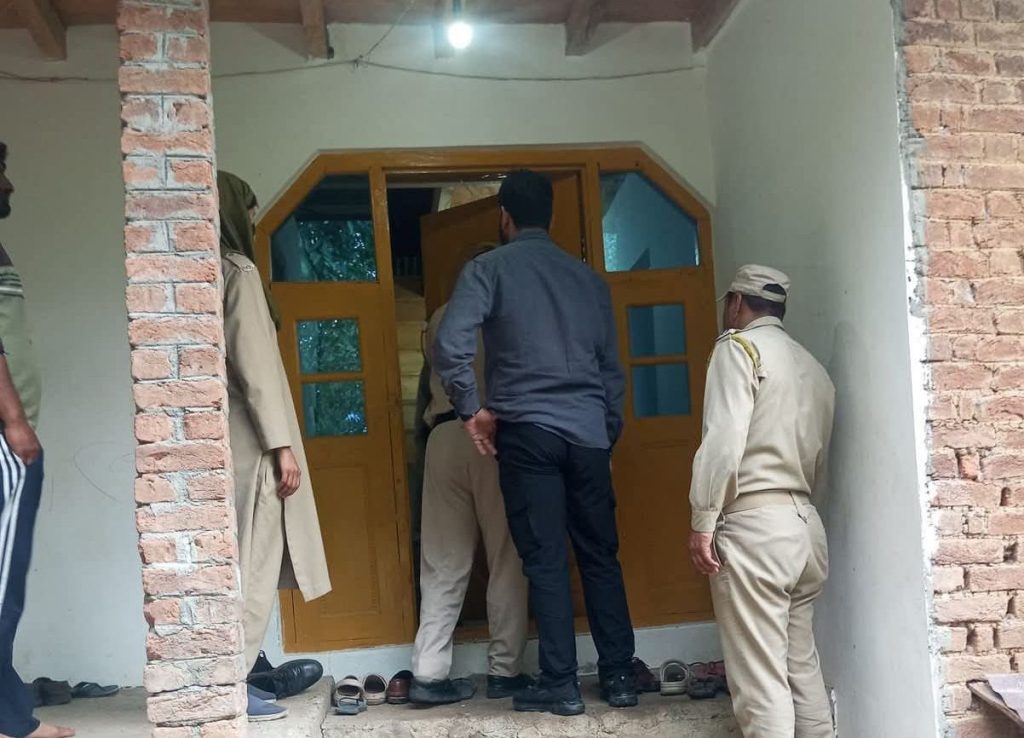
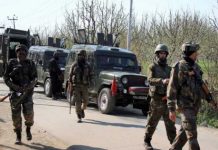
SRINAGAR- The Counter-Intelligence Kashmir (CIK) wing of the Jammu and Kashmir Police carried out raids at ten locations across the Valley on Saturday as part of a terror recruitment investigation.
Officials said the searches are linked to a case involving a terrorist sleeper cell allegedly being run by Jaish-e-Mohammad commander Abdullah Ghazi from across the border.
Raids were conducted at one location in Pulwama, six in Ganderbal, one in Srinagar, and two in Budgam district. The operation is currently underway.
Senior BJP leaders Rajnath Singh, Amit Shah, J P Nadda and Kiren Rijiju have also held a strategy session; Customary all-party meeting on Sunday
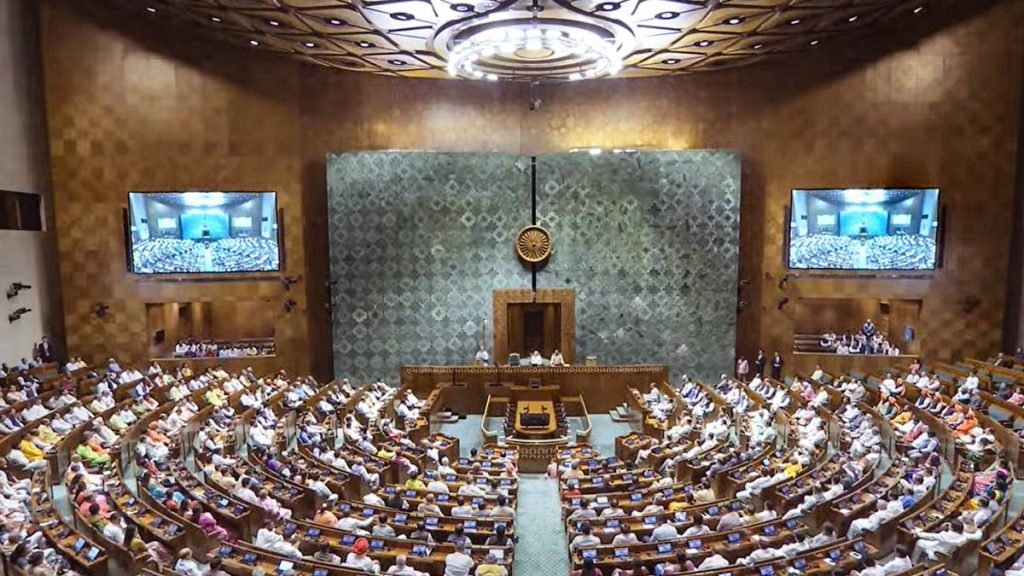
Parties of the opposition alliance INDIA are meeting online on Saturday to discuss issues for the upcoming Parliament Monsoon Session
The aim is to devise a strategy to corner the BJP-led NDA government.
However, the Aam Aadmi Party (AAP) is not expected at the meeting though the Trinamool Congress (TMC), which was earlier was said to be skipping the INDIA bloc meet, is attending
TMC national general secretary Abhishek Banerjee will be there in the online meeting.
INDIA bloc differences
AAP on Friday announced its exit from the saying that the bloc has “failed to stay united and take steps to further its agenda”.
Meanwhile, on the eve of the meeting, allies Congress and CPM also clashed over Lok Sabha Leader of Opposition Rahul Gandhi’s remarks that he is “fighting the CPI(M) ideologically”.
At a public meeting in Kerala’s Kottayam, Gandhi was quoted as saying: “I fight the RSS and Communist Party of India (Marxist) ideologically and I fight them in the realm of ideas… My biggest complaint with them is that they don’t have feelings for people. You can give whatever speeches, if you do not have feelings for people, you are not ready to connect and hug people, you will not be a leader.”
The CPI(M) called his statements “absurd”
“In his absurd and condemnable comment equating the RSS and the CPI(M), Rahul Gandhi forgets who is fighting the RSS in Kerala—the CPI(M), which has lost countless dedicated workers in resisting saffron terror. Meanwhile, in Kerala, the Congress and the RSS continue to echo each other in expressing anti-communist sentiments. As soon as he steps into Kerala, Rahul Gandhi speaks that language too,” it said in a statement.
Stormy Monsoon session
Opposition Congress is all set to question the BJP-led NDA Government on issues like the whereabouts of the Pahalgam terrorists who killed 26 persons (and are still untraceable), claims made by US President Donald Trump regarding mediating ceasefire between India & Pakistan, and “electoral manipulations in Maharashtra, Haryana, and now in Bihar.”
The leaders are expected to discuss key issues, including the Election Commission’s Special Intensive Revision (SIR) of the electoral rolls in Bihar, the demand for a discussion on the Pahalgam attack, and Operation Sindoor.
Congress leader Jairam Ramesh said all the prominent leaders of the bloc will attend the Saturday meeting.
The opposition is expected to demand discussions on the recent Air India crash and the preliminary AAIB report.
Overall, an intense showdown is expected between the government and the opposition in the Monsoon session that begins July 21.
Ruling party meeting
Senior BJP leaders, including Rajnath Singh, Amit Shah, J P Nadda and Kiren Rijiju also held a strategy session on Thursday amid the Opposition raising heat on a host of issues,
The Group of Ministers is believed to have strategized the government’s stance over issues like the SIR of the electoral rolls in Bihar, the Pahalgam attack and Operation Sindoor.
Piyush Goyal and G Kishan Reddy were among those who were part of the strategy session.
The customary all-party meeting will be held on Sunday.
Largely believed to be associated with “right-leaning news coverage,” Murdoch’s media companies have been occasionally criticised by Trump’s supporters for “right-wing bias and misleading coverage to support his own business interests”
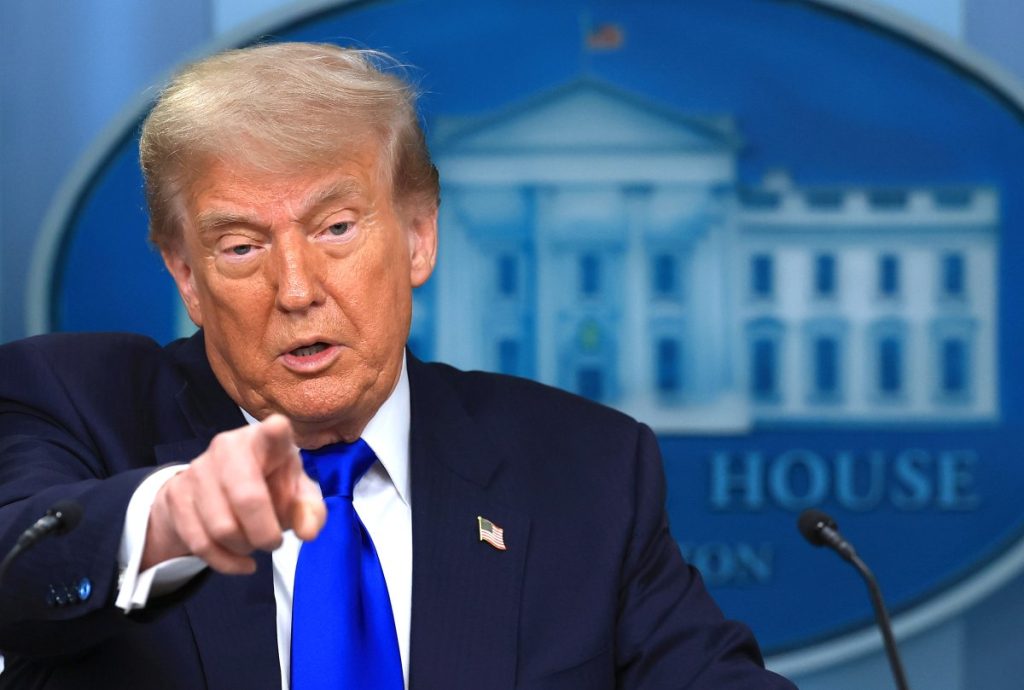
US President Donald Trump is seeking $10 billion in damages in a lawsuit against the Wall Street Journal, its parent company, owner Rupert Murdoch and two reporters claiming “libel” and “slander” for publishing an article alleging that he wrote a lewd letter to Jeffrey Epstein for his 50th birthday. Trump is accusing Dow Jones & Company, Murduch, News Corporation Chief Executive Robert Thomson and reporters Khadeeja Safdar and Joseph Palazzolo of “defamation” and causing him “overwhelming” financial and reputational harm.
Trump confirmed the lawsuit, saying he had sued WSJ for publishing “FAKE NEWS”.
“We have just filed a POWERHOUSE Lawsuit against everyone involved in publishing the false, malicious, defamatory, FAKE NEWS ‘article’ in the useless ‘rag’ that is, The Wall Street Journal,” he said on his social media Truth Social.
“I hope Rupert and his ‘friends’ are looking forward to the many hours of depositions and testimonies they will have to provide in this case,” Trump said
Who is Murdoch
Often in news for personal relationships, Murdoch is in headlines again.
The Australian-American business magnate, investor, and media mogul, is known for creating one of the largest media empires in the world.
Murdoch’s company News Corp owns hundreds of local, national, and international publishing outlets around the world. Apart from WSJ, they include some of the top news channels and media houses like Fox News, Sky News Australia, New York Post and The Sun
Largely believed to be associated with “right-leaning news coverage,” Murdoch’s media companies have been occasionally criticised by Trump’s supporters for “right-wing bias and misleading coverage to support his own business interests”
This is not the first time Trump has had issues with Murdoch.
However, the Jefferey Epstein case comes at a time when the new US President is facing a whole lot of criticism over policy matters.
Interestingly, Murdoch supported Trump and his party through the news coverage broadcast in his media empire, including on Fox News.
The controversy
The WSJ report claims that Trump allegedly sent a sexually explicit birthday note to convicted sex offender Jeffrey Epstein in 2003.
Basically, the WSJ reviewed the leather-bound album put together for Jeffrey Epstein’s 50th birthday, as part of which is this alleged letter by Trump featuring the drawing of a naked woman, thereby putting its contents under renewed scrutiny amid recent US justice Department investigations into Jeffery Epstein and Ghislaine Maxwell, who were convicted for operating a decades-long sex trafficking ring that exploited underage girls through manipulation, abuse, and a network of powerful connections.
Who is Jeffery Epstein
Jeffrey Epstein is a disgraced financier and convicted sex offender.
The “Epstein files” refer to thousands of documents, videos and investigative materials gathered over the years in connection with Epstein and his associates.
Many documents are still sealed or heavily redacted.
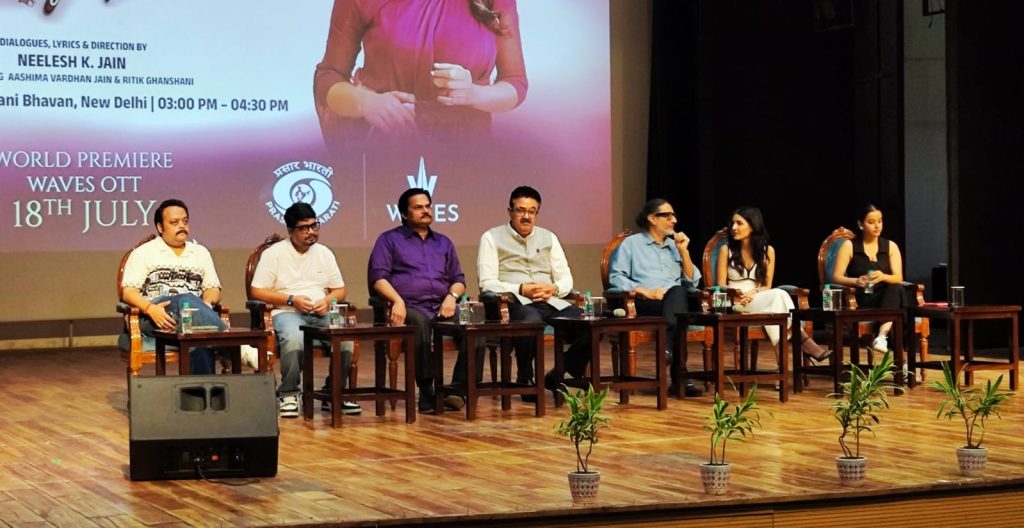
Prasar Bharati’s digital platform WAVES OTT hosted the grand premiere of its latest original feature film, Della Bella: Badlegi Kahaani, at Rang Bhawan, Akashvani Bhawan in New Delhi on Friday.
The exclusive event featured a press conference and was graced by Navneet Kumar Sehgal, Chairman, Prasar Bharati, and the film’s acclaimed director and ad filmmaker, Neelesh K. Jain.
The movie is a visually poetic Hindi film that explores themes of love, identity, and self-realization. It follows a woman’s journey to reclaim her voice and individuality—reflecting the evolving social and cultural ethos of modern India.
The film will stream exclusively on WAVES OTT starting July 18, with a scheduled telecast on DD National, reaffirming the public broadcaster’s commitment to accessible, impactful storytelling for all.
Navneet Kumar Sehgal, Chairman, Prasar Bharati, said, “WAVES 077 is India’s only public service streaming platform that blends legacy with digital innovation. Alongside original films like ‘Della Bella’, the platform offers a rich collection of documentaries, radio shows, regional cinema, classic DD archives, and live TV and radio channels—making it a truly inclusive and multilingual experience. Our mission is to create a trusted, family-first platform that celebrates India’s diversity and creativity. ‘Della Bella’ beautifully exemplifies that vision.”
Director Neelesh Jain added, “The soul of Waves OTT and the character of the movie are same as both are the story of changing world. I have come up with Simple Cinema in this changing world of Cinema, for which I was inspired by people who make reels.”
There are various theories doing the round for Gandhi’s strong public defence of Robert Vadra, the husband of his sister, Congress MP Priyanka Gandhi Vadra
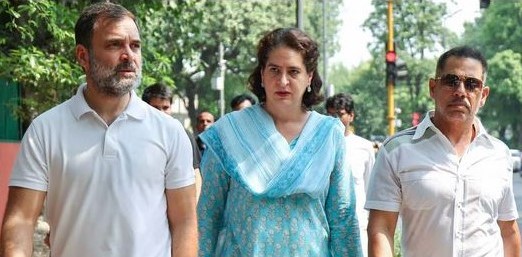
Perhaps for the first time ever, Leader of Opposition in Lok Sabha Rahul Gandhi on Friday publicly came out in strong defence of Robert Vadra saying that his brother-in-law and his family were being “hounded” by the Narendra Modi government for over 10 years but “they are all brave enough to withstand any kind of persecution.”
Describing the chargesheet by the Enforcement Directorate in a money laundering case against Vadra a “witch-hunt”, Gandhi said he stands with “Robert, Priyanka (his sister) and their children” as they face “yet another onslaught of malicious, politically motivated slander and harassment.”
“My brother-in-law has been hounded by this government for the last ten years. This latest chargesheet is a continuation of that witch hunt.
“I stand with Robert, Priyanka and their children as they face yet another onslaught of malicious, politically motivated slander and harassment.
“I know that they are all brave enough to withstand any kind of persecution and they will continue to do so with dignity.
“The truth will eventually prevail,” he wrote on X
The ED on Thursday filed a chargesheet against Vadra in connection with a money laundering case.
The probe agency also attached 43 immovable properties worth Rs 37.64 crore linked to the businessman and his entities.
The prosecution complaint also listed names of 10 other other individuals and firms linked to a land deal case.
The chargesheet was filed before a Delhi court under the provisions of the Prevention of Money Laundering Act..
Vadra, who is the husband of Congress MP Priyanka Gandhi Vadra, has repeatedly denied any wrongdoing, calling the case against him a “political vendetta” against him and his family.
Earlier this year, Vadra called the ED investigation a “political vendetta’, claiming that attempts had been made to silence him and his brother-in-law and Congress leader Rahul Gandhi.
Rahul Gandhi’s strong defence of his sister’s husband suprised many considering that the case has been going on for long.and and there are various theories doing the rounds why he has done so
One is that perhaps this is the first time any probe agency has filed a prosecution complaint naming Vadra in a criminal case.
Another is that sister Priyanka is a Congress MP and the ruling BJP is expected to raise the Vadra issue in the Parliament to counter Congress’ strategy to corner the Narendra Modi government on various issues in the upcoming Monsoon Session of Parliament.
The Congress and other opposition parties are all set to question the BJP-led NDA Government on tricky issues like the whereabouts of the Pahalgam terrorists who killed 26 persons (and are still untraceable), claims made by US President Donald Trump regarding mediating ceasefire between India & Pakistan, and “electoral manipulations in Maharashtra, Haryana, and now in Bihar.”
The role of the Election Commission before the upcoming elections in Bihar is also expected to be raised during the session, it is said.
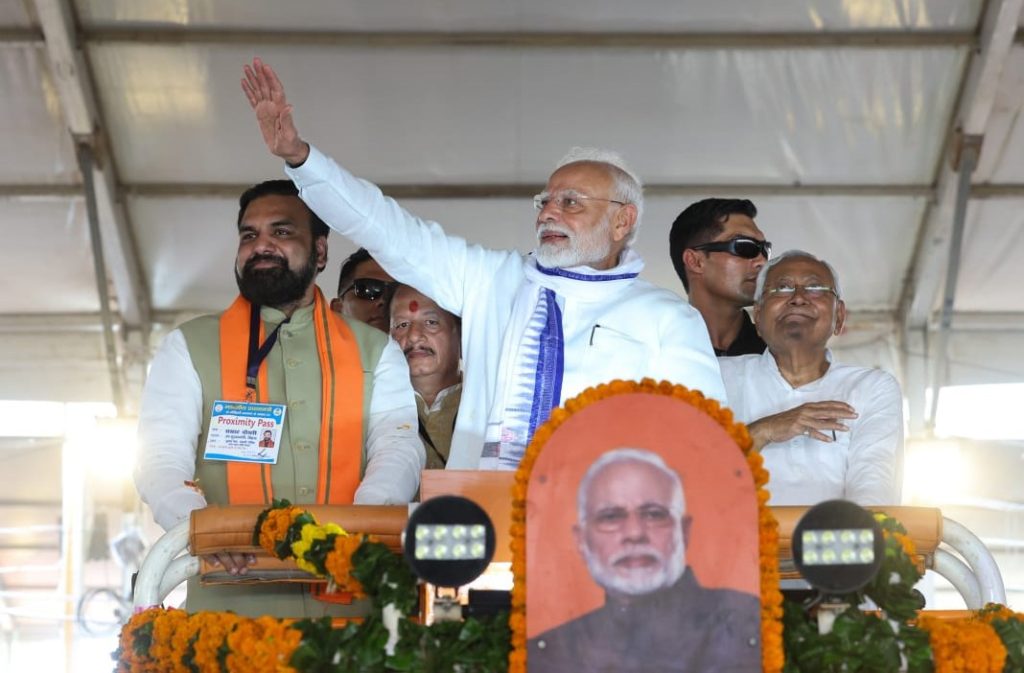
Prime Minister Narendra Modi on Friday laid the foundation stone, inaugurated and dedicated to the nation development projects worth over Rs 7,000 crore in Motihari, Bihar.
Modi remarked that the 21st century is witnessing rapid global progress, noting that the dominance once held solely by Western nations is now increasingly shared by Eastern countries, whose participation and influence are growing.
He emphasized that Eastern nations are now gaining new momentum in development. Drawing a parallel, the Prime Minister stated that just as Eastern countries are advancing globally, in India, it is the era of the eastern states.
“The government’s resolve to ensure that, in the coming times, Motihari in the East becomes as prominent as Mumbai in the West,” he said.
He envisioned equal opportunities in Gaya as in Gurugram, industrial growth in Patna akin to Pune, and development in Santhal Pargana comparable to Surat.
“To advance Eastern India, Bihar must be transformed into a developed state”, emphasised Modi, stating that rapid progress in Bihar is possible today because both the Centre and the State have governments committed to Bihar’s development.
Underscoring the importance of today’s generation in understanding the despair Bihar faced two decades ago, Modi stated that under the rule of previous governments, development was stalled and it was nearly impossible for funds meant for the poor to reach them.
He criticized the then leadership for being focused solely on looting money meant for the poor.
Modi also highlighted that over the past 11 years, more than 4 crore houses have been built under the PM Awas Yojana across the country, with nearly 60 lakh constructed in Bihar alone. He noted that this figure surpasses the total population of countries like Norway, New Zealand, and Singapore.
“In Motihari district alone, around 3 lakh families have received pucca houses, and the count continues to grow rapidly. Over 12,000 families in the region have received the keys to their new homes today”, Modi said.
Additionally, more than 40,000 poor families have received funds in their bank accounts to build pucca houses, with the majority belonging to Dalit, Mahadalit, and backward communities.
Meanwhile, he dedicated to the nation multiple rail projects, including automatic signalling between Samastipur-Bachhwara rail line that will enable efficient train operations in this section. Doubling of Darbhanga-Thalwara and Samastipur-Rambhadrapur rail line part of Darbhanga-Samastipur doubling project worth over Rs 580 crore that will enhance the capacity of train operations and reduce delays.
Local bodies and Marathi compulsions or is Fadnavis trying to “cut down to size” his deputy Eknath Shinde
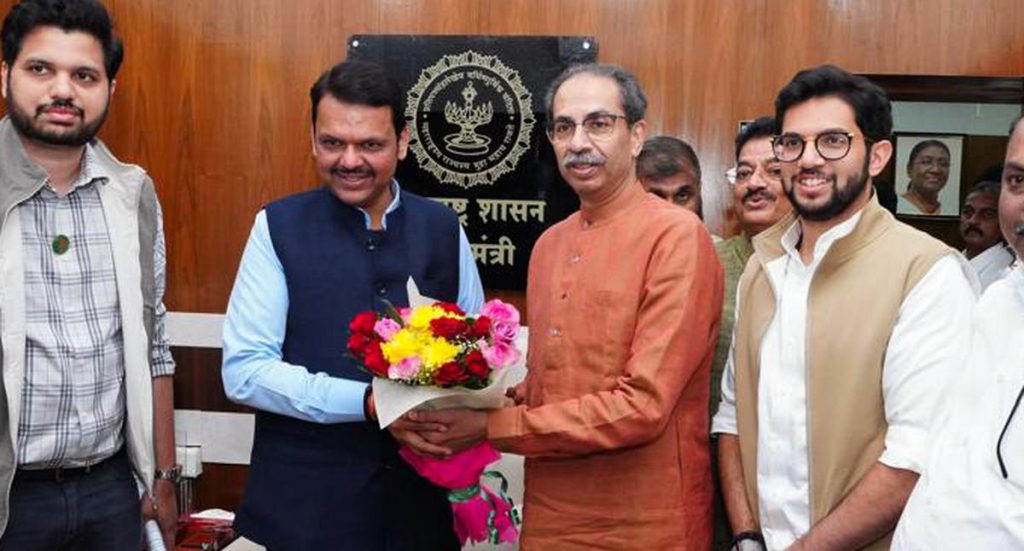
The Thursday meeting between friends-turned-foes Uddhav Thackeray and Chief Minister Devendra Fadnavis has generated a lot of speculation and buzz in the corridors of Maharashtra politics.
The given reason was that it was about the post of the Leader of the Opposition in the state assembly. However, coming a day after Fadnavis’’s “join us” comment, which Uddhav Thackeray dismissed as a “joke” it created a whole lot of buzz.
The 20-minute meeting was in the ante-chamber of Vidhan Parishad Chairman Ram Shinde at Vidhan Bhavan. According to reports, Uddhav demanded that the Speaker should allow the post of the Leader of Opposition, for which the name of Bhaskar Jadhav was recommended in the last session. Jadhav has the consensus of the Opposition Maha Vikas Aghadi but Speaker Rahul Narvekar has not taken any decision in this regard.
Fadnavis angle
MNS supremo Raj Thackeray and estranged cousin Uddhav Thackeray (Shiv Sena UBT) recently reunited after 20 years at a public rally in Worli, Mumbai, for an event called ‘Awaj Marathicha’—the Voice of the Marathi. Politics is all about optics, in those terms the rally was a success.
There are various theories over who scripted the reunion, of which one is that CM Fadnavis arranged it to “cut down to size Shinde”. Leaders from the ruling Mahayuti and opposition Congress-NCP(SP) also pointed to closed-door meetings between Fadnavis and Raj to buttress that claim.
Then on Wednesday, Fadnavis’s offer to Uddhav at an official ceremony, inviting him to join the ruling side was another incident that added fuel to the fire. The remark came during the farewell ceremony of Ambadas Danve, the Leader of Opposition and a member of Thackeray’s faction of the Shiv Sena.
“Look Uddhav-ji, there is no scope of (our) going there (in the opposition) till 2029 But if you want to come over here, then consider it…it depends on you it can be considered,” he said amid peals of laughter from his side
“Let it go. Some things should be taken on a lighter note,” said Uddhav when reporters asked his comments on Fadnavis’s offer. Adding to the already growing buzz is a video of Fadnavis and Thackeray greeting each other cordially ahead of the session, with both leaders shaking hands and exchanging smiles.
Cutting Shinde to size
The ruling NDA comprises the BJP and two breakaway factions—Eknath Shinde-led Shiv Sena, and Ajit Pawar’s NCP—who walked away with the name and symbols of their respective parties after bringing down the Uddhav-led Maha Vikas Agahadi government
Ahead of the BMC elections, Marathi language has become a big issue, so much so that Maharashtra transport minister Pratap Sarnaik had to criticise his own government over the denial of permission for a Marathi rally on Mira Road and joined the protest. It is another matter that Sarnaik was forcefully driven away by the agitated Thackeray loyalists, calling him a “traitor”.
The event was jointly organised by Shiv Sena (UBT) and MNS to mark the withdrawal of government resolutions related to the three-language policy in primary schools—an issue that is said to be giving jitters to the ruling BJP-Shiv Sena-NCP Mahayuti as also Uddhav’s supporter Congress.
Language an emotive issue
Language is often a strong marker of identity and any perceived threat can trigger strong emotional responses, thereby making it a great political tool
After Tamil and Kannada, Marathi is at the centre-stage, one of the reasons is the upcoming local bodies elections
JD Vance calls the story “complete and utter bullshit”
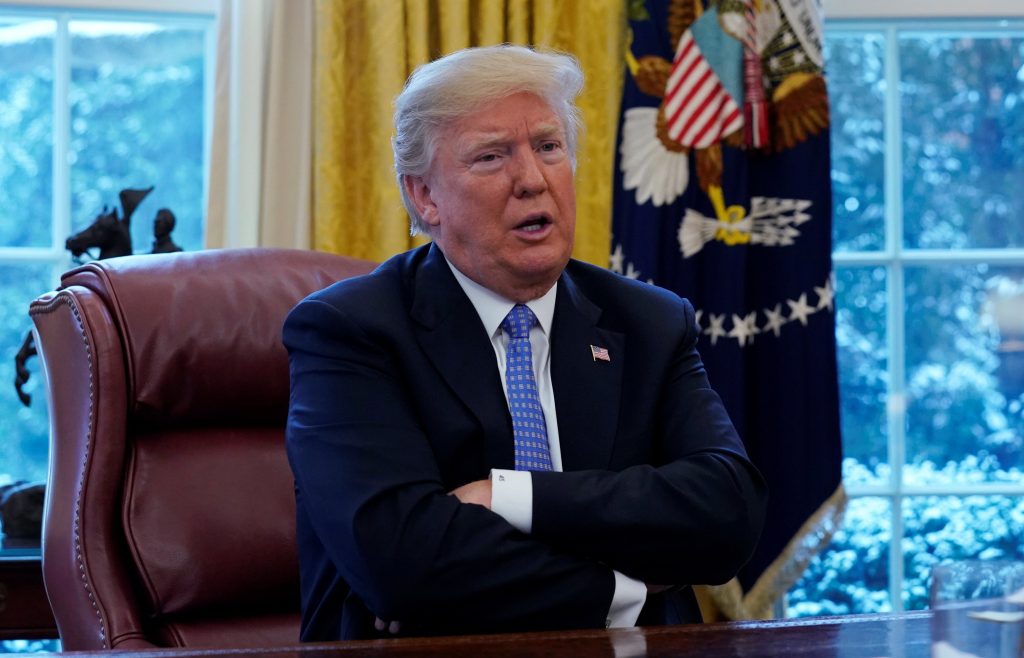
US President Donald Trump has threatened legal action against The Wall Street Journal (WSJ) over its report claiming he allegedly sent a sexually explicit birthday note to convicted sex offender Jeffrey Epstein in 2003.
In a Truth Social post, Trump slammed the report, calling it “fake news” and threatened to sue the WSJ, NewsCorp and Murdoch “shortly.”
“The Wall Street Journal, and Rupert Murdoch, personally, were warned directly by President Donald J. Trump that the supposed letter they printed by President Trump to Epstein was a FAKE and, if they print it, they will be sued.
“Mr. Murdoch stated that he would take care of it but, obviously, did not have the power to do so. The Editor of The Wall Street Journal, Emma Tucker, was told directly by Karoline Leavitt, and by President Trump, that the letter was a FAKE, but Emma Tucker didn’t want to hear that. Instead, they are going with a false, malicious, and defamatory story anyway,” he wrote
The WSJ has reviewed the book put together for Jeffrey Epstein’s 50th birthday, as part of which is this alleged letter submitted by Trump. “Trump’s letter features a drawing of a naked woman and this text which imagines a conversation between Trump and Epstein,” according to a post by Yashar Ali, an Iranian-American journalist who has contributed to HuffPost, NBC News, and New York magazine
Responding to Ali’s post, US Vice President JD Vance called the story “complete and utter bullshit”
“Forgive my language but this story is complete and utter bullshit. The WSJ should be ashamed for publishing it. Where is this letter? Would you be shocked to learn they never showed it to us before publishing it? Does anyone honestly believe this sounds like Donald Trump?
“Doesn’t it violate some rule of journalistic ethics to publish a letter like this without showing it to the victim of this hit piece? Will the people who have bought into every hoax against President Trump show an ounce of skepticism before buying into this bizarre story?” Vance wrote on X
The controversy
The leather-bound birthday album was created for Jeffrey Epstein’s 50th birthday in 2003.
It resurfaced in public discussion after the Journal claimed it reviewed a copy that included the letter attributed to Trump.
Reportedly organised by Ghislaine Maxwell, the album featured personal messages from several of Epstein’s prominent associates.
The contents of the album are under renewed scrutiny amid recent US justice Department investigations into Epstein and Maxwell, who were convicted for operating a decades-long sex trafficking ring that exploited underage girls through manipulation, abuse, and a network of powerful connections.
According to the report, Trump tried to contact the editor-in-chief of the WSJ to get the story killed.
The story dropped on Thursday afternoon
Who is Jeffery Epstein
Jeffrey Epstein is a disgraced financier and convicted sex offender.
The “Epstein files” refer to thousands of documents, videos and investigative materials gathered over the years in connection with Epstein and his associates.
Many documents are still sealed or heavily redacted.
“This is not the time to create public anxiety or angst towards the safety of the Indian aviation industry, particularly based on unfounded facts”—AAIB DG Yugandhar
India’s Aircraft Accident Investigation Bureau (AAIB) which left many questions answered in its preliminary report on the unfortunate June-12 Air India 171 crash on Thursday was compelled to issue a scathing, unambiguous statement slamming the US media reports for it “selective and unverified reporting” blaming the senior captain.
The constant media reports in the west pointing fingers at Captain Sumeet Sabharwal on basis of some information from US authorities, saw AAIB slamming “irresponsible” drawing of “conclusions” through such reports
Speculation in sections of the foreign media regarding the cause of the crash is “unfounded” and “premature”, AAIB Director General GVG Yugandhar said in his first public statement since the crash of Boeing 787-8 aircraft (registration VT-ANB), which killed 241 of the 242 people on board. “It has come to our attention that certain sections of the international media are repeatedly attempting to draw conclusions through selective and unverified reporting. Such actions are irresponsible, especially while the investigation remains ongoing,” he said.
Titled ‘Appeal’, the statement followed The Wall Street Journal (WSJ) report claiming that Sabharwal turned off fuel switches moments before the crash, which leading to anger
The WSJ report said the US assessment was based on black box data and speculated on whether Sabharwal’s actions were deliberate or accidental. It added that such details could lead US authorities to examine potential criminal liability had the crash occurred on American soil. Yugandhar also urged people and media to refrain from spreading premature narratives that risk undermining the integrity of the investigative procedure
“It is essential to respect the sensitivity of the loss faced by family members of deceased passengers, crew of the aircraft, and other deceased persons on the ground,” he also wrote.
According to the Wall Street Journal, the cockpit recording of the last conversation between the two pilots indicated that the Captain cut off the fuel to the plane’s engine. It says that the first officer flying the Boeing 787 Dreamliner asked the more-experienced Captain why he moved the switches to the “cutoff” position shortly after the flight took off from the runway. The First Officer (late Clive Kunder) then expressed panic while Captain remained calm, as per the report
According to the report posted on AAIB website, “In the cockpit voice recording, one of the pilots is heard asking the other why did he cutoff. The other pilot responded that he did not do so.”
On Thursday Indian’ pilots associations, including the Indian Commercial Pilots Association (ICPA) and the Airline Pilots’ Association of India (ALPA India), which did not support AAIB’s this statement also, went all out against the US media report saying there was no reason to support the claims that Captain Sabharwal may have been under stress.
Notably, the AAIB report did not rule out technical faults and stated that aviation medicine and psychology experts were involved in the ongoing investigation.
What AAIB DG also said-
In Thursday’s statement, the AAIB DG also underscored its “flawless record” and said its final probe on the crash will come out with “root causes and recommendations”.
Noting that the AAIB has investigated 92 accidents and 111 serious incidents since its inception in 2012, he called the AI171 crash “the most devastating accident in recent aviation history”. It had “understandably drawn public attention and shock”, but this was not the time “to create public anxiety or angst towards the safety of the Indian aviation industry, particularly based on unfounded facts,” he said
“The purpose of the AAIB’s investigation and preliminary report is to provide information about what happened. At this stage, it is too early to reach any definite conclusions,” Yugandhar said.
The AAIB was investigating the crash “rigorously and most professionally” under the Aircraft (Investigation of Accidents and Incidents) Rules, 2017, which govern India’s obligations under international aviation protocols, notably the International Civil Aviation Organization’s Annex 13. These rules lay down procedures for impartial, non-criminal investigations focused on safety improvement rather than blame, he said
He also appealed to “all concerned to await publication of the final investigation report after completion of the investigation. AAIB will also publish updates as and when required, which have technical and public interest.”
Cloudbursts, landslides and floods—2025 is turning grim for India’s hills and plains alike. As extreme weather surges, failing infrastructure and weak safeguards show how unprepared the country remains in facing climate change and unchecked development. A report by Vibha Sharma
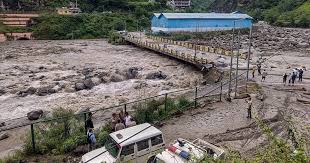
Climatically, 2025 is proving to be yet another challenging year for India, particularly for its mountains and hills, whether in north or eastern parts of the country. Multiple incidents of devastating landslides, cloudbursts, deaths and destruction, were reported from hills in the first month of the annual June-September Southwest Monsoon itself.
And the devastation is not restricted only to the hills.
On July 9, Gambhira Bridge on Mahisagar river collapsed in Gujarat. Whatever was the reason—structural/engineering fault; poor maintenance or material; climate change-induced excessive rains; or corruption—failures at dam sites, sinking of highways and collapse of bridges are all a grim reminder that infrastructure designed a few decades ago is no longer adequate in the challenge of climate change.
Engineering fixes from the era of predictable weather are no longer viable for new weather shifts.
In 2024, as many as 12 bridges collapsed in Bihar over two weeks. “Companies with poor records are awarded new tenders thanks to their political and bureaucratic links. Contractors themselves say the system leaves little room for quality construction,” say those familiar with the working of government departments
Climate change is another reality jeopardising the lives of common Indians.
The big question is: can planners and administration use it as an excuse for India’s crumbling infrastructure?
Frequent natural disasters
Constituting a substantial part of its annual rainfall, replenishing reservoirs, groundwater and two-third of the country’s agricultural tracks, monsoons are the lifeline of the Indian economy.
Bringing as much joy and cheer to the economy as to the common man, every year India eagerly awaits the seasonal rains to arrive to beat the scorching dry heat of April-May-June.
But with climate change, the gaps between seasons are blurring.
Himachal Pradesh reported multiple flash floods, cloudbursts and landslides, leaving many dead and devastated in June-end and beginning of July.
Fact is seasons can no longer be boxed in neat month-wise time zones, heavy rains/cloud bursts can happen anywhere, anytime. Every year the frequency of these “natural calamities” is increasing and are only expected to increase more rapidly in future.
Since the monsoon arrived this year, Assam, Manipur and Mizoram, Himachal Pradesh and Uttarakhand have been badly hit.
After an early onset over Kerala on May 24, the earliest arrival since 2009 and eight days ahead of the June 1 onset date, it reached Mizoram on the same day, 12 days ahead of its normal schedule.
However, whether Himachal and Uttarakhand in north or the northeast region, the glaring lack of plans to tackle climate challenges are discernible
The missing climate plan
Climate change is a recognised fact and so is the story of haphazard development in India’s fragile hills.
The Indian Himalayan Region encompasses a vast range from northwest touching Pakistan to northeast states along the border of countries like Bhutan, Nepal, and Tibet.
But whether it is Assam, Manipur, Arunachal Pradesh, or Mizoram in the Northeast; Himachal, Kashmir, or Uttarakhand in the North; or Kerala in the South—the story is the same everywhere. Construction and development take place with little regard for nature, undermining ecological needs, weather patterns, and seismic sensitivity of fragile ecosystems—highlighting deep flaws in India’s regulatory system.
Himalayas are extremely susceptible to weather conditions, seismic activity and climate change. Despite this, there are hardly many differentiated environmental standards to ensure preparedness to deal with such situations. If they exist, so do the ways and means to circumvent them.
An official who did wish to be identified says that floods in plains and sporadic landslides in hills and mountains are expected during monsoons. The problem is floods are no longer restricted to plains anymore, they are happening in mountains as well
“Manipur was among the first to enact a floodplain zoning act after a Central government mandate, allowing the state government to identify flood zones and regulate development, but did that happen?,” he asks.
“In Himachal there are strict norms for undertaking construction activities along with restoration. Roads and houses cannot be constructed at free will, geological conditions should be scientifically analysed, banks of rivers and drains monitored, but did that happen?,” he questions
Attributing frequent landslides on the Shimla-Kalka highway to 80 to 90 degrees vertical cutting of land, deforestation, and destruction of the natural drainage system of forests, he adds that illegal dumping of debris during construction activities has further exacerbated the situation.
Environmental impacts of the controversial Char Dham project are also there to see. According to environmentalists the widening of roads resulted in doubling of landslides, road blockages, accidents and loss of lives. Landslides are a regular occurrence, especially during pilgrimage seasons, they say.
Adding to the environmental mess are the hydro-power dams and the so-called restoration activities, which too has affected local weather and increased atmospheric instability.
Greed and over-tourism
But can the entire blame be laid at the government’s door?
As fast-growing India rapidly builds in tourist destinations in ecologically fragile Himalayas and Ghats of the west and the east, there has been an increase in the number of cave-ins and landslides.
Deforestation and reckless commercial interventions have destabilised the environment and the biggest example is the deadly Wayanad landslides of 2024.
Fragile ecosystems, extreme rainfall and increasing population were among the reasons behind the catastrophe in north Kerala.
To an extent people are also to blame.
Take for example in the northeast where in large parts, particularly in the Sixth Schedule areas, traditional institutions and associated communities control territories. The rights of local people over lands and resources are a sensitive and political issue and the result has been widespread ecological degradation. Autonomy over land use and management has left the administration with limited jurisdiction and teeth and an unwillingness to interfere, say officials in know of the situation there
Climate change has made the shift in weather patterns more discernible and people have found new ways to control nature.
Global warming is responsible for cloudbursts, flash floods and landslides but can the human hand be ignored?
Shrinking glaciers
Uncontrolled development in Himachal is causing extreme weather conditions, scanty snowfall, shrinking spring season and wet spells even during May and June.
With the warming of climate, glaciers have started to melt and the number and size of glacial lakes is growing.
The glacier retreat has also increased the risks of landslides, rock and debris falls in high mountain areas.
According to the ‘State of the Climate in Asia 2024’, globally 15 million people are vulnerable to potential glacial lake outburst floods. More than half of them live in just four countries—India, Pakistan, Peru, and China.
In 2013, unusually rapid snow melt, ice melt of the Chorabari glacier and intense rain combined to cause a glacial lake outburst flood in Kedarnath. As many as 6,000 persons were killed, 30 hydropower plants destroyed or severely damaged along with many roads and bridges.
In 2023, a catastrophic glacial lake outburst flood in Sikkim caused the Teesta III hydroelectric dam to collapse. More than 100 people went missing or confirmed dead, and thousands others were affected. The South Lhonak glacier that triggered this flood has been shrinking rapidly as a result of climate change.
Of nearly 100,000 glaciers containing approximately 7,000 km of ice in High Mountain Asia, around half are in the Himalaya and Karakoram mountains. Asia’s 19 largest rivers, including the Indus, Brahmaputra, and Ganga, start in the Hindu Kush Himalayas and provide water for a quarter of the world’s population.
In High Mountain Asia, glaciers shrunk between 5 and 21% from 2000-2023 due to human-induced climate change. Some of the biggest declines have been seen in the Himalayas and hazards from glacial lake outburst floods are set to triple by 2100, according to the report.
Flooding is predicted to worsen more with higher emissions scenarios.
“Glacial meltwater from the Himalayas will peak in the next few decades. It will then decline, leaving some of the world’s most populous places, and largest systems of irrigated agriculture, far more vulnerable to floods and droughts,” according to a report.
“In northern India, there will be lower river flows, especially in the dry season, after mid-century; this will impact energy, water, and food security. 52% of hydroelectric power in India is generated on rivers which start in the Himalayas,” he report says.
“The Himalayan region is one of the most vulnerable in the world to glacier-related disasters. Globally, 15 million people are vulnerable to potential glacial lake outburst floods, with more than 3 million of these in India alone,” the report adds.
Is India prepared to deal with this? That is the big question.
BOX
India’s crumbling infrastructure
The collapse of Gambhira Bridge on the Mahisagar river in Gujarat adds to the long list of India’s crumbling infrastructure. The bridge served as a vital route between central Gujarat and Saurashtra region for the past four decades. Local residents had repeatedly raised concerns over its poor condition, pleas that fell on deaf ears, though some repairs were undertaken last year, according to reports.
It was the second major bridge collapse incident in Gujarat in recent years. In October 2022, a pedestrian suspension bridge over the Machchhu river in Morbi collapsed, causing the death of over 141 persons.
Demanding the resignation of Gujarat Chief Minister Bhupendra Patel and Home Minister Harsh Sanghavi, opposition Congress claims 16 bridges have collapsed in the home state of Prime Minister Narendra Modi and Union Home Minister Amit Shah in the past four years. Politicians and bureaucrats are sharing bribes from every contract and project, alleges Congress leader Jignesh Mevani
Due to structural issues, poor maintenance/construction material, alleged corruption, bridge accidents have claimed many lives in India, the most recent being the Indrayani River bridge collapse in Pune in June. Last year, nearly 12 bridges collapsed in Bihar within a span of just 20 days. According to a study, “Analysis of Bridge Failures in India from 1977 to 2017,” in the past four decades “more than 2130 bridges (excluding culverts and pedestrian bridges) have failed to provide intended service or have collapsed during various phases of construction”.