Haryana’s new Assembly building project flouts UT’s master plan?

After pursuing the matter for more than a year, a location for the new Haryana Assembly building has been finalised in Chandigarh. However IIA UT Chapter while opposing the project claims that it is in conflict with the city’s master plan. A report by Rajendra Khatry

The Haryana government’s decision to construct a separate building for Vidhan Sabha has drawn flak from many quarters. Due to space constraints in the existing Haryana Vidhan Sabha building, Haryana has been feeling the need for the construction of a new Vidhan Sabha building in Chandigarh.

After pursuing the matter for more than a year with Chandigarh authorities, a location for the new Haryana Vidhan Sabha building has been finalised out of the three sites offered by the Chandigarh administration. The new building with a large space will cost around Rs 550 crore, according to a rough estimate.

Along with a separate Vidhan Sabha building, Haryana is also pursuing a separate High Court building for the state for which it has made certain moves.

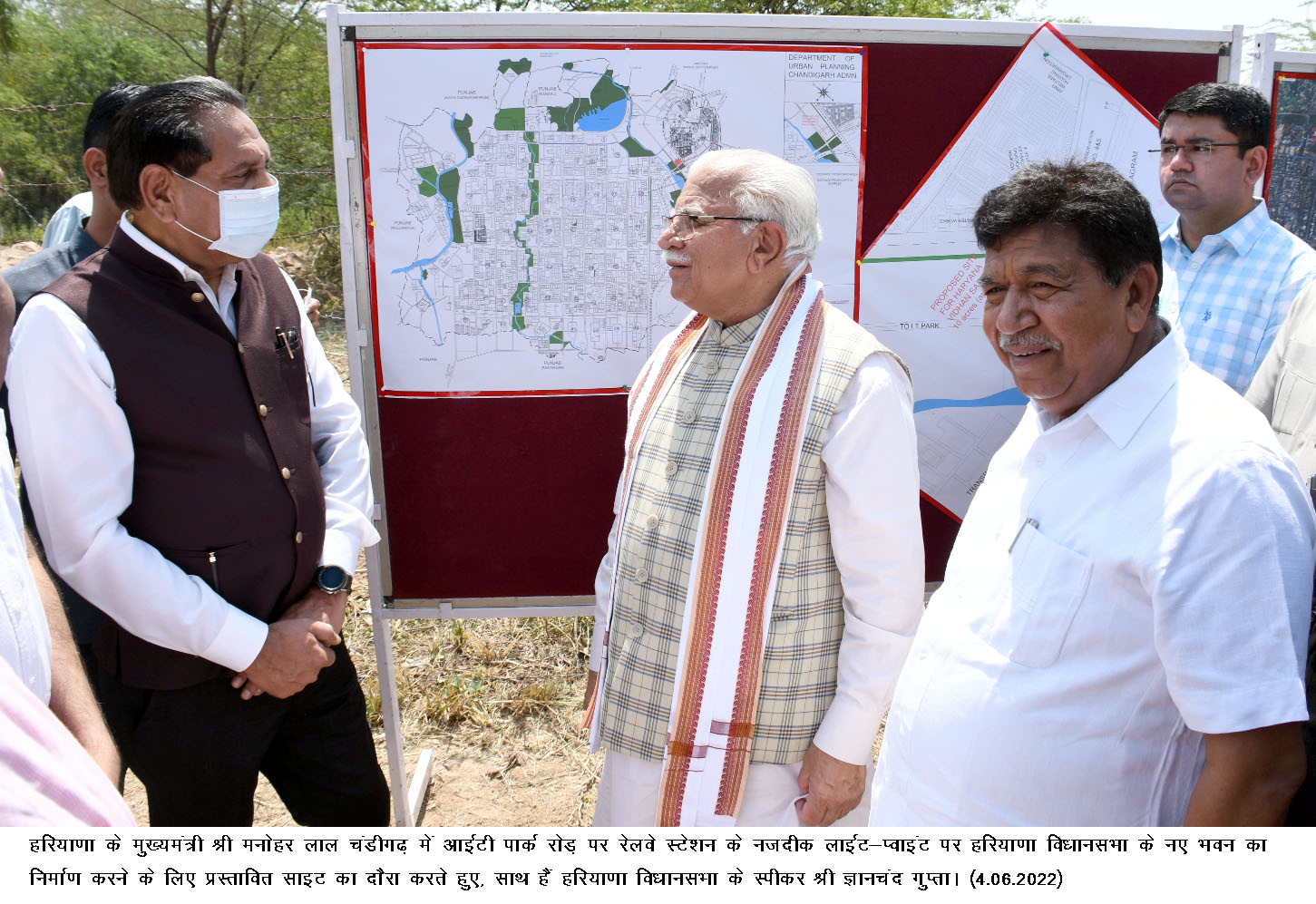
For a separate Haryana Vidhan Sabha building, Haryana Speaker Gian Chand Gupta, along with CM Manohar Lal Khattar, recently went to inspect the three sites offered by the Chandigarh Administration near Chandigarh Technology Park in Manimajra before finalising one of them. But even as the Haryana government goes ahead with the plan of constructing a new Vidhan Sabha building, objections have been raised to the building plan from many quarters, especially from the Architects body of Chandigarh.

According to Haryana Vidhan Sabha Speaker Gian Chand Gupta, the lack of space in the existing Vidhan Sabha has been hampering work for a long time and there is need for a new building much bigger in size. Gupta said that in the present building, they could not provide modern facilities. Gupta said that during the Covid pandemic in the last two years, they had to make members sit in the visitors’ gallery, much to their inconvenience.

“The existing Haryana Vidhan Sabha building is small according to our needs. We don’t even have separate space for ministers to sit. There will be more space constraints in future. After delimitation in 2026, the strength of the House could go up. So we need a new Vidhan Sabha building to fulfill our needs now and in near future,’’ said Gian Chand Gupta.

But the Indian Institute of Architects (IIA), Chandigarh Chapter, has expressed grave concern over the proposal to have a new building for Haryana Vidhan Sabha in Chandigarh. Senior functionaries of the IIA Chandigarh Chapter immediately shot a letter to the Home Minister, Chief Ministers of Haryana and Punjab and the UT Administrator, saying that the proposed building near the railway station on IT Park Road in Chandigarh will be a clear violation of the city’s master plan. The IIA argued that any such move will be nothing but tinkering with Chandigarh’s unique character.

Objecting to the plan, New Haryana Vidhan Sabha building, IIA Chandigarh Chapter wrote to Home Ministry, CM, UT Administrator seeking immediate intervention to stall the project, terming it a violation of the master plan. It will be disastrous for Chandigarh, the architects’ body said.

According to SD Singh, chairman, IIA Chandigarh Chapter, it has requested to consider other options for the Haryana plan to have a separate building for Vidhan Sabha. “The idea of making a new Vidhan Sabha will be against the master plan of the city and it may invite huge criticism at International level,” said SD Singh.

Another critic of the Haryana plan, Surinder Bahga, former Chairperson of Chandigarh-Punjab Chapter said that Chandigarh is considered as one of the best experiments in urban planning and architecture in India after Independence.  “The new Vidhan Sabha building plan will destroy Corbusier’s concept of city planning’’, he said.


CUET: Not quite a Cute route to college admissions after all

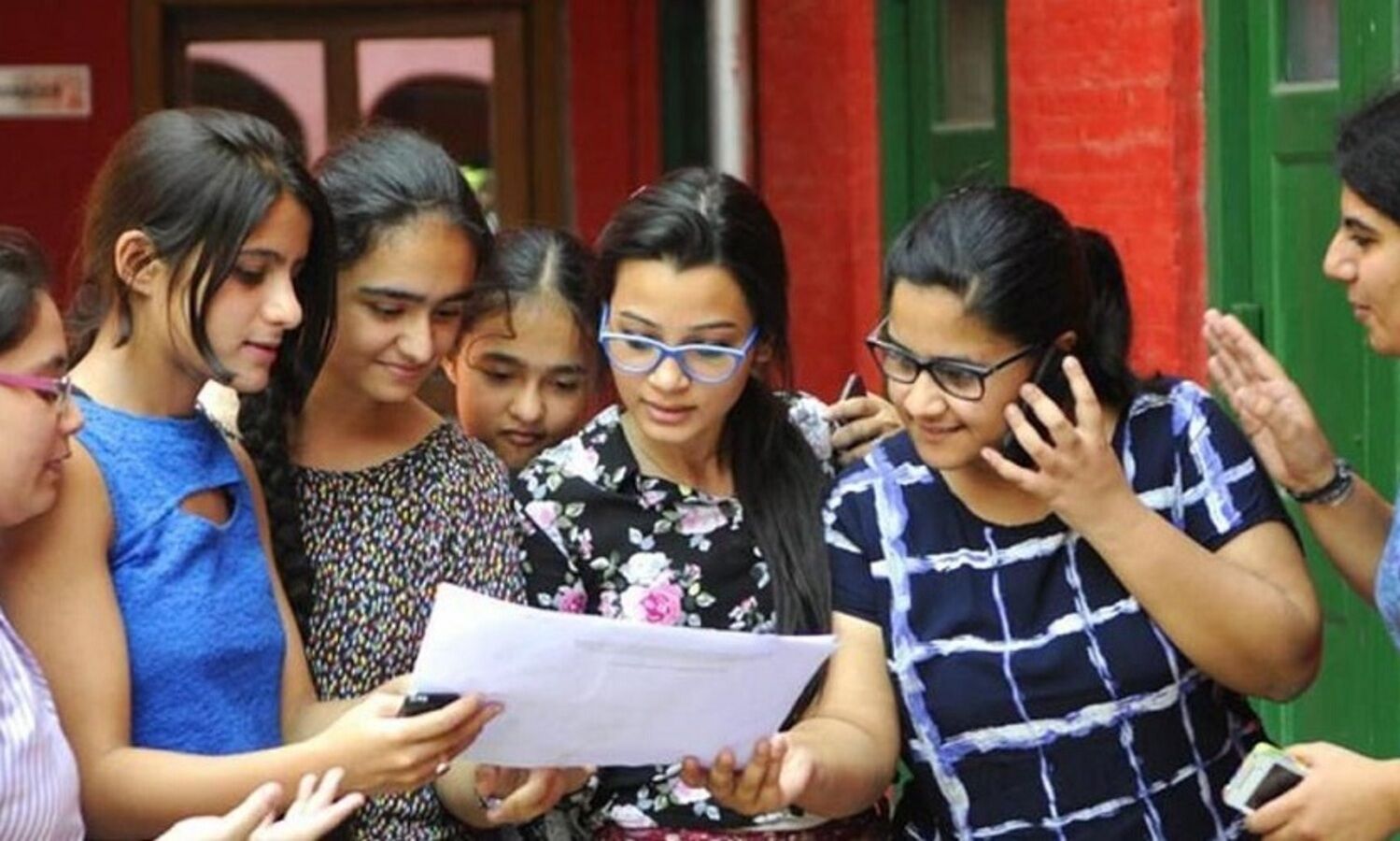
The Common University Entrance Test (CUET), introduced by the UGC for admission to UG courses, is perceived as a big blow to the CBSE and other state education boards. It is feared that the new system will totally negate the role of school education, writes Amitabh Srivastva

When we were in school, we used to play a game called ‘Hop Stop and Jump.’ But then was victory!

But the 14 lakh children who took their Class XII CBSE exams and thousands of others appearing for the 2300 schools offering the Council for the Indian School Certificate Examinations in India and abroad, thousands others from the various state boards holding their own exams who side-stepped, jumped over or took a bye pass from one problem to another in the last two years are not so lucky.

As if the unending trauma that saw school children trying to return to normalcy after a traumatic two-year layoff with online classes, offline attendance, abbreviated courses, objective questions changed to long answers, clearing boards without exams and some through offline exams, last minute confusion of children without vaccinations not being allowed to take exams suddenly face a vacuum as they are told that their exams results don’t matter. Not five per cent. Not even one per cent.

In order to get into the 45 Central Universities in the country they have to clear yet another test in the form of the Common University Test (CUET) whatever stream they want to get into, Science, Humanities or the most in demand Commerce.

As we are all aware the trigger for this was the cries of  ‘Marks Jihad’ raised by a political science teacher in the Kirorimal College of Delhi University last year because more than 300 students from Kerala had applied for admission to Delhi University with scores of 100 percent in various subjects in 2021.

Instead of crediting them for working hard this led to a tricky situation where colleges were forced to take as many students who had applied because they had all scored  100 per cent marks even though they did not have as many seats and teachers to tackle the rush.

Many BJP leaders had then alleged that the Kerala State Board had manipulated the marks of their State Boards which had created this problem, especially in DU.

But the charge of different states giving higher marks is not a new issue in DU which considers itself as one of the topmost University of the country. This hype for DU is no myth. The Education Ministry’s own ranking puts many colleges of DU including Hindu, St. Stephen, Miranda House, Sri Ram College of Commerce and Lady Sri Ram College in  particular as the best colleges for Arts, Commerce and Humanities in the country.

The pressure to get into DU has always been an issue that different administrators have dealt with it in different ways. If it is about Kerala Board giving higher marks today it was about Bihar not so long back.

We have also seen the embarrassing spectacle of a Bihar Board topper Ruby Rai exposed by TV channels for which she was even jailed which was a bit too much, say child rights activists.

However, earlier this principle of competitive exams was applicable only to those who wanted to get into specialised professional courses like engineering and medical education.

But now the National Testing Agency (NTA) which has been set up to conduct the CUET exams says that now admissions to all subjects across the board will be through CUET which will be conducted in 13 languages.

Many feel that admissions to DU is just an excuse to hit at the real targets, the minority institutions and the JNU which had their own system of admissions for so many years which have been working perfectly well.

But before introducing the new system the MoE ensured that they had a pliable VC in place in JNU, Dr. Santishree D Pandit, who would blindly follow the dictates of the new regime in place.

Having experienced embarrassment with VCs siding with students facing brutal lathi charge in Jamia Milia two years ago, the Akahand Bharat regime is taking no chances now.

Aligarh Muslim University tried to resist the new system by saying that it would follow the CUET system for most admissions but would reserve 15 per cent admissions through its own system. But it was told to fall in line.

In Delhi, the elite St. Stephens College which always follows its own time-table for admissions has been asking for 15 per cent admissions through interviews but has been told to follow the new system.

School principals are not so vocal about voicing their thoughts now but they are the most hurt because the new system totally negates the role of school education.

Sriram Oberoi, a retired teacher of DU and a former DUTA president was the first to bring out these fears through his posts on the social media like Facebook.

He wrote, “UGC decision to make CUET mandatory for admission to UG courses will be a big blow to the CBSE (which has worked very well for also many decades) and other State Education Boards. Their decision shows the high handedness of the New Education Policy (NEP) propagated by the present rulers. Such centralised test conducted by NTA is against the basic spirit of Indian federalism. CBSE came into existence by a Parliament Act and State Educational Boards were also constituted by relevant Acts passed by state assemblies… The NTA has not been created by parliament. It was constituted by the present government simply through a notification.”

He argues that the new system totally ignores the marks scored by children in their board exams which means that parents and children would not be bothered for the senior secondary classes and exams. They would rather engage tutors or private coaching centres to prepare their kids for CUET test. This is going to lead to privatisation and corporatisation of higher education, alleged  Oberoi.

Surprisingly, the first to welcome the CUET was Delhi Education Minister Manish Sisodia who agreed with the BJP that marks were manipulated by the State Boards (‘marks Jehad’).

Welcoming the CUET, Manish Sisodia said, “For us this is a very positive move. The competence of children in Delhi is not less than anyone else but somehow, many state boards tweak their students’ marks in the name of rescaling…now a child would be able to take admissions somewhere or the other based on their competence.”

All Delhi government schools except 31 of its Schools of Specialised Excellence are affiliated to the New Delhi Board of School Education.

Allaying the fears of students and school teachers, the UGC Chairperson, Prof Manidala Jagdesh Kumar has been telling the media that this competition will not be tough like that for IITs where the competition ratio is 1:50 but for the 45 Colleges where the chance of admissions is 1:15.

He had also clarified that the entrance test will be based strictly on the level of subjects taught in NCERT books for Class XII and fears of the need for extra coaching classes are exaggerated.

But contrary to his grandiose explanations, coaching institutes for training to clear the CUET have already sprung up.

Chaitanya, an MBA from Kolkata, who is now coaching students for MBA with a prestigious centre, says, “I agree that coaching centres have opened up for preparing for CUET. This is the first time the system has been introduced and I don’t know how this will work out. But yes there was always a problem in admissions to Delhi University where about 70 to 80 per cent students from outside (Bihar etc) were getting in while students of Delhi were getting a raw deal. This will introduce a level playing field for everyone. I remember the DU had also introduced an entrance test for admission to English (Hons) a few years ago but this had to be scrapped under political pressure.”

But at the same time, he clarified that it would be wrong to say that Board exam results will not be relevant at all.

When a student is selected for an MBA course his/her Xth and XIIth mark sheets will have a lot of weightage, he pointed out.

Nawal Sharma, Head of the Prudential Education Academy in Indirapuram, Ghaziabad, who teaches Accountancy, says, “Although we are not into this CUET coaching business I feel it is important to sharpen one’s skills if one wants to excel. Some students can compete without coaching but a majority do need it. There are also differences in the courses being taught in different states. For instance in Bihar, West Bengal, UP Boards, the children have to clear both the Class XI and Class XII course for their Boards but in CBSE they are done with Class XI and have to only take the course for Class XII. Hence a CUET exam will bring all at par.”

Surprisingly, opinion among school teachers on totally ignoring the board results is also sharply divided.

Even though most took this is as a personal insult to their hard work and talent, a former teacher from a prestigious school in Aligarh who spent 40 years in the profession told us,”I don’t trust the school results at all. Let me inform you that Sandeep Singh, grandson of former CM Kalyan Singh had failed in all subjects except Hindi in my school and we were under pressure to promote him but we refused. Later we were shocked to know that he finally got into one of the DPS schools and today he is a Minister in UP. But I am sure he cannot look me in the eye if we ever come face to face. So we welcome this step because it would at least  introduce some uniformity and standards in schools across the country.”

He is today Minister for Basic Education Minister in Uttar Pradesh. This is a promotion as in the earlier ministry he was minister for Primary Education, Finance and medical education.

Obviously, there are many others who are more willing to give the new system a chance. Talking about CUET, Vijay Jolly, senior BJP leader and former DUSU President says, “Without getting much into details, my first instinctive reaction is that if a new system is being introduced where admissions will be given on merit list prepared nationally, why not? Let’s welcome it. As former president of Delhi University Students Union and having travelled across 71 countries, I feel we must give the new system a chance because there were many fallacies in the earlier system and if this does not work, we can change it.”

Undeterred by these controversies and fears, the UGC is marching ahead with an ambition to implement it in more and more institutes.

UGC Chairman Prof M. Jagadesh Kumar has been discussing the prospects of further expanding its scope with the Vice Chancellors of various state level universities.

This includes not only state-level universities, but organisations like the Tata University of Social Science, Mumbai, and Gurukul Kangri, Haridwar, who have shown interest in being a part of CUET during discussions with the UGC, says a hand out of the UGC.

And to further expand its net the CUET plans to hold two examinations for this from 2023, it tells the hopefuls.

All the planning for future is OK. One only hopes they don’t turn every city into Kota.



Lalit Modi dating Sushmita Sen, shares romantic pics on Twitter

Former IPL Chairman Lalit Modi on Thursday announced that he is dating Bollywood actress Sushmita Sen and intends to tie the knot with her soon soon.

Earlier, Lait Modi had shared a series of pictures of the two on Twitter, calling the actress his better half’ and describing it as a new beginning’.

“Just back in London after a whirling global tour #maldives #sardinia with the families – not to mention my #betterhalf @sushmitasen47 – a new beginning a new life finally. Over the moon, ” he wrote.

Calling Sen his better half, Lalit Modi sent their fans into a frenzy with several discussing if the two were already married.

However, he cleared the air with another tweet, saying, “Just for clarity. Not married – just dating each other. That too it will happen one day. I JUST ANNOUNCED THAT WE ARE TOGETHER.”

Lalit Modi has been in London since 2010, when he left India amid investigation into his alleged role in tax evasion and money-laundering.

Sushmita Sen, who was crowned Miss Universe in 1994, made her Bollywood debut with the 1996 film ‘Dastak’. The 46-year-old actress has two daughters, Alisah and Renee

Barnawapara banks on 5-year blackbuck reintroduction plan

In Chhattisgarh, blackbucks are not naturally found anymore. But the animal is still found in Madhya Pradesh, Rajasthan, Maharashtra and Gujarat, writes Deepanwita Gita Niyogi

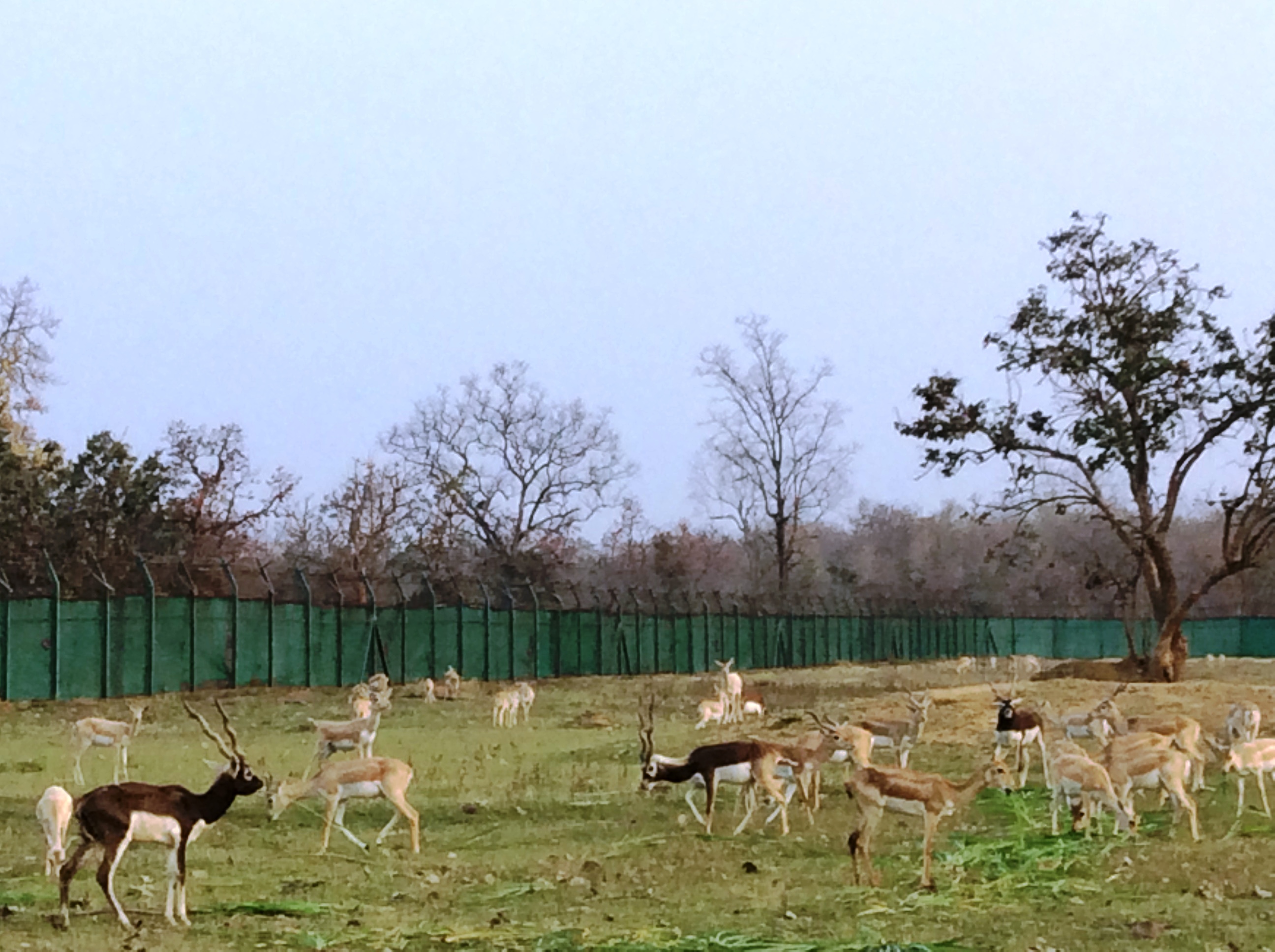
The Barnawapara Wildlife Sanctuary located in central Chhattisgarh has introduced a site specific reintroduction plan for the blackbuck (Antilope cervicapra) extending from 2021-2026. A schedule 1 species under the Wildlife Protection Act of 1972, blackbucks were once abundant in India, but their population started declining as a result of hunting and habitat loss. There were less than 80,000 animals remaining in 1947. At present, there are an estimated 50,000 individuals.

In Chhattisgarh, blackbucks are not naturally found anymore after they became extinct. But the animal is still found in Madhya Pradesh, Rajasthan, Maharashtra and Gujarat. The Bishnoi community has been instrumental in protecting the species.

In 2018, 50 blackbucks were taken from the National Zoological Park in New Delhi for release in the sanctuary established in 1976 and spread over 244.66 sq km. Before this in 2010, blackbucks were translocated for the first time to Chhattisgarh’s Kanan Pendari Zoo in Bilaspur from the capital. From there, they were later reintroduced in Barnawapara.

“The aim is to establish a viable, free roaming and wild population of blackbucks again in Chhattisgarh. It is feared that the current population is small and may crash anytime. Habitat loss and fragmentation of forests threaten the species,” said Krishanu Chandraker, range officer, Bar, Barnawapara Wildlife Sanctuary.

Reintroduction programme

Of the 77 animals reintroduced in Barnawapara, 40 were released in the wild in January this year. The rest of the population is being monitored in an especially built enclosure covering four hectares as they cannot be directly released in the forest.

Chandraker added that the translocation was carried out after the Central Zoo Authority of India gave permission as part of an exchange programme.

Barnawapara is currently preparing for national park status. As a wildlife habitat, it does not have tigers but it offers good sightings of leopard and gaur (Indian bison). The latter is listed as vulnerable on the IUCN Red List.

Relocation of species has been attempted before in Barnawapara. The sanctuary brought two sub-adult wild buffaloes all the way from the Manas National Park in Assam during the first lockdown period to improve the skewed sex ratio. It is Chhattisgarh’s state animal.

At the enclosure where the remaining blackbucks are confined, grass is being fed to the animals. Anand Kudarya, who is the superintendent at Barnawapara, said that the remaining 37 animals in the enclosure would be released during the monsoon. “In the first two batches released in January, the first batch had 13 animals but one died. The second batch had 26.”

Kudarya added that every kind of flora and fauna is important for maintaining biodiversity and the sanctuary is rich in this aspect. “The reintroduction was carried out for biodiversity maintenance. Only there aren’t tigers but otherwise people get a nice safari experience here.”

Is translocation good practice?

The cheetah, which is the world’s fastest land animal, is once again going to be reintroduced in the country under the Action Plan for Introduction of Cheetah in India. Under this, 50 animals are going to be introduced in various national parks.

Chhattisgarh’s principal chief conservator of forests Rakesh Chaturvedi said the animals were received from Delhi zoo as part of an exchange. Some of them are being kept in a closed enclosure for acclimatization. “Relocation is a good management practice and it is successful. Blackbucks were naturally found in Barnawapara and the forest working plans of 1970s mention them. Land grab, mining and other activities may have led to its decline and the species vanished.”

A former forest officer from Maharashtra not wishing to be named said the kind of habitat which determines the success of reintroduction must be considered in such cases. Open meadows and grasslands are suitable for blackbucks, but not dense forests. However, relocation is worth trying if the habitat is suitable.

Barnawapara which has black cotton soil is a mixed forest with Teak and Sal trees in plenty. Retired forest official based in Raipur Shirish Kumar Sinha was the superintendent in Barnawapara in 2017. He said if animals are introduced in a habitat and they survive, it is a good sign. “It was a climatic change for the blackbucks when they were translocated. But now they are flourishing. However, the presence of too many leopards can be a threat as they have lived for long in captivity.”

Sinha added that Barnawapara is full of forest and receives a heavy rainfall of 1100 mm annually. “But the enclosure was constructed even before I joined and the plan was made to reintroduce the animals even though it wasn’t that suitable for blackbucks. But as it is a beautiful animal, visitors love to watch them.”

Remarking on whether tiger reintroduction plan in Barnawapara has something to do with that of blackbucks, Sinha explained that it is a good place for tigers but the sanctuary has a good prey base in the form of nilgai and cheetal.

K Ramesh, scientist at the Wildlife Institute of India, said the idea of reintroduction of species is not unwelcome and should be attempted. But it should be considered based on technical and administrative consideration as well as long-term conservation commitment. Regarding the specific case of Barnawapara’s reintroduction of black bucks, however, he added that he does not have much idea.


IIT Madras remains best educational institute in country

The Indian Institute of Technology (IIT), Madras bagged the top spot among educational institutions in the country for the fourth consecutive year while the Indian Institute of Science (IISc), Bengaluru is the best university, according to the Ministry of Education’s National Institutional Ranking Framework.

The 2022 rankings were released by Union Education Minister Dharmednra Pradhan on Friday. In the overall category, IIT Madras is followed by IISc Bengaluru at second spot while IIT Bombay has been ranked third.

Among the universities, IISc Bengaluru is followed by JNU at second spot and Jamia Millia Islamia at the third position.

IIT Madras is the best engineering college followed by IIT Delhi and IIT Bombay.

Among the pharmacy institutions, Jamia Hamdard has bagged the top rank. The National Institute of Pharmaceutical Education and Research, Hyderabad is the second best in the category while Panjab University, Chandigarh has been ranked third.

Five out of ten best colleges in the category are from Delhi with Miranda House topping the chart. Hindu College has bagged the second rank while Presidency College in Chennai is at the third spot.

AIIMS Delhi is the best medical college in the category followed by PGIMER, Chandigarh and CMC, Vellore.

IIM Ahmedbad is the best management institution in the country followed by IIM Bengaluru and IIM Calcutta.

Amarnath Yatra suspended due to bad weather

Amarnath Yatra was suspended on both routes on Thursday due to bad weather as rains lashed the Kashmir Valley, officials said.
The yatra was temporarily suspended from Pahalgam as well as Baltal routes in the morning and no pilgrim was allowed to move towards the holy cave shrine, they said.

The officials said the yatra will resume after the weather improves.

Earlier, the yatra was stopped for three days following a cloudburst on July 8 which left 16 people dead and over 30 missing. It had resumed via the Pahalgam route on Monday and through the Baltal route on Tuesday.

Five dead as car hits tree in Haryana’s Narnaul

Five people died when the car in which they were travelling hit a tree near the Raghunathpura bypass in Haryana’s Narnaul, police said on Thursday.

The crash took place a little after midnight, Narnaul City police station SHO Inspector Santosh Kumar said.

“The car hit a tree along the road, and the five occupants were killed in the incident,” he said over the phone. Kumar said the victims were in the mid-30 to mid-50 age group.

India records 38 new Covid fatalities

Daily COVID-19 cases in India were recorded over 20,000 after a gap of 145 days while the active cases increased to 1,36,076, according to the Union Health Ministry data updated on Thursday.
A total of 20,139 new COVID-19 cases were reported in a span of 24 hours, pushing the total tally of cases to 4,36,89,989.

The death toll climbed to 5,25,557 with 38 new fatalities, the data updated at 8 am stated.

The active cases comprise 0.31 per cent of the total infections, while the national COVID-19 recovery rate was recorded at 98.49 per cent, the ministry said.

An increase of 3,619 cases has been recorded in the active COVID-19 caseload in a span of 24 hours.

The daily positivity rate was recorded at 5.10 per cent and the weekly positivity rate at 4.37 per cent, according to the ministry

The number of people who have recuperated from the disease surged to 4,30,28,356, while the case fatality rate was recorded at 1.20 per cent.

According to the ministry, 199.27 crore doses of Covid vaccine have been administered in the country so far under the nationwide vaccination drive.

India’s COVID-19 tally had crossed the 20-lakh mark on August 7, 2020, 30 lakh on August 23, 40 lakh on September 5 and 50 lakh on September 16. It went past 60 lakh on September 28, 70 lakh on October 11, crossed 80 lakh on October 29, 90 lakh on November 20 and surpassed the one-crore mark on December 19.

The country crossed the grim milestone of two crore on May 4 and three crore on June 23 last year. It crossed the four-crore mark on January 25 this year.

The 38 new fatalities include 16 from Kerala, 10 from Maharashtra, four from West Bengal, three from Delhi and one each from Assam, Bihar, Goa, Uttarakhand and Uttar Pradesh.

A total of 5,25,557 deaths have been reported so far in the country including 1,48,001 from Maharashtra, 70,186 from Kerala, 40,125 from Karnataka, 38,028 from Tamil Nadu, 26,288 from Delhi, 23,549 from Uttar Pradesh and 21,255 from West Bengal.

The ministry stressed that more than 70 % of the deaths occurred due to comorbidities.

“Our figures are being reconciled with the Indian Council of Medical Research,” the ministry said on its website, adding that state-wise distribution of figures is subject to further verification and reconciliation.

DRI unearths Customs duty evasion of Rs. 4389 crore by Oppo India

During an investigation pertaining to M/s Oppo Mobiles India Private Limited (hereinafter referred to as ‘Oppo India’), a subsidiary company of “Guangdong Oppo Mobile Telecommunications Corporation Ltd”, China (hereinafter referred to as ‘Oppo China’), the Directorate of Revenue Intelligence (DRI) has detected Customs duty evasion of around Rs 4,389 crore. Oppo India is engaged in the business of manufacturing, assembling, wholesale trading, distribution of mobile handsets and accessories thereof, across India. Oppo India deals in various brands of mobile phones, including Oppo, OnePlus and Realme.

During the course of investigation, searches were conducted by DRI at the office premises of Oppo India and residences of its key management employees, which led to the recovery of incriminating evidence indicating wilful mis-declaration in the description of certain items imported by Oppo India for use in the manufacture of mobile phones. This mis-declaration resulted in wrongful availment of ineligible duty exemption benefits by Oppo India amounting to Rs 2,981 crore. Among others, senior management employees and domestic suppliers of Oppo India were questioned, who in their voluntary statements accepted the submission of wrongful description before the Customs Authorities at the time of import.

Investigation also revealed that Oppo India had remitted / made provisions for payment of ‘Royalty’ and ‘Licence Fee’ to various multinational companies, including those based in China, in lieu of use of proprietary technology/brand/IPR license etc. The said ‘Royalty’ and ‘Licence Fees’ paid by Oppo India were not being added in the transaction value of the goods imported by them, in violation of Section 14 of the Customs Act, 1962, read with Rule 10 of the Customs Valuation (Determination of Value of Imported Goods) Rules 2007. The alleged duty evasion by M/s Oppo India on this account is Rs. 1,408 crore.

A sum of Rs 450 crore has been voluntarily deposited by Oppo India, as partial differential Customs duty short paid by them.

After completion of the investigation, a Show Cause Notice has been issued to Oppo India demanding Customs duty amounting to Rs. 4,389 crore. The said Notice also proposes relevant penalties on Oppo India, its employees and Oppo China, under the provisions of the Customs Act, 1962.


Shiv Sena stakes claim for LoP in Maha Legislative Council

After being dislodged from power in Maharashtra, the Shiv Sena has staked claim for the post of leader of opposition in the state Legislative Council.

A delegation of Shiv Sena MLCs – Manisha Kayande, Sachin Ahir, Ambadas Danve, Vilas Potnis and Sunil Shinde – met Counil Deputy Chairperson Neelam Gorhe on Monday and submitted a letter staking claim for the post of the LoP and chief whip.

The race is between the NCP and the Shiv Sena, amid fears that some of its members may switch sides.

The Sharad Pawar-led NCP is just two short of the Sena’s tally in the Upper House of the state legislature.

As on July 8, the 78-member Maharashtra Legislative Council has 24 BJP members, 12 of the Shiv Sena and 10 each of the Congress and NCP. The Lok Bharti, Peasants and Workers Party of India and the Rashtriya Samaj Paksh have one member each. The Council also has four independents, while 15 seats are vacant.

The Sena’s move comes following a rebellion in the party, which led to its 55 MLAs splitting into two factions. The camp led by Chief Minister Eknath Shinde has the support of 40 MLAs, while 15 have sided with former CM Uddhav Thackeray.

The revolt had also led to the collapse of the Thackeray-led tripartite government comprising the Sena, NCP and Congress.

Subsequently, the Shinde faction in coalition with the BJP formed government in the state.

The NCP, which has 53 MLAs in Maharashtra, leads the opposition in the legislature’s Lower House. Earlier this month, NCP’s Ajit Pawar was elected the leader of opposition in the state Assembly.

MOST POPULAR

HOT NEWS