Ex-Cong leader Kuldeep Bishnoi to join BJP

Former Congress leader Kuldeep Bishnoi is all set to join the BJP at the party headquarters here on Thursday.

The 53-year-old Bishnoi, who was expelled by the Congress from all party positions for cross-voting in the June Rajya Sabha polls, resigned from the state Assembly on Wednesday.

Bishnoi represented the Adampur seat in Haryana’s Hisar district.

Haryana Chief Minister Manohar Lal Khattar is expected to be present at his joining.

The four-time MLA and two-time MP had been sulking ever since the Congress had ignored him for the post of its Haryana unit chief during a revamp earlier this year.

Bishnoi had said that the BJP will decide who will contest the bypoll from Adampur but he and the people of his state want that his son Bhavya Bishnoi should contest from there.

Bishnoi and his father Bhajan Lal had floated the Haryana Janhit Congress (HJC) in 2007 after the Congress handpicked Bhupinder Singh Hooda for the chief minister’s post following the party’s thumping victory in the assembly polls.

The HJC later entered into a tie-up with the BJP and two other parties, who jointly contested the 2014 Lok Sabha polls in Haryana. They were supposed to contest the assembly polls together as well but the alliance crumbled.

Govt to build more green expressways : Nitin Gadkari

The government will be building 26 green expressways in the country in the next three years and India’s road infrastructure will be as good as that in the United States by 2024, Transport minister Nitin Gadkari told Rajya Sabha on Wednesday.

Replying to supplementaries during the Question Hour, the minister said there is no shortage of funds with the National Highways Authority of India (NHAI) which has AA rating and is financially very sound.

He said the NHAI can build five lakh km roads in a year.

“In the next three years, we are building 26 green expressways,” he said, adding that one can travel from Delhi to Dehradun, Haridwar or Jaipur in two hours thereafter.

He also claimed that once the expressways are built, one can travel from Delhi to Chandigarh in 2.5 hours, Delhi to Amritsar in four hours, Delgi to Katra in six hours, Delhi to Srinagar in eight hours and Delhi to Mumbai in 12 hours and Chennai to Bengaluru in two hours.

It used to earlier take 4.5 hours to travel from Meerut to Delhi but now people are coming in 40 minutes, he claimed.

“Under Narendra Modi’s leadership before 2024, India’s road infrastructure will be the same as that in the United States, I promise. There is no shortage of funds,” Gadkari said, adding, we will change the entire infrastructure of the country.

India’s services sector growth falls to 4-month low in July

India’s services sector lost momentum in July as demand was curtailed by competitive pressures, elevated inflation and unfavourable weather, a monthly survey said on Wednesday.
The seasonally adjusted S&P Global India Services PMI Business Activity Index fell from 59.2 in June to 55.5 in July, pointing to the slowest rate of growth in four months.

For the 12th straight month, the services sector witnessed an expansion in output. In Purchasing Managers’ Index (PMI) parlance, a print above 50 means expansion while a score below 50 denotes contraction.

As per the survey, service providers that reported higher sales in July mentioned favourable demand conditions and fruitful advertising. However, growth was dampened by fierce competition and unfavourable weather, survey participants said.

According to Pollyanna De Lima, Economics Associate Director at S&P Global Market Intelligence, there was a “noticeable loss of momentum for the Indian service economy as demand was somewhat curtailed by competitive pressures, elevated inflation and unfavourable weather. Both output and sales increased at the weakest rates for four months”.

The domestic market remained the key source of sales growth as international demand for Indian services worsened further, the survey said.

Meanwhile, business sentiment in the service economy was subdued in July as only 5 per cent of companies forecast output growth in the year ahead, while a vast majority of firms (94 per cent) predict no change in business activity from present levels.

On the prices front, services companies reported a further increase in their average expenses during July, with food, fuel, materials, staff, retail and transportation cited as the key sources of inflationary pressures. Input costs rose sharply, though at the slowest pace in five months.

“The subtle easing in cost inflationary pressures to a five-month low was also welcomed by services firms struggling to preserve margins and contributed to a softer rise in prices charged. Yet, survey participants again reported considerable strain from food, fuel, input, labour, retail and transportation costs,” Lima said.

On the jobs front, July data showed a negligible increase in service sector employment across India. The rate of job creation was fractional and broadly similar to June. The vast majority of firms left payroll numbers unchanged amid a lack of need to raise workforces.

Meanwhile, the S&P Global India Composite PMI Output Index — which measures combined services and manufacturing output — fell from 58.2 in June to 56.6, highlighting the slowest increase since March.

“New business growth picked up in the manufacturing industry whilst slowing in the service economy. At the composite level, sales increased sharply but at the weakest pace in four months,” the survey said.

As per official data, the retail inflation based on the Consumer Price Index (CPI), which the Reserve Bank of India (RBI) factors in while arriving at its monetary policy, has been above 6 per cent since January 2022. It was at 7.01 per cent in June.

Experts believe the RBI may go in for its third consecutive policy rate hike by at least 35 basis points to check high retail inflation.
The RBI’s rate-setting panel , the Monetary Policy Committee — will meet for three days from August 3 to deliberate on the prevailing economic situation and announce its bi-monthly review on Friday.

Indian economy much better, nobody is in denial about price rise: Sitharaman

Indian economy, compared to the situation prevailing in many of our peer groups and in many of the developed economies, is definitely much better, said Finance Minister Nirmala Sitharaman while responding to the short-duration discussion on the rising prices of essentials in the Rajya Sabha on Tuesday.

She said that nobody is in denial about the price rise. “We are not running away, we are here to discuss and nobody is saying and nobody is in denial about the price rise”, said Sitharaman.

The finance minister said that the government has adopted a targeted approach based on ground-level inputs to tackle retail inflation which is ruling at around 7 per cent.

“4 is the median point considered generally for inflation, sometimes minus two or plus two is what is normally accommodated. And, we are at 7 with some efforts or it can be slightly more than 7 but we have made sure with Reserve Bank and government put together or taken enough steps to make sure that it is kept at 7 or below 6 ideally, ” she said.

The minister acknowledged that global factors are impacting the economy, and said ‘these are realities’.

While discussing GST, the FM said that all states agreed to levy 5 per cent GST on labelled food items. “All states at the GST Council agreed to the proposal to levy 5% GST on pre-packed, labelled food items; not one person spoke against” said the minister. She clarified that there is no GST on loose food items.

She reiterated that there is no GST on crematoriums or mortuaries. However, if someone wants to open a new crematorium GST will be imposed. “No GST on crematorium; tax only on construction of new crematorium.”. She added that hospital beds or an ICU room with less than Rs 5, 000 per day rent have been exempted from GST.

She compared the taxes on essential items in the pre GST-era and post GST and claimed that her government has lowered the cess on several items. We have contained prices of tomato, onion, potato, said Sitharaman comparing the rates with those in November 2013.

On the Jal Jeevan Mission, the finance minister said that in 2019, there were only 3.2 crore households getting piped water but now 9.6 crore households are getting piped water under the Jal Jeevan Mission.


Corruption charges against opposition leaders based on ‘facts, evidence’: BJP

BJP on Tuesday cited the uncovering of cash and assets acquired allegedly by some opposition politicians to refute the charge of vendetta politics against its government, and asserted that those who swindled people’s money will not be allowed to go scot free.

Party spokesperson Sambit Patra spoke about the corruption allegation against Shiv Sena MP Sanjay Raut, the seizure of “mountain of cash” suspected to belong to Trinamool Congress leader Partha Chatterjee and money laundering allegation against AAP’s Satyendar Kumar Jain to hit out at the Opposition over its charge of political vendetta.

All these leaders were arrested by the federal agency Enforcement Directorate.

“Should they be allowed to go scot free just because they are big politicians? The charges against them are based on facts and evidence and not rhetoric. The opposition should not politicise corruption,” Patra said.

Speaking to reporters, he claimed the governments run by the BJP will never override constitutional values and not interfere in the work of investigation agencies.

“But we have zero tolerance for corruption. Whosoever defrauded people’s money will not be let off,” he said.

Patra noted that Raut is allegedly involved in a scam worth close to Rs 1,040 crore related to a 2007 project for the redevelopment of 47 acres of plot where 672 families lived as tenants for decades. The Maharashtra Housing and Development Authority (MHADA) had registered the case in 2018, he said.

Should the ED not act against them because they are politicians and “entitled”, he asked and added opposition parties had raised a hue and cry even when NCP leader Nawab Malik was arrested in February in a money laundering case. He remains in jail because the court has not given him bail because of the seriousness of charges against him, he said.

The opposition has accused the Modi government of targeting its leaders by “misusing” federal agencies, especially the ED.

UP govt sanctions Rs 797 crore for road work in Ayodhya

Uttar Pradesh government has sanctioned Rs 797 crore for the broadening and renovation of roads leading to the Ram temple in Ayodhya.

The decision was taken at a state Cabinet meeting chaired by Chief Minister Yogi Adityanath.

“The construction of the Ram temple is in full swing in Ayodhya. To avoid crowd on big occasions in Ayodhya and deal with it, the cabinet has approved broadening of the 12.940 km road from Sadatganj to Nayaghat on lines of Kashi Vishwanath corridor,” Tourism Minister Jaiveer Singh told reporters.

He said the road from Faizabad to the Hanumangarhi and Ram temples will also be widened and shopkeepers be rehabilitated.

The Cabinet has approved Rs 797.69 crore for the project and set a deadline of two years to complete the work, he said.

The minister said the focus of the government is to develop UP as a centre of religious tourism, which has immense possibilities of revenue generation.

For this, the government is working on improving air and road connectivity and providing basic infrastructure facilities for the convenience of people, he added.

Go First car goes under IndiGo plane at Delhi airport, narrowly avoids collision with nose wheel

A car belonging to Go First airline went under an IndiGo A320neo aircraft at the Delhi airport on Tuesday, narrowly avoiding collision with the plane’s nose wheel, sources said.

The Directorate General of Civil Aviation (DGCA) will investigate this incident, its officials stated.

There was no damage to the plane, aviation industry sources said.

The aircraft was readying to depart for Dhaka on Tuesday morning when a car belonging to Go First airline went under it, narrowly avoiding collision with the nose wheel, the sources said.

ED raids National Herald office, other locations in money laundering case

The Enforcement Directorate (ED) on Tuesday raided the head office of the Congress party-owned National Herald newspaper here and 11 other locations as part of an ongoing money laundering investigation, officials said, a week after it questioned Congress chief Sonia Gandhi.

The searches are being carried out under the criminal sections of the Prevention of Money Laundering Act (PMLA) to “gather additional evidence with regard to the trail of funds and they are against those entities who were involved in the National Herald-linked transactions”, they said.

The action is being undertaken in light of fresh evidence obtained by the ED after the latest questioning of various people, in this case, they said.

The raids come after the probe agency questioned Congress president Sonia Gandhi and her MP son Rahul at its headquarters here. While Sonia Gandhi was questioned for more than 11 hours, spread over three rounds, last month, Rahul Gandhi was probed by the ED for five days, at intervals, clocking over 50 hours in June.

Senior Congress politicians like Mallikarjun Kharge and Pawan Bansal were also questioned by the ED in April.

The National Herald is published by the Associated Journals Ltd. (AJL), and its holding company is Young Indian.

Officers of the federal agency searched the office of the National Herald located in the ‘Herald House’ building at Bahadur Shah Zafar Marg near ITO in central Delhi. The office is registered in the name of AJL.

According to officials, the location of a shell (dummy) company in Kolkata involved in the case, has also been covered in the raids.

The Congress party had called the ED action against its leaders “political vendetta”, saying there was no money laundering in the case.

The Congress party has said it gave a Rs 90 crore loan to an ailing AJL between 2001-02 and 2010-11 and later, in 2011, the shares of AJL were allotted to Young Indian and this debt was converted into equity and the loan was extinguished in the books of the AJL.

The ED claims these transactions attract anti-money laundering charges as a complex web of transactions and routing of funds were undertaken by the party and its leaders to acquire AJL’s assets worth multiple crores of rupees.

The Gandhis are understood to have told the ED during their separate questioning sessions that no personal assets were made in the Congress-AJL-National Herald deal as Young Indian was a “not-for-profit” company established under section 25 of the Companies Act.

They also told the ED that AJL continues to have possession of all its assets and Young Indian neither “owns nor controls” these properties.

Sonia Gandhi and Rahul Gandhi are among the promoters and majority shareholders in Young Indian. Like her son, the Congress president also has 38 per cent shareholding.

The ED action in the case was initiated after the agency late last year registered a fresh case under the PMLA after a trial court here took cognisance of an Income Tax department probe against Young Indian based on a private criminal complaint by BJP MP Subramanian Swamy in 2013.

Swamy had accused the Gandhis and others of conspiring to cheat and misappropriate funds, with Young Indian paying only Rs 50 lakh to obtain the right to recover Rs 90.25 crore that Associated Journals Limited owed to the Congress.

In February last year, the Delhi High Court issued a notice to the Gandhis seeking their response to Swamy’s plea.

According to the ED, assets worth about Rs 800 crore are “owned” by the AJL and the agency wants to know from the Gandhis how a “not-for-profit company like Young Indian was undertaking commercial activities of renting out its land and building assets”.
The Congress party has said that the Income Tax Department has valued AJL’s properties at worth about Rs 350 crore.

Grenade attack on police post in J&K’s Ramban

Militants lobbed a grenade at a police post in Jammu and Kashmir’s Ramban district early Tuesday. However, there was no loss of life or injury to any police personnel.

The grenade exploded on the roof of the police post.

Police and Army have launched a massive cordon and search operation in the area. An alert has been sounded in the district and a case registered.\

The attack has taken security forces by surprise as there has been no militancy in Ramban in recent years.

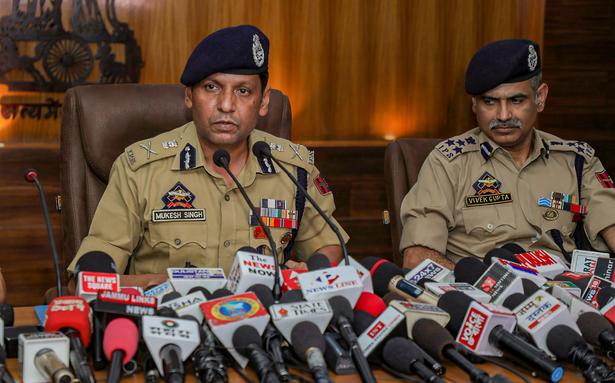
“A grenade blast has occurred near the premises of police post Ind, which falls in the jurisdiction of police station Gool,” Additional Director General of Police Mukesh Singh said,

The attack has been claimed by Jammu Kashmir Ghaznavi Force (JKGF), a little known outfit.

Private players can use drones for delivery purposes as per rules: Govt

Government of  India  is utilising services of drone service providers for vaccine delivery, inspection of oil pipelines and power transmission lines, anti-locust operations, agricultural spraying, survey of mines, and land mapping, private players are free to use drones for delivery purposes subject to compliance with Drone Rules, 2021, said the Civil Aviation Ministry.

In September 2021, the government notified the Production-Linked Incentive (PLI) scheme to promote the growth of drone manufacturing by private companies.

The scheme provides for an incentive of Rs 120 crores, spread over three financial years.

The PLI rate is 20 %  of the value addition over three financial years. PLI for a manufacturer shall be capped at 25 per cent of total annual outlay.

The beneficiaries include 12 manufacturers of drones and 11 manufacturers of drone components.

The Drones Rules, 2021 notified on August 25, 2021 provide the necessary regulatory framework for commercial use of drones.

These rules cover various aspects like type certification, registration and operation of drones, airspace restrictions, research, development and testing of drones, training and licensing, offences and penalties etc.

As per Drones Rules, 2021, every drone, except for those meant for research, development and testing purposes, is required to be registered and should have a Unique Identification Number (UIN).

An airspace map of the country segregating the entire airspace into red, yellow and green zones is available on the digital sky platform.

Operation of drones in red and yellow zones is subject to the approval of the Central government and the concerned Air Traffic Control (ATC) authority, respectively.

No approval is required for operation of drones in green zones.

The state government, the Union Territory administration and law enforcement agencies have been empowered under the rules to declare a temporary red zone for a specified period.

MOST POPULAR

HOT NEWS