Lakhimpur Kheri case: SC grants UP 2 weeks for response on Ashish Mishra’s bail plea

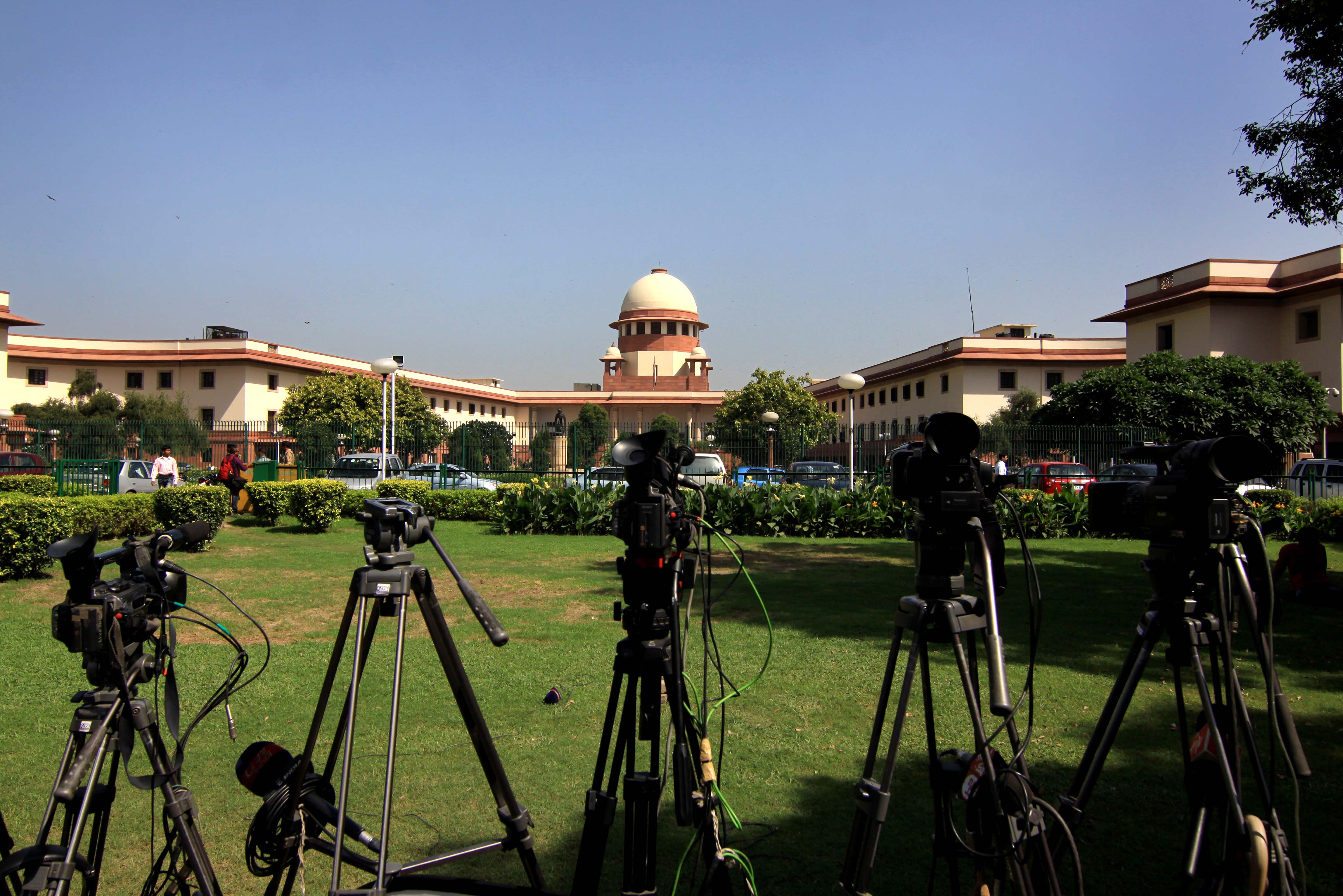
New Delhi: The Supreme Court on Monday granted two weeks to the Uttar Pradesh government to file its reply on the bail plea filed by Lakhimpur Kheri violence case prime accused Ashish Mishra, the son of Union Minister Ajay Mishra Teni.

A bench of Justices B.R. Gavai and B.V. Nagarathna said it will hear the matter on November 7.

Senior advocate Mukul Rohatgi, representing Mishra, submitted that notice was already issued in the matter.

On July 26, the Allahabad High Court’s Lucknow bench declined to entertain Mishra’s bail plea.

On April 18, the Supreme Court had cancelled the bail granted to Mishra and directed him to surrender within a week.

A bench headed by Chief Justice N.V. Ramana (retired now) and comprising Justices Surya Kant and Hima Kohli asked the Allahabad High Court to examine afresh whether Mishra should be granted bail or not.

“Instead of looking into aspects such as the nature and gravity of the offence, severity of the punishment in the event of conviction, circumstances which are peculiar to the accused or victims, likelihood of the accused fleeing, likelihood of tampering with the evidence and witnesses, and the impact that his release may have on the trial and the society at large, the High Court has adopted a myopic view of the evidence on the record and proceeded to decide the case on merits, ” the top court had noted.

It had said that the high court had shown “tearing hurry” in passing the February 10 order, granting bail to Mishra, denying a fair and effective hearing to the victims.

Mishra was arrested on October 9 last year in the case. On October 3, 2021, eight people, including four farmers, were killed in Lakhimpur Kheri in clashes during a farmers’ protest.

The family members of the farmers, mowed down by a car belonging to Mishra, in Lakhimpur Kheri had moved the top court challenging bail granted to him.


Deputy CM Manish Sisodia leaves CBI office after day-long grilling

New Delhi:  The Deputy Chief Minister of Delhi, Manish Sisodia, left the CBI headquarters here late on Monday evening after being grilled for the whole day in connection with the Delhi excise policy case, in which he has been named as accused number one in the FIR filed by the central probe agency.

Sisodia joined the investigation at around 11:15 a.m., when he reached the CBI headquarters along with scores of Aam Aadmi Party (AAP) workers who raised slogans against the BJP.

According to sources, Sisodia can be summoned again to join the investigation in the future. On Monday, the CBI asked him about 50 questions related to the excise policy and the alleged bribe which was reportedly paid to government officials by private liquor businessmen.

Sisodia, on his part, has termed his questioning as political vendetta.

Meanwhile, the AAP has claimed that BJP will lose the upcoming Assembly elections in Gujarat and that is why the Centre is misusing the probe agencies to stop Sisodia from cmpaigning in Gujarat.


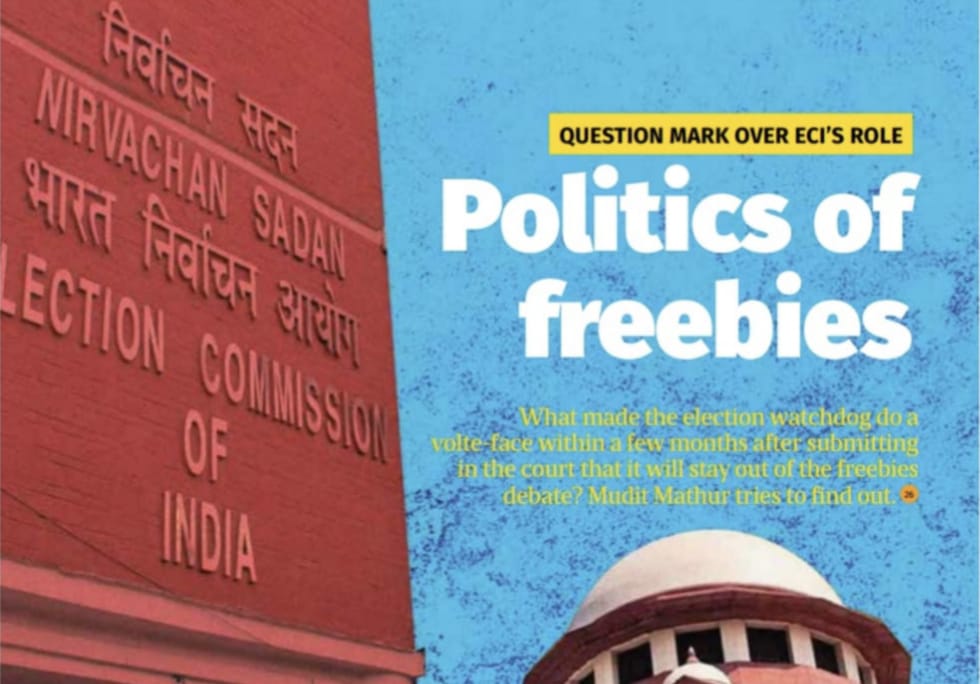
Question mark over ECI’s role, Politics of Freebies


What made the election watchdog do a volte-face within a few months after submitting in the court that it will stay out of the freebies debate? Mudit Mathur tries to find out.

Interestingly, in wake of impugned 2013 directions of the apex court, the Election Commission of India (EC) has now proposed amendments in its Model Code of Conduct (MCC) providing adequate disclosures on the financial implications of the promises made by the political parties for ‘enabling’ electorate to make informed electoral choices. The EC directive to all the political parties came amid ongoing constitutional debate before the Supreme Court over the issue of rational distinctions between welfare schemes, socio-economic concessions and poll-time announcements of material goods and items (freebies) as incentives to attract votes. The neutrality of the election watchdog has again come under a cloud and raised grave concern with regard to its declining credibility as an independent constitutional authority in Indian democracy.

Now, the apex court would examine as to whether MNREGA, Mid-Day Meal, free supply of food grains, electricity, free education to girls, direct benefit cash transfer schemes like farmers pension and other subsidies, universal healthcare and immunisation schemes, distribution of laptops and tablets to students amount to freebies? Can access to drinking water, housing to weaker sections and distribution of free consumer electronics items be treated as freebies? Whether the schemes envisaged to achieve welfare measures mandated under the Directive Principles of State Policy could be termed as freebies aimed to woo the electorate during electioneering?

The apex court agreed to revisit its ruling delivered in 2013 in the case of S. Subramaniam Balaji v. State of Tamil Nadu to a larger bench of three judges wherein it was held that pre-election promises do not fall within the ambit of corrupt practices under the Representation of the People Act, 1951, and issued directions to the Election Commission of India regarding framing of certain guidelines, in the absence of any legislative enactment covering the field. It also held that the provisions of the Representation of the People Act (1951) place no restraint on the power of the political parties to make promises in their election manifesto. The Court had added that the manifesto of a political party is a statement of its policy and the question of implementing it arises only if the political party forms a government.
In its affidavit filed in April 2022, the EC had told the Supreme Court that “…offering/distribution of any freebies either before or after election is a policy decision of the party concerned, and whether such policies are financially viable or its adverse effect on the economic health over the state is a question that has to be considered and decided by the voters…The Election Commission of India cannot regulate state policies and decisions which may be taken by the winning party when they form the government.” But after Prime Minister Narendra Modi’s “Revri” remarks, it took just a U-turn to initiate a change in MCC.

It was argued before the apex court that the reasoning in the above judgment is flawed as it had not considered various provisions of the Representation of the People Act, 1951. It was also submitted that the judgment incorrectly implies that the Directive Principles of State Policy can override the fundamental rights under Part III of the Constitution, which is against the law settled by a Constitution Bench in the historic Minerva Mills Ltd. Case.

Looking into the complexity of the issues involved, and the prayer to overrule a judgment delivered by its two Judge Bench in S. Subramaniam Balaji case, the Bench headed by Justice N.V. Ramana with justices Hima Kohli and CT Ravikumar directed listing of these set of petitions before a three Judge Bench. The Bench also framed three larger issues for judicial determination;


  1. What is the scope of judicial intervention with respect to the reliefs sought in the present batch of petitions?
    b. Whether any enforceable order can be passed by this Court in these petitions?
    c. Whether the appointment of a Commission/Expert Body by the Court would serve any purpose in this matter? Additionally, what should be the scope, composition, and powers of the said Commission/Expert Body?

In its detailed orders, the Bench also observed, “There can be no denying to the fact that in an electoral democracy such as ours, the true power ultimately lies with the electorate. It is the electorate that decides which party or candidate comes to power, and also judges the performance of the said party or candidate at the end of the legislative term, during the next round of the elections. It is also necessary to highlight herein the point raised by some of the interveners, that all promises cannot be equated with freebies as they relate to welfare schemes or measures for the public good. Not only are these a part of the Directive Principles of State Policy, but are also a responsibility of the welfare state. At the same time, the worry raised by the petitioners herein, that under the guise of electoral promises, fiscal responsibility is being dispensed with, must also be considered.”

“The Election Commission cannot regulate state policies and decisions which may be taken by the winning party when they form the government. Such an action without enabling  provisions in the law, would be an overreach of powers.” The EC clarified that it does not have power to deregister a political party, except on three grounds, which were outlined by the top court in case of Indian National Congress Vs Institute of Social Welfare and others (2002).

The Election Commission of India has consistently taken a stand before the Court that it has limited scope to interfere in such promises which are made by political parties/candidates. “Offering/distribution of any freebies either before or after the election is a policy decision of the party concerned and whether such policies are financially viable or its adverse effect on the economic health of the state is a question that has to be considered and decided by the voters of the state,” EC reiterated in its affidavit.

The Solicitor General Tushar Mehta supported the PIL filed by BJP leader and Supreme Court Advocate Ashwini Kumar Upadhyay against freebies as pre-election promises, which can have a large-scale impact on the economy of the State. The PIL highlights that such pre-election promises are made by political parties without any assessment of the financial implications on the State and is nothing but an attempt to attract the votes. This goes against the spirit of responsible electioneering and is adversely affecting free and fair elections. This severely affects the level playing field between the different political parties. The money that is being paid by the taxpayers is ultimately being misused for political parties/candidates to gain or retain power.

In this backdrop, the U-turn taken by the EC triggered political controversy with regard to alleged overreach of powers by the Election Commission of India beyond its constitutional mandate, undermining the faith in the electoral democracy, when it attempted to introduce a proforma seeking disclosure of financial impact of poll promise and its proposed source of funding by amending Model Code of Conduct. The EC suggested that political parties making election promises should provide authentic information to the voters so that they can assess the financial viability of their promises. A consultation paper is likely to be moved which proposes that parties detail the cost of promises made ahead of polls and to compare them to the state of their financial resources to give voters an idea about how these could be achieved.

The shift in the Election Commission’s stand on the issue occurred soon after Prime Minister Narendra Modi made a barely veiled attack on Aam Aadmi Party chief Arvind Kejriwal over his poll promises offering free electricity, free health-care, free education, waiver of electricity bills and farm loans. The BJP, it may be mentioned, had suffered a major setback in the recently held Punjab assembly elections after Kejriwal regained power for the second time in Delhi. Kejriwal is posing a major challenge in upcoming Gujarat and Himachal Pradesh elections to the ruling BJP and thus, has been under attack from the rank and file of saffron party.

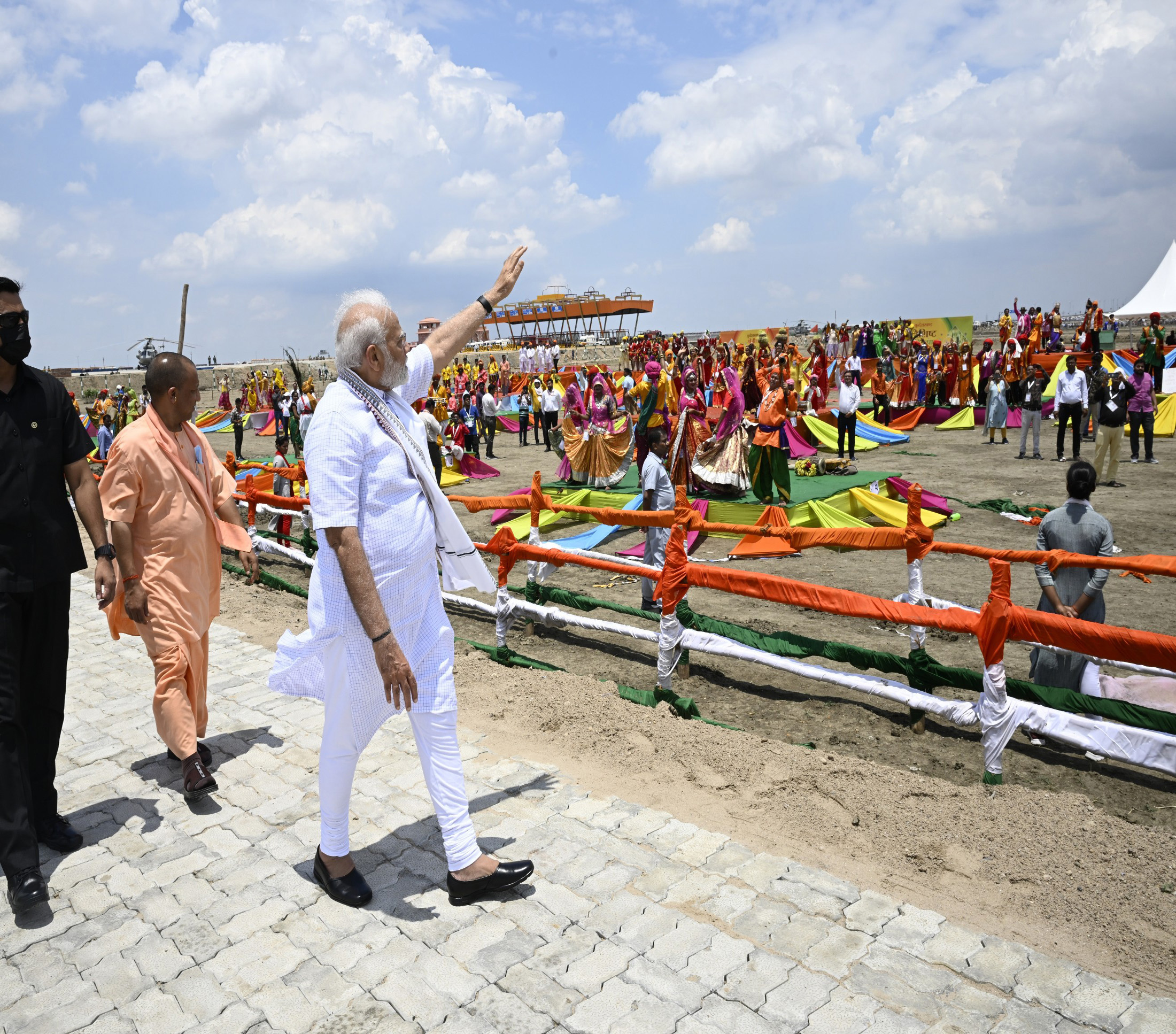
Targeting his political opponents and accusing them of promising freebies in exchange for votes, Modi termed it is “very dangerous” for the country – its development and well-being. “Today, attempts are being made in our country to collect votes by distributing free ‘Revdis’ (freebies). This ‘Revdi’ culture is very dangerous for the development of the country. People of the country, especially the youth, need to be careful of this ‘Revdi’ culture. People of ‘Revdi’ culture will not build expressways, airports or defence corridors for you,” he cautioned.

“They feel that by distributing free ‘Revdis’ to people, they can buy them. Together we need to defeat this thinking of theirs. The ‘Revdi’ culture needs to be removed from the country’s politics. Away from the ‘Revdi’ culture, we are living up to the expectations of people,” said Modi while addressing public meeting at Kaitheri in Jalaun district after inaugurating the Bundelkhand Expressway.“Poll freebies increase taxpayers’ burden, prevent the country from becoming self-reliant and block investments in new technologies,” Modi said while dedicating a modern ethanol plant of Indian Oil Corporation (IOC) at Panipat through video conferencing. He said that the act of giving away freebies is not in the interest of the country and will push the nation back. Similar thoughts were echoed by him on other public forums in Gujarat which was followed by his social media army disseminating his views to millions of people.

Reacting to Prime Minister’s attack, Delhi Chief Minister Arvind Kejriwal said, “There are allegations being levelled against me that Kejriwal is distributing free ‘Revdis’, he’s distributing freebies… I’m giving free and quality education to the children of poor and middle-class households in Delhi. I want to ask people, am I distributing free ‘Revdis’ or strengthening the foundation of the country?”

The Dravida Munnetra Kazhagam (DMK) have also hit out at the Centre over the freebies row. The party has opposed the suggestion for setting up an expert panel to examine the matter, saying that “…the scope of a “freebie” is very wide and there are a lot of aspects which are to be considered.

“A welfare scheme introduced by a State Government cannot be judged to be classified as a freebie. The ruling government at the Union giving tax holidays to foreign companies, waiver of bad loans of influential industrialists, granting crucial contracts to favoured conglomerates etc. also have to be considered and cannot be left untouched,” DMK said before the apex court as interveners.

The Rajya Sabha member of Rashtriya Janata Party, Manoj Kumar Jha termed the EC order proposing mandatory disclosure of the “financial implications” of the promises made in manifestos by political parties as “Institutional overreach” and said, “One wishes that the Commission and other independent bodies showed similar enthusiasm around the issues related to Electoral Bonds.” “Two contrasting statements by the ECI in five months raise questions about its independence. Interestingly, the ECI’s letter came after the contentious ‘Revdi culture’ remark by the Prime Minister about freebies offered by political parties. Independent watchdog institutions taking cues from the government do not augur well for the health of democracy in the country, especially when such talking points demean rights-bearing citizens as passive recipients of dole,” he opined in his write up.

The Congress general secretary in-charge of communications Jairam Ramesh said, “The Election Commission’s recent proposal to change the model code goes against the spirit of competitive politics and will be “yet another nail in the coffin of democracy.” “It was simply not the business of the Election Commission” he added. “None of the welfare and social development schemes that have been transformational over the decades would ever have become a reality if such a bureaucratic approach had been in place,” Ramesh remarked. He was of the view that the proforma proposed by the EC “looks like the function of the Executive”.

Rajasthan Chief Minister Ashok Gehlot spoke about the issue on Independence Day during the state’s flag-hoisting ceremony: “Public welfare is the top priority of the state government. Weekly payment is made to the poor and elderly in developed countries. Everyone has the right to live,” he said, adding: “It is the responsibility of a government to implement public welfare schemes.”

A day after the EC wrote its letter, the Communist Party of India-Marxist (CPI-M) in a statement hit out against it, terming it an “unwarranted move.” The EC had recently declined to be a part of a committee to examine the issue of freebies as proposed by the Supreme Court, which was hearing a Public Interest Litigation seeking regulation of freebies announced by parties. In July, Prime Minister Narendra Modi’s statement that “Revdi culture” or offering freebies was dangerous for the development of the country had stoked debate.

“The Election Commission had, in an affidavit to the Supreme Court in April, stated that the Commission cannot regulate policy decisions of political parties and that it would be an overreach of its powers. It is surprising that the Election Commission has now taken a contrary stand. Is this due to pressure being exercised by the executive?” the CPI(M) asked.

Rajya Sabha MP Kapil Sibal on October 5 took a dig at the Election Commission of India (ECI) proposing a change in the model code to ask political parties to provide authentic information to voters on the financial viability of their poll promises, saying maybe the poll watchdog itself needs a model code of conduct. “Election Commission does a U-turn after filing an affidavit in Supreme Court that it will stay out on freebie debate. Would amount to overreach. Now wishes to include it in the Model Code of Conduct. Maybe the EC itself needs a Model Code of Conduct!” Mr. Sibal tweeted.

The EC has asked all recognised national and state political parties to provide authentic information to voters on the financial viability of their poll promises, saying inadequate disclosures have far-reaching ramifications. The EC proposed a format for the parties to declare the information, including the extent of coverage of a promise, the cost to the exchequer, the ways in which it would be paid for and the implications for the State or Union government’s finances. In addition, the EC proforma would also include details of the State or Union government’s receipts and expenditure that would be filled out by the Chief Secretary or Union Finance Secretary.

“Although implementation of election promises could have several ramifications, the Commission proposes to confine the disclosures to only the financial implications of the promises in terms of the financial resources required.” The poll panel said it is of the considered view that with adequate disclosures on the financial implications of the promises made, the Indian electorate will be able to make informed poll choices.

******

A case for making model code into law

The application of the code is purely left to the discretion of the EC, which is equipped with unbridled arbitrary powers without specific guidelines. Many argue that the best way to overcome allegations of bias and partiality is by legislating MCC as law with all clarity, writes Mudit Mathur

The Model Code of Conduct (MCC) is not a statute and therefore its implementation solely depends on the discretion of the Election Commission. There has been a debate as to whether the MCC should be made into an Act of Parliament?

However, the Election Commission has opposed this move on the grounds that the interpretation of laws by the courts will take a lot of time, whereas the Election Commission would prefer handling MCC violations swiftly using its discretionary powers. It is often blamed for showing undue indulgence favouring the ruling party in its overall functioning including divergent rulings for different individuals for seemingly similar kinds of MCC violations.

In 2017, the declaration of the schedule of the Gujarat elections was delayed. Opposition parties alleged that the ECI’s actions were intended to delay the application of the Model Code of Conduct so that the state’s BJP government could announce fresh initiatives to persuade voters to vote for the party.

It was also noticed that much before the announcement of election dates, ruling party members have publicly shared dates that matched exactly with what the ECI announced later on. It may be a coincidence but it damages the credibility of the institution that is supposed to ensure a “level playing field” for all parties.

The MCC does not specify the type of punishment that may arise from a violation of its provisions. There is no classification of violations based on the severity of the act. For instance, is a violation of the prohibition on appealing to religious sentiments more serious than making unsubstantiated allegations against an opponent ? How does the EC decide whether a certain speech should attract a censure, a 24-hour ban or a 72-hour ban? In the absence of specific punishments for each violation, the application of the code is purely left to the discretion of the EC, which is equipped with unbridled arbitrary powers without specific guidelines.

The absence of specific norms on exercising its powers can lead the EC to arbitrariness and individual bias. Mayawati was banned from public meetings by the EC for 48 hours, due to her appeal to Muslims to consolidate their votes to defeat the BJP, whereas Narendra Modi’s speech about how Rahul Gandhi is afraid of Hindus and hence selected a seat where “the minority is majority” was given a clean chit by the EC.

The EC issued an advisory prohibiting appeals to voters in the name of the defence forces; however, it went out of its way to overrule the opinions of the chief electoral officer of Maharashtra and that of the district election officer, to give a pass to Modi, after he sought votes in the names of the jawans who were killed in Pulwama.

Amit Shah, the then president of the BJP, made a communally charged remark saying that he cannot distinguish between a procession in Pakistan and a procession in Wayanad thereby trying to portray the Muslims in the region as Pakistanis. Yet, the Election Commission was unmoved by his remarks.

While the Commission swiftly acted against Maneka Gandhi, Mayawati and others in a matter of days, it kept sitting on the complaints against Modi and Shah, until it was forced to dispose of them after the Supreme Court imposed a deadline.

The failure to provide for decisions to be made within a certain time frame after a complaint is lodged, increases the possibility of misuse. The EC can sit on a complaint as long as it likes, even after the main phases of the election are over, because the MCC does not specify a timeline.

Such incidents raise apprehensions about the independence of the election watchdog. The executive controls the ECI’s finances and personnel appointments. It has often been seen as appointing  pliant election commissioners to limit the agency’s authority internally.

There is a merit in demand to enact the MCC as a law, with clear procedures, clarity on the exact powers of the EC, classifying the punishments based on the severity of the violation, and placing a clear-cut time-bound procedure for following up on complaints. Getting the rules right is the best way to overcome allegations of bias and partiality and it can be done by way of legislating MCC as law with all clarity.

The success of Indian democracy depends on fair and credible functioning of its constitutional institutions including a free, fair and independent judiciary and impeccable Election Commission. We owe it to our people to build robust institutions with checks and balances to prevent abuse, since we cannot always depend on messianic personalities like T. N Seshan to maintain independent bodies without fear or favour.



Freebies or not: Which side of dice are you?

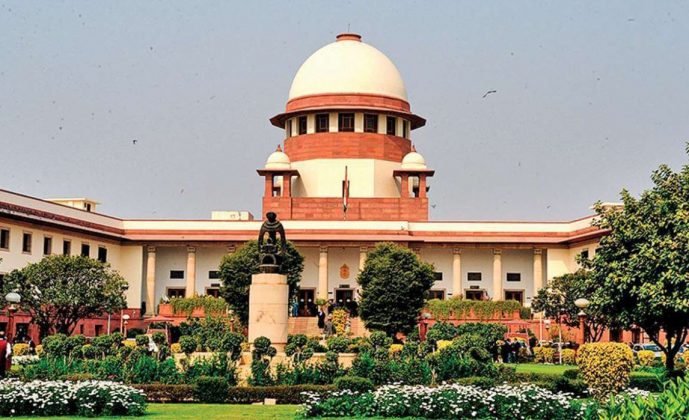
When the Prime Minister Narendra Modi targeted opposition and cautioned youth against what he called “revdi” culture, he triggered a debate on freebies. After the freebies came under the Supreme Court’s close scrutiny, the Election Commission has proposed that the Model Code of Conduct be amended so that it becomes mandatory for all parties to disclose to the electorate how they are going to meet the fund requirement needed to implement their poll promises.

Tehelka Cover Story “Politics of Freebies” by Special Correspondent Mudit Mathur in this issue argues as to why in a welfare state where there is poverty and inequality, welfare measures or freebies are actually needed. Even the Election Commission admitted in its affidavit to the Supreme Court that “freebies’ are subjective, and open to interpretation. Freebies are not only difficult to define but are highly subjective. If waiver on electricity bills is a freebie then free food grain to the poor is a bigger freebie. By the same yardstick, the Pradhan Mantri Garib Kalyan Anna Yojana (PM-GKAY) would also fall under the ambit of freebies. Under this scheme, a five kg ration per person is given to about 81.35 crore beneficiaries in addition to the ration given under the public distribution system. Is Old Age Pension to the aged population without any financial support a freebie or a welfare measure? What is wrong if the government taxes affluent sections of population to extend benefits to weaker sections?

Providing freebies empowers the state to deliver subsidised services like health and education and to help households combat poverty by providing subsidised food or electricity etc. The political parties have no qualms about promising all kinds of freebies to voters in the run-up to elections without having to spell out their financial implications. Just before Punjab elections in Punjab,  AAP promised 300 units of electricity free of cost per month to domestic consumers and now it is repeating the same promise in poll-bound Gujarat and Himachal Pradesh.  While Opposition parties promise the moon to the voters if elected to power, the ruling dispensation starts doling out sops months before the model code of conduct is enforced.

The debate over freebies is endless. The big question is why do we still yearn for freebies even after 75 years of Independence?  The fact is that nothing comes free and the freebies too are never free because the cost is imposed somewhere. The solution lies in setting up an independent fiscal council like the one recommended by the Fiscal Responsibility and Budget Management Review Committee to enable the Centre and States to make informed economic decisions whilst attending to key development objectives. With the Supreme Court asking the Centre, Niti Aayog, Finance Commission and the RBI, to set up an expert body to come up with ‘constructive suggestions’ to deal with the practice of promising freebies to woo voters in the run-up to elections, it is hoped that practice will be shown the door in near future.


Lakhimpur violence victims’ kin losing hope for justice

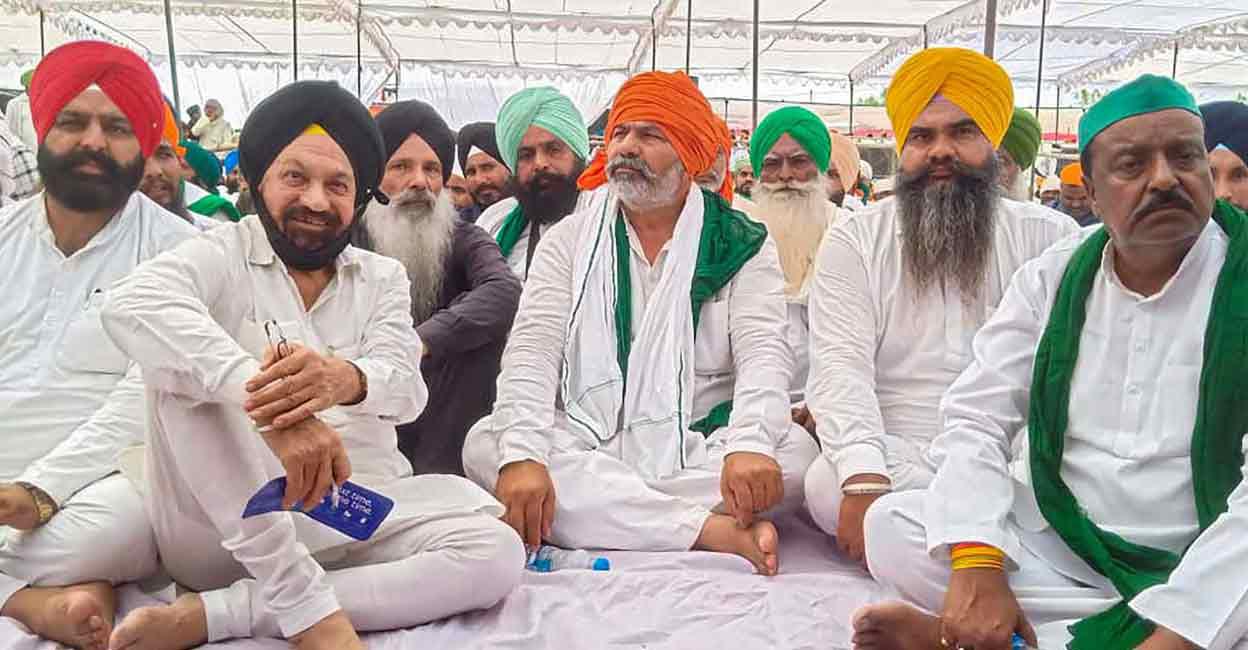
Thousands of protesting farmers observed Black Day in Tikunia area of Lakhimpur on the death anniversary of the victims of violence. They demanded removal of minister Ajay Mishra Teni from the cabinet for a free, fair and speedy trial to happen in the case. A report by Mudit Mathur

The families of farmers are losing hope to get justice against powerful BJP Minister of State for Home Ajay Mishra Teni whose son Ashish Mishra Monu had allegedly mowed downed four farmers and a journalist under the wheels of his convoy while they were protesting against three farm laws (now repealed) in Tikonia area of Lakhimpur Kheri on 3rd October last year.

In a meeting organised by Bharatiya Kisan Union leaders Rakesh Tikait and Jasbir Singh Virk in front of Kaudiyala gurdwara in Tikunia area of UP’s Lakhimpur Kheri wherein thousands of farmers observed Black Day on the death anniversary of martyrs demanding sacking of Minister of State for Home Ajay Mishra Teni to ensure a free, fair and speedy trial. Farmers also demanded withdrawal of  the “cooked up” cases registered against farmers during their stir against farm laws.

The farmers’ leaders said that it is disheartening to note that despite prosecution filing chargesheet in January 2022, there has been no progress and charges have not been filed against the accused minister’s son and 11 others. They alleged the proceedings are being delayed on one pretext or the other. They feel unless minister is removed from the central government, they cannot hope for justice.

Jagdeep Singh, who had lost his father Nachattar Singh in the incident, said, “The trial in the case is yet to start as the court has failed to frame charges because the minister is using all his powers to save his son. We are trying to get the case transferred to Lucknow as the hope of justice is diminishing with each passing day.”

The BKU’s Kheri district president, Dilbag Singh alleged, “Ajay Mishra Teni will not let justice be served until he is in power. He has been giving controversial statements even after the incident and the government is openly supporting such a person who is responsible for the atrocious Tikunia violence.”

“BKU Kheri unit is providing all possible support to the families of the affected farmers. We gave Rs 2 lakh each to the families of our farmer brothers lodged in jail. We are also trying to ensure their bail,” he told.

The protestors later in the evening submitted a memorandum addressed to Prime Minister Narendra Modi through district administration Lakhimpur Kheri demanding removal of Ajay Mishra from the cabinet and slapping of  charges of criminal conspiracy against him.

It may be recalled that eight persons had lost life in the most atrocious incident of mowing down the protesting farmers killing four of them and a journalist in bone-chilling attack from behind in Lakhimpur Kheri on October 3rd, 2021. Three BJP workers too were killed in retaliatory violent clashes as their vehicle overturned soon after it lost control and fell into a nearby trench, a few meters away from the crime scene.

The Supreme Court had cancelled bail granted to Ashish Mishra Monu expressing displeasure over the manner in which the single judge of the Lucknow Bench of Allahabad High Court allowed bail and given clean chit to minister’s son in a lengthy order. Setting aside the Allahabad high court order, the apex court held that the victims were denied “a fair and effective hearing” in the High Court that adopted a “myopic view of the evidence.”


No light at the end of the tunnel for Sivakasi’s fireworks workers

Sivakasi’s 100-year old firecracker industry has been severely hit by firecracker ban and Covid curbs. Five lakh families, who are dependent on the industry since generations, are struggling to make ends meet with no rehabilitation plan in sight, reports Aayush Goel

While the entire nation eagerly awaits to celebrate a Covid curbs-free Diwali, the quaint city of Sivakasi, nicknamed little Japan owing to its  industrious nature, in Tamil Nadu’s Virudhunagar district stares at a gloomy and black one.

Sivakasi’s booming economy owing to a 100-year old firecracker business has been hit by anti-pollution ban, green crackers and Covid for the last three years and lost its sparkle. The streets conventionally abuzz with business during this time of year are now marked by shut factories, reduced production and glaring losses. The worst affected are over 5 lakh families who have since generations worked in industry but are struggling to make ends meet today. Many have pulled children out of schools, migrated out as under-paid textile industry labour, construction labourers, house helps etc. The city that once was a picture of thriving community today battles with a high rate of alcoholism, school dropouts and malnutrition. Hit by denialism and short-sightedness, this Diwali it awaits a thought on a rehabilitation plan or the world wide talk about ‘just transition’. The 2015 International Labour Organisation guidelines on ‘just transition’ highlight the need to secure the livelihood of those who might be negatively affected by the green transition and also stress the need for societies to be inclusive, provide opportunities for decent work for all, reduce inequalities and effectively eliminate poverty. Sivakasi that has for generations lit the sky waits for its ray of hope.

A matter of life and death

“Whenever we talk about cracker ban they say it is a matter of life and death but it’s the same for us. We have since generations worked in making firecrackers and that is what kept our families alive but today we are dying a slow death. Until a few years ago me and my wife worked in a factory and earned enough to feed and teach our children. Diwali used to lit up our houses but since 2019 every Diwali pushes us more towards despair. I have pulled my children out of their school and I am sending them to government school as they can get meals there. My wife is a maid in house and I get small jobs on and off . We are ruined,” says Sanju Ganesan, a 40-year-old worker.

Ganesan is not alone but hunger and poverty is shared by over 2 lakh workers directly employed in over 1200 units in the city.

According to the Virudhunagar district administration, there are around 1200 factory units. Of these, 280 are licensed by the district revenue office and 741 by Petroleum and Explosives Safety Organization (PESO). The number of workers employed directly is over two lakh and workers in the allied industries — offset printing, paperboard, retail and transport are close to five lakhs.

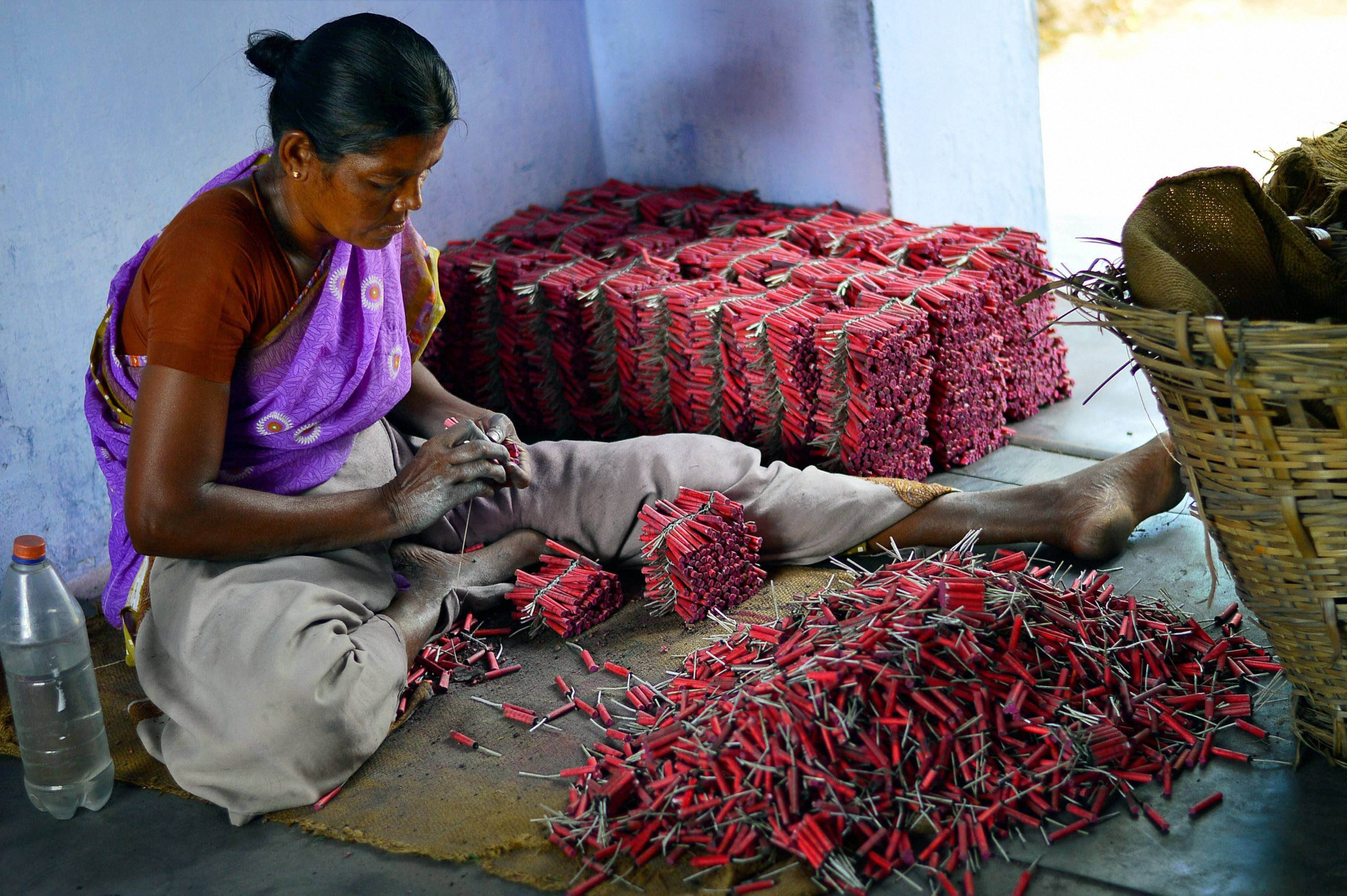
The worst hit are women workers, who are typically engaged in labelling, assembly, and packaging of crackers and work with chemicals. They are paid only about half of what men earn. Even these meagre wages have taken a hit.

“I used to make around 500 a day which went towards my household needs and liquor for my husband who lost his eyesight a few years ago. We were not that well off but were doing fine. But things changed completely. I had to raise a loan when my husband died of Covid. The factory I worked in shut. I now work on contract basis in small workshops, make some 300 rupees a day and manage to just get humble meals for us. Even my children have dropped out of the school and work with me,” says Nandini.

57-year old Sevvapandi, his wife and three other family members work as labourers in a cracker manufacturing factory. From earning 1000 a day, he now earns Rs 300-350 for 12 hours of work. The entire family has been praying that not many states ban crackers and the manufacturing unit he works in gets more demand.  Mariamma and Lakshmi are both above 55 years of age and have been working in the firecracker units for more than 15 years. “We know nothing other than this. We suffered a lot during Covid-19 and survived just by eating the ration rice. If there is a ban or closure on the fireworks industry, we will only have to survive eating porridge from ration rice for the rest of our lives,” said Lakshmi.

65-year-old P Annalakshmi, who is involved in making ground chakra crackers says for her the wages have come down by nearly a third, to about Rs 200 per day. “I earn around Rs 1,000 a week, half of which is paid as interest to money lenders, from whom I had borrowed during the lockdown. Whatever is left is used to run my household. I have acute pain in my knees and can’t stand for long. So I can’t do any other work.”

Experts feel that the successive governments had earned lakhs of crores of rupees in tax revenue over the years from the fireworks industry and the revenue should now be used for the worker’s rehabilitation. While authorities contest employment in matches and printing, they cannot accommodate such a large workforce. Textile industry is luring these workers but lack of industry skill affects earning making it not a viable option. The government needs to arrange for re-skilling, provide subsidies for setting up industries and ensuring local employment to save the city.

Manufacturing dropped by 40-50%

The fireworks manufacturers claim that though they are privy to the plight of workers and small time traders, there is hardly anything they can do as they are themselves staring at yet another gloomy Diwali. Delhi, one of the biggest firecracker markets, has banned usage of crackers, even ‘green’ ones while states of Haryana, Rajasthan and UP are expected to allow green crackers. This however will not make any difference as going by the demand, the production has already dropped by over 50 percent due to the Supreme Court’s ban on use of barium salts in crackers.

“The change of norms, legal blows and monthly shift in green cracker formula has killed the industry. From a 5000 crore booming business we have been reduced to not even 3000 crore in 2021 and it is going down every year. The manufacturing cost of crackers has increased but not the sale or demand and that has reduced the production and thrown labour out of work. Where we employed 800 workers every Diwali season we are just employing 200 odd ones. It’s sad but the industry has been hunted unlike the automobile industry which got ample time to make the green shift”, says Sivakasi Fireworks Manufacturers Association (SFMA) Vice-President A. Murali.

Raja Chandrasekaran, President, Federation of Tamil Nadu Fireworks Traders (FTFT) while talking to Tehelka said the ban on barium was imposed without any scientific study conducted on the possible hazardous impact on the environment. “As per the studies, firecrackers are number 30 in key reasons behind pollution in the country. They are just used for a day and cannot be held accountable for year-long pollution in Delhi NCR. We are being targeted because of the hue and cry of the environmentalists in the name of pollution, although other sectors use barium in various production operations. I should say that we are the weaker opponent and are being made scapegoats,” he said. Industry has constantly been questioning the efficacy of the formulation provided by the Council of Scientific and Industrial Research (CSIR) and the National Environmental Engineering Research Institute (NEERI) to make green crackers. NEERI claims that using its formulation in firecracker manufacturing, the emission levels will go down by 30 per cent but industry insists this is not scientific.

NEERI to set up emission testing laboratory in Sivakasi

Since manufacturers were finding it difficult to send their products to NEERI’s laboratory in Nagpur for conducting emission tests, NEERI will soon set up an emission testing laboratory for green fireworks products in Sivakasi at a cost of Rs 7.50 crore wherein Rs 4.50 crore will be contributed by Central Government and Rs 3 crore by manufacturers.
Stating that NEERI has got only two chambers for testing fireworks products, Raja Chandrasekaran said that the facility had the limitation in conducting tests for only four products a day. Hence, there will be a delay in certification of the fireworks products. He further elaborates, “I manufacture 100 products in my factory and there are 1000 such factories. With this speed it will take months and years to get every product tested. Still rest of the products will be sent to Nagpur for testing. It has been proposed by firecracker manufacturers to set up at least 10 chambers in Sivakasi, so that 20 products can be tested each day.” Around 800 units have already entered into agreement with NEERI for producing green crackers and every unit is sending multiple products for the same.

Sivakasi a classic failure of ‘Make in India’ policy: Virudhunagar MP

Virudhunagar MP Manickam Tagore says the centre should not just give slogans like ‘Make in India’ but make efforts to help industries. “We have met three ministries and only with their support will we be able to move forward. Sivakasi has the potential to become a world player but we are not getting the required support from the Centre. We are held guilty instead of being seen as a promoter of business. Because we are voiceless, we are from Tamil Nadu, and we just have one MP, Sivakasi is voiceless. We are being blamed for others’ mistakes,” he said. Tagore says that Delhi has a poor air quality for 289 days and Diwali is for two days.

“What is being done to control the air quality for the rest of the 287 days? Why blame Sivakasi for others’ errors and this discrimination and bias is the reason for our situation? In 2020, fireworks were banned in Delhi but the pollution levels were the same as in 2018, and people like [Delhi CM] Arvind Kejriwal who blame fireworks for pollution can’t hide their failures to control pollution due to other factors”, he quips. The city has long been trying redemption by exploring options of export and MP Manickam Tagore and the members of the manufacturing sector have put forth several representations to help the industry export crackers.

Supreme Court’s barium ban

In September 2017, the Supreme Court banned the use of antimony, lithium, mercury, arsenic, lead and strontium nitrate in firecrackers, while hearing a case filed in 2015 by the legal guardians of three Delhi-based children who argued for a complete ban to protect their right to a pollution-free environment. A year later, in 2018, the apex court held that only “green crackers” would be allowed. In 2021 clarified that “green firecrackers” were allowed, but reiterated the ban on those that contain barium salts and ‘joint crackers’ (lari), a staple of the industry. The apex court said, “Celebration cannot be at the cost of the other’s health.” The firecracker associations filed a plea against the same highlighting ‘myths’ about Barium. The hearing was scheduled in June 2022, but it was deferred.

The Supreme Court on October 11 also refused to lift the ban on firecrackers in Delhi. “We will not lift the ban on firecrackers in the National Capital Region. Our order is very clear,” the Supreme Court said.

Expressing concern over the increasing pollution levels in Delhi NCR, the Supreme Court while hearing the plea by BJP MP Manoj Tiwari challenging the blanket ban on sale and purchase and usage of firecrackers during festive seasons observed that the court had already passed detailed order with regard to the usage of firecrackers and will not vacate the previous order.


Will AAP’s entry change poll equations in Gujarat?

Indicators are there pointing to the emergence of a new set of political equations in the state’s bipolar politics. It appears this possible shakeup is directly linked to the entry of AAP and the development is likely to dent the Congress more than the BJP.  A report by Raju William

Who will win the Assembly elections slated for this December in Gujarat, the home state of the Prime Minister Narendra Modi, is a question, the answer to which is being feverishly speculated about. This western India state has been under the rule of Modi’s Bharatiya Janata Party (BJP) for the last more than 25 years. The point of interest mainly is whether BJP reign under Modi remains unchallenged and how much electoral ground both the BJP and the Congress may cede with emergence of a third alternative in the form of Aam Aadmi Party (AAP).

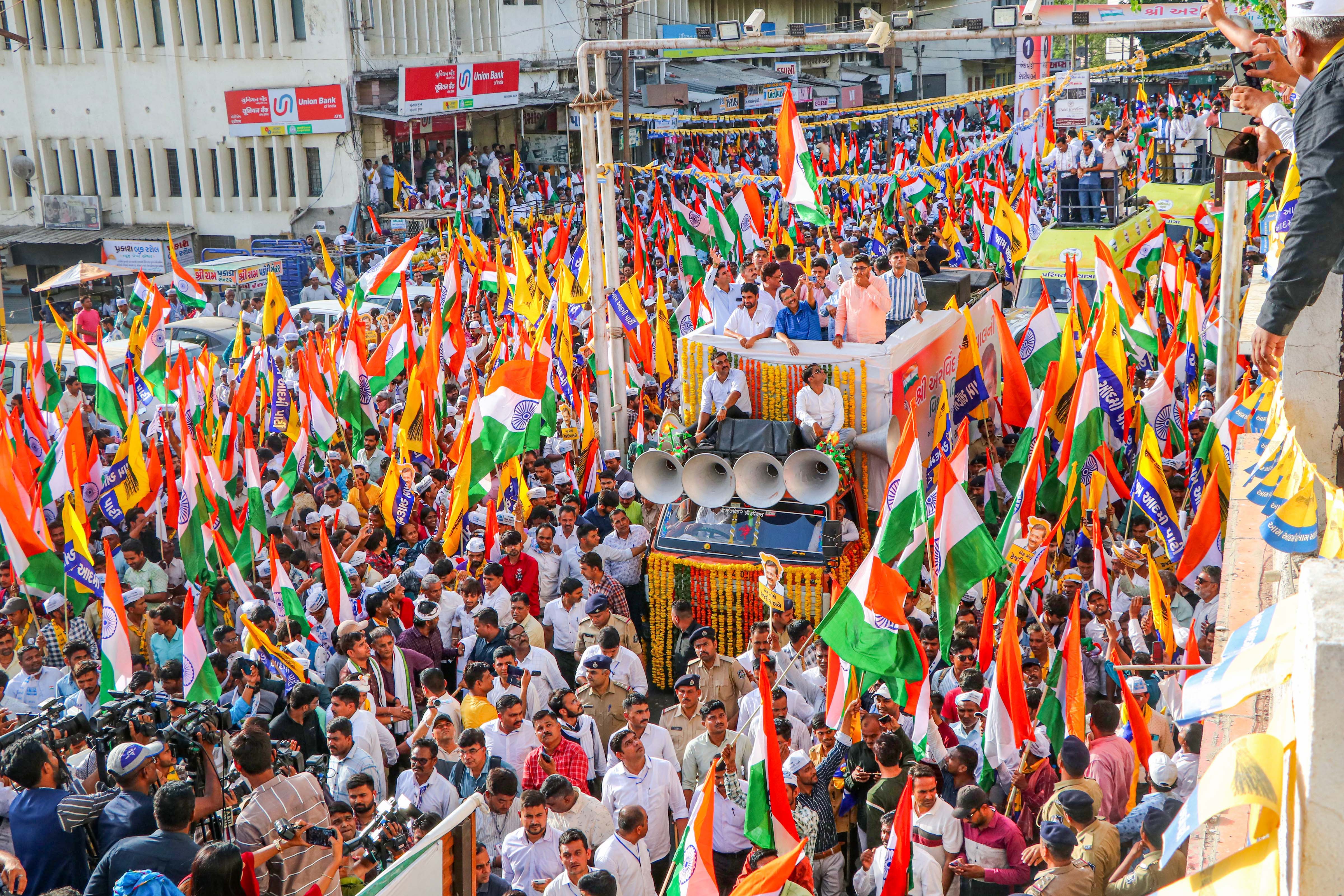
The elections are about two months away. Though its date has not been announced yet, the campaigning is well under way. Except Arvind Kejriwal, national Convener of the AAP, no big leader of other two main contenders, the BJP and the Congress, has yet paid election mode visits. Hectic strategizing, however, is on within the parties and moves are being changed given fluidity of the situation.

At this stage, the situation on the ground appears fluid in terms of voters’ preferences. As it would appear rather naïve to comment on what might be the final outcome, yet indicators are there pointing to emergence of a new set of political equations in the state’s bipolar politics. It appears this possible shakeup is directly linked to the entry of AAP and happening so is likely to dent the Congress more than the BJP.

Indeed, the BJP is quite well entrenched and the Congress not being viewed with enthusiasm, there is a perceptible public tilt in the favour of the AAP. This gain, being predicted to increase provided the party does not commit strategic mistakes, comes from its thumping electoral victory in March this year in Punjab and repeating the government in Delhi two years ago. Riding its soaring reputation as a party which brought in a people-centric model of governance, the AAP seems to be getting traction at least in a section of voters in the initial phase of its campaigning despite being a new entrant in the electoral politics of the state. The 17% vote share predicted in the recent C-Voter survey explains this.

“Among inequality-battered lower middle class, teeming millions of jobless youth and those perpetually subjected to deprivation who see any regime as the architect of their abject condition, there is always a search for an alternative. Given his unconventional politics, Kejriwal carries a trust among such disenchanted Gujarat voters. They feel here is the leader who can deliver. Like Delhi, the same feeling ran through the minds of Punjab voters. I think Gujarat will not be different. But, yes, Kejriwal is as robust a fighter as Modi. Both have uncanny skills in no-holds barred fight. The BJP has its match in this AAP chief “IITian” and former bureaucrat,” commented NK Singh, formerly Editor, ETV and national General Secretary, Broadcast Editors Association on why a section of voters is seen gravitating towards the AAP.

Switching loyalties before any election is a common feature.  Usually, this shifting is done not with any sense of commitment. And this is happening in Gujarat too. If this is any indication of which party is considered favourite, then the AAP seems to be scoring over others. For an election watcher, it is more of a case of perception than supported by any data yet this is a dominant perception here. However, the BJP cannot be dismissed as having no attraction for the turncoats. Contrary to the AAP and the Congress, none of constituency level former Congressmen-turned-BJPians this writer, during his recent visit to the poll-bound state, approached in Rajkot, Jamnagar and Jetpur areas for their views was ready to speak. This also lends credence to the perception, according to the rival camps, that there prevails an atmosphere of fear and intimidation which is being passed as the party discipline.

In the case of the BJP, it is believed they are welcomed into the party fold because of their utility in beating the strong anti-incumbency that it is facing. Another noticeable factor is that those leaving the Congress feel more comfortable being in the AAP than the BJP that is thriving mainly on its core agenda of “communal” politics. They are also a disappointed lot with the grand old party for being unsuccessful in replacing the BJP at the state’s power centre in the last more than 25 years. In the AAP, they see hope.

“Joining BJP is unimaginable for me for its communal politics and rampant corruption,” said Hardik Sonrat, a young businessman and social worker hailing from Gandhidham in Kutch district and a hotelier now based at Junagadh for a decade, who joined the AAP recently. He has been president of National Students Union of India (NSUI), a frontal organization of the Congress. He did college at Gandhidham and is an MBA from Symbiosis, Pune. He was vice-president, Gandhidham Taluka unit before joining the AAP. “Normally, business people fear getting openly involved in politics but I don’t have any fear,” he commented in the course of conversation on the plight of those running small and medium enterprises. He went on to add, “We want a change in the governance model and welfare politics like Delhi in Gujarat too. The AAP leadership would do well to announce tickets as early as possible and need to work more aggressively in the rural areas.”

Opinions, however, are divided at this stage on the chances of the AAP being able to form the government. Bimal Shah, former minister in the BJP government who left the party in 2017 and joined the Congress summarily dismissed the AAP chances. “The people have never accepted a third party,” he asserted while citing the fate of big leaders Keshubhai Patel, Shankersinh Vaghela and Chimanbhai Patel who had floated their own parties. This two-time BJP MLA from Kapadvanj constituency in central Gujarat predicted the AAP would not be able to secure more than 10% vote share.

It is being said that the Congress stands a chance if it plans well and executes it with full might. Its tally of 77 seats in the 2017 Assembly elections and restricting the BJP under 100 seats is being mainly factored in wherever its chances are being counted. “But this doesn’t seem the case unless it selects its candidates with proven loyalty credentials. Post 2017 elections, 21 Congress MLAs had defected to the BJP. The party has to be apologetic on this count and frame public-oriented policies to meet the new challenge posed by the AAP while approaching the electorate this time. Lack of a credible CM face is another area of worry,” said former Gujarat Chief Minister Sureshbhai Mehta who had led the BJP government in 1996.

Commenting on the AAP, the former CM observed this relatively new party has surely created a strong buzz in what he termed in local language as prajamanas or voters’ minds.  Like in the case of the Congress, much depends on its selection of candidates and the CM face. “With assured three-cornered contests in every constituency, the BJP calculations may go awry. In this scenario, it seems the BJP will not be able to secure a comfortable majority,” predicted the veteran politician.


Rahul’s Bharat Jodo yatra breathes new life into Congress

Though Rahul Gandhi keeps denying that he is leading the yatra and is only one among the 120 other Bharat Yatris who will walk the entire route, the Wayanad MP is the central figure of the foot march and is drawing a huge response from the public. A report by Amit Agnihotri

The Congress is upbeat over public response to the Bharat Jodo Yatra which started from Kanyakumari on September 7, saying the first month of the mass contact program had transformed the grand old party.

“One month of yatra has been nothing short of transformational politics. The public response in Tamil Nadu, Kerala, and Karnataka has exceeded our wildest expectations. It has been exhausting but supremely satisfying. A refreshed, revitalized Congress is emerging,” Congress communications in-charge Jairam Ramesh tweeted on October 8.

The 3,500 km Kanyakumari to Kashmir yatra will pass through 12 states and 2 UTs over 150 days. The mega foot march was planned at the party’s chintan shivir in May when around 400 leaders discussed and finalized a roadmap ahead of the 2024 national elections.

The main aim of the yatra is to connect with the masses and revive the party across the country after a series of electoral losses since 2014, when the BJP came to power at the Centre.

Though former Congress chief Rahul Gandhi keeps denying that he is leading the yatra and is only one among the 120 other Bharat Yatris who will walk the entire route, the Wayanad MP is the central figure of the foot march and is drawing a huge response from the public.

The Bharat Yatris, including Rahul, walk in the day in two sessions and spend the nights in fabricated iron containers mounted on trucks. Food is prepared at the campsite.

During the day breaks, Rahul meets groups of people from various walks of life and in the evening, he addresses party workers.

Besides the party workers, a large number of local residents too line up along the yatra route while some of them also get a chance to walk beside Rahul.

As the yatra progressed, Rahul came under attack from the BJP, which blamed the Congress leader for trying to break the country.

Rahul hit back saying the opposition party had to launch the yatra against growing economic inequalities, centralized politics and social polarization due to the Centre’s policies.

It was leaders of the Congress Party who fought the British, who spent years in jail. Mahatma Gandhi, Jawaharlal Nehru, Sardar Patel, all these people, gave their lives fighting the British. In my study of history, in my understanding- the RSS was helping the British. In my understanding, Savarkar used to get a stipend from the British and these are historical facts and these are not facts that the BJP can hide, right?,” said Rahul.

“The party that fought for independence and created a mass movement for independence, the party that helped bring the Constitution, the party that brought the Green Revolution, that’s the Congress Party and it is interesting that the BJP comes out with these comments. But, if you look at the historical truth, the BJP was nowhere to be found in the Freedom Struggle and the BJP is singularly dividing the nation and spreading hatred in this nation,” he said.

Why yatra?

According to the Congress leader, hatred was dividing the country while people wanted jobs and were tired of price rise. “Spreading hatred, dividing the nation are not things that help the nation. I would like to say that it is not just me doing the Bharat Jodo Yatra, there are now lakhs of people who are doing the Bharat Jodo Yatra,” said Rahul.

“So, this is not just the expression of the Congress Party, this is the expression of the people of India. The people are tired of the type of politics that is being done. They are tired of the price rise,” he said.

The former Congress chief denied that the objective of the yatra was the 2024 national polls. The objective I have stated again and again is to bring India together. Objective from my perspective is not the 2024 elections,” said Rahul.

“Bharat Jodo Yatra is aimed at raising three fundamental issues that are interconnected. The first issue is the violence, the hatred, that the BJP and the RSS are spreading, the division of the country that they are carrying out. The second issue is the massive concentration of wealth that they are enforcing, allowing it to happen. This is resulting in a few people getting very, very rich and the destruction of the backbone of India’s economy- small and medium businesses and farmers and that are in turn resulting in a collapse in employment. So, India is heading towards an unemployment disaster. The third reason is the massive increase and unrelenting rise in prices. This is why we are doing the Bharat Jodo Yatra,” he said.

According to Jairam Ramesh, a new Rahul is emerging from the yatra as the Congress leader had shown strong resolve to continue the foot march despite the grueling schedule. “Men and women, young and old and children walk beside Rahul at different stretches. The yatra has changed perception about him,” he said. Rahul noted that the BJP was spending crores of rupees to project a certain image of his but said he would go with the yatra.

Penance

The former Congress chief noted that the yatra was like a penance for him personally. “I believe in ‘Tapasya’, that is my nature, that is my family’s nature has always been and so I wanted an element in this communication with people, I want an element of suffering for myself. I didn’t want it to be easy and so I thought okay, what would be something that would make me suffer. So that while I am talking to my people, I can share in their suffering a little bit. That was the idea. So, I find that to be a very powerful experience. When you are walking on the road and you are speaking to your people, after having suffered a little bit, not much, not as much as many of them do, the communication is better,” Rahul said.

The past one month had been a learning experience, said the Wayanad MP, adding that he was able to see the advantages of holding direct communication with the people. “For me, it has been a learning experience. Frankly it hasn’t even begun yet, to be honest with you, 31 days, it is nothing. For me, it is 31 days, so it is not really big. I can already see the advantages of this type of communication. Also, I can see the thing that is most beautiful and powerful for me and I don’t mean this with disrespect. There is a lot of dishonesty in this, when I am speaking in those cameras, behind those cameras there are interests. They will distort what I am saying, automatically, even when you don’t want to do it, they will do it. That is a much more truthful conversation, and cannot be distorted. I am finding that quite a beautiful experience also the thing I am realising which I always believe, what is becoming crystal clear to me. Two things, one is, there is tremendous wisdom in our people, huge wisdom that is wasted by the type of politics, by the type of system that we are running,” said Rahul.

“I am getting support from individuals that are much more powerful than 500-1,000 people, what they are saying to me, how they are transmitting it to me, how they are telling me their stories, that to me is a huge amount of support,” he said.

Sonia joins yatra

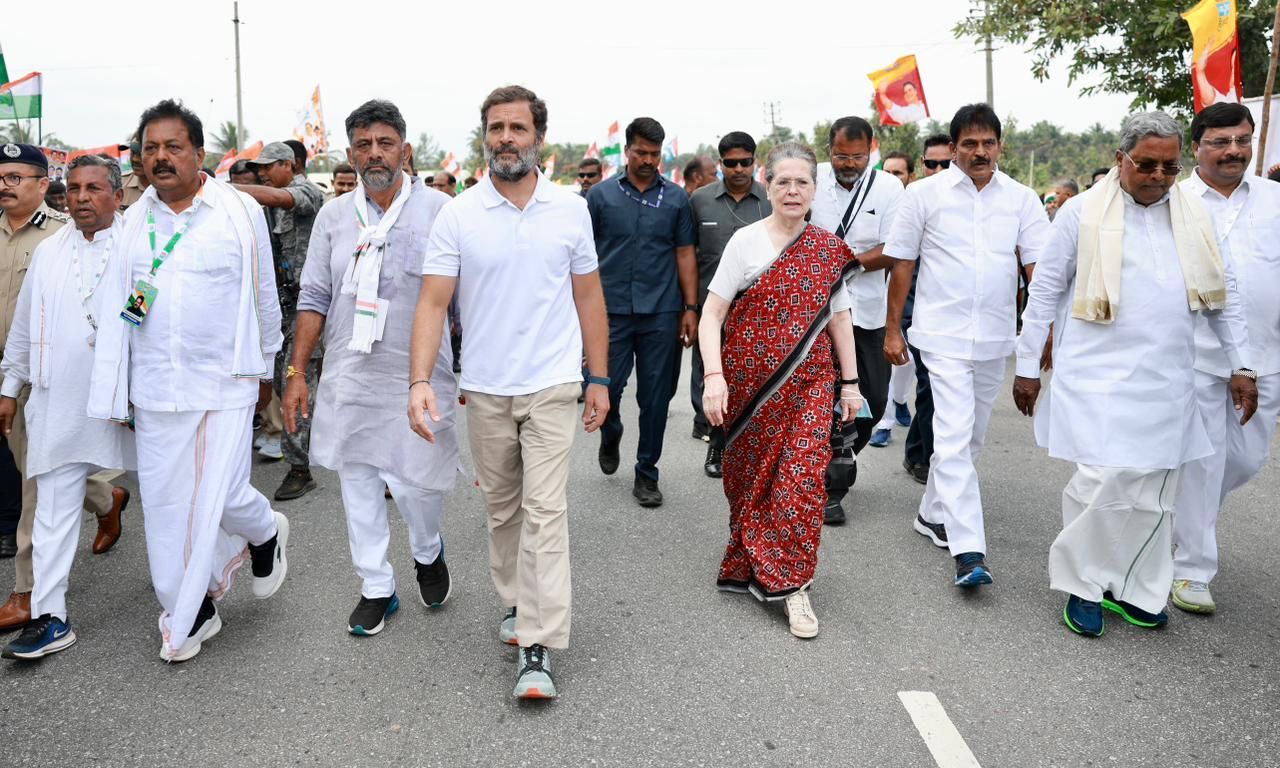
Congress chief Sonia Gandhi joined the yatra at Mandya in Karnataka, which will have assembly polls in 2023, and walked beside Rahul for a while. Though she was to join the yatra for half an hour, she spent around two hours with the foot march. Later, pictures of Rahul tying Sonia’s shoe laces during the yatra went viral. Ahead of Sonia’s visit, Rahul visited a road constructed by the party in Badanavalu in Karnataka which brought together two communities separated for long.

Mini yatras

The initial public response in the southern states of Tamil Nadu, Kerala and Karnataka prompted the Congress to launch similar yatras in states like Assam, West Bengal, Odisha, Bihar and Jharkhand, which were not included in the national route. Gujarat and Himachal Pradesh were excluded from the nation route as the two states will have assembly elections in November.

While the yatra was still in Karnataka, national coordinator Digvijay Singh and Jairam Ramesh reviewed plans for neighboring Telangana and Andhra Pradesh, where the party was once strong.

Congress president polls

While the yatra was gaining traction among the people, the party was also being talked about over the presidential elections on Oct 17 to elect a new party chief. The contest is between senior leaders Mallikarjun Kharge and Shashi Tharoor. The polls are happening after Rahul Gandhi refused to file his papers, paving the way for a non-Gandhi party president after 24 years. However, leaders like Digvijay Singh and P Chidambaram noted that irrespective of who became the next Congress president, Rahul would continue to be the undisputed leader of the grand old party.

Ramesh said the main focus of the entire Congress was on the yatra which was setting a new political narrative in the country as both people who appreciated the effort and those who did not were talking about the mass contact program.


Cong President poll: A circus or a strategy?

Irrespective of the poll results or the fact that a non-Gandhi will take over the reins of the party, it is clear that the remote control of the party will remain in the hands of the Gandhis. 

To detail present events, it is imperative to dig into History: the History of a 100-year old Party, currently facing a crisis.

It would be incorrect to say that this is its worst crisis because the way things are unfolding it is difficult to say whether the worst has already happened or is yet to come.

Delving into pages of the Congress’ History and the one-family stranglehold over it, one can begin with Motilal Nehru whose moment of happiness was to see his son succeed him as Party President. If some were taken aback by these developments, others were critical of Mahatma Gandhi’s preference for Jawaharlal over Sardar Vallabhbhai Patel.

If media reports of the time are anything to go by, apart from being “odd for a son to succeed his father”, there was angst that Patel’s contribution had been overlooked.

Reports have it that Jawaharlal Nehru’s mother Swarup Rani too reached out to Gandhi to push for her son: “Motherly love” as a few insiders chose to describe the intervention of Jawharlal’s mother.

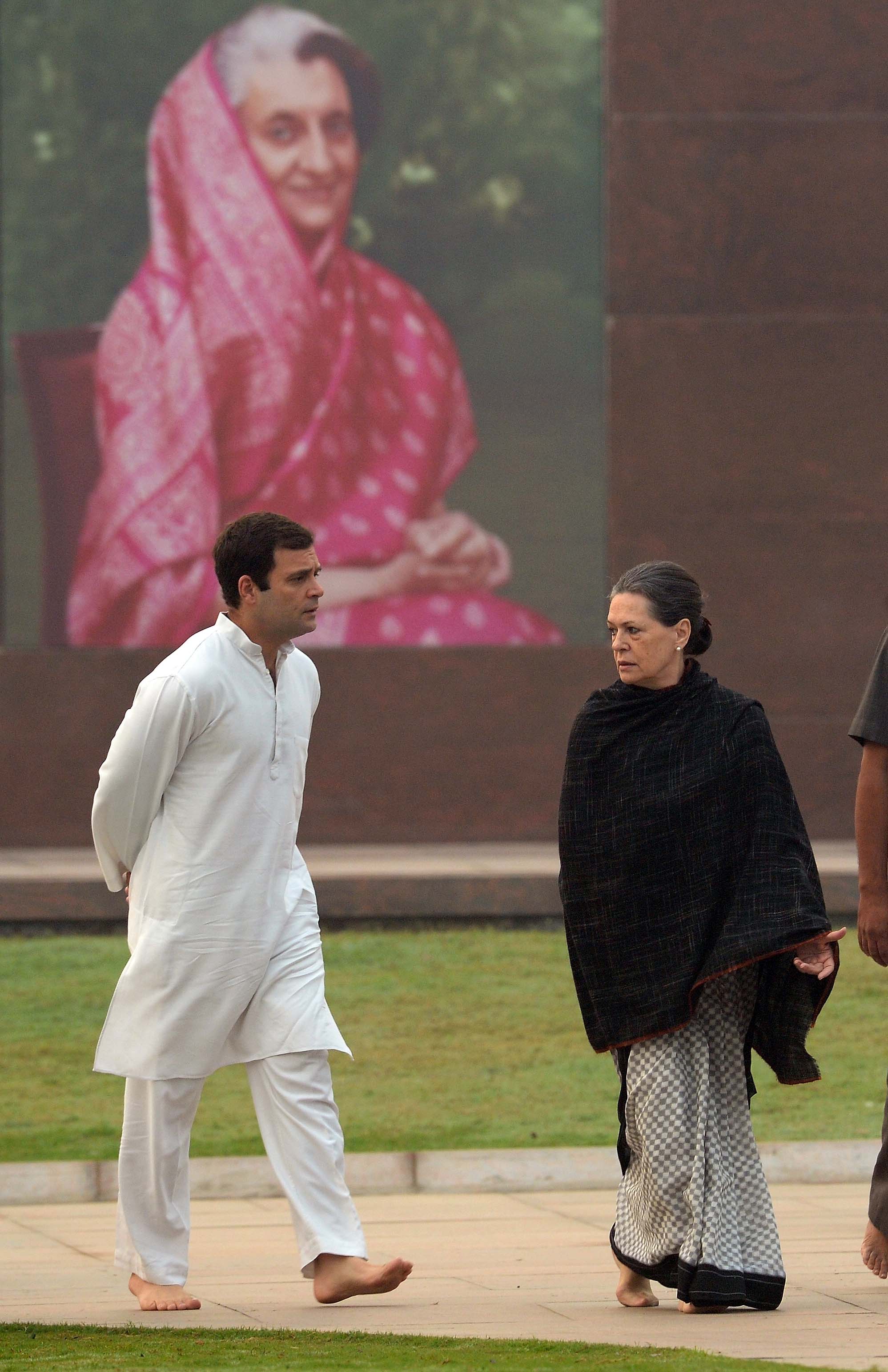
What was then considered “odd” later became a norm: a done thing as it were. As also “motherly love” be it Indira Gandhi’s for her sons, Sanjay and Rajiv in that order or Sonia Gandhi’s for Rahul.

That Indira Gandhi was grooming Sanjay as her political heir is well known. Equally, Sonia Gandhi, too, would give her right arm to see her only son plunge deep into politics.

Except that Rahul, like his father, Rajiv Gandhi, is not interested. Neither is he cut out for it.

But then neither was Sonia Gandhi but once there, she adapted to it as few would. And call it what you will, “motherly love” or a “son syndrome” she will do what it takes to ensure that Rahul Gandhi remains centre-stage.

After Rajiv Gandhi’s death, Sonia shut herself out from the world. She also shunned every offer to take over from where her husband had left off. For seven long years after her husband’s death, she kept away from active politics

Yet, once she took the plunge, she steered the Party as its longest serving President between 1998 to 2017. After that she did take a back seat leaving the stage for her son who is a one step forward and two steps back kind of a politician.

If his recent Bharat Jodo yatra is a step in the right direction, his sudden vacations have shown him up as a non-serious player in the 24×7 business of politics.

When it came to the Party and his steering it as President, Rahul gave up within two years. This led his mother to fill in as interim President even while she made it known that this is a stop gap arrangement.

But rumblings, rebellion and exodus of senior leaders forced their hand to alter the status quo. The demand for organizational elections grew by the day and the Gandhis were left with no option but to give the go-ahead for Party elections.

And with this began the circus. The first to throw his hat in the ring was Thiruvananthapuram MP Shashi Tharoor. Soon after Rajasthan Chief Minister Ashok Gehlot, till then a trusted aide of the Gandhis, followed suit.

Significantly, both contenders met Mrs Sonia Gandhi before making their intent public.

Speculation was rife about who the Gandhis would ultimately bless or “allow” to remain in the fray, despite Sonia Gandhi’s claim of remaining neutral.

From the look of the things, it appeared that Gehlot was the frontrunner given that he, more than Tharoor, was counted among the loyalists.

Tharoor, it may be recalled, was part of G-23, a group of senior leaders of the Congress who had demanded reforms in the Party.

All looked good till Gehlot’s supporters messed it up. They raised a banner of revolt and refused to back the High Command’s choice of Gehlot’s successor as Rajasthan Chief Minister.

Public embarrassment apart, the revolt also sent a message that the Gandhis were losing control over a Party that till recently was in their grip.

Sonia Gandhi was miffed and understandably so. Gehlot opted out of the race.

Enter Digvijay Singh and another act played out, with him pulling out within a day of announcing that he will contest. Like most, Singh had not bargained for Mallikarjun Kharge to step in.

But once Kharge did, it was clear that he had the support of the powers that be. In other words, Kharge, was unofficially the “official” candidate.

Even while battlelines were drawn in the “friendly match” as Congress leaders chose to describe the contest, it was clear that Kharge was Gandhi’s own and in that sense the frontrunner.

Irrespective of the results or the fact that a non-Gandhi will take over the reins of the Party, it is clear that the remote control of the Party will remain in the hands of the Gandhis.

This despite Rahul Gandhi’s assertion that the new President will have a free hand. That there is a gap between what is said and what happens is well known.

That apart one cannot fault the Gandhis for wanting to have a say in the way the Party functions given that the family has had a hold for years on end. Also, their larger-than-life persona would loom over the incumbent.

Under the circumstances, the obvious question one would ask is: why this shadow boxing and not leading from the front? Why the reluctance to take things head on?

Rajiv Gandhi downwards, reluctance is the hallmark of the Gandhis. While much of it is inherent, part of it is staged.

On their own, Rajiv, Sonia and Rahul would keep away from politics unless pushed. But this also works as a strategy because it shows them up as people who are neither interested in power or position. This works well because Indians being sentimental as they are, anyone who shuns power is hero worshipped.

For instance, the people of India never forget to mention Sonia Gandhi’s “sacrifice” and her turning down the offer of being Prime Minister of the country when it came on a silver platter. On that score, Rahul Gandhi’s reluctance to take over as President fits the bill.

Refusal has another advantage: it gives the Gandhis power without accountability. In this context critics cite the example of Sonia Gandhi being the power behind Prime Minister Manmohan Singh’s throne.

History, they feel, will repeat itself in case of the Congress chief too. That said, it is clear that between Kharge and Tharoor, the octogenarian is a better bet and would perhaps be more pliable than Tharoor who would like to carve his own niche.

Also, his wooing the young, like he has made amply clear he would, could cast a shadow on Rahul and interfere with a constituency that Rahul would wish to influence.

Another advantage of refusing to be President leaves enough time for Rahul Gandhi to build himself and connect to the nation instead of spending time in the nitty gritty of Party affairs.

The reported success of Bharat Jodo Yatra demonstrates that Gandhi scion coming out on the street and rubbing shoulders with commoners could pay dividends and shape him up as one who could be a contender for playing a national role in the future.

Whether that happens or not only time will tell but being visibly out of the scene and yet being deeply entrenched in the goings-on without responsibility is, politically, a good strategy.


BJP’s quota carrot for J-K Paharis may cut both ways for the party

The big take-away from Home Minister Amit Shah’s J-K visit was his public mobilization around the idea that Kashmir after the withdrawal of its special constitutional status was better than before. To this end, his two rallies in the UT were a roaring success. A report by Riyaz Wani

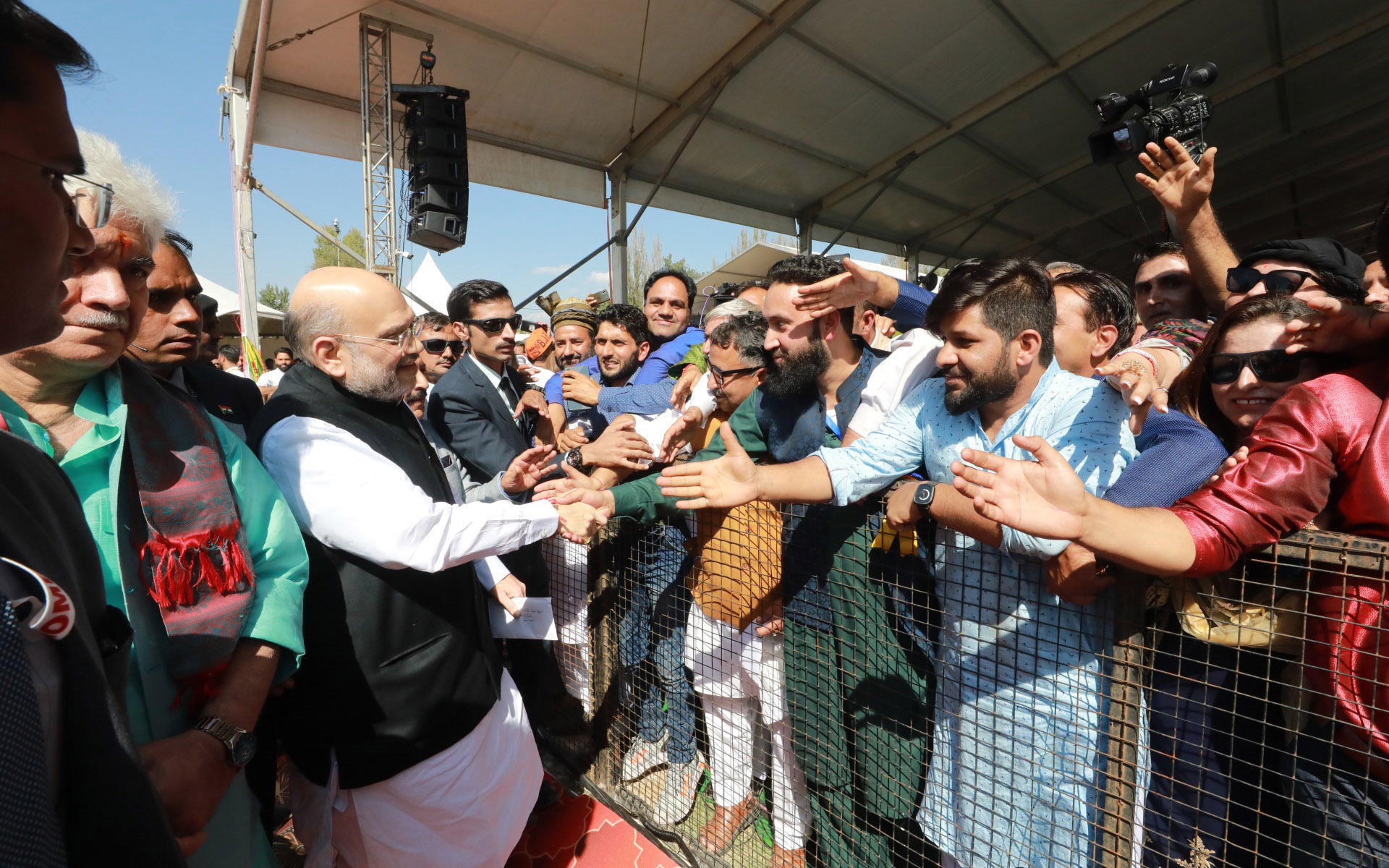
 As the high-profile ministerial visits from New Delhi to Srinagar go, the Union home minister Amit Shah’s October 4-5 visit to Jammu and Kashmir can be considered very successful.  During his stay, the union minister reviewed the security situation and addressed two rallies, one at Rajouri in Jammu and another at Baramulla in Kashmir Valley. He also launched development projects in both regions. The security meeting on October 5 was attended by Lieutenant Governor  Manoj Sinha, the National Security Advisor, Ajit Doval, top officials of the army, paramilitary forces, state police, and civil administration. The meeting took stock of the working of the security grid and the various actions being taken to reduce the incidents of terrorism over the last few years.

During the meeting, Shah directed the security forces to strive to make the border and the Line of Control impregnable to achieve peace in Kashmir. He also asked the Army and the police to make “coordinated efforts through meticulous and well-planned counter-terrorism operations to wipe out terrorism.”

The cases registered under the UAPA were also reviewed and it was stressed that the investigation should be timely and effective.

“Terror eco-system comprising elements that aid, abet and sustain the terrorist-separatist campaign to the detriment of the well-being of common man requires to be dismantled,” said the union home minister.

Two rallies

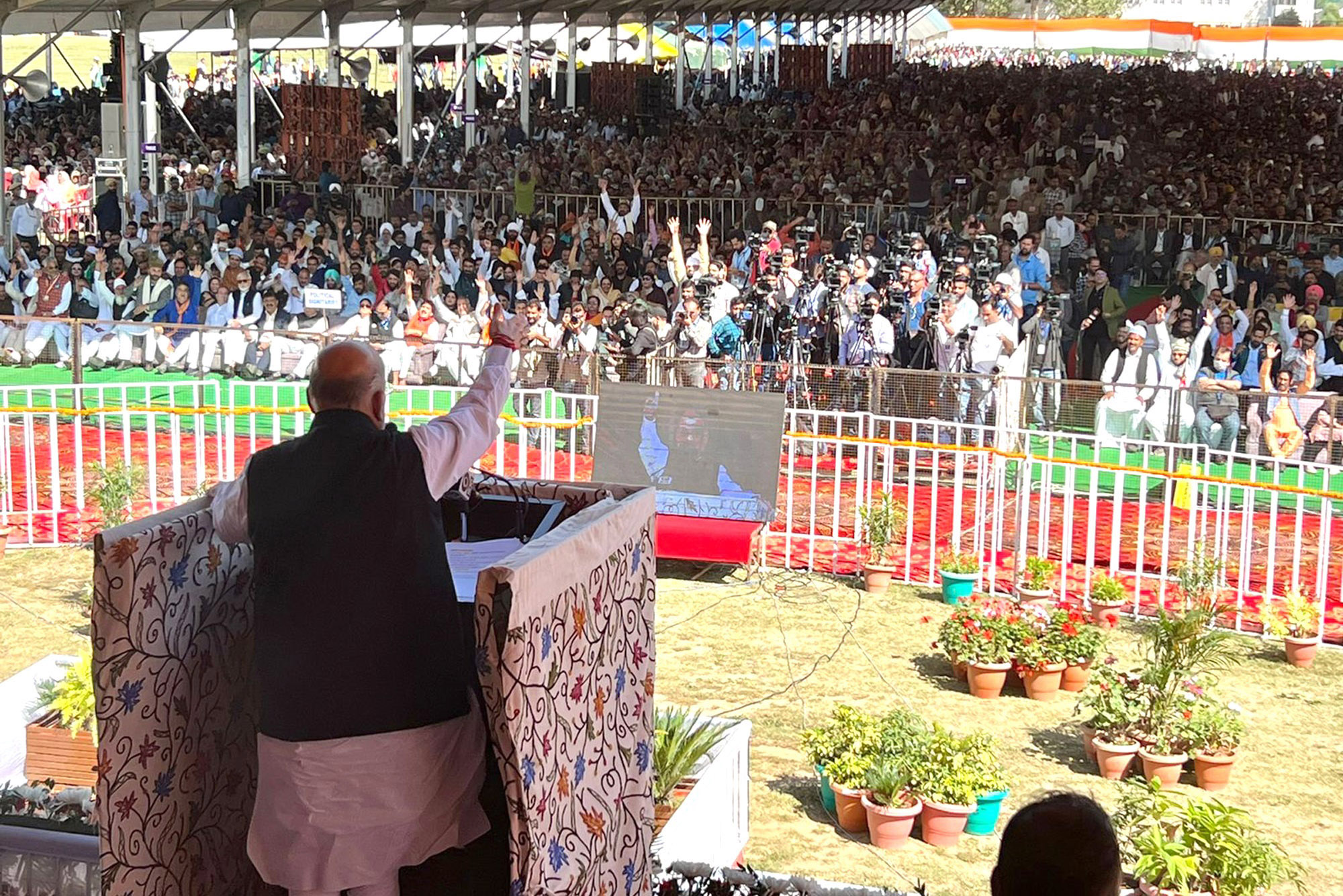
The big take-away from the Shah’s visit was his public mobilization around the idea that Kashmir after the withdrawal of its special constitutional status was better than before. To this end, his two rallies in the union territory were a roaring success, and not necessarily because they were well-attended. Over ten thousand people attended the Baramulla rally,  which was unusual and unexpected for a BJP leader, otherwise perceived to be working against Muslim interests – more so in Kashmir. This, despite the fact that Baramulla town where the rally was held was under siege for the entire day. The shops weren’t allowed to open, and the traffic couldn’t pass. No traffic was also allowed on the Srinagar-Baramulla highway.

This, however, didn’t detract from the significance of the Baramulla rally.  It was once unthinkable that a rally of this size could be held by a top BJP leader in a north Kashmir town, once roiled by militancy and conflict. Shah made most of it by training guns at the three families – Abdullahs, Muftis and Gandhis – who, according to him, have ruled and ruined Jammu and Kashmir over the past seven decades. He asserted that Naya Kashmir, forged after the erasure of the special status, was a far better place than the earlier, counting the reduction of violence, investments in development projects, and the resurrection of tourism among the BJP government’s achievements.

Shah’s claims were reinforced as the two-day visit went incident-free. In the run-up to the visit, however, there were a few incidents of violence in Jammu, including the blast on passenger buses and the killing of the DGP Prisons H K Lohia, the latter termed by the police as a crime not related to terrorism.

Outreach to Gujjars, Bakerwals, and Paharis

The home minister’s visit was marked by outreach to the Gujjar, the Bakerwal and the Pahari communities. Shah announced the implementation of the Scheduled Tribe (ST) status for economically disadvantaged communities. Addressing the rally at Rajouri, the home minister said that minorities and Dalits living in the Union Territory would not have gotten reservation rights if there was no abrogation of Articles 370 and 35A in 2019. And in Baramulla, he reiterated the reservation promise to the three communities. The ST quota in J&K carries 7 percent reservations in government jobs and educational institutions.

The decision to give reservations to the communities is seen as a clever pre-poll gambit by the BJP. Gujjars, Bakerwals, and Paharis comprise 40 percent of the population in border districts. And if the gambit succeeds as looks likely, it could persuade a large section of these tribal communities to vote for the BJP, further ensuring its victory in the Jammu division and also enabling the party to make some inroads in Kashmir Valley.

Eight assembly seats in the Rajouri and Poonch districts of the Jammu division are decidedly influenced by the Paharis, the Gujjars, and the Bakerwals. For any political party hoping to form the government in J&K, where elections are likely to take place toward the end of the year or early the following year, these seats are crucial. If the BJP wins these seats, it can hope to sweep the Jammu division with 43 seats, fortifying its chances to form a government with support from a Kashmir-based party.

There is a catch here though: Gujjars and the Bakerwals already have ST status, enjoying it since 1991, so they are worried about the dilution of their Scheduled Tribe (ST) quota, with Paharis also partaking in the pie. And as a result, the BJP may not end up benefiting to the extent it expected.

No dialogue with Pakistan 

The home minister once again refused to start a dialogue with Pakistan, saying instead he would prefer to hold talks with Gujjars and Paharis and also with the youth of Kashmir. This has made the chances of any re-engagement between the two neighbours in the near future look very bleak.

This is the second time that the home minister has rejected the possibility of a dialogue with Pakistan over the last year – earlier he had ruled out any such possibility during his visit to the union territory in October 2021. The statement once again confirmed that India has taken Kashmir off the table in any future engagement with Pakistan.

The removal of Article 370 in August 2019 and the subsequent measures have fundamentally altered the ground situation in Jammu and Kashmir in most of its aspects, changing the complexion of the Kashmir issue as it existed before. The home minister’s well-attended rally in Baramulla was a testament to this reality.

Still, the statement appeared strange considering the two countries had engaged informally for months after the revocation of Article 370. The back-channel talks were reported to have begun in November 2020 and by February 2021, the two countries had reinstated the otherwise defunct 2003 ceasefire along the Line of Control. The truce was marked by a brief spell of bonhomie. Both the then Pakistan prime minister Imran Khan and the Army chief General Qamar Javed Bajwa called for dialogue and resolving Kashmir in a peaceful manner.

But as the home minister’s statement makes it clear, there has been no progress on the back-channel making it difficult for the two neighbours to move to the front-channel.

Meanwhile, the home minister’s visit has almost sounded the election bugle in Kashmir. His outreach to the tribal communities has signalled that elections could likely be held after the revision of electoral rolls is complete. So, the elections can be held anytime towards the end of this year or early next year.


MOST POPULAR

HOT NEWS