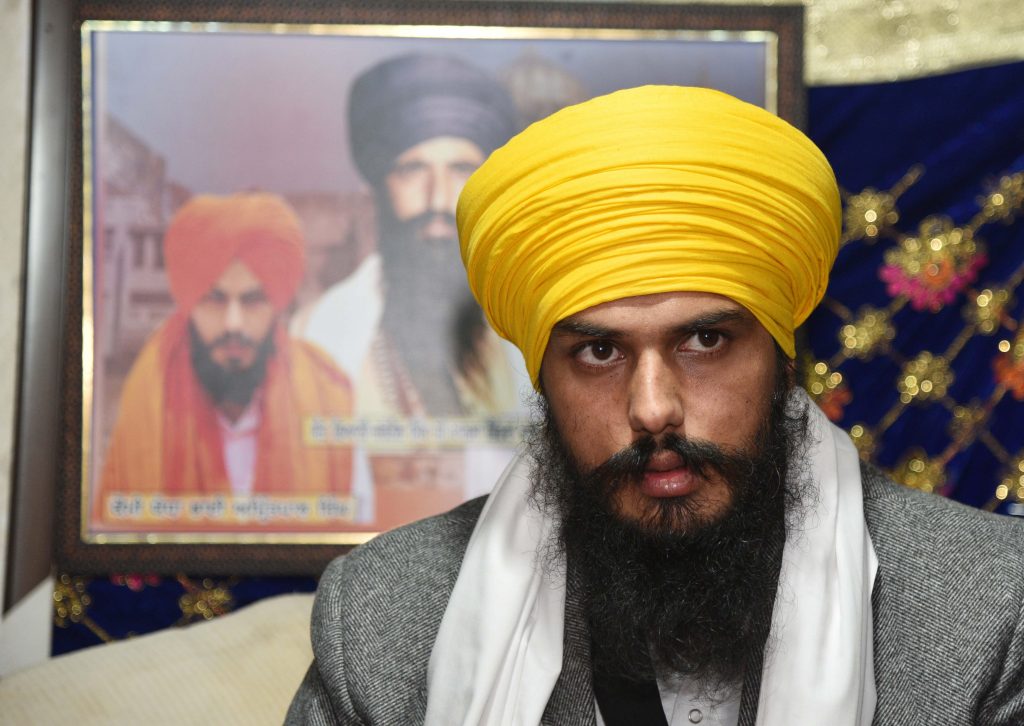
Khalistani separatist Amritpal Singh took the Punjab scene by storm in a matter of months after returning from Dubai, where he drove truck to make a living, writes Aayush Goel
No one had even heard about Amritpal Singh, the 30-year old Khalistani separatist, till a year ago but today he has rattled the state of Punjab. Amritpal, a declared fugitive, is not just challenging the might of the state but has also brought back traumatic memories of the reign of Jarnail Singh Bhindranwale and the spectre of Khalistan into Punjab.
Amritpal had set up a nascent militia called Anandpur Khalsa Fauj (AKF) that had been imparting “weapons and martial” training to youths. The investigations brought to fore videos of his new army practising shooting in addition to pictures of the emblem, logo, and currency bills of the proposed Khalistan state, and a hologram logo of AKF and its members with weapons. All this is in addition to getting terror funding from organisations like ISI as Amritpal Singh transformed from a state nuisance to a national threat.
Punjab, still scarred by a decade-long insurgency in the 80s is in no mood for encore and is out cracking on the self-styled Sikh separatist and his outfit, Waris Panjab De. Fanatically searching for him after he gave them a slip during a Bollywood style chase on March 18, Punjab police had picked up around 353 people across the state leading to panic. According to Punjab DGP Gaurav Yadav, 197 people out of these have so far been released while seven, including Amritpal, have been detained under the stringent National Security Act (NSA). NSA, 1980, empowers the central and state governments to detain an individual “to prevent him/her from acting in any manner prejudicial to the security of India, the relations of India with foreign countries, the maintenance of public order, or the maintenance of supplies and services essential to the community if it is necessary so to do”.
The family however strongly believes he is in police custody, “We are not sure as to how they will show him to the public but we just hope they don’t make a mockery of him. We don’t believe the series of videos they are releasing,” Amritpal’s mother Baljinder Kaur told media persons recently. Amritpal has become the most wanted criminal in the country. According to CCTV footages recovered and released by Punjab police he has travelled across several districts, switching vehicles and changing appearances, before he reportedly crossed over to adjoining Haryana and Uttrakhand. The man hunt is now country-wide.
Cat-and-mouse chase
Punjab woke up to tense environs on March 18 with news and reports of a major drama in the cat-and-mouse chase between the Punjab Police and Amritpal Singh in Jalandhar. The chase which included around 100 police vehicles went on for hours and he was almost caught but managed to give the cops a slip. He changed vehicles to dodge the police and also dumped his mobile phone during the chase. Soon, reports led to the rumours of him being arrested and plans of his illegal encounter started doing rounds and the state saw internet suspension for almost three days in the majority of areas. In no mood to let any speculation, opinion or rumour affect their operations or create unrest, the state machinery in an unprecedented move went ahead getting social media accounts, including those of a few journalists, suspended.
Jalandhar DIG Swapan Sharma revealed that they missed Amritpal Singh by a whisker as he changed his routes several times during the chase and reached a one-lane link road of 12 to 13 km. There were six-seven motorbikes into which Amritpal Singh’s car crashed, probably helping him to escape. Some riders were to divert the cops. Police however managed to pick up his aides across the state. The Punjab and Haryana High court called Amritpal’s escape an intelligence failure raising questions on the 80,000 strong team of Punjab police.
The making of Amritpal
Right after he went on the run following a police crackdown, old pictures of Amritpal Singh, the self-styled pro-Khalistan preacher, surfaced on social media. The 30-year old could be seen in a T-shirt with short hair and well-trimmed beard. Nobody could ever imagine or predict that this man would in a matter of months shake the entire nation. Amritpal was born in Jallupur Khera village in 1993 in Amritsar, nine years after separatist leader Bhindranwale, on whom he modelled himself, was killed in the Operation Blue Star. Singh had left India in 2012 to join his uncle in Dubai and worked as a truck driver there.
The man was first heard of in 2022, when on his return he was anointed the head of the Waris Punjab De, the outfit founded by Deep Sidhu, who died in a car crash last year. Sidhu, a Punjabi actor, had shot to fame for hoisting a religious flag on Red Fort during farmers’ protest. The investigations however reveal that Amritpal reportedly chose to form ‘Warris Panj-Aab De’, similar to ‘Waris Punjab De’ to ride on the late actor’s popularity after the radical preacher failed to take control of the existing outfit. He had demanded control but when Sidhu’s family refused, the new organisation was formed , which led to confusion on social media.
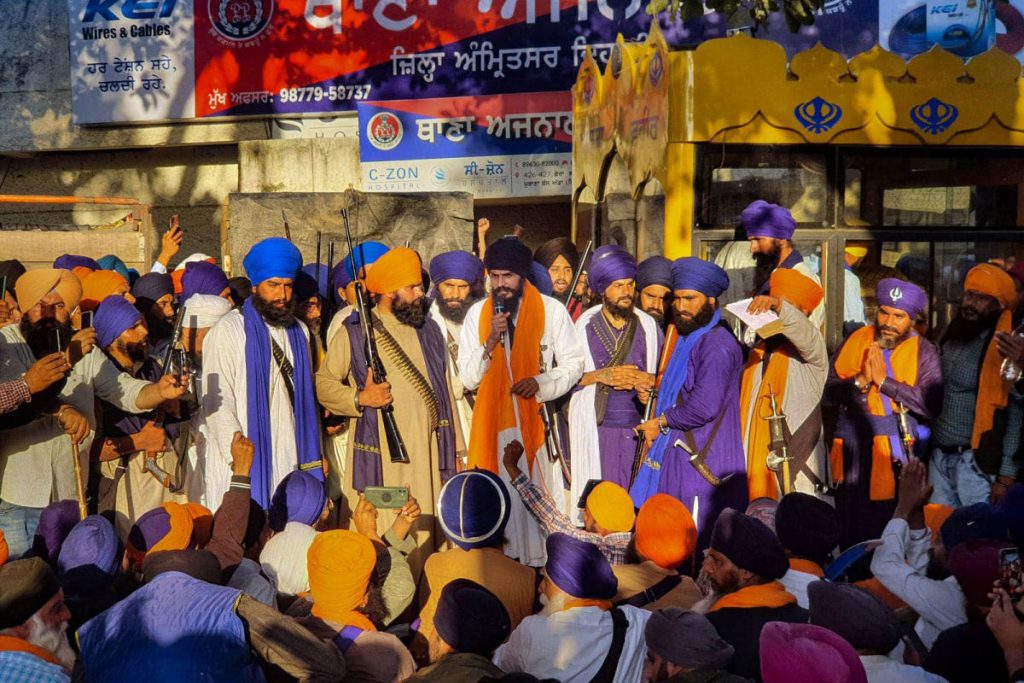
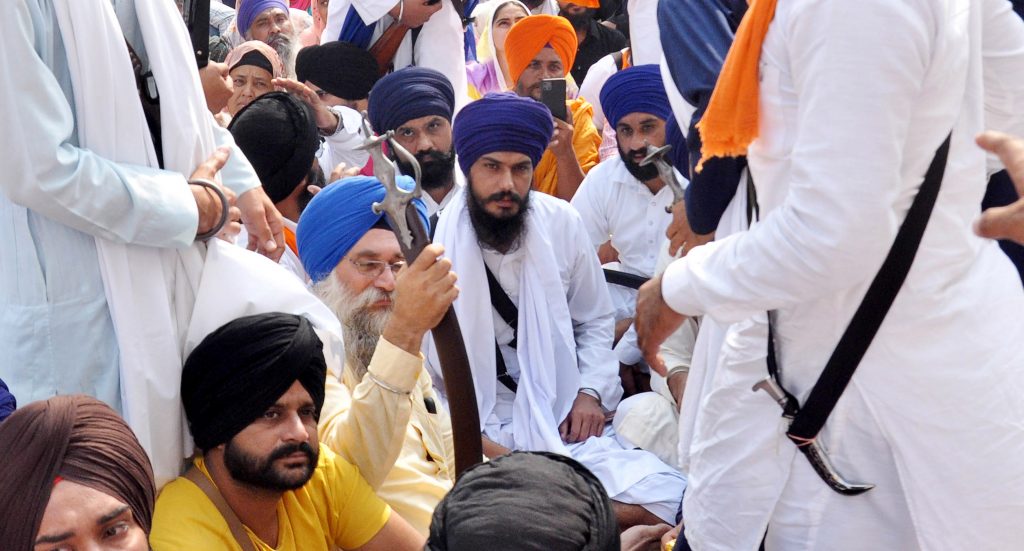
Amritpal however reached heights of notoriety with the infamous Ajnala police station attack. On February 23, a huge mob belonging to Waris Punjab De amassed in front of a police station in the town of Ajnala demanding the release of a member of their organisation, who had been booked and arrested. Armed with sticks, swords and guns, they attacked the outnumbered cops and managed to have their man released from police custody. The incident turned Amritpal into a separatist hero overnight as he had orchestrated the entire attack. He was on the media’s top list and became a self-assumed Sikh spokesperson demanding a separate nation.
The king makers
Amritpal was not a lone wolf but it was a team of Deep Sidhu loyalists who made him what he was. From managing funds to training AKF, these five close associates of his are currently in police custody and booked under NSA. The first on the list of kingmakers is Harjit Singh, Amritpal’s uncle. He landed in India in August last year and joined his nephew as manager and in charge of Amritpal’s finances.
Punjabi actor Daljeet Kalsi, also known as Jeet Kalsi, was originally associated with actor-turned-activist Deep Sidhu. Kalsi was pivotal in handing over the outfit to Amritpal. He reportedly arranged foreign funds for Amritpal and investigations revealed that he had so far garnered Rs 30 crores for him. Gurmeet Singh Bukkanwal was also a former associate of Deep Sidhu who joined Amritpal. He was made the Waris Punjab De in-charge for Moga. Basant Singh Fauji, another former associate of Sidhu, was Amritpal’s bodyguard and in-charge of de-addiction centres.
Bhagwant Singh alias Pradhanmantri Bajeke was a “outspoken Sikh radical” who was using social media to air his views about various Sikh issues using the term ‘Pradhan Mantri’. Besides several sections of the Indian Penal Code (IPC), the police have invoked the NSA against Amritpal and his five associates, who have been arrested and sent to Dibrugarh jail in Assam. The latest to join the list of close aides is Tajinder Singh Gill alias Gorkha Baba who was security in-charge of Amritpal. He got close to Amritpal when he got himself admitted to the drug-addiction centre at Jallupur Khera. He was arrested by Khanna police and his mobile data left the entire country stunned. There were videos of Amritpal’s private shooting range and an army in making along with insignia of his dream country.
Mann, Amit Shah team up
The Amritpal crisis emerged as the biggest challenge for the first time in Punjab’s Bhagwant Mann-led AAP government. Working around healthcare and education for a year, the government was thrown to deal with extremism. The crisis forced the political rivals at centre and state to come together. Bhagwant Mann’s meeting with Amit Shah had raised many eyebrows as it was followed by deputing of central forces in state.
“I will not let our youth become raw material for ‘factories’ opened in the name of religion. It is my duty to maintain peace and harmony and brotherhood in Punjab. I will fulfil it. I will continue to do so. Punjab will not become Afghanistan,” said Bhagwant Mann.
Delhi Chief Minister and AAP supremo Arvind Kejriwal lauded the ‘tough steps’ taken by the Punjab government to maintain law and order. He said, “We are patriots. We love Bharat Mata and no one will be spared if they take steps against the country or try to disrupt the peaceful atmosphere.” The opposition parties, including the Shiromani Akali Dal (SAD) and the Congress however slammed the AAP-led state government for the botched operation. Pratap Singh Bajwa, Congress leader, who is the Leader of the Opposition, said “Bhagwant Mann has acted as a pawn in the hands of the Central government. An attempt is being made to take the entire community back to the 1980s and 1990s. They could have caught him anytime from his house in Amritsar but they created ruckus in Jalandhar for forthcoming Lok Sabha by-elections.”
Describing the arrests as extra-constitutional, the SAD chief Sukhbir Badal said in a statement, “It was shocking that scores of youth were being arrested indiscriminately merely on suspicion.” He said on Twitter, “Unity and integrity of India is non-negotiable. Akali Dal strongly condemns divisive forces attempting to create communal disharmony and destabilise Punjab.” The SAD has also offered legal assistance to the arrested Sikh youths.
Protests held abroad
Out to create a flutter and garner support for Amritpal, some pro-Khalistan supporters held demonstrations in the UK, the US, Australia and Canada. The protestors have not just been shouting slogans but vandalised embassies and tried to hoist Khalistani flags there. Sections of media too have been harassed at these sites. The protest in the UK resulted in a diplomatic row, prompting the Ministry of External Affairs to summon the senior-most UK diplomat in New Delhi as the Ministry strongly disapproved of “separatist and extremist elements” replacing the Tricolour at the Indian High Commission in London with their flag.
In a clear case of retaliation, the security agencies removed the barricades around the British High Commission in Chanakyapuri in New Delhi and the residence of UK High Commissioner Alex Ellis. Similarly, a group of pro-Khalistan protesters damaged the Indian Consulate in San Francisco and another group staged a demonstration outside the Australian parliament in Canberra. The protests however have failed to gather any sympathy for Amritpal but have added strength to Sikh determination against Khalistan or similar extremism.
Khalistani groups on foreign shores have upped the ante after the Punjab Police launched a crackdown on Amritpal Singh and the other members of his Waris Punjab De group
In recent times, Khalistani groups have been upping the ante both in India and outside, particularly in the United Kingdom, Australia and Canada. Earlier, the hotspot for anti-India activities was mainly considered to be Pakistan and this neighbouring country was squarely blamed for the rise of Waris Punjab De chief Amritpal Singh, a Khalistan sympathiser and a fugitive now.
Outside India, diplomatic missions have been attacked, including most recently in London and San Francisco. Many Hindu temples have been vandalised in Australia and elsewhere. Sikhs currently account for around 1.4% of Canada’s population, or about 500,000 people.
Khalistan is the name of the state some secessionist groups propose to set up by carving out areas of India where the Sikh religion is in the majority. Some Sikh separatist outfits have been increasing their presence and influence in places like Canada, the UK and the United States, which have sizable Sikh diaspora. The genesis of the problem is that the banned terrorist organisation, Sikhs for Justice, is conducting a so-called “Referendum 2020” amid a crackdown on pro-Khalistan leader Amritpal Singh in Punjab.
Incidents in UK
Once the citadel of law and order and decent behaviour, London is now seeing one incident after another, this time with videos on social media platforms showing a man scaling the walls of the High Commission to bring down the Indian flag to the chants of ‘Khalistan Zindabad’. Members of the Indian-origin community gathered outside the Indian High Commission in London in a solidarity show, days after the incident. The demonstration had people from all over. Some in a personal capacity, while others were representing an organisation. Some had tricolour painted on their cheeks in a vibrant display of colours.
A day after India summoned a UK diplomat to protest against attacks, reports of another incident at the San Francisco consulate surfaced and made ripples. The police came in to break up the protests. However, the agitators continued with their sloganeering, chanting “Indian government, shame, shame”. Following the vandalism at the Indian High Commission, the UK High Commissioner to India, Alex Ellis, tweeted his condemnation of the events. He wrote: “I condemn the disgraceful acts today against the people and premises of the Indian High Commission – totally unacceptable.”
British Deputy High Commissioner Christina Scott was summoned to the MEA in view of the incident. “The senior-most UK diplomat in New Delhi was summoned late evening today to convey India’s strong protest at the actions taken by separatist and extremist elements against the Indian High Commission in London earlier in the day,” the MEA said. “An explanation was demanded for the complete absence of British security that allowed these elements to enter the high commission premises,” it said. The MEA said the diplomat was reminded of the basic obligations of the UK government under the Vienna Convention. “India finds unacceptable the indifference of the UK government to the security of Indian diplomatic premises and personnel in the UK,” the MEA said.
The British government highlighted that a small group of pro-Khalistan activists is spreading a false narrative that Britain is colluding with India to persecute Sikhs. It added that though the current threat to the UK from the pro-Khalistan movement is low, it could escalate in the future, warning about “pro-Khalistan extremism emerging from the UK’s Sikh communities.”
The groups are also trying to woo Sikhs in the UK by lobbying for the release of British national Jagtar Singh Johal who was arrested from Jalandhar for his role in the targeted killing of RSS leader and retired brigadier Jagdish Gagneja. Johal’s supporters have been flooding social media platforms with #freejagginow hashtags without mentioning his role in pro-Khalistan killings in Punjab.
Activities in Canada
In another incident, Sameer Kaushal, an Indian-origin journalist in Canada, was heckled by pro-Khalistan protesters in Surrey, British Columbia. Kaushal, said he was in Surrey to cover the Indian High Commissioner’s visit when a pro-Khalistani group threatened and roughed him up. “The Surrey RCMP [police] remained mute spectators to this whole affair, even as the protest turned violent. Instead of stopping them, the police kept asking me to leave for my own safety,” Sameer Kaushal, news director of Radio AM600 tweeted.
India has strongly condemned the so-called Khalistan referendum and the Canadian government for allowing it to take place. New Delhi issued a strongly worded statement calling on Prime Minister Justin Trudeau’s administration to ban the groups behind the vote. “We find it deeply objectionable that politically motivated exercises by extremist elements are allowed to take place in a friendly country,” Arindam Bagchi, spokesperson for India’s Foreign Ministry, had said. “Our position on the efforts by anti-India elements to hold a so-called Khalistan referendum is well-known and has been conveyed to the Canadian Government, both in New Delhi and in Canada,” Bagchi said. While the Canadian government has said that it respects India’s sovereignty and territorial integrity, it has refused to stop the vote.
It is also to be noted that Canada has seen a rise in anti-India activities recently by Khalistan supporters who have vandalised some Hindu temples. Last September, the Ministry of External Affairs issued a statement condemning the rise of hate crimes against Indians and anti-India activities in Canada, expressing their concern with stern language.
The groups are organising, or have already organised protests in Vancouver, Calgary, Edmonton, Winnipeg, Toronto and Montreal. Besides these cities, they have also launched agitations in Punjab by blocking roads leading from interior Punjab to Chandigarh, asking for release of prisoners who have been jailed for militancy. Groups that have blocked the Punjab-Chandigarh borders include a handful of people from diverse organisations affiliated to faith-based groups and farmers unions.
It also noted that rhetoric from clerics in Pakistan is radicalising British Muslims against India. A similar story is evolving in Australia where Khalistan groups have been trying to muster support lately. Sources say that Khalistan supporters have spread to Australia in a bid to raise support for the creation of Khalistan in Punjab and parts of Haryana, Rajasthan, Uttar Pradesh and Himachal Pradesh.
Sources said that support for the Khalistan referendum that took place on 29 January this year was raised through social media with hashtags #freepunjab, #khalistanzindabad, #freepoliticalprisoners and #freesikhprisoners. The website and the voter registration card for the Khalistan referendum in Australia was created in the US, showing close linkages between Khalistani networks across the world.
It’s high time the entire Opposition gets together. Not just voice their disgust at these latest round of ‘silencing’ strategies adopted by the government but also halt destruction & havoc happening all around.
Daily round of dents on the democratic structure! This is the basic sum total of what’s been happening around in the political climate we are trying to survive in. Actually, this is a rather mild way of putting across the blatant mess that’s been made to spread around, with structures, human and otherwise, targeted and attacked and silenced.
Rahul Gandhi’s immense popularity amongst the masses, seems a major cause of concern for the Right-Wing lobbies. Not just the padyatra he’d undertaken to unite us Indians, but the very relevant queries he has been asking the Modi government left the nexuses at work in a hugely tight spot. They have been looking for ways and means to silence him. But Rahul, Gandhi known for his grit and outspokenness, is standing tall. Even in the midst of harsh onslaughts by his political rivals he is speaking out, loud and clear, in that absolutely remarkably courageous way.
It’s about time the entire Opposition stands together. Not just voice their disgust at these latest round of ‘silencing’ strategies adopted by the Right–Wing government but also halt the destruction and havoc happening all around.
Not to overlook the fact that in these recent years, there has been targeting of various communities. One by one. The Muslims, Christians, Dalits, Sikhs…Not to overlook the Tribal and the Backward and the other disadvantaged groups. Many more in the firing range: students and scholars and researchers, the NGOs, the liberals and artists who dare to question and take on!
Today, the levels of stress and worry and apprehensions are rising …spreading out. Writ large on the faces and in the eyes of the young and old.
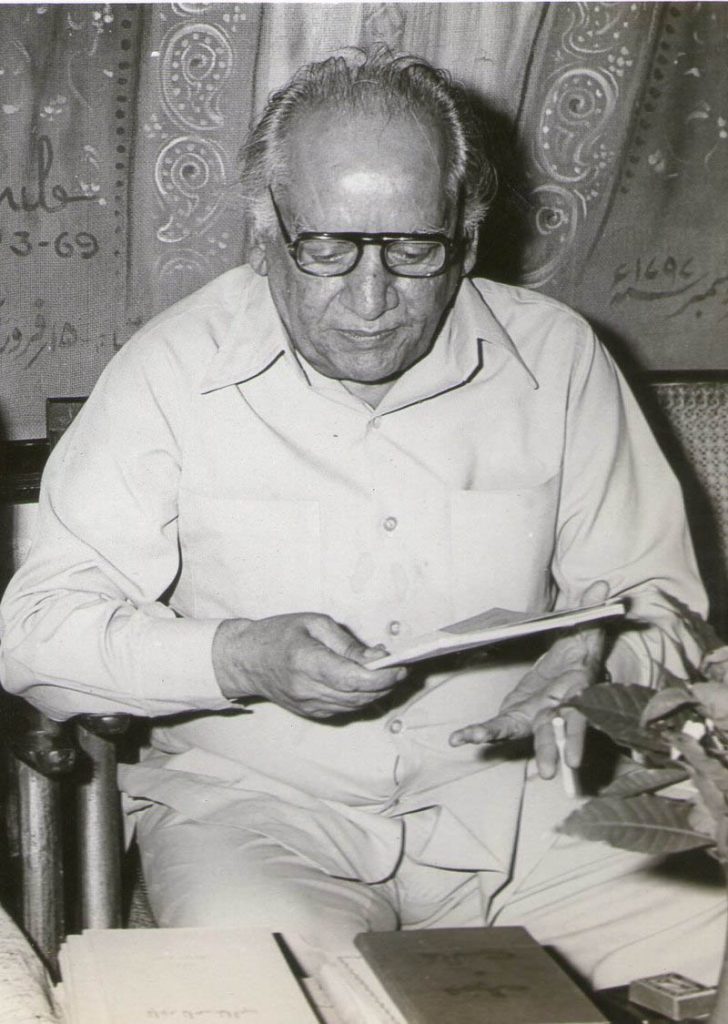
Faiz Ahmed Faiz
Perhaps, Faiz Ahmed Faiz’s this particular verse, relays much of his agony, for his times and for our times:
“This moment is to mourn the death of time/
The river of the sky has paused/
And near the banks of horizon/
The moon-ferry of the gloomy hues has anchored/
All the ferry men, all the stars/
Have disembarked/
On the shore of the earth/
The leaves are gasping for breath/
The winds are dozing off/
The gong has issued the order of silence/
Then all voices lost in quietness…”
….
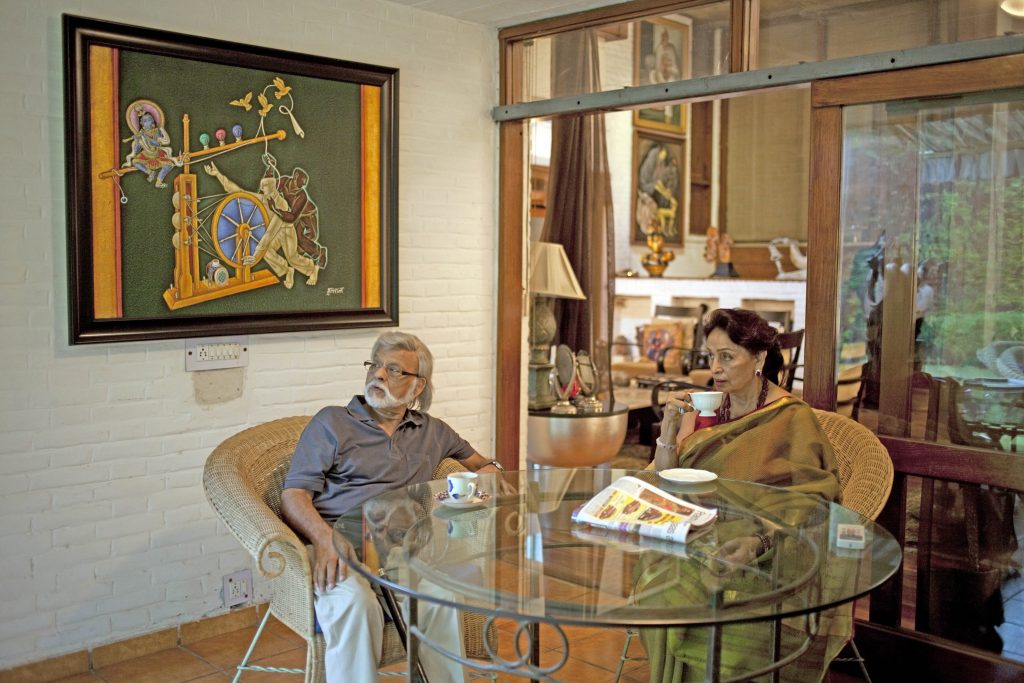
Satish Gujral – One remembers this great artist on his death anniversary. He passed away, at 94, on 26 March 2020.
I’m filing this column on 26 March and with that, keen to focus on this extraordinary artist.
I had been meeting Satish and his wife, Kiran, for the last so many years. The first time was in the early 80s when I had visited his home in New Delhi’s Lajpat Nagar. I hadn’t ever seen a more beautifully done-up home. That was the time I had to interview him for a magazine and was so distracted with the entire scenario — the picture-perfect home, his beautiful wife and his warmth. He carried a tremendous personality. This, when he was stone deaf. And it’s only through his wife Kiran that one could actually communicate with him. But once he would start talking, his bright sharp eyes would take over, relaying a whole array of emotions and expressions. That connection and bond would establish.
He came across as emotional, warm and forthright. If one were to read his autobiography A Brush With Life, it gets writ large that he didn’t shy away from putting in details of the struggles and the challenges he faced. And no bypassing of any of the personal upheavals and the differences that erupted between him and several important personalities such as — Indira Gandhi and MF Husain.
Even during the interviews with me, he would speak in that whole-hearted way, commenting on a whole range of aspects to his life and his passion — art and architecture…I would rather call those interviews as conversations with him, along the informal, relaxed strain.
I recall asking him that how he coped with the low depressing phases in his life, not to overlook the fact that he was grievously wounded as a child, whilst swimming in the Lidder ( river Lidder runs through Pahalgam in Kashmir) and that resulted in high fever and infections and hearing loss.
“Yes, tough phases, especially in view of the fact that in our country a physical problem or a visible handicap is sneered at and nobody spares you. Why just take my case alone—hasn’t Surdas always been referred to as a blind poet or Taimur mentioned as lame? There are also sayings like andhe ko andha kaho aur phir uska gussa saho (call a blind a blind and then see him get all angry). It’s always the weak people who sneer at weaker people. Yes, I was sneered at and that left me hurt and bruised. At times I was so hurt that I couldn’t even sleep at night. After we shifted from Jhelum to Lahore, I was called ‘Bola’ ( deaf ) by kids in the new school. For a while I didn’t even realise I was called Bola. One day I was looking at the attendance register and I saw the word Bola. I asked another boy who was this boy named Bola. He told me that since I was deaf, I was called so. This remark came as a shock. But, that was not just one incident. Wherever my father took me for admission to a school or college, there were some hurdles but my father never took ‘no ‘for an answer. Even in the arts college in Lahore and later the JJ School of Arts in Mumbai, my hearing problem came in the way at the admission time….In Lahore, my father had met the then chief minister Sir Sikander Hayat, who made sure I attended the arts classes on an informal basis. Later, in 1948, I got a job as a graphic artist in the Department of Public Relations of the Punjab Government, but I was kicked off after a while because I was told I was deaf… I realised that the only way to survive was through self-employment. I went to my father’s home in Jalandhar, where the family had settled down, and took to painting.”
Satish told me about the several instances when he didn’t even have a rupee on him. “Went through phases of stress and financially very tight times. But I feel that stress provokes creativity. Also, the fact that when I was actually going through those tough times I didn’t really feel they were difficult. At times I didn’t even have a single rupee. Once I didn’t have money to even reach home from the railway station and my brother Inder had to come and fetch me… What kept me going was the belief that never ever give up …I have always worked, no matter what happened. Maybe I changed the medium—like from painting to drawing architectural designs but never ever gave up! …I do not like the word despair. I’d say instead there could be an overwhelming doubt in my being but, then, my life has been a continuous process to eliminate the very stillness and to build confidence…this is what I have been portraying right from what I’d witnessed during the Partition.”
Yes, he didn’t ever give up. And that turning point did come in his life —his going to Mexico for studies on a scholarship. “Yes, call it a turning point, although I had zero chances…even my knowledge of English was minimum but nevertheless I did go for the interview. Someone had advised me that whilst answering questions I should look straight at the Mexican cultural attaché who was said to be part of the selection panel. But how was I to spot him among the Indians who had a similar complexion. I was told that Mexicans had Mongoloid features. So holding one canvas each, my brother Inder (Inder Gujral) and I walked to the appointed room and once the interview proceeded, I kept looking straight towards one particular gentleman who had those slanted eyes and high cheekbones. I was sure that he was the attaché. Later, I was told that that diplomat hadn’t turned up at all and the man I was gazing at was the Joint Secretary, Education, MG Saiyadain…Totally disappointed, I left for Jalandhar the same night, sure that nothing would come by for my case was hopeless. But, then came another turn of events. An architect friend Ted Bower had been in love with an Indian writer, Shantha Rama Rau, and though she lived in the US, she had come down to Delhi and knew that particular Mexican diplomat who turned out to be none other than Octavio Paz. He recommended my name for that scholarship.”
Perhaps, another of those turning points was his marriage to Kiran. I have always seen them happily together! Satish told me that the three times they were away from each other for a few days was when she was admitted in the maternity clinics to deliver their three kids! He’d added that for a marriage to survive along the happy format, the couple should have a common interest or focus in life. “Both of us have the same interests. Kiran is not just a trained artist but also my best critic. So we always have something to discuss and argue over.”
And yes, he was prudent enough to keep away from his female friends, “After my marriage with Kiran, I didn’t let any friendship develop into an affair. Yes, I was tempted but what actually prevented me from furthering any friendship is the fact that I am no fool to lose Kiran.”
Commenting on the fact that he was drawn to the Left ideology he explained– “Today I call myself a Leftist but not a communist. Why? Because in those early days when I was drawn to the communist party and later travelled on scholarship to Mexico and then to New York and intermingled with several communists, I was left disillusioned. In Mexico, I met many Russian artists who told me what had been happening in Russia and it opened my eyes. Today I call myself a Leftist and not a communist.”
And when I had nudged him to comment on the political scene in the country he sounded very disillusioned with the political parties and with the general prevailing scenario in the country. “What’s happening around shows a lack of tolerance in the society. Economic development does not mean it will translate into spiritual development… economic development could also produce greater intolerance. After all, the US is the richest country, but see what they are doing in America and Afghanistan or to their own coloured people. Economic growth does not mean tolerance… I think the only solution to combat this intolerance is not economic growth but education. It is only through education that you know about different people and there’s less ignorance about the other. It is actually ignorance about the other that creates misunderstandings.”
He spoke about the Partition and with that about his birth place in Pakistan. Whilst commenting on the Partition there wasn’t any bitterness nor anger. Only sadness and a whole range of connected emotions, “I’d stayed back with my father in Pakistan (after the Partition) for some months and what disasters I saw. Usually it would take just about three hours to reach Jhelum from Lahore but those days it would take 10 hours or even longer because of the killings going on and here let me also say that it’s the outsiders who came and killed and not the locals. Our own family in Jhelum was protected from the Afghan raiders by Raja Ghazanfar Ali.”
Satish didn’t mince words that he was emotionally connected to Pakistan. In fact, when he travelled to Lahore in 1986 — the very first time after the Partition — he was so emotionally overwhelmed that he suffered a heart attack and had to be admitted to a hospital for a week. Thereafter he travelled just once more to Lahore, with the former prime minister Atal Bihari Vajpayee. He said he has an emotional link with Lahore…he has several close friends there. Recounting a touching incident, Gujral said, “When I suffered that heart attack in a hotel in Lahore, Kiran didn’t know what to do, where to take me. She called up one of our lawyer friends Etajaz Hussain and told him about my condition. He was appearing in the court, arguing a case but in the middle of an argument he apologised to the judge and rushed to take me to the hospital. Tell me who will do that.”
He was hopeful that the strained relations with Pakistan could ease at some stage. Why that lingering hope? “What makes me hopeful is that there’s a growing feeling in Pakistan’s younger generation that there should be no baggage of the past and both countries could benefit on the economic front by joint collaboration. The fact that there’s great disillusionment in Pakistan vis-a-vis the army, it is surprising how warmly the people of the two countries meet, especially when they are meeting abroad. Because they share the same heritage, the same roots.”
Yet, it was surprising that he had not taken any of his solo shows to Pakistan! Why? To that he’d simply smiled in that boyish childlike way and then said with an abundance of emotions writ large on his face, that he would be happy, very happy doing so in the near future. Perhaps, that moment never came.
Many women in Odisha are not allowed to partake certain foods during pregnancy and after they start lactating. Krushna Chandra Barik, who works on maternal health and nutrition, has encountered this problem in several districts, writes Deepanwita Gita Niyogi
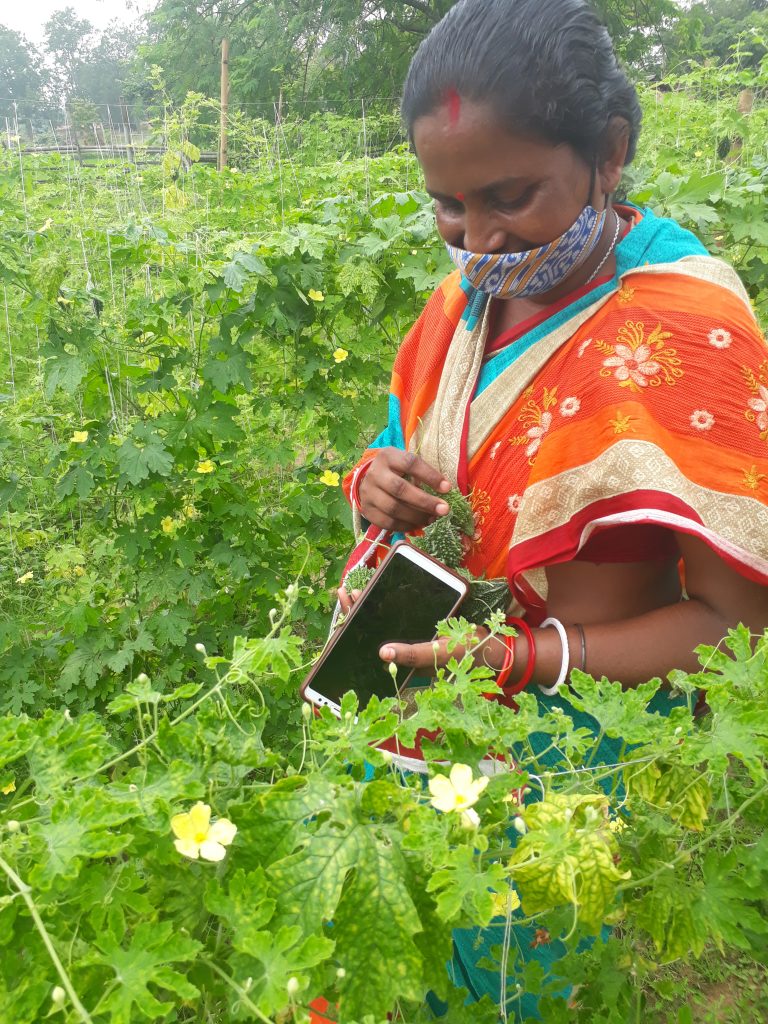
Geeta Das, a Bathudi tribal woman, is a resident of Bhagamunda village in Harichandanpur block of Keonjhar, a district in Odisha impacted by mining. Even today across its several villages women face restrictions when it comes to dietary habits during pregnancy.
Das, who has been married for 18 years and has two children, said it is a common practice to deny women mutton, jackfruit and mushrooms when they are with child. There is a perception that if these food items are consumed, the health of the unborn baby will be impacted.
Many women, especially belonging to tribal communities of Odisha, are not allowed to partake certain foods during pregnancy and after they start lactating. Krushna Chandra Barik, who works on maternal health and nutrition as a consultant, said he has encountered this grave issue in Kalahandi, Koraput and Mayurbhanj districts too. “Besides shocking practices revolving around the dietary habits of pregnant women and lactating mothers, primitive tribes like the Juangs face problems when it comes to food accessibility. This is true more in the case of women,” he said.
The government has several programmes to take care of the dietary needs of pregnant women but Barik considers these as flawed. He added that many pregnant women and lactating mothers take home dry ration distributed under the Integrated Child Development Services. But instead of eating themselves, the food items are distributed among family members and the actual beneficiaries remain deprived.
Along with restrictions placed on food consumption and what not to eat during pregnancy, this practice also impacts women’s health in rural areas. Sattu, a type of pulse flour which is usually given as part of dry ration, is given away to cattle in the hope of getting more milk. Sattu is rich in protein and should be consumed by women.
Dietary restrictions
Researcher Delliswararao Konduru from the Department of Anthropology at Pondicherry University pointed out many restrictions pertaining to food originated to protect women in the old days but are now unscientific and prejudiced in nature.
He said that avoiding certain foods like fish, mushrooms and pumpkins can lead to nutritional disorders and even anaemia in pregnant women. Certain varieties of mushrooms are rich in iron and avoidance during pregnancy affects women’s health.
India has a high prevalence of anaemia among women. The National Family Health Survey-5 report says 57 percent women in the country between 15 and 49 years are anaemic. According to the Global Nutrition Report 2022, one in three women globally aged 15 to 49 years are affected by anaemia, particularly during pregnancy.
Eggs rich in protein are a solution. But uncooked eggs distributed at anganwadi centres are also taken home, cooked and eaten by all family members, added Barik, who blamed the lack of follow-up mechanisms on part of the government.
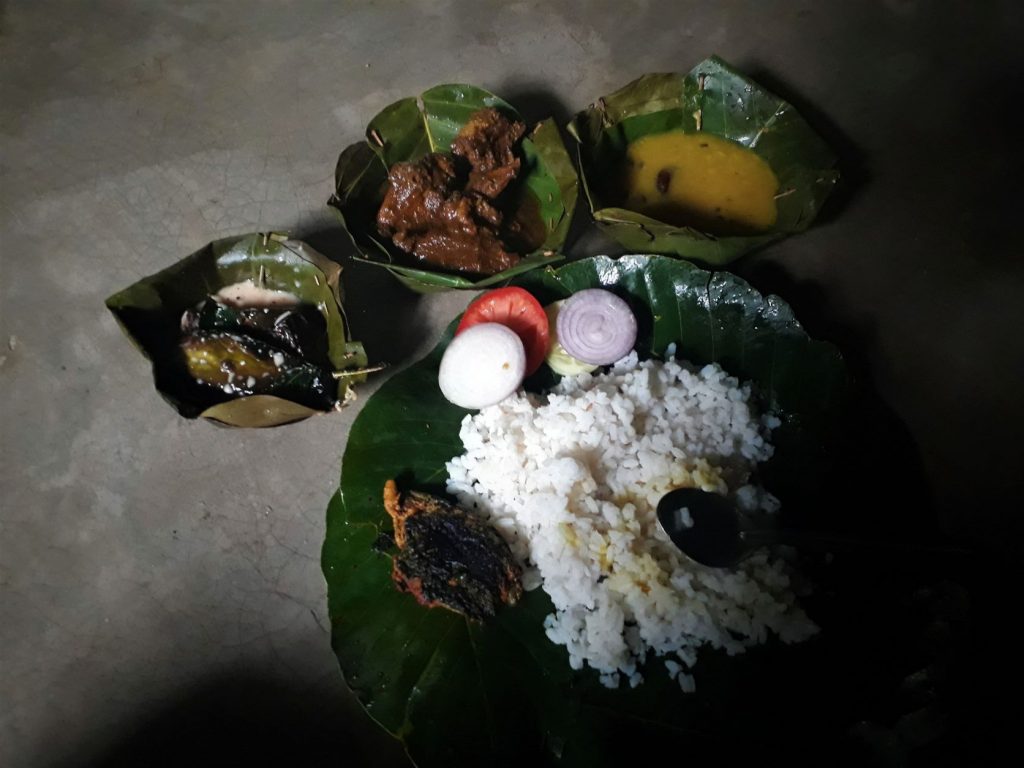
Apart from dietary restrictions and the lack of food accessibility, not consuming diversified food also affects women’s health. “The food habit in many parts of rural Odisha mainly consists of rice and saag (leafy greens) which is not adequate,” Barik said.
In Keonjhar where local food diversity is high, there is also a wrong perception that locally available fruits like bananas do not have adequate nutrients. The dependency is more on apples and grapes bought from the market. During illnesses, these two foods are more preferred.
Social problem
Besides dietary restrictions, there are other problems too related to society. In a highly patriarchal set up like India, women neglect eating. They eat after their in-laws and husbands due to cultural norms. This often leads to shortage of cooked food as most of it is consumed by other family members. High burden of work such as cooking, looking after children and fetching water also impacts the diet timings of women.
Savitri Munda, a tribal woman from Keonjhar’s Barhatipura village, has heard about such restrictions. Munda, who delivered her daughter in the hospital, said such a practice was common about a decade back but in a few places the situation has improved.
“I did not keep restrictions during my pregnancy and consumed everything. The anganwadi worker explained to me that women should eat everything during pregnancy,” Munda added. However, Das said that sometimes adequate food is not available in the villages and rural markets are far away. So, women have to adjust with whatever is available locally.
Barik said when Das was pregnant with her first child, he arranged a meeting with women and made them understand that they should not follow dietary restrictions. By the time she had her second child, attitudes had changed to some extent. But still, the consultant feels that there should be an integrated effort among self-help groups, anganwadi workers and community service providers to ensure such a practice fades away.
To improve the overall nutrition intake among women, the Mo Upakari Bagicha project, a nutrition initiative under the Odisha Livelihoods Mission in partnership with the Azim Premji Philanthropic Initiatives, was conceptualised around 2018. It aims to increase the dietary diversity among rural women by setting up nutrition gardens in villages. The aim is to set up three lakh gardens at the household level.
This recently published book on Baba Farid’s verse titled Farid’s Couplets, is remarkably well published where academic T.C Ghai has translated his verse into English. And also stands out the original text in Gurumukhi, Shahmukhi and Devanagari. The translated couplets manage to achieve intensity of original Farid. A book review by Humra Quraishi
As I hold this book in my hands to read sufi-mystic Baba Farid’s couplets, emotions do hold sway, with nostalgia overpowering. My mother was always so fascinated by Baba Farid’s verse that she’d decided to name her first born son, Farid.
My younger sister and I were in the junior school – St Francis Convent in Jhansi, and I recall how excitedly we’d rush home from school to play with our baby brother named Farid by my parents. We’d play with him till school homework took over. This went on for almost eleven months, till that fateful afternoon when Farid passed away. I still recall those details. That particular afternoon when my sister and I returned from school, we saw several family friends standing in and around the main living room, with my parents sitting close to my brother’s form, all too wrapped up in a white cotton sheet, readied for burial. He was born very feeble and extremely fragile, with the medical specialists not holding out much hope. He couldn’t go beyond those eleven months. Leaving memories and bruised emotions. Another offshoot, after my brother’s passing away I have been reading as many verses of Baba Farid as I possibly could.
This recently published book on Baba Farid’s verse titled Farid’s Couplets, is remarkably well published where academic T.C Ghai has translated his verse into English. And also stands out the original text in Gurumukhi, Shahmukhi and Devanagari. Together with this, much focus on this great mystic, who holds sway to this day. He is also known as Sheikh Farid Gunj -e- Shakar and also Sheikh Farid or Farid-ud- din Masud ( the name given to him at his birth). He was born around 1179 at a village called Kothewal, 10 kilometres from Multan in the Punjab region – undivided Punjab region, of what is now Pakistan.
Though Baba Farid’s verse have been earlier too translated into English, but as Ghai writes in the Introduction to this book, “I hope this translation achieves some of the intensity of the original Farid to convey his intense awareness of death, the transience of life, the existentialist pain of living, and the vanity of worldly ambition, in a language shorn of superfluities, and using sharply realized images from contemporary everyday life.”
There is also focus on the fact that Farid Bani – the 112 slokas –that are translated and published in this book, are said to have been acquired by Guru Nanak ( 1469-1539) during his visit to Baba Farid’s shrine in Jodhan (now in Pakistan) nearly two and a half centuries after Baba Farid’s death. However they came to light only when Guru Arjan Dev (1563- 1606), the fifth Sikh Guru, made it part of the Sikh scripture in 1604.
These verses of are immense significance in today’s world and should reach out to as many as possible.
Title of the book – Farid Couplets.
Translated by T. C Ghai. With original text in Gurumukhi, Shahmukhi and Devanagiri
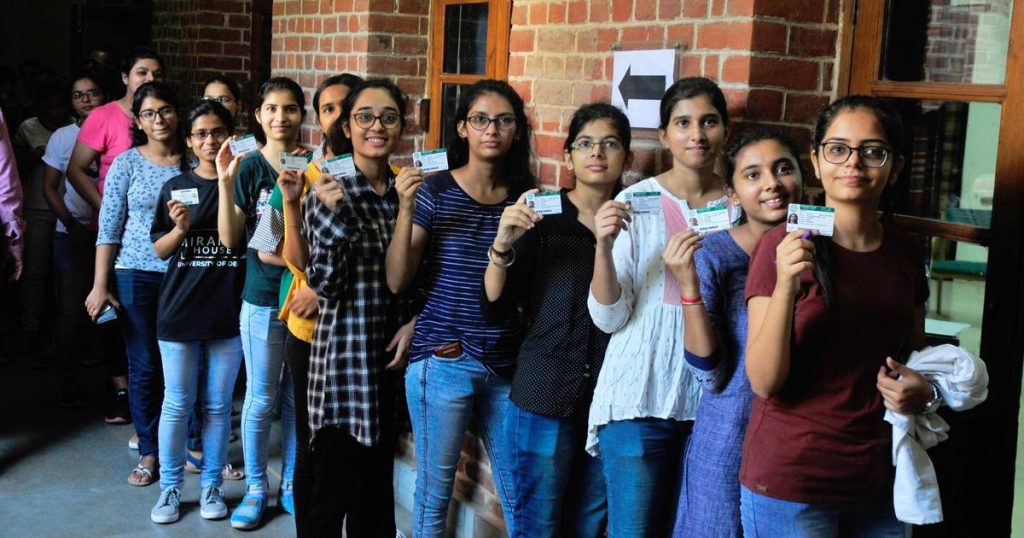
After the gap of three years Delhi University is planning to hold student Elections this year. After the pandemic induced lockdowns and change in education pattern, the University has continued to have the same student body since 2019. The officials of the University have also confirmed that the Union Elections of the Students will be held in September- October this year after the new admissions process are completed. The elections were last held in 2019. The students groups have demanded the resumption of the election exercise as many elected representatives have already left the colleges after their final years are completed.
According to the DU registrar Vikas Gupta, the DUSU elections will be held after the new batch is admitted this year. After the introduction of Common University Entrance Test (CUET) the admission process last year got delayed, so we are planning to start this session on time. It is most likely that the student Elections will be conducted in September-October, Gupta added.
“We are happy that the Elections are taking place this time, the students specially the newcomers will learn about their rights to vote and to raise their issues,” said Akshit Dahiya, current president of DUSU. The Elections will also put an end to the complications that three years of inactivity had raised, he added.
Meanwhile, students of various colleges of Delhi University has welcomed it “ I am confident that the new Union will work for the betterment of our college, feels Sakshi, a student of BA program. The students that got admission in 2022 last year, mainly faced issues related to subjects and fees, they are hopeful that the new elected body will look after their affairs now.
The Delhi University Student Union is the main body of the students from various colleges of Delhi University. Around 1 lakh students vote in the Elections and it is a platform for budding politicians. The candidates from ABVP and NSUI will also be finalized soon. The representative from Bhim Army Student Federation(BASF) will also conduct elections this time. So this year the student will get a new candidate to support.
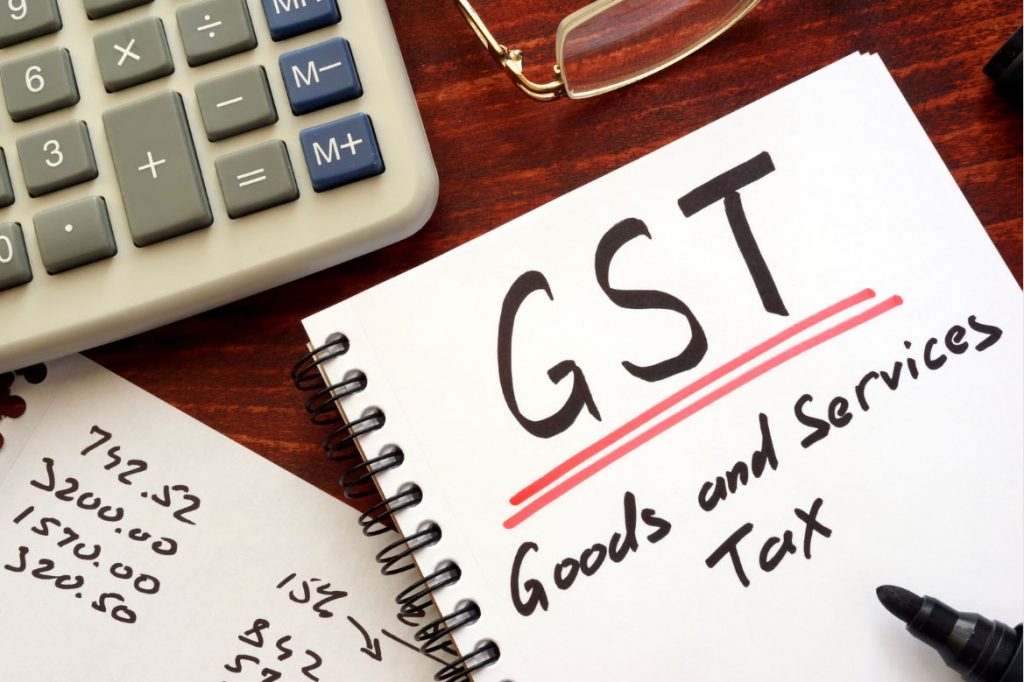
New Delhi: India’s Goods and Services Tax (GST) collection is expected to cross Rs 18 lakh crore in the current financial year that ends on March 31, reported Hindustan Times quoting two officials aware of the development.
In the first 11 months of FY23, the GST collection has already surpassed Rs 16 lakh crore, witnessing a 22.7 per cent year-on-year growth, according to data from the finance ministry.
It is expected that the growth trend will be maintained even in the last month and at least Rs 1.50 lakh crore revenue is expected in March, the officials added.
“According to a conservative estimate, even if the average Rs 1.49 lakh crore monthly GST collection (thus far in 2022-23) is maintained in the month of March, the total GST revenue for 2022-23 would be Rs 17.88 lakh crore, which is quote close to Rs 18 lakh crore mark. We expect to do better as collection data is still coming in,” one of them said.
The uptrend in GST collections both for the Centre and states was anticipated in advance. Hence, the Union government raised GST revenue numbers in the revised estimates (RE) for 2022-23, a second official said.
The Union government’s budget estimate (BE) for (central) GST collections in 2022-23 was Rs 7.80 lakh crore, but later, towards the end of the financial year (on February 1, 2023) the number was raised to Rs 8.54 lakh crore in the revised estimates (RE) of FY23.
The GST revenue in February 2023 recorded a 12 per cent year-on-year increase to a little over Rs 1.49 lakh crore, the fourth highest ever.
The Congress has dubbed Gandhi scion’s conviction in a defamation case and his subsequent disqualification as MP as the government’s attempt to muzzle his voice, writes Amit Agnihotri
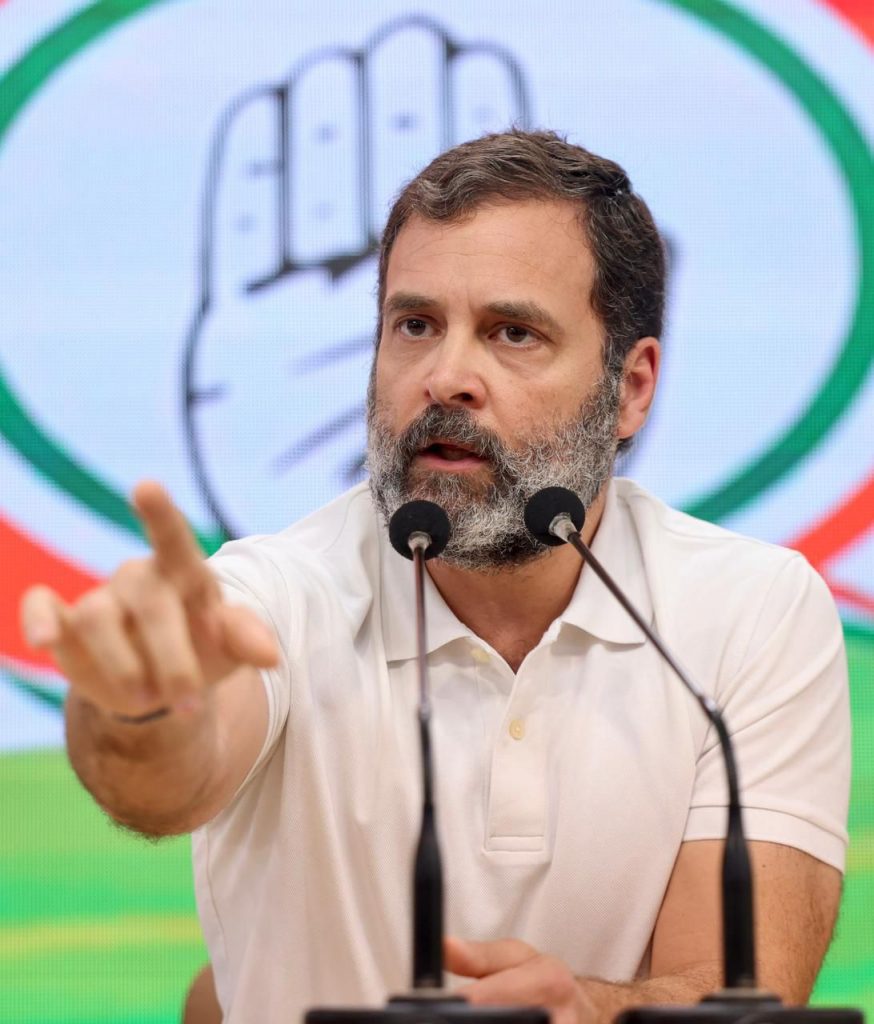
The Congress described Rahul Gandhi’s disqualification from the Lok Sabha as an attempt to silence his voice by the Centre against whom the leader had been asking tough questions even as it threatened to launch nation-wide protests over the issue.
Rahul Gandhi was disqualified as a member of the Lok Sabha a day after he was given a two-year jail term by a Surat court on March 23 in a 2019 defamation case involving his remarks on PM Modi.
Rahul had mentioned the names of fugitives Nirav Modi and Lalit Modi along with that of PM Modi to wonder “how was it possible that all the thieves had a common surname Modi” in a speech made during the 2019 Lok Sabha poll campaign in Karnataka’s Kolar district.
The defamation case was then filed by former Surat MLA and ex-minister Purnesh Modi taking objection to Rahul Gandhi’s remarks. According to the BJP leader, Rahul had defamed the entire Modh or Modi community through his remarks.
The jail-term gave fodder to the ruling BJP, whose president JP Nadda attacked the former Congress chief saying he had insulted the backward classes. Rahul was granted a bail for 30 days and the Congress said it would appeal to get a stay on conviction in the Sessions Court, High Court and even Supreme Court, if needed.
The entire Congress came out in support of Rahul Gandhi, who invoked Mahatma Gandhi to say that his fight for truth would go on. The Congress said Rahul’s conviction was both a legal and a political issue and held protests in various parts of the country against the targeting of their leader as part of Centre’s vendetta politics.
The disqualification came amidst a confrontation between the ruling BJP and main opposition Congress which paralysed Parliament.
When the second half of the Budget Session of Parliament opened on March 13, both the treasury and the opposition benches adopted hard postures against each other over various issues.
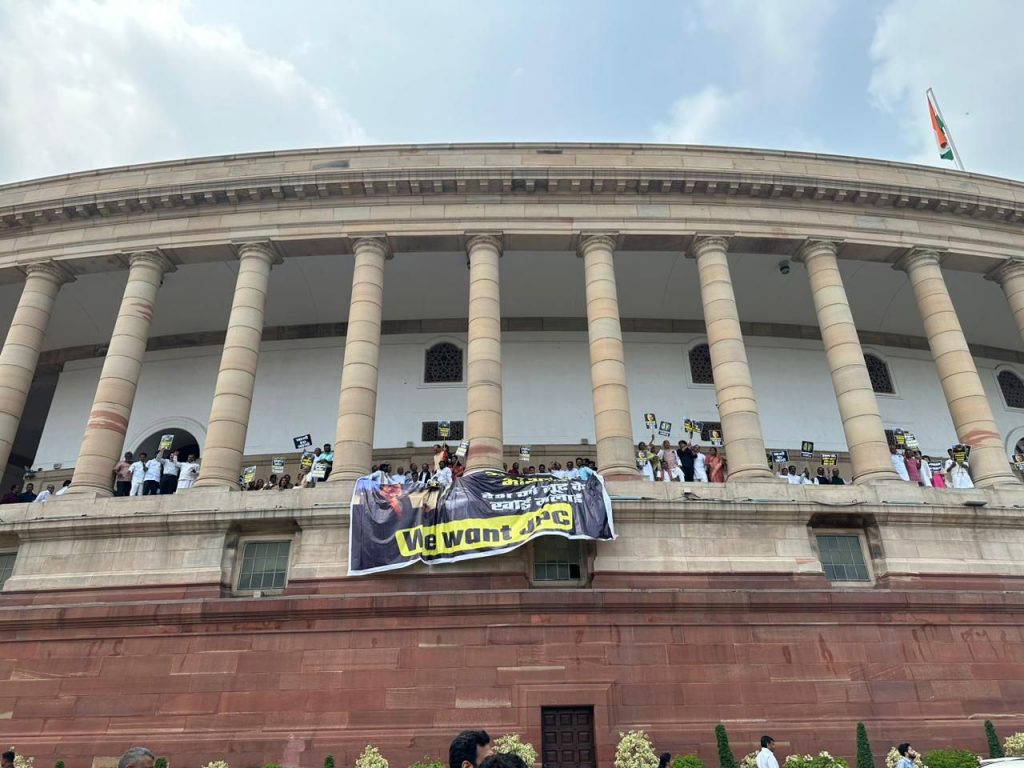
The opposition accused the ruling party of deliberately disrupting the Parliament to avoid demand of a Joint Parliamentary Committee probe into the alleged links between PM Modi and businessman Gautam Adani.
The BJP and the Centre in turn accused Congress leader Rahul Gandhi of defaming Indian democracy abroad lluding to thr remarks he made during the UK visit and said the Lok Sabha member should first apologize.
The core of the BJP’s attack was that Rahul had said in London that democracy had been damaged in India over the past years and that the Western powers should intervene to save the situation.
The Centre’s attack provoked the Congress to allege that it was PM Modi who had earlier defamed the country abroad and should tender an apology first. To prove its charge, the Congress released a series of old video clips showing the PM saying that earlier Indians were ashamed to be born in the country.
The Congress also claimed that Rahul had said nothing wrong during his recent visit to the United Kingdom and that the Centre was deliberately twisting his remarks to target the former party president, who was asking tough questions from the government.
Concerned over the impasse, Prime Minister Narendra Modi and his senior ministers conferred with Lok Sabha Speaker Om Birla. Later, the Finance Bill that gives effect to tax proposals for fiscal year starting April 1 was passed without a discussion amidst ruckus by opposition members demanding a JPC probe into the allegations against the Adani group of companies.
In fact, the Congress-BJP rivalry had started during the first half of the Budget Session when the Congress-led opposition disrupted the two houses for days over the Adani-Hindenburg issue.
The government argued that the Supreme Court had already appointed an expert committee which was looking into the issue and therefore a JPC probe was not needed in the matter.
The opposition argued that the SC panel was only probing the Hindenburg report which had questioned the functioning of the Adani group and the resultant meltdown at the stock exchange had led to wealth worth billions of rupees, belonging to small investors, getting wiped.
The opposition argued that the private businessman had benefited from his friendship with the PM and the link could only be investigated by a JPC.
Speaking during a debate to thank President Droupadi Murmu for her address to the joint sitting of the two houses of Parliament on January 31, Rahul Gandhi alleged a link between the PM and Gautam Adani and said the businessman’s wealth had grown phenomenally since 2014, when Modi came to power at the Centre.
The remarks were expunged from the record by the Speaker. When Congress chief and Leader of the Opposition in the Rajya Sabha, Mallikarjun Kharge tried to raise the matter in the upper house, his remarks too were expunged from the record by chairman Jagdeep Dhankhar. The Congress said the two Chairs had acted at the behest of the government, which wanted to silence the opposition.
As the Opposition unity rattled the government, the BJP decided to target Rahul. BJP Lok Sabha MP Nishikant Dubey wrote to Speaker Om Birla demanding action against Rahul Gandhi for “breach of privilege” saying the Congress leader had levelled “unverified, incriminatory and defamatory” statements against the PM.
“These statements are misleading, derogatory, indecent, unparliamentary and incriminatory in nature to the dignity of the House and the Prime Minister, being a Member of Lok Sabha. Rahul Gandhi, despite making a statement in the House that he will provide documentary evidence, has not submitted any duly authenticated document supporting his statements,” said Dubey.
The BJP MP said that Rahul’s remarks were a “violation of privileges of the House” and a “contempt of the House” and urged the Speaker to take immediate action against the Congress MP.
Parliamentary Affairs Minister Prahlad Joshi backed Dubey’s demand and urged the Chair that action be taken against Rahul Gandhi for certain “objectionable” comments made in the Lok Sabha and that the remarks be expunged from the record.
“One should serve a notice beforehand if he or she wants to make allegations against anyone. The Congress leader made some remarks. Those were very objectionable and baseless allegations. Those should be expunged and action should be taken against him,” Joshi said.
The Congress countered the move with a similar breach of privilege notice against the PM over his remarks related to country’s first prime minister Jawaharlal Nehru that were made in the Lok Sabha. The move, seen as a bid to counter the BJP offensive against Rahul, was initiated by AICC general secretary in charge of organisation KC Venugopal.
Venugopal, a Rajya Sabha member, submitted a notice of breach of privilege by the PM under Rule 188 of the Procedure and Conduct of Business of the upper House. The Congress’s counter was based on the PM’s comments made during his reply to the Motion of Thanks on the President’s address in February and was related to the “family” not using the “Nehru” surname.
Venugopal said the PM’s remarks, which were also condemned by the Congress, “were not only disgraceful but also insulting and defamatory vis-a-vis the members of the Nehru family, particularly Sonia Gandhi and Rahul Gandhi, who are members of the Lok Sabha.”
“I seek privilege proceedings against Prime Minister Narendra Modi for having made derogatory, insulting, distasteful and defamatory remarks against Sonia Gandhi and Rahul Gandhi which has amounted to breach of their privileges and also contempt of the House,” said Venugopal.
In his speech on February 9, Modi had said, “I find it very surprising that we may at times miss out mentioning the name of (Jawaharlal) Nehru ji, and we will also correct ourselves because he was the country’s first prime minister. But I do not understand why none of them use the Nehru surname? What is the shame in using the Nehru surname? Such a great personality is not acceptable to you, to the family?”
Venugopal reiterated the Congress’s position that in India “the surname of the father is not taken by the daughter.” “Despite this, he (PM) deliberately mocked. The tone and tenor of the remark is insinuating and derogatory in nature.”
Days after the PM’s Lok Sabha speech, Rahul accused the premier of “directly insulting” him by referring to his surname while speaking at a rally in his parliamentary constituency Wayanad, in Kerala.
The Congress leader also questioned the decision not to expunge the PM’s remarks from the record of the Lok Sabha, contrasting it with the Speaker’s move to remove from the records certain comments he had made on the Adani Group and PM Modi.
“I asked the Prime Minister some questions. I asked him about his relationship with Adani. I asked how Adani has grown so fast. The Prime Minister did not answer a single question. His response to my questions was that why are you not called Nehru, why are you called Gandhi. Because generally in India … maybe Mr Modi doesn’t understand this… But generally, in India, our surname is the surname of our father.”
Defence Minister Rajnath Singh also targeted Rahul Gandhi saying the Congress leader should apologise over his remarks made in London. Congress MP Manickam Tagore then moved a breach of privilege motion against Rajnath Singh also saying the defence minister had violated rules of the House by mentioning Rahul’s name without proper notice.
Amid the deadlock, Congress chief Mallikarjun Kharge led a group of 17 like-minded parties to demand a JPC probe into the Adani issue and said that Rahul will not apologise as he did not say anything wrong on the foreign soil. Kharge accused some ministers of deliberately twisting Rahul’s remarks.
The JPC and apology issues rocked both the houses of Parliament resulting in a deadlock. The Congress leaders in the Rajya Sabha said that minister Piyush Goyal was not supposed to have mentioned Rahul’s London remarks as he was a member of the Lok Sabha and comments made by any lower house member could not be raised in the upper house as per the rules.
London trip
Rahul Gandhi visited his alma mater, the Cambridge University, in the first week of March as a fellow to have interactions with the students and faculty and later also had interactions with the UK parliamentarians and members of the Indian Journalists Association.
During his various interactions, Rahul slammed the BJP and described its ideological mentor RSS as a fascist organization while alleging that they had captured most of India’s institutions and were choking the voice of the opposition.
“RSS is…you can call it a secret society. It is built along the lines of the Muslim Brotherhood and the idea is to use the democratic contest to come to power and then subvert the democratic contest afterwards. And it shocked me as to how successful they have been at capturing the different institutions of our country… the press, the judiciary, Parliament, Election Commission — all the institutions are under pressure, under threat and controlled in one way or the other,” he said during an interaction at Chatham House.
The former Congress chief also questioned the government’s China policy and charged PM Modi of having falsely denied the Chinese incursion along the border in eastern Ladakh. The BJP in turn used parts of Rahul’s interactions to allege that he had sought intervention from America and Europe to save democracy in India.
The Congress rejected the charge saying the BJP was twisting Rahul’s speeches in which he had said that Indian democracy was a public good and important for the world. The Congress said that Rahul had actually spoken about the strength of Indian democracy and how the world would be impacted if Indian democracy crumbled.
“He never asked the western powers to intervene in domestic issues. He clearly said that solutions to India’s problems would emerge from within,” Congress spokesperson Supriya Shrinate said.
The Congress spokesperson further said that while Rahul had been invited to deliver a talk by his alma mater, the Cambridge University, the honour had made the BJP leaders feel jealous.
Shrinate also targeted Union Law Minister Kiren Rijiju, who had criticised Rahul’s utterances in London and had described him as a “Pappu”. The Congress spokesperson countered the law minister for the kind of language a cabinet member was using against a political rival saying it was a new low in India.
The Congress spokesperson said, “I wonder while they keep saying that Rahul should not be taken seriously. Yet, whenever he speaks, the entire cabinet and BJP leaders come out to attack the former party chief and defend the Government.”
“If the government is confident why does not it debate the issues flagged by Rahul Gandhi in Parliament,” said Shrinate.
The Rahul vs BJP tussle did not end here and flared up again as Vice President Jagdeep Dhankar, who is also the chairman of the Rajya Sabha, criticised the Lok Sabha MP for telling UK lawmakers that microphones of the opposition leaders were turned off in Indian Parliament.
“The Chairman is an umpire, a referee, a friend, philosopher and guide to all. He cannot be a cheerleader for any ruling dispensation. History measures leaders not on the zealousness with which they defended their party, but the dignity with which they performed their roles in the service of the people,” Congress veteran Jairam Ramesh said as he slammed the Chair’s observations during a book launch event.
Ramesh alleged that “the Hon’ble Vice President’s statement on Rahul Gandhi, therefore, was surprising to say the least. He rushed to the defence of a government from which he is constitutionally required to be at arm’s-length and in a manner that was both confusing as well as disappointing. Rahul Gandhi has not said anything abroad that he has not said several times here. And unlike certain other individuals his stand does not vary depending on where he sits.”
Rahul’s plea denied
Amid a Parliament stand-off over his recent remarks related to Indian democracy in London, former Congress chief Rahul Gandhi expressed doubts that he would be allowed to speak in the Lok Sabha.
“I went to Parliament this morning with the idea of putting what I have said, what I feel on the floor of the house. Four ministers have raised allegations against me in Parliament House. It is my right to be allowed to speak on the floor of the house. I requested the Speaker today. I went to his chamber and I requested him. I said- look, I would very much like to speak. I told him that people from the BJP have made allegations against me and as a Member of Parliament, it is my right to speak. He was non-committal. In his way, he smiled. I am hopeful that I will be allowed to speak on Friday. But I don’t think they will let me speak,” Rahul told reporters.
“This story started the day I gave my speech in Parliament about Mr Adani. I asked some fundamental questions to the Prime Minister about his relationship with the businessman, about how Mr Adani has been given pretty much the entire India-Israel defence relationship. How he is being given the Bombay Airport, other airports, how rules have been changed to allow him to be given these things. What happened in Australia between the Prime Minister, Mr. Adani and the Chairman of the State Bank and one of the Chief Ministers of one of the states in Australia. It is a picture that is visible to everybody; why is the Prime Minister of India sitting with the State Bank Chairman, Mr. Adani, and an Australian leader? What is he discussing and why after that discussion, almost a billion dollars were pledged by the State Bank to Mr. Adani? What was said in Sri Lanka? Why a person made a statement saying- Mr. Rajapaksa told him that Mr. Adani was given the contract and it was basically Mr. Modi who told him the same in Bangladesh,” Rahul Gandhi said.
According to Rahul, the PM feared the Adani issue and was therefore trying to distract attention from the controversy.
“That is why, this whole exercise of four or five ministers, the Prime Minister is giving a speech to distract from this fundamental question which is, what is the relationship between the Prime Minister of India and Mr. Adani and his companies and more importantly, whose money is in the shell companies? Who is this unknown person, whose money is in the shell companies? What is his relationship with Mr. Adani? These are the questions,” he said.
The Congress leader said he deserved a chance to speak in Parliament and the ongoing stand-off in Parliament was testing the Indian democracy.
“If Indian democracy is functioning, I would be able to say my piece in Parliament. So, actually what you are seeing is a test of Indian democracy. After four leaders of the BJP have made an allegation about a Member of Parliament, is that Member of Parliament going to be given the same space that those four Ministers have been given or is he going to be told to shut-up? That’s what the real question in front of this country is right now,” Rahul said.
“I am a Member of Parliament and I am hopeful that I will be allowed to speak in Parliament. It is my right to have the opportunity. It is my democratic right,” he said.
Kharge alleged that it was unusual in the history of India’s parliamentary democracy that the ruling BJP was disrupting the two houses of Parliament and not allowing listed business to be conducted while the opposition was keen to run the two houses.
As confrontation peaked between the government and the opposition, the Lok Sabha was muted for around 20 minutes provoking the Congress to point out that Rahul’s allegations over lack of democracy in India had turned out to be true. The government explained the muting of Lok Sabha as a technical glitch.
As the Parliament deadlock threatened the passage of the Union Budget 2023-24, the Congress said that it will not give up the demand for a JPC probe into the Adani issue.
“Over the past few days an effort has been made to find a compromise formula. To work out a middle path so that the opposition gives up the demand for JPC probe into the Adani issue and then BJP will take back its demand for Rahul Gandhi’s apology. This is not possible. There is no link between the two issues. The demand for a JPC probe into the Adani issue is an original issue and is based on events which have taken place. The allegation against Rahul Gandhi is baseless. We are not ready for a give and take. Rahul Gandhi has written to the Speaker under Rule 357 so that he be given a chance to speak in the Lok Sabha and present his views over the allegations made by some ministers in the House. The demand for Rahul Gandhi’s apology is being repeated so that attention is diverted from the Adani issue,” Congress communications in charge Jairam Ramesh said.
“This is part of the PM’s 3D strategy. Distort, defame and divert. They have distorted Rahul Gandhi’s speeches, have defamed him and are now trying to divert attention from the Adani issue. Withdrawal of demand for JPC probe in Adani issue is non-negotiable for us,” he said.
Central agencies
Besides Rahul’s comments in London, the opposition parties also attacked the government saying while their leaders were being targeted by the various central agencies, there was no action against the Adani group companies which have been accused of duping a large number of small investors belonging to the LIC of India and various public sector banks.
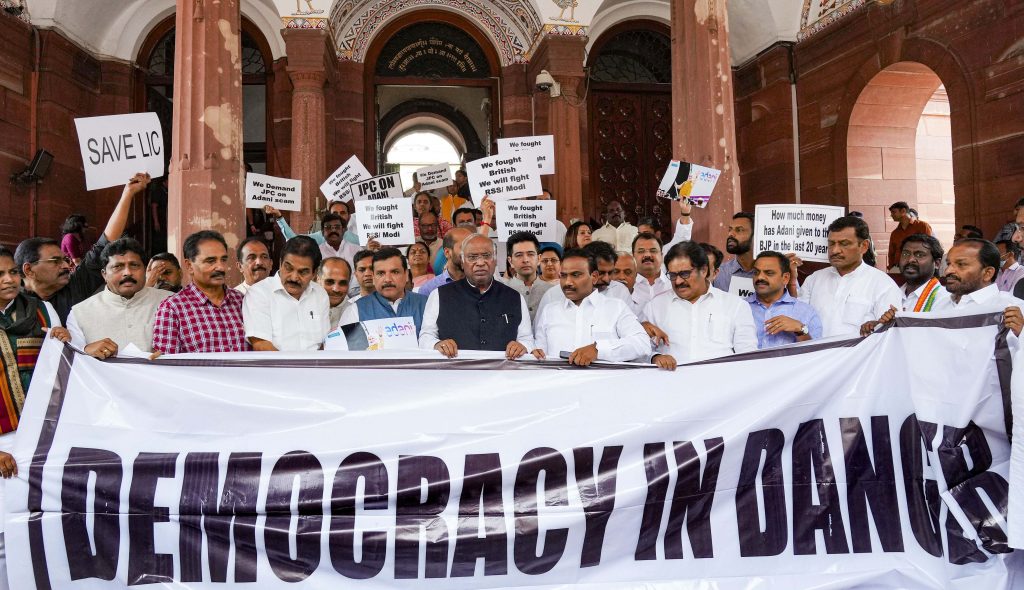
In a bid to assert pressure on the government, a united opposition tried to march to the ED office nearby but was stopped by the police just outside the Parliament House complex. The next day, the opposition members formed a human chain inside the Parliament House complex to highlight the Adani issue. Later, Rahul and Sonia Gandhi joined the opposition members who staged a sit in protest in front of the statue of Mahatma Gandhi inside the Parliament House complex.
Later, the opposition parties approached the Supreme Court over the issue and also petitioned President Droupadi Murmu.
Delhi cops come calling
A furious Congress condemned Delhi Police reaching Rahul Gandhi’s residence and said the act smacked of “politics of intimidation” by the Centre.
“The Delhi Police top officials reaching Rahul Gandhi’s residence smacks of intimidation by the Modi government. Someone at the top must have asked them to take such action. We condemn such action,” Congress spokesperson Abhishek Manu Singhvi said.
According to Singhvi, the Delhi Police had earlier sent a two-page questionnaire to Rahul Gandhi on March 16 asking him to furnish details of the women victims of molestation and domestic violence, who had met him during the Bharat Jodo yatra.
“Rahul Gandhi had sought around 10 days-time to submit his response. But senior police officials again reached his residence today. What is the hurry?” he said.
The Congress leader further said that the Delhi police had no such jurisdiction to question the Wayanad MP as the questions pertained to his speech made in Jammu and Kashmir on Jan 30.
“The Delhi police has no jurisdiction over the matter. Then what were they doing for the past 45 days. The yatra covered around 4000 km and passed through 12 states. During the yatra, he met lakhs of people. The police are asking the details of the women who met Rahul and shared their grievances with him. Normally, a leader just patiently listens to such grievances and asks the fellow yatris to take care of it,” said Singhvi, a senior Supreme Court advocate.
“We have sought time and we will submit a detailed response in time,” he said.
Rajasthan Chief Minister Ashok Gehlot said the action of Delhi police showed that “democracy was in danger in the country” while party veteran Jairam Ramesh said “the police action had come due to the opposition unity over the Adani issue in Parliament.”
“What Rahul said in London about democracy is what he had been saying earlier. Whatever is happening shows there is no democracy in the country. What if a union minister travels across Rajasthan tomorrow, meets people and makes similar observations about women getting molested. Should the state police send notices to him? They are setting very wrong precedents which will go against them,” said Gehlot.
“The Centre misuses central agencies to threaten the opposition. We will not let them go. We will keep raising the Adani issue,” he said.
“The government is rattled by the opposition unity in Parliament over the Adani issue. We will keep raising the issue. The government has no answer to the unemployment issue,” said Ramesh.
According to Gehlot, such police action based on a zero FIR had never happened in the country over the past 75 years.
“If there is a zero FIR, who registered it? IT is clear that the police are getting instructions from the top,” he said.
Making a comparison of the situation with the Janata Party government after the Emergency, Gehlot said that then Congress leader and former prime minister Indira Gandhi was also targeted in a similar way.
“Everyone knows what happened in 1980. She came back to power,” he said.
Mamata, Kejriwal lend support
Meanwhile, Rahul Gandhi has received support from West Bengal chief minister Mamata Banerjee and Delhi chief minister Arvind Kejriwal.
“In PM Modi’s New India, Opposition leaders have become the prime target of BJP! While BJP leaders with criminal antecedents are inducted into the cabinet, Opposition leaders are disqualified for their speeches. We have witnessed a new low for our constitutional democracy,” Banerjee tweeted.
“The country has to be saved from an arrogant dictator and illiterate person… Dismissing Rahul Gandhi ji from the membership of the Lok Sabha is a cowardly act. We respect the judiciary, but we do not agree with this judgment. Everyone is scared in the country… Now, people will have to stand up and my appeal to the people – this country belongs to all,” said Kejriwal.
New Delhi : Days after Rahul Gandhi’s disqualification from the LokSabha following his conviction in a 2019 criminal defamation case, LalitModi, the former chief of the Indian Premier League (IPL), took a dig at him by saying that unlike the Congress leader, he has not been convicted in any case.
In a series of tweets, LalitModi, who lives in London since 2010 after facing allegations of financial irregularities in the IPL, said, “I see just about every Tom dick and gandhi associates again and again saying i am a fugitive of justice. Why? How? And when was i to date ever convicted of same. unlike #Papu aka @RahulGandhi now an ordinary citizen saying it and it seems one and all oposition leaders have nothing else to do so they too are either ill informed or just vendetta prone.”
He added: “I have decided to take @RahulGandhi to court in UK right away. I am sure he will have to come-up with some solid evidence. I look forward to seeing him make a complete #fool of himself. #rkdhawan #sitaramkesri #motilalvohra #satishsharna all bag men of #gandhi family. Not to forget #naraindutttewari. How do u all have overseas assets. Ask #mrkamalnath.”
LalitModi also said that he can send addresses and photos to support his claims.
“#Gandhifamily who have made it as if they are the entitled ones to rule our country. Yes, i will return as soon as u pass stringent liable laws, ” he said.
LalitModi also said that nothing has been proven against him, adding that “What is clearly proven is I created the greatest #sporting event in this world that has generated close to 100 billion dollars”.
Last week, a court in Surat had found Rahul Gandhi guilty and sentenced him to two years in prison in a 2019 criminal defamation case over his remarks about Prime Minister Modi’s surname. The Congress leader, however, was granted bail and his sentence was suspended for 30 days to allow him to appeal the Surat court verdict.
The case was filed against Rahul Gandhi by BJP MLA and ex-Gujarat minister PurneshModi for saying “how come all thieves have the common surname Modi” while campaigning in Karnataka ahead of the 2019 LokSabha elections.
A day later, Rahul Gandhi was suspended from the LokSabha following his conviction in the criminal defamation case. The LokSabha Secretariat also declared his constituency in Kerala’s Wayanad as vacant.
According to the Representation of the People Act, a lawmaker sentenced to imprisonment for two years or more shall be disqualified “from the date of such conviction” and remain disqualified for another six years after serving prison time.
At 3,016 cases, India registered a 40 per cent jump in the new Covid cases in the last 24 hours, said the Union Health Ministry on Thursday. In view of the rising cases, the Delhi government has called an emergency meeting.
The daily positivity rate has been recorded at 2.7 per cent and the weekly positivity rate stands at 1.71 per cent.
There were 1, 396 recoveries in the last 24 hours and active caseload stood at 13,509.
The Delhi government has called an emergency meeting after the Covid cases spiked on Wednesday. A total of 300 new Covid infections in the last 24 hours were recorded in the national capital, which is a rise over Tuesday’s 214 cases, as per the Delhi government health bulletin.
Meanwhile, two Covid-19 related deaths have also been reported in the same time span.
The positivity rate of the national capital city has risen to 13.79 per cent. The number of active cases stands at 806 out of which 452 patients are being treated in home isolation.
With 163 patients recovering in the last 24 hours, the total number of recoveries so far has gone to 19, 82, 029, while Delhi’s total caseload is 20, 09, 361 and the death toll in the city has risen at 26, 526.
A total of 2, 160 new tests — 1490 RT-PCR and 670 Rapid Antigen – were conducted in the last 24 hours, taking the total to 4, 07, 85, 433 while 141 vaccines were administered – 27 first doses, 34 second doses, and 80 precaution doses.
The total number of cumulative beneficiaries vaccinated so far stands at 3, 74, 04, 636 according to the health bulletin.