It’s time to shut the houses of horror zoos, globally  

One hopes that Noor Jehan’s life, suffering and death in captivity were not in vain. Her plight drew the attention of the entire world towards the suffering that captive animals endure in zoos around the world

Try as I might, I cannot get the images of Noor Jehan, the 17-year-old African elephant, dragging her paralysed hind legs and walking painfully while being hit and prodded by insensitive mahouts who pulled at her ears impatiently and beat her around the legs in an attempt to make her walk faster.

I cannot get the image of Noor Jehan standing with her head resting against the drab wall of a dry, poorly-maintained, cramped enclosure. The abject despair, sadness and loneliness in her countenance were enough to tell a horrific tale of years of abuse, even if she could not.

You don’t need to have a doctorate in animal psychology to know that Noor Jehan was a broken animal. Broken in spirit, body and mind! It takes a lot of abject cruelty, beatings, indiscriminate use of the dreaded bullhook, physical, emotional and mental abuse to turn a giant, wild elephant into a broken, shriveled, rag. When I first saw her pictures I thought it was an old elephant as they can live till the age of 70. I was appalled and shocked to learn she was just 17! A teenager, in the prime of her youth! I cannot even begin to imagine the amount of abuse, neglect, hunger and pain that the poor 17-year-old elephant had to endure in her short life on this earth, because that’s what it would take to make a 17-year-old look 70.

Noor Jehan’s story of tribulations began when she saw her mother being butchered in front of her as a young calf in Tanzania before she was hauled off along with three other baby elephants, Madhubala, Sonia and Malika to Pakistan in 2009, to begin life imprisonment in the worst prison on this earth. While Sonia and Malika were sent to Karachi Safari Park, Noor Jehan and Madhubala were sent to Karachi Zoo.

Treated even at a young age more as a commodity to bring in money, rather than as a living being which felt pain and fear, for both the elephants Karachi Zoo was hell on earth, where they were imprisoned even though they had committed no crime. In the end, years of deprivation and suffering took its toll on Noor Jehan. The elephant, which had been ailing since November 2022, and had been suffering from fever for many days, died. In the end, Noor Jehan, succumbed to the constant abuse she was subjected to. Even though she underwent critical medical treatment under the supervision of international veterinarians, she could not survive, maybe because she did not have the will to live her miserable life anymore.

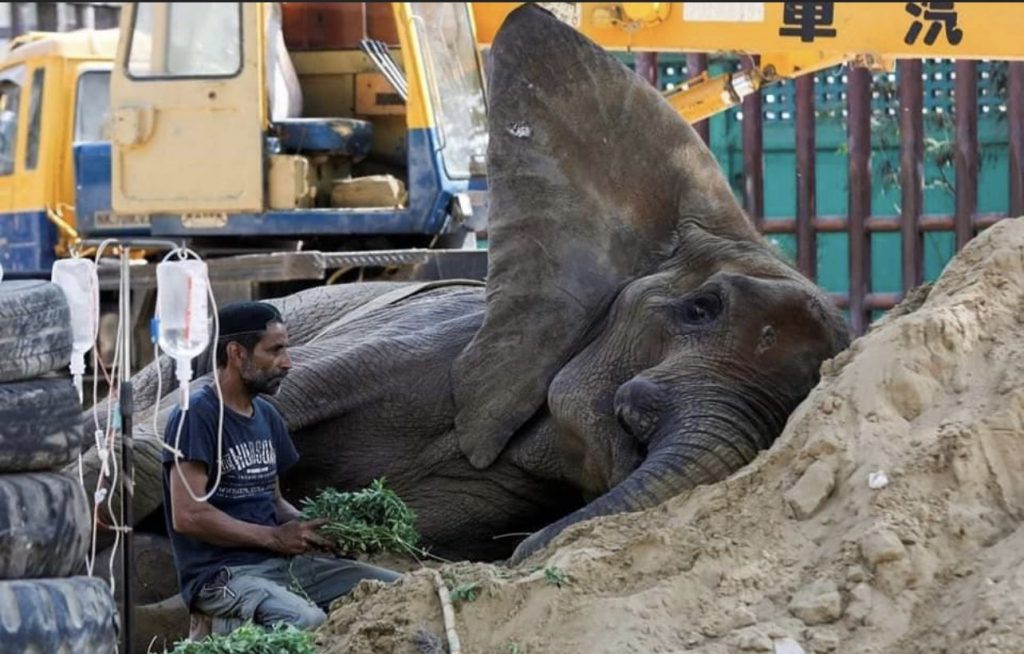
Foreign experts who had been called in by Karachi zoo because they could not figure out what was wrong with her for months, detected a large haematoma (A pool of mostly clotted blood that forms in an organ, tissue, or body cavity) in her abdomen and found the perineal (the thin layer of skin between the genitals and anus) membrane ruptured. (I wonder how that happened?) This condition made walking and movement very painful and also was the cause behind her unusual posture. In the end, she suffered a fall while trying to get into her pool and was unable to get up.

The international animal welfare organisation Four Paws’ team that arrived at Karachi Zoo following an SOS from zoo officials was unable to save Noor Jehan, who went to a better place at 11:15 am on April 22. Sadly, they had been trying to get her well enough so that Noor Jehan and her companion Madhubala could be relocated to a species-appropriate place that fulfils international standards. But that was not to be. However, now, that Noor Jehan is no more, one can only hope that her life, suffering and death were not in vain. Her plight drew the attention of the entire world towards the suffering that captive wild animals endure in zoos around the world and in Pakistan in particular. I say Pakistan in particular because their zoos are often accused of being unmindful of animal welfare and having poor facilities. For instance, two lions died of asphyxiation in Pakistan after handlers tried to get them out of their den using smoke!

Thankfully, the director of the Karachi Zoo was removed over complaints of negligence and a new, hopefully more sympathetic one was brought in a few weeks before Noor Jehan’s death. Also, a court in 2020 ordered the closure of the Islamabad Zoo, where the “loneliest” elephant Kaavan was kept before he was rehabilitated to a sanctuary in Cambodia after years of international pressure and campaigns, due to his deplorable state.

One hopes that the Karachi Zoo will be shut down soon and Madhubala and the two remaining elephants Malika and Sonia at the Karachi Safari Park and all the other animals who are in an equally deplorable, abused and starved state in Karachi Zoo will be rescued from this house of horrors. One hopes they will be rehabilitated in a sanctuary or sent to more species-appropriate facilities outside Pakistan.
After reading about the plight of animals in zoos I am convinced that it’s time that zoos were shut down globally. It may seem a bit of a drastic statement to make, but there was a time when performances by animals were considered a vital part of circuses worldwide. However, slowly and surely, thanks to the awareness created by animal rights activists and journalists, people became aware of the horrific lives full of beatings and starvation these wild beasts were being forced to live for our one evening of entertainment. Today, by and large, most nations, including India, have banned the use of wildlife in circuses. And our circuses are none the worse for it. In fact, one of the most renowned and premium circuses in the world, Cirque du Soleil, does not use any animals at all.

Now, it’s time for zoos to be shut down globally! Why should animals be snatched from their families and natural habitat and forced into life imprisonment? Why should an animal suffer loneliness, loss of freedom, beatings, and starvation just so that humans can entertain themselves?

But this call for the release and rehabilitation of captive zoo animals should not be restricted to Pakistan alone. There are a number of zoos around the world where animals are kept in captivity in appalling conditions for our viewing pleasure. They are snatched from their families in the wild and incarcerated for the rest of their lives, forced to live in isolation, and abused by ill-trained caretakers. Take for example the case of the elephant Lucy in Edmonton Valley Zoo. Brought from Sri Lanka after being orphaned, Lucy has been at the Edmonton Valley Zoo for 46 years and turns 48 this year. Lucy suffers from a number of zoo-induced ailments which will shorten her life expectancy as zoo elephants hardly ever live out their full days. She has no other elephant companions, which is cruel because elephants are highly complex social creatures like humans and cannot live alone.

The harsh Edmonton climate is detrimental to her health and painful for her arthritis and foot disease. This is made worse by the fact that Lucy lives in a tiny concrete cell and is only allowed outdoors for short controlled walks, weather permitting which means many days she never gets out at all. She spends her day in her cramped, wired, concrete enclosure just moving forward a few inches, touching her forehead to the wire, and then moving back a few inches. This is all she does the whole day, which is indicative of high levels of mental and emotional distress. The sad part is that while two sets of animal doctors and experts have ruled that Lucy can be moved to a sanctuary where she can live out the rest of her days in a happy and beautiful environment, the authorities of the zoo are not willing to let her go. Maybe it’s ego, or just the loss of revenue that scares them. Whatever their concerns are, one thing is clear: Lucy has to go to a sanctuary if she is to live any longer.  

Then there is Shankar, the elephant from Zimbabwe who has been in the Delhi Zoo for the last 24 years. A friendly country Zimbabwe gifted Shankar to India in 1998 when he was just 26 months old. However, Shankar has been alone since the death of his partner, Bombai, in 2005.  

Nikita Dhawan, the founder of Youth for Animals, had filed a petition in Delhi High Court seeking the release and rehabilitation of Shankar to a suitable wildlife sanctuary. In her petition to the Delhi High Court, she had claimed that the elephant was a victim of cruelty and viciousness at the hands of the handlers and the call for sending Shankar back to his home grew exponentially. However, sadly after a court ruled that Shankar cannot be sent home, the Delhi Zoo is exploring the option of finding a mate for Shankar from South Africa. Till that happens, Shankar will continue to suffer a lonely life in an enclosure in the middle of a bustling city, instead of roaming free in his natural habitat.

Even though Noor Jehan’s death has thrown the spotlight on the plight of elephants in zoos around the world, the condition of other animals incarcerated in dirty, cramped spaces, sometimes in groups or sometimes in isolation, is the same.

So, there should be a conscious, concerted decision-making process and a force for change around the world and zoos should be shut. The animals should be re-wilded, rehabilitated and released in sanctuaries. It will take a lot of political will and effort to do so but at least we will not be guilty of being responsible for the misery of countless species just for our entertainment. And what a perverse and macabre source of entertainment it is, because, other than that, zoos serve no other purpose. They certainly don’t serve an educative purpose, unless you want to teach your children that only human lives matter and the sufferings of other species are subservient to our desire for base entertainment. If you want to teach your child about an elephant, or lion, deer, rhino, or monkey, show them the beautiful, educative, and comprehensive documentaries made by Animal Planet, National Geographic, and Discovery to name a few. Not only will they be entertained, but they will also grow up into well-informed, sensitive individuals with a healthy respect for the voiceless creatures they have to share this beautiful planet with. Or, if you can afford it, take them to a wildlife sanctuary to see the animals in their natural habitat.

In the end, we will be bringing up individuals who will have empathy for animals and not individuals who think nothing of killing one and grow up with the misconception that this planet and all its resources are meant for humans only and everyone else is an intruder, to be shot, trapped or beaten to death. This man-animal conflict that we are increasingly witnessing as habitats shrink at a rapid pace globally, will be reduced to an extent if we educate our children about the lives of animals, their rights, and their importance in the scheme of things. Visiting a zoo is not the right way to educate your children about animals. It’s time to shut the houses of horror zoos, globally.   
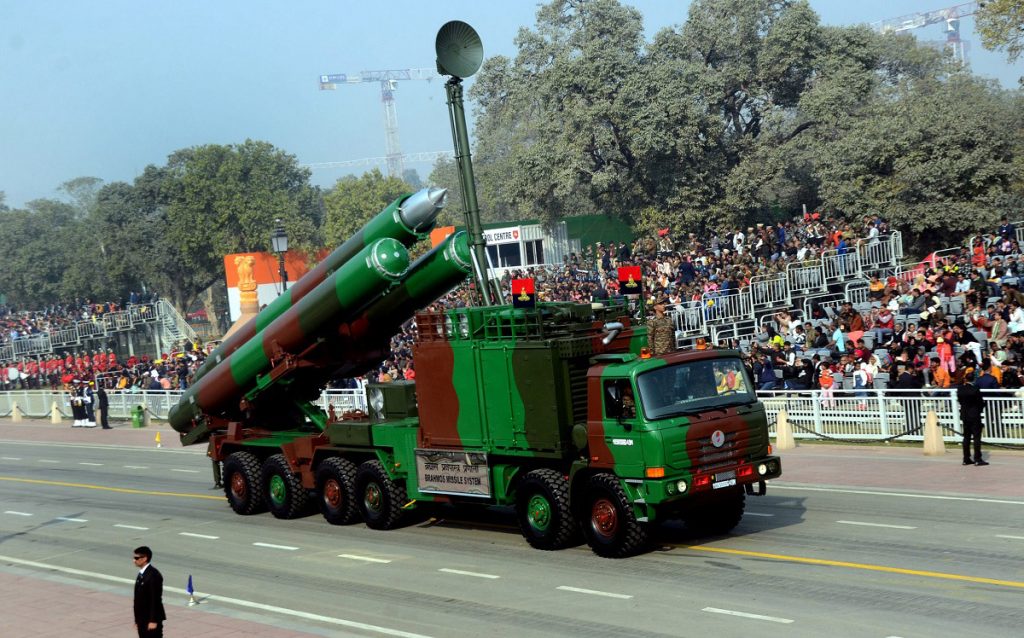
Entry of private players gives boost to defence manufacturing sector

India has exported more than Rs 16,000 crore worth of weapons to the various countries in Asia, Africa, and is poised to enter the weapon market of the Latin America. The country aims to cross a five billion USD export target by 2025.

India has achieved a remarkable success by developing the advanced version of Agni-5 inter-continental ballistic missile system capable of carrying nuclear war heads having a range of about eight thousand kilometres. Yet another milestone of the Indian technology in recent weeks has been the successful use of reusable spacecraft. These technological breakthroughs have established that India is not only a high-profile IT power, but has acquired the necessary state-of-the art technologies in the field of manufacturing high-precision armaments, radars, and now a combat aircraft, which could rival its peers in the highly competitive developed and being marketed by the developed world.

India’ weapon systems have already evoked worldwide interests. She has exported more than Rs 16,000 crores worth of weapons to the various countries in Asia, Africa, and now she is poised to enter the highly sensitive and technology-driven weapon market of the Latin American countries. She hopes to cross a five billion USD export target in 2025. Her exports of the military hardware include missiles, the advanced light helicopter (ALH), offshore patrol vessels, personal protective gear, surveillance systems and a variety of radars to a number of countries in Asia, Africa and Latin America.

For many, the five billion USD exports target appear to be a tall order, but with the inclusion of the Light Aircraft, Tejas, and the deadly BrahMos missile system to make available to friendly countries, the export target is expected to be achieved. It may be noted that India is not included in the top 25 countries being led by the USA with 40 per cent share in the global weapons market; therefore, it is natural to doubt the success of this goal. However, the recent responses from various countries for Indian weapons, aircrafts and missiles have created this optimism. In New Delhi, these days, and scores of military attaché of different countries seeking India’s most cherished missile system, BrahMos, are being seen arriving at the corporate office of BrahMos, situated on the Palam Road in the capital’s high security cantonment area. In March 2021, the Philippines, perhaps, was the first country to purchase a BrahMos missile. Indonesia, Egypt and some gulf countries too have evinced interest in buying this deadly missile, but the Indian officials are reluctant in sharing the details.

Tejas Attracts Worldwide Interest

January four, 2001, was a day of deliverance for the Indians, when their scientists successfully flew the first prototype of India’s own light combat supersonic aircraft (LAC), Tejas. It gave message to the worldwide aviation industry that India too can develop her own combat aircrafts without solely depending upon the foreign supplies. Her talented scientists have also mastered the cutting edge technologies in the sensitive field of aviation, the USP of any industry of the world.

Dr VK Aatre, the then Director General of the Defence Research Development Organization (DRDO), who was quite euphoric on this success and was seen dancing at the test site, later recollects that it was the most memorable day for many reasons. First, we demonstrated to the world the competence of Indian aeronautical community to design and fly a modern light combat aircraft (LCA). Second, it was the beginning of accomplishment of many milestones, which included a fly past at Aero India 2001 on February 10, 2001. It also generated the necessary confidence in the country’s political establishment. It was just over a month after the first sortie, which later received the approval of Cabinet for full scale engineering development of LCA. It had happened before 2001 ended. Within six-seven months of this approval on June six, 2002, the government allowed production of eight aircrafts as part of the Limited Series Production (LSP) programme.

The Project Delayed

In 2016 and 2018, the ‘Tejas’ appeared before the international audience with its full complements and glamour. It had almost eclipsed in the minds of Indians as well as defence experts across the continents. Its splendid regal appearance was applauded by the international aerospace community during the air shows in Bahrain and Langkawi, Malaysia. It also set at rest doubts about the capabilities of India’s Defence Research Development Orgnaization (DRDO) to develop a world-class aircraft. The combat aircraft’s spectacular performance over the skies of Bahrain and Langkawi has engendered enquiries for exports from friendly countries.

India’s political establishment cannot be blamed for this delay. During this period, it had faced several hurdles including the technology embargo imposed by the US administration post Pokhran-II, in 1998. Interestingly, during the tenure of the Bill Clinton Administration, the then Indian PM, P.V.Narsimha Rao, had obtained the US President’s approval for detonating nuclear device. India had stated that since India is being encircled by rogue state like Pakistan having obtained nuclear teeth from its ally China, and how a Chinese senior army officer had threatened Indian soldier of using nukes against India. However, later the Chinese authorities had removed the officer from the border, but the message was loud and clear that if India signs the CTBT (Comprehensive Test Ban Treaty) without detonating a nuclear device, India would always be a victim of nuclear blackmail!  

With the end of the sanctions on India, India renewed her ambitious venture with three well-defined aims: bridge the technology gap which was being experienced during the 1960s, develop the indigenous aeronautical industry and provide the Indian Air Force with a ready-to-go-to-war fighter in a fixed timeframe of 15 years.

Private sector fuels defence industry

It was only in 2001 that India’s defence sector was fully opened up for private players. So far, over 300 private companies have received industrial licenses and more than 100 of them have commenced large scale production as well. The credit for this historical decision to allow the private sector and FDI investment in the sector goes to the then Defence Minister George Fernandez and the then Defence Secretary, Yogendra Narain. They dared to amend the Industrial Policy Resolution of 1956, which had reserved the defence production under the government sector.

The Tejas is the second fighter developed by HAL with the intention of supersonic performance, after the HAL HF-24-Marut. The Tejas achieved initial operational clearance in 2011 and final operational clearance in 2019. The first Tejas squadron became operational in 2016. It has started replacing MiG-21s. Of the total capital acquisition budget for the year 2021-22, 64.09% was being earmarked for domestic capital procurement. There is a provision for funding up to 70 per cent of development cost by the government to Indian industry. The government has enhanced FDI in Defence Sector up to 74 per cent through the automatic route for companies seeking new defence industrial license and up to 100 per cent by the government route, wherever it is likely to result in access to modern technology or for other reasons to be recorded.

An innovation ecosystem for Defence titled Innovations for Defence Excellence (iDEX) has been launched in April 2018. The iDEX is aimed at creation of an ecosystem to foster innovation and technology development in defence and aerospace by engaging industries including MSMEs, start-ups, individual innovators, R&D institutes and academia, and provide them grants/funding and other support to carry out R&D which has potential for future adoption for Indian defence and aerospace needs.

In a bid to give a major boost to development of innovative defence technology and support a growing start-up base in the country, the defence ministry has earmarked Rs 1000 crores during 2021–22 for the procurement from the iDEX start-up. Meanwhile, the Union Government has established two defence industrial corridors, one each in Uttar Pradesh and Tamil Nadu. The investments of Rs 20,000 crore have been earmarked for them.

Bathinda Army base fratricide; remedial steps back in focus

Within days of the killing of four Army jawans inside Bathinda military station in Punjab, the police held one of their colleagues for the fratricide, reportedly committed in retaliation to the repeated “humiliation and harassment’’ meted out to him by the quartet, writes Rajesh Moudgil

By April 12 forenoon, the news about the dastardly killing of four Army jawans while they were asleep in their barrack inside the Bathinda military station in Punjab – that is located near Pakistan border – had spread not only across the country, but also around the world.

The deceased soldiers (all Gunners), from an Artillery regiment, were Sagar Banne, Kamalesh R, Yogesh Kumar J and Santosh M Nagral.

Home to the 10 Corps, the Bathinda military station is considered to be a vital Indian Army base for defending Punjab and neighbouring Rajasthan borders from Pakistan. Spread in a vast area including forest cover, it has a number of units from different divisions including infantry, armoured, aviation, artillery, signals and engineers.

The first information report (FIR) lodged at the Bathinda Cantonment police station by the military station’s Major Ashutosh Shukla, said that he was informed by Desai Mohan, a jawan on sentry (guard) duty about the firing incident around 4.30 am on April 12, who saw two persons wearing “kurta-pyjamas’’, one of whom carried an Insas (Indian small arms system) rifle and another an axe, running towards forests of the Army station before melting into the darkness after the incident.

According to the initial probe, the police and the Army investigators ruled out any terror attack though there were still no coherent answers available about the assailants and their motive behind the brutal killings.

Missing Army Insas Rifle  

Pertinently, in a major disclosure, it was also learnt that the shocking killing incident was on the back of an Insas rifle along with 28 rounds going missing on April 10 from inside the military station.

Significantly enough, it was also subsequently learnt that the said rifle was used for killing the four soldiers and that the same had been recovered on April 12 along with the magazine of which forensic analysis was in progress.

The questions then were asked as to why the probe into the case of missing weapon and ammunition took time – untill April 12 when the four jawans had been killed.

Meanwhile, even though the Army had pressed into service hexacopters and drones in the entire area, the police and army investigators scanned all the CCTV footage of the Army station for clues, though could not get any solid leads.

Holes in eyewitess’ version

It was after getting extensive checks done on the CCTV footages of all possible entry and exit points as well as grilling of various guards on duty – especially around the spot and at around the time of the crime -, the investigators had begun on April 13 zeroing in on the account of the so-called eyewitness, Desai Mohan, only to find some holes in his version given a day before.

The police had then said that the eye-witness’ version raised suspicion as no sharp-edged weapon injuries were found in the soldiers’ bodies in the post mortem and there were only injuries from gunshots. Also, except for the eye-witness, no other person on duty in the entire area had spotted the movement of two men in civvies.

Moreover, it appeared to be a targeted killing, as there would have been indiscriminate firing in case of a terror attack.

The headway

Having exhausted different theories doing the rounds, the Punjab police finally approached Army authorities on April 16 asking them to make available about 10 Army personnel, including Desai Mohan and another soldier, also gunner Naga Suresh, so that they could be quizzed or their statements recorded.

Subsequently, Desai Mohan was apparently arrested late April 16 night itself for fratricide in retaliation of repeated harassment and humiliation meted out to him by the four. He had also reportedly confessed to having stolen the Insas rifle and its ammunition on April 10, police said.

According to Bathinda senior superintendent of police (SSP) Gulneet Khurana and Col Animesh Sharan from the Bathinda military station, the accused army jawan, Gunner Desai Mohan, had killed the four soldiers in a premeditated plan as per which, he first stole an Insas rifle and bullets on April 10, hid them for two days and subsequently killed them on April 12.

The police also said that the accused who was on guard duty at the officers’ mess on April 12, had gone to the barrack – where the four soldiers were sleeping in different rooms in the barrack – twice around 3 am to ensure they were asleep, before killing them.

 They further said that the accused had confessed his crime which he held was in retaliation to the “repeated harassment and humiliation” caused to him by his four colleagues. On the question about the nature of the harassment or whether it was physical or sexual, SSP Khurana categorically said that it was a matter of further probe into the case.

Col Sharan said that when the Insas rifle, its 20 cartridges and another eight bullets of a light machine gun (LMG) were reported to be missing on April 10, the military base was put on high alert and now the matter was further investigated under court of inquiry (CoI), though the rifle used in the crime as well as six cartridges of the LMG had been recovered from a sewage pit dumped by the accused in the compound. The police had already recovered the 19 empty shells of the Insas rifle from the spot of the crime on April 12 only.

Now, remedial steps under focus

Meanwhile, the dastardly killings at Bathinda military station has once again raised the questions pertaining to the lack of connect between the senior leaders and the jawans behind the fratricide incidents that continue to take place in the security forces.

According to media reports, as many as 18 incidents of fratricide are reported to have taken place in the Indian Army and two in the Indian Air Force (IAF) between 2014 and March 21, 2021.

The media reports say that while two Army personnel were killed and as many injured in a fratricidal incident inside an Army camp in Jammu and Kashmir in 2022, fratricidal and suicide cases were much higher in the Central Armed Police Forces (CAPF).

If the reports are to be believed, 29 personnel of the CAPF were killed by their colleagues in the past five years between 2018 and 2022, according to the data presented by Union Minister of State for Home affairs Nityanand Rai in the Lok Sabha on March 28, 2023.

Media reports also raised questions if the military establishments, especially the Bathinda station, had ensured an effective grievance redressal system, the accused could have brought up the “harassment and humiliation’’ issue with his superiors. Lack of such a platform may have prompted the soldier to take the extreme step, said the reports.

Underlining the urgent need to ensure harassment-free life inside military bases, the reports also underlined the extreme working conditions and the mental stress which act as a trigger for such incidents.

Disqualified from Lok Sabha over defamation case, Rahul vacates house

Rahul, who said that he is prepared to pay any price for speaking truth to the power, has shifted to his mother Sonia Gandhi’s official residence 10, Janpath. Sonia and  Priyanka were present when the Congress scion handed over the keys to government officials, writes Amit Agnihotri

Rahul Gandhi, who vacated his official 12, Tuglaq Lane bungalow on April 22 following his disqualification from the Lok Sabha has said he is prepared to pay any price for speaking truth to power.

The bungalow was allotted to Rahul in 2004 when he first entered the Lok Sabha and represented Amethi parliamentary constituency in Uttar Pradesh. The Congress leader continued to represent Amethi till 2019 when he lost his traditional seat but won from Wayanad in Kerala.

“This house was given to me by the people of India. I thank them. I have paid the price for speaking the truth. But I am ready to pay any price for speaking the truth,” Rahul said after he handed over the keys to government officials.

“My brother is suffering because he spoke the truth about the government. But we are not afraid. He will not back off. He will continue to fight,” Priyanka Gandhi Vadra said in support.

For now, Rahul has shifted to his mother Sonia Gandhi’s official residence 10, Janpath. Sonia, Priyanka and AICC general secretary in charge of organization KC Venugopal were present when Rahul handed over the keys to government officials.

“They can give this house to anyone now. The way the Modi government is targeting Rahul Gandhi is completely a political agenda,” said Venugopal.

The disqualification happened on March 24 as a result of Rahul’s conviction and sentence of a two-year jail term in a 2019 criminal defamation case involving the surname of PM Modi by a Surat trial court on March 23.

As per the notice to vacate the house sent by the Lok Sabha housing committee on March 27, the deadline was April 22. Two days before that, the Surat Sessions court rejected Rahul’s appeal to quash the conviction order of the trial court on April 20. The party will now file an appeal in the Gujarat high court and is prepared to approach the Supreme Court, if needed. “The Sessions court order is erroneous,” party leader and senior Supreme Court advocate Abhishek Manu Singhvi said.

The Congress has pointed out that the speed with which Rahul’s conviction, disqualification and house eviction notice came, showed that it was done as part of BJP’s conspiracy because the former party chief was asking tough questions of the Modi government and demanding a JPC probe into the Adani-Hindenburg issue.

The Congress has also said that the trial court order was questionable and argued that in a normal defamation case, Rahul should have been given a few months’ jail term and not a two-year sentence which caused his immediate disqualification from the Lok Sabha.

The party said that Rahul’s comments “How come all thieves had a Modi surname” made during a rally in Karnataka’s Kolar in 2019 were distorted. The party also countered the BJP’s charge that Rahul had defamed the entire OBC community by demanding that the Centre should conduct a caste census to determine the population of the OBCs and remove the cap of existing reservations.

The BJP said that it had nothing to do with the defamation case and that due procedures were being followed in the matter. However, the Congress protested the issue across the country and said it will continue to highlight the alleged targeting of its leader.

“We all should learn from Rahul Gandhi. He has shown that he has no attachment to a post or a house. He could have said sorry and sat down quietly. This would have allowed him to retain his Lok Sabha membership and the government house. But his priority is not to compromise on the principles and fight against what he believes is wrong,” Congress media head Pawan Khera said.

In support, various party leaders, including party chief Mallikarjun Kharge offered his official residence to Rahul and party sympathizers ran a nationwide campaign saying “mera ghar, Rahul ka ghar.” The party described Rahul as the son and brother of the people.

Is the burgeoning population boon or bane for the country?

While India’ with  population of 142.86 crore has overtaken that of China for the first time, India has a certain advantage over its neighbour as it enjoys a larger number of younger population which means a larger young workforce compared to China, writes Rajendra Khatry

India has now overtaken China as the most populous country of the world.  It is the first time that India’s population has overtaken China. The UN began to collect and release population data since 1950. 

According to the UN estimates, India’s population stands today at 142.86 crore against China’s 142.57 crore. Incidentally, India does not have the latest official census report to verify the United Nations’s population claim. India’s last census was done in 2011 and crores of  people have been added since then.

With India first and China second most populous country now, the United States stands a distant third, with an estimated population of 340 million, according to the UN data. The data reflected information available till February 2023.

According to the UN report, India’s population is set to rise to 1.515 billion in 2030, from 1.417 billion in 022. China’s population, by contrast, is expected to fall slightly from 1.426 billion to 1.416 billion over the same period.

At this rate, India is projected to have a population of 1.668 billion in 2050, ahead of China’s 1.317 billion people by the middle of the century. According to the Total Fertility Rate (TFR), which means the average number of children a woman of child-bearing age must have 2 children and the extra, 01, indicates children who die in infancy or women who die before childbirth. A TFR of 2.1 will help in stabilising the population of India, according to experts.

According to a UN report, India’s demographic changes are fuelling the second largest rural-to-urban migration in human history, as masses move to cities desperately seeking work. Population density is another problem that puts immense load on natural resources, utilities, land prices, and educational and health facilities.

And yet, even as India’s population has overtaken that of China, India has a certain advantage over its neighbour as it enjoys a larger number of younger population which means a larger young workforce compared to that of China.

According to the UNFPA report 25 per cent of India’s population is in the age group of 0-14, 18 per cent in 10-19, 26 per cent in the 10-24, 68 per cent in 15-64, and 7 per cent above 65. In the population data India has a certain advantage over its neighbouring country China. 

The corresponding figures for China, has nearly 200 million people above the age of 65 which means its actively working population is much less than that of India. Compared to India’s 7 per cent retired persons, China has 14 per cent of aged people.

According to experts, India now has a demographic advantage. It has a larger number of young people. Its young population in a consumer-driven economy will be a major factor in driving the country’s development.  It presents a big opportunity for India’s economic growth.

For most of the countries the higher growth rate maybe difficult to achieve, but India stands at an advantageous position in this case. Population growth results in greater productivity due to increase in the workforce.

India may be struggling to deal with the demographic dividend which actually can be a blessing in disguise if the new entrants in the work field are positively used and employed.

However China’s advantage is that it  is doing better than India in the context of life expectancy. For men life expectancy is 76 and for women it is 82 per cent. On the other hand in India average life expectancy is 74 for men and 71 for women.

Not just this, but India’s demographic diversity among states also provides unique opportunities to reap the benefits of demographic dividend. In India different states are at various stages of demographic transition much to the country’s advantage.

No doubt India and China account for more than one-third of the estimated global population of 8.045 billion, but the positive point is that the population growth in both Asian giants has been slowing down over the years. The rate of slowing down population is much faster in China than that of India.

Since 2011, India’s annual population growth has averaged around 1.2 per cent, compared tp 1.7 per cent in the 10 years cycle earlier  according to the official data of the Indian government. According to reports, China’s population  decreased by 850,000 people last year. This was the first such decline recorded in the country since 1961.

The UN Population Fund (UNFPA) had made certain remarks about the burgeoning population of the world especially in regard to that of China and India. In a special graphic to mark the global population reaching eight billion, the UNFPA had said that Asia and Africa have driven much of this growth and are expected to drive the next billion by 2037. According to that report, Europe’s contribution will be negative due to its declining population.

China faces a looming demographic decline as birth rates plunge and its workforce ages. Not so with India though. But to deal with the reverse population growth, several regions in China have now also announced plans to boost birth rates. Well, China tried to increase population at a faster rate, but according to reports, official efforts have so far failed to reverse the decline.

It is to be noted that the National Family Health Survey (NFHS)-4 found India’s TFR had  reached 2.2. Most Indian states had already achieved or were below 2.1 TFR, according to reports. But the United Nations Fund for Population activities (UNFPA) stated that India’s TFR has declined from 2.2 to 2.0 at the national level. The country reached the national replacement level of fertility in 2020. Unfortunately this replacement level is not even across all of India as population density differs from state to state. 

31 States and Union Territories have 69.7 per cent of India’s population and they have reached below the replacement rate of 2.1. The TFR is above the national average in several states like Bihar, Meghalaya, Madhya Pradesh, Manipur, Uttar Pradesh and Jharkhand.

India’s family planning programme has not achieved the desired result, feel exp[erts. The National Programme for Family Planning was launched way back in 1952 with the slogan `Hum do, hamare do’, while the National Population Policy was launched in 2000.

But according to the UNFPA, there has been improvements in access to family planning-related information and services in the country. According to many, India’s national population policies and health systems are working although slowly. 

Also the impact of the national family planning schemes have been more in the urban areas than that of the rural. Another fact is that the middle class families now have less population compared to the poor which is tragic indeed as with less income the poor have to feed more family members.

It is good that with the increasing marriage age, fertility has declined. According to experts, the way forward is to pursue Sustainable Development Growth (SDG). This should be done with a human rights approach and having special emphasis on women and girls.

It must be ensured that the availability of information regarding sexual and reproductive health and rights and facilities like contraceptives and maternal healthcare must be made available to women.

Chhattisgarh farmers to earn from growing trees

A tree planting initiative known as the Mukhya Mantri Vriksh Sampada Yojana has identified 36,000 acres for plantation outside forests in the first year as part of a five-year plan, writes Deepanwita Gita Niyogi

As part of a special initiative, farmers in Chhattisgarh will reap monetary benefits for planting trees in unused lands. The initiative known as the Mukhyamantri Vriksh Sampada Yojana has identified 36,000 acres this year for plantation outside forests. In total, 180,000 acres will be covered in five years.

The project will contribute to farmers’ income. To help them, a buyback agreement has been prepared and it is pending approval at present. The beneficiaries will also be able to take carbon credit.

To ensure that the programme is a success, the forest department staff  have undergone intensive training.  Short duration species like eucalyptus and meliadubia as well as fruit trees will be distributed among farmers.

Earlier, under the Mukhya Mantri Vriksharopan Protsahan Yojana, if farmers shifted from paddy cultivation to tree plantation, they received Rs 10,000 per acre for three years as incentive.

“Farmers have been identified already. Under the initiative, there is a tripartite agreement among companies, the Chhattisgarh government and farmers. The buyback price will be decided by the forest department through a committee. It is a win-win for all stakeholders,” said additional principal chief conservator of forest, land management, Sunil Kumar Mishra.

Tree planting scheme

Under the Mukhyamantri Vriksh Sampada Yojana, tree planting will be carried out during the monsoon. Species like teak and bamboo will be planted in irrigated lands. However, on March 21, there was symbolic planting across the state on the occasion of the International Day of Forests.

Durjan Kashyap, the sarpanch of Dilmili in Bastar district, said fruit trees will be distributed by the forest department. For the purpose of planting, pits will be dug and these can be prepared under MGNREGA. Dilmili is already experimenting with coffee plantation. For the tree planting scheme, coordination between farmers and the forest department is on.

As part of the initiative, which is basically an agroforestry model, consultants will be hired for buying carbon credit. Mishra added that the government wants to increase trees outside forest through this scheme. There will be plantation along roadsides and river banks too.

Though there are many definitions of agroforestry, generally it is a combination of agriculture and trees in an area. According to Starry Sprenkle-Hyppolite, restoration science senior director at Conservation International, full-sun-crops like corn, wheat and soy can tolerate a light level of agroforestry, like widely-spaced lines of trees or trees around field boundaries.  Depending on the climate, trees may help ensure production of these crops in drought because they reduce soil temperature and evapotranspiration, thereby reducing water stress on crops. 

“Some trees make better neighbours for crops. Those that take a lot of water and have shallow root systems like eucalyptus and neem tend to compete with crops and make yields go down.  Eucalyptus isn’t good for the environment or agriculture, not just for water competition but also for the chemicals in leaves. But deep-rooted trees can help lift groundwater to the surface, thus benefitting crops,” Hyppolite said.

Value of trees outside forests

For carbon sequestration, trees outside forests are important. There are far more hectares of managed lands compared to forest lands as majority of the Earth’s non-desert surface is being used either for agriculture or for grazing. Thus, increasing tree densities up to levels that are compatible with food production is one of the natural climate solutions.

Under the Chhattisgarh government’s scheme, beneficiaries will receive 100 percent subsidy for five acres. If the area increases beyond that, there will be 50 percent subsidy.

Agroforestry is a good approach to defeat deforestation and increase forest cover. “Agroforests provide sustainable sources of fuelwood and timber. There is one argument against this which assumes that food production is less when trees share fields with crops.  However, research suggests there are sustainable levels of tree integration that don’t decrease crop yields. Trees also survive drought in a much better way than crops,” Hyppolite added.

Trees outside forest are counted in the Forest Survey of India reports too. But though they increase tree cover, agroforests are not the same as natural forests.

Under the Chhattisgarh model, the number of nilgiri trees will be 900-1000 per acre, said CR Sori from the forest department based in Dantewada district. Nilgiri is sold to contractors at Rs 4 per kg. Those having borewells will get tissue culture trees of hybrid quality which will mature in four years.

Anil Karma, the sarpanch of Paraspal village in Dantewada, is happy with the new scheme but threw in a word of caution. He said under previous such exercises, the forest department did not take much care and many saplings were damaged by cattle.

To encourage farmers, the Chhattisgarh government is trying to fix a minimum purchase price for meliadubia, bamboo and eucalyptus every year, said Rajesh Kallaje from the forest department, who worked extensively on the project. The number of trees will also depend on the spacing. Whereas there will be 900 -1000 trees per acre in case of nilgiri, for teak it will be 250 trees per acre, for sandalwood 160 trees per acre, and for bamboo 450 trees per acre.

Meliadubia appears to be better suited for agroforestry than eucalyptus.  It loses its leaves each year which means that it will increase soil organic matter, help in water retention and increase fertility. “It requires a lot of water for fast growth and so can cause problems in dry areas.  But it is a timber tree with valued wood,” said Hyppolite.

How historic Anglo Arabic School failed to catch educationists’ fancy

‘The School at Ajmeri Gate –   Delhi’s  Educational Legacy’ is authored by the well-known academic Azra  Razzack, and also by lawyer-scholar, M. Atyab  Siddiqui. And as to the ‘why’ they decided to write this book, there stands out a definite backgrounder. A book review by Humra Quraishi

Spring saw the launch of the book – ‘The School at Ajmeri Gate – Delhi’s  Educational Legacy’. After years I witnessed such a well-attended book launch, where guests and speakers and invitees from Old Delhi and New Delhi stood out, with their eagerness to hear details to the Anglo Arabic School, situated at Ajmeri Gate. Probably it is one of the oldest schools, started almost three centuries back.

This book is authored by the well-known academic Azra Razzack, and also by lawyer-scholar, M. Atyab  Siddiqui. And as to the ‘why’ they decided to write this book, there stands out a definite backgrounder.  To quote the two authors from the preface to the book, “We were associated with the Anglo Arabic School, Ajmeri Gate, as members of both the  managing committee  of the school and of the Delhi Education  Society under the aegis of which the school  functions. As we worked on the campus in our respective capacities, there was a painful realization about the gap that existed. This historic educational institution, having its originals in the late 17th century and located in the heart of Delhi at Ajmeri Gate, was almost non-existent for many in the field of education.”   

The two authors go on to detail the questions that hit them: “Why was such a historic school not part of the narrative, much less the imagination of well-known educationalists? Even its affiliation with CBSE not given the school a worthy mention. Was its ghettoized existence responsible for its anonymity in the wider world outside? That was the moment we decided that documentation of the story of the school was imperative. In ‘othering’ the Muslim community, somewhere the school seemed to be have been ‘othered’ as well.”

With that take off, stands out this well-researched book on this school. There’s ample mention of the relevant details to the school. And there’s direct and also indirect focus on the related aspects, which could be termed of significance in today’s political climate.

As Professor Krishna Kumar writes in the foreword, “The narrators of the Anglo Arabic School’s story leave us wiser without saying a word that might be termed political. Our troubled times have made that word both meaningless and troublesome, especially when we need to use it in the context of education. The authors of this volume are pleading for harmony: they demonstrate that the Anglo Arabic School was and continues to be a symbol of a way of life based on acceptance and appreciation of diversity.” 

BOOK  REVIEW

Title of the  book-   The  School at  Ajmeri  Gate –   Delhi’s  Educational Legacy

Authors – Azra Razzack  & M. Atyab  Siddiqui

Publishers – Oxford University Press

Pages – 501 

Price –  Rs 2295

“Mann ki Baat’’ reaches 100

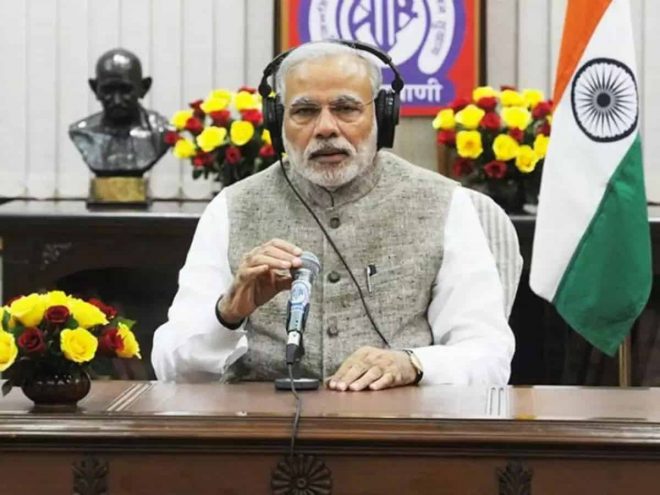
Prime Minister Narendra Modi ‘s popular program reaches at 100th episode Today.  The 100th episode of ‘Mann ki Baat’ was  broadcast today at 11 am in Radio and in Doordarshan. The program has provided a platform for the expression of the country’s positive energy and creative power. PM Modi has brought the mantra of democracy to the grassroots through 99 episodes of “Mann Ki Baat”. The Vice President Jagdeep Dhanker said that as “Mann Ki Baat” completes its 100th episode, it will be the foundation to ‘India @ 100’. He said that India will be at the top of the world when it will celebrate the centenary of Independence in 2047.

According to the reports at least 23 Crores are regular listeners of the show. The program have five main themes cleanliness and sanitation, health, wellness, water conservation, and sustainability. The BJP also properly planned to organize facilities in every Assembly constituency of the country for people to listen to the program. The program was telecast live by Doordarshan today.

The 100th episode was also broadcasted live in the United Nations headquarters in New York. A historic moment for Indians. Mann ki Baat is broadcasted in All India Radio with a motive to connect it with the young generation. Home Minister Amit Shah said that people had almost forgotten All India Radio due to different mediums of communication, but Prime Minister connected the young generation through “Mann Ki Baat” and gave a new lease of life to All India Radio. He said that PM Modi took All India Radio to every home and village of the country.

Tourism Ministry has also decided to celebrate the 100th Episode of “Mann ki Baat” through its Yuva Tourism Clubs. Tourism has been mentioned by Prime Minister Narendra Modi from time to time in the program. Tourism Ministry proposes to undertake a special initiative of “100 Episodes of “Mann ki Baat” – 100 days of Action” through the Yuva Tourism Clubs. According to survey it is said there were 23 crore regular listeners of “Mann Ki Baat” and 96% of population was aware of the radio program.

Terrorists in J&K’s Poonch had active local support: Police

A dozen terrorists are believed to be operating in the Jammu and Kashmir’s Poonch district, with the police suspecting that they are getting arms supply through drones from Pakistan. 

A week-long security operation to flush out the terrorists has been going on without much success. 

The Director General of Jammu and Kashmir Police, Dilbag Singh, visited the area and revealed that the recent attack on the army had been carried out with active local support. 

However, the arrests have not helped the police to make substantial headway in tracking down the terrorists. 

At least six suspects have been arrested, and over 200 were detained for questioning in connection with the terrorist attack that killed five soldiers. 

This attack in Bhata Durian was the second major attack in the area in the past four months. 

Earlier this year, terrorists targeted Hindu families in Rajouri, killing seven people and injuring over a dozen.  The People’s Anti-Fascist Front has claimed responsibility for the attack on the army. The police said the terrorists used armour-piercing bullets in the attack and fled with five assault rifles of the jawans after the attack.

Wrestlers Protest Continues at Jantar Mantar

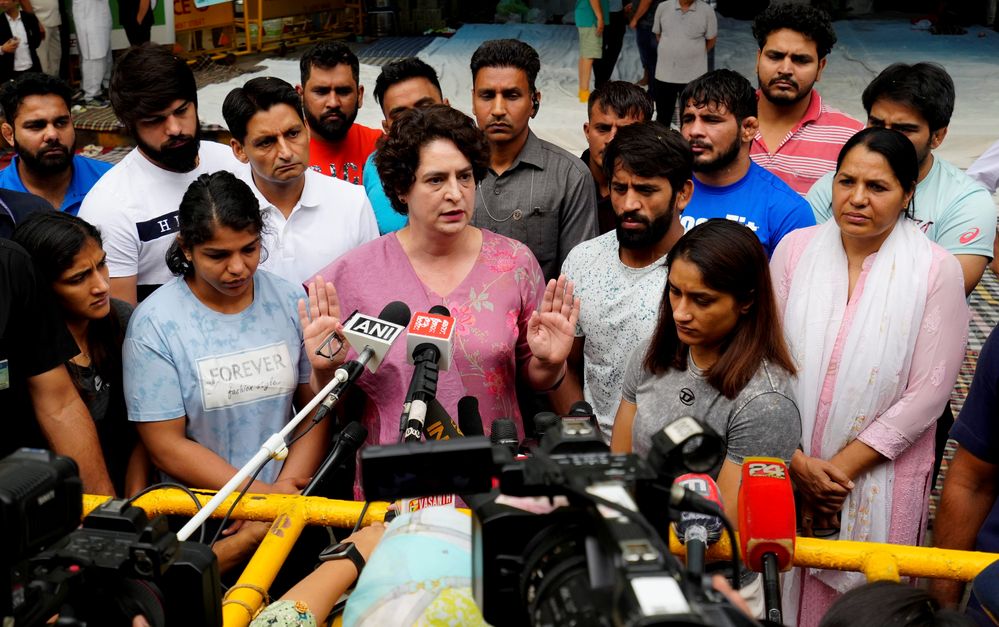
New Delhi: Congress leader Priyanka Gandhi with wrestlers Bajrang Punia, Vinesh Phogat, Sakshi Malik and Sangita Phogat speaks with the media during wrestlers’ protest at Jantar Mantar, in New Delhi, Saturday, April 29, 2023. Congress leader Deepender Hooda is also seen. (PTI Photo/Atul Yadav)(PTI04_29_2023_000018B)

Congress leader Priyanka Gandhi Vadra today met the protesting wrestlers at Jantar Mantar in New Delhi. It has been more than a week now that the Wrestlers are sitting on Dharna demanding the arrest of Wrestling Federation of India (WFI) Chief Brij Bhushan Sharan Singh on complaints of sexual harassment by women wrestlers. Though the FIRs have been registered by Delhi Police but wrestlers will continue their protest till the WFI chief is arrested.

 Top wrestlers Sakshi Malik, Vinesh Phogat, Bajrang Punia today continued their Dharna at Jantar Mantar against the Wrestling Federation of India Chief Bhushan Sharan Singh on charges of sexually harassing women wrestlers. The wrestlers are demanding the resignation of BJP MP from all the positions he holds. Congress leader Priyanka Gandhi today met them in the morning and hit out at Delhi Police for not providing the copy of the FIRs against WFI Chief. “When these girls win medals, everyone tweets in favor of them but now when they are sitting on the road and seeking to be heard no one is listening to them” added Priyanka.

“ I don’t have any expectations From the PM, because if he is worried, then why he did not meet these wrestlers yet”, She also said that there are serious allegations against Mr Singh and he should resign from the post immediately. Till he is at this post he would continue to exert pressure and harass these women wrestlers, Priyanka added. Other Congress leaders like Udit raj, Deepender hooda and Bhupender Hooda also joined the protesting wrestlers in solidarity. Congress Leader Navjot Singh Siddhu is also expected to meet these wrestlers on Monday.

The Delhi Police have now registered two FIRs against Brij Bhushan singh with sexual harassment charges levied by women wrestlers. Though the wrestlers are demanding FIR against the BJP MP from many days but it came after the Supreme Court issued notices to the Delhi Police on a plea by seven women wrestlers seeking resignation of an FIR against the WFI chief. Delhi Police have registered one FIR under section 354,354(A),354(D), and 34 of IPC.  One of the FIRs is on a complaint by a minor so FIR is filed under the Stringent Protection of Children from Sexual offences (POCSO) Act .Delhi Police will also provide security to the wrestlers. Meanwhile Sports personalities like Kapil Dev, Neeraj chopra, Sania Mirza and Bollywood stars like Pooja Bhatt, Sonu Sood and Swara Bhaskar  and some others have come out in support of these wrestlers.

MOST POPULAR

HOT NEWS