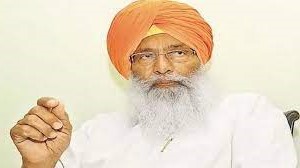
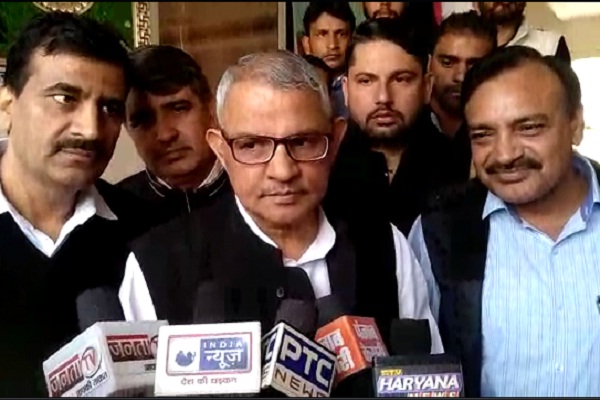
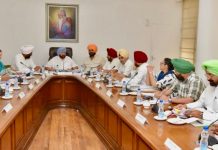
Chandigarh: President of Shiromani Akali Dal (Sanyukt) and former Union Minister Sukhdev Singh Dhindsa said that in the scheduled meeting of NDA, he will strongly put a demand to resolve long pending issues of Sikh Panth and Punjab.
Dhindsa said that the Centre should resolve those issues related to Punjab and Panth for which the Shiromani Akali Dal has been struggling for a long time. He said that Senior Vice President of SAD (Sanyukt) Justice Nirmal Singh (retired) will also attend the meeting with him.
He said that in this meeting his party’s emphasis will be laid on highlighting the fact that the NDA while making the programme should at least pay emphasis on the well-being of the people of Punjab, promoting mutual brotherhood of the Hindu Sikh community and safeguarding cultural, social and political fabric.
“The demand regarding the release of Bandi Singhs who have completed their sentences in jails, removal of the names of immigrant Punjabis from the black list, holding early elections of SGPC, issue of Punjab capital Chandigarh, waving off the debts incurred by Punjab, the opening of Wagah border for trade, will also be raised in the meeting said Sukhdev Singh Dhindsa.
He further said that apart from these issues, demand will also be made regarding an additional economic package to compensate for the damage caused due to flooding in the state.
Sukhdev Singh Dhindsa said that the fundamental motive of Shiromani Akali Dal (Sanyukt) is to solve the rightful issues of Panth and Punjab by putting aside personal interests. He said that in the country’s freedom, Punjabi and especially the Sikhs have made an invaluable contribution, but the governments of the time did not appreciate the supreme sacrifices made by the Punjabis and the Sikhs.
Sukhdev Singh Dhindsa said that these demands have been pending for several decades. The wounds given by the Congress government to the Sikhs and Punjab can never be forgotten, he said.
Dhindsa also expressed the hope that the NDA government at the Center would accept the long pending demands of the Sikhs and work to heal the wounds inflicted by the Congress.
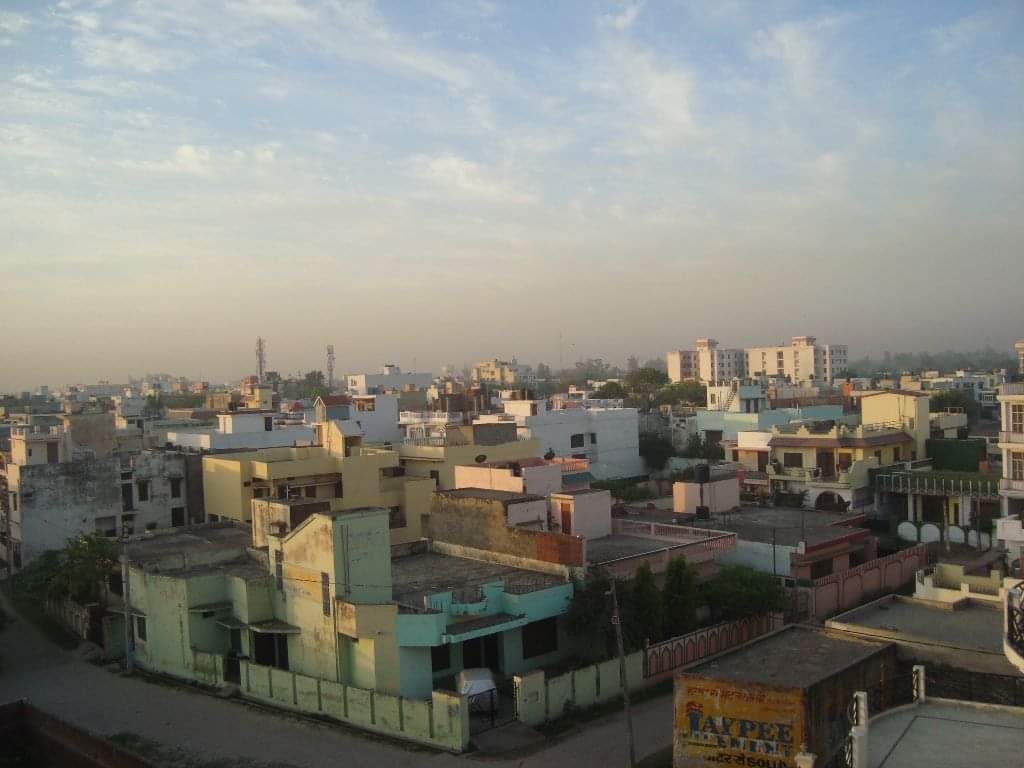
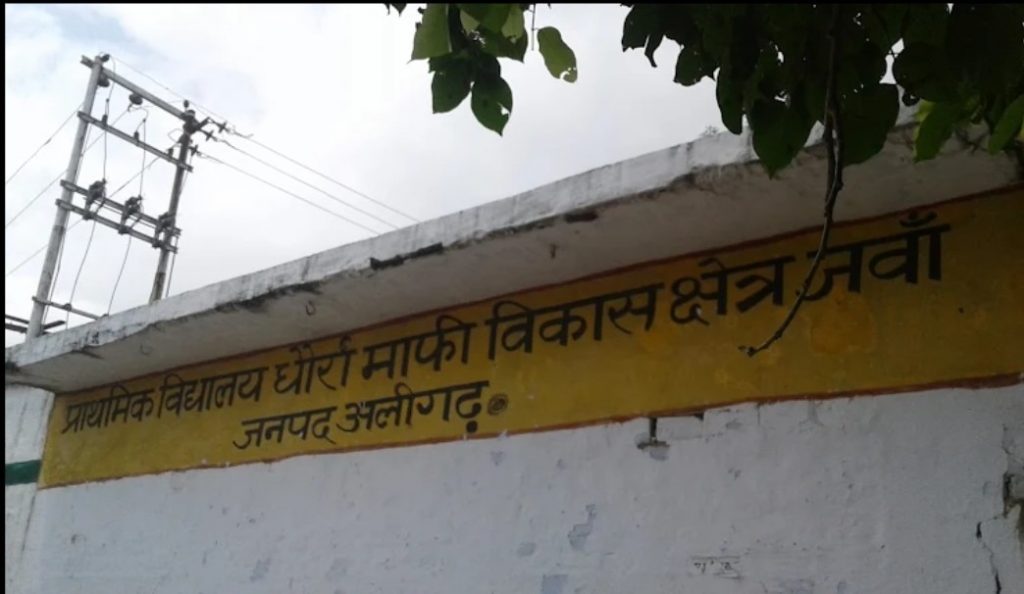
It is a proud moment for India especially Uttar Pradesh when one of its village Dhorra Mafi of Aligarh district holds a distinction for not only being the most Literate village of India but also Asia. With the literacy rate of more than 80 percent the village has already entered “Limca Book of World Records” and its name was proposed in the “Guinness World Records” also. In a recent development the village has become a part of Aligarh district now, though the Gram Panchayat and villagers demanded a status of “smart Village” by the administration.
In a telephonic interview to The Financial World, M Noorul Amin, who was the Gram Pradhan of the village since the year 2000 said “ We feel very proud that our village is considered as the most literate village in Asia, but it would have been better if our village received the status of “Smart Village”. India is a Land of Villages, and Dhorra Gaon had its distinct identity because of its educated class. We have worked hard for the development of this village but the administration did not pay attention to our proposal of converting it to a model of smart village. According to Amin, who is also a Doctor, they had requested the District and State administration many times but their demands were overlooked. He fails to understand why the administration ignored a simple request. After becoming a part of the district, Dhorra will lose its identity. Amin added.
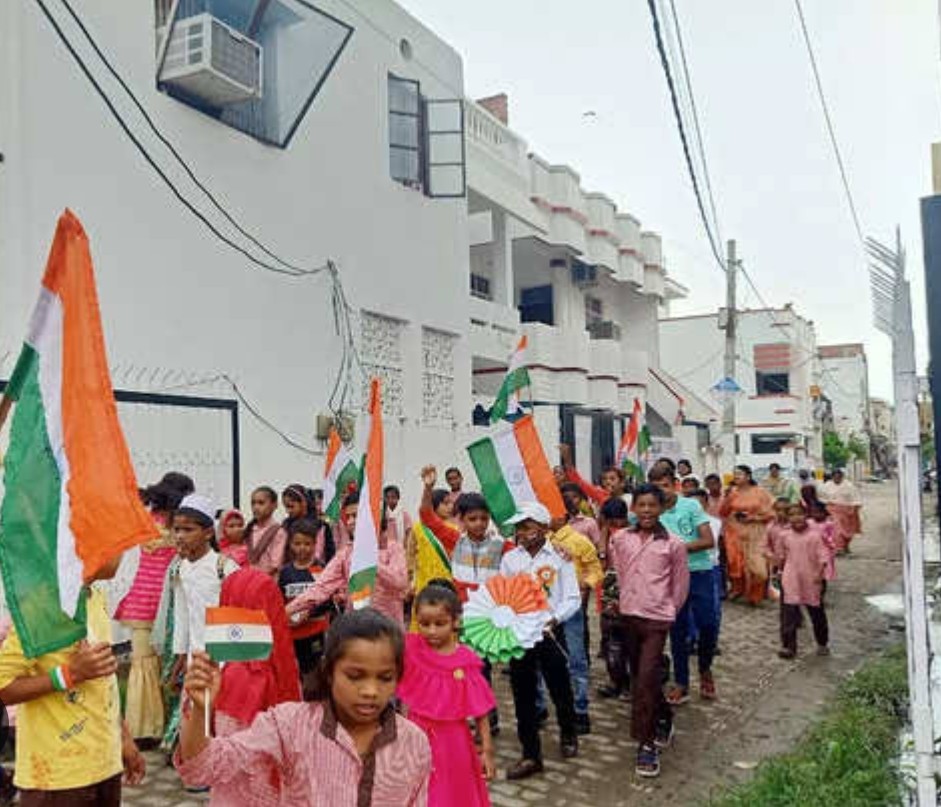
Dhorra Village is no more a village now but has become a part of Aligarh district like many other villages. The process of merging Dhorra with Aligarh district started in 2018 and now it is a part of Municipal Council. Situated in the Aligarh District of Uttar Pradesh, Dhorra Mafi village lies in the proximity of Aligarh Muslim University. It is located 4km towards North from District head quarters Aligarh. With a population of 18-20 thousand people the village was self sufficient with all necessary amenities. It had broken all the Clitches that villages are generally associated with. The Village was considered as the most developed village of the country with regular Electricity supply, water supply, English medium schools, Hospitals and Banks. The women of the village were also equally educated as men and are placed in good sectors. Because of these reasons its name was proposed for Guinness World Records also.
Dhorra Village has always been in News because of its Education. There was a mix population of Muslims and non- Muslims people that lived happily. It became popular when Super-Star Amitabh Bachchan asked a question in his famous quiz program “ Kaun Banega Crorepati “ “ Which is the most educated village of Asia ? It was listed in Limca Book of World records as the most literate village of India in 2002. This Gaon has given many scientists, doctors, Engineers, Professors and IAS officers. Most of the people belonging to this village are in Govt. jobs and many of them are settled abroad. As it lies in close proximity of AMU, it has been instrumental in giving Education to men and women. Faiz Mustafa of this village was a vice Chancellor of Aligarh Muslim University. Dr Shadab Bano and Dr Naima Gurrej are the professors and IAS Dr Siraj an IAS officer also belongs to this village. While this village has earned its reputation as Asia most literate village, other villages of India are also setting examples. A small village in Meghalaya has earned the title of “Asia cleanest village” after Dhorra.
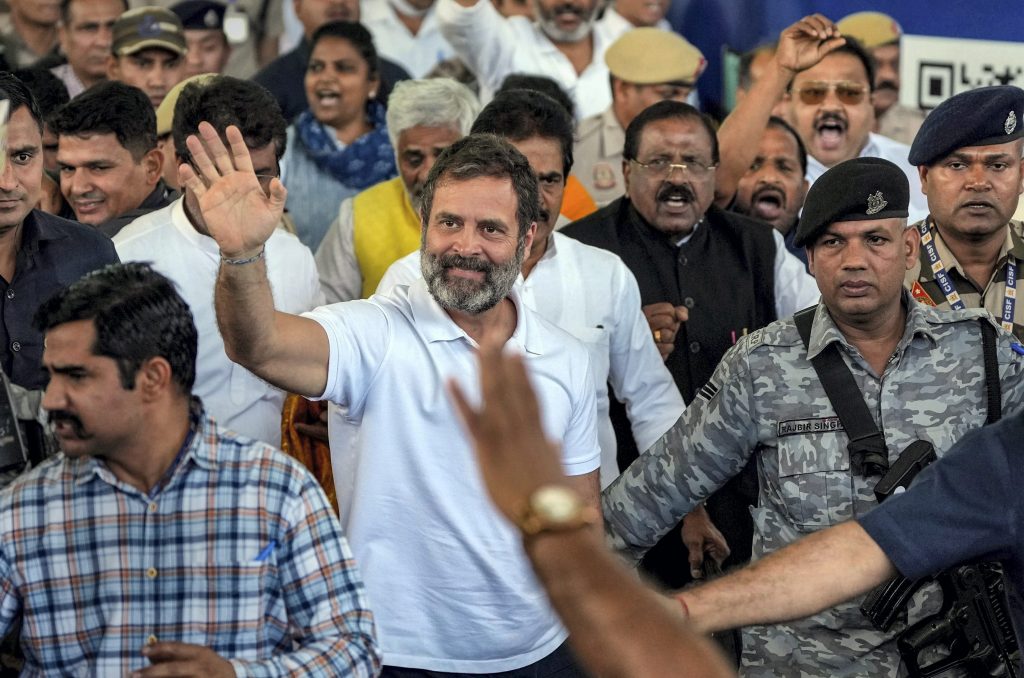
Rahul Gandhi plans to move the Apex Court after his petition seeking stay on the conviction order in defamation case was rejected by the Gujarat HiC. Meanwhile, the party held ‘maun satyagraha’ across the nation on July 12 to protest Rahul’s disqualification, reports Mudit Mathur
After a Sessions Court in Surat (Gujarat) dismissed Congress leader Rahul Gandhi’s appeal against his conviction order passed in criminal defamation case by Metropolitan Magistrate, a single judge of Gujarat High Court also dismissed his petition seeking stay on the conviction order. Congress leader and senior Advocate Abhishek Manu Singhvi called the series of complaints filed against Rahul Gandhi an ‘orchestrated political campaign’ and said that he will move Supreme Court against the orders of the Gujarat High Court.
Now all eyes are set on the Supreme Court to see how it draws balance between free speech and new phenomena of filing cases of criminal defamation against political adversaries with oblique motivated interests. The Constitution of India guarantees free speech and expression to be a fundamental right of every citizen which is not absolute but subject to certain reasonable restrictions; defamation being one of them. The recent political developments slapping criminal defamation cases on prominent politicians and journalists, allegedly as a tool to muzzle dissent, and stymie their bid to raise uncomfortable questions before the political leadership.
Soon after the judgement on July 7, the Congress party reacted that the Gujarat high court’s refusal to stay Rahul Gandhi’s conviction in the Modi surname remark case is disappointing but not unexpected. Singhvi said that the legal jurisprudence from Gujarat High Court and Sessions Court has no parallel in the law and alleged that the government is finding “newer techniques” to throttle the Congress leader’s voice as it is rattled by his plain speaking.
“This is a disappointing and not an unexpected judgment. The jurisprudence found in this judgment is unique and extraordinary. For want of a better word, I will say it has no parallel or precedent in the jurisprudence of the law of defamation,” Singhvi remarked during media interaction.
Singhvi said that a series of complaints filed against the former Congress president, including this one in Gujarat, is an “orchestrated political campaign” to curb free speech, free thought and free expression. Criticising the verdict, he said it has “no precedent in the law of defamation in India anywhere…”
Singhvi also said that Rahul Gandhi will be going to the apex court. However, he refused to give a time frame for the same. “We have full faith in the judiciary and, in particular, in the apex court. We have no doubt that this intersection of arrogance and infallibility shown by the government of the day and the ruling party of the day will be dealt with properly in the Supreme Court,” he added, targeting the BJP.
While dismissing Rahul Gandhi’s plea for seeking a stay on his conviction in the criminal defamation case over his “Modi surname” remark, Justice Hemant Prachchhak made several observations including that “the offence committed by the accused falls in the category of moral turpitude” and that the “need of the hour” is to “have purity in politics”. He observed that the Congress leader is already facing 10 cases across India, adding the order of the lower court was “just, proper and legal” in convicting the Congress leader. The court noted that there is no reasonable ground to stay the conviction.
Gandhi was found guilty of criminal defamation in a complaint filed by Surat West MLA and former Gujarat state minister, Purnesh Modi of the BJP, who objected to Gandhi’s remarks in Kolar on 13 April 2019 — in the run-up to the Lok Sabha elections — “Why do all thieves, be it Nirav Modi, Lalit Modi, or Narendra Modi, have the surname ‘Modi’?” Gandhi was making a rhetorical reference to the fugitive jeweller Nirav Modi and the former cricket administrator Lalit Modi, both of whom face allegations of financial fraud.
H H Verma, metropolitan magistrate, Surat, on March 23, this year sentenced the former Congress president Rahul Gandhi to two years in jail after convicting him under Indian Penal Code (IPC) sections 499 and 500 (criminal defamation). The Congress leader was disqualified from membership of Lok Sabha as the court’s decision triggered Section 8 (3) of The Representation of the People Act, 1951, which states: “A person convicted of any offence and sentenced to imprisonment for not less than two years shall be disqualified from the date of such conviction and shall continue to be disqualified for a further period of six years since his release.”
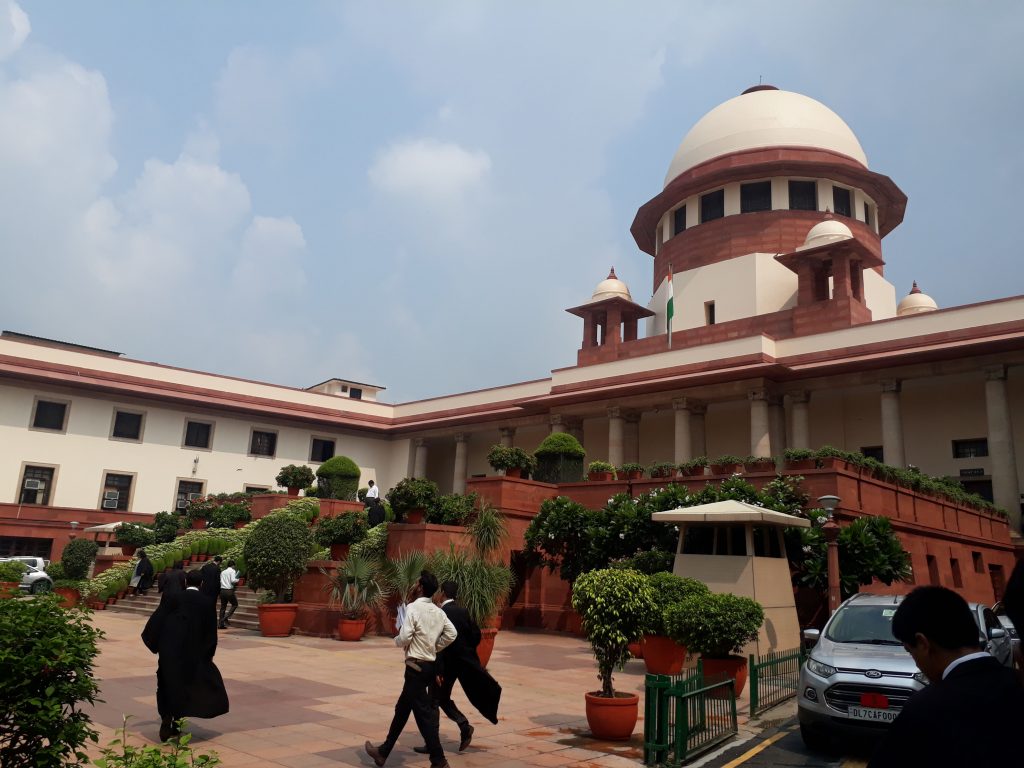
Supreme Court
Rahul moved an appeal before the Surat sessions court on April 3 this year. He filed two applications–one for the suspension of the two-year sentence and the other for the suspension of conviction.
Rahul submitted to the sessions court that it seemed “reasonable to argue” that the maximum sentence awarded to him was to “attract the order of disqualification (as an MP)”. Had the second application been allowed, his membership of Lok Sabha would have been restored. But on April 13, Additional Sessions Judge R P Mogera said he would pronounce his order on April 20. On that day, the court rejected his both applications. Rahul then moved the Gujarat High Court in appeal which too turned futile for him.
BJP MP and former Law Minister Ravi Shankar Prasad said, “If Rahul Gandhi feels he has got the license to abuse anyone, then the law will take its course. I outrightly condemn the Congress party’s comment that this is part of a conspiracy to frame Rahul Gandhi leading to his conviction…. He made an irresponsible comment. The OBC community was insulted…the court gave him a chance to apologise…he did not and thereafter he suffered the trial….”
Most of the independent observers feel that the recent trend of weaponizing criminal defamation cases for targeting prominent opposition leaders creates chilling effect on the society at large stopping them from ventilating their views on various actions and policies of the government concerning public at large, thereby hampering democratic atmosphere required for a healthy public discourse in the country– which is a basic feature and constitutional mandate for the survival of a vibrant participatory democracy.
Protesting against the disqualification of party leader Rahul Gandhi from the Parliament the Congress Party called for a ‘maun satyagraha’ across the nation on 12 July. Congress leaders and workers in almost every state capital held a ‘maun satyagraha’ near Mahatma Gandhi statues.
Party general secretary in-charge organisation KC Venugopal said Gandhi has been the strongest and most vocal opponent of the Narendra Modi-led BJP government. “After a hugely successful Bharat Jodo Yatra, Rahul Gandhi delivered a historic address to the Lok Sabha, unearthing the relationship between PM Modi and the Adani Group,” Venugopal said. As a result, the BJP “deployed its dirty tricks” to disqualify him from Parliament, he alleged.
“The Modi government is trying to insult Rahul Gandhi and keep him away from the Parliament. But the Congress workers in the country will unitedly rally behind him to check all such moves,” he said.
The Uttar Pradesh congress party staged a day-long silent protest at Shaheed Smarak in Lucknow where thousands of party workers and leaders from all corners of the state assembled to protest against the disqualification of Rahul Gandhi who was allegedly targeted by BJP and RSS workers filing criminal defamation cases against him all over the . It was led by state president Brij Lal Khabri, CLP leader Aradhna Mishra Mona and others.
In Uttrakhand , “Silent Satyagraha” of Congress workers was held under the leadership of President, Uttarakhand Pradesh Congress Committee, Karan Mahara and Leader of the Opposition, Yashpal Arya before the statue of Mahatma Gandhi against the ‘dictatorship’ of Modi government. Prominent Congressmen participated there.
In Gujarat, Congress workers under the leadership of state congress president and MP Shaktisinh Gohil participated in ‘silent satyagraha’ against the high-handedness of the Modi government in Ahmedabad. “Today, the anti-democratic face of the Modi government has come to the fore in front of the whole country. Conspiracy to expel Rahul Gandhi from the Parliament is the proof of this thinking of the government,” Gohil tweeted.
In Kerala, from where Rahul lost membership of Wayanad Lok Sabha constituency, several Congress leaders and party workers observed ‘maun satyagraha’ (silent protest) in the state capital Thiruvananthapuram to express solidarity with Rahul Gandhi, who, according to them, was “erroneously” convicted in a defamation case and disqualified from Lok Sabha. An array of senior leaders including MLAs, MPs and former ministers gathered in front of the statue of Mahatma Gandhi at Gandhi Park, located in the heart of the capital city, to take part in the protest that would continue till the evening.
Kerala PCC chief K Sudhakaran, Leader of Opposition in the Assembly, V D Satheesan, MPs including Kodikunnil Suresh, Rajmohan Unnithan and K Muraleedharan and presidents of various District Congress Committees and so on were among those who took part in the silent protest. Before the beginning of the ‘maun satyagraha’, Suresh, who is also the working president of the KPCC, alleged that the Centre under Prime Minister Narendra Modi and the ruling BJP were trying to keep Gandhi away from Parliament.
In Panaji, Goa, ‘Silent Satyagraha’ was observed in solidarity of Rahul Gandhi under the leadership of Goa PCC President Amit Patkar, LoP in the Goa Legislative Assembly, Yuri Alemao, MLA Carlos Álvares Ferreira, Altone D’Costa and MP Manickam Tagore. “Rahul Gandhi is being targeted for exposing the Modani Nexus.” Our ground workers in Goa stand united to defy the BJP’s attempts to silence him and uphold the slogan ‘Daro Mat’!
“The truth cannot be defeated,” tweeted Maharashtra Congress president Nana Patole staging ‘Maun Satyagraha’ in front of Mahatma Gandhi’s statue near Mantralaya in Mumbai along with MRCC PresidentProf. Varsha Eknath Gaikwad and other leaders from Maharashtra.TheCongress workers peacefully protested against the disqualification of senior Congress leader. The Congress functionaries claimed that all democratic institutions are working under the pressure of the BJP-led central government.“First, the defamation charge was not appropriate. Second, the punishment of two-year imprisonment is the wildest thing anyone can imagine. Moreover, the speed at which this was done while the matter is still under legal scrutiny shows how much the BJP fears our leader,” said Bajirao Khade, a Congress leader.
Similar protests were held in Goa, Jharkhand, Mizoram, Assam, Tripura, Telangana, Pudicharry etc.
By Gurbachan Jagat Former Governor, Manipur & DGP, J&K
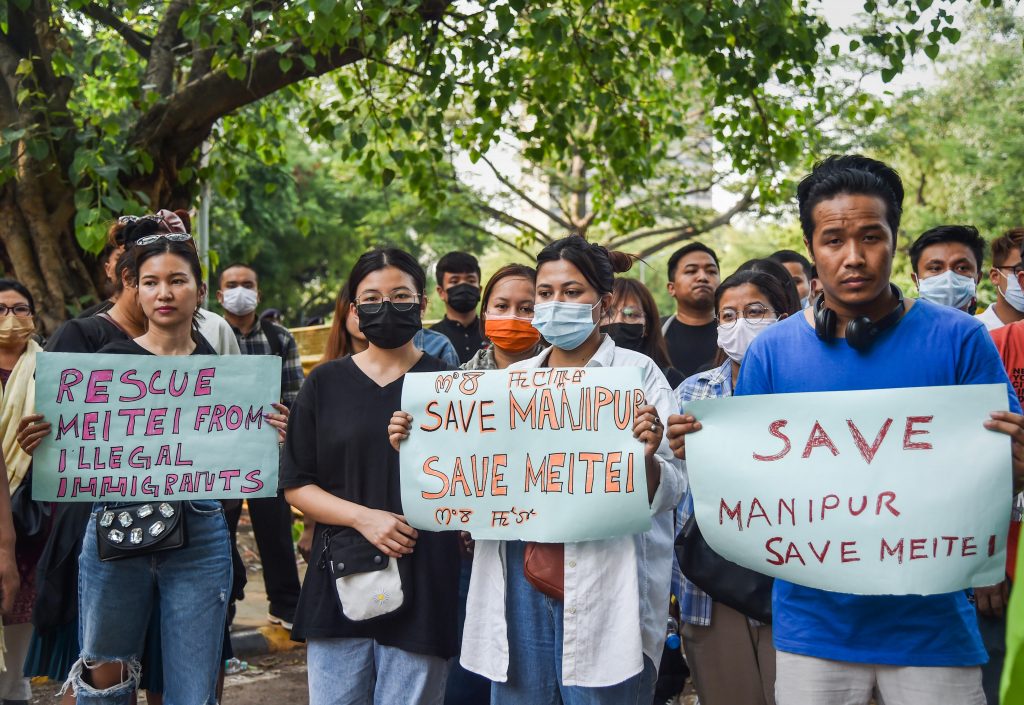
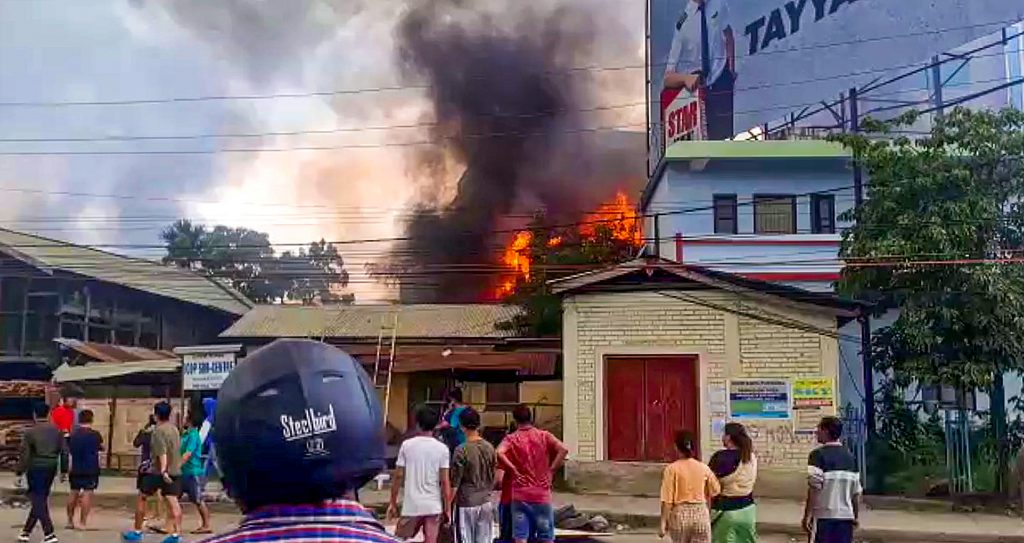
Manipur has been on the boil for the past two months, but the volcano seems to be still spewing fire and venom. I stayed there for quite some time (2008-13) and the beautiful valley, hills and forests are still fresh in my mind. I still feel the presence of its flora and fauna and picture the Loktak lake in the mind’s eye.
More than everything else, I remember its people, a virtual kaleidoscope of different tribes, with different lifestyles, customs and religions, each complete in itself and yet more complete together. All stuck in the groove of time and leading simple lives, as did their forefathers. The small towns and Imphal city showed some signs of the advances of modernity; otherwise, life was a still landscape.
In Manipur, you could get lost in the haze of time and forget the hectic pace of life elsewhere. A society in slow transition from the old ways to the new, where the Indian State’s presence has been felt more in the spectre of the armed forces rather than in education and healthcare. Left largely to its own devices, rural Manipur has still kept its traditions alive, whether they be in the arts and crafts, their ancient herbal lore, temples and tribal divide.
What happened to its peaceful people, whom I still see in their lovely traditional dresses proceeding to the temples and churches to worship their gods? It has been a volcanic eruption that swept all before it. However, the primal instincts were always visible, the tribal antagonism always lay below the surface, the tribal territories had been marked out and adhered to but some cross-migration had taken place. These were the fault lines which became the targets of violence first of all.
I do not propose to indulge in finger-pointing nor in a blame game. I am too far from the scene of activity and know only what the media chooses to reveal. However, there was some trigger which set off this chain of action and reaction. One does not know whether it was an action or a reaction, whether it was intentional or unintentional. Whether it was the failure of the executive or overreach of the judiciary?
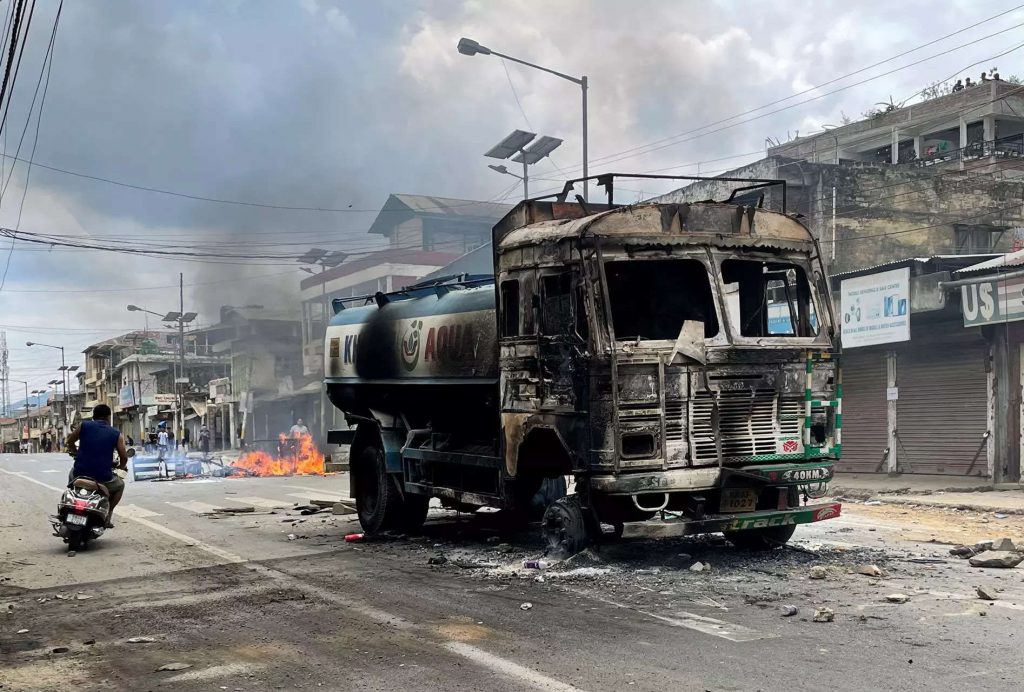
Whatever it was, it let loose ‘the dogs of war’; mayhem followed, and it still continues. Although again I have no access to factual data, but going by the media reports, over a hundred lives have been lost, hundreds injured, thousands of houses and villages burnt and properties destroyed. Much of the livestock, which is a crucial source of livelihood, must also have been lost. It appears that government property has also been targeted.
What defies all logic is the fact that police stations and police armouries have been attacked across the state and thousands of firearms and huge quantities of ammunition looted. This did not happen in the worst of times in J&K, Punjab, Delhi, Gujarat, etc. This is beyond the comprehension of anyone who has donned the uniform or is a civilian, for that matter. I’m sure these arms must have come in very handy for the mischief-mongers. It seems that in spite of appeals by the government, not many of the looted arms have been returned. They will continue to pose a challenge to the security forces in the state.
Now let us come to the thousands who have lost not only members of their families but also their homes, their livestock and means of livelihood. Thousands have fled their homes and villages in the valley and the hills and found refuge in neighbouring states or in refugee camps set up temporarily. Some might have also gone across the border to Myanmar. Whatever little that might have survived the first onslaught of violence must now have been destroyed. The conditions in the hastily established refugee camps must be abominable.
A state which cannot defend its most fundamental symbol of security — the police station — can hardly be expected to be providing quality shelters. I do not know how far the writ of the state administration has been restored and if it is able to monitor the activities at these camps. It has to be done on a war footing — providing food, shelter, sanitation, medicines, doctors, etc. It is a huge task and I hope and pray that those running the state government prove equal to the task.
It is their state, their people, their sworn duty to do so. Looking beyond the present and the refugee camps and emergency measures, there looms the larger task of rehabilitation of these uprooted people. The valley and the hills, especially the latter, afforded their people a very low level of sustenance. We cannot keep them locked up in refugee camps forever; they cannot stay with their relatives in neighbouring states forever; they have to go back to their habitat from which they have been uprooted by force of circumstance. It is this task of rehabilitation which would test our country and the state of Manipur.
Earlier, whenever and wherever such tragedies have taken place, resulting in uprooting of people, we have not succeeded in restoring them to their original habitat. In larger states and cities, people manage to find alternative places of livelihood, although never similar to what they had lost. But Manipur is a small state; its people are used to living in their valley and hills. Where will they go and from where will they obtain the means to start new lives?
The answer lies only with the Central and state governments. Fortunately, they belong to the same political party. They have to urgently draw up a rehabilitation plan which takes into consideration all aspects. It is important that the people be helped to resettle in their original habitat. This would also help in psychologically reducing the collective and individual pain. The fault lines exposed in Manipuri society are deep and primeval; they have now been renewed and deepened in the ill wind that has swept the land. Let us all help to heal and rehabilitate, to unite and build, not to divide and destroy.
Despite the flagship Ayushman Bharat scheme guaranteeing free medical facility up to Rs 5 lakh to the poor, the rural healthcare infrastructure created under NRHM is not equipped to handle cardiovascular emergencies resulting in heavy casualties, writes Mudit Mathur
Despite the well intentioned flagship programme of Prime Minister’s Ayushman Bharat guaranteeing free medical facility up to Rs 5 lakh to poor and deprived classes, the rural healthcare infrastructure created under National Rural Health Mission (NRHM) is not equipped to handle cardiovascular emergencies resulting in heavy casualties. Cardiovascular diseases (CVDs) are the leading cause of mortality at a global level (31%) as well as in India (27%). Unfortunately, the infrastructure for development of the rural cardiology system is in doldrums as 1706 non-interventional cardiologist doctors who obtained such specialisation after MBBS failed to get recognition from the government to become eligible to impart expert treatment in the public sector.
In eastern Uttar Pradesh, between June 14 and 19, more than 74 people across two blocks of Ballia district mysteriously died in a span of just five-six days in June. 154 people were admitted on June 15. Director Infectious Diseases UP, Dr AK Singh, explained to the media that the deaths were reported from rural areas of the district where most of the patients complained of chest pain, breathlessness and fever when they were admitted at the hospital.
On June 16, Sanjay Verma, 21, died while dancing to the tunes of a DJ in Gokul Nagla village of district Shahjahanpur in UP. And just a few days before in Gohadia village of Bahraich district, a couple – both in their early 20s – died on their wedding night on June 1. There was a common thread in both the incidents: cardiac arrest. It is no more an urban phenomenon. Cases of people, mostly young, dying of sudden cardiac arrest or due to heart attack has increased at an alarming rate in rural areas across the country.
Medical studies suggest that a heat stroke and cardiac arrest are two medical emergencies that are closely associated with each other. Heat stroke can sometimes lead to cardiac arrest, making it a serious and potentially life-threatening condition. The initial treatment in both the cases remains the same and cardiologists are better skilled as they know how to revive the patients and what medicines need to be administered in acute emergencies.
The Community Health Centres/Primary Health Centres across UP and even in most parts of the country are not having any support system to deal with growing cases of cardiovascular diseases (CVD). These rural health care centres have not deployed cardiologists and thoracic and cardiovascular surgeons at grassroots to attend sudden emergencies. Most of the casualties occur due to lack of skills to deal with in golden hours which could be easily handled by using non-conventional cardiac skills. There is a huge shortage of cardiologists and thoracic and cardiovascular surgeons in India.
Timely intervention could have saved thousands of lives. However, such an alarming situation failed to sensitise the Union government and Medical Council of India (now known as National Medical Commission) to take a decision on a verdict of Delhi High Court since 2019 that directed them to consider granting recognition to Post Graduate Diploma in Clinical Cardiology being sought by Indira Gandhi National Open University (IGNOU).
IGNOU within its legal competence introduced PGDCC course in 2006 with an objective to develop a cadre of non-interventional cardiologists who have to undergo “two-year fulltime rigorous training in top cardiac hospitals in the country”. In order to be eligible to apply for the PGDCC course, a candidate is required to have an MBBS degree. It was asserted before the court that the syllabus and training in non-invasive procedures of cardiology of trainees are almost identical, i.e., training provided to PGDCC students are similar to that provided that super speciality level of cardiology (DM) of All India Institute of Medical Sciences.”
“Trends in Cardiac Care utilization under Ayushman Bharat” were studied by a specialists group consisting Parul Naib (Delhi University), Pulkit Kumar (Tata Institute of Social Sciences), Sudha Chandrashekar, (London School of Hygiene and Tropical Medicine), University of London and Owen Smith, (Harvard University, Cambridge, Massachusetts), USA.
The group analysed all cardiac claims filed under Pradhan Mantri Jan Arogya Yojana (PM‑JAY) for a period of 17 months (from the inception of the scheme in September 2018 to February 2020). It was found to be significantly higher at 26% indicating that a very high proportion of the scheme was utilized to provide free cardiac care to beneficiaries coming from the poorest segment of the population. Most government hospitals in rural areas don’t have cardiologists and the death rate in North Eastern states is three times higher than the national average.
More than half a billion people around the world continue to be affected by cardiovascular diseases, which accounted for 20.5 million deaths in 2021– close to a third of all deaths globally and an overall increase of the estimated 121 million CVD deaths. The group analysis also indicates significant variation in the supply of the cardiac facilities and the need to further develop health infrastructure for cardiac care, particularly in certain states where the supply is found to be inadequate.
A study published in the medical journal “The Lancet Global Health” revealed that deaths due to cardiovascular disease were on the rise in India, causing more than one-quarter of all deaths in the country in 2015. The report says that it is affecting rural populations and young adults the most. The findings suggest that the rate of dying from ischaemic heart disease has increased rapidly in rural areas of India in populations aged 30 to 69 and surpassed those in urban areas between the year 2000 and 2015.
The world health report launched by World Heart Federation in Geneva in May 2023, the deaths from Cardio Vascular Diseases (CVD) surged 60 percent globally in the past 30 years. CVD was the leading cause of deaths worldwide in 2021 with four in five deaths occurring in low and middle income countries.
The death rate due to cardiovascular diseases surged by around 34% from 115.7 to 209 deaths per one lakh population in India between 1990 and 2016. The probability of dying from stroke decreased overall but increased in India’s northeastern states. In these states, deaths due to stroke were about three times higher than the national average.
The chairman, Board of Governors of the Indian Association of Clinical Cardiologists, Dr Rajesh Rajan while sharing details about the court matter with ‘Tehelka,’ said, “The Delhi High Court held that prior permission of the Central Government under section 10A of the IMC Act, 1956, to IGNOU, is not required and quashed the stand of the MCI denying recognition to the PGDCC. It further directed the Central Government to consider IGNOU’s application for recognition of the PGDCC qualification under Section 11(2) of the IMC Act, as stated in the aforementioned judgment.” The government has yet to take a decision on the issue.
This has virtually compelled a process of brain drain to other countries as most of the trained non-conventional clinical cardiologists left the country and started practicing in countries like Europe, USA and UAE—where they are much in demand. The private sector is also engaging them like Medanta, Narayana Hrudayalaya Bangalore, Escorts Heart Institute, U.N Mehta Heart Hospital in Gujarat, Asian Heart Institute Mumbai and many more. These MBBS doctors learnt clinical cardiology under the best experts and were capable of saving lives during initial moments after a heart attack.
Dr Manoj Gerela, who currently runs Sigma Hospital in Mulund in Mumbai, told Tehelka, “The government hospitals in sub-urban and rural Mumbai don’t have cardiologists; patients are referred to higher centres or private hospitals.” “The irony is that despite being an expert in clinical cardiology and capable of treating patients during the ‘golden hour’, we cannot designate ourselves as a specialist doctor in cardiology,” he lamented.
While declining immediate stay on Delhi government’s petition challenging the constitutional validity of the ordinance, the Supreme Court posted the matter for July 17 for examining whether the court can grant stay on a piece of legislation or not. A report by Mudit Mathur
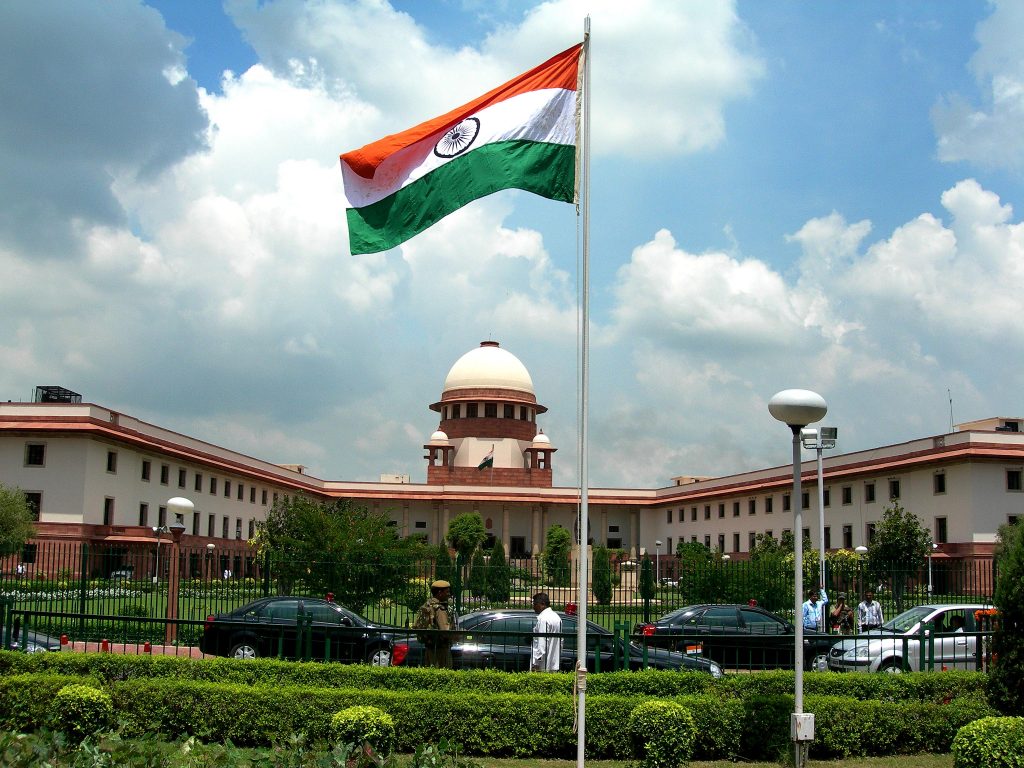
The Supreme Court has agreed to consider the pleas for a stay on the operation of “Government of National Capital Territory (Amendment) Ordinance 2023”, promulgated by Union government on May 19, that divested the reins of services of IAS officers posted under the government of National Capital Territory of Delhi (GNCTD) from the elected government to its representative Lieutenant Governor. While declining immediate stay, the matter was posted for 17 July for examining whether the court can grant stay on a piece of legislation or not?
Issuing a notice on the Delhi government’s writ petition challenging the constitutional validity of the ordinance, to the Centre and Lieutenant Governor, a bench comprising Chief Justice of India DY Chandrachud and Justice PS Narasimha posted the matter on July 17 for considering the prayer for interim reliefs. The court directed the Union government and Lieutenant Governor to respond to the Interlocutory Application with an affidavit in opposition.
Earlier, Senior Advocate Dr Abhishek Manu Singhvi, appearing for the Delhi Government, sought for interim stay of the provisions. He contended that the Supreme Court’s Constitution Bench judgment underlined the importance of “triple chain of accountability” in governance. Referring to the provisions contained in Section 45K of the Ordinance, Singhvi pleaded that they are giving overriding powers to the Lieutenant Governor. He submitted that the Ordinance was contrary to the pillars of the Supreme Court judgment.
Singhvi attempted to persuade the bench by referring to instances “where the SC had stayed an Act of Parliament, leave aside an Ordinance.” “If an Ordinance tries to nullify the pillar of a judgement of the court, the Court stays it,” he submitted.
Singhvi further contended that the Ordinance has reduced the role of the elected government and the Chief Minister. Claiming that the Ordinance takes the powers away from elected representatives, the senior counsel said 437 independent consultants engaged by the Municipal Corporation of Delhi (MCD) had been fired by the LG after the Ordinance.
“Can your Lordships imagine a meeting where a Chief Minister sits in a minority, two bureaucrats say… we believe prima facie this proposal is illegal. First, those two will outvote the CM. They will then refer it to the LG who is the super CM,” contended Singhvi.
He added that “the pillar of your (SC) judgment is civil service accountability to the executive… federalism, decentralisation, democratic government. You might not even have Article 239AA. It’s a serious issue. Therefore, either Your Lordships may consider stay or as a first step, stay the para of 437 independent consultants… fired by the LG… Give a qualified stay and call it on Friday… Their salary is stopped, they are stopped from working…
Appearing for the Centre, Solicitor General Tushar Mehta said there are “some shocking facts”. “One of the persons removed is the wife of a sitting MLA. There are several party workers who were appointed without following the due process. I will have to place it on record,” he said, adding that the affected persons could always approach the high court.
Appearing for the LG, senior advocate Sanjay Jain said, “The question is the minister is signing these Article 32 petitions for and on behalf of the party workers who have been put in those 400 positions and various such matters have been challenged before Delhi HC also. The affected person should go before the HC.”
The CJI, however, told Mehta, “You have a look at the prayer for interim relief… we will take it up on Monday (July 17).”
The AAP government’s plea, which prayed for an immediate interim stay, says the “Ordinance… completely sidelines the elected Government, i.e., the GNCTD, from control over its civil service.” The petition pleaded that the ordinance does so without seeking to amend the Constitution of India, in particular Article 239AA of the Constitution, from which flows the substantive requirement that power and control in respect of Services be vested in the elected government.
The Delhi government termed the Ordinance “an unconstitutional exercise of executive sanction that… violates the scheme of federal, democratic governance entrenched for the NCTD in Article 239AA…” In a separate plea, the petition challenged the constitutionality of Section 45D of the ordinance.
The petition highlights that the ordinance was brought out a week after a Constitution Bench of the Supreme Court pronounced that the Delhi Government has power over Entry 41 of List II (services). It is argued that through the ordinance, the Central Government has in effect overturned the Supreme Court’s verdict.
The ordinance is challenged as it is violating the scheme of federal, democratic governance entrenched for the NCTD in Article 239AA of the Constitution. It is further argued that the Ordinance negates the principle of federalism and undermines the primacy of the elected government.
“The principle of collective responsibility in a democracy – incorporated in Article 239AA(6) – requires that the elected government be vested with control over officials posted in its domain. In the federal context, this would require that such control be vested in the regional government – i.e. the GNCTD under Article 239AA – for matters in its domain. This essential feature was secured for the GNCTD by this Hon’ble Court’s 2023 Constitution Bench judgment, and is now sought to be undone by the Impugned Ordinance”, states the petition filed through Advocate-on-Record Shadan Farasat.
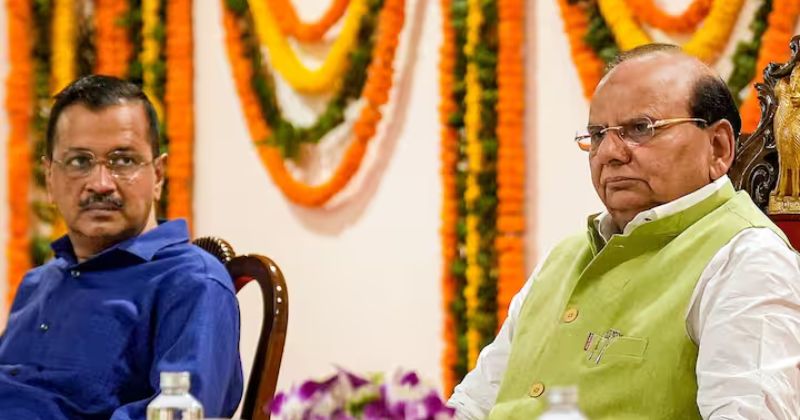
Congress on the horns of dilemma The Congress is in dilemma over the precondition set forth by Aam Aadmi Party for joining opposition ranks that it has to publicly denounce Delhi Ordinance for control of services in Delhi.
The second meeting of opposition leaders is scheduled for 17 July in Bengaluru, Karnataka, three days before the Monsoon session of Parliament to chalk out a strategy to take on BJP in upcoming parliamentary elections in 2024. The Congress Party has sent invitations to leaders of opposition parties for the meeting including Aam Aadmi Party but it is uncertain whether it will join the meeting or not?
The difference between the AAP and the Congress surfaced during the first opposition meeting in Patna held on June 23, which was attended by 16 parties and was hosted by Bihar chief minister Nitish Kumar.The parties vowed to put up a united fight against the BJP in 2024 and finalise plans in the next meeting initially planned in Shimla, but later changed to Bengaluru due to sudden floods in the hilly state.
The parties which attended the meeting included the Congress, Trinamool Congress (TMC), AAP, Nationalist Congress Party (NCP), Shiv Sena (UBT), Dravida Munnetra Kazhagam (DMK), Jharkhand Mukti Morcha (JMM), Samajwadi Party (SP), National Conference (NC), Peoples Democratic Party (PDP), CPI, CPI(M), CPI(ML), Janata Dal-United (JDU) and Rashtriya Janata Dal (RJD) .
AAP convenor Arvind Kejriwal attended the Patna meeting but he skipped the joint press briefing after the discussion convened to send out a message of opposition unity. Couple of hours later, the AAP said in a press release that it will be cautious of the Congress’s “silence”, which raises “suspicions” about its “real intentions”. “It’s high time that Congress decides whether it stands with the people of Delhi or with the Modi government,” the AAP said.
On Friday, Kejriwal reiterated the party’s position after the Patna meeting as he told reporters that while the invitation has come from the Congress to attend the Bengaluru meeting, the AAP is still waiting for the Congress’s public statement denouncing the Delhi ordinance 15 days before the commencement of the Parliament session.
Reacting to Aam Aadmi Party chief Arvind Kejriwal’s statement, the Congress national spokesperson and former MP, Udit Raj, said that setting preconditions is not the way to move further. “If they (AAP) want to remove Modi or BJP in coming elections they should join hands with all opposition parties. Look at the case of Rahul Gandhi being disqualified as an MP, or the action against Senthilbalaji in Tamil Nadu. All regional parties including the Congress have a lot of issues and if they all make preconditions then what will happen?”
The uncertainty surrounding the legality of the Modi government’s contentious decision to abrogate J-K’s special status will finally be addressed with the Supreme Court expected to start hearing in August a series of pleas challenging the scrapping of Article 370, writes Riyaz Wani
The Supreme Court is expected to commence the hearing of a series of pleas challenging the abrogation of Article 370 in August, although the cases were listed for July 11 for procedural directions.
Justice BR Gavai revealed this information while hearing the bail plea of activist Teesta Setalvad. According to reports, when senior advocate Kapil Sibal, representing Setalvad, suggested that the hearing in her petition may be scheduled in August, Justice Gavai responded that the challenge against Article 370 would be starting around that time.
A 5-judge constitution bench, headed by Chief Justice of India Dhananjaya Y Chandrachud and comprising justices Sanjay Kishan Kaul, Sanjiv Khanna, B R Gavai, and Surya Kant, has been constituted for this purpose.
Currently, there are 23 petitions pending before the Supreme Court that challenge the constitutional validity of the government’s decision to abrogate Article 370. These petitions challenge the presidential orders of August 5 and 6, 2019, as well as the Jammu and Kashmir Reorganisation Act, 2019.
The August 5 order revoked the special status granted to Jammu and Kashmir under Article 370, while the August 6 order reorganized the state into two separate union territories. Article 35A, which empowered the state of Jammu and Kashmir to define its permanent residents and make special laws for them, was also a subject of challenge. The pleas argue against the legality of these orders and the Reorganization Act.
Deeply contentious issue
The decision to scrap Article 370, which granted special rights and privileges to the people of Jammu and Kashmir since 1954, has been a contentious issue since its implementation in August 2019. The matter was last heard in March 2020 and subsequently put on hold.
Former Chief Justice N V Ramana agreed to list the matter for an “early” hearing but failed to follow through. However, the Supreme Court’s recent decision to prioritize the case and finally schedule hearings has been welcomed by political parties, including the Peoples Democratic Party and the National Conference.
People’s Democratic Party chief Mehbooba said in a tweet, “Welcome Hon’ble SC’s decision to finally hear petitions pending since 2019 challenging the illegal abrogation of Article 370. I hope justice is upheld and delivered for the people of Jammu and Kashmir.”
Mehbooba added, “The SC ruling on Article 370 maintained that the provision can be abrogated only on the recommendation of the Jammu and Kashmir Constituent Assembly.”
National Conference leader Omar Abdullah said he is looking forward to the Supreme Court hearing petitions challenging the abrogation.
“Finally the bench is constituted. I look forward to the hearings beginning in right earnest now,” he said in a tweet.
Four-year long wait
It has been close to four years since Article 370 was withdrawn and the apex court’s delay in hearing the case has been a source of great unease among opposition political parties and a large section of people in Jammu and Kashmir. At the time that J&K’s special status was repealed, the then state had no legally constituted Assembly. The experts have alleged that a temporary administrative situation, established by the central government, was used to bring about a significant and enduring change in the status of the state.
This imparts the case about Article 370 a profound constitutional significance: A broad section of intelligentsia in the country has contended that the revocation of the constitutional provision raises concerns regarding federalism, as it marks the first instance in the country where a state has been transformed into two Union Territories.
Moreover, the absence of a representative government and elected Assembly in the past five years has intensified the gravity of the situation.
The critics of the withdrawal of Article 370 have alleged that the decision to do away with law was inherently political, lending it an immensely contentious dimension. While these issues hold great importance for J&K, their repercussions extend to other states as well. Since August 2019, a chorus has built around the demand that given the circumstances, it is crucial for the courts to promptly address such matters and provide decisive rulings.
Irreversible changes in ground situation
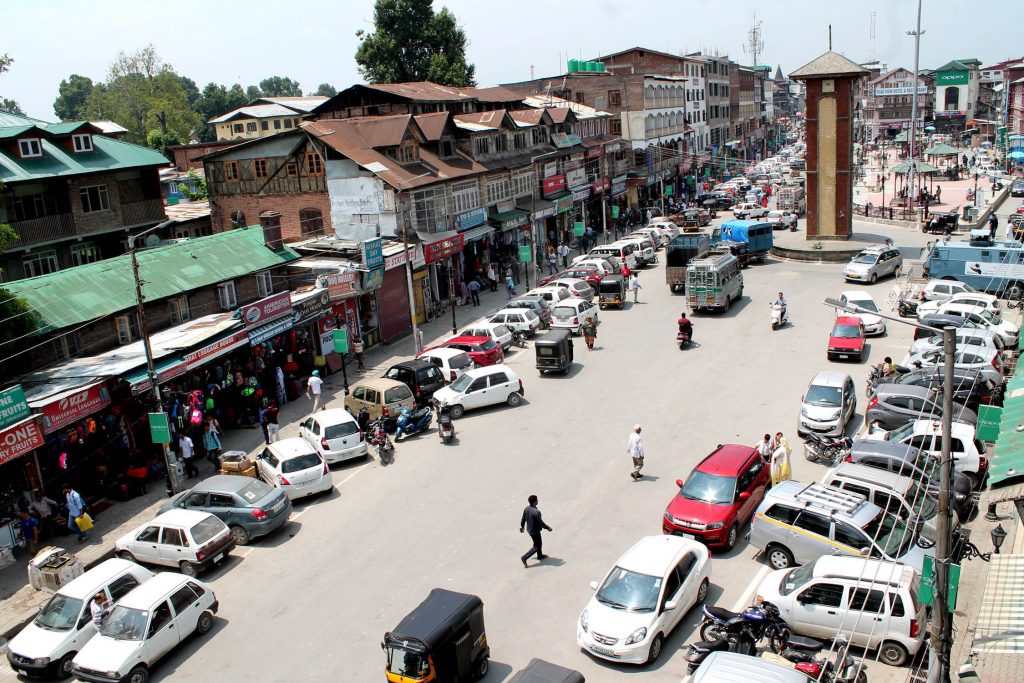
Over the past four years, irreversible changes have taken place on the ground in Kashmir. The region has changed beyond recognition. Once a vaunted separatist conglomerate, Hurriyat Conference has become extinct. Many of the grouping’s top leaders continue to be in jail or are under house arrest. This has hobbled its capacity to organize any political activity.
But even if the separatist leaders were free – and some of them are free – the situation would hardly be different. The government has outlawed any sign of separatist activity in whatever form and disproportionately raised the costs for any leader or an activist to go out and champion the cause.
There have also been far-reaching administrative and legal changes, right from the domicile laws to new land laws. As a result, J&K citizenship and the buying of land have been thrown open to outsiders. The government has also overturned the Roshni Act whereby occupants of state land were allowed to own it against payment determined by the government. Scores of other laws have been extended to the former state that is aiding the process of fundamentally altering the facts on the ground.
At the same time, the government has changed the electoral map of J&K by creating District Development Councils, a third tier of the grassroots democracy, whose members unlike in any other state in India are being directly elected.
Ball in Supreme Court
What happens in the Supreme Court will not only be watched keenly in India and regionally but also globally. Soon after the revocation of Article 370, the apex court explained its delay in hearing the case by assuring people that it “can always turn the clock back.” But the union government’s senior functionaries have time and again issued statements to the effect that “no power in the world can restore Article 370.”
In December last year, J&K, Lieutenant Governor Manoj Sinha continued with his line about Article 370 saying it “was the root cause of secessionism, terrorism, nepotism, discrimination & corruption and kept J&K underdeveloped.” Such statements emanating from the top political and administrative functionaries in the central and the UT governments have turned Article 370 into a security debate rather than a legal issue.
Article 370 and J-K polls
Recently, the Supreme Court deferred hearing on a plea seeking early assembly polls in Jammu and Kashmir. The bench comprising Chief Justice D Y Chandrachud and Justices P S Narasimha and Manoj Misra chose to adjourn the matter, citing the upcoming hearing on petitions challenging the abrogation of Article 370 on July 11. The petition filed by National Panthers Party leaders, Manju Singh and Harsh Dev Singh, highlights the critical issue of “disenfranchisement” faced by the people of Jammu and Kashmir.
This has, in a sense, linked the question of holding of Assembly elections with the long-pending hearings on Article 370. As a result, J&K may have to wait for some more time before it can go to the polls. And this may not be good news for people of the union territory.
Will elections be held in J&K until after the decision on the legality of the revocation of Article 370 is decided by the apex court? For now, things are not clear on this score. But if we go by the public opinion in Jammu and Kashmir, holding of Assembly elections in the UT has widespread support.
The Ladakh Tourist Trade Alliance’s opposition to outside investment reflects their concerns about preserving unique identity and sustainable development of Ladakh as a tourism destination. It also wants to protect local interests and the fragile ecosystem of the region, writes Riyaz Wani
The Ladakh Tourist Trade Alliance (LTTA), a coalition of trade, tourism, religious, and political organizations in Leh, recently passed a resolution opposing investment by outsiders in the tourism sector of Ladakh. The alliance warned that if such investments continue, they would impose restrictions on these investors through non-cooperation from the local travel trade fraternity, as well as community and political organizations.
The alliance, comprising several prominent associations such as the All Ladakh Tour Operators Association Leh, All Ladakh Hotel and Guest House Association Leh, Ladakh Taxi Operators Cooperative Union Leh, and others, joined forces with various religious and political bodies in a meeting held in Leh. Their collective aim is to safeguard the tourism industry of Ladakh and protect the interests of the local people.
According to the Chairman of the Ladakh Tourist Trade Alliance (LTTA), P T Kunzang, the resolution seeks to preserve Ladakh as a unique tourist destination, protect local entrepreneurship and livelihoods, and safeguard the fragile ecosystem of the region.
“The resolution seeks preservation of Ladakh as a unique tourist destination and for protection of the avenues of entrepreneurship and livelihood of the local people, to safeguard the fragile ecosystem and oppose investment, in any form, in the tourism sector from outside the region,” Kunzang told reporters at a press conference in Leh.
“It was further resolved that during any instance of exploitation of this valuable local resource base in the shape of investment from outside sources, hidden or declared, direct or through any local agency, the local community and trade bodies will impose restrictions against such individuals, businesses or tourist trade enterprises,” he further said.
Ladakh has experienced significant growth in its tourism sector over the years, with the number of tourists increasing from 527 in 1974 to 327,000 in 2018. This sector plays a crucial role in the local economy, providing income and employment opportunities for the majority of the population.
The LTTA’s opposition to outside investment reflects their concerns about preserving the unique identity and sustainable development of Ladakh as a tourism destination. They have made it clear that they want to preserve local interests and the fragile ecosystem of the region while maintaining the economic benefits derived from tourism.
As the debate over tourism development continues in Ladakh, it remains to be seen how the local administration will address the concerns raised by the LTTA and strike a balance between sustainable growth and the preservation of local identity and resources.
Although people of Leh, one of the two districts of Ladakh, celebrated the grant of union territory status to the region on August 5, 2019, they have since woken up to a sobering reality. The refrain goes that the UT status has made New Delhi a direct ruler of the region with little role in the governance for its people. What is more, Ladakhis fear their small population will be overrun by the influx of people from other parts of India without any constitutional safeguards that forbids outsiders from settling in the region.
The total population of Ladakh, according to the 2011 census is 2.74 lakh. While Leh with a population of 1,33,487 is Buddhist majority, Kargil with a population of 1,40,802 is Muslim majority.
But while the resentment is brewing, and also being politically expressed, there is little effort afoot to address the deepening concerns. In a resolution in November last year, the Ladakh Hill Development Council (LAHDC) demanded statehood, extension of the sixth schedule, separate Lok Sabha seats for Leh and Kargil – the region’s two districts – and Public Service Commission.
The Apex Body Leh (ABL) and the Kargil Democratic Alliance (KDA), Ladakh have forged a rare political unity. They protest together and also organize strikes jointly. It is for the first time in decades that the two Ladakh districts have been on the same page in pressing the government on their demands. And now the LTTA, which also represents both the districts, doesn’t want outside investment in tourism in the region. The reason is the same: Ladakhis fear being swamped by the outsiders in every sphere of their economic activity.
When PM Modi dialled Himachal Pradesh CM Sukhvinder Singh Sukhu to inquire about the impact of heavy rains and floods in the state, it was more than clear that the grim situation caused by the torrential rain in the north was worrying the Centre. A report by Tehelka Bureau
After the PM took note of the alarming situation, the Department of Expenditure, Ministry of Finance, released an amount of Rs. 7,532 crore to different State Governments for the respective State Disaster Response Funds (SDRF). The amount has been released as per the recommendations of the Ministry of Home Affairs. In the wake of heavy rains across the country, the guidelines have been relaxed and the amount has been released as immediate assistance to States without waiting for the utilisation certificate of the amount provided to the States in the last financial year.
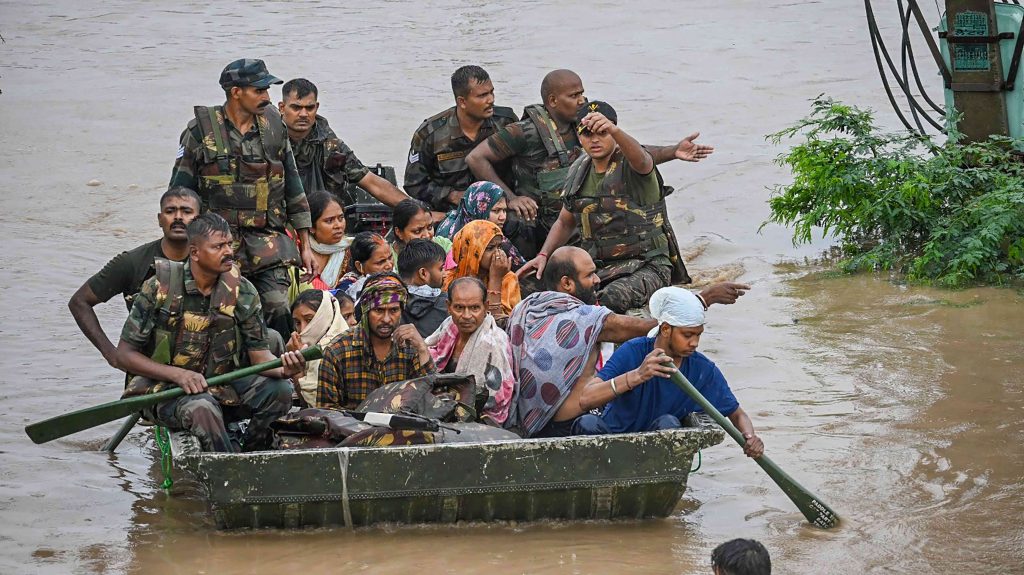
The extensive damage caused by the monsoon’s fury has exposed the authorities’ lack of disaster preparedness. It’s apparent that they have been caught off-guard despite a series of orange, yellow and red alerts issued by the Meteorological Department. Even a ‘smart city’ like Chandigarh was waterlogged in no time leading to many cause-way bridges’ giving way. In Punjab and Haryana, extensive loss has been caused to crops and property. In the hills, the unregulated construction activity has rendered the hills and valleys increasingly vulnerable to extreme weather events.
Himachal Chief Minister Sukhvinder Singh Sukhu informed the Prime Minister that the calamity had tragically resulted in the loss of 17 lives and widespread destruction, with property worth thousands of crore being swept away. Highlighting the impact of torrential rains on Himachal Pradesh, the chief minister said that the lives of many residents across the state had been severely affected. Over 500 tourists have been stranded in various parts of the state after rain-induced landslides cut off access to the areas.
Even in the national capital region, the heaviest showers in 40 years marooned the region and killed four people. The Capital received a little over 261mm of rain, crushing houses, uprooting trees and inundating localities. The weather office said that the unprecedented rainfall is due to the confluence of a western disturbance and monsoonal winds. In fact the India Meteorological Department (IMD) has predicted heavy, very heavy, and extremely heavy rainfall in 23 states in the country. A red alert has been issued in Uttarakhand while extremely heavy rainfall is expected in West Bengal, Sikkim, Arunachal Pradesh, Assam, and Meghalaya.
The River Yamuna in Delhi has breached the danger mark of 205.33 metres and the water level continues to rise. In Haryana and Punjab, after three days of heavy rain, special teams have been deployed to assess the damage and to provide food, water, and shelter to those who have been displaced.
Heavy rain and falling boulders killed four people and injured seven others in Uttarakhand. The boulders tumbled down the hills and crushed three vehicles that were passing by. An orange alert has been sounded in the state with Chief Minister Pushkar Dhami saying that his administration remains “on full alert”.
In Jammu, the Amarnath Yatra has been suspended for the time being in a row due to damage to the Jammu-Srinagar national highway in the Ramban section. The highway was closed after heavy rain caused landslides. As a result, 15,000 pilgrims are stranded in Jammu and other places.
The weather office has forecast more heavy rain for several states in north India, including Uttar Pradesh, and Rajasthan, with the Army and the National Disaster Response Force (NDRF) deployed to assist in the relief and rescue operations. The NDRF has deployed 39 teams to the affected states.
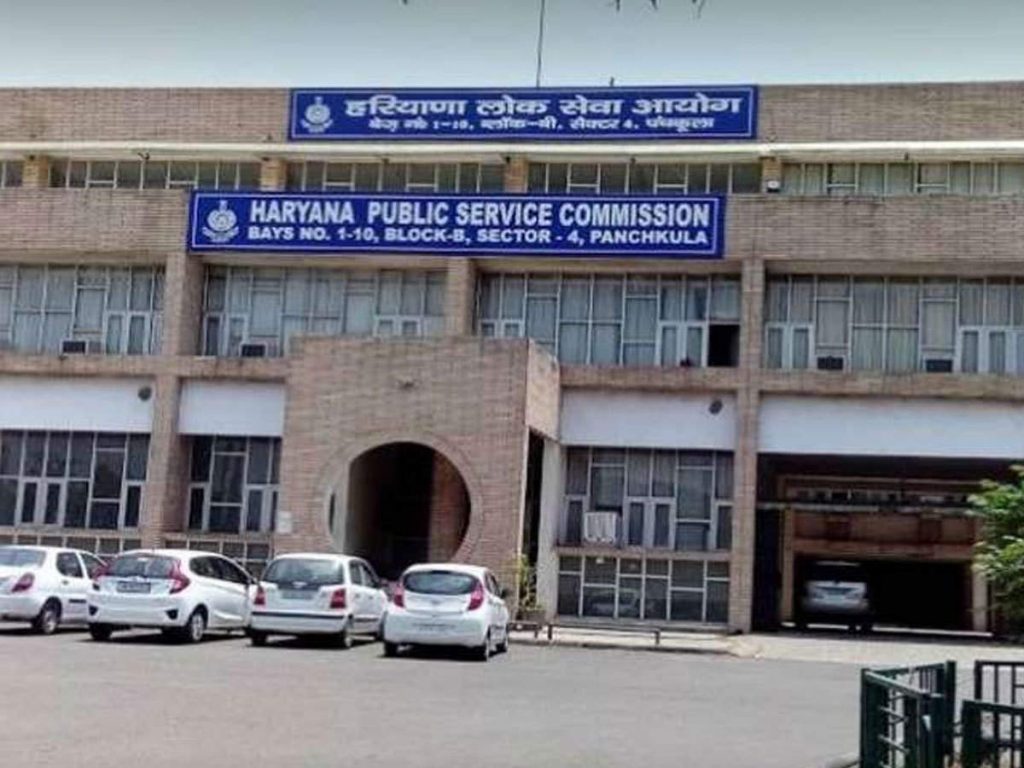
The 29 persons named in the chargesheet submitted by the Haryana Anti-corruption Bureau before a Hisar court a few days ago include some of the then HPSC functionaries besides a few selected candidates, alleged to be close to the then ruling INLD leaders, reports Rajesh Moudgil
The charge sheet submitted by the ACB (earlier called state vigilance bureau of SVB) against 29 persons a few days ago before a Hisar court, has pointed out major irregularities in the selection of Haryana civil services (HCS) examination held during 2001 Om Prakash Chautala-led Indian National Lok Dal (INLD) rule.
These 29 persons include the then HPSC chairman K C Bangar, its members, eight serving HCS officers, a retired HCS officer, a former HPSC secretary, four allied services officers and the then HPSC examiners. Most of the 13 HCS (executive branch) and allied services officers indicted in the ACB chargesheet were closely related to those who were at the helm of affairs of the then INLD regime.
While Bangar is currently a senior leader in the Jannayak Janta Party (JJP), the alliance partner of chief minister Manohar Lal Khattar-led BJP-JJP coalition government, one of the senior HCS officer also indicted in the chargesheet – Kamlesh Kumar Bhadu – is currently serving as officer on special duty (OSD) to the JJP leader and deputy chief minister Dushyant Chautala.
Among the 13 officers named in the chargesheet are Kuldhir Singh, Vatsal Vashisth, Ranjit Kaur, Kamlesh Kumar Bhadu, Sarita Malik, Ashok Kumar, Rakesh Kumar, Poonam Nara, Dilbag Singh, Veena Hooda, Jag Niwas, Surender Kumar and Jagdeep who face charges under prevention of corruption Act.
Notably, while Kuldhir Singh is son of former INLD state president Sher Singh Badshami, Kamlesh Kumar Bhadu is closely related to Chautala family, Sarita Malik is daughter of former DGP, Haryana, M S Malik, Ashok Kumar is son of former INLD MLA B S Rawat, Jagdeep is closely related to the then HPSC chairman Bangar while Ranjit Kaur is sister of the then IAS officer Harbaksh Singh, who was close to the then chief minister Om Prakash Chautala.
It may be recalled that the former CM Chautala is currently leading the INLD and the former five-time chief minister Chautala Sr and his elder son Ajay were among over 50 people who were sentenced to 10-year jail in the JBT recruitment scam on January 16, 2013.
However, the INLD, which had remained a major political party of Haryana with its huge base in rural Haryana in the past, had suffered a crippling split and which subsequently led to the formation of the breakaway Jannayak Janta Party (JJP) in December 2018 when Chautala Sr expelled his grandsons, Dushyant, the then INLD MP from Hisar, and his younger brother, Digvijay, for anti-party activities, on November 2, 2018.
A few days later, he also showed the door to his elder son and former MP Ajay for holding an “unconstitutional meeting’’ to support his sons on November 17, 2018, in Jind.
The probe, charges
According to information, the ACB probe which included forensic examinations, found out that marks of the candidates were increased and lowered by cutting or overwriting on the answer sheets in the selection process.
The probe also held that while there was no authentication of these cuttings or overwriting by the examiners, in several cases it was found out that double pens or inks were used in the marking.
Significantly enough, while different handwriting in different answer sheets by the same candidates was established in the probe, it was also found out that different parts of questions had been solved on different pages by the “candidates’’. It was also established during the investigation that marks in the answer sheets of several selected candidates were increased with the connivance of the examiners.
Prez nod to prosecute HPSC Chief, members
It may be recalled that prior to filing of the chargesheet against the accused persons, the state government had sought sanction from President of India to prosecute the former HPSC chairman and other HPSC members vide three letters in December, 2022 which was accorded by President Droupadi Murmu.
In September last year, the ACB (or the then known as SVB), in its report submitted to the government – 17 years after the cases of alleged irregularities in the HPSC recruitments in the selection of HCS (executive) and Allied Services examination and professors (college cadre) were registered – had stated the entire examination process of 2001 and 2004 was “vitiated” and the selections were “illegal and arbitrary”. This, thus, also questioned the fate of nearly 186 selected candidates of the 2001 and 2004 batches. The government had subsequently served show-cause notices to some of the officers.
According to information available, the sanction for the prosecution was related to three incidents mentioned in the then SVB First Information Report (FIR) registered in 2005.
While one was registered for the alleged irregularities committed in HCS-2001 and 2004 examinations, another related to misuse of the official position by making illegal gratification in the selection of HCS (executive branch) and other allied services examination and also in the selection of the assistant professors and lecturers in Chaudhary Devi Lal Memorial Engineering College, Sirsa, in which allegedly “ineligible candidates were allegedly selected and eligible, allegedly neglected’’.
According to media reports, apart from the 13 HCS officers, 16 others who have been chargesheeted include Bangar, former IAS officer Hardeep Singh, former secretary and former members M S Shastri, N N Yadav, Jagdish Rai, Narender Vidhyaalankar and Dayal Singh of the HPSC.
Likewise, the then empanelled examiners who would also now face prosecution include Prof J C Kappan, Maheswary Prasad, Prof Chander Mauli, R K Boss, Prof Pushpinder Kumar, Prof P S Chaturvedi, Jagdish Singh, S K Verma and Darvesh Gopal.
The charge-sheet has been submitted in the court of Hisar sessions judge Dinesh Kumar Mittal and the next hearing in the case has been fixed for August 10, 2023.