Chandigarh : The Enforcement Directorate (ED) on Wednesday said that it has attached assets worth Rs 24.01 crore belonging to Naresh Kumar Sheokand, erstwhile District Revenue Officer (DRO) of Panchkula in Haryana, and others under the provisions of Prevention of Money-laundering Act (PMLA), in the case of embezzlement of NHAI and HSIIDC funds.
The ED initiated an investigation on the basis of an FIR registered by the State Vigilance Bureau, Haryana and the CBI, against Naresh Kumar Sheokand and others under various sections of the IPC and the Prevention of Corruption Act, for criminal conspiracy, cheating, forgery and criminal misconduct by public servants.
The ED investigation revealed that Naresh Kumar Sheokand, in connivance with other private persons fraudulently transferred NHAI and HSIIDC funds meant for acquisition of land to ineligible persons causing wrongful loss to the exchequer to the tune of Rs 37.89 crore.
The ED investigation further revealed that these funds which are proceeds of crime were further routed to different bank accounts, withdrawn in cash, invested in business and used for purchase of various properties.
Accordingly, the movable and immovable properties located in Haryana, Delhi, Uttar Pradesh worth Rs 24.01 crore belonging to Naresh Kumar Sheokand and others, have been attached as per the provisions of PMLA.
Earlier, properties worth Rs 2.42 crore belonging to Naresh Kumar Sheokand and Shamshad, were attached by the ED and confirmed by the Adjudicating Authority.
The total attachment in this case stands at Rs 26.43 crore till date.
Also, Sheokand and Chandra Shekhar are currently in judicial custody.
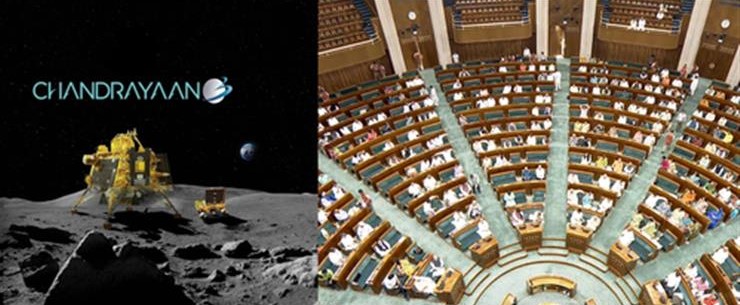
New Delhi : Lok Sabha on Thursday will discuss the Chandrayaan-3 mission’s success and other achievements in the space sector.
Also in legislative business, the government will seek introduction and passage of the Advocates (Amendment) Bill, 2023.
The bill has already been passed by Rajya Sabha.
Apart from this, the committee on estimates will present its report on, “Assessment of various initiatives under CGHS’ pertaining to the Ministry of Health and Family Welfare”.
The standing committee on home affairs will also present its report on prison reforms.
Another standing committee on education, women, children, youth and sports will present its Lok Sabha on implementation of National Education Policy. While the committee on health will lay in the house its report on “Implementation of Pradhan Mantri TB Mukt Bharat Abhiyan”.
New Delhi : The National Students Union of India (NSUI) today accused the BJP student wing, Akhil Bharatiya Vidyarthee Parishad (ABVP) of resorting to violence and hooliganism to intimidate students ahead of the Delhi University Students Union (DUSU) elections scheduled to be held tomorrow.
Addressing a press conference here today, the AICC incharge for NSUI, Kanhaiya Kumar and the NSUI president Neeraj Kundan alleged that the ABVP with the support and patronage of the administration and Delhi Police was trying to vitiate the peaceful academic atmosphere of the campus.
Kumar asserted, come what may, the NSUI will not let that happen and will not be intimidated by such tactics. He said, despite so many resources and support with their government at the centre, the ABVP had panicked and was fearing defeat. That is why this organisation is resorting to violence and hooliganism, he added.
The former JNU Students Union president said, the NSUI was going to these elections with a positive agenda. He said, the NSUI was getting extensive support from the student community from across the country like the students of North-East and the southern states.
He said, these elections were being held after a gap of three years and most of the students like those studying in first and third year were all first time voters.
He asserted that the arrogance and efforts of intimidation will be defeated on September 22, the day of elections. He expressed confidence that the entire panel of the NSUI which has been drawn from the common backgrounds will get elected. He said, those in the panel belong to a farmer’s and a soldier’s families. NSUI’s Presidential candidate Hitesh Gulia was also attacked by ABVP, they vandalized his car. He has been active in student politics and currently a student of law.
Kumar said, their positive agenda was getting immense support from the students and in some cases from the other sections also. He said, the demand for two day menstural leave for female students every month has been appreciated by the teachers and students alike.
He said, the way academic atmosphere of the campus was being vitiated, it must have caused concern among parents and families of the students who come here to study from across the country and abroad. He pointed out, Delhi University is a prestigious university and any wrong image of the institution is not good for the country.
The AICC incharge of NSUI accused the Delhi Police of allowing a free run to the ABVP for its violence and hooliganism. He alleged that instead of taking action against the ABVP activists, the NSUI activists were being wrongly targeted and harassed.
New Delhi : Vivek Katoch, Director – Corporate Affairs, Oriflame, has been elected as the new Chairman of the Indian Direct Selling Association (IDSA), the apex body of the direct selling industry in India.
Katoch has held this coveted post for the second time. He also represents the Indian direct selling industry as a member delegate on the Board of the World Federation of Direct Selling Associations (WFDSA).
The elections to the new executive committee of IDSA were held at its 27th Annual General Meeting here on Thursday, in which Harish Pant, Director and Head of Government Relations, Herbalife International, was elected as Vice Chairman, Aprajita Sarkar, Head of Growth Office, Modicare Limited, as Treasurer, and Rajat Banerji, Vice President, Corporate Affairs, Amway India, as Secretary. The new Executive Committee will hold office for a period of two years.
On the occasion of assuming the charge of the post of chairman, Katoch said, “The direct selling industry in the country is growing at a steady pace. Apart from making an important contribution to the country’s economy, the industry has provided livelihood opportunities and alternative sources of income to around nine million people working full-time or part-time. The industry has now made inroads into rural areas as well, and we are committed to taking this to every nook and cranny of the country.”
He said, “Consumer protection is of paramount importance for us. Bringing direct selling under the ambit of the Consumer Protection Act 2019 and the subsequent notification of the Consumer Protection (Direct Selling) Rules, 2021, for this industry has not only brought transparency but also more clarity on policy matters. We especially thank Locket Chatterjee, Hon’ble Chairman, Parliamentary Standing Committee on Food, Consumer Affairs, and Public Distribution, and Rohit Kumar, Secretary, of the Department of Consumer Affairs for understanding the concerns of the industry and bringing the desired amendment to the Direct Selling Rules.
Banerji, the outgoing chairman, said during his tenure one of the several initiatives taken up by IDSA was to build capacity for the state governments to set up monitoring mechanisms for supervising the activities of direct sellers and direct selling entities. A total of 9 state governments have notified the monitoring mechanism so far and I’m proud to say that five of these states have appointed IDSA as subject matter expert in their committees. I’m hopeful that the new executive committee of IDSA shall pursue this course even further with the other states, ensuring a robust monitoring mechanism in place that protects the rights of consumers.About IDSA– The Indian Direct Selling Association IDSA is an autonomous, self-regulatory body for the direct selling industry in India. The Association acts as an interface between the industry and policy-making bodies of the Government facilitating the cause of the Direct Selling Industry in India. IDSA strives to create and further, an environment conducive to the growth of the direct selling industry in India, partnering with industry and government alike through advisory and consultative activities. IDSA catalyses change by working closely with the government on policy issues, enhancing efficiency and ushering in the desired credibility, clarity & confidence in Direct Selling.
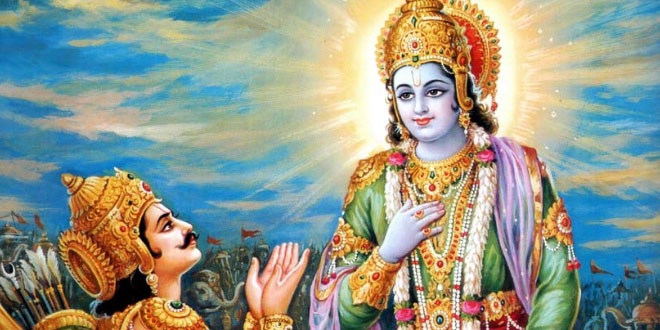
Bhagavad Gita in shlokas from 2.54 to 2.72 has spelled out the distinctive attributes of an enlightened person, the one who has steady intellect and who is forever situated in divine consciousness. It has also been explained as to how can such a state of blessedness be obtained.
While describing the characteristics of an enlightened person, it has been stated that when one gives up all his selfish desires and when his soul is content in itself ; then he is called a man of steady intelligence (sthita-pragya). The one whose mind remains unperturbed in the midst of sorrow, who does not crave for pleasure ; and who is free from attachment, fear and anger – such a person is called a sage of steady wisdom (sthita-dhih). The one who remains unattached under all conditions and is neither delighted by good nor dejected by evil, he is firmly fixed in perfect knowledge (pragya-pratishthita). The one who having brought all his senses under full control fixes his consciousness upon the Supreme Lord, he is also known as pragya-pratishthita.
Sri Krishna in these shlokas has further explained as to what are the obstacles in achieving the steady wisdom and spiritual liberation, and how can these obstacles be overcome. Attachment towards objects of the senses gives rise to afflictions of the mind like desire, anger and greed etc. ; which, in turn, results in destruction of intelligence. The cravings of the senses are so strong that they can forcibly carry away the mind even of a wise man. Citing the example of a boat on water which is swept away by strong wind, it has been stated that even one of the senses, which is wandering on the objects and on which the mind is constantly fixed, can carry away a man’s intelligence. He whose senses are all withdrawn from their objects, certainly remains steady in intelligence (pragya-pratishithita). Therefore, the one who wants his wisdom to be stable has been advised to withdraw his senses from their objects in every respect, as a tortoise draws its limbs, on all sides, into its shell.
Sri Krishna in these shlokas has also talked about peace and joy. Just as sea remains motionless even while rivers are entering it, similarly only those who remain unmoved by desires can attain peace ; and not the slaves of desires. For the one who does not have a disciplined mind, there can neither be any stability in intelligence nor any power of concentration. There can be no peace or happiness for such a person.
It has been stated that a spiritual aspirant may restrain the senses from the sense objects, but the taste for their enjoyment still remains. However, even this taste vanishes, when the Supreme is seen. But how can one see the Supreme ? The one who has abandoned all desires, who is free from longing, who has no sense of ownership ; and who is devoid of any false ego – only such a person can attain perfect peace. This is stated to be the divine state (brahmisthiti), having attained which one is not bewildered. Being established in that till the end, one attains the bliss of God (brahmanirvana). In other words, a realised soul obtains not merely an outer abstention but also inner renunciation. He remains in full control, not only of the body but also of the mind. He is always guided by vivek (spiritual discrimination).
Bhagavad Gita does not promote a life of isolation or otherworldliness. It does not look down upon the worldly enjoyments. It only advocates self-control. It has been stated that the one who even while experiencing sense objects keeps senses under control by shunning likes and dislikes, he attains purity of spirit. And the purity of spirit erases all sorrows. Intelligence of such a joyful person quickly gets firmly established (buddhi-paryavatishthata).
An enlightened person does not suffer pain because he does not hanker after pleasure. His joy is from within. His delight is long lasting as it does not depend upon outside objects or external circumstances.
A question is often asked as to whether the ideals described in the above shlokas can serve any real purpose in day to day life of a common man. Is it humanly possible to achieve such an equanimous and steady state of mind, even while remaining physically and mentally competitive, in this world of fierce competition ? The one who internalises the essential meaning of these shlokas and tries to follow them to the extent possible, he can himself vouch for the practical benefits of the Gita teachings. When one has a clear mind, is free from attachment, fear and anger, is endowed with patience, whose senses are under control and whose mind is focused, who remains content in himself – such a person of illumined intelligence and unwavering resolve puts in his hundred percent in whatever he does. He is likely to excel in all his endeavours.
To conclude, Bhagavad Gita has laid down, in clear terms, the principles of a self-disciplined, focussed, even-tempered, intelligent, aware, tranquil and joyous living. The one who subdues his ego, he is freed from the troubles of earthly existence. When one fixes his consciousness on the Supreme ; he obtains divine love, divine knowledge and divine bliss. The wisdom of the Gita is equally applicable for all, without any consideration of class, creed or gender etc. One is benefitted, to the extent he adheres to these mantras of leading a meaningful and purposeful life.
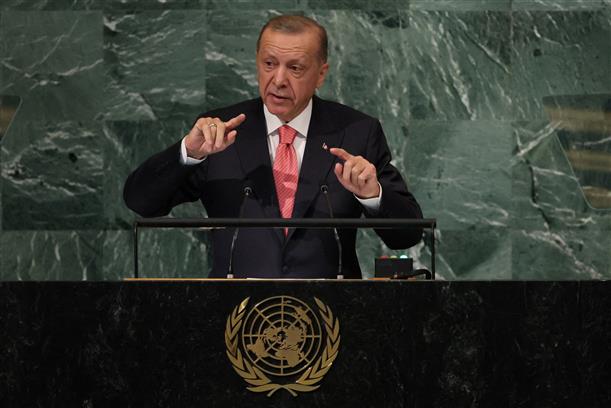
Turkish President Recep Tayyip Erdogan surprisingly once again raked up the Kashmir issue during his address at the United Nations General Assembly, advocating for a resolution through dialogue between India and Pakistan.
Erdogan stressed that resolving the Kashmir conflict peacefully would contribute to regional stability in South Asia.
During his speech, Erdogan refrained from mentioning United Nations resolutions or making a direct offer for mediation, aligning his position more closely with India’s view that the Kashmir dispute is a bilateral matter. This marks a shift from his previous statements on the issue. In 2020, Erdogan had referred to the Kashmir situation as a “burning issue” and criticized the revocation of the region’s special status. In the previous year, he asserted that despite UN resolutions, Kashmir remained besieged, with millions of people affected.
New Delhi : Following the killing/death of three dreaded pro-Khalistani terrorists in the past few months, the name of designated Khalistani terrorist and chief of the banned Sikhs for Justice (SFJ), Gurpatwant Singh Pannun, is on the top of the security agencies’ radar now.
Facing 22 criminal cases in Punjab, including three of sedition, Pannun is known to be operating from Khalistani terrorists’ safe heaven Canada.
On May 6, Khalistani leader Paramjit Singh Panjwar, the head of the Khalistan Commando Force (KCF), was shot dead in Lahore. On June 15, Avtar Singh Khanda, a leading exponent of Khalistan and handler of separatist Amritpal Singh, died of cancer at a hospital in the UK.
Three days later on June 18, Hardeep Singh Nijjar, a Canadian citizen and chief of the banned outfit Khalistan Tiger Force (KTF), was gunned down by two unidentified gunmen outside a gurdwara in Surrey, British Columbia.
Be it the rocket-propelled grenade attack on Punjab Police’s Intelligence headquarters in Mohali last year, an audio message asking Kashmiri Muslims residing in Srinagar to go to Delhi and disrupt the G20 Summit, or assassination threats to multiple Chief Ministers and other who’s who via telephonic audio messages — they all have been linked to the proscribed terrorist organisation Sikhs For Justice (SFJ) founded by Pannun.
Just last week, Pannun declared to hold “Shaheed Nijjar kill India referendum” on the question: Is Indian High Commissioner Verma responsible for the ‘assassination’ of Hardeep Singh Nijjar?
He also announced to hold Khalistan Referendum-II on October 29 in Surrey, British Columbia.
Pro-Khalistan leader Nijjar, who was declared a ‘wanted terrorist’ by the Indian government, was shot dead by two unidentified gunmen on the premises of Guru Nanak Sikh Gurdwara, of which he was the head, in the Punjabi-dominated Surrey city on June 18.
Since Nijjar’s killing, many radical activists have been questioning as three killings of Sikh separatists took place within one month. They say: Is there a pattern in the sudden killings of three Khalistani terrorists?
On Monday, Canada, in a surprise move, expelled a top Indian diplomat amid probe into the killing of Nijjar on its soil.
Canadian Prime Minister Justin Trudeau claimed ‘credible allegations of a potential link’ between agents of the Indian government and the killing of the Khalistani terrorist.
Now the question is over the role being played by Pannun of instigating a momentum on the foreign soil against the Indian government.
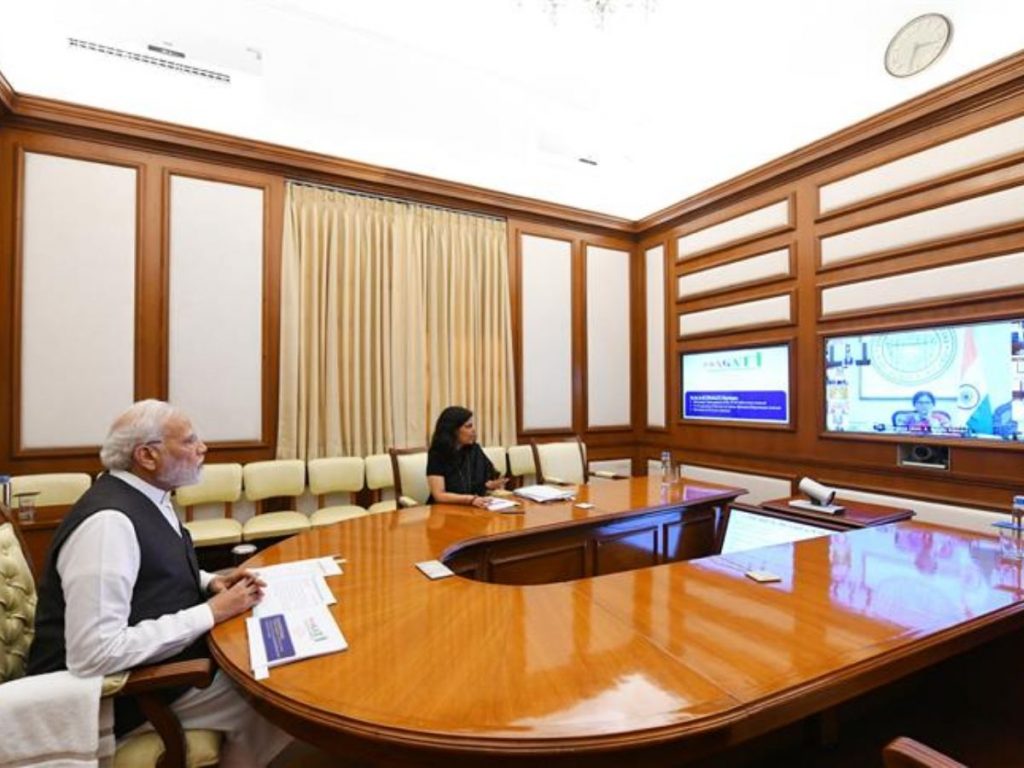
New Delhi : Prime Minister Narendra Modi on Tuesday joined WhatsApp Channels, a feature offered by messaging application WhatsApp.
“Thrilled to join the WhatsApp community. It’s yet another step closer in our journey of continued interactions. Let’s stay connected here, ” he posted on the social messaging site after joining the new application of WhatsApp.
He also shared a picture of his office from the new Parliament building.
Modi has been quite active on social media, especially on X (formerly Twitter).
The development comes on the day the proceedings of Parliament shifted to the new Parliament building.
WhatsApp Channels are a one-way broadcast tool for admins to send text, photos, videos, stickers, and polls.
Channels can be found in a new tab called Updates on WhatsApp – where one can find the status and channels one chooses to follow, and are separate from one’s chats with family, friends and communities.
New Delhi : The Central government on Wednesday will seek passage of the Women’s Reservation Bill in Lok Sabha.
Law Minister Arjun Ram Meghwal will move the Bill in the Lok Sabha for discussion and seek it’s passage.
The Constitution (One Hundred and Twenty Eighth Amendment) Bill, 2023 or the Women’s Reservation Bill, was introduced in the Lok Sabha in the supplementary list of business on Tuesday.
It proposes that the reservation would continue for a period of 15 years and there would be a quota for SC and STs within the reserved seats for women.
The legislation however is unlikely to be implemented in the 2024 Lok Sabha elections, sources said.
It will be rolled out only after the delimitation process is over, most probably in 2029, they added.
The reservation will come into effect after a delimitation exercise is undertaken and will continue for 15 years. Seats reserved for women will be rotated after each delimitation exercise, according to the Bill.
Meanwhile the government will also seek introduction and passage of the Advocates (Amendment) Bill, 2023 in Lok Sabha on Wednesday. The Bill has already been passed by the Rajya Sabha.
Congress MP Adhir Ranjan Chowdhury, who heads the Public Accounts Committee (PAC), will lay in Lok Sabha two reports related to ground water management and issues related to cultural institutions.
BJD MP Bhartruhari Mahtab will also present a report by the standing committee on labour in Lok Sabha.
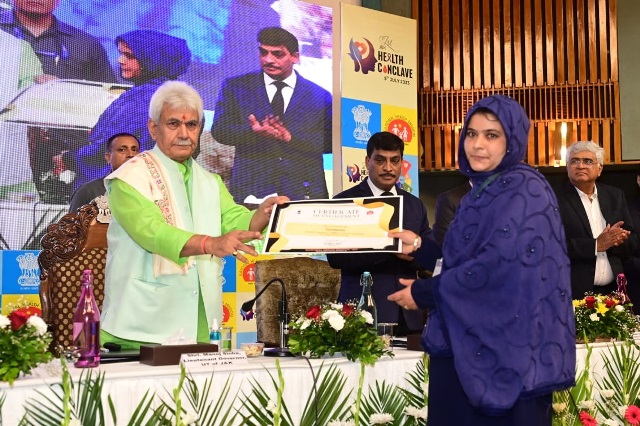
Jammu and Kashmir has announced the establishment of a mental health authority which will oversee all mental health facilities and ensure that they are registered with the proper authorities.
According to a notification issued by the Health and Medical Education Department, the Chief Executive of the Mental Health Authority will be the Mission Director of the National Health Mission (NHM) in Jammu and Kashmir.
To govern the functioning of the Mental Health Authority, a set of rules has been formulated, known as ‘The Jammu and Kashmir Mental Healthcare (Mental Health Authority) Rules, 2023.’ These rules will come into effect upon their publication in the official gazette.
The Mental Health Authority will comprise a Chairperson, the Head of the Department of Psychiatry at Government Medical College in Srinagar/Jammu, and the Mission Director of the National Health Mission in Jammu and Kashmir, who will serve as members for selection purposes. They will be responsible for nominating and selecting non-official members of the J&K Mental Health Authority. Non-official members selected or nominated under these rules will hold their positions for a three-year term and will be entitled to various allowances as applicable to non-official members of similar commissions and committees in the union territory.