The unkindest cut of all

With the panauti remark, politics reached a new low: getting personal is routine and hitting below the belt a new norm; but calling someone, and that too a Prime Minister, an ‘ill omen’ is unacceptable. 

There seems to be three players in this sordid drama: politically, the one who started it; another who was involuntarily dragged in and the third who is being quoted posthumously. Simply put they are Rahul Gandhi, Prime Minister Narendra Modi and Mrs Indira Gandhi respectively.  

Let us begin with the willing initiator; namely Congress scion Rahul Gandhi.  

For starters, it was the Congress led by Rahul Gandhi that fired first. 

Expectedly but uncharitably, he targeted Prime Minister Narendra Modi blaming him for the World Cup defeat: Achha bhalaa hamare ladke wahaan World Cup jeetne waale the, par panauti harwaa diya, our boys were going to win the World Cup, but panauti got them defeated, to quote the Congress scion while addressing an election rally. He also said “PM means Panauti Modi”. 

For record, Prime Minister Narendra Modi was present in the stadium to witness the World Cup Finals between India and Australia. 

As for terminology, Panauti is commonly understood to be a word that means ill omen. The word is used for a person or situation that brings trouble and bad luck. 

In astrology, panauti refers to a phase of a tough time due to the movement of planets. The word is commonly used for a person, situation or a period that is full of worries and reverses. 

Against this backdrop for Rahul Gandhi to call Prime Minister Modi a panauti was nothing short of it being an unkindest cut in recent times. 

The event was the Cricket World Cup which had sent the entire country and perhaps part of the World in a tizzy. 

India had, before it entered the finals, won  ten straight matches displaying its prowess, grit, determination and ability as a first rate cricketing team. 

The line-up comprising Rohit Sharma, Virat Kohli and others was formidable; Mohammad Shami emerged as a leading wicket taker but where Shami couldn’t Jasprit Bumrah did with his outstanding performance; and ofcourse Rohit Sharma stood tall as skipper. 

 Therefore the stage was set for a breath-taking performance followed by an expected win. 

The Narendra Modi Stadium in Ahmedabad, Gujarat was the go-to place in India on November 19: the day the final of the Cricket World Cup was being played between India and Australia. 

Such was the craze that both airlines and hotels made a killing on sales. If reports are anything to go, booking sites displayed hotel room rates between rupees 40,000 to 75,000 for one night. 

Flight costs, too, had skyrocketed: up to 25,000 rupees for a flight that ordinarily cost rupees 5000. 

All was well till India lost the World Cup finals. Hell broke loose with politics playing out. The focus shifted: from cricketers to politicians with Rahul Gandhi using a derogatory terminology for the country’s Prime Minister.

Therefore when senior BJP leaders and ministers lashed out at Gandhi they were not off the mark. 

If BJP’s Ravi Shankar Prasad said that Rahul Gandhi’s remarks were “shameful, condemnable and disgraceful”, Union Minister Rajeev Chandrashekar said Gandhi’s comments showed “signs of desperation and mental instability”. The Prime Minister, Chandrashekar tweeted, “is a nightmare for the Crooks of Congress”. 

The BJP was stung and rightly so. It went a step further and pulled out Rahul Gandhi’s grandmother India’s late Prime Minister Indira Gandhi from the grave as it were. The BJP accused her of insulting the Indian hockey team that lost to Pakistan in the 1982 Asian Games final.

Mrs Indira Gandhi, the BJP said, left the match midway after India started trailing: a move, the BJP said, adversely affected the  players’ morale. 

While on Mrs Indira Gandhi Assam Chief Minister Himanta Biswa Sarma gave a different reason for team India’s cricket World Cup loss in the final match. He said the Indian cricket team lost the finals because it was played on Indira Gandhi’s birthday, he said.

Mrs Indira Gandhi was born on November 19. 

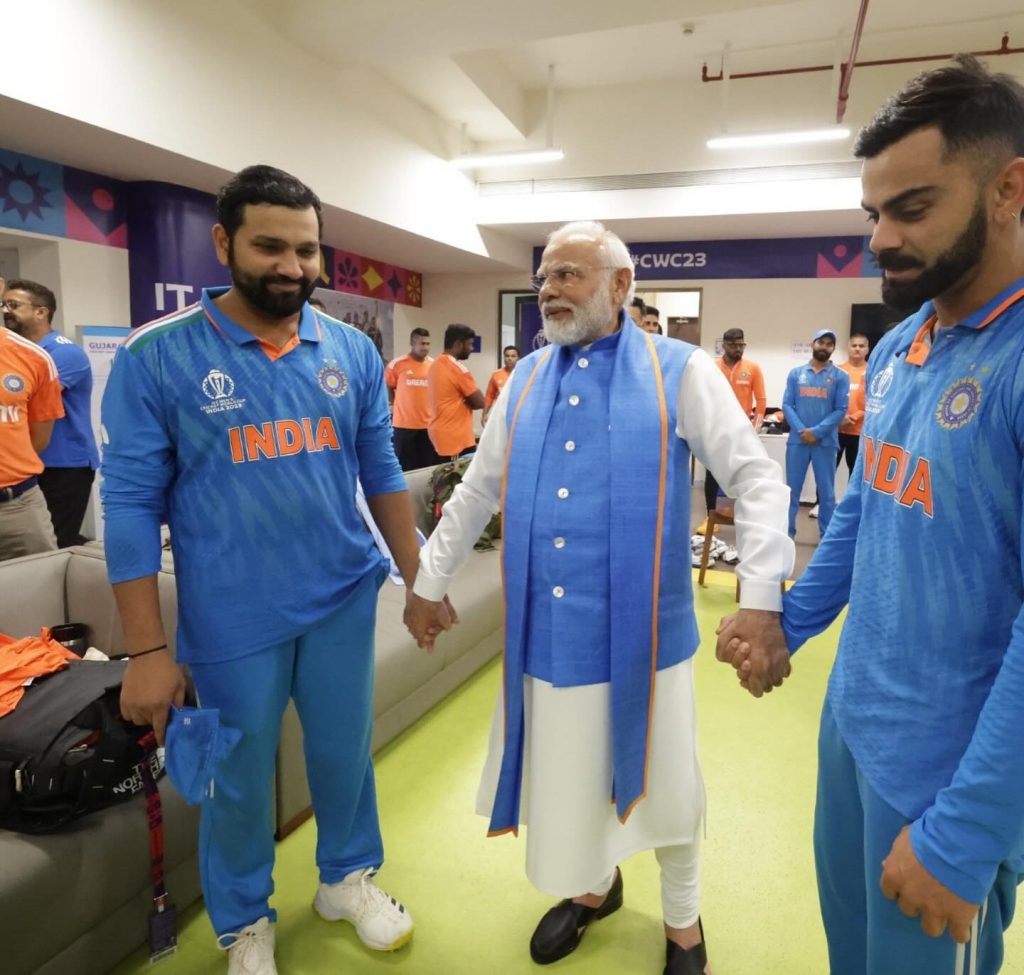
Caught in the crossfire and the tongue lashing is none other than Prime Minister Modi who watched the match, gave away the victory cup and also met the Indian team in the dressing room. 

This too raised hackles. 

Trinamool Congress’s Kirti Azad criticized the Prime Minister for “breaking rules” and invading the privacy of the Indian cricket team: “The dressing room is the sanctum sanctorum of any team…ICC does not allow anybody to enter these rooms apart from the players and the support staff”.

 Stating that Mr Modi should have met the team “outside the dressing room,” Azad tweeted: “Would @narendramodi allow his supporters to come and console or congratulate him in his bedroom, dressing room or the toilet?

For the record, after India lost to Australia in the final, Mr Modi had visited the dressing room to console the Men in Blue. 

Pictures of the Prime Minister consoling the Indian team went viral. 

On another count, Chief Minister Mamata Banerjee said that the men in blue were “turning saffron”. She was referring to the colour of the practice jersey of the Indian players where they were seen supporting saffron coloured jersey instead of the customary blue: “Now everything has been turned into saffron,” Bannerji said at an event.  

Even as Azad accused the Prime Minister of “breaking rules”, other opposition parties condemned the move on grounds that “players looked uncomfortable after the defeat and cameras were thrust on them to record the ‘pep talk’. 

Union Minister Amit Shah was right in saying that Gandhi had hit “below the belt”. Not many would disagree. 

Politics and criticism within a limit is one part but getting personal and so despicably, quite another. Add to this the fact that one is insulting the office of the Prime Minister of the country: on that account at least one must measure one’s words. 

As for Mr Modi it is a damned if he does and damned if he doesn’t kind of a situation. Had he gone to the stadium and left without meeting the players, critics would have lashed out, quoting  instances where he feted and interacted with athletes: be it those who participated in the Asian Games, the Indian contingent which brought in a medal-haul in the Commonwealth games and so on and so forth. 

Therefore, had he given a go-by to the Indian cricket team particularly when they lost the final, it would be nothing short of sacrilege. About breaking the dressing room rule and equating it to a bedroom or a toilet is a bit of a stretch, to say the least.

With the panauti remark, politics reached a new low: getting personal is routine and hitting below the belt a new norm; name calling, a done thing irrespective of the person’s age or dignity of  the office he holds but calling someone, and that too a Prime Minister, an ill omen is unacceptable. 

What about decorum and decency? What about upbringing? Does it behove one to call a Prime Minister and someone who is twice their age a bad omen? 

 What happened to the much touted mohabbat ki dukan,  merchandise of love that Rahul Gandhi had spoken about during his Bharat jodo yatra

One can accuse Prime Minister Modi of playing to the gallery but does that give others a license to abuse him personally? 

It is no one’s case to even remotely suggest that a political slugfest is not in order. Neither is it to suggest that one cannot hit out at a political opponent. Sure one can but there have to be some lines drawn however rowdy the game may be. 

That the not so young Gandhi crossed the line is a given as was the fact that the Prime Minister was targeted simply because he chose to go and watch the World Cup final, and later boost the sagging morale of the Indian team that had lost the Cup.  
Will BJP go the whole hog on Ram temple plank in 2024 poll?

The BJP plans to turn the consecration ceremony of Ram temple on January 22 into an emotive issue in the election year hoping it will relegate burning issues of inflation, unemployment etc to background. Meanwhile, assembly poll results will help the party to test the waters, writes Mudit Mathur

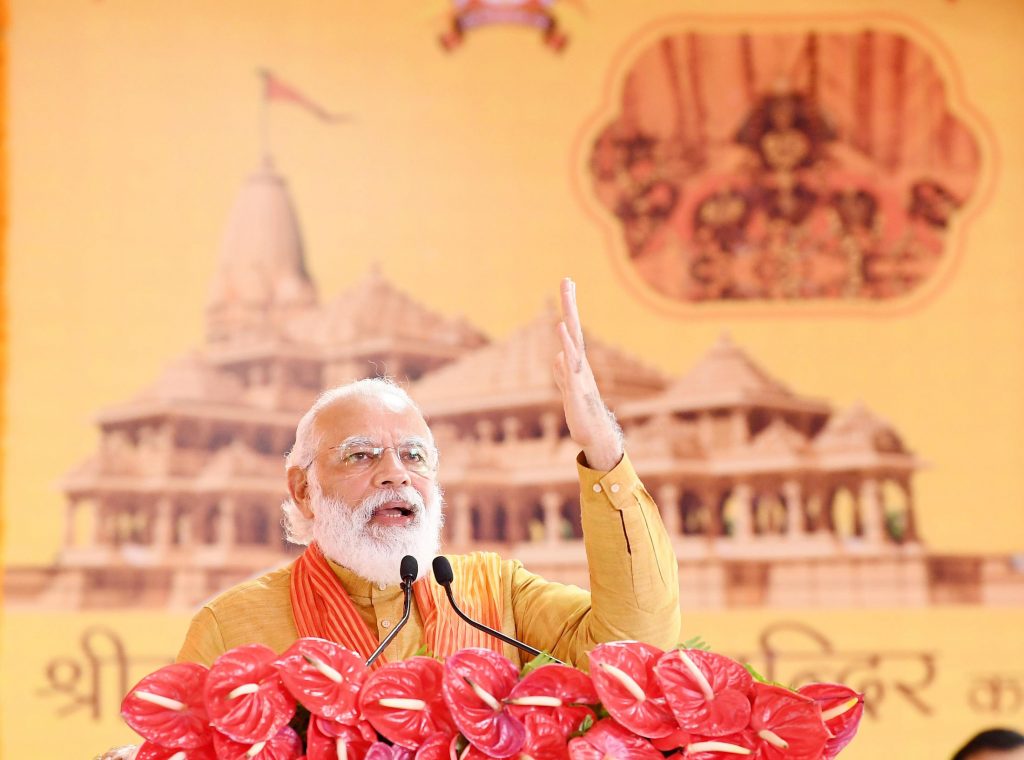
By making Ram temple at Ayodhya the central theme of its election campaign, the BJP would be entering uncharted waters — blending religion with politics to match ideology of Hindutva with cultural nationalism – as the party gears up for the 2024 Lok Sabha poll. Ayodhya would be projected as a capital of cultural nationalism and a hub of cultural tourism. If people reject its agenda of communal polarisation in the ongoing elections of five states, it would be a big blow to its ambitious plan to launch the 2024 general election campaign from the foot of  “Lord Rama” a la PM Modi’s  move for campaign launch with “Maa Ganga” blessings in 2014.

Prime Minister Narendra Modi, RSS chief Mohan Bhagwat and UP Chief Minister Yogi Adityanath will be present at the ‘Prana Pratishtha’ ceremony (consecration ceremony) in Ayodhya on January 22. Besides, over 4,000 Sants and 2,500 eminent citizens have been invited to grace the occasion. The event is planned in such a way to change the poll narrative by sidetracking core issues the country is grappling with.

The poll strategists of Prime Minister Narendra Modi have planned to project the consecration ceremony of Ram temple at Ayodhya on 22 January as a victory day and huge achievement of the Modi government as after 400 years of struggle the Hindus have been finally entrusted with the reins of the temple. They believe the emotive issue will blow away the growing anti-incumbency and issues of misgovernance that the present government is facing over the record high-rate unemployment, unrestrained price rise of essential commodities and privatisation of national assets and infrastructure to benefit a select few corporate houses.

Government employees have been protesting nationwide demanding re-introduction of old pension scheme (OPS) for their social security but their voice is going unheard amid gala celebrations. The BJP plans to ignite the religious passions with a live telecast of the consecration ceremony of Ram temple and thereafter distributing ‘Prasad’ and ‘Akshat’ (holy offering) to every household in the country through their network of local BJP and RSS workers.

Leaders of the RSS, VHP and the Shri Ram Janmabhoomi Teerth Kshetra Trust have started holding virtual and physical coordination meetings with affiliate organisations, including the BJP with their respective ‘Prant’ units. More than thousand volunteers of different RSS affiliates from each of its 45 ‘Prant’ (regional) units across the country, will be distributing ‘Akshat’ from door-to-door, inviting them to attend celebrations at their nearest temple on January 22, to mark the consecration ceremony of the Ram temple in Ayodhya. Arrangements of live streaming in each and every temple are being made by local BJP functionaries to showcase the mega event.

In a social media post on X in Hindi, the Prime Minister also shared images from the celebrations.  “Amazing, supernatural and unforgettable! The whole country is illuminated with the grand festival of lights of Ayodhya City illuminated with millions of lamps. The energy emanating from this is spreading new zeal and enthusiasm throughout India. I wish that Lord Shri Ram does well for all the countrymen and becomes an inspiration for all my family members. Jai Siya Ram!” He further mentioned that millions of ‘Diyas’ (earthen lamps) were lit in Ayodhya, illuminating the entire country.

Earlier, the homecoming from 14 years of exile of Lord Ram, Sita and Lakshman was staged before the mega event of Deepotsav. “The chariot, carrying Lord Ram, Mata Janaki, three brothers, Bajrangbali, and Guru Vashishtha was pulled and welcomed by Governor Anandi Ben Patel, Chief Minister Yogi Adityanath and his deputy, Brajesh Pathak.” The CM also performed a symbolic coronation of Lord Shri Ram.

Journalists bear the brunt of Israel-Gaza conflict

The list of the dead and dying in Gaza seems endless. Doctors and medical staff besides reporters and photo-journalists covering this genocide are constantly getting targeted, injured and killed.

On the just passed by International Day to End Impunity for  Crimes against Journalists, on November 2, the scale of violence and assaults that journalists face was highlighted. This scale is particularly shocking in conflict zones, war-torn countries, and definitely in regions like Gaza

The list of the dead and dying in Gaza seems endless. Doctors and medical staff besides journalists, reporters and photo-journalists covering this genocide are constantly getting targeted, injured and killed.

To quote from news reports on the journalists killed in the Gaza stretch, in these recent weeks: At least 37 journalists have been killed since the war began, the Committee to Protect Journalists (CPJ) said…These include 32 Palestinians, four Israelis and one Lebanese. In fact, Al Jazeera’s Gaza bureau chief, Wael Dahdouh lost four members of his own family in Israeli air strikes. His wife Amna, 15-year-old son Mahmoud and seven-year-old daughter Sham were killed, as was his 18-month-old grandson Adam, following directives to leave northern Gaza for the south, only to come under Israel’s bombardment of the Nuseirat refugee camp where they were staying.

 “They take revenge on us through our children,” Dahdouh stated upon finding his son’s lifeless body… “What happened is clear. This is a series of targeted attacks on children, women and civilians. I was just reporting from Yarmouk about such an attack, and the Israeli raids have targeted many areas, including Nuseirat…We had our doubts that the Israeli occupation would not let these people go without punishing them. And sadly, that is what happened. This is the ‘safe’ area that the occupation army spoke of.”

And November 5 strike on the home of journalist Mohammad Abu Hassir of Wafa News Agency, killed him and his 42 family members.And the Reuters journalist Issam Abdallah was standing near the Lebanon-Israeli border on October 13 when he was killed by a missile strike. Reuters journalists Thaer Al-Sudani and Maher Nazeh sustained injuries in the blast. Two AFP journalists, Christina Assi and Dylan Collins, were also injured…the list of the dead and injured and targeted and assaulted journalists is indeed long and perhaps ongoing. A tragic reality of these barbaric times we are living in, when anyone can be attacked and killed.

And to quote from The Wire news report: ‘Journalists from the United States have issued a statement of condemnation against “Israel’s killing of journalists in Gaza” and appealed to newsrooms in the West to uphold “integrity” in covering Israel’s atrocities against Palestinians. The statement of condemnation, which was first brought out on November 6, was signed by 1,265 reporters, editors, photographers, producers, and other workers in newsrooms around the world at the last count…It also condemned the biased coverage of the ongoing war and longstanding conflict between Israel and Palestine in the Western media. “We also hold Western newsrooms accountable for dehumanising rhetoric that has served to justify the ethnic cleansing of Palestinians. Double standards, inaccuracies and fallacies abound in American publications and have been well documented.” it added.

And with this scale of violence and attacks and assaults, can the writers and poets be left intact in  Gaza! The leading poet of Palestine, Mosab Abu Toha, was detained in a mass arrest by the Israeli Defence Forces on 20 November, 2023. He was reportedly at a checkpoint in Gaza, travelling towards the Rafah border crossing, with his wife and children. Later came in the news reports stating that he was finally released by the IDF after being “interrogated and beaten.”

To  quote from the Literary Hub, “On October 29, 2023, Abu Toha posted an Instagram  video of his family home, now flattened and reduced to rubble, in Beit Lahiya, North Gaza. “That used to be my house,” he says, looking over his shoulder. “There is nothing, there is nothing over there. Not my books. Not my heirlooms. Not the kitchen. Nothing.”…Later that day, Abu Toha posted a screenshot of the poem “What Is Home?” from his debut poetry collection Things You May Find Hidden In My Ear  published last year by City Lights. In the caption to the poem, he asks: “Please save this poem, recite to the people around you and tell them what happened to my home, and the homes of so many other people? Tell them some families were buried under the rubble?”

Ending this column with Mosab Abu Toha’s verse: What is  Home?, from the Literary  Hub: 

‘What is Home?
What is home:/

It is the shade of trees on my way to school before they were uprooted./

It is my grandparents’ black-and-white wedding photo before the walls
crumbled./

It is my uncle’s prayer rug, where dozens of ants slept on wintry nights, before it was looted and/
put in a museum./

It is the oven my mother used to bake bread and roast chicken before a bomb reduced our/
house to ashes./

It is the café where I watched football matches and played –/

My child stops me: Can a four-letter word hold all of these?/’

Sordid tales tumble out as victims blow the lid off predator principal

The controversy which kicked off with an anonymous letter written by 15 girl students to the Prime Minister snowballed into a major controversy with horrific details of predation of the now sacked principal of a government school at Jind coming into open. A report by Aayush Goel

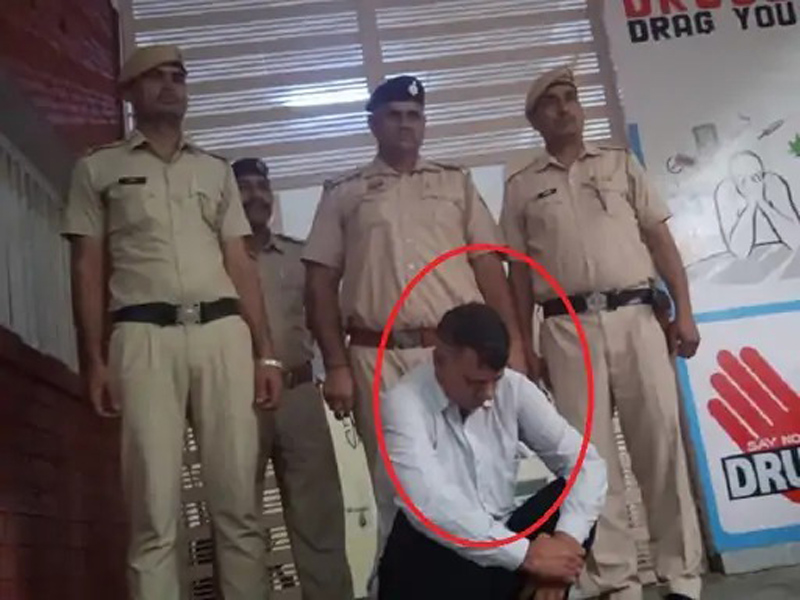
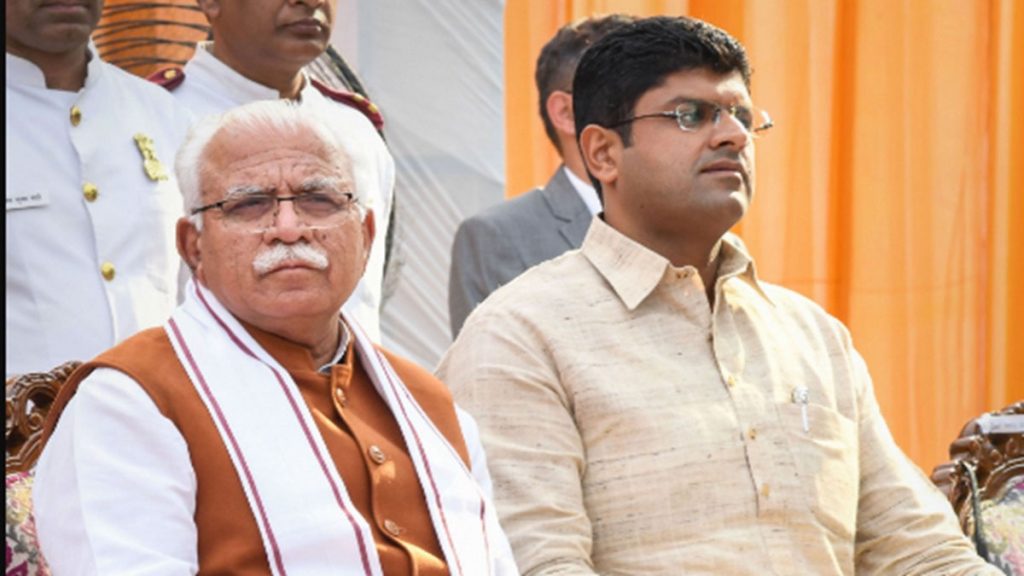
 ‘A teacher is like a candle that burns itself to help a student,’ reads a proverb painted across the dainty red wall of Government Girls School, Uchana Kalan in Jind. What used to be yet another rickety government school of Haryana, has today caught national attention for being the seat of predator principal. The dusty constituency of Haryana Deputy CM Dushyant Chautala has hit headlines as young girls, fighting societal and parental pressure, have spoken up against the alleged sexual harassment by now arrested 56-year old Principal, Kartar Singh. The accused has been dismissed from service following the orders issued by Chief Minister Manohar Lal Khattar. A government spokesperson said the action has been taken under the powers conferred upon by virtue of Article 311 (b) of the Constitution.

What started with an anonymous letter by 15 girls has now snowballed into a major controversy with horrific details of molestation at the school trickling in each day even as the number of victims has increased to 142. “I wash my hands repeatedly and shudder even when my brother or father’s hand brushes against mine. I had heard rumours about him but never thought he would ever bother a normal looking girl like me. I remember that day when he called me to his office saying teachers had complained against me. Suddenly he took my hand, squeezed it and I immediately knew that was a bad touch. Within minutes when a teacher walked in, he let go of my hand and started shouting. I have been numb since I was scared of his sight. I told everything to the DEO (District Education Officer) ma’am but my parents won’t take me to the police and I am at my aunt’s home. I am happy he is gone,” a class 9 student of the school told Tehelka.

Majority of these 142 girls have similar stories which have left them scarred but sadly only 6 of them have so far recorded their statement with police. With the incident catching wider attention, the parents are now holding back their daughters and refusing to let them talk to anyone including the state enquiry teams.

The local police has already booked and arrested Kartar Singh on October 30 under Section 8 (sexual assault) of the Protection of Children from Sexual Offences (Pocso) Act and Section 354 (molestation) of the Indian Penal Code.

“We have recorded statements of six girls so far and around 50 have given written complaints to the Education department which too are being examined. Some girls have alleged they were approached through social media platforms like Instagram and we have sought some details from Instagram for investigations. We are also looking at his past postings and complaints. The victims are being encouraged to come out and speak out. One of the victims is a Dalit, and so we will be invoking an atrocity act in FIR,” said SP Jind Sumit Kumar while speaking to Tehelka. Police suspect that the cycle of abuse began five years ago when Kartar Singh was appointed principal of the girls’ school. But how it fell through the cracks remains to be seen.

While the family members of Singh besides his supporters call the entire episode a farce and politically motivated defamation, the incident raises many questions regarding safety and security of children in state government schools. Concern has also been raised over the alleged delay in action and attempt by local authorities to brush the incident under the carpet and a victim-bashing by society, as many face the possibility of dropping out of school after the incident .

To the Prime Minister

The flood gates opened in August this year when 15 victims sent a letter to the President, the Prime Minister, the Chief Justice of India, the National Women Commission, and the State Women Commission, among others detailing allegations of sexual exploitation by the school principal involving several minor girls. After receiving the letter, the Haryana Women Commission took note of it on September 13 and sent it to Jind police for action on September 14. Police lodged an FIR only on October 30. The accused principal was arrested by the police on November 4. He was later sent to judicial custody on November 7.  The letter highlighted how the accused molested more than 10 girls, resulting in many dropping out of school out of fear of sexual exploitation. It highlighted the Principal’s questionable character and multiple transfers due to molestation complaints filed by girls in the schools where he had served previously.

“We are writing this letter anonymously as the accused may harm us if he learns of our identities. This matter should be investigated by higher authorities in Chandigarh and Delhi. Girls from this school should be interviewed separately during the investigation, and none of the  local teachers or staff members should be involved in the process. The girls will reveal the true nature and story of this unscrupulous principal. We have faced similar situations in his office on two occasions, and he threatened to file false complaints with our parents if we did not comply. When we confided in other teachers, they advised us to remain silent about the issue. Now, prompt and just action must be taken in this matter,” the letter stated.

Tales of Horror

With an enquiry marked into the issue, the local administration constituted a committee headed by the local SDM with DEO and DEEO (District Elementary Education Officer) that started investigations in October. While they walked in school on October 27 suspecting it to be usual student-teacher conflict, they were rattled by the horrific tales told by the girls as young as 11 of lecherous stares, inappropriate touch, improper questions and blackmail that scarred them for life.

DEO Jyoti Sheokand gathered over 300 girls of classes 9, 10, 11 and 12 in a room sans teachers and convinced them to confide in her. “They were scared that CCTVs would record their confession and faces told something was wrong and once they started even I couldn’t hold back my tears. They revealed those touches on the chest and back. Older girls from Class 9 to 12 said that the principal would ask them all sorts of inappropriate questions: Had they kissed boys? Were they sexually active? Did they enjoy it? There were 200 tales of horror which these girls couldn’t even tell their parents and we got 50 girls to fill a questionnaire, which was submitted to the State Women’s Commission,” says DEO.

“He obscured his glass office door with black paint, making it impossible to see from the outside, while he could observe the movements outside while sitting at his desk. He would call a selected girl into his office, close to his chair, and touch her inappropriately. He would divert attention by asking the victim girl to stand at a distance when someone visited his office,” the girls said in their complaint. They also blamed a female guest teacher for identifying ‘apt’ girls for him and sending them to him.

“I always thought myself to be revolutionary and when I said what he was doing was bad touch, he, with a smirk, said ‘Accept it quietly’. It’s not new for you, you go out with boys. I know where all you go to, and I will call your parents and tell them that you go outside the school. They will marry you off,” added another girl.

This committee which conducted a preliminary inquiry found Principal prima facie guilty and acting on its recommendations, disciplinary action was taken and criminal proceedings started against him. A female principal was posted at the Jind school and 16 other staff members were transferred. The infamous tinted glass door installed by Singh in school when he joined as Principal in 2018 has been removed and male teachers have been asked to keep the door open every time in the company of female students. Kartar Sing, it may be mentioned, after joining as the principal in 2018, immediately got the door with black tinted glass installed immediately. It allowed him to see if anyone was coming in, but no one from outside could see anything inside the room

Seminars to promote speaking up: Too late too little

Chief Minister Manohar Lal Khattar has issued a statement saying the government had zero tolerance for such incidents. “The accused, whosoever he may be, would not be spared. To address the issue comprehensively, Renu Bhatia, the chairperson of the Haryana State Women Commission, has been asked to organise seminars in collaboration with the police to prevent such heinous acts from occurring. Haryana has already enacted legislation to curb such incidents, including a provision for capital punishment,” Khattar said.

This however fails to placate parents and local panchayats who have accused the government of acting too late and too little. “This man has a history of sexual harassment complaints at  each of his earlier posting but nobody cared. Rather than dismissing him, he was posted as principal in the girls school. Majority of complaints against him ended as never opened letters or were brushed aside. We do have sexual harassment committees but just in files,” says a retired DEO.

The Special Investigative Team (SIT) probing the case is digging into Singh’s past. They’ve so far learned that he was a senior teacher at a boys’ school where he allegedly sexually harassed the female cook. During his time at another boys’ school, he is accused of sexually harassing a non-teaching female staff member. DDRs were reportedly made but are yet to be recovered by police. At the Uchana police station, members of the SIT under DSP Amit Bhatia visit the school almost every day. They talk to parents, teachers, non-teaching staff, and students to get to the bottom of the scandal.

Meanwhile, the victims are in village scrutiny with a local perception going around that he only targeted girls who were extrovert, frank and had social media accounts or talked a lot. Following a verbal advisory from local Panchayat, girls have been made to delete social media accounts and parents are not allowing them to speak to the police.

“My daughter is in the same school. My wife ensures that she goes with proper braids and her brother drops her and picks her up from the school. We have not given her a smart phone and regularly checks her school tab. She has not been targeted, the girls who have been targeted would loiter around. They themselves invited the trouble,” says a parent Pradeep Ahlawat (name changed).

World off track on climate action, on track for doom

There is nothing more powerful than the forces of nature unleashed in all their fury. If we don’t limit temperature rise to 1.5 degrees C soon, we will be pulling the plug on the planet and ourselves.

Most people around the world are aware of global warming and the effects of climate change that we are facing now. We also know that it is vital to limit the planet’s warming to 1.5 degrees Celsius by 2100. But I wonder how many are aware of what it’s going to be like if we go past the 1.5 degrees Celsius-mark.

To begin with, exceeding the 1.5 degrees Celsius-mark will bring even more unpredictable weather patterns that we have faced till now.

This in turn will hit food security globally as farm production will fall due to the vagaries of the weather. Unable to bear the frequent losses, many farmers will abandon farming and turn to other work, thereby increasing pressure on the already bursting-at-the-seams metropolitan cities.

Reduced food production will also mean frequent famines, skyrocketing inflation, rising hunger and malnutrition levels and diseases for the poorer and non-food producing nations.

Plus, oceans that have been a major source of food for millions globally are in danger as they are heating up since they absorb much of the excess heat of the planet.

Increasingly, warming waters and the consequent acidification and low oxygen levels will hit marine life and disrupt the food chain there. Oceanic heat waves and dead zones are projected to become more common and severe as the global temperatures keep rising.

Coral bleaching is already a huge problem but if the world’s temperature rises, 99 per cent of the coral reefs will die off leaving coastal areas vulnerable to erosion through the repeated impact of waves. Dead coral reefs will also impact the underwater ecosystem and the livelihood of millions of people globally.

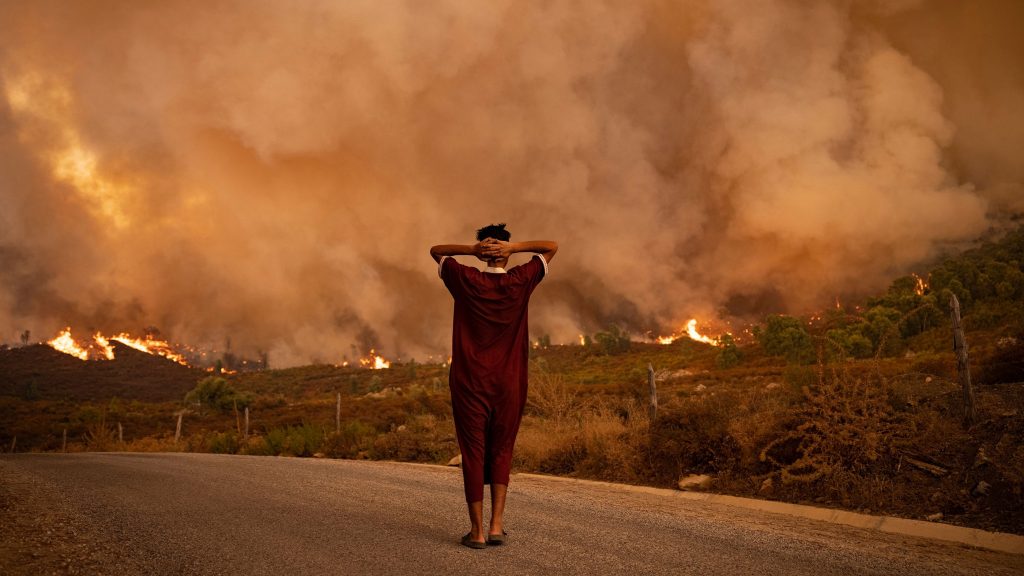
 Plus, a hotter atmosphere will be a wetter atmosphere as warmer air holds more moisture. So expect much more severe and increasingly frequent storms, cyclones and hurricanes. Also, more frequent and intense rainfall will result in more frequent floods and the destruction that they bring with them.

Many places in the world lack the infrastructure to handle rainfall and floods because they are arid regions or desert zones. For instance, the UAE and Rajasthan, once deserts, are now getting more rainfall because of which they face flash floods as they don’t have the storm drains needed to handle runoff water.

Extreme heat waves also mean that glacier, Arctic and Antarctic ice will melt faster and result in rapidly rising sea levels that are expected to go up an additional one to three feet by 2100, says the latest report from the Intergovernmental Panel on Climate Change. This in turn will submerge vast areas along the coasts and destroy entire cities, their infrastructure and upend millions of lives. In the last 30 years, the number of people at risk from rising sea levels has increased from 160 million to 260 million, 90 per cent of whom live in developing nations and island states.

By limiting the Earth’s warming to 1.5 degrees C, scientists and world leaders hope to prevent even more severe climate disruptions that will compound hunger, homelessness, poverty, deaths, diseases, conflict and drought globally.

It’s not surprising then that the more vulnerable developing nations are pushing the world, particularly the developed nations, who are responsible for most greenhouse gas (GHG) emissions since the Industrial Revolution, to stick to the 1.5 degree C target.

Frighteningly, not only is the world way off track to tackle climate change and restrict it to 1.5 degrees C,  it remains headed for a temperature rise of up to 2.6 degrees C, says the first comprehensive UN Global Stocktake (GST) of efforts to limit warming.

The UN report says that progress by countries that pledged to cut their greenhouse gas emissions has been marginal, and there is a vast gap between actions planned and what should have been done.

At the COP28 being held in Dubai from November 30 to December 12, nations will push for new pledges to cut emissions by switching to clean energy and reducing deforestation. For the first time, India is pledging to be carbon neutral by 2070, and more than 100 countries have joined a global pact to cut methane, a potent GHG.

But more needs to be done and fast as the Earth is already 1.1 degrees C hotter than it was 150 years ago. Though a half-degree difference in temperature increase might seem unimportant, the difference to the planet is massive.

According to UNHCR, an average 21.5 million people were displaced annually by climate change related events and extreme temperatures between 2008 and 2016. Climate migration is expected to increase exponentially in coming decades with IEP predicting that 1.2 billion people could be displaced globally by 2050 due to its effects.

Significantly, research suggests that climate change, specifically rising rainfall rates and glacial melting are also exacerbating dangers beneath the Earth’s surface by triggering earthquakes and volcanic eruptions.

This is an added danger which till now has not been attributed to global warming but has the potential to do more harm in a shorter span of time. For instance, till September 2023, globally, we saw 5,156 deaths due to flooding, 1,425 deaths due to frequent storms, 207 deaths due to extreme temperatures, 412 deaths due to landslides, 310 deaths due to wildfires but there were a whopping 54,652 fatalities due to earthquakes! And these are just reported numbers. As we all know, usually the official figures are underreported.  

If we set the human tragedy aside for a minute and just focus on the economic impact of climate change, the numbers are eye-popping too. For instance, the damage from the 2011 floods in Thailand amounted to around 10 per cent of Thailand’s GDP, the 2018 wildfires in California coast 1.7 per cent of the US GDP and over the past decade, climatic disasters are estimated to add up to around $1.3 trillion or around 0.2 per cent of world GDP on average, per year!

COP28 is important because it marks the conclusion of the first GST and the scientific and activist community is hoping that governments will come up with a roadmap to accelerate climate action at Dubai. They also hope that COP28 will get the Loss and Damage Fund up and running and there will be an agreement on a framework for the Paris Agreement’s Global Goal on Adaptation.

Last but not the least, one hopes that governments will continue their negotiations on a new climate finance goal to replace the $100 billion commitment that has never been shown to have been met in the first place.

The fact is that if the world keeps on going the way it is and keeps destroying the environment in the name of development and economic progress, there will be no economic progress in the years to come because we will just be ensuring our own destruction. There is nothing more powerful than the forces of nature unleashed in all their fury. If we don’t limit the temperature rise to 1.5 degrees C, we will be pulling the plug on the planet and ourselves.

Israel-Hamas war: A brief pause but permanent peace remains elusive

It appears Hamas finally relented to release the hostages after a large number of civilians were killed during the Israeli operations in Gaza. Hamas has claimed that more than 12,000 civilians casualties due to the Israeli shelling.

A belated ceasefire, only for four days, for the release of a few hostages and also for reaching some humanitarian and medical assistance to beleaguered civilians of the Gaza that too on the 46th day of the ongoing Israel-Hamas War, does not mean an end to the more than 70-year old conflict in West Asia. The conflict which had broken out on the early morning of October 7 with Hamas terrorists in a surprisr strike invading Israel, killing hapless civilians and kidnapping a large number of them, which included old men and women and even infants.

India and the USA called it a terror act, but the Muslim countries, though fed up with the Palestinians frequently invoking Islam for justifying Hamas’s unprovoked aggression killing more than 1200 civilians. With American warships promptly deployed in the region, Israel reciprocated by declaring a full scale conflict against the terror outfit. The demand for immediate ceasefire was raised in the UN Security Council, but there could not be any consensus. The UN members overwhelmingly passed a resolution for initiating peace process to safeguard Palestinian interests, before could make any headway for ceasefire. Israel finally agreed for a pause in the conflict, if Hamas agreed to release hostages kidnapped on October 7.

It appears Hamas finally relented to release the hostages, when a large number of civilians were killed during the Israeli operations in Gaza. Hamas has claimed that more than 12,000 civilians casualties due to the Israeli shelling.

The Arab-Iran Differences

Under the Chinese umbrella, Saudi Arabia and Iran renewed their diplomatic ties. Amidst these diplomatic ties, America allowed South Korea to transfer USD four billion to Iran for settling the pending payment of the oil it had imported. It may be recalled that Iran’s decision to go for nuclear weapons programme despite being signatory to the NPT had attracted stiff sanctions from the USA and other democracies. However, under the Biden administration, Iran was being given some economic relief; however, it used these financial relaxations for reinvigorating its proxies Hezbollah, a Shia terrorist outfit, and also Hamas, a pre-dominant Sunni organization. Hamas or Ḥarakat al-Muqāwamat al-Islāmiyyah, meaning “Islamic Resistance Movement” is associated with the Egypt-based Muslim Brotherhood. During 1980s, Israel and its supporters had backed it to challenge Yasser Arafat’s Palestine Liberation Organization (PLO). The Yasser Arafat, whose death is shrouded in mystery is believed to have been poisoned following the 2004 Oslo Accord signed between PLO and Israel.  

His body was exhumed and his remains were studied and analysed at the Vaudois University Hospital Centre (CHUV) in Lausanne, Switzerland. Its report was based on a detailed examination of Arafat’s medical records, samples taken from his remains and items he had taken into the hospital in Paris where he died in 2004, revealed that he was poisoned by inducting the radioactive material, polonium-210″. Prof Paddy Regan, an expert in radiation detection and measurement at the University of Surrey in the UK, who was not involved in the investigation, has endorsed the view with a cautious statement that “they are saying the hypothesis that Arafat was poisoned with polonium-210 is valid and has not been disproven by the data. However they cannot say definitively that he was murdered.”

It is also being stated that a section of Israelis, who did not approve the Oslo Accord had been sympathetic towards Hamas. In the Palestinian legislative election held in January 2006, Hamas gained a large majority of seats defeating the ruling Fatah party. In June 2007, Hamas defeated Fatah and occupied Gaza portion of the Palestinian Territories.

During the past 16 years, Hamas has been receiving liberal funding and weapons from Iran. Initially, Iran supported Hamas after the October seven attack, however, when it failed to bring all the Arab countries under the banner of the Organization of Islamic Conference (OIC), its  Supreme leader Khamenei told Hamas chief Haniyeh that since he did not notify Tehran before October 7 onslaught, Iran would not be involve itself  directly in the ongoing conflict.

It is also being stated that Iran would be offering political support to Hamas, but there would be no direct support. Hamas has been asking for military intervention of Iran as well as its proxy terror group, Hezbollah, to directly join the war against Israel “in full force.”

According to a western news agency, Hezbollah’s one of the commanders stated that “We woke up to a war.”

Arab delegates visit Beijing

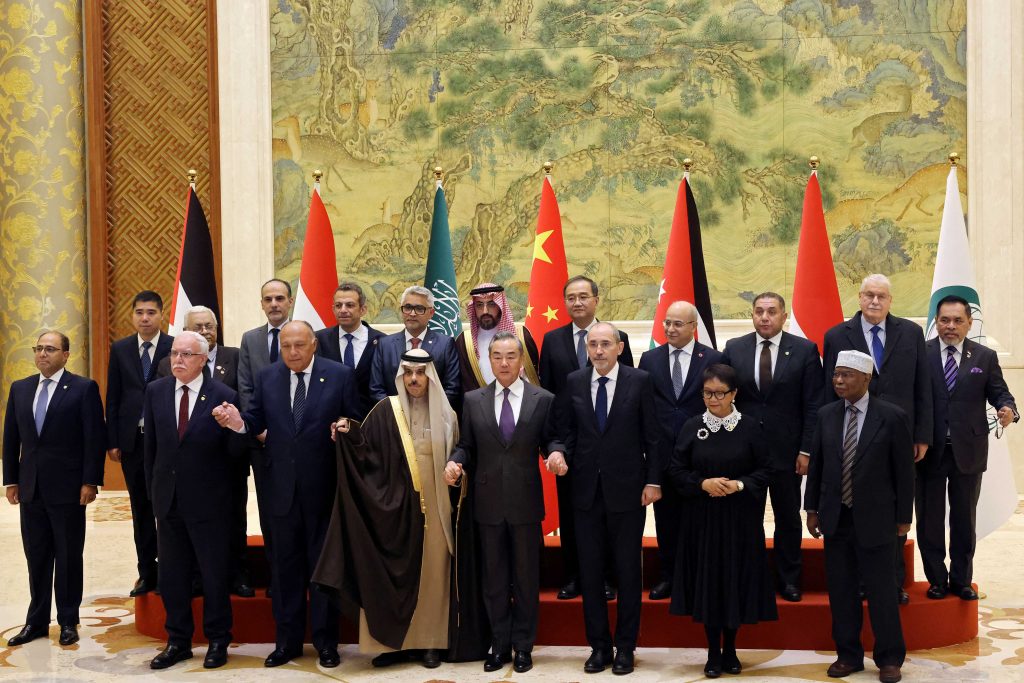
As a part of efforts to win support for the Palestinian cause, a delegation of Arab Islamic Foreign Ministers has already visited Beijing. After visiting Moscow, it is set to visit Delhi this week. The delegation is expected to include Saudi Foreign Minister Prince Faisal bin Farhan Al Saud, Jordanian Deputy Prime Minister and Foreign Minister Ayman Safadi, Egyptian Foreign Minister Sameh Shoukry, and Palestinian Foreign Minister Riyad Al-Maliki. In New Delhi, they will be holding a meeting with External Affairs Minister Dr S Jaishankar. The delegation is expected to travel to other global capitals as well. 

Earlier, Chinese Foreign Minister Wang Yi welcomed the foreign ministers from four Arab countries and Indonesia to Beijing assuring that his country would work with “our brothers and sisters” in the Arab and Islamic world to try to end the war in Gaza as soon as possible. He further stated that the fact that ministers chose to start their tour of world capitals in Beijing, reflects China’s growing geo-political influence and its support for the Palestinians. He, however, did not mention that China is also expanding its economic ties with Israel.

The Apprehension

Prime Minister Narendra Modi’s apprehensions on the ongoing Israel-Hamas war that the conflict should not be allowed to spill further in the region was well taken by the G-20 leaders. He was taking part in G-20 Leaders’ Summit in a virtual format, while a pause of four days was being agreed upon between Israel and Hamas. The summit was attended by Russian President Vladimir Putin, Chinese Premier Li Qiang, Japan’s Fumio Kishida, Turkey’s Tayyip Erdogan, Canada’s Justin Trudeau, Australia’s Anthony Albanese and Brazil’s Luiz Inacio Lula da Silva, among others.

Responding to a question during a briefing after the summit, External Affairs Minister Dr. Jaishankar said, “India’s position is known. You heard it. Most leaders discussed the crisis… there was a broad overlap of views. While there was no specific proposal made by India, we welcomed the understanding reached after meditation by Qatar, Egypt and the US. The focus is to ensure that it does not spill over.”

The leaders while condemning the attack by Hamas, stressed on the release of hostages, a humanitarian pause to the violence that has claimed a large number of innocent civilian lives in the Gaza Strip and the need for “immediate”, “effective” humanitarian assistance to the war-torn Palestinian enclave. Modi also observed: “The insecurity and instability in the West Asia region concerns us all. Our coming together today is a sign that we are sensitive to all these issues and stand together to resolve them.”

“We believe that terrorism is unacceptable to all of us. The death of civilians, wherever they may be, is condemnable. We welcome the news of the release of hostages today, and hope for the swift release of all hostages,” he hoped.

The world leaders under various banners and associations across the continents are keeping a vigil on the events unfolding in the region, which supplies most of our energy needs. It, however, gives a strong message that only diplomacy can offer peace, whether it is the war between Ukraine and Russia or West Asian crisis.

Jolt for BJP-JJP govt as HC nixes law on private job quota

The Punjab and Haryana High Court’s decision to quash Haryana’s law mandating 75% quota in jobs for the state domiciles in the private sector, has come as a major setback to the ruling BJP-JJP combine government ahead of 2024 Parliamentary and state assembly polls, writes Rajesh Moudgil

On November 17 came the Punjab and Haryana High Court order setting aside Haryana’s law which mandated 75% reservation of jobs in the private sector for the domiciles of Haryana, deeming it “unconstitutional”.

This order is being seen as a jolt for the state’s ruling BJP-JJP coalition government as it was one of the key poll promises made by the Jannayak Janta Party (JJP) – a junior partner in ruling BJP-JJP combine government – ahead of 2024 parliamentary and state assembly elections.

For the record, the BJP which had come to power with a majority in 2014 with 47 seats out of  total 90, could garner 41 seats post 2019 polls. It thus needed the support of JJP which had 10 MLAs as well as 7 independent candidates and an MLA of Haryana Lokhit Party (HLP). While Congress is the principal opposition party with 30 members, the Indian National Lok Dal (INLD) has only one MLA.

The BJP-JJP coalition government had notified the said law in November, 2021, which provided a 75% quota for the local youth in the private sector jobs with a monthly salary of less than Rs 30,000 from January 15, 2022. This Haryana State Employment of Local Candidates Act, 2020, was passed by Haryana assembly on March 2, 2021, before being approved by the governor. The Act was applicable to employers of the private sector companies, societies, trusts and firms and any person who employs 10 or more persons on salary, wages or other remunerations, for manufacturing, carrying on business or rendering any service in Haryana.

 The order of the bench of Justice Gurmeet Singh Sandhawalia and Justice Harpreet Kaur Jeewan, quashing the state government’s jobs quota law, came on a petition filed by various industries associations and other petitioners. The petitioners challenged the said quota stating that the impugned Act was against the provisions of the Constitution and the basic principles of meritocracy that acted as the foundation for businesses to grow and remain competitive. They further held that the private sector jobs were purely based on the skills and analytical blend of mind of the employees who were citizens of India having constitutional rights on the basis of their education to have jobs anywhere in India.

In its 83-page judgement, the Bench opined that the state overstepped its authority by legislating on private employment. It held that it was beyond the state’s purview to legislate on the issue and restrict the private employer from recruiting people from the open market for the category of employees receiving less than Rs 30,000 per month. It also made it clear that there was a bar which mandated under the Constitution regarding discriminating to citizens relating to employment on the basis of their places of birth and residence and to make them ineligible or discriminated against in respect of employment to the state.

Will move SC: Dushyant

However, even though representatives of industries and other business houses hailed the High Court verdict setting aside the 75% job quota for locals in the private sector, the JJP leader and deputy chief minister Dushyant Chautala said that the government would now approach the Supreme Court.

He told newspersons that the state government would move the top court against the High Court order. He held that the state government’s intention was to give employment to local youth and provide skilled workers to the private sector.

He held that the JJP wanted to generate employment at the local level as it would have benefited the industry as well. The industries would not have to pay transportation and accommodation costs in case local skilled workers were available, he said, and added that it was also noticed that the industries suffered when the workforce belonging to other parts of the country often took long leave to visit their native places.

Dushyant also pointed out that the High Court had stayed the Act in February 2022 but the same was set aside by the apex court after the state government appealed against it.

Congress tears into BJP-JJP govt

Meanwhile, former chief minister and leader of the Opposition, Bhupender Singh Hooda lashed out at the BJP-JJP government alleging that it was playing not only with the present, but also the future of Haryana by continuously carrying out recruitment scams and increasing unemployment.

“The recruitment scams and policies of the government are being exposed again and again in the courts. The latest example of this is the cancellation of veterinary surgeon recruitment and 75 percent reservation. BJP-JJP had made changes in the rules of Haryana Domicile, making 75 percent reservation zero. This was just a phrase used among the public to gain political mileage,” he said.

The issue of changing the domicile from 15 to 5 years was also raised in the state Assembly and the 75% reservation now couldn’t even stand in court, and this was only brought with the intention to mislead the people of Haryana, he said.

Hooda said that the BJP-JJP’s drama of providing 75% reservation was also exposed in the court. “The court struck down the law, implemented by the government without any study. If this government was serious about providing employment to Haryana youth, then the first thing it would have done was to protect local youth in government recruitments, but on the contrary, in order to provide maximum jobs to the people of other states, BJP-JJP relaxed the rules of Haryana domicile,” he said.

Saving the Bastar hill mynah

Mynah mitras have been employed inside the Kanger Valley National Park in Bastar as part of the bird’s conservation and protection programme. A report by Deepanwita Gita Niyogi

Samluram Nag could not complete his bachelor’s degree in science, but this tribal youth has found a new vocation, that of protecting the Bastar hill mynah. The bird is endemic to the Kanger Valley National Park of Chhattisgarh.

Today, Nag is a mynah mitra or a friend of the mynah. A resident of Kutumsar village inside the national park area, he has been employed by the forest department for the past two years. For his work, which involves daily patrolling inside the vast forest to locate the birds, he receives about Rs 9,960 per month.

The Bastar hill mynah, black in colour, is under threat due to deforestation and development. But efforts are on to stabilise its population and safeguard its habitat.

“The mynah protection work started even before I joined as a mynah mitra. Now, it has intensified through the presence of several mynah mitras who work hard like me,” Nag said.

Every morning, Nag is excited to get up early and begin his duty with a binocular in hand. In the months of September and October, some 200 birds were spotted in Kanger Valley. The birds prefer to live inside holes made by woodpeckers in Sal trees.

On the lookout for mynah

Nag patrols five km daily till late afternoon in a specific area. He pointed out that even a few years ago, it was difficult to spot the Bastar hill mynah inside the national park. At present, he and his companions, however, see them often perched on trees.

“I try to find the birds along the five km stretch which has been assigned to me. When I left college, I did not know how to secure my future and that of my family having ten members. Now, all the mynah mitras are happy to get a good source of  income monthly.”

Apart from Nag, his friend Laikhan is also a mynah mitra. He explained that the mynah mitras did not undergo training. A few of them used to roam about the forest and had knowledge about the birds.

“The birds got killed due to snares set for them by poachers as well as poison. As people used to kill birds for meat, some bird species are not seen anymore. It is fortunate that the Bastar hill mynah has survived,” Laikhan said.
To protect the Bastar hill mynah, seen mostly at dawn and at dusk, eco-development committees were formed three years ago at the village level. This has been of great help. Comprising 10 members, the eco development committees exhort people for controlled lopping for firewood. There are now over 25 such committees in the villages in and around the Kanger Valley National Park area.

Laikhan pointed out that people used to lop branches indiscriminately and did not take permission. But as there is heightened surveillance in the forest now, people pick up dry and fallen branches for use. If anyone is caught cutting a tree, the person is reprimanded and even punished. The committee members meet weekly to discuss matters.

As patrolling daily inside the forest is an arduous task, sometimes the mynah mitras rest and sleep at forest department patrolling camps.

“Sometimes we sleep in the patrolling camps at night. If we somehow miss the alarm, the sound made by the birds wake us up. There are so many now!,” chirped Laikhan.

Conservation awareness

Apart from the deployment of mynah mitras, school children are targeted through awareness drives every Saturday. So far, about 50 workshops have been organised in the nearby villages where children are taught about nature and the need to protect wildlife.

As part of the Bastar hill mynah conservation and protection project, Yugal Kumar was selected in August this year. His work is basically data collection, handling and analysis. Kumar also works with the mynah mitras, accompanies each mitra to the field and monitors their work. A weekly meeting takes place every Friday.

According to Kanger Valley National Park director Dhammshil Ganvir, the mynah conservation project will continue for a couple of years more. “Now, the movement of the birds has to be monitored using telemetry. In this regard, the Centre has given permission.”

These verses take you along rather too spontaneously 

Title of the book- DEWED

Author – Nandita Bose

Publisher – Atta Galatta

Price – Rs 275

Pages – 104

he Bengaluru-based poet-writer Nandita Bose’s verse is so refreshingly uncomplicated that it just gets absorbed straight in, in the reader’s being. One gets taken aback by the sheer  intensity-cum-diversity of the entire  expanse… hitting,  her verse, the emotions, the relays. A book review by humra quraishi

I’m all for the uncomplicated and the simple and the straight forward. Whether it is verse or prose or a person!

And the Bengaluru-based poet-writer Nandita Bose’s verse is so refreshingly uncomplicated that it just gets absorbed straight in, in the reader’s being. In fact, when she handed me her this particular book I’d thought I would quote a verse or two from it, in one of  my columns but then I was completely taken aback by the sheer  intensity-cum-diversity of the entire  expanse… hitting,  her verse, the emotions, the relays.

Nandita’s verse takes you along rather too spontaneously, without any pulls or pressures. There comes in that instant connect. It’s best to put right here her verse…you’ll then perhaps comprehend what I’m trying to relay.

Nandita Bose’s verse tucked in, in this book:

‘everyone warned me/

circumstances were against it /

people thought it was a  bad idea/

acquaintances hoped for  better sense/

friends were unsupportive/

intimates scandalized/

my judgement was overridden/

all caution ignored/

you drew me towards you/

 I went.’

—–

‘Come, walk with me where no one goes,/

talk of things no one does,/

of how your  heart grew  young,/

mine old,/

How to reach out to death and pretend/

to enjoy birthdays and gifts,/

from those who will not give us time,/

tell me of dreams you no longer dream,/

or of  graveyards you  visit  every day/

I will tell you of a childhood/

In which I died unseen.’

_____

‘Those canals now dry and boats burnt/

as firewood/

Our parrots are gone. In the orchards /

only shadows of crows./

The mud path, straight as vermillion parting/

mussed by elephant grass/

Even kites don’t fly in my village anymore,/

just the young, away/

Between here and my village centuries break/

ageing like hills/

I would walk back but they built walls/

No man’s land a shooting range/

Annihilation needs no wars or the plague/

And time does the deed.’

70.66% voter turnout in Telangana

A voter turnout of 70.66 per cent was recorded in the polling for Telangana Assembly elections held on November 30, the Election Commission of India has said.

Among 33 districts, Yadadri Bhongir district recorded the highest turnout of 90.03 per cent while Hyderabad registered the lowest polling at 46.68 per cent.

After the polling ended at 5 p.m., the turnout was estimated to be nearly 64 per cent. However, the number was revised as those standing in queues at polling stations at 5 p.m. were allowed to cast their votes. The process in some polling stations continued till 9 p.m.

The turnout has come down by about three per cent compared to 2018 elections. It was 73.74 per cent in the previous Assembly elections.

A little over 3.26 crore voters decided the political fortunes of 2, 290 candidates in the polling held on Thursday.

Total number of voters in the state are 3, 26, 02, 799 voters. They comprise 1, 62, 98, 418 men, 1, 63, 01, 705 women and 2, 676 transgenders.

Eleven districts saw a voter turnout of 80 per cent or more. Medak district recorded 86.69 per cent turnout. The turnout was 85.74 per cent in Jangaon, 85.49 per cent in Nalgonda, 84.83 per cent in Suryapet, 83.70 per cent in Mahabubabad, 83.28 per cent in Khammam, 82.22 per cent in Jogulamba Gadwal, 82.09 per cent 82 per cent in Mulugu, Jayashankar Bhupalpally and 80.82 per cent in Kumaram Bheem Asifabad district.

The highest polling of 91.51 per cent was recorded in Munugode constituency in Nalgonda district. The lowest was recorded in Yakutpura in Hyderabad at 39.69 per cent.

Palair constituency in Khammam district saw a turnout of 90.28 per cent. In Alair segment of Yadadri Bhongir district, 90.16 per cent cast their votes.

Twelve constituencies in Greater Hyderabad recorded polling of less than 50 per cent. The second lowest turnout of 41 per cent was in Malakpet.

It was only 42.76 per cent in Nampally, 43.26 per cent in Charminar, 44.86 per cent in Bahadurpura, 45 per cent in Chandrayangutta, 45.20 per cent in Jubilee Hills, 46.50 per cent in Karwan, 48.85 per cent in Serilingampally, 49.11 per cent in LB Nagar, 49.40 per cent in Secunderabad Cantonment, 49.61 per cent in Musheerabad and 49.60 per cent Secunderabad

MOST POPULAR

HOT NEWS