Homestays a hit with tourists in Khajuraho

A total of 20 homestays in this historical place, registered under the Madhya Pradesh Tourism Board, offer grand welcome to visitors from all over the world. A report by Deepanwita Gita Niyogi

On her first visit to Khajuraho, a UNESCO world heritage site famous for its temples, Anne Violle was keen to explore the place intently. As a solo traveller from France, Violle chose to spend her days at a homestay rather than a fancy hotel.

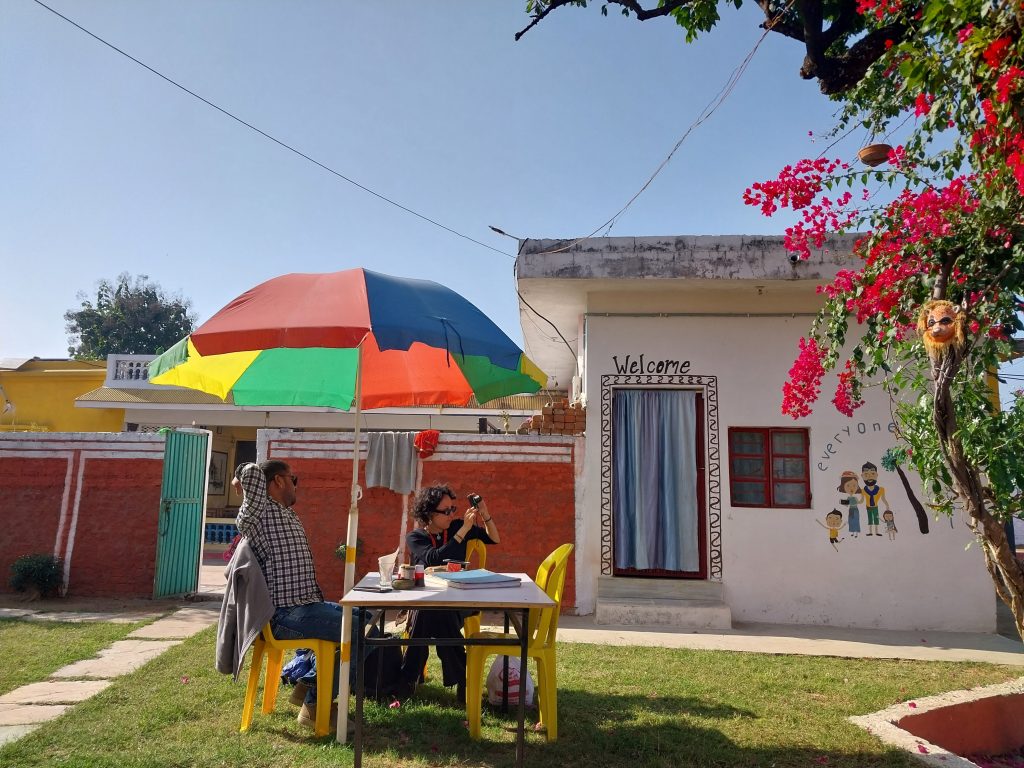
Over the past few years, the Mini Homestay situated on Lalguwan Road and about 15-minute walk from the Western Group of temples in Khajuraho, has been a huge hit with budget-conscious tourists who are assured of clean rooms and good food at affordable rates. The place has a welcoming feel with bright yellow walls, swings, pink bougainvillea blooms, open space for relaxation at the back and eye-catching wall paintings urging people to experience travel.

During a chat at breakfast, Gausia Khan informed that her family started the homestay before the Covid-19 lockdown. “Many foreigners come and stay here with us. It feels nice to serve guests who come to Khajuraho
from all over the world. Many of them come from Orchha, a nearby destination. At present, there are only a few rooms and a dormitory. The women of the house cook together for the visitors.”

A home-like feel

Winter is the best time to visit Khajuraho, one of the most prominent tourist destinations in the Bundelkhand region, spanning several districts in Uttar Pradesh and Madhya Pradesh. Summers are harsh here.

At the Mini Homestay, it is usually Lalan Khan who takes care of the guests. “Sometimes, so many tourists come here during the peak season of December-January that it becomes difficult for us to allot rooms to everyone,” said Khan,who worked for several years in the Madhya Pradesh tourism sector before retirement.
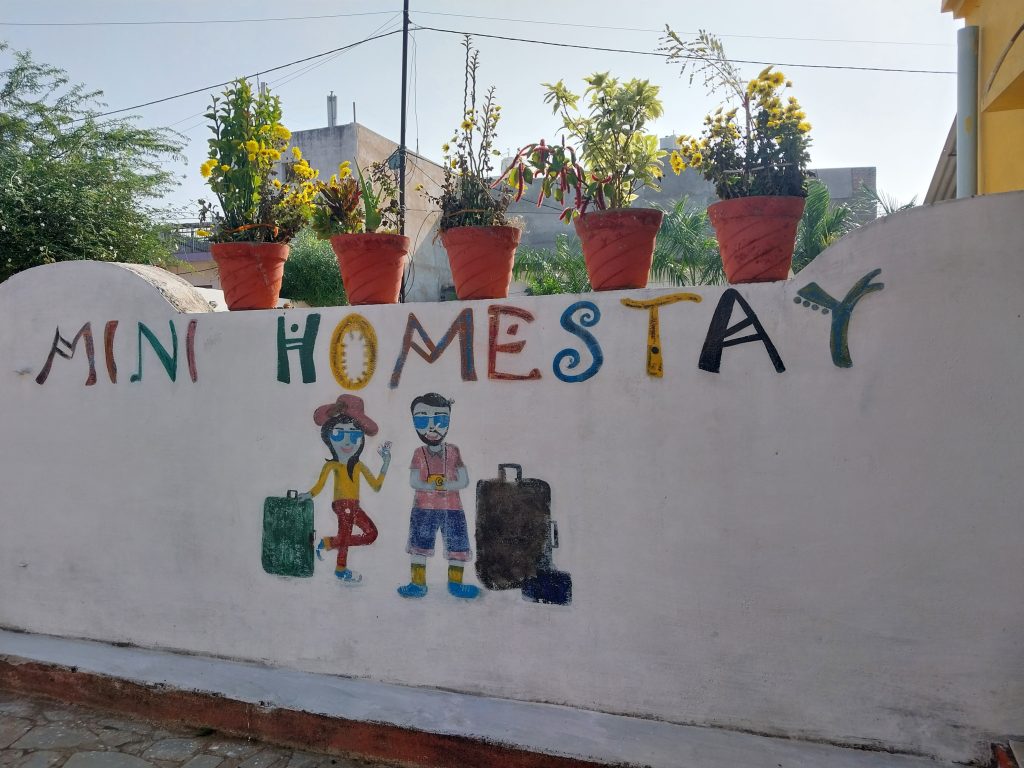
“At this homestay, my family really takes care of tourists,” Khan added as he recalled a training programme in tourism arranged by the state government for three weeks which he attended.

Khan is adept at handling visitors and seeing to their various demands, thanks to his stint in tourism where he interacted with many guests and dignitaries. “Now, many local people of Khajuraho speak good English and interact easily with foreign tourists. But at that time neither English was widely spoken here nor homestays were popular.”

At the Mini Homestay, room rates range from Rs 500 to Rs 800 with breakfast. Some guests can also leave behind their luggage or wait in a room for a few hours even after checkout.

Khan, who gained experience in the tourism sector for over a decade, earned much appreciation for his work. “This homestay was started after I retired from service. I have learnt many things in the course of my work. I know how to wait at tables, serve guests and hold interesting conversations with visitors.”

The Khan family’s ancestral village is 10 km away from Khajuraho. It is a hilly place called Achnar. “The people of this place love to welcome guests. Many locals actually build special places to welcome visitors.”

A melting pot

Like Violle, Alejandra Huerta from Mexico also chose to stay with the Khan family on her first visit to India. “I was keen to travel here. My aunt, who adopted the Hindu religion, talked a lot about this country. She got married at a very young age.” Huerta chose a homestay as it is a great way to meet and know local people and learn about their lifestyle.

Argentinian Pablo Fabian, who has lived in Europe for almost 20 years, is fond of seeing the world while working. Fabian has travelled to India six times and has experienced life in metro cities like Delhi and Kolkata.

“I choose homestays because they are affordable. People who are working and travelling together don’t always want to spend money on hotels. Foreigners spend a lot of money on tours and guides and that may be another reason why so many prefer homestays.”

For Pablo, who has also stayed at hotels in Khajuraho, there is not much of a difference between the two. He feels that hotels may work well for families though.

Lena Ziegler, who is from Germany but grew up in Russia, finds India an interesting country worth exploring, especially historical places like Agra. Ziegler came to know about the homestay online. She pointed out a few problems too. “Indian food is generally spicy even if people say it is not. The pollution level and dust are also quite high.”

Khajuraho received 3,25,779 tourists in 2022. Many people who visit the place also make it a point to visit the Panna National Park and the Ken Gharial Wildlife Sanctuary, known for beautiful forests and good wildlife sightings. Villages nearby also offer interesting colours into local life.

Under the safe tourism destination project for women aimed at maximising the female workforce, the Madhya Pradesh tourism board is supporting homestays which offer friendly experiences to solo travellers, especially women, who love to explore all alone, said Manoj K Singh, director, Madhya Pradesh Tourism Board. At present, there are 20 registered homestays in Khajuraho. There are also homestays exclusively run and managed by women in Orchha, about 170 away. Homestays are also boosting rural tourism in Madhya Pradesh.

Earthquake of magnitude 3.6 hits Kishtawar area of Jammu and Kashmir

A mild earthquake with a magnitude of 3.6 on the Richter Scale shook the Kishtawar region of Jammu and Kashmir in the early hours of Wednesday,  the National Centre for Seismology (NCS) reported. The seismic event occurred at 08:53 am, with its epicenter situated at 33.34 latitude and 76.70 longitude, at a depth of 5 km.

Residents in the affected area felt the tremors at approximately 2:19 am. Fortunately, there have been no significant reports of damage or injuries resulting from the earthquake. 

The NCS confirmed the occurrence through an official statement, stating, “Earthquake of Magnitude:3.6, Occurred on 16-01-2024, 08:53:53 IST, Lat: 33.34 & Long: 76.70, Depth: 5 Km, Location: Jammu & Kashmir, India.”

As of now, the situation appears to be under control, and authorities continue to monitor the aftermath of the seismic activity in the region.

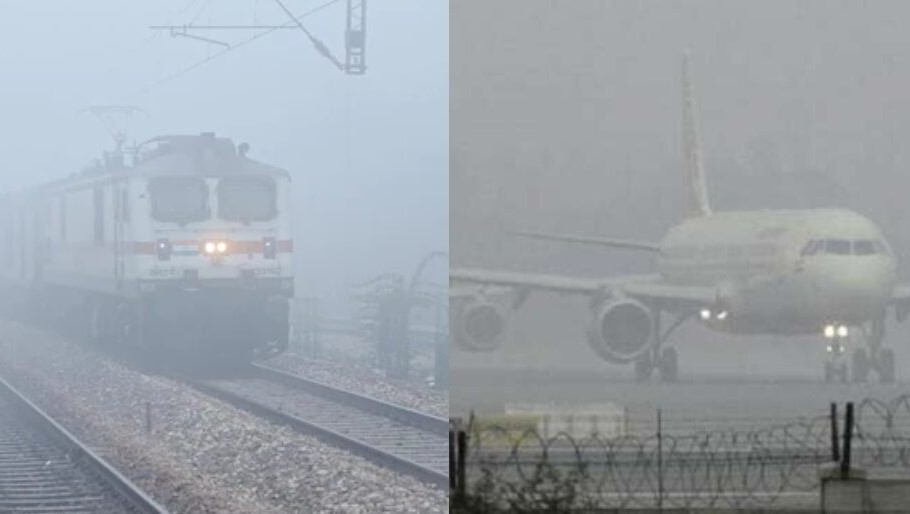
Thick fog disrupts flights & trains, cold wave conditions continue in Delhi

New Delhi : A thick layer of fog blanketed Delhi as the city continued to grapple with cold conditions on Tuesday morning with minimum temperature of 3.5 degrees Celsius, four notches below season’s average.

For the past four days, the minimum temperature has been hovering around 3 to 4 degrees Celsius, and the cold wave conditions are likely to continue till Wednesday.

According to India Meteorological Department (IMD)’s forecast, the minimum temperature is going to be 3 degrees Celsius and the maximum might hover around 21.

The IMD has also issued an orange alert for very dense fog, which has also affected the air and land traffic leading to several delays in flights and trains.

Over 70 flights have been delayed and many were reported to have been cancelled.

An advisory has also been issued for the travellers, which said, “While landing and takeoffs continue at the Delhi airport, flights that are not CAT III compliant may get affected. Passengers are requested to contact the airline concerned for updated flight information. Any inconvenience caused is deeply regretted.”

Moreover, 30 trains have been delayed with the maximum number of hours being more than six.

At 7 a.m., 100 m visibility was reported at the Palam Airport and 00 m half an hour later, whereas Safdarjung Airport recorded 50 m visibility.

The IMD classifies fog intensity into four types: shallow, moderate, dense and very dense fog.

The visibility ranges from 999 m to 500 m, 499 m to 200 m, 199 m to 50 m and less than 50 m, respectively.

The Air quality continued to remain in the ‘very poor’ category at several stations across the city.

In the Anand Vihar area, PM2.5 levels were recorded to be in the ‘severe’ category standing at 424 and PM10 reached 245 or ‘poor’, according to the Central Pollution Control Board (CPCB).

The Air Quality Index (AQI) between zero and 50 is considered ‘good’; 51 and 100 ‘satisfactory’; 101 and 200 ‘moderate’; 201 and 300 ‘poor’; 301 and 400 ‘very poor’; and 401 and 500 ‘severe’.

The Indira Gandhi International (IGI) Airport T3 also witnessed PM2.5 levels at 420, the ‘severe’ category while the PM10 was at 375, falling under the ‘very poor’ category.

Pilot assault case: Accused released on bail, was en route to Goa for honeymoon

New Delhi : Sahil Kataria, the 28-year-old who assaulted an IndiGo airlines pilot following a 13-hour flight delay, has been released on bail and was served a notice under Section 41 of the Code of Criminal Procedure (CrPC), an official said on Tuesday.

According to police, Kataria, a resident of Amar Colony in South Delhi, runs a stationery and toy shop and was en route to Goa with his wife for their honeymoon when the incident occurred on Sunday.

The long delay seemed to have triggered frustration, culminating in an altercation with the pilot inside the aircraft.

The pilot had filed a complaint against Kataria following which the Delhi Police registered an FIR.

A footage of the video that has gone viral on social media shows the accused, wearing a yellow hoodie, running up to the pilot while the latter was making an announcement regarding the delay, which he attributed to Flight Duty Time Limitations (FDTL) norms.

“Chalana hai to chala, nahi to gate khol. (If you’re going to fly, then fly. If not then open the gate), ” Kataria can be heard saying in the video, which was filmed by a fellow passenger.

In another viral video, Kataria is seen apologising apparently to the pilot.

While being deboarded, he could be heard saying “sorry sir”, in reply to the person shooting the video who says “no sorry”.

Some pot shots, and the face-off

The latest diplomatic row between India and Maldives demonstrates that Indians will no longer take things lying down. They are determined to take head on anything that is disparaging. SPOTLIGHT BY KUMKUM CHADHA

When Prime Minister Narendra Modi speaks, the world sits up and listens. It is also more than willing to act and do his bidding.

Recent developments have proved this beyond doubt. What could have passed as a storm in a tea cup has assumed proportions of a diplomatic row between India and Maldives. Add to this, the fact that Indians were enraged at the derogatory language used by a minister of a foreign country for India’s Prime Minister. 

Call it nationalism or adulation for Prime Minister Modi, the fact remains that Indians will no longer take things lying down. They are determined to rise to the occasion and take head on anything that is disparaging. 

This has been amply demonstrated by developments that have unfolded as the world rang in 2024. 

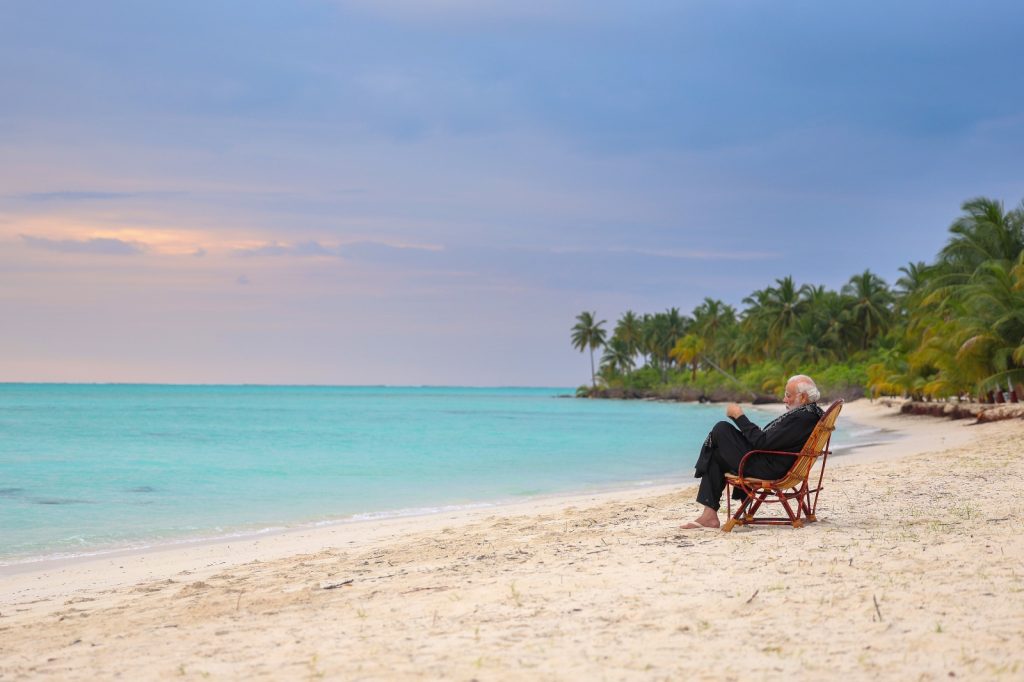
When Prime Minister Modi sat in seemingly a pensive mood watching the pristine waters of Lakshadweep, little did he know that exhorting Indians to explore this 32 sq kilometres archipelago would result in kind of an explosive situation. Neither had he imagined that his asking Indians to be “local,” as it were, would become a full blown controversy. 

So what is the story so far? It started with a simple observation that took several twists and turns involving a war of words between Maldives and India resulting in Maldives being struck off the bucket list of affluent Indians and the focus shifting to Lakshadweep. 

The image that stuck in the minds of most Indians was Prime Minister Modi lounging in a chair on a white sand beach. That critics had smirked at his attempts at snorkelling with a life jacket is another matter. This despite the fact that snorkelling with a life jacket is completely in order for those who cannot swim. 

That notwithstanding, Lakshadweep was in focus with informal pictures of Prime Minister Modi going viral.

There were  a series of posts on X this weekend from Prime Minister Modi, promoting tourism in Lakshadweep islands wherein he spoke of “being in awe of the stunning beauty” of the islands, adding that for those with an adventurer’s spirit, Lakshadweep is a must-have on their list. 

Interestingly, neither the Prime Minister nor his office mentioned Maldives nor compared it to the marvels of Lakshadweep.

Geographically, Lakshadweep is barely 100 miles north of the Maldives. Many call it “mini Maldives”. In Minicoy, for instance, people speak Dhivehi, which is the national and official language of the Maldives Republic. For record, Minicoy is the second largest island in Lakshadweep. 

Historically, it was part of the erstwhile empire of Tipu Sultan. During the British Empire, it was part of the Madras Presidency. In 1956, it became a Union Territory: the smallest in Independent India. 

Fast forward to 2024 and Prime Minister Modi flagging Lakshadweep as a tourist destination. 

The clarion call, as it were, was to pitch the dekho apna desh campaign to woo Indians to explore India rather than take overseas vacations. 

The PM of course made no mention of this campaign that Union Finance Minister Nirmala Sitharaman had included in her 2023 Budget nor did he speak about Maldives. 

So how did it all start? And why? There are no single point answers to the why but the how is there for anyone to see. 

Absolutely unprovoked, a deputy minister in Maldives accused PM Modi of being “a clown” and a “puppet of Israel”. 

It was none other than Mariyam Shiuna, who wrote: “What a clown. The puppet of Israel, Mr. Narendra diver with life jacket”. Shiuna also compared India to cow dung. 

Though the post was later deleted, the damage had been done and comparisons started between Lakshadweep and Maldives. 

A new low was reached when an image of an island resort in the Maldives was shared:  “Sun set in Maldives. You won’t see this in Lakshadweep. #Visit Maldives. CC: @narendramodi” went viral. 

It didn’t stop here. Several Maldivian social media users joined the bandwagon and posted offensive remarks against India and Indians, even as they started drawing comparisons between the Maldives and the Lakshadweep islands.  Others saw it as an attempt to “compete” with their country as a choice for a tropical vacation for travellers.

“The move is great. However, the idea of competing with us is delusional. How can they provide the service we offer? How can they be so clean? The permanent smell in the rooms will be the biggest downfall,” posted a member of the senate.

 To make matters worse, this followed racist remarks against Indians and Indian tourists who travel to the Maldives.

Mockery of the Prime Minister, racist remarks and denigrating India had its effect. 

Indian travellers vowed not to travel to the Maldives for their holidays and called for a boycott of Maldives as a holiday destination. 

From the Indian point of view, what came as a pleasant surprise was the camaraderie shown by Indians. Celebrities voiced support for the Prime Minister’s call for promoting local tourism and flagged Lakshadweep’s potential. While many Indians cancelled their proposed holidays to Maldives, the travel trade led by Ease My Trip said “NO to Maldives”, promising “crazy special offers” to promote Lakshadweep.

Taking the cue from PM Modi, Co- Founder Prashant Pitti asked travellers to “discover the enchanting beauty of Ayodhya and the pristine allure of Lakshadweep”. Irked at the “jibes” taken at Prime Minister, India and Indians, Pitti said that his company has stopped taking all bookings to Maldives: “As a nationalist, this is the least we can do”. 

The damage was more than Maldives could perhaps digest and hence it not only suspended its errant Ministers but distanced itself from any adverse comments made by either the members of the government or its people. 

If statistics are anything to go by, in 2023, Indians formed the largest chunk of tourists to the Maldives accounting for over 200,000 travellers, followed by tourists from Russia and China. The Maldives is heavily dependent on tourism and the industry reportedly accounts for over 28 percent of its GDP. Indians are Maldives’ biggest source of high-spending visitors.  

Therefore Indians backing off and dropping Maldives from their to do list is something Maldives can ill afford. 

Politically anti-India sentiments are nothing new in the bi-lateral relationship between India and Maldives. In 2020, the ‘India Out’ campaign started as on-ground protests in the Maldives. By mid 2021, it had developed into an active and visible political campaign. 

Politics and geography apart, the fact that Indians stood up in support of India and its Prime Minister speaks volumes about us as a people. It also demonstrates that Prime Minister Modi has the support of his people and if slighted they would stand up for him. Also his clarion call — be it for Lakshadweep or any other — has a sanctity which few want to trifle with. Remember the “thali bajao” campaign when during Covid 19, the PM had asked people to clap, beat steel plates and ring bells during the ”Janata curfew” on a Sunday.  Willy nilly, hundreds and thousands had come out, some even taking to the streets, to demonstrate that Prime Minister Modi’s wish is their command. 

Naysayers apart, Mr Modi does command that sentiment that when he asks, the country is keen to do his bidding. His one call motivates millions, the Modiji ne kaha spiel being at its peak. Add to that the jitters the recent controversy has sent down the spine of lawmakers in Maldives is proof enough. 

Despite the present dispensation in Maldives fervently wooing China at the cost of India, it is bending over backwards to distance itself from the unsavoury controversy and the uncharitable remarks against the Indian Prime Minister. This is proof enough that neither India, nor Indians nor the Indian Prime Minister can be taken lightly substantiating the oft repeated fact that when Modi speaks the world sits up and listens.

Meddling army casts its shadow on upcoming election in Pakistan

Political uncertainty gripped the country after Pakistan Senate, with the Army pulling the strings, passed a resolution on January 5 seeking to defer national elections that are slated to take place on February 8 citing harsh winter weather by Gopal Misra

There is apprehension among Pakistanis that the elections for the much-awaited National Assembly scheduled for February 8, may be further postponed. Professor Ishtiaq Ahmad, a political scientist from Pakistan, presently based in Sweden, says that the Election Commission of Pakistan (ECP) may just issue a notification for its postponement, if the establishment so desires. Pakistan has already been under direct military dictatorships or under civilian proxies since it was carved out by partitioning India on communal lines in 1947. It is also apprehended that the resolution adopted in Senate asking for postponing the polls under the pretext of severe winter might have been sponsored under the instructions of the GHQ; perhaps after finding it difficult to ‘manage’ polls by effecting large-scale rigging as it had done in 2018 to favour its then favourite, Imran Khan and his party, Pakistan Tehreek-i-Insaf (PTI).

The polls should have been held within 90 days of the dissolution of the National Assembly, and Anwar-ul-Haq Kakar, known for his proximity to the present army chief, Asim Munir, was sworn in August, 2022. The polls are already delayed by five months, thus casting shadow even on the constitution of a civilian face of a hybrid regime to take over in Islamabad. It is widely believed that General Munir and his supporters in the army do not want either Khan or PTI to get a majority in the new House. It may be recalled that General Munir had never been considered for the army’s top post during the tenure of the PM Imran Khan. He owes his elevation to erstwhile PM Shehbaz Sharif and his party, Pakistan Muslim League-Noon (PML-N).

Imran Khan too was groomed by the GHQ. He could get the coveted post after 2018 polls, believed to have been rigged during the tenure of the then army chief Qamar Jawed Bajwa and his crony, Faize Hamid, the then director general of the Inter-Services Intelligence (ISI). Later, Bajwa and Hamid fell apart. And since PM Imran Khan was keen to promote Hamid as the new army chief, he too was sent packing that too through a no-confidence motion. Khan has been accusing the GHQ for conniving with certain parties to oust him. The development resulted in the formation a coalition government led by Shehbaaz Sharif, which finally resigned when the National Assembly’s five-year term expired. With the Khan implicated in various cases, he may not be able to contest the forthcoming polls, but the process of rehabilitating Shehbaz Sharif’s elder brother of Nawaz Sharif, a three-time PM, has already begun and he has returned from London to supervise his party, PML-N, in the forthcoming polls at a time when Imran Khan’s popularity is at its peak. Maybe, Khan’s success has made Munir and his generals scared of the outcome of the polls. Therefore, they may prefer postponement of polls.

The Resolution

The Supreme Court of Pakistan has already received a bunch petitions stressing that schedule of the elections, due to be held in February, must be adhered to. The apex court is being requested to ask ECP to ignore the Senate request for the polls postponement. Ironically, a senator of the Pakistan People Party (PPP) who had initially supported the resolution in the House, later chose to oppose the same. Meanwhile, many media channels have described the resolution just a joke; however, it is also being suspected that the ISI cronies have piloted the resolution before the Senate seeking postponement of the polls that too under the pretext of ‘severe winters’ engulfing most of the country. The unexpected Senate resolution passed on January 5 has ignited a heated debate, that too in a thinly attended session with the presence of just 14 lawmakers in the 100-strong House.

Few within Pakistan as well as abroad really believe that the forthcoming polls will be impartial. In the history of Pakistan the only independent and free polls were held in 1970; and that had led to the formation of Bangladesh in1971. The establishment i.e. army believes that if its cronies do not win the elections either its hold on the country would weaken or Pakistan might be further fragmented.

Meanwhile, Khan’s article in “Economist has attracted worldwide attention that the forthcoming polls were likely to be “a disaster and farce”. He like his predecessor, Nawaz Sharif, too has been implicated in a number of corruption cases and also being denied to contest the forthcoming polls. The army’s disenchantment with Khan finally has paved the way for the return of Nawaz Sharif to Islamabad. It is hoped if his petition seeking approval of the Supreme Court seeking permission to contest the elections is allowed, he would finally regain his position of PM.

Army Afraid of Free Polls

The outcome of the 1970 polls was disastrous for the army generals and top bureaucrats, mostly belonging to Punjab. The then army dictator, Yahia Khan’s refusal to swear in Sheikh Mujibur Rehman as the new PM and the crackdown on his supporters in East Pakistan had led to the emergence of Bangladesh. The army did not expect that Rehman’s party, Awami League, would have an unprecedented landslide victory in the elections. Most of the political commentators believe that if the army generals and politicians from Punjab do not address the grievances of the people of Baluchistan and Pashtuns, the 2024 polls, if held impartially, might lead to a situation the country had witnessed after the 1970 elections.

Dilawar Khan, an independent Senator believed to be close to the GHQ, cleverly tabled the resolution seeking postponement of the polls, and got it ratified. It, however, exposed ISI’s limitation in rigging the forthcoming elections. It is being stated that during his recent visit to the US, Munir was told to get the elections conducted as early as possible, paving the way for a new government. He was also asked that his crony, Kakar, should ensure that the polls are held on schedule; otherwise Pakistan would be denied financial as well as defence aid.

Democratic World Cold Shoulders

Both Munir and his crony, Kakar, have been visiting world capitals seeking financial support of their country, but most of the top leaders were reluctant even to meet them.  Similarly, Asim Munir, too travelled to the US, China and other western countries seeking financial aid or military hardware, a job seldom an army chief does in any democratic country. Their conduct indicates that both Munir and Kakar are not keen to conduct polls as scheduled.

It may be noted that Pakistan’s president, Arif Alvi, had appointed Kakar on the advice of the outgoing Prime Minister, Shehbaz Sharif and the opposition leader, Raja Riaz Ahmad. Ahmad, who had been associated with a number of political parties such as Bhutto’s Pakistan’s People’s Party, PML-N had joined PTI in 2016. It is widely believed that the two politicians had recommended Kakar as the caretaker PM on the advice of GHQ. The National Assembly was dissolved in August 2023; therefore, the polls should have been conducted before the end of 2023. There are also indications that Asim Munir is keen to ensure that even if the polls were held, the supremacy of the army and its financial interests retained; and the loot of the men in uniform never to be probed. It means only hybrid regimes will be functioning in Pakistan, whether polls are held as scheduled or delayed.

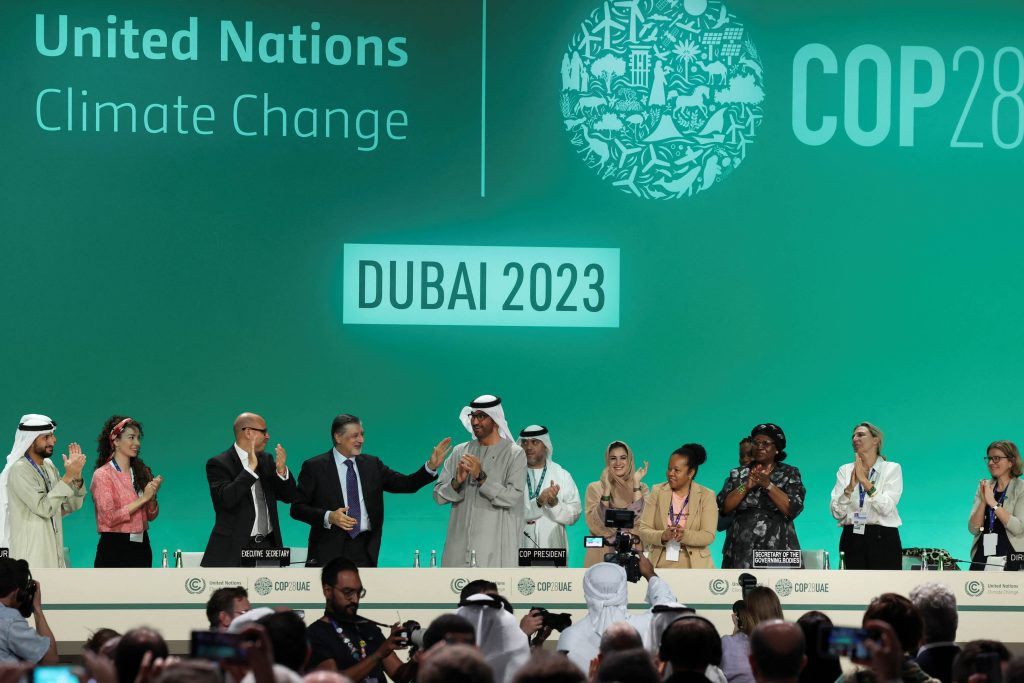
COP28: Some wins, but no one bit the fossil fuel bullet

The biggest disappointment of the summit was that it ended with the decision to “transition away from fossil fuels,” the main culprit behind climate change, instead of the much-anticipated call for phasing out. by R Dyes

There is nothing more powerful than the forces of nature unleashed in all their fury. If we don’t limit temperature rise to 1.5 degrees C soon, we will be pulling the plug on the planet and ourselves.

Frighteningly, not only is the world off track to tackle climate change, it remains headed for a temperature rise of up to 2.6 degrees C, said the first comprehensive UN Global Stocktake of efforts to limit warming that was released a few months ago in the run-up to the COP28 summit at Dubai, UAE in Nov-Dec 2023.

With the planet already feeling the effects of climate change, one had hoped that the world leaders, particularly those belonging to the climate-vulnerable nations, who had gathered for the COP28 summit would push for some concrete, pathbreaking changes and there would be some straight-talking that would make the leaders belonging to the major polluting countries realise that unless drastic decisions are taken to cut emissions, we are hurtling towards our destruction as global temperatures continue to rise.

There were, however, a few wins, like agriculture-intensive nations inking the Declaration on Sustainable Agriculture, Resilient Food Systems, and Climate Action and committing to integrate food and food systems into their Nationally Determined Contributions (NDCs) by 2025. This was a big victory because it was the first time that talks on sustainable food production became part of the agenda.

The second big takeaway was the flurry of positive and vital steps on forests, ranging from enhanced commitments to ending deforestation in the tropics to new financial support for forest action in developing countries.

But, the COP28 left some loose ends to be tied up next year at the COP29 summit in Azerbaijan.

Though the COP28 began on a positive note, with the Loss and Damage Fund that is meant to help climate-vulnerable countries deal with the major effects of climate change, being effectuated on the first day itself, developing nations who are the most climate-vulnerable, had to make major compromises to seal the deal.

Plus, the $700 million pledged for the Loss and Damage Fund is nowhere near the projected $580 billion in climate change-related damages that vulnerable countries will incur by 2030.

Also, while Loss and Damage were made a part of the Global Stocktake decision it was not given the status of the third arm in the fight against climate change along with adaptation and mitigation, which was an oversight and does not bode well for developing countries.          .

Going forward, the Loss and Damage Fund Board must ensure that the fund is up and running by COP29; its policies are flexible and it mobilizes adequate funds and resources for those who need it.

Also, in order to meet the projected $580 billion climate change-related damages, developed nations who are the biggest contributors to global warming in the first place, must pledge more sizeable funds to help climate-vulnerable countries more effectively rather than providing a mere lip service.

They must also apportion generous funds for the all-important Santiago Network that is meant to mobilise the technical know-how for the adoption of technologies and approaches for averting, minimizing, and addressing Loss and Damage at the local, national and regional levels.

The biggest disappointment of the COP28 was that it ended with the decision to “transition away from fossil fuels” , the main culprit behind climate change, instead of the much-anticipated call for phasing out.

The UAE Consensus called for the world to “transition away from fossil fuels in energy systems, in a just, orderly and equitable manner, accelerating action in this critical decade, to achieve net zero by 2050.”

The UAE Consensus also included the pact to triple the world’s renewable energy capacity and double its energy efficiency by 2030. It called on nations to speed up the reduction in emissions from road transport with the aid of EVs, RRTS, electric public transport, and a safe cycling infrastructure wherever possible.

Even though some see it as a big win because this was the first time the term even appeared in a COP’s formal outcome the scientific community is seething over it as too late and too little.

Climate scientists say the failure to phase out fossil fuels runs counter to the key goal of limiting global warming to 1.5C. They say that the only viable path forward is for every nation, developed or otherwise, to phase out almost all fossil fuels as quickly as possible.

Sir David King, Chair, of Climate Crisis Advisory Group and UK’s former Chief Scientific Adviser summed it up, “The wording of the deal is feeble. Ensuring 1.5C remains viable will require total commitment to a range of far-reaching measures, including full fossil fuel phase-out. There was a chasm between the stark statement of the emissions cuts needed and the action proposed to deliver those reductions. The COP28 text recognises there is a need for deep, rapid, and sustained reductions in greenhouse gas emissions to stay in line with 1.5C. But then it lists a whole bunch of efforts that don’t have a chance of achieving that.”

The other major disappointment was the charter that was released by the UAE and Saudi Arabia that committed oil companies to reach net-zero emissions by 2050 for their operations but not for the fuel they sell.

This oversight is significant because oil sale accounts for up to 95 per cent of the petroleum industry’s contribution to global warming.

For the world to meet its climate goals, governments must ensure that the oil and gas sector addresses its operations and the products it sells to the whole world.

We can’t just “transition away” from fossil fuels if we are serious about saving the planet. We have to phase out fossil fuels as fast as we can. And it is not the public who can do this, it is the policymakers i.e the governments and our leaders who will have to ensure that the UAE Consensus is translated into laws, domestic policies and  NDCs.

They could not push for phasing out at the COP28 but now that they are back in their domains, our leaders and governments need to make phasing out a big part of national policies and give a major push to green energy, green transport, and reduce the use of fossil fuels drastically.

For this, the politicians will have to bite the bullet no matter how unpopular their decisions might be with the public and even the fossil fuel lobby which is extremely strong globally.

Also, while renewable energy is the cheapest option in the long run, getting it up and running in the beginning requires a lot of investment which puts wind and solar power out of reach of developing countries.

The COP28 outcome did not tackle these financial challenges but it must do so at the next UN climate summit.

On their own, developing nations can ramp up renewable energy use for their citizens by providing subsidies and also encouraging local manufacturing of parts so that the cost comes down for the end user. This will also have the dual impact of reducing heating greenhouse gases and generating much-needed employment.

At the end of the day, we are all equal participants and owners of this planet. While agreements at global fora can show the right path, the planet’s fate and ultimately ours will be decided by how well nations play their part in tackling the climate crisis.

Does Baig’s return to PDP hint at party’s potential policy shift ?

Former Dy CM Baig had quit the PDP following his rift with party chief Mehbooba Mufti’s stand on revocation of Article 370 as he wanted the party to acquiesce to the Centre’s move. One wonders how Mehbooba will reconcile her politics with that of Baig now, writes Riyaz Wani

In a surprising turn of events, veteran J&K politician Muzaffar Hussain Baig returned to the People’s Democratic Party (PDP) on January 7, the seventh death anniversary of the PDP founder and former J&K former chief minister Mufti Mohammad Sayeed.

Talking to the reporters on the occasion, Baig said: “I never left the party. If you uproot a tree and plant it somewhere else, it will dry up.”

Baig, also a founding PDP member and a former J&K Deputy Chief Minister, had quit the PDP in 2020 following differences with the party president Mehbooba Mufti in the wake of the revocation of Article 370 in the previous year. One big factor in the split was that Baig was the first major Kashmiri political figure to embrace the Centre after the withdrawal of the all-important constitutional provision.

On the contrary, Mehbooba made the demand for restoration of Article 370, the central feature of her politics, while as the other Valley based parties either diluted their stand on the constitutional provision or moved to toe the BJP line.

Also, Baig is perceived to be close to the BJP and not keen on pursuing a politics centered around the restoration of Article 370. In 2020, while Mehbooba was in detention under PSA for her opposition to rescinding of the special status, Baig was one of the first senior Kashmiri politicians to say that Article 370 was “history” now. So, his return to the PDP fold has raised eyebrows, making people wonder as to how Mehbooba can reconcile her politics with that of Baig

But with Baig by her side, Mehbooba in her speech on father’s death anniversary at South Kashmir’s Bijbehara town, criticized the Centre, alleging a double standard in dealing with different regions. She accused the government of engaging in dialogue with militants in the Northeast while unjustly labeling ordinary Kashmiris as militants.

“We will not surrender; we will not raise the white flag. If you talk to us with dignity, we will respond with respect,” Mehbooba stated, referencing alleged civilian deaths in army custody in Poonch. She criticized the government’s approach in Jammu and Kashmir, citing widespread arrests and raids by agencies like the Enforcement Directorate, NIA and SIA.

However, since the PDP’s founding in 1998, the situation in J&K has come a long way. The PDP first emerged as a credible opposition in 2002 profoundly altering the political scene in the state at that time. On the one hand, the party ended the political monopoly of the National Conference and on the other it turned Congress into a king-maker. With the Kashmir Valley seats split between them, the NC and PDP were hardly in a position to form the government without support from a Jammu-based party: the BJP or Congress. This is why the Congress ruled the state for twelve years as part of the coalition government, first with PDP from 2002 to 2008 and thereafter with the NC from 2009 to 2014.  But now with Congress decimated and BJP stepping into the breach, the NC and the PDP – on a decent showing in polls are obliged to share power with the saffron party, even in union territory polls.

In the existing situation, the BJP continues to reign supreme and is likely to be an important partner in a future J&K government. This is where Baig’s return comes in handy for the PDP. He can not only help rebuild the PDP’s strained relationship with the BJP but also shore up the party’s depleted ranks. Following revocation of Article 370, the PDP suffered most desertions of its leaders with some Kashmir observers putting these down to New Delhi pulling the strings. They joined the People’s Conference led by Sajad Lone and the Apni Party led by Altaf Bukhari.  But Baig’s return could also pave the way for bringing them back, making the PDP once again a force to reckon with. 

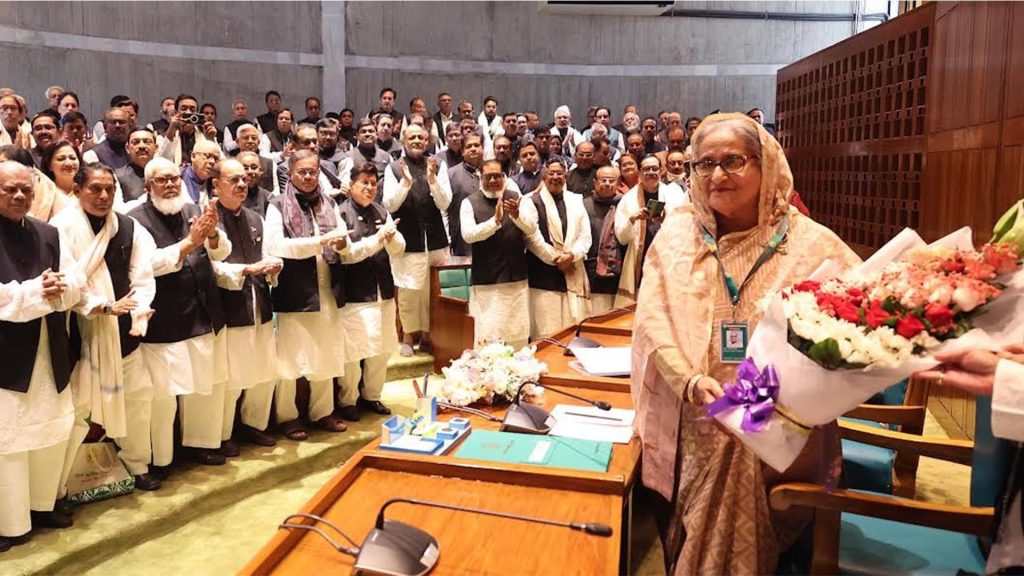
Amid opposition’s poll boycott, Sheikh Hasina secures facile win

A poor turnout (42%) took the sheen off the Awami League’s landslide win in parliamentary poll to 350-member Jatiya Sansad amid poll boycott by the main opposition party, BNP. BNP leaders claimed that low turnout indicated the people’s rejection of poll process, writes Nava Thakuria

When Bangladesh embraced the 12th general election amidst violence and boycott call from the prime opposition Bangladesh Nationalist Party  (BNP), it was predicted that the ruling Awami League (AL) led by Prime Minister Sheikh Hasina was winning for the fourth consecutive time to lead the poverty stricken south Asian nation for another five years.


Accordingly, the national polls on Sunday (a working day for the Muslim majority country) gave an absolute majority to the incumbent AL with 222 seats in Jatiya Sansad, the highest legislative body of the populous country strategically located between India and Myanmar.

The parliamentary election to 350-member Jatiya Sansad (where 50 women members are elected indirectly) reflecting a poor voters’ turnout (less than 42% of 120 million registered electorates exercised their franchise) witnessed the electoral victory of  62 independent candidates (many even defeated AL  nominees), a record since its birth as a nation in 1971. A compromised opposition Jatiya Party won only 11 seats and three smaller parties emerged winning one constituency
each.

The polling began at 8 am on 7 January 2014 and continued uninterrupted  till  4 pm under high security arrangements as the 170 million nation often reports widespread poll-related violence. Over
750,000 police and paramilitary forces were deployed on the ground, where Bangladesh Army, Navy, and Air Force personnel were on duty to ensure security during the single day polling in 261,912 booths under 42,024 voting centres across  the country.

To motivate the electorate, even PM Hasina cast her vote as the first individual in Dhaka City College polling station. She was accompanied by her sister Sheikh Rehana and daughter Saima Wazed. More than 200 foreign observers representing over 30 countries and global organisations visited the country to monitor the electoral process. Three senior members of the Election Commission of India also joined the group. Over 20,000 Bangladeshi observers representing 84 organizations were also engaged in the process.

Sporadic incidents of violence and rigging of polls were reported, as BNP leaders called for a 48-hour Hartal (general strike) beginning the previous day to polls. Alleging that elections under Hasina’s
government would never be free and fair, the BNP and its political allies stick to their demand to conduct the polls under a caretaker neutral government in Dhaka, which Hasina strongly denied.
Jamaat-e-Islami, a radical political party of Bangladesh, even took out processions in the capital city on the polling day supporting the BNP’s boycott call.

Meanwhile, the UN rights chief expressed serious concern over the violence and repression reported during the electoral exercise in Bangladesh. Violations and irregularities during the campaign and on
election-day should be thoroughly investigated, asserted the global rights chief, adding that the hard earned democracy in the country should not become cosmetic. The United States stated that the
Bangladesh elections were neither free nor fair. Moreover, not all political parties were engaged with the electoral exercise, said a government representative, adding that Dhaka should investigate
reports of violence and make the perpetrators accountable.


Terming the 12th national election as a fake one, the BNP leaders claimed that such a low turnout in the polling indicated the people’s rejection following their boycott call. Alleging the Hasina government of running fabricated cases against 5,00,000 BNP leaders and even imprisoning over 1,700 party workers in the last 15 years, they asserted  that the Bangladeshi voters thoroughly rejected the one-sided election. Now the BNP leaders have decided to intensify their movement against the fake regime with a series of peaceful public demonstrations across the country.
BNP’s president Khaleda Zia (78 years old) is currently ailing and amazingly the former Bangla Premier is also under house arrest for graft charges. Even the party’s acting president Tarique Rahman, son of former Bangla President Ziaur Rahman and Begum Zia, has been living
in self-imposed exile since 2008. Tarique faced 18 months jail term before leaving to London and staying there till date. So the party remains almost a leaderless entity on the ground and the BNP leaders were assumed not interested in contesting the elections.

Speaking to this writer from Dhaka, a Bengali political observer pointed out that the 7 January election was fought by AL leaders and well wishers only, as most of the independent candidates are either deprived political activists or just a dummy.  Observer Tapan Malik also claimed that those independent candidates were encouraged to join the fray to increase the number and hence the election cannot be assumed as free and fair. The Jaitya Party candidates also won the polls with favours from the AL. Thus Bangladesh is emerging as a one-party nation and now the question that arises is who would play the role of an opposition in the parliament, stated Malik.
The Paris-based global media rights body Reporters Sans/Without Borders (RSF) also condemned the violence against the journalists during the Bangla polls, when at least 12 reporters were attacked and expelled or denied entry to voting stations, in most cases by supporters of Hasina’s party. The AL supporters attacked reporters covering the cases of electoral fraud, asserted the RSF, adding that
the relevant authorities should launch independent probes so that the responsible individuals can be brought to justice.
“Furthermore, in a context of stifled media freedom, muzzled by governmental suppression of all criticism, we urge the newly re-elected authorities to finally adopt strong measures to safeguard
unrestricted Internet access and protect the freedom of the press enshrined in Bangladesh’s constitution and freedom of expression, which is being obstructed by the draconian new cyber security act. The government’s toxic control over news and information must end,”
asserted the statement.
On a polling day marked by tension – with the main opposition party (BNP) boycotting the polls- many journalists were physically attacked or were subjected to harassment and intimidation, and were either expelled from or denied entry to voting stations. Most of the harassment and violence was alleged to be the work of ruling AL supporters targeting reporters trying to cover irregularities.  In another serious violation of the right to report, access to the website of a Bengali newspaper was blocked. The newspaper management claimed that it had no internal technical issues when it experienced the access problems in the alternate media space on 6 January.
“The Bangladeshi authorities also refused to issue visas to journalists from the headquarters of many leading international media outlets, including BBC News, New York Times, Bloomberg, Agence
France-Presse, Reuters and Al Jazeera. Most of the foreign reporters who managed to obtain visas were those based in New Delhi. Some foreign reporters were also asked to sign a statement accepting that their photographs and video footage would have to be approved by the Bangla authorities before being sent, and could not harm the national image,” pointed out the statement.

Hasina (76) had earlier won the three national elections continuously from 2008 to establish herself as the longest-serving government head among women in the world. Daughter of Bangabondhu Sheikh Mujibur Rahman, Hasina maintained that only her party can lead Bangladesh towards peace, prosperity and growth. In the election manifesto, Hasina promised to convert the digital Bangladesh to a smart nation. She also committed to protect and promote the spirit of democracy, offer quality education to youths, modernise agriculture, and make healthcare services affordable to all Bangladeshi nationals.

Indian high commissioner in Dhaka, Pranay Verma was the first foreign diplomat to call on Hasina at Ganabhawan to convey greetings after her re-election and victory to her party. Ambassadors representing China, Russia, Bhutan, Philippines, Singapore, Sri Lanka etc also followed
and assured cooperation from their governments. Prime Minister Narendra Modi also congratulated Hasina on her poll victory and pledged a mutually trusted relationship with Dhaka. Hasina reciprocated the goodwill from New Delhi.

Traditionally, New Delhi remains sympathetic to Hasina as she maintains a comfortable relationship with India. Her strong actions against the north-eastern militants (taking shelter in
Bangladesh) as well as various initiatives to enhance bilateral economic ties haave already been appreciated by the billion-plus nation. Now it’s logically expected that Hasina will effectively
safeguard the interest of religious minorities (Buddhist, Christian besides Hindus) in the land of Bengalis, as she is considered as pro-Indian in nature compared to her rival Begum Zia.

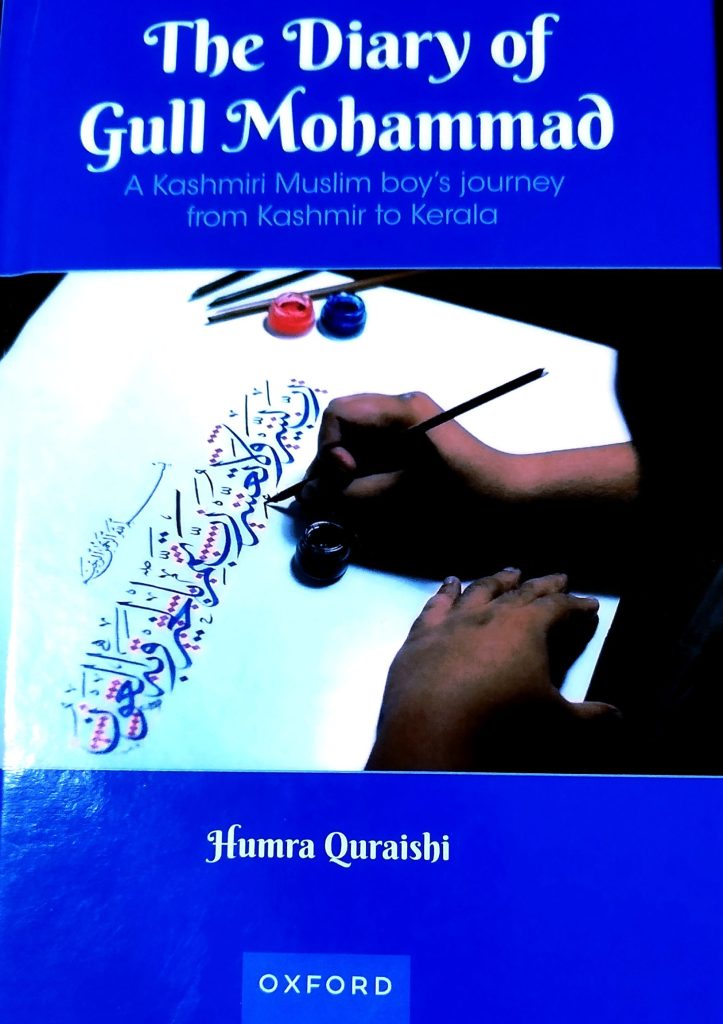
Diary of a madrassa boy: Gull Mohammad’s brush with realties

Although living a humble life of an ordinary madrassa boy, Mohammad, protagonist of Humra Quraishi’s eponymously titled book, The Diary of Gull Mohammad”  somewhat assumes the role of a chronicler of contemporary India, noting down his and that of his colleague’s intermittent harsh encounters with the current political climate. His diary notings are thus a tiny piece of the observed history of today’s India.  A book review by Riyaz Wani

Madrassas are Islamic schools where generally religious education is imparted. Students are taught scriptures, Islamic theology, jurisprudence, and Arabic language. Besides, they have to follow a strict daily schedule of saying namaz five times a day beginning with the first one at dawnbreak, in addition to intermittent recitals of Quran. This is a life dedicated to spiritual pursuit and disconnected from the rough and tumble of daily life. But the life of Gull Mohammad, protagonist of Hamra Qureshi’s eponymously titled book, straddles this spiritual-wordly divide – in fact, looming larger towards the latter. So, more than the life within the madrassa, it is the one without that he ends up explaining and illuminating: and it is the state of today’s India. 

Mohammad’s is a unique vantage point: that of a Muslim and a Kashmiri to boot. He looks at the prevailing state of affairs from Kashmir to Kerala by recording it in his diary. His entries from Srinagar document a deeply troubled Kashmir grappling with the daily killings, crackdowns and protests. 

 “Maddening noise around! Crackdown! Gulzar (Mohammad’s brother) wasn’t moving away from the window ——, these security creatures started firing down the lane. Mother had been trying pulling him away but he not listening (sic),” reads Mohammad’s dairy entry at 10 pm on August 2. 2016. “When will father get back! Will write again. So many screaming, pellets hitting at doors and windows.”

In a subsequent diary entry on August 5, we are told that Gulzar’s eyes have been hit by pellets and he is being treated at a Srinagar hospital. 

 “Mother shrieked and shrieked and told that inspector janab, blocking the way that our Gulzar is dying, his eyes bleeding and only then he let us rush him to that big hospital named after our long-dead Maharaja Hari Singh (sic),” the entry reads. “Gulzar (has) been crying. Now no school for him. Now no homework for him. Now no more peeping out of the window.”

During the summer of 2016, Kashmir experienced a six-month long unrest following the killing of the militant commander Burhan Wani. Over a hundred people were killed and several hundred were blinded in the daily skirmishes between protesters and the security forces. 

 However, more than Kashmir, Quraishi’s book speaks to the current situation in the country through Mohammad’s bitter encounters with people which he duly records in his dairy. 

“Two men stopped us and then sneered calling us ‘madrasa wallahs!’. One of them pointed at his hand at my skullcap and shrieked ‘Kharku’. I wanted to shriek back but Shamshad and Shakeel (fellow students) pulled me one side and started telling me that I have to get used to hearing all this rubbish,” his Delhi diary entry notes. “Shamshad had even showed his injured wrist and said that he was hit in the park by some goons when he refused to chant Jai Shri Ram!”   

Mohammad’s disadvantage is that besides being a Muslim and a Kashmiri, he has a third identity: a madrasa student, a situation made further difficult with its identity markers such as the skullcap and beard. This makes him and his ilk easily identifiable and thus vulnerable. 

In plains of North India, the situation becomes more hostile. In one instance quoted in the book where Mohammad along with his friend Imtiaz offer to work at a sweetshop in exchange for a plate of jalebis, the owner shoes them away upon learning they are Muslims. 

“You all Muslims. Run away from here. Go to shops run by Muslims. Not here. Muslims are not needed here,” reads his diary entry. 

Although living a humble life of an ordinary madrassa boy, Mohammad somewhat assumes the role of a chronicler of contemporary India, noting down his and that of his colleague’s intermittent harsh encounters with the current political climate. His diary notings are thus a tiny piece of the observed history of today’s India.  He is in no position to judge, interpret or analyze the situation. He feels it, sees it as it is and suffers in the process, once even being sent to jail for no fault of his. 

 That is when he once went as a guest to his friend Shaaz’s house in Lucknow. 

 “That night at Shaaz’s home, I had slept off as I was completely exhausted—-. Woke up all too suddenly when I heard loud banging on the iron-gate, the outer darwaza of their home,” reads one diary entry. “Strange loud noises and slogans all around ——Out with Gaddars. Out with Kashmiri terrorists ——– out——– will kill ——will settle (scores with) you all deshdrohi. “

However, a kind, “one big police officer,” came to his rescue and helped get back his belongings including the diary.  

Mohammad’s plight as narrated through his diary serves to shed light on one of the unreported aspect of the current “communally-surcharged times.”

“This diary written over a period of approximately just over a year, from early August 2016 till about the second week of September 2017, is enough to relay the tough challenging times these children face,” Qureshi writes in her introduction to the book. 

She achieves this feat not by expressing her own views but by letting the victims speak for themselves, delivering a poignant portrayal of their hardships.

MOST POPULAR

HOT NEWS