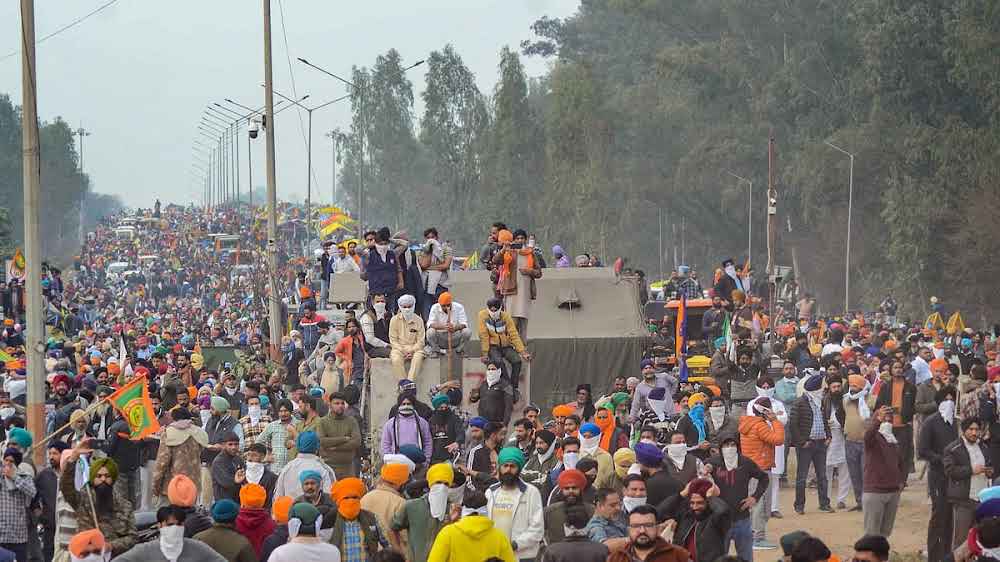
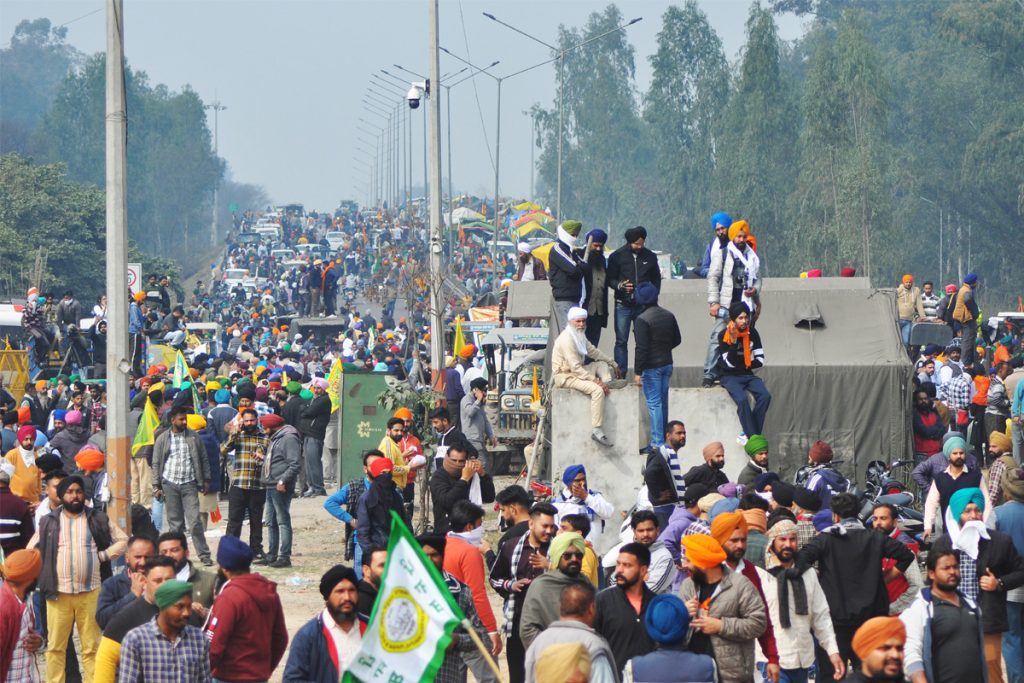
A few years after farmers ended their massive protest after the government scrapped the proposed farm laws in 2021 and consented to discuss other demands, they are back on the roads demanding guaranteed prices for their crops. The farmers’ protest has brought back memories of the chaos which prevailed in the capital during their first protest that began in 2020 against the move to introduce controversial agricultural reforms and was witness to many farmers dying from heat, cold and Covid at the Delhi borders. The peaceful, non-violent protests had become a watershed farm moment post-Independence.
The farm unions are now exerting pressure on the Centre for the enactment of a law to guarantee a minimum support price (MSP) for all crops of at least 50 per cent above the weighted average cost of production. The protesters are also seeking the implementation of the Swaminathan Commission’s recommendations, pensions of Rs 10,000 for farmers and farm labourers, farm debt waiver, withdrawal of police cases and justice for victims of the Lakhimpur Kheri violence in 2021.
The genesis of the problem lies in that the government sets the MSP of over 20 crops on the recommendations of the Commission for Agricultural Costs and Prices twice a year but procurement agencies buy only rice and wheat at the minimum support price level, benefiting around just 7% of farmers who raise those crops. The state agencies buy only the two staple food grains at MSP to build reserves to run the world’s biggest food welfare programme that entitles 800 million Indians to free rice and wheat.
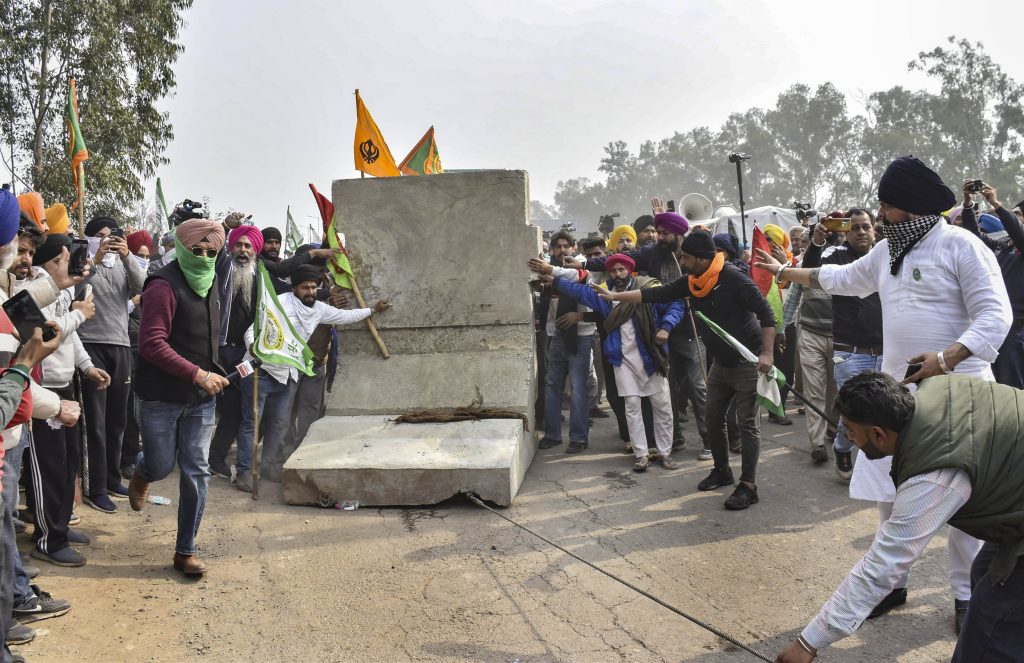
The right to protest to challenge the government to respond is a constitutional right of the people that stems directly from various provisions of Article 19 of the Constitution, which defines the Right to Freedom of Speech and Expression. However, what has irked the farmers is the use of force and the setting of concrete barricades to block their entry to Delhi where they were heading to protest. The Punjab and Haryana High Court has pointed out that, as citizens of India, “farmers have the right to move”. The bench, consisting of Acting Chief Justice GS Sandhawalia and Justice Lapita Banerji, said this while hearing a PIL challenging the Haryana Government’s decision to seal its borders to prevent protesters from entering the state and moving towards the national capital. Farmers form the most influential voting bloc in India and the government would not like to rub them the wrong way just weeks before India holds the general elections. The government has so far held three new rounds of talks with the farm leaders. However, the farmers called the talks “delaying tactics”. Farming is indeed linked to production risks, more so given the vagaries of climate change. What farmers require is assured minimum income support so that they are not left to the mercy of market forces.
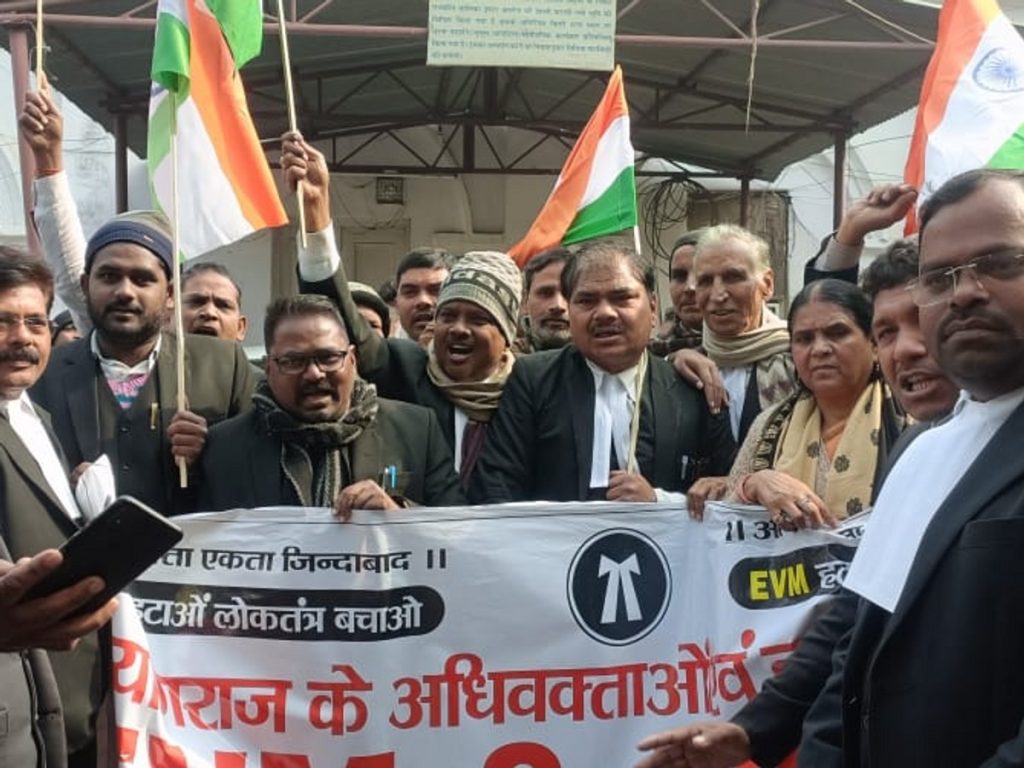
Doubts over EVMs have cast a cloud over poll process. Also, the way the Opposition is being targeted by ruling dispensation, one wonders if there will be any Opposition left before the elections ? …By Humra Quraishi
Unease and apprehensions are coming to the fore as hundreds of activists, retired civil servants and lawyers are coming up with genuine doubts about the EVMs and the connected aftermath… will there be transparency and accountability?
Compounding the scenario, the next query: Will there be any Opposition left before the general elections? With the arrest of Jharkhand chief minister Hemant Soren of the Jharkhand Mukti Morcha, such apprehensions are spreading out.
Doing the rounds is the obvious – at the rate the Opposition is getting targeted, will there be any elections..fair and free from fear?! Relays of the tough-turbulent times to come seem writ large as evidenced by the recent elections for the Chandigarh mayor’s post. Both AAP and Congress candidates have accused the BJP of employing manipulative tactics to influence the outcome.
Also, stands out the fact that senior opposition leaders are forewarning that violence could be used by the ruling brigades to create an atmosphere of fear. Though let me hasten to add that fear-laden atmosphere already well exists! Every single day, the common man is the target. Where does he or she go for help! Who’s there to hear those cries of our fellow citizens in these homeless- jobless-penniless- hopeless times, as homes and shops and age old structures and monuments are getting bulldozed!
He saw it coming
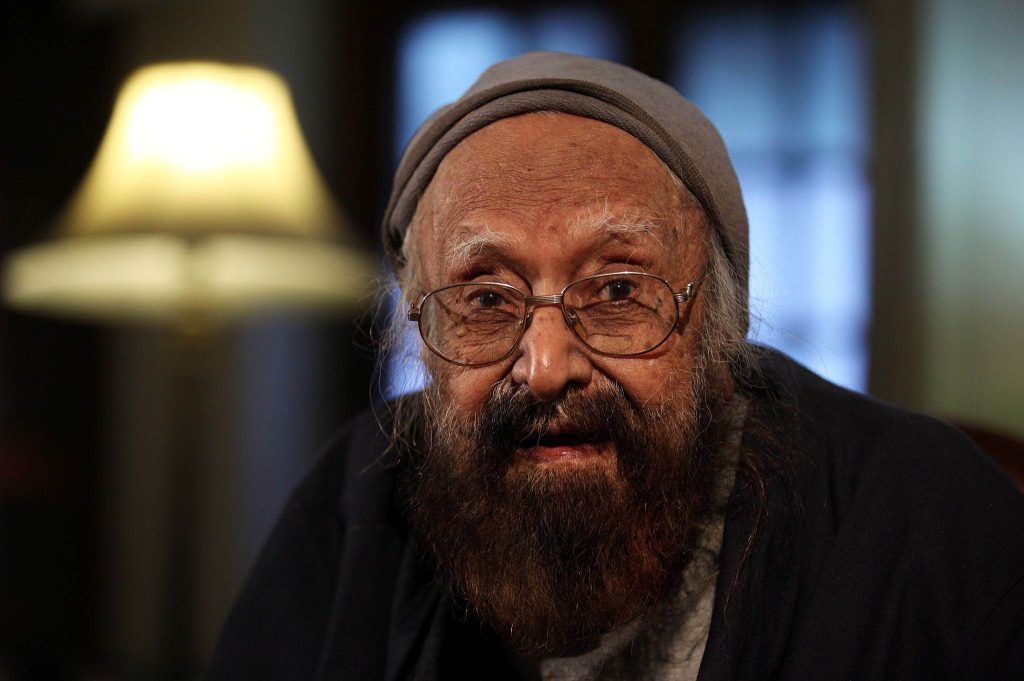
On Khushwant Singh’s birthday, 2 February, (he celebrated two birthdays – 2 February and 15 August), I kept thinking of his sheer farsightedness. Till about a couple of weeks before he’d passed away in 2014, he would comment that the communal situation in the country wouldn’t improve: “No, I am not optimistic but one should fight, one should make every single effort to save the country and openly challenge and take on these men who are destroying the country. We have to battle with them at any cost. If we love our country, we have to save it from the communal forces. And though the liberal class is shrinking, I do hope that the present generation totally rejects the communal and fascist policies and realizes that these are tough times for India.”
He would detail: “Today we don’t seem to be punishing the culprits who are fouling the atmosphere! Has anyone been punished for the Gujarat pogrom, for the Mumbai riots. For the last several years, I have been seeing signs of fascism creeping in and private senas being used to unleash terror on minority segments. …I think most Indians don’t realize the magnitude of the communal problem in our country—in spite of the signs being writ large in recent years. The way MF Husain’s paintings were burnt, or the shooting of a film stopped or the way changes were introduced in history books and school texts, the hate propaganda against the Christians and Muslims—false theories that the Christian population is going up because of conversions when in fact the reality is that the Christian population in India has actually gone down. And the Sangh capitalizing on old prejudices about Muslims—that they are multiplying at an alarming rate when the census figures clearly show that the rate of growth of the Hindu population has always been higher.”
“This communal violence and these prejudices are what worry me the most about this country…Fascism well and truly has crossed our threshold and dug its heels in our courtyard. We let the fanatics get away with every step they took without raising a howl of protest. They burnt books they did not like, they beat up journalists who wrote against them, they openly butchered people for believing in a different God.”
“Today what’s worrying is the anti-Muslim build-up and, now, encounter killings taking place on a daily basis. What causes me anguish is the way the media, both print and electronic, accepted the police version that, as usual, depicts Muslims as subversive and links them with militant outfits.”
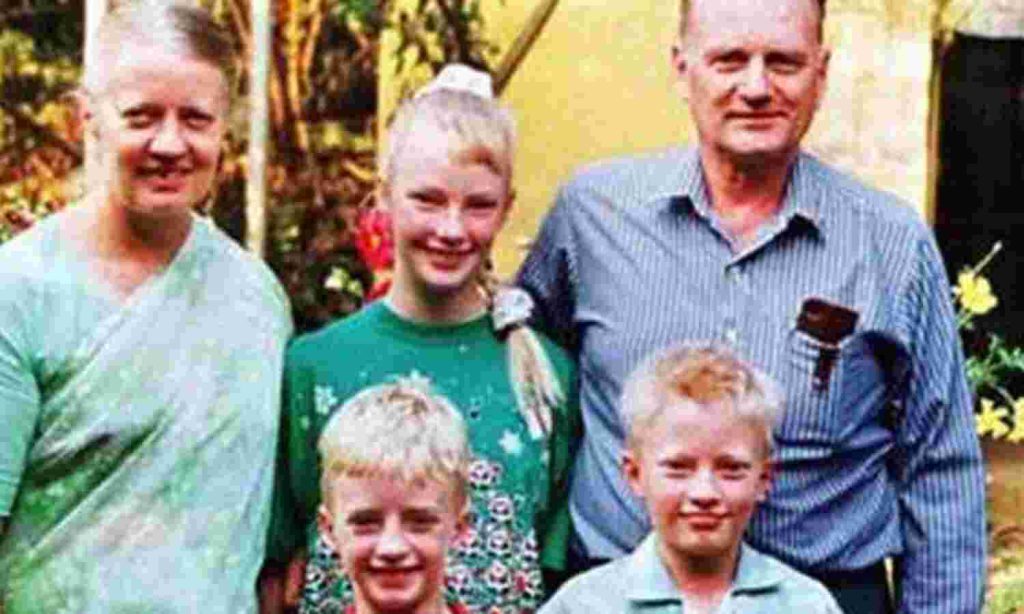
“I’ve written against the attacks on Christians…Anti-Christian violence, right from the time Graham Staines and his two sons were killed, to riots in Orissa’s Kandhamal and incidents of mob violence and damage to churches and Christian property. A great majority of English-speaking Indians have at some stage of their lives been to missionary schools or colleges or a hospital managed by missionaries, and nobody has ever tried to convert these Indians there. I think we have no gratitude for those who have served us selflessly.”
“I’d always wanted to bridge the gap between Sikhs and Muslims. When I was awarded the Rockefeller Fellowship I decided to write the two volumes on the history of the Sikhs under the auspices of the Aligarh Muslim University. Atal Behari Vajpayee had raised this issue in parliament, asking why I’m doing it from AMU!”
To the ‘why,’ Khushwant never developed anti-Muslim feelings. He told me, “I’ve never had any anti-Muslim feeling. Our village had about three hundred families and a majority of them were Muslims and though there was no real mixing (only met during formal occasions- deaths or marriages) but there was no apparent tension …peace prevailed and our families remained friends and during the Partition, nobody touched the village gurudwara. It remained intact… And years later, whilst studying in Lahore, I could sense the same – that is, aloofness between the Sikhs and Muslims with members of each community keeping to themselves but again it was largely peaceful. Years later, when I came back to Lahore I became friends with several Muslims – Manzur Qadir and also with Professor A.S. Bokhari and also with Rasheed sahib who was D-G Pakistan Radio. And even after Partition, some of my closest friends have been Muslims … when we shifted here, Muslims from our village would come to meet us here in New Delhi. In fact, two people who have left a deep impact on me are my Urdu teacher Maulvi Shafiuddin Nayar at the Modern School and Manzoor Qadir, my lawyer–friend in Lahore. And, of course, my love for Ghayoornissa.”
On how to counter the mess around, he would say: “It’s time to take on the fundoos and I also feel it’s time we came up with some sort of guidelines on how to protest against the establishment or to voice our anger against the general state of affairs. These protests should be done in such a way that they do not affect thousands of others – the general public, the commuters, office-goers, schoolchildren. Protests should not disrupt normal life … And one does not have to evolve some complicated procedure for this. Follow the example set up by Mahatma Gandhi and his non–violent ways of protest. He was no doubt the greatest protestor and did so by non-violent methods …Yes, our own Bapu Gandhi was the world’s greatest protester of all times. He had no doubts in his mind as to what was legitimate and what was not.”
Rice distributed through the public distribution system is responsible to a great extent behind the non-consumption of millets or in its sharp reduction when it comes to rural areas. Also, millet processing is a tedious job. A report by Deepanwita Gita Niyogi
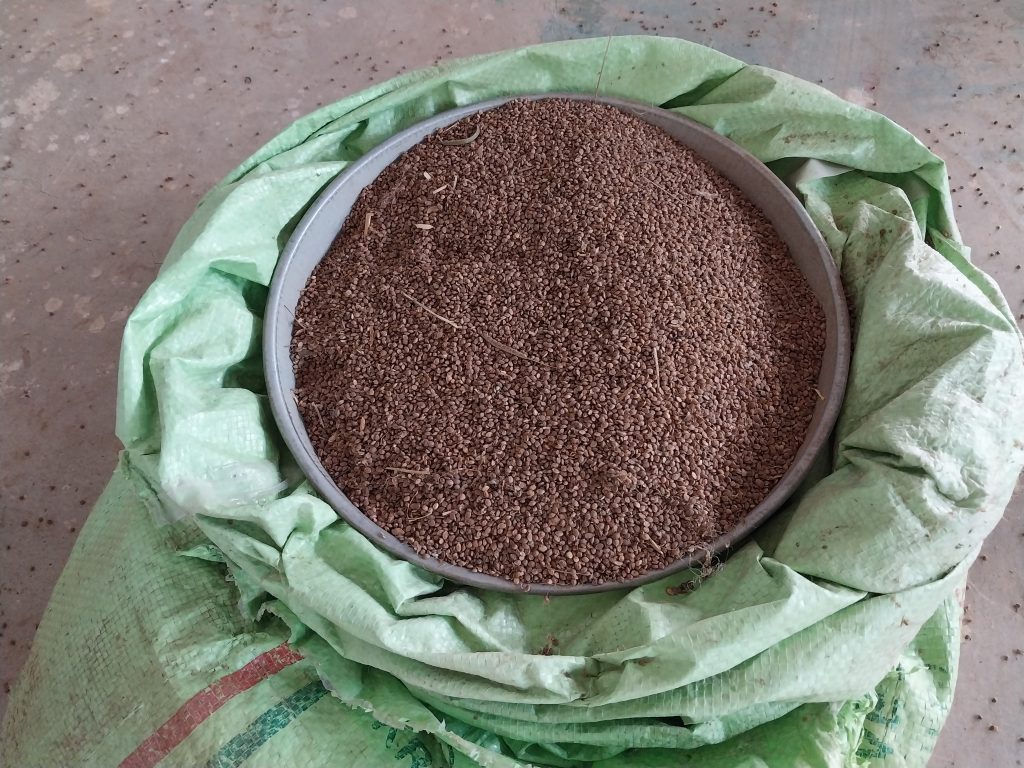
Across the country, respective state governments are promoting millets on a large-scale through various millet missions. To popularise the cultivation and consumption of millets, Chhattisgarh announced a higher minimum support price (MSP) for kodo and kutki, both small millets.
At present, the MSP for kodo stands at Rs 3200 per quintal and that of kutki is Rs 3500 per quintal. On the lines of Odisha, Telangana and Andhra Pradesh, the state also launched a millet mission in 2021.
Amit Singh, under secretary, department of agriculture, Chhattisgarh, said the MSP for kodo and kutki will continue. “The millet area in the state initially covered 80,000 hectares. Under the mission, the target was 1,80,000 hectares in five years. In the past two years since its launch, the area has increased to about 1,20,000 hectares in the state from the initial 80,000 hectares. The actual figure is awaited.”
The millet mission in Chhattisgarh is running under the convergence model and has been linked to other government schemes. The mission is on in all districts even though in the beginning, 21 districts were targeted.
A shift away from millets
Though millet missions have a targeted approach, overall, the consumption of millets, has gone down in the rural areas of the country. Tribals, who still cultivate millets in large quantities, are gradually moving away from millets which used to be their staple diet once.
For instance, in Odisha’s Niyamgiri hills, the dominance of commercial crops such as pineapples have taken a toll on traditional crops, including millets. Still, the Odisha Millets Mission covers 177 blocks in 30 districts of the state.
Naresh Biswas, who works with Baiga tribals in Madhya Pradesh, said there is a correlation between millets and forest foods. Millets in tribal areas are mostly eaten as rice or bhat or as pej or porridge. Pej is consumed in the morning before setting out to work but for main meals twice a day, bhat is preferred.
However, for the consumption of millet bhat, the quantity of dal and vegetables has to be more compared to that of rice because of the taste and texture of millets. “Millet bhat dries up quickly. It soaks up dal faster and so one needs more dal to go with it. In the absence of dal, one needs more vegetables,” said Biswas.
Earlier, tribals collected different types of vegetables from the forest. But as forests have become protected ones in many areas, there are restrictions on the collection of forest foods. “Thus, tribals often do not get the required quantity of vegetables. They also cannot buy dal much from the market due to economic constraints,” Biswas explained.
Forests are a big food basket for tribals. Many tribals eat dried leaves in summers when there is a shortage of vegetables. Mono-cropping has ruined the concept of forest foods. People’s food habit has become focussed on rice and wheat.
Preference for rice
The public distribution system of rice is responsible to a great extent for the non-consumption of millets or in its sharp reduction when it comes to rural areas.
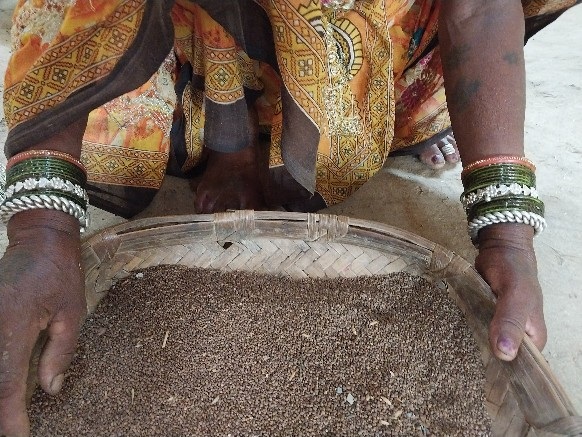
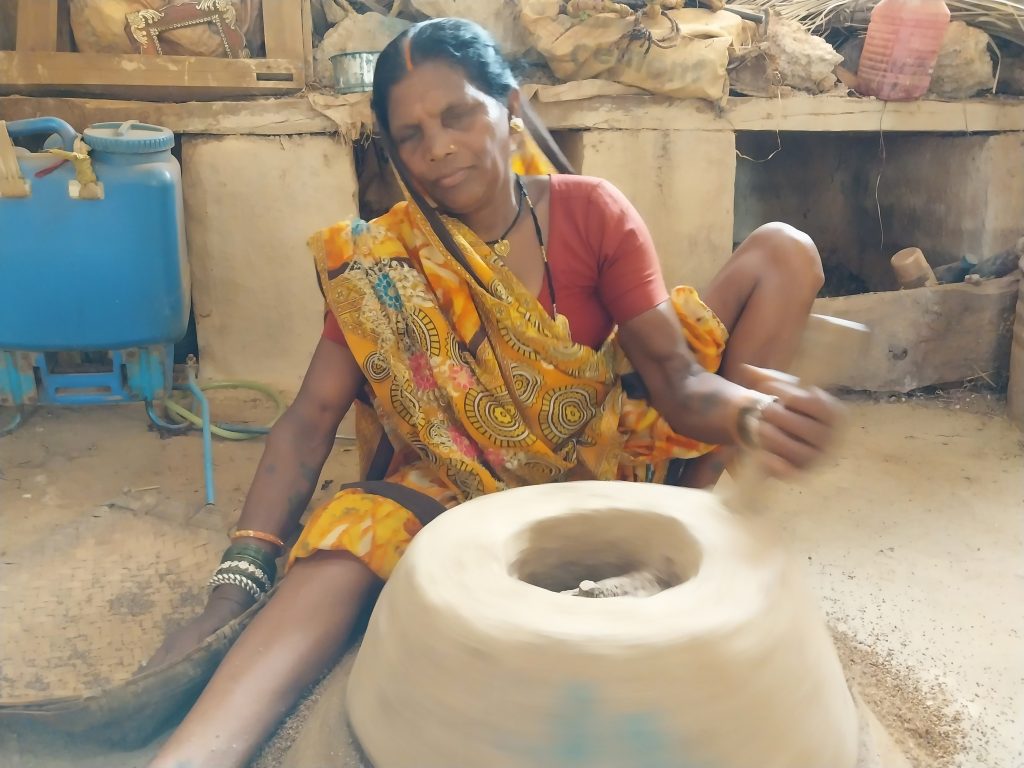
Millet processing is a tedious job. For tribal women, time is short as many go for labour work these days. Rice can be cooked faster. Processing machines are not available for domestic uses and those that are in use are for commercial purposes. Mostly, traditional items like jata and musar are used at homes in millet processing and both are labour intensive.
Biswas feels the school system is also to be blamed. “Tribal children get rice-based mid-day meals. When at home, they refuse to eat millets. Women say it is not possible to cook both rice and millets at home.” Odisha has introduced millets in anganwadi menu and mid-day meals.
Consumption of millets is mainly popular now in urban areas. “Once tribal women consumed millets in large quantities. In those days, they got up at dawn for millet processing. Now, they have an option. Broken rice is available at ration shops. Some also exchange millets for rice,” Biswas added. He cited the instance of Baiga tribal woman Laheri Bai who consumes more rice than millets. When she has time, she eats millets but it is rare.
Dwiji Guru of The Millet Foundation admitted that tribals are moving away from millets and that it is only in small pockets that millets are getting mentioned. “Both consumption and cultivation are reducing in most Adivasi communities. Bleached (polished) rice through the public distribution system is one of the many reasons. Processing of millets is vital. Community-oriented, decentralized millet processing with an ecosystem approach is the way to go. We cannot look at processing in isolation.”
Millets are still a niche segment and by no means comparable to current staples like rice and wheat. People’s health concerns and the much publicized health benefits of millets is a primary driver of the current rush for millets.
A Chhattisgarh officer, who works for the women and child development department, said on the condition of anonymity that tribals in Chhattisgarh still consume millets, especially kodo and kutki as well as ragi. This is true of the Bastar region mostly.
“Non-consumption of millets alone cannot be blamed for malnutrition. There are several reasons for it like not leading a hygienic lifestyle and the absence of safe drinking water. Many women don’t take supplements during pregnancy. But many farmers are selling millets and even maize for ready money as the minimum support price is good and not keeping much for consumption.”
R.L. Khare, the registrar of Mahatma Gandhi University of Horticulture and Forestry in Raipur, said ragi is being promoted in the state and millet cafes have opened in certain places. “But millet productivity is low as tribals do not possess the technical knowhow. There is a need for improved varieties to increase the yield.”
Five years after the withdrawal of Article 370, Ladakh feels disempowered. Although the centre has announced some safeguards to address the region’s anxiety about potential demographic changes, the move has failed to resonate with the people of Ladakh. A report by Riyaz Wani
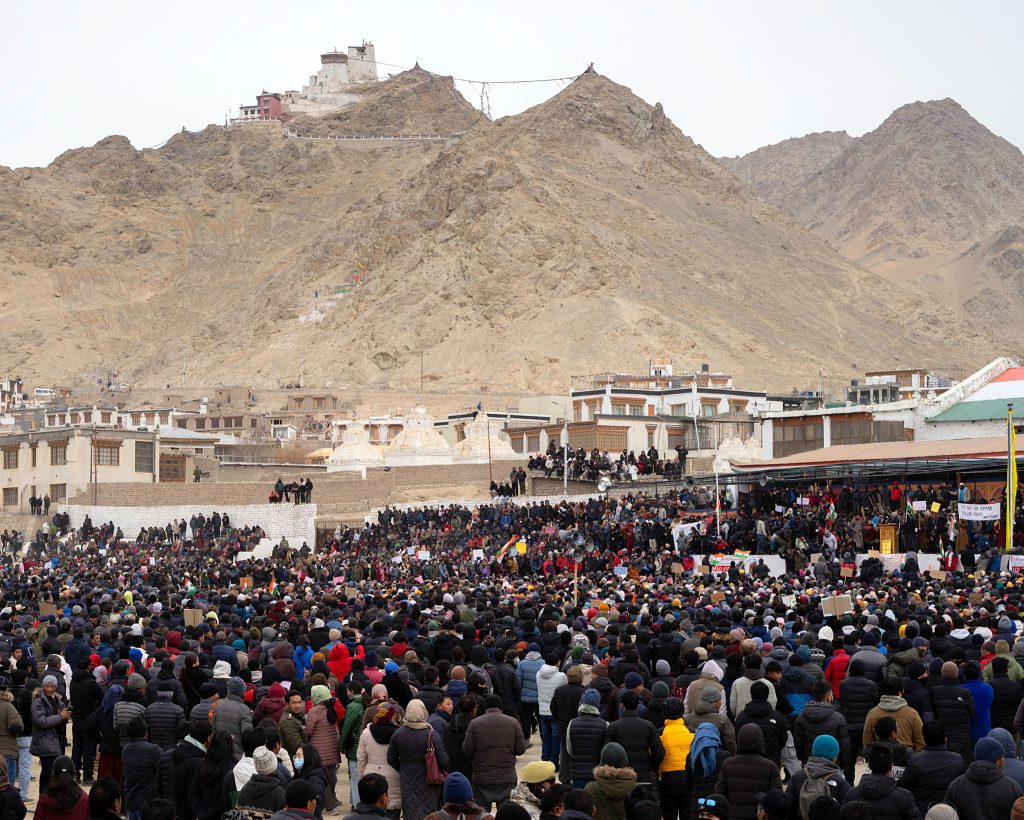
On February 6, thousands of protesters, braving intense cold, gathered at the Polo Ground in Leh. The speeches at the gathering, including those by prominent Ladakhi leaders and activists like Sonam Wangchuk, sought the fulfilment of the promises made by the Union government.
The Leh Apex Body (LAB) and Kargil Democratic Alliance (KDA) which are spearheading the agitation, are demanding special rights and statehood for Ladakh, which was downgraded to a Union territory without a legislature on August 5, 2019. Prior to that, Ladakh was a part of Jammu and Kashmir, which also was made a union territory. The unprecedented step followed the withdrawal of Article 370 that granted the then undivided state a special constitutional position within the Indian Union.
Ironically, the Buddhist majority Leh district in the region had then celebrated the separation from J&K and the grant of union territory status. A UT status was a popular demand from the region going back to the nineties. Once the unimaginable demand was suddenly fulfilled in 2019, Ladakhis have slowly become conscious of drawbacks of the move which they think has disempowered them and also made them vulnerable to demographic change. Hence, the demand for constitutional safeguards under 6th Schedule.
In the new scheme of things, the democratically elected Ladakh Hill Development Councils (LAHDCs), both of Leh and Muslim majority Kargil, which acted autonomously in undivided J&K have become redundant. The region is now directly ruled by the centre through a Lieutenant Governor. So, LAHDCs effectively mean little for regional empowerment.
Ladakhis have now been making a strong pitch for statehood for the region. But the region hardly qualifies for statehood with a population of just over three lakh. This has created a quandary for the union government. More so, at a time when it has no immediate plans to even restore statehood to Jammu and Kashmir.
The total population of Ladakh, according to the 2011 census is 2.74 lakh. While Leh with a population of 1,33,487 is Buddhist majority, Kargil with a population of 1,40,802 is Muslim majority. Overall, Ladakh has a slim Muslim majority.
The fear of the change in demography has brought the people of Leh and Kargil together. It is the first time in decades, the two Ladakh districts have been on the same page in pressing the union government to fulfill their demands for statehood and protection of rights.
The number of demands have since grown. The demands put forth by LAB and KDA include tribal status for Ladakh, inclusion in the constitution’s Sixth Schedule, job reservation for locals, and a parliamentary seat each for the Leh and Kargil districts. Ladakhis are citing the cases of Mizoram, Tripura and Sikkim which are protected by special constitutional provisions.
Last year, the Ladakh Tourist Trade Alliance (LTTA), a coalition of trade, tourism, religious, and political organizations in Leh, passed a resolution opposing investment by outsiders in the tourism sector of Ladakh. The alliance warned that if such investments continue, they would impose restrictions on these investors through non-cooperation from the local travel trade fraternity, as well as community and political organizations.
The alliance, comprising several prominent associations such as the All Ladakh Tour Operators Association Leh, All Ladakh Hotel and Guest House Association Leh, Ladakh Taxi Operators Cooperative Union Leh, and others, has joined forces with various religious and political bodies. Their collective aim is to safeguard the tourism industry of Ladakh and protect the interests of the local people.
Centre’s response so far
In 2021, the centre took steps to address Ladakh’s anxiety about any potential change to its demography by giving it some safeguards. The administration of Ladakh announced that it would issue “Resident Certificates” only to holders of Permanent Resident Certificates as was the case before the withdrawal of J&K autonomy when Ladakh was a part of the undivided state.
This is unlike Jammu and Kashmir where the administration has allowed outsiders who have stayed in the region for a particular duration to apply for permanent residency rights and also buy land.
According to the Ladakh Resident Certificate Order 2021, “any person who possesses a Permanent Resident Certificate (PRC) issued by the competent authority in the districts of Leh and Kargil or belongs to a category of persons who would have been eligible to be issued PRC shall be eligible to receive the ‘Resident Certificate’.”
Future imperfect
As the situation has turned out, the centre’s concession has not satisfied Ladakh. The negotiations with the centre are on. The committee formed by the Union home ministry held talks with LAB and KDA on December 4, but the lack of significant breakthroughs reveals the complexity of the issues at hand. The upcoming second round of talks on February 19 in Delhi provides an opportunity for the government to engage in a meaningful dialogue and address the genuine concerns of the people of Ladakh.
Sonam Wangchuk, a prominent advocate for constitutional safeguards for Ladakh, has announced plans to undertake a fast unto death starting February 19 to intensify the campaign. The Leh Apex Body, led by Wangchuk, has been persistently seeking the inclusion of Ladakh in the Sixth Schedule of the Constitution, which grants protection for tribal rights.
Details regarding the extent of local residents’ involvement in the upcoming agitation are still being finalized. Wangchuk expressed a growing sense of desperation among the residents, citing unmet demands for safeguards under the Sixth Schedule and the attainment of full statehood for Ladakh.
“First it will be Thupstan Chhewang (former BJP Lok Sabha MP) and me, and if we die, who next and how many? All that roster is being prepared,” Wangchuk said while highlighting the gravity of the situation.
Initially planning a three-week fast from February 3, Wangchuk postponed the initiative at the request of Thupstan Chhewang, the chairman of the Leh Apex Body (LAB). Chhewang urged Wangchuk to await the outcome of the meeting on February 19, where prominent leaders from the Union Territory are scheduled to meet Union Minister of State for Home Affairs Nityanand Rai in New Delhi.
The LAB advocates for Ladakh’s inclusion in the Sixth Schedule, focusing on securing tribal rights. The Kargil Democratic Alliance (KDA), on the other hand, has been pressing for Ladakh’s statehood.
Wangchuk explained the significance of the Sixth Schedule, emphasizing its requirement for consulting local indigenous people on any agenda. The provision entails the establishment of councils with legislative and lawmaking rights, ensuring that industries can operate only with the consent of the local population.
Five years after the withdrawal of Article 370, Ladakh feels disempowered. Before the reorganization of Jammu and Kashmir, Ladakh had four MLAs and two MLCs in the then state Assembly, providing a stronger voice for the region. Now, only one Member of Parliament democratically represents the region.
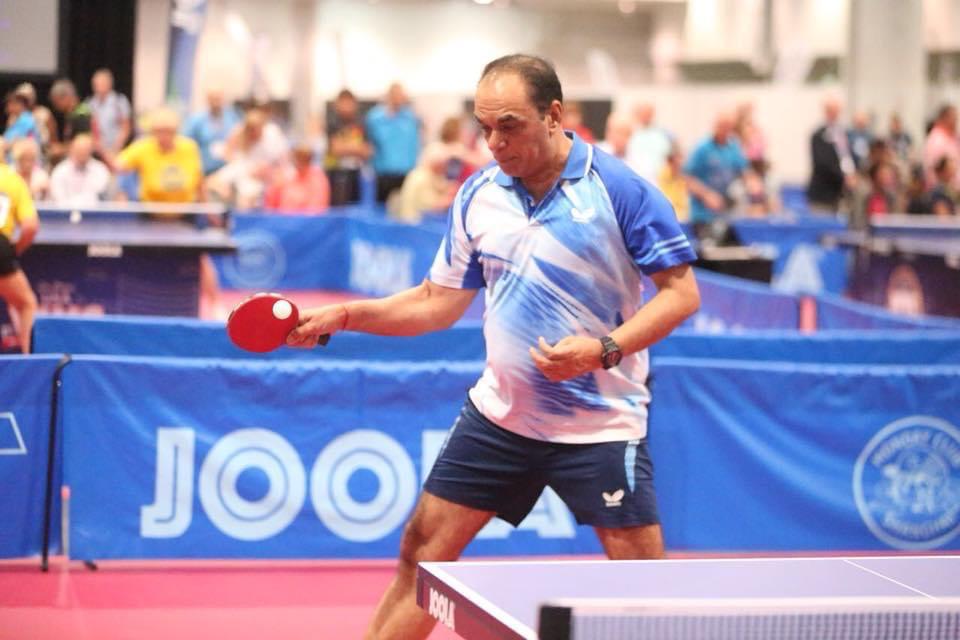
Q&A with Vinay Chopra – the veteran Table Tennis champ – by Humra Quraishi
Though in his 60s, Vinay Chopra – the veteran Table Tennis champ – is still going strong. Tournament after tournament for him! So what is the mantra for his being so agile at the age when many might consider slowing down. Following are the excerpts from the interview:
What got you to table tennis …and in such a passionate way that you have been playing all through these years or shall we say decades?
Ans: I think any Game in Sport comes from within; either one is born with a particular talent or one inherits it. As for me, I became passionate about the game of TT from my school days since the age of 11. Moreover it was one of the sports promoted in the school I studied and that is where I used to play a lot, practice and started participating in different tournaments. My first achievement was when I became National Champion at the age of 15 years in Allahabad.
So basically it’s because of winning so many tournaments and representing my school initially that helped me get more passionate and motivated me to keep playing for my school and for Delhi which led me to playing for so many years for domestic as well as international tournaments wherein I have always achieved success and won laurels.
How did you manage to do all the required balancing – with school and academics and later with a full-time job ?
The school saw that I was very good at the game and in fact many tournaments were promoted by the school itself. So the school gave me enough time to practice and attend the tournaments, especially inter-school tournaments. During my free time, I would study. There were teachers and friends who helped with my notes in different subjects which made it easy for me during my exams. A lot of support came from my school so that I could do well both in TT as well as in school. I graduated from SRCC on the basis of sports and represented in the game of TT from the college too.
As regards my job in CWC (Central Warehousing Corporation), I was selected on the basis of my sports skill. So I was given permission to work for half a day and the rest was put into practice or travel to different cities for tournaments. The office supported me financially with regards to my trips as well as my TT kits to play within India and abroad too. There were public sector TT tournaments too in which I had to perform and in fact bagged the most trophies for my office. So, basically I got a lot of support from all my institutions and was able to balance my academics when in school and college as well as my full time job.
You are in your early 60s but still going strong. Comment.
I think age is just a number. I am in my 60s and still going strong and achieving success in this age makes me strongly motivated. I never think that I am getting old or I have crossed my 60s but I just believe that as long as my legs and hands support me I will continue playing and keep working hard to always achieve and aim to beat my opponents. For my age, I am ready to face any age group, even youngsters for that matter, as it helps me to improve and play better. It’s vice-a-versa that youngsters too want to practice and play with me knowing I am good at my game. Even my regular fitness regime helps me.
There must have been setbacks and disappointments in life. How did you deal with those tough or low phases?
Yes, I have had my bit of tough times and low phases in life, be it personal or anything to do with my games, but I never allowed these moments to come in the way of my games. There have been setbacks and disappointments. But I needed to believe that sometimes you lose and sometimes one wins. This is part of the game and life as it comes which I am always ready to face. Losing a game always made me think over the mistakes I made. It’s through mistakes that one tends to realise what went wrong and you try to work towards mending those mistakes so that they are not repeated. I always try to put away the bad times of my life or disappointments behind my head, especially when playing crucial games at important tournaments. I am ready to face challenges in life and still continue dealing with them.
Do you believe in the cliched term – a woman behind every successful man. How supportive is your wife?
Yes, definitely! I do believe that behind every successful man is a woman. I think a lot of support comes from one’s better half, especially a wife. But this happens when our views click. Especially, when it comes to our common interests, being like-minded in our line of thinking and understanding.
As much as I am passionate about my game in table tennis, my wife has been equally enthusiastic since the time we were married. She’s been very supportive and in fact has also been accompanying me on many of my trips for my tournaments. In fact she has represented in some tournaments as my coach too. On winning my games, at times, I believe that her presence brings me luck.
Why is it that in our country, cricket overtakes all other games?
Cricket is a sport which probably started much before TT could be recognised as a sport. Cricket was also promoted by many schools and colleges which slowly gained popularity all over the world, especially when it first started in the UK. It became a worldwide entertainment for youngsters wherein media and companies too started sponsoring the game in a big way and paying the players a lot of money for advertising. A lot of prize money is involved in the game of cricket, so every youngster wants to be a cricketer and is watching the game closely. Partially, it’s because of cricket that the economy too is growing because big multinational companies, celebrities are sponsoring players and buying off teams to represent, especially in tournaments like IPL. The government too is supporting the game with the largest cricket body of India i.e., the BCCI, so naturally the sport is given a lot of exposure in a big way. So basically, one could say cricket has become a status symbol in India. It is seen as a sport for the affluent and is associated with wealth and success. The game has become a way for many Indians to showcase their social status and has even led to the formation of celebrity cricket leagues and that’s why more importance is given to cricket than all the other sports.
You have been playing abroad and also in the country. In which country is table tennis the most popular sport, especially amongst the youngsters?
Although the game originated in England in the early days of the 20th century and was originally called Ping-Pong, a trade name. The name table tennis was adopted in 1921–22 when the old Ping-Pong Association, formed in 1902, was revived and is now best known as Table Tennis. But today, Table Tennis is most popular in China. In fact it is the country’s national game and there are players who start playing from a very young age of 5/6 years. The best players are from China who are very professional and usually are among the top ranking players in the world.
Table tennis seems like a low cost, no-fuss game. With that in the backdrop, shouldn’t it get promoted in smaller towns and also in the schools and colleges situated in the conflict zones?
TT is no more a low cost or a no-fuss sport. The cost of the TT rubbers of different kinds and the racquets and balls are expensive and usually need to be replaced every two months. Initially, the sport was not so popular or promoted by sports authorities or the government, but today it is widely promoted by schools, colleges and sports bodies in every state in many countries even in backward areas or conflict zones. Colleges are also admitting students having talents in sport and table tennis is one of the sports. If a student has performed well in tournaments and has good skills of playing TT, he or she is given admission in a particular college under sports category.
It seems that table tennis hasn’t really received the significance and promotion it deserves. In your opinion, what’s the reason for this? Also, what more efforts should be made to highlight the game?
Initially in India, importance was given to cricket because of its popularity. Even today, cricket is promoted in a big way probably due to wealthy people and big multinational companies sponsoring the game so other sports did not receive much publicity. Slowly and gradually when the game was promoted in other countries, it slowly started getting popular in India also. Many schools and colleges too started promoting the game for school children and college students. Now, the game is very popular and many national and international tournaments too are being held for all age groups and even for veterans. As government bodies and sports governing bodies sponsor more tournaments and national and international level competitions are held across the country, the greater significance the sport of table tennis will gain, and its prominence can be highlighted.
With an eye on the upcoming 2024 LS poll, the BJP government of Uttarakhand has passed the controversial Uniform Civil Code in the legislative assembly. This will serve as a litmus test for Modi government before potentially implementing it in other BJP-ruled states. A report by Mudit Mathur
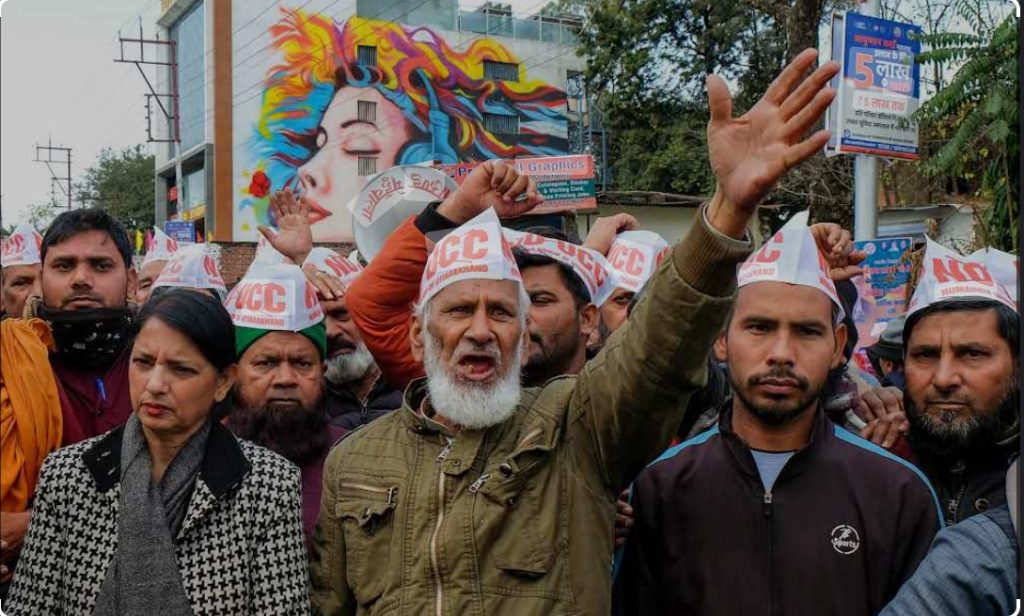
Positioning to woo the majority community in the upcoming 2024 general elections, the BJP government of small state of Uttarakhand recently passed the controversial Uniform Civil Code 2024 (UCC) in the legislative assembly, possibly as a trial run before implementing it in other states that it governs.
The Muslim community plans to challenge the constitutionality of the UCC in the apex court. The move has triggered a debate over the potential conflict with citizens’ fundamental right to privacy. The new law requires citizens to compulsory register their live-in relationships within a stipulated time frame or face strong punitive actions, including fines and imprisonment.
It has caused concern as it will apply to all residents of Uttarakhand, even if they settle down in other states of India. The Uniform Civil Code (UCC) will be uniformly applied to people in Uttarakhand across religions, with the exception of a section of tribal populations.
The BJP had promised a Uniform Civil Code in its election manifesto, along with the removal of Article 370 from Jammu and Kashmir and the construction of the Ram Mandir in Ayodhya. These pledges were made with the aim of consolidating the majority community of the country through ideological polarization. Union Home Minister Amit Shah pushed the narrative further by announcing to notify the Citizenship (Amendment) Act (CAA) before Lok Sabha polls.The act was passed by the Parliament in December 2019.
Shah stressed that the CAA was brought in to provide citizenship and not “take away anyone’s citizenship.” “CAA was a promise of the Congress government. When the country was divided and the minorities were persecuted in those countries, Congress had assured the refugees that they were welcome in India and they would be provided with Indian citizenship,” Shah claimed, while addressing the Global Summit of a media group.
However, the controversy over CAA had led to incidents of retaliatory violence that witnessed communal tensions all over the country amid huge protests and selective use of draconian sedition law against the protesters. It also witnessed a growing sense of insecurity among the minority community about the alleged misuse of the law.
On the implementation of UCC in the state of Uttarakhand, the chairman of Parliamentary Standing Committees on Home Affairs, Law, and Commerce and eminent lawyer, Abhishek Manu Sanghvi said, “It is clearly a political and symbolic gesture, unleashed just before (Lok Sabha) elections, with the usual great event management and fanfare for which the BJP is famous. If the UCC is to have any meaning, it has to be the product of all-India consensus in a single national law.” “The BJP is far away from that, so it has gone ahead and done this usual tokenism, very similar to the Women’s Reservation Bill we saw a short while ago,” the Congress leader added.
The Uniform Civil Code has entered a totally new area by introducing provisions of formalising what was previously been in the realm of informal sexual relationship between consenting adults and raises constitutional concerns over privacy and personal liberty. It is difficult to understand the purpose for which the provisions of registering a live-in relationship have been included in the UCC drafted by an expert committee headed by Justice (retd) Ranjana P. Desai of the Supreme Court. The criticism against it is that there has not been appropriate discussion among communities or even in the state legislature. While many of its provisions are controversial, an issue that has raised much heat is the provision for mandatory registration of live-in relationships.
It overthrows the very purpose of a live-in relationship as it renders it on par with a formal marriage, with conditions for entering into a relationship similar to a marriage contract — monogamy, prohibited degrees of relationships, etc., UCC stipulates non-registration to be a criminal offence with a fine of Rs 10,000 and/or imprisonment of three months. In the event of failure to produce a certificate of live-in relationship, a term of six months is prescribed on conviction and/or fine of Rs 25,000. Similarly, as is the case in marriage (and divorce), one has to register the contract with the registrar at the time of entering into a relationship and also upon terminating the same.
The Code provides for maintenance for a woman “deserted” by her partner, similar to a married woman, Section 388 states: “If a woman gets deserted by her live-in partner, she shall be entitled to claim maintenance from her live-in partner, for which she may approach the competent court having jurisdiction over the place where they last cohabited.” The Code further provides that a child born in a live-relationship is a legitimate child. While this is the prevailing legal position, under the UCC, it is codified as law.
These provisions alter the entire personal relationship from an informal one into one governed by a draconian and stiff criminal law. The entire objective seems to be to deter young couples from entering into such relationships, which raises questions about individual’s privacy and liberty guaranteed under the Constitution of India.
The Code also defines heterosexual relationship as a “relationship between a man and a woman” who “cohabit in a shared household through a relationship in the nature of marriage, provided that such relations are not prohibited.”
Most young adults may not want this kind of state protection which abridges their freedom to not choose marriage but to stay in a consensual relationship without the intrusion of the state apparatus into their private lives.
Uttarakhand’s UCC Bill which seeks to “govern and regulate the laws related to marriage and divorce, successions, live-in relationships, and matters related thereto”, was passed in the Assembly on 7th February after two-day discussion. The Bill will now be sent to President Droupadi Murmu for her assent, after which it will become law. After the Act gets the presidential assent, Uttarakhand will become the first state after Independence to get a common law on marriage, divorce, land, property and inheritance for all citizens, irrespective of their religion.
Chief Minister Pushkar Singh Dhami said it is not an ordinary legislation. “The Uniform Civil Code (UCC) will create equal laws for men and women across all faiths and will help create a non-partisan and non-discriminatory society. It will especially protect the rights of women and put an end to their exploitation,” Dhami remarked. “It fulfils a commitment we had made to the people of the state in the run-up to the 2022 assembly polls. It is a small contribution from Uttarakhand to building a developed India under the leadership of Prime Minister Narendra Modi,” triumphant Dhami claimed.
The Muslim community would challenge the constitutionality of the recently passed Uniform Civil Code in the Supreme Court and further they would continue to protest against it by way of civil disobedience. They termed the Bill an attempt to impose the laws of one religion on others. After deliberating intricacies of the newly applicable Uniform Civil Code 2024 with several prominent members of the Muslim community in a meeting at Paltan Bazar Jama Masjid, Dehradun, Qazi Maulana Mohammad Ahmad Qasami announced it before the media.
West Bengal Chief Minister Mamata Banerjee criticised the BJP for bringing up the issues of CAA, NRC and Uniform Civil Code (UCC) before the Lok Sabha elections and asserted that Bengal will show the way on how to fight against the divisive politics of the saffron camp. She alleged that the BJP “opportunistically raised” the issue of the Citizenship (Amendment) Act ahead of the upcoming elections. “This is nothing but politics,” she said at a post- state Budget press conference.
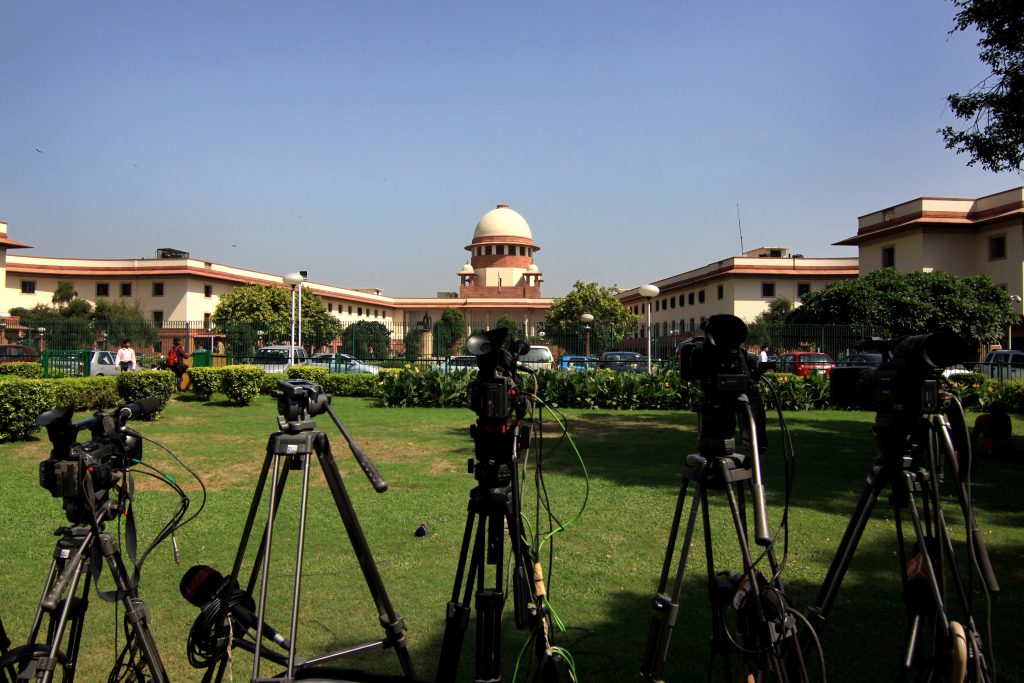
The five-judge bench of the Supreme Court headed by CJI DY Chandrachud has struck down the controversial electoral bonds scheme brought by Modi govt and ruled that information about funding of political parties is essential for effective exercise of the choice of voting, writes Mudit Mathur
In a historic judgment, the Constitution Bench of five Supreme Court judges has struck down controversial electoral bonds scheme brought by Narendra Modi government, for being violative of the Article 19(1)(a) of the Constitution of India. Information about funding of political parties is essential for the effective exercise of the choice of voting, it ruled.
The Apex Court pronounced a unanimous decision, with Chief Justice DY Chandrachud delivering the lead judgment with justices BR Gavai, JB Pardiwala and Manoj Misra while Justice Sanjiv Khanna penned a concurring judgement with a slightly different reasoning.
While directing the State Bank of India to stop issuing electoral bonds, it further directed the SBI to issue details of the political parties which received electoral bonds and all the particulars received and submit them to ECI by March 6. The SBI shall furnish bonds, purchase details with date of purchase, name of purchaser and denomination. The SBI shall also submit details of parties who received contributions through Electoral Bonds. The bank should disclose details of each bond encashed. By March 13, ECI shall publish this information on its official website. Electoral Bonds, which are not encashed by political parties, shall be returned and refunded to purchasers, the bench ruled.
Congress leader Jaya Thakur, the Communist Party of India (Marxist), and the non-governmental Association for Democratic Reforms have challenged the Electoral Bond scheme through Finance Act, 2017 before the apex court on the ground that they have opened doors to unlimited, unchecked funding of political parties. The petitions also raised the issue that the Finance Act could not have been passed as a Money Bill.
The Modi government has introduced Electoral bonds scheme through the Finance Act, 2017, which, in turn, amended three other statutes – the RBI Act, the Income Tax Act and the Representation of People Act – to enable the introduction of such bonds. The court held amendment to Section 29(1)(c) of RPA and IT Act amendment is declared to be unconstitutional. The amendments to the Companies Act are unconstitutional. It noted that the infringement to the right to information is not justified with the stated purpose of curbing black money.
The electoral bonds scheme allows donors to anonymously send funds to a political party after buying bearer bonds from the State Bank of India (SBI). Through it, companies and individuals in India can make anonymous donations to political party. Rs 16,518 crore worth of electoral bonds were sold from 2018 to the start of 2024, the government recently informed Parliament. It was revealed under Right to Information Act that from January 2 to January 11, 2024 the Electoral bonds worth more than Rs 570 crores have been sold in the latest phase of the sale.
Chief Justice of India DY Chandrachud, while reading out the judgment, also said that financial contributions to political parties are made either to support it or in fulfilment of a quid pro quo arrangement. Right to privacy of political affiliation does not extend to contributions made to influence public policy and applies only to contributions below the threshold, the bench stressed.
The bench noted that under the scheme, while the ruling party would have the identity of the donors, no opposition party could have it.
Reading out settled view on the issues raised before it during arguments, Justice Chandrachud expressed, whether right to information under 19(1) includes right to know about political funding? “I lay down our reasonings and conclusions now. This Court recognised the right to information about social, cultural, political, and economic issues … and that it is not limited to State affairs but to further participatory democracy principle.”
“Political parties are relevant political unit in the political process. Information about political funding is essential to exercise correct choice of voting. Economic inequality leads to differing level of political engagements. Access to information leads to influencing the policy making and also leading to quid pro quo arrangements may also help a party by the party in power, Electoral Bonds scheme is violative of right to information under Article 19 (1)(a),” the Could held.
“Fundamental right to privacy includes a citizen’s right to political privacy and political affiliation. Information about a citizen’s political affiliation can lead to subjecting a citizen to curbs or subjecting them to trolls. It can be used to disenfranchise voters through voter surveillance. Book purchase history shows the ideological leanings, etc., can lead to gauging political affiliations. Financial contribution to political parties are generally for support to party or for quid pro quo. Law as of now allows it by corporations and individuals. When the law permits political contributions, showing political support, it is duty of constitution to protect them. Some contribution is also for not major parties and it is generally to show support,” the Chief Justice emphasised.
The Congress Party welcomed the decision of the Supreme Court and demands that SBI should put all the information in the public domain, so that the public can know who gave how much money. This scheme was brought by the Modi government in the form of a Money Bill, so that it could be passed directly without discussion in the Rajya Sabha, it said. “What has BJP sold in exchange of the Rs 5200 crore it has received in Electoral Bonds. “We fear that another ordinance may be issued again and the Modi government may be saved by this decision of the Supreme Court,” apprehended Pawan Khera Chairman of Media and Publicity Department of the party.
Far-n-Wide :– Despite PML-N not getting a majority, Nawaz Sharif, a 3-time PM, may get another chance to lead the government with the Army’s backing. While India is circumspect, Beijing is now firmly poised to play a pivotal role in India’s north-western region. by Gopal Misra
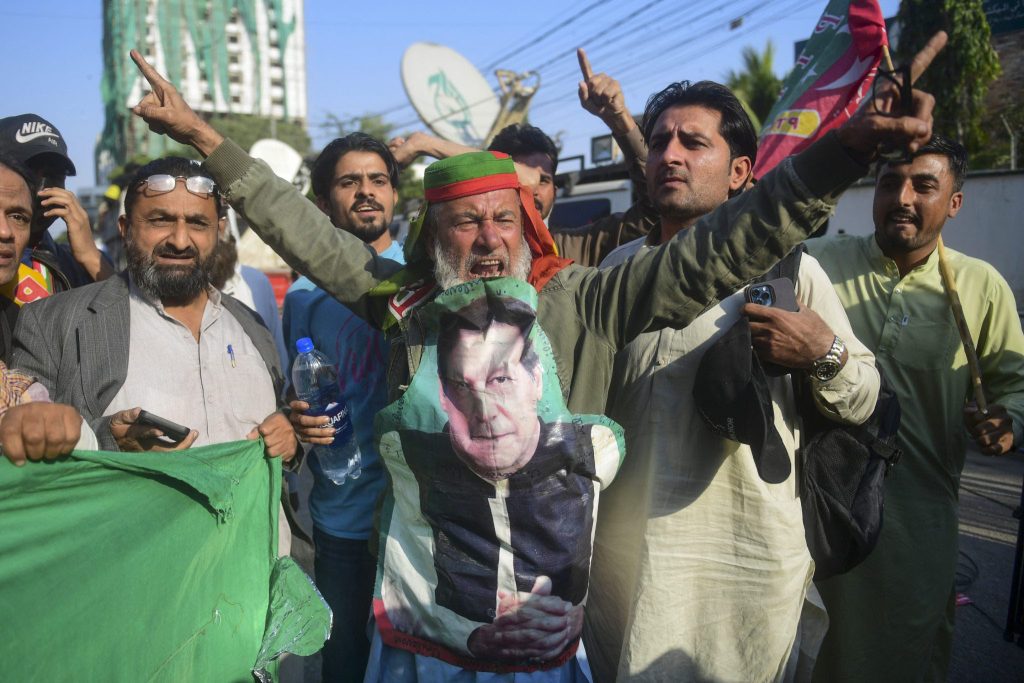
With a hung National Assembly in the delayed 2024 polls in Pakistan, Beijing is now firmly poised to play a pivotal role, if not assertive, in India’s north-western region. In spite of his party, Pakistan Muslim League-Noon (PML-N), not getting a majority, Nawaz Sharif, a three-time prime minister, is expected to get another chance to lead his country’s civilian government. It is yet to be ascertained whether his return to power in Islamabad would ease relations with India. It is, however, certain that China would be reviving the much-delayed China-Pakistan Economic Corridor (CPEC). Despite pumping billions of US dollars in the project, it was shelved since 2018, when the cricketer-turned politician Imran Khan came to power.
The National Assembly was dissolved in August 2023, and under its basic law, the elections should have been held before the end of the year. With the failure of PML-N not getting a clear mandate, it is now preparing to form coalition governments at the federal level as well as in Punjab with the Pakistan People’s Party (PPP). With a presence of a large number of independent law makers having affiliations with Imran Khan’s Pakistan Tehreek-i-Insaf (PTI) in the National Assembly as well as in Punjab province, the political governments are expected to be much weaker to tackle financial issues and ethnic clashes, including the Jihadists led by Tehrik-i-Taliban Pakistan (TTP).
The allegations of rigging of the polls amidst countrywide violent clashes accompanied by a software, believed to have been obtained from China, for counting ballots have created doubts about the legitimacy of the elections. Further, it was a nightmare for the country with 12.8 crore voters to locate their respective polling stations due to the deliberate closure of the mobile services during the polling day. The presence of a large number of independent law makers in the National Assembly could be attributed to the fact that PTI was stripped of its electoral symbol, a cricket bat, forcing its candidates to run as independents. The country also witnessed violence on the polling day. A blast hit Balochistan, instantly killing 26 on the spot, and wounding scores of people nearby.
International Appeals Ignored
In spite of the repeated appeals of the KeepItOn coalition, a global network of over 300 organizations from 105 countries, to the caretaker Prime Minister Anwaar ul-Haq Kakar and Chief Election Commissioner Sikandar Sultan Raja, mobile services and internet were shut-down. The voters needed to send an SMS to the number 8300 to obtain details on where they should vote, but many were struggling to find the right place. It is believed a substantial number of people could not exercise their franchise.
The concern expressed by Liz Throssell, spokesperson for the United Nations High Commissioner for Human Rights, says that “We are disturbed … by the pattern of harassment, arrests and prolonged detentions of leaders of the PTI and its supporters even during the election period. Multiple legal cases have been brought against former Prime Minister Imran Khan, which have disqualified him as a candidate and sentenced him to long prison terms. We expect that the higher courts will carefully review these conclusions in line with applicable due process and fair trial rights. All eligible parties must be able to compete fairly.”
Huong Le Thu, the deputy director of the Asia program at the International Crisis Group, has cautioned that “a disputed poll would damage the incoming government’s legitimacy, leaving it ill-equipped to deal with the political and economic instability that is sure to follow.” Majid Nizami, an election analyst in Lahore, suggested that the way the elections have been conducted marks a step backward. “The impact would be negative on Pakistan’s democracy,” he cautioned.
Chinese Diplomatic Offensive
With the expected return of Nawaz Sharif back to power in Islamabad, Beijing is set to initiate a massive diplomatic initiative. Since Russians continue to be bogged down in a two-year old fratricidal war with Ukraine, Dragon’s influence in Central Asia has increased manifold. In the West Asian regions, including the Gulf countries, China is quietly emerging in an assertive role. It has already established its strong diplomatic presence by brokering peace between Saudi Arabia and Iran. Their foreign ministers were summoned to Beijing to be told to resume diplomatic ties; they meekly abided by the instructions. Also, China successfully diffused the brewing violent clashes between Iran and Pakistan in January 2024.
The initial response of the scholars and political analysts keenly watching political developments in Pakistan across the continents has been unanimous that with the army, having close ties with China, meddling in the polls and imminent return of Nawaz Sharif to power, the decks appear to have been cleared for massive financial and strategic interference of China in the region, and in Pakistan particularly. With the departure of the US-led western powers from Afghanistan, China has an open field to assert its military might and pursue its economic interests. The initial concerns regarding rigging in the polls from the U.S. and U.K. indicate that the West has already lost its clout in the region.
India’s Concern
In India, in spite of Nawaz Sharif’s pro-India rhetoric, he is not trusted by the Indian establishment irrespective of the political outfit or coalition ruling in New Delhi. The trust deficit had increased manifold following the Kargil War that too soon after the visit of the then PM Atal Behari Vajpayee.
Nawaz Sharif has repeatedly alleged that the army had initiated Kargil operations without his consent, but this time, he came to power with the help of the army. So it is quite doubtful whether he would succeed in improving Pakistan’s ties with India. Also, in spite of being sacked, humiliated, convicted and jailed, the former Pakistani PM, Imran Khan’s supporters form the strongest group in the new national Assembly. They have been elected without the party’s symbol. A number of them might be joining the ruling coalition. Khan has already congratulated his followers on X for their excellent performance in the polls. He and his supporters might not accept the verdict of the elections, thus again plunging Pakistan in a political and financial cesspool.
The poll results indicate only partial success for Nawaz Sharif. He wins a seat in Lahore, but loses to the PTI-backed Shahzada Gastasap in Mansehra constituency. Interestingly, the ISI-backed Talha Saeed, son of the dreaded terrorist Muhammad Hafiz Saeed; and Jamiat Ulema-e-Islam (F) chief, Fazlul Rehman suffered humiliation by being trounced by their rivals. Talha received only about two thousand votes. Hafiz Saeed, who had masterminded the deadly 26/11 attacks in Mumbai, recently floated Pakistan Markazi Muslim League (PMML). The PTI leader, Ali Amin Gandapur, thrashed Fazlul Rehman with 93,443 votes to 59,922 votes.
Both Bajwa and Faize Hamid are known to be against the elevation of Asim Munir. He got the coveted position of the army chief during the tenure of the coalition government led by PM, Shehbaz Sharif, younger brother of Nawaz.
Bajwa and Faize Hamid, though superannuated, continue to have a sizable following in the defence forces.
The apprehension is that the power struggle might shift from the political arena to the barracks, where Imaran Khan continues to have sizeable support. India has to be concerned with these developments in the immediate neighbourhood.
The BJP’s upbeat mood is in no way its insurance for the immediate future: read 2024 elections. The Opposition can halt its speed by coming together and adding to its kitty as many seats as possible. BY KUMKUM CHADHA
G 20 over; India’s robotic Moon landing accomplished; its Sun mission launched; Ram Mandir completed; White paper done; Black paper released; Congress blackened; Nehru defamed; Prime Minister Modi praised; BJP upbeat; the Opposition scrambling and the INDIA alliance desperate to set its house in order.
This, as of now, is the sum total of the political scenario in India which is poised to face a general election in less than 100 days this year.
Pitched in this battle are the Congress and the BJP with of course the regional parties and other small and minor players thrown in.
But the giants first, irrespective whether the Congress fits the “giant” description. As of now, the BJP certainly does.
Be it hype or ground reality, the BJP seems set to take on the electoral challenge better than most parties put together.
The reasons are many: beginning with the welfare projects launched by the Narendra Modi government; a step-up of India’s image on the world stage and aspirational Indians looking to Prime Minister Modi to drive India’s growth.
These are gains the BJP is going to drumbeat and of course cash in on even while it attempts to brush under the carpet the harsh reality of communalism and divisiveness that has been unleashed by the ruling dispensation. Add to this, the growing frustration among the unemployed and price rise which critics call “dismal”.
These were possible challenges that the saffron party would have found difficult to handle had God not come to its rescue. Literally.
Yes God, in this case, Lord Ram, seems to have descended on Earth. In one sense, he actually did on January 22 when the doors of the temple were thrown open in Ayodhya. The chants of Ram Lalla or child god returning homerent the air even as devotees thronged the temple that the VHP-RSS-BJP led by Prime Minister Modi unveiled and gifted to India.
Consequently, the BJP seems all set to package and fire its well stacked ammunition, training its guns at a weak, struggling and disjointed Opposition.
Today, when one talks of an Opposition in the Indian context, it is in two ways: one, different parties struggling to survive and another an amalgam coming together to take on the BJP.
As things stand, one does not cancel the other but as it turns out, nor does it complement. As of now the stakeholders are not on the same page, to put it mildly. For the BJP, this is god sent and hence it is doing what it takes, to stoke the fire.
However much its detractors may wish otherwise, the truth is that the BJP is in a strong position. The regional players are not strong enough to pose a challenge nationally.
Equally, it is true that the coming together of relevant parties could check the saffron party in its tracks.
It is therefore not without reason that when the INDIA alliance was formed, it made the BJP sit up.
Of course, the coming together of 26 parties was a worry but what was more unnerving was the nomenclature itself. In fact, naming the alliance INDIA was nothing short of a masterstroke. To position itself as a conglomerate which is representative of the country rather than a political party which propagates divisive politics did make the BJP nervous.
It sensed that the nomenclature had the potential of being synonymous with INDIA the nation and not a political party jostling for space: a SAVE INDIA to check those who had set out to destroy its ethos. Read the Opposition versus BJP.
True to its grain, the BJP lost no time in trying to regain the initiative. At the G-20 summit, it pushed Bharat to replace India.
For the first time, the invites sent out to Heads of State from the President of India read President of Bharat. Even Prime Minister Modi’s name card on the high-table read Prime Minister of Bharat instead of the customary Prime Minister of India.
With the I.N.D.I.A alliance starting off as well as it did, it had the potential to effectively take on the BJP. But it frittered the gains.
For starters, it dithered and lost the first mover advantage. The cracks started showing and the public spat was out in the open. The BJP did the expected: moved in swiftly, cashed in on discord, won some and wooed the rest. Bihar Chief Minister Nitish Kumar walking out of the alliance to join hands with the BJP was nothing short of a coup.
That is one part of the story. Equally crucial is the second; which is about alliance partners speaking in different voices: AAP has declared that it will go alone while the Samajwadi Party has its own angst. West Bengal Chief Minister Mamata Banerjee has kind of raised a banner of revolt by saying that the Congress will not even win 40 seats in the forthcoming elections.
Yet, those desperate to make the INDIA alliance work, are putting up a brave front, hoping against hope that things will ultimately work-out. And those who have left, are spewing venom.
Interestingly there are two targets: one within and one outside: the outside enemy is unmistakably the BJP which the Opposition wants to oust.
The other is within: the Congress.
Alliance partners are peeved at the Congress’s big brother attitude which is devoid of a give and take spirit. If Banerjee decided to go alone in West Bengal, it can be attributed to Congress’ stubbornness in demanding seats it cannot even imagine to win in West Bengal. Having said that, Banerjee has, reportedly, not downed the shutters for a national alliance: at least not yet.
This may be music to some ears except it is one which keeps losing its rhythm off and on.
The other issue is about the Congress kind of “mishandling” the alliance, rather not handling it at all, so to speak. If reports are anything to go by, partners including the JD(U), its erstwhile partner, was peeved at meetings not taking place despite reminders. A senior leader is on record stating that Nitish Kumar had to “coax” Mrs Sonia Gandhi for deliberations.
Surely, an alibi for the JD(U) given that its reasons for exiting are well known, yet the “ho jayega” and “chalta hai” attitude of the Congress made its partners feel that the Congress is not serious about making things work.
Add to this, Rahul Gandhi launched the Bharat Jodo Nyay Yatra and projected it as a solo show. This was a clear message that the Congress would prefer a piecemeal approach: to go solo when it wants and unite only if and when necessary.
Irrespective, the Opposition cannot afford to lose time or the opportunity. The BJP is on an all- time high but its upbeat mood is in no way its insurance for the immediate future: read 2024 elections.
As of now, its win may be certain but the Opposition can halt its speed by coming together and adding to its kitty as many seats as possible. And if it squanders this opportunity then it has only itself to blame. Therefore, to borrow a popular phrase: Its Time begins Now.
With Punjab farmers adamant on their “Delhi Chalo’’ tractor march to press various demands including MSP for their crops, the Haryana authorities have a tough task at hand given the skirmishes between police and farmers on day one of the agitation itself, writes Rajesh Moudgil
The Shambhu barrier on the Ambala-Patiala border turned out to be the epicentre of clashes between Haryana police and a multitudes of farmers from Punjab amid the rain of teargas shells on February 13 – the day one of their “Delhi Chalo’’ march to press for their various demands including minimum support price for their crops and loan waivers.
Not only Punjab-Haryana borders including Khanauri border which also saw skirmishes between farmers and police, tens of thousands of motorists and commuters of the national capital region (NCR), especially those bordering parts of Uttar Pradesh and Haryana, underwent harrowing times due to the Delhi authorities’ tight security at its borders.
At Shambhu border, throngs of young farmers not only made repeated attempts to uproot the cement and iron barricades, but also succeeded in removing a couple of them, physically, and throwing them into the seasonal ghaggar river running below the bridge of the Shambhu border. They could also be seen hurling stones at the drones while these dropped teargas shells.
According to reports, dozens of people including a few journalists, police personnel and farmers were hurt in the action at the two borders.
This confrontation was imminent after the second round of the talks between the farmers unions and the Union ministers over the former’s demands had failed to yield any results.
Apart from Shambhu barrier which is on the GT road (national highway No 44), confrontation between the Punjab farmers and police was also witnessed at the Khanauri border which is on national highway No 52 joining Sangrur district (Punjab) and the Jind district of Haryana. Here, too, the farmers faced teargas shells after skirmishes with police following which the latter also resorted to cane-charge. There were also reports about tension mounting on the borders of two states at Kaithal, Sirsa and Jhajjar.
Even though there were meetings among the farmer leaders to decide the future course of action, groups of women had also flocked the Shambhu protest site. The number of farmers at the Khanauri border was also said to be swelling.
They ‘came prepared’ for long haul
The Haryana authorities’ steps to thwart them notwithstanding, the protesting farmers appeared resolute and apparently prepared to counter police action. While the police used drones to drop teargas shells on the farmers, they could be seen with their faces covered with wet clothes and in many cases with headgears equipped with masks.
Besides, the tens of hundreds of farmers who had come with trolleys full of ration, utensils and even makeshift toilets appeared ready for a long stay in case of need. Scores of trolleys could also be seen loaded with firewood, fuel, fans and coolers, besides adequate beddings.
Industries, motorists suffer
Meanwhile, amid the farmers’ stir, it was the industrial and business houses and tens of thousands of motorists who suffered because of the sealed borders and stretches of the national highways connecting Punjab with Haryana. The motorists choosing diversions and alternative routes too underwent harrowing times in the wake of jams there.
The industrialists and the business houses of Sonepat and Jhajjar also bemoaned the huge losses being caused to them because of the farmers’ agitation as they recall how they suffered huge losses during the 2020-2021 stir. Similar views came from the industries cluster of Bahadurgarh which has Tikri border where tension was also said to be mounting due to the farmers’ stir.
HC for protest at designated area
Meanwhile, the Punjab and Haryana High Court which was hearing a plea against the suspension of internet services in Haryana and sealing of state borders in view of the farmers’ march, has suggested that the states should identify a designated area for the protesters.
The High Court has issued notices asking the Punjab, Haryana and Union government for a status report and favoured resolving the dispute by urging the parties involved to sit down and solve the problem on February 15.
Notably, the High Court has also questioned the Haryana government for putting the blockades on the highways in view of the farmers’ march. “Keeping in view the exigencies of the situation and the general hardship being caused to the public, the court is sanguine that all the parties to the present dispute would make efforts to sit down and solve the problem, and even if a demonstration has to take place, an area should be identified by both the States to allow peaceful agitation by the protesters,” the bench of acting Chief Justice G S Sandhawalia and Justice Lapita Banerji said.
The Bench also directed that the Kisan Mazdoor Morcha and Samyukta Kisan Morcha (non-political) should be made “necessary respondents’’ and the state of Delhi, through its Home secretary, was also directed to be made a “necessary party’’.
The Bench further held that it was undisputed that the right to free passage of the public at large was to be balanced with the right to freedom of speech and expression and none of them existing in isolation could be put forth so that the public was not put to any inconvenience.
However, Additional Solicitor-General of India Satya Pal Jain told the Bench that two meetings had been held to resolve the issues raised by the agitators and were attended by union ministers and secretaries. Haryana Additional Advocate-General Deepak Sabharwal submitted that Haryana had taken necessary precautions having received an advisory from the Union of India and that there was an apprehension that the tractor-trailers had been modified to storm barricades. The protesters were also equipped for a “long sit-out’’, he said.
However, the Punjab Advocate-General Gurminder Singh held that Punjab had not set up any barricades or hindrances to ensure free movements on the highways since the protest was peaceful.