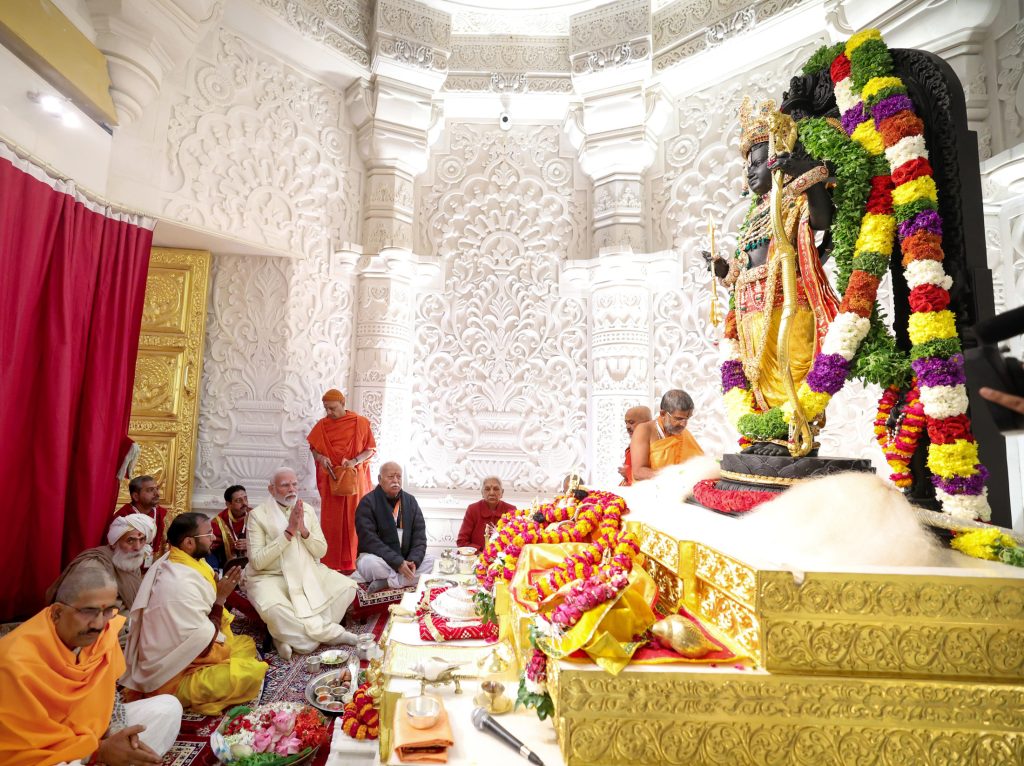
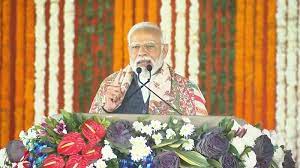
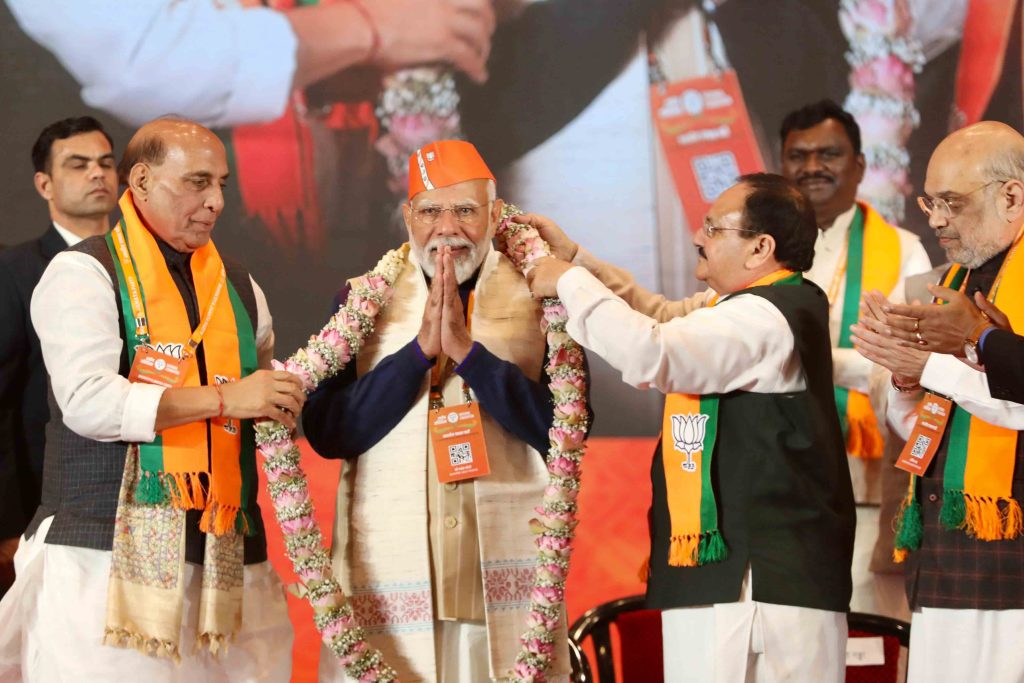
PM at the Pran Pratishtha ceremony of Shree Ram Janmaboomi Temple in Ayodhya, Uttar Pradesh on January 22, 2024.
Of all the pushes that the BJP has made to fulfil its ‘Mission South’ till now, the masterstroke was that the idol of Ram Lalla for Ayodhya’s Ram temple was made by an artiste from the South. by R Dyes
The Lok Sabha polls are just a few months away and the BJP which till now has not had much success in its ‘Mission South’ is yet again looking to make inroads into South India.
If the saffron party’s focus in the 2019 LokSabha elections was making its presence felt in the eastern states, in this year’s General Elections, its focus will be on getting a firm footing in the southern states, where despite many efforts in the last eight years the party has made limited gains.
The five southern states of Telangana, Karnataka, Kerala, Andhra Pradesh and Tamil Nadu together account for 129 LokSabha seats, hence they play a major role in government formation at the Centre.
Despite the fact that the party swept North India in the 2014 Lok Sabha polls and West India in the 2019 General Elections, the BJP is not sitting on its laurels and is keen to conquer the East and the South to fulfil its national ambitions.
Also, as the party is seeking a third term at the Centre it is bound to be worried about the anti-incumbency factor because not every vote is riding on the Hindutva wave.
So, just as insurance it wants to establish itself in the states that have eluded it till now so that there is no threat to its national ambitions at all and it can fulfil its ambition of ‘Akhand Bharat’ in the long run.
However, the BJP has not been able to make an impact in the South as yet in the last nine-and-a-half years. It won and then lost the gateway to the South, the state of Karnataka. But it has not been for the lack of trying.
The NarendraModi-led Government at the Centre has been wooing the South Indian people with its infrastructure push with the Prime Minister, Home Minister and Finance Minister making frequent visits and big-ticket announcements for development projects there, including the launch of Vande Bharat trains.
They have also been playing the inclusivity card for the last few years by increasing the representation of influential figures from the South in key bodies and by giving them important positions.
For instance, Lingayat strongman BS Yediyurappa has been a part of the Parliamentary board committee of the BJP since 17 August 2022 which is the highest office of authority in the party and Telangana’s Dr K Lakshman is the National President of the party’s OBC Morcha since 26 September 2020.
As part of its southern push, the BJP also held its national executive meeting in Madhapur in Hyderabad in 2022 and it has been trying to bridge the North-South cultural divide by hosting events like the two Kashi-Tamil Sangamams where prominent Tamilians were invited as part of a cultural exchange and to revive the age-old links between Kashi and Tamil Nadu.
However, the North-South divide which is based on the intrinsic nature, culture and mindset of the populace of the two poles of the country is not that easy to bridge.
The South is vastly full of educated, thinking people who don’t get swayed by religion, they are more economically dynamic and socially progressive, their society is almost matriarchal, and they are of a scientific temper and open to research, innovation and entrepreneurship. Plus they have by and large controlled their population, which is a boon of education.
And this is not something that has happened now. This was true of the South way back in the 50s also. Soon after India became Independent. Dr BR Ambedkar, hit the nail on the head when in his book ‘Thoughts on Linguistic States’ he wrote, “There is a vast difference between the North and the South. The North is conservative. The South is progressive. The North is superstitious, the South is rational. The South is educationally forward, the North is educationally backward. The culture of the South is modern. The culture of the North is ancient”.
Also, the tall regional leaders like MK Stalin and Pinarayi Yijayan among others, that dominate the political firmament of the South are not going to make it easy for the BJP to make inroads into their domain.
For instance, in Tamil Nadu, the DMK-led ruling coalition is trying to stall the BJP’s push into its domain by showcasing its welfare schemes, harping on its Dravidian roots, the work it has done for the people and the investments that are coming into the state on the back of improved law and order provisions.
In Karnataka, which the BJP won and lost in the Assembly elections, the party is battling anti-incumbency and is thinking of bringing in new faces. It just got a boost by the return of former Karnataka Chief Minister Jagadish Shettar to its fold after he left for the Congress in April 2023.
However, its biggest rival in the State, the ruling Congress too is exploring potential candidates in Bengaluru city and other constituencies. Names like Mrunal Hebbalkar and Priyanka Jarkiholi are being bandied about for Belagavi. The grand old party is looking for a new Lingayat face in Dharwad and Muslim candidates may be fielded in Haveri and Bengaluru Central to counter the saffron push.
Plus the Karnataka Government has fulfilled all its five poll guarantees in the time it has been in Government and it is reminding the people that it kept its election promises while the BJP and JD-S did not.
In Telangana, there will be a direct fight between the BJP and the Congress as the BRS which was just rejected in the Assembly polls has no role in national politics.
The ruling Revanth Reddy Government is stressing the point that the Congress, which is a part of the INDIA bloc, is a strong alternative to the BJP. It will also corner the BJP on issues that have a lot of resonance with the people like unemployment, polarisation, inflation and farmers’ woes.
Kerala has always been a tough nut to crack for the BJP as the Muslims at 26 per cent and Christians at 18 per cent collectively make up 44 per cent of the population of the state. Now, with the spectre of Manipur violence and bulldozer justice haunting the minority communities, the chances of the saffron party making inroads into the state look slim.
However, the party that is known for its tenacity is not giving up and is trying its best to woo the South and will ramp up its efforts in the months to come, led by the top party leadership.
One will not be surprised if there are big ticket announcements in the Interim Budget for projects in the South.
However, of all the pushes that the BJP has made to fulfil its ‘Mission South’ till now, the masterstroke was that the idol of Ram Lalla for Ayodhya’s Ram temple was made by an artiste from the south, Karnataka’s ArunYogiraj portraying the deity as a five-year-old.
In a country like India where religion means so much to people, in one saffron stroke the BJP has bridged the North-South divide at least on the spiritual level.
It has given Hindus in the South the ownership of Ram Lalla in the North. Will the Hindus of the South be able to resist the lure of Ram Lalla pulling at their heartstrings? Will Ram Lalla open the door to the South for the BJP, only time will tell.
EAM S. Jaishankar has expounded India’s contemporary foreign policy imperatives accompanied by its strategic concerns. He explains that India’s pragmatic world-view has enabled her to adopt a dynamic approach towards global issues. by Gopal Misra
The two high-profile interactions were held among the major players in geo-politics during February 2024. The first was held at Munich (Feb 16-18), where the world leaders of IT industries were present, while the other concluded in New Delhi on February 23. They have set in motion a new perspective towards the global challenges having both national and international issues.
At the Raisina Dialogue in New Delhi as well as during the discussions in Munich, Indian External Affairs Minister S. Jaishankar successfully expounded India’s contemporary foreign policy imperatives accompanied by her strategic concerns. He candidly talked about India’s multi-level approach towards world issues. In New Delhi discussions, however, he strongly voiced his disapproval of other countries meddling into the ‘tense’ India-China relationship.
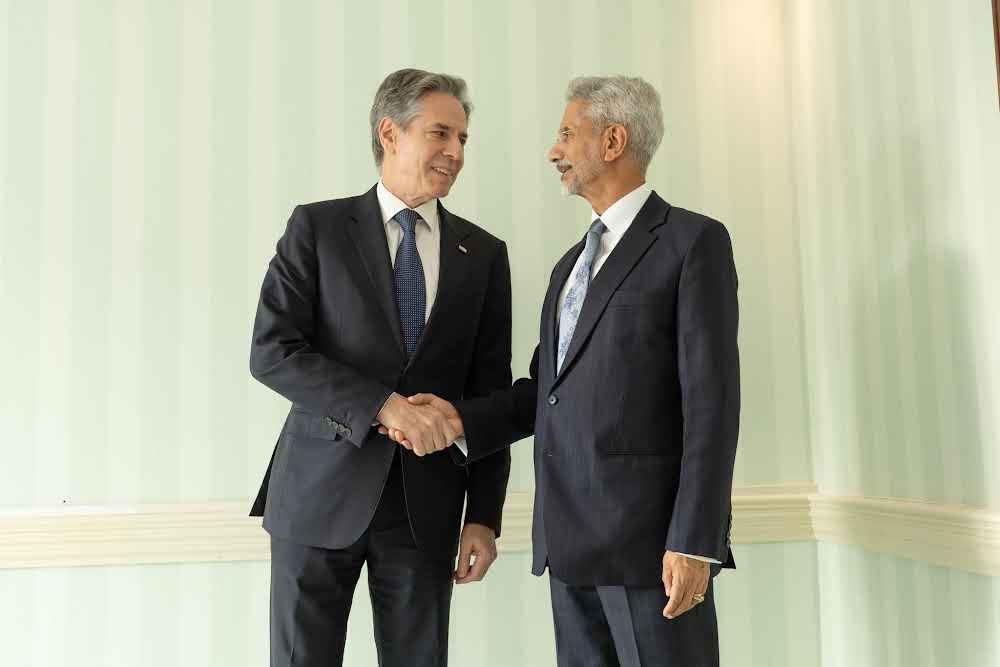
During the discussions on the sensitive security issues in Munich, Jaishankar presented India’s concerns in the presence of the US Secretary of State, Antony Blinken, Ethiopian Prime Minister Hailemariam Desalegn and a number of high-ranking participants from Africa, Europe and Asia. He also briefly met his Chinese counterpart, Wang Yi on the sidelines of the Security Conference.
Much to the dismay of many security experts in New Delhi awaiting peace finally dawning on the Indo-Tibetan borders, there was no diplomatic breakthrough between India and China for a permanent peace initiative. It means that the stand-off between Indian and Chinese troops in the High Himalayan region of Eastern Ladakh, will continue to haunt the fragile relationship between the two Asian giants despite the brief meetings between their top diplomats. The India-China relations have remained frozen since May 2020 when the People’s Liberation Army (PLA) amassed troops in the high Himalayas that had triggered off a deadly clash.
Addressing the AI Challenges
The conference attracted worldwide attention due to the presence of high-tech companies deciding not to encourage use of artificial intelligence (AI) for election purposes. It is considered a groundbreaking move of the major technology companies to voluntarily adopt measures aimed at preventing the malicious use of artificial intelligence (AI) tools to disrupt democratic elections globally. The pact, announced at the Munich Security Conference, included executives from Adobe, Amazon, Google, IBM, Meta, Microsoft, OpenAI, TikTok, and Elon Musk’s X among others.
The framework focuses on addressing the threat posed by AI-generated deepfakes, which can intentionally deceive voters by manipulating images, audio and video. While the accord is largely symbolic, it marks a significant step towards addressing the growing concern of AI misuse in the political landscape. Twelve additional companies, including chatbot developers Anthropic and Inflection AI, voice-clone start-up ElevenLabs, chip designer Arm Holdings, and security companies McAfee and TrendMicro, have also joined the initiative.
The statement of Nick Clegg, President of Global Affairs for Meta, is being noticed worldwide. He has emphasized on the collective responsibility to address the challenges posed by AI technology. He further stated, “Everybody recognizes that no one tech company, no one government, no one civil society organization is able to deal with the advent of this technology and its possible nefarious use on their own.”
The announcement comes at a crucial time, with over 50 countries, including India, scheduled to hold national elections in 2024. Recent instances of AI-generated election interference, such as robocalls mimicking U.S. President Joe Biden’s voice and AI-generated audio recordings impersonating political candidates, highlight the urgency of addressing this issue.
It is hoped that in future, the issue will also be focussing on the possible use of AI in warfare.
Indian Foreign Policy Redefined
India External Affairs Minister S. Jaishankar’s observation that India is not the West or she is anti-West received wide-spread attention. He further clarified, “We try to explain what are the different pulls and pressures that countries have. It’s very hard to have or evolve any uni-dimensional relationship.”
“I do not want you, even inadvertently, to give the impression that we are purely and unsentimental transactional. We are not. We get along with people, we believe in things, we share things, but there are times when you are located in different places, different levels of development, different experiences, all of that gets into it,” Jaishankar added.
He explained India’s pragmatic world-view which had enabled her to adopt a dynamic approach towards global issues. Many in India who consider the policy of non-alignment a ‘holy cow’ or a non-negotiable agenda, might find his statement outrageous; however, he appeared to be in good humour, when he stated, “If India moves from “non-alignment” to multi-alignment, why should that be a problem? If I am smart enough to have multiple options, you should be admiring me. Is that a problem for others? ” India’s top diplomat made this remark in response to the moderator explicitly referenced India’s ongoing procurement of crude oil from Russia despite Moscow’s invasion of Ukraine.
Another Perspective
It is being stated that the recent observation of Nikki Haley, an aspiring Republican presidential candidate, regarding India-US ties is, perhaps self-explaining. She has stated that India wants to be a partner with the US, but currently lacks trust in American leadership. She also mentioned before a television channel that India has strategically stayed close with Russia in the global situation; because India doesn’t trust American leadership, and as of now, India sees the United States as weak.
“I have dealt with India too. I have got to say, I have dealt with India too. I have talked with Modi. India wants to be a partner with us. They don’t want to be a partner with Russia,” she said. “The problem is, India doesn’t trust us to win. They don’t trust us to lead. They see right now that we’re weak,” she added.
She further stated that India has always played it smart. They have played it smart, and they have stayed close with Russia, because that’s where they get a lot of their military equipment.”
“When we start to lead again, when we start to get the weakness out and stop putting our head in the sand, that’s when our friends, India, Australia, New Zealand, all of them will — and Israel, Japan, South Korea — all of them want to do that.”
Raisina Dialogue
The Raisina Dialogue inaugurated by Indian Prime Minister Narendra Modi with his Greek counterpart, Kyriakos Mitsotakis as the chief guest has also attracted the attention of policy makers and scholars across the continents, who have been apprised of Indian perspectives. The Raisina Dialogue is held every year, and its ninth edition this year was jointly organized by the Ministry of External Affairs, and Ambani’s Observer Research Foundation, a policy research outfit. Its theme this year was “Chaturanga: Conflict, Contest, Cooperate, Create,”
More than 2,500 delegates from around 115 countries attended the meeting highlighting the dialogue’s global importance. It delved into crucial topics across six categories: Tech Frontiers: Regulations and Realities; Peace with the Planet: Invest and Innovate; War and Peace: Armouries and Asymmetries; Decolonising Multilateralism: Institutions and Inclusion; The Post-2030 Agenda: People and Progress; and Defending Democracy: Society and Sovereignty. The participants included ministers, national security advisors, high-ranking officials, diplomats and representatives from various sectors worldwide.
While Pakistan awaits the outcome of the general election in India slated for May-June, it should be mindful of the fact that abrogation of Article 370 has altered the complexion of Kashmir issue. So now, the two countries would need to evolve new terms of engagement. A report by Riyaz Wani
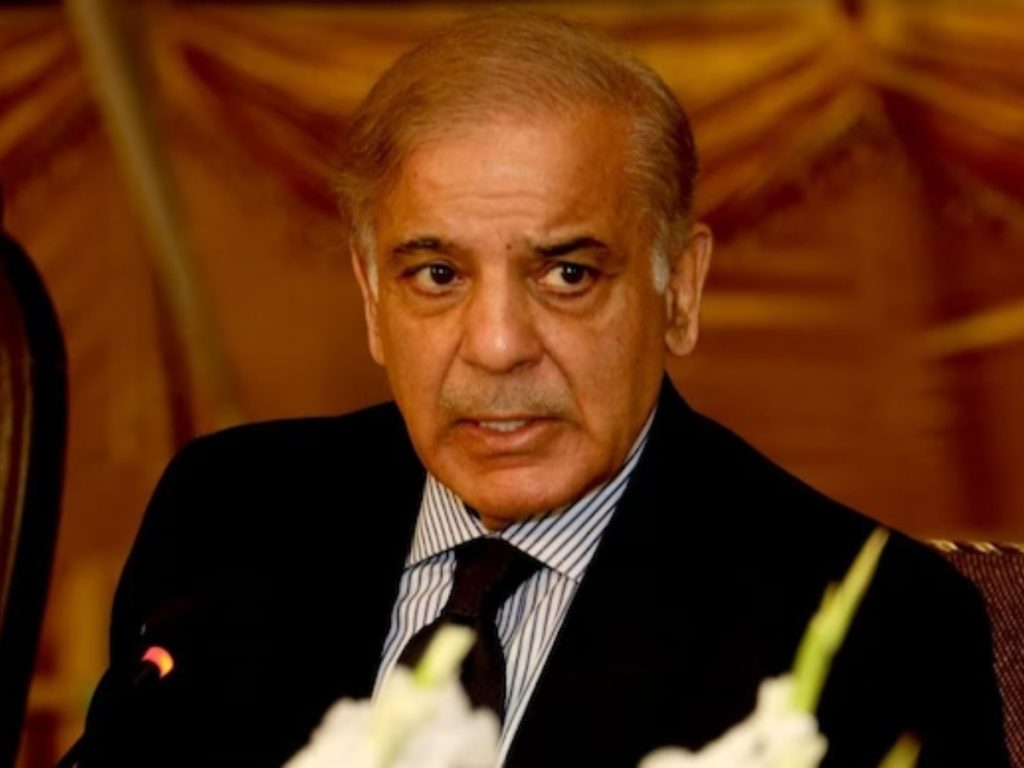
What does the takeover of Shehbaz Sharif-led coalition government mean for Kashmir and India-Pakistan engagement? Apparently, not much. The new PML-N and Pakistan People’s Party (PPP) coalition will take over amid credible allegations that the elections were brazenly rigged to ensure their return to power. But despite that, the independents backed by Pakistan Tehreek-i-Insaf (PTI), the incarcerated Imran Khan’s party, got the largest number of seats. The party, however, has refused to ally with either the PML-N or the PPP, with the result that it won’t be able to form the government. Also, given the party’s difficult relationship with the Pakistan Army, it is unlikely that the PTI-backed independents would get the necessary support to lead a coalition government of their own. So, Sharif is the country’s new prime minister.
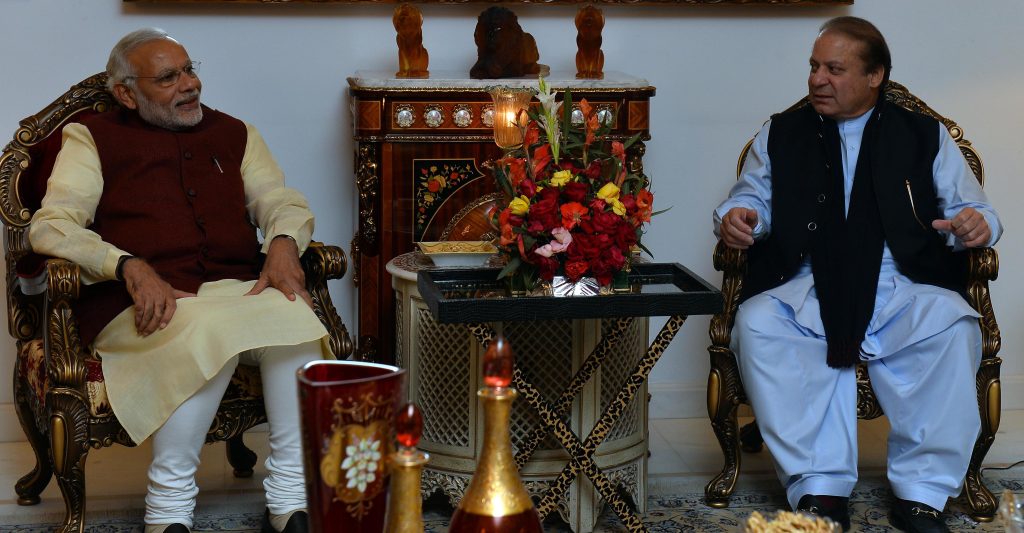
From India’s point of view, Sharif as the Pakistan PM holds more promise for friendly bilateral relations than Khan, who in his term in office adopted a fiercely hawkish stance towards India, especially towards Prime Minister Narendra Modi. But the Sharif family is known to be more reconciliatory in its approach towards India, and there is hope that the new Pakistan prime minister will take steps to restore some kind of a relationship with India. When PM Modi was sworn in 2014, Nawaz Sharif was among the invited regional leaders who had visited India for the ceremony. And later in 2015, Modi made an impromptu visit to Lahore to attend the wedding of Sharif’s granddaughter. But the bonhomie between the two countries was cut short when the militants traced to Pakistan attacked an Army base in Pathankot. From thereon, the relationship went steadily downhill reaching its nadir when New Delhi abrogated Article 370 of the constitution in August 2019.
The neighbours tried to pick up the pieces with the surprise re-affirmation of the 2003 ceasefire along the Line of Control in February 2021. Ever since, however, they have failed to build upon the truce and restore the dialogue process between them.
Would Modi-Sharif be able to pull it off? Chances don’t seem bright enough. This is despite the fact that even the Pakistan Army is reportedly in favour of resuming dialogue with New Delhi. But inherent limitations of the new ruling arrangement in Pakistan will make it difficult to reach out to New Delhi and institute a process of dialogue. This points towards a possibility for restoration of some engagement. But as is the case with India-Pakistan ties, nothing can be said with certainty until things actually turn around. This is because the conditions for engagement between the neighbours remain irreconcilable. Pakistan wants to place Kashmir at the front and centre of its dialogue with New Delhi which is unacceptable to India. Pakistan also wants India to restore Article 370 that granted J&K its semi-autonomous status within India, which, again, India sees as irreversible. More so, after the Supreme Court endorsed the Modi government’s move, making the constitutional provision’s abrogation a fait accompli. The unmistakable signal to Pakistan is to temper its expectation about the extent to which India can accommodate it on Kashmir. In fact, New Delhi now wants Kashmir off the table in any future discussion with Islamabad. The only issue about Kashmir that is pending resolution, according to India, is the Pakistan Occupied Kashmir (PoK) which New Delhi wants to be returned to and even threatens to take it back through a military operation.
As for talks with Islamabad, India, as always, wants terrorism to be the central issue and wants Pakistan to stop supporting militancy in Kashmir. Pakistan of course doesn’t accept that it backs terrorism.
But it was with these irreconcilable positions intact that the two countries in February 2020 agreed to reinstate their 2003 ceasefire along the Line of Control and made positive noises signaling a return to dialogue. But they failed to build on the goodwill as any such effort was undone by New Delhi’s refusal to concede on Kashmir. There have been no further measures, nor does it look likely there will be in the near future. New Delhi seems in no hurry to do this. If anything, this only goes on to show that India feels little need to relent and wants Pakistan to reconcile with the new status quo. But Pakistan seems unlikely to do so. More so, under a government that lacks legitimacy in the eyes of a large majority of its people following an election where Khan’s PTI was the obvious choice of an overwhelming majority of the voters.
As for India’s concerns about Pakistan fanning violence in Kashmir, Islamabad in recent years has appeared less than eager to support flagging militancy in Kashmir Valley. More so, following the abrogation of Article 370, when a section of public opinion in Kashmir and the rest of India expected otherwise. Albeit, Islamabad did raise diplomatic ante which, in turn, achieved nothing. This could be both because of Pakistan’s ongoing troubled economic situation and its beleaguered geopolitical standing. Or it could also be the outcome of the dominance enjoyed by the security forces in Kashmir, which has increasingly narrowed the space for militants to operate. Hence, probably, the tactical shift of militancy to the Jammu division, which had otherwise been militancy-free over the last decade and a half. The militancy in Rajouri and Poonch has witnessed a sharp rise throughout 2023 and it remains to be seen how the situation evolves in 2024.
Going forward, it looks unlikely that India and Pakistan could go back to any engagement in the near future. Immediately, however, any further progress in the relations will be subject to the outcome of the general election in India in May-June. It is believed that the re-election of PM Modi, as looks likely, and Shehbaz Sharif as Pakistan prime minister would be more conducive to resumption of dialogue between the two neighbours. They could pick up where PM Modi and former Pakistan prime minister Nawaz Sharif – brother of Shehbaz Sharif – left off in 2017 when the latter was forced out of power. However, the regional situation has since transformed. And with the abrogation of Article 370, the complexion of the Kashmir issue too has altered. So, for the two countries to re-engage, they would need to evolve new terms of engagement. And it is easier said than done. This would call for a diplomatic leap of faith, more so, on the part of Pakistan.
The venue for Prime Minister Narendra Modi’s upcoming rally in Kashmir has been shifted from Sher-e-Kashmir International Convention Centre (SKICC) on the banks of Dal lake to Bakshi Stadium in the heart of Srinagar city.
The decision comes amidst expectations of a huge turnout for the event, which is scheduled to take place on March 7.
The PM has been visiting different parts of the country ahead of the Lok Sabha polls, with his speeches focusing on how his government’s schemes have touched the lives of beneficiaries.
The shift, official sources said, was a need for a larger space to accommodate the expected influx of people.
The Bakshi Stadium, with its larger seating capacity, is deemed more suitable to host the anticipated crowd.
This will be the second visit by PM Modi to J&K since February 20, the day he addressed a massive public rally in Jammu where he also inaugurated projects worth Rs 32000 crore.
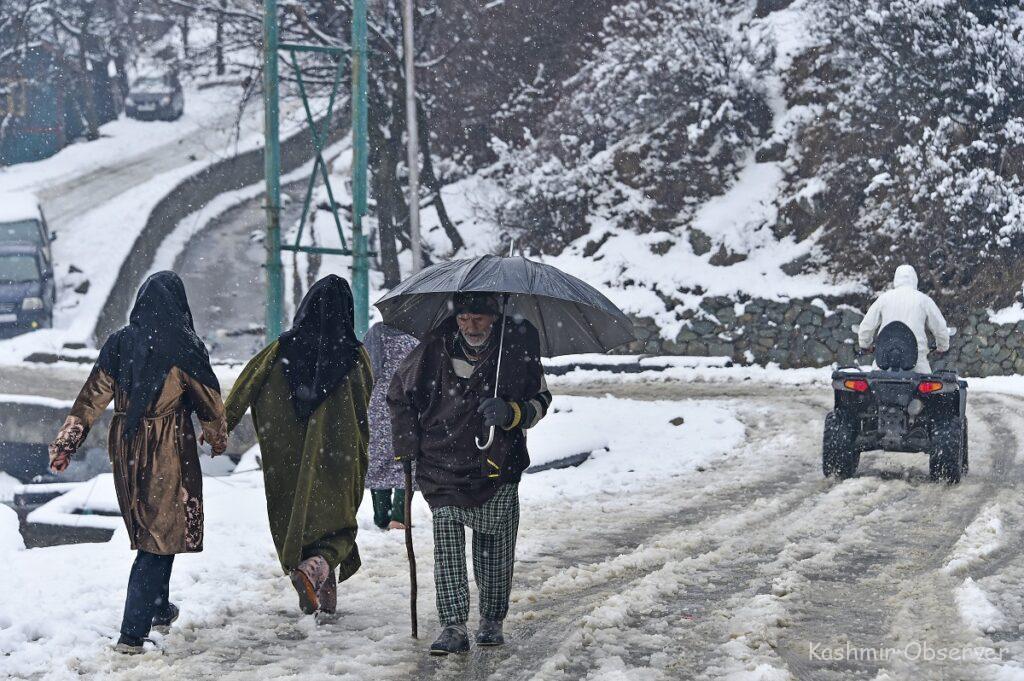
As Kashmir braces for an impending snow spell, the Meteorological Department has issued a warning indicating the likelihood of heavy snowfall and rainfall affecting Jammu and Kashmir and surrounding areas from Friday evening onwards.
The department predicts widespread moderate to heavy snowfall and rain in the region from the night of February 29th until the afternoon of March 3rd, with peak activity expected on March 2. Areas likely to be significantly affected include the Pirpanjal Range of Jammu division and the middle and higher reaches of Kashmir Division.
The anticipated weather conditions may lead to disruptions in surface and air transport, including the Jammu-Srinagar highway and other major roads in the middle and higher altitudes of J&K. The advisory urges residents in snow-bound areas to avoid venturing into avalanche-prone regions, with concerns raised about potential landslides, mudslides, and shooting stones in vulnerable areas.
In response to the forecasted snowfall, authorities have extended the winter vacation for schools in the valley by four days. Initially scheduled to reopen after a three-month break on March 1st, schools will now resume classes on March 4. This decision comes in light of the expected inclement weather conditions and the advisory issued by the Meteorological Department.
The winter vacation for students up to class 8 began on November 28th last year, while students in class 9 to 12 commenced their break on December 11th. Teachers had resumed their duties on February 21, with classwork originally slated to resume on March 1.
The Meteorological Department has cautioned that some areas, particularly the higher reaches of North Kashmir, Central & South Kashmir, and the Pir Panjal range of Jammu Division, may experience heavy to very heavy snowfall in the coming days.
Farmers have again locked horns with the Centre over demand for MSP for their crops, writesAayush Goel
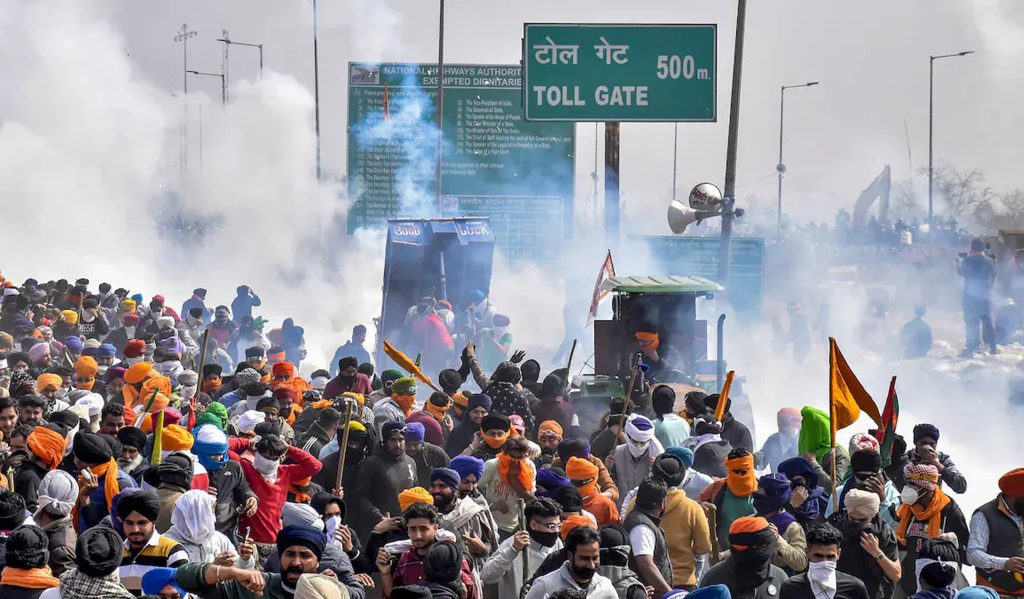
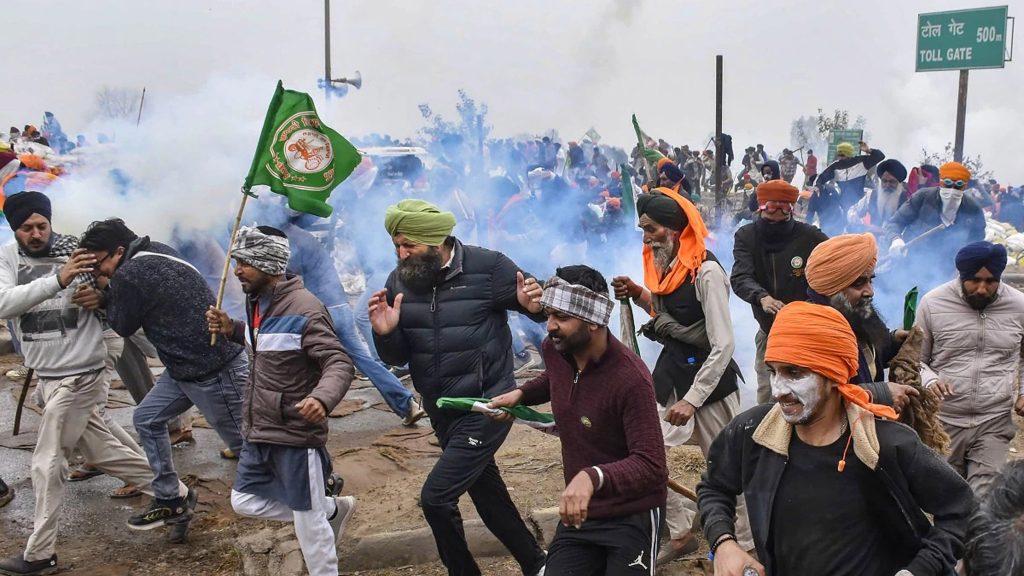
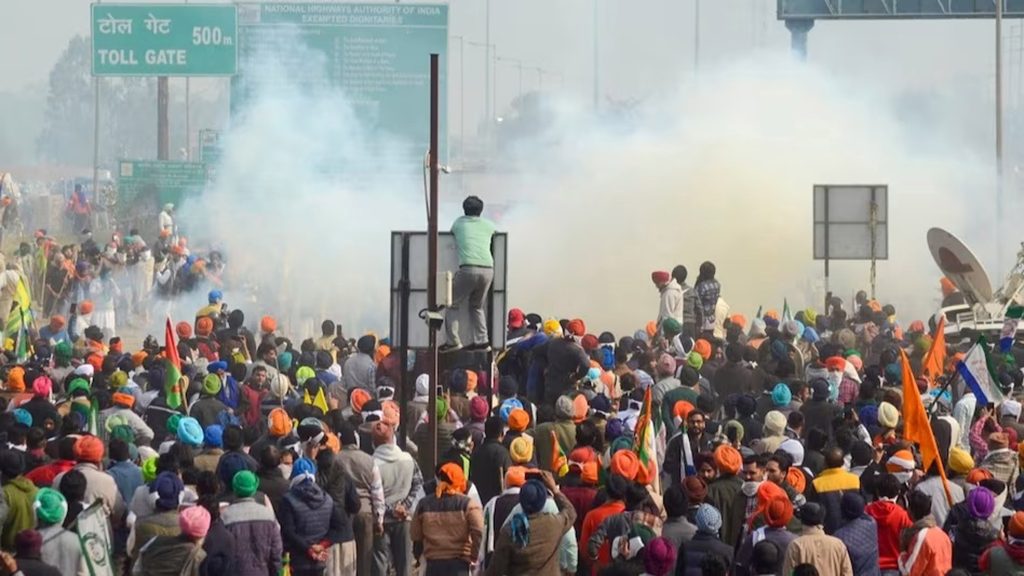
After a period of thaw lasting for almost two years, the Indian farmer movement seeking MSP for their crops has been revived. Started on February 13 with Dilli Chalo 2.0, the movement is now epicentered around Punjab-Haryana borders. Visuals of clashes between farmers and Haryana police with the latter stopping them from entering into their state en-route to Delhi, using tear gas, pellets and stones are going viral across the world while the current regime dismisses the movement as a politically motivated stint ahead of Lok Sabha elections.
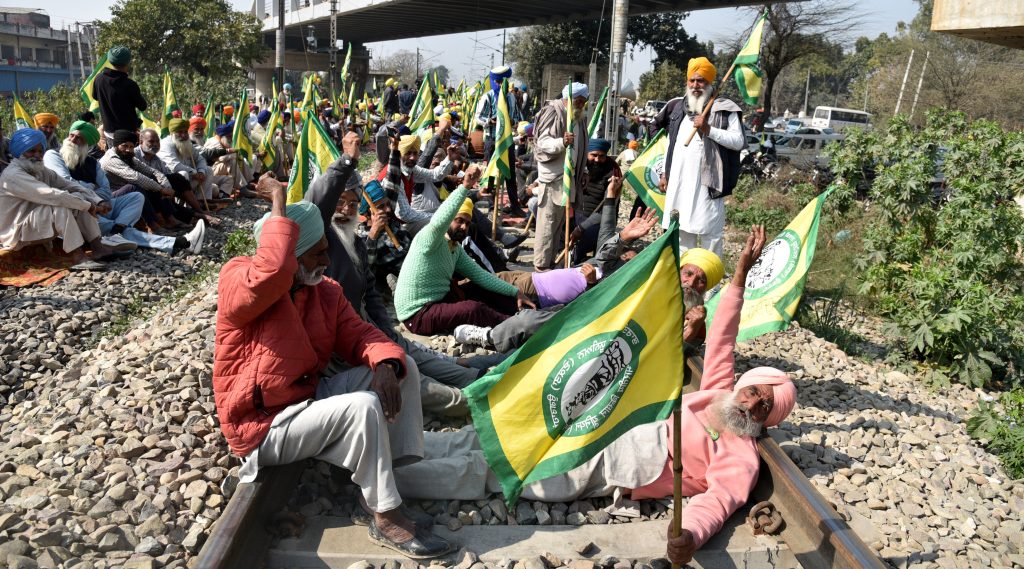
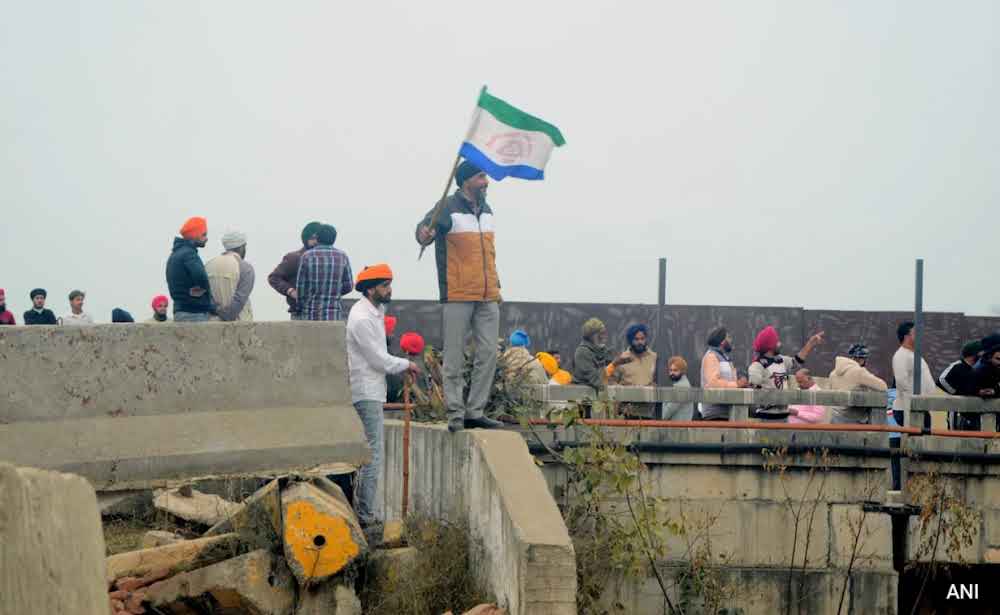
On February 13, groups of farmers responded to a call given by the Kisan Mazdoor Morcha and the Samyukta Kisan Morcha (non-political) and began a march to the national capital, to press for fulfilment of their demands. While farmers from different states reportedly started heading for Delhi, it has been largely from Punjab that scores of farmers started their ‘tractor-trolley’ march to reach Delhi via Haryana. As they arrived at Shambhu-Ambala and Khanauri-Jind borders, both on the inter-state boundary between Haryana-Punjab, they were stopped from entering Haryana.
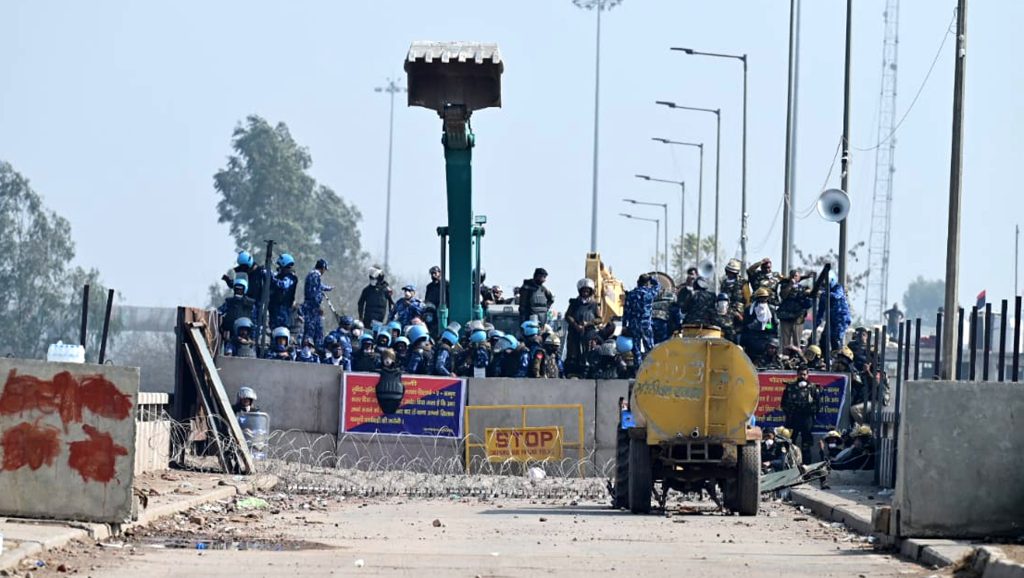
The Haryana government had put in place elaborate security arrangements with multi-layer barricades, which included iron nails, barbed wires, concrete barricade-blocks, boulders, trenches and anti-riot vehicles on the roads bordering Punjab. Ready for the same as farmers went ahead smashing the barricades, the police resorted to the use of tear gas through drones, and water cannons to disperse the agitating farmers. The internet was suspended for over a week in Haryana districts bordering Punjab. Meanwhile, massive deployment of police and paramilitary personnel was done in areas bordering Delhi to stop protesting farmers from entering the city.
So far, seven lives have perished in the stand-off including five farmers. The two cops died of cardiac attacks while posted on duty. Similarly, according to official records from Patiala’s Rajindra Hospital, three farmers too passed away due to heart attacks. Subhkaran Singh from Punjab’s Baloke village died in a clash between security forces and protesting farmers at Khanauri border. The farmers allege he was shot but with no post-mortem till date being allowed by family and protestors, the claim is yet to be verified.
The farmers claim that over 150 people have so far been injured by pellets and shells while Haryana police peg the number of injured cops at 30. The stand-off still continues after two failed attempts by farmers to reach Delhi. Though now they have deferred the march till February 29, they have been camping near different locations on the inter-state boundary with Haryana.
This has thrown the traffic on Delhi-Chandigarh highway out of gear with the vehicles being diverted via Indri and Yamunanagar for many days. The farmers have accused the BJP-led Haryana government of deep hostility towards them and their cause even as they asserted that holding a peaceful protest was their fundamental right.
“Haryana, a BJP-ruled state, is a puppet in the hands of the central government. They are treating us not like farmers but mobsters or rioters. We have a fundamental right to protest and holding no ill will announced our march to help states prepare for traffic management. They however prepared for war. They erected barricades on highways and got war level stock of drones, expired tear gas shells and rubber pellets and waged a war. We believed in the government once and gave it two years, but we were fooled. However, we will not be taken in by their hollow promises now,” says Jagjit Singh Dallewal, farmer leader and president of Bhartiya Kisan Union Ekta Sidhupur.
Duped by Centre: Farmers
According to Sarvan Singh Pandher, who heads Kisan Mazdoor Sangharsh Committee (KMSC), the script for Dilli Challo 2.0 was written by the Modi government itself when it made false promises and sent farmers home from the Singhu border in 2021. In December 2021, the farmers decided to return home after the three farm laws they had protested against for nearly two years were rescinded. They explain how they left in good faith, as the Modi government promised them that their other demands like a law on minimum support price, the withdrawal of cases, compensation for the farmers who died during the protest, etc. would be met with.
The government continued its dialogue with the SKM until January 2022, when a statement on MSP was made. After that, all talks stopped as the farmer movement had lost their leverage. Meanwhile, the government formed a committee to further deliberate on the MSP question. The farmer organisations boycotted the same citing its biased composition. As the government refused to talk with the farmers’ leadership, the SKM used the next two years to build a campaign across India for MSP and also lent its support to other agrarian and social causes.
For the past six months, farmer groups have been organising meetings all over India to reiterate the demand for MSP and other agrarian issues. A new coalition was emerging between the north and south. But the first sparks were seen in Punjab again, when farmers launched sit-ins and hunger strikes for MSP. They approached the Modi government again for talks. As a reaction to this new wave, the government blocked ‘X’ accounts, formerly Twitter, and started arresting and weakening the farmers. Even before the convoy started, some of the farm leaders met with Central ministers to remind the government of its promises and informed them of the farmers’ resolve to head towards Delhi for a peaceful protest. The meeting however bore no fruit.
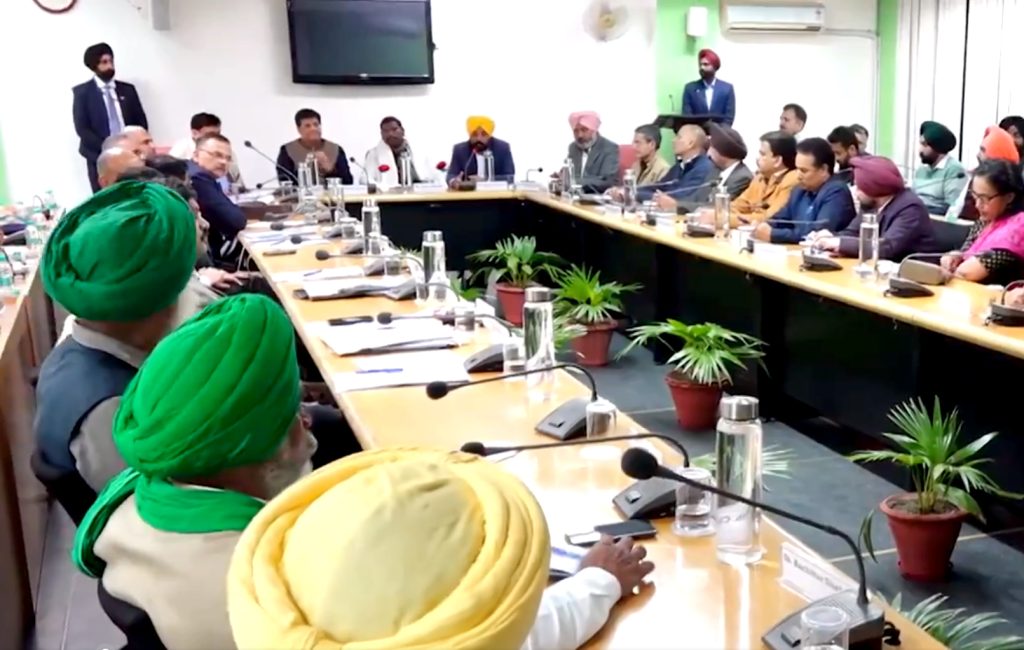
When it comes to the farmers’ demands, nothing has changed. They are raising the same demands since they left Delhi’s borders around two years ago. The demands include implementing a Minimum Support Price (MSP) for crops in line with the Swaminathan formula, ensuring a legal guarantee of procurement, providing debt waivers, refraining from increasing electricity tariffs or implementing smart meters. Additionally, they seek free allocation of 300 units of power for farming, domestic use and shops, comprehensive crop insurance, and a hike in pension to Rs 10,000 per month. There have been four meetings between the government and farmers, but there has been no solution to the deadlock so far. In the latest meeting on February 18, the government proposed to buy five crops at MSP for five years, but the farmers declined the offer.
What is the govt’s stance?
The Union government has repeatedly asserted that announcing a guaranteed MSP will not be possible. Union Agriculture Minister Arjun Munda said that for a law on guaranteed MSP, the Centre would have to look at all sides. While there is still a deadlock on the negotiation table, the government hopes to resolve the farmers’ issues before the wheat procurement season starts in March. The Secretary, Food and Public Distribution, Sanjeev Chopra said that the protest is unlikely to impact wheat procurement in Punjab and Haryana. “We made an offer but they rejected it. We are hopeful of making them understand our intent through negotiations,” says Chopra.
Punjab Chief Minister Bhagwant Mann has openly expressed his support to farmers and announced a compensation of Rs 1 crore for the family of deceased farmer Shubhkaran Singh. “He was not there to get his pictures clicked but to seek fair price for his crops and this is what he gets. We are with farmers and will not care even if I have to stake my position as CM to support their cause and welfare,” said Mann.
Haryana CM Manohar Lal Khattar who is in the line of fire for his alleged hostility to farmers, says, “The opposition is troubled when we talk about farmers. Farmers are our ‘Annadatas’. So we look into their problems. I don’t think any other state has done as much for farmers as we have.” Listing out the steps taken by his government for farmers, Khattar said, “Which other state buys 14 crops on MSP in the country? Which other state gives crores of rupees for vegetables and fruits under the Bhavantar Bharpai Yojana? Which other state has increased loan amounts given to farmers and also waived off interest and penalties? Over Rs 1,700 crore worth of loans have been waived off.”
Khattar said that farmers in his state face no problems but they are protesting because they want to stand in solidarity with their fellow farmers in Punjab who do not get such assurances from their state government. “There are no problems faced by farmers in Haryana. But in Punjab, farmers are expressing their pain as they don’t get what we are giving to our farmers in the state. They (the opposition) want to stand with them (Punjab farmers). The farmers have understood which government is their well-wisher,” the Chief Minister pointed out.
The MSP Dynamics
The MSP regime is meant to act as a safety net with the government directly buying a crop from farmers if the market price falls below the minimum support price it has set. The central government declares MSP for 23 crops but consistently purchases only rice and wheat for its food security schemes.
Punjab and Haryana are biggest suppliers of wheat and rice as they account for 74 percent of wheat and 28 percent of paddy purchased by the government in 2022-23. The constant concentration on two crops, especially paddy, is depleting the soil and reducing the water table in two states. The focus on paddy cultivation is also cited as one of the biggest causes of farm fires in Punjab leading to poor air quality in Delhi NCR (National Capital Region) for almost half a year. The agriculture experts have time and again recommended crop diversification in both the states. However farmers say that they struggle to get a fair price for other major crops like moong, mustard, and sunflower. The government, according to them, does declare MSP on these but doesn’t buy produce and they end up making losses. In October 2021, eight major crops like groundnut, Bajra, Jowar and maize were purchased at a harvest price lower than the MSP. In 2018, cereals, oilseeds, and pulses sold in over 60 percent of the markets fetched a price lower than their MSP. As climate change creates greater uncertainty and impacts the quality of farm produce, farmers say guaranteed support from the government is essential to help them move beyond rice and wheat cultivation.
“The government is not listening to our demands on MSP,” said Manjit Singh Gharanchon, a block level president of the Bharatiya Kisan Union Ekta Ugrahan, one of the farmer groups participating in the protest. “On the other hand, they are telling us to take measures against the depleting groundwater and shift away from chemical agriculture.”
In 2022, Punjab government announced MSP of Rs 7,275 per quintal for moong dal. However state official records show that in 2023, over 96 percent of moong was sold to private buyers, almost entirely below the declared MSP. This year, in the first week of February, farmers in Punjab’s Abohar threw truckloads of ‘kinnows’ in front of the district collector’s office in protest. They alleged that Punjab Agro Industries Corporation had purchased small quantities of ‘kinnows’ from a few farmers, leaving others at the mercy of private traders who were offering less than Rs 10 per kg. In Haryana in 2023, the state had announced an MSP of Rs 6,400 per quintal of sunflower. But farmers were able to sell their sunflower seeds only at Rs 4,900 per quintal to private players. Even with the fixed financial compensation of Rs 1,000 per quintal for sunflower, the price still remained less than MSP.
When sunflower farmers agitated against this price difference, the Haryana government transferred Rs 29 crores as interim compensation to over 8000 farmers. The government said that “a detailed study about market rate” was ongoing, and once it was completed, a final announcement would be made.
Agricultural economists say an assured MSP can go a long way in helping farmers diversify the crops they cultivate. “The cyclical production is such that when many people start producing the crops they diversify to, then the prices of those crops crash,” Shweta Saini, agricultural economist and chief executive of Arcus, explained. “If you want the diversification drive to sustain in time, some kind of price support does help.”
But, she added, there could be a challenge in states like Haryana and Punjab like if farmers compare the incomes of other crops with their earnings in rice and wheat, even assured MSPs would not help. If the government expands minimum support prices to other, less environmentally-damaging paddy varieties, farmers say they would not mind making a shift.
Agricultural economists however say a legal guarantee for MSP won’t work in isolation, and the government will have to first set clear macro-level objectives that align with the price support of MSP. According to experts, farmers will grow whatever has a ready market and lack of a public distribution system in Haryana and Punjab for alternate crops is one of the key crises.
While farmers are demanding a ‘legal guarantee’ for MSP, but according to former Secretary, Food & Agriculture, Govt of India, T Nanda Kumar, if the interpretation of a ‘legal guarantee’ is that of a mandatory minimum price as obtains in the case of sugarcane, where sugar mills are required to buy and pay the government announced support price, this demand brings into play a new set of complexities. “A mandatory minimum price means that no purchaser of these commodities can pay anything less than the declared price. Apart from the fact that this will distort the entire market, many small traders will find it impossible to operate. This would also mean that the government instead of being the buyer of last resort will become the first, and probably, the only buyer in the market. The dangers of such a system are well known. Another danger of any ‘mandatory’ provision is the likely proliferation of inspections and inspectors. The harassment and rent-seeking opportunities are too well known to merit description,” he says in his analysis of farmer demands. Kumar also adds that farmers are demanding a calculation at C2 + 50 per cent as against the current formula of ‘cost (A2 + FL) plus 50 per cent’. “It easily results in an increase between 10 and 45 per cent of the current MSP. This could impact not only the government budget, but family budgets as well,” he adds.
Unarguably, farmers need better financial support. The economy will not be able to take frequent shocks in agriculture. The series of orders this year on stock limits and export bans are clear indications of the crisis. But knee-jerk reactions to multiple demands cannot be a solution. The governments (States and Centre) have to find comprehensive long-term solutions to the problems confronting farmers and their livelihoods, climate change, food inflation and the demands of food and nutrition security.
Farmer leaders have rejected the proposal given by a panel of Union ministers after the fourth round of talks, offering to purchase pulses, maize and cotton crops by government agencies at the minimum support price for five years if farmers withdraw their protest. The government looks keen to end the impasse given the forthcoming Lok Sabha elections. However, the death of a young farmer, Shubhkaran Singh in a clash between security personnel and protesters at Khanauri in Punjab has escalated tension and the deadlock persists.
Tehelka’s cover story in this issue “Face-off” delves into why after a nearly two-year period of relative calm, farmers have again locked horns with the Centre over their demand for MSP for their crops. Started on February 13 with Dilli Chalo 2.0, the movement is now epicentered around Punjab-Haryana borders. Visuals of clashes between farmers and Haryana police with the latter stopping them from entering into their state en-route to Delhi, using tear gas, pellets and stones are going viral while the current regime dismissed the movement as a politically motivated stint ahead of the elections. Staging a peaceful protest is a constitutional right of every citizen and the farmers’ agitation of 2020-21 was proof of the resilience shown by the farmers forcing the Centre to repeal the three farm laws.
The genesis of the whole issue is that the government sets the MSP for about two dozen commodities twice a year based on the recommendations of the Commission for Agricultural Costs and Prices but it lacks a legal guarantee. Little doubt, that most of the crop procurement under MSP is from Punjab and Haryana and of mainly wheat and rice produce which supports the government’s public distribution system. However, farmers want a law that guarantees MSP on every crop. They also insist on implementation of the recommendations of the MS Swaminathan committee on agriculture which suggested increasing the MSP to at least 50% above the average cost of production.
Farmers also want the government to put pressure on developed countries at the World Trade Organisation to keep agriculture out of its ambit given its limits on crop price guarantees allowed for individual nations. The ‘de minimis limits’ under the rules of the WTO Agreement on Agriculture (AoA) refer to the minimal amount of domestic support allowed for a country and these allowances have been set at 5% of the value of production for developed countries and at 10% for developing nations. Post-WTO agreement, domestic trade continued to be operated through restrictive trade practices in India that proved good for the procurement agencies and registered traders of the Agricultural Produce Market Committees (APMCs), but not for the farmers. It is time that the government and farm unions look at the larger picture to resolve the issue to spur farmers to further step up the production of crops in the national interest.
The fissures within INDIA Bloc became apparent after National Conference (NC) displayed its reluctance to part with any of the 3 Lok Sabha seats in Kashmir, which it had won during last elections, for its allies as part of seat sharing arrangement in the J-K. A report by Riyaz Wani
With the National Conference (NC) deciding to contest the forthcoming Lok Sabha elections independently, it has triggered ripples of unease among the members of the INDIA Alliance in Jammu and Kashmir. More so, the Peoples Democratic Party (PDP), a key ally in the coalition, has been miffed by the NC decision.
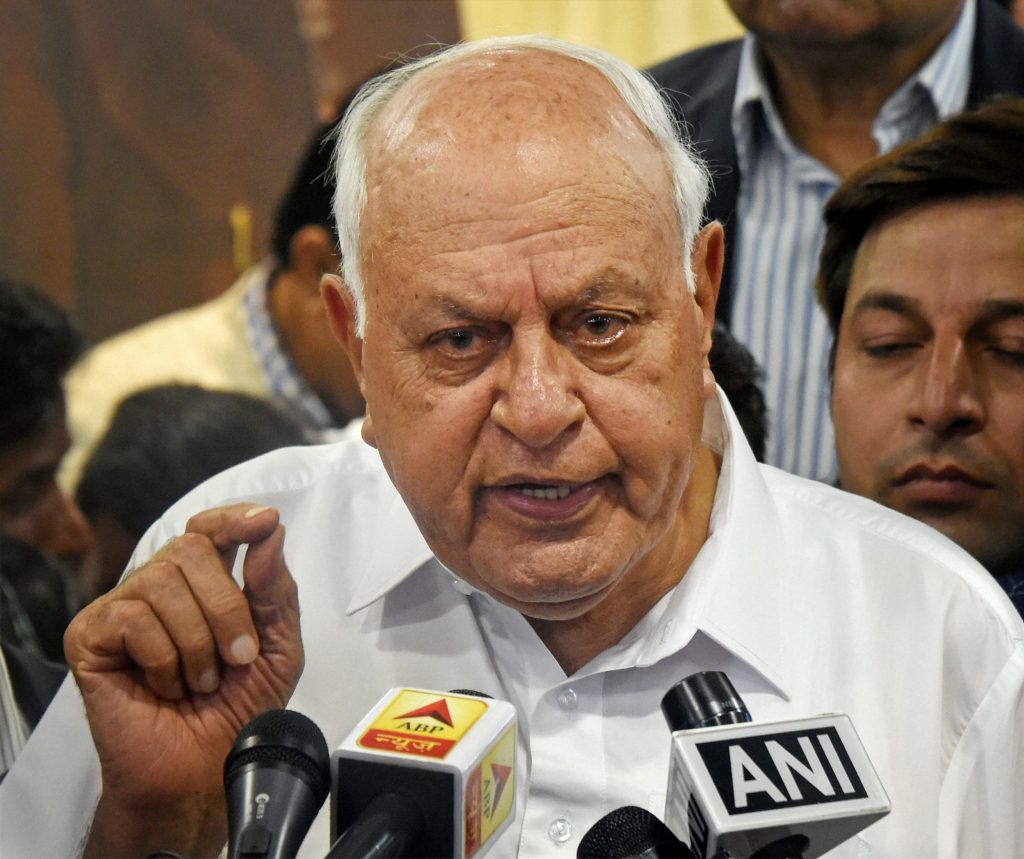
“As far as seat sharing is concerned, NC will contest alone and there’s no doubt about it,” NC leader Farooq Abdullah said while speaking at a press conference.
The alliance, comprising NC, PDP and Congress has been facing internal challenges ranging from desertions to challenging negotiations over the distribution of seats, although there aren’t enough seats to distribute. Jammu and Kashmir has five parliamentary seats and Ladakh has one. Three of these six seats were won by the BJP last time. However, the latest stance taken by the NC, asserting its unwillingness to allocate any of the three Lok Sabha seats from Kashmir to its allies, has intensified the strains within the coalition. NC had won these seats in the last election.
PDP, which expected a share in the three Valley seats, may also decide to go solo and contest independently, as may the Congress. This will split the votes among the three parties. Votes will further fragment with the other non-allied parties like People’s Conference, Apni Party and Democratic Azad Party – seen as close to the BJP – also throwing their hat in the ring. This will be a certain advantage for the BJP which will fight all the six seats in J&K and Ladakh.
Incidentally, the NC and the PDP are also part of the People’s Alliance for Gupkar Declaration (PAGD). The PAGD, formed with an objective of ensuring restoration of the special status of Jammu and Kashmir, faces an internal challenge as its constituent members, which also include CPI(M) and Awami National Conference, grapple with divergent interests and ambitions. But ever since its formation in 2020, the PAGD has become a distant memory, with the constituent parties not even meeting, let alone talking about the restoration of Article 370.
As things stand, a significant opinion in the NC and the PDP has grown increasingly skeptical about their alliance and for very different reasons: the NC has come to see the PAGD as detrimental to its traditional standing as the largest J&K party and the PDP, in a sense, reciprocates the feeling. In the process, both the parties have gone slow on the demand for restoration of the former state’s autonomy as the centre has turned up the heat.
Though the parties again banded together when they joined the INDIA Alliance, they have since drifted apart. One of the factors for this is that J&K has too few a number of seats to share. However, the NC has expressed its willingness to go for seat-sharing on the three seats held by the BJP candidates.
“NC workers want to fight elections on all six seats but the truth is that sometimes for a bigger objective, small sacrifices have to be made. If the bigger objective is to win seats back from the BJP, it is necessary for the National Conference to enter into a seat sharing understanding with the Congress. Our doors are open,” Omar Abdullah, the NC’s vice president, said.
“Informal talks with the Congress are already on and there is scope for further discussions,” he added.
As both the NC and PDP actively mobilize their efforts to assess their strengths across the five Lok Sabha constituencies in Jammu and Kashmir and the one in Ladakh, the unfolding political drama raises fundamental questions about the stability of the INDIA bloc alliance. The fissures within the coalition in J&K reflect the intricate challenges of managing alliances in a region characterized by complex political dynamics, regional aspirations, and individual party ambitions.
Compelled to leave their fields and sit protesting again, they are in no mood to be taken in by hollow assurances of the establishment or let the political tactics dent the very unity of the farmers this time. By Humra Quraishi
This time, the farmer wants a concrete solution, where all the long-pending demands are met with. And nothing is left in suspense. Braving the harsh ground realities-cum-weather conditions, there’s no going back for the farmer. After all, he realizes it’s now or never! And this time, he’s in no mood to be taken in by hollow assurances of the establishment or let the political tactics dent the very unity of the farmers.
The logical way out for the establishment would have been to hold a series of detailed discussions with the farmer leaders; their demands to be met with within a set time framework. All these dilly-dallying tactics are not only agitating the already upset farmer but also leading to an absolutely stressful situation. Not sure, what happens next, as tension continues, not just in and around the Delhi borders but spreading out.
Ironical, it seems that the farmer who provides us with our daily bread is going through such harsh conditions. He is compelled to leave his fields and sit protesting, facing the State unleash! Couldn’t be a more dismal or grim situation. Nobody dare ask what happens to the crop and the yield and the output. Prices of even the basic grains going up the graph, leaving the farmer and the rest of us, the consumers, devastated but who’s there to listen to the ongoing cries!
Where’s that age old norm of talks-discussions-debates-arguments and counter arguments! Where are we heading! Perhaps, towards destruction of the very basic framework that had held us intact but now all seems withering!
*****
Whilst on the farmer and our daily bread, it’s time to focus on roti banks. Yes, till the stomach is not filled and hunger pangs not contained, there’s little point harping on any of the other aspects to everyday living; nay, survival.
Sadly, facts and figures indicate that percentage of the food-deprived in the country is on the rise. Men, women and children are sitting without adequate food and clean drinking water, and are deprived of the basics to survival. Perhaps, weak and fragile to the extent that even those cries of want are not to be heard.
Little point calling ourselves ‘developed’ when the human form is shrinking and withering away. Except for the rich, corrupt and over ambitious, the rest are fighting a daily battle to somehow survive in these harsh times.
What can be done to lessen their plight? Roti banks seem a practical and viable option. After all, all it involves is collecting a couple of rotis or handful grain from each household in particular mohallas or localities or residential colonies, to be distributed on a daily basis to those who cannot afford to feed themselves and their families. Only one caution to be strictly adhered to: Let no political party interfere and intrude. Also, do not let communal brigades unleash any of those political thrusts in the roti collection and distribution efforts.
Whilst on food deprivation and starvation deaths, there is another land where its citizens are hit…severely affected. Yes, today a large percentage of the Palestinians are starving! Governments should be urged and appealed to, to let food packets be air dropped so help save lives of hundreds and thousands sitting besieged in Palestine.
Gulzaar Saab – the poet with a personality
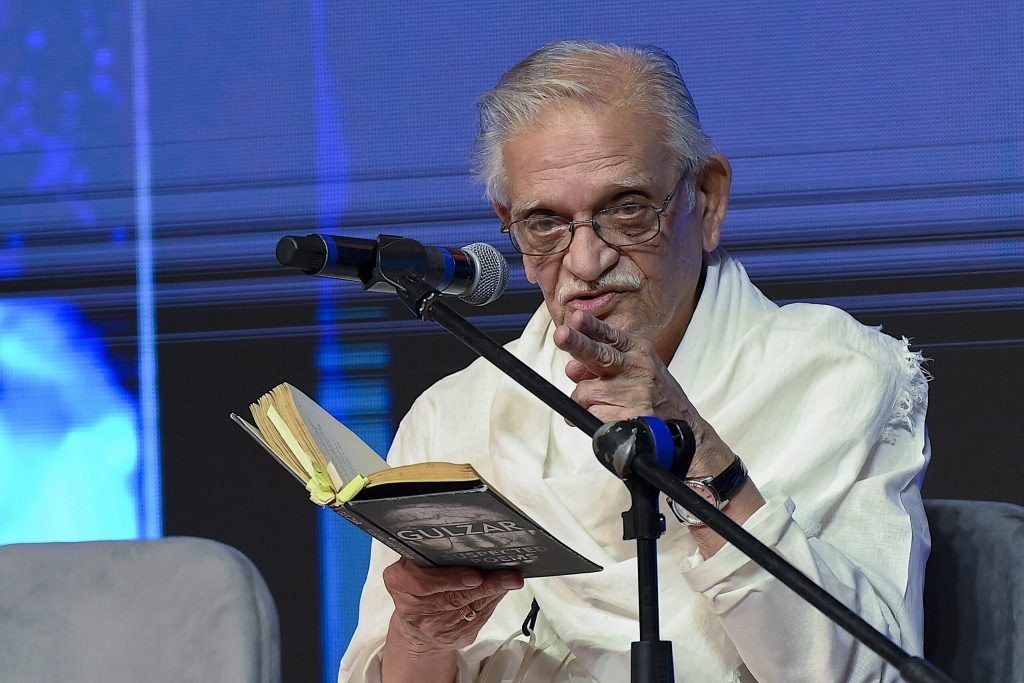
The 58th Jnanpith Award for the year 2023 has been awarded to Swami Rambhadracharya for Sanskrit and Gulzar saab for Urdu. He has earlier received the Sahitya Akademi Award for Urdu in 2002, the Dadasaheb Phalke Award in 2013, the Padma Bhushan in 2004, and at least five National Film awards for his works.
The more I read Gulzar saab, I am left amazed by the expanse and the sheer sensitivity of his verse and prose. There’s that stark simplicity and with that, that instant connect. His fans are in thousands and spread out, right from our land to those spread-out continents. After all, poets don’t believe in boundaries or barriers.
Gulzar saab’s prose and verse focusing on the Partition hitting to such an extent that till date that pain and turbulence seems hovering around. He witnessed the Partition and experienced those upheavals, and the impact and imprints they’d left on him gets writ large in his writings; that pain manages to seep in each one of those words.
I re-read one of Gulzar saab’s earlier published volumes -‘Footprints on Zero Line-Writings On The Partition’ (Harper Collins) which he has dedicated to, ‘To Dina, my birthplace in Pakistan’. He dwells on Dina, and also on the masses going through turbulence… To quote Gulzar saab, “I have witnessed the Partition. I have experienced the Partition. Standing on Zero Line I am still watching the trail of Partition. Seventy years have passed. Time has not been able to blow off the footprints. I don’t know how long it will take for them to sink into history and be the past.”
Tucked in this volume, Gulzar Saab’s this absolutely hitting, touching verse:
“Walking up to Wagah with measured steps
When I came to stand at the Zero line
My shadow fell in Pakistan!
The sun was behind me
And my abbu was standing in front
He saw me
Resting his stick on the ground
He smiled and said,
‘When I had left my body there
I came back home, Punni!’
Abbu used to call me ‘Punni.’
‘I had hoped you would come,
For you had not received the news of my death
I knew you would come to bid me farewell!’
Startled, the moment paused
He tapped the ground with his stick
Stretching his hand, he said:
‘Come, let us go to Dina!’
My friends who had come to receive me at Wagah
Held me by the hand and took me to Lahore
In the din of the city no voices came back to me
But I could see a trail of silence
That led to Dina …”
*****
Ending this column with these lines of Gulzar Saab :
Despite the hype, the BJP is well aware of the negatives stacked against it if the opposition comes together. It knows very well that a well-stitched alliance can pose a challenge to its dream run. BY KUMKUM CHADHA
Finally, there seems to be some light at the end of the tunnel. At least for the Opposition, rather the I.N.D.I.A. alliance or Indi, as the critics prefer to term it.
By knocking off the A, they had perhaps thought that the Grand alliance would also be piecemeal, which perhaps it was, given that every party was speaking in different voices.
If Trinamool chief Mamata Banerjee hit out by saying that the Congress would not get more than 40 seats, Aam Aadmi Party declared that it would go solo in Punjab.
The last straw was when the Farooq Abdullah-led National Conference declared that it would contest the Lok Sabha seats “independently”. Decode this and it means that the alliance was falling like a house of cards.
The BJP was ecstatic because an Opposition alliance would be the last thing it would want to see. It is no secret that since its inception, the BJP was in panic mode.
However, what was music to the BJP’s ears was that within a few months, the alliance was a divided house. Yet, the BJP was not complacent. It left nothing to chance just in case, so to speak.
And it is this just in case that has proved it right. The alliance seems to have come together with AAP and the Congress agreeing on seat sharing in crucial states including Delhi and Gujarat and still counting.
Of course, there are several bridges that are yet to be crossed including the arrangement with Trinamool Congress.
The Opposition coming together to fight the BJP is good news for individual parties and the country. It cannot be denied even by pro-BJP lobbies that a strong Opposition is the answer to a strong and viable democracy. And if anything can check the BJP’s ride to the power, it is a united Opposition.
And this is bad news for the BJP. Therefore for it to check this and do whatever it takes is understandable.
However, what does not fit in is BJP being on tenterhooks. And this it was, even when the alliance was as divided as enemies.
It is at this point that one needs to ask: is the BJP’s buoyancy mere optics? Is abki baar char so paar a mere slogan? Or is the Party as confident as it is positioning itself to be?
There are a few pointers that indicate that the answers to the above questions may be in the affirmative.
Were it not so, why would the BJP step in wherever it got even less than a foothold? The fact that it was overactive even for an insignificant election of a mayor in Chandigarh is enough to substantiate BJP’s overzealousness. Or should we say its jitteriness ?
While on the Mayor’s election, the Court came down like “a ton of bricks” to quote lawyer politician Abhishek Manu Singhvi and overturned the result.
Till the Court stepped in, the BJP candidate had secured a win over the AAP-Congress alliance candidate.
Interestingly, the returning officer is associated with the BJP for over a decade.
That being so, one is compelled to repeat the question: is the BJP nervous and is its upbeat mood a fallacy?
But given the way things have shaped up, the BJP has enough reason to be smug and actually sit pretty.
Prime Minister Narendra Modi and his government seem to be in a comfortable position having delivered well on the welfare schemes and of course having gifted the Ram temple to god-hungry Indians.
Add to this the fact that the world is looking towards India with envy. The list is long enough to push BJP’s communal and divisive politics under the carpet.
So why and what is BJP’s worry for it to expose itself in insignificant elections like a Chandigarh mayor’s?
Or unleash the Enforcement Directorate on the Opposition? It is, therefore, not without reason that people are asking: Are there defaulters only among the Opposition? Are there no black sheep within the BJP? And why are agencies hounding only those the BJP fails to tame?
The answer is obvious. The fact is that under the BJP rule, there is no level playing field. Simply put, this means: walk with us else we will let the dogs loose on you.
Bihar Chief Minister Nitish Kumar may be a willing partner but there are others who were coerced into joining hands with the saffron party.
Therefore the picture may not be as rosy as the BJP may wish it to be, given the challenges particularly from the South and the Eastern belt of India. Modi may ride the North wave but the same may elude him in other parts.
Even in a worst case scenario, West Bengal Chief Minister Mamata Banerjee remains a formidable force who the BJP would find hard to vanquish.
The mishandling of the Manipur situation is another minus in the BJP’s electoral count. And of course, the southern states may continue to spring surprises much to the BJP’s angst.
Therefore it is imperative that the BJP counts its chickens before flashing the char sau paar figure.
The reality is that the Opposition could well gain from putting up a united front to take on the BJP.
Given that the BJP vote share is less than 40 percent as past elections have amply demonstrated, the alliance partners are working towards a consolidation of a major chunk to cause a dent in the BJP’s speed-march.
While doing so, it is quite aware that it cannot halt BJP’s victory march which, as of now, seems a foregone conclusion but what it can do is help reduce the numbers.
Statistics apart, the Opposition is also banking on the silent vote to speed brake BJP’s free run, as it were. There are not many takers for the current trend of aggressive politics that the BJP has unleashed. Add to this, the worry about a complete absence or a negligible presence of the Opposition in a democracy.
Given the BJP’s track record, its leadership would probably say: So be it but then this take it orleave it attitude neither augurs well for the country nor its democracy.
On its part, the Opposition alliance is banking on this segment or the “silent vote” as it calls it, to come out and vote against the BJP, not to speak of those being crushed under the menace of price rise and unemployment.
As things stand, this seems to be the best case scenario for the Opposition alliance: to check the BJP numbers and ensure that it does not have a free run for the next five years.
This seems to be the immediate challenge for the BJP and therefore it would do what it takes to ensure that the alliance fails.
Irrespective of the hype, it is well aware of the negatives stacked against it, if the opposition comes together. And this, perhaps more than anything else, is making the BJP nervous because the Modi wave notwithstanding, the alliance, if stitched well, can pose a challenge to the saffron party’s dream-run.