How Trump fashioned a turnaround for the ages

President Biden has a tough battle on his hands as he faces his predecessor, Donald Trump, in the upcoming US Presidential poll. This follows Trump’s spectacular back-from-the-brink win against Republican frontrunner Nikki Haley on March 5. by Gopal Misra

The two main contestants for the earth’s most powerful executive position, i.e. the presidency of the United States, the incumbent, Joe Biden, and the former president, Donald Trump, are again locked in the poll fray scheduled in November this year. It is natural that the forthcoming election is drawing worldwide attention at a time, when the planet’s only super power, the USA, is increasingly grappling challenges from its one-time crony, China besides facing the growing alienation of the oil-rich Muslim nations.

The forthcoming contest is not between a statesman or a mediocre politician, but between an intellectually accomplished Joe Biden and aggressive tycoon-cum-politician Donald Trump.

For most Indians, Joe Biden resembles Bahadur Shah, the last emperor of the Mughal dynasty, who finally witnessed the final collapse of his regime to the East India Company, a business conglomerate, having support of the British crown. The penetration of the Chinese companies representing the imperial ambitions of Beijing has already a sizable share in the American economy. Also, through its proxies, China has huge shares in the media companies, big newspapers and channels, and also it has liberally funded the movement, Black Life Matters. Interestingly, the growing influence of the dragon has already alarmed the civil society of the western world, but the poll issue is being focused on the immigration issues. The two contestants, Biden and Trump, have swept to victory to be nominated by their respective parties, the Democrats and the Republicans, without any discussion on the geo-politics, especially the Ukraine-Russia conflict, the Israel-Hamas War in West Asia and China finally invading Taiwan, thus asserting its supremacy as a World Power. In spite of their low-rating among their respective party workers, they finally became their party’s respective candidates on March 5, now called the Super Tuesday.

Another factor enabling the two leaders getting the party’s nominations despite having a low-rate of approval could be the party system, which is loaded in favour of the incumbent. Therefore, it is not surprising that Biden could not be replaced unless he himself decides to quit the contest.

Another dimension of the electioneering is that Biden will be locked in a fierce electoral battle against Trump, who might be convicted in the ongoing criminal trial before a New York court, thus ensuring his victory against the Republican nominee. Also, it is yet to be ascertained what would happen, if Trump is convicted after he takes over as the president. The Trump supporters, however, dismiss such possibilities by describing the legal issues as politically motivated. Trump’s main political plank is against the illegal presence of the migrants and inability of the Biden administration to take any effective measures in controlling illegal immigration.

As soon as it became clear to the two contestants that they would be fighting the electoral battle, they started a fierce campaign against each other. Trump, in an aggressive posture, called Biden as the “worst president” in American history for his immigration policy. Biden has reciprocated by calling Trump a threat to American democracy. In a statement, he stressed that the American electorate has to decide whether they would like Trump to drag us backward to chaos, division and darkness.

It goes to the credit of Biden that he could finally get the nomination despite a section of his party, especially in Minnesota, being opposed to his support for Israel in the ongoing war with Hamas. He also won 14 other states, thus becoming the nominee of his party for presidency. With the former US Ambassador in UN, Nikki Haley’s inability to muster up adequate votes, the decks were finally cleared from Donald Trump. It is believed that if she had withdrawn without complaining, she might have become a natural choice to become Vice-President, if Trump finally returned to the White House.

Trump’s reassertion with the Republican Party is also quite significant. Earlier, Trump was blamed at a Las Vegas meeting of his party’s key financiers for the party’s poor performance in the 2022 US midterm. A section of them had even called him a drag on the party. Trump, however, finally staged a historical comeback. His comeback has astonished many in the US as well as in other countries. “It’s totally nuts. Most defeated presidents don’t come back and run. There is no reason to think he should have won the nomination, especially this fast,” said Lindsay Chervinsky, a presidential historian at Southern Methodist University in Dallas.

Trump’s Strategy

Trump’s return to the political arena is being attributed to his unshakeable strong base of loyalists and a capable fundraiser aided by a disciplined team that stayed with him despite the Biden Administration’s bid to shackle him in multiple litigations. Another factor could be the firm belief of a large number of his supporters trusting his claim of election fraud in 2020 which allegedly prevented his return to power. The cases against him not only restored his political image, but have turbo-charged the sympathy campaign by his party voters.

His top opponents within the party, the Florida Governor, Ron DeSantis and Nikki Haley, were reluctant for months to reproach him – and even stood by him in the face of criminal and civil charges. At the same time, Republican voters’ top concerns – the economy and border security – were the issues where he was much more assertive than DeSantis and Haley.

Interestingly, Manhattan’s district attorney, Alvin Bragg’s, a Democrat, indictment of Trump accusing him of falsifying records to hide hush-money payments to a porn star could not adversely affect his political fortune. It is a case based on technicalities. Trump’s survival perplexes political observers, because his resurgence on the American political horizon is contrary to every known political law of gravity. The charges have allowed Trump to claim he was a victim of a politically-driven prosecution; his supporters rallied to his side and money flooded his campaign coffers.

Trump has adopted another unusual, norm-breaking strategy by refusing to debate his Republican rivals in any of the party-sanctioned debates. It helped him in regaining his political position, while the other candidates were seen spending much of the time denouncing one another; while largely giving him a pass.

The Israel-Hamas War

It appears that the failure of the Biden administration in ending the Russian-Ukrainian conflict in Europe and the Hamas attack on Israel has also given a powerful tool to Trump; thus the global events also began to influence American politics in the election year. With Republicans increasingly skeptical of providing more aid to Ukraine and the Hamas terrorists attack on Israel has allowed him to unabashedly play up the failure of the Biden administration. Another tool to malign Biden could be the administration’s failure to effectively contain a surge of migrants crossing the US southern border with Mexico.
PM’s one liners: Now, the Lotus Connect

One will have to wait for the outcome of the forthcoming elections to know whether PM Modi’s rhetoric about the benefits of abrogating Article 370 has worked for the BJP or not. BY KUMKUM CHADHA 

Trust Prime Minister Narendra Modi to form linkages when none exist. But then, he is a past master of one liners and each time has turned them to his advantage. 

Remember how the sabka saath slogan kept changing? It started with sabka saath, sabka vikas and graduated to sabka saath, sabka vikas aur sabka vishwas:  This is our mantra, the Prime Minister had said at the outset of his second term. 

Two years down the line, he added sabka prayas to the original one liner. 

Speaking from the ramparts of the Red Fort in the 75th year of India’s Independence, Prime Minister Modi said that “sabka saath, sabka vikas, sabka vishwas aur sabka prayas will ensure the creation of a new India”. 

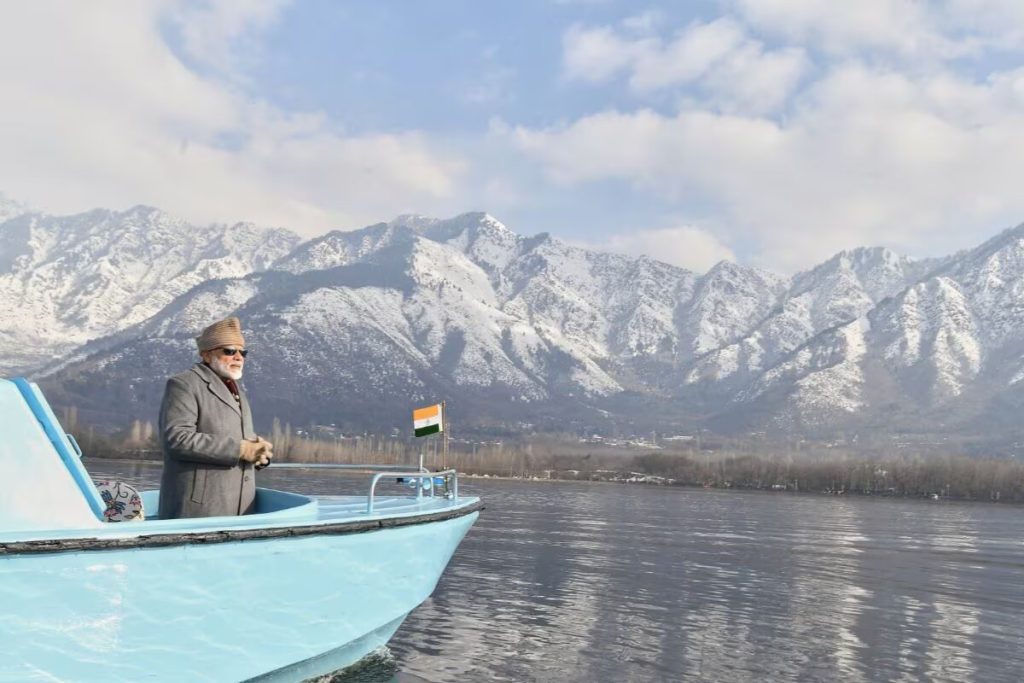
It is perhaps part of the quest for new India that the BJP government abrogated Article 370 and stripped Jammu and Kashmir of its special status: a point Modi hammered during his recent visit to the state: “The dawn of Naya Kashmir has arrived,” he told the  30,000 plus crowd at the football stadium there.

While on linkages and the Srinagar visit, the Prime Minister gave the lotus analogy or BJP’s  “lotus connect” as some branded it: “We see lotus everywhere in the lakes here…Is it a coincidence or a sign of nature that the BJP’s symbol is also a lotus and Jammu and Kashmir has a deep connection with the lotus?,” PM Modi said. 

Neither did he fail to weave in the nadru, or the lotus stem vegetable, which is popular in Kashmir. He told the crowd that he had often mentioned nadru in his radio program. 

Irrespective, it touched a chord with the people who have battled hatred, terror and separatism for years together. 

The Prime Minister or the BJP may not prove to be an effective balm but the visit certainly would send signals that Kashmir is no longer alien or dreaded territory. 

In fact, a slew of projects and schemes announced were enough to boost the confidence of the people. 

 For instance, the Wed in India slogan, wherein the Prime Minister said that Kashmir is the ideal destination to host grand weddings instead of foreign destinations. 

He will, Modi said, ask well-off families to ‘Wed in India’ rather than indulging in lavish weddings abroad; and what better place for a wedding than Kashmir?  

Slogans and one liners apart, the visit assumes significance given that it happened on the eve of the general elections. 

If poll surveys are anything to go by, there is a close fight in the state where the BJP is aiming at making significant gains. 

Unlike other parts of India, in Jammu and Kashmir, the abrogation of Article 370 will have a bearing on the outcome of the forthcoming elections. Therefore when Prime Minister Modi slammed previous governments for misleading the people over the special status issue, it was not without meaning. 

That the 2024 election seems to be a do or die for the BJP is a given. It however defies logic because by all indications, the BJP is not only sure of a win but is in a rather comfortable position. 

The 370/400 arithmetic is to hammer the point that the BJP will win 370 seats on its own and 400 plus with alliance partners. 

Given that the 370 figure resonates with Kashmir, it was politically prudent for the Prime Minister to make it his theme song during his recent visit. 

That apart, he also slammed the Opposition parties and dynastic politics which, he said, had benefited only a handful. The bottom line:‘Dil jeetne aaya hoon’ to quote the PM. 

Modi, it may be recalled, has spoken in the past about removing “Dilli ki doori” and “Dil ki doori, with reference to Kashmir.

Sentiment, emotion, hype and slogans is one part. But the other and more important is a reality check. 

It is in this context that one needs to assess whether the Prime Minister’s visit cut ice; whether the crowds that had gathered were actually supporters or critics; and more importantly, were they forced to be present or volunteered to be there? On the last, one must take cognizance of what two former Chief Ministers of the state, namely Mehbooba Mufti and Omar Abdullah said about government employees being carted in buses to attend the event: “Employees, men and women both in their 1,000s, are being asked to assemble between 4.30 am and 5.30 am in the freezing temperatures to be bussed to the venue. This participation is not optional. It’s compulsory. Employees who don’t show up are being threatened with disciplinary action by their department heads,” Omar Abdullah alleged. 

One cannot discount what Abdullah has observed. Nor can one dismiss Mehbooba Mufti posting a video of government employees being huddled in buses. Or the fact that agencies would be “gushing about the historic crowd” to quote her. 

If reports are anything to go by, the crowds were “unprecedented”: some 30,000 at the venue sporting saffron flags and an equal number at the district headquarters who watched and heard what the Prime Minister said through video conferencing. 

On the flip side, there are reports of crowds not knowing the full slogan they were forced to chant; of people being “coerced” into attending the rally, including daily wagers, who showed up simply because they were afraid of losing their jobs. 

That the BJP managers are adept at gathering crowds is a given. Therefore whether they were government employees or beneficiaries of welfare schemes, they were there; whether the slogans were tutored or spontaneous they certainly rent the air; whether they were forced to clap their hands at every second sentence or put them together spontaneously, the applause was there for everyone to hear. 

That notwithstanding, there are two sides of Modi’s Kashmir story: 

The first: Why would Kashmiris cheer the man who stripped their home state of the special status: in other words took away their identity? 

The other: Since the abrogation, cases of terrorism have registered a sharp decline and people are breathing easy. 

It is between these two extremes that the electoral fate of the BJP vacillates. 

One will have to wait for the outcome of the forthcoming elections to know whether Prime Minister Modi’s rhetoric about the benefits of abrogating Article 370, Kashmiris being his parivar, family, and the spiel about putting an end to dil and dilli ki doori has worked for the BJP or not.

Cast calculus on BJP’s mind as Khattar makes way for Saini

OBC vote arithmetic and anti-incumbency are cited to be the key reasons behind the BJP’s dramatic move to replace Haryana CM Manohar Lal Khattar with the party’s state president, 54-year-old Nayab Singh Saini ahead of Lok Sabha and assembly elections. A report by Aayush Goel

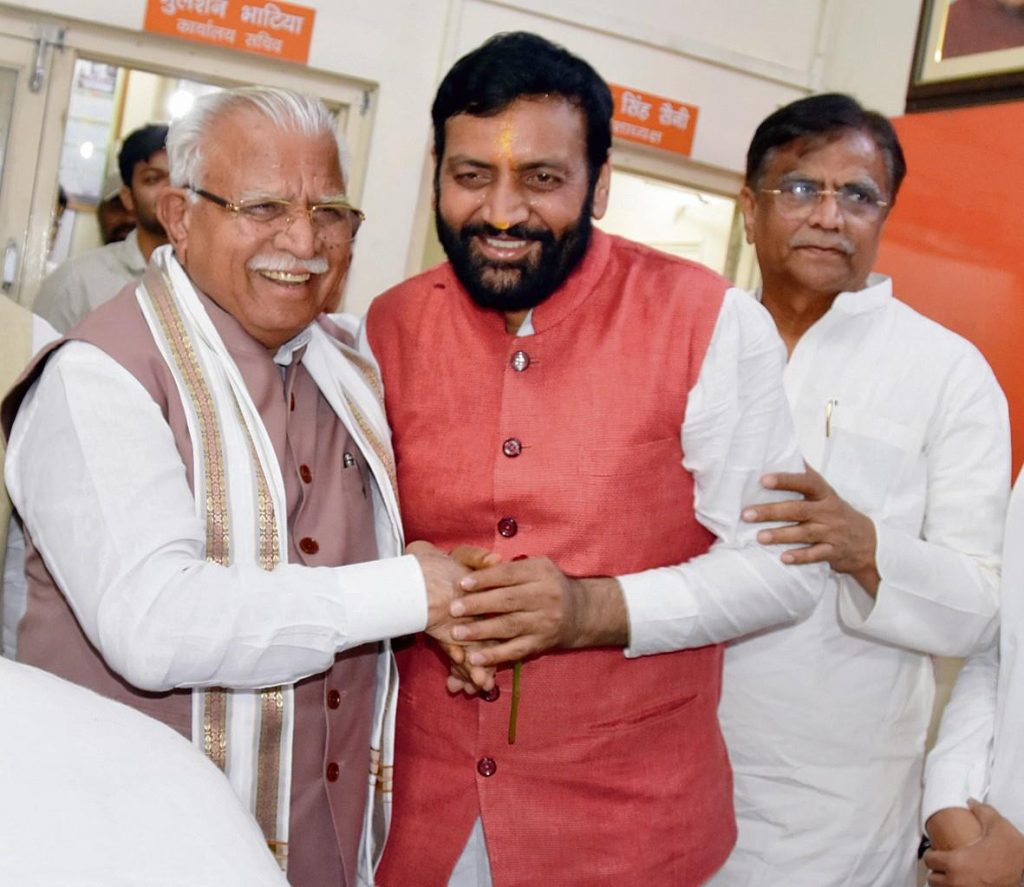
Following its tried and tested script which led to victory in three states, BJP went ahead replacing Haryana CM Manohar Lal Khattar with BJP state chief 54-year-old Nayab Singh Saini right before assembly and Lok Sabha elections. The resignation of CM along with entire cabinet after snapping ties with coalition partner Jannayak Janta Party (JJP) has been dubbed as a masterstroke by political experts to counter any anti-incumbency against 10 years of Khattar rule, splitting Jat votes and wooing Other Backward Class (OBC) communities. The opposition Congress however dubs it as acceptance of defeat ahead of the Parliamentary and state elections.

The political drama unfolded in state on March 12 within 12 hours of PM Narendra Modi taking to the mighty Dwarka Expressway for road show and showering numerous praises on Khattar. The dramatic developments of the day that began with the collapse of the BJP-JJP alliance, the BJP, with 41 MLAs in the 90-member House and the support of six independents was unruffled and presented governor Bandaru Dattatreya a list of 48-members who support the government. While it appeared sudden, the former CM said that they just followed a winning tradition to bring in new leadership. “It happened in Madhya Pradesh, Rajasthan, Chhattisgarh. In fact, I myself had suggested to the party high command that time has come for a new leadership to take over in Haryana’’, Khattar said.

It may be noted that BJP has also replaced CMs of Gujarat (Bhupendra Patel replaced Vijay Rupani), Uttarakhand (Pushkar Singh Dhami replaced Tirath Rawat), Tripura (Manik Saha replaced Biplab Dev) where the party won but replacing B. S Yediyurappa with Basvaraj Bommai in Karnataka led to the BJP’s defeat in assembly polls.

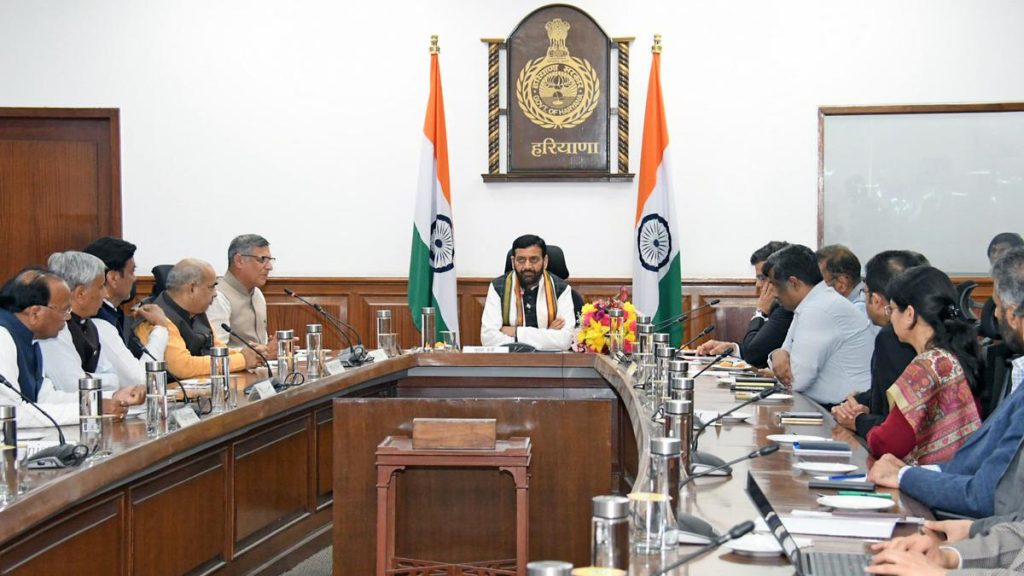
“Our newly formed cabinet wants to thank former CM Manohar Lal Khattar. He has given Haryana a new direction and has given the best example of good governance. He did development work in the state without any discrimination,” said the newly elected CM Saini. Saini was sworn in along with BJP’s Kanwar Pal (Jagadhari), Mool Chand Sharma (Ballabhgarh), Jai Parkash Dalal (Loharu) and Banwari Lal (Bawal), and Independent MLA Ranjit Singh Chautala (Rania). They were all part of Khattar’s council as well and there are still 8 seats vacant. The realignment faced a hiccup as former state home minister Anil Vij did not attend the swearing-in ceremony amid speculation that he was upset with the change of guard. Vij had also walked out of the legislature party meeting where Saini was “unanimously” named the CM-designate.

Khattar issued a statement saying that Vij’s name was on the list of new ministers to be sworn in at the Raj Bhavan ceremony, but the MLA decided to skip it. The former CM indicated that both he and Saini will talk to Vij later to persuade him to accept a place in the cabinet. Vij is not leaving the party however as he said that he had stood by the party during all changes and will do so this time as well.

Who is Nayab Singh Saini

Nayab Singh Saini comes from the OBC community and last year he was made the state president of Haryana BJP. Saini is considered a confidant of Khattar. Saini has long experience of working in the organisation. In 1996, he was given responsibility in the organization of Haryana BJP. After that, in 2002, Nayab Singh Saini became the district general secretary of Ambala BJP Yuva Morcha. In 2005, he became the district president of BJP Ambala Yuva Morcha. He was also made the state general secretary of BJP Haryana Kisan Morcha. In 2012, Saini was promoted and was made the district president of Ambala and in the 2014 assembly elections, he was given a ticket from Naraingarh and he reached the assembly after winning. He graduated with a B.A. from BR Ambedkar University, Muzaffarpur, Bihar in 1996 and LLB from Choudhary Charan Singh University, Meerut (UP) in the year 2010.

Key challenges

While the plan may have been perfectly executed by BJP but Saini has his own set of challenges as he will be racing against time with poll code of conduct being in place. Saini’s biggest challenge will be to lead the BJP into 2024 assembly elections and help it tide over a strong anti-incumbency sentiment. With the Haryana assembly elections due in October this year and the model code of conduct for Lok Sabha elections likely to be imposed anytime now, Saini would have little time to set his image and realise party goals on hot seats. He will, at least for initial phases, be guided by his predecessors and his aides and will be up for backseat driving and may become a lame duck in view of the time limitations he has.

Congress slams ‘scripted move’

Former CM and Congress leader Bhupinder Singh Hooda said that so far as the snapping of ties with the JJP was concerned, he “had said a week back that the BJP and the JJP had entered into a new agreement to divide opposition votes. But by changing the chief minister, the BJP has accepted its defeat.” “The BJP-JJP government led by Khattar failed on all fronts. People were unhappy and are waiting to oust this government in the assembly election this year. By changing the CM, the BJP has tried to cover up its failures by bringing in a new face, but this is not going to help,” said Hooda. Congress general secretary Randeep Singh Surjewala, too, tweeted that the BJP enacted “a pre-arranged drama” of snapping ties with the JJP to save itself from the consequences of the failures while Kumari Selja, another general secretary of the Congress, described the act of replacing Khattar with Saini as a “repackaging” to fool the voters.

What caused BJP-JJP split

The BJP-JJP split is believed to have been triggered by disagreement over seat-sharing for the summer’s Lok Sabha elections; the BJP, which has 10 incumbent MPs in all 10 parliamentary constituencies in the state, was unwilling to share Lok Sabha seats with the JJP. The number of seats sought by JJP had not been disclosed by either side, while there has been no discussion on assembly seats. Political experts claim that BJP now has the numbers and no longer requires JJP which, according to many BJP leaders, was becoming more demanding since 2019.

“We abided by gathbandhan Dharam (code of conduct for coalition) and worked for people. They backed out. Our party was preparing for two Lok Sabha seats, Bhiwani-Mahendragarh and Hisar but BJP couldn’t be fair enough. BJP had asked me to contest from the Rohtak Lok Sabha seat. This cannot break us. Our party will now contest both Lok Sabha and Vishan Sabha and in the state we will win over 50 seats. We just want people’s support as that is the true power,” said former Dy CM Dushyant Chautala at his rally in Hisar. BJP announced Manohar Lal Khattar’s candidature from Karnal Lok Sabha seat.

Vote arithmetic

One of the key reasons behind the change has been cited as OBC vote arithmetic. Though there is no authentic data of the caste-wise population in Haryana, various estimates put the population of backward classes at 35 percent. The Dalits and the general caste, including the Jats, comprise nearly 20 percent and 45 percent, respectively. While Saini will bring in OBC votes, Jats represent approximately 20 percent of the state’s population. Over the years, the political landscape of Haryana has been primarily dominated by the Jats. Khattar had fallen out of favour of them during 2020-21 farmers agitation, the wrestlers’ protest and action against Punjab farmers on Haryana borders of late. The snapping of ties with JJP implies that the votes of the Jats, the most populous community in the state, are likely to be divided among the Congress, the JJP and the Indian National Lok Dal (INLD).

Social justice plank to the fore as top oppn leaders showcase unity

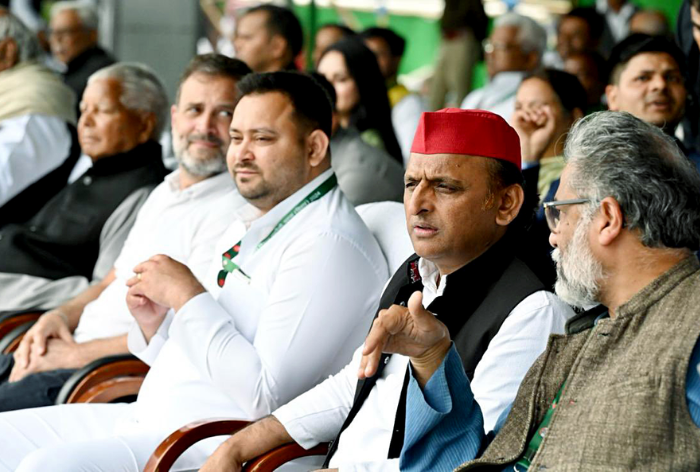
A galaxy of opposition leaders including Congress president Kharge,  Rahul Gandhi, SP chief Akhilesh and RJD patron Lalu Prasad Yadav came together to showcase the INDIA Bloc’s unity during a mammoth rally held at iconic Gandhi Maidan of Patna. A report by Mudit Mathur

Lok Nayak Jayaprakash Narayan gave a historic call for “Total revolution” from the iconic Gandhi Maidan of Patna on 5th June, 1974, aiming to overthrow the dictatorial rule of Indira Gandhi. Subsequently, in the 1977 general election, the people of India voted her out. The same historic venue was utilized by the INDIA bloc for its Jan Vishwas Rally on March 3, urging the nation to defeat the BJP in the forthcoming Lok Sabha elections with the slogan “Modi Hatao Desh Bachao.” After drawing a record number of crowds at the Patna rally, it will be keenly watched how the united opposition will confront the BJP as the nation gears up for the LS polls.

The Jan Vishwas Rally marked the culmination of extensive public mobilization led by RJD leader Tejashwi Yadav through his confidence-building yatras. This effort resulted in an unprecedented turnout from backward classes, minorities, scheduled castes, and tribals, all rallying around the issue of unemployment. The emergence of apparent battle lines suggests a significant shift towards the “Ram versus Roti” narrative, with a focus on the struggle for social justice among the impoverished and marginalized, who comprise a significant 70 percent of the population.

The challenge before the INDIA bloc leaders is huge, given their internal differences. However, amidst the surging wave of Hindutva following the highly publicized Ram temple consecration ceremony, Prime Minister Narendra Modi’s popularity is purportedly reaching an all-time high, resonating deeply with the majority Hindu community. This stands in stark contrast to 1977 when Indira Gandhi’s popularity had plummeted to its lowest point.

Indira Gandhi rose to the peak of her popularity after she won the 1971 war against Pakistan dividing it into two nations, and creating Bangladesh. But the Iron Lady lost elections in 1977 when she tried to muffle the voice of the entire nation, including the media, snatching fundamental rights and liberties by arbitrarily imposing Emergency throughout India, imprisoning her political opponents, and assuming unbridled powers.

Many new laws were enacted which limited personal freedom. The people of India voted against her to restore democracy against dictatorial tendencies undermining fundamental rights and liberties of the citizens.

The Gandhi Maidan of Patna has been a historical site where, shedding their ideological differences, opposition leaders in 1974  had pledged to oust Indira Gandhi by uniting under the umbrella of the Janata Party. They won the next general election against the mighty Indira Gandhi, the then Prime Minister. However, thereafter, the new government indulged in vendetta politics, as it started harassing Indira Gandhi and even put her behind the bars for her alleged atrocities against opposition leaders.

The Janata Party coalition included right-wing Hindu nationalists, socialists, and former Congress party members. Consequently, there was no ideological glue among them, leading to internal infighting and the eventual downfall of the Janata Party government led by Morarji Desai in August 1979. When fresh elections for the Lok Sabha were held in January, 1980, Indira Gandhi and the Congress (I) swept back to power in a landslide victory.

History is marked by an unmistakable message: the people of India have consistently demonstrated an inherent behavioral trend, standing for freedom, liberty, and democracy to counter the misuse of power by authoritarian figures. Today, history seems to be repeating itself with different characters, as most opposition leaders, including those from the Congress party, have united against Prime Minister Narendra Modi. His government has similarly slapped numerous cases against opponents through central agencies such as the CBI, ED, and Income Tax.

The Election Commission of India is also facing severe allegations of partisanship, as it is perceived to have become a handpicked body of the government. The sudden resignation of Election Commissioner Arun Goel just before the general election reveals uncertainty and stress within the system, especially amid growing opposition to voting through Electronic Voting Machines (EVMs) and demands for the deployment of 100% Voter-Verified Paper Audit Trail (VVPAT). The institution has been under a cloud regarding issues of neutrality, transparency, and accountability.

The successful mobilization of a mammoth turnout at the iconic Gandhi Maidan in Patna has largely been attributed to the organizing skills of Tejashwi Yadav, son of Lalu Prasad Yadav and the leader of the opposition in the Bihar assembly. This comes after Tejashwi Yadav lost the deputy chief ministership due to Chief Minister Nitish Kumar’s U-turn. Nitish Kumar returned to the NDA fold, realigning his ties with the BJP. The inspiring rally assumed political significance at the national level, serving as a collective counter to the BJP’s narrative on the Ram temple, as well as its portrayal as the champion of the Hindu cause and its consistent attacks on ‘dynastic’ parties.

RJD chief Lalu Prasad Yadav took the lead in questioning Narendra Modi’s credentials of being a true follower of Hinduism. He asked why Modi did not shave off his hair when his mother died? Shaving of the head, he said, is part of the rituals defined in “Hindu Shastras” which are to be observed after the death of a parent. His remarks were criticised by BJP followers on social media platforms but Lalu played smart, giving a clear message to his targeted audience assembled in his rally.

Lalu Prasad Yadav drew an emotional connect from the crowds reminding them of Bihar before his times when deep caste inequities were prevalent from the village well to the roads. “We ensured that everyone gets respect,” he said. He also narrated his struggle to implement the Mandal commission report and how backward castes captured power as a result of his efforts. He said because of the commission, all poor, backward castes and Dalits are now standing at the doors of power.

Taking credit for employment of around five lakh youths, Tejashwi compared the brief tenure of the Mahagathbandhan government to 17 years of NDA rule in Bihar. Calling upon people to defeat the BJP in order to save the nation, he said, “I can say with confidence that the BJP is a factory of lies, but the RJD stands for ‘Rights, Jobs and Development’. He mocked Nitish Kumar, who recently ditched him to join the BJP-led NDA, by reciting old Hindi film song – “Idhar chala main udhar chala, Jane kahan main kidhar chala, arey fisal gaya.” “One thing is for sure: Janata Dal United (JDU) will be finished in the 2024 Lok Sabha elections,” Tejashwi thundered.

Addressing the issues of communalism, caste inequalities, unemployment and farmers, Congress leader Rahul Gandhi questioned Prime Minister Narendra Modi about the quantum of farm loans waived so far? “The country has not seen unemployment of this scale in the last 40 years. About 73 per cent OBCs, Dalits and tribals have marginal representation in top positions in private sector, media houses and other places. Among 90 top decision-making bureaucrats, there are only three Dalits,” he revealed. Slamming the Agniveer scheme, Rahul said: “Imagine what kind of soldiers we will prepare with just six months of training and how we can put them up against the better trained troops of Chinese and Pakistani forces.”

Congress president Mallikarjun Kharge severely criticised the NDA.  He termed PM Modi as ‘Jhooton ka sardaar‘ (king of lies) even as he urged the public to cast a vote to save democracy and the Constitution.

Prominent political leaders like CPI(M) general secretary Sitaram Yechury, CPI general secretary D Raja, CPI(ML) chief Dipankar Bhattacharya and SP chief Akhilesh Yadav, shared the stage at Patna. Rahul Gandhi, it may be mentioned, left his Bharat Jodo Nyay Yatra to join the rally, highlighting the rally’s significance for the Congress.

Sukhbir Singh Sandhu  & Gyanesh Kumar take charge as Election Commissioners

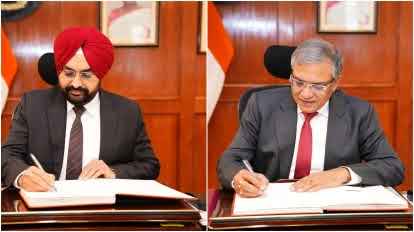
New Delhi: Newly appointed Election Commissioners Gyanesh Kumar and Sukhbir Singh Sandhu took charge of the office on Friday at the ECI headquarters here.

CEC Rajiv Kumar welcomed the two newly-appointed Election Commissioners and emphasized the significance of their joining at the historic point when the Election Commission of India (ECI) is all set to conduct the Loks Sabha elections in the world’s largest democracy.

He said that their team is set for action-packed weeks ahead.

Earlier, a notification for the appointment of the two Election Commissioners was issued by the Central government on Thursday evening.

Prime Minister Narendra Modi-led three-member committee on Thursday picked bureaucrats Gyanesh Kumar and Sukhbir Singh Sandhu as election commissioners.

The decision comes days after the resignation of Election Commissioner Arun Goel.

The selection panel includes the Prime Minister, the leader of the Opposition, and a designated Union Cabinet minister. Congress leader Adhir Ranjan Chowdhury was in the three-member panel in capacity as the opposition member. Besides the Prime Minister and the Congress leader, Union Home Minister Amit Shah attended the meeting.

Panel on ‘One-nation, One-poll’ submits report to President Droupadi Murmu

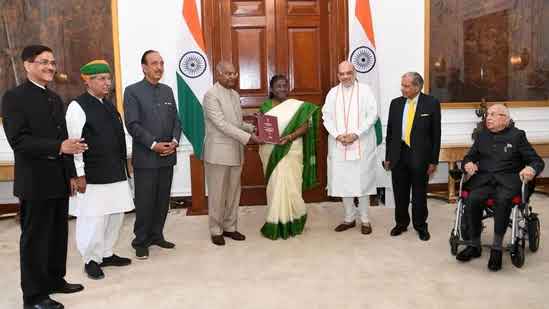
New Delhi : A committee led by former President Ram Nath Kovind, submitted its detailed report on ‘One-nation, One election’ to President Droupadi Murmu at Rashtrapati Bhavan on Thursday.

The comprehensive report has strongly advocated for holding the national and state polls simultaneously.

The report, running into thousands of pages has been prepared after extensive consultations from various stakeholders, former election commissioners and constitutional experts.

The committee to study the possibility of holding simultaneous polls was formed on September 3, 2023. Its members comprised of Union Home Minister Amit Shah, former Chief Minister of Jammu & Kashmir, Ghulam Nabi Azad, senior advocate Harish Salve and more.

Notably, Prime Minister Narendra Modi has time and again underlined the need for clubbing the national and state elections together to save huge expenses and also utilise the time for bettering governance.

‘One-nation, One-election’ was also one of the major poll planks of the BJP in the 2019 Parliamentary elections.

Maharashtra cabinet greenlights land acquisition for Maharashtra Bhavan in Kashmir

The Maharashtra cabinet has given the green light for acquiring 2.5 acres of land at Srinagar in Jammu & Kashmir, to construct a Maharashtra Bhavan. This decision, made during the previous budget session of the Maharashtra Assembly, aims to establish a guest house catering specifically to tourists from Maharashtra visiting the scenic region of Kashmir.

Deputy Chief Minister Ajit Pawar, also holding the Finance Ministry portfolio, had earlier announced plans to build Maharashtra Bhavans in Srinagar and Ayodhya. This move, integrated into the state budget, will provide comfortable and safe accommodations for tourists and devotees at reasonable rates.

“It has been decided to construct Maharashtra Bhavan at Srinagar, Jammu and Kashmir, and Sri Ram Janmabhoomi, Ayodhya to provide better and safer facilities to the tourists and devotees of the State at reasonable rates. In both these places, the respective State Governments have provided land at prime locations for which a provision of Rs. 77 crores is proposed,” Pawar said.

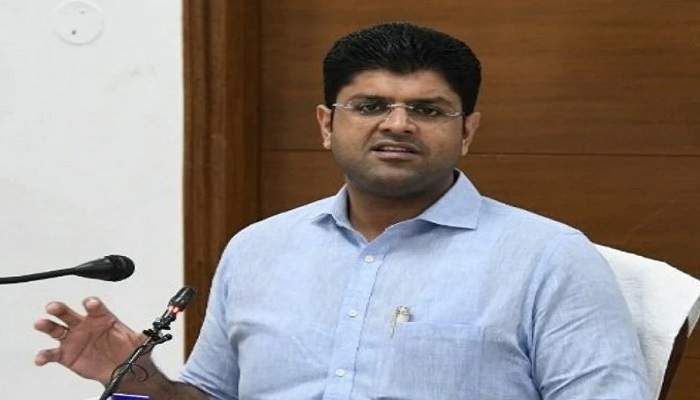
We felt neglected in alliance with BJP,in Haryana says Chautala

Hisar : Addressing Nav-sankalp Rally in Hisar on the birthday of Dr Ajay Singh Chautala National President of Jannayak Janta Party (JJP), a day after the coalition in alliance with the ruling BJP in the state ended, the JJP leader a former deputy Chief Minister in Haryana state Dushyant Chautala said that the party was preparing to contest 2024 LS elections on two seats, accusing  the Bharatiya Janata Party of neglecting the alliance Jannayak Janata Party the step to break alliance was taken, the former Haryana Deputy Chief Minister Dushyant Chautala said in a public rally at Hisar on Wednesday. Chautala said that JJP was a part of the government in the state for four and a half years and took sincere interest in the development of Haryana. In five years, just one meeting of the NDA was held in which he along with Ajay Singh Chautala participated, however, what decision did the BJP make in the end? He said that JJP was prepared to contest the 2024 Lok Sabha elections on just two seats. “We followed the ethics of our alliance and started preparing to contest on two seats,” Dushyant Chautala lamented.

Chautala said, in a high-voltage drama on March 12, Manohar Lal Khattar, the chief minister of Haryana tendered his resignation amid speculations of escalating tensions with the alliance partner JJP in the state government ahead of the 2024 Lok Sabha elections, Khattar was replaced by the party’s recently appointed state unit head Nayab Singh Saini as the new chief minister of Haryana in high profile dramatic manner with sudden break in the relationship between the BJP and the JJP, led by their inability to finalise a seat-sharing arrangement in the state for the upcoming Lok Sabha polls.

The past scenario reveals that BJP had secured victory in all 10 Lok Sabha constituencies in Haryana during the 2019 elections, as such the BJP was uncomfortable with sharing two seats with the JJP in the upcoming Lok Sabha elections. In 2019 assembly elections, the BJP had fallen short of the majority and formed a coalition government with the JJP. The BJP retained four of its 13 ministers in the new Council of Ministers, whereas no representation was given to the alliance JJP, Chautala said that following the political development the JJP called a meeting in Delhi of its leaders, but at least five of its legislators skipped the meeting for the reason best known to them..

Mamata Banerjee fell probably because of a ‘push’ from behind, says SSKM Director

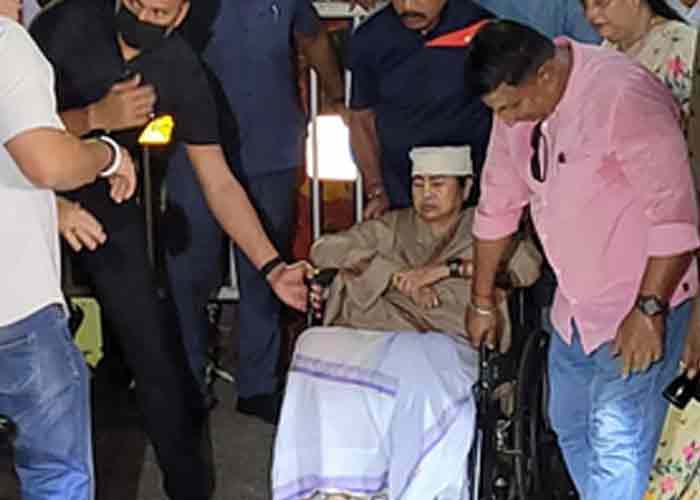
Kolkata : West Bengal Chief Minister Mamata Banerjee might have been pushed from behind at her residence on Thursday evening, following which she fell and sustained injuries on her forehead, the Director of S.S.K.M. Medical College and Hospital, Manimoy Bandopadhyay, said on Thursday night.

Almost an hour after the Chief Minister was released from the hospital and taken back to her residence in Kalighat, Manimoy Bandopadhyay made this explosive statement while speaking to mediapersons.

“The Chief Minister was brought to the hospital at around 7.30 p.m. She fell down probably because of a push from behind. She received a deep injury on her forehead. There was profuse bleeding from that wound, ” the S.S.K.M. Director said.

He also said that the Chief Minister was treated by specialists from the neurosurgery, general medicine, and cardiology departments.

“A number of medical examinations like electrocardiogram and CT scan were conducted. The hospital authorities advised her to stay back. But she insisted on returning home, ” Manimoy Bandopadhyay said

The Chief Minister will be brought to the hospital again on Friday for further medical checkup. She has been kept under medical observation at her residence.

As per the information shared by the Trinamool earlier, the Chief Minister had tripped while taking a walk at her residence on Thursday evening. The social media cell of the Trinamool had also released a photograph in which the Chief Minister could be seen bleeding from her forehead.

Nayab Saini Government wins trust vote in Haryana Assembly

Nayab Singh Saini government offered the chair Chief Minister in Haryana after the resignation of Manohar Lal Khattar yesterday won the confidence motion in the Assembly here through a voice vote in assembly having strength of 41 BJP MLAs in the 90-member House for which the majority mark is set at. A two-hour discussion took place on the motion. The Jannayak Janata Party (JJP) had issued a whip, asking its 10 legislators to remain absent from the House during voting on the confidence motion. However, when the issue of trust vote was taken up, five of its MLAs left the House. In the 90-member State Assembly, the BJP has 41 MLAs and it also enjoys the support of six of the seven Independents as well as of lone Haryana Lokhit Party MLA Gopal Kanda. The JJP has 10 MLAs in the House. The main Opposition Congress has 30 MLAs while the Indian National Lok Dal has one.

The Speaker Gian Chand Gupta fixed two hours for discussing the motion. Jannayak Janata Party MLAs Devender Singh Babli, Ram Kumar Gautam, Ishwar Singh, Ram Niwas and Jogi Ram Sihag left the House when the issue of trust vote was taken up. The JJP had issued a three-line whip requesting its 10 MLAs to remain absent during voting on Confidence Motion in the Assembly. Former State Home cum Health Minister Anil Vij was also present in the House. Before the new CM moved the motion, Congress MLAs raised a question to know from the speaker about the urgency of convening the Assembly session. “There was no emergency”, senior Congress leader, the former Haryana Chief Minister and leader of opposition in Vidhan Sabha Bhupinder Singh Hooda said, claiming that proper time has not been given to the MLAs.

Party MLA B.B. Batra asked, “What was the urgency of convening the session?” Hooda asked the Speaker to adjourn the session for at least one hour so that the legislators could reach the Assembly. To this, the Speaker Gian Chand Gupta said it was the duty of the members to reach the House on time saying that let the discussion take place and in the meantime, the members can reach the House. Participating in the discussion, Congress MLA Raghuvir Singh Kadian opposed the trust vote and took on the State Government over the issues of farmers’ plight, law and order, unemployment, alleged repeated liquor, cooperative, registry scams took place  in the state. He raised questions over the corruption is rampant, law and order has completely collapsed and unemployment is at its peak. Does the government not have any responsibility towards its citizens?” he asked.

Describing Chief Minister Saini as a gentle person, Kadian claimed the BJP leader has been made a scapegoat by being handed over the crown when the State was passing through unstable times. All congress leaders in the House demanded President Rule should be imposed if the situation prevails at present. “We stand in opposition to this trust vote, if the voting would have been held through secret ballot, at least five members from the treasury benches are likely   to oppose it,” said Congress MLAs.

MOST POPULAR

HOT NEWS