The future of a nation depends on its education system, and when the integrity of that system is compromised, the repercussions are felt across society.
For the last many years, India has struggled with the problem of question paper leaks, which continue to undermine fair assessments and public sector recruitments.
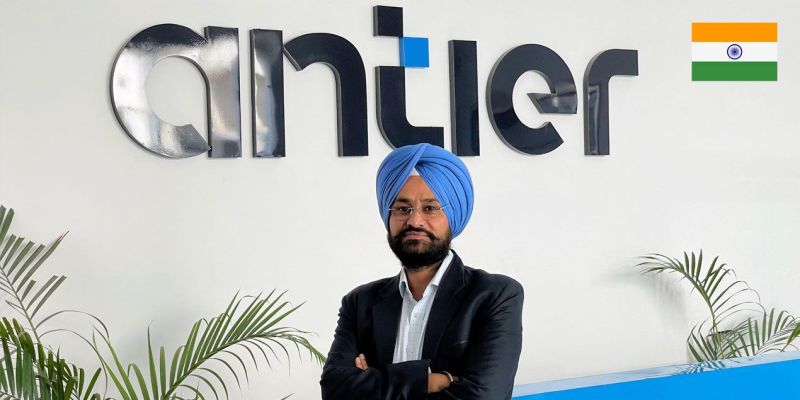
However, Mohali based organization, Antier, has achieved a significant breakthrough by utilizing blockchain to address this issue. The blockchain consulting firm, deployed EduBlock Pro, a software system to conduct a government exam for Punjab State Aids Control Society (PSACS) . This was a recruitment exam for staff nurses and lab technicians.
Rising incidents of question paper leaks
In 2023 alone, a spate of paper leak incidents impacted the education sector in Maharashtra, Assam, Telangana, and Rajasthan. Further, in the last five years, 41 instances of exam leaks were reported across 15 states, as a result of which nearly 1.4 crore job applicants suffered delayed appointments.
Recently, in May 2024, one of the most prestigious medical entrance examinations, NEET-UG, faced paper leaks in Bihar. The system is plagued by rampant corruption, bribery, and favoritism, giving rise to such unethical practices and reduced public trust.
The problem is more serious than we think
Public confidence in the education system and recruitment processes is severely undermined, leading to widespread skepticism and disillusionment. Paper leaks create an uneven playing field, where undeserving candidates gain an unfair advantage, impacting meritocracy and fairness.
Numerous instances of delayed job appointments and academic admissions cause significant disruptions in the lives of millions of students and job applicants.
Additionally, the need for re-conducting exams and investigations into leaks incurs substantial financial costs and diverts resources that could be used for developmental purposes.
How Edublock Pro Works ?
EduBlock Pro, Antier’s flagship product, leverages advanced blockchain cryptographic techniques to secure the examination process with minimal human interference. It begins with encrypted student registration and secure question uploads by contributors. The exam board locks and validates questions using a public and private key infrastructure. On exam day, invigilators decrypt and unlock papers for secure distribution.
By leveraging blockchain’s inherent security, EduBlock Pro protects exam content against unauthorized access and manipulation. It uses Web3.0-based sequential encryption, asymmetric digital signature-based encryption, multiparty computation, and automated evaluation, ensuring a robust and transparent examination process, effectively preventing question paper leaks.
“As demonstrated in the case of the recent PSACS hiring drive, hundreds of candidates applied and appeared for the examination held through the integration of EduBlock Pro. This affirmed the integrity and accuracy of the examination procedure, alongside the efficiency and effectiveness of the product. “ – Says Vikram r Singh, Founder & CEO Antier.
EdublockPro aligns with UNESCO’s SDG 9
EduBlock Pro aligns with UNESCO’s Sustainable Development Goal 9 by contributing to inclusive industrialization and resilient infrastructure. The platform not only secures examinations but also promotes transparent and equitable governance.
EduBlock Pro ensures the integrity of educational processes, fostering trust and reliability. This innovative approach supports fair practices in the education sector, creating a more inclusive and equitable environment.
EduBlock Pro’s vision extends beyond merely preventing exam malpractices; it aims to transform governance standards, making them more transparent, accountable, and accessible to all.
Antier – India’s largest blockchain development company
With a strong foothold in building a multitude of decentralized applications and experience of almost two decades in the IT industry, Antier is India’s leading blockchain consulting firm. Based in Mohali, Punjab, Antier boasts of a 700+ strong workforce and an accomplishment of delivering more than 1000 projects.
Conservative British MP Marco Longhi has come under fire after writing a public letter urging the British Pakistani community in Dudley North to vote for him in the upcoming UK polls on July 4. In his letter, released on the occasion of Eid al-Adha, Longhi emphasized his condemnation of India’s “illegal actions in Kashmir” and pledged to continue raising the issue in Parliament.
Longhi’s letter highlighted his commitment to speaking against what he described as the Indian government’s “atrocities” towards the people of Kashmir. He also criticized the re-election of Prime Minister Narendra Modi, predicting tougher times for Kashmiris and condemning Modi’s plan to pursue full statehood for Kashmir, which Longhi claimed would strip Kashmiris of their special status.
The letter has sparked significant backlash. Rajesh Agrawal of the Labour Party criticized Longhi’s actions as a “shameful attempt to divide communities,” offensive to both Muslim and Hindu communities. Agrawal called for Conservative leader Rishi Sunak to withdraw support for Longhi’s campaign and to apologize for what he described as divisive and alienating tactics.
Narendra Modi-led NDA government takes charge after 2024 election results gave a fractured mandate, leaving the BJP, which ceded considerable ground in its stronghold states of UP and Maharashtra to the INDIA Bloc, vulnerable to pulls and pressure of its allies, writes Mudit Mathur
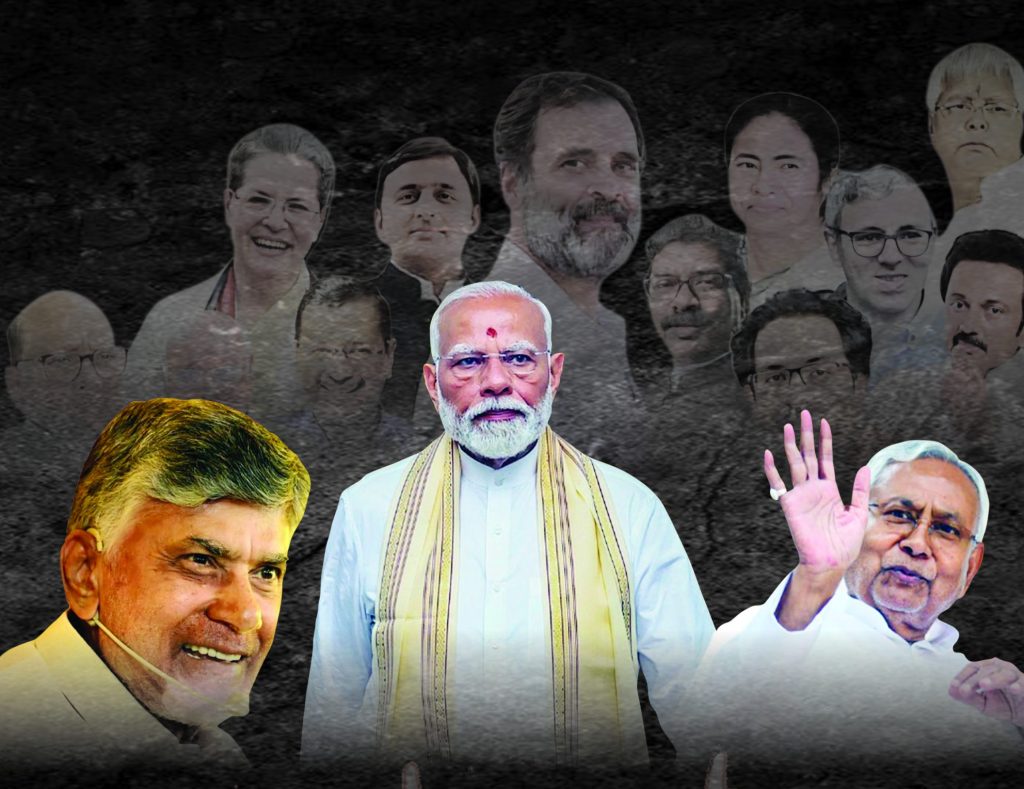
While providing a breather to opposition parties under its expanding umbrella, the Congress party has shown signs of robust revival by winning 100 seats under the proactive leadership of Gandhi scions, Rahul and Priyanka. The fractured 2024 verdict given by Indian voters has altered the nation’s political discourse,checking the ruling party’s slide towards authoritarianism and rejuvenating democracy through coalition governance. The new government will remain under the compelling influence of regional allies, who will undoubtedly continue to press Prime Minister Narendra Modi for financial support to advance their states’ ambitious plans.
The BJP lost 84 parliamentary seats, suffering a significant blow from Uttar Pradesh where it faced a humiliating defeat. The BJP won 33 out of 80 seats as its 27 sitting members lost elections, shattering its dream of winning more than 400 seats and breaking the 414-seat record achieved by Rajiv Gandhi-led Congress in 1984. The poor performance in Uttar Pradesh and the major setback in Maharashtra marred the BJP’s prospects of winning a majority on its own. Notably, the BJP couldn’t secure a single seat in Tamil Nadu, Punjab, Sikkim, Manipur, Meghalaya, and failed to win the lone seats in Mizoram, Nagaland, Puducherry, Chandigarh, Ladakh and Lakshadweep, as its efforts to polarize voters bore no fruit.
Proving the unduly high seat projections for the BJP by various exit polls wrong, Verdict 2024 resulted in a hung Lok Sabha, bringing back the supremacy of coalition diplomacy. Political analysts considered it the first moral defeat of the Brand Modi in political terms. Compared to the mighty Modi 2.0 regime, this time the BJP’s tally fell drastically from 303 to 240 seats, compelling him to seek support from his coalition partners for a third consecutive term. This personal ambition is driven by a desire to equal the record of Pandit Jawaharlal Nehru, who had achieved a hat-trick of heading the governments at the centre.
Unlike BJP stalwart Atal Behari Vajpayee, Prime Minister Narendra Modi has led governments with an absolute majority both while at the Centre and in the state of Gujarat. In Gujarat, he governed with unquestioned authority. However, the current political landscape presents a significant challenge for him. Working with coalition allies, who won elections based on divergent political narratives and incompatible ideological propositions poses a considerable hurdle, especially given the saffron outreach of the BJP
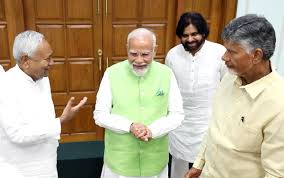
This is why many political observers doubted from day one the political stability and ability needed for the continuation of his governance, given his now well-known uncompromising and inflexible temperament. How will he deal with allies who can pull him down and who may not share the same ideological views? It will be interesting to watch how he handles the ideological differences with his counterparts in Andhra Pradesh and Bihar, who hold the key to power.
Currently, Modi faces challenging propositions: handling a strong opposition, satisfying the political needs of NDA allies, and, above all, pacifying the apparent concerns of his parent organization, Rashtriya Swayamsevak Sangh (RSS), regarding issues of ‘misgovernance’ and ‘significant setbacks’ highlighted by its chief, Mohan Bhagwat. Reversing the Agniveer scheme, reinstating earlier arrangements for ad-hoc recruitments in the defence forces, and implementing special financial packages for Bihar and Andhra Pradesh will test the ability of the coalition government to deal with challenges in the days ahead.
Recently, Bhagwat publicly expressed his concerns, stating, “Manipur has been waiting for peace for the last year. There was peace in Manipur ten years ago; it seemed like the gun culture had ended. However, the state has recently experienced violence.” ” The situation in Manipur will have to be considered with priority. There is a need to get over election rhetoric and focus on problems facing the nation,” emphasized the RSS chief. Interestingly, he criticized the practice of attacking each other during election campaigns, the misuse of technology, and the spread of false information. Bhagwat suggested replacing the term “virodhi” with “pratipaksh.”
Bhagwat perhaps was referring to an undignified and divisive level of discourse pursued by a desperate Modi in his aggressive campaigning. When Modi learned of the continuing slide in the party’s fortunes through various poll phases, he upped the ante and targeted his political opponents and the minority community, spreading all sorts of misinformation about Muslim birth rate, snatching of mangalsutras, talks of mujras, and stolen faucets, which hardly helped the party’s cause.
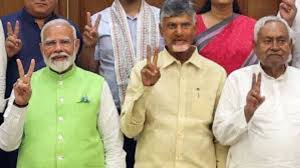
Meanwhile, the selection of the Lok Sabha Speaker remains a contentious issue, with the TDP showing disagreement over the nomination of Daggubati Purandeswari as the BJP nominee for the post. Purandeswari is the estranged sister-in-law of Naidu and the state president of BJP in Andhra Pradesh. The TDP, with its 16 MPs, and the Janata Dal-United, with 12 MPs, have emerged as key players. Chandrababu Naidu has always been a cautious player, seeking a financial package for his state and its capital, Amaravati. Modi, in his past election speeches, had made disparaging remarks about Naidu, which would not be easily forgotten by the latter.
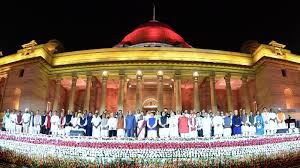
Narendra Modi was sworn in as Prime Minister of India for a third consecutive term on June 9. However, this is the first time he has assumed office as the head of a coalition government. Alongside Modi, a total of 71 ministers were sworn in, including 30 cabinet ministers, 36 ministers of state, and five ministers of state with independent charge. Notably, there is no Muslim minister in his cabinet team.
After assuming office as Prime Minister, Modi allocated the same portfolios to his key cabinet colleagues in the Union Cabinet, largely to strengthen the sentiment of continuity and to demonstrate unity and political stability in the government. The Union Cabinet includes top BJP leaders such as Rajnath Singh, Amit Shah, Nitin Gadkari, S. Jaishankar, Nirmala Sitharaman, Piyush Goyal, Sarbananda Sonowal, Virendra Kumar, Pralhad Joshi, Giriraj Singh, Jyotiraditya Scindia, Ashwini Vaishnaw, Dharmendra Pradhan, Bhupendra Yadav, Gajendra Singh Shekhawat, Annapurna Devi, Kiren Rijiju, Hardeep Singh Puri, Mansukh Mandaviya, G. Kishan Reddy, Rao Inderjeet Singh, and Arjun Ram Meghwal. A new addition to the cabinet is the party president, J.P. Nadda, whose term as BJP president will end this month. Modi also accommodated former chief ministers Shivraj Singh Chouhan and Manohar Lal Khattar in his cabinet.
The induction of former Congress leader Ravneet Singh Bittu from Punjab as a minister of state, despite losing the Lok Sabha election, surprised many. On the other hand, Modi’s decision not to extend a similar gesture to Smriti Irani, who lost the election to Gandhis’ acolyte, KL Sharma, from Amethi, raised eyebrows. Anurag Thakur of Himachal Pradesh being dropped from the cabinet highlights his declining influence following the rise of controversial actress Kangana Ranaut, who successfully contested from Mandi seat to enter the political arena.
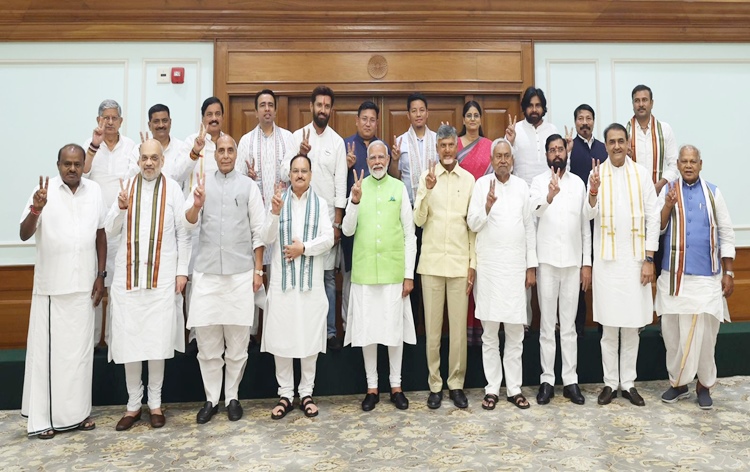
Modi has allocated two ministerial berths each to two crucial allies, TDP and JD(U). Kinjarapu Ram Mohan Naidu from TDP has been sworn in as a cabinet minister, with Chandra Sekhar Pemmasani taking oath as minister of state. From JD(U), Rajeev Ranjan Singh has been appointed as a cabinet minister, while Ram Nath Thakur has been made the minister of state. Cabinet positions have also been given to leaders of other allies, including Chirag Paswan (LJP), Jitan Ram Manjhi (HAMS), and H.D. Kumaraswamy (JDS), but none to the NCP.
Former allies like Shiv Sena (UBT) and Akali Dal have already parted ways on a bitter note. New partners like Shinde Sena and Ajit Pawar’s NCP vied for representation in the Union Ministry but have not secured any cabinet positions in the NDA-3 cabinet.
The Nationalist Congress Party (NCP) – the faction under Ajit Pawar – was denied a ministerial berth. Although NCP’s Praful Patel was offered a Minister of State position, he declined it, describing the offer as disrespectful and unacceptable. He cited his prior work in prominent ministries as a cabinet minister in the UPA government to buttress his case. No cabinet positions were allocated to allies in Maharashtra and Uttar Pradesh, where the NDA suffered huge losses.
The BJP fell short of a majority on its own in the 2024 Lok Sabha elections, with its tally of 240 seats. Consequently, it had to rely on its allies in the National Democratic Alliance (NDA) to form the government. The BJP’s losses in India’s two largest states—Uttar Pradesh and Maharashtra—caused a serious setback to Modi’s unfettered dreams. In Uttar Pradesh, the BJP lost 29 seats, while in Maharashtra, it lost 14 seats. This cumulative loss of 43 seats kept the saffron party from reaching the simple majority mark
It may be recalled that the political turmoil in Maharashtra was engineered by the BJP to topple the Udhav Thackrey-led government. The state witnessed how Shiv Sena and Nationalist Congress Party (NCP) split with a bitter fight for claim over name and symbol among their leaders after they were targeted and raided by central investigating agencies––the Enforcement Directorate and the CBI. And how these leaders were compelled to switch over their loyalties towards the BJP to get a clean chit. After toppling the Udhav Thackrey-led government, the BJP cobbled a coalition with breakaway Shiv Sena and NCP factions. In the 2024 Lok Sabha elections, the Mahavikas Aghadi, which included the Congress, Nationalist Congress Party (led by Sharad Pawar), and Shiv Sena (led by Uddhav Balasaheb Thackeray), won 30 out of the 48 seats in the state. In contrast, the BJP, which had won 23 seats out of total 48 in the 2019 elections, secured only eight seats this time
Explaining what went wrong in the state, Maharashtra CM and Shiv Sena chief Eknath Shinde said, “The BJP’s slogan was “400 paar,” with the objective of winning over 400 Lok Sabha seats. However, in certain regions, a negative narrative emerged, suggesting that the Constitution would be changed, and this narrative was linked to the “400 paar” target.” Shinde continued, “People kept this in mind, and it backfired. The BJP’s electoral vehicle couldn’t even cross 300 seats. In several states, they faced a major setback. Even in Maharashtra, the Mahayuti alliance did not achieve the success it had anticipated.”
In the 2019 Lok Sabha elections in Uttar Pradesh, the BJP won 62 seats, and its tally increased to 64 with its ally, the Apna Dal (Soneylal), winning two seats. However, in the 2024 elections, the BJP’s tally has shrunk to 33 despite forming new alliances with parties like the Rashtriya Lok Dal (RLD), the Suheldev Bharatiya Samaj Party (SBSP), and the Nishad Party, aiming to strengthen its OBC base. However, this strategy proved futile as both leaders were discredited in their communities due to their opportunistic approach. OBC-based parties such as NISHAD, Apna Dal (Sonelal), and SBSP failed to transfer their votes to the BJP and even lost their seats, with the RLD being the only gainer.
The RLD has a strong base among Jat voters in districts like Baghpat, Meerut, Mathura, Bijnor, Amroha, Kairana, Muzaffarnagar, Saharanpur, Bulandshahr, Hathras, and Aligarh in western UP. Despite this, the RLD’s support did not translate into wins for the BJP in Muzaffarnagar, Saharanpur and Kairana seats. Meanwhile, the BJP candidates such as Arun Govil (in Meerut), Satish Gautam (Aligarh), and Kanwar Singh Tanwar (Amroha) struggled to secure victory in their respective seats. Overall, other allies also failed to deliver positive results for the party.
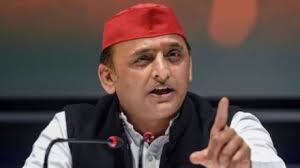
Samajwadi Party chief Akhilesh Yadav effectively dismantled the caste chemistry crafted by BJP strategist Amit Shah, expanding his outreach beyond his traditional Yadav-Muslim support base to include Dalits through his Progressive Democratic Alliance (PDA) formula. His strategic ticket distribution to Dalits and the most backward classes paid dividends, resulting in an unexpected victory on 37 seats, surpassing the BJP tally in the Hindu heartland state.
This unforeseen political scenario arose as a consequence of Prime Minister Modi’s unrestrained political rhetoric during his inconsistent election speeches, which seemed to pose a threat to the secular social fabric of the republic. This was followed by the echoing sentiments of many of his close associates across the country, creating concerns among voters that if Modi were to come to power with an overwhelming majority, he would undermine or even replace the Constitution of India, revoking ongoing benefits of reservations for deprived sections of society.
Though Prime Minister Modi later realized the serious adverse effects of these remarks on the party’s prospects, by then it was beyond his control to rectify the situation. The BJP could not secure a single seat in Tamil Nadu, Punjab, Sikkim, Manipur and Meghalaya, and failed to win the lone seats in Mizoram, Nagaland, Puducherry, Chandigarh, Ladakh and Lakshadweep, as its efforts to polarize voters bore no fruit.
The mandate significantly reflects a strong consolidation of oppressed classes (Mandal) against the forces of “Hindutva” (Kamandal), ostensibly to protect the Constitution. This formula halted the surge of the Hindutva tide, putting an end to speculation about India heading towards becoming a “Hindu Nation” through amending or replacing the constitution.
These sentiments ran so deep that even at the birthplace of Lord Rama — Ayodhya — and its surrounding parliamentary constituencies, there was a rejection of the politicization of the consecration ceremony of the Lord Rama temple by Prime Minister Narendra Modi. Modi had tried to use the consecration ceremony to his political advantage by stirring religious sentiments.
Modi also attempted to establish a subtle Hindutva connection, reaching every corner of southern Indian states, symbolized by the route Lord Rama traveled during his exile period to win the war with Ravana in Sri Lanka. However, the results proved to be quite disappointing for him as the BJP bit the dust from Ayodhya to Rameswaram.
In Uttar Pradesh, the Samajwadi Party emerged on top with 37 seats, while the BJP secured 33, the Congress 6, and the Rashtriya Lok Dal (RLD) and Apna Dal (Soneylal) each won 2 seats. The Azad Samaj Party also secured one seat. Consequently, the tally of the INDIA Alliance rose to 44 seats out of 80. Many of the seats won by the BJP were by a very narrow margin. The BJP’s strategy of caste combination this time failed to account for the strength of the realignment of Dalit voters under the Progressive Democratic Alliance (PDA) led by Akhilesh Yadav. Yadav’s decision to distance himself from BSP supremo Mayawati, who was perceived as passive in addressing threats to Baba Saheb’s Constitution and her tactical support for the BJP, contributed to this shift.
The BJP suffered a huge humiliation due to the single-handed approach of Modi-Shah duo, who disregarded advice from grassroots and state leadership in ticket distribution. Despite adverse feedback regarding their winnability, the party repeated many sitting members, excluding the controversial Brij Bhushan Sharan Singh, whose son, Kirti Vardhan Singh replaced him. Brij Bhushan is facing charges of sexual exploitation of women wrestlers in the court. The new Union Council of Ministers saw a drop in the state’s representation from 14 to nine. Kirti Vardhan Singh from Gonda was among those favoured for Modi’s team. Meanwhile, the highly protected minister, Ajay Mishra Teni , lost the election. Teni’s son was involved in an incident of knocking down the agitating farmers with his vehicle, leading to nation-wide protests.
These reversals occurred in Uttar Pradesh, being developed as a hotbed of aggressive “Hindutva” with brewing issues in Kashi and Mathura, similar to Ayodhya, under the regime of saffron-clad Chief Minister Yogi Adityanath. Popularly called “Bulldozer Baba,” his governance model was replicated by the Central government in Delhi and by state governments in Haryana and Madhya Pradesh, where administrations targeted minorities, particularly Muslims.
The administrative highhandedness in demolition drives in Ayodhya hurt a large section of the poor and Dalits depriving them of their housing and livelihood. This approach proved counterproductive, failing to consolidate Hindu communities and muster their votes due to the perceived threats to the rule of law and the constitution.
The message of the mandate is crystal clear: ignore burning issues at your own peril; and more than that: never dream of making democracy opposition-free. This is what the slogan “abki baar 400 paar” perhaps tried to convey but it has remained just a rhetoric though the party think tank believes that minus the slogan, complacency would have set in to make the mandate even more daunting. The message is that you can’t take voters for guranteed when there are unresolved issues like unemployment, inflation, Agniveer, farm sector unrest and show of the State might. The biased predictions for exit poll exposed most mainstream media and psephologists, and led to a bloodbath at stock markets while the Rupee saw the largest fall in 15 months. Indeed, the NDA has overcome the shock given by the INDIA block and formed the government at the Centre albeit with the support of regional satraps like N Chandrababu Naidu, who has been catapulted from political obscurity to the pivotal role along with Nitish Kumar, to keep the government intact.
But some reversals can’t take away the gains as the BJP has done well in Odisha, made major inroads in the South, and swept Delhi, Himachal, Uttarakhand, and Madhya Pradesh. However, the setback in Uttar Pradesh must have left it shell-shocked. The most shocking is the drubbing it received in Faizabad, the home of Ram Mandir at Ayodhya where the Samajwadi Party-Congress combine turned the tables on the BJP with a remarkable performance. The PM’s own depleted victory margin in Varanasi as against over four lakh in 2019 would worry the party. Maharashtra too had surprises in store. In West Bengal, the iconic leader, Mamata Banerjee, with her astute political wisdom, further consolidated her standing. For the BJP, there were losses in Rajasthan and Haryana too while it lost a seat each in Chhattisgarh and Gujarat. Bihar, Odisha, and Andhra Pradesh showed support for NDA.
Clearly, the country now is in no danger of becoming opposition-free. Also, the mandate has dispelled doubts over the EVMs and the credibility of an institutions like the Election Commission of India. The mandate is sure to keep the government on its toes not only because of its allies but also because of a strong Opposition. It would be for the first time since he became the Gujarat CM in 2001 that Prime Minister Narendra Modi would be running a government without a full majority and his hands would be tied as he would be dependent on its NDA allies. There is also a message in RSS chief Mohan Bhagwat’s utterances after polls, where he stressed the need for humility and consensus. It shows that Sangh is not on the same page with BJP as far as the ideological path is concerned. Yet it is too early to say that INDIA is blooming and Lotus is wilting!
Five years after the revocation of Article 370, that granted special status to J&K, the old political order and its narrative which the BJP tried hard to displace, stays unchanged. This is a setback to the BJP’s efforts to set up a parallel political structure in the Valley. A report by Riyaz Wani
But for the unexpected victory of Engineer Rashid in North Kashmir’s Kupwara constituency, the poll outcome in Jammu and Kashmir was more or less along the expected lines. The National Conference and the BJP won two each in the four remaining seats. In Ladakh, it was the independent candidate Haji Hanifa Jan who eventually won.
If the election was presumed to be a referendum on the acceptance or rejection of the abrogation of J&K’s special status as the mainstream parties like National Conference and the PDP framed it, the verdict in the Valley was clearly against it. More so, in Kupwara, where Rashid’s Awami Ittehad Party (AIP) has adopted a more hardline approach on the issue. Rashid himself has been in jail since 2019. In August 2019, soon after the abrogation of Article 370, he was arrested by the National Investigation Agency (NIA) in a case of terror funding. The incarceration brought him a wave of sympathy during a spirited campaign led by his sons Abrar Rashid and Asrar Rashid. Theirs was a wild card entry at a time when the contest seemed to be evenly split between the former chief minister Omar Abdullah and the People’s conference chief Sajjad Lone. They were considered the only serious candidates in the fray. But Rashid polled a whopping 4,54,950 votes, 46 percent of the total votes in the constituency.
The victory may not help Rashid come out of jail but it has made him a far bigger leader in the Valley than he has been so far. Rashid has won two successive Assembly elections from his small constituency Langate, He also fought 2019 parliamentary polls, and polled over one lakh votes which too was a surprise at the time. This time, he has not just got over 3 lakh more votes but these votes are spread across the North Kashmir, giving him a solid foothold in several Assembly constituencies. North Kashmir has around 16 Assembly constituencies, which makes Rashid a force to reckon with in a future Assembly election and a potential kingmaker in a future government if the current wave persists in his favour. And such a prospect looks likely considering Assembly polls are expected to be held by September this year.
Meanwhile, Engineer Rashid has approached Delhi’s Patiala House Court seeking interim bail to take oath as a member of parliament (MP).
Other battles
In Srinagar constituency, the NC candidate Aga Syed Ruhullah Mehdi polled 3,56,866 votes as against his nearest competitor 1,68,450 by the PDP candidate Waheed ur Rehman Parra. Similarly in Anantnag constituency, Mian Altaf polled 5,21,836 votes while former Chief Minister Mufti bagged 2,40,042 votes.
Jammu and Kashmir, in all, recorded a voter turnout of 58.58 percent in the election. In a statement on May 27, the CEC said the voter turnout was the highest in 35 years and there had been a 23 percent increase in the number of candidates compared to 2019.
One big takeaway from the election was that the candidates who were seen as close to the BJP lost big. For example, Apni Party candidate in Srinagar, Mohammad Ashraf Mir polled just over 65,000 votes and its Anantnag constituency candidate Zafar Iqbal Manhas got 1,42,195 votes. In North Kashmir, Lone’s People’s Conference, otherwise an established party, also lost a substantial chunk of its public support for being perceived as close to the saffron party.
This is a setback to the BJP’s efforts over the past five years to set up a parallel political structure that takes on the established parties such as the NC and the PDP. Five years after the revocation of Article 370, which granted special status to J&K, the old political order and its narrative which the BJP tried hard to displace, stays unchanged. And by electing Rashid, who champions a hardline mainstream politics that seeks constitutional safeguards for Kashmir, the Valley has once again conveyed its unhappiness over the loss of its special constitutional status.
In fact, during the election campaign, the accusation of being pro-BJP became a slur which opponents liberally used against one another. The BJP, however, did not contest in the Valley. Parties like the NC and the PDP attributed this to the saffron party supporting candidates from its alleged proxy parties, such as the Apni Party and the People’s Conference. As it turned out, none of them won.
But, will the BJP again fight through its alleged proxies in the Assembly elections? It may not be the case. The BJP leader and the former Union Home Minister Amit Shah announced during his recent visit to Srinagar in the middle of elections that the party intended to compete for all 90 seats in the assembly elections.
Assembly elections in sight?
Beginning preparations for the Assembly elections, the Election Commission (EC) announced on June 7 that it will start accepting applications from political parties for the use of common symbols for their candidates.
“The Commission has decided to accept applications seeking allotment of Common Symbol under Para 10B of the Election Symbols (Reservation & Allotment) Order, 1968 for the General Election to the Legislative Assembly of Union Territory of Jammu & Kashmir with immediate effect,” stated the EC.
Last year, the Supreme Court directed the EC to conduct the J&K Assembly elections by September 30. This ruling came alongside the Court’s upholding of the August 5, 2019, abrogation of Article 370, which resulted in the division of the former state into two Union Territories.
A Delimitation Commission was established in 2020 to redefine the boundaries of the Lok Sabha and Assembly constituencies. The delimitation order, issued in May 2022, established a 90-member Assembly, allocating 47 seats to Kashmir and 43 to Jammu.
This has effectively paved the way for the Assembly polls in J&K. And this time, the people are more hopeful of the elections being held due to the altered nature of the government at the centre. A BJP-led coalition government in which Chandra Babu Naidu’s Telugu Desam Party and Nitish Kumar’s Janata Dal (United) are important partners, is expected to work towards restoration of democracy in J&K and hopefully the subsequent reinstatement of statehood.
J&K has not had an elected government since June 2018 when Governor’s rule was imposed after the PDP-led coalition government lost its majority following the withdrawal of support by the BJP. The last five years have witnessed a drastic political makeover of the state-turned-union territory, so much so that in many aspects, the current J&K bears little resemblance to what it was pre-August 2019 when Article 370 was withdrawn. Will things change for the better now? There’s now hope that they would.
The recent multi-cornered Lok Sabha election in Punjab has sprung notable results for all the political majors. While Congress has succeeded in retaining its grip on the state, the results have left the ruling AAP, which had swept the 2022 Assembly polls, chastened. A report by Rajesh Moudgil
The June 1 general elections in Punjab which gave Congress seven out of total 13 Lok Sabha seats and three to ruling Aam Aadmi Party (AAP), show the Congress as the biggest gainer in the state in which ruling AAP had won 2022 assembly polls with a historic win of 92 out of total 117 assembly seats.
The Shiromani Akali Dal (SAD), which is the biggest regional party, on the other hand, could win just one and the BJP failed to even open its account.
The voters of the state also elected two pro-Khalistan Sikh radical independents – Amritpal Singh and Sarbjit Singh Khalsa – from Khadoor Sahib and Faridkot seats, respectively. This election also had an unprecedented show of party hoppers.
The Congress had won eight seats in the 2019 general elections and faced a brutal drubbing in the 2022 state election when the Aam Aadmi Party (AAP) not only registered a landslide victory by winning 92 out of the total 117 assembly seats, but also decimated Congress’ vote-share. The Congress which had about 40% vote share and 18 MLAs, has come down to about 26% this time, but has bagged seven seats across the trio regions of the state – Malwa, Majha and Doaba.
It has won Ludhiana, Ferozepur, Fatehgarh Sahib (SC) and Patiala (Malwa), two seats – Gurdaspur and Amritsar (Majha) and Jalandhar (SC) seat (Doaba).
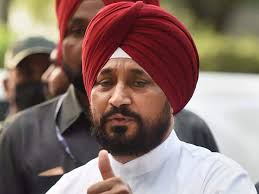
Former chief minister Charanjit Singh Channi has come out as one of the Congress’ giant killers this time who has won the Jalandhar (SC) seat by a huge margin trouncing BJP’s Sushil Rinku, who was Congress’ own sitting MLA from Jalandhar West till recently but had hopped over to the saffron party along with another sitting MLA Sheetal Angural.
The two other prominent winners of Congress are Dr Dharamvira Gandhi and state party chief Amarinder Singh Raja Warring. While Gandhi defeated former Congress stalwart and four-time MP Preneet Kaur who had recently joined BJP from Patiala, Warring trounced his party’s turncoat and two-time MP Ravneet Bittu from Ludhiana.
The remaining four Congress winners are: Gurjeet Singh Aujla from Amritsar, Amar Singh from Fatehgarh Sahib, Sher Singh Ghubaya from Ferozepur and former deputy chief minister Sukhjinder Singh Randhawa from Gurdaspur.
AAP humbled
Even though Punjab once again became the only state in the country to have elected AAP MPs since 2014 general polls, its score of three out of 13 this time, appears far from being impressive given its ambitious target of winning all the 13 seats this poll season.
The party which had a brute majority in the state assembly and which had fielded at least five Cabinet ministers and many more MLAs failed to yield desired results.
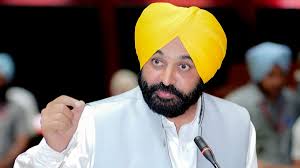
The AAP in Punjab had seen four of its candidates triumphing in 2014 LS Election– Bhagwant Mann from Sangrur seat, Dharamvira Gandhi from Patiala, Harinder Singh Khalsa, Fatehgarh Sahib and Prof Sadhu Singh from Faridkot, and only one in 2019 – Bhagwant Mann.
However, since Mann had vacated his Sangrur seat and won Dhuri assembly seat and became the chief minister, the vacated seat was bagged by Shiromani Akali Dal (Amritsar) chief Simranjit Singh Mann, also a Khalistan sympathiser.
However, the AAP’s Sushil Rinku won the Jalandhar Lok Sabha seat after the demise of Congress’ sitting MP Santokh Choudhary, during the Rahul Gandhi-led Bharat Jodo Yatra. Rinku hopped over to BJP recently, but eventually lost to Channi.
The AAP’s three nominees who have won this election are Gurmeet Singh Meet Hayer from Sangrur ousting Simranjeet Singh Mann of SAD (Amritsar), Raj Kumar Chabbewal from Hoshiarpur seat and Malvinder Singh Kang from Anandpur Sahib seat.
SAD reduced to single seat
Meanwhile, even though the Harsimrat Kaur Badal of Shiromani Akali Dal (SAD) has succeeded in retaining her Bathinda seat and that too by doubling her previous margins of about 20,000, as many as 10 out its 13 candidates failed to save their deposits.
Both SAD and BJP had fought on all the 13 seats, alone. In most of the constituencies, the SAD finished a poor fourth.
The two candidates who could save their deposits are Anil Joshi, Amritsar seat, and Nardev Singh Bobby Mann, Ferozepur.
The party’s vote share has also slided – from 27.76% in 2019 to 13.53% this time.
The BJP which also went solo on all the 13 seats, failed to even open its account, though it recorded 18.56% vote share – about 5% more than its former ally SAD.
The poll data also showed that BJP’s performance in 35 out of total 117 assembly segments, which were Hindu, urban or semi-urban areas, had significantly improved and the saffron party finished second in seven seats – Jalandhar west, Jalandhar cantt, Amritsar west, Fazilka, Anandpur Sahib, Sahnewal and Dinanagar.
While the issues like Ram Temple and Modi wave did have a positive impact, the farmers’ ire went against it.
Radicals spring a surprise
Meanwhile, the victory of two pro-Khalistan Sikh radical independent candidates also seem to have potential to create a disquiet in the state, poll observers have opined.
The two candidates are – pro-Khalistan radical Sikh preacher Amritpal Singh, 31, who is lodged in Dibrugarh jail (Assam) under NSA and Sarabjeet Singh Khalsa, 45, who is son of former Prime Minister Indira Gandhi’s assassin Beant Singh.
They fought from Khadoor Sahib and Faridkot Lok Sabha constituencies, respectively, as independent candidates and won by huge margins.
The campaigning for Amritpal was primarily done by his parents and supporters and the Shiromani Akali Dal (Amritsar) incumbent MP from Sangrur seat, Simranjit Singh Mann, also a pro-Khalistan leader, had withdrawn his candidate in support of Amritpal.
Amritpal’s supporters portrayed him as an “anti-drug crusader’’ and recalled the campaigns he aggressively conducted, which were primarily against the drugs, rampant across the state. They also laud the “amrit sanchar’’ (Sikh initiation ceremony) conducted by the radical Sikh preacher. They, however, maintain radio silence on Amritpal’s stances on Khalistan or distrust in the Constitution of India.
He had hit the headlines after he along with a score of his supporters stormed Ajnala police station in Amritsar on February 23 last year, demanding release of one of his aides booked in a case of assault and abduction. He surrendered before police on April 23, last year, after Punjab police launched a hunt to nab him and his aides.
Sarabjeet Singh, on the other hand in Faridkot, faced BJP’s Hans Raj Hans, a noted sufi singer, cine actor, singer Karamjit Singh Anmol, SAD’s Rajwinder Singh Dharamkot, Congress’ Amarjit Kaur Sahoke
Sarabjeet during his campaign, raised the Panthic chord and drew responsive gatherings. He also had backing of Sikh leaders who were part of 2015 Bargari protests against sacrilege – including former Akal Takht Jathedar Jasbir Singh Rode and former AAP leader Justice Jora Singh.
Notably, Sarabjeet’s mother Bimal Kaur Khalsa had won from the Ropar Lok Sabha election and his grandfather Such Singh from Bathinda Lok Sabha seat in 1989 as SAD candidates, though this time, the SAD had fielded its own candidate against him.
Sarabjeet Singh during his campaign highlighted the Panthic issues and how his father Beant Singh had avenged the attack on the Golden Temple in 1984 – during the army’s Operation Blue Star.
Meanwhile, the sitting MP from Sangrur, Simranjit Singh Mann, who heads his Shiromani Akali Dal (Amritsar), also a Khalistan sympathiser, faced the drubbing as ruling Aam Aadmi Party (AAP) candidate Gurmeet Singh Hayer won the seat defeating his nearest rival Congress’ Sukhpal Khaira by a margin of over 1.9 lakh votes.
Faced with setbacks in the Lok Sabha polls and with Assembly elections just months away, the Haryana BJP has adopted a two-fold strategy: targeting the non-Jat voters and galvanizing the bureaucracy for swift redressal of public grievances. A report by Pawan Kumar Bansal
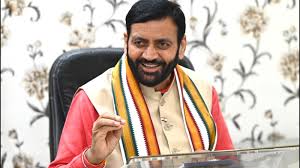
Although Haryana assembly elections are due in October this year, the BJP has set up its double fold agenda by focusing on non-Jat voters and at the same time starting addressing people’s grievances by putting CM Nayab Singh Saini in action.
However, the main opposition party in the state, the Congress, is also not lagging behind either. Former CM and Leader of Opposition Bhupinder Singh Hooda has already convened a meeting of party legislators and discussed the strategy for the coming assembly elections. He is planning to meet party workers.
Rejuvenated after having won five out of ten Lok Sabha seats in just concluded elections, the Congress has now decided to press the paddle. Hisar MP Jai Parkash, who defeated Ranjit Chautala, Naina Chautala and Sunaina Chautala, all from the family of former deputy prime minister Devi Lal in the LS poll, has claimed that that this time, Congress will form the government under the leadership of Bhupinder Singh Hooda by winning 70 out of 90 assembly seats in Haryana.
Stakes are high for both the BJP as well as for Congress. In a significant development, Aam Aadmi Party(AAP) which contested Lok Sabha elections in alliance with Congress has snapped its ties with the Grand Old Party and has announced to contest all the 90 seats independently.
Sushil Gupta of AAP, who contested from the Kurukshetra seat as alliance candidate, narrowly lost to Naveen Jindal of the BJP. The AAP has accused a section of Congress leaders of sabotaging the election of Gupta. However, Bhupinder Singh Hooda has hit back saying that Congress does not need any alliance for the Assembly elections in the state as it is capable of fighting alone.
The parties such as Indian National Lok Dal (INLD) and Jannayak Janata party (JJP) headed by Dushyant Chautala which lost badly in the elections are also planning to contest all the ninety seats.
The BJP which had lost five seats in Lok Sabha polls has recovered from initial shock with formation of NDA Government led by Narender Modi at the Centre.While Congress is facing infighting between Bhupinder Singh Hooda and Kumari Selja, who has won the Sirsa Lok Sabha seat, the BJP has no such problem. Both Selja and Bhupinder Singh Hooda are claimants of CM’s post in case the Congress comes to power.
Blaming Hooda for choosing weak candidates in some constituencies, Selja has alleged that Congress could have made a clean sweep in the state with better ticket distribution. In the BJP , Manohar Lal, former two-term Haryana CM, who has been appointed as cabinet minister in the new NDA government, is in complete control of the party, courtesy his close proximity with Narender Modi.
In another development, it is now believed that CM Nayab Singh Saini will not be changed and elections will be held under joint leadership of Saini and Manohar Lal.
The post of the state BJP head is also vacant as Nayab Singh Saini is holding dual charge of both the posts of CM and the party chief. The BJP can accommodate one leader as one seat of Rajya Sabha will fall vacant with Rajya Sabha member Deepender Hooda winning the Lok Sabha election from Rohtak.
Besides, several posts including that of a chairman and two members of Human Rights Commission are also lying vacant. Since the BJP feels that it can’t win election on the basis of its performance of two terms hence it is banking upon polarization on caste basis.
Jats, by and large, are perceived to be anti-BJP. The fact that Abhimanu, Om Parkash Dhankad, Subash Barala, member of Rajya Sabha, besides Dharmvir who has won for the third consecutive time from Bhiwani-Mahendragarh constituency are all from the Jat community. But despite these overtures, the party doesn’t enjoy the support of the community.
Therefore the BJP is banking upon non-Jats who constitute about seventy percent of the population. Krishan Pal Gujjar and Rao Inderjit from backward class were inducted in the Modi government besides Manohar Lal, who is from Punjabi community, with an eye on non-Jat vote bank.
CM Saini also belongs to the backward community. Besides focusing on non-Jat vote banks, the BJP government has taken several measures as part of the damage control exercise. Besides giving plots to poor it has given them free transport facilities in roadways buses subject to some conditions.
Sensing tremendous resentment among people over preparation of property identity papers and Parivaar Pehchaan Patras, the deputy commissioners have been ordered to hold camps on a daily basis for resolving the public grievances on these issues. Chief Secretary TVSN Prasad is personally monitoring the programme.
The surge in militant activities in Jammu comes at a time when the militancy seems to be on its way out in Kashmir Valley. The fact that most of the perpetrators of multiple terror attacks in Jammu since June 9 are still at large and their number remains unknown makes the future uncertain, reports Riyaz Wani
On June 9, hours before prime minister Narendra Modi was set to take oath as prime minister for the third consecutive time, a bus carrying pilgrims to the base camp of the Hindu temple Mata Vaishno Devi came under attack from militants. The driver lost control and the bus tumbled into a ravine, killing nine pilgrims.
This was followed by another attack at Saida Sukhal village in Hira Naga sector, close to the International Border, in Kathua district in which two militants were killed and a CRPF jawan lost his life.
While an encounter in Kathua village was on, militants attacked a joint patrol party of police and army at a checkpoint at Chattergala area in neighbouring Doda district at midnight. Five Armymen and a police jawan were injured in the attack.
Then in Doda’s Kota top area near Gandoh, a special police officer was injured after a joint team of police and paramilitary forces came under fire from militants.
This has once again put the Jammu division on edge. The region has been a site of renewed militancy since 2021. Rajouri and Poonch, the twin districts, alone accounted for 53 deaths out of 134 militancy-related killings in 2023, roughly 40 percent of total killings. Of the 53 people killed in the two districts, 19 were Army personnel, including a few officers.
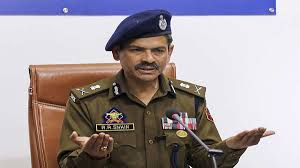
This year, so far the situation was largely under control until the post-June 9 spurt in the violence. This has taken security forces by surprise. J&K Director General of Police R.R. Swain has accused Pakistan of trying to disturb the peaceful atmosphere in the region, and asserted that the forces were determined to give a befitting response to the enemy. Swain also warned the locals supporting terrorism that they would repent their decision.
“They have stakes including families, land and jobs, unlike Pakistani terrorists who have nothing to lose,” the DGP said. “The clear intent of the adversary is that if they cannot motivate locals for subversive activities to disturb the peaceful atmosphere in Kashmir, send their own people.”
Earlier in an interview before the attacks, the DGP said that “70-80 foreign terrorists have infiltrated Kashmir and are posing a threat to peace in the region.” He stressed the necessity of taking tough actions against certain individuals to maintain peace for the larger interest of the masses.
The surge in militant activities in Jammu comes at a time when the militancy seems to be on its way out in Kashmir Valley. The fact that most of the militants who carried out these killings are still at large and their number remains unknown makes the future uncertain. It is likely that more violence is in store until the security forces track them down. So far, the extensive search in the jungles has yielded no result, but it may in the near future.
The militants who have infiltrated from across the border are believed to be very well-trained. Successive militancy-related incidents have momentarily shifted attention away from the lingering turmoil in the Kashmir Valley to Jammu which has otherwise been free of militancy over the last two decades – the sporadic incidents of violence notwithstanding. But the last three years have witnessed some revival of militancy in the twin districts of Rajouri and Poonch.
It remains to be seen whether the violence in Jammu intensifies or abates going forward. The pattern over the last three years has been one of a sudden spike followed by an extended lull. For example, in 2021, the militants vanished into thin air soon after successive incidents of violence during July and August. Last year too, the violence disappeared after a few sensational attacks. The militants who carry these out are believed to return to Pakistan from where they come. Will this turn of events repeat this year? The situation in the coming weeks in the region will make things clear on this score.
Also, a tactical ticket distribution by Samajwadi Party chief Akhilesh Yadav showcased his political maturity. He employed inclusiveness while selecting candidates to free the party from the tag of being a Yadav-Muslim party. A report byMudit Mathur
In the politically most crucial state of Uttar Pradesh, when the fight was reduced to “Ram versus Roti,” people opted for “Roti,” rejecting the camouflaged propaganda sponsored by BJP stalwarts with the help of excessively compromised print and TV media, which allegedly fabricated a hype about BJP’s landslide victory.
The Samajwadi Party chief, Akhilesh Yadav, emerged as the third biggest player after the Congress Party on the national scene, securing 37 seats from Uttar Pradesh while the BJP bagged 33. His shrewd outreach to Dalit classes and most backward classes filled the political vacuum created due to inertia gripping around Mayawati. Factors like ticket distribution, PDA (Pichada, Dalits, Alpsankhyak) outreach, and anger among the Rajput community helped the Samajwadi Party-Congress alliance in Uttar Pradesh win 43 of the 80 seats.
Varanasi (oldest religious city in the world, Kashi) was nurtured with a lot of development and infrastructural projects after Prime Minister Narendra Modi adopted it as his parliamentary constituency. But this time, INDIA bloc gave him a tough fight diminishing the aura of indomitability as borne out by sharp reduction of his victory margin.
Despite unlimited resources at his hand, Modi could barely win with a thin margin of 1.52 lakh votes against a predicted win of 10 lakh votes. So, winning with such a narrow margin gave no reason to BJP workers to go for any sort of jubilation on the streets. His victory margin dipped from 4.25 lakh votes in 2019 to a miserable 1.52 lakh votes this time. The time has come for his party to review what went wrong for him to face such a decline in his popularity.
This time, social media platforms proved to be the more reliable fora with their almost accurate poll projections. The BJP’s ambitions were too high as the party claimed this time, it would win all 80 seats. However, with the counting of votes, its euphoria died down as the results showed major reversals as the party could only win 33 seats, thereby losing 29 seats from its 2019 tally.
The big setback came to the BJP as its 27 sitting members of parliament, including seven union ministers, lost the elections. It gave a big jolt to the BJP in its heartland where its Hindutva project was going on in full swing and thus, it caused huge embarrassment to the BJP and its top ideologues.
The BJP faced the biggest in Amethi. Prominent Union Minister Smriti Irani who defeated Congress leader Rahul Gandhi in 2019, lost the most prestigious battle in Gandhi’s bastion Amethi. An ordinary Congress worker, Kishori Lal Sharma, a loyal aide of the Gandhi family, defeated her by a margin of 1,67,196 votes despite top BJP leadership from the centre and the state having done an extensive high-voltage campaigning for her, addressing public meetings and spending a lot of money.
Raebareli was another prestigious and contentious seat from where Congress leader Sonia Gandhi fielded her son, Rahul Gandhi, leaving the traditional seat for him. BJP fielded a Congress turncoat and state minister Dinesh Pratap Singh against him equipped with enormous money power and a battery of top leaders. Rahul’s sister, Priyanka Gandhi Vadra took command of the election campaign herself and went to nook and corner of both the constituencies. Rahul Gandhi won with a record margin of 3,90,030 votes and his lead was more than Modi and Rajnath Singh, whose victory margin significantly dipped this time in the face of anti-incumbency.
Uttar Pradesh had been a testing ground to sow the seeds of the “Hindu Rashtra.” BJP stalwarts Prime Minister Narendra Modi and Chief Minister Yogi Adityanath synchronized their election speeches aimed at polarising votes in this politically most crucial state which send 80 members to the Lok Sabha.
The entire idea was to discredit opposition parties by painting them as corrupt, and incapable, having family-centric politics instead of nation-centric one. Law and order was another issue on which these leaders attacked Samajwadi chief Akhilesh Yadav’s rule as compared to the “Bulldozer justice” introduced by Chief Minister Yogi Adityanath.
Hindi-speaking Uttar Pradesh is home to many holy Hindu pilgrim centres like Mathura-Kashi, which in many ways functioned as a labortary for the BJP’s Hindutva politics by rousing the communal passions. The BJP has relied on a multifaceted Hindutva strategy in the state, leveraging socio-religious issues to consolidate its support base and secure electoral victories.
Prime Minister Modi in his election rallies in eastern Uttar Pradesh kept accusing the Congress of making several attempts to stall the construction of the Ram temple in Ayodhya and “insulting” the deity by “rejecting an invitation to the “pran pratishtha” (construction ceremony). The BJP accused opposition parties of practicing policies of minority appeasement.
The tactical ticket distribution by Samajwadi Party chief Akhilesh Yadav showcased his political maturity as he employed inclusiveness while selecting candidates and freeing the party from the tag of Yadav-Muslim party. BJP master strategist Amit Shah did the same social engineering in 2014 when he micromanaged these communities to alienate them from the Samajwadi Party and BSP. The breakup of 37 winner candidates from SP, comprises 20 OBCs including five Yadavs, 9 Dalits, 4 each from upper castes, and Muslims. His PDA formula countered the hype of poll predictions and exaggerated media propaganda.
The controversial Union Minister of State for Home Affairs, Ajay Mishra Teni, who has been enjoying the proximity of Home Minister Amit Shah lost to the Samajwadi Party’s Utkarsh Verma from the Kheri Lok Sabha seat by a margin of 34,329 votes. He was running for a third term and aiming for a hat-trick from the same seat. Teni faced resentment over the Lakhimpur Kheri incident, whose son is accused of knocking down protesting farmers, who were protesting against the farm laws which were later repealed by the Modi government, and a journalist, with the vehicle he was riding.
Samajwadi Party won not only the Ayodhya seat but the entire region including Sultanpur, Ambedkar Nagar, and Shrawasti while the other two seats, Amethi and Barabanki were bagged by the Congress party. SP candidate Avdhesh Prasad,79, defeated the BJP in the Faizabad constituency by more than 54,000 votes. Prasad was born into a Pasi (Dalit) family in 1945 in a village in Sohawal tehsil of Faizabad district, renamed Ayodhya. The defeated BJP candidate was one of the few leaders who said 400 seats are required for the BJP to change the present Constitution.
Another big blow came from Muzaffarnagar, which saw a clash between the two Jat leaders. SP’s Harendra Malik defeated union minister of state for fisheries, animal husbandry, and dairying Sanjeev Balyan in a close contest. Balyan lost by a margin of 24,672 votes. Balyan had won the Muzaffarnagar seat in 2014 and 2019. Union Minister of State for micro, small, and medium enterprises (MSME) Bhanu Pratap Verma lost to SP’s Narayan Das Ahirwar from UP’s Jalaun by 53,898 votes.Verma is a five-time MP from this seat, having won it in 1996, 1998, 2004, 2014, and 2019.
Union Minister of State for Consumer Affairs, Food and Public Distribution, and Rural Development Sadhvi Niranjan Jyoti lost to SP’s Naresh Chandra Uttam Patel by 33,199 votes from UP’s Fatehpur. She won the same seat in 2014 and 2019 decisively with winning margins crossing 1.8 lakh and 1.9 lakh and was aiming for a third term.
Samajwadi Party candidate and former Uttar Pradesh minister RK Chaudhary triumphed over Union Minister of State for Housing and Urban Affairs and BJP candidate Kaushal Kishore in the Mohanlalganj (reserved) parliamentary seat by a margin of 70,292 votes. Samajwadi Party’s Birendra Singh defeated BJP’s Mahendra Nath Pandey, the Union Minister for Heavy Industries, in the Chandauli parliamentary constituency by approximately 21,000 votes.
Results could bring more cheers in the opposition camp had it started its election campaign earlier as they could not correctly assess their collective strength and people’s resentment on the ground over core issues of unbearable price rise, growing unemployment, faulty Agniveer scheme, insensitive government policies to resolve farm distress, and concentration of national wealth in the hands of a few favoured corporates.
The focus should be on the crucial issues of unemployment and poverty besides upholding the great diversity that this country was well known for, till the right-wing forces tried to trample on it by Humra Quraishi
Election results are out. And the new government has been formed at the Centre. Now what? Will any of the grim crisis situations facing us, the citizens of this country, get solved, or will those distractions along the communal lines carry on… all those tactics that were put forth to gather votes by whipping up hatred for the other. Before I move any further, it gets significant to mention that there’s not a single Muslim in this newly formed Cabinet. Not really shocking. Perhaps, along the much expected lines, considering the communal stand of the Right-Wing who’s who.
In a democracy it doesn’t really matter if there are Hindus or Muslims or Sikhs or Christians at the helm of affairs but apprehensions do arise when the democracy is weakened with constant dents and the destruction of the basic foundation.
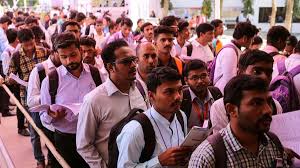
Getting back to the immediate wants: Employment! The situation is so very dismal that our unemployed youth are rushing towards Israel for jobs! The young are just too fed up and disillusioned. He or she wants to see a change. A change towards the positive. And this more than explains why they voted for the Congress, Samajwadi Party and for several regional political parties, whose leaders worked non-stop, to try to reach out to the masses; giving them genuine assurances and that much-needed hope of jobs and livelihoods.
Also, destruction of homes and shops ought to come to halt. One of the reasons for the defeat of the several of the BJP’s top brass in Uttar Pradesh is connected to the mass bulldozing of homes in several towns and cities of the state. Yes, homes of hundreds of the residents were destroyed by the state machinery in Ayodhya and also in Benaras and even in Uttar Pradesh’s capital city, Lucknow! Paving way for broader roads, supposedly to do away with congestion and clutter, to make beautiful sites! But can any of the excuses be good enough to destroy survival structures of the poor and of all those who cannot even afford to provide their families two square meals a day!
Also, blatantly communal speeches of the rulers of the day ought to be banned. Never before one witnessed such a pathetic scenario; provocative speeches, directly or indirectly, paving way for those hateful divides! Why were those speeches allowed to carry on during electioneering …one speech after another loaded with the typical communal onslaughts against the largest minority community in the country.
And the farmers of the country need immediate attention. Don’t overlook the basic fact that the farmers have been holding peaceful protests in recent years …sitting at the borders, in the midst of the severe winters, amidst rains, in the scorching heat, asking the sarkar for their rightful demands and dues. Yet the end result has been more than disappointing for them. For how long can their anger and frustration be harnessed? They can no longer be bypassed.
The masses seem awakened after a dreadfully long slumber. Yes, finally awakened! These election results are ample pointers to the fact that the average citizen has responded to the urgent need for grim ground realities to be tended to. It was reassuring to hear Rahul Gandhi, Akhilesh Yadav, Tejashwi Prasad Yadav and their party men and women, highlighting the real issues hitting us – unemployment, poverty, hunger and homelessness. A focus should be on these crucial issues. Above all, upholding the great diversity that this country was well known for, till the Right-Wing forces tried to trample on it, doing their level best to make us suspicious of the other, if not hate and kill each other.
Rays of hope do stand out, after this rather tough fight the secular parties and their leaders and the masses of the country gave to the right-wing forces! Committed leaders and the hundreds and thousands of the men and women and teenagers worked endlessly in this heat and dust …trying to save this land from the grasp of those who spoke of hateful divides in those hate-filled speeches!
Shahryar and hislyrics
Akhlaq Mohammad Khan, better known by his takhallus, Shahryar, was born many summers back, on 16 June 1936…but till date his lyrics and shairi do hold out!
I recall meeting the Aligarh based poet-academic Shahryar, in New Delhi. It was around 2004 when I’d first met him…Incidentally, his family also belonged to my ancestral qasba, Aonla. Also, he knew my Aligarh-based younger sister Habiba.
When I was introduced to him as ‘Habiba’s sister’ he looked somewhat taken aback as my sister and I look very different, and uttered rather too spontaneously, “You Habiba’s sister!”
“Yes, I am …she’s my younger sister.”
“But you look so different! She covers her head and you…” With that he gave a rather disapproving look towards that sleeveless shirt on me, “You two real sisters?”
“Yes, we are real sisters. “
“From the same father?”
“Yes, of course …”
“Same father?”
“Yes …yes …”
“Same father!”
“Yes …at least this is what amma has told us!“
With that he had a hearty laugh. Yes, he seemed to be equipped with a sense of humour, though he had suffered emotional pain after he’d gone through a messy separation from his spouse – after 23 years of marriage. Maybe, it’s that emotional pain and loneliness that emerged in the form of those haunting lyrics and verse …he did talk of those spells of loneliness, that emotional vacuum he was going through. He’d also sounded philosophical, “Whenever I felt I’m going ahead in life, Allah seemed to pull me down. His ways, so who can question them! But one thing is sure that the minute you are going ahead towards achieving success, hurdles come about …I have seen this happen in my life.”
And with that he also spoke at length on the difficulties that come about with the singleton status! And though there were several stories doing the rounds of his rather colourful lifestyle, whenever I spotted him at those various dos, he was not just all alone but also looked all alone! Yes, he seemed to carry strains of loneliness, though tried to camouflage it by trying to be witty and talkative. He carried a certain attitude…one of those blunt and outspoken sorts. Quite a contrast to those romantic songs he’d penned for the film Umrao Jan.
Last when I had spotted Shahryar at one of those receptions, he looked unwell but tried not to dwell on his ill health. He tried to put up a brave front right till the very end. He passed away on 13 February 2012.