New Delhi: Congress MP and Leader of Opposition in the Lok Sabha, Rahul Gandhi has claimed that the Enforcement Directorate (ED) was planning a raid on him.
He said some ED insiders had told him about a raid being planned, and that he was ‘waiting with open arms’.
In a post on X on Friday, Rahul Gandhi said, “Apparently, 2 in 1 didn’t like my Chakravyuh speech. ED ‘insiders’ tell me a raid is being planned. Waiting with open arms, @dir_ed. Chai and biscuits on me.”
He was referring to his July 29 speech in the Lok Sabha during a discussion on the Union Budget.
The Congress leader had alleged that the “NDA government had stabbed the middle class in the front and the back with announcements in Budget 2024 amid an atmosphere of fear across the country.”
While referring to Mahabharata, he said, “Thousands of years ago, in Kurukshetra, six people trapped Abhimanyu in a ‘Chakravyuh’ and killed him. I did a little research and found out that ‘Chakravyuh’ is also known as ‘Padmavuyh’ — which means ‘Lotus formation’… In the 21st century, a new ‘Chakravyuh’ has been formed… What was done with Abhimanyu, is being down with India — the youth, farmers, women, small and medium businesses.”
BJP MP Anurag Thakur slammed Rahul Gandhi over the Chakravyuh statement and said the country has seen many “Chakravyuhs of Congress Party”.
He attacked Congress by counting seven Chakravyuhs while saying that the first Chakravyuh was Congress itself, which divided the country.
Finance Minister Nirmala Sitharaman presented the Union Budget 2024 in the Lok Sabha on July 23.
In a clear indication that assembly elections in Jammu and Kashmir are imminent, the Election Commission (EC) has directed the union territory administration to transfer officers posted in their home districts. This standard pre-election exercise aims to ensure impartiality and fairness.
Prime Minister Narendra Modi, during a visit to Srinagar in June, had assured that assembly polls would be conducted in the union territory and statehood would be restored. The Supreme Court, in its hearing on the Article 370 case last year, instructed the EC to hold elections in the union territory by September 30, 2024.
The EC’s communication to J&K’s chief secretary and chief electoral officer said that
no official connected directly with polls shall be allowed to continue in the present district (revenue district) of posting if she/he is posted in her/his home district or if she/he has completed three years in that district during the last four years or would be completing three years on or before September 30, 2024.
The directive aligns with similar instructions issued to the chief secretaries of Maharashtra, Haryana, and Jharkhand, where elections are also due.
While Jammu division has witnessed revival of militancy over the last three years, Kashmir Valley has seen a boom in tourist influx. The fresh data announced by the Centre has pegged the tourist numbers visiting the Valley at one crore by June this year. A report by Riyaz Wani
While Jammu division has witnessed revival of militancy over the last three years, Kashmir Valley has seen a boom in tourist influx. The fresh data announced by the Centre has pegged the tourist numbers visiting the Valley at one crore by June this year. Speaking in Rajya Sabha, Minister of State for Home Affairs Nityanand Rai attributed the growth in the sector to the abrogation of Article 370, which, according to him, had helped bring peace to the region. This has increased tourism’s contribution to the Gross State Domestic Product (GSDP) from 7.84 percent in 2019-20 to 8.47 percent in 2022-23. According to Rai, a total of 1,08,41,009 tourists visited J&K till June. In previous years, the numbers were 34,70,834 in 2020, 1,13,14,884 in 2021, 1,88,64,332 in 2022, and 2,11,24,874 in 2023. Rai credited the J&K government’s initiatives for this growth, including the Tourism Policy 2020 and the Jammu and Kashmir Industrial Policy 2021, which granted industry status to the tourism sector, enabling it to avail incentives. The homestay permits to accommodate more tourists have also helped and benefited locals economically. Additional measures such as the Jammu and Kashmir Film Policy 2021, Houseboat Policy 2020, and the identification of 75 off-beat destinations have also contributed to the transformation. Border tourism has gained momentum, with previously lesser-known locations such as Gurez, Keran, Teetwal, and R S Pura opening up for tourists. Adventure and golf tourism are also on the rise. But the excessive focus on fewer resorts are drawing tourists away from other equally scenic places; some of them like Aharbal, Yusmarg, Tosamaidan, Gurez, historic old city in Srinagar have only recently found a prominent place on the tourist map of Kashmir. The tourism sector forms 6.8 percent of Kashmir’s GDP and employs 2 million people. The sector, as such, has the potential to shore up the union territory’s beleaguered economy. In recent years, the J&K administration has made efforts to bring more tourists to the region. Once the successive Covid lockdowns were over, the administration launched promotional efforts within and outside the country to attract tourists back to the Valley. The government has added more tourist places, earmarking another 75 tourist destinations for tourism. The homestay facilities have attracted tourists to far-off areas once considered a no-go zone due to security concerns. The facility was introduced by the government in 2022, and it has boosted border and rural tourism. Authorities have recently opened the Pir Panjal region from the Yusmarg end in South Kashmir for trekking. Similarly, the Athwatoo area in Bandipora, located in the Shamsbari range — once notorious for infiltration routes — has become accessible to tourists. This shift has led high-end tourists from the rest of the country to explore beyond traditional spots like Gulmarg, Pahalgam, and Sonamarg, opting instead for trekking and visiting border areas. Gurez is one such area. Hitherto out of bounds for tourists due to militancy, Gurez is witnessing tourist inflow. However, fresh challenges have emerged: for example, the surge in militant violence in the Jammu division. This has already led to the United States asking its nationals not to travel to Manipur, Jammu and Kashmir, the India-Pakistan border, and parts of central and eastern parts of India where Naxalites are active. This will affect the inflow of high spending foreign tourists to Kashmir. On a positive note, according to the Union Minister for Railways, Ashwini Vaishnaw, the long-awaited Udhampur-Srinagar-Baramulla Rail Link project in the union territory is nearing completion and very soon it will be inaugurated by Prime Minister Narendra Modi. This would facilitate more tourist inflow to the Valley and help boost the economy.
Although the challenge of militancy in Jammu may be similar to that faced by the Kashmir Valley, the region is demographically and geographically different. Jammu is a Hindu-majority area and is hillier than the Valley, providing militants with ample hiding spaces. A report by Riyaz Wani
As militant attacks continue to rock the Jammu division of Jammu and Kashmir, the UT government has decided to adopt the Kashmir model of counter-insurgency in Jammu as well.
“We will not allow revival of terrorism in Jammu at any cost and adopt the Kashmir model to wipe out terrorism in Jammu. The way security forces crushed terrorism in Kashmir, a similar strategy will be adopted in Jammu as well,” J&K Lieutenant Governor Manoj Sinha said at an event in Srinagar on July 20. “Today all terror outfits in Kashmir are headless.”
On the same day, Sinha and the Army Chief, General Upendra Dwivedi held two separate joint security review meetings in Jammu to introduce a new counter-terrorism strategy to tackle renewed militancy in the union territory.
Recurrent militant attacks and the attendant loss of lives of security personnel in the Jammu region have created a challenging situation for both the UT and the union government. The new strategy aims to address operational flaws, intensify counter-terrorist operations, and track down hiding militants with active support from locals. But it is likely to take longer before the situation gets better. Although, the local militancy has, to a large extent, been reigned in, the influx of foreigners, especially in Jammu, has thrown the UT into fresh turmoil.
The rise of militancy in twin districts of Rajouri and Poonch in Jammu division, and which is largely led by foreign militants attests to this fact. More than a decade ago, the twin districts were declared free of militancy by the government. However, since October 2021, the region has witnessed an incremental surge in militant attacks. Although an uneasy calm prevailed in Jammu in 2022, this year the region has once again become a hotspot for militants. The dense forests of the region have made it difficult for security forces to trace them.
The situation has been made even more difficult by the fact that the forest area where the militants are hiding extends to the districts in South Kashmir, which have been a stronghold of militancy in recent years.
LG Sinha said that the government is working on a plan to replicate the counter-insurgency strategy adopted in Kashmir Valley to curb the rising violence in Jammu, a statement he had also made last year. This includes identification and arrest of over-ground supporters of militants, proactive counter-insurgency operations, deployment of police, Army, Central Armed Police Force (CAPF) and night patrolling and area domination, which are believed to have helped check infiltration to a large extent in the Kashmir region.
Will the model succeed in Jammu? It is still early days to gauge its efficacy. Although the challenge of militancy in Jammu may be the same faced by the Kashmir Valley, the region is demographically and geographically different from the valley. Jammu is a Hindu majority area and geographically it is more hilly than the Valley, giving militants plenty of hiding space.
There are other important distinctions: Militants in Kashmir have largely been local while those in Jammu are understood to be battle-hardened foreigners with sophisticated weapons.
Since 2021, Jammu has experienced 33 militant-related attacks, according to official data. In 2024 alone, the region witnessed eight attacks, resulting in the deaths of 11 soldiers and injuries to 18 others. Civilian fatalities in Jammu for the first half of this year total 12, matching the number for all of 2023. These attacks took place in Rajouri, Poonch, Doda, Kathua, Udhampur, Reasi, and other areas within the Jammu division. Militants, on the other hand, have suffered lesser fatalities, at least in Jammu region. After every attack they flee deep into forests, making it difficult for the security forces to trace them. They reappear only to stage another attack before escaping back into the woods again.
This is unlike Kashmir where local militants mostly stay in residential areas and the intelligence network is quick to track them down and kill them, without security personnel themselves suffering any losses. Besides, the local nature of militancy ensures that the social support network of militants can be easily reached and targeted. This is not generally the case with foreigners. They maintain a limited contact with the local population. Also, they avoid staying in houses. So, they are not vulnerable in the same way, the militants in Kashmir are. Also, as against people in the Valley who are considered sympathetic to the cause of militants, those in Jammu have generally been supportive of the Army. Taking harsh action against them could backfire on the anti-militancy operations in the region. It could alienate people making their cooperation in the anti-militancy operations as much difficult.
Kashmir model of fighting militancy can’t therefore be easily replicated in Jammu division as announced by the LG Sinha.
True, in the past, the Army has successfully countered militancy of similar nature in Jammu and which could then boast of some local support. In 2003, Operation Sarp Vinash (Snake Destroyer) was launched by the Army to eliminate militants who had established bases in the Hilkaka Poonch-Surankote area of the Pir Panjal range in Jammu and Kashmir during April–May 2003. During this operation, involving seven battalions, 64 militants affiliated with various jihadist outfits were killed. The system of hideouts discovered during this operation was the largest ever recorded in the history of insurgency in Jammu and Kashmir.
Would the Army go for a similar kind of operation in Jammu forests again? It looks likely. However, several smaller operations over the last three years have not yielded the desired result. Now the Army is launching “Operation All Out” modeled after the one conducted in Kashmir in 2017, where security forces launched one to combat a surge in militant violence following the encounter and killing of Hizbul Mujahideen commander Burhan Wani on July 8, 2016.
Over 3,500 security personnel, including 500 elite para commandos, will be deployed, particularly in the border districts of Poonch, Rajouri, Kathua, Doda, Udhampur, and Reasi. The aim is to tighten the siege and prevent militants from escaping. It is a large forest area between Kashmir and Jammu. Would one all-out operation do the job? Only time will tell.
The LG Sinha on July 24 said the situation in the Union Territory “will be back to normal within a few months.”
“Those who cannot digest the peaceful atmosphere here, they should be ready for their end,” Sinha told reporters in Srinagar. “People here have also given a befitting response to them before. The situation demands so.”
The coming weeks and months will be crucial as to the direction of the situation. Much will depend on the success or otherwise of the fresh Operation All Out.
Even as all the political majors step up their respective campaigns in Haryana, the AAP has spelt out its “five guarantees’’ for the people of the state if elected to power besides announcing rallies for all the 90 assembly segments across the state for the next fortnight. A report by Rajesh Moudgil
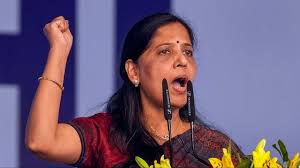
While the Aam Aadmi Party (AAP) supremo and Delhi chief minister Arvind Kejriwal is currently in judicial custody in the Delhi excise policy-related case, his wife, Sunita Kejriwal, has launched five AAP `guarantees’ for the people of Haryana if voted to power, at a party event in Panchkula city on July 20, last.
These `guarantees’ (read poll promises), she held, are – better health services at mohalla clinics level, free domestic power supply to all, better free school education, Rs 1,000 per month for every woman and employment to every unemployed youth of the state.
These “guarantees’’ held political import as assembly elections are due in October this year in Haryana.
The July 20 event was also addressed by the Punjab chief minister Bhagwant Mann, senior AAP leaders Sanjay Singh and Sandeep Pathak, besides all the senior Haryana leaders including state president Sushil Gupta and senior vice president Anurag Dhanda.
Speaking on the occasion, Sunita highlighted how Arvind Kejriwal, who belonged to a village of district Hisar of Haryana, fought for justice for people, became the chief minister of the national capital and did what the big political parties and top leaders could not do.
She asked the gathering if they would remain silent while Haryana’s son, Arvind Kejriwal, has been put in jail.
Exhorting the gathering to bring the AAP to power in Haryana, Punjab CM Mann hit out at the ruling BJP on various state and national issues including the Agnipath scheme.
Stating that while the BJP made false promises and AAP gave guarantees, he said that the AAP had already announced that it would go solo in the upcoming assembly elections and it was confident that it would form the government as the people had made up their mind to bring a change in the state.
Meanwhile, starting July 26, the AAP has also begun to hold 45 rallies in the next 15 days across the state.
Announcing the AAP rallies schedule on July 25, Dhanda said, these would be addressed by Punjab chief minister Bhagwant Mann, AAP national convenor and Delhi chief minister Arvind Kejriwal’s wife Sunita Kejriwal, Rajya Sabha MP Sanjay Singh and party’s national general secretary (organisation) Sandeep Pathak, besides the state leaders.
In all, there are 90 assembly segments in the state.
Dhanda said that the leaders during their rallies would disseminate information and awareness about the AAP’s five guarantees. “We will take these questions among the people. These five guarantees are in the basic ideology of AAP’’, he said and added that apart from this, the party will bring very detailed plans on every issue related to farmers, students and women of Haryana.
Notably, even though the AAP has contested Lok Sabha, assembly and civic polls in the past, it has not tasted electoral success in Haryana so far.
Cong’s `Haryana Mange Hisaab’ campaign
For record, in the House of 90, the ruling BJP had won 40 seats in the 2019 state polls, principal opposition party Congress won 31, Jannayak Janta Party (JJP) 10 and there were nine others.
The Congress has already launched its “Haryana Mange Hisab’ campaign which is being led by Deepender Hooda, who is a five-term MP and son of two-time chief minister Bhupinder Singh Hooda, who also has a separate plan to take out a “rath yatra’’ ahead of assembly polls in days to come.
Deepender plans to take out the drive to 14 out of 90 assembly constituencies across the state in the first leg – focussing on the nine districts along the Delhi-Ambala national highway, also called GT road. The Jat heartland – especially the Sonepat, Rohtak and Jhajjar region – has been Bhupinder Singh Hooda’s citadel.
The party also aims to enhance its sway it garnered in recently held Lok Sabha polls when it achieved its highest vote share for INDIA bloc nationwide at 47.61% and bagged five of the total 10 parliamentary seats in Haryana. It was a decade later, the Congress had staged a comeback and won five of the total 10 seats.
A free hand to Hooda senior notwithstanding in the upcoming assembly polls, the Congress, however, has its own set of challenges as one of the party senior leaders, Kiran Choudhry and Kuldeep Bishnoi from Hisar and Bhiwani-Mahendergarh region have already left Congress and joined the saffron party. Some observers also look askance at the role of other stalwarts including Congress’ Sirsa MP Kumari Selja and Birender Singh who has returned to Congress along with his former MP son, Brijender Singh in the ensuing polls.
However, the Congress which seems to be going ahead with its campaign full throttle poses 15 questions to Haryana’s ruling BJP government which primarily pertain to the unemployment, inflation, worsening law and order situation, corruption and farmers’ protest.
The chief minister Nayab Saini, on the other hand, however, highlights how Congress had been reduced to a “baap-beta’’ (father-son – Bhupinder Singh Hooda and Deepender) party by Hooda senior and how his (Hooda’s) rivals would teach him a lesson at an appropriate time.
The JJP, which had post-election alliance with the BJP in the government and its leader Dushyant Chautala had become deputy chief minister, has also already begun holding district level meetings where besides Dushyant, his father Ajay Chautala and other leaders have begun deliberations with the party supporters about the upcoming polls. The party leaders have also held district level programmes in a few districts of the state.
The Indian National Lok Dal (INLD), on the other hand, has again joined hands with its former ally BSP and announced that while the former would fight on 53 seats, the BSP would contest the remaining 37 assembly seats in the assembly polls.
The alliance has also planned 10 back-to-back meetings at the parliamentary constituency till August 10 which would be held by INLD leader Abhay Chautala and BSP national convenor Akash Anand. The leaders held that while the people felt betrayed by BJP, the Congress was plagued by internal bickering, hence the people’s choice was INLD-BSP alliance.
While UP CM Yogi and his deputies, Maurya and Pathak, spar, the reality is that no one wants to shoulder the blame for the humiliating defeat in the recent LS polls, which hindered PM Modi from achieving a majority without relying on mercurial and costly allies. A report by Mudit Mathur
Victory has a thousand fathers, but defeat is an orphan. This saying explains the ongoing political cold war between the UP chief minister Yogi Adityanath and his two deputies, Keshav Prasad Maurya and Brijesh Pathak, and the state party chief, Bhupendra Chaudhary. No one wants to shoulder the blame for the humiliating defeat in the recent parliamentary elections, which hindered Prime Minister Narendra Modi from achieving a majority without relying on costly, over-ambitious allies.
Despite winning in Varanasi by a very thin margin, Prime Minister Narendra Modi is reportedly unhappy and emotionally hurt, and seeks to assign responsibility for the fiasco. This prompted a series of review meetings at both the organizational and chief ministerial levels. Modi separately met his trusted lieutenant, Deputy CM Keshav Prasad Maurya, and BJP state president Bhupendra Chaudhary to get their first-hand accounts. Both have shifted the blame to CM Yogi Adityanath, alleging that his inflexible and stubborn approach, rooted in bureaucratic dominance, alienated the party workers. Bulldozer justice also caused panic among the masses, particularly the poor and marginalized sections, who moved to the Samajwadi fold, they lamented.
The political cold war in Uttar Pradesh is being seen as a reflection of national politics where the emergence of UP Chief Minister Yogi Adityanath on a bigger canvas could potentially challenge the mighty Union Home Minister Amit Shah who has always positioned next in the succession hierarchy to Prime Minister Modi. Though Defence Minister Rajnath Singh is an official number two in the government, nobody expects a bullying style of lobbying from him to be seen as a challenger to Modi or Shah. In such a situation, both of the deputies of Yogi Adityanath are openly defying him due to patronage from “Delhi Darbar” and have ganged up to check his might.
Chief Minister Yogi Adityanath on his part sought to wash his hands of the humiliating defeat arguing that his feedback on the selection of candidates and advice about repeating most of the sitting Lok Sabha members was ignored by the overconfident BJP high command. He said that the party brass thought that Modi’s popularity would sweep the elections as it was being fought on “Modi ki Guarantee” and that the perceived Modi wave would render the credentials of the candidates meaningless.
In 2024, the BJP’s tally has shrunk to 33 despite acquiring new partners — the RLD, the Suheldev Bharatiya Samaj Party (SBSP), and the Nishad Party — to strengthen its OBC base. Twenty seven sitting members lost elections dashing the party’s dreams of winning more than 400 seats and making history by breaking the record of 414 seats won by Rajiv Gandhi in 1984. In Uttar Pradesh, the BJP won 62 seats in the 2019 Lok Sabha elections and its tally went up to 64 with its ally, the Apna Dal (Soneylal) winning two seats.
While facing stiff challenge to his leadership, Adityanath is expected to submit a confidential report on the Lok Sabha election results to Modi, Shah, and party national president J.P. Nadda. The report is likely to reveal the names of some of the senior BJP leaders who worked against the party’s candidates. It may further highlight how many candidates constantly misbehaved with party workers and voters, and banked on him (Adityanath) and Modi to ensure their victory.
The report has been prepared by the chief minister after holding region-wise meetings with party MLAs over the last few days, which is meant to counter those submitted to the high command by Maurya and state BJP president Bhupendra Chaudhary against him. Maurya stayed away from Adityanath’s meeting with party MLAs from the Allahabad division. However, the chief minister met Pallavi Patel, Apna Dal (K) MLA from Sirathu, Kaushambi, who had defeated Maurya in the 2022 Assembly elections.
Deputy CM Maurya campaigned for party nominees in his native Allahabad division during the general election. But the BJP was defeated in most of the seats, including Allahabad and Kaushambi, his current and ancestral home districts. The BJP also lost in neighbouring Jaunpur, Pratapgarh, and Machhlishahr.
In contrast, the party won the majority of seats in Adityanath’s home turf of eastern Uttar Pradesh, where the chief minister campaigned. These include Gorakhpur, Kushinagar, Deoria, Maharajganj and Domariyaganj.The RSS leadership promoted Yogi Adityanath for a leadership role in the biggest politically crucial state because of his hardcore agenda of Hindutva ideology, thus he finds patronage from it.
Whatever be the truth, what stares one in the face is probationer Puja Khedkar’s attempt to shortchange the system. This puts a question mark on the entire gamut of the disability quota. by KUMKUM CHADHA
Hell broke loose when G20 Sherpa Amitabh Kant said that selection in the Union Public Service Commission, more popular as UPSC, should be on competence and integrity.
What Kant meant was that the coveted services should not be a kind of a “dole out” on grounds of physical or mental disability.
Demanding stringent action against misuse of disability quota, Kant voiced concern over several cases of fraud that were reported and said that reservations for physically and mentally handicapped individuals need “reconsideration”.
Also under fire is IAS officer Smita Sabharwal, who voiced similar concerns.
Unlike Kant, who said that he favoured scheduled caste, scheduled tribes and OBC reservations, Sabharwal questioned the necessity of disability quota on grounds that services like the IAS are demanding and require fieldwork. There is, she added, no room for people with disabilities in the services. She backed up her argument with a question: Does an airline hire a pilot with a disability? Or would someone trust a surgeon with a disability?
Quite clearly, Sabharwal explicitly said what Kant was hinting at.
In view of recent events that have occurred, both Kant and Sabharwal said what should have been said long ago.
As expected, activists were up in arms, pointing their guns at both Kant and Sabharwal. Some went as far as demanding a public apology from Sabharwal. Such was the anger against her that, if people had their way, they would have resorted to name calling.
As for Kant, activists charged him with a bias against the disabled: “Kant needs to be told that reservations are not charity given out of sympathy”.
Taking a moral high ground is one part. On that count, if one were to slam the policy of exclusion, there would be takers. As for political correctness, rather than exclusion, it should be seen as “inability to include” given the demands of the profession which call for mental agility and sound judgment. Therefore, in some sectors, even if competence scores over compassion, so be it.
As for ground reality, there are several cases of misuse. Many among those, who make it, have followed a dubious route.
Apart from the much-discussed case of Puja Khedkar, another one is under the scanner.
There are allegations against a former IAS officer who secured his position under the Locomotive Disability category, but there are videos showing him dancing and working out in a gym. Locomotive disability, it may be pointed out, is a condition restricting limb movement.
There are unverified reports too: a claim by an IAS officer about her taking a driving test despite being visually impaired; another who availed the benefit of a quota, was found to be “completely fit”; and yet another whose claim of being handicapped was belied by a display of photographs doing trekking and cycling.
Irrespective, medical opinion states that it is difficult to fake a disability certificate: “Difficult but not impossible,” said a doctor.
Difficult it sure is but what about the inherent corruption that exists or the rot within: a rot that has, in one sense, demonized the coveted service.
So, the issue is not about quotas alone: it is much more than that and one that is getting murkier by the minute.
In this context, controversy also surrounds the resignation of the UPSC Chairman Manoj Soni five years ahead of time.
Citing “personal reasons” for stepping down, Soni is said to be close to Prime Minister Narendra Modi.
His resignation amid the Khedkar controversy has stirred up a hornet’s nest. The process of vetting credentials of aspiring candidates is under the scanner and those at the helm are under scrutiny.
Soni’s hands may be clean or maybe not be, but the political slugfest over his resignation is on. The Congress is already talking about Soni being “nudged out” and the “autonomy and sanctity” of the institution being compromised.
The Opposition is on record questioning whether there is any connection between the various scandals and the resignation: “Are the people who have come on top posts of UPSC through political appointments responsible for this?” is what Congress’ Priyanka Gandhi sought to know. Meanwhile, her colleague, Jairam Ramesh, alleged that Soni was Modi’s “favourite academic from Gujarat”
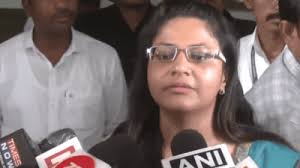
The UPSC, it is well known, has filed a criminal case against Puja Khedkar, a probationary officer for faking her identity.
Khedkar is in the eye of a storm: a sense of entitlement being her undoing.
It all started with her allegedly exceeding her brief, using her personal Audi luxury car hooting a siren, demanding a private cabin and new furniture apart from other instances of high handedness that caught the attention of the administration which was swift to move in.
Whether it has something to do with her father being a politician or her mother a daredevil is anyone’s guess.
Puja’s father, Dilip Khedkar, recently contested the Lok Sabha elections; about her mother’s daring, there are visuals of her brandishing a gun while negotiating a land deal that made everyone sit up.
As for Puja’s disability, she had an OBC or Other Backward Classes certificate which she was not eligible for.
If reports are anything to go by, Puja Khedkar’s father’s net worth is Rs 40 crores which makes her part of the “creamy layer,” which is ineligible for the quota.
How is it that this fact was overlooked? Could it be complicity, because the excuse of oversight does not hold water. Also, what about the checks and balances for a claim by an aspirant? What about verification?
That apart, Puja Khedkar’s medical certificates, for mental health and visual impairment, were secured without going through the mandatory checks at AIIMS in Delhi which had summoned her six times but had drawn a blank. Khedkar is combating allegations of faking the certificates.
Therefore, the likes of Kant and Sabharwal, though “politically incorrect,” have hit the bulls-eye.
As for the system clean-up, it calls for a focus-shift from “cracking the services exam” to integrity, righteousness and ethics rather than scores. Once that happens then “scholars with a heart” would get in rather than those who flag high scores or a bunch of certificates.
There is a section which alleges a political twist to this distasteful episode, suggesting that Khedkar is a victim of vicious politics.
Whatever be the truth, what stares one in the face is a probationer’s attempt to shortchange the system. This puts a question mark on the entire gamut of the disability quota. It defames and discredits even those who are genuinely disabled and have used the quota provision justly and fairly.
Khedkar’s case has sparked off a much-needed debate: Where does the buck stop? What are the safeguards against misuse? Does a distinguished service like the IAS deserve to be tarnished?
More importantly, don’t recent events and the gross misuse call for a revaluation of the quota system and perhaps usher in the “inability to include” clause?
On the last, knives would be out but for the sake of the people, the institution and the services, it is an option which should be exercised: an option which may be a bitter pill but one that should and must be administered.
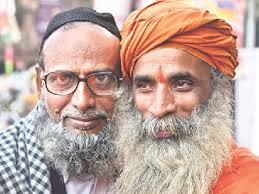
While ignoring the ground realities, the rulers devise ways to add to the communally tense atmosphere, such as the latest sarkari order to display names of the owners of eateries along the Kanwar Yatra route by Humra Quraishi
What is frustrating and more than disappointing is the fact the rulers of the day do not dwell on the ground realities. They do not wish to talk or dwell or focus on the current problems facing the citizens. Nah, they don’t talk of the flooded cities and suburbs and the havoc hitting those sitting in the water-logged areas with basic infrastructures giving way. They don’t dwell on the rising prices of everyday commodities …rising to such an extent that it’s getting difficult to run the kitchen. They don’t talk of the unemployed. They do not even acknowledge the fact that corruption has corrupted the education sphere, affecting the future of hundreds and thousands of students. They don’t talk of the rising crime graph. They don’t seem bothered if hate crime and lynch killings are happening more than often, in the midst of the communal pollution spreading out all around as never before. They don’t seem bothered if hundreds amongst us are rendered homeless after bulldozers destroyed home after home.
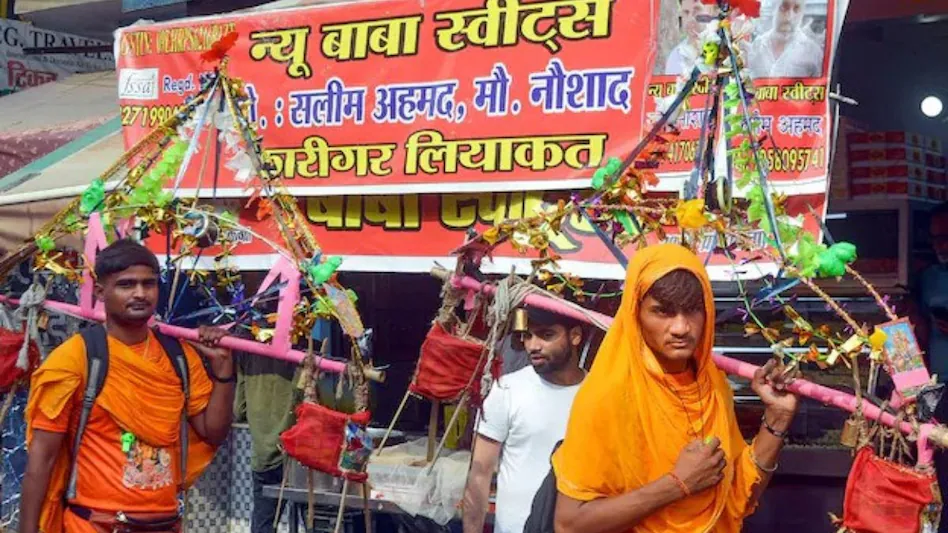
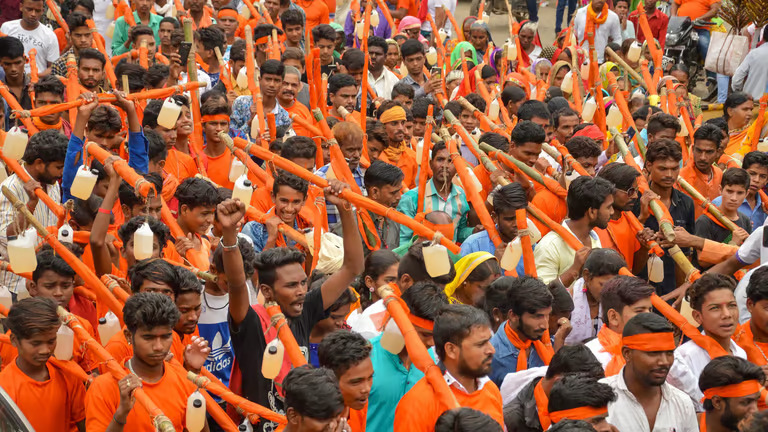
It gets obvious that new ways are being put forth by the right-wing to add to the communally tense atmosphere. The latest, of course, was the sarkari order to display names of the owners and workers and sellers of the food eateries along the Kanwar Yatra route. That order was thankfully cancelled after the Court’s intervention and ruling.
Today there could be hundreds and thousands of food bloggers and foodies and food enthusiasts yet no one stood up and voiced their disgust at those name-display tactics to food sellers!
Can food and fruit sellers be spread from this Hindu-Muslim thing! I’m reminded of what Sufi Hazrat Nizamuddin had said – words along the strain: when our Creator didn’t discriminate between countries and communities and castes and creeds whilst spreading out His bounty – sunshine and trees and fruits and rivers and the air we breathe – then who are we, the fragile human beings, to interfere and throw about don’ts!
This right-wing’s latest strategy of compelling food-sellers to display their names and surnames could be termed absolutely dangerous in every possible way… The list of Muslim haters and abusers in the Modi sarkar is long and unending. Not to overlook the comments churned by several politicians, who find time to sit through television programmes to come up with nothing better than go about commenting along the typical slanted and biased strain.
Neither a watch-dog group nor a gutsy independent commission head that could order them to shut up just there and then, so that they can’t get further …so blatantly communal. Today, it’s frightful how television debates take place; shrieks and counter screams, never really focusing on actual issues and genuine concerns of the citizens.
Those subtle and harmless taunts
Today, distractions are on, along the Hindu-Muslim strain. Any crisis, big or small, then dragged along are those typical communal ploys to distract and hoodwink the masses. It’s an utterly sad and painful situation. After all, Hindus and Muslims have lived together in this country for centuries. Mind you, they co-existed with a certain level of respect and love for each other.
Togetherness between communities was intact till about the 70s; where each community realized the differences and yet lived on par. Though several of my parents and grandparents’ friends would not eat at our place but they would decline rather too subtly, “aaj hamara vrat hai/ today we are fasting.” In all probability, the non-vegetarian fare cooked in our homes came in the way but it was so gently put through that there was nothing hurtful about it. Refinement was still intact, to a great extent.
Looking back I wasn’t particularly confident about my knowledge of my beliefs and though my parents had engaged a Maulvi Sahib, but there were few free-flowing meaningful discussions at home. In fact, I started saying, ‘As – Salaam – Alaikum’ with a certain degree of confidence, only after Khushwant Singh insisted he would greet me with that greeting, after prefixing “Tum kaise Musalmaan ho … As Salaam Alai Kum nahin kahtee ho!… This greeting carries such a beautiful meaning – May peace on you….Now onwards just say As Salaam Alai Kum.”
Let me also rather too sheepishly add that though Avadh cuisine was famous and food was centre stage in our home (my parents had always employed a khansamah/cook and the dining table laden with at least three if not four dishes at every meal) but here again, I was somewhat apologetic about the non-vegetarian fare tucked in my tiffin. I recall an incident from my early school days which relays how children react to off beats. It was during my father’s posting in Jhansi, with younger my sister Habiba and I enrolled in the St. Francis convent, where lunch had to be ferried from home and to be eaten in a common dining hall. When Habiba would excitedly open the huge tiffin (got from home) and take out those hugely rounded rumaali rotis and kababs, I used to sit all too embarrassed, more so as I’d looked around and saw that tiffins of the other kids stuffed with the usual daal and sabzis and smaller rounded rotis /phulkas… I recall even pinching my sister’s arms for over displaying the rumaali rotis and inviting comments from the school kids, “Never seen these types of big, huge rotis … you are different … eating different stuff! Why not our type of rotis… our phulkaas and daal. ”
All those subtle harmless taunts that one heard during the schooling and college years, seem all too harmless and subtle as compared to the dangerous ongoing communal unleashes after the Babri Masjid demolition and the killings of Muslims in the Gujarat pogrom… Never before the biased role of the administration was so blatant. Those at the helm sat as spectators or as else as supporters, as though ‘okaying’ all those grave human tragedies.
The Apex Court’s striking down of the UP administration’s contentious directive requiring eateries on the Yatra route to display owner details has cast Yogi government in a poor light and given the opposition a leg up. A report by Mudit Mathur
While declining to entertain the last-minute reply filed by the Uttar Pradesh government that the direction to shops along the Kanwar Yatra route to display the names of owners was to ensure a peaceful pilgrimage, the Supreme Court on July 26 extended the interim stay order on directives issued by the Uttar Pradesh and Uttarakhand governments asking eateries along the Kanwariya pilgrim route to display the names of the owners and the staff. The stay order will continue to remain in force till August 5, the next hearing date.
The Supreme Court on Friday extended its interim stay order on directives issued by the Uttar Pradesh, Uttarakhand, and MP governments mandating the eateries along the Kanwar Yatra to display the names and identities of owners and staff.
A bench comprising Justices Hrishikesh Roy and SVN Bhatti was hearing the petitions filed by the Association for Protection of Civil Rights, TMC MP Mahua Moitra, Prof Apoorvan, and columnist Aakar Patel against the directives of the UP and Uttarakhand governments.
When the matter was taken up, Senior Advocate Dr Abhishek Manu Singhvi, appearing for Moitra, submitted that the Uttar Pradesh Government filed a counter-affidavit at 10:30 p.m. on 25 July and time was required to file a rejoinder. Stating that the counter-affidavit has not come on record, the bench agreed to adjourn the matter.
The Uttar Pradesh government has told the Supreme Court that its directive to the shops along the Kanwar Yatra route to display the names of owners was to ensure that the religious sentiments of Kanwariyas were not hurt, “even accidentally”, and also for “peace and tranquillity”. It further explained that the directive was issued in response to complaints received from Kanwariyas regarding confusion caused by the names of the shops and eateries.
“Past incidents have shown that misunderstandings regarding the type of food being sold have led to tensions and disturbances. The directives are a proactive measure to avoid such situations,” the government said. The state government added that the order doesn’t impose any ban on the trade or business of food sellers — barring restrictions on the sale of non-vegetarian food — and that shopkeepers are “free to conduct their business as usual”. The directive to display the names of owners is “merely an additional measure” to ensure transparency and keep any potential confusion at bay.
The apex court was also told that even “small confusions” related to the food Kanwariyas are served, have the potential to “hurt their religious sentiments and can lead to flare-ups, especially in a communally sensitive region like Muzaffarnagar.
“It is to be noted that the directive does not impose any discrimination based on religion, caste, or community. The requirement to display the names and identities of the owners applies uniformly to all food sellers along the Kanwar Yatra route, irrespective of their religious or community affiliations,” the UP government said. It added that the order was aimed at ensuring public safety and order during the Kanwar Yatra, considering the large number of participants in the pilgrimage. “It is imperative to take preventive measures that ensure a peaceful and harmonious pilgrimage,” the state government told the top court.
Senior Advocate Mukul Rohatgi, appearing for the State of Uttar Pradesh, submitted that the regulations under the Central law Food and Safety Standards Act, 2006 require every food seller, including dhabas, to display the owner’s names. The interim order passed by the Court, which stayed the directive to display the owners names, was not in line with this Central law, Rohatgi submitted, as it was not brought to its notice by the petitioners.
The bench however remarked that if there is any such law, then the State should be enforcing it throughout all areas. “Then let it be enforced all across…not only in certain areas. File a counter showing it has been enforced all over…” Justice Roy said.
Rohatgi requested for an early hearing of the matter, preferably next Monday or Tuesday, saying that the matter will otherwise become infructuous as the Kanwar yatra period will be over in two weeks. He added that the petitioners had the duty to inform the Court about the existence of such a law.
In response, Singhvi submitted that since there was no mandate to display owners’ names during the Kanwar pilgrimages of the last 60 years, there was no harm in allowing the yatra this year without the enforcement of such directions. He added that the UP Government has admitted in their affidavit that the direction was causing discrimination. Senior Advocates Chander Uday Singh and Huzefa Ahmadi also appeared for the petitioners.
Singhvi read out the following statement from the affidavit: “The temporary nature of the directives ensures that they do not inflict any permanent discrimination or hardship on the food sellers, simultaneously ensuring maintaining the sentiments of Kanwariyas and their religious beliefs and practices”. “So they say there is discrimination, but it is not permanent,” he submitted.
Deputy Advocate General of Uttarakhand, Jatinder Kumar Sethi, submitted that the law mandates the display of the owners’ names and that the interim order was creating problems. He stated that this legal mandate was being enforced by the State all over during all festivals. If an unregistered vendor causes any mischief along the Kanwar Yatra route, it will lead to law-and-order problems, he submitted. When the bench asked the Dy. AG to elaborate on what could be a “mischief”, he cited an example of an unregistered vendor selling mangoes laced with sedatives to the pilgrims.
The bench also heard the brief submissions made by certain Kanwar pilgrims, who intervened in the matter to support the government’s directions. The intervener submitted that Kanwar pilgrims only take vegetarian food items prepared without garlic and onion. There are certain shops with confusing names, giving a false impression that they serve only vegetarian food causing problems to the pilgrims, he submitted.
“There are shops with names like Saraswati Dhaba, Maa Durga Dhaba. We assume it is pure vegetarian. When we enter the shop, the owners and the employees are different, and non-vegetarian food items are served there. It is against my custom and usages,” he submitted. It was in this context that the Muzaffarnagar police issued the advisory to display the names “voluntarily”, he submitted.
The bench clarified that it has not prevented anyone from voluntarily displaying the names of owners and staff and the stay was only against forcing anyone to do so. After the order was dictated, Dy AG of Uttarakhand urged the bench to clarify that the State can take action under the law requiring the display of owner’s names. However, the bench stated that the interim order will remain as it was.
The counsel appearing for the State of Madhya Pradesh denied a news report that the Ujjain Municipal Corporation has issued a similar directive. On the last date of the hearing, the Apex Court issued notices to UP, Uttarakhand, Madhya Pradesh, and Delhi on three petitions filed against the directives. It also stayed the impugned directives which said that shops and eateries may be required to display the kind of food they were selling to Kanwariyas. However, they must not be forced to display the names/identities of owners and employees deployed in the establishments.
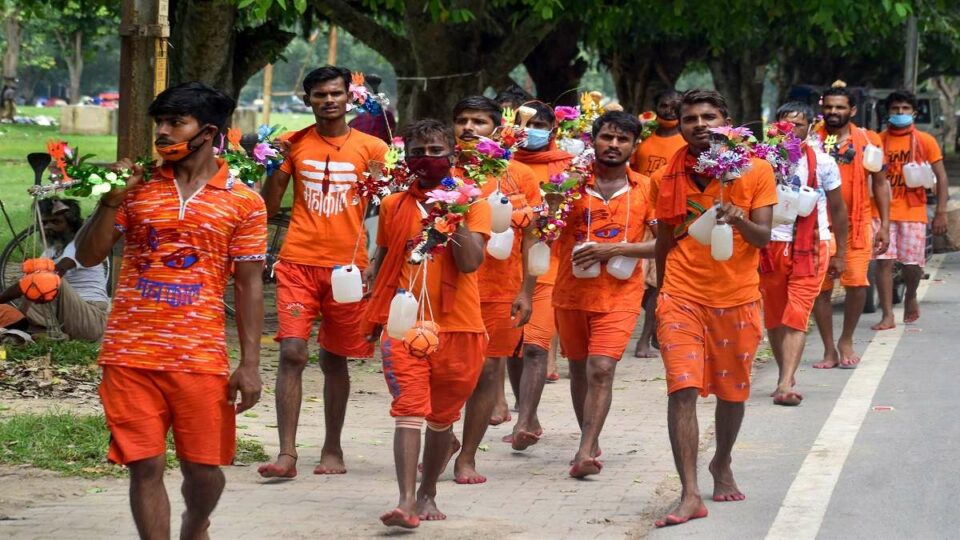
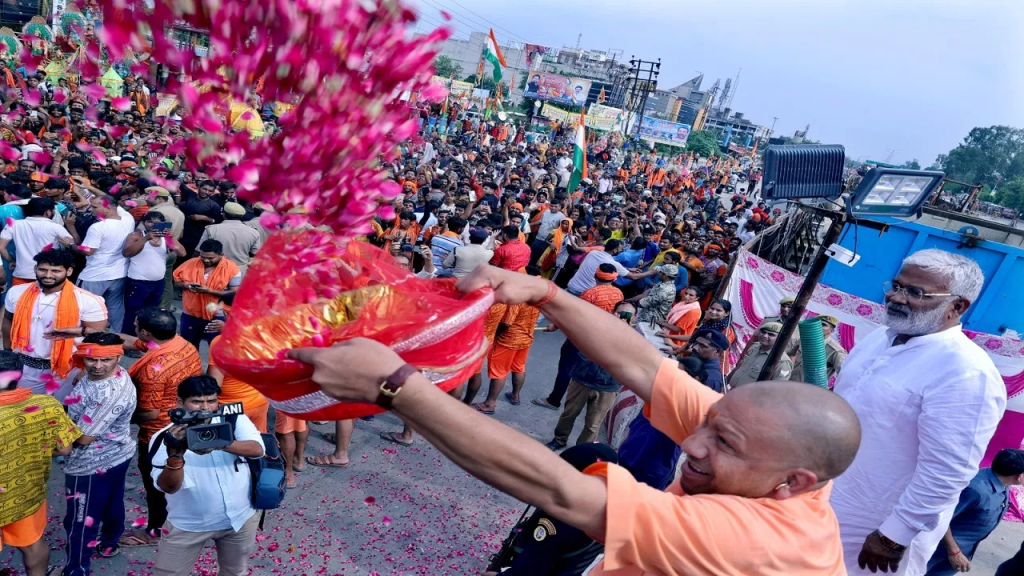
The Kanwar Yatra is an annual pilgrimage undertaken by Shiva devotees known as Kanwarias or “Bhole”, during which they travel to key Hindu pilgrimage sites such as Haridwar, Gaumukh, and Gangotri in Uttarakhand and Ajgaibinath in Sultanganj, Bhagalpur, Bihar, to fetch holy water from the Ganges river.
On July 17, 2024, the Senior Superintendent of Police, Muzaffarnagar, issued a directive requiring all eateries along the Kanwar route to display the owners’ names. This direction was extended state-wide on July 19, 2024. Reportedly, the directive was rigorously enforced across all districts of Uttar Pradesh and Uttarakhand.
Against the said directive, three petitions seem to have been filed before the Supreme Court – (i) first, by NGO-Association for Protection of Civil Rights (APCR), (ii) second, by TMC MP Mahua Moitra, and (iii) third, by well-known political commentator and Delhi University academic Apoorvanand Jha and columnist Aakar Patel.
The petitioners argue inter-alia that the directives threaten to create a religious divide and violate the fundamental rights of citizens guaranteed under Articles 14, 15, 17, and 19 of the Indian Constitution. It is further claimed that they violate the right to privacy of owners and workers of eateries, exposing them to danger and making them targets.
At the outset, senior advocate Dr Abhishek Manu Singhvi, appearing for the petitioner, questioned the “rational nexus” behind the directives. He pointed out that the situation is worrisome as police authorities that have issued these directives have taken upon themselves to create a division.
Dr Singhvi claims that these directives would virtually identify the owners and subject them to economic boycotts. He argued that it would lead to a “domino effect” in other states.
The bench asked if these were ‘orders’ or ‘directives’ issued in a press statement. To this, Dr Singhvi clarified that earlier directives were issued through press statements. However, the authorities are strictly enforcing it, he pointed out. Dr Singhvi said: “It has never been done before. It has no statutory backing. No law gives police commissioners the power to do it. The directives are for every haath-gaadi (hawkers), tea stalls…Giving names of employees and owners does not serve any purpose.”
Justice Roy asked again if any formal order has been issued by the government.
Dr Singhvi replied that it is a “camouflaged order”.
Justice Roy pointed out that some of the directives are voluntary in nature. To this, Dr Singhvi said: “Your Lordship is harsh on people who violate and harsher when people are too clever and camouflage”. The bench asked if there is any element of coercion in the directives?
Dr Singhvi told the court that some of these directives fine violators for non-compliance. He further argued that these directives raise a larger issue, which is that there would be exclusion based on identity.
However, Justice Bhatti stated that the issue need not to be exaggerated. He summarised that there are three dimensions to these directives: safety, standard and secularism.
Dr Singhvi told the court that Kanwar Yatra has been happening in the country for decades. He stated that the court must note that people from all religions – Muslims, Christians and Buddhist – have been helping Kanwariyas.
As for the issue of vegetarian and non-vegetarian food, Dr Singhvi told the court that there are existing laws that are strict on serving non-vegetarian food. He said: “There are a lot of pure vegetarian restaurants run by Hindus but they have Muslim employees. Can I say I will not go there and eat? Because the food is somehow touched by them [Muslim employees]?”
Justice Bhatti shared an interesting story. He said that in Kerala, there is one hotel run by a Hindu and another by a Muslim. But he would often visit a vegetarian hotel owned by a Muslim because he maintained hygiene of international standards in his hotel.
Are the directives voluntary?
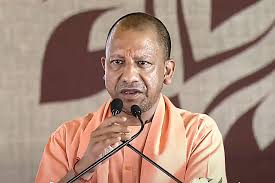
Dr Singhvi pointed out that the directives state “sweccha se” (by will). He argued that these are camouflaged because if the names are disclosed, the person would face economic exclusion. If the names are not disclosed, the person would be liable to pay a fine. Dr Singhvi clarified although these may have been voluntary directives, the Chief Minister of Uttar Pradesh, Yogi Adityanath, has stated that the directives would apply in general to all districts.
Dr Singhvi added that many people from minority community have reportedly lost their jobs. The law prescribes only displaying calories and the nature of food, he said. He referred to the Food Safety Standard (Labelling and Display) Regulations, 2020, under the Food Safety and Standards Act, 2006, and argued that the law does not prescribe owners to name their eateries by their names.
He told the court that the legislation only prescribes two conditions on food items, that is, only calories and vegetarian or non-vegetarian labelling must be mentioned on food items.
In Muzaffarnagar, where the first of such directives came from the police, the stay has made little difference. Except for some street vendors, almost all eateries have the new name plates with the details in place. At least some eateries have shut, choosing caution over confusion. The Uttar Pradesh government defended the directive before the Supreme Court on grounds of “transparency” and “religious sentiments”.
Waseem Ahmad, 50, whose shop was vandalised in 2023 by a group of right-wing activists, who ransacked his eatery after accusing him of “misusing” the name of a Hindu god to serve “impure food” to Kanwariyas. Till last year, he ran the bustling ‘Ganpati Tourist Dhaba’ on the bypass road to Haridwar. His co-owner was a Hindu – hence the name, he says – as were all his staff. For nine years, they faced no issue. Ahmad, who hasn’t reopened his dhaba, believes the trigger for the latest police order for display of owners’ names is that very incident.
Farman Ali has kept his sheermal shop open, hoping Kanwariyas will look past his name. Till last year, Kanwariyas milled at his shop, which he has been running for 17 years, looking especially for the sweet bread. “They would call out, ‘Ai Bhole! Kya banayeho (What have you made)’?” However, sales have dipped to one-tenth of what they used to be. “Earlier, I sold about a hundred sheermal a day during the Kanwar Yatra, but it has now reduced to just 10. Till last year, I also ran an eatery during Kanwar Yatra selling vegetarian food and breakfast. But now who will dare get into a fight?” he lamented.
In Haridwar, mosques and mazars on the Kanwar Yatra route were briefly covered using large white sheets on the morning of 25th July and by the evening, the district administration removed them. The police said what happened was a mistake. The Yatra route in Haridwar passes through the Jwalapur area of the city, where mosques and mazars are located.
While the administration claimed they had not issued any order to put up the sheets, the Haridwar district in-charge minister Satpal Maharaj said the measure was taken to prevent any agitation or unrest and to ensure smooth progression of the Kanwar Yatra. It must be noted that this is the first time such a unique measure has been adopted by the authorities.
Asked about the move, Satpal Maharaj said, “It is done to ensure that there is no agitation or flare up. It was kept in mind that our Kanwar Yatra should go on smoothly. Where there is any construction going on, that structure is also covered… We have done (the same) here and will see what feedback we get. We will study that.”
Haridwar Superintendent of Police (City) Swatantra Kumar, however, told the media that there was no order to do so – either from the district administration or the police.
One of the ways to mitigate the impact of cyclones and tidal surges in coastal areas is through the restoration of the mangrove ecosystem. A report by Deepanwita Gita Niyogi
Last year, during a visit to the coastal city of Visakhapatnam, Suman S described how his organisation, Dr. Reddy’s Foundation, is trying to focus on the regeneration of the coastal ecosystem.
“Coastal communities are the most vulnerable to climate change impacts. As cyclones pose a grave risk along the Andhra Pradesh coast, there is a need to focus on adaptation and mitigation measures for protection,” he said.
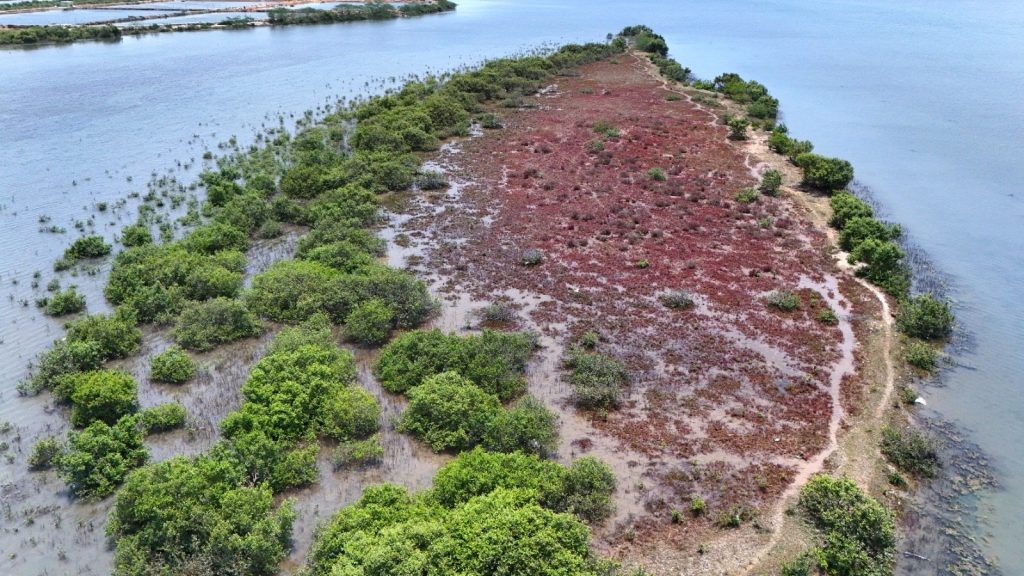
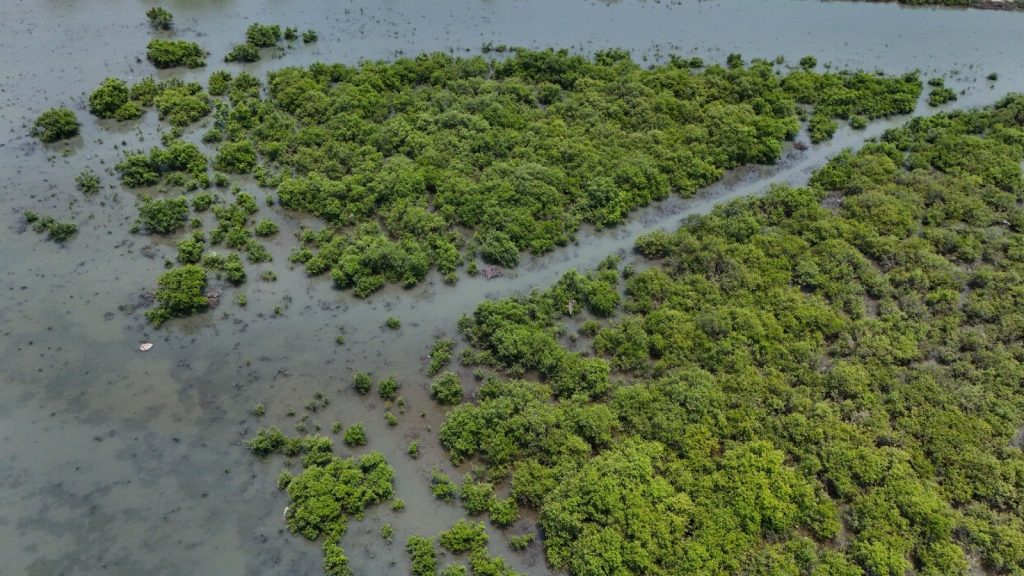
One of the ways to mitigate the impact of cyclones and tidal surges is through the restoration of the mangrove ecosystem. Towards this end, the foundation started work this year under which part of the existing mangrove belt from Visakhapatnam to Srikakulam would be conserved.
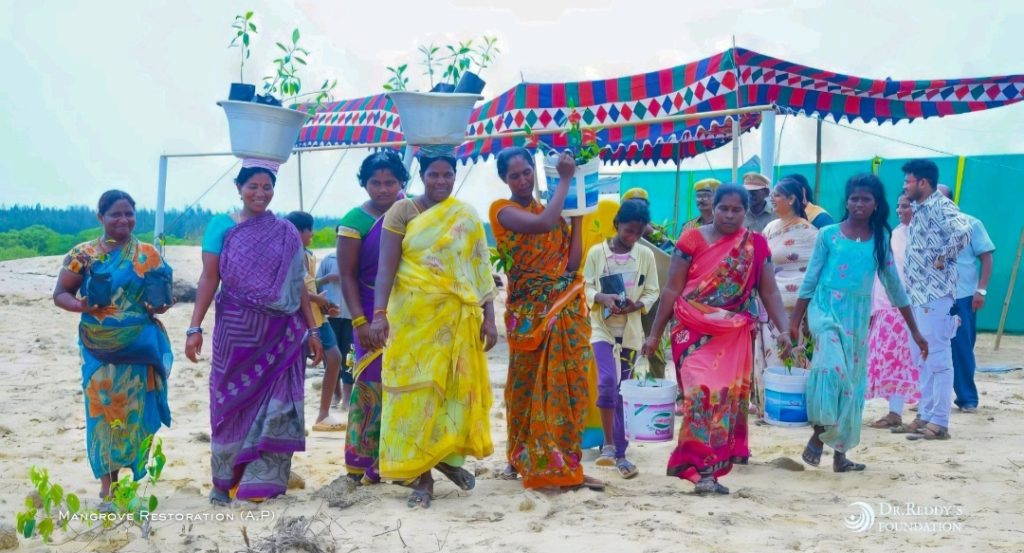
“As part of the project involving communities, areas have been demarcated along the coastal belt of Andhra Pradesh. Mangrove restoration work is being carried out using scientific methods. Along with restoration, there will be promotion of mud crabs to enhance the income of the people living along the coastline. Mud crabs are found in mangroves,” Suman added.
A long-term project, it can be showcased as a model to be picked up and replicated by others along the eastern coast of India. On July 26, the International Day for Conservation of Mangrove Ecosystems was observed.
Protecting mangroves
About 40 percent of the world’s mangrove cover is found in two regions: South East Asia and South Asia. India has about three percent of the total mangrove cover in South Asia, according to the Global Mangrove Alliance.
Among the states, West Bengal has 42.45 percent of India’s mangrove cover, followed by 23.66 percent in Gujarat and 12.39 percent in the Andaman and Nicobar Islands. As India is a coastal country reeling under the impact of climate change, mangrove conservation is vital.
In Andhra Pradesh, 404 sq km area is covered by mangroves which fall under the open mangrove and moderately dense mangrove categories, the Global Mangrove Alliance says. Satya Aruna of Dr. Reddy’s Foundation, who holds the position of technical associate, biodiversity, explained that the foundation is laying emphasis on the rejuvenation of the coastal ecosystem under its Action for Climate and Environment Programme.
“The degradation of mangroves is high. That is why the restoration work has been taken up. As the mangroves are under the forest department, the organisation approached government officials to implement the project,” Aruna said. Work has already taken place in Sullurupeta in the Tirupati district of Andhra Pradesh. So far, 200 acres of mangroves have been restored in Tirupati.
To make the project a success, on-site nurseries have been established to collect propagules (plant materials used for propagation) and raise seedlings. This will ensure a 95 percent survival rate.
One of the technical partners in this project is the ICFRE-Coastal Ecosystem Centre based in Visakhapatnam. Scientist Tatiparthi Srinivas said the mission of the institute is to conserve biodiversity across India.
“The institute is at present concentrating on mangroves, as part of which pilot surveys have been carried out. We have identified some patches where restoration activity can be done. In some coastal areas, there is human pressure. In these areas, there is a scope for improvement through revival. Work has been carried out in the Pulicat Lake area. Here, we observed that only specific species of mangroves can survive. Mangroves can restrict damage in the coastal regions. Sometimes, they grow slowly and that is why a scientific approach is needed,” Srinivas added.
S Venkatesh, the divisional forest officer of Srikakulam, said there has been an agreement between the foundation and the forest department.
According to the forest officer, mangroves are important. That is why they need to be protected and restored, especially in sensitive areas. Work in the division will start soon. The foundation will mobilise the local communities for the project.
Mangroves in India
The Forest Survey of India has been assessing the mangrove cover using remote sensing since 1987. There are many important species of mangroves found in the country.
Apart from Andhra Pradesh, Odisha also has a history of getting impacted by frequent cyclones. The state’s Bhitarkanika mangrove forest covers an area of 650 km and is one of the best patches of mangrove forest along the Eastern Indian coast. The Bhitarkanika mangroves offer protection from devastating storm surges.
Spread across India and Bangladesh, the Sundarbans are an archipelago of islands, famous for the world’s largest mangrove forest. However, due to sea-level rise as a result of climate change, mangroves are disappearing.
In the Sundarbans, Kolkata-based non-profit, Nature Environment and Wildlife Society, has worked with communities on restoration of mangroves. Started around 2011, the region witnessed the plantation of 16 million mangroves to strengthen houses and farmlands from flooding, according to the Livelihood Funds which invests in projects across Asia, Africa and Latin America. The other aim was biodiversity protection.
After cyclone Amphan caused large-scale devastation in West Bengal in 2020, Chief Minister Mamata Banerjee launched a mangrove plantation drive in convergence with MGNREGA. Under this, plantations would be carried out in the months of August-October over the next 10 years. Altogether, 2,500 hectares of available land would be covered with 50 million mangroves.
In the Indian Sundarbans, rising sea level is destroying the Sundri trees, the dominant mangrove species, found in the region. This is also impacting the habitat of the tiger.
“There is no freshwater inflow in the Indian Sundarbans. So an increase in salinity is impacting the diversity of vegetation. Many mangroves, which thrive in less salty water, are dying. This in future will impact tiger habitats,” said Jones Justin, deputy field director, Sundarbans Tiger Reserve.