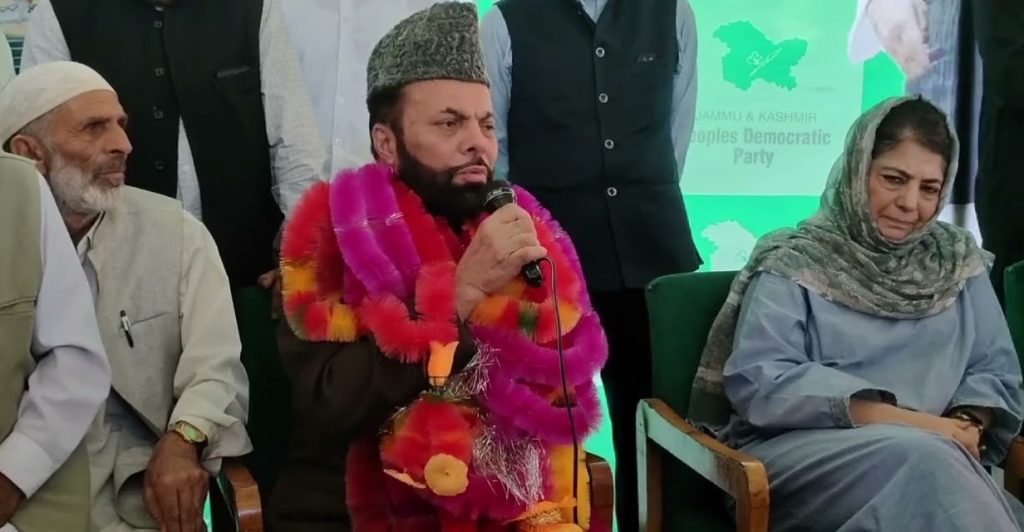
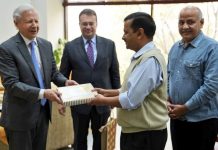
A former leader of the Hurriyat Conference Salim Gilani joined the People’s Democratic Party (PDP) on Sunday. The move comes as Kashmir gears up for its Assembly elections, attracting several former separatists and their associates into mainstream politics. Gilani was welcomed into the PDP by party chief Mehbooba Mufti and is expected to run for a seat in Srinagar.
Gilani is among several former separatists or their family members who are now entering electoral politics. Following the decision of the Jamaat-e-Islami, a separatist group, to field candidates in the upcoming elections, other prominent figures have also made similar moves.
Ghulam Nabi Shaheen, a senior member of the High Court Bar Association, is campaigning for the party of jailed Baramulla MP Sheikh Abdul Rashid, also known as Engineer Rashid. Besides, Aga Syed Muntazir, son of Hurriyat leader Aga Syed Hassan, has joined the PDP, while Javaid Hubi, son of former separatist Dr. Ghulam Mohammad Hubi, has aligned with Engineer Rashid’s Awami Itehaad Party. Explaining his decision to join the PDP, Gilani said that he has always been inspired by the party’s stance on resolving the Kashmir issue and advocating for the release of detainees
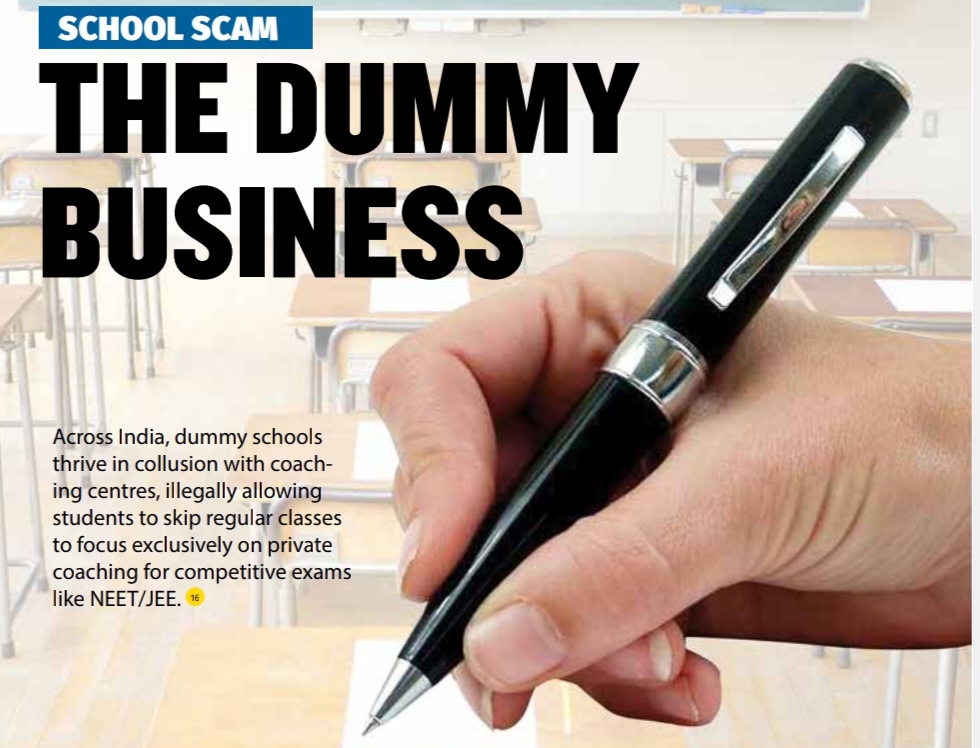
Across India, dummy schools thrive in collusion with coaching centres, illegally allowing students to skip regular classes to focus exclusively on private coaching for competitive exams like NEET/JEE. all under the nose of the CBSE. A report by Tehelka SIT
Top coaching institutes in India have been caught on Tehelka’s camera confessing that they guide interested students and their parents to gain admission to “dummy schools.” One of these institutes, it may be mentioned, became a household name in India after a web series on the OTT platform, Amazon Prime. These dummy schools, also known as non-attending schools, allow students to skip regular classes and focus solely on coaching for competitive exams like NEET/JEE.
The nexus between these coaching centres and dummy schools runs deep. Parents and students who approach these institutes for NEET/JEE coaching, along with requests for admission to dummy schools, are provided with middlemen by the institutes. These brokers visit the coaching centres weekly, armed with lists of CBSE-affiliated dummy schools in Delhi-NCR where interested students can be admitted. In return, the middlemen pay commissions to the coaching centres for securing candidates’ admission to dummy schools.
The admission process for dummy schools occurs only in Class XI. Parents and students openly express their preference for dummy schools, enrolling their children in selected CBSE schools through the coaching centres, where they would not be required to attend classes. Although they pay monthly fees, these students do not attend regular school classes; instead, they focus on what is taught at the coaching centres. Remarkably, Tehelka’s investigation has revealed that the attendance of these non-attending students is managed by the dummy schools in exchange for regular monthly fees, with students only required to appear for the final exams.
Educators argue that dummy schools are undermining the schooling system in the country. They urge CBSE to inspect schools and identify those that are hand in glove with private coaching institutions. Some warn that if these unfair practices go unchecked, more schools will follow suit, leading to a decline in holistic learning. One Public Interest Litigation (PIL) suggests that dummy schools are also used to enrol students from other states in Delhi schools, making them eligible for the 85 percent quota in Delhi University colleges. Others prefer dummy schools for exam preparation as it is less tiring than attending both school and coaching centre each day.
In September last year, the Delhi High Court issued notices to the Delhi Government and the Central Board of Secondary Education (CBSE) in response to a plea seeking action against CBSE-affiliated schools in Delhi. These schools were allegedly involved in the illegal practice of offering “dummy schooling” to Class 11 and 12 students. Despite CBSE disaffiliating 20 schools (including five in Delhi) for enrolling dummy students, the dummy school business continues to thrive. This pan-India business has been running for over a decade.
To expose this thriving business, Tehelka conducted an eagerly awaited investigation into dummy schools, which operate in conjunction with coaching institutions. We approached several prominent institutes in Delhi and Noida. Remarkably, these institutes agreed to our team’s request for “our ward’s” admission for NEET/JEE preparation and assured us that they would also facilitate the child’s admission to a CBSE-affiliated dummy school in Delhi.
“We are also in the dummy business. Dummy schools are a very profitable business for coaching institutes. We receive 15-20k as commission for each admission to a dummy school. This commission comes from the middleman, who coordinates between the dummy school and the coaching centres. Dummy schools generate significant revenue for the coaching industry. Currently, there are 10-12 students in our institute enrolled in dummy schools. For these dummy students, we conduct classes in the evening, not in the morning,” says Rati Chauhan, a manager at one of these institutes.
We met Rati at the institute’s Nirman Vihar branch in East Delhi, posing as parents seeking admission for their child in both NEET/JEE preparation and a dummy school. Rati agreed to admit our child for NEET/JEE preparation and promised to assist with dummy school admission, describing the dummy school business as highly lucrative for the coaching centre. According to Rati, the institute currently has 10-12 students enrolled in dummy schools. It emerges from the conversation that in the murky world of dummy schools, both students and institutions are caught in a web of deceit. The connections between middlemen and schools reveal a profit-driven scheme that thrives on secrecy and manipulation.
Rati- Aap jab bhi cheque denge.. wo school ke naam ka cheque denge, jitni unki fees hogi. Hamara 15 thousand ya 20 thousand mediator ka hota hai.
Reporter- Accha school aapko commission dega?
Rati- School nahi jo mediator hoga, jiske through hum karayenge, hamare beech mein do source bethey hain school ke jo..mediators.
Reporter- Middleman?
Rati- Jo public dealings kartey hain..jaise aap school jaatey hain coordinator hota hai, aap seedha principal se nahi mil saktey, you have to meet coordinator. Similarly hame bhi school se milne ke liye coordinator ko approach karna padta hai.
Rati- Ussey miltey hain wo sara setup school se karwata hai. And then institute ko bahut fayde hain dummy se, Paisa bahut acha aata hai dummy se..wo costly bhi hota hai.
Reporter- Abhi kitne bacchey honge Dummy mein.?
Rati- Hum dummy bhi detey hain toh evening mein, morning mein koi dummy classes nahi dengey.. evening hi dengey same.
Reporter- Abhi kitne bacche hain ?
Rati- Aap manogey nahi!.. kareeb 10-12 bacche hain abhi.
[The conversation unveils the hidden operations behind dummy schools, where mediators facilitate lucrative deals between parents and institutions. This shows how financial incentives can corrupt educational values.]
“We have a list of dummy schools tied up with coaching centres, all CBSE-affiliated and located in Shahdara, Loni, and Rohini. Students don’t need to attend school even once in two years, which is why they prefer dummy schools,” Rati told our undercover reporter. In the following revealing exchange, the shadowy world of dummy schools is laid bare, exposing how deeply entrenched these institutions are in the Indian education system. It highlights the alarming ease with which students bypass traditional schooling.
Reporter- Aur agar hum dummy ke liye jaatey hain next year to aapke kaun kaun se school hain dummy wala
Rati- Wo sab mein aapko listing kar dungi.
Reporter- Sab CBSE ke hain ?
Rati- CBSE affiliated hi hotey hain.. government ka nahi hota hai.
Reporter- Aas pass mil jayenge schools kahin.?
Rati- Sir ye mushkil hota hai, shahdara mein ek hai, Loni ke pass hai, phir Rohini mein hain 2-3 schools, kyunki baccho ko jana to hota nahi, poore 2 saal mein ek baar bhi nahi jaata.
Reporter- Ek baar bhi nahi ?
Rati- Kuch nahi, tabhi to baccha leta hai.
[The conversation highlights the long-standing practice of dummy schools, showing how they allow students to skip regular attendance entirely. It shows that this entrenched system prioritizes convenience over actual education, raising serious ethical concerns.]
“The dummy school concept in fact is quite old in India. When I finished Class 12 in 2013 from Deoghar, Jharkhand, students in my area were already using dummy schools and coaching from Delhi,” revealed Rati. The facts revealed by Rati here underscores thatthe concept of dummy schools, though illegal and unethical, has deep-rooted origins. This conversation delves into its history, revealing how it quietly existed for over a decade, influencing even the educational landscape of smaller states like Jharkhand.
Reporter- Ye concept shuru kyun hua mam?
Rati- Concept, ye mere time ka concept hai, bahut purana, jab maine 12th kiya hai, in 2013 I did twelth.
Reporter- Itna purana hai ye.?
Rati- I am talking about myself.
Reporter- I am talking about dummy.
Rati- Bahut purana hai… mein small state se hoon.. Jharkhand se, us samay mere friends.. 2013 mein.. they were doing coaching in Delhi.
Reporter- 11 years pehle ki baat hai! Hamne to abhi suna hai.
Rati- Yes Yes bahut purana hai sir.. mere friends Delhi mein aa kar, they were doing coaching in Nairaina and all.. wahan bhi Deoghar mein jahan se mein hoon, wahan bhi sab ne chotey chotey schools banaye hain, sabki shakalein dikhti hain jab board exam dena hota hai!
[The conversation highlights that the concept of dummy schools is far from new, with roots going back over a decade. The upshot is that this practice has long been a quiet, widespread reality in various regions lof the country.]
After Rati, we met Rabia Sadaf at another prominent institute’s office with a fake deal that we wanted to admit our child for NEET coaching in their institute and also want to admit him in dummy school. “Yes, we have a tie-up with dummy schools, as many students ask for admission. Most students in our institute are enrolled in dummy schools, all CBSE-affiliated and based in Delhi and Noida. A broker regularly visits our coaching centre to facilitate these admissions,” revealed Rabia Sadaf, a counsellor at a well-known coaching institute’s Sector 18 branch in Noida, to our undercover reporter. Rabia assured us that she will provide all possible help to get our ward admitted in dummy school. The dialogue unveils the practical aspects of navigating this shadowy educational network. From non-attending schools to crucial references, it sheds light on how these institutions operate and provide alternatives for students.
Reporter- Prateek ji se baat hui thi meri 11the mein admission ke liye, non attending school.
Rabia- To wo school ja rahe hain na..?
Reporter- He will leave the school.
Rabia- Accha he will be leaving the school..haan to schooling ke liye hum karwa denge ..haan dummy schools se tie up hai. Wo hum karwa denge agar aapko lena hai.
Reporter- Mujhe Prateek ji ne bataya hum reference de denge aapko..unko dummy schools kehtey hain.
Rabia- Haan dummy schools.
Reporter- Schools kaun kaun se hain ?
Rabia- Wo to mere pass nahi hain ek mam aati hain.. unse poochna padega.
Reporter- Kaunsi mam hain?
Rabia- Unhi ke end se hain jo hamari mam hain reference wali..hamare pass bacche aate hain to unko provide karna hi padta hai..
Reporter- Hain aapke pass bacche?
Rabia- Haan bahut se bacche..mostly to non-attending wale hi hote hain.
Rabia- Haan ab baccho ko lagta hai school mein time zyada occupied ho raha hai.
Reporter- Prateek Chaudhary kya hain?
Rabia- Wo bhi counsellor hai.
Reporter- Mam ye non-attending schools Noida ke hi hain ya Delhi ke bhi hain.?
Rabia- Dono hi rehtey hain mam, preference rahega aapka,. Apko agar benefit mil raha hai to mil jata hai Delhi ka bhi.. wo phone utha nahi rahi hain, mein number de dungi, aap baat kar lena.
Reporter- Aapke reference se baat kar loon ?
Rabia- haan.
Reporter- Ye dummy schools CBSE rahenge ?
Rabia- Haan haan, aur agar hum aapko reference de rahe hain to definitely admission hoga.
[The conversation delves into the realm of ‘dummy schools,’ exposing their nexus with private coaching centres. Rabia’s insights underscore how requirement of mandatory minimum attendance in schools runs into coaching priorities.]
“You’ll pay Rs 1.20 to 1.30 lakh for two years of dummy school fees. Your attendance will be managed, and you won’t need to attend school in Class 11. In Class 12, you’ll only go for practicals and the final exam. You’ll be promoted without exams from Class 11 to 12. Just buy a school uniform from the place we specify for the few times you need to attend,” confessed Rabia. The following exchange reveals the practicalities of enrolling in a dummy school, including fees, attendance requirements, and exam protocols. It highlights how these institutions offer a streamlined, albeit unconventional, educational pathway for students.
Reporter- Iska procedure kya hoga ?
Rabia- Unka koi 1.20 to 1.30 lakh ke beech ka fees hoga…kaunsa class rahega aapka ?
Reporter- 11th, 12th.
Rabia- Haan 1.20 rahega.
Rabia- I lakh 20 hazar..dono saal ka..ismein aapko school nahi jana padega, attendance manage hoga.11 th mein aapko jana nahi padega, 12th mein aapke practicals honge..file wagera submit karna hoga, number bhi acche de detey hain ye practicals mein.
Rabia- Uniform kuch lena padega, exams dene jana padega school…wo bhi aapko bata denge kahan se collect karna hai…
Reporter- First term, second term sab dene jana padega ?
Rabia- Nahi 11th mein to koi exam hi nahi dena padega, 12th mein sirf boards ke liye jana padega.
Reporter- Ist term, second term, kuch nahi hoga sirf board mein jana hoga
Rabia- Haan sirf board mein.
Reporter- 11th mein final exam mein nahi jana hoga ?
Rabia- Nahi.
Reporter- Pass kaise karegi phir?
Rabia- Entry rehta hai usmein sab detail rehti hai.
Reporter- Accha..koi issue nahi hai ?
Rabia- Kahin par bhi jaatey ho dummy ke liye, aisa hi process hota hai.
“Rest assured, your ward will be promoted to class 12th without taking any exam. I can assure you that there will be no hassle. Those running these dummy school are experienced people as they have been doing it for years,” Rabia tried to reassure us. This conversation uncovers the ubiquity and practicality of dummy schools, detailing how they manage practicals and exams with minimal attendance. Rabia’s experience reveals that this system is a well-established, nationwide phenomenon.]
Rabia- Maine bhi apne time par jab kiya tha to hame bhi exam dene jana padta tha.
Rabia (continues)- Sirf practicals mein jana hota hai, de denge kya banana hai, 12th mein sirf jana hoga exam ke liye..wo to paisa aapse isi baat ka to le rahe hain.
Reporter- Accha 11th, 12th aapne bhi dummy se ki hai…?
Rabia- Ji sir.
Reporter- Ismein koi issue to nahi hai bacche ke liye ?
Rabia-No sir.
Reporter-Nahi aisa na ho CBSE ki taraf se kuch jaanch ho jaye..?
Rabia- Waise to kuch bhi kabhi bhi ho sakta hai but kafi time ye log yahi kaam kar rahe hain, inka business hi ye hai…aap to phir bhi end user ho, kuch hoga to sabse pehle to humpar hoga.
Reporter- Aap Bihar se ho aur aapne bhi dummy school se padha hai, iska matlab ye to All india mein hota hai..?
Rabia- Haan haan exactly. Aisa nahi hai ki sirf yahan par hota hai ye sab jagah hota hai.
Reporter- We are surprised..hum logon ko abhi tak dummy school ke bare mein pata hi nahi tha…wo to mere bete ne bataya ki bahut sare bacche school nahi aatey hain..yahan institute mein hain aapke dummy school wale bacchey ?
Rabia- Haan haan.bahut se admissions hote hain.
[Dummy schools, used widely across India, offer a feasible solution for students preparing for competitive exams with minimal attendance. The upshot is that while some uncertainties exist, this system remains a popular and well-established option for many.]
“The coaching centre will get you enrolled in a dummy school. Parents who are aware prefer dummy schools because, ultimately, students have to appear for competitive exams. There’s no point in studying the same thing at both school and the coaching institute, so they choose dummy schools,” says Anup Kumar Yadav, an administrator at a prominent institute in Preet Vihar, East Delhi. This was the third coaching institute Tehelka’s undercover team visited, posing as parents seeking admission for their child in a dummy school. In the following discussion, Anup explains the concept of ‘dummy schools’—a parallel system where students focus on competitive exam preparation. Anup explains the strategic use of dummy schools for students juggling multiple academic commitments. He is at pains to explain how these institutions allow students to concentrate on their goals without the distractions of regular schooling.
Reporter – Acha ek mein kafi bacho ko dekh raha hoon, jaise tehth ke baad ek system aur bhi chal raha hai,hum log ko jankari nahi hai..aapse pata karna chah raha hoon since you are from this field. Ki 11th mein baccha gaya wo school nahi jata..
Anup- Dummy school
Reporter- Dummy school ye kya hai..-?
Anup- Sir classes hain, 11th, 12th mein hai kya, wahi aapka NEET mein hai wahi JEE mein..
Anup (continues)- Ab jab hum bhi aapko wahi padha rahe hain wahi cheez aap school mein padh rahe ho, dono jagah par alag alag aapko workout karna hai..aapka focus nahi ho pata hai..
Anup (continues)- Jo parents aware hotey hai wo kya kartey hain beta ek hi jagah focus karo, aap 11 th 12 apna dummy school se karo..
Anup (continues)- Competitive ki taiyari coaching se karo, aapko end of the day kya chahiye, competition level par hi bethna hai, jab syllabus aapka clear hota hai, exam dene aaye sirf ek certification ke liye, aakhir kar kya karna hai competition dena hai. Focus rahe..isliye dummy school prefer kartey hain.
Reporter- Wo Dummy school CBSE affiliated hotey hain ?
Anup- Obviously
Reporter- Hota hai..school mein enroll kaun karayega..coaching centre?
Anup- Haan
[As Anup highlights the benefits of dummy schools, which allow students to focus solely on their studies without regular school attendance to prepare for competitive exams, he overlooks the positive impact that a well-rounded education has on a child’s overall development. While academic excellence is crucial, schooling encompasses much more than just academics.]
“The dummy school manages students’ attendance as per CBSE requirement. We have a team of people who handle dummy school admissions for the children. After passing Class 10, your ward can get into a dummy school through us,” said Anup. Now, Anup outlines how dummy schools can facilitate students’ attendance management, especially after class 10th. He explains the role of his team in coordinating with these schools to ensure compliance with CBSE requirements. This system provides a streamlined pathway for students to focus on their competitive exams.
Reporter- Kyunki CBSE to mangega attendance jab bacha board dega?
Anup- Wo attendance manage karte hain..
Reporter- Kuch schools aapki list mein hain.. ya sab schools kartey hain..?
Anup- Nahi ..hamari team coordinate karti hai, bata degi.
Reporter- Kya hum apne bacchey ka 10th clear kar leta hai to aapke saath ye system karwa saktey hain..?
Anup- Haan bilkul karwa saktey hai..abhi 10th par focus karne dijiye, after that we will sit and discuss.
[The conversation highlights how this contrived education system provides a streamlined pathway for students to focus on their competitive exams, while sidestepping the legal requirement of minimum school attendance as mandated by the CBSE.]
“It’s a win-win for Dummy schools. First, they get students automatically. Second, they don’t have the pressure of managing students since they are non-attending. Third, the school can employ 10 teachers instead of 20,” revealed Anup. In the complex world of educational institutions, these conversations shed light on grassroot realities. As Anup discusses the nuanced benefits of dummy schools, the exchange offers a candid look at the evolving landscape of education.
Reporter- Accha sir ye ismein school ka kya fayda hai, benefit hai..?
Anup- School ka ye fayda hai: waise wo baccho ke liye bhatkege, aise bacche mil rahe hain..
Reporter- Baccho ka pressure kam hoga school par mujhe aisa laga..?
Anup- Baccho ke pressure ke elawa teachers ka bhi..jahan unhe 20 teachers chahiye padhane ko wahan 10 mein hi kaam chal jayega..
[Anup explains how dummy admissions ease the burden on schools by reducing the need to hire more teachers. This exchange provides a candid look at the evolving educational landscape against the backdrop of disproportionate stress on competitive exams.]
“You will get a reputable school as a dummy through us. They manage attendance and expect students to focus on preparing for competitive exams at coaching centres. We have schools in Anand Vihar and Karkardooma in East Delhi.” In a candid exchange, Anup now discusses the nuances of finding reputable schools through his network. The conversation highlights how certain institutions, despite appearing conventional, are willing to bend the rules to manage student attendance in their zeal to support competitive exam preparation.
Reporter- Aisey acchey school mil jayenge aapke through.?
Anup- Obviously sir..bahut schools hain, XXXXX public school hai Karkardooma mein..
Reporter- XXXX..CBSE board hai..?
Anup- XXXX wo bhi accha school hai, Anand Vihar mein hai, XXXX wo bhi accha school hai.
Reporter- Vo bhi dummy karatey hain..?
Anup- Proper schools hi hotey hain par wo manage kartey hain…attendence, koi baat nahi, nahi aa raha aap taiyari karo competitive exams ki..simple.
Reporter- aapke panel mein bhi hain.. ho jayega..
Anup- haan..
[Anup’s revelation underscores the multifaceted nature of educational institutions, where ‘operational flexibility’ can coexist with quality education.]
The Tehelka investigation has unveiled a troubling nexus between coaching institutes and dummy schools, exposing a covert network where coaching centres act as intermediaries. These centres not only broker arrangements between students and dummy schools through middlemen but also profit from this dubious tie-up.
Schools benefit by making extra revenue without the overheads of additional teachers or physical space, while coaching centres secure additional income from facilitating these transactions and enrolling students. This mutually beneficial scheme underscores a deeply ingrained issue within the educational system.
It is high time for the CBSE to take decisive action to address this open abuse of the system and restore integrity to the education sector. The revelation calls for a thorough overhaul and stringent regulations to ensure that educational institutions serve their intended purpose without compromising on ethical standards.
Concerned about the welfare of students, the Ministry of Education has announced several guidelines for mushrooming dummy schools across the country. The missive came as the National Crime Records Bureau (NCRB) reports poured in that across the country, a student took his or her own life every 42 minutes; or, in other words, 34 students died by suicide every day. The culprit is the cut-throat competition, and the easy availability of admissions in ‘dummy schools,’ thanks to many coaching institutes doubling up as intermediaries. The malice is so widespread that over two lakh students flock to Kota in Rajasthan every year yearning to compete for exams like the JEE for engineering and the NEET for admission to medical colleges, all thanks to admission to ‘dummy schools’ that ‘manage’ their required attendance. Students skip schools to join coaching institutes even to crack CUET. The new guidelines say that the coaching centres can now only enrol students at least 16-years-old. However, umpteen centres across the nation have enrolled students of Class 8 to 12 preparing for competitive examinations.
Tehelka’s cover story “School Scam: The Dummy Business” exposes the unholy nexus between dummy schools and coaching centres. Our special investigation team recorded on hidden cameras how across India, dummy schools thrive in collusion with coaching centres. Tehelka conducted an eagerly awaited investigation into dummy schools, which operate in conjunction with coaching institutions. The institutes agreed to our team’s request for “our ward’s” admission for NEET/JEE preparation and assured us that they would also facilitate the child’s admission to a CBSE-affiliated dummy school, without worrying about curriculum and attendance, boasting their expertise in the ‘dummy business’.
The covert network where coaching centres broker arrangements between students and dummy schools to profit from this dubious tie-up benefits these unscrupulous operators – the schools that earn extra revenue without the overheads of additional teachers or physical space, while coaching centres secure additional income from facilitating these transactions and enrolling students. Ironically, all this happening despite the CBSE disaffiliating and downgrading many schools recently, under surprise inspections across the country in Delhi, Uttar Pradesh, Kerala, Rajasthan, Chhattisgarh, Maharashtra, Jammu and Kashmir, Uttarakhand, Assam, and Madhya Pradesh.
Union Education Minister Dharmendra Pradhan agrees that the issue of dummy schools cannot be ignored anymore and the time has come to have serious discussions and deliberations on the subject. Experts are unanimous in their opinion that students staying away from regular schools often struggle with restricted personality development and growth. The revelation calls for a thorough overhaul and stringent regulations to ensure the integrity of the education system. Former President of India and an aerospace scientist, APJ Abdul Kalam once said that teaching is a very noble profession that shapes the character, calibre, and future of an individual. Let’s us strive to live up to that lofty ideal!
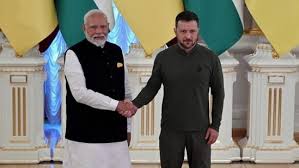
Many scholars in New Delhi have serious reservations about Modi’s visit to Ukraine, especially following the recent successful advance of Ukrainian forces in the Kursk region of Russia. by Gopal Misra
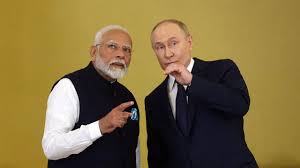
Prime Minister Narendra Modi’s visit to Ukraine during the third week of August, immediately after his visit to Moscow, has triggered debate among his supporters as well as his detractors. For his admirers, Modi has emerged as an apostle of peace, and for the detractors, the visit was done to please Washington.
The truth may never be revealed, but the hectic tour of Poland before visiting Ukraine by a 10-hour train journey reaffirms the theatrical style of the Indian politicians, especially prime ministers, from Atal Bihari Vajpayee to Modi, seldom missing any media coverage. Admittedly, Modi has excelled his predecessors.
It is yet to be ascertained how much political mileage Modi would gain in the country’s complex political horizon. A low-key or little response of the scholars of foreign and strategic affairs indicate that the Modi establishment has to make efforts to convince that it was not just one of the ‘aimless’ foreign sojourns he is believed to be fond of. They are also to understand the relevance of his two confidants, External Affairs Minister S. Jaishankar and the National Security Advisor, Ajit Kumar Doval, during this much-trumpeted tour. The domestic media as usual was seen describing Modi, an invincible political icon, as the messiah of peace, but the media coverage lacked any serious analysis of the impact of this high-profile visit.
An opportunity wasted
It is being stated that instead of traveling by train, if Modi and his team could have opted to travel by an aircraft to reach Kieve, the capital of Ukraine, they could have given more time for discussing better bilateral ties with the host country. They could be in Kiev only for seven hours.
During this visit, India could have offered jobs to a number of highly qualified Ukranians, who might prefer to serve in India than migrating to other countries.
It is being asked how far the visit could really persuade the leaders of the war-ravaged country engaged in a fratricide war with Russia, since February 24, 2022 for an immediate ceasefire. The Chinese have already asked the Ukrainian leadership to explore for genuine peace instead of becoming a proxy of the West.
It is being alleged that Ukraine has become a victim of an international conspiracy. Initially, the US and its allies used their proxies against the people of the Russian speaking areas; thus finally provoking Russia to invade Ukraine.
Moscow, which was denied entry in NATO, was perturbed by the expansion of this defence alliance during the past 10 years, especially focusing on former members of the Warsaw Pact in the region, including Poland.
Alarmed by the reports that Ukraine’s present leadership is negotiating for a NATO membership, the Russian finally attacked Ukraine to protect the Russian speaking regions.
The casualties in the ongoing war has caused an unprecedented human tragedy for the first time in the post World War-II years. It is estimated that Russian forces have lost nearly one lakh soldiers, and Ukraine has lost nearly 40,000 lives and more than 22000 have been left wounded. A large number of Ukrainians have become refugees in various countries in Europe.
The visit of the Modi-led high powered delegation to Poland could have become more meaningful, if a detailed homework was done before the visit. Few are aware that like India, Poland too has suffered partitions.
It may be recalled that in 1939, the USSR and Nazi Germany had signed a secret agreement known as the Molotov-Ribbentrop pact, thus dividing the Polish territories among themselves. The agreement could not last long, when Nazi Germany invaded the USSR. Again, Poland suffered when the USSR got substantial Polish territories as the zone of its influence.
It is hoped that in future before planning such visits, the Indian foreign office would be given adequate time for issuing related articles and curtain-raisers.
À la Don Quixote
Narendra Modi’s high- profile recent visits to Russia, Poland and Ukraine revealed that he appeared to be in a hurry to pick up the gauntlet like Don Quixote, the knight errand, in a hurry to destroy the demon. He also believes like the legendary hero, thanks to the country’s servile media, that he is a warrior par excellence. The continuous propaganda of projecting him as an invincible hero, Modi finally finds himself attacking the huge windmills instead of attacking the demons.
There is no need to unnecessarily focus on Modi in the Indian media and social platforms. Being a PM, he is entitled to be the center figure in such missions.
Decisive battle of Kursk
Many serious scholars in New Delhi may have serious reservations regarding Modi’s visit to Ukraine, especially after the successful penetration of the Ukrainian forces in the Kursk region of Russia. During the August-September of 1943, the USSR forces comprising the Ukrainians had trounced the army of Hitler’s Germany. Later, Moscow had gifted Cremea to Ukraine for its supreme sacrifices during World War-II.
Eighty one years later, the region is again facing a fierce battle; this time between the brothers, the Russians and the Ukrainians. It is quite well known that Cremea was annexed following the reports that the US-led western powers were hatching a plot to encircle Russia by enrolling a number of Eastern European countries in NATO.
Russia was also upset that the US-led West succeeded in ousting pro-Russian politicians in the Ukrainian election. They also ensured that an anti-Russian regime under the leadership of Vladimyr Zelenskyy, a comedian-turned-politician, was installed in Ukraine.
During the Zelenskyy regime, the repression against the Russian speaking people continued.
It is widely believed that Modi’s visit is taking place at a time, when the Ukrenians have penetrated quite deep in the Kursk region of Russia. With this success, Ukraine has an upper hand in this ongoing conflict. However, it might escalate the conflict beyond Donetsk and Luhansk. It means the Ukrainian forces might face much more aggressive challenges from Moscow in future.
Most of the military experts are tight lipped about the possible Russian response to the Kieve’s daring decision to expand the war theater. It is not known what exactly transpired between Narendra Modi and the Ukrainian leaders. Since Modi has met the Russian President Vladimir Putin before visiting Ukraine, he might have advised Zelenskyy not to be too elated by the success in capturing a large part of the Kursk region. This battle-front success should not be used as a bargaining point to get back the Russian-occupied territories of Ukraine.
The Chinese proposal
The peace proposal of Beijing has already been communicated to Zelenskyy, which calls for an immediate ceasefire. It also suggests that the areas under the Russian occupation should be allowed to decide about their future, whether the people living in the region want to remain with Ukraine or want to join Russia.
It may be recalled that the people have been demanding to rejoin Russia since the 1990s, when the USSR was fragmented and Ukraine became a new country. However, the successive Russian governments didn’t concede the demand. The picturesque Cremea was annexed only in 2014, when the West had unleashed the agenda of weakening Russian influence in the region.
Despite the gloomy picture of the current situation, if the concerned parties realize the futility of war in the future, they may accept Modi’s olive branch, leading to peace.
For the first time since the advent of militancy in 1989, the people eagerly look forward to participating in the election. After six years of a sterile bureaucratic rule, people want an administration that shows some feeling and is accountable for its actions, writes Riyaz Wani
In recent months, the surge in militancy in the Jammu division had created uncertainty about the prospects of holding Assembly elections in Jammu and Kashmir. Now that the election has been announced, the renewed militancy is apprehended to have the potential to disrupt the exercise. But there are little chances that it may.
The immediate example is the recent Lok Sabha election which not just stayed largely peaceful but a significant percentage of people also cast their vote. Jammu and Kashmir recorded the highest voter turnout in a Lok Sabha poll in the last 35 years, with the Kashmir Valley witnessing a “massive” 30 points jump in poll participation compared to 2019. The combined voter turnout was 58.46 percent in Lok Sabha elections. Equally encouraging was the voter turnout of 50.86 percent at the three parliamentary seats in the Kashmir Valley — Srinagar, Baramulla, and Anantnag-Rajouri
A similar or even better turn of events is expected this time. More so, in the absence of an election boycott call. This may persuade the Valley’s large boycott constituency to also vote as a significant section of them did in parliament polls.
The three-phased voting in the 90 constituencies will conclude on October 1 and counting is set for 4 October. Some 8.7 million people, including 4.26 million women, will be eligible to vote, according to Chief Election Commissioner Rajiv Kumar.
Although militancy has revived, more so over the past four months, it is confined to hilly areas of Jammu and concentrated in three districts of Poonch, Rajouri and Doda. This poses little threat to plains where the voting will be held. This is why the recent parliament election was one of the most peaceful ever held in the region over the past more than three decades.
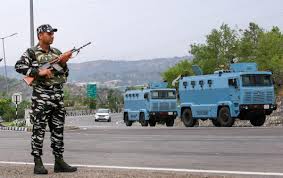
But the Centre doesn’t want to take any chances: It has beefed up the security across Kashmir to ensure peaceful and incident-free elections. Officials say nearly 300 paramilitary companies of CRPF, BSF, SSB and ITBP have been deployed in the valley.
Both the absence of militancy on the ground and the lack of the boycott call is likely to profoundly impact the election. It may or may not lead to an increase in voter turnout. The reason is that the poll boycott has become a default response among a significant section of people, particularly in urban areas. It is an over three decade old habit which may not go away easily.
Since the early nineties, separatists have championed the boycott of elections, although this trend saw diminishing returns over the years. The urban areas still witness significant election boycott but the rural areas generally experience higher voter turnout.
The question now arises whether people in cities and towns will vote in large numbers in the absence of a public boycott call. Many may still choose to boycott, driven by emotions or a belief that casting a vote is a betrayal of the Kashmir cause.
Moreover, generations of people in the Valley have grown up boycotting elections, entrenching a culture that may be hard to shake off, particularly in urban areas. The exercise remains deeply stigmatized for many, and others simply have no prior experience of voting.
One thing, however, is sure. For the first time since the advent of militancy in 1989, the people eagerly look forward to participating in the election. However, this approach to the exercise seems driven more by calculated pragmatism than genuine enthusiasm for the restoration of democracy. After six years of a sterile bureaucratic rule, people want an administration that shows some feeling and is accountable for its actions.
Even if only symbolically so, as the new elected government would be largely subservient to the Lieutenant Governor. And the renewed militancy in Jammu division will make no difference to this state of affairs.
The Congress-NC alliance leaves out the PDP, which otherwise is a member of the INDIA bloc, apparently because NC doesn’t want the latter to further nibble away at its share of seats in the valley. But this also leaves the PDP free to contest on all seats in the UT. A report by Riyaz Wani
When Rahul Gandhi visited a famous Srinagar ice cream parlour on the evening of August 22, and interacted with the people there, it, in a sense, launched the Congress’s Assembly election campaign in the Valley. The video of Gandhi having ice cream at the parlour went viral in Kashmir and followed immediately after the Congress signed an alliance agreement with the National Conference which also included CPI(M).
Earlier in the day, Gandhi and the Congress president Mallikarjun Kharge held a meeting with National Conference (NC) president Dr Farooq Abdullah and vice-president Omar Abdullah.
“The alliance is on track and will work successfully. The people of J&K have suffered immensely without an elected government for years. We are committed to restoring statehood with all powers,” Dr. Abdullah said after the meeting.
Kharge expressed confidence in the alliance’s prospects, expecting the Congress to secure 40 to 45 seats in the elections. He assured the people of Jammu and Kashmir that the Congress would work to protect their land, forests, and other rights.
Under the terms of the agreement, the two parties have finalized a seat-sharing agreement on all 90 seats in the union territory, leaving, however, one seat to the CPI(M)’s M Y Tarigami, who will contest from his South Kashmir hometown Kulgam. The NC will fight on a predominant majority of 47 seats in Kashmir Valley and the Congress will contest a lion’s share of 43 seats in Jammu. This, the parties expect, will ensure that the votes are not split which would give advantage to the BJP, a force to reckon with in Jammu division – that is, despite some recent disaffection in the region with the saffron party’s policies.
The Congress-NC alliance leaves out the PDP which otherwise is a member of the INDIA bloc. This is believed to have been done at the urging of the NC which doesn’t want the PDP further nibble away at its Valley share of seats. But this also leaves the PDP free to contest on all seats in the UT. The party could especially be a challenge in South Kashmir which remains its stronghold. In the District Development Council polls in 2020, the PDP had won 27 seats while the NC had secured 67.
Ram Madhav is back
Ram Madhav, the architect behind the PDP-BJP ‘Agenda of Alliance’ in 2015 has once again been appointed as the BJP’s pointman for J&K. He is now the party’s co-poll incharge along with Union Minister G Kishan Reddy, for the Assembly elections. Madhav’s advantage is that he knows leaders across the parties and will thus be able to keep the lines of communication open with them until after the elections are over and the government formation begins.
Incidentally, Madhav was also in Kashmir around the time Gandhi and Kharge were here. But not much was known about his activities in the summer capital of the UT. Kashmir observers contend that his appointment shows that like the Congress, the BJP is also looking for alliance partners in the UT, more so in the valley. Although the saffron party is supposed to have an understanding with the parties such as the Apni Party, Democratic Progressive Azad Party and the People’s Conference, none of them is publicly willing to acknowledge it for fear of losing support. All these parties not only failed to win a single seat in the recent parliamentary elections but also couldn’t enthuse Kashmiri voters. In terms of vote tallies they finished last in the seats they contested from.
But more than a pre-election alliance, Madhav could be expected to look at a post-election scenario. Should the BJP win a majority of seats in Jammu division, where it retains significant following despite a rejuvenated Congress making inroads recently, Madhav could be hoped to explore options with the parties in the Valley.
“After the polls, the parties are unlikely to be as inhibited about joining hands with the BJP as they are now,” said a political analyst. “In case of a scenario where the BJP does well in Jammu, Kashmir-based parties will have little option but to form an alliance with the saffron party. But just in case, the Congress does well, then Kashmiri parties won’t touch the BJP by a ten-foot pole.”
Article 370, statehood at the centre
The manifestos issued by the major Kashmiri parties have expectedly given pride of place to the demands for restoration of Article 370 and statehood. Harking back to the special status that the erstwhile state once had is certain to drive politics of the union territory for a long time to come. Pressing this demand has now become a condition for political survival for Kashmiri parties. Any party that appears soft on the demand will find it harder to convince people about its bonafides. This was clear in the recent parliamentary polls: the parties that were seen ambivalent on the demand bit the dust.
That said, demand for special status for J&K even when it is forcefully pressed by any party in the UT is largely rhetorical in nature. It succeeds the earlier demands for autonomy and self rule, which principally again were slogans to mobilize the public support.
The NC Vice President Omar Abdullah likened the demand for the reinstatement of Article 370 to the BJP’s longstanding pursuit of its abrogation, which the latter finally fulfilled on August 5, 2019.
“We will continue to fight politically for Article 370. The manifesto is an assurance that we will not stay silent on these issues,” Omar said. “The Supreme Court has in the past upheld Article 370 three times. Can’t we expect a situation where the SC will change its recent decision. The BJP did not accept defeat despite three orders by the SC in favour of Article 370. Why should we?”
However, the NC’s alliance partner, Congress, is silent on the demand. Both Gandhi and Kharge have only been calling for the reinstatement of statehood. “It is our priority in the Congress Party and also in the INDIA alliance to restore statehood to Jammu and Kashmir as soon as possible,” Gandhi said in Srinagar.
“This is the first time since independence that a state has become a union territory. This has never happened before. Union territories have become states, but it is the first time that a state has become a union territory,” he added.
Already, Union home minister Amit Shah launched a scathing attack on the Congress party over its alliance with the National Conference (NC) for the upcoming Jammu and Kashmir Assembly elections, questioning its stance on key issues outlined in the NC’s poll manifesto.
Shah questioned whether the Congress endorsed the National Conference’s promise to reinstate a separate flag for Jammu and Kashmir? He also highlighted the National Conference’s commitment to restoring Article 370 and 35A, which had previously granted special autonomy to the region, asking if the Congress party supports this move, suggesting it could lead Jammu and Kashmir back into an “era of unrest and terrorism.”
Overall, the election holds interesting possibilities for Jammu and Kashmir. The NC expects to secure a majority of its own or at least emerge as the largest single party. The BJP expects to repeat the 2014 performance. In fact, with fresh delimitation giving it an edge in many more constituencies in Jammu, the party expects to even better its 2014 tally of 25 seats. It is also possible that the newly rejuvenated Congress under Rahul Gandhi would once again make inroads into Jammu and undercut the BJP. In that case, the BJP would no longer be able to assert a role in the future elected government. That said, in the Valley, the NC could face a tough challenge from the PDP, which remains relevant and also from Rashid’s Awami Ittehad Party. The field as of now is wide open.
Just ahead of the upcoming assembly polls in Haryana, J-K, Maharashtra, Bihar, Jharkhand and Delhi, PM Modi announced the Unified Pension Scheme (UPS) with slight tweaks in NPS for the government staff, overlooking their long pending demand for OPS restoration, writes Mudit Mathur
Just ahead of the upcoming assembly elections in Haryana, Jammu and Kashmir, Maharashtra, Bihar, Jharkhand and Delhi, Prime Minister Narendra Modi announced the Unified Pension Scheme (UPS) with slight improvements in the New Pension Scheme (NPS) for the central government and Railway employees from the next financial year, but did not accept their long pending demand to restore non-contributory Old Pension Scheme (OPS). The Maharashtra government has adopted it while other BJP-led state governments are likely to adopt it soon.
OPS had become a major poll issue in the state elections and BJP faced many electoral reversals on this count. The tremors were also seen in the huge parliamentary losses. The Congress-led state governments have already restored OPS as a part of their poll promises. The Unified Pension Scheme (UPS) is contributory; however, the old one was non-contributory. Many federations have outrightly rejected UPS reiterating their demand for OPS while announcing their decision to intensify the agitation in a big way.
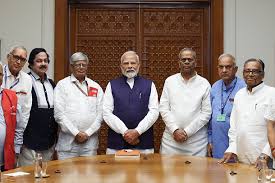
Prime Minister Modi, while praising the UPS, stated in a post on ‘X’ sharing photographs of meetings with employee leaders, “We are proud of the hard work of all government employees who contribute significantly to national progress. The Unified Pension Scheme ensures dignity and financial security for government employees, aligning with our commitment to their well-being and a secure future.” “Met a delegation of staff from the Joint Consultative Machinery for Central Government employees. They expressed joy over the Cabinet’s decision regarding the Unified Pension Scheme.”
The Joint Consultative Machinery (JCM), the apex body representing Central government employees, lauded the newly launched UPS by the Modi government but many other federations of employees, including the All-India Defence Employees Federation (AIDEF), have refused to accept the UPS as the second Contributory Pension Scheme and declared to continue struggle till achieving Non-Contributory Pension Scheme –– OPS.
Shiv Gopal Mishra, secretary of the Joint Consultative Machinery (JCM), a joint forum of government employees’ organisations, said they were invited by the prime minister for the meeting. He added that the Prime Minister acknowledged their concerns after days of protest. “This was for the first time that JCM was invited by the PM. It was a very good meeting. It was a very proud moment for 32 lakh government employees,” an overwhelmed Mishra told Tehelka.
The National Council (Staff Side) of JCM had submitted 14 demands in a letter to Prime Minister Modi covering various pending issues related to central government employees, including a demand that the Centre must cut-short the period for restoration of the commuted portion of pension to 12 years from the existing 15 years. The National Council JCM is the highest consultative forum of the central government employees of which the Cabinet Secretary is the chairman.
AIDEF president S.N. Pathak told Tehelka that our decision to boycott the NPS improvement Committee and the meeting convened by the Prime Minister has proved to be correct and justified. “We as a fighting Organisation will continue our battle for the restoration of OPS with all our strength and might. Let us continue to educate the employees and mobilise them to continue our struggle to achieve the Non-Contributory Pension Scheme under CCS Pension Rule 1972 (Now 2021),” he added.
Pathak said AIDEF will make efforts to bring like-minded Government Employees Organisations together to launch nationwide agitation for the restoration of the Old Pension Scheme. Terming UPS worse than NPS, the president of the All Teachers Employees Welfare Association (ATEWA), Vijay Kumar Bandhu, announced further protests to restore OPS.
After Narendra Modi took over as a Prime Minister for the 3rd time, on behalf of the JCM Staff Side, a memorandum was submitted to him on June 18, 2024, bringing to his notice about 14 major demands, which included setting up of 8th Pay Commission, restoration of old pension scheme, withdrawal of corporatization of ordnance factories, release of 18 months DA arrears, restoration of commuted portion of the pension after 12 years, CGHS wellness in all districts, to implement various Supreme Court judgements on service matters to the non-petitioners etc. But there has been no response to such demands from the government.
AIDEF, one of the major Central Government Employees organizations representing the Defence Civilian Employees, has boycotted the NPS improvement committee meetings since, according to them, their demand is only for the restoration of the Old Pension Scheme which is continuing on defence forces.They also demanded to withdraw the process of corporatization of ordnance factories, restructuring of DRDO & DGQA and also reduction of Manpower in MES & Navy etc.
ATEWA president Vijay Kumar Bandhu, who had spearheaded the national movement for the restoration of OPS, complains that despite many letters, the TV Somanathan Committee did not call us for any consultations. Bandhu, it may be mentioned, was the chief architect for organising historic all-India rallies in the Ram Leela ground in support of the demand for restoration of OPS. Though such rallies were blacked out in the mainstream media, it sent ripples in the political set-up.
Rejecting UPS outrightly, Bhandu told Tehelka that our executive committee has decided, “No NPS–no UPS; only OPS” is our fresh campaign which will be launched on X (formerly Twitter) for mobilisation of our cadres. All the employees will wear black stripes from 2–6 September. Thereafter, we will demonstrate at every district headquarters on 26th September and will march to the parliament house in November or December.
Congress President Mallikarjun Kharge, while reacting to the announcement of UPF, said, “The ‘U’ in UPS stands for Modi Govt’s U-turns! Post June 4, the power of the people has prevailed over the arrogance of power of the Prime Minister. — Rollback in the budget regarding Long Term Capital Gain / Indexation — Sending Waqf Bill to JPC — Rollback of Broadcast Bill — Rollback of Lateral Entry.” “We will keep ensuring accountability and protect 140 Cr Indians from this despotic government!”, he remarked.
Union Minister Amit Shah also hailed the decision, stating the Modi government has reiterated its commitment to the financial security of those who form the backbone of the nation’s governance.
Uttar Pradesh Chief Minister Yogi Adithyanath, too, welcomed the decision. “The approval given to the Unified Pension Scheme (UPS) by the Union Cabinet, under the successful leadership of Prime Minister Narendra Modi, who is continuously dedicated to making the lives of 140 crore countrymen easier, is commendable.” “This revolutionary decision, benefiting lakhs of central government employees, has brought a new sunrise in their lives with the assurance of economic security and a happy future. My heartfelt gratitude to you, Prime Minister!” he stated in a post on “X”.
While briefing the media about the Unified Pension Scheme (UPS), Union Minister Ashwini Vaishnaw announced that the newly approved UPS would provide a 50 per cent assured pension as its first pillar, and an assured family pension as its second. He said the Union Cabinet, chaired by Prime Minister Narendra Modi, approved the Unified Pension Scheme (UPS).
Elaborating salient features of the UPS, Vaishnav said that the assured pension would be 50% of the average basic pay drawn over the last 12 months before superannuation for a minimum qualifying service of 25 years. This pay is to be proportionate for a lesser service period up to a minimum of 10 years of service. The scheme envisaged an assured family pension: @60% of the pension of the employee immediately before her/his demise.
It further provides an assured minimum pension: @10,000 per month on superannuation after a minimum of 10 years of service. Besides inflation indexation: on assured pension, on assured family pension and assured minimum pension. Dearness relief will be provided on the All-India Consumer Price Index for Industrial Workers (AICPI-IW) as in the case of service employees. lump sum payment at superannuation in addition to gratuity 1/10th of monthly emoluments (pay + DA) as on the date of superannuation for every completed six months of service. This payment will not reduce the quantum of assured pension. Additionally, there will be an option for employees to choose between the existing National Pension System (NPS) and the new UPS.
The demand for a joint medal was clearly jumping the gun. It would have been more dignified for India to have stepped back and respected the rule rather than make demands to be treated differently. by KUMKUM CHADHA
As one thought that the hullabaloo about Olympian Vinesh Phogat was over, there was yet another storm that was brewing: this time on home ground.
The dust had barely settled on Phogat’s weight issue at the Olympics in Paris. Back home she was at it again, this time hitting out at the Police.
Phogat had alleged that the cops had withdrawn her security cover along with other women wrestlers.
The wrestlers were scheduled to testify against Brij Bhushan Singh, former President of the Wrestling Federation of India.
Phogat, it may be recalled, was in the forefront demanding Singh’s arrest. She, along with other wrestlers, has accused Singh of sexual harassment.
On its part, the courts directed the Delhi Police to provide security to Phogat and others.
Fighting legal battles is not new to Phogat: if at home, it is over Singh or the Police; in Paris it was about a medal.
Phogat, it may be recalled, missed a silver by a whisker, so to speak.
It all began with Phogat beating Japanese wrestler Yui Susaki.
This followed an elated Phogat to beat champion Oksana Livach to reach the finals.
At that point in time, Phogat was the first Indian woman wrestler to reach an Olympic final.
Then Disaster struck.
As per rules, Phogat was required to meet the weight requirement for the finals. Once on the machine, she was two kgs overweight.
This followed drastic measures including vigorous exercising, wearing a sauna suit to help her sweat and even drawing out blood, shortening her clothes and cutting her hair.
By the time she went back on the weighing machine it was more than half the battle won but she lost by a whisker: literally. She had cut nearly, yes nearly, all of the two kg but unfortunately fell short by a mere 100 gms.
Phogat was 100 gms above the prescribed limit in the customary morning weigh in.
This led to her disqualification from the Games. Worse still, it placed her last among the 16 competitors. It also made her ineligible for the medal.
According to Article 11 of the United World Wrestling’s rule book, an athlete who doesn’t make the permissible weight cut stands to be eliminated from the tournament.
Had Phogat entered the finals and won she would have bagged the gold. In the event of losing the finals, she was, in any case, eligible for the silver.
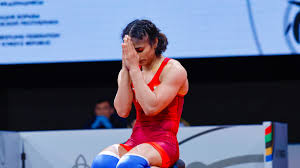
Smiles turned to tears and from someone who India and Indians were watching for a gold came to a naught: “I have no strength left to continue” is what she said as she announced her retirement from the sport.
Later, she appealed to the Court of Arbitration of Sports for a joint silver medal alongside Cuban wrestler Y Guzman Lopez.
After hearing both sides, the Court said it would give its decision before the end of the Games. That gave hope: Indians prayed for Vinesh Phogat and the country for silver.
The deadline passed; the Games were over and the decision deferred to a later date not once but multiple times.
Reactions to this were mixed: some saw a ray of hope in this; others said the writing on the wall was clear and the procrastination by the CAS was nothing but a bid to buy time and let things cool.
On August 14, Phogat’s plea for a joint medal was dismissed. The Court, while highlighting strict adherence to rules, said that wrestlers will have to remain below their permissible weight limit without any exceptions.
The verdict broke hearts but a rational analysis would substantiate that it could not have been different.
Therefore, what Indian goalkeeper PR Sreejesh said made a lot of sense.
The hockey legend, while empathizing with Phogat said that her case should be a lesson for Indian athletes to be strict with rules.
Citing examples of athletes being banned in the past, Sreejesh said that rules are made to make the game beautiful and controlled and sportspersons should follow: “You have Olympic rules and the Indian athletes know what is happening there and they should be ready for that”.
None could have put it better because rules are rules and are in place because they need to be followed.
Therefore, this hue and cry about being denied a silver for Phogat is much ado about nothing.
And Phogat’s case is not the only one in Olympic history.
Ironically, the one who was seen consoling her in Paris was gold medalist Rei Higuchi, who was disqualified from Tokyo Olympics for being 50 grams, yes 50 gms, overweight in men’s wrestling.
Therefore, all those shedding tears for Phogat’s loss need to stop and ask:
Aren’t we overdoing the Phogat issue? Are we bending over backwards to appease her? Did the Indian Olympic Association overstep by appealing to the Court for a joint silver?
And more importantly, shouldn’t there be a dividing line between emotion and judgement?
One’s sympathies may be with Phogat but then sympathy is not synonymous with justice.
Therefore, the demand for a joint medal was clearly jumping the gun. It would have been more dignified for India to have stepped back and respected the rule rather than make demands to be treated differently.
But then it was a damned if you do and damned if you don’t kind of a situation for the Government.
Had Singh’s case not staring it in the face, it could have remained silent. But given that background, the Government had no option but to fight for Phogat.
It is well known that the Modi Government was slammed for shielding Singh.
For starters, it was reluctant to remove him as Federation Chief. And when it did, it brought in one of its cronies.
Against this backdrop, the BJP government had no choice but to fight for Phogat’s medal and of course defend the indefensible.
And what can one say about those alleging a conspiracy theory against Phogat?
When Phogat lost her medal, critics of the Modi government alleged that she was a victim of a conspiracy.
Their take: she was made to pay for her daring of taking on Singh. Also, had she won she would be felicitated: an act which would send the Federation running for cover.
However, to even imagine that any government would barter the country’s medal to settle scores is a bit far-fetched.
Therefore, to continue crying over Phogat or with her is a bit of a stretch.
One must concede that in sports, you win some and you lose some. The true mark of a sportsperson is to handle defeat with dignity rather than demand concessions, altering rules or crying foul. On that count, Phogat fell terribly short.
Despite their serious efforts to put up an improved show in the October 5 assembly polls in Haryana, the INLD and JJP have a tough road ahead. While the INLD has been on a downward slide since 2005, most of the JJP MLAs have deserted the party for green pastures. A report by Rajesh Moudgil
There is a direct contest between ruling BJP and the principal opposition party Congress, and to put it plainly, two players, namely Indian National Lok Dal (INLD) and its breakaway faction Jannayak Janta Dal (JJP), helmed by the Chautala family, face a battle for their survival in the upcoming assembly elections in Haryana.
The JJP had come into existence in December 2018 – after a crippling vertical split in the INLD following a feud in Chautala family – and won 10 seats in 2019; JJP leader Dushyant Chautala became the deputy chief minister forging a post-election coalition with BJP, which came to power for the second term in a row.
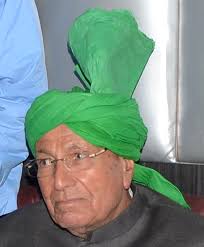
The INLD which had its government about two decades ago, has been on a downward slide since. The JJP had come into being after the party supremo and the former five-time chief minister Om Prakash Chautala expelled his grandsons, Dushyant and Digvijay for indulging in anti-party activities, and later also threw out his elder son, Ajay Chautala, for trying to run a parallel party set-up.
Bhupinder Singh Hooda-led Congress government had remained in power for two terms in a row till 2014 when BJP came to power and is eyeing to make a hat-trick.
However, speaking on the party poll prospects, the INLD leaders highlight the party’s tie-up with the Bahujan Samaj Party (BSP) this election and say that while the INLD would contest 53 out of the total 90 seats, the BSP would fight on the remaining 37 seats this time.
The party media head Rakesh Sihag says that since the voters have now realised the JJP was formed because of its leaders’ greed for power, party’s voters would return to INLD. “Also, the leaders of other parties, BJP and Congress, who are frustrated because of their policies, are in touch with INLD’’, he says and adds that INLD is the only party which has consistently stood by the farmers.
6 JJP MLAs jump ship
The JJP, on the other hand, has suffered an internal crisis with six of its total 10 MLAs leaving the party just a few weeks ahead of the upcoming polls.
The two legislators who resigned from the party earlier this week are Jogiram Sihag from Barwala and Ram Niwas Surjakhera from Narwana. The MLA duo had been openly supporting BJP during the recent general elections despite the repeated objections by the party leadership.
The four other legislators who quit the party a little earlier were Devender Babli, Ram Karan Kala, Ishwar Singh and Anup Dhanak. While Ishwar Singh is close to Congress’ leader Kumari Selja, Kala has already joined Congress.
With these developments, the JJP, which had 10 MLAs, has been left with only four MLAs – Dushyant, his mother Naina Chautala, Amarjit Dhanda and Ram Kumar Gautam. Notably, Gautam can be seen endorsing Congress’ former leader Kiran Choudhry, who has recently joined BJP.
According to media reports, Dushyant held that the BJP would be wiped out of the state this time and the Congress divided the state on the basis of regions in its tenure. Alleging rampant corruption during the Congress regime, he also held Congress did development and gave jobs to the youths of only one region of the state. He further held that the JJP would not only improve its tally but also play an important role in the formation of the government because of the hard work put in by JJP workers.
Meanwhile, the Aam Aadmi Party (AAP) has also been striving for a toehold in the state. The party’s state president Sushil Gupta says that INLD, BSP and JJP had lost their base in the state as the voters had already rejected these parties. In recently held Lok Sabha polls, the AAP, which fought only in the Kurukshetra seat, took more votes than the candidates of these three parties together, Gupta said.
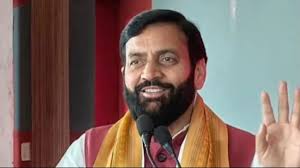
For record, in the House of 90, the ruling BJP in 2019 had won 40 seats, while the Congress secured 31 seats and JJP, 10 seats. The INLD and Haryana Lokhit Party (HLP) each won one seat while seven independent candidates made it to the House. The BJP formed a coalition government with JJP even though most of the independents also backed the saffron party. Manohar Lal Khattar, who belonged to the Punjabi community, continued as chief minister for BJP’s second term, the BJP replaced him with Nayab Saini, an OBC leader while snapping ties with JJP in March, this year.
In the recent Lok Sabha polls, the BJP which had won all the 10 seats in previous polls, came down to five, while remaining five went to Congress.
The BJP squirmed when, just 3 hours before the ECI announced in New Delhi that elections would be held in Haryana on October 1 — which was later deferred to October 5 — about a month earlier than scheduled, CM Saini had been telling media that election would not be advanced, reports Pawan Kumar Bansal
The Election Commission of India has rescheduled Haryana elections to October 5 from the earlier announced date of October 1. The ECI decision came following the representation made by Mohan Lal Badoli, President of Haryana BJP.
It may be mentioned that about earlier date of October 1, Haryana CM Naib Saini was caught off guard as just three hours before the the ECI announced in New Delhi that elections would be held in Haryana on October 1—about a month earlier than scheduled—CM Saini had been telling newsmen in Chandigarh that the election would not be advanced.
Though the ECI has postponed the election by four days but questions are being raised in the political and official circles over the leadership of Haryana CM Nayab Saini? He is the CM face of BJP, but was caught unawares on the issue of election-schedule. Although it is the prerogative of the Election Commission of India to declare election schedule, normally the concerned state government is sounded in advance. Moreover, the BJP is in power at the Centre. Whether the central BJP leadership was also unaware of it or it deliberately didn’t share information with CM Nayab Saini ?
Also, whether Union Urban Development Minister Manohar Lal, the blue-eyed boy of PM , Narender Modi was also unaware or he deliberately didn’t share the information with Nayab Saini to put him in an embarrassing position. Nayab Saini, it may be mentioned, is becoming more popular due to his easy availability to the party-workers and ordinary people in sharp contrast with the arrogant behavior of his predecessor, Manohar Lal Khattar.
It may be mentioned that Mohan Lal Badoli, State President of the BJP, has written to the Election Commission of India for rescheduling of election date arguing that there is six-day break before and after the elections with only one intervening working day, and therefore, there will be low voter turnout as people will go holidaying.
According to political analyst Devinder Surjewala, the BJP is worried due to the fact that urban people who, the BJP believes, are its supporters normally go for outings during holidays and rural voters, believed to be anti-BJP, stay at home and vote enthusiastically.
The BJP is facing anti-incumbency sentiments also. Change of guard by replacing CM Manohar Lal with Nayab Saini in the run up to Lok Sabha election has not changed the situation much. Although during this short period, Nayab Saini has taken several steps to check the impact of anti-incumbency by empowering sarpanches with more financial power to spend on development works and ensured that people’s grievances regarding irregularities in making of property identity cards are solved by deputy commissioners by holding daily meetings known as “Samadhan Shivirs,” but he failed to give the message that he is in charge of state of affairs in the state.
It may be recalled that sarpanches were lathi- charged during the regime of Manohar Lal and there was widespread resentment over the issue of irregularities in making of property identity cards.
Meanwhile, politics of Haryana is so lucrative and attractive that a large number of retired judges, doctors, IAS officers, cops, players and journalists are trying to enter the fray. Haryana, due to its proximity with the national capital and being the headquarters of about four hundred fortune companies is go-to state for the politicians. Although in the past also, several judges, IAS officers, players, doctors and police personnel have tried their luck in electoral-game but the beeline for tickets this time is extra-ordinary and interesting. About half a dozen retired IAS officers and cops of Haryana are also in the race for tickets. Retired DGP Baljit Sandhu, retired ADGP Subash Yadav and V Kamraj are also vying for assembly tickets.