CIA’s Sikh separatist gamble undermining the India-US ties

The recent chill in Indo-US relations is being linked to the Biden Administration’s warming ties with Sikh separatists, with CIA officials seemingly emboldened by the visible drift at the highest political level by Gopal Misra
The recent downturn in the Indian-American ties could be attributed to the new found love of a section of the Biden Administration, specifically some officials of the CIA, for the Sikh separatists. Earlier, the intelligence agency or the deep state had been working covertly, but perhaps, now emboldened by the visible drift at the highest political level, the agency has become overt.

Interestingly, few are surprised in New Delhi regarding this emerging affinity  of the deep state for the separatists. Indians are well-versed in its tactics reflecting its personal admiration or Oedipus Complex. In recent years, it has emerged as a collaborator of the ruling mafias or the dictators in countries like Pakistan or even with a section of the Chinese Communists.

Within the USA, they are known to be working in collaboration with the military-industrial complex. With their close ties with Mafia and drug lords, they could eliminate even a president like John F. Kennedy. Kennedy’s assassin Lee Harvey Oswald, a former Marine, was killed even in police custody. The autopsy of Kennedy too was believed to have been manipulated.

The report of the Warren Commission regarding the murder of Kennedy also exposed that even those who had conspired to eliminate a president would never be punished by a judicial process. The same justice system is now being used to malign the Indian government and accusing India of eliminating or planning to kill the Sikh separatists.

It is yet to be ascertained who are the domestic as well as international lobbies working in unison in this well planned scheme for undermining the growing cooperation between the US and India. Also, they have successfully been manipulating the Canadian government to support the separatists.

The Sikh terrorists had bombed an Air India aircraft in 1985 killing 385 people on board, but those responsible for this act have been released by the Canadian government. Even a Canadian government enquiry report has admitted in 2006 that the Canadian secret police committed a series of errors that finally led to the release of the terrorists. With the recent outbursts or accusations of the Canadian Prime Minister Justin Trudeau against India for eliminating a few Sikh separatists reaffirms that the promoting terrorism is a part of the Canadian state policy.
Meanwhile, in this action packed  anti-India drama a new dimension has been introduced by a case filed by an Attorney General in New York against Vikash Yadav, claiming to be a government employee in India for hiring an assassin to eliminate a Sikh separatist, Gurupatwant  Singh Pannu. Interestingly, Pannu has issued an advisory that the Sikhs were planning to repeat the 1985 tragedy and therefore people should avoid travelling in Indian Airlines aircraft, but the FBI has so far refused to take a cognizance of it

Earlier, the US authorities had extricated an Indian citizen Nikhil Gupta from the Czech republic. He is also facing charges regarding the alleged conspiracy against Pannu.

Meanwhile, within hours before framing Yadav, a support group of Sikhs for giving legal assistance to the separatists, the American Legal Defense and Education Fund has asked to take urgent measures for preventing transnational repression of Sikhs.

Trust deficit

There are few takers of this anti-India narrative in India as well as among the Indian Americans.

Neither the mandarins in the South Bloc in New Delhi nor the decision makers in the Pentagon, the headquarters of America’s defence, are taking the allegations against India seriously.

Unfortunately, for the naives occupying the seat of power at Capitol, appear to believe in the colonial narrative about countries like India. If the American establishment needs China as a hub of cheap labor for manufacturing American products, it also needs India as a counterweight for China’s growing economic power.

With the American capital and technology, China has emerged a super economic power causing apprehensions in the USA.

With the ongoing conflicts in Eastern Europe and West Asia, Russia and China have become close allies. Meanwhile, the Chinese proxies have successfully penetrated American business, academia and are also influencing the black population. It is difficult to explain amidst these challenges, how the American establishment could irritate India by supporting the separatists. It appears they suffer a perennial itching for a one night fling, the feudal lords used to have for women of easy virtue rather than sustaining a prolonged courtship.

For many in New Delhi, a few are amused by this dilemma, but not surprised that a section of the US establishment could unleash Khalistani separatists against India, while the American Congress is busy enacting a legislation to offer India the much-needed security umbrella at par with Japan and Israel.

Deep state and media

The Department of Justice in the American Federal Administration has confessed that during the period 2019-22, the Chinese companies funded  the US media to the tune of seven million USD. The beneficiaries included Los Angeles Times, Time magazine and the USA Today.

Interestingly, these publications have been supporting the military takeover of Bangladesh with the Muslim radicals, thus toeing Beijing’s agenda. These media outfits are also publishing the demand of a separate Sikh state.

They are also publishing unsubstantiated allegations against India for repressing the Sikhs. It appears that the Biden Administration is being haunted by its traditional self-love at the cost of the geopolitical imperatives. The American institutions, such as the media and judiciary, which have been representing the American dream of equality, freedom and opportunities have been bribed by the dragon.

The delay in the enactment of the proposed Bill to ensure deeper US-India ties also reveals the apathy of the Biden Administration as well as of Kamala Harris, currently Vice-President and a presidential aspirant. The US Senator from Florida, Marko Rubio, a veteran Republican and an eminent lawyer, has introduced the Bill giving India her befitting role as a vibrant democracy and ally; however, by causing unnecessary irritation to India implicating her in false accusations only serves the interests of the anti-democracy forces.

These tactics have also undermined the efforts of Biden holding the QUAD summit, just a few weeks before the end of the tenure of his term.

Meanwhile, the defence documents across continents including all the permanent members, except Russia, have apprehensions of China as a military superpower. China’s recent supply of laser weapons to Iran has caused apprehension regarding the victory of Israel in the ongoing conflict in West Asia.

The two world wars of the 20th century were fought among the European powers i.e. between the British-led Allies and the German-led Axis powers. Later years, however, the US-led West identified a new enemy in the USSR. Eight decades later, the US is positioning China as a new enemy. It wants India, earlier debunked as a land of snake charmers and yogis, to be an ally, but she has to be kept under reins by triggering forces undermining her unity and plural democratic society. It may prove counterproductive for the Americans, if they continue to unleash false media reports accompanied by legal cases. It has caused a noticeable decline of the warmth in India-US strategic ties.

Interestingly, these foolish projections might have impacted India, but they have neither caused any panic or anxiety among the mandarins of the South Bloc in New Delhi. It is being taken with a pinch of salt by the knowledgeable sections in India.

Unless corrective steps were jointly taken by the White House as well as the Pentagon, the decline in their warmth might finally undermine the agenda to position India as a counter weight in the contemporary geo-politics to Beijing. It is hoped that the new President would be taking effective steps for renewing ties with India as an equal partner for global peace.
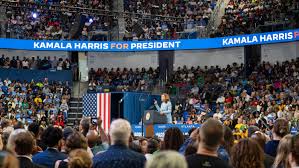
The US Presidential  polls: A preliminary assessment

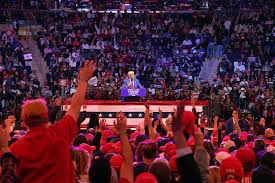
As the 2024 US Presidential election looms, Kamala Harris and Donald Trump emerge as contrasting candidates, each navigating a polarized landscape shaped by mood of the electorate, gender dynamics, and crucial national issues

It’s a very interesting contest between the Vice President of the U.S., Kamala Harris, and former President Donald Trump, being races with different backgrounds each will present contrasts, different ideological processes, and styles of leadership that make it a very competitive contest with much focus on this election. In trying to predict their chances, one has to consider the mood of the American electorate, the popularity index of each candidate, and the general context of American voters’ ability to accept a female president, much more so now with Hillary Clinton’s candidature in 2016. The mood of the American electorate is the crucial determinant of this election. 

The US remains highly polarized along all lines – political, social, and economic – points of contention like immigration, climate, and, more recently, the COVID-19 pandemic, after the economy and healthcare. Well, the economy, healthcare, immigration, climate, and COVID-19 pandemic issues have continued to polarize the electorate. The result is that voters are seeking a leader who can solve these burning issues and give a clear-cut vision for the future.

Kamala Harris has the special distinction of being the Vice President for this campaign. At least in that office, she had immense national visibility and experience which necessarily would come out while dealing with all national issues during the ongoing campaign. However, even with that experience, her popularity went up and down. Harris and Trump have now emerged recently in some polls tied dead where each one received 48 percent support among the registered voters. This is the first lead change from early polls, where Harris was leading Trump with a slight margin. There could be many reasons behind her decline. Above all, there must be enough emotions attached to her connection with the incumbent regime and apprehensions about her failure to make a difference. 

But Donald Trump is a polarizing figure. Though his presidency has been highly controversial and has an ongoing series of legal challenges, he is still holding on to a sturdy base of support. His rating seems stable since many in the electorate feel positively about his first term. The mobilization of that base would be much easier for him than attempting to mobilize voters disillusioned with the current administration because Trump has a comfortable margin now. Of course, the speech he makes also carries divisive rhetoric and past controversies that alienate a large portion of the electorate.

The popularity index of each candidate further gives a deeper insight into the prospects of each candidate. Kamala Harris’s favorability ratings, on the other hand, have lessened as given by recent polls set at 43% positive ratings and 49% negative ratings. This shift in the sentiment of the voter reflects the hurdles that she has encountered in her efforts toward achieving broad-based support for her candidacy. For instance, even once-core groups, including independents and the younger generation, have started to weaken. On the other hand, the favorability rating for Trump has stabilized, while most of the electorate perceives him as unfavourable. However, his having a loyal constituency remains impossible to discount.

Gender factor

The other critical aspect of this election is how the electorate has accepted an American female president. This is because Hillary Clinton’s 2016 election presents lessons that must be taken seriously in this area. Clinton won the popular vote, but she had to face countless criticism obstacles. Among them were her gender bias and lack of electability. Pragmatic bias is estimated to include the perception that others were not ready to choose a woman for the presidency, another reason behind Clinton’s failure. This factor is current and will continue ruling over preferences among voters because most people in America are sceptical regarding the idea of electing women.

Kamala Harris also faces the same challenges. Though increasingly, female leaders are more welcomed in their societies, gender discrimination is an important benchmark. In a recent study, it was found that 76% believed that for a woman to defeat a male candidate would be tougher. To this is added the perception that female candidates have to surpass two yardsticks: the stature of the candidate and the extent of their criticism. But such challenges still, there is some indication of shifting opinions. A survey conducted among young voters in swing states found that 68 percent felt America was ready for a female president. This shift of opinion in more youthful voters may be a decisive factor in the Harris campaign.

It is a very complex phenomenon if one goes deeper into American voters’ acceptability of a female president. While there is a growing realization of women’s abilities and leadership qualities, deep-seated biases and stereotypes are quite prevalent. These are often encouraged by media coverage and societal beliefs that make it difficult for a woman candidate to find wide acceptability. However, the increased mileage that women have been gaining within all sectors of governance is slowly changing these perceptions. Kamala Harris represents one of the most important steps toward that transformation, but only long-term efforts and overall societal transformation will overcome those prejudices.

Campaign strategy

As the presidential campaign garners momentum in the run-up to the finale on November 5, Kamala Harris and Donald Trump are in the middle of shifting political cultures. In this respect, Kamala Harris would have to establish a sense of distance from the present administration that should underpin all of her accomplishments and vision for the future. She must articulate her portfolio of policy ideas clearly and show that she is a leader who can navigate the US out of its messes: economic recovery, healthcare reform, climate change, and so on. Grassroots campaign infrastructure, outreach to and coordination with grassroots organizations, and a robust digital footprint will all be crucial components in enabling her messages to reach as many different, disparate factions of voters as possible.

Donald Trump is probably focusing on expanding his base and exploiting the desperation created among the voters who have been left behind by this administration. His strategy in the campaign is probably somewhat similar to some of what he did before, be it the same as the previous tax cuts and deregulation, as well as the way the incumbent administration handled matters of significant importance. He is playing off the interests of the media, but he is also bringing into the campaign his masterful use of social media to mobilize his cause. However, he will also face the controversy and court battles that trailed him out of office.

Now, it is going to be independent and swing voters who will significantly have a role in deciding the outcome of the election. Frequently, they do not lean too far either on one side or the other, more precisely, a major party. And with close races, they usually played the defining role. So, both Harris and Trump are going to need to appeal to them by giving their talk and showcasing a tremendous vision for the future. This would speak to Harris as an emphasis on bipartisanism and pragmatic solutions, whereas Trump will rely on his outsider status and the promise of upheaving the political establishment.

Factors beyond its control will also determine the outcome of the elections, including how the economy will perform and other global events. Media is such a significant tool in this perception level and also on the level of voting behaviour; therefore, it cannot be played down. Probably media scrutiny awaits Harris to ensure that her message gets through. Campaign financing and political advertising have become the most expensive. Both candidates will require enormous sums of money to fund the campaign which includes advertisement as well as outreach and mobilization. Their ability to raise funds and strategically use them to build a campaign infrastructure will determine what approach is best used to reach the voters across the board.  

Wider aspects of the USA’s cultural and social dynamics also come into play. For example, race and gender equality, immigration, and social justice issues are the centrepieces of the Harris campaign. Her candidacy brings to America a historic chance toward better representation and diversity but it is, at the same time, living proof of the durable issue of full equality. Perhaps, Trump’s campaign is simply strong enough to reach out to people who are threatened by social change and such type of traditional values.

The Way ahead

The poll will depend on the collective play of the strategic decisions by the candidatures, voter behaviour, events, and social trends. Both Kamala Harris and Donald Trump carry forward the asset and liability in their bid to capture the presidency; the determinant factor for success or failure will lie with voter connection, a clear vision for public expression, and how they navigate the complexities of the general political landscape.

These prospects, then, are shaped by a wholeness of considerations and encompass the mood of the American electorate, their popularity indices, and the broader perspective of gender bias in politics. Harris’s association with the current administration, besides fluctuating popularity, stands as a challenge. On the other hand, Trump’s stable base of support and polarizing persona add a layer of complexity to the race. The notion of a female president continues to be a matter of utmost controversy, and Harris is to face the same kind of bias that Hillary Clinton’s campaign has faced.  

As the election draws near, both candidates have to navigate these waters and emerge as a winner. Ideally, it will also decide not only who the next president will be but also carry the reflection of the larger attitude of society pertaining to leadership and gender equality in America. It follows that voters need to be highly enlightened, should participate in this great democratic process, and critically examine the platforms and credentials of persons vying for office in the elections. The nature of the elections is of such a kind that the stakes are very high as the choices made will find reverberations into the future of the United States of America and by extension, the world. By participating in the electoral process, for instance, citizens can influence their own leaders to institute more justice and equality.

(The author is currently in Washington, D.C.and Editor of  ‘STAR Views’)

India’s missing children crisis is staring us in face

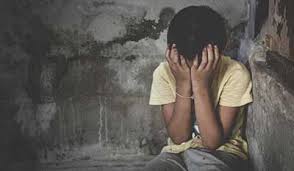
As we gear up to celebrate the Children’s Day on November 14, the grim fact remains that thousands of children are missing in the country. It’s time we sit up and ask their whereabouts. by Humra  Quraishi

I do realize that November 14, Children’s Day, is a fortnight away from now but let’s begin the search for our children. India’s missing children. The grim fact is that thousands of children are missing in the country yet we sit a bit too quiet!

Sure  enough, even on this  upcoming Children’s Day  one  would get to hear speech after  speech from the political rulers of the day, but  beyond those  typical speeches nothing very  substantial  in terms of the much-needed search for the missing children.

Today’s rulers might claim this or that achievement in their shrilly synthetic speeches but cannot overlook the fact that hundreds and thousands of children and women and men of the country are in the missing slot!  Where are they? Who will find them? And when? In what condition, if ever found?

Another disturbing reality is that a substantial percentage of our children are malnourished, facing severe health related issues. The school dropout rate is high and many don’t reach the college stage. Financial, social and health hurdles come in the way. Many become victims to the political poisoning spreading around. Grabbed and kidnapped and picked up by the political mafia on the prowl; on the lookout for fresh recruits and foot soldiers, to unleash hate poisoning amongst the  masses!

Many teenage boys face severe crises when picked up by the cops.  Even as and when released, their names in those police records and registers.  Next time even if there’s a cracker burst, they are the first ones to be rounded up for questioning and much more.

And now with bulldozers destroying homes, the poverty graph is sure to peak, affecting the very well-being and survival of our children. Isn’t it time that the concerned citizens of this country play a role to halt the  blatant destruction  of  homes  and with that of entire families? Once a home is bulldozed it’s akin to demolishing an entire family or a clan. Gone not just their dwelling but their very vital base for day-to-day survival. With bulldozed homes, gone are the children’s school books and uniforms and clothes and the very kitchen… also hit the very wish to carry on, to take on challenges. Entire families and clans ruined!

Many more children will be destroyed, if homes get bulldozed and destroyed, so very steadily and systematically. And yet we sit like mute spectators to the destruction spreading out so very blatantly, right in front of our eyes.

It  is  time  we  sit up and ask the  whereabouts of the country’s  missing  children.One doesn’t have to be an investigative reporter to grasp the exact facts about the missing  kids. All up there – online. Even the government released data, the so-called official data.

Putting these shocking figures on the missing children in the country, from the news reports to our missing children.

A matter of grave concern is that girls constitute a significantly higher proportion of missing and kidnapped children in India. In 2022, of the total 83,350 missing children 62,946 were girls. That means more than 75% of missing children were girls. The proportion of girl children in total missing children has been rising from about 65% in 2016 to 75% in 2022 at the all-India level. This has been the trend for all the states mentioned above. 

NCRB (National Crime Records Bureau) figures for the five years up to 2022 also show a mostly rising trend in the figures of missing children — a spike of 7.5 per cent in 2022 in comparison to 2021, a significant surge of 30.8 per cent in 2021 against 2020, a drop of 19.8 per cent in 2020 against 2019 and again an increase of 8.9 per cent in 2019 against 2018 and of 5.6 per cent in 2018 against 2017.

174 Children Go Missing In India Every Day, Half of them remain untraced!

Palestinian Child! 
On this upcoming Children’s Day we cannot bypass focus on the children of Palestine. They are facing the most traumatic childhood: each day dripping with sorrow in the backdrop  of  hunger and  thirst and injuries and deaths. And   of course, the ongoing bombardments and targeted attacks on them and on their homes, tents, schools and hospitals by the Israeli forces. 

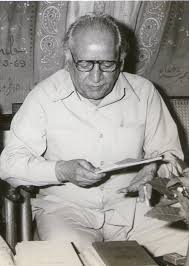
Leaving you   readers with this verse of Faiz Ahmed Faiz – ‘Song for  a Palestinian  Child’. This  verse is tucked in the  volume – ‘A  Song For  This  Day –  52  poems of  Faiz Ahmed  Faiz’ (Sang-e-Meel  Publications). Translated  from Urdu to  English by  Shoaib  Hashmi,  accompanying  images from the works of   Faiz’s  daughter Salima Hashmi,  the verse stands out, along a  diverse range,

Faiz Ahmed  Faiz

This volume was published around December 2009, but holds out to this day.  Here goes this verse by Faiz Ahmed  Faiz:

‘Song for a Palestinian Child/

Be still child!

For your mother too is still, in sleep/

Having poured out all her pain in tears/

Be still child!/

For it is but a moment since/

Your father laid down his burden of woe/

Be still child!/

For your loving brother/

Has left the home of his fathers/

To go seeking the beautiful butterfly of his dreams/

And your sister too has left the hearth/

To set up home in an unknown land/

Be still child!/

For  here, in your little courtyard/

They have bathed the lifeless sun of days/

And interred the lifeless moon of the night/

Be still child!/

For your mother and father/

And brother and sister/

And the sun and the moon/

If they hear you weeping/

They will weep with you, and you with them/

And  if you  smile, then  perhaps/

One day, transfigured/

They will all come  back, to  be with you.’

Milestone 23: A legacy of highs and hurdles

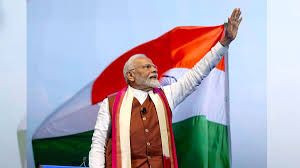
As Narendra Modi completes 23 years in governance both at the state and national level, he should count his blessings. Alongside, he must address the demons that could cast a shadow along the way. by KumKum Chadha.

Former Kenyan Prime Minister’s allegations about Prime Minister Narendra Modi and industrialist Gautam Adani’s “close ties” could not have come at a worse time. 

The BJP was gung-ho about Prime Minister Modi completing 23 years in public office and his ascent from Gujarat Chief Minister to the country’s Prime Minister: not once but thrice over. 

Adept at a publicity blitz, the Party exhorted the people to celebrate PM Modi’s “nation first commitment”. 

Till the disclosure from Kenya dampened its spirits. 

Former Prime Minister Raila Odinga has admitted that as Chief Minister of Gujarat, Modi had introduced Adani to him. Back home, Odinga is under attack for favoring the Adani group for infrastructure projects in his country. 

Nearer home, there were reports of “pressure” from the Modi government on the Sri Lankan Government to hand over a wind energy project to the Adani group. 

This was enough ammunition for the Congress Party to train its guns at the Modi government and accuse it of favoring the Adani group.

Charges about the Modi Adani connection have stuck. 

The Modi-Adani relationship dates back to 2002 when communal riots had badly damaged Modi’s image as Chief Minister. Adani was among those in the business community in Gujarat that stood by Modi. Later, he helped him organize the Vibrant Gujarat summit that helped showcase Modi as a development icon. 

It is but a strange and perhaps an interesting coincidence that the Adani-Modi relationship is just a year short of the 23 years of Modi being in office, both at the state and the Centre. 

23 years is a long time: life takes a turn, sometimes for the better and at other times for the worse. There are happy moments and there are pitfalls; there are times you are lauded and there are times you get flak. But you carry on: fighters and warriors don’t quit: whatever be the circumstances. 

Nothing can describe Narendra Damodardas Modi’s life better. 

It was on October 7, 2021 that Modi was sworn in as Gujarat Chief Minister for the first time. He was not even an MLA then. 

His elevation to office was circumstantial. The then Chief Minister Keshubhai Patel’s health was failing and the aftermath of the Bhuj earthquake was staring hard.

The choice to lead the state fell on Modi. He took over and the rest is History: the Gujarat riots being one black mark in his chequered career. 

The Courts gave him a clean chit but the scars have remained. 

To refresh memory, on February 27, 2002 as many as 58 people died when a coach of Sabarmati Express carrying kar sevaks were burnt alive in Gujarat’s Godhra. They were returning from Ayodhya. This resulted in large scale riots, slated to be among the worst communal violence in India. 

As per official estimates, over 1000 people were killed, the majority being Muslims. Allegations of the state government “not doing enough” were doing the rounds and fingers were pointed at its complicity. In the eye of the storm was Narendra Modi. 

Undeterred, the man at the helm carried on. His focus: economic development of Gujarat, something which he continued till he headed the state. 

Thanks to Modi’s outreach and the Adani push, there was a boom in production; Gujarat topped the world ranking of “ease of doing business”; it also ranked first among all Indian states for “economic freedom”. 

Therefore, when Modi ascended to Delhi from Gujarat, he did not carry the Godhra baggage. Rather he was seen as a man who mooted development. 

Every leader, who is ambitious and progressive, faces a rocky path. So did Modi, and perhaps continues to do so. 

When he was named BJP’s candidate for Prime Minister, ahead of 2014 elections, opposing him was none other than his erstwhile supporter L.K.Advani: the same man who had saved him from being replaced as Chief Minister when Prime Minister Atal Behari Vajpayee was hell bent on showing him the door. 

Since then, much water has flown under the bridge. The Vajpayee-Advani era is History. Now, Modi has new opponents to contend with. It is a new journey with demons raising their heads.

But first, the positives. 

Even Modi’s bitterest critics cannot deny the path of development that was ushered in during Modi’s three tenures as Prime Minister. 

The world has not only started taking India seriously but when Modi speaks, the world leaders sit up and listen. That India has emerged as a force to reckon with under Modi is a given.  

Critics may call it BJP’s PR machinery and differ with official statistics and growth figures, but there can be no two opinions of India being in a decisive and dominant position on the world stage. 

Even if there is a gap between perception and reality, in Modi’s India, perception scores. 

Having said that one cannot take away from him his initiatives in qualitatively improving the lives of ordinary Indians. Which Prime Minister, and even those who came from the not so privileged backgrounds and had battled poverty in their formative years, had thought of building toilets in rural homes? Which Prime Minister had actually ensured money being transferred to an individual’s bank account, particularly women? Which Prime Minister had spoken about replacing chulahs at homes with cooking gas? Yes, there were issues with implementation or gaps in the delivery system but aren’t these initiatives laudable? 

Should these be dismissed simply because only some people and not everyone has benefitted? 

At the macro level, there are many initiatives the Modi government has taken that one must take note of, the digital initiative being one such. 

Add to this, the push to local manufacturing under the Make in India initiative, infrastructure development, the massive government-funded health care programme including health insurance, water and environmental conservation, sports development and poverty alleviation to mention a few. 

Against this backdrop one may ask, and of course legitimately: then why did the BJP fail to get a majority on its own in Modi’s third electoral run? 

The answers are not there in black and white: nor in one or two sentences. However, the crux seems to be that there is an atmosphere of fear that prevails; the suffocation in certain segments and the absence of free will and speech that has cast a shadow on governance. 

Add to this the muzzling of those who are critical of the government’s functioning; erosion of institutions and puppet stringing agencies like the CBI or Enforcement Directorate and everyone would agree that course correction is the only way forward.   

 But a course correction is not the same as being written off. Yes, the recent general election results are a warning for the BJP and a stern message that personal liberty in this country cannot and should not be jeopardized. 

For those casting their votes, it is not a trade-off between development and liberty and the freedom to speak one’s mind. 

Not only should these go hand in hand but in a vibrant democracy like India, freedom and liberty must get precedence. 

As things stand, under Modi, India’s growth story is well scripted. Yet there are contours which should be chiseled and fine tuned:  the colours are, perhaps, right but the blend needs to be corrected. 

As Modi reaches a historic milestone of completing 23 years in governance both at the state and national level, he should count his blessings. Alongside, he must address the demons that could cast a shadow along the way. 

“Technology, AI has the potential to revolutionize farming in Punjab”

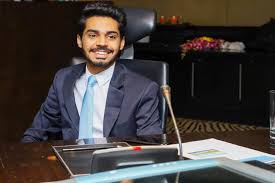
“Technology and AI have the potential to revolutionize farming in Punjab by enhancing productivity, reducing costs, and ensuring sustainable agricultural practices”, says Trishneet Arora, Founder, and CEO of TAC Security, a cybersecurity, risk, and vulnerability management company.

The young achiever who specializes in safeguarding systems and data against cyber threats and has made it big in his field says that, “With precision farming techniques, real-time data analytics, and AI-driven crop management, farmers can optimize their resources, predict yields, and mitigate risks more effectively. Embracing these advancements will not only boost the agricultural output but also improve the livelihoods of our farmers, making Punjab a leader in modern farming”.

He opines that “Punjab’s economy has traditionally been driven by agriculture. However, the need for diversification is more pressing than ever. Entrepreneurship presents a viable path to economic rejuvenation. By encouraging innovation, creating job opportunities, and attracting investment, a thriving entrepreneurial ecosystem can drive sustainable growth. I strongly believe fostering a culture of entrepreneurship can be the key to revitalizing Punjab’s economy and addressing its financial woes”. As part of his ‘give it back’ philosophy Arora has a detailed vision for his state Punjab where youth suffer from drug abuse and unemployment.

He envisions a synergistic relationship where the government provides the necessary infrastructure and policy support, while entrepreneurs drive innovation and growth. This partnership can create a conducive environment for businesses to thrive, ultimately benefiting the state’s economy. Arora cites youth exodus as the biggest challenge for Punjab and emphasizes the need to create an environment where young talents see a future within the state. This not only involves job creation but also fostering innovation hubs, providing access to capital for start-ups, and ensuring robust infrastructure. “We need to instill a sense of pride and opportunity within our youth. By showcasing successful local role models and creating avenues for growth and development, we can motivate our young people to stay and contribute to Punjab’s progress”, he says.

Coming from a youth icon whose success story has the potential to inspire lakhs of youth in Punjab and everywhere, the visionary ideas carry added weight. From making it to the Forbes list of 30 under 30 Asia in 2018, Trishneet Arora has made it to the Hurun India Rich List 2024. This recognition underlines his impressive net worth of ₹1,100 crore and highlights his remarkable significant impact on technology and innovation worldwide.

Significantly, the founder and CEO of TAC Security, a cybersecurity, risk, and vulnerability management company was established by him at the age of 19 in 2013.  Based in Chandigarh, TAC Security is valued at around Rs. 1,100 crore and specializes in safeguarding systems and data against cyber threats. In 2024, TAC Security was officially listed on the National Stock Exchange, a significant milestone for Trishneet and his company. GQ India also recognized his contributions to cybersecurity in 2017 when he was named one of India’s 50 most influential young Indians. By 23, he was counted among India’s top ethical hackers. Not just in the country, Arora has found his place in the Indian diaspora with a day dedicated to him in Santa Fe USA.

With over 500 clients in 50 countries, his company’s product, ESOF, has been pivotal in securing Fortune 500 companies and government entities worldwide. In November 2022, Trishneet was invited by US Vice-President Kamala Harris to discuss cyber security at a gathering of young business leaders in New Mexico.

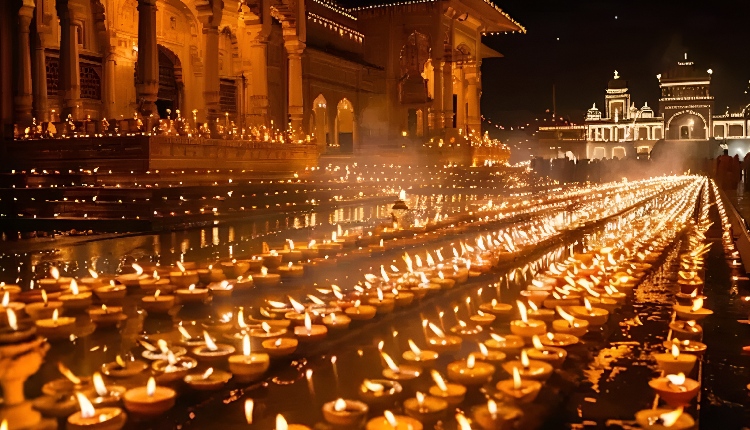
Ayodhya Deepotsav: Yogi Government aims to set record with 28 lakh diyas

New Delhi: The Ram Temple in Ayodhya is all decked up for Deepotsav on Wednesday. This will be the first such celebration in the city after the consecration ceremony of the Ram Temple, held on January 22.

The day began with the Shobha Yatra, a procession of tableaux showcasing the life of Lord Ram and based on the seven chapters of the Ramayana.

The procession started from Saket Mahavidyalaya and around 18 tableaus lined up. These will tour the city and showcase all the chapters of Ramayana, and will also give the message of women empowerment.

Artists from all over the country were presenting different folk dances in the procession.

One of the artists participating in the festival said they were working to promote traditions and cultural heritage.

“My aim is to further the celebration of our traditions. There is a portrayal of Lord Ram’s childhood, along with Mata Kaushalya and King Dasharath, depicting the early years of Lord Ram, ” said the artist performing at the Shobha Yatra.

The Yogi Adityanath government plans to illuminate the city with 28 lakh ‘diyas (earthen lamps)’ in an attempt to create a new world record. These will be arranged by 30, 000 volunteers.

In this year’s Deepotsav, another world record will be attempted. It will be of 1, 100 people performing the largest ‘aarti’ together on the ghats of Saryu. The UP CM will also be one of the participants to perform the special aarti and then light the diyas. The event will take place at multiple locations, including New Ghat, and Old Ghat.

A 30-member Guinness World Records team is present in the city to oversee the preparations. The team is likely to pronounce results after the lighting of diyas. The counting of the diyas will utilize specialized software to ensure accuracy, as precise dimensions for each 16 by 16-foot area are critical for maintaining count integrity.

The five-day Diwali festivities began with Dhanteras on Tuesday and will end with Bhai Dooj. Also known as the “festival of lights”, Diwali is celebrated on the 15th day of the Hindu lunar month of Karthik, between mid-October and mid-November.

For Deepotsav, there will be performances by artists from six countries — Myanmar, Nepal, Thailand, Malaysia, Cambodia, and Indonesia — along with a Ram Leela presentation from Uttarakhand.

Deepotsav celebrates Lord Rama’s return to Ayodhya after a 14-year exile, highlighting the city’s cultural and spiritual significance and attracting millions of devotees and tourists.

While detailing the plans for the celebrations, Uttar Pradesh Minister Jaiveer Singh said after the establishment of the Ram Temple, this is the first celebration of Deepotsav and to make this occasion memorable, grand and divine, many beautiful decorations have been assembled to enhance the festivities.”

“Today, I extend my best wishes to every Sanatan follower who believes in traditions and rituals in the country and across the world. Everyone in Ayodhya is overwhelmed and happy today. They are feeling the same enthusiasm and happiness that people must have felt when Lord Ram returned from 14 years of exile. We will also perform Aarti with 1, 100 diyas at the Saryu Ghat with 1, 100 Vedacharyas.”

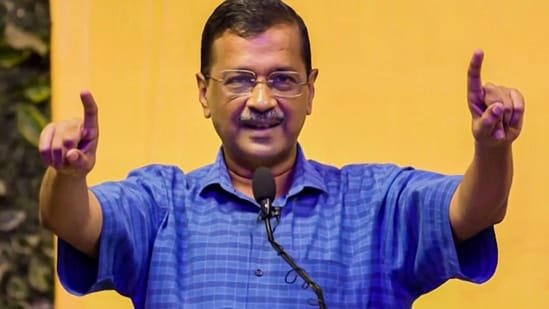
Arvind Kejriwal urges people to light diyas, avoid firecrackers on Diwali

New Delhi: Former Delhi Chief Minister Arvind Kejriwal has called upon residents of the national Capital to avoid bursting firecrackers during Diwali, pointing to the severe air pollution it causes in the city. Instead, he encouraged people to light diyas as a safer, more environment-friendly way to celebrate the festival of lights.

The Aam Aadmi Party’s (AAP) National Convenor stressed that the issue of firecrackers was not about religious sentiments but rather the health and well-being of Delhi’s residents.

“This is not a matter of Hindu or Muslim sentiments. The Supreme Court, the High Court, all courts have emphasised the need to control pollution. Diwali is the festival of lights, we should celebrate it by lighting diyas and candles, not firecrackers, ” he stated at a press conference in Delhi on Wednesday.

People in Delhi-NCR will celebrate Diwali on Thursday, a festival traditionally marked by widespread use of firecrackers which contribute significantly to air pollution in the region.

Meanwhile, Delhi’s air quality continues to be in the ‘poor’ category. According to the Central Pollution Control Board (CPCB), the Air Quality Index (AQI) recorded at 7.45 A.M. on Wednesday was 273, which is in the ‘poor’ category. Several stations recorded AQI in the ‘poor’ category of 201-300, but some were in the ‘very poor’ category of 301-400.

Not just Delhiites, but people living in areas in the neighbouring states of Haryana and Uttar Pradesh also suffer due to the heavy air pollution in the region.

Kejriwal also extended his Diwali greetings to Delhi’s sanitation workers and congratulated them on receiving their salaries and bonuses before the festival.

He said, “For the first time in 18 years, sanitation workers have received their salaries ahead of the month’s end. In the past, their payments were often delayed by seven to eight months. This Diwali, the Municipal Corporation has ensured they receive both their salary and Diwali bonus early, so that they can celebrate with their families.”

In light of the upcoming Assembly elections, Kejriwal and other leaders of the AAP are making efforts to connect with Delhi’s residents through outreach events across the city. This includes ‘padyatras’ in different areas, as well as highlighting recent initiatives by the Delhi government for the welfare of the public.

Kejriwal has also voiced concerns about certain projects for Delhi’s people being halted by the Central Government and the BJP, a point he and AAP leaders have continuously raised.

Defence Minister on two days visit in Arunachal to interact with soldiers

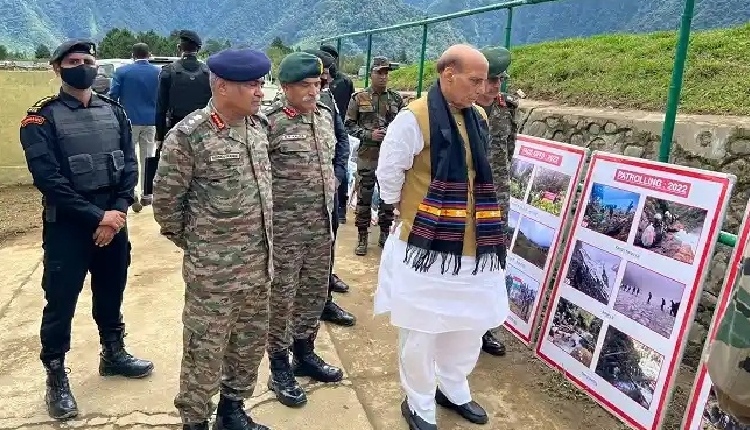
New Delhi:   Defence Minister Rajnath Singh, on Wednesday, left for Tawang on a two-day visit to Arunachal Pradesh where he will interact with soldiers stationed along the India-China border.

He is accompanied by Union Minister Kiren Rijiju. Manipur Chief Minister N. Biren Singh is also likely to visit Tawang during this time.

Ahead of the visit, the Defence Minister posted on his X handle that he was looking forward to meeting the Armed Forces personnel deployed at the forward area.

“Leaving New Delhi for Tawang on a two-day visit to Arunachal Pradesh. Looking forward to interact with Armed Forces personnel and attend the inaugural ceremony of a museum dedicated to brave Indian Army officer Major Ralengnao Bob Khathing, ” Rajnath Singh’s post read.

Major Ralengnao Bob Khathing was instrumental in bringing Tawang to Arunachal Pradesh under the Indian Union, and the museum is a tribute to his bravery.

Rajnath Singh’s visit to Tawang comes at a time when India and China reached a breakthrough in patrolling along the Line of Actual Control (LAC) in Eastern Ladakh. Last week India said that it had reached an agreement with China on patrolling along the LAC in eastern Ladakh. This was later confirmed by China. This is considered to be a major breakthrough in ending the four-year-long military standoff, which began after Indian and Chinese troops got engaged in a violent confrontation in Galwan Valley in May 2020.

The Defence Minister visited the forward posts in Arunachal Pradesh in October 2023 also and carried out an on-ground assessment of the operational preparedness of the armed forces along the LAC. He also participated in a ‘Shastra Puja’ with the troops at Tawang, and celebrated Dussehra with them. The Minister also interacted with the soldiers deployed in frontline locations along the LAC.

In the last few years, Tawang has become one of the focal points of friction between India and China, especially in areas like Yangtse, where soldiers of the Indian Army and China’s People’s Liberation Army (PLA) clashed in December 2022 leading to injuries on both sides. The Army in a statement then said, “On December 09, 2022, People’s Liberation Army (PLA) troops contacted the LAC which was contested by own troops in a firm and resolute manner. This face-off led to minor injuries to a few personnel from both sides…Both sides immediately disengaged from the area.”

Rajnath Singh in March celebrated Holi with the soldiers in Leh and lauded them for protecting the country from enemies while braving extreme weather conditions.

Delhi Air quality continues to be in ‘poor’ category

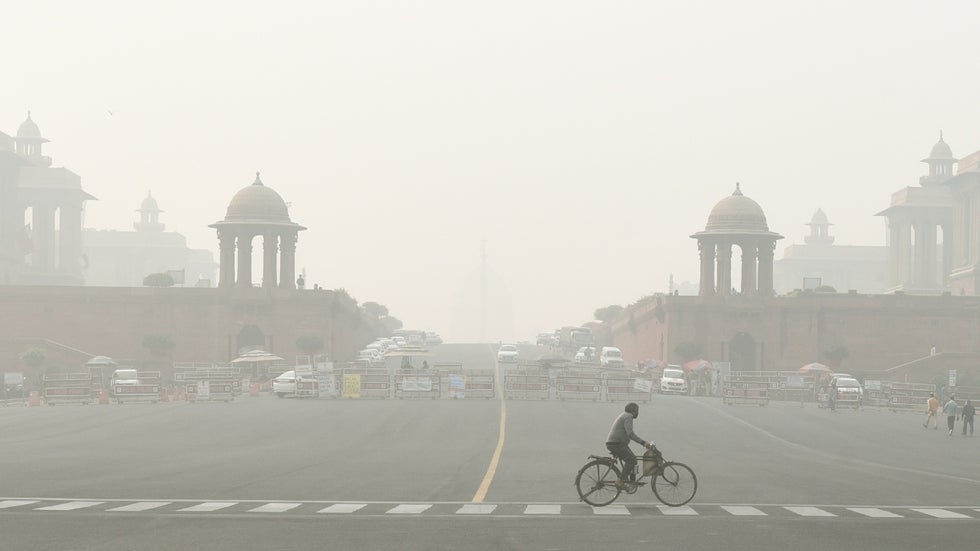
New Delhi:  A thin layer of smog engulfed the Delhi-NCR on Wednesday as the air quality continued to be in the ‘poor’ category amid the Diwali festivities.

According to the Central Pollution Control Board (CPCB), the air quality index (AQI) recorded at 7.45 a.m. on Wednesday was 273, which is in the ‘poor’ category. Several stations recorded AQI in the ‘poor’ category of 201-300, but some were in the ‘very poor’ category of 301-400.

The AQI level was 351 in Anand Vihar, 319 in Bawana, 313 in Jahangirpuri, 351 in Mundka, 308 in Narela, 326 in Vivek Vihar, 327 in Wazirpur.

In other areas of Delhi, the AQI level remained between 200 and above 300. It was 300 in Alipore, 290 in Aya Nagar, 289 in Burari Crossing, 267 in Dr Karni Singh Shooting Range, 250 in DTU, 268 in Dwarka Sector 8, 274 in IGI Airport, 284 in ITO, 220 in Jawaharlal Nehru Stadium, Lodhi Road. 239, 277 at Major Dhyanchand Stadium, 265 in Mandir Marg, 267 in Najafgarh, 251 in Nehru Nagar, 248 in North Campus DU, 220 in NSIT Dwarka, 277 in Patparganj, 276 in Punjabi Bagh, 285 in RK Puram, 289 in Rohini, 289 in Shadipur, and 273 in Siri Fort.

In the NCR cities, the air pollution levels were a little below that of Delhi — 172 in Faridabad, 197 in Gurugram, and 213 in Ghaziabad, Greater Noida.

The score remains 199 in Uttar Pradesh and 199 in Noida.

An AQI between 0-50 is considered good, 51-100 is satisfactory, 101-200 is moderate, 201-300 is poor, 301-400 is very poor, and 401-500 is severe.

Delhi suffered from similar air quality on Tuesday also with an AQI of 268. This, however, was an improvement from 304 the previous day.

The air pollution levels in Delhi-NCR have been fluctuating between ‘very poor’ to ‘poor’ levels in the past few days with stubble burning and firecrackers being major contributors. The absence of favourable wind conditions is also contributing to the high pollution levels.

The Delhi Pollution Control Committee (DPCC) has imposed a total ban on the manufacturing, storage, sale, and use of firecrackers until January 1, 2025.

The state government has deployed 377 teams to enforce the cracker ban in the city. Of these 300 are from the police and the rest from the revenue department.

On October 22, the Commission for Air Quality Management (CAQM) ordered the implementation of Stage 2 emergency measures under the Graded Response Action Plan (GRAP) to curb the city’s air pollution.

Under this phase of GRAP, additional efforts focus on tackling dust pollution and limiting emissions from diesel generators, a move aimed at curbing further deterioration. Authorities deploy mechanical and vacuum road sweepers, conduct water sprinkling operations on key roads, and intensify inspections at construction sites to enforce strict dust control measures.

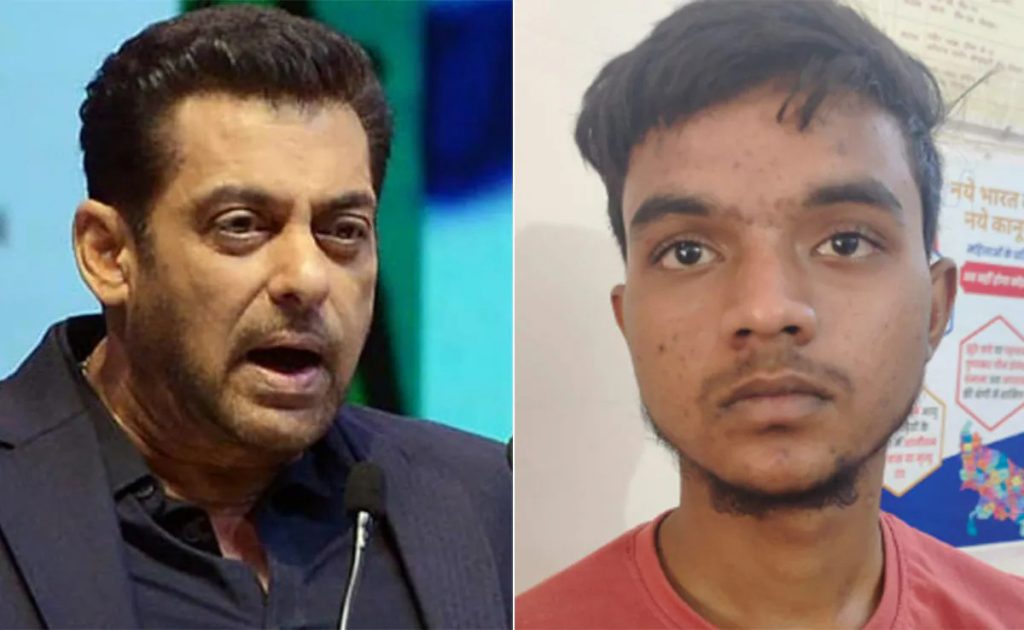
A 20 year old arrested for death threat to Salman Khan, Zeeshan Siddique

New Delhi : The Mumbai police have arrested a 20-year-old man from Noida in Uttar Pradesh for allegedly issuing a death threat to Bollywood actor Salman Khan and NCP leader Zeeshan Siddique, an official said on Tuesday.

The man was held on Monday, he said.

“The accused initially sent a threatening message on MLA Zeeshan Siddique’s helpline number and later made a voice call on it, in which he issued a death threat to Siddique and actor Salman Khan. This took place on Friday,” an official of Nirmal Nagar police station here said.

A case in this connection was registered on Monday and with the help of technical evidence, the accused was nabbed from Noida. He is being brought to Mumbai for investigation, he added.

The call was made at the Zeeshan’s public relations office located in Bandra East, he said.

Zeeshan’s father, Baba Siddique (66), a three-time MLA and former state minister, was shot dead outside his son’s office in Bandra on October 12. The Lawrence Bishnoi gang, which claimed responsibility for the NCP leader’s killing, citing the politician’s close ties with Salman as one of the reasons why he was killed.

The ruling Nationalist Congress Party (NCP) led by Ajit Pawar has fielded Zeeshan from the Bandra East constituency in Mumbai in the next month’s Assembly elections.

Zeeshan recently mentioned in an interview that after the death of his father, who was also a close friend of actor Salman Khan, the Bollywood actor was extremely worried about his well-being.

MOST POPULAR

HOT NEWS