In Bihar’s Jehanabad molestation case, a special investigation team formed by Patna Zonal IG Nayyar Hasnain Khan have arrested four youths from Bharthua village under Kako police station area on April 30.
The accused were named as Amar Kumar (18), Deepak Kumar (18), Sunil Kumar (18) and a 14-year-old minor.
The police reportedly identified the accused using video footage of the incident that went viral on social media on Saturday night.
The incident came to light when a shocking video showing a group of eight youths molesting a girl in broad daylight went viral on the night of April 30. The girl kept on pleading for mercy while trying to escape.
The police team, have arrested four including a minor from Bharthua village in Jehanabad within 24 hours after the video went viral, said IG Hasnain while talking to mediapersons on April 30.
“The police team tracked down the location from the motorbike which was on the viral video. On the basis of the number plate, the district transport officer traced the location of the owner of the bike. However, the owner of the bike is yet to be arrested,” said the IG.
From the arrested youth Amar Kumar, the police also recovered the mobile phone which was used to make the video
Viral video: Police arrest 4 in Jehanbad molestation case
Bombay HC nullifies 9-year-old marriage on grounds of non-consummation
 On April 30, the Bombay High Court ruled in favour of the wife and nullified a 9-year-old marriage on grounds of non-consummation.
A couple from Kolhapur had been fighting the legal battle from 9 years. The case dates back to 2009 when the woman was 21 and the man was 24. The woman claimed that the man had fraudulently married her by obtaining her signatures on a blank paper by making false promises of getting her a job. While she had sought that the marriage be annulled, the man had opposed it.
She also stated that she never stayed with the respondent husband after the marriage was registered.
“One of the most important objects of marriage is a regularisation of sexual relationship between the two parties, and in the absence of such a relationship, the object of marriage is frustrated. Even a single occurrence of sexual intercourse amounts to consummation of marriage,” said Justice Bhatkar.
Justice Mridula Bhatkar said that due not availability of any evidence of fraud, the husband cannot be held guilty, but struck down the marriage on the grounds that there was no proof that there were sexual relations between the couple.
“In the present case, when the parties did not stay together even for a single day and no evidence is brought by the husband when he claims that there was sexual relationship, then in absence of such evidence… the woman establishes the case of non-consummation of marriage.”
The man claimed that the couple had sexual relations and even the woman had got pregnant but the court pointed that no evidence of the gynaecologist or about the pregnancy test had been furnished.
However, the court granted the stay as the respondent’s counsel sought a stay of 8 weeks on the judgment in order to challenge it before the Supreme Court.
Jammu and Kashmir cabinet reshuffle: Kavinder Gupta sworn in as deputy CM

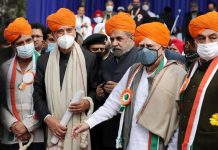
Jammu and Kashmir Assembly speaker Kavinder Gupta and seven others were sworn in as ministers in the state’s PDP-BJP government led by Mehbooba Mufti on April 30.
In place of Nirmal Singh, Kavinder Gupta will now be the new deputy chief minister.
The new BJP faces sworn in were party’s state unit chief Satpal Sharma and Kathua and Sambha MLAs, Rajiv Jasrotia and Devinder Kumar Manyal, respectively.
The PDP members included in the cabinet were Mohd Khalil Band, MLA from Pulwama, and Mohd Ashraf Mir, MLA from Sonwar.
Including the chief minister, the state can have a maximum of 25 ministers, out of which 14 portfolios are with the PDP and the remaining are with the BJP.
The oath of office and secrecy was administered by the governor.
In order to enable bringing in new faces in the two-year-old Mufti cabinet, the BJP on April 17, asked all its nine ministers in the PDP-BJP government to submit their resignations.
Out of eight ministers inducted into the cabinet seven were new faces.
Tripura CM advises youth to milk cows and avoid seeking govt jobs
 Tripura chief minister Biplab Kumar Deb has landed in a fresh row by advising the youth of his state to not waste their “crucial time” in running after political parties for government jobs and instead milk cows or set up ‘paan’ shop to earn a living.
“Why run after netas for government jobs? Graduates should get cows and milk it to earn Rs 10 lakh in 10 years. Instead of running after political parties, had the same youth set up a paan shop, he would have had a bank balance of Rs 5 lakh by now,” the chief minister said.
Deb reportedly suggested that educated young people should not run behind government jobs, and rather become self-employed by starting various projects under the Pradhan Mantri Mudra Yojana.
The statement comes after a series of bizarre remarks made by the chief minister. After his ‘Internet in the Mahabharata era’ remark, the chief minister had said a day earlier that civil engineers should join civil services as they have the prior experience to build the society, media reports said.
This was the third consecutive statement of Deb that sparked controversy.
Earlier, the Tripura chief minister had grabbed the headlines for questioning Diana Hayden’s Miss World title won 20 years ago and compared her with Aishwarya Rai, reported ANI.
Before the statement on Hayden, he had claimed that the Internet technology is nothing new to India as something on similar lines existed even in the Mahabharata era when Sanjaya would share updates about the Kurukshetra battle with Dhritarashtra.
PM Modi, Chinese President Jinping all set to discuss bilateral, regional issues
 Prime Minister Narendra Modi is all set to meet Chinese President Xi Jinping on April 27 to hold an informal meeting at Mao Zedong’s villa in Wuhan, the central Chinese city.
Officials said that the two leaders would hold one-on-one conversations focusing on global, regional and bilateral issues.
Officials further, the informal meeting will forge consensus to resolve the issues with follow up actions by officials than announcing any agreements. This is something the leaders of the two countries have never tried so far.
Indian PM Modi and Chinese President Jinping will hold two meeting. The first engagement will begin at around 3.30 pm at the Hubei Provincial Museum and other will be at 6 pm, with delegations from both the sides. Both the meetings will be followed by a dinner which is hosted by the Jinping.
China and India’s development goals are similar and 27-28 April meeting between both the leaders will promote free trade, strengthen unity among developing countries and uphold the principles of equity and justice, said by Chinese Ambassador to India Luo Zhaohui as quoted by leading Chinese English daily.
Chinese envoy further stated both the countries are at a “critical stage” of economic development and modernization.
PM Modi has said that President Jinping and he will exchange views on a range of issues of bilateral and global importance.
We will further discuss our respective visions and priorities for national development, he added.
This visit is the fourth visit of PM Modi to China in his four years after coming to power.
Allahabad HC: No evidence in Gorakhpur infant death case, Dr Khan released on bail
 The Allahabad High Court on April 26 ruled out that there is no evidence of medical negligence against Dr Kafeel Khan, the pediatrician who was arrested in the case regarding death of 63 children who allegedly died due to disruption of oxygen supply at a BRD hospital Gorakhpur in August 2017.
Dr Khan who was imprisoned since 2 September 2017 was released on bail on 25 April 2018.
Allahabad court stated that Khan was kept in jail even as he was not stated to be part of the tendering process that resulted in the enlistment of the entity, which was charged with the supply of medical oxygen.
Justice Yashwant Verma has reportedly said “There is no material on record, which may establish medical negligence against the applicant individually. This is quite apart from the fact that no inquiry was also undertaken or initiated.”
While favouring the doctor, additional government advocate stated that not even a single aspect of the probe remains outstanding and there is no need for the continued custody of Dr Khan. He admittedly is a medical practitioner, a government employee with no prior criminal history.
Dr Khan’s family had applied for bail several times and he finally got bail following a 10-page letter released by his family which he wrote from jail, in which he claimed he was being made a scapegoat in the case.
Never ordered to link SIM with UID: SC

The Supreme Court (SC) on 25 April clarified that it did not order mandatory linkage of mobile phone numbers with Aadhaar card. In the new revelation, even Centre admitted that there was no SC order for mandatory linking of Aadhaar to your mobile number.
This clarification was in response to a PIL filed by Lokniti Foundation.
Justice D Y Chandrachud during a hearing before a bench of (Chief Justice Dipak Misra and Justices A K Sikri, A M Khanwilkar and Ashok Bhushan) in the Lokniti Foundation case, said that the apex court never directed linking of SIM with UID. But the Union government’s circular says so.
There was no direction by the court.
Rakesh Dwivedi (advocate representing UIDAI), has clearly mentioned that the mandatory Aadhaar-mobile number linking move was based on the SC’s order to verify mobile numbers.
He added, “My submission is that the government had a legal basis to link Aadhaar with SIM by virtue of section 4 of the Telegraph Act and also, the measure is reasonable in the interest of national security.”
The UIDAI (body governing Aadhaar) said that its database cannot be breached or used to profile citizens.
Reportedly, he also claimed that the UIDAI was being unfairly targeted and banks and telecom companies have a much “bigger database” about the citizens comparatively.
13 children killed, others injured in UP's Kushinagar train-school van collision
 At least 13 children were killed and eight others were critically injured on April 26 at around 7 am, when the van of Divine Public School which was carrying 25 students passed through the crossing and collided with a speeding train. The van was badly crushed in Uttar Pradesh’s Kushinagar, which is about 50 km from Gorakhpur.
An official said that 13 children were killed on the spot and seven are critically injured. The wounded children and staff were taken to a hospital around 30 km from the accident site.
The official also claimed that a person who alerted commuters about approaching trains at unmanned crossings also tried to stop the van but it was already too late.
“He (the driver) didn’t pay any heed, this is a case of pure negligence,” said a railways spokesperson.
State Chief Minister Yogi Adityanath has expressed deep condolences on the incident and has announced compensation of Rs 2 lakh for the kin of the deceased. He also instructed top officials of Gorakhpur to conduct a strict inquiry into the incident.
Demanding compensation to be raised to Rs 50 lakh, locals are expressing anger and started protesting near Dudahi. They also want a manned railway crossing at the accident site.
Prime Minister Narendra Modi and President Ram Nath Kovind have expressed grief over the incident.
PM Modi tweeted “I am extremely saddened on hearing about the death of 11 school students in a collision between a school van and a train in Uttar Pradesh’s #Kushinagar . UP Government and railway dept will take appropriate action.”
Thayil brings out outlandish souls from the fragments of desperate times
 No vigils left to keep, No enemies left to slaughter. Dom Moraes, in his 1983 poem <Absences>, perhaps best describes what he would not know then to be his own fictional reincarnate. Like the poem, the protagonist of Jeet Thayil’s novel, The Book of Chocolate Saints, Newton Frances Xavier lives in the dilemma of conflict, much in the aftermath of it. Only in this case, the conflict does not appear to be in the face of a direct confrontation but the lack of it. In fact, it lies in the connected dots of the characters Xavier faces throughout his elusive life.
It would be true to say that Thayil’s second novel is an ambitious read. More than just a novel, it can be said to be a homage to the potpourri of artists and poets who cramped the creative scene of the 1980’s Bombay. For those initiated with the times, it would not be surprising to find some renowned artists at almost every turn of the page. Eunice De Souza, Arun Kolatkar and most prominently, Dom Moraes, to whom the book is dedicated. Fiction only enters in the fragments tying the story together. In fact, there are even glimpses of the author himself. No, the book is definitely not an attempt at an autobiography but seems to be a mirror which allows Thayil to comprehend some of the points in his life. However, it is difficult to say whether Thayil wants to juxtapose them against the western artistic culture (by presenting a veiled satirical picture) or wants to plaster the final confirmation of the western imposition on their art. Whatever is it, one thing that Thayil definitely wants to portray is the inherent madness in each of these artists which makes them loners of the same eclectic club. A club in which drunken, sexually violent and addicted and, most importantly, forgotten geniuses have together closed the door to the world. Like Thayil says, “poets who had been forgotten by everyone except the odd scholar or barkeep to whom they owed money”
 At the centre of the book is Newton Frances Xavier, a Goan painter, poet and drunkard who lives in New York but leaves a post-9/11 city wrecked in fearful thoughts. A quick analysis of the character reveals that he himself is a blend of two major influences of Thayil’s life – Dom Moraes and painter Francis Newton Souza. Interestingly, the author seems of have borrowed chunks out of Souza’s life to fill in Xavier’s childhood. Like that part where Xavier is expelled from his school for drawing a graffiti on the wall of his school’s toilet is directly taken from Souza’s experience as a school student in Goa. However, readers who are familiar with Thayil’s work would know that Newton Frances Xavier was already introduced in <Narcopolis>, the author’s first novel which was also shortlisted for the Man Booker Prize.
In The Book of Chocolate Saints, the author’s second novel, Thayil takes the liberty to explore Xavier through the latter’s same perpetual weaknesses – booze, broads and beauty. Xavier’s tendency for broads is only reflected in his repeated drunken stupors and frequent need to untangle himself from the demands of a relationship. In the first page itself, Xavier is seen fleeing secretly from his wife of eighteen years to be with Goody Lol, his muse (another character loosely borrowed from Souza’s personal life). Indeed, Xavier is married thrice and has a plethora of women in his life, without being explicitly able to claim his love for any one of them. One thing that the book points out now and again, is that the only identity Xavier has been able to build for women in his life is that of beauty. What he seems to need and pine for is a muse for his art project till the painting is complete. And by the time, a project is over, Xavier would have already seen enough through the emotional peephole of the muse for it to appear lacklustre. In fact, women in the novel or per se Xavier’s life hardly have a say in the way the protagonist whirls around them and at best assure and reassure Xavier of his sexual abilities. Like the model Glory Pande, who recounts how her enlarged breasts were a confirmation of Xavier’s sexual prowess. At certain points, it seems like Thayil almost gives Xavier a freehand over women, making it almost justifiable for an artist, whose love for his art is above all mortal beings. Also, if the author was inspired by a host of artists lighting the poetry scene in Bombay, he could have paid tributes to at least some women poets who flourished in that era. Who wouldn’t have recognised Kamala Das’s explicit words on women’s actual desire? Or does Thayil just recognise artists to be desirous, damaged and aloof men in whose lives women can’t claim to be more than stage props?
However, one still cannot unsee Xavier’s carnivorous mind, stealing his inspirations from the commonplace market of facts. It is as if Xavier’s personalities dual with each other. He is addicted to the emotions of his art but callous in his approach to relationship which does not limit itself to romantic liaisons. He even leaves his young daughter without much of a hint of remorse. He is magnanimous and outlandish but coward and laden with the insecurities of time.
Most of the protagonist’s tale is told through interview excerpts of Dismas Bambai, Xavier’s biographer. Throughout of the length of the interviews it becomes increasingly clear that Xavier is himself trying to escape the finality of his artistic abilities. “You understand that thought is the enemy, the source of all lesions, tumours and sarcomas; then thought becomes flesh becomes the emblem of your shame,” this quote by Xavier almost exposes the poignant gamble of thoughts in the painter’s mind.
One thing that Thayil manages to achieve through this book is to divide the reader’s mind. One half that shivers in the cruelty of the painter and the other half that sympathizes with him. There is also this other part which has to admire the artist despite the person in the artist.
The unrestrained volatility in The Book of Chocolate Saints is one of the main reasons why you read this book. Both the language and the characters are unabashed and Thayil manages to capture the reader’s attention at every sentence either through shock or awe. The novel will leave you aghast but also satisfied. At best, it tries to pull the desperate and hidden glories of the unclaimed artists from the potholes of their times.
Jammu & Kashmir gives nod to implementation of 7th Pay Commission recommendations

Jammu & Kashmir on 25 April approved implementation of the 7th Pay Commission recommendation for state government employees and pensioners with effect from January 2016. It has become the first state across the country to implement the same.
The decision was announced during the meeting of the state cabinet chaired by J&K Chief Minister Mehbooba Mufti which was attended by both PDP (Peoples Democratic Party) and BJP ministers, including Deputy Chief Minister Dr Nirmal Singh.
The employees will be able to draw revised salaries from the current month. “As already announced by Govt, the employees to draw revised scales of pay from current month,” the state information department tweeted.
The employees will get more than 20 per cent hike in the salary for the month of April, state Finance Minister Syed Altaf Ahmed Bukhari told reporters.
The state government in 2017 had announced that it will implement 7th pay commission recommendations from April 2018, giving a massive 23.5 per cent hike to lakhs of government employees and pensioners in the state.
Bukhari said that state government has committed its implementation in budget. It has been the first time in state’s history that pay commission’s recommendations have been implemented without any agitation from employees and despite lack of resources, he added.
From April 2018 onwards, employees of J&K government will start getting the revised salary as per the recommendations of the 7th pay panel.
The cabinet decision is going to benefit around five lakh employees and pensioners in the state. The financial implications will be Rs 4,201 crore per year while one-time arrears would cost the government Rs 7,477 crore.