The Irrepressible Amrita

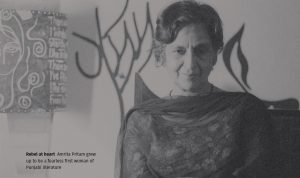
In 1935, a book of Punjabi verse called ‘Thandian Kirnan’ gave the world its first glimpse into the life and literature of a young girl, Amrit Kaur. Barely sixteen at the time of its publication, she wrote with a clarity, romanticism and fearlessness that far belied her tender age. Years later, she confessed that before her, there were only two known women writers in Punjabi and they wrote on religious themes. Her poems shocked, outraged and fascinated the literary world at that time. The critical acclaim and public fascination that followed grew with every subsequent work that she produced. The young romantic rebel grew up to be an even more fearless first woman of Punjabi literature, none other than Amrita Pritam. She was an iconic writer, whose works as well as her life, were a bold statement that redefined not just the Punjabi literary canon, but also created a new imagery on how Indian women perceived themselves.

Despite the divergent paths taken by the two fragments of Punjab as part of two separate countries, some ties could not be entirely broken by Partition. Most notable would be the cultural ties that bind the two Punjabs: a rich poetic heritage and post-1947 literary output continued to unite the writers and poets of the divided land. No figure could be a better example of this process than Amrita Pritam. She enshrined the concept of Punjabi, the deep consciousness of being a Punjabi — a child of the land of the five rivers — irrespective of religious or caste affiliation. Hailed as a ‘Feminist before Feminists,’ Pritam was as much a non-conformist as she was non-confrontational. But first and foremost, she was a romantic. She bent the rules instead of breaking them but always remained true to herself. Though her infamous love life took over her public image in her later years, Pritam opened the doors for the plethora of women writers in Punjabi, as we see today.

Amrita’s identity began with what she called ‘one of nature’s secrets.’ Before her birth, two little girl students of her father prayed publicly in a gurudwara wishing for a girl child in the house of their Masterji. She was an only child of Kartar Singh and Raj Kaur, born on 31st August, 1919, in Gujranwala, in erstwhile undivided Punjab, now Pakistan. Her father was a school teacher and a Pracharak/Sikh religious preacher. The environment in her early home was deeply spiritual. While the religious constraints perplexed her, she inherited her love for literature from her father, a small-time poet who wrote under the pen name Piyush and also edited a Punjabi magazine. Bereft by her mother’s demise at an early age of eleven, she turned agnostic after witnessing the futility of prayer through her mother’s illness. Isolated by a disciplinarian father, Amrita found solace in her poems, each ‘a forbidden desire.’

The girl, wished for by two girls, grew up to give expression to the repressed desires and silent emotions of her ilk, countless women weighed down under the veil of exalted feminine virtues revered at that time. Her initial work consisted mainly of romantic poems though she gradually gravitated towards the Progressive Writers’ Movement. In 1944, in a poetry collection titled ‘Lok Peed’ (Anguish Of The Public), Amrita’s first social poetry emerged and she criticised the economy being depleted by the Second World War and the disastrous Bengal famine of 1943. Her increased involvement in social work in the mid-1940s, her working with the Lahore Radio Station for a brief period and her angst at the helplessness of the commoners, especially women, made her works around that time become more rebellious and socio-political in nature.

Pritam not only read history but also she witnessed history in the making. She became the part of that history during the partition of India in 1947, witnessing the killing of thousands of people, be it Hindus, Muslims or Sikhs. The events that happened at the time of Partition badly shattered the young Amrita. She depicted the sorrows, the pains and the helplessness of the times in her most famous poem ‘Aj aakhaan Waris Shah nu.’ She found a way out of her haunting reality by invoking the Sufi poet Waris Shah, calling on him to rise from his grave and give voice to the macabre horrors of a divided land. She wrote the poem on a train journey from Lahore to Dehradun in the aftermath of Partition. She also spoke of the women abducted during Partition and of the children they bore to unknown fathers. In her book ‘Pinjar’, she created the memorable character of Puro, a collective symbol of violence against women, loss of humanity and the ultimate surrender to existential fate.

After the Partition, Pritam moved to Delhi and started working for All India Radio for a period. She also presented a program called ‘Darpan’ on television. But her pet and most notable venture was Nagmani, a literary monthly. The magazine was a hallmark of Punjabi literature, a gateway that introduced many new voices and was known for its distinctive design, developed by her long-time companion Imroz. It ran for over three decades (1966-2003) and had a cult following. It was hailed for making authors out amateurs, be it a truck driver, a Dalit labourer or an army-man. The author of more than 100 books and later a Rajya Sabha member, Amrita Pritam produced poetry, fiction, biographies, essays, a collection of Punjabi folk songs and two autobiographical works that were translated into several Indian and foreign languages.

Amrita Pritam’s love-life and unconventional life choices always captured and rattled popular culture at the same time. Married at sixteen, Amrita endured an unhappy marriage for twenty-five years. While still married, Pritam nurtured an affection for noted lyricist Sahir Ludhianvi, an unrequited love which became as iconic as folklore. The relationship bore the iconic poem Sunehe, which won her the Sahitya Akademy Award in 1956, making her the first woman to receive the honour. Even after her divorce, still considered a taboo in certain sections, she equally celebrated her relationship with painter/artist Imroz. It is mirrored in her famous last poem ‘Main Tenu Phir Milangi.’ She revered every relationship in her life and the famous letters she wrote to Ludhianvi, Sajjad and Imroz are little gems known for their literary finesse. Pritam was conferred with countless awards and honours, including Bhartiya Jnanpith Award in 1982 for ‘Kagaj Te Canvas’ (Paper and Canvas).

The ever sceptical Khushwant Singh himself confessed to translating Pritam’s novel ‘Pinjar’ to English, in the hope of getting ‘a candid account of her love-life.’ Disappointed by her abstract loves, he dismissively remarked that the story of her life and love could fit on a postage stamp. In her signature irreverent style, she named her memoir ‘Raseedi Ticket’ (Postage Stamp). Amrita Pritam was the woman who taught us to celebrate women as imperfect mortals rather than put them on unrealistic pedestals. Through her writing, she has become the friend and confidante of women across continents. She stood for a humanity devoid of the barriers of caste, creed, boundaries or gender. Born ninety-nine years ago, Amrita Pritam is a classic modern woman and still the poster-girl for equality in today’s fragmented society.

LETTERS@TEHELKA.COM

Darul Qazas aren’t courts but counselling centres

The All-India Muslim Personal Law Board (AIMPLB) recently announced that it is going to set up Darul Qazas (Muslim courts) in every district of the country. This created an uproar, with many alleging that it is an attempt to set up a parallel judicial system. A closer look into its history, mechanism and way of functioning will help in getting a clear picture.

The system of Darul Qaza, which has been in existence since the advent of Islam, was introduced in India by Mughals and was used to resolve issues and disputes involving Muslims until 1864. When Britishers came to power, they stopped appointing Qazis (equivalent to judges) to these judicial institutions. In 1921, a renowned Islamic scholar Maulana Abul Mohsin Sajjad tried to revive the practice at personal level in Bihar. In its present form in India, Darul Qaza is more like a counselling centre to resolve small disputes as it does not have any power or authority to punish the culprits. Only civil issues like marital and family disputes, issues related to property, divorce etc. are brought before it.

In recent past, a case of a property dispute came to Imarat-e-Sharia Phulwari Shareef Patna. The complainant, a Hindu, alleged that a Muslim had grabbed his property. The case was already decided in favour of the Muslim accused by the Supreme Court. Both parties were called. While hearing the case, the Qazi reminded them about the life after death, judgement day, heaven and hell, etc, adding that the culprit may escape laws of this world but will surely be punished in the hereafter. The Muslim suspect, after some time, broke down and not only admitted his crime but also revealed how he forged the will of the plaintiff’s father. He apologised to the complainant and the matter was resolved amicably.

In 2005, a Delhi-based lawyer Vishwa Lochan Madan filed a public interest litigation with a plea to ban all Sharia courts, saying they are unjust to women. In its 2014 verdict, the Supreme Court however had refrained from doing so. Interestingly, a recent study titled, “Women’s Access to Justice in Darul Qaza” by Nalsar Law University, Hyderabad, stated that more than 90 per cent complainants who approach Darul Qazas are women. Another study by sociologists Anindita Chakrabarty and Suchandra Ghosh suggested that none of the interviewed women had stated that the procedures or verdicts of Darul Qazas were gender unjust.

Reports suggest that Darul Qazas running in Bihar alone have so far resolved nearly 50,000 family disputes, and in very few cases people knocked the doors of the regular courts as these institutions amicably resolved their issues or solved their problems. Besides, the cases in Darul Qazas are resolved quickly—usually in less than a year.

These Darul Qazas, which generally resolve issues within three months, work more like Lok Adalats and counselling centres that aim to reduce the burden on the courts. The country needs more such institutions as, according to Chief Justice Dipak Misra, the courts are facing the backlog of around 3.3 crore cases. While 2.84 crore cases are pending in the subordinate courts, the backlog clogging the High Courts and Supreme Court (SC) is 43 lakh and 57,987 cases, respectively. According to National Judicial Data Grid (NJDG), the five states which account for the highest pendency are Uttar Pradesh (61.58 lakh), Maharashtra (33.22 lakh), West Bengal (17.59 lakh), Bihar (16.58 lakh) and Gujarat (16.45 lakh).

More Darul Qaza like institutions should be allowed to come up to resolve petty issues. This will give more time to courts to ponder on cases involving Indian Penal Code and other important litigations related to general masses.

LETTERS@TEHELKA.COM

Centre announces merger of Vijaya Bank, Dena Bank, and Bank of Baroda

The Centre on September 17 announced the plans to merge three national banks – Dena Bank, Vijaya Bank and Bank of Baroda.

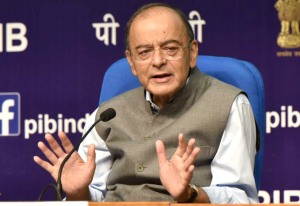
Finance Minister while directing their respective boards to consider the proposal said, “The Alternative Mechanism made the decision today and it has been proposed to the individual bank boards to take a decision. Boards would meet and after consultation take appropriate action.”

Finance minister further said, “This will hopefully create another mega bank which will be sustainable. The amalgamated entity would increase banking operations and its ability to go for further consolidation.”

“Merger of the three banks will make this the third largest bank of the country,” Rajiv Kumar, Secretary Department of Financial Services (DFS), said during a media briefing.

DFS Kumar said that the three banks will continue to work independently after the merger. He added that the merger would help improve operational efficiency and customer services. This will set an example for the next generation of strategic banking reforms.

Amalgamation of three banks will results in:

It will become third largest bank in the country.

It will become the strong competitive bank with economies of scale.

It will protect the interests of the employees.

It will preserve the brand equity.

It will ensure capital support.

It will position for substantial rise in customer base, market reach, operational efficiency and wider bouquet of products and services for customers.

Bhima Koregaon case: SC extends house arrest for 5 activists till September 19

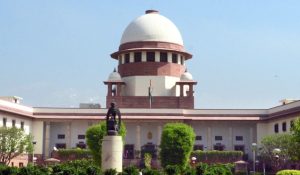
The Supreme Court on September 17 extended till September 19 the house arrest of five activists in connection with the Bhima-Koregaon case, and also added that it will examine whether there is material supporting the arrest or not.

Activists Arun Ferreira, Varavara Rao, Sudha Bharadwaj, Vernon Gonsalves and Gautam Navlakha are the five activists under house arrest.

The SC bench comprising of Chief Justice Dipak Misra and justices A.M Khanwilkar and D.Y. Chandrachud, said, “Every criminal investigation is based on allegations, and we have to see whether there is some material (to the evidence).”

According to reports the apex court also agreed to examine the evidence gathered by the Maharashtra Police in the probe against the five activists to decide whether there is any substance to them and whether the inquiry should continue or be quashed and also added that if there are some grave lapses, it would consider an investigation by a Special Investigating Team in the case.

However, Additional Solicitor General Tushar Mehta, appearing for the Maharashtra government, said there was enough evidence to indicate that these five activists were involved in criminal acts and further added that the court should make it clear that after the adjudication from the SC, the arrested accused cannot avail remedies simultaneously on similar issues at other judicial fora.

The activists were detained on August 28 from various cities for their alleged involvement in the Bhima Koregaon violence. They have been under house arrest since August 29.

Petroleum Minister Pradhan reiterates stand to bring fuel under GST ambit

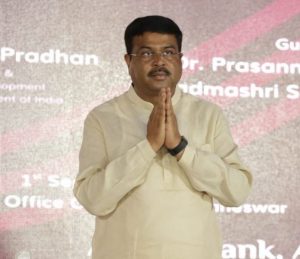
Dharmendra Pradhan, Union Petroleum and Natural Gas Minister, on September 17 expressed concern over soaring fuel prices and while reiterating his stand said that petrol and diesel should come under the ambit of Goods and Services Tax (GST).

Petroleum Minister Pradhan said, “I want petrol and diesel to come under the ambit of GST. The GST Council should take a decision on this.”

Shifted the burden of bringing about the change on the level of state governments he added, “The state governments are more powerful than the Centre in GST Council meeting.”

He said this during his visit in Jharsuguda to review the preparations ahead of Prime Minister Narendra Modi’s visit to inaugurate various infrastructure development projects in Odisha.

“I have already told about that State government need to cooperate as well. Many states have reduced state tax. Odisha government should also reduce taxes. The central government had reduced excise duty last October. Excise duty is fixed. If oil prices go up in international markets, the states benefit more and this information is now in the public domain. I had put out the facts about how the states use to earn less than Rs 3000 crore during 2014, now they can earn about Rs 7000 crore. So now the onus is on the state to reduce taxes” added Petroleum Minister.

Petroleum Minister maintained that the Government was concerned about the rise in fuel prices and was working on a long-term solution.

Congress stakes claim to form govt in Goa, submits letter to governor

The Congress on Monday staked claim to form the government in Goa even as the ruling BJP-led coalition alliance looks for a new leader to replace ailing Chief Minister Manohar Parrikar who is undergoing treatment in AIIMS, Delhi.

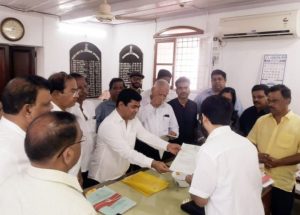
Sixteen Congress MLAs submitted a letter to Governor Mridula Sinha’s office, at the Raj Bhavan, demanding that she should not dissolve the Assembly and Congress being the single largest party should be invited to form the government in the state.

However, Congress MLA could not meet the governor as she is out of the state.

In the letter, the party has requested the Governor that the government should not be dissolved. They have also asked her not to impose President’s Rule or keep the House in suspended animation.

For the fourth time, the Congress has staked claim to power in Goa since emerging as the single-largest party in Assembly elections last year. 

The Bhartiya Janata Party (BJP) has ruled out a change in leadership in Goa, saying Parrikar was doing fine.

BJP president Amit Shah has sent three senior members of the party — Ram Lal, B L Santhosh, and Vinay Puranik — to Goa to take stock of the political situation in the state.

Parrikar has been admitted to the AIIMS for follow-up treatment reportedly for a pancreatic ailment.

The 62-year-old is running the BJP-led government with the help of two regional allies — the Goa Forward Party (GFP) and the Maharashtrawadi Gomantak Party (MGP) — and three Independents.

Previously, alliance partners had asked the BJP’s central observers to a provide a permanent solution to the situation arising out of Parrikar’s illness and his absence from day-to-day administrative work.

‘Eco-Labels’ are driving trade with developing countries: UN

A new United Nations report launched at a event in Delhi on Monday suggests that, “Eco-labels” and Voluntary Sustainability Standards that uphold not just the quality but the sustainability of products from developing countries can be the key to unlocking new markets.

The report was launched at the International Convention on Sustainable Trade and Standards, organized by the Quality Council of India (QCI) and the United Nations Forum on Sustainability Standards (UNFSS), in New Delhi.

UNCTAD Deputy Secretary General Isabelle Durant at the event said “Today, there are almost 500 eco-labels in 199 countries and 25 industrial sectors, With broad uptake, standards can move industries towards improved social, environmental and economic performance. Standards translate the broad concept of sustainability into specific and concrete measures for companies and their suppliers and influence consumption decisions of the consumers.”

The UNFSS is a knowledge-sharing and convening platform backed by UNCTAD and the Food and Agriculture Organization of the United Nations (FAO), the International Trade Centre (ITC), the United Nations Environment Programme (UN Environment) and the United Nations Industrial Development Organization (UNIDO).

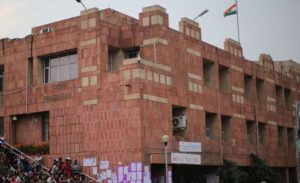
Clashes erupt at JNU campus after students’ union poll results, 6 ABVP leaders critically injured

Following the announcement of the Jawaharlal Nehru University Student’s Union (JNUSU) election results, major clashes erupted between Akhil Bharatiya Vidyarthi Parishad (ABVP) and those belonging to left-wing groups on September 17.

According to reports, six leaders of ABVP have been injured in the clashes and have been admitted to AIIMS.

Soon after the clashes a political blame game erupted as the leaders of the ABVP and the United Left accused each other of instigating violence at the campus.

Both the ABVP and the AISA have filed complaints at the Vasant Kunj police station.

ABVP in a statement said, “The targeted violent attacks by Left on ABVP students are a clear sign of an evil design unfolding in the campus. AISA-SFI and their allies have decided to turn things ugly in the JNU campus. Left wants turmoil in the campus.”

Devender Arya, Deputy Commissioner of Police (South West) said, “Yesterday at around 3 a.m, PCR calls about a scuffle between students in JNU were received. Subsequently, we have had discussions with university authorities, students and university professors.”

“Complaints have been received in PS VK North. Legal action is being taken on merit. The situation is under control now and normal. Police arrangements are in place,” Arya further said.

However newly-elected president of the JNUSU, N. Sai Balaji, said that at night, ABVP students randomly attacked some other students and he was called to the scene at Sutlej Hostel.

Balaji further said, “As the elected JNUSU president I went to ensure the safety of the students. Upon reaching, what I saw was mayhem. The mob led by Saurabh Sharma was baiting for the blood of any student and they were attacking students with sticks.”

Shutdown call by separatists affects life in Kashmir valley, security tightened

Shutdown called by the separatists has affected normal life adversely across the Valley in Jammu and Kashmir on Monday.

The shutdown by Joint Resistance Leadership (JRL) separatist conglomerate headed by Mirwaiz Umer Farooq, Syed Ali Geelani and Muhammad Yasin Malik was called against the killings of five militants and a civilian in Chowgam village of Kulgam district on Saturday.

All Shops, public transport, other businesses and educational institutions remained closed in Srinagar and the district headquarters of the Valley.

Train services between the Valley and Bannihal town of Jammu region have been suspended in view of the shutdown. All university exams that were previously scheduled for Monday have also been postponed.

Security arrangements have been put in place as Centre Reserve Police Force (CRPF) and police have been positioned in Srinagar city, along with other sensitive places in the Valley.

Rajiv Gandhi assassination case: SC asks victims’ families to file fresh petitions in 3 weeks

The Supreme Court on September 17 asked the families of the victims in Rajiv Gandhi assassination case to amend their petitions and file fresh petitions after three weeks.

The families of the victims have been urging the government to not release the convicts in the case.

Tamil Nadu Governor Banwarilal Purohit refuted reports in a section of the media that he had forwarded to the Central government the state government’s recommendation to release all the seven convicts in the case.

Raj Bhavan statement reads, “It is clarified that no reference has been made to the Ministry of Home Affairs in the matter. The case is a complex one and involves the examination of legal, administrative and Constitutional issues.”

TN governor said that a decision on the issue would be taken in a “just and fair manner” in accordance with the constitution.

“A section of media has been reporting that in the matter of the release of the convicted prisoners undergoing life imprisonment for involvement in the assassination of former Prime Minister Rajiv Gandhi, a reference has been made to the Ministry of Home Affairs, Government of India,” a statement issued by the Raj Bhavan reads.

 Rajiv Gandhi was assassinated by a suspected Liberation Tigers of Tamil Eelam suicide bomber along with 14 others in May 1991 during an election rally in Sriperumbudur in Tamil Nadu.

Families of other 14 victims have been opposing the release of the convicts after the All India Anna Dravida Munnetra Kazagham led TN government recommended to get them out of prison.

MOST POPULAR

HOT NEWS