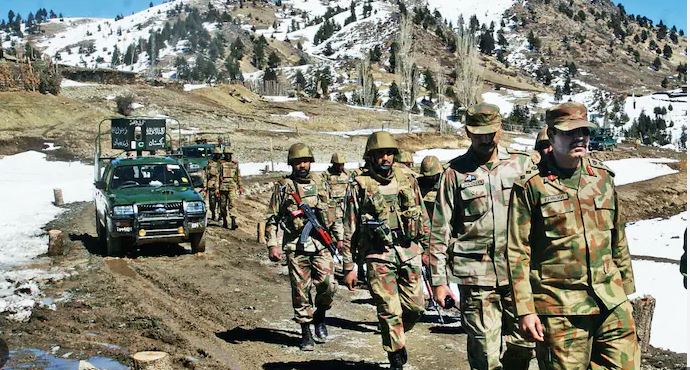
Srinagar – Pakistani troops allegedly breached the ceasefire and crossed into Indian territory along the Line of Control (LoC) in Jammu and Kashmir’s Poonch district, a defence spokesperson said on Wednesday.
Reports indicate that the intrusion and ceasefire violation occurred at around 1:10 pm on Tuesday. In response, Indian troops carried out a “controlled and calibrated” retaliation. So far, the Indian Army has not reported any casualties on the Pakistani side.
According to official sources cited by the Press Trust of India (PTI), five Pakistani soldiers were injured following an explosion and the subsequent exchange of gunfire.
Jammu-based defence PRO, Lt Col Suneel Bartwal, said that a landmine blast took place in the Krishna Ghati sector due to the Pakistani Army’s incursion across the LoC, which was followed by unprovoked firing and a ceasefire violation.
“Our troops responded effectively in a controlled and calibrated manner. The situation is under control and is being closely monitored,” he said.
The Indian Army has reiterated the importance of maintaining the 2021 agreement between the Director Generals of Military Operations (DGsMO), which was established to ensure peace along the LoC. Since its renewal on February 25, 2021, ceasefire violations have been relatively rare.
Pakistan’s media is in overdrive, accusing India of fueling unrest in Balochistan and backing the Afghan Taliban. It sure has caused anxiety in New Delhi, but India’ s reluctance to be drawn to any discussion on this issue appears to be justified. by Gopal Misra
The Pakistani media’s recent outbursts against India’s growing proximity with the Taliban regime in Kabul, especially in the context of the Baloch uprising, has been causing anxiety in India. The response of the Indian foreign office, however, has either been subdued or quiet.
On the other hand, the news dailies and television channels across Pakistan have been blaming India for the Baloch rebellion as well as the violence unleashed by the Tehrik-e-Taliban of Pakistan (TTP) in the areas bordering Afghanistan. The situation is worsening with each passing day in the Khyber Pakhtunkhwa or KPK and Balochistan.
The apprehension among the foreign affairs scholars is natural that in a bid to keep the people subjugated and for diverting their attention, Islamabad appears to be blaming India for the escalation of the ethnic conflict. It may be a repeat of the 1971 war with India. The situation, however, witnessed a sudden change during the third week of March this year, when the Trump Administration decided to drop Sirajuddin Haqqani and two others from its terror list. They belonged to the dreaded Haqqani network. Sirajuddin had recently been serving as the interior minister in the Taliban regime. He, however, has been sacked amidst the reports that he was conspiring with the Pakistani secret police, Inter-services Intelligence (ISI) to dethrone Taliban in Afghanistan.
It appears that with their names removed from the American list of terrorists, the US may be trying to broker peace between the Afghan Taliban and the Haqqanis.
The proximity between the ISI and Haqqanis can be traced to the eighties, when they had jointly worked for creating a worldwide network of Islamists and Jihadists under the guidance and funding of the US-led West. The close relationship between the West and Muslim terrorists collapsed following the incident of the 9-11 of 2001, when the Haqqanis and al-Qaeda attacked New York and Pentagon. Further, their relationship worsened during the 20-year war between the Taliban forces and the US-led coalition army. During this period, the Pakistani military dictator Musharraf officially supported the West, but continued to support the Haqqanis in the army’s well protected centres. Later, Washington realized that for Islamabad, the US engagement provided it access to huge American support. The removal of the two other associates of Sirajuddin, Abdul Aziz Haqqani and Yayha Haqqani from the terrorists’ list also indicate that it could be followed by a new approach of the White House in dealing with the Taliban Government.
It might get financial assistance and later recognition. In these sensitive parleys, Islamabad has not been involved. The US has also withdrawn the reward of the 10 million USD for destroying the Haqqanis.
It, thus, not only finally thwarts the Pakistani strategy for penetrating the Taliban Government, but also shatters the dream of getting huge financial support from the US as a country engaged in the war against terrorism.
The impact of the US decision was also noticed during the recent visit of Sadiq Khan, a special Pakistani envoy deputed for negotiating peace with Kabul. He could not assert the agreement the Pakistani army wanted between Kabul and Islamabad. His earlier visit in 2023 had also failed, because it was led by the defence minister, Khwaja Asif, not known for the polite exchange necessary in such sensitive negotiations.
Meanwhile, it is also being evaluated on the implications of the recent appeal of Nawaz Sharif, a three times prime minister of Pakistan, asking for the redressal of the grievances of the people of Balochistan and KPK by initiating discussion for a solution to end the insurgency.
Olive branch
It is difficult to assess the impact of these recent developments immediately: whether these happenings are being done in coordination or took place separately. The removal of the Haqqanis from the terror list, stated to be bargained for the release of an American citizen, George Blazmann, does not fit in the larger picture of changing alliances and loyalties in the region. The quiet return of the former US special envoy for Afghanistan, Zalmay Khalizad, who reportedly has played a key role in the release of the American captive, in the US-Afghan talks, might lead to a paradigm change in the present military-strategic environment in the region. The olive branch from Trump is being reciprocated by Nawaz Sharif. He has stated that “there cannot be a military solution to the ongoing rebellion in Balochistan”.
Since April 2022, when the then Prime Minister, Imran Khan, was ousted from office through a no -confidence motion in the National Assembly, Nawaz Sharif has been playing the role of a guide and helping the army and other institutions to regain their prestige without holding a government position.
It is recalled that in spite of being in the shadows, he didn’t indulge in any political rhetoric despite being jailed and humiliated. He already has partially returned to the country’s politics by becoming the president of the ruling Pakistan Muslim League (Noon) or PML-N. His return to the national politics is expected to give the much needed stability to the Pakistani state. With this backdrop, he might also prevail upon the Pakistani army chief, Asim Munir, to avoid any confrontation with India and Afghanistan. The region may soon be facing a new play of international power games with the return of the US interests in this fluid political situation. The moves of the American special envoy to the region need to be watched carefully; whether his bid for a peaceful resolution to usher in peace in the region has a long-term agenda or just a goodwill mission.
The US decision to remove the Haqqanis from the terror list, however, indicates that a new understanding between Kabul and Washington in near future cannot be ruled out. These developments might also adversely affect the Pakistani aspirations in the region.
War cry
The Pakistani media has launched a full throated campaign against India for supporting the Afghan Taliban Government and the Baluch uprising. It must have caused anxiety in New Delhi, but India’ s reluctance to be drawn to any discussion on this issue appears to be justified.
There is a growing realization in New Delhi that the ongoing blame game against India by Pakistan could be an effort to push a conventional war between the two countries to camouflage the failure of the present hybrid government in Islamabad in giving justice to its minorities.
It appears that these developments are also adversely affecting the fragile social relationships among the people of provinces. The anger against the uniform is being diverted towards the people of Punjab, perhaps they constitute a majority in the defence forces.
The solution to the ongoing conflicts within Pakistan could be resolved only by sharing natural resources with the people of provinces and also by upholding their democratic rights. The army has to return to the barracks, but its officers have been using proxies to do illegal mining of rare metals in Balochistan with the help of the Chinese companies. It is difficult to stop them from this loot. The situation appears to be worsening with each passing day.
The Sadiq Khan mission to Kabul appears to have finally failed, but for finding an amicable solution the communication between the two friendly neighbors must continue. The Taliban regime had refused to take the threats of the Pakistani army; instead its acting foreign minister, Amir Khan Mustaqi, told Sadiq Khan to take appropriate steps for normalisation of their ties. It means that Pakistan should remove trade barriers and deal with the problems of the Afghan refugees with a friendly approach.
The new reservation policy in Jammu & Kashmir has sparked a heated debate, with data revealing a stark regional disparity. With quotas overwhelmingly favouring Jammu over Kashmir, opposition leaders and student protesters are demanding urgent reforms. A report by Riyaz Wani
The issue of reservations has dominated the budget session of J&K Assembly, with opposition parties, except the BJP, aggressively raising the issue. The debate came to a head when in response to a question by the People’s Conference leader Sajjad Gani Lone, the government shared the data on the reservation benefits enjoyed by the people in Kashmir valley and the Jammu region.
The figures tabled in the Assembly showed all scheduled caste (SC) beneficiaries from Jammu, and not a single recipient from Kashmir. Similarly, 85.3% of those benefiting under the scheduled tribe (ST) category are from Jammu, and only 14.7% from the Valley. Ditto for economic weaker section (EWS) category: 92.3% of the beneficiaries are from Jammu and a mere 7.7% are from Kashmir. Jammu-based candidates also dominate across other categories, such as the Actual Line of Control (ALC) and International Border (IB).
The data shocked Kashmiri politicians, some of whom said that the disparity in terms of the distribution of the reservation benefits between the two regions was beyond what they had imagined it to be.
“This is a shocker regionally – loss due to reservation much higher than anticipated,” Lone tweeted. “Kashmir as region is far behind. The net loss of quotas to the Kashmiri speaking population is of a much higher scale than we had thought. The whole reservation concept is rigged against the Kashmiri-speaking population and against STs or EWSs living in Kashmir.”
This despite the fact that Kashmir valley comprises around 55% of J&K’s population, as per the 2011 census. Government jobs mean a lot for a region that has a 32% unemployment rate and the government sector is a major employer in absence of a robust industrial sector and limited unorganised private sector.
The elected government headed by Omar Abdullah has formed a cabinet sub-committee to take stock of the issue and address the imbalance. The committee has been given six months to complete its report.
The reservation policy has also been challenged in the J&K High Court. The petitioner, Zahoor Ahmad Bhat, who previously challenged abrogation of Article 370 in the Supreme Court, along with co-petitioners, argues that the 2024 amendments made by the Jammu & Kashmir Union Territory government are unconstitutional and violate principles of equity and fairness.
According to the petitioners, the amendments have restructured reservation percentages, reducing the open merit category from 57% to 33% and the Resident of Backward Areas (RBA) category from 20% to 10%. In contrast, reservations for Scheduled Tribes have been increased from 10% to 20%, social castes from 2% to 8%, the Area Line of Control from 3% to 4%, and physically handicapped candidates from 2% to 4%. New categories introduced include children of defense personnel (3%), police personnel (1%), and sports achievers (2%), among others.
The petition contends that these changes unfairly disadvantage open merit candidates, constituting “unwarranted discrimination” and violating the Indian Constitution. It argues that the amendments are harmful to the broader population of Jammu & Kashmir, which reportedly includes 70% open merit candidates and over 20% RBA candidates.
“The reservation policy is intended to uplift underprivileged classes in proportion to their population. However, this should not come at the expense of open merit and RBA category candidates, who represent nearly 80% of the population in Jammu & Kashmir. These changes violate the fundamental rights of the petitioners and other unemployed youth, and must be overturned,” the petition states.
Before the amendments, the Jammu & Kashmir Reservation Rules of 2005 allocated 57% of positions to open merit candidates and 43% to reserved categories. The petitioners note that open merit candidates—those not benefiting from any reservation—had traditionally secured the majority of government positions under the earlier framework.
Reservation issue has also been raised forcefully by the ruling party politician and Member of Parliament, Aga Ruhullah Mehdi. On December 23, Mehdi staged a peaceful protest outside J&K Chief Minister Omar Abdullah’s residence, calling for the rationalization of the new reservation policy in the union territory that has reduced the share of the open category students to just 30 percent. Ironically Ruhullah protested against his own government and in this, he was accompanied by the opposition parties, the PDP and the Awami Ittehad Party led by jailed Engineer Rashid. The PDP leaders like Waheed Para and Iltija Mufti were by the side of Ruhullah.
Ruhullah was also joined by students from different areas of Kashmir, who were seeking scrapping of the reservation policy
“We want a proportionate representation for all communities,” Ruhullah told the gathering at the time. “The government must ensure fairness and equality in its policies. The current system marginalizes many deserving groups,” Mehdi said, urging the government to revise the policy for a more inclusive and equitable approach.
Drastic reduction in quota to open merit category has hit the open merit category hard in both Jammu division and Kashmir Valley. More so, the valley, which doesn’t have the proportionate category classes. The reduction followed the Lieutenant Governor administration’s decision early last year to raise reservation for Paharis by 10 percent and that of the other tribes and the Other Backward Classes by 8 percent.
According to the 2011 census, 69% of J&K’s population falls under the general category, which includes those not classified under Scheduled Castes, Scheduled Tribes, and Other Backward Classes. But while reservations in the rest of the country have been capped at 50%, in J&K they have been fixed at 70 percent.
Where do we go from here? There is no easy answer to this question. Although Chief Minister Omar Abdullah heads a majority government and on this issue enjoys the support of the opposition barring the BJP, it may not be amenable to an easy solution. The BJP, which in the first place, gave these disproportionate reservations to underprivileged classes is likely to oppose it tooth and nail. The National Conference-led government is also likely to face a strong opposition in parts of Jammu dominated by these classes. On the other hand, inability to correct the regional imbalance in the distribution of job quotas will cost the party dearly in the Valley, its core constituency. The government could, however, be bailed out by a favourable judgement by J&K High Court in the case. But an unfavourable judgement will only further increase his problems.
“True, reservation policies are designed to uplift those in need, regardless of their geographical location, but the current arrangement is clearly skewed heavily in favor of Jammu at the cost of Kashmiri-speaking populations,” an editorial in a local daily read. “This is neither just nor in line with the fundamental ideals of reservation. This is a gross injustice.”
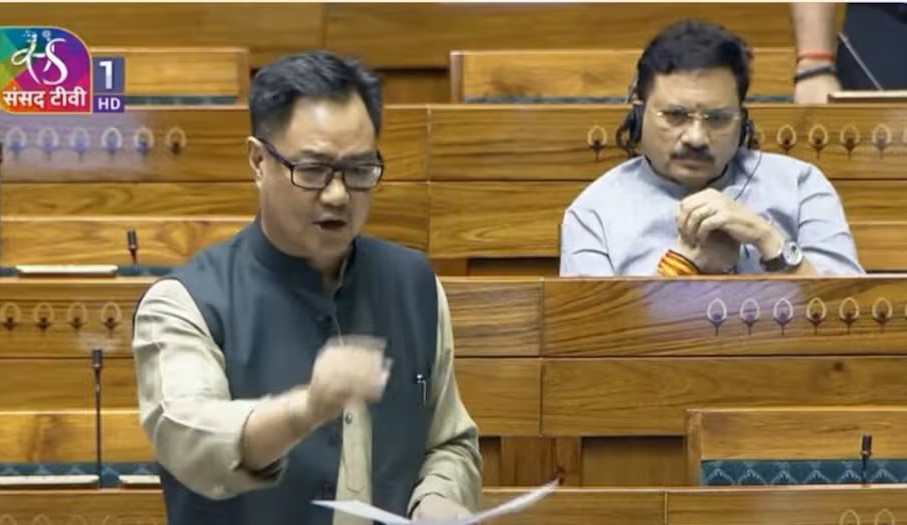
The eight-hour debate on the Waqf Amendment Bill, proposing changes to laws that decide how muslim charitable properties are administered started on Wednesday with union minister Kiren Rijiju tabling the Waqf (Amendment) Bill 2025 in the Lok Sabha for consideration and passage.
The bill seeks to improve the administration of Waqf properties, introduce technology-driven management and ensure transparency.
Addressing the House, the minister said that over 97.27 lakh petitions, memorandums were received by the Joint Parliament Committee through physical and online formants and the JPC had gone through each of them before finalizing its report.
The minister said as many as 284 delegations submitted their views on the bill besides the Waqf boards of 25 states and Union Territories.
Legal luminaries, charitable organisations, academicians and religious leaders, among others, have also submitted their opinions, he said.
He bagan with launching jabs at Congress and said that the party would have given the Parliament to the Waqf if not stopped as it had made significant changes when it was in power in the centre.
“A case going on since 1970 in Delhi involved several properties, including the Parliament building,” he added.
He said if we would not introduce this bill today, the building we are sitting in could have been claimed as Waqf property. “If Prime Minister Narendra Modi did not come to power, several other properties would also have been denotified,” the minister said.
The Waqf Amendment Bill was first tabled in the Lok Sabha in August last year amid furious protests from the opposition which slammed the proposed law as ‘draconian’.
Later it was sent to the Committee which filed its report in February after Opposition MPs said their views had been ignored.
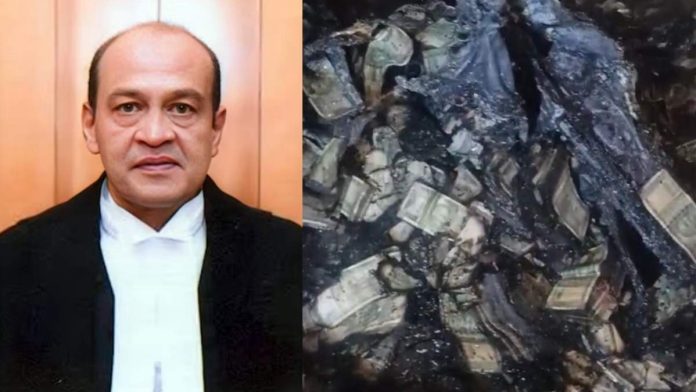
The Supreme Court’s inquiry into sacks of burnt cash found at Justice Yashwant Verma’s residence has sparked judicial turmoil. His repatriation to Allahabad High Court amid transparency concerns have intensified debates on judicial accountability. A report by Mudit Mathur
The Supreme Court of India has initiated a three-member in-house inquiry into allegations surrounding the discovery of sacks of burnt cash in a storeroom at the official residence of Justice Yashwant Verma, a senior Delhi High Court judge, after a fire broke out on March 14, 2025. This inquiry has led to his repatriation to the Allahabad High Court, sparking protests and an indefinite strike by Allahabad lawyers. Justice Verma was in Bhopal when the fire broke out, while his daughter and his elderly mother were at home. Justice Verma has denied any knowledge of the cash, suggesting it may be part of a deep conspiracy against him.
Chief Justice of India Sanjeev Khanna has taken a historic step towards transparency by releasing redacted inquiry documents, including a preliminary report submitted to him by Delhi High Court Chief Justice Devendra Upadhyay, and annexing Justice Verma’s categorical denial of any knowledge of the cash found on his premises. The uploaded material also features a brief video showing a firefighter collecting a pile of charred currency notes from the still-smouldering storeroom, along with two photographs.
These efforts reflect a shift towards openness, contrasting prior cases of judicial impropriety of sitting judges of the apex court. The controversy has raised concerns about judicial accountability and public trust in the system, while a Public Interest Litigation challenges the investigation process.
Amazingly,the shocking incident came into the public domain a week later, on March 21, 2025, which raises many unanswered questions, including the ownership and disappearance of the cash and blatant inconsistencies in the handling of evidence by the Delhi Police and Fire Services.
In this context, several questions arise from public discourse. Who brought and kept the currency notes, if any, in the storeroom, and when? Most importantly, who did they belong to? Why did the Delhi Police not register an FIR under Section 326(f) of the Bharatiya Nyaya Sanhita, which prescribes punishment for arson, to determine whether the fire was an act of arson or an accident, such as a short circuit? Why did the Delhi Police not cordon off the scene of the crime? Who removed the debris or burnt currency notes (if any) on the morning of March 15, 2025? Why were the currency notes, if any, found in the storeroom not shown to Justice Verma’s family members, as he has claimed? Where are the remains of the burnt currency notes visible in the video shared by the Commissioner of Police, Delhi, with Chief Justice Upadhyay? Were they seized? If not, why? Who saw the burnt currency notes? Have the remains been disposed of? If so, why, and by whom? Who recorded the video? Where is the CCTV footage of entry and exit to Justice Verma’s bungalow premises and storeroom? Finally, does an in-house inquiry have the authority to take evidence on oath and subject witnesses to cross-examination? If not, how will the inquiry reach a definitive conclusion?
Justice Yashwant Verma was appointed as a judge of the Allahabad High Court in October 2014. Hailing from a distinguished family of legal professionals, he is the son of the late Justice A.N. Varma, a former Allahabad High Court judge, and the nephew of the late S.N. Varma, a prominent senior advocate. In October 2021, the Supreme Court collegium transferred him to the Delhi High Court. Born in 1969, Justice Verma is set to retire in 2031 unless he is elevated to the Supreme Court, which would extend his retirement to 2034. Until recently, he was widely regarded in judicial circles for his impeccable career and promising future.
The controversy has prompted an in-depth investigation, with Chief Justice of India (CJI) Sanjiv Khanna forming a three-member committee to examine the matter and repatriating Justice Verma to his parent Allahabad High Court. The in-house committee, comprising Justices Sheel Nagu, G.S. Sandhawalia, and Anu Sivaram—Chief Justices of the Punjab & Haryana and Himachal Pradesh High Courts, and a judge of the Karnataka High Court, respectively—has been tasked with conducting an inquiry into the allegations against Justice Verma.
Chief Justice of India (CJI) Sanjiv Khanna’s decision to release official documentation—albeit with “some portions and names redacted … to maintain confidentiality”—marks a significant departure from the Supreme Court’s earlier approach to allegations against its judges. In recent years, cases such as the sexual harassment allegations against former CJI Ranjan Gogoi (now a Rajya Sabha MP) and the land deal controversy involving Justice N.V. Ramana were handled with far less transparency. This move signals a shift towards greater openness in addressing judicial impropriety.
The Supreme Court Collegium, in its meetings on March 20 and 24, recommended the transfer of Justice Yashwant Varma from the Delhi High Court to the Allahabad High Court. This decision has sparked significant backlash from the Allahabad High Court Bar Association, which passed a resolution opposing the transfer and called for a review of Justice Varma’s judgments during his tenure at both courts to restore public confidence in the judiciary.
The Allahabad High Court Bar Association has also initiated an indefinite strike, starting March 25, to protest against the transfer. Its president, Anil Tiwari, has announced plans to involve other bar associations in Lucknow and demanded that the Chief Justice of India (CJI) allow investigative agencies like the CBI and ED to file an FIR and conduct a thorough investigation. The association further urged the CJI to recommend impeachment proceedings against Justice Varma.
The Bar Association’s statement, titled “We Are Not a Trash Bin,” criticized the transfer and raised concerns about the judiciary’s credibility. Meanwhile, a Public Interest Litigation (PIL) has been filed in the Supreme Court, challenging the three-member committee formed by the CJI to investigate the matter and seeking the registration of an FIR against Justice Varma. This controversy has intensified debates about judicial accountability and transparency.
Key events and timeline
March 14, 2025:
A fire broke out at around 11:30 p.m. in a storeroom near the office at 30, Tughlak Crescent, New Delhi, the official residence of Justice Varma. A PCR call was made at 11:43 p.m. by his private secretary, but no separate call was made to the fire department. Justice Varma was in Bhopal at the time, while his daughter and his elderly mother were at home.
March 15, 2025:
The Commissioner of Police, Delhi, informed Delhi High Court Chief Justice D.K. Upadhyaya about the fire and the discovery of burnt cash in sacks. The prima facie cause was determined to be a short circuit.
Chief Justice Upadhyaya was in Lucknow at the time but later briefed CJI Khanna in the evening.
Justice Varma returned to Delhi.
The Registrar-cum-Secretary to Chief Justice Upadhyaya visited the scene, accompanied by Justice Varma.
March 16, 2025:
The Registrar-cum-Secretary submitted an inspection report detailing the burnt remains in the storeroom.
The Commissioner of Police reported that a security guard claimed debris and half-burnt articles had been removed that morning.
Chief Justice Upadhyaya returned to Delhi and met CJI Khanna.
March 17, 2025:
Chief Justice Upadhyaya met Justice Varma at the Delhi High Court Guest House.
Justice Varma insisted that the storeroom was used for discarded household items and was accessible to various staff members, including gardeners and CPWD personnel.
Chief Justice Upadhyaya showed Justice Varma photographs and videos from the Commissioner of Police, prompting Varma to suggest a conspiracy against him.
March 20, 2025:
Chief Justice Upadhyaya shared evidence, including photos and a video, with CJI Khanna.
The Supreme Court Collegium decided to transfer Justice Varma to the Allahabad High Court.
Chief Justice Upadhyaya agreed to the transfer, stating it was in the “interest of better administration of justice.”
March 21, 2025:
The story was reported in the media.
Chief Justice Upadhyaya formally submitted his report to CJI Khanna, suggesting that the matter warranted a deeper probe.
CJI Khanna instructed Chief Justice Upadhyaya to obtain a written response from Justice Varma explaining the presence of cash and its source as well as identifying who removed the burnt money.
Call record details and security deployment logs were requested.
March 22, 2025:
Justice Varma submitted a written response, strongly denying any involvement and dismissing allegations as “preposterous.”
Chief Justice Upadhyaya forwarded Justice Varma’s response to CJI Khanna, along with staff details and call records.
The Supreme Court issued a statement confirming that Justice Varma would not be assigned judicial work for the time being.
March 23, 2025:
The Supreme Court made the Delhi High Court’s inquiry report and related documents public, including the video evidence.
A three-member committee, including Justices Sheel Nagu (Punjab & Haryana HC), G.S. Sandhawalia (Himachal Pradesh HC), and Anu Sivaraman (Karnataka HC), was formed to conduct the probe.
March 24, 2025:
The Supreme Court reiterated its decision to repatriate Justice Verma to Allahabad High Court.
March 25, 2025:
The committee visited Justice Verma’s residence to examine the site.
Allahabad lawyers began an indefinite strike protesting his transfer.
From Mamata Banerjee’s show of authority to Mayawati’s sudden turnarounds over their nephews, legacy politics continues to overshadow merit, putting family ties above loyalty and ability. BY KUMKUM CHADHA
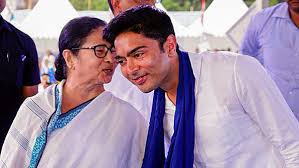
West Bengal Chief Minister Mamata Banerjee did right when she made it clear that she is supreme and her’s is the last word in the Trinamool Congress or the TMC: a Party she formed after parting ways with the Congress, nearly three decades ago.
It was in December last year that Banerjee took the unprecedented step of saying: “I am still there. I am the final word”.
Obviously, this was not an off the cuff remark. It was necessary to clear the confusion about a political heir.
It was in 2011 that Banerjee’s nephew Abhishek made a soft entry into politics through the youth wing. His aunt, Mamata Banerjee, facilitated his entry by creating a new platform, Yuva.
It was a parallel organization to the youth wing headed by mass leader, then in the TMC, Suvendhu Adhikari.
Abhishek’s entry caused enough heartburn: it not only undermined Adhikari’s clout and hold but also sent a signal of the bloodline getting precedence over loyalists. It is therefore not without reason that when Adhikari quit the TMC, he had said: “I did not drop in using a parachute nor did I take a lift. I took the stairs, step by step”.
This is clearly not what Abhishek can say about himself.
Within three years of his steering Yuva, he took the plunge in active politics. In 2014, Abhishek contested and won his first election from Diamond Harbour Lok Sabha constituency.
In 2015, when Mamata Banerjee shifted all her belongings, including her treadmill, to her nephew’s residence in New Delhi it signaled that her bloodline will carry forward her political legacy.
That perhaps heralded the advent of Abhishek being a clear number 2 in the Party.
Even though it is not clearly spelt out, the youth wing is seen as a springboard for successors. Remember Congress’s Sanjay Gandhi who too made his debut through the Indian Youth Congress and later rose to be a de facto Prime Minister often overturning decisions that his mother Indira Gandhi took.
While Abhishek could not emulate Sanjay’s heft and style, he surely accelerated his political rise “by taking the lift,” as Adhikari put it, instead of taking the stairs “step by step”.
Abhishek is Mamata Banerjee’s brother’s son. An MBA, from the controversial IIPM, headed by Arindam Chaudhary, Abhishek’s lavish wedding was in stark contrast to his aunt’s hawai chappal austerity.
For the record, IIPM is defunct amid allegations of fraud. As for Mamata Banerjee, her personal style is characterized by a jhola (cotton bag) and trademark hawai or rubber chappals.
The familial ties were soon under a strain with a flip-flop over Abhishek’s position and status in the Party. Compounding the situation was his name being linked to a money laundering case in a coal scam among others.
Last year, Abhishek announced that he would take a “short hiatus” from the Party’s politics. On her part, Mamata Banerjee inducted her loyalists to key posts after the Lok Sabha elections, completely ignoring Abhishek’s recommendations. The distancing was kind of complete. That Mamata Banerjee had to remind her Party cadres about her authority substantiates this.
Irrespective, Banerjee with her I am the final word assertion has done away with all speculation about her political heir.
This is quite like another aunt-nephew story where Bahujan Samaj Party chief, Mayawati, made it clear that there will be no successor in her lifetime.
There is a backstory to this: it is a story about the rise and fall of another nephew; about his waking up one morning and being bereft of what had been bestowed; it is about the whim and fancy of his benefactor. It is about being symbolically crowned and then being dethroned; it is about a smile and a frown; it is about losing favour and the package deal that came with it: the entitlement, the legacy and trappings of political power.
It is the story of Akash Anand whose rise and fall has been a subject of intense debate within the Party.
Once labelled as Mayawati’s political heir, he fell from grace earlier this month after she axed him for a second time within a year.
The BSP has officially stated that Akash was removed from all party posts. It was in 2019 that Akash emerged on the political scene. By 2023, he was appointed the national coordinator: seen as a number 2 kind of a position.
However, his meteoric rise was cut short when ahead of the Lok Sabha polls last year, Mayawati axed him.
In June last year, she reappointed him as national coordinator, only to show him the door in less than a year. Mayawati’s angst: Akash is selfish, arrogant and under the influence of his father-in-law Ashok Siddharth.
Mayawati accused Ashok Siddharth of creating divisions within the Party aimed at weakening it. What irked Mayawati was Siddhartha’s influence over Akash which in her view led to his wavering political approach: “He not only damaged the BSP but also derailed Akash’s political career”, Mayawati said.
Out in the cold, Akash Anand was faced with a what next dilemma, amid reports of the Congress inviting him to join.
Aunts and nephews apart, this narrative is about nepotism and legacy. It is, to borrow Adhikari’s phrase, about parachuting or taking the lift rather than the stairs, step by step. It is about the rot in our political system: about how deeply the legacy quotient is entrenched in the system; about its strong roots and about it dominating the inner dynamics of a particular party.
This is not about the Trinamool Congress or the Bahujan Samaj Party; neither is it about Mamata Banerjee or Mayawati or about women leaders often charged with being erratic and whimsical. This is about the malaise which is spread across political parties.
The Congress, it is well known, is gripped by the son syndrome, so to speak. Party patriarch Mrs Sonia Gandhi, would do what it takes to push ahead Rahul Gandhi.
As for the BJP while Prime Minister Narendra Modi has no family or nephews to push, there are many within the BJP who are guilty of nepotism. For starters, Union Minister Amit Shah’s son Jay’s meteoric rise from a businessman to Chairman of the International Cricket Council is there for everyone to see.
In other parties too, including the Samajwadi Party, its Chief Akhilesh is a product of nepotism. Or Tejashwi Yadav, who served two terms as Bihar’s Deputy Chief Minister.
Akhilesh Yadav is Party founder Mulayam Singh Yadav’s son. His wife Dimple is an MP.
Tejashwi Yadav is Lalu Prasad Yadav’s son. Yadav senior has served as MLA, MP, Union Minister and Bihar’s Chief Minister. He was later convicted in a fodder scam and put behind bars.
Down south, the list is equally revealing. If the DMK is a family run party in Tamil Nadu, in Andhra Pradesh, it is Chandrababu Naidu’s family that rules the roost. His son Nara Lokesh is a serving minister in the state ruled by his father.
It is against this backdrop that one would stop and ask: is nepotism justified? Is it fair to deny the deserving and allow parachuting of those who boast of a bloodline? Should privilege outdo merit?
The questions are complex and the answers difficult to find. And till one does, one must learn to live with the grim reality of nepotism and legacy.
The suspension of IAS officer Abhishek Prakash over bribery allegations exposes a deep nexus of corruption in project approvals, with possible links to money laundering now under ED scrutiny, threatening to derail UP CM Yogi’s ambitious investment drive. A report by Mudit Mathur
Uttar Pradesh chief minister Yogi Adityanath has suspended Industrial Development Department secretary and Invest UP chief executive officer (CEO) Abhishek Prakash, a 2006-batch IAS officer, over serious allegations of soliciting a bribe from a businessman in exchange for project approval. The incident underscores how corruption and irregularities in project clearances continue to hinder development plans in the state, despite mega-investment summits organised by the chief minister to attract investors. The Enforcement Directorate has also stepped in to investigate possible money laundering in the case.
The chief minister received a complaint from Vishwajit Dutt of SAEL Solar P6 Private Limited, stating that his group had approached Invest UP to set up a plant for manufacturing spare parts for solar cells and solar energy. They submitted their proposal both online and offline. An officer from the organisation provided Dutt with the mobile number of a private individual, Nikant Jain, who allegedly facilitates bribe payments for Abhishek Prakash. When Dutt contacted Jain, he was asked to pay a 5% advance commission for project approval. Upon refusing, Jain allegedly warned, “Your project will not be approved in the high-powered committee, and ultimately, you will have to route it through me.”
The chief minister immediately deputed senior officers to verify the allegations. After the preliminary inquiry confirmed them, the government filed an FIR against Abhishek Prakash and middleman Nikant Jain. Jain allegedly demanded a 5% commission on behalf of Prakash to facilitate approvals for the solar manufacturing project.
The FIR against Abhishek Prakash includes charges under Section 308(5) (extortion) and Sections 7, 12, and 13 of the Prevention of Corruption Act. It also states that Jain pressured the applicant to pay an advance, suggesting that bureaucratic hurdles were deliberately created to extract bribes. Police have arrested Nikant Jain and intensified their investigation to identify other officials involved in the case. They also revealed that Jain has a history of fraud and financial crimes.
The Enforcement Directorate (ED) has launched a probe into the alleged 5% commission demand that led to Abhishek Prakash’s suspension. The Lucknow Zone office of the ED has sought full details from city police regarding the FIR and the arrest of Nikant Jain.
The ED is likely to take Nikant Jain into custody once relevant records are scrutinised. Jain and his brother, Sukant Jain, have been linked to 12 registered companies. The agency plans to analyse their transactions and business models to track the money trail, suspecting that some of these firms may be shell companies used for money laundering. IAS officer Abhishek Prakash may also be summoned for questioning once sufficient evidence is gathered.
The ED is examining the Detailed Project Report (DPR) of the solar plant, the approval process, and the officials involved. Investigators plan to interrogate Nikant Jain after reviewing his bank account details and may then summon Abhishek Prakash to record his statement.
Abhishek Prakash’s name had earlier surfaced in the Defence Corridor land acquisition scam in Lucknow’s Bhatgaon area, which involved fraudulent disbursement of compensation claims and the misuse of government funds. A total of 16 officials, including Prakash, were initially found guilty in the matter.
Chief minister Yogi Adityanath has reiterated his government’s zero-tolerance stance on corruption, warning IAS and PCS officers of strict consequences if found involved in malpractice. Over the past eight years, the Uttar Pradesh government has suspended 11 IAS officers on corruption charges.
The Modi government’s grand millet campaign promised prosperity for small farmers, but Rajasthan’s Bajra growers feel betrayed. Despite Bajra being on the MSP list, they are forced to sell the crop at throwaway prices, raising uncomfortable questions. A report by Jag Mohan Thaken
While inaugurating the Global Millets (Shree Anna) Conference on March 18, 2023, the Prime Minister, Narendra Modi reiterated that the year 2023 was declared the International Year of Millets by the United Nations after persistent efforts by India. The Prime Minister informed that India now calls millets – ‘Shree Anna’.
Informing further that about 2.5 crore small farmers are directly involved in the production of millets in India, the Prime Minister noted that they faced the challenges of climate change even though they own very little land. “India’s Millet Mission – The campaign for Shri Anna will prove to be a boon for 2.5 crore farmers of the country”, the Prime Minister said. He pointed out that it is the first time after the independence that the government has taken care of 2.5 crore small farmers who grow millets (Bajra, Jowar, Ragi etc.).
He also added that many states have included Shree Anna in their PDS system and suggested that other states follow suit. He also suggested including Shree Anna in the mid-day meal so that children can get proper nutrition while also adding a new taste and variety to the food.
But has the Prime Minister’s concern about the millets campaign for Shri Anna proved a boon for 2.5 crore small farmers who grow millets? Why the farmers of Rajasthan, the largest Bajra grower state, producing 45% of Bajra of the country’s total produce, still have to sell their crop in the market at throw away prices?
Despite Inclusion in the Central List, why the Rajasthan farmers are deprived of MSP on Bajra? Allured by the promises of the BJP in its manifesto, publicised as Modi’s Guarantee, during Rajasthan state assembly election in 2023, the farmers diverted their vote support in favour of the BJP and defeated the Congress, so that they could get the MSP for their Bajra crop, but what did they get? Now they are perplexed on their decision, as the present BJP-led state government, despite its double engine support of the BJP-led centre, has totally rejected any suggestion for providing MSP on Bajra.
On March 20, Rajasthan Food and Civil Supplies Minister Sumit Godara said in the Assembly that after Prime Minister Narendra Modi declared coarse grains as Shri Anna, the support price of millet has increased and the farmers have got direct benefit from it, but in a written reply to the original question of MLA Pabbaram Vishnoi, the Minister accepted that during the Kharif marketing season 2021-22 to 2023-24, the target for purchasing millet at the minimum support price in the state has not been fixed and purchase has not been made accordingly.
When the state government is not procuring the millets (Bajra etc.) on MSP since 2021-22, despite inclusion in central MSP list, how the minister is claiming that after Prime Minister Narendra Modi declared coarse grains as Shri Anna, the support price of millet has increased and the farmers have got direct benefit from it? How Rajasthan farmers got benefitted from PM’s declaration, when not even a single grain of Bajra is purchased by the government on MSP? What a funny joke with the farmers!
The Government of India in its press release dated 18 March, 2025 states that government fixes minimum support prices (MSPs) for 22 mandated agricultural crops on the basis of the recommendations of the Commission for Agricultural Costs & Prices (CACP), after considering the views of the state governments and the central ministries/departments concerned. The release claims that the government procures cereals and coarse cereals through Food Corporation of India (FCI) and other designated state agencies to provide price support to the farmers.
But the question stands unanswered; why Bajra is not being purchased by the government on MSP in Rajasthan? Bajra is one of the crops which has been included in the MSP list by the centre.
Due to not extending MSP to Bajra, farmers of Rajasthan have to face a double-edged trouble, because most of the millet production areas are dependent on rain; when it does not rain, the farmers have to struggle to get even the grains to eat and if the rains are good and millet is produced in abundance, then due to the lack of minimum support price, they are forced to sell their millet crop at throw away prices.
Even Prime Minister Modi himself stated in his address March 18, that 2.5 crore small farmers are directly involved in the production of millets in India and they faced the challenges of climate change even though they own very little land. When PM himself knows the predicament being faced by the millet growers, why is the government not procuring their produce on MSP?
Govind Singh Dotasra, the President of Rajasthan State Congress, while raising the plight of Bajra grower farmers on his social media platform, FB, on March 21,2025 states, “One after the other, ‘Modi’s guarantee’ is turning out to be a bundle of lies. Exploitation of farmers is the truth of BJP’s rule.”
The state president adds, “Before the elections, Prime Minister Modi gave a guarantee to buy millets at the minimum support price. The BJP also promised to buy millets at MSP in its Sankalp Patra, but the hopeful farmers of the state who were deceived have got only disappointment so far. Now, the government is clearly refusing to buy millets at MSP.”
Dotasra raises the question, “Why does the Chief Minister, who calls himself a farmer’s son, not have the power to speak for the farmers? There is a BJP government both at the centre and the state, so why is the Chief Minister unable to take any decision in the interest of farmers?”
Dotasra asks, “Chief Minister ji.. what crime have the farmers of Rajasthan committed that the BJP government is giving them a step-motherly treatment.?”
Criticizing further, Dotasra adds, “Rajasthan is the leading state in millet production, the highest 42% millet production in the country takes place in Rajasthan alone. Just imagine, in a state where the average market production is 40 lakh tonnes, the government is buying only 3 thousand tonnes of millet, whereas in the neighbouring state of Haryana, 4.5 lakh tonnes of millet has been bought on MSP.” “This is a sheer fraud of the BJP government with the farmers,” he bristled.
On March 26, 2025, senior Congress leader and a former chief minister of Rajasthan, Ashok Gehlot, also tweeted, “Today, in a government programme, the Chief Minister commented on my tweets which highlighted the public’s complaints and the government’s shortcomings.”
Gehlot further asks, “Chief Minister, I want to remind you of a tweet of yours which is about two and a half years old, in which you were protesting against the Congress government demanding the purchase of millets on MSP.” Gehlot adds, “Chief Minister, your government is now going to complete one and a half years. There was a promise of purchasing millets on MSP in your manifesto too. Today, please tell us when are you going to start purchasing millets on MSP?”
The question – “Despite Inclusion in Central List, Why Rajasthan Farmers are Deprived of MSP on Bajra?”, still pinching the distressed farmers and now the helpless farmers are again waiting for the forthcoming assembly elections going to be held in 2028, as it is the tradition in Rajasthan to change the governing party in every alternate election. Will the ruling BJP rethink over its promise of providing MSP on Bajra in its 2023 election manifesto or has accepted the inevitable change in advance?
The need for transparency, accountability, and a balanced public-private approach will be critical to ensuring the space programme’s continued success and integrity. Most importantly, it could define the ethical exploration of space for the welfare of humankind. A report by Bijoy Patro
Sunita Williams, a name that resonates with the very essence of human exploration and boundless ambition, has etched herself into the hearts of millions, particularly in India. Her connection to the nation, through her father, Dr. Deepak Pandya’s journey from Gujarat to the United States, has forged an unbreakable bond, transforming her into a symbol of pride and inspiration. Williams’ extended sojourn aboard the International Space Station (ISS) in 2024, a mission initially slated for a mere eight days, captivated the imagination of a global audience, showcasing the extraordinary potential of the Indian diaspora and the remarkable heights they can attain (until it ended on 18 March This year).
Her unwavering composure, formidable technical acumen, and extraordinary resilience in the face of unforeseen delays and intricate technical challenges have further cemented her iconic status. Every news cycle that followed her mission was followed with great interest in India. Her eventual return on a SpaceX Dragon capsule, after the issues with the Boeing Starliner, added an unexpected twist, but did nothing to diminish her standing. Rather, it added to the drama of her journey, and made her a part of a larger story of the space business. In India, she is seen as a role model, especially for young girls, demonstrating that with determination and hard work, even the sky is not the limit.
Prime Minister NarendraModi tweeted, welcoming Sunita Williams and Butch Wilmore back to earth, describing Williams as a trailblazer and icon who has exemplified this spirit throughout her career.
Alluding to his new friend, Elon Musk, Modi tweeted “….. incredibly proud of all those who worked tirelessly to ensure their safe return.”
The politics of space: A race for monopoly?
The protracted mission of Sunita Williams and Butch Wilmore, which deviated dramatically from its original timeline due to persistent technical malfunctions with the Boeing Starliner, has ignited a profound and far-reaching discussion about the future of space exploration and the evolving power dynamics between public and private sectors. This incident has raised critical questions about the strategic direction of the American space programme and the potential for a private entity to exert disproportionate influence over a venture funded by public resources.
The first issue here concerns SpaceX and Boeing and how a shifting power dynamic in the United States and the shadow of influence have impacted on the erosion of trust.
Elon Musk’s SpaceX has emerged as a dominant and disruptive force, fundamentally reshaping the traditional landscape of the commercial space sector and challenging the established supremacy of legacy aerospace giants like Boeing. The company’s consistent track record of successful launches, coupled with the proven reliability of its Dragon capsules and its swift provision of a viable alternative to the beleaguered Starliner, has underscored a seismic shift in the space industry’s balance of power.
The close proximity of Musk’s business to influential political figures, including his past interactions with Donald Trump, has fuelled persistent speculation about potential favouritism and undue influence, raising critical questions about the integrity of the competitive landscape and the potential for a private entity to gain a near-monopolistic hold on ISS transportation, a facility built through the collaborative efforts of multiple nations and funded by public resources.
Boeing’s protracted struggles, characterized by repeated delays, intricate technical glitches, and escalating costs, have resulted in significant financial losses and irreparable reputational damage, eroding public trust in the company’s capabilities. The stark contrast between SpaceX’s efficiency and reliability has highlighted the evolving dynamics of space exploration, where agile and innovative private companies are increasingly leading the charge. The question now looms: can Boeing effectively recover its footing and regain its lost credibility, or is its once-promising space ambition destined to fade into the annals of history?
Musk factor at play
Secondly, it must be borne in mind that the Trump administration has slashed NASA’sbudget. This has come together with the erosion of oversight and the potential for unchecked influence.
NASA’s persistent budget constraints, particularly the closure of key offices responsible for independent analysis and long-term strategic planning, have raised serious concerns about the agency’s ability to maintain its essential oversight and strategic direction. According to reports, these cuts, driven by the Trump administration’s focus on streamlining government operations and reducing federal spending, risk increasing costs in the long run and inadvertently handing more influence to private entities like SpaceX.
The appointment of individuals with close ties to Musk, coupled with the substantial contracts awarded to SpaceX, has fueled accusations of preferential treatment and potential conflicts of interest, raising concerns about the agency’s impartiality and the potential for unchecked influence. Critics argue that this concentration of power could undermine NASA’s core mission, compromise its ability to act in the public interest, and lead to an over-reliance on a single private provider, potentially stifling innovation and competition.
Together with this, NASA’s diversity promises have taken a hit, as the Trump administration has mandated that the organisation drop its plans to land the first woman and a person of colour on the moon.
Previously, NASA had promised to send the first woman and the first person of colour to the moon as part of its Artemis programme – now in the bin following Trump’s anti-wokeness campaign.
Space programmes beyond US-Russia orbit
Thirdly, there is the issue of ISRO’s rising star and the potential for international collaboration and the diversification of space partnerships.
Amidst the challenges faced by the American space programme, the Indian Space Research Organisation (ISRO) has emerged as a successful and cost-effective player, demonstrating its growing capabilities in space exploration and its commitment to international collaboration. ISRO’s remarkable achievements, including the Chandrayaan lunar missions and the Gaganyaan human spaceflight programme, have garnered widespread international recognition and respect.
This success has prompted discussions about alternative partnerships and collaborations, with some suggesting that NASA should diversify its reliance on private American companies and explore international options, including potential collaborations with ISRO. The successful growth of the Indian space programme has also been noted as a potential avenue that NASA could pursue, when creating alternative partnerships, in order to guarantee future success, and create redundancy.
The potential for leveraging ISRO’s expertise and capabilities could provide NASA with a valuable alternative, fostering a more balanced and competitive space ecosystem and reducing the risks inherent in relying on a single provider. This would also open the door to a more diverse and resilient space programme, promoting collaboration and innovation on a global scale.
Eroding trust in the space programme’s integrity
Lastly and, perhaps, most importantly, is the concerns over cronyism, monopoly, the erosion of public trust, and the need for transparency in space programmes across the globe.
The situation surrounding the Starliner mission and the subsequent reliance on SpaceX raises critical questions about the extent of cronyism in the American space program. The close relationship between private companies and government agencies (not to mention the highest office in the United States working in tandem of the interests of Elon Musk, the world’s richest individual), coupled with substantial financial investments, is leading to allegations of undue influence and a potential monopoly, eroding public trust in the integrity of the space programme.
The public’s concern is understandable. The ISS, a symbol of international collaboration and scientific advancement, built with taxpayer funds from multiple nations, could soon be largely serviced by a single private entity. This concentration of power raises concerns about accountability, transparency, and the potential for abuse, undermining the public’s perception of fairness and impartiality. As the space race intensifies, the need for a balanced and competitive environment becomes increasingly crucial.
The potential for a private entity to wield disproportionate influence over a publicly funded infrastructure raises fundamental questions about public trust and the role of government oversight. Ensuring a fair and competitive space ecosystem is essential to safeguard the public interest and promote innovation, demanding greater transparency and accountability from both public and private stakeholders.
The prolonged stay of Williams and Wilmore on the ISS, and the subsequent reliance on SpaceX for their return, has highlighted the precarious nature of space exploration and the evolving dynamics between public and private sectors. As the future of space travel unfolds, the lessons learned from this mission will undoubtedly shape the trajectory of space exploration for years to come.
The need for transparency, accountability, and a balanced approach to public-private partnerships will be critical in ensuring the continued success and integrity of the space programme. Most importantly, it could define the ethical exploration of space for the welfare of all of humankind.
The way Sunita Williams and Butch Wilmore were stranded in space could likely recur again in this evolving area of frontier science research. But humankind must know how to handle the situation better, were it to happen once again.
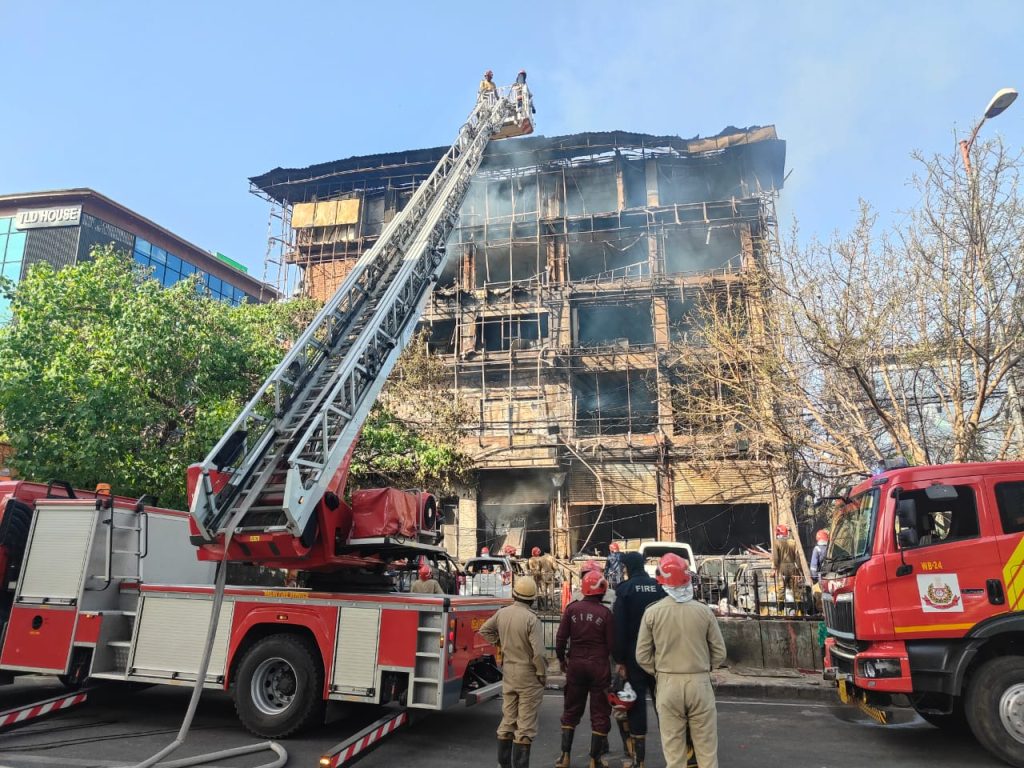
Several vehicles were gutted in a massive fire that broke out at a shopping complex in Central Delhi’s Jhandewalan area on Tuesday .
A total of 15 fire tenders were rushed to the spot to douse the blaze. No casualty has been reported yet.
According to the police, the fire broke out in the Anarkali Building and a Delhi Development Authority (DDA) shopping complex in the area. “Some vehicles parked nearby have also caught fire. Fire fighting is going on… No information about any persons trapped. It will have to be checked once the fire is doused,” said Harsha Vardhan, Deputy Commissioner of Police (Central).
Photo: Naveen Bansal
As per the Delhi Fire Service Deputy Fire Chief SK Dua, “Delhi Fire Service received a call at 2:27 pm of a fire in Jhandewalan Extension. Fire tenders were rushed as soon as information was received. Seeing the gravity of the fire, it was categorised as medium. Twenty-five fire tenders are present at the spot. The fire is under control. Seven-eight cars and a couple of two-wheelers came in contact with the fire. No casualties have been reported. We believe the cause of the fire is because of a blast in the AC compressor.”
This is the second incident of fire in Delhi in a day. At 7.35 am, the Delhi Fire Services received a call about a blaze in a slum cluster in New Seelampur, and rushed seven fire tenders to the area.
Delhi Fire Service officials said the fire in two shanties was doused, and there were no reports of any injuries or casualties.