


Page 19 - 31OCT2018E
P. 19
CoverStory                                                                                      AGRICULTURE


 SPIRALLING DIESEL PRICES  he owes to the banks. In this case, ultimately he finds
 Hike in the fuel prices adds burden on farmers di-  himself caught in debt trap and commits suicide. The
 rectly and indirectly. Direct impact is in the form of   banks have Debt-Swap Scheme to free the farmers
 increase in the diesel price. Indirect impact is felt in   from loans due to the moneylenders, but progress of
 the garb of revised prices of all inputs. The hike in   the scheme is not satisfactory.
 diesel price from an average  48 per litre to  80 per   Punjab, for example, is an agriculturally prosper-
 litre has increased the cost of cultivation. The cost of   ous state with almost 100 per cent public procure-
 fuel price is built into all the goods and a service pur-  ment of food-grains (wheat and paddy). Farmers
 chased and leads to inflation in all the sectors. As a   in the state witnessed huge prosperity during and
 consequence of frequent price revisions of fuel price   in the period immediately followed by the green
 during the regime of Modi government, the cost of   revolution. This prosperity was well aided by the
 cultivation has increased by  1500- 2500 per hec-  government policy of providing agricultural inputs
 tare depending upon the crop, for the farmers who   at highly subsidised rates and keeping the prices of
 practice mechanised farming. This has squeezed the
 margins of the farmers because the remuneration of
 the crops has not increased proportionately.
 The successive
 INDEBTEDNESS
 Why has the indebtedness being rising despite rapid   governments have
 expansion of banking and higher credit allocation
 year-on-year? Prof Satish Verma, an RBI Chair Pro-
 fessor at Centre for Research in Rural and Industrial   failed to take up the
 Development, Chandigarh, said that indebtedness in
 not the key reason for the predicament of the farm-  cause of the farmers.
 ers, though it has been the triggering factor in most
 of the cases. Indeed, indebtedness is the manifesta-  The promises have been
 tion of a number of factors through which the thread
 of suicides is commonly believed to run. It is mainly   made to ameliorate the
 the agricultural distress rooted in crop failure, de-
 pressing prices of agricultural products, rising cost
 of production, lack of irrigation facilities, monsoon   situation of farmers
 failures, floods, pest attacks, spurious seeds and pes-
 ticides and policy paralysis, that is the igniting factor   but their problems
 leading to farmers’ suicides. Diverting loans for non-
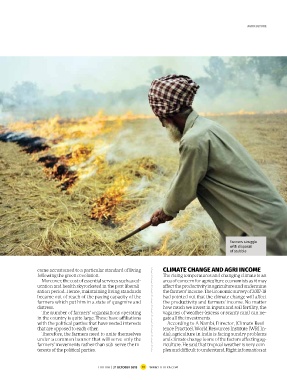
 productive purposes has also been widely quoted as   continue to multiply                Farmers struggle
 the factor that ultimately causes the farmer to com-                                     with disposal
                                                                                          of stubble
 mit suicide in the event of his failure to repay the
 loaned amount. Raising loans from the moneylend-
 ers and commission agents has always been stressful
 that, in some cases, has also induced suicides.   food-grains at higher levels. This provided them huge   come accustomed to a particular standard of living   CLIMATE CHANGE AND AGRI INCOME
 Farmers have diverse credit needs and all of these   margins that the farmers used for up-scaling their   following the green revolution.   The rising temperatures and changing climate is an
 cannot be met by the banking sector. Farmers re-  living standards. In the subsequent period — start-  Moreover, the cost of essential services such as ed-  area of concern for agriculture economists as it may
 quire funds for meeting domestic as well as other   ing particularly from the era of liberalisation of 1991   ucation and health skyrocketed in the post liberali-  affect the productivity in agriculture and undermine
 non-productive expenditures. Banks extend credit   -- the liberal import of food-grains depressed their   sation period. Hence, maintaining living standards   the farmers’ income. The Economic survey of 2017-18
 for productive purposes only. Crop loans, which   prices in the local markets. Also, the government fol-  became out of reach of the paying capacity of the   had pointed out that the climate change will affect
 are eligible for interest subvention of three per cent   lowed a policy of keeping the food prices low to en-  farmers which put him in a state of quagmire and   the productivity and farmers’ income. No matter
 subject to fulfilment of the terms and conditions, ac-  sure food security in the country. The cost of produc-  distress.   how much we invest in inputs and soil fertility, the
 count for the major share in agriculture credit. Since   tion also rose at a rate much higher than the output.   The number of farmers’ organisations operating   vagaries of weather (excess or scanty rain) can ne-
 the banks do not have control over the end use of   Indeed, the terms of trade between agriculture and   in the country is quite large. These have affiliations   gate all the investments.
 these funds, the possibility of their diversion for non-  non-agriculture sector which was favourable before   with the political parties that have vested interests   According to A Nambi, Director, (Climate Resil-
 productive purposes is quite high. Ultimately the   1991 turned unfavourable for agriculture sector in   that are opposed to each other.   ience Practice), World Resources Institute (WRI In-
 farmer finds himself in a position where he is unable   the subsequent period.   Therefore, the farmers need to unite themselves   dia), agriculture in India is facing sundry problems
 to return the amount and takes recourse in suicide.   Thus, the farmers’ margins in the post liberalisa-  under a common banner that will serve only the   and climate change is one of the factors affecting ag-
 In some cases, the farmers borrow from the com-  tion period continuously declined while their expen-  farmers’ movements rather than sub-serve the in-  riculture. He said that tropical weather is very com-
 mission agent/moneylender to pay off the debts that   ditures did not fall correspondingly as they had be-  terests of the political parties.    plex and difficult to understand. Right information at


 TEHELKA / 31 OCTOBER 2018  18  WWW.TEHELKA.COM  TEHELKA / 31 OCTOBER 2018  19  WWW.TEHELKA.COM


 12-21 20th CStory.indd   8  10/16/2018   12:29:30 PM  12-21 20th CStory.indd   9                 10/16/2018   12:29:40 PM

