


Page 33 - 15MAR2019E
P. 33
addiction


         jab, Delhi, Andhra Pradesh, Telangana,
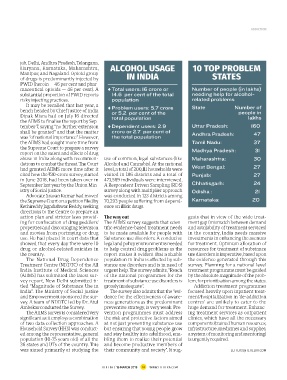
         Haryana, Karnataka, Maharashtra,   ALCOHOL USAGE                   10 tOp prObLEm
         Manipur, and Nagaland. Opioid group      IN INDIA                          StAtES
         of drugs is predominantly injected by
         PWID (heroin — 46 per cent and phar-
         maceutical opioids — 46 per cent). A   ♦  Total users: 16 crore or   Number of people (in lakhs)
         substantial proportion of PWID reports   14.6  per cent of the total   needing help for alcohol-
         risky injecting practices.         population                      related problems
           It may be recalled that last year, a                             State           Number of
         bench headed by Chief Justice of India   ♦  Problem users: 5.7 crore                 people in
                                            or 5.2  per cent of the
         Dipak Misra had on July 16 directed   total population                                   lakhs
         the AIIMS to finalise the report by Sep-
         tember 7, saying “no further extension   ♦  Dependent users: 2.9   Uttar Pradesh:          160
         shall be granted” and that the matter   crore or 2.7  per cent of   Andhra Pradesh:          47
         was “of national importance”. However,   the total population
         the AIIMS had sought more time from                                Tamil Nadu:               37
         the Supreme Court to prepare a survey                              Madhya Pradesh:            31
         report on the extent and effects of drug
         abuse in India along with recommen-  use of common, legal substances (like   Maharashtra:          30
         dations to combat the threat. The Court   Alcohol and Cannabis). At the national
         had granted AIIMS more time after it   level, a total of 200,111 households were   West Bengal:           27
         cited how the  30-crore survey, started   visited in 186 districts and a total of   Punjab:            27
         in June 2016, had been taken over in   473,569 individuals were interviewed.
         September last year by the Union Min-  A Respondent Driven Sampling (RDS)   Chhatisgarh:           24
         istry of Social Justice.         survey along with multiplier approach   Odisha :             21
           Advocate Sravan Kumar had moved   was conducted in 123 districts among
         the Supreme Court on a petition filed by   70,293 people suffering from depend-  Karnataka:           20
         Kethireddy Jagadishwar Reddy, seeking   ence on illicit drugs.
         directions to the Centre to prepare an
         action plan and stricter laws provid-  The way out               gests that in view of the wide treat-
         ing for confiscation of drug peddlers’   The AIIMS survey suggests that scien-  ment gap (mismatch between demand
         properties and discouraging television    tific evidence-based treatment needs   and availability of treatment services)
         and movies from portraying or drug   to be made available for people with   in the country, India needs massive
         use. He had placed in court data that   Substance use disorders. A conducive   investments in enhancing the avenues
         showed that every day there were 10   legal and policy environment is needed   for treatment. Optimum allocation of
         drug or alcohol-related  suicides in    to help control drug problems as the   resources for treatment of substance
         the country.                     report makes it evident that a sizable   use disorders is imperative, based upon
           The National Drug Dependence   population in India is affected by sub-  the evidence generated through this
         Treatment Centre (NDDTC) of the All   stance use disorders and is in need of   survey. Planning for a national level
         India Institute of Medical Sciences   urgent help. The survey admits, “Reach   treatment programme must be guided
         (AIIMS) has submitted the latest sur-  of the national programmes for the   by the absolute magnitude of the prob-
         vey report, New Delhi submitted ti-  treatment of substance use disorders is   lem, for prioritization among the states.
         tled “Magnitude of Substance Use in    grossly inadequate”.        Addiction treatment programmes
         India”. The Ministry of Social Justice   The survey also admits that the “evi-  focused heavily upon inpatient treat-
         and Empowerment sponsored the sur-  dence for the effectiveness of aware-  ment/hospitalization in ‘de-addiction
         vey. A team of NDDTC led by Dr. Atul    ness generations as the predominant   centres’ are unlikely to cater to the
         Ambekar conducted the Survey.    preventive strategy, is very weak. Pre-  huge demand for treatment. Enhanc-
           The AIIMS survey is considered very   vention programmes must address   ing treatment services as outpatient
         significant as it employs a combination   the risk and protective factors aimed   clinics, which have all the necessary
         of two data collection approaches. A   at not just preventing substance use   components (trained human resources,
         Household Survey (HHS) was conduct-  but ensuring that young people grow   infrastructure, medicines and supplies,
         ed among the representative, general   and stay healthy into adulthood, ena-  a system of monitoring and mentoring)
         population (10-75 years old) of all the   bling them to realize their potential   is urgently required.
         36 states and UTs of the country. This   and become productive members of
         was aimed primarily at studying the   their community and society”. It sug-       letters@tehelka.com


                                        Tehelka / 15 march 2019  33  www.Tehelka.com

