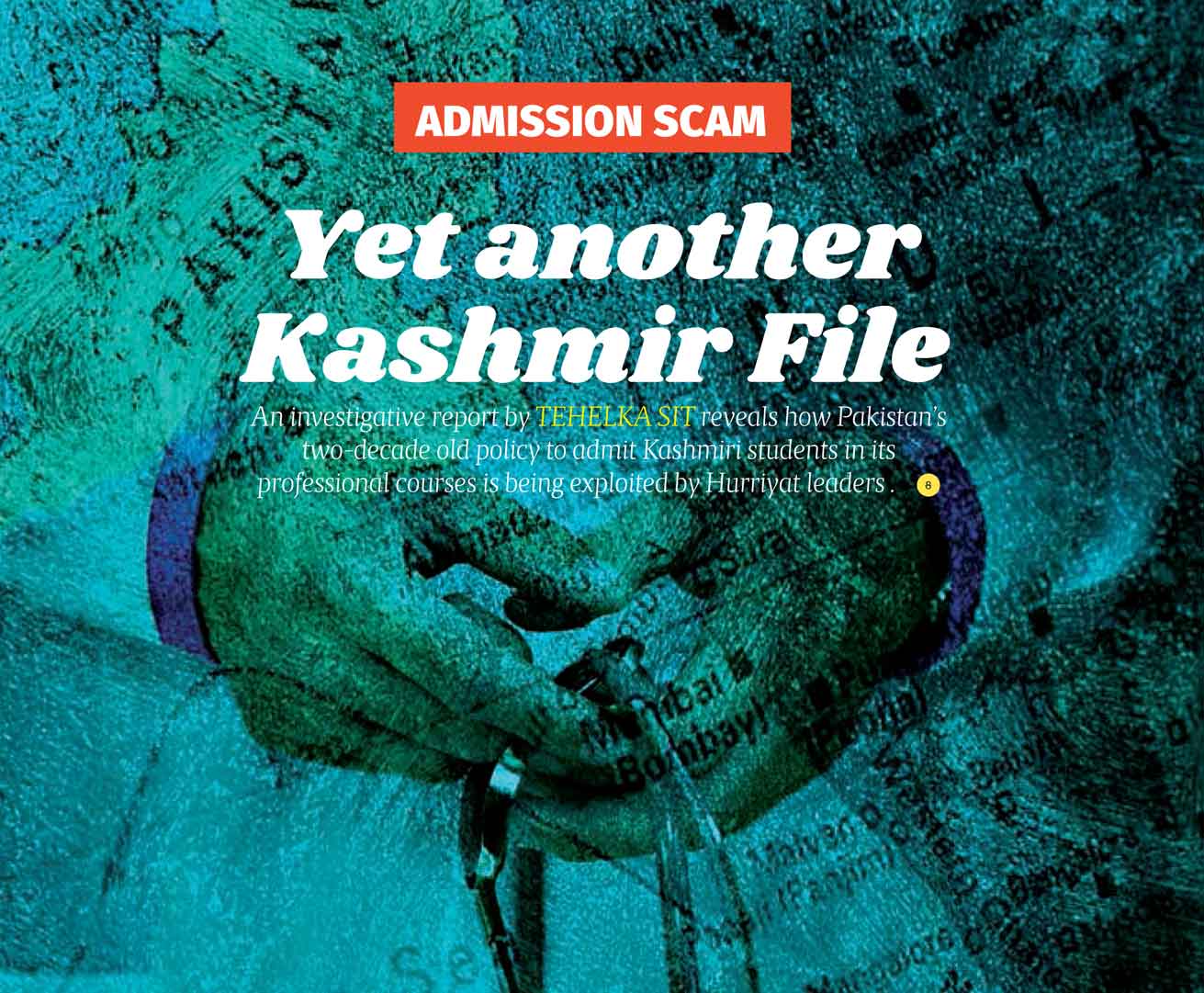
Yet another Kashmir File


An investigative report by Tehelka SIT reveals how Pakistan’s two-decade old policy to admit Kashmiri students in its professional courses is being exploited by Hurriyat leaders. 

For over two decades, the Pakistan government has been providing a special quota for the students of Jammu and Kashmir in all its professional courses, in especially medical and engineering colleges. Students from Jammu and Kashmir are broadly classified in two categories: [a] those applying for admission under foreign students seats through the ministry of education, Pakistan, and [ b ] the students applying for admission under the scholarship programme. The students applying through foreign students seats have to pay the normal fee like any other foreign student pays. But under the scholarship programme, the students are provided 100 per cent scholarship, free accommodation and per diem. The students, whose parents or close relatives have been killed by the security forces in Kashmir or have “suffered at the hands of Indian forces” are given preference for seats under the scholarship programme. Every year, around 50 students go to Pakistan under the scholarship programme for MBBS alone while a similar number of students get admission in other courses.

While there is a cut-off percentage for admission to various courses, the recommendation for the students under the scholarship programme is given by the Hurriyat leaders. Over the years, both factions of the separatist conglomerate Hurriyat Conference have been issuing recommendation letters to the students for admission in professional courses in Pakistan. And over the years, there have been allegations that some Hurriyat leaders demand money from the students before issuing them a recommendation letter, and that the basic criteria set by the Pakistan government is being flouted. There were allegations that even wards of some police officers have managed recommendation letters from the separatist leaders. As Kashmir has a very few professional colleges, the students would move to foreign countries for studying medicine – first to Russia, and now to Bangladesh and Pakistan. The courses in Pakistan are relatively cheap and valued more, and after Hurriyat recommendation letters become 100 per cent free for students going under the scholarship programme. Therefore, the number of students going to Pakistan has increased.

The National Investigation Agency [NIA] in a chargesheet filed in the terror funding case in 2018 had said that Pakistan is offering scholarship to Kashmiri students to prepare a generation which will be inclined towards Pakistan. Most of the youth on student visa in the neighbouring country were relatives of militants. “During the course of investigation, it was ascertained that students who were proceeding to Pakistan on student visas were either relatives of ex-militants who had indulged in various anti-national activities and had migrated to Pakistan or they were known to Hurriyat leaders”, it said. The probe agency also claimed that their visa applications were recommended to the Pakistan high commission in New Delhi by the various Hurriyat leaders.
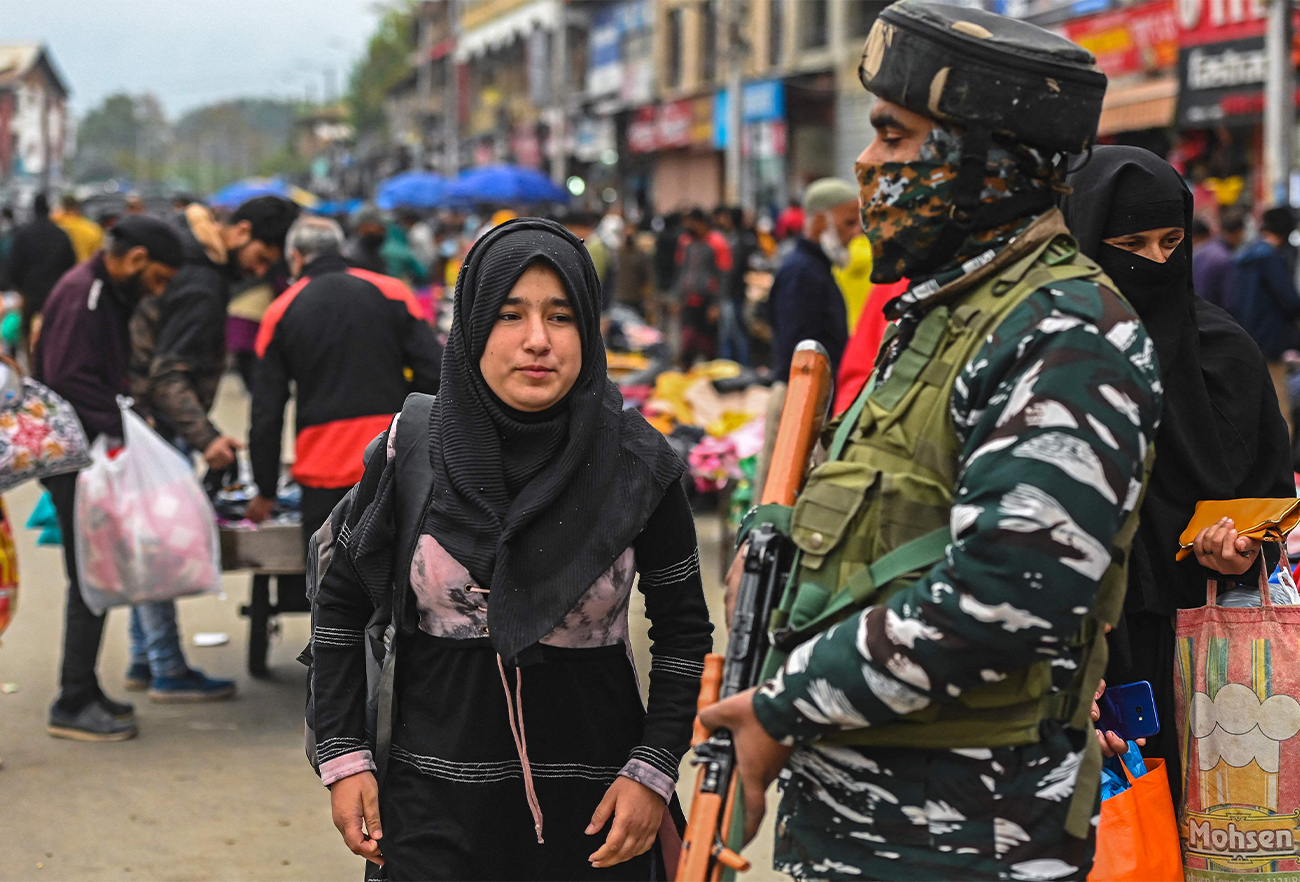
“ This shows a triangular nexus wherein the terrorists, the Hurriyat and the Pakistan establishment are the three verticles and they are ostensibly patronizing the Kashmir students in order to prepare a generation of doctors and technocrats in Kashmir who will have leanings towards Pakistan,” the NIA said in the chargesheet, published at various media platforms. The NIA had seized a document from the house of Hurriyat leader Nayeem Khan wherein he recommends a student for admission in a “standard medical college” in Pakistan because “her family has remained committed to the freedom struggle through thick and thin”.

The Jammu and Kashmir police in August 2021 unearthed a major nexus wherein students from Kashmir valley were sent to Pakistan to pursue an MBBS degree and the money taken from their parents was used to fund terror activities across the Union Territory. “The funds used after selling these MBBS seats were used to fund terror in the valley. Evidence also reveals that this money was also used to organize stone pelting”, the Director-General of Jammu and Kashmir Police, Dilbagh Singh said.

Sources revealed that in 2020, the counter intelligence wing of Kashmir registered a case after it received information through reliable sources that several unscrupulous persons including some Hurriyat leaders were hand in glove with some educational consultancies and are selling seats in MBBS and other professional courses in various colleges and universities in Pakistan.

Hurriyat on the other hand have always denied its leaders were involved in “selling” admissions in medical colleges of Pakistan for financing terror in Kashmir. The amalgam said that it wants to put on record that “this is completely unfounded, and can be verified by those students or parents whom they have recommended, many among them being from economically weaker sections”.

To unravel the truth, TEHELKA carried out investigation and discovered that agents and nonprofits linked to the Hurriyat are found to be selling medical seats purportedly reserved for Kashmiri students in Pakistani colleges. TEHELKA Investigation discovered what appears to be a well-oiled system executing cheating in test and a transnational education fraud in connivance with Pakistani colleges and separatists and their aides on this side of the border. In this chain, Hurriyat agent Sajjad Mir from Kashmir travelled down to Delhi to offer Pakistani medical slots to TEHELKA’s undercover reporter probing the suspected racket. Immediately after meeting TEHELKA’s undercover reporter in a five star hotel of Delhi, Sajjad Mir narrated his plan of admission to the reporter.

Sajjad Mir…. “Abhi chaar admission bhejo aap”

Tehelka…. “ Chaar ladke”

SAJJAD MIR….. “Percent eighty plus honey chahiye”.

TEHELKA….. “Twelth mein …eighty plus”.

SAJJAD MIR…. “Neet qualify hona chahiye”.

TEHELKA…. “Neet qualify hoga pakistan ke liye”.

SAJJAD MIR….. “Pakistan ke liye”.

TEHELKA…… “Kharcha sir”

SAJJAD MIR….. “ 15 -16 lakh”.

TEHELKA…. “matlab ye apko dena padega”.

SAJJAD MIR….. “Ji”

TEHELKA…. “Matlab ek candidate ka 15 lakh rupay”

SAJJAD MIR…. “Ek candidate ka….pichley saal ka yehi rate tha. Is saal ka to pata nahin abhi to NEET abhi hua hai.. ek do lakh extra hongey ya kam hongey ya barabar hongey, abhi pata nahin.”

TEHELKA….. “Procedure kya hai ek baar zara samjha dijiye”.

SAJJAD MIR…. “Form bharna hai. Wo jo hamarey bandey hai wo online bhej dengey waha par. Waha se list niklega exam ke liye…jo select hoga usko exam dena hai. Waha par fail hongey paas hongey unka admission hona hi hona hai. Wo certified hai agar exam main fail hoga to usko padney nahin de wahan par…agar hamara banda fail bhi ho jayega tab bhi selection hai”


[“It will cost 15-16 lakh [rupees per head]. Our people will fill forms, which will be sent online. They [the Pakistanis] will release the list of candidates for an entrance exam. Whether they [the candidates] fail or pass, they will be admitted. We have an understanding with them. Even if a candidate fails, he/she won’t be disqualified. He/she will be selected. Send four candidates’ applications for now. They should have scored 80 percent and qualified NEET”, Sajjad Mir explained. ]


Sajjad Mir explains how Kashmiris are benefitted in Pakistan for MBBS admission


SAJJAD MIR…. “Wahan to wo karte hi nahin hai, Kashmiriyon ka wo deal hai, unke liye fail-wail ka masla hi nahin hai”.

TEHELKA…  “Pakistan mein”.

SAJJAD MIR…… “Pakistan mein wo benefit dekhte hai Kashmiriyon ka”.

TEHELKA…. “OK”

SAJJAD MIR….. “ Kashmiriyon ko ye benefits hai”.


[“In Pakistan, Kashmiris enjoy the benefit of not getting failed. This is the deal Kashmiris have with Pakistan. Pakistan also see how Kashmiris can be benefitted” , Sajjad Mir explained]


As the talks go on, Sajjad Mir told TEHELKA’s investigative reporters about his mode of payment for the admission in Pakistan.

TEHELKA…. “Paisa kab dena hai advance”.

SAJJAD MIR….. “50 percent pehley dene jab form bharengey. 50 percent tab jab wahan se [Pakistan se] call letter ayengey uskey baad”.

TEHELKA….. “Matlab 16 lakh ka 8 lakh abhi de doon, remaining jab wahan”.

SAJJAD MIR…. “Jab wahan se call letter ayengey jisko jaana ho us time.. wo to confirm admission hota hai”.

[Half the payment in hard cash during the form filling exercise and the remainder when the call letter arrives from Pakistan,” Sajjad Mir explained.]


Sajjad Mir further explains that for admission, he will charge in cash.

TEHELKA…. “Aap ka kya system hai paisey leney ka”.

SAJJAD MIR…. “Hum to cash hi lete hai”.

TEHELKA…. “Cash lete hai poora 100 percent”.

SAJJAD MIR ….. “Haan”

[“Sajjad Mir explained that he always take money in cash for the MBBS admission in Pakistan. So he will take 100 percent cash from us too”. ]


Now, Sajjad Mir reveals how Hurriyat people write recommendation letters for the Kashmiri students for the MBBS admission in Pakistan.

TEHELKA….. “ To kya Hurriyat ke log chitthi wagareh likhte hai”.

SAJJAD MIR…. “Kaun”.

TEHELKA…. “Hurriyat ke log admission wagareh ke liye Pakistan mein MBBS ke liye”.

SAJJAD MIR…. “ Unhoney apne agents rakhey hue hai”.

[“Sajjad Mir said that Hurriyat people have kept their agents to bring students for the admission in Pakistan”]

When asked how Hurriyat leaders are writing recommendation letters when most of its top leaders are in jail after scrapping of Article 370, Sajjad Mir explained the Hurriyat system, as to how Hurriyat second and third layers of leaders work in the absence of its top leadership.

TEHELKA….. “Ye sab to jail main hain, ye chitthi kaisey likhengey Hurriyat wale”.

SAJJAD MIR…. “Inka system hota hai. Aap band ho aapke baad main hoon. Ye group hota hai. Tanzeem ek bandey par hoti hai?”.

TEHELKA….. “Ji”

SAJJAD MIR… “Jo tanzeem hoti hai na wahan na wahan to 10-15 tanzeem chalti hai, bees-bees log kaam karte hai. Aapke followers tees-tees hotey hai. Aap band ho jaogey doosra hoga. Doosra band ho jayega to teesra hota hai. Jiske contact main rehte hai. Kaam to chalta rehta hai”.

TEHELKA….. “Unke signature?”.

SAJJAD MIR…. “Wo problem nahin hai. Unko pata hai na ye banda hamara hai.”

TEHELKA…. “Achcha Pakistan waley doosrey bandey ko jaantey hotey hai”.

SAJJAD MIR….. “ Haan sarey bandey ko jaantey hain jo group main hota hai”.

TEHELKA….. “Matlab koi bhi chitthi likh de wo maan lengey”.

SAJJAD MIR…. “ Haan”.

[“There are many people in Hurriyat. It is a big group with many followers. If one goes to jail, second works. And if second goes to jail, third works. The organisation works like this. There is no issue of Pakistan not knowing their second and third ranks leaders. They are aware of all leaders working in the group”, Sajjad Mir explained.]


Sajjad Mir further explains that all our students will get admission in Pakistan’s government medical colleges and not private. And the five-year MBBS course will be free of cost for the students under the scholarship scheme.

SAAJAD MIR…. “Wahan government medical college mein admission ho jayega”.

TEHELKA…. “Achcha, government medical college mein”.

SAJJAD MIR…. “Government medical college mein. Wahan private nahin hai”.

TEHELKA….. “Pakistan mein”.

SAJJAD MIR…. “Pakistan mein government medical college mein admission ho jayega, free of cost mein, wahan kuch nahin”.

TEHELKA…. “ Arey Wah”.

SAJJAD MIR…. “Wahan kuch nahin dena hai, paanch rupay tak nahin dena hai, wahan free hai. Agar wahan se scholarship ho gayi, wahan se hi paisey milenge. Usko kapdo ke liye bhi paisey wahin se aatey hai. Agar usko kapdey khareedney hongey na, to wahin se paisey ayengey, wo bhi paisey add hai usmein”.

TEHELKA….. “OK. Ye paanch saal ka course hai ya chaar saal ka”.

SAJJAD MIR…. “Paanch”.

TEHELKA…. “Paanchon saal free hai”.

SAJJAD MIR… “paanchon saal”.

TEHELKA…. “Koi fee nahin”.

SAJJAD MIR…. “Kuch nahin”.

TEHELKA…. “Aisa kyon”.

SAJJAD MIR…. “Kashmir ke liye rakha hai.Haalat-walat kharaab hai, wo hai”.

[“Admission will be done in government medical colleges there, not private. Nothing else is to be paid there. Not even five rupees. Everything is free. In fact, they [students ] will get money if given scholarship. They will get money even for their clothes. It is a five year course. All five years will be free. They don’t have to pay their fee even. This is a special arrangement for the Kashmiris, because of the prevailing situation in the state”. Sajjad Mir explained ]

Sajjad Mir confesses that the entire scheme is a money-minting exercise for people like him and the separatists.

TEHELKA… “Pakistan main quota hai jo yahan shaheed hue hai”.

SAJJAD MIR…. “Isliye business chal raha hai na, main kya bol raha hoon. Ye saara business hai. Dukaan kholkar rakha hai”.

TEHELKA….. “Ye bhi Hurriyat ke jariye jaate hai”.

SAJJAD MIR…. “Hurriyat ke through”.

TEHELKA…. “Tabhi aap keh rahe hai ye bhi business hai”.

SAJJAD MIR… “Haan ye business hai. Main bol raha hoon. Ye saara business hi hai ye. Saara khel hai logon ko bewakoof  bananey ke liye”.

[ “What I am saying is that it’s all business. We have opened a shop. It’s a game to fool people”, Sajjad Mir admitted.]

“ They [the candidates] go through Hurriyat. Right ?” The reporter probed.

“Through the Hurriyat”. Mir replied.

***

Tehelka reporter now meets Assad Siddiqui, who runs a non-profit organization in Kashmir. Assad came to Delhi to meet Tehelka’s reporter. This meeting was held in the five star hotel of Delhi. Assad confesses that he had facilitated the process in exchange for anything between Rs 2.5 lakh and Rs 5 lakh.

TEHELKA…. “Pakistan karatey they aap”.

Assad Siddqui….. “ Haan”.

TEHELKA….. “ Ab nahin kara rahe hain medical mein”.

Assad Siddiqui…. “Medical mein MBBS karte they, medical mein. Aur free mein karwatey they. Koi cost nahin”.

TEHELKA…. “ Wo kaisey”.

Assad Siddiqui…. “Actually hamara thoda bahut channel tha unke saath jo Kashmiriyon ko muft admission karwatey they”.

TEHELKA…. “ Pakistan main…OK”.

Assad Siddiqui…. “ Haan”.

TEHELKA…. “OK.. to unse kitna charge letey they aap” ?.

Assad Siddiqui….. “Wo apne oopar tha, matlab free jab sab kuch ho raha hai apne oopar tha. 2.5 lakh, 3 lakh, 5 lakh lena.”

[ “Actually, we had some channel to facilitate admissions of Kashmiris free of cost in Pakistan”, Assad said.  “How much would you charge them?”, the reporter asked. “It all depended on us. After all, everything else was free. So it could be 2.5 lakh, 5 lakh”. ]

Now Assad explains as to how the top Hurriyat leader aide helped in writing recommendation letters for Pakistan embassy for the Kashmiri students’ admission in Pakistan medical colleges.

Assad Siddiqui….. “Aapka ya kisi ka admission karana hai jaisey aapka. Jo Hurriyat leader ka banda tha”.

TEHELKA….. “ Haan-Haan”.

Assad Siddiqui….. “Matlab uska ek jo banda kaam sambhaalta tha, usko bhi laalach tha, usko bhi paisey ka laalach tha”.

TEHELKA…. “ Kashmir mein”.

Assad Siddiqui….. “Haan to bas aaraam se kaam ho jaata tha”.

TEHELKA…. “Wo chitthi likhta hai”.

Assad Siddiqui…. “ Haan wo chitthi likhta hai”.

TEHELKA…. “Chitthi kis ko likhta tha wo, chitthi kis ko likhta tha wo”.

Assad Siddiqui…. “Wo chitthi likhta tha wo, matlab wahan Pakistan mein.”

TEHELKA…. “Embassy ke liye”.

Assad Siddiqui…. “Haan”.

TEHELKA…. “ Paisey aap letey they students se”.

Assad Siddiqui…. “Haan, lekin ye unko bhi nahin pata chalta tha paisey hum lete hai. Theek hai na, hum bol dete they matlab, hum dikha dete they hum bhi karte hain. Jo banda hai usko maalom tha hamara unka kuch chal raha hai”.

TEHELKA…. “ Acchha”.

Assad Siddiqui…. “ Haan”.

TEHELKA…. “Uskey baad wo paisey leta hoga” ?

Assad Siddqui…. “Haan uske baad wo paisey leta tha”.

TEHELKA…. “Aap kitna lete they chaar lakh rupay”.?

Assad Siddiqui…. “Haan chaar main kaam kar dete they”.

TEHELKA…. “ Students ki padai free main hoti thi” ?

Assad Siddiqui…. “Haan”.

[“The aide of top Hurriyat leader used to write recommendation letters for Pakistan embassy. He was handling everything. He was also expecting some money. So the work would be done smoothly. The top leader knew we were up to something. And his aide was taking money after writing recommendation letters. I used to charge 4 lakh rupees from the students, and their MBBS course was free of cost,” said Siddiqui]


Beyond The Kashmir Files is “Yet Another Kashmir File”

Tehelka’s Cover Story in this issue “Yet another Kashmir File”, comes on the heels of the film “The Kashmir Files” which is centered around an exodus of Kashmiri Hindus following alleged genocide from the Valley.  While the fictional account in the movie digs into the past to tell untold tales, the Cover Story by our Special Investigation Team lays bare how Pakistan’s policy to admit Kashmiri students into its professional colleges under a scholarship programme is being exploited by Hurriyat leaders.  The students, whose parents or close relatives have been killed by the security forces in Kashmir or have “suffered at the hands of Indian forces”, are given preference for seats under the scholarship programme for MBBS and other courses. The recent phenomena is that in some medical colleges in Pakistan, a vast majority of the new admissions from among the Kashmiri students are women.

The dream to become a doctor has always been daunting for Kashmiri students who had sought admission to Pakistan’s medical colleges in view of alleged harassment at the border, nagging questions over their ideology, and their scanning on return by security agencies.

However, what could add to their cup of woes is that in April this year,  the University Grants Commission and the All Indian Council for Technical Education have issued a statement, that “Any Indian national who intends to take admission in any educational institution of Pakistan shall not be eligible for seeking employment or higher studies in India on the basis of such educational qualifications acquired in Pakistan.”  Taking a cue, the National Medical Commission has also issued a similar warning that any Indian student who wishes to pursue MBBS, BDS or any other equivalent medical degree from Pakistan shall not be eligible to appear for FMGE or seek employment in India on the basis of the educational qualifications gained from Pakistan universities.

Already in 2017, degrees obtained from colleges in PoK were declared invalid by MCI as India does not recognise PoK as part of Pakistan. The reason, the officials said, was that these youths were brainwashed across the border and some of them were imparted with arms training or recruited in sleeper cells.   There are allegations that a well-oiled separatist lobby would arrange recommendation letters from Hurriyat leaders and other valid travel documents from the Pakistan Embassy to facilitate their visit to Pakistan for admission.

Also, there have been allegations that some separatist leaders, especially, seek monetary benefits from the students before issuing them recommendation letters.  According to the police, separatists were pumping the funds earned into militancy in Kashmir.  Both the National Investigation Agency and the State Investigating Agency are probing the role of Kashmiri students in militancy and money laundering.  The SIA has filed a charge sheet related to “selling” MBBS seats in Pakistan to Kashmiri students and using the money to support and fund terrorism. There are allegations that even wards of some police officers have managed recommendation letters from the separatist leaders for admission into medical courses in Pakistan. Indeed worrisome!


Space for separatist politics shrinks further as Malik gets life in prison

Yasin Malik, who was awarded life imprisonment by the NIA court in Delhi in terror funding case , has been among the top separatist leaders in Kashmir.  Believed to be one of the chief architects of the militant struggle in the valley, he gave up arms in 1994. A report by Riyaz Wani

On May 25 when the NIA court in Delhi was mulling the quantum of punishment to be handed to Jammu and Kashmir Liberation Front chief Yasin Malik, parts of Srinagar including Malik’s locality Maisuma erupted in a spontaneous fury and the markets promptly shut down. The protests continued after the court awarded Malik life imprisonment in the terror funding case. The following day, however, the anger abated as the life imprisonment was generally perceived as preferable to death sentence something which can also be challenged in the higher courts and possibly even reduced.

Malik has been among the top separatist leaders in Kashmir. He is counted one among the separatist triumvirate along with Mirwaiz Umar Farooq and Syed Ali Geelani who passed away in September last year. He commands a wide popular following across the Valley. But unlike the other two, Malik is regarded as one of the chief architects of the militant struggle in 1989 and has since been the central figure of the campaign for Azadi. It was he who along with his colleagues Javed Mir, Ashfaq Majid Wani, and Abdul Hamid Shiekh had started the armed campaign in Kashmir in 1989 – the last two of them have since been killed.

So, he will always be relevant to the political scene in Kashmir with his life imprisonment only enhancing his stature as a symbol of Kashmiri separatist aspirations. His incarceration will thus be a perpetual source of grievance for Kashmiris and a fuel to the sentiment for Azadi.

Also, Malik has been the most prominent secular face of the separatist movement and has, in the past, also been acceptable to the west. It would, therefore, be hard for New Delhi to stick a religious label on him and project him as someone who wants to create an Islamic state.

As for the militant campaign in Kashmir, it is expected to go on regardless of him. In any case, Malik had given up arms in 1994 and decided to follow Gandhian non-violent ways to pursue a peaceful political struggle. From a militant outfit, the JKLF became a political organization – albeit, like Hurriyat, it stayed away from the electoral politics. This, often, made him a target of criticism by the militants who taunted him for following Gandhian principles.

Malik is the only major pro-independence leader in Kashmir among a gaggle of pro-Pakistan separatist leaders.  He is part of neither of the two Hurriyat amalgams headed by Mirwaiz and the late Geelani respectively.  But the three were forced to make a common cause following the sudden mass eruption following the 2016 killing of the popular Hizbul Mujahideen commander Burhan Wani.

In 2020, a letter attributed to Malik was issued to the local press in Kashmir in which he talked about the reasons that forced him to take up the gun. “I actively participated in the 1987 (Assembly) elections with a hope that the electoral process will lead to the resolution of Kashmir dispute”, the letter read. “An arrest spree was unleashed and I was arrested from the counting hall, sent to an interrogation centre, tortured which gave me blood infection… It was at the police hospital where I was diagnosed with a damaged heart valve. I along with hundreds of members was detained under Public Safety Act (PSA). After our release from jail we got convinced that there was no space for a non-violent democratic political movement here.”

Writing about his decision to give up arms in 1994, Malik said it was not  easy  to do so.

“It was in fact a most dangerous and unpopular decision. I was declared as a traitor by many. I miraculously escaped a bid on my life when I was kidnapped by some militants,” the letter read. “Many of my colleagues lost their lives too but I and members of the JKLF stood firm in our decision and pursued a path of non-violent struggle against all odds”.

But in the new scheme of things where the centre has even given up on the Valley’s mainstream political leadership like Dr Farooq Abdullah and Mehbooba Mufti – both former J&K chief ministers – the separatist leaders like Malik and Mirwaiz are being completely dispensed with. It is too early to prefigure the near and long term political repercussions of the new strategy to deal with Kashmir.  But one thing is certain: the strategy has obliterated the space for the separatist political leaders.


Of chicken sandwiches and biscuits

For the Congress it is a now or never. Either it gears up to lead from the front or else sees its own collapse. Were that to happen it would be a disservice to a vibrant democracy called India

Chicken sandwiches? Dog biscuits? So what? Pidi? Holidays?

Is this the sum total of Congress scion Rahul Gandhi?

Ask his critics, and there is no dearth of them, and they will unanimously answer in the affirmative. His loyalists may spring up to defend him but those may only be a handful.

Is Rahul Gandhi a serial offender politically?

To be fair, he is actually a victim: one who is ridiculed at the drop of a hat. He may not be completely absolved, but a chicken sandwich here or there does not really discredit him.

The chicken sandwich story is thanks to Hardik Patel and the dog biscuits episode is courtesy Himanta Biswa Sarma. Patel’s story is recent while Sarma’s is one that is done to death.

Yet, both provide interesting insights into Rahul Gandhi’s working style as well as the dire straits the Congress currently is in.

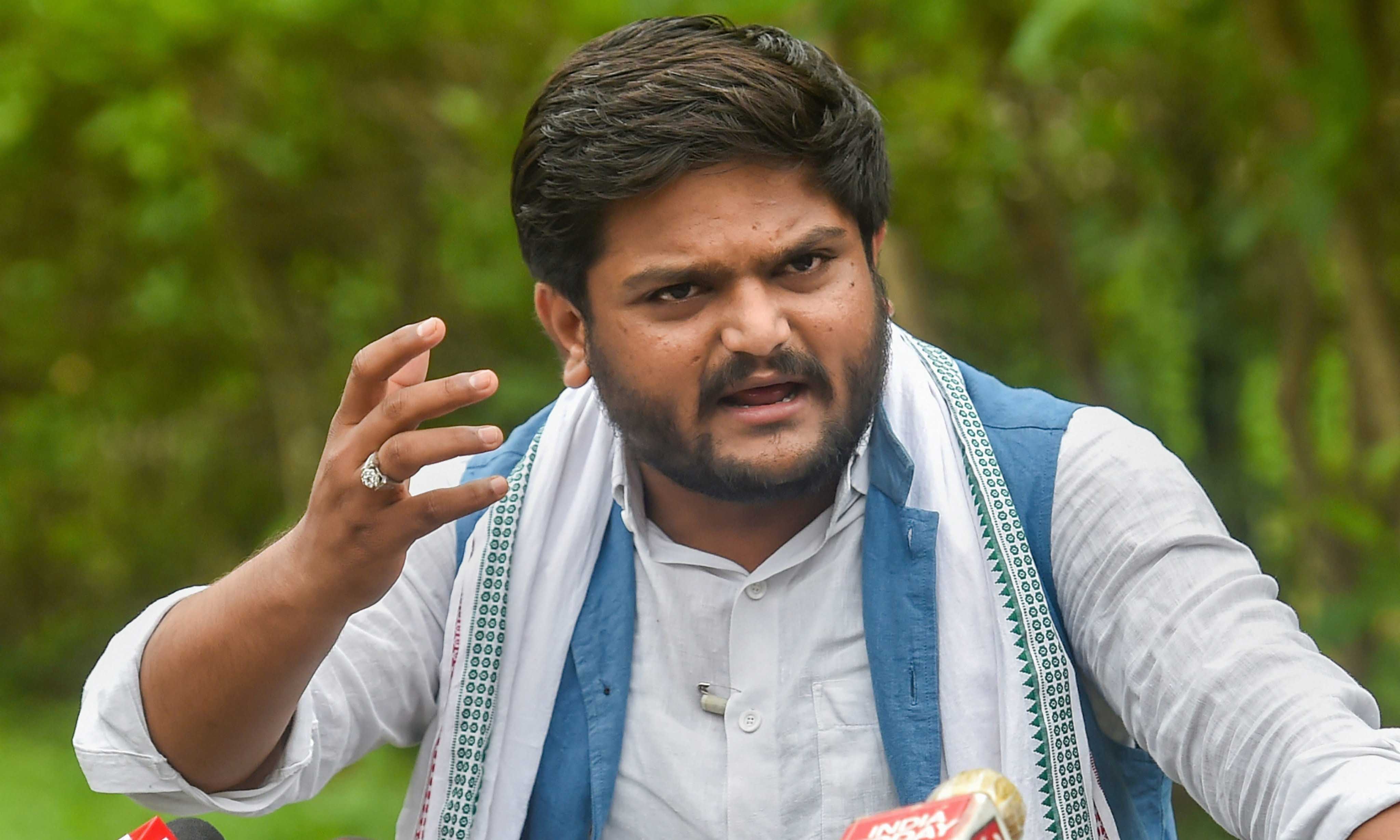
Hardik Patil, till recently the Working President of the Congress in Gujarat, walked out of the Party he had joined some three years ago.

Taking a potshot at the Congress he said that the Party is more about chicken sandwiches: “Big leaders of the Congress in Gujarat are more focused on ensuring that chicken sandwich for leaders who have come from Delhi is delivered on time”. He made two additional points: one about mobile phones and the other about holidaying abroad: “The senior leaders were not interested in hearing about problems…but were more engrossed in what messages they had received on their mobile…” he said adding “When the Congress needed leadership, the Congress leaders were enjoying abroad”.

No guesses for this one because there is enough evidence for Rahul Gandhi’s obsession with mobile phones and holidays abroad.

On many occasions, including important ones in Parliament, Gandhi has been seen scrolling messages on his phone. As for holidays, he has often taken off at crucial times when the Party needed him.

As per BJP-maths, Rahul Gandhi has made a minimum of 247 trips between 2015 to 2019 which work out to five trips a month. As for the chicken sandwich barb, it is no rocket science to figure out who it is aimed at.

Then there is the dog-story which grabbed eyeballs, once Sarma went public.

In the run up to the Assam assembly elections when Sarma had met Gandhi to discuss the problems of Assam, Gandhi was busy playing with his pet dog Pidi. The “ultimate humiliation” to quote Sarma: “We were served tea and biscuits; the dog went up…and picked up one biscuit from the plate…I waited thinking that Rahul will…ask someone to change the plate. After waiting for five minutes, I saw all leaders eating the biscuits from the same plate”.

Then there is Sarma’s “So what?” story wherein to every issue raised in the meeting Rahul would say so what?. Going by Sarma’s calculation, in 20 minutes, Rahul said so what at least 50 times.

But so what? Isn’t one entitled to utter words one is used to? Can’t one humour one’s dog? And is it a sin to eat chicken sandwiches?

On the face of it, all this seems quite legitimate. But given the state of the Congress Party, one wrong move and hell breaks loose. This is exactly what is happening vis a vis Rahul Gandhi and the Party leadership.

Both are under fire: Gandhi for not doing enough and his mother, Mrs Sonia Gandhi for doing what it takes to keep him firmly in the saddle.

This, perhaps, is where the trouble begins. The son seems disinterested and the mother overtly aggressive to ensure that no one upsets the apple cart or usurps the legacy that the Nehru-Gandhi clan seems to have hijacked from all others who have rightfully contributed towards building and strengthening the Party.

The brand name may be Gandhi but the sweat and blood is surely of all those who have spent a lifetime serving the Congress. Therefore, they have an equal stake in the well-being of the Party, if not more.

It is against this backdrop that one needs to look at the revolt by a group of senior leaders including Kapil Sibal, Ghulam Nabi Azad, Anand Sharma, Bhupinder Singh Hooda and Manish Tewari among others.

Known as G-23 or Group-23, these leaders demanded an organizational rejig, party level reforms and a democratic set-up within the Party.

Acting as a pressure group within the Party, the group stirred up the hornet’s nest when it demanded organizational elections and a full-time as well as a hands-on President.

The last was interpreted as a signal for a non-Gandhi to take over: “It is time that the first family…steps aside and paves the way for a new leadership”, a leader had then stated, adding that the Party is not “someone’s fiefdom”.

It was not till two years after that the Congress leadership decided a course correction and attempted to chalk out a strategy for revival.

This was done through the Chintan Shivir in Udaipur in the Congress-ruled state of Rajasthan which concluded earlier this month.

At the macro level, the focus was to be battle-ready for elections; the micro decisions included more representation to younger leaders; a five year cap for tenures of all office bearers, filling up vacant posts within three months and so on and so forth.

Add to this, the one family one ticket formula with a clause that protects the Gandhis. The provision that a second member of a family will be eligible for a ticket if he or she has put in five years work in the Party automatically entitles all three Gandhis, namely Sonia, Rahul and Priyanka to contest elections. This, however, would limit backdoor entry for children of several politicians who aspire to contest elections simply because they are VIP kids.

But will any of this address the concerns expressed at different levels?  Will it help the Congress to gear up to the challenges it faces? Would it show up as a viable alternative to the BJP?

As of now, the chances are remote. One Chintan Shivir, a few reforms and an intent to change things is mere optics.

On paper it may appear that some concerns have been addressed but till things change on the ground, the BJP will remain a demon the Congress cannot even look in the eye, leave alone attempt to ride or fight it.

To do that, something more than a course correction is called for. It requires an overhaul of the Party rather than a rejig. Not much can be achieved by repositioning pieces. The game that should be played must be different and innovative: and one that has skilled and crafty players.

The Party must aim high. It is not enough to badmouth the BJP or slam Prime Minister Narendra Modi like Congress interim President Sonia Gandhi did during her address at the Shivir.

The need of the hour is to move ahead and devise strategies to checkmate the saffron Party. It sure is a tall order but it is not one that is impossible to achieve.

In Udaipur, when Sonia Gandhi spoke about the need to look beyond “personal ambition”, she hit the nail on the head. But the pertinent question is whose ambition? The answer lies within because she must stop and think whose “personal ambition” is thwarting the growth of the Party?

To be fair it is not Rahul Gandhi’s because he is completely disinterested in politics. Equally, it is his mother who wants him centre-stage.

There is enough evidence of this, given that his peer group was kept in the background so that he could shine. Shine he did not and those who could, simply left in disgust.

Whatever the drumbeaters may say, the outcome of the three-day conclave is not very encouraging. Apart from cosmetic changes not much has happened. The fact that Sunil Jakhar quit during the three-day conclave speaks volumes of the way things have panned out.

Asserting that there is no real intent to emerge from the mess the Party is in, Jakhar beautifully summed up the current confusion that has gripped the Party:

“Ghar ko sajaane ka tassavur to bahut baad ka hai

Pehle ye to taiy ho ki is ghar ko bachayen kaise 

(The idea of decorating the house will happen much later/ One has to first decide on how to save the home).

Jakhar was hitting out at the Party announcing committees, instead of examining reasons for the poll debacles: “The Party needs chinta, to worry, not chintan shivir”, he said.

News has also come in about senior leader and perhaps a G-23 architect, Kapil Sibal,  filing his Rajya Sabha nomination supported by the Samajwadi Party.

The issue is not about a Jakhar or a Sibal leaving or those who have left earlier or may leave later.

The point is about the disillusionment and the disenchantment that the leaders or the rank and file are grappling with. Worse still, it is the feeling that the Party has reached a dead end.

However hopeless the situation may appear, in real terms all is not lost. The Congress still remains the only pan-India party at the national level. It may have fallen into bad days but all is not over. There is a lot that remains and the leadership could well gather the fragments and deftly piece them together.

However much one may wish to flag it, the primary issue is not the Gandhis. Or whether Rahul should be sacrificed for a larger good? Neither is it about chicken sandwiches or holidays abroad.

At stake are things that are more important: the road ahead; the challenge by the BJP; the Modi factor and a completely and totally fragmented Opposition. And more importantly a nation that is at a cross roads of divisive and communal politics; the threat of a divided India looming large.

Therefore for the Congress it is a now or never. Either it gears up to lead from the front or else sees its own collapse.

Were that to happen it would be a disservice to a vibrant democracy called India that demands more players than one, irrespective of who is in power.

Power politics is transient but nations are not. Therefore be it the Congress, or the regional parties, a Sonia Gandhi or a Mamata Banerjee, they must look at the big picture rather than the narrow prism of who is first among equals.

Equally, the Congress leadership should apply the same formula within and cede space to others. The intent demonstrated in the Conclave must translate into action.

Sonia Gandhi ‘s spiel about checking personal ambition sounds good but a beginning must be made from within her own home, lest it misses the wood for the trees. (ends)


How Nehru spent his final four Days in Dehra Dun!

In the pre-Independence era, the entire Nehru clan headed by patriarch Motilal would spend its summer holidays in Mussoorie where the Savoy hotel was their favourite abode. Here is a first person account of Nehru’s last visit to Dehradun by Raj Kanwar

NEHRU first visited Mussoorie in the summer of 1906 – as a 16-year old. Thereafter he made frequent visits to Mussoorie for rest and relaxation during summers, generally accompanied by his father, mother, wife, daughter, sisters and nieces. Even though Dehra Dun then was a small blip on India’s Political map, it nonetheless used to attract leaders of national eminence. Nehru too made many Political visits. Other than such visits that Nehru made willingly and happily, there were some involuntary and not so happy visits when he was brought here as the ‘guest of the then British government in India’.

Nehru even preferred Dehradun jail

DURING the long Freedom Movement, Nehru was sent thrice to Dehra Dun Jail. It was here, during his incarceration in June 1934 that Nehru started writing his much acclaimed AUTOBIOGRAPHY. During his imprisonment, Nehru was lodged in a solitary confinement, with birds as his companions. Even though he could not see the mountains from his cell, his “mind was full of them”. “I was ever conscious of their nearness, and a secret intimacy seemed to grow between us,” Nehru wrote in his AUTOBIOGRAPHY.

Not so surprisingly then, Nehru preferred to be confined in Dehra Dun jail rather than anywhere else. He found Dehra Dun’s Spring very pleasant, and far longer in duration than in the Plains. He found that its Autumn too was very pleasant. He enjoyed Winters too but without the rains. No wonder then, Nehru’s love and liking for Dehra Dun continued right throughout his life. Ironically, the Last Four Days of his life too were spent in Dehra Dun.

In the post-1947 era, Nehru as the Prime Minister of India visited Dehra Dun and Mussoorie on many occasions. So much did he like Dehra Dun in general and the sylvan environs of its Circuit House in particular where he stayed that Nehru would come here again and again on any pretext, or even no pretext. It was easy then to invite Nehru to Dehra Dun and the local Congress leaders took every advantage of this weakness of his. Mahavir Tyagi played hosts to him on a couple of occasions. K.D. Malaviya invited him twice to visit ONGC. Incidentally, this writer too was present in one of those meetings when Nehru addressed the first 1956 batch of the young ONGC Pioneers. On another occasion, Nehru visited Tuini in the Jaunsar Bawar area of Chakrata at the behest of the then MLA, Gulab Singh. For a rookie journalist that I was then, it was a great privilege to have covered that function. Once he also took the salute at the Passing-Out Parade at the Indian Military Academy.

Nehru’s Last Four Days

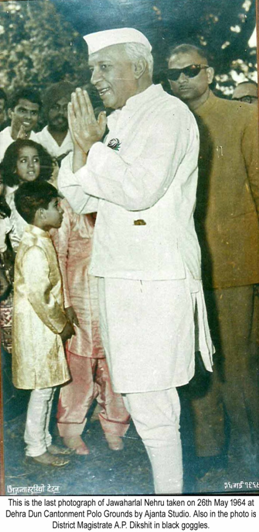
NEHRU made his last visit to Dehra Dun on 23rd May, 1964 to recuperate from the stroke that had afflicted him earlier that January at the Bhuvneshwar session of the All India Congress Committee. The Circuit House was his favourite abode; here, he spent his time, relaxing and resting. He loved its heavily wooded expansive lawns. He would stroll across the length and breadth of its large grounds. Here he would sit silently for hours under the shade of his favourite camphor tree, with birds as his companions, listening to their chirping. Occasionally, he would read or write or dictate, depending on the mood of the hour.

On 25th May Nehru visited his old friend Sri Prakasa, former minister and governor, at Kotalgaon, eight miles uphill on the Mussoorie Road. He took lunch with his former colleague, and returned to the Circuit House late in the afternoon.

Nehru wanted to postpone his departure

HE WAS really enjoying here so much that he did not want to return to Delhi, and talked many times of postponing his departure for Delhi by a day. Nehru had an appointment in the Capital on 27th May afternoon, and as such, he could easily leave for Delhi on 27th morning. District Magistrate Dikshit noticed his desire and gathered courage to suggest extension of his stay in Dehra Dun through May and June, quietly adding that all important files could be sent to Dehra Dun, ‘aur sab, kaam yehan se ho jayega’. ‘Haan, kaam to sab ho jayega’, Nehru replied philosophically. Was this a sort of foreboding? But eventually, the scheduled departure on 26th afternoon was adhered to, since it was felt that it would give Nehru an overnight rest in Delhi, and enable him to attend to his appointments the following day, rested and refreshed.

The Last Farewell

IN THE late afternoon on 26th May, a motley group of 30-odd people, including this writer, had gathered at the Cantonment Polo Grounds to see off Prime Minister Nehru. He was to take a helicopter ride to the Air Force base at Sarsawa in Saharanpur district, and thence to Delhi by an Air Force plane. Seeing off Nehru at the end of his visits to Dehra Dun was a routine exercise for this group. Standing at the door of the helicopter, Nehru waved at us, and we all waved back. The door was shut, and blades began swirling that raised a cloud of dust and the farewell group instantly fell back. The helicopter took off, and disappeared soon yonder beyond.

Reverting to Dehra Dun, neither anyone in the assembled Farewell Group at the Helipad nor among the large throngs that had earlier cheered Nehru and waved at him during his short drive from the Circuit House could have dreamt that the sunset that evening would be his last, and that he would not see another sunrise.

The news of his death the following afternoon in Delhi shocked us all. Nehru could not keep that appointment of 27th afternoon, but nonetheless he did keep his FINAL appointment with his Creator. I shed many quiet tears, and cursed myself for not having met Nehru oftener. I met him off and on whenever he visited Dehra Dun, and adored his charming and graceful manners and the innate courtesy that he always accorded to one and all. In his own way, Nehru seemed to like me and would often tell me “come again”.


(Raj Kanwar is a Dehra Dun-based veteran journalist and author. He has written extensively on Nehru and Indira Gandhi.)


Gyanwapi row poses threat to Kashi’s communal harmony

Kashi, which is in the eye of storm over Gyanvapi mosque row, has had a distinguished legacy where Hindus and Muslims have prayed close to each other in a temple and a mosque integrated with each other for the centuries. A report by Mudit Mathur

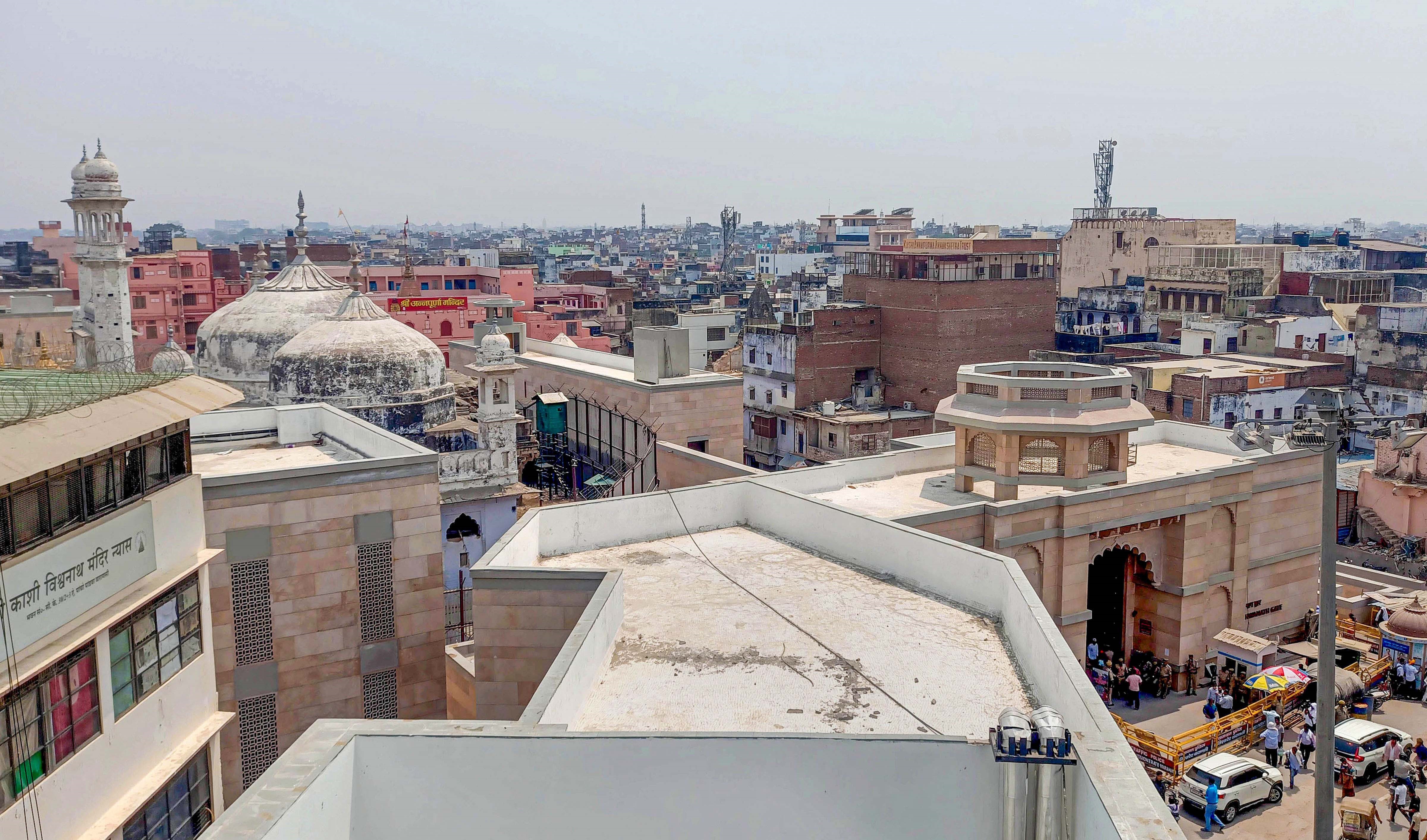
Is Kashi going to be next Ayodhya? After demolition of Babri mosque in1992 and all the accused persons including conniving official machinery honourably acquitted, the much-professed unfinished mission of Kashi and Mathura appears to be gaining momentum. The way Kashi controversy over a historical wrong is getting boiled up aggressively with incitement of religious passions, no one can deny that just a spark could repeat another Ayodhya in Kashi. Kashi – believed to be the world’s most ancient calm living city – turned into a supreme power centre after Prime Minister Narendra Modi won twice from this parliamentary constituency – had a distinguished legacy where Hindus and Muslims have prayed close to each other in a temple and a mosque integrated with each other for the centuries much before our Independence.

The most sacred religious place – Kashi, once known for peace and harmony is just sitting on a powder keg of communal divide where a spark is enough to trigger unimaginable riots and violence. Though the history is a non-justiciable subject in the jurisprudence, but spurt of fresh litigations have suddenly swelled the courts demanding to correct the historical wrongs by allowing their religious rights to worship inside controversial sites –  those invaded by Mughal rulers destroying temples and converting them into mosques.

The Supreme Court bench comprising Justices DY Chandrachud, Surya Kant and PS Naramsimha,while ordering maintaining status quo clarified that the order passed by the Civil Judge Senior Division at Varanasi to protect the spot where a “shivling” was claimed to have been found during the survey of the Gyanvapi mosque will not restrict the right of Muslims to access the mosque to offer namaz and to perform religious observances (wuzu).

The apex court remanded the suit filed by Hindu devotees in connection with the Gyanvapi Mosque – Kashi Vishwanath Temple dispute to District Judge transferring it from the Court of Civil Judge Senior Division who passed controversial orders without disposing objections with regard to maintainability of the suit raised by Muslims. The suit was filed before the Civil Judge Senior Division, alleging that the Mosque was built after a Lord Vishweshwar’s temple was destroyed by Mughal emperor Aurangzeb.

The Supreme Court also ordered that the application filed by the Committee of Management of Anjuman Intezamia Masjid (which manages Gyanvapi mosque in Varanasi) before the trial court under Order VII Rule 11 CPC for rejection of the suit as being barred in law, shall be decided on priority by the District Judge. Meanwhile, its interim order dated May 17 shall continue in operation till the application is decided and for a period of 8 weeks thereafter. Further, the concerned District Magistrate has been directed to make proper arrangements for observance of wuzu.

One Rakhi Singh and the four other women had filed a suit before Civil Judge Senior Division in the Varanasi court seeking permission for regular prayers in the temple located inside the Gyanwapi mosque and contended that there are idols of Lord Ganesha, Hanuman and Nandi on the wall, which should be restored. Entertaining the plea, the court had appointed an advocate commissioner and asked him to video-graph the premises and submit a report. When the advocate commissioner was filming the interiors of the premises, the management of the mosque had objected to the exercise.

The counsel of the mosque management committee, Abhaynath Yadav, requested the court to replace the advocate commissioner, who was allegedly acting in a partisan manner. Yadav claimed that the court did not order any videography inside the mosque but the advocate commissioner was insisted on it. “As per the court order, the videography is to be done of the platform (Chabutra) called Shringar Gauri inside the mosque complex,” he added.

In compliance with the apex court orders, the District and Sessions Judge Dr Ajay Kumar Vishwesha has ordered first to hear the submissions of Anjuman Islamia committeeon on 26th May, 2022 with regard to question of maintainability of the suit under Order VII Rule 11 in view of objections raised at the beginning as preliminary objections. The Court has also invited objections from both parties to the Commission Report. The objections have to be filed within 7 days. The second part of the order could again open up a Pandora Box of conflicts.

The Uttar Pradesh is just witnessing spurt of communal tides over pre-independence contentious conflicts by right-wing hardcore Hindutva forces despite existence of the Places of Worship (Special Provisions) Act, 1991, whereby it was declared that the religious character of a place of worship existing on the 15th day of August, 1947 shall continue to be the same as it existed on that day.

It was further provided in Section 4 (2) of the Act 1991, that any suit, appeal or other proceeding with respect to the conversion of the religious character of any place of worship, existing on the 15th day of August, 1947, is pending before any court, tribunal or other authority, the same shall abate, and no suit, appeal or other proceeding with respect to any such matter shall lie on or after such commencement in any court, tribunal or other authority.

Analysing the 1991 Act, the Constitution Bench of the Supreme Court in its Ayodhya Verdict had held that, “The Places of Worship Act is intrinsically related to the obligations of a secular state. It reflects the commitment of India to the equality of all religions. Above all, the Places of Worship Act is an affirmation of the solemn duty which was cast upon the state to preserve and prevent the equality of all faiths as an essential constitutional value, a norm which has the status of being a basic feature of constitution.”

“There is a purpose underlying the enactment of Places of Worship Act. The law speaks to our history and to the future of the nation. Cognizant as we are of our history and of the need for the nation to confront it, Independence was a watershed moment to heal the wounds of the past. Historical wrongs cannot be remedied by the people taking the law in their own hands. In preserving the character of places of public worship, Parliament has mandated in no uncertain terms that history and its wrongs shall not be used as instrument to oppress the present and the future,” it ruled.

The constitutional validity of the Places of Worship (Special Provisions) Act 1991 has been under challenge before the apex court wherein a Bench comprising of the then CJI SA Bobde and Justice AS Bopanna issued notice on a PIL filed by BJP leader and advocate Ashwini Upadhyay. The main ground of challenge is based that it bars remedies against illegal encroachment on the places of worship and pilgrimages prior to August 15, 1947. The same bench also entertained and tagged similar PIL filed by BJP leader Subramanian Swamy on the same footings, terming it to be unconstitutional and also void ab initio.

This phenomena appeared soon after the trial court of the Central Bureau of Investigation (CBI) in Lucknow in its verdict acquitted all the senior leaders of the ruling Bharatiya Janata Party (BJP) over a lack of evidences in the decades-old cases pertaining to demolition of the 16th-century Babri mosque in 1992 by Hindu rioters in Ayodhya. The trial was faced by 32 accused, including former Deputy Prime Minister Lal Krishna Advani, 92, – a one-time mentor of Prime Minister Narendra Modi.

A galaxy of BJP leaders including former ministers Murli Manohar Joshi, Mohan Bhagwat, Uma Bharti, Vinay Katiyar, Jai Bhagwan Goyal and former Chief Minister of Uttar Pradesh Kalyan Singh. All the 32 people were accused of criminal conspiracy and inciting a mob to tear down the Mughal-era Mosque in 1992 in Ayodhya – about 135 km away from the state capital, Lucknow. The demolition sparked nation-wide communal violence that left more than 2,000 people dead.

Babri mosque in Ayodhya was pulled down after status quo orders granted in title suit were interfered with by the then District Judge of Faizabad who allowed opening of lock on the gates and allowed worship to Hindu idols in February 1986. The official records maintains that idols of Ram Lalla were put inside mosque, conspicuously, by Hindu Mahasabha activists during the chief ministership of Govind Ballabh Pant and the then Home Minister Sardar Vallabhbhai Patel took strong exception to it and wrote a strongy-worded letter disapproving such attempt. A similar pattern seems to be unfolding in the Gyanvapi mosque premises adjoining Kashi Vishwanath temple and Shahi Idgah mosque near the Krishna Janmabhoomi temple in Mathura.


Marital rape: Time to right the wrongs of the past

Our society is changing with the times slowly and surely as far as the  laws and attitudes towards women’s rights and their safety and security are concerned. Then why the reluctance to criminalise marital rape?

Rape is rape. The trauma, horror, humiliation, the physical and emotional scarring is no less if the rapist is the husband. In fact it is more, because of the sense of betrayal. Sadly, in this day and age, when women are making great strides in many spheres in India, many are subjected to domestic abuse and a silent majority to sexual abuse by their spouse. According to the latest National Family Health Survey (NFHS-5) nearly one in three Indian women (32%) in the age group of 18-49 has suffered some form of spousal abuse; and around 6% have suffered sexual violence. Among ever-married women of age 18-49 who have ever experienced sexual violence, 83% reported their current husband and 13% their former spouse as the offender.

That is why there is a crying need to criminalise marital rape. And that is why there was an outcry and outpouring of frustration and disappointment from many women’s associations and right thinking men when on May 11, the Delhi High Court delivered a split verdict on the issue of criminalisation of marital rape; with one of the judges favouring striking down the provision and the other holding it was not unconstitutional.

For those who tuned in late into this great Indian debate on marital rape, the case is in court because under the exception given in Section 375 of the IPC, sexual intercourse or sexual acts by a man with his spouse, if the wife is not a minor, is not rape, even if it is against her will. The May 11 verdict came on PILs wherein the petitioners challenged the constitutionality of marital rape exception under Section 375 on the ground that it discriminated against married women who are sexually assaulted by their husbands. The petitioners want the unconstitutional exception to marital rape struck down because it violates a married woman’s right to equality, right to life with dignity and the right to self-expression, all of which are guaranteed under the Constitution. They point out that this provision also creates an anomaly, where beating or killing one’s wife is criminal but not raping her. Removing the exception would remove the protection married men have from being prosecuted for rape, and in doing so, restore a modicum of respect, equality and decency in our marriages.

The lawyers fighting for criminalisation of marital rape argue, and rightly so, that it is an archaic law enacted in 1860 by the British and is based on outdated concepts like the “doctrine of covertures” which means that “the very being or legal existence of the woman is suspended during the marriage.” It is based on the misogynistic thinking voiced by a British court in 1707 that “in return for support and protection, the wife owed her husband a consortium of legal obligations, which included sexual intercourse.”

The thinking over the centuries seems to have changed little in the matter; else the matter would not be court today.

The reluctance of the powers that be, to change status quo and deal with such a delicate yet fundamental issue in a family-centric society like ours can be seen by the fact that in its 2017 affidavit, the Centre had opposed the pleas, saying that marital rape cannot be made a criminal offence as it could become a phenomenon that may destabilise the institution of marriage and an easy tool for harassing husbands!! Then in January this year, the Government told the court that it was “re-looking” at its earlier stand and in February, the Centre urged the court to grant more time to enable it to state its stand on the issue after a consultative process. However, the Bench turned down the request on the ground that it was not possible to defer an ongoing matter endlessly. Then on May 11, after the split verdict, the Division Bench granted leave to the parties to file an appeal before the Supreme Court.

Given that the Government did not balk at criminalising the age-old practice of Triple Talaq that was a tool for subjugating Muslim women and has been banned by most Islamic nations, it is surprising that it is treading so slowly and cautiously on this very vital issue that affects nearly 48.04 per cent of the population of the country, i.e. its women.

I’m not saying that all married women in India have been subjected to violence or rape by their husbands but the percentage of Intimate Partner Violence (IPV) which includes sexual violence in the nation is quite high. An analysis of the unit-level data of the 2015-2016 NFHS data done by the online publication Mint throws up some shocking numbers. According to it, “an estimated 99.1 per cent of sexual violence cases are not reported, and in most such instances, the perpetrator is the husband of the victim. The average Indian woman is 17 times more likely to face sexual violence from her husband than from others.”

Given the fact that the numbers are speaking for themselves, even if the women aren’t, it’s time that Indian women are given protection from IPV, because the woman has to live with her tormentor and be subjected to sexual violence for the rest of her life, until she either dies or gets a divorce.

Because, make no mistake about it, a man who does not respect his wife’s right to say “no” and thinks that once married then it means that she has given conjugal consent for life, will not just force himself on his spouse once, it will be a repeated phenomenon. There might be some who will apologise to the wife after the dastardly deed is done and there will be others who will show no remorse, but once the nightmare begins, it will recur.

It’s not for nothing that marital rape has been criminalized by a 100 countries, including Britain itself, in 1991. That is why, when a progressive country like ours hems and haws about criminalising marital rape it makes one wonder about what is going on in the boudoirs of “respectably married” people in the nation. Many habitual India-baiters may balk at the fact that I have called India a progressive country where women are concerned, but before I go any further let me remind my discerning readers that we are the country where a woman became the Prime Minister in 1966, a President in 2007 and our first woman Chief Minister came to power as early as 1963. How many so called “developed” nations can equal our record? Even the big daddy of them all, the US, does not have a woman President as yet.

Also, take a look at the women-centric legislations, legal reforms and court rulings in the last decade in India. The Maternity Benefit Act, 1961 (“Maternity Act”) was amended to extend paid maternity leave for women employees from the previous 12 weeks to 26 weeks. Not just this, the amendment catered to adoptive and surrogate mothers as well, allowing 12 weeks of maternity leave, among other benefits. Not bad for a country steeped in tradition, is it?

Then there was a 2018 ruling by the Supreme Court which struck down a rule that disallowed girls and women in the 10-50 age group from entering the Sabarimala temple in Kerala. Sadly, later the top court again took up the matter for review and hence the ban on women in the 10-50 age group is still continuing, but at least, the highest court in the land did acknowledge that the temple rule violated women’s right to equality and right to worship. It was a step in the right direction, even if it was stymied later.

Also, in another highly–progressive move for a conservative society like ours, the Supreme Court of India has given its stamp of approval to live-in relationships and held that if a man and woman have been living together for a long period of time, they would be considered as married and will enjoy all rights. Plus the children born to live-in partners are treated as legitimate.

So, our society is changing with the times slowly and surely as far as the laws and attitudes towards women’s rights and their safety and security are concerned. Then why the reluctance to criminalise marital rape? Just so the “institution of marriage doesn’t get destabalised” is it fair that millions of women should be forced to lead a life full of fear, torture, terror and indignity? If the foundation of the Indian system of marriage is based on such a hellish existence for women, then it is better that the institution should fall. And, what is wrong with the menfolk in our country? We are the land that gave the world the Kamasutra, yet, men in modern India don’t know the art of romance and seduction. Shockingly, a 2018 survey of more than 160,000 households revealed that 93 per cent were arranged marriages and just three per cent had a “love marriage.” Go figure! As compared to the West, where the men have to work and compete hard to gain the attention of a woman, let alone marry her, Indian men have it so easy.

So, if you have a great relationship where you have happiness and peace and the only place you face problems is in the boudoir, then work on it. Try and find out what’s causing the lack of spark. If all efforts to arouse her interest fail, then go for marriage counseling or see a sexologist. Also, most people, especially men have the tendency to let themselves go, after marriage. Why? Are their wives not worth the effort for them? If wives can work hard to look good, why not men? Who gave them the right to let themselves go and then expect the wife to still find them attractive? And if the romance has truly died in your marriage and if she says “no” then learn to respect her feelings and learn to live with it. But rape is certainly not the answer. And if all efforts to woo her fail, make a fresh start in life.

Hopefully, once the case lands in the Supreme Court, something good will come out of it and millions of bruised, battered, abused and terrified wives in the country will be given protection and their dignity back by the highest court in the land.

But, the court and the Government together will have to do a tightrope walk to ensure that men too don’t end up becoming victims of vindictive women who think nothing of using a law that has been made for the good of a suffering majority, in order to serve their own petty purposes, à la the anti-dowry Act and the much-abused #MeToo movement.

Lastly, given the number of women in position of power and privilege in the country, it is surprising that it is taking us so long to criminalise marital rape. Because these women can use their position to raise awareness and their voices for their unfortunate sisters who are not in a position to protect themselves! They should and they must. And if the men of the country join this cause, then perhaps we can say that the Indian male has come of age at last!


Cong bets on youth power as it charts its roadmap ahead

At the Chintan Shivir in Udaipur, the Congress approved a slew of changes in the organization. It has decided to  have 50 percent of all office bearers under 50 years of age besides expressing its resolve to implement the ‘one family one ticket’ rule.  A report by Amit Agnihotri

The Congress has decided to get a new look ahead of the 2024 Lok Sabha elections when it hopes to take on the ruling BJP.

To achieve that goal, the party approved a slew of changes in the organization at the Nav Sankalp Shivir held from May 13-15 in Udaipur, Rajasthan.

Now, the Congress will have 50 percent of all office bearers under 50 years of age, implement the ‘one family one ticket’ rule, which however will not apply to the Gandhi family and limit the tenure of office bearers to five years, which again will not apply to the Congress president as the person holding that office has unlimited tenure as per the party constitution.

“We want all committees, including the Congress Working Committee down to the booth-level teams to have half of office bearers under the age of 50 years,” Congress general secretary Ajay Maken said.

The Congress will also set up mandal-level panels, which will bridge the gap between the booth level and block level panels.

“A gap was being felt between block and booth level teams. The mandal level panels can fill this gap. Around 15-20 booths can come under a mandal and 15-20 mandals can come under a block. This will strengthen our party at the ground level,” said Maken.

Noting the systems of the Congress had not changed since the past 50-60 years, Maken said the party will set up an insight group, which will function round the year to assess issues relevant to the people and conduct surveys to get public feedback which is usually done only near the elections.

“New tools of democracy have emerged but we have not been able to make use of them. Due to this sometimes our rivals speed past us and we are left behind. This needs to change,” said Maken.

He also said the party will set up an assessment wing, which will review the performance of party functionaries at regular intervals and make suitable amendments wherever needed.

“Many a times, posts are lying vacant and we are not able to appoint leaders. This should be avoided in future,” said Maken.

Talking about unity, the senior leader said that disciplinary panels needed to be formed at the state and district level to ensure better accountability.

“There should be a system at the state and district level to punish and reward the workers based on what they do. It will discipline the errand workers as well motivate those who toil for the party,” said Maken.

The decisions were taken after Congress chief Sonia Gandhi clearly told the party leaders that it was time for change.

“The people expect the party to be flexible to change. The time for change is now and it will be done. The organisation needs to change in order to be alive and grow. We need to display a spirit of sacrifice and courage,” Sonia said at the Chintan Shivir.

For that, she said, a collective effort was needed.

“We should take a pledge to restore the position of the party in the country,” she said, urging the leaders to stay united and speak in one voice.

Why Chintan Shivir?

The Chintan Shivir was organized in the wake of the party’s defeat in the five assembly polls, UP, Uttarakhand, Punjab, Goa and Manipur in March.

Last year, the party lost polls in Assam, West Bengal, Puducherry and Kerala. In Tamil Nadu it won in alliance with DMK.

The party has suffered several losses since it was defeated in the 2014 and 2019 Lok Sabha elections. It now needs a roadmap for 2024 polls.

Noting she was aware of the “recent poll losses and the struggle required to win” in the future, Sonia said “the party was in the midst of unprecedented circumstances, which needed unprecedented responses.”

She reminded the leaders that it was payback time.

“It is time for us to repay our debt to the party. We have to place personal ambitions below the party’s interests,” said Sonia.

Listing the various challenges being faced by the country, for which she blamed the Modi government, the Congress chief pressed for reforms saying the organisation “needed to change its strategy and the way it conducts routine affairs.”

She also urged the leaders to curb dissent in public. “During the shivir discussions, you can express yourself freely. But ensure that the message of unity that goes out is in one voice,” said Sonia.

The Udaipur shivir came almost a decade after the last such session was held in Jaipur in 2013. Noting that “there are serious threats to the country,” the Congress said the grand old party “liberated the country from British rule and will now play its role.”

Implementing changes

To implement the decisions taken at Udaipur, the Congress has formed a political affairs committee, a task force 2024 and a panel to coordinate the proposed nation-wide yatra.

The AICC in charge will hold state-level shivirs on June 1 and 2 to guide the leaders on how to implement the Nav Sankalp Declaration.

AICC general secretary in charge of Organization KC Venugopal held a meeting of all general secretaries in charge of states and discussed the ways to implement the Declaration, which is expected to bring sweeping changes in the grand old party and prepare it for the 2024 national elections.

“We discussed in detail how to implement the decisions taken at the Chintan Shivir,” AICC in charge of Uttar Pradesh Priyanka Gandhi Vadra tweeted after the meeting.

Later, the state unit chiefs will hold similar shivirs in the states on June 11 to guide the leaders on block-level implementation of the Udaipur declaration.

The “50 percent under 50 years” rule has been approved to give the grand old party a new look and bring it closer to the young voters.

The Congress has also decided to take up the issue of unemployment in a big way and has directed the Youth Congress and the NSUI to take out three-day Azadi Gaurav yatras from August 9 to 15 in all states.

Sources said the directive to hold state-level shivirs to implement the Udaipur declaration has been planned to address the resistance that the change is generating from the seniors who have been working for the past decades.

Many of the veterans are miffed over the decision that half the tickets for the 2024 Lok Sabha polls will only go to those under 50 years of age. This, the veterans, have argued is not beneficial and may create more dissent.

Party insiders said that bringing about changes in an old system is never easy but the process has to be taken forward through consultations.

“We are inviting the youth to join the party and become part of a happening and dynamic organization,” Ajay Maken said.

Congress losing leaders

Even as the Congress was holding its chintan shivir, former Punjab chief Sunil Jakhar announced he was quitting the party and later joined the BJP.

Within a week, the Gujarat working president Hardik Patel also left the Congress, in a setback for the party ahead of the assembly polls later this year.

Jakhar quit the party weeks after he was issued a show cause notice by the leadership over his criticism of former chief minister Charanjit Singh Channi.

In April, the Congress’ disciplinary panel, chaired by senior party leader AK Antony, had recommended that Jakhar be suspended from the party for two years and removed from all posts.

“Goodbye and good luck, Congress,” Jakhar said in a Facebook live video. “The party is facing an existential crisis and we are behaving as if the country’s responsibility is on our shoulders. As they say, there are many ideas to decorate the house, but first decide how to save it.”

“You did not sever ties with me, you broke my heart, you issued a notice, were you all ashamed to talk to me? I would have given all the answers,” he said.

The former Punjab Congress chief had termed Channi a liability for the party after it lost to the Aam Aadmi Party (AAP) in the state.

Jakhar had also been critical of the party leadership for picking Channi as chief ministerial candidate for the elections, and had hit out at senior leader Ambika Soni for supposedly scuttling his chances of being picked as chief minister after Amarinder Singh’s ouster.

Soni had said she turned down an offer for the chief minister’s post and told the leadership that only a Sikh should be chosen for the job. Jakhar was being considered a front runner for the top post and Soni’s remark supposedly ruined his prospects.

Responding to Jakhar’s exit, former Punjab Congress chief Navjot Singh Sidhu said the party should not lose him. “The Congress should not lose #sunilkjakhar …. Is an asset worth his weight in gold …. Any differences can be resolved on the table,” he tweeted.

In Gujarat, Hardik had blamed the indifference of senior state leaders as one of the reasons behind his exit.

Party insiders said though Hardik, who shot into fame after leading the Patel quota movement in 2015 and was later roped in by Rahul Gandhi, had been in contact with the state BJP leaders as he had been miffed over the Congress’ attempts to woo Naresh Patel.

Party insiders claimed that Hardik, who had been made a working president by the high command, had lost much of his influence among the Patels over the past years and was therefore facing criticism from sections of his community who had participated in the quota agitations earlier.

Congress strategists said though the withdrawal of cases against Hardik and his supporters was linked to the young leader’s resignation, his style of functioning had miffed several senior leaders.

Congress and PK

In April, poll manager Prashant Kishor suggested a plan to revive the Congress ahead of the 2024 national polls but later declined an offer from Sonia Gandhi to become part of an empowered action group for the purpose.

Kishor had suggested radical changes in the party, which was not appreciated by the veterans, who were miffed over his views that the Congress should have a tie with TRS in Telangana.

This was against Rahul’s view who has said no to any pact with the TRS.

Recently, a miffed Kishor predicted that the Congress would face defeat in the coming Himachal Pradesh and Gujarat assembly polls but would be known only later this year.

Congress and allies

Rahul Gandhi’s remarks at the shivir that Congress was the only national party that can defeat the BJP ideologically and the regional parties were only based on caste and were not equipped for the challenge that the saffron party presents before the opposition, had upset the allies like RJD in Bihar and JD-S in Karnataka.

RJD MP Manoj Jha said that the regional parties were stronger players when it came to the Lok Sabha elections and the Congress should work like a co-traveller.

RJD, based in Bihar, has been an ally of the Congress since 2004 both in the state and national polls. It was also part of the previous UPA government at the Centre.

In 2019, the two parties contested the national elections jointly but the RJD scored nil while the Congress could get just one seat of Kishanganj out of the 40 Lok Sabha seats in Bihar.

The BJP-JD-U alliance got 39 seats.

Since then. the Congress has been trying to regain lost ground in the eastern state and is in the process of revamping the state unit.

The Congress had also planned a yatra in the name of Mahatma Gandhi starting from Champaran to regroup in the state. However, the event was cancelled at the eleventh hour and former state unit chief MM Jha was asked to resign.

Later, in a course correction, Rahul said that the Congress did not have a big brother attitude but was working together with the other opposition parties to take on the ruling BJP.

“The Congress is not a big daddy but is working together with the other opposition parties. The point that I made in Udaipur was misconstrued. The Congress is the party that has an ideology at the national level. It will enable the opposition. It is not that the Congress is superior to other parties. We are fighting the same battle,” Rahul said at the “Ideas for India” conference in London, which was also attended by RJD leaders Tejaswi Yadav and Manoj Jha, CPI-M leader Sitaram Yechury and TMC leader Mahua Moitra.


Mann sends out a tough anti-graft message: minister sacked, arrested

Punjab CM Bhagwant Mann on May 24  took to social media to inform about the dismissal of his health minister, Dr Vijay Singla on corruption charges. His five-minute address left nobody in doubt that his AAP government has a zero tolerance against corruption,. A report by Rajesh Moudgil

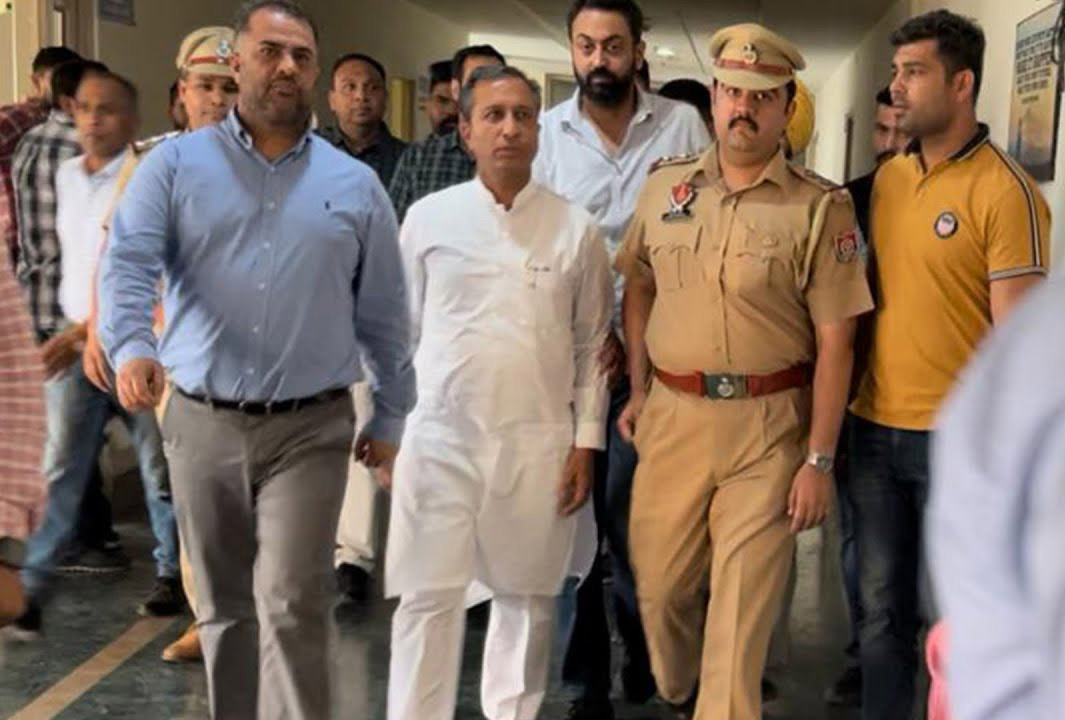
Punjab health minister Dr Vijay Singla was arrested on May 24 by the state’s anti-corruption bureau (ACB) shortly after chief minister Bhagwant Mann sacked him from his Cabinet over corruption charges and handed over the case to the police.

Besides Singla, his officer on special duty (OSD) and nephew Pradeep Kumar was also arrested under Sections 7 and 8 of the prevention of corruption Act registered on the complaint of Rajinder Singh, superintending engineer (SE), Punjab Health Systems Corporation. The accused were later in the day produced before a Mohali court where they were sent to three-day police remand till May 27.

Conspicuously enough, Mann himself took to social media through his 5-minute video message to convey the information about the dismissal of Singla from his Cabinet on corruption charges after he was reportedly found seeking 1% cut in tenders allotment and purchase of goods related to the department on an audiotape.

Mann said in his video address that since he alone was in the know throughout the case, he could have covered it up if he wished so. However, he said, by hushing up the matter, he would have not only failed his own conscience but also betrayed lakhs of people who trusted him. Mann underlined his party’s resolve of giving an honest governance and zero-tolerance to corruption.

Mann went on say that it is for the second time in the history of the country that an action had been taken by a government against its own minister on corruption charges. He held that it was first time when Delhi chief minister Arvind Kejriwal who had sacked his own food and civil supplies minister in 2015 after a video of him seeking a bribe was shown to him. Reiterating that he would not tolerate the corruption of even Re 1, Mann recalled his government’s pledge at martyr Bhagat Singh’s village Khatkar Kalan to give a corruption-free governance.

Interestingly, Mann had also pre-empted criticism by the Opposition parties, hence he said he knew the opposition parties would say that AAP’s minister was found involved in corruption within two months of forming the government, but, he wanted to tell them that he had taken an action whereas the chief ministers of other parties had themselves said that that they knew their ministers were engaged in the mafia and yet they did not take any action against them.

Audio clip did accused in

Meanwhile, according to information, the audio clip in which Singla and his OSD (his nephew) Pradeep Kumar are reportedly talking about Rs 5 lakh bribe from the SE, recorded by the SE (also the complainant) did them in.

The complainant SE said in the FIR that he was approached by the minister’s OSD Pradeep Kumar and asked to meet the minister in Punjab Bhawan last month. During the meeting, says the FIR, the minister asked the SE to take instructions from the OSD following which the OSD told the SE that latter had allotted works worth Rs 41 crore and paid Rs 17 crore to various contractors in March. He also demanded Rs 1.16 crore (2%) commission from the SE.

The complainant held that shocked by such demand he told the minister that he could not pay such a huge amount but the minister insisted for the commission. Upon this, Pradeep Kumar repeatedly called up the SE earlier this month asking for the commission and threatening that else he would ruin his career.

At this point of time, the SE expressed his helplessness and requested the minister to shift him anywhere and bring any other engineer who could fulfil the said demand. The SE held that he was then asked to give Rs 10 lakh for the works he had already got executed and 1 % of the works he would carry out in future. The SE held further that the final deal, however, was struck for Rs 5 lakh. On May 23, Pradeep Kumar called the SE to minister’s office in the Punjab civil secretariat where Singla is reportedly heard on the audio clip asking the SE to give the money to his OSD.

TROUNCED MOOSEWALA

Singla who is a dentist by profession and runs a dental clinic in the Mansa city is an MLA from Mansa. He had joined AAP about seven years ago and had also headed the traders’ wing of the party. He had polled highest number of votes in the state giving a sound beating to the Congress candidate Shubhdeep Singh Sidhu, popular as singer Sidhu Moosewala.

 KUDOS TO MANN

Meanwhile, lauding Mann’s action, AAP supremo and Delhi CM Arvind Kejriwal said on Twitter: “Proud of you Bhagwant. Ur action has brought tears to my eyes. The whole nation today feels proud of AAP.”

AAP leader Raghav Chadha also lauded Mann and said that AAP was the only party that had the integrity, courage and uprightness to take action against their own on grounds of corruption. We saw it in Delhi, now we are witnessing it in Punjab. Zero tolerance for corruption.

OPPN TAKES SWIPE AT AAP

Meanwhile, the state Congress chief Amarinder Singh Raja Warring said that the Congress stood vindicated by no less a person than CM Mann himself revealing corruption by one of his ministers.

Likewise, the BJP state president Ashwani Sharma said that the AAP stood exposed. The party which claimed corruption would be wiped out in 10 days has fallen flat in 80 days, he added.


SC panel nails police lie in Hyderabad encounter case

The Supreme Court-appointed inquiry commission has concluded that the killing of four accused in 2019 gang-rape and murder of a 26-yr-old vet was a ‘fake encounter’ staged by Telangana cops

The Supreme Court-appointed inquiry commission’s report into the cold blooded killing of four accused arrested for the 2019 gangrape and murder of a 26-year-old veterinarian has come to the conclusion that it was a ‘fake encounter’ by Telangana police.

It may be recalled that the Telangana government, which was under pressure from people to bring the alleged rapists to instant justice in the rape and murder, did not condemn the alleged encounter killing of the four accused, two of whom are now proven to be minors. The four accused were cousins Jollu Shiva and Jollu Naveen, C Chennakeshavulu and Mohammed Arif.  Now the commission has  recommended murder charges against 10 cops. The Justice VS Sirpurkar panel’s observation was that the accused were deliberately fired at when they were taken to the crime scene. This amounted to ‘instant justice’.

There were many who hailed the “encounter” three years ago — from Ministers to youth organisations in Telangana. Telangana Home Minister M Mahmood Ali, who had backed the police in 2019 and even questioned the victim’s failure to dial 100, said: “I do not want to comment on the issue, let the courts handle it.” On the morning of December 6, 2019, hours after the alleged encounter took place, the family of the victim had hailed the police, with her father saying that they got “relief” and “closure” with the death of the accused. At that juncture as news spread of the alleged encounter, a crowd gathered on the flyover overlooking the site on the Hyderabad-Bengaluru highway, and showered rose petals and flowers on the police officials below.

The police had already given CCTV proof of how the four youths approached the victim after deflating the tyres of her vehicle, took her two-wheeler after promising to fix the tyres, and after committing the crime, purchased petrol to set her body on fire.  That proof was enough to convict them in court but the police were under intense pressure to ensure instant justice because people were angered by the brazen crime.

The Justice V S Sirpurkar Commission, set up by the Supreme Court to probe the killing in an alleged encounter of four accused in the gangrape and murder of a veterinarian on the outskirts of Hyderabad in 2019, has submitted a report stating that it believes the police deliberately fired on the accused “with an intent to cause their death” — and recommended action against ten police officers and personnel under various charges, including murder.

In its report, the three-member commission stated that it does not believe the police version of events that led to the killing of the four accused when they were taken to the crime scene in the early hours of December 6, 2019, nine days after the gangrape and murder.

The commission also noted in the report that two of the accused, Jollu Shiva and C Chennakeshavulu, were minors at the time of the incident, based on their school records.

The Commission recommended that ten police officers and personnel be tried under IPC sections 302 (murder) read with 34 (common intent), 201 (causing disappearance of evidence, providing false information) read with 302, and 34. The ten are: V Surender, K Narasimha Reddy, Shaik Lal Madhar, Mohammed Sirajuddin, Kocherla Ravi, K Venkateswarlu, S Arvind Goud, D Janakiram, R Balu Rathod and D Srikanth.

The police had alleged that the four accused — cousins Jollu Shiva and Jollu Naveen, C Chennakeshavulu and Mohammed Arif — assaulted the accompanying police personnel, and tried to snatch their weapons and fire at them. Referring to the police’s argument in the case, the report stated that “there did not arise any occasion for exercising the right of private defence”.

The Commission’s report stated that the police officers accompanying the accused to the crime scene were responsible for their safekeeping. “If either by acts or omissions they failed to fulfil their responsibility, then their common intention to cause the deaths of the deceased suspects is established,” it stated. “Their conduct subsequent to the deaths of the deceased suspects in falsifying the record would indicate that not only did they act in furtherance of common intention to give false information in order to screen the offenders but also that they all acted with the common intention to cause the deaths of the four deceased suspects”.

“These officers cannot take shelter under Section 76 IPC and Exception 3 to Section 300 IPC because their contention that they fired in good faith at the deceased suspects has been disbelieved. Good faith, which is an essential prerequisite of Section 76 IPC and Exception 3 to Section 300 IPC, is found to be clearly absent,” it stated. Section 76 IPC deals with a situation where an act is committed by a person due to a mistake of fact and not due to a mistake of law, believing in good faith that he is bound by law to do it. Exception 3 to Section 300 IPC says that culpable homicide will not amount to murder if it is done with the intention of causing bodily injury, which is sufficient in the ordinary course of nature to cause death. According to the police, the accused were taken to the spot to recover articles belonging to the victim. While at the site, the four attacked the police with sticks and stones and tried to snatch their guns, the police claimed. The officers opened fire in self -defence killing all four.

Left stranded with a flat tyre, vet met a gory end 

Waiting for her two-wheeler to get fixed, a 27-year-old veterinarian was sexually assaulted and killed on the outskirts of Hyderabad in 2019. According to Police, the woman was returning home from her clinic a little after 8 pm when she noticed a flat tyre and called her sister, who suggested that she leave her two-wheeler at the toll plaza and take a cab home. But before she could, she was approached by two men, who offered to take her vehicle for repair, police said.

The woman agreed, and as she waited for the men to return, she was ambushed and dragged into the bushes barely 50 metres from Tondupally toll plaza, behind a line of trucks that obscured visibility from the road, police said. According to police, after killing her, the accused took her body to an under-construction bridge a few kilometres away, and set it on fire.


MOST POPULAR

HOT NEWS