3 yrs after scrapping of Article 370, Valley more alienated than ever

Though an uneasy peace has held in the Valley since the Article 370 was revoked, people are far from reconciled to the loss of autonomy as a fait accompli. While mass protests may have abated, the overall violence hasn’t. A report by Riaz Wani

On the face of it, Jammu and Kashmir looks like any other normal place three years after the revocation of Article 370 that granted the region a special position within the Indian Union. Kashmir Valley is no longer a witness to frequent protests, stone-pelting and shutdowns. Separatist politics has all but disappeared. Tourism is booming, with over one crore tourists having visited the union territory in the last six months. Tourists are also visiting the hitherto no-go zones near the border with Pakistan. But does this constitute normalcy? Apparently yes. But look deeper, and the situation appears contrary to its outward appearance. While mass protests may have abated, the overall violence hasn’t.

Giving a break-up of the violence over the last three years, Additional Director General of Police, Kashmir zone, Vijay Kumar recently said that over 500 militants have been killed in the period, besides 174 security personnel and 110 civilians.

J&K Police, however, acknowledges a redeeming difference in the security scenario since the withdrawal of the erstwhile state’s special constitutional position. Sharing the data on its Twitter handle, the police said that from August 5, 2016 to August 4, 2019 the number of law-and-order incidents reported in the Valley stood at 3,686 while only 438 such incidents were reported from August 5, 2019 to August 4, 2022. Similarly, 290 security personnel and 191 civilians were killed in the previous three years.

“The number of civilians killed in terror incidents is on a decline,” the ADGP Vijay Kumar said. “Once the total number of terrorists in Kashmir come down below 50, number of civilian killings will certainly decrease.”

Muted celebration 

J&K witnessed a muted celebration of the third anniversary of the withdrawal of Article 370. Kashmir Valley remained calm on the day and there was no call for hartal – albeit shops in parts of Srinagar remained closed.

Workers of the People’s Democratic Party, led by its president Mehbooba Mufti staged a protest at Lal Chowk in Srinagar to mark the anniversary. Addressing the protest, Mehbooba said August 5 was a black day for the entire country.

“Our constitution and our flag were taken from us unconstitutionally and illegally. This has harmed not just J&K, but also the entire country,” she said. “We will take back our flag and our constitution and also continue the fight for resolution of Kashmir issue.”

Similarly, National Conference vice-president Omar Abdullah reiterated the party’s resolve to continue the struggle to challenge the abrogation of Article 370 and Article 35A.

“We will continue our peaceful struggle using all legal and constitutional means to challenge what was done to J&K on 5th Aug 2019. The road ahead may be a long one, full of twists and turns but it’s not one @JKNC_ will abandon,” Omar posted on Twitter.

People’s Conference chairman Sajad Lone blamed NC-PDP alliance for endorsing further decline in the political identity of J&K “by their deceptive conduct”,  and accused the BJP of “continuing to disempower masses of the erstwhile state of J&K.”

A delegation of the Congress, led by former minister Tariq Karra and senior leader Taj Mohiuddin, also assembled at the party office on Maulana Azad Road in Srinagar to protest against the abrogation of Article 370.

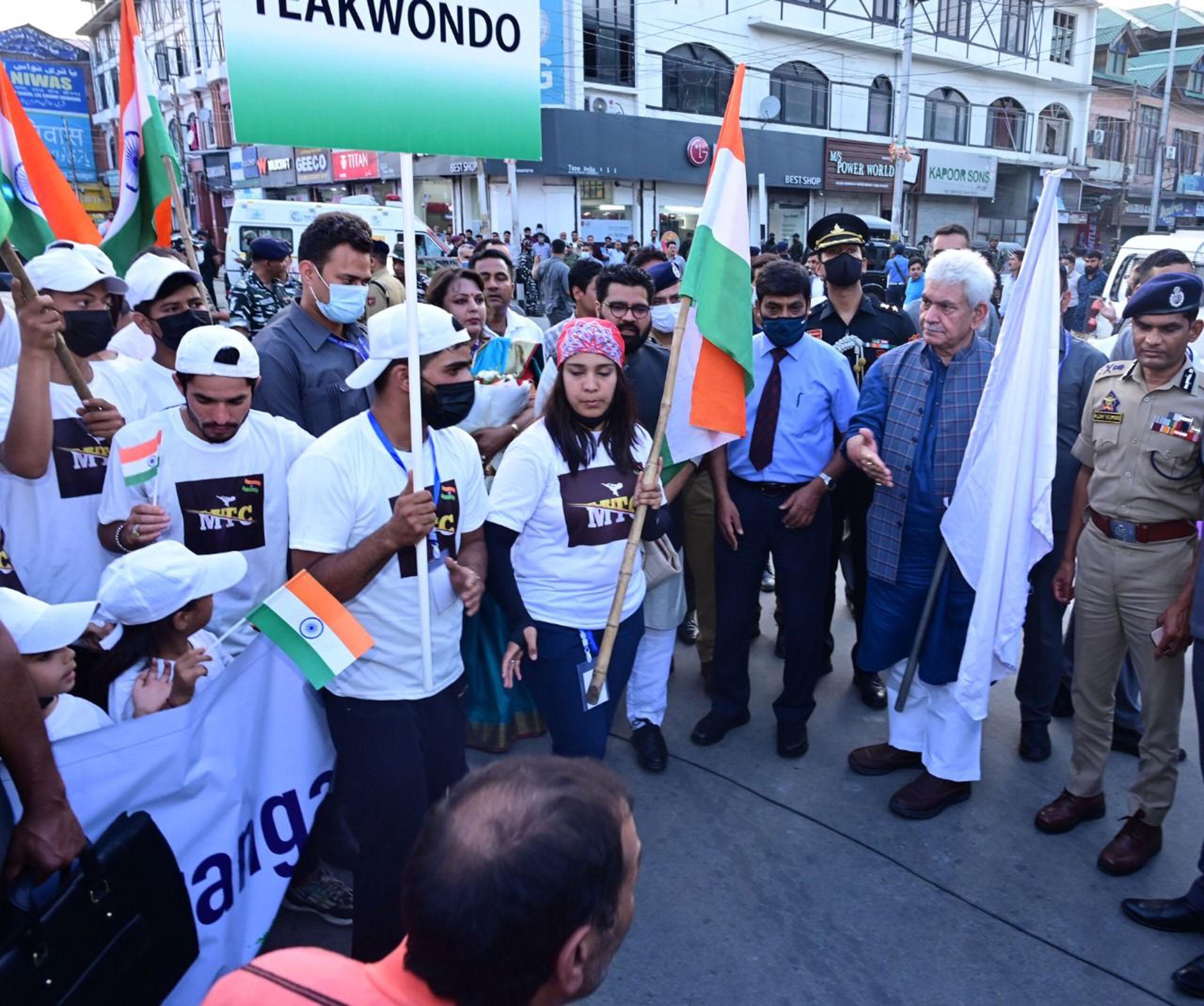
However, Lieutenant General Manoj Sinha declared August 5 as “Bhrashtachar Mukt Diwas” (Corruption-free day). Sinha attended a number of functions in Srinagar, and flagged off ‘The Great India Run’ from Lal Chowk. The marathoners will cover a distance of more than 800 km from Srinagar to New Delhi with the message of peace and national integration. But apart from official events, there wasn’t much of a celebration.

Unease in Jammu, Ladakh

In Jammu too, the situation of the last three years has had some sobering effect on the people. The celebration on August 5 was largely limited to the BJP and its supporters while the other parties watched from a distance. A significant number of people in Hindu dominated districts of Jammu support abrogation of Article 370 and 35A, but some of its provisions have begun to bite.

It is true that over the last year, Jammu and Ladakh have exhibited visible signs of disaffection with the fallout of the repeal of Article 370.  A looming prospect of demographic change, loss of jobs and land rights have made people uneasy. People in Jammu apprehend that their region would be the first destination for the eligible outsiders choosing to settle in J&K. But while the expression has been muted in Jammu, people have been vocal about their rights in Ladakh. Last year when all parties in Ladakh closed ranks against entry of outsiders and to this end threatened to boycott the then LAHDC elections, the centre promptly assured these protections to the region unlike its approach to Kashmir. But until these safeguards are actually granted, Ladakhis will have reason to feel apprehensive.

At the same time, Muslims in Ladakh who are in a slim majority in the region, aren’t interested in these safeguards. Like their counterparts in Kashmir, they also want reversal of Article 370 move and rejoining of Ladakh with J&K. Or else, they want statehood for the region.

But as things stand, these apprehensions are not deep enough to cause people to protest publicly. Besides, in case of Jammu, the fears of a demographic change are being trumped by the expectation of development of the region and more importantly the anticipated shift of political power away from Kashmir Valley.

Geopolitical shift

Things have since become complicated geopolitically too. China’s incursions in Ladakh have effectively made the communist power yet another party to the Kashmir issue. People’s Liberation Army has yet to vacate the remaining friction points after withdrawing from Pangong lake last year. This has created a lingering stand-off between the two countries.

Taliban’s takeover of Afghanistan has also altered the security scenario in the region.  But so far the Taliban has done little to upset the existing regional security order, something its neighbours, particularly India, apprehended it to do. This is unlike the Taliban’s previous stint in power, which led to a marked rise in violence in Kashmir Valley. Five years of Taliban rule from 1996 to 2001 saw a sharp escalation in Kashmir violence—from 2,903 killings in 1996 to 4,011 in 2001.  The period is also marked by the hijacking of 1C-814 to Kabul and Kargil war.  However, it is difficult to predict how the Taliban will behave over the coming years.

Meanwhile, New Delhi has aligned itself more closely with the US and the west.

These shifting alignments are putting in place a new regional geopolitical order. This order, however, in no way will help resolve the issues of the subcontinent, particularly those between India and Pakistan. Going forward, the situation looks set to become more complicated. Though the signs of thaw between India and Pakistan early last year had offered some hope, the prospect has since fizzled out.

Deep Alienation

Though an uneasy peace has held in the Valley since August 2019, people are far from reconciled to the loss of autonomy as a fait accompli. They have been watching the unfolding state of affairs silently. There have been fewer protests and far fewer stone pelting incidents.  Hartals have become scarce. But despite these outward manifestations of peace, the Valley is more alienated than ever. The militancy has suffered a setback but remains very much alive and kicking. It is difficult to predict what the future holds. The situation in Kashmir may have stabilized in the last years but it remains deeply uncertain and far from peaceful.
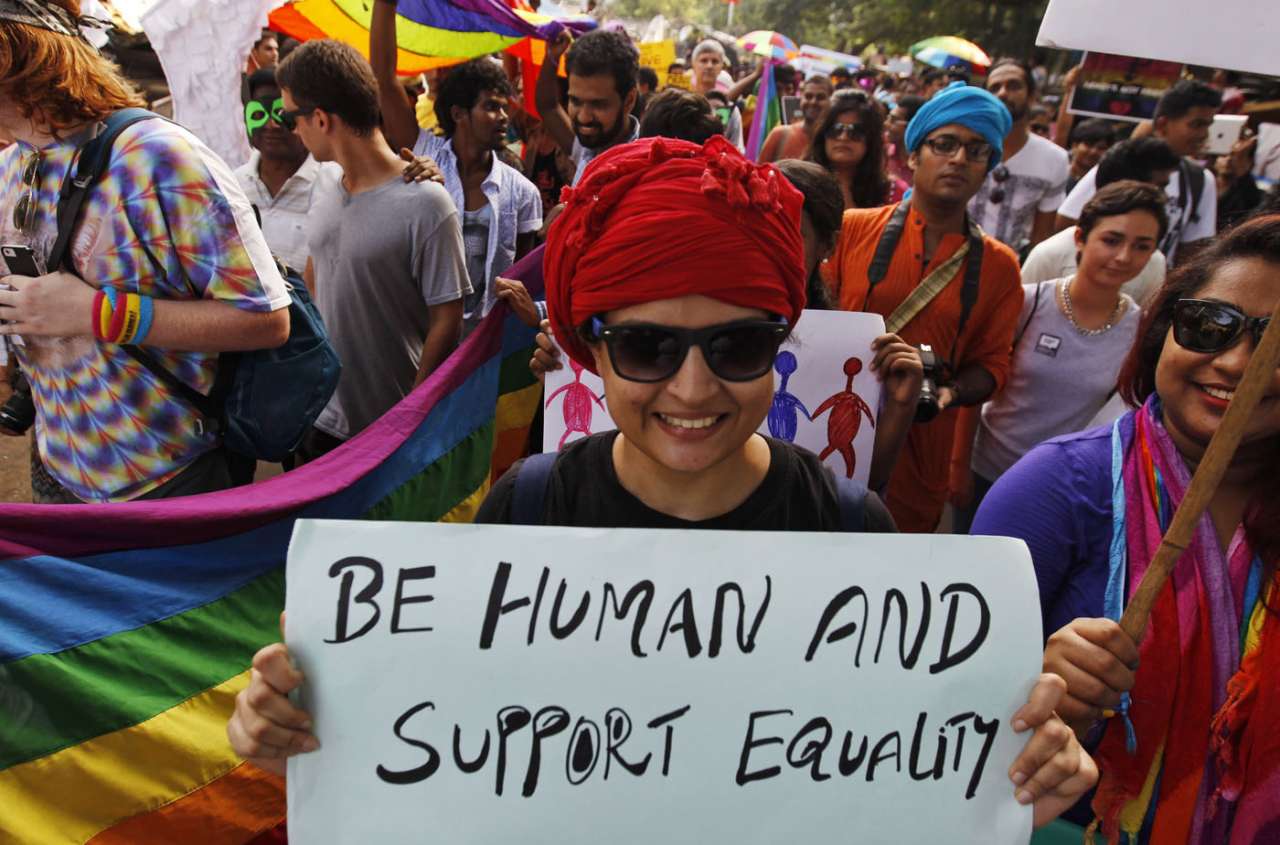
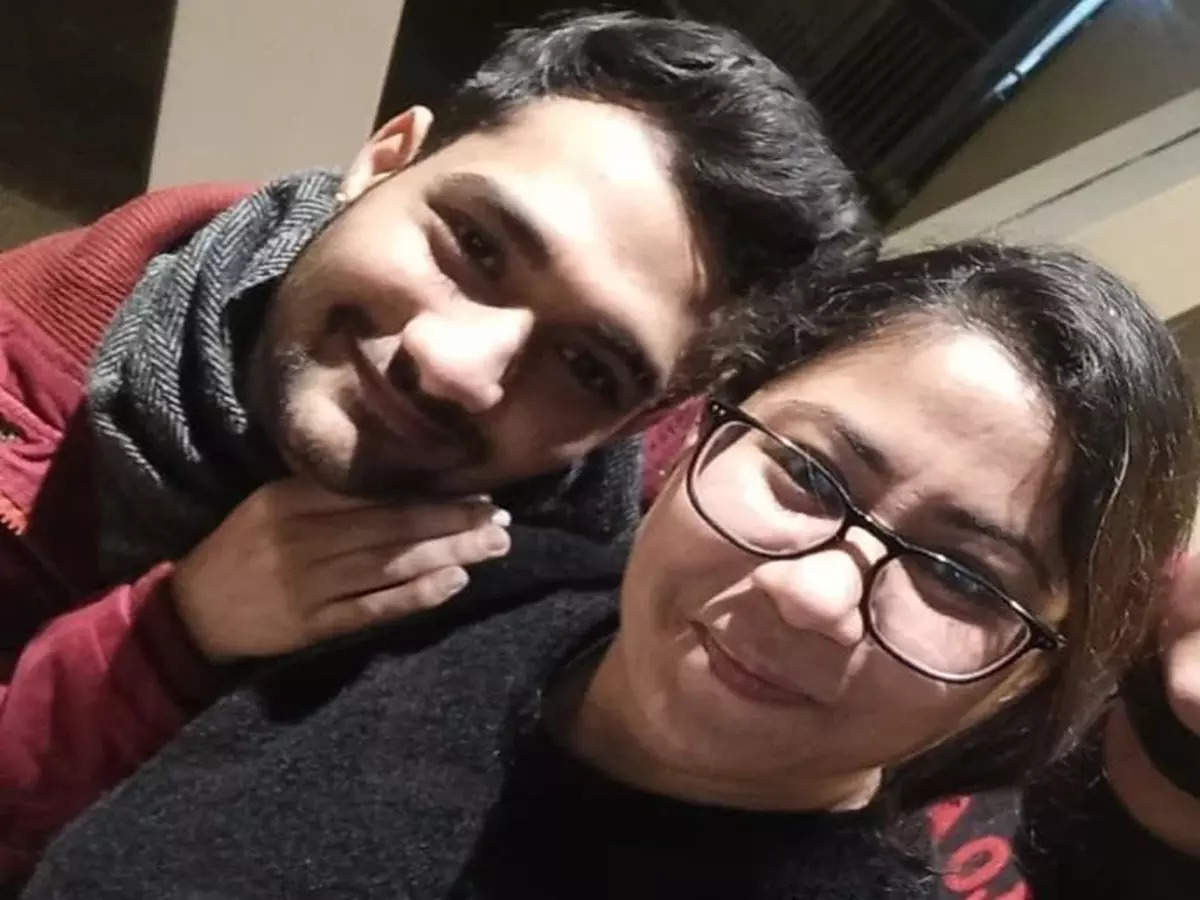
 

How many more Arvey Malhotras will it take for us to embrace diversity?

Even as the mother of the DPS Faridabad student who died by suicide fights for justice, one wonders why cisgender adults are having a hard time accepting people from the LGBTQI+ community

Imagine getting up every morning and having to go to a school and college where you are shunned and isolated, laughed at, taunted, called names, talked about, beaten up and worse groped by your fellow students, stripped, sexually assaulted and threatened with rape. Imagine having no recourse to any justice or dignity because the cisgender authorities who are supposed to protect you don’t want to address the issue or are indifferent or maybe in their heart agree that this is how someone “like this” should be treated. Imagine being bullied and traumatized to the extent in school and college that you would rather give up your education and beg on the streets or resort to prostitution to make a living or just kill yourself, to end the daily torture and humiliation. This is not fiction, but the reality of the lives of millions of LGBTQI+ children and youths in India and abroad. A whopping 54 per cent of LGBTQI+ students have experienced bullying in schools at least once because of their identity, says a telling UNESCO study.

They face this because they don’t conform to our gender sensibilities. They live this monstrous existence because even after thousands of years of civilization, we, as a society have not evolved to accept those who are different from us in any way. It’s because of our small-mindedness and inability to embrace that which is different from us that people of different colour, body-types, minorities, different castes and gender, especially those belonging to the LGBTQI+ community suffer. Multiple studies have found that LGBTQI+ youth who are bullied are three times more likely to be at risk of suicide than those who haven’t faced bullying. Because confusion about their identity, depression, the feeling of helplessness, isolation, rejection from family and society and humiliation break them till they feel that it’s better to end it all.

This is why, 16-year-old Arvey Malhotra, a student of DPS in Faridabad, decided to jump off the 15th floor of the building he lived in to end his life in February this year and a mother lost her precious child, the centre of her universe. In his suicide note to his mother Aarti Malhotra, the teenager, who was allegedly battling bullying and sexual assault at an insensitive and indifferent school, wrote, “This school killed me.” Now, his mother, who was incidentally a teacher at the same school, is fighting to bring the culprits to book and get justice for her precious Arvey.

One shudders to think, that if the child of a teacher in the same school can be driven to suicide by bullies who turned sexual assaulters, then what will be the plight of other LGBTQI+ children in our schools? And how is it that a prestigious school like DPS was unable to clamp down on the offending students and put an end to the harassment of an innocent child over his sexuality. And I say child because the nightmare for Arvey began when he was in Grade 6.

Media reports quote Aarti as saying: “The bullying started in 6th grade. Arvey would cry, ‘The boys call me a chakka.’ I was a teacher in the same school, DPS. I’d complain to the authorities but they’d say, ‘He’s a nautanki!’ I’d tell him things would get better. He tried to be ‘manly’ by playing volleyball. But it wasn’t for him. He loved art & music; that made him happy. But at every step, he was mocked for being ‘feminine’.”

By the time Arvey reached Grade 9, matters had spun out of control and the bullies, encouraged by the lack of action by the school had now turned into sexual predators. The depressed and distressed boy confessed to his mother that he was blindfolded by boys in his class and he was made to strip. Finally, unable to cope with the harassment and dreading the prospect of going back to school even for his exams in February, Arvey took the step that most parents dread and he committed suicide, leaving behind a grieving and devastated mother.  Can you imagine how horrific and terrifying the experience must have been for him to prefer jumping off a building and leave his beloved mother alone, rather than go through another day of being bullied and pilloried?

But, things should not have come to such a pass. If the school had taken timely action and clamped down on the miscreants hard, they would not have dared to bully the child after that.

If the school had gender sensitization classes, both for the teachers and the children, they would have learnt to be more open minded, accepting and would have understood different sexualities better. But, how are the schools in India supposed to do all this when we ourselves are so closed minded? For example, in November 2021, the National Council of Education Research and Training (NCERT) released a booklet designed to sensitise teachers about gender biases in order to create a safe, gender-sensitive environment in our schools. However, this path-breaking document titled ‘Inclusion of Transgender Children in School Education: Concerns and Roadmap’, met with so much vitriol and opposition on social media that the National Commission for Protection of Child Rights (NCPCR) issued a letter on November 2, to NCERT, suggesting that it was ‘conspiring to traumatise school students in name of gender sensitisation’. Can you believe that! As a result, the NCERT had to remove the booklet from its website within a few weeks.

So, if we adults behave in such an intolerant, ignorant and archaic manner, how do we expect our children to know better? Because don’t our children learn from us?  So, not surprisingly, the children, too, target any student who does not conform to our definitions of male or female. And have not we, as a society, given them enough reason to behave in the worst possible manner towards the LGBTQI+ community? For instance, take the example of Adam Harry, India’s first transgender trainee pilot. He is worried sick about realising his dreams of becoming a professional pilot because of the double-speak by the Directorate General of Civil Aviation (DGCA). Though it has “clarified” that there are no restrictions on transgender persons becoming pilots it has been firm on its stand that “flying duties cannot be assigned to those on hormonal therapy.” Really? So what does it do when its female pilots have to go on hormone therapy for medical reasons? Does it ground them too?

Gender dysphoria is another reason that the DGCA has given for rejecting his flying licence, without explaining how ‘gender dysphoria’ renders him unfit to fly. According to doctors, none of these conditions make Adam Harry unfit to fly and it’s just “unscientific” and “homophobic”. Because if that was so, then he would be ineligible to fly abroad too, but other nations like the UK, US and South Africa don’t have any issues like that. Now Harry is fighting a legal battle with the DGCA for his basic fundamental right to make a living.

All this discrimination, heartbreak and struggle despite the fact that our Government and judiciary are doing their best to mainstream the LGBTQI+ community. After the 15 April 2014 landmark ruling by the Supreme Court that declared transgender people a socially and economically suppressed class entitled to reservations in education and jobs, and also directed Union and State Governments to frame welfare schemes for them, things should have become easier, but the reality on the ground is far different because the cisgender-dominated society is yet to mature and become more inclusive. It’s a similar story for same sex couples despite the landmark 2018 Supreme Court ruling decriminalizing gay sex among consenting adults.

Shockingly, even the highly educated cisgender adults have a hard time accepting people from the LGBTQI+ community. For instance, one would think that the scientific community, which includes highly educated people of science would be far more understanding and inclusive, but sadly that is not the case if the results of a 2021 survey of people from the LGBTQI+ community by an aspiring neuroscientist Sayantan Daetta are anything to go by. Daetta’s survey of the STEM discipline revealed that 38 per cent of respondents had faced bullying and harassment, experienced fear of ostracisation, silence about gender and sexuality. If such diversity phobia and inability to accept anyone who identifies with a different gender or has a different sexual preference exists in the hallowed STEM spaces, then what can we say or expect of those not as educated or not educated at all?

We Indians are very proud of our sanskriti and sanskar, but why do we pick and choose which part of our sanskriti and sanskar do we want to be a part of? For all those pointing fingers at LGBTQs, don’t the Vedas refer to a “third sex,” roughly defined as people for whom sex is not procreative, either through impotence or a lack of desire for the opposite sex? Members of the third sex are not ostracized in the ancient texts and are sometimes recognized for having divine powers or insights.

The world-renowned Kama Sutra, an ancient Indian text, states that same-sex experience is “to be engaged in and enjoyed for its own sake as one of the arts.” And Varuna and Mitra are famously referred to as the “same-sex couple” in the ancient Indian scripture of the Rig Veda, and what of King Bhagirathi, who is known in mythology for bringing the Ganges down to earth from the heavens. According to the Krittivasi Ramayan composed by the 15th century Bengali poet Krittibas Ojha: Dilip, the son of Ayodhya’s King Sagara, died due to the wrath of the sage Kapila. Thus he could not ensure the continuance of the royal lineage as he died before his two queens could become pregnant. But the Krittivasi Ramayan says that Dilip’s widows drank a magic potion, and made love to each other to conceive. Later, one of them gave birth to King Bhagirathi.

There are many more such examples of the LGBTQ community being an acceptable part of our society in ancient India. They held their heads high then, so why not now? Are we to learn nothing from our glorious past, the golden India of yesteryears? Sometimes, it is good to go back to our roots and try and understand where we went astray. I certainly hope in this case we find our paths. And I pray that Arvey Malhotra’s mother gets the justice she is fighting for, so that there are no more lives like Arvey’s, snuffed out by heteronormative biases, insensitivity and fear of diversity. And for Arvey I have this to say, “We are sorry we failed you in this world. Shine on you beautiful star in the firmament.”


Man seen assaulting a woman in viral video falls in UP police net

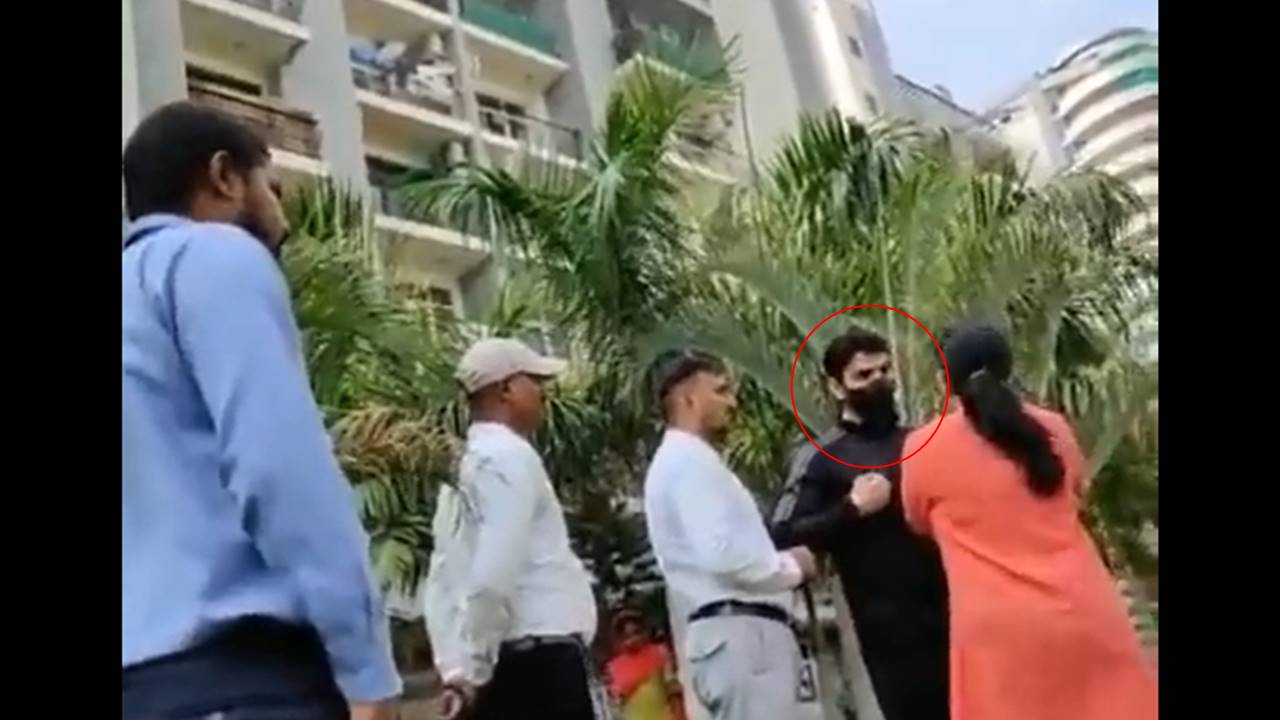
Shrikant Tyagi, a self-proclaimed BJP politico, who was seen abusing and thrashing a woman on video in a plush multi-storey Grand Omaxe residential society in Noida, was nabbed by the UP police soon after CM Yogi Adityanath ordered his arrest, reports Mudit Mathur

Shrikant Tyagi, who was seen abusing and thrashing a woman on video in a plush multi-storey Grand Omaxe residential society in Noida, has been finally arrested by the Uttar Pradesh police soon after Chief Minister Yogi Adityanath himself took tough stand ordering his arrest and probe into the matter. The court sent him in judicial custody rejecting his bail pleas. The pleas in other matters, including in the FIR related to impersonation and cheating, will be heard by the Surajpur court on August 16.

Tyagi was booked by the police for assaulting and abusing a woman resident of Grand Omaxe housing society in Noida’s Sector 93 who objected to him planting trees in the common area of the society with an alleged intention to grab common area facility and green cover as his personal lawn. On August 8, Noida Authority rolled out bulldozers and razed the illegal structures outside his Noida flat. The demolition order was passed on RWA complaint years back but not executed earlier due to political power he wielded.

Tyagi fled the scene soon after the case was filed and Noida police was reluctant to nab him due to his political clout and alleged association with senior BJP leaders. In view of strong public outburst against him on the grounds and social media, the BJP leadership disowned him quickly though Tyagi posted many photographs with BJP leaders including its president J.P. Nadda on his social media handles.

Shrikant Tyagi’s official Twitter profile mentions that he is a National Executive Member, Bharatiya Janata Party (Kisaan Morcha); National Co-Coordinator, Yuva Kisaan Samiti Bharatiya Janata Party.  However, both BJP and Kisaan Morcha have denied the claim. Although BJP leaders have denied any link with him, several reports have provided evidence that contradicts these claims.

Nine cases against him are registered against him with the Uttar Pradesh police ranging from encroachment and threatening incidents but nobody dared to touch him. His proximity with the high-level police officers is an open secret in Noida, and that perhaps was responsible for rise of his notoriety. Two cases were filed against the alleged BJP leader in 2007 under the sections of the Gunda Act and extortion.

One year later in 2008, a case was filed against Tyagi under police station of Sector 39 on multiple charges such as causing hurt, criminal intimidation, and mischief-causing damage. He was also booked twice in 2009 on charges of violence and rioting. Tyagi was further booked in a case of attempted murder and criminal intimidation in 2020, and an FIR against him was lodged in the Phase 2 police station. In 2019, a complaint was filed against him by the residents of his housing society for illegal construction. After the incident reported on 4th August, 2022, when he was accused of bullying and assaulting a female resident of his society in Noida, two more cases were filed against Tyagi.

Tyagi was dramatically arrested by the Uttar Pradesh Police on 9th August following the mounting pressure of chief minister Yogi Adityanath over the issue of safety of women in BJP rule and a severe dent in his image of  “Bulldozer Baba”. He was on the run since Friday, when the FIR against him was registered for assaulting the woman. Later, sections of criminal trespass, causing hurt, insult with intent to provoke breach of the peace and criminal intimidation were added.

Noida police commissioner Alok Singh told media that the Gangster Act would also be slapped against him. Singh said Tyagi claimed he had got the “vidhayak” (MLA) sticker on one of his vehicles “through (former MLA) Swami Prasad Maurya but Maurya denied issuing him any such pass.” It was also found a fake car pass as its validity was shown to be up to 2023 while it is issued on yearly renewable basis.

Noida police commissioner further said in his press briefing that five cars—two Fortuners, two Safaris and a Honda Civic—under Tyagi’s and his wife’s Anu Tyag’s name have been impounded. “The vehicles seized from the accused run in 001 UP 32 series. He made a bid for each number plate, and each cost around Rs 1,10,000.” “Tyagi’s driver also unauthorisedly got printed an emblem of UP government on its number plate on his instructions.”

Tyagi was provided security by the Ghaziabad administration between 2018 and 2020. He was provided with one personal security officer in 2018, which was later increased to four on the government’s orders. The security cover was withdrawn on February 26, 2020.


With eye on 2024 polls, Cong ready to hit the streets

The party will launch the nationwide Bharat Jodo padyatra from Kanyakumari to Kashmir on September 7 which will be led by Rahul Gandhi and see participation of all party leaders. The 3,500 km long yatra will criss-cross through 12 states and 2 UTs. A report by Amit Agnihotri

Looking at the party’s national revival and to take on the Centre ahead of the 2024 Lok Sabha polls, the Congress has decided to hit the streets in September.

The Congress will launch the nationwide Bharat Jodo campaign on Sep 7, which will be led by Rahul Gandhi and see participation of all leaders, weeks after the party’s state units staged 75 km mini-yatras in all districts to mark 75 years of Independence.

The party will also protest against the Agnipath defence recruitment scheme from August 15 across the country.

Earlier, the Congress had announced at the Udaipur Chintan Shivir held from May 13-15 that the party will launch the nationwide Kanyakumari to Kashmir padyatra on October 2, the birth anniversary of Mahatma Gandhi, against the BJP’s alleged divisive politics.

The party advanced the Bharat Jodo yatra as it feels that the recent nation-wide protests over the ED summons for the Gandhi family and over issues like price rise and unemployment have charged up the party workers.

The 3,500 km long yatra will criss-cross through 12 states and 2 UTs over a span of 150 days and is expected to keep up the momentum generated over the past two months of protests.

The Congress has been alleging over the past months that the Gandhi family was being targeted by the ED after the party announced plans to launch the Bharat Jodo yatra as part of the Udaipur declaration finalised after three days of brainstorming by over 400 leaders to prepare a strategy for the 2024 national elections.

Rahul Gandhi had flagged the need for the grand old party to get into an agitation mode and go back to the people to counter the ruling BJP.

In June when Rahul was questioned by the ED, the entire Congress came out on streets. Later, when Sonia Gandhi was questioned in July, Rahul led the protests.

On August 5, when the Congress staged nationwide protests over issues like price rise and unemployment, Rahul led the march of party MPs from Parliament to the Rashtrapati Bhavan while his sister Priyanka Gandhi Vadra led a Congress protest march to the PM’s house over price rise and unemployment issues.

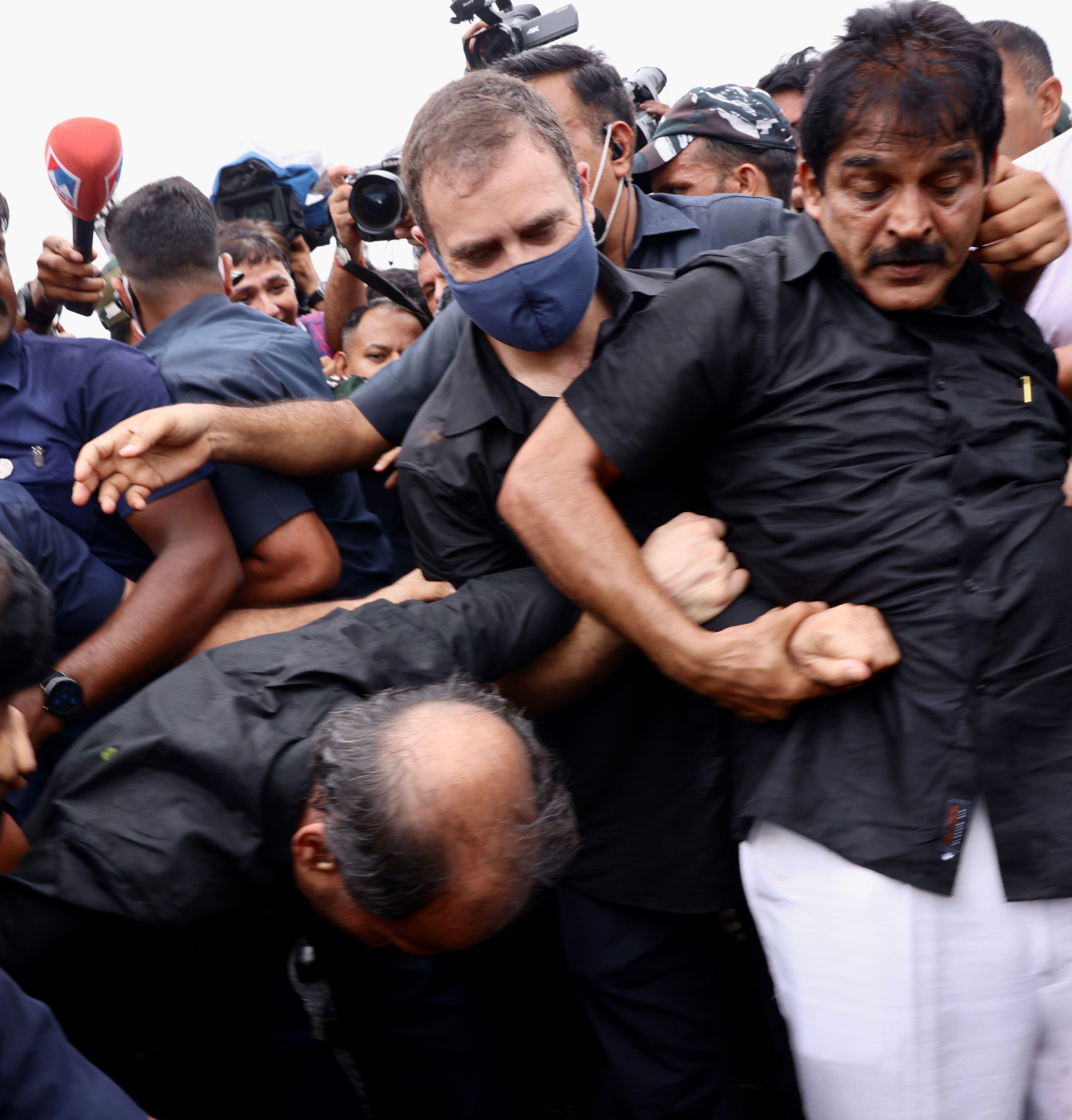
The sibling duo, along with senior leaders, was detained by the police, who allegedly manhandled Priyanka during the protests.

As the videos of Priyanka’s manhandling by the police went viral, the action was strongly criticized by the Congress as well as the other parties.

Before the protests, Rahul Gandhi slammed the ruling BJP/RSS saying the country was witnessing an “onset of dictatorship and death of democracy.”

“Are you enjoying the onset of dictatorship in India? What we are witnessing is the death of democracy. What India built over centuries ago is being destroyed. It is a dictatorship of four people. Anybody against this onset of dictatorship is put in jail. There is no debate in Parliament. The sole agenda of the government is that people’s issues should not be debated,” Rahul said at a presser.

“The government’s focus is just on 2-3 big business people,” he said.

Rahul said that he was being targeted for speaking truth to power.

“The more I speak the truth, the more I will be attacked. I feel joy when I am attacked as it helps me understand the battlefield. I am not afraid, I will stand for democracy and raise the people’s issues,” he said.

Targeting the Centre, Rahul said: “Those who have fear, threaten others. They fear the condition of the country today and the false promises they made to the people because they lie to people,” he said.

Later, Rahul responded to the sealing of the Young Indian offices, which owns the National Herald, saying he was not afraid of PM Modi and home minister Amit Shah and would keep on fighting the ideology of the BJP.

Sena’s support

At a time when the Congress was battling against ED raids, ally Shiv Sena supported the grand old party. Former chief minister Uddhav Thackeray, who has recently become the editor of party mouthpiece Saamna, praised Rahul Gandhi and Priyanka Gandhi Vadra over the way they led the protests and slammed parties like NCP and TMC for not joining the Congress’ agitation over price rise and unemployment on August 5.

He also targeted the TMC for not supporting the joint opposition candidate for the vice-presidential polls Margaret Alva over a small issue. Thackeray alleged that the central agencies were being used to target the opposition parties and weaken the opposition unity. Yet, the opposition parties were not together and distanced themselves from the Congress agitation, which was not a healthy sign for democracy.

Thackeray said the Sena was also fighting against the misuse of ED against senior party leader Sanjay Raut, who has been arrested in a case. Thackeray who lost his chief ministerial post recently as a party rebel Eknath Shinde took the office with support of BJP, alleged that the ED played a role in the episode.

Nationalism

According to Congress insiders they also want to counter the BJP’s version of nationalism by  highlighting the role of the Congress in the country’s freedom struggle and therefore had announced the nationwide yatra on Aug 9, the anniversary of the Quit India movement started in 1942 by Mahatma Gandhi.

“On this day, 80 years ago, the Indian National Congress under the leadership and inspiration of Mahatma Gandhi launched the “Bharat Chhodo” movement that won our country freedom five years later. Today the Indian National Congress announces the launch of its Kanyakumari to Kashmir Bharat Jodo Yatra from September 7th, 2022,” Congress communications in charge Jairam Ramesh said.

“This is a padyatra throughout twelve states and 2 Union Territories. It will be about 3500 km long and will be completed in about 150 days. Congress workers and leaders including Rahul Gandhi will participate in the yatra,” he said.

Recently, the Congress leaders changed their social media DPs to a picture of first prime minister Jawaharlal Nehru holding the Indian flag in an attempt to counter the BJP’s “Har Ghar Tiranga” campaign to mark 75 years of Independence.

The party also made an “appeal to all wanting to be part of a gigantic national endeavour to provide an alternative to the politics of fear, bigotry and prejudice and to the economics of livelihood destruction, increasing unemployment and growing inequalities to participate in the Bharat Jodo Yatra.”

The Congress had pressed for a debate over these issues during the monsoon session of Parliament, which was adjourned on Aug 8 four days ahead of schedule.

Azadi yatra

Before the Bharat Jodo Yatra, the various state units of Congress carried out mini-yatras, dubbed as “Azadi ki Gaurav Yatra”, which covered around 75 kms across all districts under their jurisdiction.

During the Azadi Gaurav yatra, Congress workers and leaders celebrated the political milestone, highlighted the grand old party’s role in the freedom struggle and used the foot marches as public outreach events.

“We told people about the role of Congress in the country’s freedom struggle. You can’t separate the Congress and the freedom struggle. We told them about the work the party did since Independence. In contrast, we also told the people that the Centre has done nothing over the past eight years except for carrying forward the previous UPA government’s schemes,” AICC secretary in charge of organization Qazi Mohammed Nizamuddin said.

Party insiders said that the June and July nationwide protests over ED summons for party chief Sonia Gandhi and former chief Rahul Gandhi and the August 5 agitation over price rise and unemployment issues have galvanized the party workers and the leaders alike. The recent protests, they acknowledged, had been qualitatively different from the past agitations over various public issues.

Qazi, a former Uttarakhand MLA, said that though the Congress had been protesting over public issues in the states over the past years, the grand old party was going into the Azadi Gaurav Yatra with a “renewed energy and resolve.” “The recent protests have certainly charged up the party. We have to prepare for the future challenges,” he said.


Haryana House witnesses fireworks over drugs, illegal mining

The defence put up by ruling BJP-JJP coalition notwithstanding, the treasury benches came under heavy fire from Congress, the main opposition party in Haryana, and the INLD during the recently concluded three-day monsoon session, reports Rajesh Moudgil

The opposition parties – Congress and the Indian National Lok Dal (INLD) – remained consistent in their scathing attack against the ruling BJP-Jannayak Janta Party (JJP) combine throughout the recently held three-day monsoon session on various issues including extortion calls to legislators, illegal mining and the rapid spread of drug menace in the state.

On the day one of the session, the treasury benches came under severe criticism of the opposition parties when the Congress also staged walk-outs twice on the issue of what its members termed as the deteriorating law and order situation in the state.

The leader of opposition, Bhupinder Singh Hooda, who is also Congress legislature party (CLP) leader while speaking on the issue, objected to the converting of the adjournment notice move of the Congress’ members into a calling attention motion, which, he held was to undermine the seriousness of the said issue.

Hooda highlighted the recent extortion calls and threats to about six legislators of Haryana as well as several other incidents exposing deteriorating law and order situation. He held that the Congress members expected a longer and detailed discussion on the issue with participation of more members which could not be possible as it had been converted into a calling attention motion which had its limitations of time and participation.

Senior Congress legislator Raghuvir Kadian held that all the state issues including the economic growth were also related to the law and order issue, hence the need to discuss it threadbare instead of trivialising it by reducing the time for discussion. Even though the heated arguments continued for long, several Congress MLAs staged a walk-out against the ruling BJP-JJP combine. They also gave example of the brutal murder of Surender Singh, a DSP deputed in Nuh district by mining mafia when he was carrying out a raid against the miscreants on July 19, last.

Home Minister Anil Vij during his answer after several members including Geeta Bhukkal, B L Saini, Jaivir Valmiki, Balraj Kundu, Shamsher Gogi and Neeraj Sharma and leader of another opposition party – Indian National Lok Dal (INLD) – had spoken on the issue, detailed the House of the incidents of illegal mining during Congress rule.

However, Vij’s reply further miffed Congress legislators who held that Vij’s reaction also reflected how the ruling government was trying to trivialise the issue instead of seeing its gravity and again staged a walk-out.

The treasury benches again faced scathing attack of the Congress on the second day of the session on the issue of illegal mining and the DSP Surender Singh’s murder by mining mafia in Nuh. The House witnessed arguments between the treasury benches and opposition members including the leader of the House, Manohar Lal Khattar and the leader of the opposition, Bhupinder Singh Hooda.

Giving statistics on how the illegal mining was handled with iron hand by the BJP government since 2014, Khattar said that while the state had earned about Rs 1,267 crore revenue from mining from 2005 to 2014 during the Congress rule, the same jumped to Rs 4,660 crore since 2014 during the present rule, to this date.

Countering the same, the Congress members held that the data itself showed the sharp increase in the cases during BJP rule and the less number during Congress rule was due to the ban on mining during its regime.

Abhay Chautala of another opposition party – Indian National Lok Dal (INLD) – also hit out at the government and said that the state government had failed to act firmly against the mining mafia since the past about eight years and hence the shocking murder of the DSP occurred on July 19, 2022 while he was checking the illegal mining in the Tauru area of Nuh district.

However, the mining minister Mool Chand Sharma informed the House that all the 12 accused including the main accused of the DSP’s murder had been arrested.

Lumpy skin disease in Haryana

Replying to another calling attention motion moved by Congress MLAs Amit Sihag and Sheesh Pal on the issue of lumpy skin disease (LSD) in Haryana, the Haryana animal husbandry and dairying minister J  P Dalal said that out of the total 62.92 lakh bovine (buffalo and bovine) animals in the state, 19.32 lakh were bovines. Giving a brief description of the total number of LSD cases till August 08, 2022, he said that the number of affected villages is 482, the number of affected cattle is 6,135 the number of affected buffalo is zero, the number of samples taken for diagnosis is 161, and the number of dead animals is 23.

The issue of alleged rapid spread of drug menace in the state dominated the last day of the three-day monsoon session when several of the opposition members took on the treasury benches while participating in a calling attention motion on the issue.

Home Minister Anil Vij in his reply said that the Haryana State Narcotics Control Bureau (HSNCB), set up in August 2020, and all districts Anti-Narcotics Cells (ANC) had attached properties of the culprits worth about Rs 25 crore.

Vij further informed the House that in the year 2020, Haryana police registered 2,982 cases under the NDPS Act and arrested 4,477 persons and recovered about 221 kg of Opium, besides other drugs. In 2021 the police registered 2,745 cases under NDPS act, arrested 3,975 persons and recovered about 345 kg of opium, about 29 kg of heroin, over 13 lakh tablets and 45,280 capsules. He said that this calendar year up to August 2 the police had registered 2,334 cases and arrested 3,209 persons and recovered about 181 kg of opium and about 20 kg of heroin.

However, the INLD member, Abhay Chautala alleged that the drug menace was still rapidly increasing and the situation was grave in 11 districts of the state. He alleged that at least 329 persons had died because of the drug overdose, he said that 33 persons died during the past about one and half years alone who were aged between 18 and 30 years.

Speaking on the issue, Congress’ legislator Amit Sihag highlighted the severity of the issue alleging that in Sirsa alone where about 1,919 persons were admitted in the drug de-addiction centre in 2015, while the number of such persons had jumped manifold now. He held that unemployment was also one of the reasons that the people in the state were taking to drugs and some of them to crimes because of the drugs. He demanded a concrete and time-bound plan to check the drug menace. Legislators Sheesh Pal and Neeraj Sharma also took on the treasury benches on the issue.

House sees new practices

Beginning this session, however, the Haryana assembly introduced a few new practices – while all the members have been provided with Tablets installed at their seats, it was the first time that the three-session had one sitting a day.

Spare a thought for those languishing in our jails

Today, amidst the developmental cries, where’s that required focus on the jails and on those languishing in jails? Can there be some degree of transparency to what’s taking place inside those high walls?

Here’s hoping and wishing that  the under-trials get  some  sort of  relief in this  month of  August  – after all, this  month is of  great and  immense historical and emotional and social significance for us Indians.

It  gets significant to ask:  What is  happening  in terms of  relief to the  growing number  of the  under-trials lodged  in the country’s jails and  prisons? As citizen of the country we ought to know what is happening inside those high walls, to those who sit languishing. Why jails and prisons are not being developed and spruced up along the developmental cries? Where is the transparency in the treatment meted out to the jailed? Why shouldn’t a non-governmental agency be allowed to carry out investigative probes? Why is it getting easy for the police and agencies to arrest an innocent and frame charges on him; with which he sits languishing as an under-trial for years to come? Why are details to the jailed under-trials not probed by an independent agency or a watchdog group?

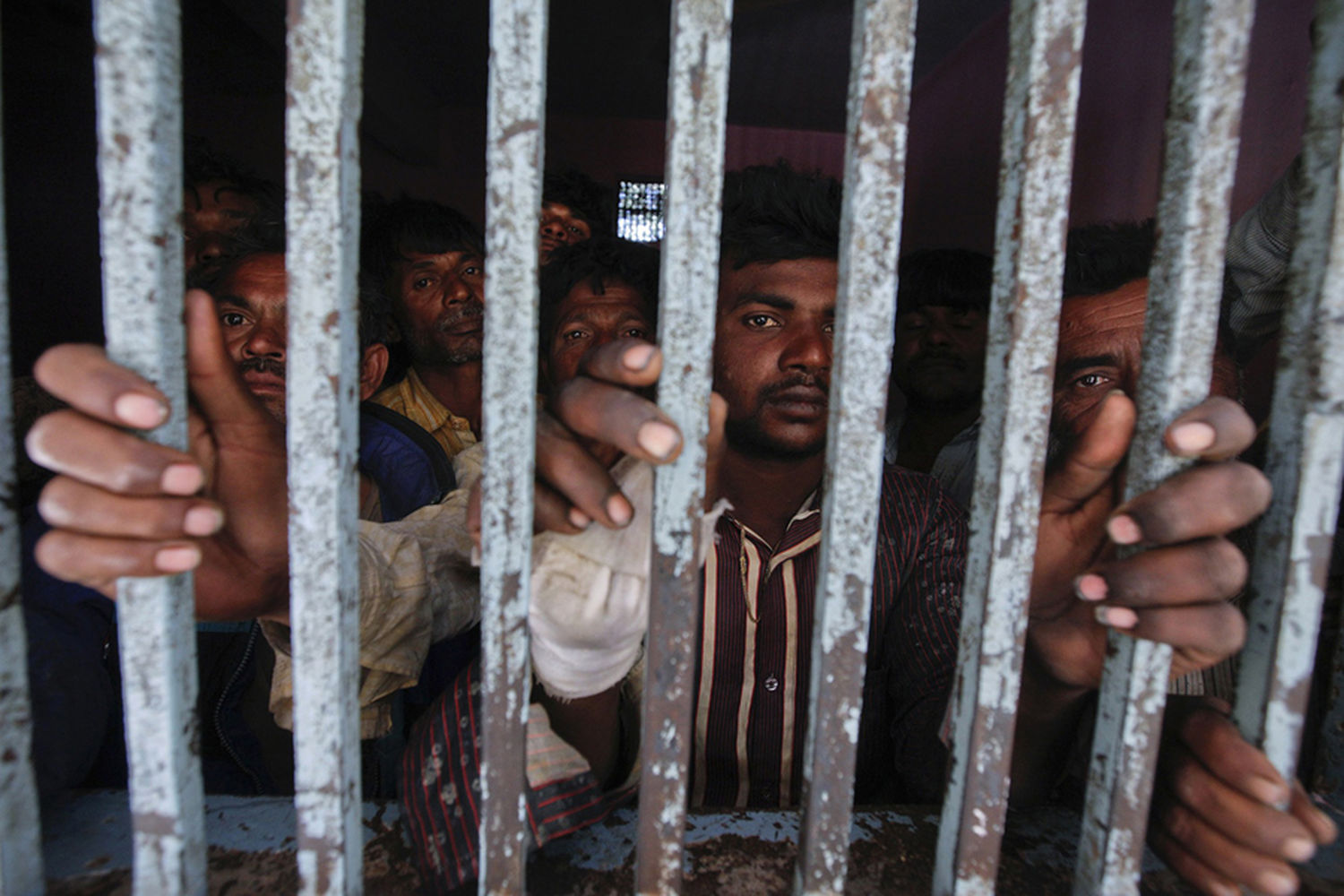
Not to overlook a very vital fact to the imprisoned in our country — almost seventy-five percent of the imprisoned are under-trials and with that technically innocent. Yet, they sit imprisoned. Frustrated and disgusted with the system, many fade away, some even try to break free, only to be bound once again! We haven’t even bothered to study the crucial ‘why’ inmates try to break free, try their utmost to run away from prison hellholes. Perhaps, they are unable to cope with the overdose of jailed life and cannot pick up the courage to talk about the trauma and stress they are undergoing. Talk to whom?

Today, amidst the developmental cries, where’s that required focus on the jails and on those languishing in jails? If the rulers carried even faint traces of connect with the disadvantaged, the first thing they would have done was to reach out to the jailed inmates. To begin with, they ought to have expanded the very concept of open jails. Let the jailed men and women breathe fresh air. Even if they have committed crimes, it does not give the State the sanction to demolish them, slowly and steadily.

A large number of under-trials languish in jails even after they are granted bail because they are unable to raise the surety amount. In this context, we should consider the release of under-trials on personal bonds.

Can there be some degree (not third degree!) of transparency to what’s taking place inside those high walls? Also, how I wish that several of the jailed political prisoners of the day write details to what’s taking place in their jails…detailed to their jailed life. Let’s not overlook the fact that in those yesteryears best works were authored by the political who’s who, when they sat jailed.

Let us not bypass the core fact to the jailed – they are a part and parcel of the society and system that is only furthering the crime graph and not lessening it. Aren’t we, as a collective lot, to be blamed for this! Isn’t our system and society, directly or indirectly, pushing many towards crime and violence?

Moving about freely, from here to there!

And along the strain of what I have  been writing all along, let me  re-stress that we lived in a far less complicated times in those years  long  past  by…that’s when human beings  could  move about freely from here to there. If  Saadat  Hasan Manto’s clan had  moved from  Kashmir to the Punjab, several who’s who had  shifted to  reside in the Kashmir Valley.

I just re-read Andrew Whitehead’s book –  ‘The Lives of Freda – The Political, Spiritual and Personal Journeys of Freda Bedi’ (Speaking Tiger),  focusing on the life and times of the extraordinary English woman, Freda, who’d married B.P.L Bedi, in Oxford in 1933 (Freda  and B.P.L  Bedi –  parents of  film star Kabir Bedi),  and one realized  how the world  was actually a cosy little setup!

To quote from Andrew Whitehead’s book, “The life of Freda Bedi is a remarkable story of multiple border crossings, confounding accepted definitions of identity. Born in a middle-class home in provincial England, she became a champion of Indian nationalism, even serving time in jail in Lahore as a satyagrahi. In Kashmir, in the 1940s, while her husband. B.P.L Bedi drafted the ‘New Kashmir’ manifesto, she kept in contact with underground Left-Wing nationalists, and pined a women’s militia setup to defend Srinagar from the invading Pakistani tribesmen. In the 1950s, she encountered Buddhism during a visit to Burma.”

Freda’s  journey to Burma brought along another turn in her life as she embarked on a spiritual journey. And around 1959 she persuaded Pandit Jawaharlal Nehru to give her a role to help the Tibetan refugees and with that she setup a school for the young Lamas and also a nunnery… In fact, Freda is possibly the first woman ever to receive full ordination as a Tibetan Buddhist nun.

Andrew Whitehead has also brought to the fore the role played by Freda and her husband in the Kashmir region. Perhaps, the crux holds out in the two letters of Jawaharlal Nehru to Sheikh Abdullah which, together with this brief backgrounder, are tucked in this book – “Nehru also pressed Sheikh Abdullah to keep communists at a distance, with Bedi the main target of his displeasure. In May 1949, after a brief visit to Kashmir, Nehru wrote to ‘Shaikh Saheb’ with a gentle warning : quite a number of our embassies here are greatly worried at, what they say, the communist infiltration into Kashmir… most of them have heard about Bedi and they enquire about him. I understand that Bedi is editing the newspaper there and is drawings substantial salary plus free car etc. I have no personal grievance against Bedi, but in view of the trouble we are having with the Communist Party in India, naturally Bedi’s name is constantly coming up before people here.”

There was another letter from Nehru to Sheikh Abdullah (it followed the first one) and is along the same pattern: “You referred to the Bedis, I rather like them …I know Freda left the Communist Party some years ago. What she done since, I do not know. But so far as I know, Bedi has continued in the Party, and the Party, especially today, does not tolerate lukewarm people or those who do not fall in line with their present policy… I do not want you to push out the Bedis and cause immediate distress to them. But I do think that no responsible work should be given to them and they be kept completely in the background. Yesterday I saw a little book on you written by the Bedis. This kind of thing immediately makes people think that the Bedis are playing a prominent role in Kashmir and are closely associated away from Kashmir, because they felt that leftist policies would be going on more and more adamantly if I stayed on there.”

There are also more than hints that the Bedi couple were trying to project Sheikh Abdullah as a national leader. In fact, not very surprisingly the best phase of their lives in terms of social and financial well-being was the time this couple spent in the Kashmir region… This book holds out the who’s who they met and interacted with.


Rotting in the shadow of Smart Cities

The villages with landfill sites in the vicinity of the Smart Cities suffer because of the lack of proper waste management plan. The beleaguered villagers have been fighting for their right to healthy living moving from one court to another, but without any success, writes Aayush Goel

Swanky malls, tall high rises, over 250 of global 500 fortune companies and everything that makes them cosmopolitan. The twin cities of Gurugram and Faridabad are Haryana’s window to the World.  While Faridabad was selected amongst 100 smart cities in 2015, Gurugram which is proudly flaunted as Singapore of Haryana too is being developed as a smart city.

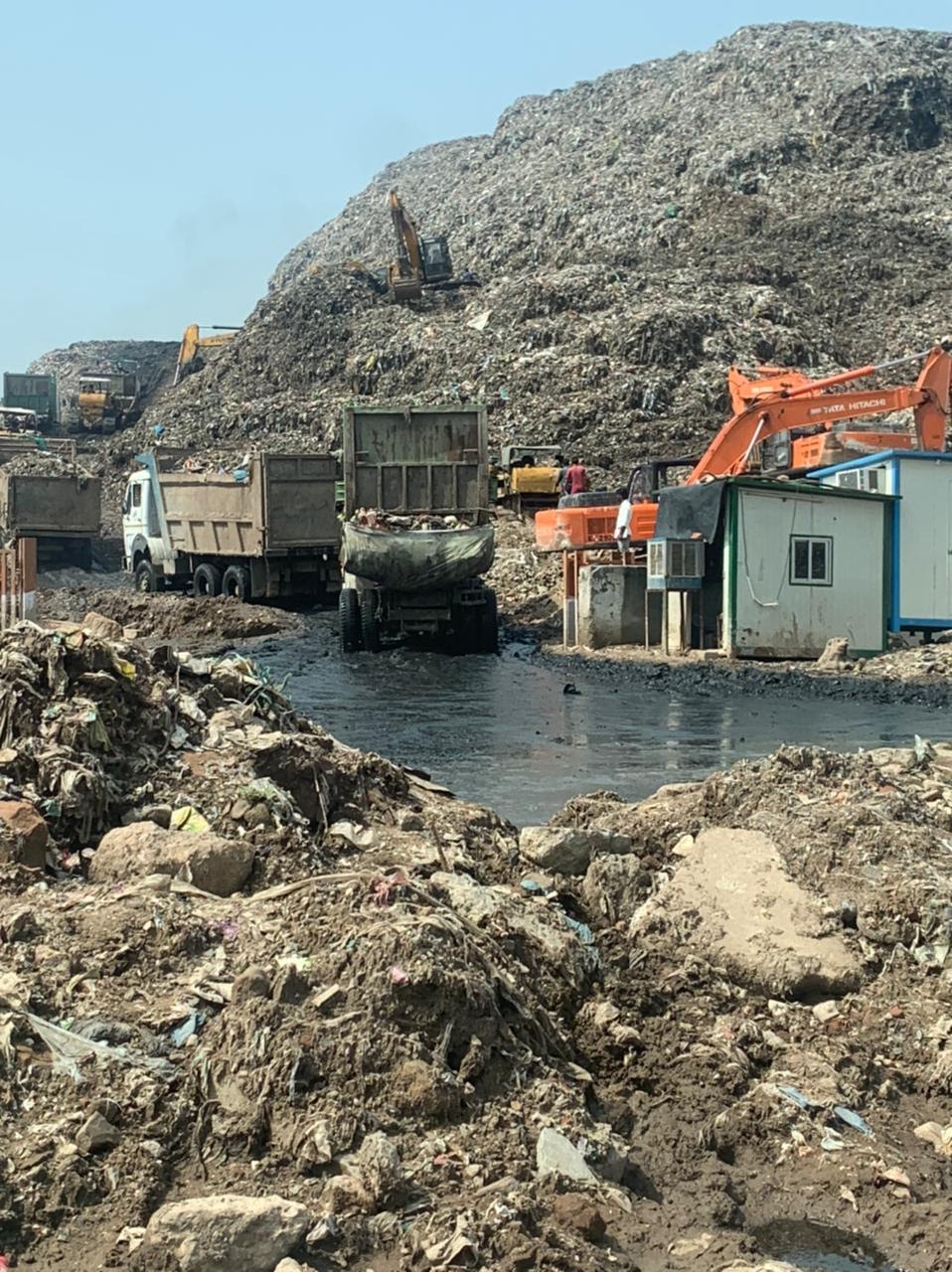
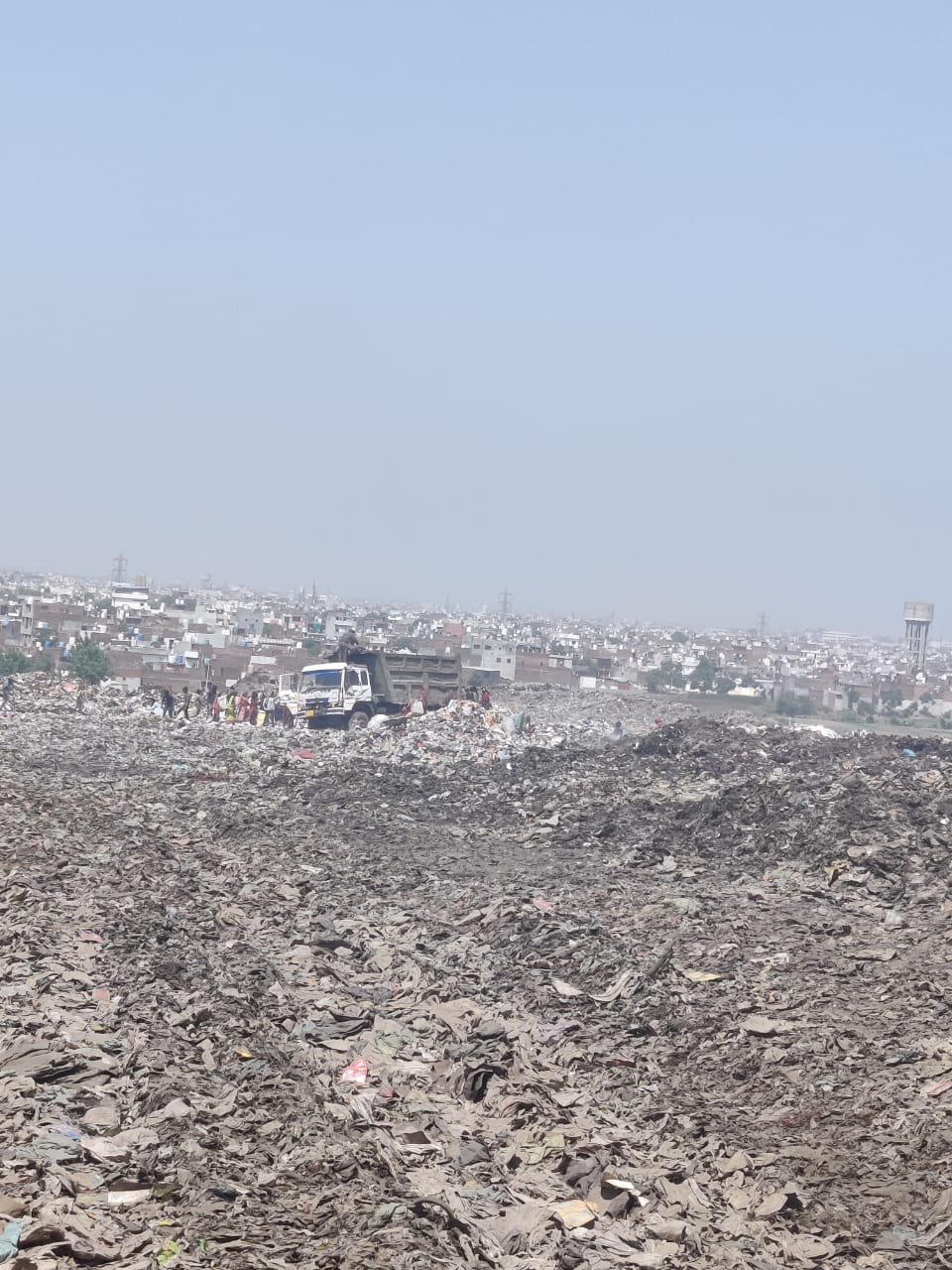
While one is left mesmerised and in awe of the progress made so far, but a drive down of around 15 km from these cities brings to fore the ugly facet of this development. Spread over 30 acres and standing 40 metre tall is the infamous Bandhwari waste mountain. In the absence of a proper treatment plan, it grows by almost 2000 metric tonnes every day pushing around 10000 odd residents of the area over the age with contaminated soil, water and air.

Bandhwari is not the lone case but the plight is shared by Sudher in Himachal Pradesh’s Dharamshala and Tajpur in Punjab’s Ludhiana. All these villages live in the shadow of so called smart and developed cities and have borne the brunt of their transformation. While the residents have since a decade now fought for their right to healthy living and moving from one court to another, the governments and authorities are yet to spare a thought regarding the same.

Bandhwari, Haryana

Bandhwari is a village that lies on Gurugram-Faridabad road. It along with neighbouring villages has around 5000 inhabitants. Landfill started in an abandoned mining pit and was welcomed as it brought profits for villagers who deployed their trucks here. Otherwise a flourishing village with duplex houses and a cricket academy, Bandhwari is dubbed as the bachelor’s village as majority of men are still single, all thanks to the garbage mountain and resultant health issues. This village along with neighbouring Mangar, Mandi, Baliwas and Gwal Pahari are the new cancer hubs of the region. The villages have reported over 40 cancer deaths since 2017.

“We curse the day when we allowed them to make landfill here. It killed everything in our soil, water and air. We had never heard of a disease in our area but today we have TB, gastro ailments, cancer and ophthalmic issues even in children. We have set up a water filtration plant in our village but of no use. Nobody wants to marry off their daughters to the boys of this village. We have set up our own water filtration plant and every house uses bottled water,” says village Sarpanch Raja Ram. A doctor in the local Ayushman Bharat health centre on condition of anonymity revealed that there had been a constant increase in gastro, dermatological and ophthalmic issues and patients were being referred to bigger hospitals.

A report by the Central Pollution Control Board in 2017 had revealed that groundwater of three villages around the landfill site was contaminated. Two years later in 2019, a report by the National Environmental Engineering Research Institute warned of the contamination even in neighbouring villages. Ever since, regular testing of ground water and soil has confirmed high toxicity. Environmentalists like Vaishali Rana Chandra have been fighting against the leachate being discharged from the landfill site into the Aravalis for the past several years, harming the wildlife and contaminating the groundwater.

“We have been fighting since 2017. The place was for solid waste but over 70 percent of the waste coming to this landfill is wet and leachate is seeping. We have been fighting for it in NGT and the Tribunal has issued many orders and directives but there is hardly any compliance. Even multiple visits by CM ML Khattar has failed to change things,” says Chandra.

The site and treatment is managed by contractor company EcoGreen and Municipal Corporation. The NGT had recently set July 2022 as the deadline to clear all legacy waste but they have already missed the deadline. Gurugram Deputy Commissioner Nishant Yadav has directed MCG officials and its solid waste management concessionaire Eco Green to expedite processing of legacy waste and the new deadline now is December 2023.  The MCG on its part tried to resolve the issue by shifting landfill site but the locals of proposed sites have objected and are protesting.

MCG chief engineer Thakur Lal Sharma said the corporation had attempted to resolve the problem by identifying an alternative landfill site first in Farrukhnagar and then in Mohabbatabad, but they couldn’t be finalised due to objections from locals. Similar issues have now started to emerge in Karnal, second smart city of Haryana, where locals living in vicinity of solid waste management plant in Shekhpura, Suhana village on Meerut road are facing health crises. Karnal city (constituency of Haryana CM) generates around 200 tonne garbage per day, while the capacity of the plant is around 150 tonne. However determined not to go the Bandhwari way, Karnal Municipal Corporation has already expedited the processing and clearing of legacy waste.

Tajpur, Ludhiana

Ludhiana, the only city from Punjab that had made it to the first list of 100 “Smart Cities” way back in 2015, is an epitome of solid waste management crisis. With a defunct processing unit and legacy waste of over 21 lakh metric tonnes, city’s landfill on Tajpur road pushed over two lakh residents in the vicinity to a virtual hell. Not just water or soil contamination but regular fire at site leaves entire area choked for a major part of month. While the residents suffer, the civic authorities continue to be mute spectators. The residents of nearby Kakka village are the worst hit. Gurwinder Singh, sarpanch of Kakka village, said that the waste is never processed and the mountain is increasing each day. “Fires are common in the dump. You can buy bottled water but what about the air? Fires here are never extinguished completely and smoke continues to rise and the entire village is a pulmonary patient now,” he says. It may be noted that NGT had fined Ludhiana Municipal Corporation around 100 crores after seven were charred to death in this dump yard fire in 2021. The fine is yet to be fully paid.

Not just villagers but a public interest litigation was also filed by inmates of the central jail, which is nearby, regarding hepatitis B and other health issues due to contaminated water and air.

“We feel that this contaminated groundwater, which contains heavy metals and other harmful chemicals, is still being pumped out for prisoners. This is a violation of their fundamental rights,” stated the petition. According to amicus curiae in the case, HC Arora, the petition was clubbed with the ongoing case pending in NGT.

It may be noted that the industrial hub of Ludhiana produces around 11,00,000 kg, or 1,100 tonnes waste per day (TPD). The waste is dumped at its Jamalpur landfill site on Tajpur road and spread across 50 acres. The processing plant at the landfill site is non-operational after the private company which the MC had entered into an agreement with – for lifting and processing of solid waste – left work midway and the contract was terminated.

While the MC and the company are now locked in an arbitration battle and the blame game is on, the residents and environment are taking a hit. “The villagers have respiratory issues and communicable diseases owing to the large number of flies and mosquitoes. We are flooded with dermatological infections and cases of diarrhoea. The best advice we can give to them is not to drink supply water and use bottled water,” says Dr. Gurmukh Singh who runs a hospital in Tajpur area.

It was in May this year that taking cognizance of the fact that garbage dumping site pollutes groundwater, a National Green Tribunal (NGT) panel had directed authorities that all the water pumps in the ambit of 2 km from the dumping site be seized and required alternative arrangement be made to ensure safe drinking water supply to the residents. “There are many problematic aspects to the garbage dump. One, because of the smoke, people, especially elderly and children, suffer respiratory issues. It is a health hazard for pregnant women. Second, during the rainy season, water from garbage seeps into the groundwater and contaminates it. The MC is solely responsible for not taking appropriate remedies,” said local environmentalist Kapil Arora.

Similarly in Jalandhar, also enlisted as a smart city, the solid waste treatment is a non-starter as village Wariana deals with a dump of 8 lakh metric tonnes. In 2017, a bio-mining project was planned to manage and process the waste at Wariana dump however nothing concrete has happened so far. The overflowing waste is spewing toxins into the air leaving people ill in nearby areas. The civic authorities are holding the concessionaire company responsible and according to Krishan Sharma, assistant health officer, MC has been imposed a penalty on company.

Like its two other counterparts, Amritsar’s Bhagtanwala dump too faces similar issue. The residents of the area are harried over constant fire in dump which has made the air extremely unhealthy. The dump piled up near the grain market occasionally catches fire as well and remain up in flames for days. Area residents claimed that the Municipal Corporation employees don’t even visit the dump to douse the flames. The leachate from dump hill flows to the Upper Bari Doab Canal which is key water source for over 20 villages. “The landfill has polluted air, water and soil and spread diseases in entire area. The Bhagtanwala dump is a perennial political issue but the successive governments have failed to deal with it. The residents are losing all hope now”, said Kulwant Singh Ankhi, patron of Amritsar Vikas Manch.

Summing up the waste management woes of Punjab the NGT monitoring panel head Justice (retd.) Jasbir Singh says environment is sadly the last priority in state while it should be first. “In rush of advancement, we are moving ahead in an unplanned manner. We are putting natural resources, health and even the lives of people at stake for the development of one area. There are clear guidelines and directives for issues like waste management but there is no execution. Either move the landfill or the people as their health is facing a grave risk. Arrangements need to be made for immediate provision of clean potable water. While some work has been initiated at Amritsar site, Ludhiana and Jalandhar are yet to wake up to the crisis”, he said while talking to Tehelka.

Sudher, Himachal Pradesh

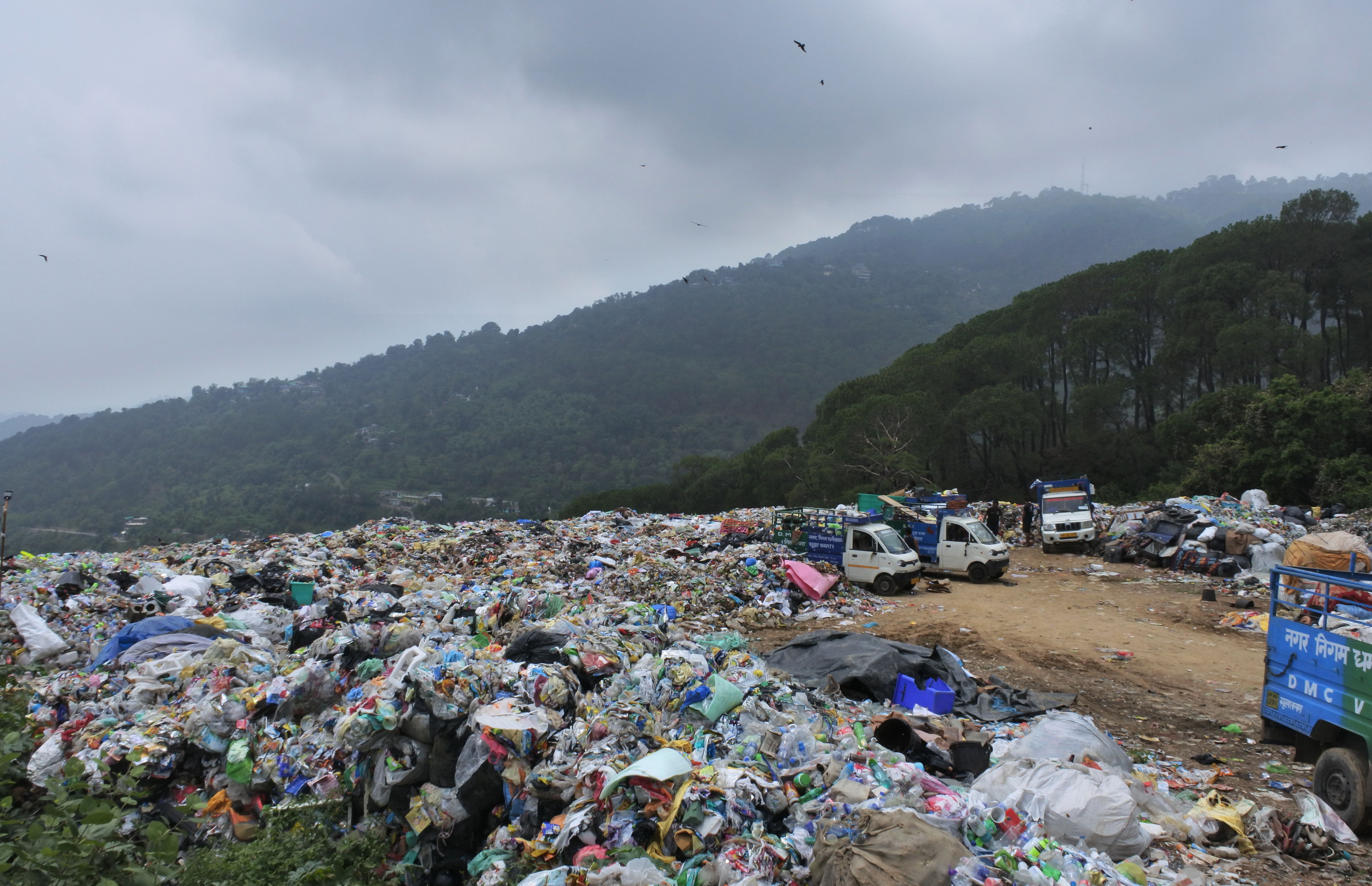
Dharamshala and its twin town of McleodGanj are stars on world tourism and spiritual map for being the abode of Dalai Lama. Not just this, Dharamshala is also a proud member of 2015 list of 100 smart cities.

While everything looks pristine here at first sight, one has to drive down a few kms to witness the price of this development. Sudher, just another off road quaint village with a population of around 5000, has allegedly been facing unscientific dumping of non-segregated waste. This is generated by 53000 residents, hotels, homes, offices and even hospitals of Dharamshala and its suburb, McLeodganj since last decade. Taking a daily dump of 30 tons, the dumpyard has become an inseparable part of village’s landscape. It has polluted the air, water and soil of village overturning their lives forever.

The village became home to dermatological and ophthalmic ailments owing to contamination of their sole water source the Kuhl or water community channel now called ‘Khooni Nala’. “This is our Kuhl. It was always crystal clear but turned yellow in the last six years and gets crimson even. We now call it Bloody river. This flow down brings leachate and kills our crops, animals and even our elders and children. This has killed our indigenous profession and now our men have gone to work in shops and hotels. We face regular disease outbreaks and the majority of villagers have constant skin issues. As it affected every single house in the village we women had a common pain, which brought us together. It sounds funny but once every month we come here and pledge that we will get the waters back to pristine and leave our children a crystal clear stream reflecting the struggle of their moms,” says Sunita Thakur. Thakur, president of local Bageshwari Mahila Mandal, along with 48 women of the village has been fighting for six years to get the dumpyard shifted and save the village. They have pooled in their resources to stage dharnas, file RTIs and even move the NGT. As per the petition made by a group in NGT in 2019, the dump yard violates the Solid Waste Management Rules, 2016 and threatens their lives and livelihoods. In March, 2019, the NGT disposed of the case asking the Municipal Corporation to adopt a cluster approach but nothing has been done so far.

Commissioner of Dharmashala Municipal Corporation Pradeep Thakur while speaking to Tehelka said that they were privy to the woes and were working to resolve the issue. “We have got funds of around Rs 1 crore and legacy waste will be removed. We are setting up a plastic treatment plant. The non-segregation of waste is the biggest hurdle,” he said.


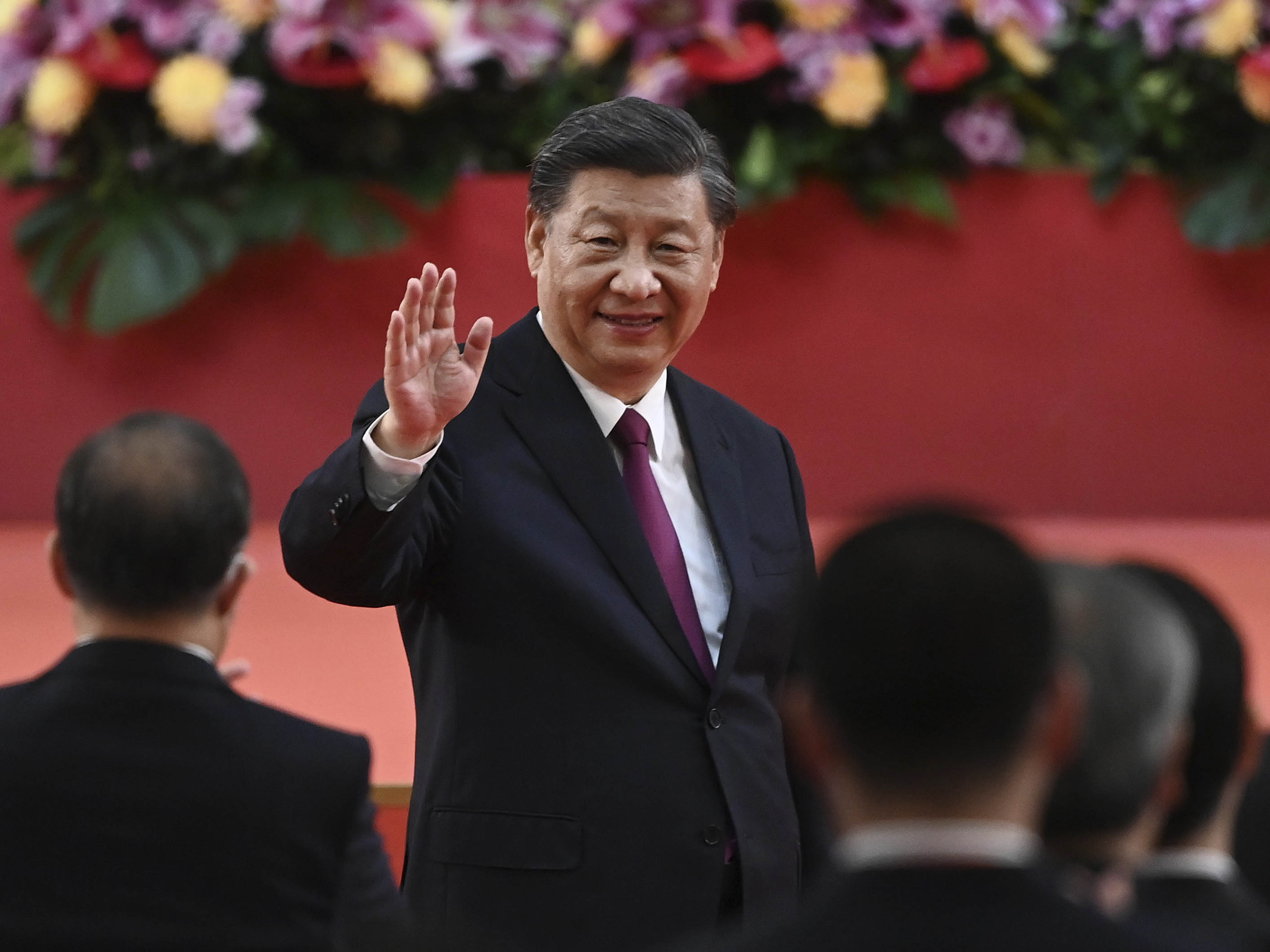
Is Xi Jinping’s third term ambition behind China’s war mongering?

In a bid to project himself a strong nationalist, President Xi Jinping may resort to muscle-flexing against Taiwan. China may not assault Taiwan which has a US nuclear shield, but resort to aggression against India on the India-Tibet’s borders.

In India, few may subscribe to a New York Times document that the visit of the US Speaker Nancy Pelosi has enraged China to encircle Taiwan, strangulating it economically, thus attempting its forced merger with the mainland. It, however, betrays the western media’s poor understanding of the Chinese psyche and tactics.

The Indians, having been quietly aware of Beijing’ coercive geo-politics for the past six decades, precisely its invasion in 1962, know that the Chinese doctrine is and has been, “Being powerful do not hesitate to unleash aggression”. New Delhi, perhaps, is rightly reluctant to accept the newspaper blaming Pelosi for the ongoing crisis..

Meanwhile, China watchers do not rule out the possibility that in a bid to project himself a strong nationalist, President XI Jinping, who is seeking a third term might resort to muscle-flexing or even initiate a limited war against Taiwan before the scheduled meeting of the party in November. The Chinese Premier, Li Keqiang, has decided to demit office later this year after serving two five-year terms. It means, he is going to usher in a new team during his third term of those only loyal to him. It appears that the domestic politics too has influenced him to resort to an aggressive war-mongering policy.

The Blame Game

It is stated that Pelosi arrives in Taiwan in a US military aircraft, ignoring the private warnings of President Joe Biden advising her to abandon the visit. And thus, her action triggers off the Chinese anger leading to an aggressive military posturing. The situation, however, has almost reached a flashpoint; it may lead to massive flare-up if China continues its blockade policy against the island nation.

In India, knowledgeable sources are aware that if Pelosi had not visited the disputed island, Dragon could have cooked up some other pretext to launch its military activities against the island nation. The successive Presidents in Washington from Nixon onwards have never been ‘fair’ to Taiwan, which is being denied a sovereign status. Encouraged by the West’s knee-jerk policy towards Taiwan, an emboldened China may launch a full-fledged attack to annex Taiwan. The ongoing conflict is one of the six wars China has planned for the 21st century.

Credibility of the American Media

In India, the tilt of major American newspapers towards Beijing is being noticed, especially following the revelation by the US Justice department that during the past two years, the Chinese Communist Party’s proxies have been giving liberal doses of advertisements estimated to be USD 19 million to the publications. The recipients of this largesse include Washington Post, Wall Street Journal and New York Times. Therefore, few in New Delhi are surprised by the daily’s critical remarks against Pelosi.

It is also being pointed out that while the American media could blame her for the visit, they are keeping Sphinx like silence about the six wars China has planned during the current century. The document revealing the schedule of the wars has been circulated by the Chinese media. It  has spelt out the following: 1st War: “Unification” of Taiwan (Year 2020 to 2025), the 2nd War: “Reconquest” of Spratly Islands (Year 2025 to 2030), the 3rd War: “Reconquest” of Southern Tibet (Year 2035 to 2040), the 4th War: “Reconquest” of Diaoyu Island (Senkaku) and Ryukyu Islands (Year 2040 to 2045), the 5th War: Unification of Outer Mongolia (Year 2045 to 2050) and the 6th War: Taking back of lands lost to Russia (Year 2055 to 2060).

The Indian Apprehensions

In New Delhi, the top strategic affairs experts, including diplomats, both serving and superannuated, are convinced that India should not lower her guard on the 3000-kilometers border with Tibet. It is also being stated that despite  more than dozen rounds of official talks, China has not agreed to revert to its pre-Galwan positions in Ladakh. It is also being stated that China may hesitate to finally assault Taiwan having US nuclear shield. It means, it may resort to aggression against India on the India-Tibet’s borders. The Chinese may consider their border with India could be a softer target, if compared with Taiwan. China, according to the war schedule, has planned to annex Arunachal in 2035-40, but it might invade Arunachal  even in 2022, if it is forced to soften her aggressive posture against Taiwan. .

XI Jinping’s Re-election

Chinese Premier Li Keqiang will be retiring later this year, but XI Jinping has no such intention. He is being introduced in the school curriculum as a great leader like Mao Zedong. The ongoing blockade of Taiwan could also be related to his re-nomination efforts for the third time. For this, he, perhaps, is keen to project himself as “an assertive president”.

The recent reports indicate that in the domestic play of power politics within the Communist Party of China (CPC), XI Jinping has already succeeded in sidelining his opponents in the party. They include Jiang and his Shanghai Gang. It also means that he has not hesitated to eliminate even those who had supported him to reach the pinnacle of power. It appears that he has weakened them to retain his hold on the party. Earlier, Jiang and his Shanghai Gang had dominated Chinese politics. Those who are being dumped comprised the party’s powerful members who had risen to prominence due to their association with Jiang Zemin. Jiang during his tenure in Shanghai had developed an extensive political network, and after his elevation as the CPC general secretary, many of his close contacts took up prominent leadership positions at the central and provincial level. During his tenure, the power was shared by the CPC’s youth wing and the Shanghai Gang. The reports, however, reveal that he has also purged a large number of leaders in the youth wing too, who in future could have been a challenge to his leadership.

It is being observed that during the past few years, Xi Jinping has been behaving like an autocrat—quite distinct from the previous generation of leaders who were referred to as “enlightened authoritarians”. He has been resorting to an aggressive turn in Chinese foreign and security policy. It included the ending of the autonomous status of Hong Kong, and finally resetting the terms of engagement between the state and private firms in China, who could have been in touch with his opponents. XI Jinping now controls the military (People’s Liberation Army), the state-owned enterprises (SOEs), the internal security apparatus, as well as the propaganda machine.

His faction, according to the recent reports, is now well-entrenched in China’s power structure. He has already purged the party’s six most influential leaders including Sun Zhengcai, Bo Xilai, Zhou Yongkang, Ling Jihua, Guo Boxiong, and Xu Caihou. They were maligned by implicating them in unsubstantiated corruption charges.

During the past 10 years, he has now his own faction. The members of the Xi Gang are essentially party officials who have had a professional, educational, or personal connection with Xi at some point during the latter’s career – much like members of Shanghai Gang. However, he does not believe in any power-sharing arrangement between factions. Thus, XI Jinping’s ambitions have forced us to live under the threat of war.

Pelosi’s meeting with Taiwan Prez raises hackles

US Speaker Nancy Pelosi’s meeting with the Taiwan President Tsai Ing-wen during the visit has been strongly condemned by China, but she appears to be trying to amend the mistakes of the previous administrations. In 1972, the then US President, Richard Nixon, had recognized China as a one-nation, but at the cost of the interests of Taiwan. Her visit to Taiwan is a bold step to assure the island nation that America stand by democracy, thus rectifying the past blunder. She is the most senior US politician in 25 years to visit Taiwan. He also asserted that “her delegation had come to make it ‘unequivocally clear’ that the US would not “abandon” the island.

Pelosi also stated, referring to the Taiwan Relations Act,  that the US abides by the “One China Policy”, but also maintains a “robust unofficial” relationship with the island. That includes selling weapons for Taiwan to defend itself. Her visit, however, is viewed by Beijing as yet another sign of support for Taiwan.

Poor nations reel under the impact of conflicts

The down-trend in the world economy continues since Covid-19 appears to have hit almost each continent of the earth. The avoidable war between Russia and Ukraine during the past six months has further eroded the hope for a fast recovery, and China’s growing belligerence towards Taiwan, an island nation in the South China Sea, has caused worldwide dismay regarding any immediate improvement in the world economic scenario. The economic crisis is already hitting the rich nations as well as the poor nations of Asia, Africa and Southern American countries. The poor with the shortage of food and energy might soon be facing existential challenges. Fragile and conflict-affected low-income economies are the hardest hit by the conflicts. China might have postponed its decision to annex Taiwan, at least for the time being, but the hope for improvement in the economy, especially related to food and energy, is vanishing with each passing day. An immediate cessation of hostilities between Russia and Ukraine; amidst these alarming situations, could have given some solace to the world economy, but the war has intensified in the Crimean peninsula, where Ukraine recently has hit a few key military establishments with the high-tech weapons received from the USA during the ongoing war.


.


Dip in fertility data busts myth about Muslim rigidity on FP

The fertility rate declined from 2.2 children in 2015-16 to the current 2.1 children per woman. Significantly, there is a marked decline in the fertility rate of the Muslim women across India which has played a major role in aiding this population decline. A report by Kulsum Mustafa

 The National Family Health Survey (NFHS-5) 2019-2021 data not just heralds a hope on population control it also simultaneously shatters myths about the minority’s rigid attitude against Government of India family planning programmes.

The key finding in the survey state that currently the national fertility rate is 2.1 children per woman. The total fertility rate is 2.0 children per woman. The survey states that the fertility rate declined from 2.2 children in 2015-16. The ideal or wanted fertility rate is 1.6 children per woman. It ranges from 0.9 children in Sikkim to 2.7 children in Meghalaya. According to the report between 1992-93 and 2019-21, the TFR declined from 3.4 children to 2.0 children.

The statistics need to applauded. While these results were possible because of the combination of deploying of  the ‘inclusive efforts’ of the government, it cannot be denied that there is a marked decline in the fertility rate of the Muslim women across India and that they have played a major role in aiding this population decline.

“The intensive counseling done by religious preachers and welfare societies and the role of Muslim medical practitioners cannot be underrated in this fertility decline,” said, Professor Tamkin Khan, Chairperson, Department of Obstetrics and Gynaecology, J N Medical College, Aligarh Muslim University.

According to Prof Khan, the group counseling has been an effective way of driving home the point. She said that almost 60 per cent of the patients at the Medical College are Muslims; they understand the message of birth control better when it comes from a Muslim female doctor.

“A woman is most vulnerable post partum. The pain and trauma of childbirth is still fresh in her mind so it is most likely that the family planning counseling will impact her more at this junction,” said Prof Khan stressing that the doctors use this crucial time when the woman is with them and even when she returns for checkup of herself and the baby to impress upon her the importance of keeping a gap in her next child.

To the question whether these women are not guided by the religious belief that children are gifts from Allah and that they should accept their birth graciously and not put any hindrances in the way, Prof Khan had valid arguments.

“We quote to them religious hadees from the Holy Quran which speaks about the parents’ sacred responsibility of the right upbringing of their children whom they have brought into this world,” she said.

She said that during the counseling, they tell them that in case as parents they cannot properly feed and educate the child they are going against the spirit of Islam and are committing a sin. Such logic clears their doubts.

“As birth control options we offer them a basket of choices, but we highly recommend Cooper T. This contraceptive is safe and convenient. It is totally pro-women and while it is for 10 years, it allows a woman total freedom. In fact she need not even tell her husband she is using it if she wishes to do so,” said the professor.

Public Heath Practitioner Mohammad Anas also expresses happiness at the survey report. Familiar with ground realities having put in over 15 years in this field, chiefly with government medical research, Anas, who is now engaged as programme manager with a private firm, says that this has been possible because of the awareness created among the girls through education and the increase in the marriage age.

“Unlike some years back, Muslim families are enrolling their girls not just for primary but higher education too, this has decreased the pressure on them for marriage in teens,” he said.

“Girls are engaged now in education till the age of 22-23. The marriage age which used to be around 15-16 has now gone up to 25. This affects their biological clock and reduces the fertility period,” he said.

He also added that unlike in previous years, now there is more awareness about sex education among adolescents.

He said that families are now very conscious of their socio economic status and the Muslim girls too want to create their own identity and economically empower themselves before taking the step to settle down in matrimony,

Anas’s contention is proved by the report finding data.

“The number of children per woman declines with women’s level of schooling. Women with no schooling have an average of 2.8 children, compared with 1.8 children for women with 12 or more years of schooling.” says the survey.

Late marriages of males and global warming, according to Anas, also affect the potency of male sperms leading to lowering of the fertility rate.

‘High temperature adversely impacts the male sperm production cycle and so does the advancing age. Till 28 years, the sperm production in males is at its peak,” says Anas.

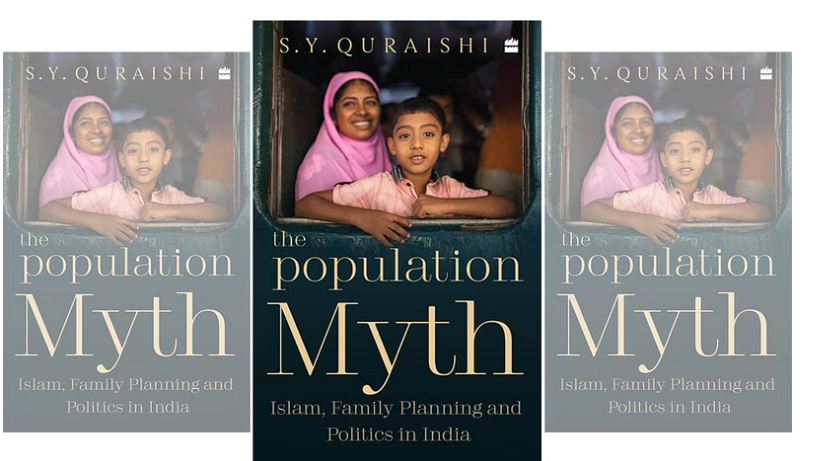
The man who had attempted to shatter many myths associated with the Indian Muslims and proved them with  data and facts is none other than the former Chief Election Commissioner of India Mr. SY Quraishi.  In his book titled The population myth: Islam, family planning and politics in India, he had stated that myths are being created purposely around the Indian Muslim population in order to “create fear and hostility in the majority Hindu population.” He had through his writing attempted to burst these myths.

Quoting statistics to prove that population explosion is being wrongly blamed on Muslims, he says

“Between 1951 till 2011 Census, a net increase in Muslim population was 13.6 crores and of Hindus 67.6 cr.”

“The demographic ratio of India indeed shows an increase in Muslims from 9.8 in 1951 to 14.2 in 2011, and decline in Hindus from 84.2% to 79.8%.  This is an increase of 4.4 percentage points in 60 years.”

To the accusations that Muslims are not adopting family planning faster than Hindus, he said that the gap in their number of children is narrowing. From 1.1 in 1991 it has come down to 0.48.

He is also critical of the Right wing appeal to Hindus to produce 8-10 children in order to ensure that the Muslim population does not take them on. Mr. Quraishi said that unlike these Hindu preachers, the Muslim leaders or scholars have not issued appeals for producing more children.

He has in fact expressed fear that this Hindutava unfounded fears may come as roadblocks in way of family planning measures being promoted by the government.

Quraishi also refuted the myth that Islam encourages polygamy.

“There is a general misconception that Islam encourages polygamy. The reality, however, is different. Islam only permits polygamy subject to two stringent conditions – absolute equality among wives and marrying only widows,” he says.

He said it is totally wrong that Islam is against family planning. He said that nowhere has the Quran prohibited family planning.  In fact many verses of Quran & citations from Hadith emphasize quality over numbers, health of women & children and right of children to good upbringing.

The Ex CEC said that what Islam forbids is sterilization but birth-spacing is not only allowed, but it is encouraged.

Categorically stating that fertility is not the Hindu-Muslim Issue, he says, “Fertility of all communities is dependent on socio-economic factors like literacy, income and delivery of family planning services. The level of these conditions varies from region to region”.

For anyone who still does not wish to understand, he had a suggestion that one should look for a developmental priority in Islamic countries, like Iran, Egypt, Indonesia and Bangladesh. He said that in Bangladesh and Indonesia, Imams and mosques actively propagate family planning.

Quraishi  said that the only way to reduce fertility is to tackle the real factors and address them headlong. They are literacy, poverty, service delivery, etc.

He suggested more efforts by all communities and especially the Muslim community to dispel myths. He suggested that a fact or resource book be prepared for health staff,  communicators or politicians. Political leaders who have so far been indifferent to family planning programmes must be roped in too. Special efforts must be made to educate those who are resistant to family planning.

What has made India assertive on foreign front?

India’s strategy on foreign affairs has evolved during the last 75 years. The way India held its own during Russia-Ukraine war is the latest proof that the country can take a clear stand on any global issue. 

With India completing 75 years of its journey since it won independence in 1947, there is an occasion to have a close look at its performance on the foreign affairs front. What has it achieved in this significant area? Could it do better? What should it do to ensure that the country adds substantially to its stature in the comity of nations? These and many other such questions come to one’s mind as one goes deeper into the strategy adopted to protect the country’s interests abroad.

One can notice changes in India’s strategy in accordance with the changing world scenario during these 75 years — from the days of Nehru, the country’s first Prime Minister, known for his internationalism and socialist ideas, to the era of Prime Minister Narendra Modi, heading a powerful government led by the BJP — but the country definitely has been gaining in its stature. India today is in a much better position to take a clear stand on any global or regional issue without bothering about what the world community would think of it. The latest proof of this is provided by India’s independent stand on the Russia-Ukraine war.

Whatever the prevailing circumstances, all the governments that came to be formed, without doubt, did their best to safeguard the country’s national interests while handling issues concerning India’s relations with other nations. This could be seen during the difficult days of Nehru, guiding the country’s destiny as the first Prime Minister, as also now when Prime Minister Narendra Modi is presiding over the political dispensation. Nehru did not allow India to join either of the two power blocs existing then— one headed by the US-UK and the other by the erstwhile Soviet Union.

Nehru laid the foundations of a foreign policy that was free from the influence of power blocs. He found willing leaders to launch the Non-Aligned Movement which held its first conference at Belgrade (the capital city of then Yugoslavia) in 1961. Besides Jawaharlal Nehru, those who played the leading role included Yugoslavia’s Josip Broz Tito, Egypt’s Gamal Abdel Nasser, Ghana’s Kwame Nkrumah and Indonesia’s Sukarno. These countries had earned the hard way their freedom from the colonial powers in the wake of World War-II. The establishment of NAM catapulted India to the world stage as one of the countries not allowing themselves to be used by any power bloc for its purpose of expanding areas of influence.

Before NAM was born, India decided to develop friendly relations with its most important neighbour, China, as an answer to the US policy of focusing more on Pakistan than any other country in South Asia. With a view to finding a solution to the Tibet problem, Nehru signed an agreement with China in 1954 on the basis of Panchsheel (five sacred
Buddhist principles like non-interference in any other country’s internal affairs, mutual non-aggression, showing respect for others’ territorial integrity and sovereignty, promoting equality and mutual benefit and peaceful co-existence). However, increased Chinese
repression in the Tibetan region led to an uprising in 1959, resulting in the Dalai Lama escaping to India along with many of his followers.
This ruptured New Delhi’s relations with China so much so that the latter militarily attacked India in 1962, leaving it bewildered. Nehru trusted the Chinese considerably, but they proved to be utterly untrustworthy. The slogan ‘Hindi, Chini bhai, bhai’ was now in tatters.

Today, however, an entirely different scenario has emerged. Despite the unending border disputes, trade between India and China has been growing fast. China remains the largest trade partner of India and for the first time their bilateral trade exceeded $100 billion in 2021, according to the latest available figures.

For a long time, India has been giving top priority to developing relations with its neighbours. New Delhi has always been busy building bridges of understanding not only with China, but also with Nepal, Sri Lanka, Bangladesh and Myanmar. India began to focus on its neighbours in 1991 as part of its Look East Policy, which came to be known as the
Act East Policy with the formation of the Modi-led BJP government in 2014. Though India has been facing a tough competition from China in South Asia and East Asia as Beijing has been investing liberally in the countries in these regions as part of its String of Pearls policy, these nations have been no less interested in developing relations with India.The truth is that these Asian countries have been feeling very uneasy with the growing presence of China in their territories. The reason is China’s clandestine policy of enslavement through investment. Pakistan remains in the tight grip of China as a result of this very policy.

China invariably looks the other way when a friendly country is caught in a crisis as has been witnessed in Sri Lanka. China did little to prevent the economic turmoil in Sri Lanka despite having excellent relations with the island nation. India, however, came to the rescue of Sri Lanka with an aid package of $4 billion during the unprecedented economic crisis its southern neighbour faced though this could not prevent what ultimately happened there.

The biggest challenge for India’s foreign policy establishment came when Russia invaded Ukraine on February 24. Despite tremendous international pressure on India to condemn Russia for its aggressive behaviour, New Delhi continued to stick to its stand on the conflict
in accordance with its own economic and strategic interests. As External Affairs Minister S. Jaishankar explained it without taking sides, New Delhi “urged a cessation of hostilities, return to dialogue and national sovereignty”. India did not see logic in condemning
Russia, as the West wanted. Since the war’s impact was bound to be on petroleum and food prices, India could not afford to take a stand which would have affected oil and gas supplies from Russia. At present, India’s import of Russian crude comes to over 10 per cent of the total oil import by New Delhi from various countries — an increase of over 50 per cent since the Russia-Ukraine war began. In May, Russia overtook Saudi Arabia to emerge as the number two oil supplier to India after Iraq.

If India’s assertiveness to protect its national interests are clearly visible in its strategy vis-a-vis the Russia-Ukraine war, it can also be seen in New Delhi’s approach towards West Asian countries. With Modi taking over as Prime Minister, India transformed its policy for this region by refusing to treat Israel the way it was done before the BJP captured power at the Centre. Modi visited Israel in 2017 to infuse a new life in New Delhi’s relations with Tel Aviv, but the focus on the Arab Gulf countries remained unaffected. He made a series of visits to Israel, Saudi Arabia, Iran, the United Arab Emirates (UAE), Jordan, Qatar, Oman, Bahrain and the Palestinian territories, providing proof of a more active diplomatic engagement with a broader Middle-East region than what was the situation previously. It is not without reason that the UAE honoured Modi with its highest civilian award called the “Order of Zayed”.

If the world has got transformed drastically during these 75 years, so has India. It was not an economic powerhouse when India got herself freed from the British yoke. But now it is, as the figures provided by the IMF show. In 2019, India became the world’s fifth largest economy with a GDP of $2.94 trillion, overtaking France ($2.71 trillion) and the UK ($2.83 trillion). It is expected to set a new record in the years to come.

MOST POPULAR

HOT NEWS