Bilkis Bano: Time to hang our heads in shame

The hapless rape victim and her husband, children and relatives are living in fear and moving from  place to place, whereas the convicted rapists-murderers  are getting  garlanded!

I’m focusing on Bilkis Bano. And as details are fast emerging of fear gripping her entire  clan, after the  release of  her  rapists, a strange  irony hits:  This hapless rape victim and her husband and children and relatives are  living in fear and moving from  place to place, whereas  the convicted rapists – murderers  are getting  garlanded by hard core outfits as though they have  indulged  in some  heroic deed! Couldn’t be a bigger irony hitting us!

Isn’t rape and killings and murders, heinous crimes? The core fact is Bilkis Bano has been terrorized by her tormentors –  she was  gang raped, her 3 year old daughter Sahela, who was then with her, was brutally killed by the rioters, seven of her relatives were also killed. To top it all, she and her family have been surviving in fear. In fact, her tormentors ought to be booked under any of the terror acts, because she has been terrorized all through, all these twenty years!

Expand and broaden the very definition of terrorism and the very basic fact that emerges is that Bilkis Bano went through severe terrorizing onslaughts on her body, psyche and soul. She was gang-raped by these very men who have been set free, she also saw her little daughter getting brutally killed, and also the killings of her relatives.

It’s time to hang our heads in shame, for here is this woman who has suffered all these years and even now she and family are getting hounded, moving  from one locale to the next, for safety, security, safe refuge and sheer survival! If the political who’s who of the country are provided with security so why not this hapless citizen – Bilkis  Bano and  the surviving members of her family and clan.

A connected reality

Isn’t it time to document details to hundreds of women and their families who have been targeted and assaulted and threatened and attacked?  Even today, the very word ‘Gujarat’ drags along images and details of the affected, either during the 2002 pogrom or even years after …an ongoing trauma for the survivors. Many living in isolation, cut off and bruised to the extent that they have lost all hope. Their lives completely ruined and destroyed and their emotions trampled upon.

In fact, the hapless women victims are too scared and petrified to even lodge complaints/ FIRs against the Hindutva culprits as they are worried about the severe aftermath; of the political mafia taking revenge, making life hell for them! I have been hearing this dark reality from the women victims of the various communal carnages and onslaughts.

During my visit to Ahmedabad in 2006, as I got interacting with the affected families, it got more than apparent that they was surviving amidst fear. And there seemed to be no respite for times to come. Many of the pogrom survivors were too terrified to return to their homes. Mothers spoke of their ‘lost’ children, not just in pogroms or encounters but in the aftermath. Muslim families put their children in far off hostels, or sent them to distant relatives, so that their children somehow survive…Women spoke of the nothingness spread around them – they had lost just about everything!

I’m reminded  of what a well-known dancer-activist  wrote in the backdrop of the then Gujarat situation: “ In  Gujarat, people are so terrified that they are silent. They are to be made voiceless. How does it matter how rich you are if you are voiceless!”

To this day, there’s been no closure to the maddening communal killings and rapes and anarchy of 2002! How can there be, if survivor-victims sit all too marginalised?

The fact that these eleven rapists and killers have been set free speaks volumes of our decaying system, of the breakdown of the basic norms and values, of the hollowness of the political speeches of the rulers of the day.

Yet we, the mute spectators, sit all too quiet!  Why?

******

Another connected reality

Read these latest officially released figures related to rape and crime against women in the country. And after one has gone through these facts and figures, can one stop oneself from raising question after  question on the release of the rapists of  Bilkis Bano!

To quote from news reports: India registered 31,677 cases of rape in 2021. That is, an average of 86 daily, while nearly 49 cases of crime against women were lodged every single hour, according to the latest government report on crimes in the country.

Among states, Rajasthan (6,337) was on top of the list followed by Madhya Pradesh (2,947), Maharashtra (2,496) and Uttar Pradesh (2,845), while Delhi recorded 1,250 rape cases in 2021.

The rate of crime (per lakh population) for rape was highest in Rajasthan (16.4) followed by Chandigarh (13.3), Delhi (12.9), Haryana (12.3) and Arunachal Pradesh (11.1). The all-India average rate stood at 4.8, according to the NCRB.

Overall, 4,28,278 cases of  ‘crimes against women’ were lodged across the country in 2021, with a rate of crime (per one lakh population) at 64.5. The charge-sheeting rate in such offences was 77.1, the official data showed.

In 2021, the maximum cases of crimes against women were lodged in Uttar Pradesh (56,083) followed by Rajasthan (40,738), Maharashtra (39,526), West Bengal (35,884) and Odisha 31,352, the NCRB showed.

However, in terms of rate of crime against women, Assam (168.3) was on the top of the list for 2021, followed by Delhi (147), Odisha (137), Haryana (119.7) and Telangana (111.2).

*****

Gujarat pogrom had brought along intense verse …Bureaucrat-poet J. P. Das wrote in 2002 — After Gujarat:

‘After Gujarat

will there be  poetry?

Could poets write

after Alexandria  was  razed ?

After Auschwitz

Hiroshima and Vietnam

after the Emergency

after Babri Masjid

9/11 and Iraq?…Poetry cannot be banished

It returns at will

to Plato’s Republic

to Stalin’s Siberia

to Pokhran and Kalahandi

following in the footprints

of violence

as it chronicles

the descent of man

As with history, to poetry

there is no end …

Poetry will be written

despite fatwas and bans

Poetry will defy the Gulag

it will ignore the censor’s blue pencil

and the fundamentalist ‘s frown

poetry will be written

even as books

are being burnt  …After  Gujarat

poetry will be written

About Gujarat itself

beginning with

the shame of Ayodhya

and following the bloody trail

to Godhra, to Gujarat

and on to Mumbai   …When  Babri  rises

poetry will affirm

that temples are made

not with blood-scribed bricks

or stones carved in hate

that they, like poetry

are founded on

imagination and faith

in the hearts of  men.’


Politics hots up over SYL issue again post SC fiat

With the apex court asking Punjab and Haryana to amicably resolve the 26-year old issue of SYL canal within four months, the politics over the vexed issue is heating up gain, this time with a new dispensation in Punjab – the AAP government. A report by Rajesh Moudgil

 The vexed Sutlej-Yamuna-Link (SYL) canal issue between Punjab and Haryana, is back in the news. The Supreme Court on September 6, asked the two states to amicably resolve the issue that has defied any solution for decades despite several rounds of litigation, within four months.

A three-judge bench of the top court, led by Justice Sanjay Kishan Kaul has asked the Union Jal Shakti ministry to convene a meeting of the chief ministers of the two states for the purpose and listed its next hearing in January 2023, with a report on the progress.

Asking the two states to cooperate in the matter, it observed: “Either they sit and talk or the court will order execution of the decree…. These issues should not be allowed to fester…. It will allow forces that may be inimical to the country to act and interfere”. The apex court further said that water was a natural resource and living beings must learn to share it – whether individuals or states. The matter could not be looked at from the point of view of only one city or one state, it added.

Appearing for the Union ministry of Jal Shakti, attorney general K K Venugopal, presented a letter dated September 5 and said that despite many endeavours, Punjab refused to take part in the meeting called by Centre in terms of the previous order of the court passed on July 28, 2020. The chief ministers of the two states last met on August 18, 2020 and since then, Punjab was non-committal on talks.

Representing Haryana, senior counsel Shyam Divan and additional advocate general Anish Gupta demanded execution of the 2002 decree in favour of Haryana, while representing Punjab, advocate J S Chhabra, assured the apex court that it would cooperate in finding a negotiated settlement to the problem.

The Punjab counsel Chhabra told the court that the state was keen on continuing with talks but the gap was due to Covid and the farmers’ stir. He held that the new dispensation in the state was willing to cooperate, pointing to the fact that since the court’s order of July 2020, the chief ministers met a month later to resolve the dispute.

It may be recalled that while Punjab has been demanding a negotiated settlement between the two states with the help of the Centre, Haryana has maintained it could not be made to wait indefinitely despite having a decree in its favour.

Ready to meet, discuss: AAP

The Aam Aadmi Party (AAP) supremo Arvind Kejriwal and Punjab chief minister Bhagwant Mann, were in Haryana on September 7 last in connection with a rally for the upcoming Adampur assembly seat by-election. The AAP has also announced it would fight the upcoming panchayat polls in Haryana.

On the issue pertaining to the SYL canal, Kejriwal urged Prime Minister Narendra Modi for a solution to the vexed issue of river’s water sharing through the SYL canal.

Stating that SYL canal was an important issue for both the states, he, however, said that dirty politics was played on the issue and the two states should not fight each other. He appealed to the prime minister to find a solution and offered to give his suggestion if the latter was unable to find any.

Mann also said he had no hesitation in meeting his Haryana counterpart Manohar Lal Khattar on the issue. Mann, however, also urged upon the Centre to find a solution to the issue as both states were facing water shortage.

Khattar, on the other hand, said that Haryana would not let go of its right on SYL water. He said that the people of the state had the right over the SYL waters and they were going to claim it at any cost. He went on to say that while on the one hand, Haryana was not getting water from Punjab, Delhi, on the other hand, was demanding more water from Haryana. He added that due to the non-completion of the SYL canal, the surplus, un-channelled water of the Ravi, Sutlej and Beas was going to Pakistan.

Former chief minister and leader of the Opposition Bhupinder Singh Hooda held that since the Supreme Court had already given the final verdict in favour of Haryana, therefore, the Haryana government should file a contempt in the case for the defiance of the orders of the Supreme Court.

Member of the Congress working committee, former Union minister and former Haryana Congress president Kumari Selja said the Supreme Court had once again reprimanded the Punjab government considering Haryana’s strong claim on SYL. She also held Haryana had not been able to get SYL water even after there were BJP governments in both the Center and the state for the last eight years.

Vexed since decades

Here is the timeline of the dispute between the two states:

The Supreme Court had in a decree issued on January 15, 2002 ruled in favour of Haryana and directed Punjab to construct the SYL canal within a year. This decree came on a suit filed by Haryana in the year 1996.

In June 2004, the SC reiterated its earlier decision while dismissing a suit filed by Punjab seeking discharge of its obligation to construct the SYL Canal.

However, in 2004 only, the Punjab assembly passed a law by which it cancelled the agreement with Haryana over SYL. This law went to the SC by way of a Presidential reference and got decided in November 2016.

The top court, while holding the law as unconstitutional, said that a state, which is a party to the litigation or an agreement, cannot unilaterally terminate the agreement or nullify the decree of the highest court of the country. It held that the state of Punjab could not discharge itself from its obligation which arose from the judgment and decree dated 15 January, 2002 and the judgment and order dated 4 January, 2004 of the apex court.

In July 2019, the SC while dealing with the 1996 suit filed by Haryana against Punjab noted with anguish that its January 2002 decree remained unexecuted till date and that while the court had been passing several orders since 2017 (after the Presidential reference judgment) to work out some amicable settlement between the states, the same had failed to yield any results.


How judiciary stepped in to foil bid to impose martial law in Pakistan

With the possibility of an imminent return of PML (Noon) leader Nawaz Sharifand Altaf Hussain, the exiled leader of MQM,  the process of the reconciliation among political rivals as well as the confrontation among the key institutions, judiciary, executive and armed forces has begun

With the possibility of an imminent return of Nawaz Sharif, the unquestioned leader of the Pakistan Muslim League (Noon), and Altaf Hussain, the exiled leader of the founder of the Muttahidda Quami Movement, a Sindh-based UP Muslim outfit in Karachi, the process of the reconciliation among political rivals as well as the confrontation among the key institutions, judiciary, executive and armed forces has begun.

The political developments are unfolding amidst the reports that how the judicial watch had prevented military take over on the fateful night of April 10 this year.

Nawaz Sharif, a three-time Prime Minister, was convicted by Supreme Court in false corruption and money laundering cases. He is London. He was allowed to travel to London for treatment. Altaf Husain, who was implicated in various terror charges, too is in London. He has also acquired the British citizenship.  He was prosecuted before the Kingston Crown Court, for encouraging terrorism in his two speeches delivered from London to Karachi via telephone on 22 August 2016, but the court rejected the charges against him. During his exile years, it is estimated that the Pakistani army has killed more than 25,000 young men in fake encounters. These young men belonged to the families emigrated from northern India, especially UP.  It may be recalled that during the forties, the emigrant families had led the movement for Pakistan like the Bengali Muslims of East Pakistan, now Bangladesh.

With Altaf Hussain finally exonerated for encouraging terrorism by the Kingston Crown Court, the decks are being cleared for his return to Pakistan.

Historical role of judiciary

It appears that the judiciary in Pakistan is quietly asserting its role as the protector of democratic institutions in the country; thus shedding off its perceived image of its “submissive behaviour” before the army authorities. It successfully averted the imposition of martial law on the crucial night of April 10 this year. It is believed that Khan was trying to enforce martial law with the help of his supporters in the armed forces. It was indicated by the Islamabad High Court (IHC) Chief Justice, Athar Minallah, on August 31 during the contempt proceedings against Khan.

It is now in public domain that how did an alert judiciary really avert an imminent imposition of the martial law. It is also now known that Khan had connived with a section of the army generals, however, Justice Minallah, who heads a five-member bench, told Khan that being a former PM, he must behave in a dignified manner and must revise his submission regarding his intimidating comment against a judge. However, there are differences on the issue whether IHC has been ‘too polite’ towards Khan, who was not  even asked to stand in the witness box. It is being recalled that Pakistan’s Supreme Court had convicted the then Prime Minister Yousuf Raza Gilani for contempt of court for refusing to revive graft cases against President Asif Ali Zardari in 2012. Most of the political commentators in Pakistan, including the editor of the Friday Times, Nazam Sethi, are of the view that Khan should have been sent straight to jail for not apologising for his comments against the Additional District and Session judge, Zeba Chaudhary, at a public rally in Islamabad on August 20.

A section of lawyers and journalists, however, believe that by allowing Khan to resubmit his statement about his rude behaviour is an attempt to end his ‘confrontation’ with the state institutions, especially judiciary, and the defence forces. In his submission, Khan , who did not submit apology, had  claimed that he did not know that Zeba Choudhary was a judge. He also claimed that he believed she was just an executive magistrate.

It is also being stated that it was an unnecessary observation of the IHC Chief Justice, Minallah, that the IHC was deliberately opened late night on the April10 for preventing impsoition of the martial law. He, however, did not elaborate on this sensitive subject.

Imran’s Islamic avatar

It appears that Imran Khan and his followers are in combative mood. Their growing alliance with Islamists has also unnerved the present coalition government led by PM Shahbaz Sharif. During the contempt of court proceeding, Khan was seen wearing a white shalwar kameez suit with a rosary in his left hand. Since, his ouster from the coveted position as the PM, he has been hobnobbing with radical Islamists. The large presence of ex-army men has also alarmed the Shahbaz government.

Imran Khan’s growing political clout is reflected in the reluctance of Shahbaz Sharif to open the trade route with India. In the flood-ravaged Pakistan, the prices of food grains and vegetables have gone up.

Judiciary reinvents its role

Justice Minallah’s observation that the IHC had remained opened till the midnight to prevent martial law has set the record of the night of April 10 straight, when Khan was getting a proposal for the imposition of the martial law endorsed by his cabinet. Before, the cabinet could do the mischief, the army chief Qamar Jawed Bajwa, accompanied by the ISI chief, Lt. General Nadeem Ahmed Anjum, arrived at Khan’s residence. It is also being claimed that enraged Bajwa had even slapped Khan.

It may be recalled that the political crisis had begun on April 3, 2022, when the deputy speaker, Qasim Khan Suri, dismissed the motion of no confidence without putting the motion to a vote in the National Assembly, on grounds of “foreign interference”. With the motion set aside, and invoking his powers as prime minister, Khan advised president. Arif Alvi, to dissolve the National Assembly and called for fresh general elections. The Supreme Court, with a 5–0 vote, ruled that the deputy speaker’s ruling to dismiss the motion and the subsequent dissolution of the National Assembly were unconstitutional, thus allowing the no-confidence vote to proceed.

It is believed that the IHC, perhaps, was ready to stay the cabinet decision of imposing the martial law, but the timely arrival of Bajwa and Anjum, forced the deputy speaker to rush back to the National Assembly for ensuring the voting on the no-confidence motion.  It was passed with a majority of 174 votes (out of 342) in the National Assembly, thus ending the tenure of Khan as PM.

Earlier, the judiciary has been endorsing the illegitimate role of army in the country during the past 75 years of its existence since it was carved out from united India in the name of Islam in 1947.  The first military coup took place in 1958.  Since its creation in 1947, Pakistan has spent several decades under military rule (1958 – 1971, 1977 – 1988, 1999 – 2008).

The political situation, however, remains fragile in Pakistan due to growing schism in the military’s top leadership. The absence of Faiz Hameed, a former ISI chief and presently corps commander of Bahawalpur, during the commanders meeting in August is considered quite worrisome. The next two months are going to be crucial for Pakistan. It is being stated that much will depend upon the extension of tenure of the army chief Bajwa. Earlier, Bajwa, already on extension, had indicated that he would not seek new term, but the indications are that Shhabaz Sharif has promised him extension, when Bajwa’s present term expires in November this year.

With two provincial governments, Punjab and Khyber Pakhtunkhwa, under Khan’s political outfit, Pakistan Tahreek-i-Insaf, the anti-Bajwa lobby is reportedly getting emboldened with each passing day. It is being keenly watched whether, Khan and Islamists, finally succeed in thwarting the ongoing efforts for political reconciliation or Pakistan would return to a normal life.


Protecting gharials

Trained watchers keep a close watch along the Mahanadi river gorge in Satkosia tiger reserve for conservation of a critically endangered species, writes Deepanwita Gita Niyogi

Manas Ranjan Tripathi’s day begins in his khaki uniform. An ardent gharial watcher, he has been engaged by the forest department since 2008 and his job is to monitor the reptiles in the Mahanadi river.

The fish-eating gharial is a critically endangered species according to the International Union for Conservation of Nature. They are found only in a few places across India and Nepal.

“Armed with a binocular I look out for gharials in the river in a speed boat four to five days a week. I also take photos whenever I spot them. There are gharials as well as Marsh crocodiles in the Mahanadi which cuts across the Satkosia Tiger Reserve,” Tripathi said.

Like him, there are four other watchers. All of them cover a distance of about 20 km individually while tracking gharials. The watchers are responsible for monitoring their population.

The 900-km long Mahanadi river in east central India, which originates in neighbouring Chhattisgarh, forms a spectacular gorge in the Satkosia tiger reserve, which has been recently declared a Ramsar site. The gorge is the natural habitat of not only gharials and Marsh crocodiles, but also of the critically endangered Batagurkachuga turtle and the endangered Indian Skimmer bird.

Recovery plan for gharials

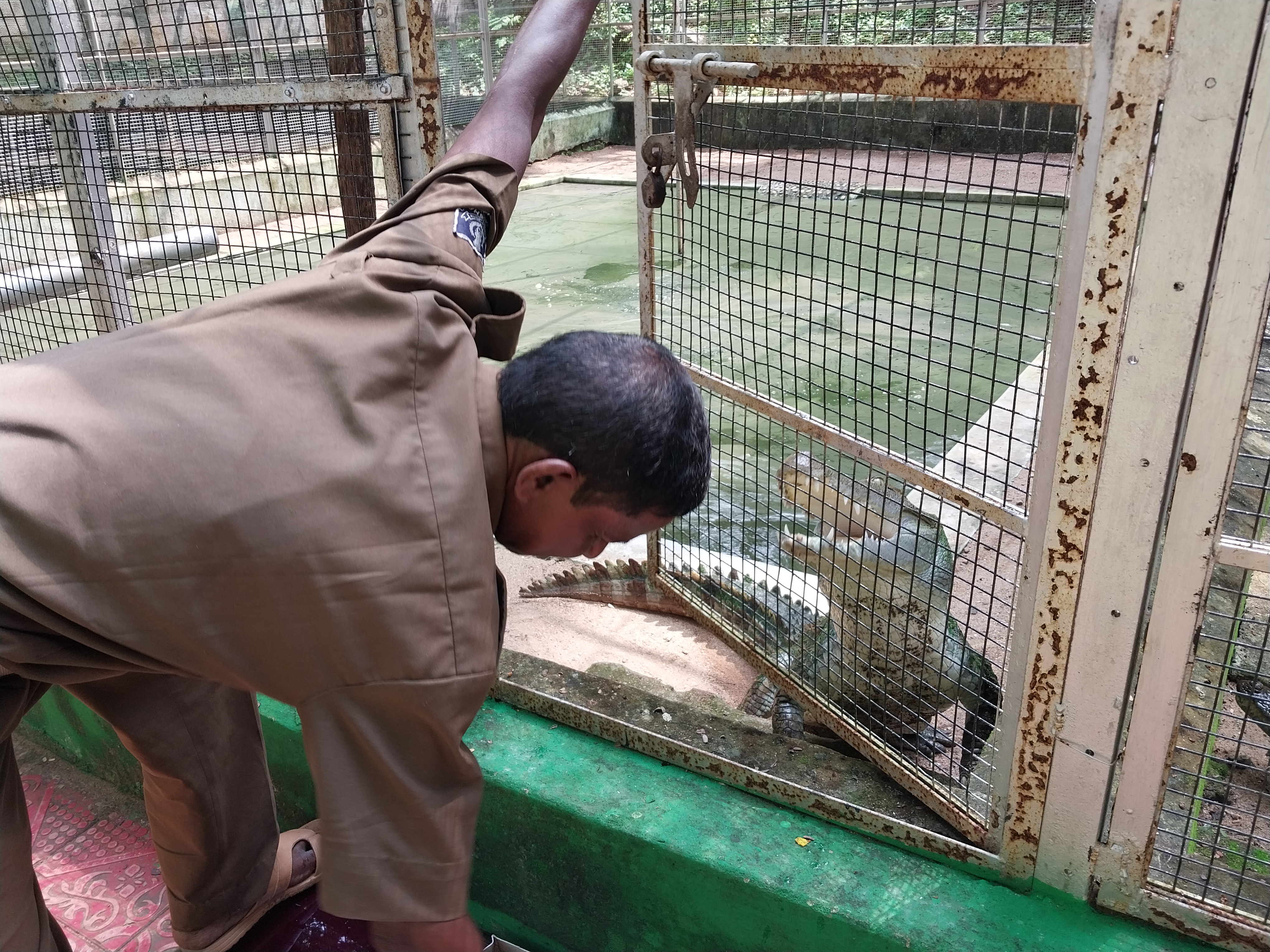
At the gharial conservation centre at Tikarpada inside the Satkosia tiger reserve, there are a few gharials kept inside cages for tourists. Satkosia is the only place in Odisha to have gharials. Besides, gharials are also found in the Chambal river.

As gharial babies get washed away during heavy monsoon floods, it is important to protect them. So, after they are hatched at the Nandankanan Zoological Park in Bhubaneswar, the animals are released only after they grow eight feet in size. Then the chance of getting washed away by floods is minimal.

Biologist Shailendra Singh of Turtle Survival Alliance – India said that Nandankanan has a breeding group of gharials and the conservation story of Satkosia starts from there. “When babies are hatched, they are released in the Mahanadi after a certain period. Though they are naturally found in the river, their population dwindled in the past mainly due to overfishing. The babies also sometimes drown when water is released from dams. But now there is adequate patrolling to protect the species.”

Since 2018, 18 gharials have been released in the river as part of the recovery programme solely taken up by the zoo authorities. “Altogether, 28 gharials were counted in 2020-21 and in 2021-2022 there were 32, ” Tripathi added.

Satkosia Tiger Reserve divisional forest officer Saroj Panda said in the past four decades, natural breeding did not occur. So, gharials were released in the river to augment the population. However, in the past two years natural breeding has taken place.

Sometimes individual animals are rescued from downstream. About 15 animals were taken to a safe place after the monsoon started this year. A total of 31 hatchlings were also born due to natural breeding in the gorge.

At the centre, about 50-100 visitors come to watch gharials and Marsh crocodiles on a daily basis. It was set up in 1972-73. In 1982, a huge flood submerged the place.

For feeding the animals, Purushottam Nayek is in charge. He feeds them fish by opening the cages every morning around 11am. Apart from gharials, there are also Marsh crocodiles and Batagurkachuga turtles. Water is cleaned every 15-30 days.

Apart from the men, women too are in charge here. A woman named Kumari Jani is a gharial tracker. She joined in 2015 after the demise of her husband. She travels in a boat at daytime in the Mahanadi along with her friend Anita Behera.

As the boat sped along towards the narrow part of the Satkosia gorge, Tripathi informed that this area has more gharials whereas the broader riverine space has Marsh crocodiles. Sometimes, the crocodiles are seen basking in the sun on rocks. The river has 125 Marsh crocodiles.

Intense patrolling

Apart from daytime patrol, the watchers are also active at night. Night patrol usually starts at 5 pm or even at 7pm. Sometimes, it is on at midnight too.

“Gharial reintroduction plan has been on since the past four years. It is a good sign that the number has risen from 28 to 32. As they travel downstream, it is imperative to rescue them from floods, especially the young ones,” said Tripathi whose patrolling hours range for almost three hours. He is a resident of Angul district.

As the boat entered the narrow part of the Mahanadi, sandy banks and vast stretches of sand bars came into view along with heavily forested hills dotting both sides of the river.

As most visitors who end up in Satkosia enjoy boat rides for the gorge and spotting crocodiles and gharials, staying in Tikarpada is the obvious choice. Keeping this in mind, a nature camp was set up here 15 years back and is entirely community managed. The Tikarpada eco-development committee is in charge here. Dileshwar Nayek, forest guard of Tikarpada section, said that the forest department handed over the place to the people for livelihood options. There are 10 tents where about 25 people can stay. Food is also served. There is a plan to introduce a Canter vehicle in the winter for safaris.


Muthulakshmi Reddy:  A woman with many Firsts

This biographical monograph of Muthulakshmi Reddy: A Trailblazer in Surgery and Women’s Rights takes the reader way back to Madras Presidency of over a 100 years ago. The author VR Devika writes about the indomitable spirit of a Pioneer path-creator for women – the multitalented Muthulakshmi, who had had numerous ‘FIRSTS’ to her credit. A book review by Raj Kanwar

Muthulakshmi Reddy was a trailblazer not only in surgery but also in the domain of Women’s Rights in Madras way back in the first decade of 20th Century.  In a biographical monograph, the author VR Devika describes in depth the indomitable spirit of a Pioneer path-creator for women – the multitalented Muthulakshmi, who had had numerous ‘Firsts’ to her credit. Her very First was when she became the first girl student at the Maharaja’s School for Boys in Pudukkottai. Her next First came when she became the first Indian woman surgeon from Madras Medical College. It was followed by many other Firsts – the first woman member of legislature of Madras Presidency, the first woman deputy speaker and the first alderwoman.

Muthulakshmi’s mother Chandrammal wanted her to get married and settle down, but she stood her ground arguing that marriage subordinated women. Muthulakshmi finally agreed to get married. The bridegroom was Dr. Sundaram Reddy. The marriage was solemnized in April 1914.

Muthulakshmi had campaigned to get rid of “the practice of wet nurses, fought for girls’ education and widow remarriage, equal property rights, education reforms and rural healthcare for women. She was also concerned that the word ‘Devadasi’ was considered as an abusive term in Tamil. She wanted to release the girls born to Devadasis free from that curse, and give them a future devoid of such bondage. In order to improve the economic and social condition of the poor and destitute girls, Muthulakshmi also established AVVAI Home – an educational institution for Devadasis in Adyar.

After establishing her fame as a specialist in gynaecology and obstetrics, Dr. Muthulakshmi established the Cancer Institute in Adyar which is today renowned worldwide. She had also started a Cancer Relief Fund that has now grown into an all-India institution combining therapy and research on cancer, and attracting patients from all over the country. Incidentally, she also had had the rare opportunity of interacting with Mahatma Gandhi, Sarojini Naidu, Annie Besant, Kamala Chattopadhyay, K. Kamraj and several other leaders of that era.


Title:   MUTHULAKSHMI REDDY; A Trailblazer in Surgery and Women’s Rights

Author:  VR Devika

Pages:    202

Publisher:  NIYOGI BOOKS

Cover Price:    Rs. 299/-


PM Modi to attend SCO summit in Uzbekistan

Prime Minister Narendra Modi on Friday will attend the first in-person summit of the Shanghai Cooperation Organisation (SCO)  in two years in the historic Uzbek city here which will deliberate on major regional security challenges and issues like trade, investment and energy supplies.

Modi arrived in Samarkand on Thursday night to attend the summit of the eight-member SCO grouping which will also see the participation of Russian President Vladimir Putin, Chinese President Xi Jinping and Iran’s Ebrahim Raisi, Pakistan Prime Minister Shehbaz Sharif and other leaders from the Central Asian countries.

The SCO summit in Samarkand will have two sessions — one restricted session which is only meant for the SCO member states and then there will be an extended session that is likely to see the participation of the observers and the special invitees of the chair country.

Ghulam Nabi Azad receives militant threat 

Former Congress leader Ghulam Nabi Azad has received a threat from the militant outfit The Resistance Front (TRF) claiming that the recent entry of Azad in the politics of Jammu and Kashmir following his exit from the Congress is part of a well-thought-out strategy by the BJP-run central government.

“Before leaving the party, Azad had a closed-door meeting with Union Home Minister Amit Shah and National Security Advisor (NSA) Ajit Doval,” an online poster said.

The poster also claimed that the BJP is using displaced Kashmiri Pandits for its political agenda and Ghulam Nabi “is part of the plan B of the Centre.”

The TRF also said that Rahul Bhat, a Kashmiri Hindu killed as part of a target killing campaign by terrorists in Kashmir Valley, was in direct contact with the NSA Ajit Doval.

“Our intelligence wing detected the synergy of these two and we eliminated Rahul Bhatt. There are many people like Rahul Bhat, who are working for the center by staying here. Soon they too will be found,” the TRF claimed in its statement.

Justin Bieber cancels India show due to health reasons: BookMyShow

International Pop star Justin Bieber has cancelled the India leg of his ‘Justice World Tour’ owing to health concerns, promoters BookMyShow said Thursday.

The development comes three months after Bieber announced that he was diagnosed with the Ramsay-Hunt Syndrome, which had caused him partial facial paralysis.

The 28-year-old Grammy winner, who was set to perform in New Delhi on October 18 as part of ‘Justin Bieber Justice World Tour’, had said on June 15 that he was putting a pause on his world tour due to illness.

AAP will fully support Agnipath scheme: Arvind Kejriwal

Delhi Chief Minister Arvind Kejriwal on Wednesday said that the AAP government in Punjab will “fully support” the Agnipath Scheme during the recruitment drives of Agniveers.

Kejriwal’s clarification came after reports that the Punjab government was not supportive of the recruitment drive.

The Aam Aadmi Party (AAP) had earlier criticised the Agnipath Scheme and appealed to the central government to give defence job aspirants the chance to serve the country throughout their life, not just four years.

“We had differences with the Centre on Agnipath Scheme but since the Centre has implemented it we will support it fully. We will completely cooperate with the scheme and the army,” Kejriwal said while replying to a question in his first offline press conference since the formation of the AAP government in Delhi in February 2020.

Later, his Punjab counterpart Bhagwant Mann clarified that directions have been given for “complete support” on the Agnipath scheme.

“All deputy commissioners were directed to provide complete support to Army authorities for recruitment of Agniveers in Punjab. Any laxity shall be viewed seriously. Every effort will be made to recruit the maximum number of candidates in the army from the state,” Mann said in a tweet.

The Agnipath scheme, launched in June this year, seeks to recruit soldiers in the Army, Navy and Air Force on a short-term contract of four years.

PM Modi has given 1,000 sq kms of territory to China without fight: Rahul

New Delhi:  After reports of disengagement with China at Ladakh, Congress leader Rahul Gandhi on Wednesday attacked the government for not restoring the status quo of April 2020 at Line of Actual Control (LAC) with China.

Rahul said, “China has refused to accept India’s demand of restoring status quo of April 2020. PM has given 1000 Sq Kms of territory to China without a fight. Can GOI explain how this territory will be retrieved?” he said.

Government sources on Tuesday said that there has been complete disengagement at key flashpoints in the Ladakh sector between India and China.

The process started on September 8 after months of talks and 16 rounds of corps commander meetings. As per sources the two sides have moved back after May 2020 friction. The sources said that both sides have verified their posts at LAC by the ground commanders.

According to sources both India and China moved back their frontline troops to the rear from the face-off site of PP-15 in the Gogra-Hotsprings area in eastern Ladakh and dismantled temporary infrastructure there as part of a five-day disengagement process.


MOST POPULAR

HOT NEWS