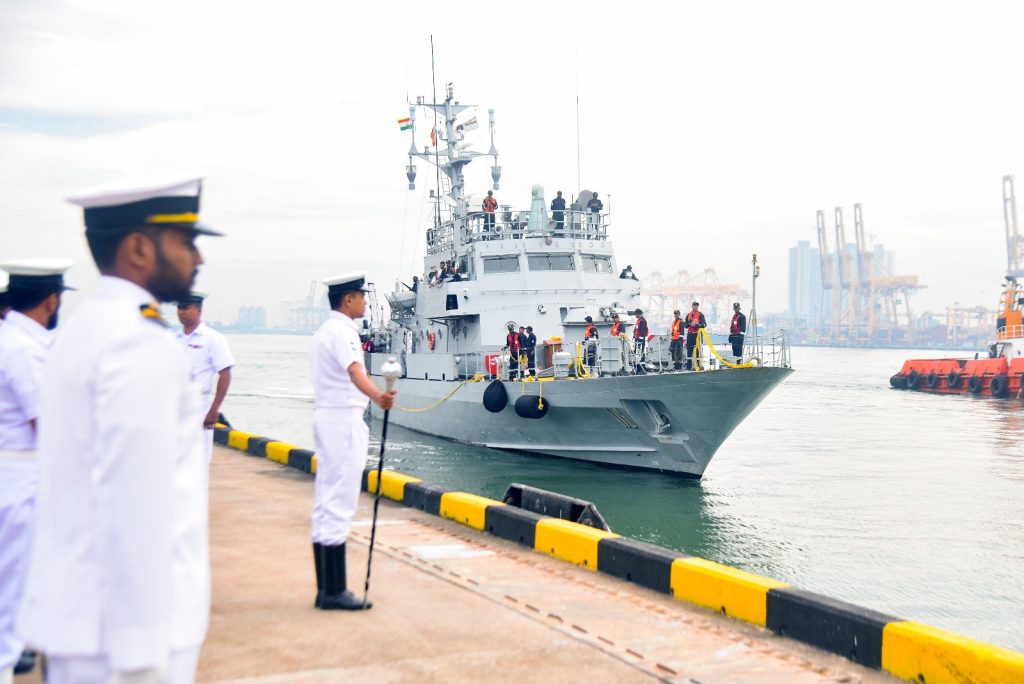
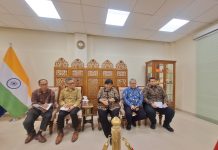
New Delhi: Indian Navy’s Fast Attack Craft INS Kabra arrived at Colombo, Sri Lanka on 08 Jan 24. The ship was accorded a warm welcome by the Sri Lanka Navy. During the port call, Commanding Officer, INS Kabra called on Commander, Western Naval Area, Rear Admiral TSK Perera.
In a presentation ceremony, essential spares and stores meant for the Sri Lanka Navy and Air Force were handed over by the ship. The visit further strengthens the bilateral cooperation and camaraderie between the two Navies in keeping with the Prime Minister’s vision of SAGAR.
Before INS Kabra, Indian Navy’s INS Delhi had gone to Colombo. That was a two-day visit to the port city, the ministry of defence said.
The ministry said that during the ship’s stay in harbour, several interactions, including cross training of personnel in various topics of mutual interest, were held between the ship’s crew and personnel from the Sri Lanka Navy (SLN). A clean-up drive at Crow Island beach was also jointly undertaken by the visiting ship’s crew and personnel from SLN.
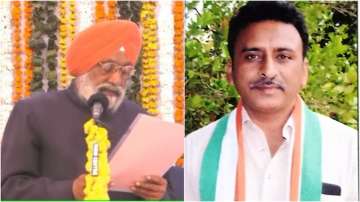
Jaipur : Surendra Pal Singh TT, who was made a minister in Rajasthan even before being elected as an MLA, on Monday lost the Assembly election to Congress rival, Rupinder Singh Kunnar by 11,283 votes from the Karanpur seat.
The BJP candidate was the Minister of State (Independent Charge) in Bhajan Lal’s cabinet.
This is the first time in Rajasthan that a leader who became a minister before becoming an MLA has lost the election. The Assembly elections were held in November, but the election on Karanpur seat was postponed due to the death of the Congress candidate and the then MLA Gurmeet Singh Kunnar . The Congress then gave the ticket to his son, Rupinder Singh Kunnar.
Former Chief Minister Ashok Gehlot and Congress State President Govind Singh Dotasara, while congratulating Rupinder Singh Kunnar on the victory, said that this mandate was a “slap on the dictatorship of BJP”.
At the same time, BJP state president C.P. Joshi said that he will review the reasons for the defeat. Kunnar got 94,761 votes and TT got 83,500 votes.
Counting was done on Monday at Dr. Bhimrao Ambedkar Government PG College. Voting on this seat was held on January 5. Even before winning the elections, this seat was in the news due to the appointment of BJP candidate Surendra Pal Singh TT as a minister in the new government.
The eyes of the entire state were fixed on this election result. Counting of votes was completed in 18 rounds. TT was ahead in the first two rounds, but started falling behind from the third round onwards.
After the defeat in the Assembly elections, the question is being raised is whether TT will remain a minister now or not?
According to rules, any Indian citizen can remain a minister for six months without becoming an MLA. TT has lost the Assembly elections, so there will be moral pressure on BJP and TT to leave the ministerial post, but legally he can remain a minister for six months.
At present, it has been only eight days since he became a minister. He had not even taken charge yet. Everything will depend on the BJP leadership whether it wants to retain TT as a minister or not.
After the death of Congress candidate Gurmeet Singh Kunnar, elections were not held on the Karanpur Assembly seat on November 25.
In Rajasthan, out of 200 Assembly seats, BJP won 115 seats, Congress 70 seats, BAP three, BSP two, RLD one, RLP one and independents have eight seats.
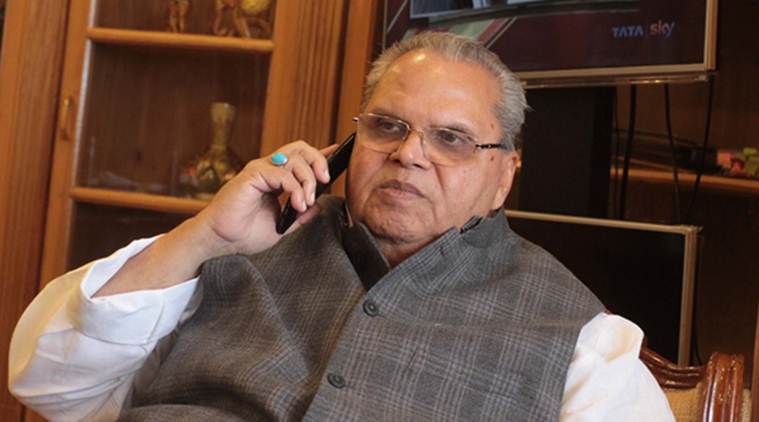
Governor of Jammu and Kashmir Satya Pal Malik at Raj Bhawan srinagar. Express Photo by Shuaib Masoodi. 03.10.2018.
Former Jammu and Kashmir Governor, Satyapal Malik, has once again defended his contentious move of dissolving the Jammu and Kashmir Legislative Assembly on November 21, 2018. He attributed the decision to Peoples’ Conference leader Sajad Lone’s purported intention to engage in ‘horse-trading’.
During an interview on senior Supreme Court advocate Kapil Sibal’s YouTube channel “Dil Se,” Malik asserted that the decision to dissolve the assembly was solely his own and not influenced by the BJP-government. When pressed about the constitutional legality of the dissolution, Malik initially cited it being in the Jammu and Kashmir Constitution, only to be corrected by Sibal, to which Malik questioned, “Then how did it happen?”
Regarding pressure from the central government, Malik denied any coercion, stating that despite seeking advice, he received no response from the Centre.
Malik highlighted his reluctance to invite Sajad Lone to form the government, expressing concern over potential horse-trading. He recalled, “I asked Lone. He didn’t have even six MLAs. But he said that if you let me take over, I can provide you the majority in one week… I sensed there would be major horse-trading if I allowed that. This is not my job, and I will not do it.”
While acknowledging Mehbooba Mufti’s majority, Malik defended his decision to dissolve the assembly, citing fears from various parties about potential defections due to the looming threat of horse-trading.
He stated, “Several parties were keen that the assembly should be dissolved because they feared that their party members would be weaned away… which is why I dissolved the assembly.”
Malik reiterated that his action was aimed at preventing potential horse-trading, emphasizing the increasing threats faced by various parties, leading to the dissolution of the assembly.
The complex and the rising danger of drug trades and cross-border movement of inimical elements as well as violence-hit civilians have become more challenging for the Indian authorities especially after the 2021 February coup by the Myanmar military.
Considering the vulnerability of the 1, 643 km unfenced India-Myanmar borders with Arunachal Pradesh (520 km), Manipur (398 km), Nagaland (215 km) and Mizoram (510 km), the Free Movement Regime (FMR), which allows citizen residing close to both sides of the border to move 16 km into each other’s territory without passport or visa, is likely to be discontinued soon.
The FMR allows people to cross over after showing a border pass with one year validity.
Assam Rifles and Border Road Organisation (BRO) officials said that work of erection of border fencing along the Manipur border with Myanmar is now going on and there are plans to erect fencing on the entire India-Myanmar border within the next four-five years.
“The erection of fencing is not only to stop the misuse of FMR, but also to prevent influx of illegal immigrants, drugs peddling and gold smuggling. The insurgent outfits also take the advantage of the FMR freely and undertake their movement on either side of the border to carry out attacks on the Indian side and flee towards Myanmar, ” a top Assam Rifles official told to media
Manipur Chief Minister N Biren Singh had earlier requested the Union Home Ministry to cancel the FMR.
Former Mizoram Chief Minister Zoramthanga, who’s party Mizo National Front (MNF) lost the November 7 Assembly elections, urged the United Nations to take pro-active steps to curb the illegal drugs trafficking and smuggling of various contraband goods from Myanmar.
MNF supremo Zoramthanga, militant leader turned politician, while talking to IANS had said that without any control and prohibition of the Myanmar authority rampant drugs trading and poppy cultivation has been going on in the neighbouring country and this is being smuggled to Mizoram, Manipur and other northeastern states.
“We are facing the big challenge of drug trafficking. Mizoram police, para-military forces together with Churches, NGOs and local people have joined in the war against drugs. We need the help of the Indian Government and the United Nations to effectively tackle the illicit drug trades, ” Zoramthanga pointed out.
Apart from the Golden triangle (which includes Myanmar, Laos and Thailand), militant outfits in Myanmar are involved in poppy cultivation, he pointed out.
The former head of the Indian Army’s Eastern Command, Lt Gen Rana Pratap Kalita, who retired on December 31 after four decades of service, had said, “Any instability in India’s neighbourhood is not in our interest, it impacts us as we share a common border. The problem of India-Myanmar gets accentuated by difficult geography and terrain.”
“There has been recovery of a lot of contraband drugs and narcotics from people who are coming (from Myanmar into NE states), so security forces are keeping a very close eye on drug peddlers, ” the veteran Army officer said in Guwahati.
After the Myanmar military toppled the Aung San Suu Kyi Government and seized power in a coup in February 2021, the cross-border smuggling of drugs, arms, gold and various other contrabands increased to a large extent with Mizoram becoming the main transit route of the illegal trade.
According to various law enforcement agencies, various drugs, worth over Rs 2, 000 cr have been seized after these were smuggled from Myanmar into the northeastern states and over 300 people including Myanmarese have been arrested in 2022 and 2023.
After Mizoram and Manipur, Assam, Tripura and other northeastern states are also facing a serious threat of drugs, mostly smuggled from Myanmar and traded to Bangladesh, different states of India and other countries.
Nagaland police recently arrested 12 drug peddlers from the Zubza police station area in Kohima district, which led to the busting of an inter-state racket that operated in Manipur, Assam, Arunachal Pradesh and Punjab, besides Nagaland.
“Upon interrogation, it was revealed that the accused are suspected to have trafficked around 60 kg of heroin worth about Rs 400 crore within one year, ” Nagaland’s Director-General of Police (DGP) Rupin Sharma said.
Manipur Chief Minister N. Biren Singh and senior law enforcement agency officials have accused illegal immigrants from Myanmar and drug peddlers, including Myanmar nationals, of being involved in mass poppy farming and forest destruction in the northeastern state.
Before the over eight-month-long ongoing ethnic violence, the Manipur Government, during March-April last year, started destruction of illegal poppy cultivation and launched an eviction drive against the encroachers who illegally occupied the reserve and protected forest lands in the mountainous areas of the state.
Hundreds of encroachers have been evicted from forest land in Imphal East, Kangpokpi, Thoubal and Noney districts during the past seven years (2017-2023). People belonging to Meitei, Kuki, Pangal (Manipuri Muslim) and Kabui tribes have been evicted from the forest land. With seeds supplied from Myanmar, the Poppy cultivation in Manipur was done over 15, 496.8 acres. The Kuki-Chin community inhabited area in 2022-23 accounted for 804 acres and the Naga people inhabited area was 350 acres. The enormity of the drug menace has assumed such proportions that out of the state’s population of 28 lakh, the number of drug-affected youths is around 1.4 lakh.
Manipur, which shares 398 km unfenced border with Myanmar, has also become a gateway for illegal drugs. In Mizoram, the number of drug-related deaths was recorded at 72, including 11 women last year, 43 in 2022 and 47 in 2021.
Drug abuse in Mizoram reached alarming levels with 139 deaths in 2000 while the highest number of drug-related fatalities was 143 in 2004. Varied drugs, including heroin and highly addictive methamphetamine tablets, foreign cigarettes, gold, arms and ammunition, exotic animals, and areca nuts are often smuggled from Myanmar into the northeastern states.
After several decades of militancy, the drug menace has become the prime threat in the northeastern states because of the region’s close proximity to Myanmar.
According to the Southeast Asia Opium Survey 2023 report, which was released last month, the United Nations Office on Drugs and Crime (UNODC) stated that Myanmar is the world’s biggest opium producer. According to the survey, from 2022 to 2023, Myanmar saw an 18 per cent increase to 1, 16, 000 acres in the land used to grow the illicit crop and a 16 per cent rise in production. The growth can be attributed to multiple factors such as improved plot density, the use of irrigation and fertilisers.
Earlier Afghanistan was the biggest producer but since the ascent of the Taliban to power in 2021, the cultivation of opium poppies has seen a decrease of 95 per cent. The report notes that opium farming in Southeast Asia is closely linked to poverty, unemployment, lack of government services, challenging macroeconomic environment, instability and insecurity.
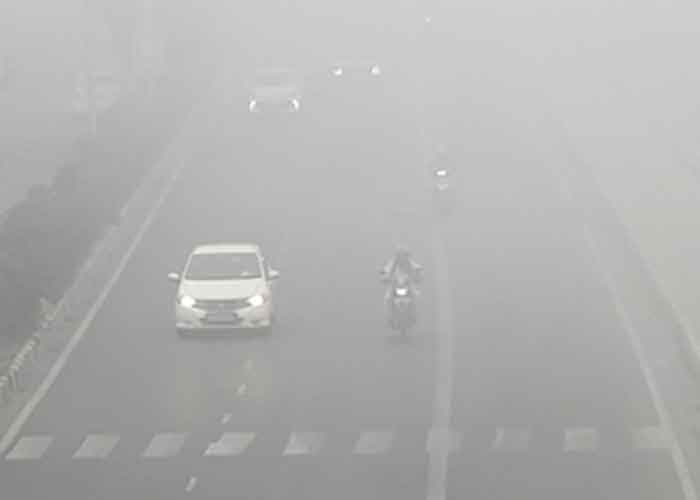
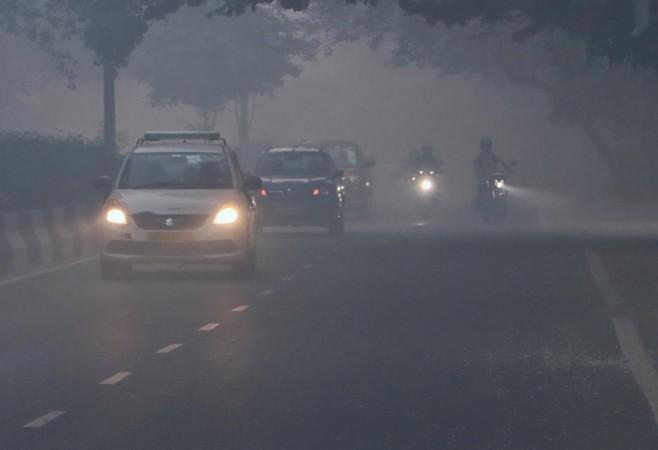
New Delhi : Dense to very dense fog and ‘Cold Day’ to severe ‘Cold Day’ conditions are likely to continue over plains of Northwest India during next 24 hours and gradually decrease thereafter, the India Meteorological Department (IMD) said on Sunday.
It further also predicted a fresh spell of rainfall over Northwest and Central India (with isolated thunderstorm/ hailstorm over east Rajasthan and west Madhya Pradesh) on January 8 and January 9 while light to moderate rainfall spell is also likely over south Peninsular India with isolated heavy rainfall over Tamil Nadu during the next four days and over Kerala during the next two days.
The IMD said that minimum temperatures are in the range of 6-9 degrees Celsius over Punjab, Haryana, Chandigarh, Delhi, west Uttar Pradesh and north Rajasthan, and 10-12 degrees Celsius over parts of east Uttar Pradesh, remaining parts of Rajasthan, and northwest Madhya Pradesh.
“It is above normal by 1 to 3 degrees Celsius in isolated pockets over Punjab, Haryana, Chandigarh, Delhi, Rajasthan and in many pockets over west Uttar Pradesh, west Madhya Pradesh and 4-7 degrees Celsius above normal over many parts of east Uttar Pradesh, east Madhya Pradesh, Bihar, and Jharkhand, ” it said in its daily bulletin.
The IMD said that maximum temperatures are in the range of 14-15 degrees Celsius over Punjab and Haryana, Chandigarh, Delhi and in the range of 16-18 degrees Celsius over north Rajasthan and west Uttar Pradesh.
“It is below normal by 4-9 degree Celsius over many parts of Punjab, Haryana, Chandigarh, Delhi, Rajasthan, and Madhya Pradesh, ” it said.
The IMD predicted that dense to very dense fog conditions are very likely to prevail in the night/morning hours in some parts of Punjab and in isolated pockets of Haryana, Chandigarh till January 9, and dense fog in isolated pockets for subsequent 24 hours.
“Dense to very dense fog conditions are very likely to prevail for a few hours in the morning in some parts over west Uttar Pradesh and in isolated pockets over Bihar on January 8 and dense fog in isolated pockets for subsequent two days, ” it said.
The IMD also predicted that dense fog conditions are very likely to also prevail for a few hours in morning in isolated pockets over east Uttar Pradesh during January 8 and January 19, over Uttarakhand, Madhya Pradesh, Jharkhand, Odisha, Assam, Meghalaya, Mizoram and Tripura till January 9, and over north Rajasthan during till January 12.
Cold Day to severe Cold Day conditions are very likely to continue in some parts over Punjab, Haryana, Chandigarh, Delhi till January 8 and Cold Day conditions in isolated pockets over Rajasthan on January 8.
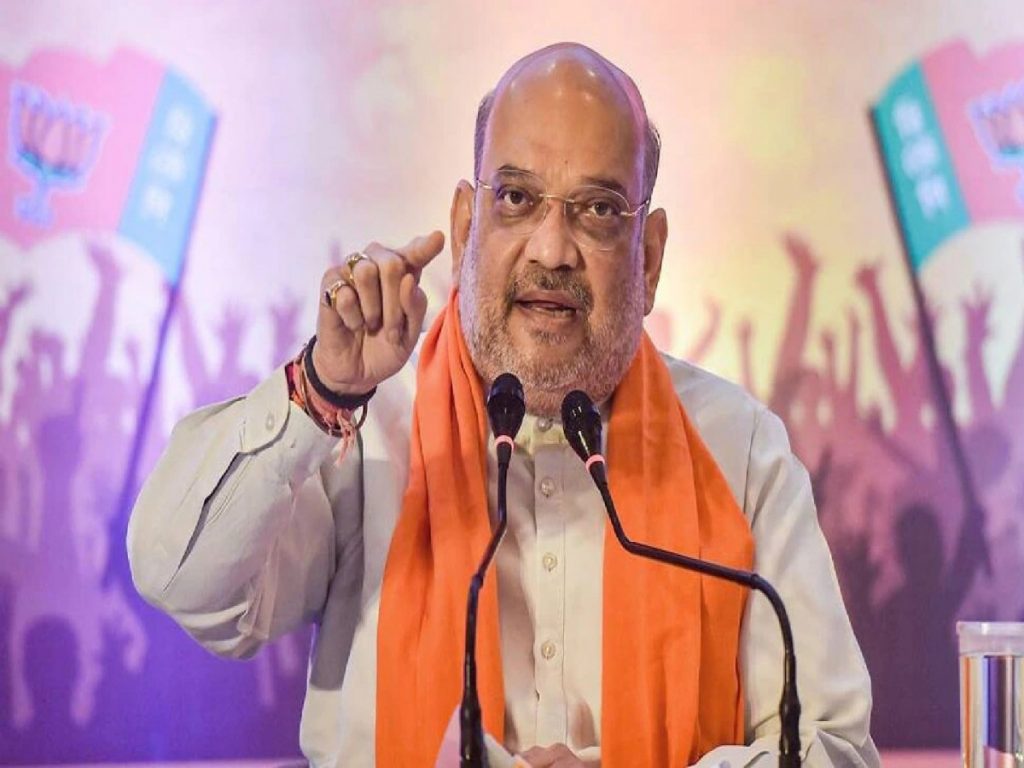
Union Home Minister Amit Shah is likely to visit Jammu and Kashmir on January 9 to assess the security situation in the region following the recent Poonch attack. The attack resulted in the loss of four soldiers, with two others sustaining injuries after heavily armed terrorists ambushed two Army vehicles.
Shah’s visit comes in the wake of escalating tensions in Jammu and Kashmir, particularly after the deaths of three civilians in Poonch subsequent to the attack. His agenda includes a thorough review of the anti-terror operations in the forward areas and a security assessment meeting in Jammu.
The Home Minister is also expected to convene a meeting involving key BJP leaders in Jammu and Kashmir during his visit. Emphasizing the significance of robust coordination among the police, Army, and CRPF for heightened security measures, Shah previously chaired a security review meeting on January 2. He underlined the need to enhance local intelligence capabilities during this meeting.
Prior to Shah’s upcoming visit, Defence Minister Rajnath Singh and Army chief General Manoj Pande had visited Jammu to show solidarity with the armed forces affected by the Poonch attack.
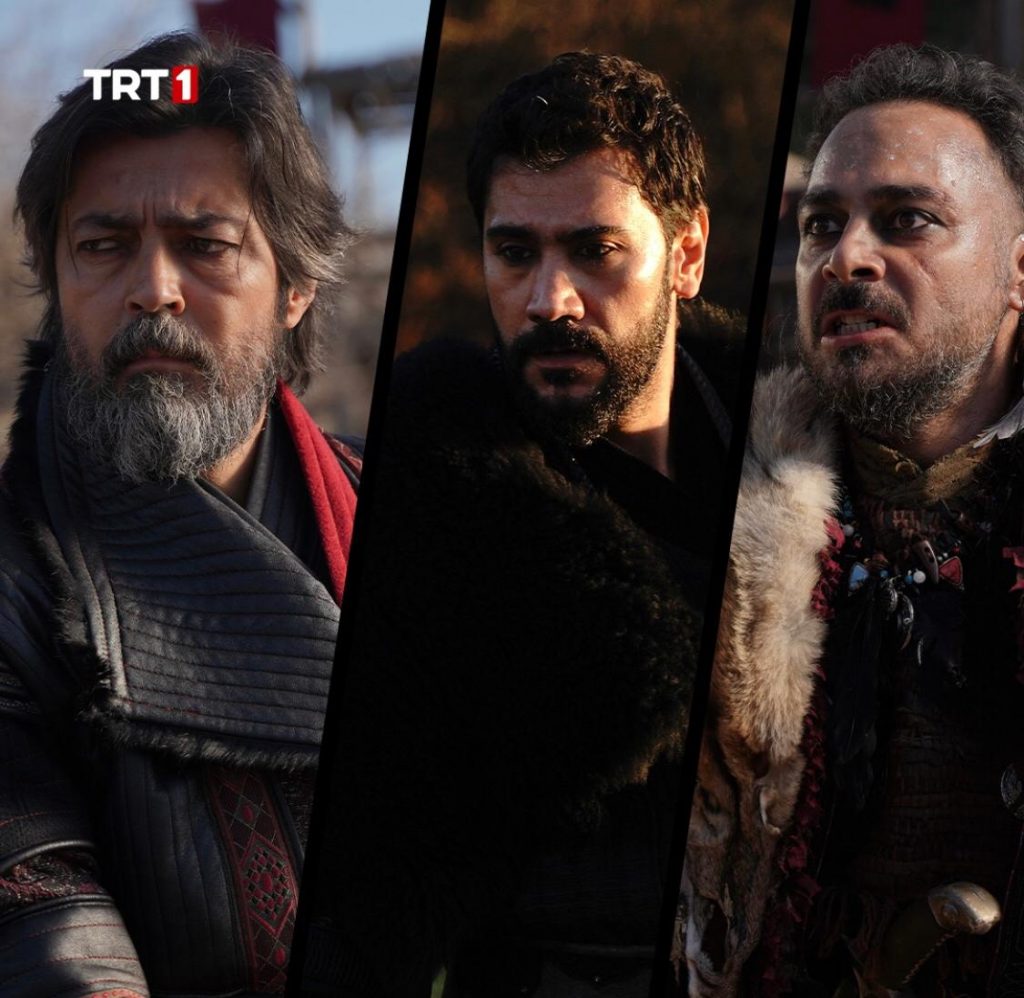
In recent years, Turkish dramas have emerged as a perennial favorite among Indian audiences, captivating viewers with their compelling storytelling, rich cultural narratives, and stellar performances. The unique blend of drama, romance, and historical elements in Turkish series has struck a chord with Indian viewers, fostering a growing appreciation for the diversity and excellence of Turkish television productions. Against this backdrop, the eagerly anticipated release of the dubbed version of “Selahaddin Eyyubi” jointly produced by Akli Films and Ansari-Shah Production, in India is poised to further solidify the country’s love affair with Turkish dramas, promising an immersive experience for audiences eager to explore the world of international television. The series has recently been released in Turkey on TRT.
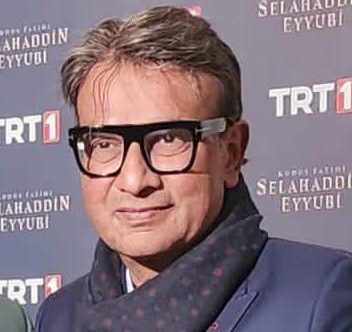
In an exclusive interview, Dr. Kashif Ansari, one of the masterminds behind “Selahaddin Eyyubi,” opens up about the intricacies of the production. As the much-anticipated dubbed version prepares to hit Indian screens at the end of January, Dr. Ansari shares insights into the challenges faced, the global resonance of the Turkish release in December, and the meticulous efforts invested in bringing this epic tale to audiences worldwide.
Can you share insights into the journey of producing “Selahaddin Eyyubi”? What were the challenges faced during the production of such an expansive historical series?
Dr Ansari—Creating Selahaddin Eyyubi on a grand scale posed significant challenges. The primary hurdle involved meticulously gathering accurate information from the vast array of historical sources, as blending fiction and facts is a delicate task. Our dedicated team of Turkish researchers and historians extensively combed through history books and biographies to ensure an authentic portrayal of the warrior king that resonates with the modern world. Now is the opportune moment to propagate Selahaddin’s principles of equality, justice, and kindness globally. Moreover, overcoming the language barrier for our non-Turkish speaking actors demanded extra efforts to achieve fluency in the language.
Given the success of series like “[Diriliş] Ertugrul” internationally, how do you envision “Selahaddin Eyyubi” resonating with a global audience, especially in India?
Dr Ansari—The question at hand is undeniably intriguing. Ertugrul has achieved remarkable success globally, resonating deeply with audiences and cultivating an expansive fandom, particularly for its lead actors and actresses. Acknowledged by historians and producers alike, Ertugrul is recognized as a work of fiction. In stark contrast, Selahaddin Eyyubi distinguishes itself as a meticulously researched masterpiece, although the journey was arduous due to the vast information surrounding the king, where every fact holds significance. Comparing the two would be unjust, as Ertugrul primarily portrayed a Turkish national hero within a nation-centric theology, whereas Selahaddin transcends boundaries by focusing on the broader human race. Emphasizing principles like peaceful co-existence regardless of religion, nationality, or region, Selahaddin’s universal appeal promises a more profound impact on the audience, given its broader scope beyond a specific region.
Can you elaborate on the strategic decision to release a dubbed Hindi version and how you expect this to enhance the accessibility of the series in India?
Dr Ansari—It is crucial to emphasize that Selahaddin Eyyubi’s regal persona and grandeur extend to international stature. The world is in need of a leader like him more than ever, making this an opportune time to delve into the life of someone who significantly contributed to making the world a better place during his reign. Our primary focus is on the Hindi/Urdu speaking audience in the Indian sub-continent, and we are currently in discussions with several OTT platforms and channels. The ongoing effort to dub the series in Hindi is progressing well and will be completed soon, making Selahaddin Eyyubi accessible to the Indian audience. It’s important to note that our objective extends beyond entertainment; we aim to strengthen global human connections by identifying common ground and shared challenges. The most prominent common issue we face is a lack of respect and acceptance for one another. This is why we chose Selahaddin, as he advocated for love, peace, and peaceful co-existence, providing a powerful narrative to foster understanding and unity.
How do you ensure that the essence and cultural nuances of the series are preserved in the dubbed versions for a diverse international audience?
Dr Ansari—Selahaddin, as historical records affirm, was a wise and just ruler. His commitment to justice, undeterred by factors like color, caste, creed, or religion, coupled with a steadfast belief in equality, represents universal values that underpin every society. Given the resonance of these principles with people worldwide and the shared cultural ground in the Indian sub-continent, cultural nuances remain preserved. Simultaneously, meticulous attention is being given to prevent the loss of meaning in translation, a common challenge in dubbed series. The dubbed script has undergone rigorous scrutiny by experts to maintain the essence. Recognizing and respecting cultural, religious, and regional differences, our goal with Selahaddin Eyyubi is to convey a message of understanding and unity to the audience.
You mentioned that Selahaddin offers hope with his values of justice, kindness, and compassion. How do you believe the series will resonate with viewers, especially in today’s challenging times?
Dr Ansari—At the core of Selahaddin’s rule lay the paramount principles of equality and justice, emphasizing humanity above all. He consistently advocated for a society where preferential treatment was not granted based on religion, race, or economic and social status—a stark contrast to contemporary challenges such as the widening rich-poor divide, human rights violations, and oppression. Addressing these issues requires leaders with a strong commitment to justice, achievable only through fostering peace and acceptance. This interconnected loop forms the foundation upon which everything else operates. Selahaddin Eyyubi vividly portrays a time when justice, equality, and peace prevailed. The series serves as a catalyst for contemplation, prompting us to reflect on the world we wish to leave for our children—a world plagued by differences, animosity, where peace is a rare luxury, and equality an unfamiliar concept. Additionally, it serves as a valuable lesson for global leaders on implementing laws without biases.
How did you go about selecting Uğur Güneş for the lead role, and what qualities did you believe he brought to portray the warrior king effectively?
Dr Ansari—Uğur Güneş stands out as a top-tier actor in the Turkish industry, showcasing remarkable versatility across television, theatre, and cinema. His prowess in acing roles, regardless of genre, is evident throughout his career. When we presented the concept of Selahaddin Eyyubi to him, Güneş eagerly embraced the opportunity. While we approached other A-list actors, Güneş ultimately secured the role due to the finesse he consistently brings to the screen.
New Delhi : Backing Delhi Chief Minister Arvind Kejriwal over Enforcement Directorate summoning him, Nationalist Congress Party president Sharad Pawar on Thursday said the Centre was misusing power to discourage those who do not have similar political views.
Addressing party workers here, Pawar said summons have been sent by the central probe agency to Jharkhand CM Hemant Soren as well and feared he too could be arrested.
Pawar said in the last 10 years, people have voted Kejriwal to power, adding that Aam Aadmi Party ministers have been jailed and steps were being taken to arrest him as well.
“He has been issued notices to appear before the ED. The chief minister of the country’s capital. Everyone in Delhi knows he is a simple man with a clean image. It will not be surprising if he is arrested,” Pawar claimed.
“This means efforts are being made to discourage those who do not have similar political views by misusing power,” Pawar alleged.
Kejriwal, who is also the Aam Aadmi Party (AAP) national convener, had skipped the Enforcement Directorate summons on Wednesday.
He has so far skipped three summons by ED for questioning in connection with a money laundering case linked to the alleged liquor scam.
The alleged liquor scam is related to the excise policy 2021-22 that was scrapped by Kejriwal’s government last year after Delhi Lieutenant Governor VK Saxena recommended a CBI probe into “lapses and irregularities” in its implementation.
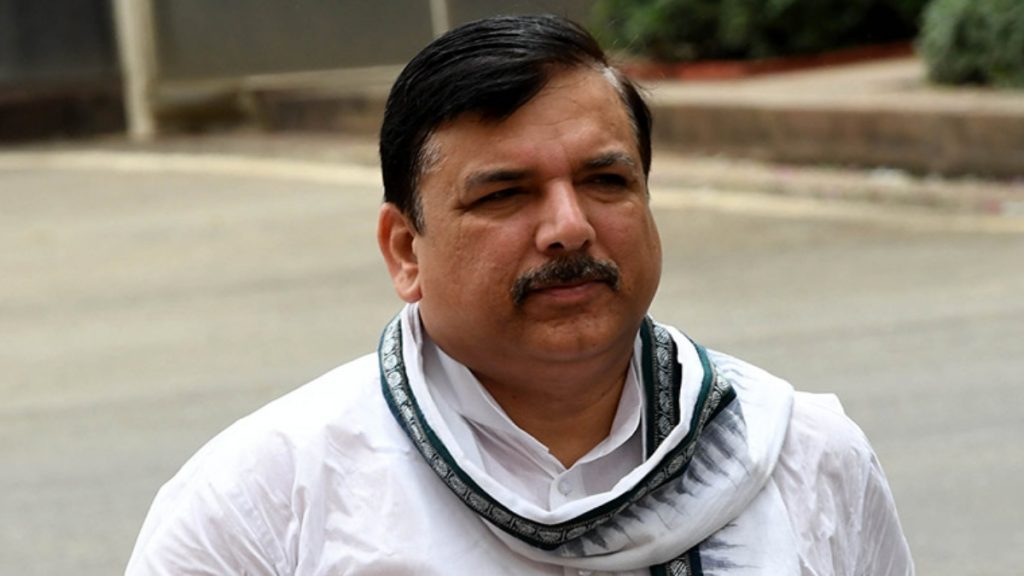
New Delhi : Aam Aadmi Party leader Sanjay Singh has again been re-nominated by his party for Rajya Sabha seat. Presently, he is in a Delhi jail relating to a money laundering case connected to the alleged excise policy. The Rouse Avenue Court in Delhi allowed him to sign forms and documents for his Rajya Sabha re-nomination. Special Judge MK Nagpal passed the order on an application filed by the politician, who submitted that his present term as a member of the Rajya Sabha is expiring on January 27 and the Returning Officer has issued a notice on January 2 for the conduct of the election and nominations for the same are to be submitted by January 9.
Singh was arrested by the anti-money laundering agency on October 4. The Enforcement Directorate (ED) has accused him of playing a significant role in the formulation and implementation of the excise policy, which has since been scrapped. The ED alleges the Singh benefited certain liquor manufacturers, wholesalers and retailers in exchange for financial gains However, Singh has vehemently denied these allegations.
New Delhi : The India Meteorological Department (IMD) has predicted a “cold day” in Delhi on Friday with maximum temperature to hover around 13 degree Celsius.
However, the city recorded minimum temperature of 9.4 degree Celsius, two notches above the seasonal average.
The city also witnessed dense to moderate fog affecting traffic and rail movement.
“The dense fog was for a brief period of two hours and during this period, Palam recorded the lowest visibility of 150 m at 3:30 a.m., ” said the weatherman.
At 8 a.m., the visibility at Palam and Safdarjung was at 400 m each.
According to Indian Railways, delays affecting 22 trains bound for Delhi stem from various factors, including fog-related issues in the northern region.
The highest delay reported in trains arriving in Delhi is five to six hours.
Meanwhile, the Air quality continued to remain in ‘very poor’ category at several stations across the city.
At the Anand Vihar area, PM2.5 levels were recorded to be in ‘very poor’ category standing at 318 and PM10 reached 191 or ‘moderate’, according to the Central Pollution Control Board (CPCB).
The Air Quality Index (AQI) between zero and 50 is considered ‘good’; 51 and 100 ‘satisfactory’; 101 and 200 ‘moderate’; 201 and 300 ‘poor’; 301 and 400 ‘very poor’; and 401 and 500 ‘severe’.
The Indira Gandhi International (IGI) Airport T3 also witnessed PM2.5 levels at 206, the ‘poor’ category while the PM10 was at 129, falling under the ‘moderate’ category, respectively.