J-K poll rallies resonate with separatist struggle slogans!

What is significant is that the variations of the separatist slogans are now yelled in mainstream political rallies including those of the BJP. The reason for this is that these slogans are known to everyone in the Valley, helping the parties to connect easily with the masses. A report by Riyaz Wani
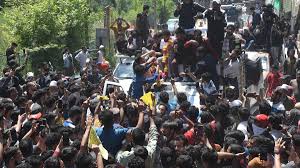
Election rallies in the Valley are reverberating with slogans like ‘Jeet Hamaari, Inshallah (Victory will be ours, God willing).” While the slogan might be typical in an election season, it is anything but. It was last used by the opposition alliance, Muslim United Front, in the allegedly rigged election of 1989.

Not just this slogan, most others being chanted in this Assembly election, and earlier in the recent parliament polls,  are adapted from the Valley’s troubled political past. Some of these go far back as this one:  “Jis Kashmir jo khoon se seencha, woh Kashmir hamara hai” (The Kashmir we drenched in blood is our Kashmir). 

The slogan has separatist origins, tracing back to the struggle for the right to self-determination through the fifties and sixties, spearheaded by Sheikh Mohammad Abdullah, the founder of the National Conference. 

Ironically, the slogan along with another one “Ragdo Ragdo, NC Ragdo PDP Ragdo” (Rub out NC, Rub out PDP), were also used by the BJP during the  parliamentary election. The slogan was coined by separatists during the six-month long unrest in the Valley in 2008 during which over 100 people were killed. Other parties have adapted the slogans to their own political needs, urging their supporters to “rub out” the other parties including the BJP. 

Another slogan, ‘Na Bayi Na (Never, Never)’ that became wildly popular during 2016 unrest in which over a hundred people were killed and more than 1100 were blinded has also caught on. The slogan which expresses refusal to accept oppression or any other injustice from the government is also being repurposed by the parties to suit their ends. Incidentally, the separatist leader Sarjan Barkati, who had conceived the slogan, is in jail for the past some years. He is also contesting the Assembly election from two constituencies – Ganderbal and Beerwah – with his daughter Sugra Barkati leading the campaign on his behalf. And she is drawing crowds wherever she goes. 

Traditional political leaders, including Dr. Farooq Abdullah and his son, Omar Abdullah, of the National Conference, are being hailed as lions by their supporters. At rallies, enthusiastic crowds chant, “Aaya Aaya, Sher Aaya” (The lion has come, the lion has come). Similarly, supporters of People’s Democratic Party, and Peoples Conference chairman Sajad Gani Lone, chant, “Nakli shera yeti wat dera, asli shera aa gaya” (Time for fake lions to leave, the real lion has arrived).

The PDP has made a clever use of the slogans coined by the separatists, some of them during the several unrests over the past one and a half decade. For instance one of them goes like: “Na Jhukne Waali PDP, Na Bikne Waali PDP (The party which won’t surrender or sell out is the PDP). The slogan was earlier used to describe the politics of the deceased top separatist leader Syed Ali Shah Geelani. The slogan then went as: Na Jhukne Waala Geelani, Na Bikne Waala Geelani. 

This is not the first time that the PDP has adapted separatist symbols to garner public support. In the past, the party has even appropriated parts of the separatist agenda, an exercise that once earned it the label of a soft-separatist party. However,  this political agenda helped the party tap into the Valley’s separatist constituency, especially Jamaat-i-Islami cadre in parts of South Kashmir. 

These slogans, deeply rooted in Kashmir’s political history, serve as potent symbols of pride, strength, and unity for the Kashmiri people. The slogan “Sher-e-Kashmir Zindabad” (Long live Sher-e-Kashmir), originally used to honour Sheikh Abdullah’s leadership, has now become a rallying cry for various political parties.

In the ongoing Assembly election, these slogans have gained renewed salience, reflecting the changing political landscape of the region. With traditional political parties reclaiming centre stage, the fleeting fame of self-proclaimed “Sher” personas on social media seems to be diminishing.

However, the resurgence of the traditional slogans is not without controversy. The BJP’s use of slogans traditionally associated with separatist sentiments has raised eyebrows. The chanting of “Jis Kashmir jo khoon se seencha gaya hai, woh Kashmir hamara hai” (The Kashmir we drenched in blood is our Kashmir) attracted widespread attention, given its historical association with anti-India protests.

What is significant is that the variations of the separatist slogans are now yelled in mainstream political rallies including those of the BJP. The reason for this is that these slogans are known to everyone in the Valley, helping the parties to connect easily with the masses.
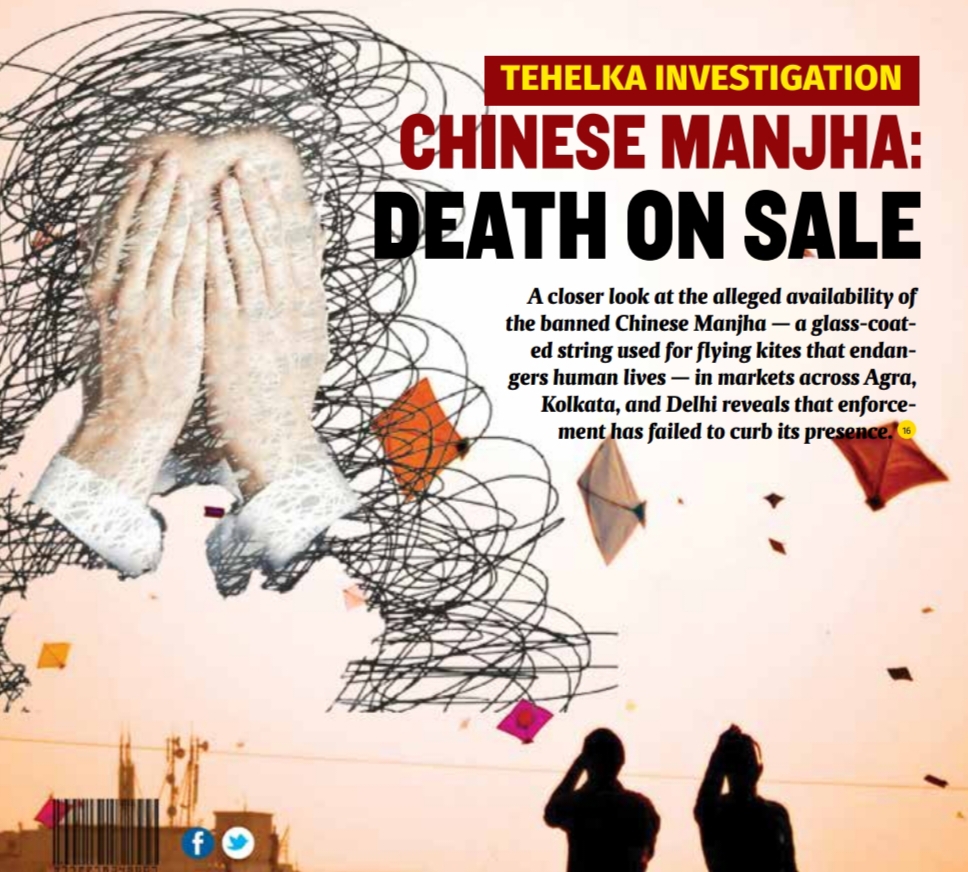
String That Endangers Human and Avian Lives

Kite flying is a cherished tradition during many festivals and celebrations, but the alarming rise in tragic incidents involving banned Chinese Manjha during these events has raised serious concerns. Kites, which originated in China around 3,000 years ago, were initially made from silk fabric and bamboo, readily available materials. Ironically, the kite thread coated with Manjha also hails from China and has gained popularity across various Asian countries alongside kite flying.

Year after year, many people and birds suffer severe injuries due to kite threads made from Chinese glass-coated or synthetic Manjha for which the string proves fatal. Disturbing incidents, such as the death of a three-year-old boy riding with his father on a bike in Chennai, a 13-year-old in Adampur, Punjab, whose neck was slit while riding a scooter, and a man in Delhi who bled to death after becoming entangled in a string, have sparked public outrage. Reports from the Animal Welfare Board of India indicate that at least 2,000 birds are injured, with over 500 fatalities, during the annual kite-flying event in Ahmedabad alone. This data underscores that kite flying, once a harmless pastime, has transformed into a dangerous societal menace.

In response to these tragedies, the National Green Tribunal (NGT) imposed a nationwide ban on the synthetic-glassed thread (Manjha) on July 11, 2017. The NGT mandated that Chief Secretaries of the states enforce this ban and directed the Union of India to prohibit the import of any synthetic Manjha or similar threads. Furthermore, the NGT instructed authorities to prosecute violators under the Indian Penal Code and the Environment (Protection) Act, Prevention of Cruelty to Animals Act, and Wildlife (Protection) Act, as applicable. The Delhi High Court has also urged the government to formulate a compensation policy within eight weeks for those who have lost lives or suffered injuries due to Chinese Manjha, expressing concern over the ongoing fatalities despite existing restrictions.

However, due to inadequate enforcement, Manjha remains easily accessible. The non-biodegradable nylon string poses a significant environmental hazard and is priced at just one-third of a cotton spool, making it an attractive option for kite flyers. While police occasionally seize spools of Manjha and arrest a few individuals following a tragedy, there is a lack of sustained efforts to eradicate this menace. Unless authorities take decisive action, the casualties are likely to grow.

Tehelka’s cover story-“Chinese Manjha-Death on Sale” is the result of an investigation into the alleged availability of banned Chinese Manjha — a glass-coated string used for flying kites that endangers human lives — in markets across Agra, Kolkata, and Delhi reveals that enforcement has failed to curb its presence. The deaths and injuries resulting from manjha highlight the urgency of the situation and call for immediate action, including enhanced surveillance of violators and coordinated efforts by policymakers.

New order takes on the old one in Kashmir’s electoral maze

In Kashmir, the old order is represented by the NC, the PDP, and the Congress, while the new order is powered by the Apni Party, the DPAP, and the PC led by Sajad Lone with Engineer Rashid’s entry adding another dimension to the already fragmented electoral landscape. A report by Riyaz Wani

In his address in Srinagar on September 19,   his first in Kashmir Valley during the ongoing Assembly election, Prime Minister Narendra Modi promised restoration of statehood to Jammu and Kashmir if the BJP was elected to power. And as he made the commitment, stopping short of specifying any timeline, the audience clapped. 

He cautioned people against the alliance between Congress and the NC, saying this would have made Pakistan happy.  The PM warned that a vote for the Congress would lead to the reinstatement of Article 370, which he said would pave the way for violence to return to the Valley. He made the statement despite the well-known fact that a predominant majority of people in the erstwhile state are upset over the withdrawal of Article 370 that granted Jammu and Kashmir an autonomous status and removed inherited protection on land and jobs. 

However, the BJP’s core constituency in Jammu and Kashmir is not the Kashmir  Valley but the Jammu division. In 2014, the party had by and large swept the division, securing 25 out of the then 37 seats.   But the electoral scene for the party now is not as conducive as it was in 2014 when the Modi wave was at its peak. The ground looks a bit shaky now.

However, the saffron party hopes to better its tally than the 25 seats it garnered in 2014, enabling it to form a government with support from major or smaller Kashmir-origin parties or independents. 

In Kashmir Valley, on the other hand, the BJP faces a difficult task of peddling a political narrative that is contrary to aspirations of a large majority of people of the union territory. People here want restoration of Article 370 and the attendant rights. They also want an empowered Assembly unlike what is on offer, and more importantly the restoration of statehood.  But none of these is being offered by the BJP. As for the statehood, the promise is undone by the lack of a timeline. But for the BJP, Kashmir is not where it hopes to do well.

No visible wave 

The Assembly election in Jammu and Kashmir has not generated a wave in favour of any political party, including that for Engineer Rashid who was supposed to galvanize a mass mobilization soon after his release.  But this hardly means he hasn’t whipped up the passion. He has both livened up the electoral scene and also made the outcome further unpredictable. 

He is drawing good crowds all across the Valley, although still short of expectations. In South Kashmir, which is not his constituency, the crowds rooted for him wherever he went. It is still not certain whether he will win seats across the Valley, but he is certain to create a major disruption. His presence has already strained the grip of the established parties like the NC, PDP and the Congress, as well as the smaller parties like the People’s Conference. 

The recent alliance between Rashid and Jamaat independents have introduced a new factor into the evolving political tug of war. 

At the same time, like the BJP in Jammu division, the National Conference is the favourite party in the Valley to win the majority of seats. But this initial perception has been dented by the intensifying electoral competition as the campaign progresses. The NC now barely holds on to its initial edge in the campaign. For example, in South and Central Kashmir, the PDP, Jamaat-i-Islami  and even Rashid’s Awami Ittehad Party (AIP) have crowded the electoral scene, making the outcome uncertain 

The PDP, Jamaat and the AIP have drawn massive crowds. North Kashmir, on the other hand, has taken an interesting turn: While earlier, the media attention was mainly focussed on the battle royale between the NC and Sajjad Lone’s People’s Conference, a wild card entry of Rashid has dramatically shifted the dynamics of the electoral race.  Since his release on September 11, Rashid has been running a high-energy campaign and attracting large crowds even in areas that have not traditionally been supportive of his party. Although the groundswell is still short of what could be called a wave in his favour,  all bets seem to be off now.  

 The new political outfits like the Democratic Progressive Azad Party (DPAP) floated by the former top Congress leader Ghulam Nabi Azad and the Apni Party led by the businessman turned-politician Altaf Bukhari are also in the fray, but they haven’t made much of a mark so far, more so the former.  As for Azad, this is such a fall from the position of being once one of the foremost national leaders  to a regional leader running a district level party. 

Old versus new order

Essentially, the ongoing election in Kashmir is a contest between the traditional mainstream political narrative and the new-fangled politics of the past five years. 

The old order is represented by the National Conference and the PDP as well as the Congress party, which is a national party though. The BJP’s rise in the former state is a post 2014 phenomenon, when for the first time it won 25 of 37 seats from Jammu division in the then Assembly elections. The party subsequently formed a coalition government with the PDP which secured 28 seats.  

 The new order is represented by the Apni Party led by the businessman-turned politician Altaf Bukhari, the DPAP  headed by Azad and the People’s Conference  of Sajad Lone. Although the PC is an old party, its new avatar owes itself to the political restructuring of the Valley following the abrogation of Article 370 in August 2019. 

 After the recent parliament elections, the ongoing Assembly election is the first major electoral exercise  in which the old and the new political orders have come face to face. And at the heart of this contest are now almost all constituencies. Rashid’s entry seems to have already changed the game in Kupwara.   

 Although Kashmir has witnessed many elections over the decades, this one is likely to go down as one the most interesting and also “heavily engineered,” as claimed by the PC leader Sajad Lone in one of his interviews. Not only are several political parties vying for votes but there are also many independents in the fray. This has confused the voter, preventing the formation of a coherent public opinion.  

 “The anticipated division and sub-division of votes will profoundly impact the Valley’s representation in the Assembly. Whether to its advantage or detriment, only time will tell,” an editorial in a local daily said.  “This is why it is incumbent on people to exercise their franchise very sensibly this time. 

All eyes on Julana as Phogat  gets locked in fierce ‘dangal’

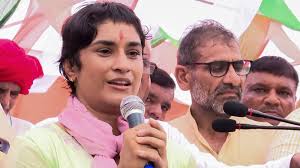
Her huge fame and fan-following notwithstanding, star wrestler and Congress candidate Vinesh Phogat is faced with a tough multi-corner electoral fight in her ‘sasural’ assembly constituency of Julana in the upcoming Haryana assembly elections. A report by Rajesh Moudgil

An Olympian wrestler-turned-politician, the Congress candidate Vinesh Phogat seems to have been locked in a multi-corner bout in the Julana constituency, a key seat in the state’s Jat heartland, making it one of the most-watched electoral fights in upcoming October 5 Haryana assembly elections.

Julana is Vinesh’s “sasural’’ as her husband Somvir Rathee belongs here while she hails from village Balali in Charkhi Dadri district.

Vinesh is the first Indian woman wrestler to recently reach the Olympics final at Paris, the stage where she was disqualified after being found overweight by about 100 grams in the 50-kg category; Vinesh subsequently announced her retirement from the game. She joined Congress on September 6 last and was given a ticket by Congress to fight from Julana seat.

A star grappler, Vinesh faces Aam Aadmi Party (AAP) candidate Kavita Dalal, who herself is a former WWE wrestler and who claims substantial support from about six villages having Jats with Dalal `gotra’. Adding to the possible disadvantage to Vinesh, there is sitting MLA of Jannayak Janta Party (JJP) Amarjit Dhanda; JJP is a splinter outfit of Indian National Lok Dal (INLD). The rival party INLD, has fielded Surinder Lather, with a large number of Jats of Lather gotra in the constituency; The INLD has also forged an alliance with BSP this time here.

All these candidates belong to the Jat community in the constituency which is Jat-dominated and it amply indicates a possible split in the votes. There are about 80,000 Jat votes in Julana constituency with about 1.85 lakh votes, out of which nearly 40% are Jats, 40,000 SC votes, 33,000 OBC and 22,000 Brahmin voters.

Vinesh is also facing a daunting challenge from BJP’s Capt Yogesh Bairagi, a non-Jat candidate backed by OBC and SC as well as Brahmins who also have a major chunk of votes here. The saffron party is also throwing its weight behind its candidate Capt Bairagi, who is a trained pilot and is also known for his relief works during the Covid-19 pandemic and Chennai floods.

Another possible disadvantage for her seems to be from the danger from within as there are said to be some of Congress leaders who are said to be anguished over last minute denial of party ticket to them by selecting her. The local Congress leaders had been active even ahead of the declaration of the candidates. They include former MLA Parminder Dhull, Dharmender Dhull and Rohit Dalal and they are said to have distanced themselves from Vinesh’s campaign.

Julana is a stronghold of INLD. While Congress’ Sher Singh won from here twice in a row in 2000 and 2005, INLD’s candidates won this seat in 2009 and 2014 and Amarjit Dhanda of JJP, a splinter outfit of INLD, won in 2019.

Vinesh, however, has been a crowd-puller as she boldly undertakes her poll campaign in her chaste Haryanvi language as “Julana ki Bahu’’ (daughter-in-law of Julana), not forgetting to remind the gatherings of her protest against former president of the Wrestling Federation of India (WFI), Brij Bhushan Sharan Singh, who was accused of sexually harassing female wrestlers. She claims that she fought against that powerful man and performed well in the Olympics but unfortunately missed the medal.

Apart from Congress’ Vinesh, there are also two sportspersons fielded by BJP – Aarti Singh Rao, an international skeet shooter, who is the daughter of Union minister Rao Inderjit Singh, and Deepak Hooda, former captain of national kabaddi team, as candidates from Ateli and Meham assembly seats, respectively.

Valmiki community votes for 1st time in Assembly elections of J&K

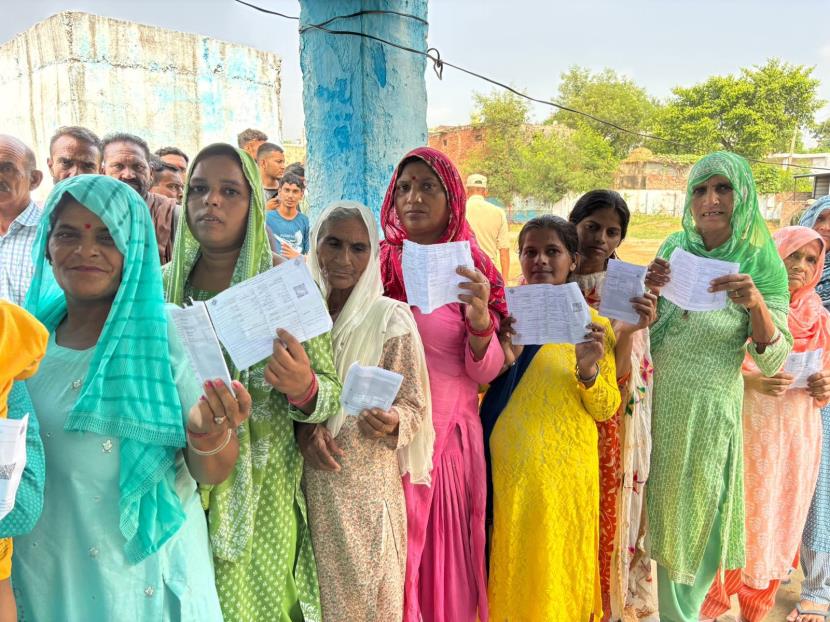
New Delhi: Expressing their joy at this historic moment, the Valmiki community members said they had been granted voting rights after waiting for decades. It is a momentous day to be voting for the first time in the Jammu and Kashmir Assembly elections.

They also voiced hopes for a brighter future for their community, saying, “We want the government to do more for the upliftment of our society. We believe that after this change, better opportunities will open up for our people.”

Laal Chand, an 85-year-old first-time voter of the community, said, “I am very happy, but also concerned about the future of my children, who are educated but still unemployed. I cast my vote with the hope of a better future for them.”

Ekta, a young woman from the Valmiki community, expressed her gratitude, “Every government seeks votes, but as we didn’t have voting rights, how could we participate? I am thankful to the Modi government for abrogating Article 370, which opened up many opportunities for us. After this change, I was able to enrol in an LLB programme. I urge people to elect a government that understands and works for their future, not one that promotes terrorism and creates hurdles.”

Another member of the community, a 45-year-old man, remarked, “I am very happy to have finally cast my vote. Our country is one of the largest democracies, but due to Articles 370 and 35A, we were deprived of our rights. After their abrogation, we not only gained voting rights but also domicile status. I hope the Valmiki community will now receive land allotments, job opportunities, loans, and avenues for businesses.”

He further added, “I dream of a healthy and peaceful life for our community. After seven decades, I voted, and I trust that our voice will not go unheard as we have faith in the Modi government, which cares for every section of society.”

Granting the right to the Valmiki community to be able to vote in the Assembly elections marks a significant political and social shift in the union territory, and is a step towards empowering communities that have long been marginalised.

Meanwhile, as the final phase of polling is underway, Prime Minister Narendra Modi has called upon the people, especially first-time voters and women in the Union Territory, to come out and vote in large numbers.

Polling for the third and final phase of the Jammu and Kashmir Assembly elections began at 7 a.m. across 40 constituencies, with 24 in the Jammu division and the rest in the Kashmir Valley. Voting will continue until 6 p.m. and the votes will be counted on October 8.

Shifting loyalties and high-stake showdowns mark Haryana polls

The BJP is keen to secure a win in Haryana to stem its waning influence in the aftermath of the Lok Sabha poll results. For the Congress, though plagued by severe infighting, this is a golden opportunity to regain power it lost to the saffron party a decade ago. A report by Aayush Goel

With less than a week left for Haryana polls, the election scenario in the state is brimming with high-stakes and most anticipated contest between the ruling BJP and Congress. While the two mega parties are fighting to establish supremacy, it is an existential crisis for other regional parties and independent candidates. It’s a war of relevance for most senior candidates and a golden debut chance for younger ones. Legacies are fighting to stay alive whereas voter sections like farmers, Meo-Muslims, and Ahirs are fighting to make it to the priority list.  

The election victory will be crucial for the BJP to regain its waning influence amidst the anti-incumbency wave in the aftermath of the Lok Sabha poll results. For the Congress, plagued by severe infighting, it is the opportunity to regain the power lost 10 years ago and pave an easy way for the next generation of leaders like Deepender Hooda, Rao Chiranjiv, and Aditya Surjewala. Both parties won five seats each in the Haryana Lok Sabha, further adding to the anticipation of the Assembly poll outcome on October 8. Those who have decided to go Independent after being denied tickets by parties are in a do-or-die situation. Aam Aadmi Party’s plan to run solo on all 90 seats is facing a litmus test. So, with unprecedented anticipation in the air here’s a look at most high-stake constituencies.

Garhi Sampla-Kiloi

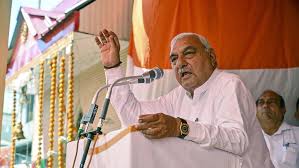
Garhi Sampla-Kiloi, Congress’s power hub in Haryana, is the bastion of former Congress Chief Minister Bhupinder Singh Hooda, the tallest Jat leader and most influential Congressman. The Jat community makes up 25 percent of the Haryana population and is central to the Deswali-belt that comprises Rohtak, Jhajjar, and Sonipat districts.  Congress is heavily banking on its conventional voter base and considers this election as Jat versus non-Jat. Being the tallest leader, Hooda needs to get a record-winning margin from here. Hooda, the two-time former CM of Haryana has a political career spanning five decades. He has never once lost an election. In the hope of countering him, the BJP has fielded Manju Hooda – wife of gangster Rajesh Hooda. Manju is expected to gather votes from Jats upset with the Hooda clan.

Tosham

Here cousins are fighting it out to claim the legacy of state’s another tall leader and former Haryana Chief Minister late Bansi Lal. Congress has nominated cricket administrator-turned-politician Anirudh Chaudhary against Shruti Choudhry, who is contesting on BJP  ticket after defecting from Congress recently. Both candidates are cousins and grandchildren of the late former Haryana CM Bansi Lal.

 Ateli

Ateli is part of the Ahirwal belt of South Haryana and the launch pad of Arti Rao, daughter of the tallest Ahir leader and six-time MP and MoS, Rao Inderjit Singh. Singh who shifted from Congress to BJP in 2014. Rao Inderjit Singh has been reigning supreme in the area for decades but it is only after the Lok Sabha elections that the BJP has finally started recognizing his might. Arti has been fielded by the party after being denied a ticket twice in 2014 and 2019. It’s not just a war of supremacy for her but also political relevance of the Rao clan as Arti is the third generation who is taking the baton from her father. She is not just battling strong candidates from Congress and other parties but grappling with the rebellion in the local BJP units, where a disgruntled cadre is up in arms against the ‘imported’ leader Rao Inderjit Singh.

Ambala Cantt

Ambala Cantt is one of the key constituencies in Haryana, from where 71-year-old BJP leader Anil Vij has been a six-time MLA. A former Home Minister, who enjoyed immense power in former CM Manohar Lal Khattar-led government, was completely ignored by the party in incumbent Nayab Singh Saini’s cabinet. He recently created jitters in party ranks by staking a claim to the post of CM citing himself as the senior most MLA. In addition to battling anti-incumbency and party infighting, he is crossing swords with Parvinder Singh Pari of Congress and strong Independent candidate Chitra Sarwara.

Ladwa

A non-descript segment in Kurukshetra hardly talked about in years, Ladwa is the centre of attention now as Haryana’s three-month-old CM Nayab Saini has been fielded from here after winning the by-poll contest from Karnal, the stronghold of Khattar. Though he was not up for the seat, the BJP chose to grant its CM the seat they considered safest. In the Lok Sabha polls, the BJP won 47.14 percent of the vote in the Ladwa Assembly segment of the Kurukshetra constituency. Here, the Congress has fielded Mewa Singh, the incumbent MLA who won the 2019 polls by a narrow margin of 12,637 votes.

Hodal

Here, Haryana Congress President Udai Bhan is facing a litmus test. Udai Bhan is fighting  against BJP’s Harinder Singh Ramrattan. Last time, the  BJP had won this seat with a thin margin of only about 3,300 votes. The outcome of this seat is crucial for the Congress.

Hisar

All eyes are on Hisar seat, where India’s richest woman, Savitri Jindal, is contesting independently. While Hisar is conventionally crucial to Haryana’s political scene, it is more prominent now as India’s richest woman Savitri Jindal is in the fray as an Independent candidate. Savitri chose to go solo after the BJP did not give the ticket to her but re-nominated its sitting MLA and state Health Minister Kamal Gupta. Notably, Jindal quit the Congress in March and switched over to the BJP shortly after her son industrialist Naveen Jindal joined the party. He is a BJP MP from Kurukshetra. The Congress has named Ram Niwas Rara from this seat.

Kaithal

Rajya Sabha MP from Congress Randeep Surjewala, the leader of anti-Hooda faction is sweating it out to stay relevant to Haryana politics and make his son win. Aditya is debuting this year from Kaithal, the seat represented by his father twice in the past. Randeep lost the seat in 2019 and has slowly been nudged out of the party’s prominence by the Hooda camp.

Julana

One of the most high-profile constituencies this time, Julana marks the beginning of Olympian wrestler Vinesh Phogat’s political career. Phogat who has been the face of wrestlers’ protests and poster girl of the anti-BJP movement, especially after her Paris Olympic medal controversy, is battling it out against the BJP’s Capt Yogesh Bairagi and AAP’s Kavita Devi, also a wrestler. Phogat, who recently joined the Congress, is expected to solidify the party’s influence among farmers, youth and women.

Uchana

JJP leader Dushyant Chautala, striving to retain his kingmaker role in the next government, is facing the toughest battle of his political career. Once a part of the BJP-led state government and former deputy CM Chautala has been struggling with the collapse of his ‘kingmaker’ party JJP and dealing with defectors. He will contest the Uchana seat in Jind to defend it against BJP’s Devender Attri and Congress’ Brijendra Singh. Singh, a former IAS and a BJP turncoat, joined Congress in March this year. Chautala had defeated his mother Prem Lata in 2019.  Brijender is the son of Birender Singh, who is a former Union Minister who joined the BJP in 2014, and then made a U-turn to re-join the Congress again this year.

Ellenabad

The once-powerful Indian National Lok Dal (INLD) is struggling for survival in Haryana. The INLD general secretary, Abhay Singh Chautala will contest the polls to retain his Ellenabad seat in Sirsa. Like JJP, INLD has also lost its influence in the Haryana political landscape. The party has been out of power in Haryana for 20 years and got a meager 1.74 percent vote share in the Lok Sabha polls. Chautala has represented the seat since 2010. Previously, it was held by his father, OP Chautala.

Political leaders sleepwalk amidst surrounding chaos

One wonders what sleeping potions and concoctions are given to the political rulers, so that they can sleep well and not sit all too perturbed seeing the human killings! Can they be called leaders? by Humra  Quraishi

I’m  curious and also  keen to  know from the so-called ‘sleep  experts’,  what sleeping potions and lotions and pills and concoctions and medicines are given to the  political rulers, so that they can sleep well and not sit all too perturbed seeing the  human  killings! Nah, I wouldn’t call these men ‘leaders’ as they are not leading us to anywhere near survival! They are all too blatantly political, hopping from one summit to the next, in their best attires, with those frills all too intact. The in-between gaps fitted with speeches and more of those fairy tale promises! Far, far away from any of the realities as they do not take the trouble of visiting any of the troubled war torn zones or countries.

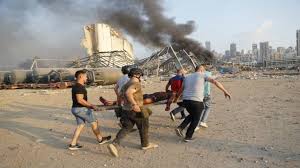
If one were to focus on the Israeli forces targeting Lebanon, it gets far too obvious that killings and violence are only worsening, going beyond the Palestine borders. Last fortnight, many were  killed and many more were wounded as explosions went off in Beirut and in several other parts of Lebanon in an apparent second wave of detonations of electronic devices, walkie-talkies and even solar equipment were  targeted a day after hundreds of pagers blew up.

As this new form of warfare gets  unleashed  by the  Israeli forces, the political web and military might seemingly gaining ground, unsettling hundreds of  innocents not just  in the West Bank and Middle East but far beyond.

Bound to carry huge tragedies. And bigger offshoots. There is, of course, the refugee crisis which has been spilling over to Europe. This crisis is an extended offshoot of the internal strife and civil war instigated by the vested interests of the bigger nations!

We sit all too subdued and meek and mute, wondering: Who is masterminding these killings? Who is behind these organized bombardments? Who are the behind-the-scenes destroyers? Why are the governments and world leaders not speaking out? We don’t even scream or shriek in horror to end this mess, even when news reports come in, day after day, of human disasters!

We are worried about the consequences of speaking out!  Even as the civilian population sits terrorized, we sit all too shut. State-fed inputs to terrorism continue to hold sway. No, we are not even inclined to go beyond, and question and query.

Few talk openly and responsibly; even bypass its seriousness by overlooking the political complexities to it, as political powers and fascist forces expand their domain on sheer barbaric tactics.

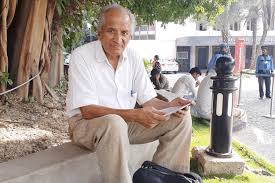
One of those exceptions to this is Professor V.K. Tripathi, who till his retirement was teaching Physics at IIT Delhi. He has been doing his utmost to unmask those layers, by holding meetings with students and researchers. Several  years back,  one  late evening  as  I reached  the  stretch  near  the Aravali hostel of  IIT  New Delhi, I was  taken   aback  to see that  on that   cold  December  evening Tripathi, sitting on a  faded piece  of cloth, discussing with his  students  and  research  scholars, the political polarization and terrorism in today’s world! Mind you, not   talking about terrorism in one of  those  hyped  political  or  biased  terms, but as  he’d   put  across, “ For resisting terror, it is vital that we understand terror  in all its forms  and  take  up  responsible roles.” And in continuation with that, he went on to explain that Imperialism is the deadliest form of terrorism. He also gave the backgrounders to the  start  of people’s discontent,  build-ups leading to terrorist  activity in our country,  in Punjab and also in North East and Kashmir.

 *****

What if Mahatma Gandhi was still in our midst. He would have definitely travelled to the Palestinian State and also to Lebanon  and  met the survivors. He would  have spent days  or weeks there, amidst the  affected. Don’t you recall the  fact that whenever  communal violence  and rioting hit the  various  regions of our country,  Mahatma  Gandhi  would  undertake padyatras and  camp at the riot-hit place and see to it that some semblance of  peace prevails.

****

Kahlil Gibran  

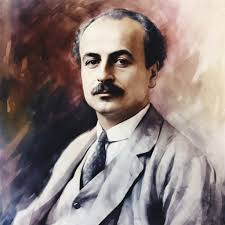
I started to re-read Kahlil Gibran, with news reports of Lebanon getting targeted by Israeli forces… Do not overlook the fact that he was from Lebanon. Though he had shifted to America, when his   mother and half-brother and two sisters were moving base, his heart was back home, in Lebanon. And  though  he   lived   most  of   the  years  in New York   but  couldn’t really  ever forget  his Lebanese roots. So much so he  willed  royalties  from  his  books  for the  people  of  his  hometown, Bsharreh…He was born   in  1883,  in  Lebanon’s  mountain   town  of  Bsharreh.

 Leaving you with these quotes from   Kahlil Gibran’s book ‘The   Prophet’.

 On  love:  “When  love  beckons you, follow  him /Though  his ways are  hard and steep  /And when his wings enfold you  yield to him /Though the  sword  hidden among  the pinions may wound   you /And when  he speaks to you, believe  in  him / Though his voice may shatter  your dreams as  the  north  wind lays  waste  the garden…”

On children: “Your children  are not  your children  /They  are the  sons   and  daughters of  Life’s  longing for itself /They come  through  you  but  not from you  /And though  they are with you  yet they   belong not  to you …”

On  joy and sorrow: “Your  joy  is  your   sorrow unmasked/Together they come, and when one sits alone with /you at your  board, remember the other  is  asleep/upon your  bed …”

On  crime  and   punishment: “You   cannot   separate the  just from the  unjust  and the good from the wicked /For they stand  together   before the face of the   sun /even as the black thread and the   white  are woven together /And when the  black  threads  breaks, the  weaver  shall   look  into  the   whole  cloth and  he  shall  examine the  loom also …”

Along the    same strain  of   crime  and  punishment  Gibran  brings  into   focus   much  more: “If  any   of you  would  bring   to  judgement  the /unfaithful wife /let  him also   weigh  the  heart  of   her  husband in / scales and  measure  his soul with  measurements/And  let  him  who would  lash  the  offender look  unto/the spirit  of the  offended /And  if  any  of you   would  punish  in the  name  of  /righteousness and  lay  the  axe  unto the   evil tree  let /him  see  to  its roots.”

On religion:  “Is not religion all deeds and all reflection /And that  which  is  neither deed  not reflection, but a /wonder and  a  surprise  ever  springing   in the soul /even  while the hands  hew the stone  or  tend the  loom …Your daily  life  is  your temple and your  religion /whenever you enter  into  it take  with you  your all /Take the   plough  and the  forge and the  mallet and the   lute/ the  things you  have   fashioned  in  necessity  or for  delight …“And   if you would   know  God ,be  not therefore  a  /solver  of riddles /Rather  look  about you and you   shall  see   Him /playing with your  children /And  look into space ;and you   shall  see Him walking  in / the cloud , stretching  His  arms  in the  lightening  /and  descending  in rain /You shall see  Him smiling    in flowers ,then   rising /and waving His  hands  in trees.”

Strategic or ill-timed? Modi’s US visit sparks debate among experts

There are sharp differences within the Indian establishment comprising former high-profile diplomats and security experts regarding the recent visit of the Indian Prime Minister Narendra Modi to the USA amid its election season by Gopal Misra

There are sharp differences within the Indian establishment comprising former high-profile diplomats and security experts regarding the recent visit of the Indian Prime Minister Narendra Modi to the USA.

A large number of scholars known for their in-depth studies of world affairs believe that Modi should have avoided his visit, especially on the eve of the highly controversial US presidential election. There are others, who are convinced that the India-US strategic partnership is a part of the role two democracies want to play immediately as well as in the coming decades.

Meanwhile, the media debates whether Modi’s three-day visit is going to improve the election prospects of the Democratic Party nominee Kamala Harris or her Republican Party nominee, Donald Trump, a former US President. It, however, appears to be too pedestrian, especially for the people who are aware of the political choices of the American electorate, including the voters of Indian origin. The initial assessment is that the visit of Modi to the US is not going to boost the prospects of either candidate. Also, he is not going to share any public platform with Kamala Harris and Donald Trump.

Modi’s visit to New York to address the UN General Assembly could be explained, especially in the context of seeking a peaceful solution to the ongoing fratricide between Russia and Ukraine. In the light of the recent decision of Dragon to ease the ongoing tension on the India-Tibet border in Eastern Ladakh, his decision to attend the QUAD summit at Denver has become quite relevant.

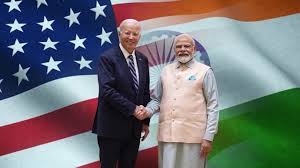
His participation in the summit, which was attended by President Joe Biden, has drawn worldwide attention. During the intense election campaign, some have criticized the meeting in the USA. Though there is a suggestion that the summit could have been avoided till the inauguration of the new president, it is also being stated that the QUAD is being endorsed by both the parties. Also, it was attended by the Japanese PM Fumo Kishida and the Australian PM Anthony Albabes. It means a continuous dialogue for the security of the Indo-Pacific region is being endorsed by the US political establishment.

Setting up an Agenda

Apart from the intense media debates and discussions, the participants of the high-profile summit have so far not cared to provide an all inclusive dialogue for cooperation among the countries of the region. The foreign affairs specialists in New Delhi are keen that the issue is not just of policing the region, but a broad spectrum approach is needed for addressing the immediate as well as long-term concerns.

It is hoped that the US-led coalition comprising Australia, India and Japan would be able to prepare a document after the inauguration of the new US President next year. Since the US has deep economic ties with China, the new president would be expected to define the American strategy in the region.

Meanwhile, China too has to redefine its role in geopolitics. It is necessary and also in the wider interests of a state, the ruling elite or the oligarchy, that churning for new ideas and strategies continue to redefine their narratives. Beijing too cannot remain wedded to the dated concepts and mischiefs. Therefore, the visit of the Indian Prime Minister Narendra Modi, that too just two months before the presidential poll, needs to be understood. The apprehension that if Kamala Harris makes it to the Whitehouse, her not-so-warm relations with Modi might adversely affect the US-India ties, is ill founded. The country’s interests are seldom affected by personal attitudes.

It cannot be denied that despite being less than two percent of the total voters, Indian voters do have strong voices in US politics. They are much more prosperous than the Jews, and have been contributing to all the sensitive key areas from Silicon valley, the American academia  and even the White House.

It cannot be denied that inspite of pro-Modi rhetoric of Trump, the Democrats, especially a miniscule minority of the Roman Catholic, have always been the first choice of the voters of Indian origin.

The Indians, having elephantine memory, have never forgotten the crucial support of John F. Kennedy, the first Roman Catholic President of the US, to India during the 1962 Chinese invasion of her north-eastern region. Indians know that the Chinese premier, Zhou Enlai had telephoned the then Pakistani military dictator, Ayub Khan, to forcefully occupy Jammu and Kashmir, when most of the Indian troops were deployed in the northeastern region. However, it was  Kennedy’s intervention that prevented Pakistan from attacking India.

The crisis and challenges

Each country has its own agenda and narrative, but during driving, a motorist has to make course corrections according to the existing ground realities. Since 1962, India’s foreign and strategic planning has undergone changes from the rhetoric of the Panchsheel or ‘the five principles’ for defining international affairs and non-alignment for maintaining world peace.

On January 31, 1992, the then Indian Prime Minister, P.V. Narasimha Rao had met the then US President, George W. Bush, in New York during the UN Security Council summit, and tried to convince him that the fragmentation of a democratic country like India  would not be in the best interests of the free world, especially the US. Interestingly, just two days before the meeting, India had taken a bold step to establish full diplomatic ties with Israel.

Rao’s initiative was followed by initiating economic reforms. Two years later, Rao again visited Washington in May 1994, and sought American technologies and investments in India. However, compared to the Chinese initiative, it was not much. The successor of Mao Zedong, Deng Xiaoping had visited the US in 1979, laying the foundation of US-Chinese economic cooperation for the next 50 years during the presidency of Jimmy Carter. Carter writes in his diary that the visit had lit a spark that turned into a prairie fire. It, indeed, was a prophetic observation that transformed the world.

It may also be noted that in spite of being the paramount leader of a Communist country, Deng had married Zhuo Lin, daughter of a well-known industrialist of Yunnan. During his US visit, apart from Lin, he was also accompanied by the chairman of the Technology Commission, Fang Yi. Apart from signing agreements with various officials, he had met as many as 17 governors.

 The colonial narrative

The main challenge before the US Administration in 2025 is how to reduce America’s dependence on China as it is the manufacturing hub of the American brands. Also, its approach towards India and other countries in the South Asian region continues like a colonial boss.

Most of the counties in the region have a colonial past. Since the conclusion of World War-II in 1945, the USA became a successor state of the erstwhile colonial powers of Europe, including the UK.  Even 80 years after the end of colonial rule, a section of the US establishment, such as its  judiciary and the deep state i.e the CIA have failed to weave in a new narrative with the rest of the world. Recently, it was quite ridiculous for an American court to summon India’s National Security Advisor, Ajit Doval. The support of the CIA to the Sikh extremists is quite known.

It is hoped that the new US President would be able to bring better coordination among the three key institutions, Pentagon, CIA and the foreign office.

Meanwhile, the love of Indians for the Roman Catholic continues for their commitment to the community and the poor. After Kennedy, Biden will be remembered for his friendly policies towards India.

Why Himalayan springs that nurture life and culture are dying

In the present scenario of climate change coupled with deforestation, many springs or jaldharas, which are a common source of drinking water for the villagers in hill states, are drying up, thus leading to water shortage in the hills and impacting communities. A report by Deepanwita Gita Niyogi

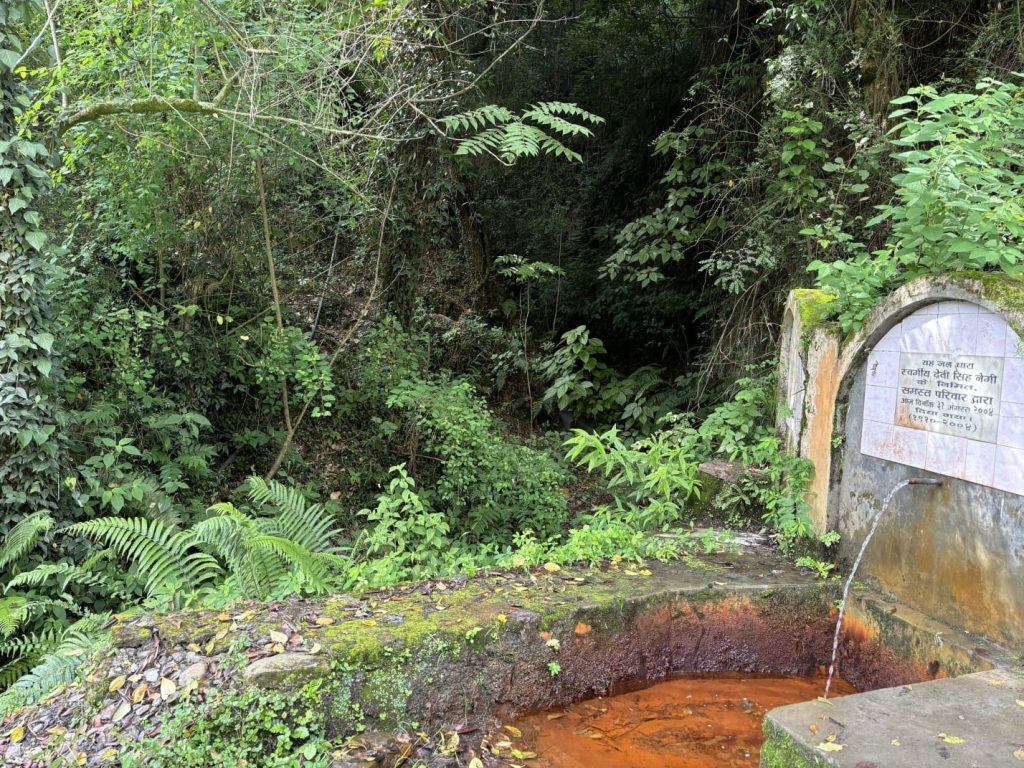
In the Himalayan region, a common source of drinking water is the spring or jaldhara from where water comes out naturally like a fountain from subterranean passages.

In the present scenario of climate change  coupled with deforestation, many springs are drying up, thus leading to water shortage in the hills and impacting communities. A NITI Aayog  report says that there are five million springs across India, of which nearly three million are in the Himalayan region. An estimated 200 million people depend on spring water. 

These jaldharas or springs are found in abundance in states like Uttarakhand and Himachal Pradesh due to their being situated in the Himalayas. According to Chandarshekhar Tewari, rural people collect water from dharas. But a changing climate is responsible for the drying up of many of these natural water sources.

Tewari, who works at the Doon Library and Research Centre, a public library in Dehradun as a programme associate, also blamed factors like road cutting, installation of hand pumps and the insistence on piped water supply in villages behind the drying up of jaldharas. “To boost tourism, many hotels and resorts are coming up in the mountains which is impacting water availability and source.”

The situation is the same in the eastern Himalayas. Pasang Lepcha is based in Darjeeling district of West Bengal and works for WWF. “The organisation is collecting data in Darjeeling to find out how much amount of rainfall is seeping underground and recharging aquifers. Recharged aquifers are most important for continuance of springs. There are spring sheds where water gets absorbed and stored in aquifers, and then is discharged out.”

“Springs which were perennial in nature earlier have turned seasonal. In many places, the water discharge rate has gone down. At the same time, the demand for water is increasing day by day due to rural tourism,” Lepcha said.

He talked about plans to carry out restoration work like tree plantation to secure spring sheds. As part of the recharge work, pits are also dug where water can be collected. “Now, a lot of rainfall happens within a short period. So, there is no time for the water to seep inside the earth.”

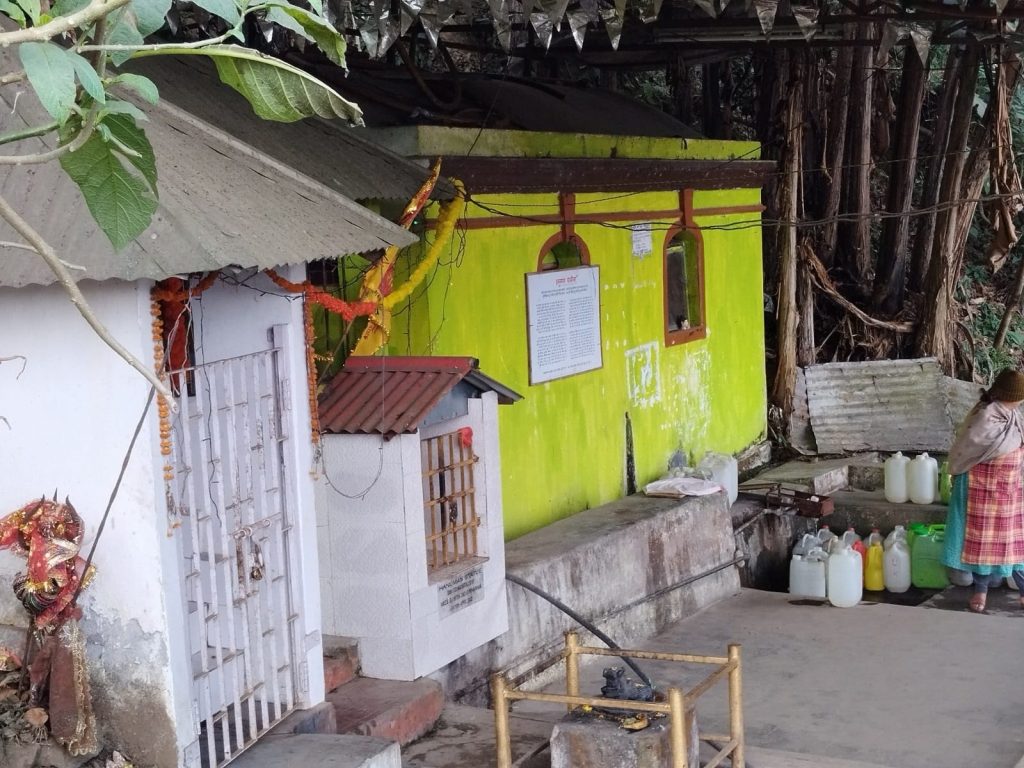
Fortunately, local beliefs revolving around these springs or jaldharas can also help them survive. In Darjeeling, people grow banana plants.Temples are also found at many of these spring sites.

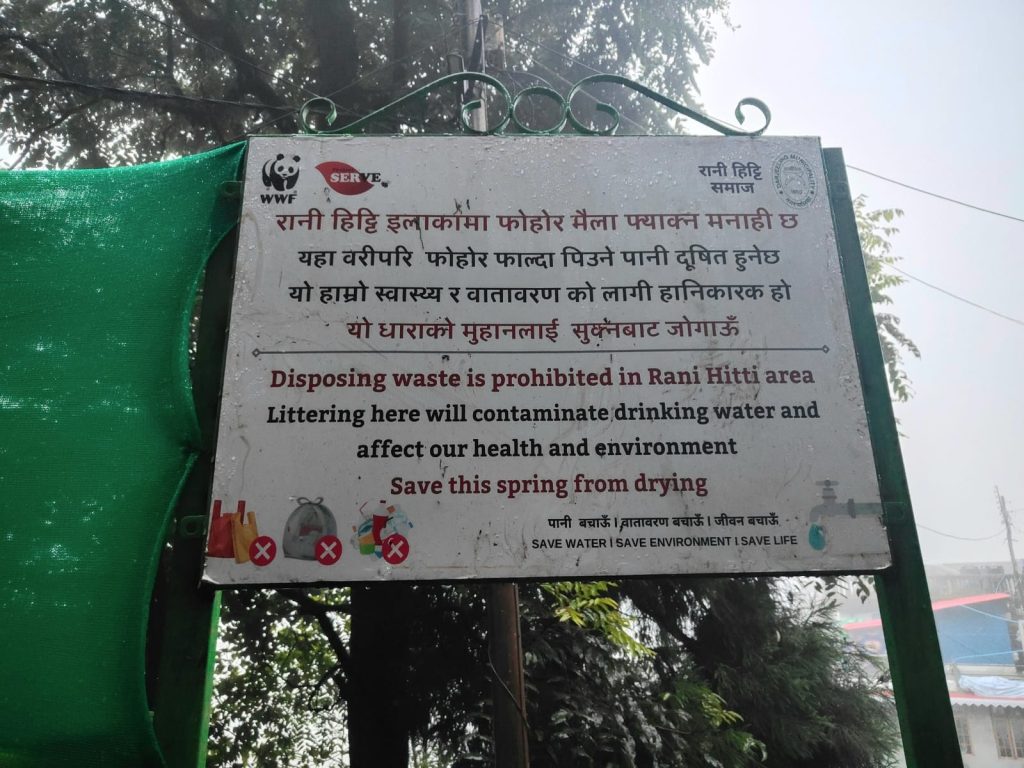
In Darjeeling, springs are called hittis. One such place is the Rani Hitti where the queen of Burdwan Raj used to come and take bath. Though locals try to keep the area clean, waste disposal is a challenging issue, especially the accumulation of plastics.

Pasang’s colleague, Abishek Pradhan, pointed out that springs are most important as water is essential for life. “Generally, people revere these springs and refrain from spitting in the area and defiling them.”

Many springs are found in forest areas. But Rani Hitti is in a semi-urban area. It is a source of drinking water for 300 households. “About 15,000 people depend on it. Across Darjeeling, springs are drying up. These days, rains are intense and happen for a shorter duration.There is a huge amount of run-off leading to wastage,” Pradhan said.

Today, the Rani Hitti area has been fenced. WWF cleaned up the area in January this year. During that time, municipal waste workers were provided with gum boots.

Himachal Pradesh-based Manshi Asher works on issues related to the environment and forest rights. About 50 percent of the springs are drying up due to the lack of moisture, construction, development, climate change and forest loss. “Land use change is constantly happening due to tourism and urbanisation.” Asher works for Himdhara Environment Research and Action Collective.

Similar to that of Darjeeling, in Himachal Pradesh too, people revere springs. They install tiles around jaldharas which are dedicated to the deceased. These are common in Shimla, Sirmaur and Solan districts.

Manoj Sharma, a resident of Thalog village, said that the one near his village was dedicated to his father after the latter’s demise. “Jal dharas are dedicated in six months’ time. Priests calculate the right date and time for the ceremony. People carry out decorations according to their financial capacity mentioning the name of the deceased. Often tiles are used for beautification. Usually, these are found where many people can use them.”

Beyond books: An educationist’s take on nurturing young minds

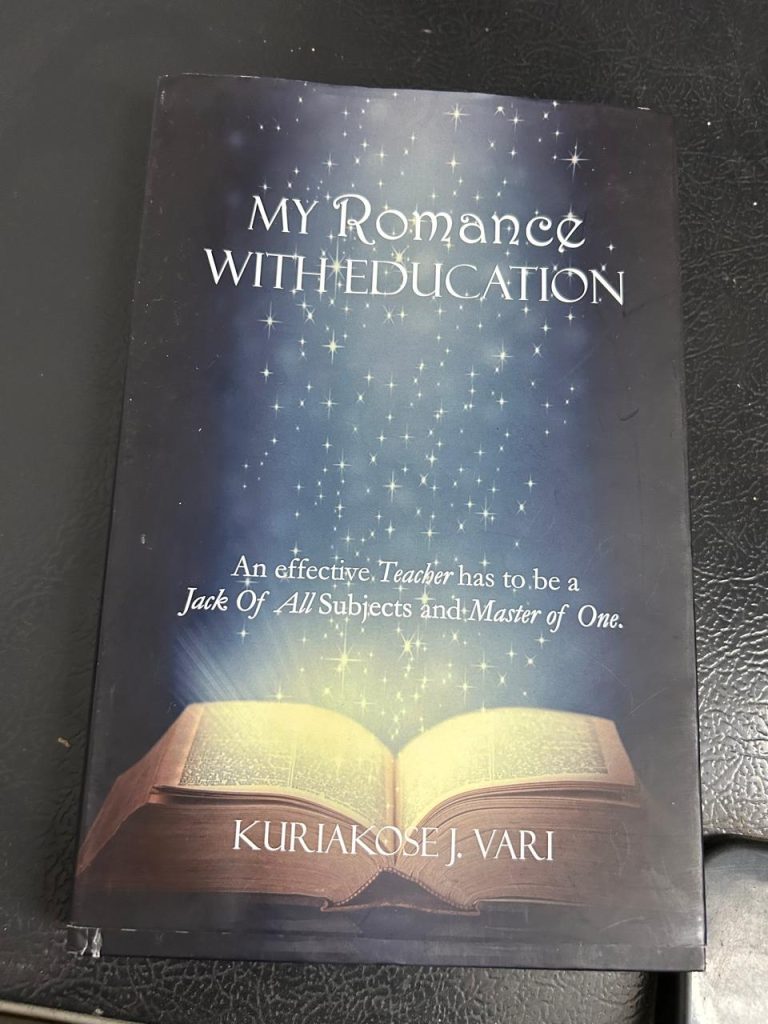
Well-known educationist, Kuriakose J. Vari has written “My  Romance with Education”  with passion and involvement. Not just dos and don’ts to education and all those policies and patterns to it, but inter-webbed and interwoven are details from his day-to-day experiences dealing with students and their parents and also the school staff. A book review by Humra Quraishi

Critics could get somewhat critical, pointing out that I should have written about this book last fortnight, around Teacher’s Day. I do understand but I feel such books are significant every single day as they revolve around our children …our future generation. 

Today’s children are living in rather tough times. Too many distractions and high technology gadgets and frightfully fierce competition. In the background lurks the communal climate and the corruption riddled atmosphere.

This book authored by the well-known educationist, Kuriakose J. Vari, is definitely significant. He is the former principal of the Modern School, Vasant Vihar, New Delhi, and also a former member of the Expert Advisory Committee, HRD Ministry (GOI). Above all, he has helped set-up schools where the basic aim is to make the child feel confident and secure.

He starts this volume by focusing on the school he himself went to in the initial years, the  Salesian School at  Sonada, close to Darjeeling. The formative years were of great significance for him, as he travelled there, to Darjeeling, all the way from Kerala. “I am grateful to the Salesian school-cum-college for the wonderful education I received there through Don Bosco’s educational paradigm – ‘The preventive system.’ He also mentions the names and details to the academics and teachers and his fellow classmates who made a lasting impact.

With that take-off, he focuses on the bigger picture! After all, education goes beyond books and classrooms. To quote him, “No serious efforts have been made to impart ‘education for life’. Without life skills, you cannot navigate day-to-day life smoothly. Every activity, both academic and non-academic, must be deftly interwoven with life-skills education…Even the greatest of  technological communication tools cannot  bypass the fundamental and  extremely complex  human element involved  in true education, which defies being caged in absolute constructs.”

Vari  has written this volume with passion and involvement. Not just dos and don’ts to education and all those policies and patterns to it, but inter-webbed and interwoven are details from his day-to-day experiences dealing with students and their parents and also the school staff. It  makes an interesting read, with  the varying  human characteristics or factors  which you and I  can well relate to.

After  having  helped shape the  lives and careers of  hundreds of  his students, he  decided to  settle down in Bangalore, with  his wife Alice, to whom he  has  dedicated  this book. As he told me, “I’m in my mid-80s and decided it’s time to retire …but I’m always there for whoever seeks my advice or suggestions on education.” (This book carries his contact mail id –   kjvari@gmail.com )

After reading this volume, one basic aspect stood out, loud and clear. Vari’s earnest and sincere efforts to help the child. The basic aim is to make each child’s individuality taken into account and respected, and with that the child is made to feel confident and secure and comfortable.

Such a significant  book in today’s  India, where  one  incident after another comes up  where  teachers are seen  humiliating and even  verbally hitting young Muslim students on the  basis of religion! Two recent such incidents captured in videos/ shots, are from the schools of Uttar Pradesh. Shocked us yet didn’t perhaps shock the right-wing political rulers of the day.

BOOK  REVIEW

Title of the  book –  MY  Romance  WITH  EDUCATION –  An  Effective  Teacher   has to be a  Jack of  All  Subjects and Master of One

 Publisher – Milap Publications

 Author  –  Kuriakose  J.  Vari

 Price –  Rs  699

 Pages –  178

MOST POPULAR

HOT NEWS