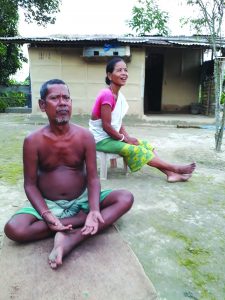
NRC limbo goes on for ‘persecuted’ Hajongs

The hope to getting rid of the long refugee tag, however, was dashed on July 30, when the final draft of the NRC containing names of more than 2.89 crore applicants was published. Ninety of the 112 families of Bamungaon in Assam’s Kamrup district, about 60 km west of Guwahati, did not find their names in the draft NRC, raising fears that they would be declared foreigners and “pushed back” to Bangladesh or erstwhile East Pakistan from where their forefathers had migrated to Assam in 1964 to “escape religious persecution.”

“We were certain that we will pass the NRC as we have relief eligibility certificate in my father’s name issued by the government of India in 1964. We had submitted the relief certificate as it is one of the documents accepted for NRC update. But we were shocked to see most of our villagers’ names missing from NRC,”  Nimai Hajong (60) told Tehelka,  sitting with his wife Sinnibala at the courtyard of his bamboo thatched house at Bamungaon.

Although Nimai is unable to tell what exactly had prompted his father Mahadeb to leave their ancestral home in East Pakistan in 1964, he said it could be due to harassment meted out to Hindus by Pakistani forces or the Muslims in Erstwhile East Pakistan, which
became Bangladesh in 1971.

“I was too young to understand. But later I came to know that many like my father had come here as the government of India assured them shelter and brought us as per an agreement between Indira Gandhi and Mujibur Rahman, father of Bangladesh. As we grew up, we never considered India to be a foreign country but we have always been taunted here as
Bangladeshis, refugees and our village is still called a colony. This despite the fact that Assam government provided us with this plot of land in 2005, enrolled us in voters list in 1993 and even accepted us as scheduled tribes. But now how can we be left out of the NRC?” Hajong asked.

Forefathers of most of the Hajong and Bengali families who live here now had taken shelter at Matia in Goalpara district in West Assam and in Silchar in South Assam before they were shifted to Bamungaon colony.

The story of Gunamoni Dalu, a 70-year-old Hajong woman who remained unmarried is equally heart-wrenching.

“My mother was killed by Muslim miscreants in East Pakistan. I came here with my father Dhaneswar. I have no one to look after and I work as a daily wager to survive. What will I do if I am sent back to Bangladesh? I have none there too,” narrated Gunamoni as she looked blank.

“Please do something so that we are included in the NRC,” she requested.

The NRC is being updated in Assam under the supervision of the Supreme Court with March 24, 1971, as the cut-off date, which was decided in the historic Assam Accord of 1985 after the six-year-long anti-foreigner movement. Indigenous people in Assam have since been demanding update of the NRC as they faced identity crisis due to “unabated illegal migration” from Bangladesh through the porous India-Bangladesh borders. They said all post-1971 migrants must be detected and deported to Bangladesh as agreed in the Assam Accord which was signed by former Prime Minister Rajiv Gandhi and those leading the Assam Agitation or anti-foreigners movement.

But Hajongs have questioned why they have been left out despite the fact that they had pre-1971 documents to prove that their forefathers lived in Assam before 1971.

Thirty-seven-year-old Rupdhar Hajong, who had gathered like several others, looked tense. “We were born and brought up here. We grew up hearing the insult of being Bangladeshis but we thought NRC would remove that insulting tag. We all are in favour of NRC and its cut-off date. But, why our applications have been rejected despite the fact that we have pre-1971 documents? We visited the local circle office asking the reasons for rejection of our
applicants, but too seems to be clueless,” he said.

Rupdhar will submit claims with the documents on September 7, the day fixed for submitting claims with necessary documents for inclusion of names of those who were left out of the final NRC draft. “I don’t want my two daughters, Poonam (8) and Shriya to face the same insult of being called Bangladeshis,” he said.

More than 40 lakh applicants failed to make it to the draft NRC, released on July 30, drawing sharp reactions from across the world. This also raised fears that those failing to prove their citizenship could be declared foreigners and rendered “stateless” as Bangladesh have already rejected the allegation that they had illegally migrated from their soil. 

letters@tehelka.com
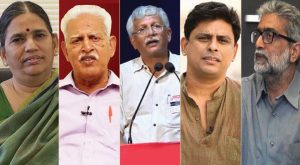
ARRESTED ACTIVISTS RECEIVE WIDESPREAD SUPPORT

The arrest of five rights activists across the country in connection with the Bhima-Koregaon violence has stirred a hornet’s nest. The sudden and bizarre raids by the Pune police on August 28 at the homes of left-wing activists and the subsequent arrest of the activists has invited widespread criticism, with some labeling it as an ‘undeclared emergency.’
The arrested activists in question include a poet, a management professor, a business journalist and well known lawyers. The police had arrested Sudha Bharadwaj, Gautam Navlakha, Arun Ferreira, Vernon Gonsalves and P Varavara Rao, and it is on a look out for 10 more people.

The arrests have been made in relation to the Elgar Parishad, a public meeting held in Pune on December 31, 2017, a day before the violence at Koregaon Bhima. While the Supreme Court has given them relief by ordering only house arrests for them, the activists have been charged under different sections of the draconian Unlawful Activities (Prevention) Act (UAPA).

On January 1, 1818, the Mahar soldiers of the East Indian Company, led by the British, had defeated the massive Peshwa army in Koregaon. The Dalits regard the moment as a legendary stature in their history. This year, on 1st January, Dalits across the country had assembled in huge numbers in Koregaon to celebrate the 200th anniversary of a defining moment in their history. However, there were groups who were unhappy with this growing unity and celebration of Dalit stature. Consequently, they tried to stir and provoke the situation, which resulted in violence at the scene.

Prominent Dalit leader Prakash Ambedkar, the grandson of BR Ambedkar, had named Sambhaji Bhide and Milind Ekbote, the known promoters of Hindutva and popular leaders in Maharashtra. He blamed these two men for conspiring and orchestrating the violence at Koregaon on January 1 this year. There has hardly been any action on the firebrand Hindutva leaders from the government, the police instead arrested the human rights activists, accusing them of being part of the Elgar Parishad and conspiring to bring down the government.Sources say the arrests have also have been done regarding a letter that threatened of assassinating Narendra Modi, but the search warrants and witness documents suggested that the raids were in relation to Bhima-Koregaon violence.

In retaliation to the move, five eminent people recently moved the Supreme Court questioning the rationale of the arrests. The petitioners alleged the move was an attempt to silence dissent. The SC issued a notice to the Maharashtra government directing that the arrested activists be kept under house arrest till further hearing on September 6. The court said that “dissent is the safety valve of democracy” and that “if it is not allowed, the pressure cooker will burst.” The court gave relief to the activists, while questioning the motive of the simultaneous arrests.

The social media too was abuzz with citizens across the country expressing their outrage over the emerging anti-democratic atmosphere in the country. The arrested activists were attacked by trolls by using hashtags like “UrbanNaxals”, which were vehemently criticised by people from all walks of life. The rightwing trolls were responded with hashtags like #MeTooUrbanNaxal and netizens were open in expressing solidarity with the human rights activists. The hashtag #MeTooUrbanNaxal became number 1 trend on twitter, with the increasing number of people coming out in support of the arrested activists.

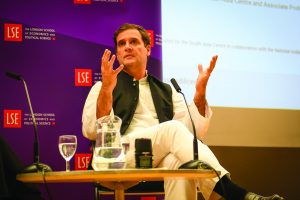
The Opposition parties, especially Congress, came out in the support of the arrested human rights activists, questioning the motive of the Maharashtra government in such actions. The Gandhi scion while on Kerala visit talked of ‘undemocratic’ ‘certain’ actions, apparently referring to the arbitrary arrests and raids across the country. Bollywood stars, activists, journalists and intelligentsia from across the spectrum have vehemently condemned the arrests as being an ‘attack’ on democratic values and an ‘undeclared Emergency’ of our times. Some referred to the arrests as being a ploy to divert attention from the demonetization failures.

The people have been expressing fears of a changing political environment which doesn’t go in sync with our cherished democratic values and puts a question mark on the intentions of the incumbent government.


letters@tehelka.com

RAHUL GANDHI OPENS ‘MEMORY BOX’ OF 1984 ANTI-SIKH RIOTS

The Congress President, Rahul Gandhi, was visiting Europe and addressing UK-based parliamentarians and local leaders when he said that “the Congress was not involved in the 1984 Sikh riots”. In the same breath, he said, “anti-Sikhs riots were a tragedy and a painful experience. Any violence done against anybody is wrong…anything done that was wrong during that period should be punished and he would support that 100 per cent.”

Back in India, senior BJP leaders were quick to hit back. However, it was Shiromani Akali Dal (SAD) leadership’s question which raised many eyebrows in Punjab. SAD President Sukhbir Singh Badal had asked Gandhi, if Congress was not involved in the riots then why did former Prime Minister Manmohan Singh apologised? Though Rahul’s purpose may be to absolve Congress of the 1984 riots tag, the ploy have only revived the memories of the gory incidents and reminded the Sikhs of the unhealed wounds.

If that was not enough, days later, Punjab Chief Minister Capt. Amarinder Singh named few senior Congress leaders being involved in 1984 riots where over 3,000 Sikhs were massacred. Singh alleged that at least four Congress leaders may have been involved in the 1984 riots at their own volition. Singh made this statement on the floor of the Punjab State Assembly.

However, the Punjab Chief Minister backed out from his earlier statement and clarified that as “the incident took place at the time of assassination of Indira Gandhi and Rajiv Gandhi was in Calcutta, so, there was no involvement of Congress except for some people. ”

“Those people I have been naming for the last 34 years. I have named Sajjan Kumar, Dharam Das Shastri, Arjun Das, Bhagat and one more person. I got those names when I had travelled to the refugee camps on my own. It was not a party matter, it was individuals who did it and they are being tried.”

Sadly, even after 34 years of riots and Operation Blue Star episode, the memories continue to haunt the system.

At a time when the country is preparing for the biggest of all battles, General Elections 2019, is it wise to raise the issue of Sikh riots? The reference to 1984 riots is always sensitive. The two leaders have resurrected a ghost, an apparition of 1984 riots and reminded the Sikh’s bruised psyche of the tragedy. The Sikh community has neither forgotten nor forgiven the genocide of this magnitude after partition.

Various commissions of enquiry have mentioned names of top leaders of the Congress party — HKL Bhagat, Sajjan Kumar, Jagdish Tytler and Dharam Shashtri. The CBI report has observed, “There was a conspiracy of terrifying proportion with the complicity of police and patronage of local MP Sajjan Kumar who instigated to the mob that “not a single Sikh should survive.” 

Tytler’s name appeared in the report of Nanavati Commission which said that he had a hand in the attacks.

The 1984 riots were the most tragic incident in the Indian history after partition and the Congress cannot wipe its hands of the genocide of Sikhs. Like Manmohan Singh, Rahul Gandhi should have shown the magnanimity of asking the community for forgiveness. That is what differentiates a statesman from a run of the mill politician. That is what differentiates between a seasoned, measured politician from a novice. Seeking forgiveness requires admission of guilt without any excuses and willingness to repair the damage already done. The big question is will Congress and its leadership rise from this tag and show magnanimity or will continue playing street politics to its own peril?

letters@tehelka.com

US ‘economic war’ may not affect Turkey much

US President Donald Trump, perhaps, believes that even today we live in an America-driven world though the situation has changed considerably. Of course, the US continues to remain the most influential country having the most powerful armed forces and theworld’s largest economy, but it no longer has the capacity to intimidate any country that shows courage to defy its dictates, reasonable or otherwise. The latest proof of the changed reality is available in Turkey’s rejection of President Trump’s demand for release of a US citizen, a pastor, facing terrorism charges over a failed military coup to overthrow Turkish President Recep Tayyip Erdogan on July 15, 2016.
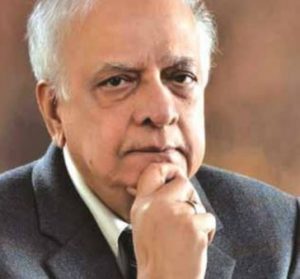
Turkey has been arguing that the law of the land must be allowed to take its own course, but the US administration is not convinced. The US is adamant that the pastor, Andrew Brunson, a missionary living in Turkey for 24 years, must be released forthwith as he has allegedly been framed in the case of terrorism with “trumped-up charges”. However, President Erdogan’s stand is that the legal proceedings launched against Brunson cannot be snapped simply because the US feels the pastor is innocent.

Despite denials by Brunson and his family members, the case against him is claimed to have been instituted on the basis of proof that Brunson has allegedly strong links with a rebel Turkish cleric having political ambitions, Fathullah Gulen. The unsuccessful July 2016 military coup in Turkey was found to have been carried out by Gulenists in the Turkish armed forces. However, no one knows how the Turkish intelligence network failed to smell what had been cooking there for a long period. The anti-Erdogan plot could not succeed to achieve the desired objective because the Turkish President has a strong following among the masses. Followers of his Justice and Development Party (AKP, for short) came out in large numbers to fill the streets in various cities, defeating the Gulenists swiftly. Over 50,000 saboteurs were taken to task by the Erdogan regime to send across the message that a democratically elected government cannot be overthrown in this manner.

However, Turkey as a nation continues to suffer because of the indirect US support to the Gulenists. It is believed that the US wants Gulen (who lives in a US city) to replace Erdogan as the ruler of modern Turkey. The Trump administration has refused to recognise the fact that both countries are NATO (North Atlantic Treaty Organisation) allies. The US under Trump has shown that it can go to any extent to intimidate even a long-time and strategically important ally.

President Trump claims that he and Erdogan had reached an informal agreement on the release of the US pastor and some other foreign detainees during their private discussion at a recent NATO summit at Brussels. In return, Erdogan, according to Trump, wanted the US President to help him in securing the release of a Turkish woman prisoner from an Israeli jail. Now that the woman has been released at the behest of Trump, Erdogan too should have acted to honour “the agreement”, claims Trump.

Erdogan, however, denies the “agreement”, yet he has shifted Brunson from jail to put him under house arrest. But this is not acceptable to Trump. He wants Brunson to be released immediately as the latter belongs to the evangelical community in the US, a significant Republican Party vote bank. Brunson has been initially jailed for 20 months and his case is still in a court. If finally convicted, he faces 35 years in prison.

A conservative Christian organisation called the American Center for Law and Justice has entered the scene in support of the drive to get Brunson freed. This suits Trump, who has “prioritised the freedom of US citizens as part of his diplomacy,” according to a diplomatic affairs expert. With a view to punishing Turkey, the US has imposed on it punitive economic sanctions and tariffs, resulting in the Turkish currency, the lira, losing around 40 per cent of its value in the international currency market. The “economic war” by the US against Turkey is unlikely to end in the near future which is a major cause for global concern.

The Brunson case is not about the fate of just one individual. It has become a major prestige issue for Trump and may seriously damage his image in the evangelical community and other right-wing Americans. This is, however, only one of the factors why the “economic war” on Turkey has been launched by the US by imposing sanctions and doubling tariffs on steel and aluminium. The other factors are also equally serious. President Erdogan’s West Asian (Middle East) policy has very little to cheer the US about. Erdogan has refused to justify US help to Kurdish YPG allies, whose scheme of things for the region doesn’t suit Turkey. He has outrightly ignored the US reservations against the Turkish decision to buy Russian S-400 missile system. The Turkish President has made it clear that he cannot take any step which goes against the larger Turkish interests. That is why he ignored the US sanctions against Iran imposed after Washington’s unilateral withdrawal from the international deal reached over Teheran’s nuclear programme. Turkey has declared that it will continue to import Iranian oil and gas irrespective of Washington’s threats to punish any country which does business with Iran.

Contrary to the US stand on a tiny but rich Arab nation, Qatar, Turkey has stationed a large number of its troops to provide fool-proof security to the rulers in Doha. This is resented by Saudi Arabia, the closest US ally in the West Asian region. In the case of the Syrian crisis, too, Turkey under Erdogan has been providing all kinds ofsupport to the beleaguered Syrian ruler, Bashar Al-Assad, whereas the US favours a regime change as desired by Saudi Arabia. In fact, Riyadh assisted by Washington has been militarily engaged in Syria in support of the anti-Assad forces. Turkey has been on the opposite side along with Russia and Iran to ensure that the Assad regime regains full control over Syria.

But the relations between the US and Turkey had not taken the turn as seen today if the Brunson factor had not come into the picture in a big way, threatening the Republican Party’s following among the rightists in the US. Both countries are preparing to face elections in the coming months; the US Congressional elections are due to be held in November and Turkey has its municipal elections scheduled for March next year. Erdogan cannot afford to be seen as having succumbed to the US pressure to take a decision on the Brunson case, yet to be finally decided by the court.

Experts have been expressing the view that the problem can be handled diplomatically to the satisfaction of both sides. Economically coercive tactics, as Trump has resorted to, will only further complicate the matter. Turkey is the second biggest NATO ally of the US and it is integrated with the European Union countries in such a way that weakening the Turkish economy too much, though not possible as it appears, may destabilise many European economies also. Interestingly, neither Erdogan nor any of his ministers have directly assailed Trump for his anti-Ankara drive. But they may go to that extent too in view of the sharp impact the steadily weakening lira is having on the Turkish economy. That situation can lead to shaking NATO from its very foundations. Then Turkey may move closer to Russia to safeguard its national interests. How NATO remains intact under such circumstances will be interesting to watch.

letters@tehelka.com

LOVE TAKES THE STORY TOWARDS LOGICAL END

Hari Jaisingh, the veteran journalist and editor, is a well-known name in the subcontinent. After all, he’s been editor of national dailies and publications and he has also authored several non-fictions — No, My Lord!, Kashmir — A Tale Of Shame, India After Indira — The Turbulent Years, India Between Dream And Reality and other volumes.

And, now that he is out with his debut novel — Zarina, there is bound to be much focus on it. Yes, it did come as bit of a surprise to realise that this busy editor was so very passionately writing his very first novel. And, as one read this novel, which revolves around not just along an emotional overflow but also contains a well-structured story which is not too far from the realities of the day. It gets somewhat apparent that the story has been close to his heart and soul. Probably, Jaisingh had been seeing and sensing all these build-ups, and was waiting for that ripe enough moment to unleash this story on paper.

There is a definite spontaneous flow to his writing. Mind you, it’s a tale pregnant with happenings and shifts and counter shifts and not to miss out the very climax. No, nothing dramatic but quiet and peaceful. What holds sway is the very expanse of the novel. It covers three continents — Asia, Africa, America. And not just that, the story moves along a purposeful strain, as the central character, Priya, changes the very course of her life … so much so that she even changes her name, from Priya to Zarina. If you were to query that vital why? Well, there unfolds the varying highs to this novel, bringing to the fore an interplay of emotional happening. Priya falls in love with a young Muslim man, Zaheer, and it’s their love that takes the story forward towards the expected logical conclusions, where sense and sensitivity prevails.

There are no violent eruptions. On the contrary, several subtle and subdued moves hold out, carrying an abundance of wisdom laden strains.

Though I am more than tempted is to write and focus on the intense philosophical relays that this novels holds out, but it would be best if the readers read it for themselves and inhale the wisdom.

In fact, the very introductory lines to this novel are enough to relay what awaits the reader — I quote from one of those lines: “She is a young lady at the cusps of a new world which is tantalisingly different from Lagos, the most fascinating conurbation in Africa, where she had her childhood and schooling, and her first crush. Yet she did the unthinkable within a few years of setting foot in America. and embarked on a journey, like a Star Trek voyager, ‘to boldly go where no man has gone before.’ For her, from being Priya (Beloved in Hindi), in a traditional Hindu family with liberal values tempered by the sufferings endured during the creation of Pakistan out of British India in 1947, to Zarina (Golden beauty in Persian) as the wife of an Indian American Muslim with roots in the Hindi heartland of Uttar Pradesh its upbringing in Pakistan’s North West frontier region that refuses to be subdued even today…”

And as Jaisingh calls that transformation in the central character, that is when Priya marries Zaheer and changes her name to Zarina, as ‘no small step…it was as giant a leap as Neil Armstrong’s on the moon for mankind in July 1969’, so the offshoots cannot be expected to be regular. But, thankfully, there are none of the typical Hindu — Muslim clashes and confrontations. Rather acceptance of the other, with great sensitivity and with an abundance of emotions.

There is lot of dialoguing between the prime characters in this novel. Maybe a good strategy, as the dialogues expressed clear the haze and throw light on the  crucial issues and misconceptions holding sway in today’s world. But then, they also distract. Thankfully, not much come in the way of the flow of the story, which flows along uninterrupted and ever so gently right till the very end.


letters@tehelka.com

TWO HuJI OPERATIVES GET LIFE TERM IN UP COURT’S BLAST CASE

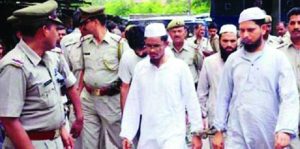
Amid strong opposition from Human Rights activists, a special court in Lucknow convicted two accused Tariq Qasmi and Mohammad Akhtar alias Tariq Hussain for life imprisonment in connection with 2007 court blast case in the state capital and imposed a heavy fine of 5.21 lakh on them. 

The judgment pronounced by Special Judge Babita Rani, on August 23, held the HuJI operatives, Qasmi and Akhtar, guilty under the Explosive Substances Act, the Prevention of Unlawful Activities Act and sedition, criminal conspiracy and attempted murder under IPC. Both the accused have already completed jail terms of 11 years.

The third alias in this case, Sajjadur Rehman, was given a clean chit by the court. While, the fourth accused, Khalid Mujahid, was found dead under mysterious circumstances during the trial in the police custody. 

On November 23, 2007, 13 people lost their lives when a series of RDX bombs planted on the parked bicycles went off at the court premises of Lucknow, Faizabad and Varanasi. The police had earlier confirmed that the blasts were jointly carried out by the operatives of Harkat-ul-Jihad al-Islami (HuJI) and Indian Mujahideen.

The court has said that the accused had not only “attacked the judiciary but also conspired to wage war against the country, which is serious offences.” Demand for the death penalty was raised by Joint Director of ATS Subhash Chandra Singh and senior public prosecutor Atul Kumar Ojha, while the lawyers of the convicts, Arif Ali and Furkan Khan, pleaded for leniency, saying they had been in jail for last 11 years.

However, Human Rights activists including Ramon Magsaysay awardee Sandeep Pandey and Arundhati Dhuru, retired IPS officer S.R. Darapuri, Advocates Randhir Singh Sumar and Mohammad Shoaib (also the president of Rihai Manch) opposed the judgement in a press conference, alleging that the accused have not been granted a fair trial as judgement suffers from procedural and factual infirmities. They resolved to challenge the verdict in high court on merits.  

Shoaib has also written to state’s DG Police expressing serious threat of life to these convicts in the jail as a judicial commission headed by RD Nimesh found cracks in the Uttar Pradesh police theory related to the alleged involvement of  Qasmi and  deceased Mujahid in terror activities.

The commission has said, “the involvement of the accused in the incident mentioned in the case (crime number 1891/2007) registered in Kotwali police station in Barabanki appeared doubtful.”

On August 31, 2012, the 237-page Nimesh Commission report was tabled in the Vidhan Sabha after it was submitted to the Samajwadi Party government.

 Government lawyers Pravin Srivastav and MK Singh said that the accused had been charged for sedition, criminal conspiracy and attempt to murder which were offences under the Indian Penal Code. Three witnesses have been examined from the 44 witnesses produced in this case before the District Jail in Lucknow where the trial was going on.

On December 22, 2007, Tariq Qasmi was arrested by STF Mohammad Akhtar of Kashmir was arrested on December 27.

Earlier, the STF had informed that the four accused were the operatives of Harkat-ul-Jihad-al-Islami (HuJI). Mohammad Tariq was accused for a blast in Gorakhpur, UP, in May 2007. The Lucknow court blast was transferred to the anti-terror squad (ATS) which submitted the charge-sheet against the accused in April 2008.

However, in the Varanasi court blast case, the police are yet to ascertained any information and arrest the culprits.

letters@tehelka.com

Blockchain may help media become more transparent

Before we delve into the underbelly of journalism and new media, it is very crucial to understand how blockchain works. Blockchain technology functions on a distributed yet interconnected network of preconfigured nodes, which is entirely encrypted. Existing on the architecture of the distributed ledger technology, blockchain not only eliminates the necessity of a third party but also has the potential to reduce cost and increase security in transactions and settlements. Let’s dig deeper and understand how blockchain will encompass the entire world in the coming years. Blockchain stores information across a network of computers which distributes and decentralises the entire systems. Blockchain, therefore, strips away the power from any one particular entity controlling or manipulating the data.

Now how does this work? If you are on a blockchain network or any distributed ledger network for that matter, you will store vast amount of records known as blocks in your personal computer. Every new piece of information is added block by block, so no one can go back and alter any one block. As it gets uploaded on the network, it is time stamped, verified and downloaded on all the computers on the net. Each new block uses the previous block’s identity to create its own identity. So suppose I try to delete or alter a piece of information, every computer on the network would know precisely what it is I was trying to change, from where and at what time.

Gaurang Nanda, a student and blockchain enthusiast from Pune, said that even though blockchain is a pretty recent term in the market, he has been hooked on it for quite some time now. He understands the tremendous potential of blockchain and said that the very existence of cryptocurrency can be attributed to the blockchain technology. As a person closely working in the field every day, Gaurang said that blockchain will slowly take over all the sectors because of the high degree of security it guarantees.

Blockchain makes a constantly evolving system of checks and balances a possibility. These are all stored in a chronological chain on track with all other people on the network. So to put it simply, you have everybody’s record, and everybody has your record. Anyone who is interested can join the network through their personal computer and gain access to all the files.

Journalism saviour

With click baits and fake news flooding the media industry every day, journalism is under siege and blockchain could be the saving grace to all of these complications. Media houses, now more than ever, promote stories that reaffirm the status quo along with the views of the entity that funds them. Real journalism and 360-degree perspectives get lost in a deep web of paid news and propaganda. Due to the various incentives that a writer gets, the content that they generate could have compromised motives. Journalistic integrity gets undermined and not only does this harm the material that is published but is a severe violation of the principle of truth on which the entire industry once stood. Even the most reputable news sources will present their arguments on the basis of what fits their agenda best, and there is no one to question it since most of the media industry encash on whatever’s more profitable. Blockchain comes into play here by taking control of information flow from one entity and allowing the uncensored version of the truth to be published and accessible to all.

Simran Singh, a content writer for Coinedict, said that the media houses keep their online content behind paywalls, charging fees to access stories online. This compromises the content creators because they tend to fit in the commercial models best suited for their organisation. Blockchain resolves a number of these issues permeating the industry by establishing a direct connection between the creator and the consumer. He further added that the widespread use of blockchain based technologies could bring about a massive change in the way we receive content on a daily basis.

The very fact that blockchain eliminates the need of a third party to carry out any form of transaction or exchange can save this industry, which as of today lives under constant fear of dying due to its corrupt and even worse, manipulative elements. It’s quite evident how this network of distributed ledgers can help journalism. Through blockchain technology, we can not only introduce uncensored content but also ensure that no one person has the power to alter facts once published. This is one of the most disarming problems of media, and if we had the means of printing uncensored content without the filters of a publishing house, we would be able to establish a direct connection between the people who produce the content and the people who consume it. This is precisely what blockchain technology stands to bring about.

Vajaahath Hussain, CEO of Almora, has been a dedicated member of the blockchain industry. He turned his passion into a full-fledged company that works on the distributed ledger technology. Almora is a crypto investment bank based in Delhi that assists blockchain focused companies in tailoring solutions and increasing investment opportunities in cryptocurrency. Here is what he has to say about blockchain and its impacts.

The scope

On the scope of blockchain technology, Hussain said, “We cannot quantify the reach of blockchain technology with a metric, but wherever there are middlemen and a need to eliminate the trust factor, blockchain would be useful. Be it in a network of supply chain, finance or the media industry; the distributed ledger technology will find its way in every sector eventually. But the core agenda here is to remove one point of truth and decentralise the power of delivering information to the consumers.

“I used to run my startup called as advogue from Vishakhapatnam, Andhra Pradesh. But I had to drop that idea because it was very similar to existing technologies in the West and somewhere we can see this pattern a lot in the tech industry. India is always behind the curve because we lack creativity and tend to replicate the western technologies. So my co-founder and I wanted to research more in this area and work ahead of the curve. We got into bitcoin, and once we started learning more about the technology behind it and the potential it holds, we stayed with it and grew from there. I read an article that mentioned 90 use cases of blockchain in various sectors and I was very fascinated by it. This is how it all started.”

On how the blockchain may revolutionise the media industry, Hussain said, “It will enable creators to truly flourish and give them the freedom to proceed with a reduced reliance on content aggregators, platform providers, and royalty collection associations. Creators of content are granted a higher level of autonomy thanks to the blockchain. Although I believe that some applications of blockchain technology will still require a few more years to fully mature, aspects of the media value chain are well underway to be threatened by the rise blockchain based payment and contract options.”

More than ever, there is an alarming need to check and regulate the content that gets published on any platform. Not only does it have a real-life impact, but it is also capable of altering the entire host of issues within our society. Keeping in mind, all the above let us not forget the significant role of the advertising industry in backing up the media houses. Not only the news articles but even the advertisements and the statistics that we see online have become precariously prone to tampering and falsification. Various organisations that post their ads online tend to hire “clickers” to jump up their statistics so that the distributors can demand a higher price for that. Not only this, these big shot companies take advertising money for content they don’t own or produce.

One cannot exaggerate the irresponsibility of media houses and advertising companies when it comes to publishing content and generating advertisements online. This not only costs billions of damage to advertising companies but one can never trust if the statistics are from actual people or they are just “bots”. Now with the help of blockchain, we can say goodbye to the middleman and have complete transparency and clarity about who is clicking on these advertisements. This will revolutionise the entire marketing strategies that these companies formulate and help them spend their funds wisely and more accurately for their target audience. Blockchain technology will disrupt the power of online click bait and bots which will help the companies get returns from all the money that goes into online advertising.

This might be 2018, but a free press is still an illusion, a farfetched goal that seems almost impossible to achieve when we factor in the number of filters any news story has to go through. However, blockchain brings us closer to this reality by eliminating the need for a middleman. It establishes a direct, transparent connection between the producer and the consumers. Blockchain serves the common purpose of bringing out the truth to the forefront and to free us from the centralisation of information.

letters@tehelka.com

Light of love still alights amid darkness of hate

Yes, madness is spreading out.We are living in dark times, where one is not too sure what the next day would bring along, unfold, hold out! Violence has been accelerating in the last four years, peaking as never before. Today, you and I can be killed, lynched, threatened, on any possible alibi — right from selling cattle to trading beef, if not cooking and consuming it. Not to overlook the other dreaded alibi for getting hacked and hounded in today’s so called ‘developed’ times. The BJP coined love jihad, where a Muslim or a Hindu has to think a hundred times before daring to fall in love and marry the other. No explanations or counter explanations are sought and, of course, no hope of protection by the political rulers of the day who seem hell bent on following a divisive agenda.


And, if you are keen to witness the dark realities of the day, its best to view Shahid Kabeer’s debut feature film — Unmaad.

I was somewhat intrigued by the offbeat name of the film, till of course, he took pains to explain that Unmaad stands for madness of a certain kind. “When passion crosses all limits, a certain level of madness overtakes and over-rules,with that, sane thinking and saner elements are pushed into the background by surcharged politics holding sway,”said Kabeer.

In fact, this Mumbai-based filmmaker and theatre director, decided to shoot this low-budget film in his home town, Saharanpur, in Western Uttar Pradesh. Perhaps, for several specific reasons. After all, Uttar Pradesh, has been witnessing communal violence in all its horrifying hues and forms.

Love jihad killings took off from Uttar Pradesh, before spreading out to the other BJP ruled states of the country. Even today, a Muslim or a Dalit is apprehensive of befriending an upper caste Hindu, because the local goons will not just intrude and interfere but kill the lovers out there, in broad daylight. And, if one were to talk of lynching by gau-rakshaks (though I prefer to call them goons and gangsters of the worst kind), then once again, Uttar Pradesh tops the list. There is that constant scare amongst the members of the minority communities for getting targeted and killed by rightwing brigades roaming about, all along the highways and inner roads of this state, all too eager to kill.

In fact, it wouldn’t be incorrect to say that those not officially killed in the various encounters by the governmental machinery are killed rather too unofficially by these goon brigades nurtured and pampered by the political mafia of the day.

Perhaps, another reason for Shahid Kabeer to opt for Uttar Pradesh is his absolute fascination for the 15th century mystic poet, Kabir. So much so that Shahid has even added ‘Kabeer’ to his name and also named his production company — Kabeera. He tells me that the very significance of that mystic poet’s verse holds out in these troubled times, after all, Kabir spoke out ever so constantly for unmasking hypocrisy, for exposing the evil doers and the fake camouflaged in various hues and forms. Pick up any of his verse/dohas and each one of them relays a message, nudging one into thinking sense, if not guiding towards introspection, along the strain of that much needed fearlessness to speak out the truth and expose the layers of hypocrisy and deceit.

Probably, Shahid’s undying faith in Kabir held sway all through the making of this feature film. After all, Shahid comes across rather fearless in projecting the ground realities in his debut film.

Stark and raw they stand out on the screen, with seemingly little dilutions and coatings. And with that in the foreground or backdrop one of my queries for Shahid was this — how difficult it was for him to make this film?

“As a film maker I had to show what’s been happening …it was important for me to portray all that, on the big screen. After all, there is little point making a film if one cannot show as starkly as possible what’s been on and ongoing in certain belts of the country.”

“Yes, initially we faced hurdles in terms of finances but we managed to collect the required funds through public funding. Friends and relatives pitched in. I have avoided using big Bollywood names or flashy sets and elaborate platforms for the film, as the basic purpose of the film is for the ground realities to be shown as clearly as possible to the viewer. After all, these horrific incidents were taking place right in front of us; all that one had to do was to put them on the screen for public viewing.”

Whilst keying in, I am left wondered how the long departed Kabir would have reacted to one of his modern-day admirers making this hard-hitting film on the atrocities taking place in north India, the belt where this mystic poet lived and died. Lying well tucked in his grave in Uttar Pradesh’s Maghar (a town and a nagar panchayat in Sant Kabir Nagar district of Uttar Pradesh) I am certain Kabir would be at ease; at least someone out there is showing the ground realities and ripping off the hypocrisy of the well-masked, deceitful political mafia and the third class politics holding sway.

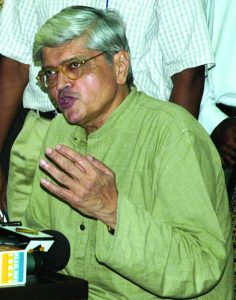
Divisive Politics Hurts Consitution: Gopalkrishna Gandhi

Gopalkrishna Gandhi was the Governor of West Bengal serving from 2004 to 2009. He is the grandson of Mahatma Gandhi, Photo by Pintu Pradhan/Tehelka

Born just a couple of years before India attained freedom, Gopalkrishna Gandhi is a retired IAS officer, a former governor of West Bengal. Combine to this his biological lineage- paternal grandfather Mahatma Gandhi and maternal grandfather C Rajagopalachari (Rajaji) and what emerges is a statesman of great acumen.

Thus, when he speaks of distractions and divisive politics that is plaguing India one just listens with apt attention and one can actually feel with him. After all it was his direct decedents who helped bring freedom to our nation.

“There lurks a great danger to the very soul of our Constitution for its very basic foundation is being shaken by divisive politics,” said Gandhi adding that while amendments are always needed in any document it should be done with care and caution so that the spirit of unity is not tampered with, which is the very core of the Constitution.

Referring to the Preamble of our Constitution as a “lyrical” document, Gandhi said that the very phrase of “We the people’ sends across such positive vibes and must be respected and imbibed. Gandhi was speaking at veteran journalist Osama Talha memorial lecture on Hum Hind ki awam (we the people of India) in Lucknow as chief guest.

Applauding the tremendous work and thought process that went into drafting the Constitution of India, Gandhi said that it was the aim of the drafting committee to create a document which captured the very essence of freedom — equality laced fearlessness and a confidence that citizens will abide by it, regardless of caste, creed, religion or political affiliations.

Stressing that the Indian Constitution is one of the finest example of a document with a vision and mission Gandhi said that while the entire document was planned in English, it was simultaneously prepared by two equally important committees in English and Hindi as the aim was to give it in the hands of the ‘We the People’ in the language that they spoke and were emotionally bound with.

Gandhi said that while the Constitution aimed at evoking a feeling of patriotism, oneness and helping to bring forward the thinking masses, just the opposite is happening now, when the main aim of political parties is to stifle the thinking and reasoning acumen of the commonman and to divide him on the lines of caste, creed and religion. That he stressed is a total violation of the spirit of the Constitution of India.

“Politics of yesteryears gave us a open mind, it taught us to think, be alert but today’s politics is one of diversions and distractions and sure is very dangerous,” said Gandhi.

Stressing that terrorism, fanaticism and polarisations are the biggest threats facing the Constitution, the former diplomat said that while fear predominates we the people of India must not lose faith and confidence for it is we the people of India who gave themselves this Constitution and it is they who will protect it and ensure that its spirit lives on.

Banking heavily on the Fourth Pillar for making this possible, Gandhi lauded the efforts of the Foundation to honor journalists who are promoting fearless journalism. He congratulated this year’s awardees Vinod Doa and Harish Khare and said they are two solid pillars of journalism and they help send the right message to Society through free expression.


letters@tehelka.com

Talking entertainment with ‘Swan Lake’ producer Dinesh Singh

Edited Excerpts from an interview •

Tell us about some of Navrasa Duende’s events in India in the recent past. What has the response been like?

 Producing ‘Swan Lake’ was a delightful and overwhelming experience for us. Despite ballet being a relatively lesser known performing art in India, both the productions received a phenomenal response. We had maximum sold-out shows during the first production in September 2017 in New Delhi as well as the multi-city tour across Mumbai, New Delhi, Kolkata and Ahmedabad this year. The Royal Russian Ballet’s troupe of 46 extremely talented artistes performed the classic ballet, which was choreographed by Vladimir Troschenko and directed by Anatoliy Kazatskiy. Both productions had different sets of leads playing Odette/Odile and Prince Siegfried, and all of their performances were equally loved by the audiences. The production is the most successful western classical theatrical experience ever staged in India till date. By now, over 50,000 persons have enjoyed the show and we are getting requests from all major cities to stage the production.

The World Classic Movie Festival was our second event (after ‘My Journey’, an intimate evening with Pandit Jasraj), and our first event on cinema. The idea behind the festival was to offer Indian audiences a glimpse into classic world cinema. We chose two directors from the classic age of Hollywood, Alfred Hitchcock and Frank Capra, and showcased two of the best known works of each. The event was met with much enthusiasm from audiences of all ages who expressed their appreciation for the opportunity to watch films like these on a big screen. The second edition of the festival held this year in June, was based on the theme of World Classic. It featured nine films from across several countries like India, Japan, Sweden, Russia, Italy, the US, UK and France, by directors such as Satyajit Ray, Akira Kurosawa, Ingmar Bergman, Andrei Tarkovsky, Victor Fleming, Marcel Carne, Norman Jewison and David Lean. This year’s festival got an even better response with near houseful screenings across all three days. Besides Turner Classic Movies, this is a one-of-its-kind movie festival in the world.

Please share details of some of the upcoming events and their highlights that Indian audiences can look forward to.

As part of the ongoing collaboration with the Royal Russian Ballet, we have two productions on the floor — ‘Romeo and Juliet’ and ‘Nutcracker.’ ‘Romeo and Juliet’ is a much-loved play and the love story will be a unique treat for art enthusiasts — something that audiences have never seen before. The ballet has been composed by Russian composer Sergei Prokofiev, and is not only one of most celebrated ballets, but also one of the most frequently performed ballets across the world. Audiences can expect a thrilling live experience full of powerful music and performances in the ballet format.

Tell us about Navrasa Duende’s plan to launch its own theatre production, R K Lakshman’s Common Man, and the political satire it will feature.

For our first in-house theatre production, R K Laxman’s Common Man goes ‘Right to the Centre’ — a social and political satire that will be written, produced and directed in-house. The play picks up social and political themes from across the globe to draw humour and satire which can find relevance in any part of the world. ‘RK Laxman’s Common
Man’ can be relevant in any political or social milieu.

The play uses a unique fusion of cartooning, ballet, opera and cinematic techniques in a way that has never been used before.

The production is expected to appeal to the mature theatre audience across the globe and is likely to be staged in multiple cities of India, the US, UK and other countries.

The play will be a befitting tribute to RK Laxman’s common man, and his innocent but most lethal and sharp witticism and astute social and political commentary, which his endless admirers (including those he cartooned). Several people will be able to identify with it, and it will revive his memories globally in a big way too.

In what way has Navrasa Duende been strengthening cultural relations between nations by promoting the arts and entertaining audiences through its carnivals and festivals?

A blend of the east and the west is the underlining theme for most of our events as we collaborate with international entertainment companies to offer audiences an authentic experience of engaging with global arts. Not only do we help bring arts and artists from across the globe to India, but also promote India’s art and culture among international audiences. We are doing this through events encompassing diverse media like cinema, music, theatre, and even visual arts like cartooning.

Are classical dance forms gaining more relevance over contemporary dance forms with the help of live entertainment platforms? Tell our readers more about this.

The classical art forms including dance is a part of every country’s tradition and remain a source of inspiration for contemporary dance forms. Most theatrical commercial successes use the right blend of classical forms, modern techniques and narrative to take it across a wider audience.

There is an audience out there for both, but there is a vast difference in how they are engaged by entertainment companies or event organisers. While contemporary dance-based events target larger audiences, classical dance or musical events have a more niche appeal and there have not been any drastic changes in this scenario. However, live entertainment platforms are gradually helping to take classical dance to the mainstream by properly scaling up production values or experimental elements and effective advertisement campaigns.

Are international companies increasingly seeing more opportunities in the Indian entertainment industry?

As urban audiences are increasingly exposed to global entertainment, India has seen a growth of live entertainment shows and festivals produced by international companies over the years. Such events not only bring international artists to the country, but also draw audiences from across India as well as other parts of the world.

The presence of international entertainment companies is becoming more prominent in the digital space and in film production. Global giants like Disney and Netflix, for instance, have invested heavily into the Indian entertainment industry, which only goes to show the massive potential that the market has.

However, the Indian live entertainment industry has to go long way to achieve international standards in terms of scale, logistics, content and discipline. Government support to grant industry status to live entertainment will enable it to have proper business or finance plans.

letters@tehelka.com

MOST POPULAR

HOT NEWS