No evidence to support Pakistan’s claims, while India shared images of the damage caused to Pakistani targets, says Air Chief Marshal Amar Preet Singh
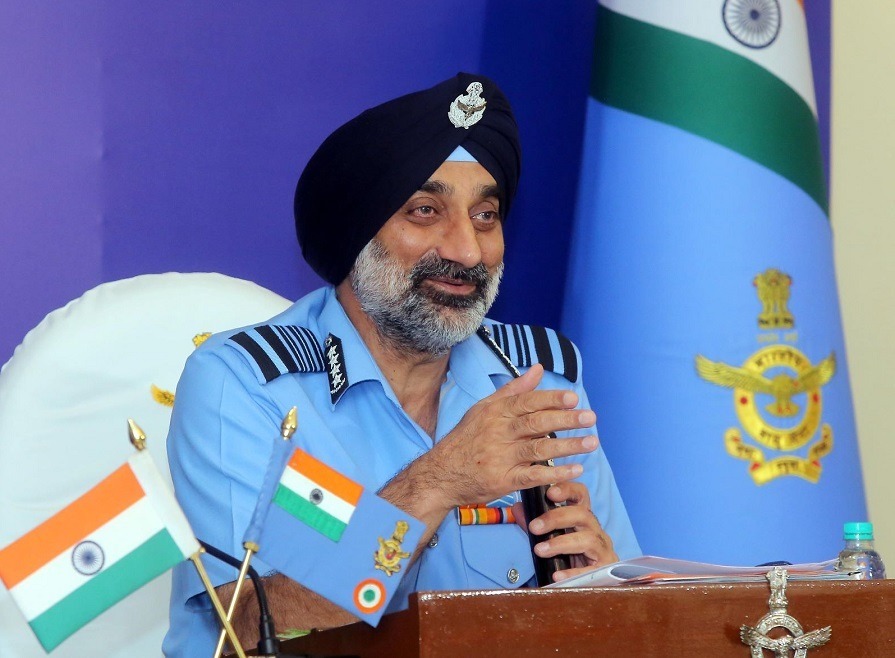
Indian Air Force chief Air Chief Marshal Amar Preet Singh on Friday dismissed Pakistan’s claims of shooting down Indian fighter jets during Operation Sindoor as ‘manohar kahaniyan’—basically describing them as imaginary or concocted stories or plain humbug. The IAF chief said there was no evidence to support Pakistan’s claims, while India had shared images of the damage caused to Pakistani targets, and that such statements are made only to save face and mislead the Pakistani public.
Addressing the media ahead of the Air Force Day on October 8, Singh was quoted as saying: “If they think they shot down 15 of my jets, let them think so. I hope they’re convinced about it, and they will cater for 15 less aircraft in my inventory when they come to fight again. So why should I talk about it? Even today, I won’t say anything about what happened, how much damage was done, how it happened, because let them find out.
“Have you seen a single picture where something fell on any of our airbases, something hit us, a hangar was destroyed, or anything like that? We showed so many pictures of their places. However, they couldn’t show us even a single picture. So their narrative is ‘manohar kahaniyan’. Let them be happy; after all, they also have to show something to their public to save face. That doesn’t matter to me.”
Rather, Pakistan’s F-16 and JF-17 fighter jets were destroyed in Operation Sindoor, describing the operation as a lesson for the world to learn from India and a reflection of tri-services synergy.
Asked about Pakistan’s losses, he said IAF destroyed or damaged at least a dozen planes of Pakistan during operation Sindoor.
The IAF Chief said during the airstrikes on Pakistan Air Force (PAF) bases, one C130-J type plane, one airborne early warning plane and 4-5 of the US-made F-16 jets were hit on ground. The F-16 were there at a base for maintenance. Counting the IAF strikes in air, he said “we have clear evidence of a long range hit was almost 300 kms away, it happened to be a PAF signal intelligence plane along with that five hi-tech fighters between the F-16 and the J-17 ( Chinese) class, is what our system tells us”.
The strikes in air were done using the Russian S-400 air defence system, he also hinted calling it the newly inducted long-range surface to air missile.
“We have clear evidence of one long-range strike, more than 300 km, which happened to be either an AEW&C or a SIGINT aircraft. Along with that, five high-tech fighters between F-16 and JF-17 class,” the Air Chief Marshal said, calling the 300 km strike inside Pakistani territory the “longest kill” ever achieved by the Air Force.
Apart from the jets, the targets blown to smithereens on the ground include radars at four places, command and control centres at two locations, two runways, three hangars, and one Surface-to-Air Missile (SAM) system.
The IAF chief said all three services have started working on the ‘Sudarshan Chakra’ air defence system, and the force has drawn up a Roadmap 2047 to enhance its combat capabilities. “We will move forward towards self-reliance, but where required, we will seek strategic technology to fill critical gaps quickly,” Singh said.
‘Atmanirbharta’ (self-reliance) remains central to the IAF’s roadmap, and orders have been placed for the LCA Mk1A, while the LCA Mk2 and Indian Multi-Role Helicopter (IMRH) projects are in the pipeline. Various radars, systems, and indigenous innovations are under development.
The IAF chief also pointed to successful multilateral and bilateral exercises with countries such as the UAE, Egypt, France, and Singapore, noting that foreign commanders had expressed eagerness to continue joint drills.
Responding to a question on tech billionaire Elon Musk’s assertion on the future of warfare, Singh said the importance of manned missions is not going to fade away. Earlier this year, Musk claimed that the future of warfare will be dominated by artificial intelligence and drones, insisting that manned missions would soon fade away. However, according to Singh, while more and more automation and AI are coming in and there will be unmanned systems available, they would have to work in collaboration with the manned system or have to be controlled by a man. .