Similar to India’s situation, tigers are increasingly at the centre of human-wildlife conflict due to the loss of habitats and a dwindling natural prey base in Bhutan. Both these issues could be attributed to a changing climate. A report by Deepanwita Gita Niyogi
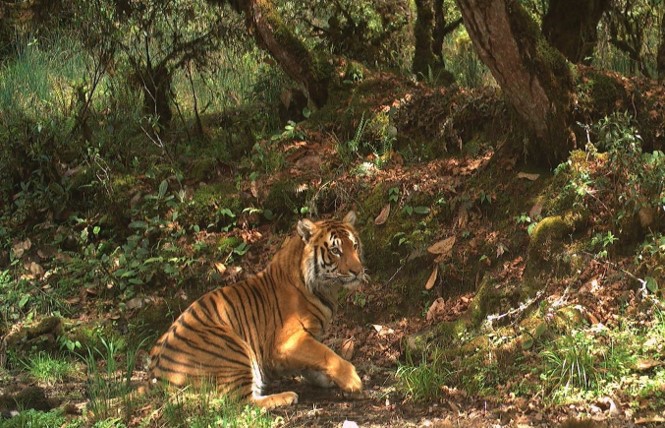
Our neighbouring Bhutan is one of the eight countries in the world where a breeding tiger population is found in the wild. The tiger is listed as a fully protected species and is included in Schedule 1 of the Forest and Nature Conservation Act of Bhutan, 1995.
Whereas India has an estimated 3682 tigers, the estimated number of tigers in Bhutan stands at 131. However, the country is an important tiger conservation area in the global Tiger Conservation Landscape, in addition to being the source population for tigers.
Globally, there were almost 100,000 tigers in the beginning of the twentieth century. It has plummeted to estimated 5572 individuals, with India holding over 70 percent of the global tiger population.
Bhutan has prepared a Tiger Action Plan for 2024-2033. The plan says that the country’s commitment to tiger conservation traces its roots back to 1989. It was also followed by a pugmarks survey carried out in 1998. Over the past two decades, breakthroughs in technology have triggered a transformation in tiger protection. Bhutan has recorded a 27 percent increase in tigers since 2015, when the count stood at 103. Since its inception of Project Tiger in 1973, India has also seen a steady growth in the number of tigers in the wild.
Growing conflict and community participation
Though Bhutan is considered a safe haven for the tiger, in recent years a number of factors have emerged which threaten the species. Just like in India, even in Bhutan, tigers are at the forefront of human-wildlife conflict due to the loss of habitats and a dwindling natural prey base. Both could be due to climate change. As a result, the animals turn to livestock for food.
Climate change may directly impact the physiology of tigers, with temperature and water stress affecting their development, survival and reproductive success, says a study “Getting Climate-smart with the Royal Bengal Tiger in Bhutan”. A possible effect of physiological stress could be their migration to upland areas where temperatures are cooler, but resources fewer.
A study carried out under a grant of the United Nations Development Programme (UNDP) showed that in Dangchu gewog (a gewog is a group of villages), which comes under Wangdue Phodrang district in central Bhutan, there have been increasing incidences of human-tiger conflict, as the animals turn to livestock depredation for food. Conflict is exacerbated by a changing climate.
About 80 percent of the Bhutanese population are agrarian and live close to tiger habitats. According to the Global Tiger Centre, there could be about six tigers frequenting the gewog. The centre is a government-based tiger and cats conservation and research wing under the Department of Forests and Park Services, Ministry of Agriculture and Forests.
In rural areas, the loss of valuable livestock at times leads to retaliatory killings and even the migration of the rural population to urban areas in Bhutan. Apart from retaliatory killings, poaching of tigers for economic benefits is also escalating in the gewog. Tigers are killed mainly through poisoning and snaring.
Mitigation measures
To mitigate the retaliatory killing of tigers by local communities and prevent poaching, the Chubar Dendupcholing Community Forest Management Group, in collaboration with the Wangdue Forest Division and the local administration, provided farming support to communities. To reduce people’s dependence on forests, a number of measures were undertaken from 2019-2020. One of these is the cultivation of mushrooms and another is growing fruit trees. The UNDP project covered an area of 42311.76 acres and benefitted 193 households and 1134 people.
Conflict also escalates at times due to the collection of firewood for cooking. This is also true in India. In the Melghat tiger reserve in Maharashtra, non-profits handed over free smokeless chulhas to people to reduce human-tiger conflict. This also reduced people’s dependence on forests.
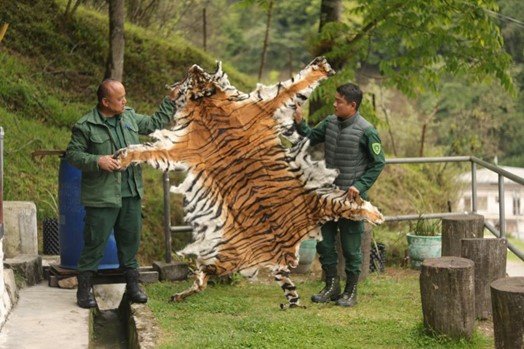
In Bhutan, mostly men and young boys enter deep forests for gathering firewood whereas in India, it is mostly women. However, this is not regular. For annual firewood needs in Bhutan, communities usually source it from peripheral forests which are regulated by the forest department or government forest management units, said Tenzin Wangchuk, who headed the UNDP project on tigers in Bhutan. Wangchuk worked in the GEF-SGP (Global Environment Facility’s Small Grants Programme Management) of UNDP Bhutan from May 2020 to July 2023.
“With almost 99 percent grid electricity coverage in Bhutan, readily available fuelwood, rice cookers and first 100-unit free electricity for the rural population since about nine years ago, wood consumption may have reduced,” said Wangchuk.
The programme implemented by the UNDP, in partnership with the Royal Government of Bhutan, complements the country’s tiger conservation efforts outside protected areas. While national parks remain the primary habitats of tigers in Bhutan, the National Tiger Survey found that tigers also thrive outside protected areas. In India too, tigers are spilling outside protected areas, resulting in human-tiger conflict escalation. Conflict needs smart management to reduce losses on both sides.
In Bhutan, new tiger photographs and pugmarks have emerged from different parts which are encouraging signs for conservation. This has been possible, thanks to camera trap images. But human-tiger conflict needs a proper solution.
It is important to protect tigers at a time when they are threatened by several factors. A common issue in a changing climate is the drying up of water sources needed for survival of wildlife, including that of tigers. Providing water resources can reduce conflict and increase chances of tiger survival.
In India’s Sariksa Tiger Reserve, there are about 30 tigers. To ensure the survival of tigers, the park management has concentrated on rewilding, an attempt made to naturalise an area. In the reserve’s Talvrisksh range, solar-powered borewells ensure that there is never a dry day for animals.
Conservation efforts on the part of both the countries are important as there have been news reports of a tiger from Sikkim crossing the international border and entering Bhutan. High-altitude tigers need special focus.