


Page 56 - Tehelka Issue 13 - July 15, 2018
P. 56
Indian courts. This is why they also re-  use by celibate ascetics and students.   the other instances in the book is that of
           fused to take on board international   What is so powerful about paan? Are   hair. We think of hair as deeply “normal”
           best practices in terms of jurispru-  there any other everyday objects of   and “natural,” yet how long or short it
           dence on subjects of sexuality. But what    erotic appeal that are used by many,   is, whether we leave it loose or tie it up,
           they seemed to forget is that Section   and yet, hidden?           what colour it is are all closely linked
           377 was a British imposition on an    Paan is an everyday substance but it also   with questions of desire.
           Indian culture that did not criminal-  provides extraordinary pleasure. It is
           ise same-sex desire. Indeed, I like to   ubiquitous on the Indian landscape, and   A very interesting chapter in the
           joke that every single sculpture in the    we often take it for granted, not giving    book is about grandparents’ desires.
           temples of Khajuraho represents a sex   it a second thought. But this is precisely   As a society, have we silenced
           act that is now illegal in India.  the treasure trove that I have mined    their desires and portrayed them
           The third gender has been a part of   for Infinite Variety — everyday objects    in a stereotypical way of either
           Indian culture in various ways —spir-  that we do not associate with desire but   caregivers for the family or leading
           itual, pedagogical and musical. Yet,   that are nonetheless deeply associated   spiritual lives? Why is there a culture
           the British criminalised their exist-  with it. There are several examples of   of silence around grandparents’
           ence by the Criminal Tribes Act, 1871.   this quotidian extraordinariness. One of   desires, travel and companionship
           How do you reflect on their chang-                                 needs?
           ing fortune in light of the Supreme                                The silencing of the desires of older
           Court’s NALSA judgment and the cur-                                people seems to point to our collapsing
           rent bill pending in the Parliament?                               sex into reproduction. And when we
           How would you explain the duality in                               make that collapse, we assume that only
           our relationship with hijras — on the                              people who are of child-bearing age
           one hand, we revere them and on the                                should have sex. Ergo, older people who
           other hand, we criminalise them?                                   can no longer reproduce should not have
           Our attitude to hijras is very similar to                          sex or sexual desires. This is an extremely
           our attitude toward homosexuality. The                             shortsighted view on our part because it
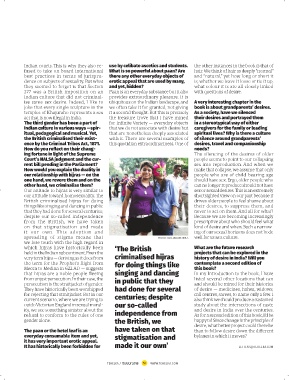
           British criminalised hijras for doing                              drives older people to feel shame about
           things like singing and dancing in public                          their desires, to suppress them, and
           that they had done for several centuries;                          never to act on them. And all for what?
           despite  our  so-called  independence                              Because we are becoming increasingly
           from the  British, we  have taken                                  prescriptive about who should feel what
           on that stigmatisation and made                                    kind of desire and when. Such a narrow-
           it our own.  This adoption and                                     ing of our sexual horizons does not bode
           spreading of stigma means that                       photo: tehelka archives  well for us as a culture.
           we lose touch with the high regard in
           which hijras have historically been    ‘The British                What are the future research
           held in the Indian subcontinent. Even the                          projects that can be explored in the
           very term hijra — deriving as it does from   criminalised hijras   history of desire in India? Will you
           the term for the Prophet’s flight from   for doing things like     contemplate a second edition of
           Mecca to Medina in 622 AD — suggests                               this book?
           that hijras are a noble people fleeing    singing and dancing      In my Introduction to the book, I have
           from unjust persecution. In their case, the   in public that they   listed several other locations that can
           persecution is the straitjacket of gender.                         and should be mined for their histories
           They have historically been worshipped   had done for several      of desire — medicines, halwa, widows,
           for rejecting that straitjacket. But in our   centuries; despite   call centres, sarees, to name only a few. I
           current scenario, where we are trying to                           also think we should produce a sustained
           outdo Victorian England in sexual moral-  our so-called            study about the intersections of caste
           ity, we see something sinister about the                           and desire in India over the centuries.
           refusal to conform to the rules of one   independence from         As for a second edition of this book, I’d be
           gender alone.                       the British, we                happy to! Since change is the principle of
                                                                              desire, what better project could there be
           The paan or the betel leaf is an    have taken on that             than to follow desire down the different
           everyday consumable item and yet,   stigmatisation and             bylanes in which it moves?
           it has very important erotic appeal.
           It has historically been forbidden for   made it our own’                            letters@tehelka.com


                                            Tehelka / 15 july 2018  56  www.Tehelka.com


     54-56 Q&A Neha Kirpal.indd   4                                                                     03/07/18   4:08 PM

