


Page 56 - JAN2020E2
P. 56
Rock


           thought


                to be


                gold,


               turns


          out more


         precious!


                tehelka bureau


             n an interesting turn of events,   To crack open his find, Hole tried a   offerings have ever turned out to be
             a man found a piece of rock,   rock saw, an angle grinder, a drill, even   real meteorites.
             brought it home thinking it to be   putting the thing in acid, but not even
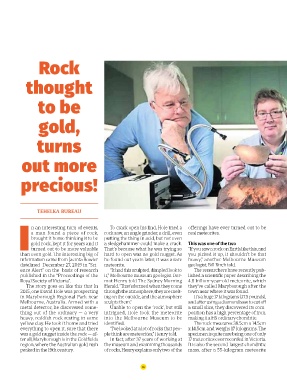
             gold rock, kept it for years and it   a sledgehammer could make a crack.   This was one of the two
         I turned out to be more valuable   That’s because what he was trying so   “If you saw a rock on Earth like this, and
         than even gold. The interesting big of   hard to open was no gold nugget. As   you picked it up, it shouldn’t be that
         information came from Jacinta Bowler   he found out years later, it was a rare   heavy,” another Melbourne Museum
         datelined  December 27, 2019 in “Sci-  meteorite.                geologist, Bill Birch told.
         ence Alert” on the  basis of research   “It had this sculpted, dimpled look to   The researchers have recently pub-
         published in the “Proceedings of the   it,” Melbourne museum geologist Der-  lished a scientific paper describing the
         Royal Society of Victoria”.      mot Henry told The Sydney Morning   4.6 billion-year-old meteorite, which
           The story goes on like this that In   Herald. “That’s formed when they come   they’ve called Maryborough after the
         2015, one David Hole was prospecting   through the atmosphere, they are melt-  town near where it was found.
         in Maryborough Regional Park near   ing on the outside, and the atmosphere   It’s a huge 17 kilograms (37.5 pounds),
         Melbourne, Australia. Armed with a   sculpts them.”              and after using a diamond saw to cut off
         metal detector, he discovered some-  Unable to open the ‘rock’, but still   a small slice, they discovered its com-
         thing out of the ordinary — a very   intrigued, Hole took the meteorite   position has a high percentage of iron,
         heavy, reddish rock resting in some   into the Melbourne Museum to  be   making it a H5 ordinary chondrite.
         yellow clay. He took it home and tried   identified.                The rock measures 38.5cm x 14.5cm
         everything to open it, sure that there   “I’ve looked at a lot of rocks that peo-  x 14.5cm and weighs 17 kilograms. The
         was a gold nugget inside the rock — af-  ple think are meteorites,” Henry told.  specimen is quite rare being one of only
         ter all, Maryborough is in the Goldfields    In fact, after 37 years of working at   17 meteorites ever recorded in Victoria.
         region, where the Australian gold rush   the museum and examining thousands   It is also the second-largest chondritic
         peaked in the 19th century.      of rocks, Henry explains only two of the   mass, after a 55-kilogram meteorite


                                                        56

