


Page 29 - 29NOV2019E-4
P. 29
HEALTH


      households (63,736 in rural areas and   and about 75.0 per cent in the urban ar-  the urban areas had independent house.
      43,102 in urban areas) from 5,378 sample   eas had exclusive access to bathroom.    Among the households living in houses,
      villages in rural areas and 3,614 sample   About 56.6 per cent of the households   about 76.7 per cent of the households
      UFS blocks in urban areas, following a   in rural and about 91.2 per cent in urban   in the rural and about 96.0 per cent in
      scientific survey methodology. This re-  areas had access to bathroom. Among   the urban areas had the house of pucca
      port is based on the central sample data   the households, which had access to   structure.  Among the households living
      collected through the survey on Drink-  bathroom, about 48.4 per cent in the    in houses, average floor area of the dwell-
      ing Water, Sanitation, Hygiene and Hous-  rural areas and about 74.8 per cent in the   ing unit was about 46.6 sq. m. in the rural
      ing Condition during NSS 76th round.  urban areas used bathroom attached to   and about 46.1 sq. m. in the urban areas.
                                       the dwelling unit.                Among the households living in houses,
      Drinking water facility             About 71.3 per cent of the households   about 93.9 per cent of the households in
      Significantly, the NSS survey found that   in the rural and about 96.2 per cent in the   the rural and about 99.1 per cent in the
      major source of drinking water was hand   urban areas had access to latrine. It may   urban areas had electricity for domestic
      pump for the households in the rural ar-  be noted that there may be respondent   use.
      eas and piped water into dwelling in the   bias in the reporting of access to latrine
      urban areas. About 42.9 per cent of the   as question on benefits received by the   Micro environment
      households in the rural areas used hand   households from government schemes   Among the households living in houses,
      pump as the principal source of drink-  was asked prior to the question on access   about 48.3 per cent of the households in
      ing water and about 40.9 per cent of                               the rural and about 86.6 per cent in the
      the households in the urban areas used                             urban areas used LPG as fuel for cooking.
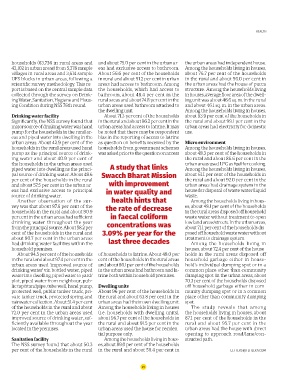
      piped water into dwelling as the princi-  A study that links       Among the households living in houses,
      pal source of drinking water. About 48.6   Swacch Bharat Mission   about 61.1 per cent of the households in
      per cent of the households in the rural                            the rural and about 92.0 per cent in the
      and about 57.5 per cent in the urban ar-  with improvement         urban areas had drainage system in the
      eas had exclusive access to principal   in water quality and       house for disposal of waste water/liquid
      source of drinking water.                                          waste.
        Another observation of the sur-     health hints that              Among the households living in hous-
      vey was that about 87.6 per cent of the   the rate of decrease     es, about 48.1 per cent of the households
      households in the rural and about 90.9                             in the rural areas disposed off household
      per cent in the urban areas had sufficient   in faecal coliform    waste water without treatment to open
      drinking  water  throughout  the year   concentrations was         low land areas/streets. In the urban areas,
      from the principal source. About 58.2 per                          about 71.1 per cent of the households dis-
      cent of the households in the rural and   3.09% per year for the   posed off household waste water without
      about 80.7 per cent in the urban areas                             treatment to drainage system.
      had drinking water facilities within the   last three decades        Among the households living in
      household premises.                                                houses, about 72.4 per cent of the house-
        About 94.5 per cent of the households   of households to latrine. About 48.0 per   holds in the rural areas disposed off
      in the rural and about 97.4 per cent in the   cent of the households in the rural areas   household  garbage  either in  house-
      urban areas used ‘improved source of   and about 86.1 per cent of the households   hold’s individual dumping spot or in a
      drinking water’ viz. bottled water, piped   in the urban areas had bathroom and la-  common place other than community
      water into dwelling, piped water to yard/  trine both within household premises.  dumping spot. In the urban areas, about
      plot, piped water from neighbour, pub-                             70.3 per cent of the households disposed
      lic tap/standpipe, tube well, hand pump,   Dwelling units          off household garbage either in com-
      protected well, public tanker truck, pri-  About 96 per cent of the households in   munity dumping spot or in a common
      vate tanker truck, protected spring and   the rural and about 63.8 per cent in the   place other than community dumping
      rainwater collection. About 51.4 per cent   urban areas had their own dwelling unit.   spot.
      of the households in the rural and about   Among the households living in houses   The study reveals that among
      72.0 per cent in the urban areas used   (i.e. households with dwelling units),   the households living in houses, about
      improved source of drinking water, suf-  about 96.7 per cent of the households in   87.1 per cent of the households in the
      ficiently available throughout the year   the rural and about 91.5 per cent in the   rural and about 95.7 per cent in the
      located in the premises.         urban areas used the house for residen-  urban areas had the house with direct
                                       tial purpose only.                opening to approach road/lane/con-
      Sanitation facility                 Among the households living in hous-  structed path.
      The NSS survey found that about 50.3   es, about 89.0 per cent of the households
      per cent of the households in the rural   in the rural and about 56.4 per cent in    LETTERS@TEHELKA.COM


                                                        29

