


Page 24 - 15DEC2019E-5
P. 24
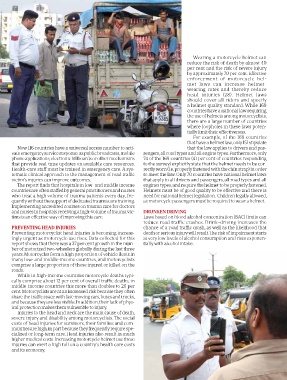
Wearing a motorcycle helmet can
                                                                          reduce the risk of death by almost 40
                                                                          per cent and the risk of severe injury
                                                                          by approximately 70 per cent. Effective
                                                                          enforcement of motorcycle hel-
                                                                          met  laws  can  increase  helmet-
                                                                          wearing rates and thereby reduce
                                                                          head injuries (28). Helmet laws
                                                                          should  cover  all  riders  and  specify
                                                                          a helmet quality standard. While 169
                                                                          countries have a national law requiring
                                                                          the use of helmets among motorcyclists,
                                                                          there are a large number of countries
                                                                          where loopholes in these laws poten-
                                                                          tially limit their effectiveness.
                                                                            For example, of the 169 countries
                                                                          that have a helmet law, only 151 stipulate
        Now 116 countries have a universal access number to acti-         that the law applies to drivers and pas-
      vate emergency service response. as public broadcasts, mobile   sengers, all road types and all engine types. Furthermore, only
      phone applications, electronic billboards or other mechanisms   74 of the 169 countries (41 per cent of countries responding
      that provide real-time updates on available care resources.   to the survey) explicitly state that the helmet needs to be cor-
      Health-care staff must be trained in emergency care. A sys-  rectly worn (i.e. properly fastened with the chin strap) in order
      tematic clinical approach to the management of road traffic   to meet the law. Only 70 countries have national helmet laws
      victim’s injuries can improve outcomes.            that apply to all drivers and passengers, all road types and all
        The report finds that hospitals in low- and middle income   engines types, and require the helmet to be properly fastened.
      countries are often staffed by general practitioners and nurses   Helmets must be of good quality to be effective and there is
      who treat a high volume of trauma patients every day, fre-  need for national helmet legislation.  Children legally allowed,
      quently without the support of dedicated trauma care training.   as motorcycle passengers must be required to wear a helmet.
      Implementing accredited courses on trauma care for doctors
      and nurses in hospitals receiving a high-volume of trauma vic-  DRUNKEN DRIVING
      tims is an effective way of improving this care.   Laws based on blood alcohol concentration (BAC) limits can
                                                         reduce road traffic crashes. Drink–driving increases the
      PREVENTING HEAD INJURIES                           chance of a road traffic crash, as well as the likelihood that
      Preventing motorcyclist head injuries is becoming increas-  death or serious injury will result. The risk of impairment starts
      ingly urgent as motorcycle use rises. Data collected for this   at very low levels of alcohol consumption and rises exponen-
      report shows that there was a 27 per cent growth in the num-  tially with alcohol intake.
      ber of motorized two-wheelers globally during the last three
      years. Motorcycles form a high proportion of vehicle fleets in
      many low- and middle-income countries, and motorcyclists
      comprise a large proportion of those injured or killed on the
      roads.
        While in high-income countries motorcycle deaths typi-
      cally comprise about 12 per cent of overall traffic deaths, in
      middle-income countries this more than doubles to 26 per
      cent. Motorcyclists are at an increased risk because they often
      share the traffic space with fast-moving cars, buses and trucks,
      and because they are less visible. In addition, their lack of phys-
      ical protection makes them vulnerable to injury.
        Injuries to the head and neck are the main cause of death,
      severe injury and disability among motorcyclists. The social
      costs of head injuries for survivors, their families and com-
      munities are high, in part because they frequently require spe-
      cialized or long-term care. Head injuries also result in much
      higher medical costs. Increasing motorcycle helmet use these
      injuries can exert a high toll on a country’s health care costs
      and its economy.

