For many readers, Budget speeches can feel complicated and distant. Here is a simple breakdown of what this Budget means for common people — without the jargon.
Continuity
The key takeaway from this year’s Budget is continuity. The government has chosen not to disrupt existing policies, instead strengthening areas it believes will support long-term growth. The emphasis remains on building infrastructure, boosting domestic manufacturing and keeping government finances under control.
While the Budget does not offer immediate financial relief to households, it also avoids placing additional burdens on taxpayers.
Status Quo for Salaried Class
One of the most closely watched aspects of the Budget — personal income tax — remains unchanged.
- No change in income tax slabs under either the old or new tax regime
- No new taxes on salaried individuals
- No additional exemptions or deductions
For taxpayers, this means financial predictability. Monthly budgets will not be affected, though many middle-class families were hoping for some relief to cope with rising living costs.
The Budget does not directly control prices, but several steps aim to manage inflation:
- Customs duty cuts on select essential items and medicines
- Continued support to agriculture and food supply chains
- Investments to improve transport and logistics
These measures may not immediately lower prices, but they are intended to prevent sharp increases, especially in food and healthcare costs.
Infrastructure Push
A major focus of the Budget is infrastructure spending, with large allocations for highways, railways, ports and urban transport.
Why does this matter to ordinary citizens?
Because infrastructure investment:
- Generates employment, especially for workers in construction and allied sectors
- Improves connectivity, reducing travel time and transport costs
- Encourages private investment and regional development
In the long run, better infrastructure can translate into cheaper goods, improved services and more job opportunities.
Manufacturing
The government continues to push for India to become a global manufacturing hub.
The Budget focuses on:
- Electronics and semiconductor manufacturing
- Clean energy and green technologies
- Defence and strategic industries
For common readers, this means a push towards domestic production, reduced dependence on imports and more stable jobs, particularly for young people entering the workforce.
MSMEs
Micro, Small and Medium Enterprises (MSMEs) — which employ millions across the country — received attention in the Budget.
Key measures include:
- Improved access to loans
- Support to scale up high-performing small businesses
- Simplified compliance procedures
Since MSMEs form the backbone of local economies, stronger support for them can help boost employment and entrepreneurship, especially in smaller towns and cities.
Rural Economy
The Budget continues to support farmers and rural households through:
- Technology-based advisory tools
- Encouragement of high-value crops
- Support for allied activities like dairy and fisheries
The focus is on helping farmers move beyond traditional practices and increase incomes through diversification and better information.
Health & Education
While not heavy on new schemes, the Budget reinforces spending on:
- Healthcare infrastructure and essential medicines
- Education and skill development
- Drinking water and sanitation
Steps to reduce the cost of critical medicines and improve access to education, especially for girls, remain part of the government’s social agenda.
Fiscal Discipline
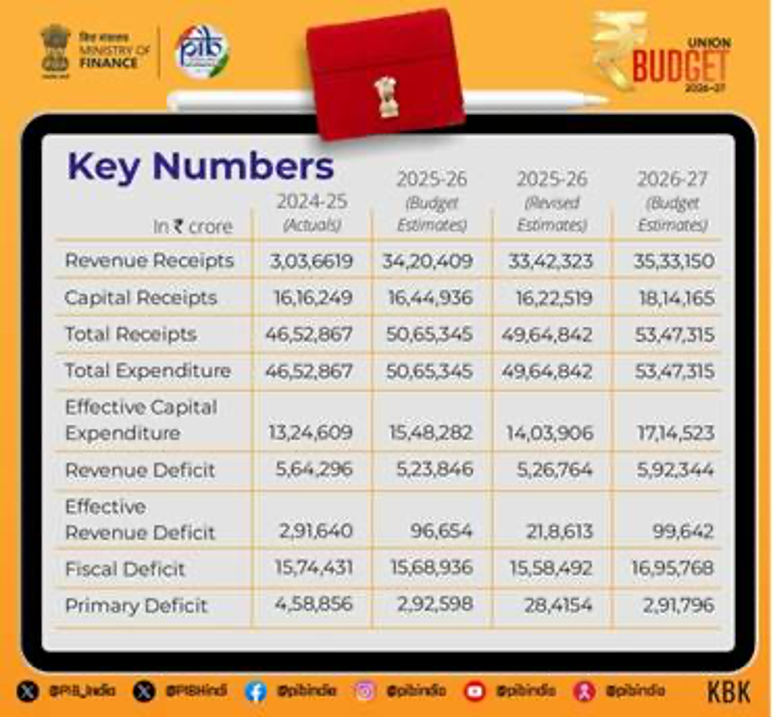
A significant feature of the Budget is the government’s effort to keep the fiscal deficit under control — meaning it is limiting how much it borrows.
This matters because fiscal discipline:
- Helps keep inflation in check
- Maintains investor confidence
- Prevents excessive debt burden on future generations
Though careful spending may limit short-term giveaways, it helps maintain long-term economic stability.
Reactions
Reactions to the Budget have been varied:
- Industry leaders welcomed the focus on infrastructure and manufacturing
- Markets showed some volatility, reflecting concerns over trading costs and taxation changes
- Middle-class taxpayers expressed disappointment over the lack of tax relief
- Opposition parties criticised the Budget for not doing enough to boost household consumption
Economists, however, largely see the Budget as prudent and growth-oriented, prioritising stability over populism.
What This Budget Means for You
In simple terms:
- No increase in income tax, but no reduction either
- Job creation expected mainly through infrastructure and manufacturing
- Prices may stabilise, though immediate relief is limited
- Focus on long-term economic foundations rather than short-term benefits
The Bottom Line
This Union Budget is a steady and cautious document, aimed at strengthening India’s economic base rather than offering quick wins. While it may not excite everyone, it reflects a belief that sustainable growth comes from investment, discipline and consistent policy. The real impact will be felt gradually — and much will depend on how effectively these plans are implemented on the ground.